EP0244875A2 - Method and device for controlling a liquefied gas (LPG) fuelled engine - Google Patents
Method and device for controlling a liquefied gas (LPG) fuelled engine Download PDFInfo
- Publication number
- EP0244875A2 EP0244875A2 EP87106739A EP87106739A EP0244875A2 EP 0244875 A2 EP0244875 A2 EP 0244875A2 EP 87106739 A EP87106739 A EP 87106739A EP 87106739 A EP87106739 A EP 87106739A EP 0244875 A2 EP0244875 A2 EP 0244875A2
- Authority
- EP
- European Patent Office
- Prior art keywords
- gas
- compensation valve
- internal combustion
- combustion engine
- liquid
- Prior art date
- Legal status (The legal status is an assumption and is not a legal conclusion. Google has not performed a legal analysis and makes no representation as to the accuracy of the status listed.)
- Granted
Links
- 238000000034 method Methods 0.000 title claims description 8
- 238000002485 combustion reaction Methods 0.000 claims abstract description 40
- 239000000203 mixture Substances 0.000 claims abstract description 34
- ATUOYWHBWRKTHZ-UHFFFAOYSA-N Propane Chemical compound CCC ATUOYWHBWRKTHZ-UHFFFAOYSA-N 0.000 claims abstract description 26
- 239000001273 butane Substances 0.000 claims abstract description 16
- IJDNQMDRQITEOD-UHFFFAOYSA-N n-butane Chemical compound CCCC IJDNQMDRQITEOD-UHFFFAOYSA-N 0.000 claims abstract description 16
- OFBQJSOFQDEBGM-UHFFFAOYSA-N n-pentane Natural products CCCCC OFBQJSOFQDEBGM-UHFFFAOYSA-N 0.000 claims abstract description 16
- 239000001294 propane Substances 0.000 claims abstract description 13
- 238000002156 mixing Methods 0.000 claims abstract description 4
- 239000007788 liquid Substances 0.000 claims description 56
- 239000000446 fuel Substances 0.000 claims description 7
- 230000005540 biological transmission Effects 0.000 claims description 5
- 230000001105 regulatory effect Effects 0.000 claims description 5
- 230000009977 dual effect Effects 0.000 claims description 2
- 239000007789 gas Substances 0.000 abstract description 113
- 239000000470 constituent Substances 0.000 abstract 1
- 239000003570 air Substances 0.000 description 11
- 239000003915 liquefied petroleum gas Substances 0.000 description 6
- 238000010586 diagram Methods 0.000 description 4
- TVMXDCGIABBOFY-UHFFFAOYSA-N octane Chemical compound CCCCCCCC TVMXDCGIABBOFY-UHFFFAOYSA-N 0.000 description 3
- 230000006835 compression Effects 0.000 description 2
- 238000007906 compression Methods 0.000 description 2
- 238000001816 cooling Methods 0.000 description 2
- 238000012937 correction Methods 0.000 description 2
- 239000003344 environmental pollutant Substances 0.000 description 2
- 231100000719 pollutant Toxicity 0.000 description 2
- 239000012080 ambient air Substances 0.000 description 1
- 230000009286 beneficial effect Effects 0.000 description 1
- 238000010276 construction Methods 0.000 description 1
- 230000001419 dependent effect Effects 0.000 description 1
- 238000011161 development Methods 0.000 description 1
- 230000009365 direct transmission Effects 0.000 description 1
- 238000006073 displacement reaction Methods 0.000 description 1
- 230000000694 effects Effects 0.000 description 1
- 239000003502 gasoline Substances 0.000 description 1
- 238000009434 installation Methods 0.000 description 1
- 239000007791 liquid phase Substances 0.000 description 1
- 238000005259 measurement Methods 0.000 description 1
- 239000012071 phase Substances 0.000 description 1
- 238000002360 preparation method Methods 0.000 description 1
- 238000011160 research Methods 0.000 description 1
- 238000012546 transfer Methods 0.000 description 1
Images


Classifications
-
- F—MECHANICAL ENGINEERING; LIGHTING; HEATING; WEAPONS; BLASTING
- F02—COMBUSTION ENGINES; HOT-GAS OR COMBUSTION-PRODUCT ENGINE PLANTS
- F02D—CONTROLLING COMBUSTION ENGINES
- F02D19/00—Controlling engines characterised by their use of non-liquid fuels, pluralities of fuels, or non-fuel substances added to the combustible mixtures
- F02D19/02—Controlling engines characterised by their use of non-liquid fuels, pluralities of fuels, or non-fuel substances added to the combustible mixtures peculiar to engines working with gaseous fuels
- F02D19/026—Measuring or estimating parameters related to the fuel supply system
- F02D19/027—Determining the fuel pressure, temperature or volume flow, the fuel tank fill level or a valve position
-
- F—MECHANICAL ENGINEERING; LIGHTING; HEATING; WEAPONS; BLASTING
- F02—COMBUSTION ENGINES; HOT-GAS OR COMBUSTION-PRODUCT ENGINE PLANTS
- F02D—CONTROLLING COMBUSTION ENGINES
- F02D19/00—Controlling engines characterised by their use of non-liquid fuels, pluralities of fuels, or non-fuel substances added to the combustible mixtures
- F02D19/02—Controlling engines characterised by their use of non-liquid fuels, pluralities of fuels, or non-fuel substances added to the combustible mixtures peculiar to engines working with gaseous fuels
- F02D19/021—Control of components of the fuel supply system
- F02D19/023—Control of components of the fuel supply system to adjust the fuel mass or volume flow
-
- F—MECHANICAL ENGINEERING; LIGHTING; HEATING; WEAPONS; BLASTING
- F02—COMBUSTION ENGINES; HOT-GAS OR COMBUSTION-PRODUCT ENGINE PLANTS
- F02D—CONTROLLING COMBUSTION ENGINES
- F02D19/00—Controlling engines characterised by their use of non-liquid fuels, pluralities of fuels, or non-fuel substances added to the combustible mixtures
- F02D19/02—Controlling engines characterised by their use of non-liquid fuels, pluralities of fuels, or non-fuel substances added to the combustible mixtures peculiar to engines working with gaseous fuels
- F02D19/026—Measuring or estimating parameters related to the fuel supply system
- F02D19/029—Determining density, viscosity, concentration or composition
-
- F—MECHANICAL ENGINEERING; LIGHTING; HEATING; WEAPONS; BLASTING
- F02—COMBUSTION ENGINES; HOT-GAS OR COMBUSTION-PRODUCT ENGINE PLANTS
- F02M—SUPPLYING COMBUSTION ENGINES IN GENERAL WITH COMBUSTIBLE MIXTURES OR CONSTITUENTS THEREOF
- F02M21/00—Apparatus for supplying engines with non-liquid fuels, e.g. gaseous fuels stored in liquid form
- F02M21/02—Apparatus for supplying engines with non-liquid fuels, e.g. gaseous fuels stored in liquid form for gaseous fuels
- F02M21/0203—Apparatus for supplying engines with non-liquid fuels, e.g. gaseous fuels stored in liquid form for gaseous fuels characterised by the type of gaseous fuel
- F02M21/0209—Hydrocarbon fuels, e.g. methane or acetylene
- F02M21/0212—Hydrocarbon fuels, e.g. methane or acetylene comprising at least 3 C-Atoms, e.g. liquefied petroleum gas [LPG], propane or butane
-
- F—MECHANICAL ENGINEERING; LIGHTING; HEATING; WEAPONS; BLASTING
- F02—COMBUSTION ENGINES; HOT-GAS OR COMBUSTION-PRODUCT ENGINE PLANTS
- F02M—SUPPLYING COMBUSTION ENGINES IN GENERAL WITH COMBUSTIBLE MIXTURES OR CONSTITUENTS THEREOF
- F02M21/00—Apparatus for supplying engines with non-liquid fuels, e.g. gaseous fuels stored in liquid form
- F02M21/02—Apparatus for supplying engines with non-liquid fuels, e.g. gaseous fuels stored in liquid form for gaseous fuels
- F02M21/0218—Details on the gaseous fuel supply system, e.g. tanks, valves, pipes, pumps, rails, injectors or mixers
- F02M21/023—Valves; Pressure or flow regulators in the fuel supply or return system
- F02M21/0239—Pressure or flow regulators therefor
-
- F—MECHANICAL ENGINEERING; LIGHTING; HEATING; WEAPONS; BLASTING
- F02—COMBUSTION ENGINES; HOT-GAS OR COMBUSTION-PRODUCT ENGINE PLANTS
- F02M—SUPPLYING COMBUSTION ENGINES IN GENERAL WITH COMBUSTIBLE MIXTURES OR CONSTITUENTS THEREOF
- F02M21/00—Apparatus for supplying engines with non-liquid fuels, e.g. gaseous fuels stored in liquid form
- F02M21/02—Apparatus for supplying engines with non-liquid fuels, e.g. gaseous fuels stored in liquid form for gaseous fuels
- F02M21/06—Apparatus for de-liquefying, e.g. by heating
-
- Y—GENERAL TAGGING OF NEW TECHNOLOGICAL DEVELOPMENTS; GENERAL TAGGING OF CROSS-SECTIONAL TECHNOLOGIES SPANNING OVER SEVERAL SECTIONS OF THE IPC; TECHNICAL SUBJECTS COVERED BY FORMER USPC CROSS-REFERENCE ART COLLECTIONS [XRACs] AND DIGESTS
- Y02—TECHNOLOGIES OR APPLICATIONS FOR MITIGATION OR ADAPTATION AGAINST CLIMATE CHANGE
- Y02T—CLIMATE CHANGE MITIGATION TECHNOLOGIES RELATED TO TRANSPORTATION
- Y02T10/00—Road transport of goods or passengers
- Y02T10/10—Internal combustion engine [ICE] based vehicles
- Y02T10/30—Use of alternative fuels, e.g. biofuels
Definitions
- a method and a device for power control are presented for internal combustion engines operated with liquid gas, main components propane / butane (LPG), in particular gasoline engines, the liquid gas being brought into the gaseous state in an evaporator and then mixed with air in the gas mixer is before it gets into the engine.
- LPG propane / butane
- Otto gas engines are known, whose combustion mixture, air-gas mixture, is sucked in by the internal combustion engine directly from the gas mixer. This has no influence on the composition of the liquid gas and thus the calorific value, and therefore also not on the power setting of the internal combustion engine: consequently, the output changes proportionally to the calorific value of the propane / butane mixture. Since neither a German nor a European standard for liquid gases As a fuel, the composition of liquid gases often differs from country to country and according to the season.
- the main components propane and butane can vary in the mixing ratio from 100 to 0% to 20 to 80%. Depending on the butane content, the specific, volume-related calorific value increases up to 25%. At the same time, as the butane content increases, the octane number drops by up to 13 units RON (research octane number), which also significantly reduces the knock resistance of the fuel.
- the object on which the invention is based is to present a method with which a permanent, gas-independent mixture is used for all liquid gas compositions
- Another requirement for ensuring engine operation is that the pollutant emissions do not deteriorate in the entire operating range of the internal combustion engine.
- a control of the amount of liquefied gas supplied is made possible depending on the calorific value.
- the internal combustion engine can be operated independently of the composition of the liquid gas, i.e. operate optimally with changing propane / butane proportions.
- This goal is achieved by transferring the as-state values, the liquid gas pressure and the liquid gas temperatures, to a metering device. Corrections are made according to the specific vapor pressure curves of the liquid gas.
- the mixture proportions can be determined with the help of the vapor pressure curves, since every propane / butane mixture moves on this state line. The measurement of pressure and temperature leads to the identification of the liquid gas mixture.
- an advantageous gas quantity that is beneficial to the internal combustion engine can be set: Another advantage that arises from the gas quantity control according to the invention depending on the gas mixture components and thus the calorific value is the exhaust gas quality, which increases even with increasing butane proportions and the associated higher air requirement, particularly in the partial load range, does not deteriorate significantly: the metering device controls the amount of gas in such changed conditions so that this effect is almost avoided.
- a compensation valve is provided as the metering device according to the invention. Inserted into the connecting line between the evaporator and the air mixer, the gas quantity can be metered and regulated directly through the compensation valve.
- the compensation valve serves as a control valve or throttle element which is controlled depending on the gas composition and the associated stoichiometric air requirement and thus regulates the amount of gas in the low-pressure gas line between the evaporator and the engine.
- the compensation valve has a specially designed variable throttle cross section.
- the cross-sectional geometry can be adjusted, for example, so that, under standard conditions (e.g. DIN 70 020, which relates to an ambient temperature and gas temperature of 20 ° C), a uniform engine rating is achieved for all the liquid gas mixtures mentioned: This option also allows the passage geometry to be adapted to the composition of the liquid gas.
- a further development of this idea provides that a direct transmission of the liquid gas pressure to the piston of the compensation valve serves as a manipulated variable for changing the passage cross section.
- the gas pressure change resulting from changing mixing ratios in the liquefied petroleum gas can be used at any time to adapt to the amount of gas supplied to the internal combustion engine without great installation effort.
- the invention also provides for an influence by the liquid gas temperature, by means of which an additional adjustment of the compensation valve is achieved.
- precise regulation of the gas volume flow through the compensation valve is achieved in connection with the liquid gas pressure control.
- a compensation valve is designed, designed as a rotatable piston valve, in which the passage geometry is provided with a control edge.
- the LPG pressure acts on the spring-loaded piston.
- the rotation of the piston can be achieved with the aid of transmission elements which rotate the piston when the liquid gas temperature changes.
- a passage geometry that is provided with an inclined edge is advantageous: in particular when the stroke is changed and the piston in the compensation valve is rotated at the same time, an inclined control edge achieves a readily determinable metering of the gas flow that passes through.
- a transducer as a transmission element for adjusting the piston in the compensation valve: temperature sensors and pressure sensors in the liquid gas container transmit the measured values to the transducers for adjusting the piston in the compensation valve.
- the transducer adjusts, i.e. Rotation and / or displacement in the axial direction of the piston is achieved.
- Claim 10 provides that an actuating magnet is flanged directly to the compensation valve:
- a magnet is used which acts as a function of the gas temperature and exerts a superimposing force on the piston.
- the control magnet thus acts on the force an increase in temperature, which is exerted on the piston by the liquid gas pressure.
- the control magnet thus compensates for the influence of gas temperature in gas quantity control, which is primarily dependent on the liquid gas pressure.
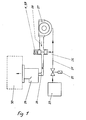
- FIG. 1 shows all components for internal combustion engines operated with liquid gas for the preparation and supply of the liquid gas as well as the new compensation valve presented by the invention.
- the solenoid valve 25 can also be used as a safety device, for example in the form that it is at excess pressure or excessive gas flow, e.g. due to a leak in the pipe system, which can interrupt the gas flow directly.
- the solenoid valve 25 and the evaporator 27 there is a branch in the liquid gas line 24 connected to the pressure line 26 through which the gas pressure is transmitted to the metering device 37, the compensation valve 1.
- the gas exiting the evaporator 27 and brought into the gas state passes through the gas line 28 into the compensation valve 1.
- the opening cross section in the compensation valve 1 can thus be regulated in particular by the liquid gas pressure.
- the liquid gas composition can thus influence the amount of gas that flows into the internal combustion engine.
- the internal combustion engine 30, which is shown in simplified form as a rectangle in the present diagram, sucks in the gas metered by the compensation valve 1, which is mixed with air in the gas mixer 29 and reaches the internal combustion engine 30 as a gas-air mixture for combustion there.
- the exemplary embodiment shows a metering device 37 which is cylindrical in the outer contour, the compensation valve 1, consisting of the housing 4 and the inner part 6 located therein.
- the outer contour of the compensation valve 1 can be rectangular or: be formed in any other geometrical shape.
- the inner part 6 has an axial bore 31 through which the gas is passed. The gas enters from the evaporator 27 in the inlet 2 and emerges from the compensation valve 1 through the outlet 3 opposite.
- the cylinder 12 is introduced in the center of the compensation valve 1 in a radial bore 32, crossing the axial bore 31.
- the cylinder 12, arranged in the inner part 6 by the seal 16 and sealingly radially flush with the inner part 6, serves to receive the piston 7.
- the cylinder 12 has openings, the cylinder inlet and the cylinder outlet: the cylinder inlet 13 is attached in the direction of the inlet 2, the cylinder outlet 14 is aligned with the outlet 3.
- the cylinder inlet 13 and the cylinder outlet 14 are designed differently and are arranged in different positions relative to one another.
- the control edge 36 on the upper piston part 33 on the side facing the lower piston part 10 releases a certain part of this opening, depending on the position predetermined by the gas pressure.
- a defined gas volume flow can flow through the compensation valve 1 to the internal combustion engine 30.
- the piston 7 is acted upon by the liquid gas pressure which is present in the pressure chamber 17.
- the piston 7 has a large taper over a region which is larger than the cylinder inlet 13, which is identified as connection 9 and divides the piston into a lower part 10 and an upper part 33.
- the tapering of the piston 7 is carried out so far that the flow cross-section is equal to or greater than the cross-section of the cylinder inlet 13.
- the liquid gas pressure prevailing in the pressure chamber 17 acts against a compression spring 15 arranged opposite on the piston.
- the guide 8 is intended for the compression spring 15 and further has the task of limiting the adjustment path of the piston 7 when the guide 8 is in contact with the housing 4.
- the lower piston part 10 is sealed off from the pressure chamber 17 by the seal 11.
- FIG. 3 shows a largely identical construction of a liquid gas supply for an internal combustion engine as in FIG. 1.
- a further adjustment possibility of the metering device 37 is provided by the liquid gas temperature from the gas container 23.
- the liquid gas temperature is transmitted to the transducer by the temperature transmitter 38 and the electrical connection 39.
- the temperature sensor 38 can measure the temperature in the liquid gas container 23 or immediately behind it in the liquid gas line 24.
- the transducer 35 is connected to the voltage source 40.
- the rack 18 movable in the direction X causes the piston 7 to rotate, the upper guide 8, the shaft 22, the gear 20 and the rack 18 are connected to one another.
- the piston 7 has an oblique control edge 34 which changes the cross section of the cylinder inlet 13 when rotated.
- the piston 7 can be displaced vertically in the direction Y from the gas pressure present in the pressure chamber 17.
- the toothing width 21 of the toothed rack 18 is also designed by the corresponding amount of a possible vertical shift to Y.
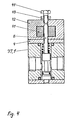
- FIG. 4 shows in section the compensation valve 1, as already explained in more detail in the description of FIG. 2, which is provided with an integrated actuating magnet 41.
- This is located almost centrally in the magnet housing 42, which is flanged on one side to the housing 4: the guide 8 is extended through the housing 4 and continues through the actuating magnet 41 until the stop formed by the adjusting screw 44. Lying on the same axis with the guide 8, the adjusting screw 44 is screwed into the magnet housing 42 from the outside. With the help of the lock nut 43 the screwing depth of the adjusting screw 44 can be adjusted.
- the actuating magnet 41 is intended to compensate for the influence of gas temperature in compensation valves, the manipulated variable of which is the liquefied gas pressure.
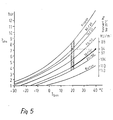
- the vapor pressure curves in FIG. 5 show the changes in calorific value as a function of the liquid gas composition with the main proportions propane and butane.
- the limit mixture ratios which can occur due to a lack of standardization and which can range from a propane / butane content of 100/0% to 20/80%, are clearly highlighted:
- the volume flow in an exclusively pressure-controlled compensation valve 1 then corresponds to that of an 80/20% mixture at 20 ° C. The fuel energy supplied to the engine thus increases.
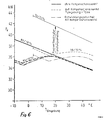
- the motor characteristic corresponds to that of the motor without adjustment of the calorific value Compensation for the change in performance of the engine due to the degree of delivery.
- the assumption that the gas and ambient air temperature behave approximately the same should predominantly apply if the engine and the LPG container are in one room or together in the vehicle.
- the temperature behavior then corresponds to that of an internal combustion engine without a compensation valve (see diagram in FIG. 6).
- the increase in output is not critical, in particular for air-cooled internal combustion engines.
- the idea of the invention also provides for a device by means of which the liquid gas temperature can be reduced by means of transmission means, e.g. Transducers, can influence the control and thus the amount of gas flowing through the compensation valve.
- transmission means e.g. Transducers
- this device is provided for compensation valves, the gas quantity control of which takes place primarily as a function of the liquid gas pressure.
Landscapes
- Engineering & Computer Science (AREA)
- Chemical & Material Sciences (AREA)
- Combustion & Propulsion (AREA)
- Mechanical Engineering (AREA)
- General Engineering & Computer Science (AREA)
- Chemical Kinetics & Catalysis (AREA)
- General Chemical & Material Sciences (AREA)
- Oil, Petroleum & Natural Gas (AREA)
- Output Control And Ontrol Of Special Type Engine (AREA)
- Electrical Control Of Air Or Fuel Supplied To Internal-Combustion Engine (AREA)
Abstract
Description
Mit der Erfindung wird ein Verfahren und eine Vorrichtung zur Leistungsregelung vorgestellt für mit Flüssiggas, Hauptbestandteile Propan/Butan (LPG) betriebene Brennkraftmaschinen, insbesondere Otto-Gasmotoren, wobei das Flüssiggas in einem Verdampfer in den gasförmigen Zustand gebracht wird und danach im Gasmischer mit Luft vermischt wird, bevor es in die Brennkraftmaschine gelangt.With the invention, a method and a device for power control are presented for internal combustion engines operated with liquid gas, main components propane / butane (LPG), in particular gasoline engines, the liquid gas being brought into the gaseous state in an evaporator and then mixed with air in the gas mixer is before it gets into the engine.
Für verschiedene Einsatzfälle, wie Gabelstaplerbetrieb in Werkshallen, in denen eine hohe Abgasgüte gefordert wird und ein Elektroantrieb ausscheidet, beispielsweise wegen nicht ausreichender Verfügbarkeit, bieten sich Brennkraftmaschinen an, die mit Flüssiggas betrieben werden; ebenso dort, wo ein hohes Aufkommen an Flüssiggas vorhanden ist und sich daher der Einsatz von Brennkraftmaschinen mit Flüssiggasbetrieb anbietet.For various applications, such as forklift operation in workshops, in which a high exhaust gas quality is required and an electric drive is out of order, for example due to insufficient availability, internal combustion engines that run on liquid gas are suitable; also wherever there is a high volume of liquefied petroleum gas and therefore the use of internal combustion engines with liquefied petroleum gas operation makes sense.
Bekannt sind Otto-Gasmotoren, deren Verbrennungsgemisch, Luft-Gasgemisch, von der Brennkraftmaschine direkt aus dem Gasmischer angesaugt wird. Hierbei wird kein Einfluß auf die Flüssiggaszusammensetzung und damit den Heizwert genommen, und damit auch nicht auf die Leistungseinstellung der Brennkraftmaschine: Folglich ändert sich die Leistung proportional zum Heizwert des Propan/Butan-Gemisches. Da weder eine deutsche noch europäische Norm für Flüssiggase als Kraftstoff besteht, ist die Zusammensetzung der Flüssiggase oft von Land zu Land und nach Jahreszeit unterschiedlich. Die Hauptbestandteile Propan und Butan können im Mischungsverhältnis von 100 zu 0 % bis 20 zu 80 % schwanken. In Abhängigkeit von dem Butananteil steigt dabei auch der spezifische, volumenbezogene Heizwert bis zu 25 % an. Gleichzeitig damit verbunden fällt mit steigendem Butananteil die Oktanzahl um bis zu 13 Einheiten ROZ (Research Oktanzahl) ab und damit verringert sich auch die Klopffestigkeit des Kraftstoffes wesentlich.Otto gas engines are known, whose combustion mixture, air-gas mixture, is sucked in by the internal combustion engine directly from the gas mixer. This has no influence on the composition of the liquid gas and thus the calorific value, and therefore also not on the power setting of the internal combustion engine: consequently, the output changes proportionally to the calorific value of the propane / butane mixture. Since neither a German nor a European standard for liquid gases As a fuel, the composition of liquid gases often differs from country to country and according to the season. The main components propane and butane can vary in the mixing ratio from 100 to 0% to 20 to 80%. Depending on the butane content, the specific, volume-related calorific value increases up to 25%. At the same time, as the butane content increases, the octane number drops by up to 13 units RON (research octane number), which also significantly reduces the knock resistance of the fuel.
Für den Betrieb der Brennkraftmaschine in der Praxis bedeutet das, daß beispielsweise eine mit 100 % Propan auf Nennleistung eingestellte Brennkraftmaschine bei Betrieb mit 20/80 % Propan/Butan eine Mehrleistung von ca. 25 % besitzt. Die thermische Mehrbelastung kann dadurch kritisch oder gar untragbar für die Brennkraftmaschine werden: Hinzu kommt, daß die reduzierte Oktanzahl zum Motorklopfen bei Vollast führen kann. Beide Faktoren zusammen können erhebliche, bleibende Schäden verursachen und zum Ausfall der Brennkraftmaschine führen.For the operation of the internal combustion engine in practice, this means that, for example, an internal combustion engine set to nominal output with 100% propane has an additional output of approx. 25% when operated with 20/80% propane / butane. The additional thermal load can therefore become critical or even unbearable for the internal combustion engine: In addition, the reduced octane number can lead to engine knocking at full load. Taken together, both factors can cause considerable, permanent damage and lead to failure of the internal combustion engine.
Außerdem ergibt sich im Teillastbereich das Problem, daß aufgrund des unterschiedlichen stöchiometrischen Luftbedarfs von Propan und Butan das Verbrennungsluftverhält- nis λv beispielsweise bei zunehmendem Butan-Anteil kleiner wird. Dies hat zur Folge, daß die Schadstoffemission stark ansteigt.In addition, results in the partial load range, the problem that due to the different stoichiometric air requirement of propane and butane, the Verbrennungsluftverhält- n i s v λ, for example, with an increasing proportion of butane is reduced. This has the consequence that the pollutant emission rises sharply.
Die der Erfindung zugrunde liegende Aufgabe besteht darin, ein Verfahren vorzustellen, mit dem für alle Flüssiggaszusammensetzungen ein gasmischungsunabhängiger, dauerhafter Motorbetrieb zu gewährleisten ist mit einer weiteren Maßgabe, die Schadstoffemission im gesamten Betriebsbereich der Brennkraftmaschine nicht zu verschlechtern.The object on which the invention is based is to present a method with which a permanent, gas-independent mixture is used for all liquid gas compositions Another requirement for ensuring engine operation is that the pollutant emissions do not deteriorate in the entire operating range of the internal combustion engine.
Diese Aufgabe wird durch ein Verfahren der gattungsgemäßen Art durch die im Kennzeichen des Anspruchs 1 aufgeführten Merkmale gelöst.This object is achieved by a method of the generic type by the features listed in the characterizing part of
Mit diesem erfindungsgemäßen Verfahren wird eine Regelung der zugeführten Flüssiggasmenge in Abhängigkeit vom Heizwert ermöglicht. Damit kann die Brennkraftmaschine unabhängig von der Flüssiggaszusammensetzung, d.h. bei sich verändernden Propan/Butan-Anteilen optimal betrieben werden. Erreicht wird dieses Ziel, indem die aszustandswerte, der Flüssggasdruck und die Flüssiggastemperaturen, auf eine Zumeßeinrichtung übertragen werden. Erforderliche Korrekturen werden entsprechend der spezifischen Dampfdruckkurven des Flüssiggases vorgenommen. Die Mischungsanteile sind mit Hilfe der Dampfdruckkurven bestimmbar, da sich jedes Propan/Butan-Gemisch auf dieser Zustandslinie bewegt. Die Messung von Druck und Temperatur führt zur Identifizierung des Flüssiggasgemisches. Durch eine Übertragung der Gaszustandswerte auf die Zumeßeinrichtung läßt sich eine vorteilhafte, der Brennkraftmaschine zuträgliche Gasmenge einstellen: Ein weiterer Vorteil, der sich durch die erfindungsgemäße Gasmengenregelung in Abhängigkeit der Gasgemischkomponenten und damit des Heizwertes einstellt, ist die Abgasqualität, die sich selbst bei zunehmenden Butananteilen und dem damit verbundenen höheren Luftbedarf insbesondere im Teillastbereich nicht wesentlich verschlechtert: Die Zumeßeinrichtung steuert bei solch geänderten Verhältnissen die Gasmenge so, daß dieser Effekt nahezu vermieden wird.With this method according to the invention, a control of the amount of liquefied gas supplied is made possible depending on the calorific value. This means that the internal combustion engine can be operated independently of the composition of the liquid gas, i.e. operate optimally with changing propane / butane proportions. This goal is achieved by transferring the as-state values, the liquid gas pressure and the liquid gas temperatures, to a metering device. Corrections are made according to the specific vapor pressure curves of the liquid gas. The mixture proportions can be determined with the help of the vapor pressure curves, since every propane / butane mixture moves on this state line. The measurement of pressure and temperature leads to the identification of the liquid gas mixture. By transferring the gas state values to the metering device, an advantageous gas quantity that is beneficial to the internal combustion engine can be set: Another advantage that arises from the gas quantity control according to the invention depending on the gas mixture components and thus the calorific value is the exhaust gas quality, which increases even with increasing butane proportions and the associated higher air requirement, particularly in the partial load range, does not deteriorate significantly: the metering device controls the amount of gas in such changed conditions so that this effect is almost avoided.
Als erfindungsgemäße Zumeßeinrichtung ist ein Kompensationsventil vorgesehen. Eingesetzt in die Verbindungsleitung zwischen dem Verdampfer und dem Luftmischer kann durch das Kompensationsventil direkt die Gasmenge dosiert und geregelt werden. Das Kompensationsventil dient als Regelventil bzw. Drosselelement, das je nach der Gaszusammensetzung und dem damit verbundenen stöchiometrischen Luftbedarf angesteuert wird und damit die Gasmenge in der Niederdruckgasleitung zwischen Verdampfer und Motor regelt.A compensation valve is provided as the metering device according to the invention. Inserted into the connecting line between the evaporator and the air mixer, the gas quantity can be metered and regulated directly through the compensation valve. The compensation valve serves as a control valve or throttle element which is controlled depending on the gas composition and the associated stoichiometric air requirement and thus regulates the amount of gas in the low-pressure gas line between the evaporator and the engine.
Der Erfindungsgedanke sieht auch vor, daß das Kompensationsventil einen speziell gestalteten variablen Drosselquerschnitt aufweist. Die Querschnittsgeometrie ist beispielsweise so abstimmbar, daß bei Normbedingungen (z.B. DIN 70 020, die sich auf eine Umgebungstemperatur und Gastemperatur von 20 °C bezieht,) für alle angesprochenen Flüssiggasgemische eine einheitliche Motornennleistung erreicht: Weiter bietet diese Möglichkeit eine Anpassung der Durchtrittsgeometrie an die Zusammensetzung des Flüssiggases.The inventive idea also provides that the compensation valve has a specially designed variable throttle cross section. The cross-sectional geometry can be adjusted, for example, so that, under standard conditions (
Eine Weiterbildung dieses Gedankens sieht vor, daß als Stellgröße für die Veränderung des Durchtrittsquerschnittes eine direkte Übertragung des Flüssiggasdruckes auf den Kolben des Kompensationsventils dient. So kann ohne großen Installationsaufwand jederzeit die sich bei verändernden Mischungsverhältnissen im Flüssiggas ergebende Gasdruckänderung zur Anpassung an die der Brennkraftmaschine zugeführte Gasmenge genutzt werden.A further development of this idea provides that a direct transmission of the liquid gas pressure to the piston of the compensation valve serves as a manipulated variable for changing the passage cross section. In this way, the gas pressure change resulting from changing mixing ratios in the liquefied petroleum gas can be used at any time to adapt to the amount of gas supplied to the internal combustion engine without great installation effort.
Die Erfindung sieht darüber hinaus auch eine Einflußnahme durch die Flüssiggastemperatur vor, durch die eine zusätzliche Verstellung des Kompensationsventils erreicht wird. Mit dieser Möglichkeit wird in Verbindung mit der Flüssiggasdrucksteuerung eine genaue Regelung des Gasvolumenstroms durch das Kompensationsventil erreicht. Gedacht ist dabei beispielsweise an ein Kompensationsventil, ausgelegt als verdrehbares Kolbenventil, bei dem die Durchtrittsgeometrie mit einer Steuerkante versehen ist. Auf den federbelasteten Kolben wirkt der Flüssiggasdruck. Die Verdrehung des Kolbens kann mit Hilfe von Ubertragungsorganen erreicht werden, die bei sich verändernden Flüssiggastemperaturen eine Kolbenverdrehung vornehmen.The invention also provides for an influence by the liquid gas temperature, by means of which an additional adjustment of the compensation valve is achieved. With this option, precise regulation of the gas volume flow through the compensation valve is achieved in connection with the liquid gas pressure control. For example, a compensation valve is designed, designed as a rotatable piston valve, in which the passage geometry is provided with a control edge. The LPG pressure acts on the spring-loaded piston. The rotation of the piston can be achieved with the aid of transmission elements which rotate the piston when the liquid gas temperature changes.
Vorteilhaft ist eine Durchtrittsgeometrie, die mit einer Schrägkante versehen ist: Insbesondere bei einer gleichzeitig erfolgten Hubveränderung und Verdrehung des Kolbens im Kompensationsventil wird durch eine Schrägsteuerkante eine gut bestimmbare Zumessung des durchtretenden Gasstromes erreicht.A passage geometry that is provided with an inclined edge is advantageous: in particular when the stroke is changed and the piston in the compensation valve is rotated at the same time, an inclined control edge achieves a readily determinable metering of the gas flow that passes through.
In besonderer Ausgestaltung der Erfindung wird vorgeschlagen, als Ubertragungsorgan zur Verstellung des Kolbens im Kompensationsventil Meßwertumformer einzusetzen: Temperaturgeber und Druckaufnehmer im Flüssiggasbehälter übertragen die Meßwerte auf die Meßwertumformer zur Verstellung des Kolbens im Kompensationsventil. Durch einen Abgleich der Meßwerte mit Vorgabewerten, die z.B. den Dampfdruckkurven der Flüssiggase entsprechen, wird durch die Meßwertumformer eine Verstellung, d.h. Verdrehung und/oder Verschiebung in axialer Richtung des Kolbens erreicht.In a special embodiment of the invention, it is proposed to use a transducer as a transmission element for adjusting the piston in the compensation valve: temperature sensors and pressure sensors in the liquid gas container transmit the measured values to the transducers for adjusting the piston in the compensation valve. By comparing the measured values with default values, e.g. correspond to the vapor pressure curves of the liquid gases, the transducer adjusts, i.e. Rotation and / or displacement in the axial direction of the piston is achieved.
Der Anspruch 10 sieht vor, daß unmittelbar an das Kompensationsventil ein Stellmagnet angeflanscht ist: Erfindungsgemäß ist dabei an einen Magnet gedacht, der gastemperaturabhängig wirkt und eine überlagernde Kraft auf den Kolben ausübt. Damit wirkt der Stellmagnet der Kraft bei einem Teperaturanstieg entgegen, die durch den Flüssiggasdruck auf den Kolben ausgeübt wird. Der Stellmagnet kompensiert damit den Gastemperatureinfluß bei einer Gasmengenregelung, die vorrangig in Abhängigkeit vom Flüssiggasdruck erfolgt.
Weiter ist an eine Ubertragung dieses Erfindungsgedankens auf Dual/FUEL-Brennkraftmaschinen gedacht. Diese Brennkraftmaschinen werden mit zwei Brennstoffen, insbesondere einem flüssigen und einem gasförmigen Brennstoff betrieben. Auch hierfür bietet sich das in Abhängigkeit von der Flüssiggaszusammensetzung regelnde und die Gasmenge zumessende Kompensationsventil an, um Heizwertschwankungen im Flüssiggas und damit Leistungsunterschiede zu unterbinden.It is also contemplated to transfer this inventive concept to dual / FUEL internal combustion engines. These internal combustion engines are operated with two fuels, in particular a liquid and a gaseous fuel. The compensation valve, which regulates and adjusts the amount of gas depending on the composition of the liquid gas, is also suitable for this purpose, in order to prevent fluctuations in the calorific value in the liquid gas and thus differences in performance.
Weitere Merkmale ergeben sich aus der folgenden Zeichnungsbeschreibung, in der bevorzugte Ausführungsbeispiele der Erfindung schematisch dargestellt sind sowie erläuterternde Diagramme vorgestellt werden. Es zeigt:
- Fig. 1 den schematischen Aufbau der Flüssiggaszuführung einer Brennkraftmaschine mit dem erfindungsgemäßen Kompensationsventil,
- Fig. 2 die Schnittzeichnung durch das Kompensationsventil,
- Fig. 3 einen schematischen Aufbau der Flüssiggaszuführung, ähnlich Fig. l, jedoch mit einer zusätzlichen Verstellmöglichkeit der Zumeßeinrichtung durch die Flüssiggastemperatur,
- Fig. 4 in einer Schnittdarstellung das Kompensationsventil mit angeflanschtem Stellmagnet,
- Fig. 5 Dampfdruckkurven,
- Fig. 6 Verlauf der Nennleistung in Abhängigkeit von der Flüssigkeitszusammensetzung.
- 1 shows the schematic structure of the liquid gas supply of an internal combustion engine with the compensation valve according to the invention,
- 2 shows the sectional drawing through the compensation valve,
- 3 shows a schematic structure of the liquid gas supply, similar to FIG. 1, but with an additional possibility of adjusting the metering device by the liquid gas temperature,
- 4 is a sectional view of the compensation valve with a flanged control magnet,
- 5 vapor pressure curves,
- Fig. 6 course of the nominal power depending on the liquid composition.
Der in Fig. 1 gezeigte schematische Aufbau zeigt alle Bauteile für mit Flüssiggas betriebene Brennkraftmaschinen zur Aufbereitung und Zuführung des Flüssiggases sowie des neuen, durch die Erfindung vorgestellten Kompensationsventils.The schematic structure shown in FIG. 1 shows all components for internal combustion engines operated with liquid gas for the preparation and supply of the liquid gas as well as the new compensation valve presented by the invention.
Das im Gasbehälter 23, dem Vorratsbehälter für die Brennkraftmaschine 30 befindliche Flüssiggas gelangt durch die Flüssiggasleitung 24 zum Verdampfer 27, in dem das Flüssiggas von der Flüssigphase in die Gasphase gebracht wird. In die Flüssigleit'ung 24 ist unmittelbar hinter dem Gasbehälter 23 ein Magnetventil 25 geschaltet, das die Gaszufuhr unterbrechen kann. Das Magnetventil 25 kann auch als Sicherheitsorgan eingesetzt werden, beispielsweise in der Form, daß es bei Überdruck oder zu hohem Gasdurchfluß, z.B. durch ein Leck in dem Leitungssystem, den Gasfluß direkt unterbrechen kann. Zwischen Magnetventil 25 und dem Verdampfer 27 befindet sich in der Flüssiggasleitung 24 ein Abzweig verbunden mit der Druckleitung 26, durch die der Gasdruck auf die Zumeßeinrichtung 37, das Kompensationsventil 1 übertragen wird. Das aus dem Verdampfer 27 austretende, in den Gaszustand gebrachte Gas gelangt durch die Gasleitung 28 in das Kompensationsventil 1. Der Öffnungsquerschnitt im Kompensationsventil 1 ist damit insbesondere vom Flüssiggasdruck regelbar. Und damit kann die Flüssiggaszusammensetzung Einfluß auf die Gasmenge, die der Brennkraftmaschine zuströmt, nehmen. Die Brennkraftmaschine 30, die in dem vorliegenden Schema vereinfacht als Rechteck dargestellt ist, saugt das durch das Kompensationsventil 1 zugemessene Gas an, das im Gasmicher 29 mit Luft versetzt wird und als Gas-Luft-Gemisch in die Brennkraftmaschine 30 zur dortigen Verbrennung gelangt.The liquid gas located in the
Die Fig. 2 zeigt in einer Schnittdarstellung das Kompensationsventil 1. Das Ausführungsbeispiel zeigt eine in der Außenkontur zylindrisch ausgeführte Zumeßeinrichtrung 37, das Kompensationsventil 1, bestehend aus dem Gehäuse 4 und dem darin befindlichen Innenteil 6. Ebenso kann die Außenkontur des Kompensationsventils 1 rechteckig ausgeführt sein bzw: in einer anderen beliebigen geometrischen Form ausgebildet sein. Das Innenteil 6 besitzt eine axiale Bohrung 31, durch die das Gas geführt wird. Das Gas tritt im Eintritt 2 vom Verdampfer 27 kommend ein und gegenüberliegend durch den Austritt 3 aus dem Kompensationsventil 1 heraus. Mittig im Kompensationsventil 1 in einer radialen Bohrung 32, die axiale Bohrung 31 kreuzend, ist der Zylinder 12 eingebracht. Der Zylinder 12, in das Innenteil 6 durch die Abdichtung 16 dichtend angeordnet und radial mit dem Innenteil 6 bündig abschließend, dient zur Aufnahme des Kolbens 7. In Richtung der axialen Bohrung 31 besitzt der Zylinder 12 Öffnungen, den Zylindereintritt und den Zylinderaustritt: Der Zylindereintritt 13 ist in Richtung des Eintritts 2 angebracht, der Zylinderaustritt 14 zum Austritt 3 ausgerichtet. Zur Erzielung einer vielfältigen Durchtrittsgeometrie sind der Zylindereintritt 13 und der Zylinderaustritt 14 verschieden gestaltet und in unterschiedlichen Lagen zueinander angeordnet. Die Steuerkante 36 am Kolbenoberteil 33 an der zum Kolbenunterteil 10 gerichteten Seite gibt je nach der durch den Gasdruck vorgegebenen Stellung einen bestimmten Teil dieser Öffnung frei. Dadurch kann ein definierter Gasvolumenstrom durch das Kompensationsventil 1 zur Brennkraftmaschine 30 strömen. Der Kolben 7 wird mit dem Flüssigkeitsgasdruck, der im Druckraum 17 ansteht, beaufschlagt. Durch den Eintritt 5 im Gehäuse 4 des Kompensationsventils 1 befindlich wird durch die Druckleitung 26 und die Flüssiggasleitung 24 der Flüssigkeitsdruck aus dem Gasbehälter 23 auf den Druckraum 17 übertragen. Der Kolben 7 besitzt über einen Bereich, der größer als der Zylindereintritt 13 ist, eine starke Verjüngung, die als Verbindung 9 gekennzeichnet ist und den Kolben in ein Unterteil 10 und ein Oberteil 33 teilt. Die Verjüngung des Kolbens 7 ist soweit durchgeführt, daß der Durchströmquerschnitt gleich oder größer dem Querschnitt des Zylindereintritts 13 ist. Durch eine Verstellung des Kolbens 7 kann der Querschnitt des Zylindereintritts 13 verändert und die damit durch das Kompensationsventil 1 strömende Gasmenge geregelt werden. Der im Druckraum 17 anstehende Flüssiggasdruck wirkt gegen eine am Kolben gegenüberliegend angeordnete Druckfeder 15. Die Führung 8 ist für die Druckfeder 15 gedacht und hat weiter die Aufgabe, den Verstellweg des Kolbens 7 zu begrenzen, bei Anlage der Führung 8 am Gehäuse 4. Das Kolbenunterteil 10 ist zum Druckraum 17 durch die Abdichtung 11 abgedichtet.2 shows a sectional view of the
In Fig. 3 ist ein weitestgehend identischer Aufbau einer Flüssiggaszuführung für eine Brennkraftmaschine dargestellt wie in Fig. 1. Abweichend von Fig. 1 ist eine weitere Verstellmöglichkeit der Zumeßeinrichtung 37 durch die Flüssiggastemperatur aus dem Gasbehälter 23 vorgesehen. Durch den Temperaturgeber 38 und die elektrische Verbindung 39 wird dem Meßwertumformer die Flüssiggastemperatur übertragen. Dabei kann der Temperaturgeber 38 die Temperatur im Flüssiggasbehälter 23 oder unmittelbar hinter diesem in der Flüssiggasleitung 24 messen. Der Meßwertumformer 35 ist mit der Spannungsquelle 40 verbunden.FIG. 3 shows a largely identical construction of a liquid gas supply for an internal combustion engine as in FIG. 1. In contrast to FIG. 1, a further adjustment possibility of the metering device 37 is provided by the liquid gas temperature from the
Zwischen den Vorgabewerten des Meßwertumformers 35 und den Meßwerten erfolgt ein Abgleich. Erforderliche Korrekturen werden vom Meßwertumformer 35 mit Hilfe eines integrierten Stellmagneten auf das Kompensationsventil 1 übertragen. Als Übertragung dient die mit dem Meßwertumformer 35 verbundene Zahnstange 18, die am Ende mit der Verzahnung 19 versehen ist. In die Verzahnung 19 greift das Zahnrad 20 ein, das sich an der Welle 22 befindet, die eine Verlängerung der Führung 8 darstellt. Die in Richtung X bewegbare Zahnstange 18 bewirkt eine Verdrehung des Kolbens 7, der Ober die Führung 8, die Welle 22, das Zahnrad 20 und die Zahnstange 18 miteinander in Verbindung stehen. Der Kolben 7 besitzt eine Schrägsteuerkante 34, die bei Verdrehung den Querschnitt des Zylindereintritts 13 verändert. Weiter kann der Kolben 7 vertikal in Richtung Y vom im Druckraum 17 anstehenden Gasdruck verschoben werden. Um den entsprechenden Betrag einer möglichen vertikalen Verschiebung nach Y ist auch die Verzahnungsbreite 21 der Zahnstange 18 ausgelegt. Mit der Möglichkeit, das Kommpensationsventil 1 getrennt voneinander durch zwei Regeleinrichtungen vorzunehmen, die von verschiedenen Stellgrößen beeinflußt werden aber gleichzeitig die Stellung und die Lage des Kolbens 7 verändern können, kann eine genauere und besser abgestimmte Gasmengendosierung für die Brennkraftmaschine 30 vorgenommen werden.A comparison is made between the default values of the
Fig. 4 zeigt im Schnitt das Kompensationsventil 1, wie in der Beschreibung zu Fig: 2 bereits näher erläutert, das mit einem integrierten Stellmagnet 41 versehen ist. Dieses befindet sich nahezu mittig im Magnetgehäuse 42, welches einseitig am Gehäuse 4 angeflanscht ist: Die Führung 8 ist durch das Gehäuse 4 verlängert und durch den Stellmagneten 41 hindurch weitergeführt bis zu dem Anschlag, den die Stellschraube 44 bildet. Auf gleicher Achse mit der Führung 8 liegend ist die Stellschraube 44 von außen in das Magnetgehäuse 42 geschraubt. Mit Hilfe der Kontermutter 43 kann die Einschraubtiefe der Stellschraube 44 eingestellt werden. Der Stellmagnet 41 soll den Gastemperatureinfluß bei Kompensationsventilen ausgleichen, deren Stellgröße der Flüssiggasdruck ist.4 shows in section the
Die Dampfdruckkurven in Fig. 5 zeigen die Heizwertänderungen in Abhängigkeit von der Flüssiggaszusammensetzung mit den Hauptanteilen Propan und Butan. Deutlich hervorgehoben sind die Grenzmischungsverhältnisse, die aufgrund einer fehlenden Normung auftreten können und von einem Propan/Butan-Anteil von 100/0 % bis zu 20/80 % reichen können: Ein Beispiel, daß die Temperatur-Druck-Abhängigkeit des Flüssiggasgemisches verdeutlicht, ist in dem Kurvenverlauf eingetragen. Bei einem 30/70 %-Gemisch zum Beispiel steigt der Druck von 4,1 Bar bei 20 °C auf 7 Bar bei 40 °C an. Der Volumenstrom in einem ausschließlich druckgesteuerten Kompensationsventil 1 entspricht dann dem eines 80/20 %-Gemisches bei 20 °C. Die dem Motor zugeführte Brennstoffenergie nimmt damit zu. Diese Tatsache wird genutzt, um die Gemischliefergradeinbuße (Leistungsabnahme) von 20 °C auf 40 °C auszugleichen. Speziell bei einer luftgekühlten Brennkraftmaschine mit ihrer Umgebungstemperaturabhängigkeit (Kühlluft und Verbrennungsluft) gelingt dies sehr gut, wie auch im Diagramm der Fig. 6 deutlich sichtbar wird. Das zuvor genannte Beispiel hat jedoch eine unvermeidbare Gemischanfettung zur Folge, da die Luftmenge konstant bleibt. Um den λv-Bereich, in dem der Motor folglich betrieben wird, einzuengen, wird der Verstellweg des Kolbens 7 für den bei der Gastemperatur von 20 °C minimal notwendigen Dampfdruckbereich der Gasgemische begrenzt. Der Arbeitsbereich des Kompensationsventils 1 ist erkennbar an den Knickstellen im Kurvenverlauf gemäß Fig. 6. Außerhalb dieses Bereichs entspricht die Motorcharakteristik der des Motors ohne Heizwertanpassung: Die bei der Kompensation der liefergradbedingten Leistungsänderung des Motors zugrunde liegende Annahme, daß sich Gas- und Umgebungslufttemperatur näherungsweise gleich verhalten, dürfte überwiegend zutreffen, wenn sich Motor und Flüssiggasbehälter in einem Raum oder gemeinsam im Fahrzeug befinden. Von dieser Annahme kann beispielsweise ein flüssiggasgetriebener Gabelstapler abweichen, der vom Freien (T=20 °C) in ein Kühlhaus (T=-20 °C) fährt, der Flüssgkeitsgasdruck in dem Gasbehälter 23 bleibt zunächst konstant, der Gemischliefergrad und die maximale Leistung der Brennkraftmaschine steigen jedoch an. Das Temperaturverhalten entspricht dann dem einer Brennkraftmaschine ohne Kompensationsventil (siehe Diagramm Fig. 6). Der Leistungsanstieg ist in Anbetracht der Kühllufttemperatur insbesondere für luftgekühlte Brennkraftmaschinen unkritisch.The vapor pressure curves in FIG. 5 show the changes in calorific value as a function of the liquid gas composition with the main proportions propane and butane. The limit mixture ratios, which can occur due to a lack of standardization and which can range from a propane / butane content of 100/0% to 20/80%, are clearly highlighted: One example that illustrates the temperature-pressure dependency of the liquid gas mixture entered in the curve. With a 30/70% mixture, for example, the pressure increases from 4.1 bar at 20 ° C to 7 bar at 40 ° C. The volume flow in an exclusively pressure-controlled
Um jedoch mit dem Kompensationsventil 1 die Regelung noch zu verfeinern und über einen weiteren Bereich zu ermöglichen, ist nach dem Erfindungsgedanken auch an eine Einrichtung gedacht, durch die die Flüssiggastemperatur mit Hilfe von Übertragungsmitteln, z.B. Meßwertumformern, Einfluß auf die Regelung und damit auf die das Kompensationsventil hindurchströmende Gasmenge nehmen kann.However, in order to further refine the control with the
Insbesondere ist diese Einrichtung für Kompensationsventile vorgesehen, deren Gasmengenregelung vorrangig in Abhängigkeit vom Flüssiggasdruck erfolgt.In particular, this device is provided for compensation valves, the gas quantity control of which takes place primarily as a function of the liquid gas pressure.
Claims (11)
dadurch gekennzeichnet, daß die der Brennkraftmaschine zugeführte Gasmenge in Abhängigkeit vom Heizwert geregelt wird.1. Method for regulating the output of an internal combustion engine operated with LPG, main components propane / butane (LPG-Liquid Petrol Gas), in particular Otto gas engines, the liquefied gas being brought into the gaseous state in an evaporator (27) and then in the gas mixer (29) is mixed with air before it gets into the internal combustion engine,
characterized in that the amount of gas supplied to the internal combustion engine is regulated as a function of the calorific value.
dadurch gekennzeichnet, daß als Zumeßeinrichtung (37) zwischen Verdampfer (27) und dem Gasmischer (29) ein Kompensationsventil (1) in die Gasleitung (28) eingesetzt wird.3. Device for carrying out the method according to claim 1, with a gas container (23), a liquid gas line (24) and an evaporator (27),
characterized in that a compensation valve (1) is inserted into the gas line (28) as the metering device (37) between the evaporator (27) and the gas mixer (29).
Priority Applications (1)
| Application Number | Priority Date | Filing Date | Title |
|---|---|---|---|
| AT87106739T ATE70595T1 (en) | 1986-05-09 | 1987-05-08 | METHOD AND DEVICE FOR POWER CONTROL OF LIQUID GAS (LPG) FUEL COMBUSTION ENGINES. |
Applications Claiming Priority (2)
| Application Number | Priority Date | Filing Date | Title |
|---|---|---|---|
| DE19863615679 DE3615679A1 (en) | 1986-05-09 | 1986-05-09 | METHOD AND DEVICE FOR CONTROLLING THE PERFORMANCE OF LIQUID GAS (LPG) OPERATING COMBUSTION ENGINES |
| DE3615679 | 1986-05-09 |
Publications (3)
| Publication Number | Publication Date |
|---|---|
| EP0244875A2 true EP0244875A2 (en) | 1987-11-11 |
| EP0244875A3 EP0244875A3 (en) | 1989-01-04 |
| EP0244875B1 EP0244875B1 (en) | 1991-12-18 |
Family
ID=6300483
Family Applications (1)
| Application Number | Title | Priority Date | Filing Date |
|---|---|---|---|
| EP87106739A Expired - Lifetime EP0244875B1 (en) | 1986-05-09 | 1987-05-08 | Method and device for controlling a liquefied gas (lpg) fuelled engine |
Country Status (3)
| Country | Link |
|---|---|
| EP (1) | EP0244875B1 (en) |
| AT (1) | ATE70595T1 (en) |
| DE (2) | DE3615679A1 (en) |
Cited By (5)
| Publication number | Priority date | Publication date | Assignee | Title |
|---|---|---|---|---|
| DE3918683A1 (en) * | 1989-03-10 | 1990-09-13 | Motoren Werke Mannheim Ag | Gas engine exhaust emission control - measures exhaust gases to regulate fuel ratio corrected for fuel gas quality |
| DE4135233A1 (en) * | 1991-10-25 | 1993-04-29 | Man Nutzfahrzeuge Ag | Secondary power source for commercial vehicle - consists of engine using liquefied petroleum gas or compressed natural gas as fuel |
| EP0558591A4 (en) * | 1990-11-20 | 1993-12-01 | Biocom Pty. Ltd. | A dual fuel injection system and a method of controlling such a system |
| EP0719385A4 (en) * | 1993-04-15 | 1996-02-15 | Mesa Environmental Ventures Co | Method and system for improved fuel system performance of a gaseous fuel engine |
| WO2014166534A1 (en) * | 2013-04-10 | 2014-10-16 | Intec Ag | Gas mixture detection module for liquefied gas for motor vehicles |
Families Citing this family (3)
| Publication number | Priority date | Publication date | Assignee | Title |
|---|---|---|---|---|
| DE10249274B4 (en) * | 2002-10-23 | 2013-07-11 | Iav Gmbh Ingenieurgesellschaft Auto Und Verkehr | Method for operating a gas-powered internal combustion engine |
| US8412438B2 (en) | 2009-12-15 | 2013-04-02 | GM Global Technology Operations LLC | Dual state liquefied petroleum gas engine assembly |
| DE102012100115B4 (en) | 2012-01-09 | 2013-07-18 | Intec Ag | Gas mixture detection module for LPG for motor vehicles and associated method |
Family Cites Families (7)
| Publication number | Priority date | Publication date | Assignee | Title |
|---|---|---|---|---|
| DE739518C (en) * | 1934-03-20 | 1943-09-28 | Dimitry Balachowski | Carburetor device with catalytic processing of the fuel for internal combustion engines |
| DE2103008C3 (en) * | 1971-01-22 | 1978-11-02 | Siemens Ag, 1000 Berlin Und 8000 Muenchen | Device for generating a gaseous fuel |
| BE786225A (en) * | 1971-07-16 | 1973-01-15 | Siemens Ag | PROCESS FOR THE NON-POLLUTING OPERATION OF INTERNAL COMBUSTION AND CARBURETOR MACHINES FOR IMPLEMENTING THE PROCESS |
| JPS5060424U (en) * | 1973-10-08 | 1975-06-04 | ||
| DE3305680A1 (en) * | 1983-02-18 | 1984-08-23 | Nippon Carbrueter Co., Ltd., Tokyo | Device for regulating the fuel feed to a liquid gas engine |
| DE3327699A1 (en) * | 1983-08-01 | 1985-02-21 | Motoren-Werke Mannheim AG vorm. Benz Abt. stationärer Motorenbau, 6800 Mannheim | DEVICE FOR ADAPTATION TO GAS DIFFERENT HEATING VALUES IN THE GAS-AIR-MIXTURE SUPPLY OF GAS ENGINES |
| GB2152581A (en) * | 1983-08-12 | 1985-08-07 | Solex | LPG fuel systems |
-
1986
- 1986-05-09 DE DE19863615679 patent/DE3615679A1/en not_active Withdrawn
-
1987
- 1987-05-08 EP EP87106739A patent/EP0244875B1/en not_active Expired - Lifetime
- 1987-05-08 AT AT87106739T patent/ATE70595T1/en not_active IP Right Cessation
- 1987-05-08 DE DE8787106739T patent/DE3775267D1/en not_active Expired - Fee Related
Cited By (5)
| Publication number | Priority date | Publication date | Assignee | Title |
|---|---|---|---|---|
| DE3918683A1 (en) * | 1989-03-10 | 1990-09-13 | Motoren Werke Mannheim Ag | Gas engine exhaust emission control - measures exhaust gases to regulate fuel ratio corrected for fuel gas quality |
| EP0558591A4 (en) * | 1990-11-20 | 1993-12-01 | Biocom Pty. Ltd. | A dual fuel injection system and a method of controlling such a system |
| DE4135233A1 (en) * | 1991-10-25 | 1993-04-29 | Man Nutzfahrzeuge Ag | Secondary power source for commercial vehicle - consists of engine using liquefied petroleum gas or compressed natural gas as fuel |
| EP0719385A4 (en) * | 1993-04-15 | 1996-02-15 | Mesa Environmental Ventures Co | Method and system for improved fuel system performance of a gaseous fuel engine |
| WO2014166534A1 (en) * | 2013-04-10 | 2014-10-16 | Intec Ag | Gas mixture detection module for liquefied gas for motor vehicles |
Also Published As
| Publication number | Publication date |
|---|---|
| EP0244875A3 (en) | 1989-01-04 |
| ATE70595T1 (en) | 1992-01-15 |
| DE3615679A1 (en) | 1987-11-12 |
| EP0244875B1 (en) | 1991-12-18 |
| DE3775267D1 (en) | 1992-01-30 |
Similar Documents
| Publication | Publication Date | Title |
|---|---|---|
| DE60317482T2 (en) | TWO FUEL ENGINE | |
| EP0267209A1 (en) | System and device for metering fuel. | |
| DE2146506B2 (en) | FUEL INJECTION SYSTEM FOR MIXED COMPRESSING, EXTERNAL IGNITION ENGINE WITH CONTINUOUS INJECTION INTO THE INDUCTION MANIFOLD | |
| WO2012059226A1 (en) | High-pressure fuel pump for an internal combustion engine having direct injection | |
| EP0244875B1 (en) | Method and device for controlling a liquefied gas (lpg) fuelled engine | |
| DE2438217A1 (en) | METHOD AND SYSTEM FOR REDUCING AIR POLLUTANT EMISSIONS FROM COMBUSTION ENGINES | |
| DE2054911A1 (en) | Control element for a fuel injection system | |
| DE1626429B1 (en) | Power plant with a diesel internal combustion engine for operation with liquid fuel and gas | |
| DE2544810A1 (en) | FUEL INJECTION SYSTEM | |
| DE2941513A1 (en) | ENGINE SYSTEM | |
| DE3887609T2 (en) | Control device for gas venturi carburettors. | |
| DE2539007C2 (en) | Fuel control system for an auxiliary combustion chamber of a compression-ignition internal combustion engine operating with exhaust gas turbocharging | |
| EP0515816B1 (en) | Fuel injection pump for internal combustion engines | |
| DE3149839C2 (en) | ||
| DE3026826C2 (en) | Fuel injection device for a spark-ignition piston internal combustion engine | |
| DE3808397C2 (en) | ||
| DE2348859A1 (en) | FUEL INJECTION SYSTEM | |
| DE2623121B2 (en) | Pressure control valve for a fuel injection system | |
| DE3312760A1 (en) | DEVICE FOR INJECTING LIQUID GAS | |
| DE2736487A1 (en) | GASIFICATION SYSTEM FOR COMBUSTION MACHINES | |
| DE2531766C3 (en) | Control element for a fuel injection system | |
| DE2520322A1 (en) | FUEL INJECTION SYSTEM | |
| DE2112373C3 (en) | Power plant with a diesel internal combustion engine for operation with liquid fuel and with gas | |
| EP2984320A1 (en) | Gas mixture detection module for liquefied gas for motor vehicles | |
| DE1626429C (en) | Power plant with a diesel internal combustion engine for Betneb with liquid fuel and gas |
Legal Events
| Date | Code | Title | Description |
|---|---|---|---|
| PUAI | Public reference made under article 153(3) epc to a published international application that has entered the european phase |
Free format text: ORIGINAL CODE: 0009012 |
|
| AK | Designated contracting states |
Kind code of ref document: A2 Designated state(s): AT DE FR GB NL |
|
| PUAL | Search report despatched |
Free format text: ORIGINAL CODE: 0009013 |
|
| AK | Designated contracting states |
Kind code of ref document: A3 Designated state(s): AT DE FR GB NL |
|
| 17P | Request for examination filed |
Effective date: 19881212 |
|
| 17Q | First examination report despatched |
Effective date: 19900115 |
|
| GRAA | (expected) grant |
Free format text: ORIGINAL CODE: 0009210 |
|
| AK | Designated contracting states |
Kind code of ref document: B1 Designated state(s): AT DE FR GB NL |
|
| PG25 | Lapsed in a contracting state [announced via postgrant information from national office to epo] |
Ref country code: NL Effective date: 19911218 |
|
| REF | Corresponds to: |
Ref document number: 70595 Country of ref document: AT Date of ref document: 19920115 Kind code of ref document: T |
|
| ET | Fr: translation filed | ||
| GBT | Gb: translation of ep patent filed (gb section 77(6)(a)/1977) | ||
| RAP2 | Party data changed (patent owner data changed or rights of a patent transferred) |
Owner name: KLOECKNER-HUMBOLDT-DEUTZ AG |
|
| REF | Corresponds to: |
Ref document number: 3775267 Country of ref document: DE Date of ref document: 19920130 |
|
| PGFP | Annual fee paid to national office [announced via postgrant information from national office to epo] |
Ref country code: FR Payment date: 19920408 Year of fee payment: 6 |
|
| PGFP | Annual fee paid to national office [announced via postgrant information from national office to epo] |
Ref country code: GB Payment date: 19920410 Year of fee payment: 6 |
|
| PG25 | Lapsed in a contracting state [announced via postgrant information from national office to epo] |
Ref country code: AT Effective date: 19920508 |
|
| NLV1 | Nl: lapsed or annulled due to failure to fulfill the requirements of art. 29p and 29m of the patents act | ||
| PGFP | Annual fee paid to national office [announced via postgrant information from national office to epo] |
Ref country code: DE Payment date: 19920704 Year of fee payment: 6 |
|
| PLBE | No opposition filed within time limit |
Free format text: ORIGINAL CODE: 0009261 |
|
| STAA | Information on the status of an ep patent application or granted ep patent |
Free format text: STATUS: NO OPPOSITION FILED WITHIN TIME LIMIT |
|
| 26N | No opposition filed | ||
| PG25 | Lapsed in a contracting state [announced via postgrant information from national office to epo] |
Ref country code: GB Effective date: 19930508 |
|
| GBPC | Gb: european patent ceased through non-payment of renewal fee |
Effective date: 19930508 |
|
| PG25 | Lapsed in a contracting state [announced via postgrant information from national office to epo] |
Ref country code: FR Effective date: 19940131 |
|
| PG25 | Lapsed in a contracting state [announced via postgrant information from national office to epo] |
Ref country code: DE Effective date: 19940201 |
|
| REG | Reference to a national code |
Ref country code: FR Ref legal event code: ST |