EP0244739B1 - N-substituierte Pyrrolidin- und Piperidinderivate und deren Salze - Google Patents
N-substituierte Pyrrolidin- und Piperidinderivate und deren Salze Download PDFInfo
- Publication number
- EP0244739B1 EP0244739B1 EP87106161A EP87106161A EP0244739B1 EP 0244739 B1 EP0244739 B1 EP 0244739B1 EP 87106161 A EP87106161 A EP 87106161A EP 87106161 A EP87106161 A EP 87106161A EP 0244739 B1 EP0244739 B1 EP 0244739B1
- Authority
- EP
- European Patent Office
- Prior art keywords
- alkyl
- cycloalkyl
- compounds
- substituted
- alkylcycloalkyl
- Prior art date
- Legal status (The legal status is an assumption and is not a legal conclusion. Google has not performed a legal analysis and makes no representation as to the accuracy of the status listed.)
- Expired - Lifetime
Links
Classifications
-
- C—CHEMISTRY; METALLURGY
- C07—ORGANIC CHEMISTRY
- C07D—HETEROCYCLIC COMPOUNDS
- C07D211/00—Heterocyclic compounds containing hydrogenated pyridine rings, not condensed with other rings
- C07D211/04—Heterocyclic compounds containing hydrogenated pyridine rings, not condensed with other rings with only hydrogen or carbon atoms directly attached to the ring nitrogen atom
- C07D211/06—Heterocyclic compounds containing hydrogenated pyridine rings, not condensed with other rings with only hydrogen or carbon atoms directly attached to the ring nitrogen atom having no double bonds between ring members or between ring members and non-ring members
- C07D211/08—Heterocyclic compounds containing hydrogenated pyridine rings, not condensed with other rings with only hydrogen or carbon atoms directly attached to the ring nitrogen atom having no double bonds between ring members or between ring members and non-ring members with hydrocarbon or substituted hydrocarbon radicals directly attached to ring carbon atoms
- C07D211/10—Heterocyclic compounds containing hydrogenated pyridine rings, not condensed with other rings with only hydrogen or carbon atoms directly attached to the ring nitrogen atom having no double bonds between ring members or between ring members and non-ring members with hydrocarbon or substituted hydrocarbon radicals directly attached to ring carbon atoms with radicals containing only carbon and hydrogen atoms attached to ring carbon atoms
- C07D211/14—Heterocyclic compounds containing hydrogenated pyridine rings, not condensed with other rings with only hydrogen or carbon atoms directly attached to the ring nitrogen atom having no double bonds between ring members or between ring members and non-ring members with hydrocarbon or substituted hydrocarbon radicals directly attached to ring carbon atoms with radicals containing only carbon and hydrogen atoms attached to ring carbon atoms with hydrocarbon or substituted hydrocarbon radicals attached to the ring nitrogen atom
-
- C—CHEMISTRY; METALLURGY
- C07—ORGANIC CHEMISTRY
- C07D—HETEROCYCLIC COMPOUNDS
- C07D207/00—Heterocyclic compounds containing five-membered rings not condensed with other rings, with one nitrogen atom as the only ring hetero atom
- C07D207/02—Heterocyclic compounds containing five-membered rings not condensed with other rings, with one nitrogen atom as the only ring hetero atom with only hydrogen or carbon atoms directly attached to the ring nitrogen atom
- C07D207/04—Heterocyclic compounds containing five-membered rings not condensed with other rings, with one nitrogen atom as the only ring hetero atom with only hydrogen or carbon atoms directly attached to the ring nitrogen atom having no double bonds between ring members or between ring members and non-ring members
- C07D207/06—Heterocyclic compounds containing five-membered rings not condensed with other rings, with one nitrogen atom as the only ring hetero atom with only hydrogen or carbon atoms directly attached to the ring nitrogen atom having no double bonds between ring members or between ring members and non-ring members with radicals, containing only hydrogen and carbon atoms, attached to ring carbon atoms
Definitions
- the invention also relates to the preparation of the compounds of the general formula I, the use of these compounds as fungicides, and also fungicides which comprise these compounds and processes for combating fungi.
- Phenyl- and benzylpyrrolidines and piperidines which can also be substituted in the aromatic radical, are antidepressants (DE-OS 28 01 195, US-A 3 632 767) and muscle relaxants (DE-OS 20 17 255, DE-OS 20 17 256) is known.
- the compound is N- [3-p-tert-butyl-phenyl-2-methyl-1-propyl] cis-2,6-dimethylmorpholine (fenpropimorph) I 'from DE-OS 26 56 747 known as a commercial fungicide.
- the invention had for its object to provide new effective fungicides.
- the new N-substituted pyrrolidine and piperidine derivatives of the formula I and their physiologically tolerated salts may contain chiral centers. They are generally obtained as racemates or, if appropriate, as mixtures of diastereomers. Diastereomerically pure compounds can be isolated from some of the new compounds, for example by distillation, column chromatography or due to differences in solubility. Enantiomerically pure compounds can be e.g. obtained by resolution with a chiral auxiliary reagent according to known methods, for example via diastereomeric salts.
- the number 2 is particularly preferred for m and the number 0 for n.
- hydrochlorides are particularly preferred as plant physiologically tolerable salts of the compounds I.
- N-substituted pyrrolidine and piperidine derivatives of the formula I and their physiologically acceptable salts or the fungicidal compositions comprising them and the ready-to-use preparations produced therefrom can be used, for example, in the form of directly sprayable solutions, emulsions, suspensions, dusts, powders, pastes or granules in a manner known per se, for example by spraying, atomizing, dusting, scattering, pickling or pouring.
- the application forms depend entirely on the purposes of use. In any case, they should ensure a fine and even distribution of the active substance.
- the formulations are prepared in a manner known per se, for example by stretching the active ingredient with solvents and / or carriers, optionally using emulsifiers or dispersants.
- Aromatics such as Benzene, toluene or the xylenes, chlorinated aromatics such as chloro- and bromobenzene and their derivatives, paraffins such as various petroleum fractions, alcohols such as methanol, ethanol, n- and iso-propanol or n-, iso- and tert-butanol, ketones such as acetone , Cyclopentanone or cyclohexanone, amines such as ethanolamine, dimethylamine, triethylamine or dimethylformamide, or water.
- Solubilizers are used when water is used as a diluent.
- Organic solvents which are miscible with water or, if appropriate, only partially miscible, such as acetone, methanol, ethanol, ethanolamine, dimethylamine or triethylamine, serve as such.
- Natural rock powders such as kaolin, chalk, talc or alumina or synthetic rock powders such as highly disperse silica or silicates are suitable as carriers.
- Nonionic or anionic such as polyoxyethylene fatty alcohol ethers, alkyl or aryl sulfonates are used as emulsifiers, and lignin, sulfite waste liquors or methyl cellulose are used as dispersants.
- N-substituted pyrrolidine and piperidine derivatives of the formula I are notable for excellent activity against a broad spectrum of phytopathogenic fungi, in particular from the classes of the Ascomycetes and Basidiomycetes. They are partly systemically effective and can be used as foliar and / or soil fungicides.
- the compounds I are particularly important for combating a large number of fungi on various crop plants and / or their seeds, for example for wheat, rye, barley, oats, rice, corn, cotton, soybeans, coffee, sugar cane, peanuts, fruit or ornamental plants Gardening or viticulture, as well as for vegetables, such as cucumber, beans or squash.
- the compounds I are particularly suitable for combating the plant diseases listed in / on the corresponding useful plants.
- the fungicidal compositions generally contain between 0.1 and 95% by weight, preferably between 0.5 and 90% by weight, of active ingredient.
- the application rates of active ingredient are between 0.02 and 3 kg of active ingredient / ha or above.
- the N-substituted pyrrolidine and piperidine derivatives I are applied before or after infection of the plants or seeds, either by spraying or dusting.
- the compounds I can also be used in material protection, for example for combating wood-destroying fungi such as Coniophora tenuea or Polystictus versicolor.
- these compounds can also be used as fungicidally active components of oily wood preservatives against wood-staining fungi, e.g. by painting or watering the wood.
- Some of the compounds I are suitable for controlling skin-pathogenic fungi, such as Trichophyton mentagrophytes or Candida albicans.
- N-substituted pyrrolidine and piperidine derivatives I can also be used with other active ingredients, e.g. Herbicides, insecticides, growth regulators or fertilizers are mixed and applied.
- Leaves of potted vines of the "Muller-Thurgau" variety were sprayed with an aqueous spray liquor which contained 80% by weight of active ingredient and 20% by weight of emulsifier in the dry matter.
- the plants were placed in the greenhouse for 8 days after the spray coating had dried on. Only then were the leaves infected with a zoospore suspension of Plasmopara viticola (vine peronospora). After that, the vines were first left for 48 hours set up in a steam-saturated chamber at 24 ° C and then for 5 days in a greenhouse with temperatures between 20 and 30 ° C. After this time, the plants were again placed in the moist chamber for 16 hours to accelerate the sporangium carrier outbreak. Then the extent of the fungal outbreak on the undersides of the leaves was assessed.
- potted wheat seedlings of the "Jubilar" variety were sprayed to runoff point with an aqueous spray mixture which contained 80% by weight of active ingredient and 20% by weight of emulsifier in the dry matter.
- the dried plants were infected with an aqueous spore suspension of Septoria nodorum and then further cultivated for 7 days at 17 to 19 ° C. and 95% relative atmospheric humidity. The extent of the fungal attack was then determined visually.
Landscapes
- Chemical & Material Sciences (AREA)
- Organic Chemistry (AREA)
- Hydrogenated Pyridines (AREA)
- Agricultural Chemicals And Associated Chemicals (AREA)
- Plural Heterocyclic Compounds (AREA)
- Pyrrole Compounds (AREA)
- Pharmaceuticals Containing Other Organic And Inorganic Compounds (AREA)
- Nitrogen Condensed Heterocyclic Rings (AREA)
Description
- Die vorliegende Erfindung betrifft neue N-substituierte Pyrrolidin- und Piperidinderivate der allgemeinen Formel I

in der der Substituent und die Indices folgende Bedeutung haben: - R
- C₁-C₂₀-Alkyl, C₂-C₂₀-Alkoxyalkyl, C₂-C₂₀-Hydroxyalkyl, C₃-C₁₂-Cycloalkyl, C₄-C₂₀-Alkyl-cycloalkyl, durch Hydroxy substituiertes C₄-C₂₀-Alkyl-cycloalkyl, C₄-C₂₀-Cycloalkyl-alkyl, Aryl, Halogenaryl, C₇-C₂₀-Halogenaryl-alkyl, C₈-C₂₀-Trifluormethylaryl-alkyl oder C₇-C₂₀-Aryloxy-alkyl,
- m
- 1 oder 2,
- n
- 0 oder 1
- Außerdem betrifft die Erfindung die Herstellung der Verbindungen der allgemeinen Formel I, die Verwendung dieser Verbindungen als Fungizide, sowie Fungizide, welche diese Verbindungen enthalten und Verfahren zur Bekämpfung von Pilzen.
- Phenyl- und Benzylpyrrolidine und -piperidine, die im aromatischen Rest auch substituiert sein können, sind als Antidepressiva (DE-OS 28 01 195, US-A 3 632 767) und als Muskelrelaxantien (DE-OS 20 17 255, DE-OS 20 17 256) bekannt.
- Weiterhin ist die Verbindung N-[3-p-tert.-Butyl-phenyl-2-methyl-1-propyl]-cis-2,6-dimethylmorpholin (Fenpropimorph) I' aus der DE-OS 26 56 747

als handelsübliches Fungizid bekannt. - Der Erfindung lag die Aufgabe zugrunde, neue wirksame Fungizide bereitzustellen.
- Demgemäß wurden die eingangs definierten neuen N-substituierten Pyrrolidin- und Piperidinderivate I und deren Salze gefunden. Weiterhin wurde gefunden, daß die Verbindungen I und deren pflanzenphysiologisch verträglichen Salze sich hervorragend als Fungizide eignen.
- Außerdem wurden Verfahren zur Herstellung der Verbindungen I und deren Salzen gefunden.
- Die Verbindungen des Typs I sind nach folgenden Methoden erhältlich:
Die Verbindungen I können, wie aus folgendem Schema hervorgeht, durch tert.-Butylierung des Aromaten und anschließender N-Substitution des sekundären Amins oder durch Umkehr der Reaktionsfolge aus derselben Ausgangsverbindung IV hergestellt werden.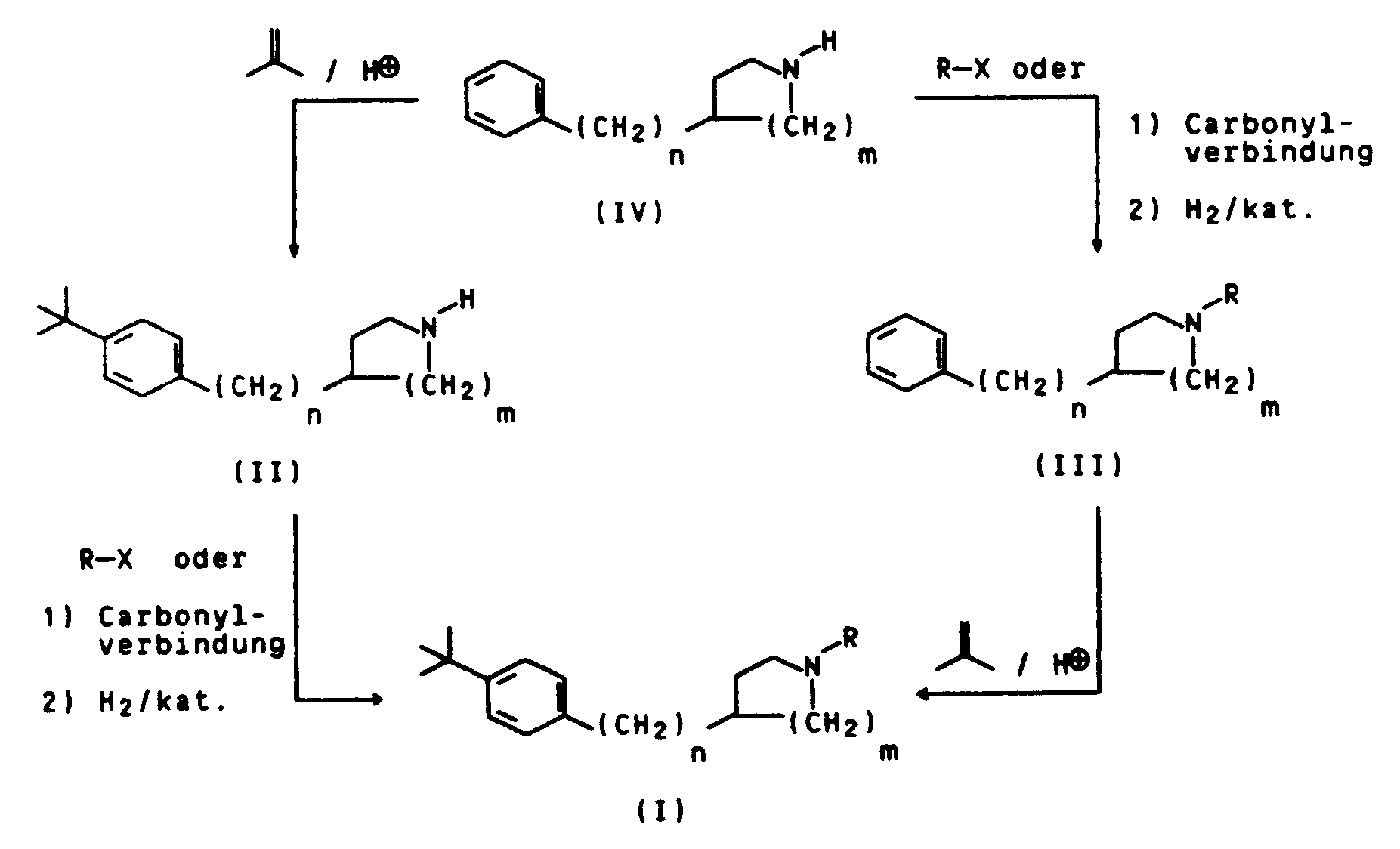
- a) Einführung des Restes R
- a₁) Mit Halogeniden R-X
Die Substitution am Stickstoff der Arylamine II und IV kann in an sich bekannter Weise gegebenenfalls in Gegenwart eines Lösungs- oder Verdünnungsmittels und/oder einer Base und/oder eines Reaktionsbeschleunigers durchgeführt werden. Zur Reaktionsbeschleunigung verwendet man insbesondere Jodide, beispielsweise Kalium- oder Natriumjodid. Als Lösungs- oder Verdünnungsmittel werden die hierfür üblichen eingesetzt wie Chlorkohlenwaserstoffe, z.B. Tetrachlorethylen, Tetrachlorethan, Methylenchlorid, Chloroform, Tetrachlorkohlenstoff, Trichlorethan und Chlorbenzol; Ether, z.B. Di-n-butylether, Di-isopropylether, Tetrahydrofuran, Ethylenglykoldimethylether und Dioxan; Nitrokohlenwasserstoffe, z.B. Nitromethan und Nitrobenzol; Ketone, z.B. Cyclopentanon, Cyclohexanon und Aceton oder Amide, z.B. Formamid, Dimethylformamid und Dimethylacetamid. Als Basen können alle üblichen anorganischen und organischen Säurebindemittel verwendet werden. Hierzu gehören vorzugsweise tertiäre Amine, Alkali- und Erdalkaliverbindungen sowie entsprechende Gemische. - a₂) Mit Carbonylverbindungen
Die Enaminbildung bei der Umsetzung der Amine II und IV mit einer Carbonylverbindung
- a₁) Mit Halogeniden R-X
- b) Einführung der tert.-Butylgruppe in den Aromaten
Arylamine des Typs III und IV lassen sich mit Isobutylen säurekatalysiert in an sich bekannter Weise zu den p-tert.-Butyl-substituierten Phenylverbindungen umsetzen. Geeignete Lösungsmittel sind besonders Halogenkohlenwasserstoffe, wie Methylenchlorid, Chloroform, Tetrachlorkohlenstoff, Tetrachlorethan, Trrichlorethan und Chlorbenzol sowie die hierfür üblichen Lösungsmittel. Man verwendet Mineralsäuren wie beispielsweise Schwefelsäure und führt die Reaktion unter Eiskühlung z.B. bei -5 bis +10°C durch. Das Produkt kann sowohl als Salz, beispielsweise als Hydrogensulfat, oder als freies Amin gewonnen werden. - c) Herstellung von Salzen der N-substituierten Pyrrolidin- und Piperidinverbindungen
Das cyclische tertiäre Amin I kann in einem inerten Lösungsmittel aufgelöst werden und die Salzbildung in an sich bekannter Weise bei gasförmigen Säuren z.B. HCl-Gas durch Einleiten in die Lösung, bei flüssigen Säuren wie Phosphorsäure oder Schwefelsäure durch Zutropfen in equimolaren Mengen, sowie bei festen Säuren durch Lösen einer equimolaren Menge in einem inerten Lösungsmittel und anschließendem Zutropfen erfolgen. Die Reaktion läßt sich bei Raumtemperatur, gegebenenfalls unter Eiskühlung durchführen.
Unter den pflanzenverträglichen Salzen der cyclischen tertiären Amine können beispielsweise diejenigen mit HCl, HBr, HJ, H₂SO₄, H₃PO₄, HNO₃, HCO₂H, CH₃CO₂H, C₂H₅CO₂H oder C₁₂H₂₅-C₆H₅-SO₃H gebildet werden. - Die neuen N-substituierten Pyrrolidin- und Piperidinderivate der Formel I und deren pflanzenphysiologisch verträglichen Salze enthalten gegebenenfalls chirale Zentren. Sie werden im allgemeinen als Racemate oder gegebenenfalls als Diastereomerengemische erhalten. Diastereomerenreine Verbindungen lassen sich bei einigen der neuen Verbindungen beispielsweise durch Destillation, Säulenchromatographie oder aufgrund von Löslichkeitsunterschieden isolieren. Enantiomerenreine Verbindungen lassen sich z.B. durch Racematspaltung mit einem chiralen Hilfsreagenz nach bekannten Methoden beispielsweise über diastereomere Salze erhalten. Für die Anwendung der neuen N-substituierten Pyrrolidin- und Piperidinderivate I und deren pflanzenphysiologisch verträglichen Salze als Fungizide sind sowohl die Diastereomeren bzw. die Enantiomeren als auch deren bei der Synthese anfallenden Stereoisomerengemisch geeignet.
- Der Rest R in den Verbindungen I bedeutet:
- C₁-C₂₀-Alkyl, bevorzugt C₁-C₁₀-Alkyl, besonders bevorzugt C₄-C₉-Alkyl, wie n-Butyl, iso-Butyl, tert.-Butyl, n-Pentyl, iso-Pentyl, n-Hexyl, n-Octyl, n-Nonyl, 4,4-Dimethylpentyl und 3,5,5-Trimethylhexyl, 3,3-Dimethyl-n-butyl, 1,1,2-Trimethyl-n-propyl und 1,1,3,3-Tetramethyl-n-butyl;
- C₂-C₂₀-Alkoxyalkyl, bevorzugt C₂-C₈-Alkoxyalkyl, wie Methoxymethyl, Methoxyethyl, Methoxy-n-propyl, Methoxybutyl, Methoxyhexyl, Ethoxymethyl, Ethoxyethyl, Ethoxybutyl, Propoxymethyl, Propoxyethyl, Butoxymethyl, Butoxypropyl;
- C₂-C₂₀-Hydroxyalkyl, bevorzugt C₂-C₈-Hydroxyalkyl, wie Hydroxyethyl, Hydroxypropyl, Hydroxybutyl, Hydroxyhexyl, Hydroxyoctyl;
- C₃-C₁₂-Cycloalkyl, bevorzugt C₅-C₈-Cycloalkyl, besonders bevorzugt Cyclopentyl und Cyclohexyl;
- C₄-C₂₀-Alkyl-cycloalkyl, bevorzugt C₄-C₁₂-Alkyl-cycloalkyl, besonders bevorzugt C₈-C₁₀-Alkyl-cycloalkyl, wie 3-Methyl-5-n-propyl-cyclohexyl, 3,5-Diethyl-cyclohexyl, 4-(tert.-Butyl)-cyclohexyl, 1-Ethyl-cyclohexyl, 3,3-Dimethyl-cyclohexyl und 3,3,5-Trimethyl-cyclohexyl;
- durch Hydroxy substituiertes C₄-C₂₀-Alkyl-cycloalkyl, bevorzugt durch Hydroxy substituiertes C₄-C₁₂-Alkyl-cycloalkyl, besonders bevorzugt durch Hydroxy substituiertes C₆-C₁₀-Alkyl-cycloalkyl, wie 3,3-Dimethyl-4-hydroxy-cyclohexyl;
- C₄-C₂₀-Cycloalkyl-alkyl, bevorzugt C₄-C₁₂-Cycloalkyl-alkyl, besonders bevorzugt C₆-C₈-Cycloalkyl-alkyl, wie Cyclopentyl-methyl, Cyclopentyl-ethyl, Cyclohexyl-methyl, Cyclohexyl-ethyl und 2-Cyclohexyl-ethyl;
- Aryl, bevorzugt Phenyl und Naphthyl;
- Halogenaryl, bevorzugt Fluor- und Chloraryl, besonders bevorzugt Chloraryl, wie 4-Chlorphenyl, 2,4-Dichlorphenyl und 3,5-Dichlorphenyl;
- C₇-C₂₀-Halogenaryl-alkyl, bevorzugt C₇-C₁₄-Halogenaryl-alkyl, besonders bevorzugt C₇-C₁₀-Fluor- und Chloraryl-alkyl, wie 4-Fluorbenzyl, 4-Chlorbenzyl, 4-Chlorphenylethyl, 4-Chlorphenylpropyl, 4-Chlorphenylbutyl;
- C₈-C₂₀-Trifluormethylaryl-alkyl, bevorzugt C₈-C₁₄-Trifluormethylaryl-alkyl, besonders bevorzugt C₈-C₁₀-Trifluormethylaryl-alkyl, wie 4-Trifluormethylbenzyl und 4-Trifluormethylphenyl-ethyl;
- C₇-C₂₀-Aryloxy-alkyl, bevorzugt C₇-C₁₄-Aryloxy-alkyl, wie Phenoxymethyl, Phenoxyethyl, Phenoxypropyl, Phenoxybutyl, Phenoxyhexyl, Phenoxyoctyl.
- Bei den Indizes sind für m die Zahl 2 besonders bevorzugt und für n die Zahl 0.
- Als pflanzenphysiologisch verträgliche Salze der Verbindungen I werden die Hydrochloride besonders bevorzugt.
- Beispiele für geeignete Verbindungen I sind:


- Die N-substituierten Pyrrolidin- und Piperidinderivate der Formel I und deren pflanzenphysiologisch verträglichen Salze bzw. die sie enthaltenden fungiziden Mittel sowie die daraus hergestellten gebrauchsfertigen Zubereitungen können beispielsweise in Form von direkt versprühbaren Lösungen, Emulsionen, Suspensionen, Stäuben, Pulvern, Pasten oder Granulaten in an sich bekannter Weise, z.B. durch Versprühen, Vernebeln, Verstäuben, Verstreuen, Beizen oder Gießen angewendet werden, Die Anwendungsformen richten sich ganz nach den Verwendungszwecken. Sie sollen in jedem Fall eine feine und gleichmäßige Verteilung der wirksamen Substanz gewährleisten. Die Formulierungen werden in an sich bekannter Weise z.B. durch Verstrecken des Wirkstoffes mit Lösungsmitteln und/oder Trägerstoffen, gegebenenfalls unter Verwendung von Emulgier- oder Dispergiermitteln hergestellt. Als Lösungsmittel werden beispielsweise Aromaten wie Benzol, Toluol oder die Xylole, chlorierte Aromaten wie Chlor- und Brombenzol und deren Derivate, Paraffine wie diverse Erdölfraktionen, Alkohole wie Methanol, Ethanol, n- und iso-Propanol oder n-, iso- und tert.-Butanol, Ketone wie Aceton, Cyclopentanon oder Cyclohexanon, Amine wie Ethanolamin, Dimethylamin, Triethylamin oder Dimethylformamid, oder Wasser verwendet. Bei der Benutzung von Wasser als Verdünnungsmittel werden Lösungsvermittler gebraucht. Als solche dienen organische Lösungsmittel, die mit Wasser mischbar oder gegebenenfalls nur teilweise mischbar sind wie Aceton, Methanol, Ethanol, Ethanolamin, Dimethylamin oder Triethylamin. Als Trägerstoffe eignen sich natürliche Gesteinsmehle wie Kaolin, Kreide, Talkum oder Tonerde, oder synthetische Gesteinsmehle wie hochdisperse Kieselsäure oder Silikate. Als Emulgatoren werden nichtionogene oder anionische wie z.B. Polyoxyethylen-Fettalkohol-Ether, Alkyl- oder Arylsulfonate und als Dispergiermittel beispielsweise Lignin, Sulfitablaugen oder Methylcellulose verwendet.
- Die N-substituierten Pyrrolidin- und Piperidinderivate der Formel I zeichnen sich durch eine hervorragende Wirksamkeit gegen ein breites Spektrum von pflanzenpathogenen Pilzen, insbesondere aus der Klasse der Ascomyceten und Basidiomyceten, aus. Sie sind z.T. systemisch wirksam und können als Blatt- und/oder Bodenfungizide eingesetzt werden.
- Besonders wichtig sind die Verbindungen I für die Bekämpfung einer Vielzahl von Pilzen an verschiedenen Kulturpflanzen und/oder deren Samen, beispielsweise für Weizen, Roggen, Gerste, Hafer, Reis, Mais, Baumwolle, Soja, Kaffee, Zuckerrohr, Erdnüsse, Obst oder Zierpflanzen im Garten- oder Weinbau, sowie für Gemüse, wie Gurken, Bohnen oder Kürbisgewächse.
- Die Verbindungen I eignen sich besonders zur Bekämpfung der aufgeführten Pflanzenkrankheiten in/an den entsprechenden Nutzpflanzen.


- Die fungiziden Mittel enthalten im allgemeinen zwischen 0,1 und 95 Gew.%, vorzugsweise zwischen 0,5 und 90 Gew.% Wirkstoff.
- Die Aufwandmengen an Wirkstoff betragen je nach Art des gewünschten Effektes zwischen 0,02 und 3 kg Wirkstoff/ha oder darüber. Die Applikation der N-substituierten Pyrrolidin- und Piperidinderivate I erfolgt vor oder nach der Infektion der Pflanzen oder Samen entweder durch Besprühen oder Bestäuben.
- Die Verbindungen I können auch im Materialschutz, beispielsweise zur Bekämpfung holzzerstörender Pilze wie Coniophora puteanea oder Polystictus versicolor eingesetzt werden.
- Ferner lassen sich diese Verbindungen auch als fungizid wirksame Bestandteile öliger Holzschutzmittel gegen holzverfärbende Pilze, z.B. durch Anstreichen oder Tränken des Holzes, verwenden.
- Einige der Verbindungen I eignen sich zur Bekämpfung hautpathogener Pilze, wie Trichophyton mentagrophytes oder Candida albicans.
- Die N-substituierten Pyrrolidin- und Piperidinderivate I können auch mit anderen Wirkstoffen, wie z.B. Herbiziden, Insektiziden, Wachstumsregulatoren oder Düngemitteln vermischt und ausgebracht werden.
- Eine Lösung von 434 mmol eines cyclischen Amins II, 430 mmol eines Halogenids R-X und 1,3 mol Natriumcarbonat in 400 ml Dimethylformamid wurde 8 Stunden auf 150°C erhitzt, wonach das Reaktionsgemisch wie üblich aufgearbeitet wurde.
- Einzelheiten und Ergebnisse sind Tabelle 1 zu entnehmen.

-
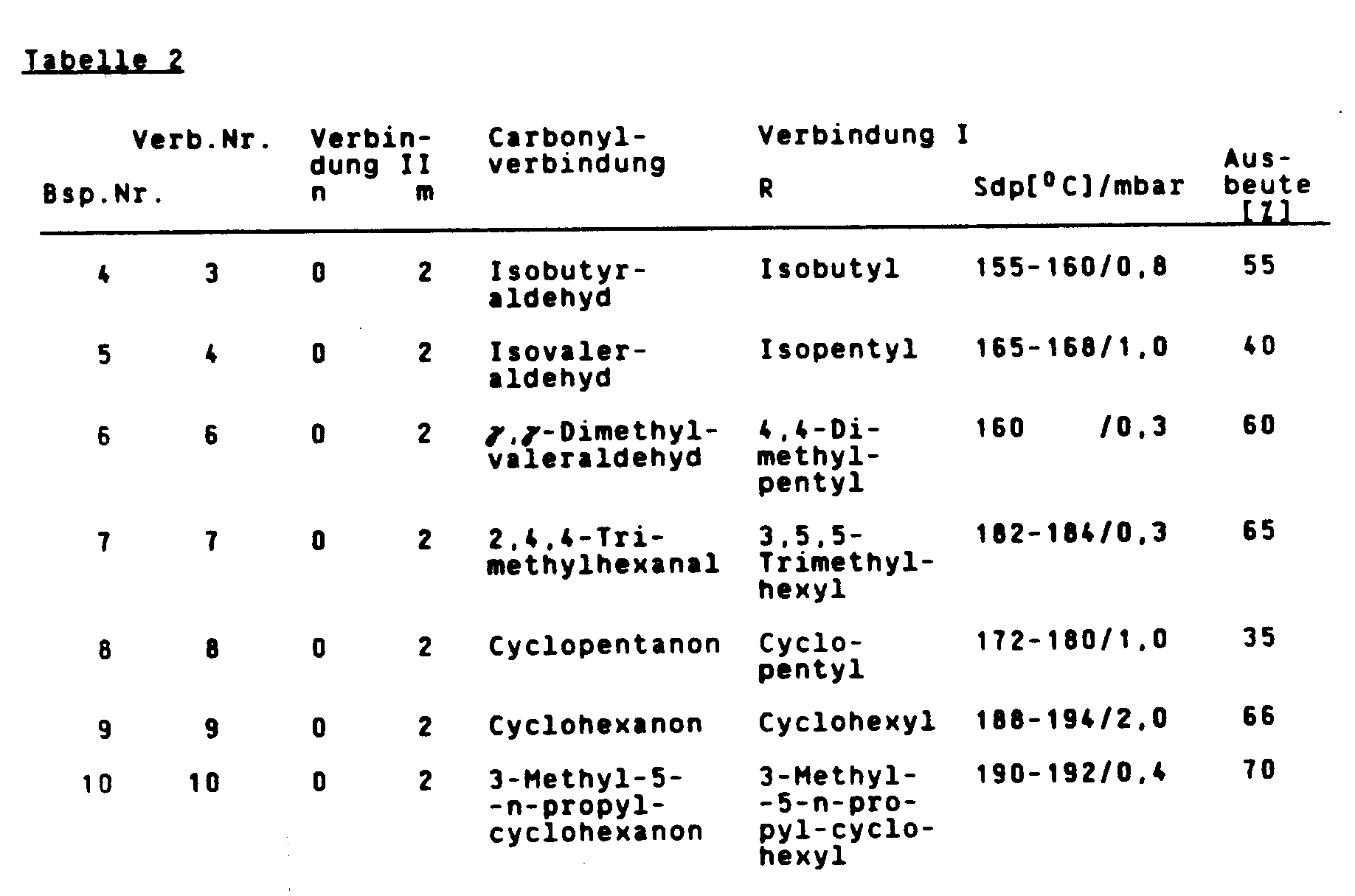
- a) Darstellung der Enamine
Eine Lösung von 2 mol eines cyclischen Amins II, 1 mol einer Carbonylverbindung und 1 g Toluolsulfonsäure in 400 ml Toluol wurden am Wasserabscheider erhitzt und wie üblich aufgearbeitet. - b) Hydrierung der Enamine
Eine Lösung von 460 mmol Enamin in 1 l Essigsäure-ethylester wurde in Gegenwart von 10 g 10proz. Pd/C bei 60 bis 70°C und 100 bar hydriert und wie üblich aufgearbeitet. - Einzelheiten und Ergebnisse sind in Tabelle 2 zusammengestellt.

- Zu einer Lösung von 275 mmol eines cyclischen Amins in 500 ml Methylenchlorid wurde unter Eiskühlung bei 5 bis 10°C 1,4 mol konz. Schwefelsäure zugetropft und anschließend bei 10 bis 15°C 375 mmol Isobutylen eingegast. Nach einstündigem Rühren bei Raumtemperatur wurde wie üblich aufgearbeitet.
- Einzelheiten und Ergebnisse sind Tabelle 3 zu entnehmen.

- In eine Lösung von 73 mmol N-Isobutyl-4-(p-tert.-butylphenyl)-piperidin wurde HCl-Gas bei Raumtemperatur eingeleitet. Die übliche Aufarbeitung lieferte 67 % der Verbindung 32; Smp. 246°C (unter Zersetzung).
- Blätter von in Töpfen gewachsenen Gurkenkeimlingen der Sorte "Chinesische Schlange" wurden im Zweiblattstadium mit einer Sporensuspension des Gurkenmehltaus (Erysiphe cichoracearum und Sphaerotheca fuliginea) besprüht. Nach etwa 20 Stunden wurden die Versuchspflanzen mit einer wäßrigen Spritzbrühe, die 80 Gew.% Wirkstoff und 20 Gew.% Emulgiermittel in der Trockensubstanz enthielt, bis zur Tropfnässe besprüht. Nach dem Antrocknen des Spritzbelages wurden sie anschließend im Gewächshaus bei Temperaturen zwischen 20 und 22°C und 70 bis 80 % relativer Luftfeuchtigkeit aufgestellt. Zur Beurteilung der Wirksamkeit der neuen Stoffe wurde das Ausmaß der Pilzentwicklung nach 21 Tagen ermittelt.
- Das Ergebnis des Versuches zeigte, daß die Verbindungen 4, 5, 6, 7, 8, 9, 13, 14, 23, 24 und 32 der Beispiele 1, 2, 4, 5, 6, 7, 8, 10, 11, 12, 13, 14, 15 und 16 bei der Anwendung als 0.025 %ige Spritzbrühe eine bessere fungizide Wirkung (mit 97 bis 100 %) zeigten als die Vergleichsverbindung Fenpropimorph (mit 70 %).
- Blätter von Topfreben der Sorte "Muller-Thurgau" wurden mit einer wäßrigen Spritzbrühe, die 80 Gew.% Wirkstoff und 20 Gew.% Emulgiermittel in der Trockensubstanz enthielt, besprüht. Um die Wirkungsdauer der Wirkstoffe beurteilen zu können, wurden die Pflanzen nach dem Antrocknen des Spritzbelages 8 Tage im Gewächshaus aufgestellt. Erst dann wurden die Blätter mit einer Zoosporenaufschwemmung von Plasmopara viticola (Rebenperonospora) infiziert. Danach wurden die Reben zunächst für 48 Stunden in einer wasserdampfgesättigten Kammer bei 24°C und anschließend für 5 Tage in einem Gewächshaus mit Temperaturen zwischen 20 und 30°C aufgestellt. Nach dieser Zeit wurden die Pflanzen zur Beschleunigung des Sporangienträgerausbruches abermals für 16 Stunden in der feuchten Kammer aufgestellt. Dann erfolgte die Beurteilung des Ausmaßes des Pilzausbruches auf den Blattunterseiten.
- Das Ergebnis des Versuches zeigte, daß die Verbindungen 4, 5, 6, 7, 8, 9, 10, 13, 14, 23, 24 und 32 der Beispiele 1, 2, 4, 5, 6, 7, 9, 10, 11, 13, 13, 14 und 16 bei der Anwendung als 0,05 %ige Spritzbrühe eine bessere fungizide Wirkung (mit 90 bis 100 %) zeigten als die Vergleichsverbindung Fenpropimorph (mit 50 %).
- Die Blätter von in Töpfen gewachsenen Weizenkeimlingen der Sorte "Jubilar" wurden mit einer wäßrigen Spritzbrühe, die 80 Gew.% Wirkstoff und 20 Gew.% Emulgiermittel in der Trockensubstanz enthielt, bis zur Tropfnässe besprüht. Am folgenden Tag wurden die angetrockneten Pflanzen mit einer wäßrigen Sporensuspension von Septoria nodorum infiziert und dann für 7 Tage bei 17 bis 19°C und 95 %iger relativer Luftfeuchtigkeit weiter kultiviert. Das Ausmaß des Pilzbefalls wurde dann visuell eimittelt.
- Das Ergebnis des Versuches zeigte, daß die Verbindungen 3, 4, 8, 13 und 14 der Beispiele 2, 4, 7, 10 und 14 bei der Anwendung als 0,05 %ige Spritzbrühe eine bessere fungizide Wirkung (mit 97 bis 100 %) zeigen als die Vergleichsverbindung Fenpropimorph (mit 90 %).
Claims (7)
- Verfahren zur Herstellung von N-substituierten Pyrrolidin- und Piperidinderivaten der allgemeinen Formel I
 R C₁-C₂₀-Alkyl, C₂-C₂₀-Alkoxyalkyl, C₂-C₂₀-Hydroxyalkyl, C₃-C₁₂-Cycloalkyl, C₄-C₂₀-Alkyl-cycloalkyl, durch Hydroxy substituiertes C₄-C₂₀-Alkyl-cycloalkyl, C₄-C₂₀-Cycloalkyl-alkyl, Aryl, Halogenaryl, C₇-C₂₀-Halogenaryl-alkyl, C₈-C₂₀-Trifluormethylaryl-alkyl oder C₇-C₂₀-Aryloxy-alkyl,m 1 oder 2,n 0 oder 1bedeuten und deren pflanzenphysiologisch verträgliche Salze, dadurch gekennzeichnet, daß mana) die Verbindungen II
 a₁) mit einem Halogenid der Formel R-X, in der X Chlor, Brom oder Jod bedeutet, odera₂) mit einer Carbonylverbindung
 b) die Verbindungen IIIund gegebenenfalls in an sich bekannter Weise in deren Salze überführt.
- Fungizid, enthaltend eine Verbindung I oder eines ihrer pflanzenphysiologisch verträglichen Salze neben hierfür üblichen Trägerstoffen.
- Verwendung der Verbindungen I und deren pflanzenphysiologisch verträgliche Salze als Fungizide.
- Verfahren zur Bekämpfung von Pilzen, dadurch gekennzeichnet, daß man die Pilze oder die vom Pilzbefall bedrohten Materialien, Pflanzen, Saatgüter oder Böden mit einem Fungizid gemäß Anspruch 2 behandelt.
Applications Claiming Priority (2)
| Application Number | Priority Date | Filing Date | Title |
|---|---|---|---|
| DE19863614907 DE3614907A1 (de) | 1986-05-02 | 1986-05-02 | N-substituierte pyrrolidon- und piperidinderivate und deren salze |
| DE3614907 | 1986-05-02 |
Publications (3)
| Publication Number | Publication Date |
|---|---|
| EP0244739A2 EP0244739A2 (de) | 1987-11-11 |
| EP0244739A3 EP0244739A3 (en) | 1988-04-06 |
| EP0244739B1 true EP0244739B1 (de) | 1994-07-27 |
Family
ID=6300035
Family Applications (1)
| Application Number | Title | Priority Date | Filing Date |
|---|---|---|---|
| EP87106161A Expired - Lifetime EP0244739B1 (de) | 1986-05-02 | 1987-04-28 | N-substituierte Pyrrolidin- und Piperidinderivate und deren Salze |
Country Status (6)
| Country | Link |
|---|---|
| EP (1) | EP0244739B1 (de) |
| JP (1) | JPS62277353A (de) |
| AT (1) | ATE109132T1 (de) |
| CA (1) | CA1297880C (de) |
| DE (2) | DE3614907A1 (de) |
| ES (1) | ES2056795T3 (de) |
Families Citing this family (11)
| Publication number | Priority date | Publication date | Assignee | Title |
|---|---|---|---|---|
| DE3732930A1 (de) * | 1987-09-30 | 1989-04-20 | Basf Ag | Fungizide n-substituierte 3-aryl-pyrrolidin-derivate |
| DE3732910A1 (de) * | 1987-09-30 | 1989-04-20 | Basf Ag | Fungizide n-substituierte 3-alkyl-4-aryl-pyrrolidin-derivate |
| US5192767A (en) * | 1987-10-14 | 1993-03-09 | Basf Aktiengesellschaft | 3-substituted pyridines and fungicides containing them |
| DE3901244A1 (de) * | 1989-01-18 | 1990-07-19 | Basf Ag | Phenylalkylamine und diese enthaltende fungizide |
| GB8929331D0 (en) * | 1989-12-29 | 1990-02-28 | Shell Int Research | Piperidine derivatives |
| US5169855A (en) * | 1990-03-28 | 1992-12-08 | Du Pont Merck Pharmaceutical Company | Piperidine ether derivatives as psychotropic drugs or plant fungicides |
| GB9100505D0 (en) * | 1991-01-10 | 1991-02-20 | Shell Int Research | Piperidine derivatives |
| ATE201669T1 (de) * | 1991-04-17 | 2001-06-15 | Upjohn Co | Substituierte (s)-3-phenylpiperidin derivate, deren herstellung und deren verwendung als dopamin autorezeptor antagonisten |
| GB9113031D0 (en) * | 1991-06-17 | 1991-08-07 | Smithkline Beecham Plc | Compounds |
| AU4566093A (en) * | 1992-07-08 | 1994-01-31 | Shell Internationale Research Maatschappij B.V. | Piperidine derivatives |
| CO5150201A1 (es) * | 1998-09-07 | 2002-04-29 | Hoffmann La Roche | Derivados de piperidina |
Family Cites Families (4)
| Publication number | Priority date | Publication date | Assignee | Title |
|---|---|---|---|---|
| CH636858A5 (de) * | 1977-01-17 | 1983-06-30 | Ciba Geigy Ag | Verfahren zur herstellung neuer phenylazacycloalkane. |
| DE2727482A1 (de) * | 1977-06-18 | 1979-01-11 | Basf Ag | Derivate cyclischer amine |
| FI792076A7 (fi) * | 1978-07-05 | 1981-01-01 | Ciba Geigy Ag | Menetelmä uusien fenyylipiperidiinijohdannaisten valmistamiseksi. |
| DE3441927A1 (de) * | 1984-11-16 | 1986-05-28 | Basf Ag, 6700 Ludwigshafen | Am stickstoff substituierte 4-(p-tert.butyl-phenyl)-3-methyl-piperidine, dessen quartaere salze sowie deren anwendung als fungizide |
-
1986
- 1986-05-02 DE DE19863614907 patent/DE3614907A1/de not_active Withdrawn
-
1987
- 1987-04-28 ES ES87106161T patent/ES2056795T3/es not_active Expired - Lifetime
- 1987-04-28 EP EP87106161A patent/EP0244739B1/de not_active Expired - Lifetime
- 1987-04-28 DE DE3750274T patent/DE3750274D1/de not_active Expired - Lifetime
- 1987-04-28 AT AT87106161T patent/ATE109132T1/de not_active IP Right Cessation
- 1987-04-30 CA CA000536072A patent/CA1297880C/en not_active Expired - Lifetime
- 1987-05-01 JP JP62106518A patent/JPS62277353A/ja active Pending
Also Published As
| Publication number | Publication date |
|---|---|
| DE3750274D1 (de) | 1994-09-01 |
| EP0244739A3 (en) | 1988-04-06 |
| DE3614907A1 (de) | 1987-11-05 |
| ES2056795T3 (es) | 1994-10-16 |
| EP0244739A2 (de) | 1987-11-11 |
| JPS62277353A (ja) | 1987-12-02 |
| CA1297880C (en) | 1992-03-24 |
| ATE109132T1 (de) | 1994-08-15 |
Similar Documents
| Publication | Publication Date | Title |
|---|---|---|
| DE2333354C2 (de) | 2-Aryloxy-2-(imidazol-1-yl)-äthanole sowie deren Salze, Verfahren zu ihrer Herstellung und ihre Verwendung als Fungizide | |
| EP0482410A2 (de) | Antimikrobielle Mittel sowie substituierte 2-Cyclohexan-1-yl-amin-Derivate und deren Herstellung | |
| DE2350123C2 (de) | 1-Propyl-imidazol-Derivate und deren Salze, Verfahren zu ihrer Herstellung und ihre Verwendung als Fungizide | |
| EP0040744B1 (de) | Aminopropiophenon-oxime, Verfahren zu ihrer Herstellung und ihre Verwendung als Fungizide | |
| DE2743767A1 (de) | Diastereomere triazolyl-0,n-acetale, verfahren zu ihrer herstellung sowie ihre verwendung als fungizide | |
| EP0244739A2 (de) | N-substituierte Pyrrolidin- und Piperidinderivate und deren Salze | |
| DE2816817A1 (de) | Oximino-triazolyl-aethane, verfahren zu ihrer herstellung sowie ihre verwendung als fungizide | |
| DE2825961A1 (de) | Fungizide amine | |
| DE2600799A1 (de) | Acylierte triazolyl-0,n-acetale, verfahren zu ihrer herstellung und ihre verwendung als fungizide | |
| EP0269041B1 (de) | Fungizide Cyclohexylamine | |
| DD158850A5 (de) | Aminopropanol-derivate,verfahren zu ihrer herstellung und ihre verwendung als fungizide | |
| EP0243940B1 (de) | Phenyl-und Cyclohexyl-Isobutylpyrrolidinderivate | |
| EP0164706B1 (de) | Phenylalkylamine - Bioregulatoren | |
| EP0161455B1 (de) | Beta-naphthylalkylamine | |
| DE2334352A1 (de) | Im heterocyclus halogenierte triazolderivate, verfahren zu ihrer herstellung und ihre verwendung als fungizide | |
| DE2827968A1 (de) | Sulfenylierte carbamoyl-triazolyl- o,n-acetale, verfahren zu ihrer herstellung und ihre verwendung als fungizide | |
| DE3321023A1 (de) | Triazolylalkohole, verfahren zu ihrer herstellung und ihre verwendung als fungizide | |
| EP0309913B1 (de) | Fungizide N-substituierte 3-Aryl-pyrrolidin-Derivate | |
| DE3033380C2 (de) | ||
| EP0351647A2 (de) | 2,2-Difluorcyclopropyl-Derivate | |
| EP0003975B1 (de) | Dichlormaleinsäurediamid-Derivate, Verfahren zu ihrer Herstellung und ihre Verwendung als Fungizide | |
| DE3716559A1 (de) | Hydroxyalkyl-triazolyl-derivate | |
| DE2201063C3 (de) | 1,2,4-Triazol-Derivate, Verfahren zu ihrer Herstellung und ihre Verwendung als Fungizide | |
| EP0123179B1 (de) | Phosphorylierte Azolyl-Derivate, Verfahren zu ihrer Herstellung sowie ihre Verwendung als Fungizide | |
| DD152466A5 (de) | Fungizide mittel |
Legal Events
| Date | Code | Title | Description |
|---|---|---|---|
| PUAI | Public reference made under article 153(3) epc to a published international application that has entered the european phase |
Free format text: ORIGINAL CODE: 0009012 |
|
| AK | Designated contracting states |
Kind code of ref document: A2 Designated state(s): AT BE CH DE ES FR GB GR IT LI NL SE |
|
| PUAL | Search report despatched |
Free format text: ORIGINAL CODE: 0009013 |
|
| AK | Designated contracting states |
Kind code of ref document: A3 Designated state(s): AT BE CH DE ES FR GB GR IT LI NL SE |
|
| 17P | Request for examination filed |
Effective date: 19880219 |
|
| 17Q | First examination report despatched |
Effective date: 19890921 |
|
| GRAA | (expected) grant |
Free format text: ORIGINAL CODE: 0009210 |
|
| AK | Designated contracting states |
Kind code of ref document: B1 Designated state(s): AT BE CH DE ES FR GB GR IT LI NL SE |
|
| REF | Corresponds to: |
Ref document number: 109132 Country of ref document: AT Date of ref document: 19940815 Kind code of ref document: T |
|
| REF | Corresponds to: |
Ref document number: 3750274 Country of ref document: DE Date of ref document: 19940901 |
|
| ITF | It: translation for a ep patent filed | ||
| GBT | Gb: translation of ep patent filed (gb section 77(6)(a)/1977) |
Effective date: 19940816 |
|
| REG | Reference to a national code |
Ref country code: ES Ref legal event code: FG2A Ref document number: 2056795 Country of ref document: ES Kind code of ref document: T3 |
|
| REG | Reference to a national code |
Ref country code: GR Ref legal event code: FG4A Free format text: 3012844 |
|
| ET | Fr: translation filed | ||
| EAL | Se: european patent in force in sweden |
Ref document number: 87106161.0 |
|
| PGFP | Annual fee paid to national office [announced via postgrant information from national office to epo] |
Ref country code: FR Payment date: 19950327 Year of fee payment: 9 |
|
| PGFP | Annual fee paid to national office [announced via postgrant information from national office to epo] |
Ref country code: SE Payment date: 19950328 Year of fee payment: 9 Ref country code: CH Payment date: 19950328 Year of fee payment: 9 |
|
| PGFP | Annual fee paid to national office [announced via postgrant information from national office to epo] |
Ref country code: GR Payment date: 19950330 Year of fee payment: 9 |
|
| PGFP | Annual fee paid to national office [announced via postgrant information from national office to epo] |
Ref country code: AT Payment date: 19950405 Year of fee payment: 9 |
|
| PGFP | Annual fee paid to national office [announced via postgrant information from national office to epo] |
Ref country code: GB Payment date: 19950418 Year of fee payment: 9 Ref country code: ES Payment date: 19950418 Year of fee payment: 9 |
|
| PGFP | Annual fee paid to national office [announced via postgrant information from national office to epo] |
Ref country code: DE Payment date: 19950427 Year of fee payment: 9 |
|
| PGFP | Annual fee paid to national office [announced via postgrant information from national office to epo] |
Ref country code: NL Payment date: 19950430 Year of fee payment: 9 |
|
| PGFP | Annual fee paid to national office [announced via postgrant information from national office to epo] |
Ref country code: BE Payment date: 19950508 Year of fee payment: 9 |
|
| PLBE | No opposition filed within time limit |
Free format text: ORIGINAL CODE: 0009261 |
|
| STAA | Information on the status of an ep patent application or granted ep patent |
Free format text: STATUS: NO OPPOSITION FILED WITHIN TIME LIMIT |
|
| 26N | No opposition filed | ||
| PG25 | Lapsed in a contracting state [announced via postgrant information from national office to epo] |
Ref country code: DE Effective date: 19960424 |
|
| PG25 | Lapsed in a contracting state [announced via postgrant information from national office to epo] |
Ref country code: GB Effective date: 19960428 Ref country code: AT Effective date: 19960428 |
|
| PG25 | Lapsed in a contracting state [announced via postgrant information from national office to epo] |
Ref country code: SE Effective date: 19960429 Ref country code: ES Free format text: LAPSE BECAUSE OF NON-PAYMENT OF DUE FEES Effective date: 19960429 |
|
| PG25 | Lapsed in a contracting state [announced via postgrant information from national office to epo] |
Ref country code: LI Effective date: 19960430 Ref country code: CH Effective date: 19960430 Ref country code: BE Effective date: 19960430 |
|
| BERE | Be: lapsed |
Owner name: BASF A.G. Effective date: 19960430 |
|
| PG25 | Lapsed in a contracting state [announced via postgrant information from national office to epo] |
Ref country code: GR Free format text: THE PATENT HAS BEEN ANNULLED BY A DECISION OF A NATIONAL AUTHORITY Effective date: 19961031 |
|
| PG25 | Lapsed in a contracting state [announced via postgrant information from national office to epo] |
Ref country code: NL Effective date: 19961101 |
|
| REG | Reference to a national code |
Ref country code: GR Ref legal event code: MM2A Free format text: 3012844 |
|
| REG | Reference to a national code |
Ref country code: CH Ref legal event code: PL |
|
| GBPC | Gb: european patent ceased through non-payment of renewal fee |
Effective date: 19960428 |
|
| PG25 | Lapsed in a contracting state [announced via postgrant information from national office to epo] |
Ref country code: FR Effective date: 19961227 |
|
| NLV4 | Nl: lapsed or anulled due to non-payment of the annual fee |
Effective date: 19961101 |
|
| EUG | Se: european patent has lapsed |
Ref document number: 87106161.0 |
|
| REG | Reference to a national code |
Ref country code: FR Ref legal event code: ST |
|
| REG | Reference to a national code |
Ref country code: ES Ref legal event code: FD2A Effective date: 19990201 |
|
| PG25 | Lapsed in a contracting state [announced via postgrant information from national office to epo] |
Ref country code: IT Free format text: LAPSE BECAUSE OF NON-PAYMENT OF DUE FEES;WARNING: LAPSES OF ITALIAN PATENTS WITH EFFECTIVE DATE BEFORE 2007 MAY HAVE OCCURRED AT ANY TIME BEFORE 2007. THE CORRECT EFFECTIVE DATE MAY BE DIFFERENT FROM THE ONE RECORDED. Effective date: 20050428 |