EP0243341A2 - Biopsy device for sampling tissue probes and application of substances in one operation - Google Patents
Biopsy device for sampling tissue probes and application of substances in one operation Download PDFInfo
- Publication number
- EP0243341A2 EP0243341A2 EP87890076A EP87890076A EP0243341A2 EP 0243341 A2 EP0243341 A2 EP 0243341A2 EP 87890076 A EP87890076 A EP 87890076A EP 87890076 A EP87890076 A EP 87890076A EP 0243341 A2 EP0243341 A2 EP 0243341A2
- Authority
- EP
- European Patent Office
- Prior art keywords
- biopsy
- channel
- application
- cannula
- wall
- Prior art date
- Legal status (The legal status is an assumption and is not a legal conclusion. Google has not performed a legal analysis and makes no representation as to the accuracy of the status listed.)
- Granted
Links
Images
Classifications
-
- A—HUMAN NECESSITIES
- A61—MEDICAL OR VETERINARY SCIENCE; HYGIENE
- A61B—DIAGNOSIS; SURGERY; IDENTIFICATION
- A61B10/00—Instruments for taking body samples for diagnostic purposes; Other methods or instruments for diagnosis, e.g. for vaccination diagnosis, sex determination or ovulation-period determination; Throat striking implements
- A61B10/02—Instruments for taking cell samples or for biopsy
- A61B10/0233—Pointed or sharp biopsy instruments
- A61B10/0283—Pointed or sharp biopsy instruments with vacuum aspiration, e.g. caused by retractable plunger or by connected syringe
-
- A—HUMAN NECESSITIES
- A61—MEDICAL OR VETERINARY SCIENCE; HYGIENE
- A61M—DEVICES FOR INTRODUCING MEDIA INTO, OR ONTO, THE BODY; DEVICES FOR TRANSDUCING BODY MEDIA OR FOR TAKING MEDIA FROM THE BODY; DEVICES FOR PRODUCING OR ENDING SLEEP OR STUPOR
- A61M5/00—Devices for bringing media into the body in a subcutaneous, intra-vascular or intramuscular way; Accessories therefor, e.g. filling or cleaning devices, arm-rests
- A61M5/14—Infusion devices, e.g. infusing by gravity; Blood infusion; Accessories therefor
- A61M5/158—Needles for infusions; Accessories therefor, e.g. for inserting infusion needles, or for holding them on the body
- A61M5/1582—Double lumen needles
-
- A—HUMAN NECESSITIES
- A61—MEDICAL OR VETERINARY SCIENCE; HYGIENE
- A61M—DEVICES FOR INTRODUCING MEDIA INTO, OR ONTO, THE BODY; DEVICES FOR TRANSDUCING BODY MEDIA OR FOR TAKING MEDIA FROM THE BODY; DEVICES FOR PRODUCING OR ENDING SLEEP OR STUPOR
- A61M25/00—Catheters; Hollow probes
- A61M25/0021—Catheters; Hollow probes characterised by the form of the tubing
- A61M25/0023—Catheters; Hollow probes characterised by the form of the tubing by the form of the lumen, e.g. cross-section, variable diameter
- A61M25/0026—Multi-lumen catheters with stationary elements
- A61M25/0032—Multi-lumen catheters with stationary elements characterized by at least one unconventionally shaped lumen, e.g. polygons, ellipsoids, wedges or shapes comprising concave and convex parts
Definitions
- the invention relates to a biopsy device for obtaining tissue samples and applying substances in one operation. It is known that there are various bioptical techniques for taking tissue samples from animal and human organs based on the principle of a single-channel needle with suction device and / or cutting device, with and without a trocar. Multi-lumen cannulas and needles are also known (DE-PS No. 818 246 and DE-OS 2643594), which, however, are not suitable for biopsy removal and substance application in one operation.
- suction biopsy is based on the principle given by Menghini (Menghini, G. 1957: Un effettivo progresso nella tecnica della puntura biopsia del fegato. Rass. Fisiopat. Clin. Ter. 29, 756).
- This is a hollow needle with an average diameter of 1.4 mm with a possible attachment for a syringe with which a negative pressure (suction) is applied after piercing the skin and before the actual organ puncture.
- the organ puncture liver then takes place in a fraction of a second with continued suction.
- the cutting biopsy is in principle carried out with a cannula ground at the front end.
- the cutting device and the lumen of the cannula are protected during the puncture process by a stylet inserted into the cannula lumen, which is removed after the puncture. Only then is a cylindrical piece of tissue cut out of the punctured organ under suction with a rotating, forward-directed movement (for example: Tru-Cut needle, Travenol company).
- Lung tissue cutting biopsies have a relatively high complication rate due to bleeding events and pneumothorax (McEvoy, RD, Begley, MD, Antic, R. 1983: Percutaneous Biopsy of Intrapulmonary Mass Lesions. Cancer 51, 2321).
- mesevoy, RD, Begley, MD, Antic, R. 1983 Percutaneous Biopsy of Intrapulmonary Mass Lesions. Cancer 51, 2321).
- the subsequent sealing of the puncture channel with resorbable material was recommended, in particular to prevent bleeding complications (Riley, SA, Irving, HC, Axon, ATR, Ellis, WR, Lintott, DJ, Losowsky MS 1984: Percutaneous liver biopsy with plugging the needle track: a safe method for use in patients with impaired coagulation. Lancet, Aug.
- the biopsy device is characterized in that a biopsy cannula is provided which extends over its longitudinal extent to form a biopsy channel and one or more
- the application channels are designed with two or more lumens, with at least the transverse diameter of the biopsy channel being retained over the entire length of the cannula and furthermore a cross section with respect to a longitudinal plane having the full cannula diameter, the inner limitation of the cannula lumens being provided by a partition wall which continuously merges into the outer cannula wall takes place so that the biopsy channel does not have any corners or edges that impair the quality of the tissue sample, and furthermore biopsy and application channels or application channels communicate with one another in the area of the cannula tip, and furthermore there are connection options for suction and application devices at the proximal end of the cann
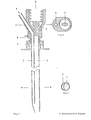
- FIG. 1 shows a longitudinal section through a two-channel needle
- FIG. 3 shows a cross section in the area of the two-channel needle along line B in FIG. 1
- FIG. 2 shows a cross section of the two-channel needle in the area of the attachment devices for generating a positive and / or negative pressure
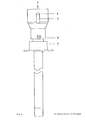
- FIG. 4 shows a front view of the two-channel version
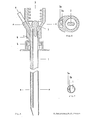
- FIG. 5 shows a longitudinal section of a three-channel needle
- FIG. 7 shows a cross section in the region of the three-channel needle along line B of FIG. 5
- FIG. 6 shows a cross section the three-channel needle in the area of the attachment devices along the line A of FIG. 5
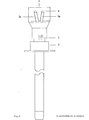
- FIG. 8 is a front view of the three-channel version.
- Fig. 9 shows the longitudinal section
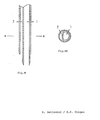
- Fig. 10 shows the cross section in line B-B of the cutting end of a two-channel needle.
- the puncture needle consists of a biopsy channel -1-, which also records the largest cross-sectional diameter of the needle.
- the separation from the application channel -2- or from the application channels -2a, 2b- is carried out by a partition -9- in such a way that there are no corners and edges in the biopsy channel -1- which could impair the quality of the tissue samples.
- a smaller space of the puncture needle, which is separated from the main channel, functions as the application channel.
- the channels can also be separated, for example, by two thin-walled tubes (Fig. 9, Fig. 10) that are adapted to one another and eccentrically pushed into one another. In the examples shown in FIG. 1 to FIG.
- the partition wall -9- between the biopsy channel -1- and the application channel -2- or application channels - 2 a, 2 b- does not reach as far as the cutting end of the cannula, so that the biopsy channel -1- and application channel (channels) -2, 2 a, 2 b- are connected to each other in the area of the needle tip.
- the outer wall of the application channel -2- or the application channels -2 a, 2 b- is directed inward in the area of the tip, so that the cutting end extends to the course of the biopsy channel -1-.
- the needle is ground according to the usual guidelines for suction or cutting biopsies.
- FIG. 10 The embodiment of the biopsy apparatus corresponding to the longitudinal section, and 9 shown in the Figure in -.
- Cross-section shown in Fig 10 on the line BB of F ig.. 9 shows that the cutting end is formed solely by the biopsy channel -1- ending at right angles to the longitudinal axis, the wall of which is ground at an acute angle, and that the application channel -2- formed by an eccentrically pushed tube over the wall of the biopsy needle does not reach the cutting end and the latter Wall is ground at an obtuse angle, so that a smooth transition of the outer wall of the biopsy channel -1- into the outer wall of the application channel -2- is effected in the section in which both channels touch.
- a bolt -7- which does not completely close the lumen of the needle and which is used to aspirate the tissue sample into the vacuum system which can be connected at -3- (for example syringe with locking) prevented.
- -4- represents the starting point for an application system whose arrangement and design (for example cone, thread etc.) can be adapted to the respective requirements (for example a system under pressure).
- the puncture depth is limited and the application system is controlled by a mechanism mounted on the needle, consisting of a part -6- attached to the cannula and having one or more contact points and a movable part - 5- having one or more contact points, which is operated by a spring -8- is held in the starting position.
- part -5- After reaching a certain puncture depth, part -5- is moved towards part -6- after contact with the body surface until the stop is reached and the contact is closed.
- the number of arrangement of contact points can be adapted to the requirements for controlling the application system.
- a mechanical system is also conceivable without changing the essence of the invention.
- the puncture is carried out according to the Menghini technique, in which, after piercing the skin, a negative pressure is created with the aid of a lockable syringe attached to the -3- position.
- the needle is then further inserted into the tissue (organ) to be punctured. After reaching the stop -5-, the needle is withdrawn immediately.
- substances for example blood coagulation substances, vasoactive pharmaceuticals, cytostatics, antibiotics etc.
- the design enables tissue removal and application of substances coordinated with the puncture procedure in one operation. As a result, the duration of the intervention is greatly reduced compared to previously known methods cuts.
- the arrangement of the channels ensures, despite the presence of additional channels, a minimum overall cannula diameter with a constant quality of the tissue sample taken for the histological diagnosis.
- this needle enables the puncture channel to be easily sealed with coagulation-active substances.
- the indications for punctures can be significantly expanded, which means improved diagnostics and therapy.
Landscapes
- Health & Medical Sciences (AREA)
- Life Sciences & Earth Sciences (AREA)
- Animal Behavior & Ethology (AREA)
- General Health & Medical Sciences (AREA)
- Biomedical Technology (AREA)
- Heart & Thoracic Surgery (AREA)
- Veterinary Medicine (AREA)
- Engineering & Computer Science (AREA)
- Public Health (AREA)
- Hematology (AREA)
- Vascular Medicine (AREA)
- Anesthesiology (AREA)
- Pathology (AREA)
- Medical Informatics (AREA)
- Molecular Biology (AREA)
- Surgery (AREA)
- Surgical Instruments (AREA)
Abstract
Biopsieeinrichtung zur Gewinnung von Gewebsproben und Applikation von Substanzen in einem Arbeitsgang.Biopsy device for obtaining tissue samples and applying substances in one operation.
.Die Konstruktion besteht aus einer mehrlumigen Kanüle mit einem Biopsiekanal (1), der den vollen Querdurchmesser der Kanüle miterfaßt und einen oder mehreren Nebenkanälen (2); (2a, 2b) zur Applikation von Substanzen, die im Bereiche der Kanülenspitze mit dem Biopsiekanal (Fig. 1:1) kommunizieren. Die Anordnung der Kanäle (1, 2, 2a, 2b) gewährleistet einen maximalen Querdurchmesser der Gewebsproben bei minimalem Querdurchmesser der Nadel. Bei der Ausführung, bei der das schneidende Ende der Biopsieeinrichtung von der spitzwinklig geschliffenen Wand des Biopsiekanals (Fig. 9:1) allein gebildet wird, und der durch ein exzentrisch über den Biopsiekanal geschobenes Rohr entstandene Applikationskanal (2) nicht bis zum schneidenden Ende reicht, wird einerseits das Gewebe beim Biopsievorgang ohne Beeinträchtigung durch den Applikationskanal (2) geschnitten, andererseits wird der nur verdrängend wirkende Applikationskanal (2) nicht durch Gewebe verstopft. Die Steuerung des Applikationssystenis erfolgt automatisch über einen Kontaktmechanismus (5, 6) durch den Punktionsvorgang. Durch diese Erfindung ist es möglich, die Eingriffsdauer für Gewebsentnahme und Substanzapplikation deutlich zu verkürzen. Dadurch können Komplikationen im Rahmen der Biopsie vermieden und die Indikationen zur Biopsie erweitert werden.
Description
Die Erfindung betrifft eine Biopsieeinrichtung zur Gewinnung von Gewebsproben und Applikation von Substanzen in einem Arbeitsgang. Es ist bekannt, daß zur Entnahme von Gewebsproben aus tierischen und menschlichen Organen verschiedene bioptische Techniken auf dem Prinzip einer Einkanalnadel mit Saugvorrichtung und/oder Schneidvorrichtung, mit und ohne Trokar existieren. Bekannt sind weiters mehrlumige Kanülen und Nadeln (DE-PS Nr. 818 246 und DE-OS 2643594), die für eine Biopsieentnahme und Substanzapplikation in einem Arbeitsgang allerdings nicht geeignet sind.The invention relates to a biopsy device for obtaining tissue samples and applying substances in one operation. It is known that there are various bioptical techniques for taking tissue samples from animal and human organs based on the principle of a single-channel needle with suction device and / or cutting device, with and without a trocar. Multi-lumen cannulas and needles are also known (DE-PS No. 818 246 and DE-OS 2643594), which, however, are not suitable for biopsy removal and substance application in one operation.
Zur Saugbiopsie ist zu bemerken: Die bekannteste Saugbiopsietechnik basiert auf dem von Menghini angegebenen Prinzip (Menghini, G. 1957: Un effettivo progresso nella tecnica della puntura biopsia del fegato. Rass. Fisiopat. clin. Ter. 29, 756). Dabei handelt es sich um eine im Durchschnitt 1,4 mm im Durchmesser haltende Hohlnadel mit einer Ansatzmöglichkeit für eine Spritze, mit der nach Durchstechen der Haut und vor der eigentlichen Organpunktion ein negativer Druck (Sog) angelegt wird. Die Organpunktion (Leber) erfolgt dann bei anhaltendem Sog im Bruchteil einer Sekunde.Regarding suction biopsy, it should be noted that the best-known suction biopsy technique is based on the principle given by Menghini (Menghini, G. 1957: Un effettivo progresso nella tecnica della puntura biopsia del fegato. Rass. Fisiopat. Clin. Ter. 29, 756). This is a hollow needle with an average diameter of 1.4 mm with a possible attachment for a syringe with which a negative pressure (suction) is applied after piercing the skin and before the actual organ puncture. The organ puncture (liver) then takes place in a fraction of a second with continued suction.
Zur Schneidbiopsie ist zu bemerken: Die Schneidbiopsie erfolgt im Prinzip mit einer am vorderen Ende zugeschliffenen Kanüle. Schneidvorrichtung und Lumen der Kanüle sind während des Punktionsvorganges durch ein in das Kanülenlumen eingelegtes Stilet geschützt, das nach der Punktion entfernt wird. Erst dann wird aus dem punktierten Organ unter Sogwirkung bei drehender, vorwärts gerichteter Bewegung ein zylindrisches Gewebsstück herausgeschnitten (zum Beispiel: Tru-Cut Nadel, Firma Travenol).Regarding the cutting biopsy, it should be noted that the cutting biopsy is in principle carried out with a cannula ground at the front end. The cutting device and the lumen of the cannula are protected during the puncture process by a stylet inserted into the cannula lumen, which is removed after the puncture. Only then is a cylindrical piece of tissue cut out of the punctured organ under suction with a rotating, forward-directed movement (for example: Tru-Cut needle, Travenol company).
Bei allen derzeit üblichen bioptischen Techniken muß mit Komplikationen gerechnet werden, die von der Art der Punktion (wie dem zu punktierenden Organ und der angewandten Technik) und vom Allgemeinzustand des Patienten abhängen. Die Hauptkomplikationen bei der Saugbiopsie der Leber stellen in erster Linie starke Blutungen, gallige Bauchfellentzündungen und der Pneumothorax dar (Lindner, H. 1967: Grenzen und Gefahren der perkutanen Leberbiopsie mit der Menghini-Nadel. Dtsch.med.Wschr. 39, 1751; Piccinino, F., Sagnelli E., Pasguale, G., Giusti G. 1986: Complications following percutaneous liver biopsy. J. Hepatology 2, 165). Schneidbiopsien vom Lungengewebe weisen eine relativ hohe Komplikationsrate durch Blutungsereignisse und Pneumothorax auf (McEvoy, R.D., Begley, M.D., Antic, R. 1983: Percutaneous Biopsy of Intrapulmonary Mass Lesions. Cancer 51, 2321). Auch für Nierenbiopsien und Biopsien anderer Organe gilt in erster Linie eine schwere Blutung als bedeutendste Komplikation. Um diesen Komplikationen zu begegnen, wurde die anschließende Plombierung des Stichkanales mit resorbierbarem Material empfohlen, um insbesondere Blutungskomplikationen hintanzuhalten (Riley, S.A., Irving, H.C., Axon, A.T.R., Ellis, W.R., Lintott, D.J., Losowsky M.S. 1984: Percutaneous liver biopsy with plugging the needle track: a safe method for use in patients with impaired coagulation. Lancet, Aug. 25 1984, 436). Derartige Techniken setzen aber eine lange Verweildauer der Punktionsnadel im Organ voraus, was insbesondere bei Leberpunktionen eine neuerliche Ursache für Komplikationen darstellt (Thaler, H. 1982: Leberbiopsie. Springer-Verlag. Heidelberg-New York).With all currently common bioptical techniques, complications must be expected, which depend on the type of Puncture (such as the organ to be punctured and the technique used) and depend on the general condition of the patient. The main complications in the suction biopsy of the liver are primarily heavy bleeding, bilious peritonitis and pneumothorax (Lindner, H. 1967: Limits and dangers of percutaneous liver biopsy with the Menghini needle. Dtsch.med.Wschr. 39, 1751; Piccinino , F., Sagnelli E., Pasguale, G., Giusti G. 1986: Complications following percutaneous liver biopsy. J. Hepatology 2, 165). Lung tissue cutting biopsies have a relatively high complication rate due to bleeding events and pneumothorax (McEvoy, RD, Begley, MD, Antic, R. 1983: Percutaneous Biopsy of Intrapulmonary Mass Lesions. Cancer 51, 2321). For kidney biopsies and biopsies of other organs, too, heavy bleeding is the most important complication. In order to counter these complications, the subsequent sealing of the puncture channel with resorbable material was recommended, in particular to prevent bleeding complications (Riley, SA, Irving, HC, Axon, ATR, Ellis, WR, Lintott, DJ, Losowsky MS 1984: Percutaneous liver biopsy with plugging the needle track: a safe method for use in patients with impaired coagulation. Lancet, Aug. 25 1984, 436). Such techniques, however, require the puncture needle to remain in the organ for a long time, which is a new cause of complications, particularly in the case of liver punctures (Thaler, H. 1982: Leberbiopsie. Springer-Verlag. Heidelberg-New York).
Zur Vermeidung der oben angeführten Komplikationen wurde gefunden, daß mit einer mehrkanäligen Biopsieeinrichtung sowohl die Entnahme von Gewebsproben als auch die Applikation von Substanzen in einem Arbeitsgang in kürzester Zeit (unter einer Sekunde) möglich ist. Die Biopsieeinrichtung ist erfindungsgemäß dadurch gekennzeichnet, daß eine Biopsiekanüle vorgesehen ist, die über ihre Längserstreckung zur Ausbildung eines Biopsiekanales und eines oder mehrerer Applikationskanäle zwei- oder mehrlumig ausgeführt ist, wobei zumindest der Querdurchmesser des Biopsiekanales über die gesamte Länge der Kanüle erhalten bleibt und weiters ein Querschnitt bezogen auf eine Längsebene den vollen Kanülendurchmesser aufweist, wobei die innere Begrenzung der Kanülenlumina durch eine kontinuierlich in die Kanülenaußenwand übergehende Trennwand erfolgt, sodaß der Biopsiekanal keine die Qualität der Gewebsprobe beeinträchtigenden Ecken oder Kanten aufweist, und weiters Biopsie- und Applikationskanal beziehungsweise Applikationskanäle im Bereich der Kanülenspitze miteinander kommunizieren, und ferner am proximalen Ende der Kanüle Anschlußmöglichkeiten für Saug- und Applikationsvorrichtungen bestehen.In order to avoid the above-mentioned complications, it was found that with a multi-channel biopsy device, both the taking of tissue samples and the application of substances in one operation is possible in the shortest possible time (under one second). According to the invention, the biopsy device is characterized in that a biopsy cannula is provided which extends over its longitudinal extent to form a biopsy channel and one or more The application channels are designed with two or more lumens, with at least the transverse diameter of the biopsy channel being retained over the entire length of the cannula and furthermore a cross section with respect to a longitudinal plane having the full cannula diameter, the inner limitation of the cannula lumens being provided by a partition wall which continuously merges into the outer cannula wall takes place so that the biopsy channel does not have any corners or edges that impair the quality of the tissue sample, and furthermore biopsy and application channels or application channels communicate with one another in the area of the cannula tip, and furthermore there are connection options for suction and application devices at the proximal end of the cannula.
Drei Ausführungsbeispiele der Biopsieeinrichtung sind in den folgenden Zeichnungen dargestellt. Es zeigen Fig. 1 einen Längsschnitt durch eine Zweikanalpunktionsnadel, Fig. 3 einen Querschnitt im Bereich der Zweikanalnadel entlang der Linie B in Fig. 1, und Fig. 2 einen Querschnitt der Zweikanalnadel im Bereich der Ansatzvorrichtungen zur Erzeugung eines positiven und/oder negativen Druckes entlang der Linie A der Fig. 1 , Fig. 4 eine Vorderansicht der Zweikanal-Ausführung, Fig. 5 einen Längsschnitt einer Dreikanalpunktionsnadel, Fig. 7 einen Querschnitt im Bereich der Dreikanalnadel entlang der Linie B der Fig. 5, Fig. 6 einen Querschnitt der Dreikanalnadel im Bereich der Ansatzvorrichtungen entlang der Linie A der Fig. 5, Fig. 8 eine Vorderansicht der Dreikanalversion. Fig. 9 stellt den Längsschnitt, Fig. 10 den Querschnitt in der Linie B-B des schneidenden Endes einer Zweikanalnadel dar.Three embodiments of the biopsy device are shown in the following drawings. 1 shows a longitudinal section through a two-channel needle, FIG. 3 shows a cross section in the area of the two-channel needle along line B in FIG. 1, and FIG. 2 shows a cross section of the two-channel needle in the area of the attachment devices for generating a positive and / or
Die Punktionsnadel besteht aus einem Biopsiekanal -1-, der den größten Nadelquerdurchmesser miterfaßt. Wie aus den Figuren 3 und 7 hervorgeht, erfolgt die Trennung gegenüber dem Applikationskanal -2- beziehungsweise gegenüber den Applikationskanälen -2 a, 2 b- durch -eine Trennwand -9- derart, daß im Biopsiekanal -1- keine Ecken und Kanten entstehen, die eine Qualitätsbeeinträchtigung der Gewebsproben bewirken könnten. Als Applikationskanal fungiert ein vom Hauptkanal abgetrennter kleinerer Raum der Punktionsnadel. Die Trennung der Kanäle kann zum Beispiel auch durch zwei aneinander angepaßte, exzentrisch ineinander geschobene dünnwandige Rohre ( Fig.9, Fig.10 ) bewirkt werden. In den in Fig.1 bis Fig.8 dargestellten Beispielen reicht die Trennwand -9- zwischen Biopsiekanal -1- und Applikationskanal -2- beziehungsweise Applikationskanäle - 2 a, 2 b- nicht bis unmittelbar an das schneidende Ende der Kanüle heran, sodaß Biopsiekanal -1- und Applikationskanal (-kanäle) -2, 2 a, 2 b- im Bereich der Nadelspitze miteinander in Verbindung stehen. Die Außenwand des Applikationskanales -2- beziehungsweise der Applikationskanäle -2 a, 2 b- ist im Bereich der Spitze nach innen gerichtet, sodaß das schneidende Ende bis an den Verlauf des Biopsiekanales -1- reicht. Der Schliff der Nadel erfolgt nach den für Saug- oder Schneidbiopsien üblichen Richtlinien.The puncture needle consists of a biopsy channel -1-, which also records the largest cross-sectional diameter of the needle. As can be seen from FIGS. 3 and 7, the separation from the application channel -2- or from the application channels -2a, 2b- is carried out by a partition -9- in such a way that there are no corners and edges in the biopsy channel -1- which could impair the quality of the tissue samples. A smaller space of the puncture needle, which is separated from the main channel, functions as the application channel. The channels can also be separated, for example, by two thin-walled tubes (Fig. 9, Fig. 10) that are adapted to one another and eccentrically pushed into one another. In the examples shown in FIG. 1 to FIG. 8, the partition wall -9- between the biopsy channel -1- and the application channel -2- or application channels - 2 a, 2 b- does not reach as far as the cutting end of the cannula, so that the biopsy channel -1- and application channel (channels) -2, 2 a, 2 b- are connected to each other in the area of the needle tip. The outer wall of the application channel -2- or the application channels -2 a, 2 b- is directed inward in the area of the tip, so that the cutting end extends to the course of the biopsy channel -1-. The needle is ground according to the usual guidelines for suction or cutting biopsies.
Das Ausführungsbeispiel der Biopsieeinrichtung entsprechend dem in Fig. 9 dargestellten Längsschnitt und dem in - Fig. 10 dargestellten Querschnitt in der Linie B-B von Fig. 9 zeigt, daß das schneidende Ende vom rechtwinkelig zur Längsachse endenden Biopsiekanal -1- alleine gebildet wird, dessen Wand spitzwinkelig geschliffen ist, und daß der durch ein exzentrisch über die Biopsienadelwand geschobenes Rohr entstandene Applikationskanal -2- nicht bis zum schneidenden Ende reicht und dessen Wand am Ende stumpfwinkelig geschliffen ist, sodaß ein fließender Übergang der Außenwand des Biopsiekanals -1- in die Außenwand des Applikationskanals -2- in dem Abschnitt, in dem sich beide Kanäle berühren, bewirkt wird.The embodiment of the biopsy apparatus corresponding to the longitudinal section, and 9 shown in the Figure in -. Cross-section shown in Fig 10 on the line BB of F ig.. 9 shows that the cutting end is formed solely by the biopsy channel -1- ending at right angles to the longitudinal axis, the wall of which is ground at an acute angle, and that the application channel -2- formed by an eccentrically pushed tube over the wall of the biopsy needle does not reach the cutting end and the latter Wall is ground at an obtuse angle, so that a smooth transition of the outer wall of the biopsy channel -1- into the outer wall of the application channel -2- is effected in the section in which both channels touch.
Am Ansatzende der Nadel ( Fig. 1,2,4,5,6,8 ) befindet sich ein das Lumen der Nadel nicht vollständig verschließender Bolzen -7-, der ein Absaugen der Gewebsprobe in das bei - 3- anschließbare Unterdrucksystem (zum Beispiel Spritze mit Arretierung) verhindert. -4- stellt die Ansatzmöglichkeit für ein Applikationssystem dar, dessen Anordnung und Gestaltung (zum Beispiel Konus, Gewinde etc.) an die jeweiligen Erfordernisse (zum Beispiel unter Druck stehendes System) angepaßt werden kann. Die Begrenzung der Punktionstiefe und die Steuerung des Applikationssystems erfolgt durch einen der Nadel aufsitzenden Mechanismus, bestehend aus einem an der Kanüle befestigten und einen oder mehrere Kontaktpunkte aufweisenden Teil -6- und einem oder mehrere Kontaktpunkte aufweisenden beweglichen Teil - 5-, der durch eine Feder -8- in Ausgangsstellung gehalten wird. Nach Erreichen einer bestimmten Punktionstiefe wird Teil -5- nach Berührung mit der Körperoberfläche in Richtung Teil -6- bewegt, bis der Anschlag erreicht ist und der Kontakt geschlossen wird. Die Zahl der Anordnung von Kontaktpunkten kann den Erfordernissen zur Steuerung des Applikationssystems angepaßt werden. Anstelle des skizzierten elektrischen Steuerungssystems ist auch ein mechanisches System vorstellbar, ohne daß dadurch das Wesen der Erfindung eine Änderung erfährt.At the attachment end of the needle (Fig. 1,2,4,5,6,8) there is a bolt -7- which does not completely close the lumen of the needle and which is used to aspirate the tissue sample into the vacuum system which can be connected at -3- (for example syringe with locking) prevented. -4- represents the starting point for an application system whose arrangement and design (for example cone, thread etc.) can be adapted to the respective requirements (for example a system under pressure). The puncture depth is limited and the application system is controlled by a mechanism mounted on the needle, consisting of a part -6- attached to the cannula and having one or more contact points and a movable part - 5- having one or more contact points, which is operated by a spring -8- is held in the starting position. After reaching a certain puncture depth, part -5- is moved towards part -6- after contact with the body surface until the stop is reached and the contact is closed. The number of arrangement of contact points can be adapted to the requirements for controlling the application system. Instead of the electrical control system outlined, a mechanical system is also conceivable without changing the essence of the invention.
Die Punktion erfolgt nach der Menghini-Technik, bei der nach Durchstechen der Haut ein Unterdruck mit Hilfe einer an der Stelle -3- angesetzten, arretierbaren Spritze erzeugt wird. Anschließend wird die Nadel weiter in das zu punktierende Gewebe (Organ) eingestochen. Nach Erreichen des Anschlages -5- wird die Nadel sofort zurückgezogen. Die Injektion von Substanzen (zum Beispiel Blutgerinnungssubstanzen, vasoaktive Pharmaka, Zytostatika, Antibiotika etc.) wird automatisch durch den Auslösemechanismus nach Erreichen einer vorbestimmbaren Einstichtiefe ausgelöst.The puncture is carried out according to the Menghini technique, in which, after piercing the skin, a negative pressure is created with the aid of a lockable syringe attached to the -3- position. The needle is then further inserted into the tissue (organ) to be punctured. After reaching the stop -5-, the needle is withdrawn immediately. The injection of substances (for example blood coagulation substances, vasoactive pharmaceuticals, cytostatics, antibiotics etc.) is triggered automatically by the trigger mechanism after a predeterminable penetration depth has been reached.
Die Konstruktion ermöglicht eine Gewebsentnahme und eine mit dem Punktionsvorgang koordinierte Applikation von Substanzen in einem Arbeitsgang. Dadurch wird im Vergleich zu bisher bekannten Methoden die Eingriffsdauer stark verkürzt. Die Anordnung der Kanäle gewährleistet trotz des Vorhandenseins zusätzlicher Kanäle einen minimalen Kanülengesamtdurchmesser bei gleichbleibender Qualität der für die histologische Befundung entnommenen Gewebsprobe. Diese Nadel ermöglicht unter anderem die unkomplizierte Plombierung des Punktionskanales mit gerinnungsaktiven Substanzen. Die Indikationen für Punktionen können dadurch wesentlich erweitert werden, was eine verbesserte Diagnostik und Therapie bedeutet.The design enables tissue removal and application of substances coordinated with the puncture procedure in one operation. As a result, the duration of the intervention is greatly reduced compared to previously known methods cuts. The arrangement of the channels ensures, despite the presence of additional channels, a minimum overall cannula diameter with a constant quality of the tissue sample taken for the histological diagnosis. Among other things, this needle enables the puncture channel to be easily sealed with coagulation-active substances. The indications for punctures can be significantly expanded, which means improved diagnostics and therapy.
Claims (4)
Applications Claiming Priority (4)
| Application Number | Priority Date | Filing Date | Title |
|---|---|---|---|
| AT1041/86 | 1986-04-21 | ||
| AT104186A AT384165B (en) | 1986-04-21 | 1986-04-21 | Biopsy device for obtaining tissue samples and for administering substances in a single step |
| AT914/87 | 1987-04-13 | ||
| AT0091487A AT385890B (en) | 1987-04-13 | 1987-04-13 | BIOPSY DEVICE FOR OBTAINING TEST SAMPLES AND APPLICATION OF SUBSTANCES IN ONE WORKPROCESS |
Publications (3)
| Publication Number | Publication Date |
|---|---|
| EP0243341A2 true EP0243341A2 (en) | 1987-10-28 |
| EP0243341A3 EP0243341A3 (en) | 1990-01-17 |
| EP0243341B1 EP0243341B1 (en) | 1992-11-19 |
Family
ID=25594298
Family Applications (1)
| Application Number | Title | Priority Date | Filing Date |
|---|---|---|---|
| EP19870890076 Expired - Lifetime EP0243341B1 (en) | 1986-04-21 | 1987-04-15 | Biopsy device for sampling tissue probes and application of substances in one operation |
Country Status (3)
| Country | Link |
|---|---|
| EP (1) | EP0243341B1 (en) |
| DE (1) | DE3782679D1 (en) |
| ES (1) | ES2036222T3 (en) |
Cited By (14)
| Publication number | Priority date | Publication date | Assignee | Title |
|---|---|---|---|---|
| EP0455626A1 (en) * | 1990-05-03 | 1991-11-06 | IMMUNO Aktiengesellschaft | Biopsy device |
| EP0465458A1 (en) * | 1990-07-04 | 1992-01-08 | AVL Medical Instruments AG | Dual lumen needle for withdrawal of body fluids |
| FR2703909A1 (en) * | 1991-12-03 | 1994-10-21 | Hokama Yasuo | Permanent intravenous injection needle having two passage channels for reflux of blood |
| EP0632996A1 (en) * | 1993-07-09 | 1995-01-11 | Hossein Nabai | Skin biopsy device and method |
| EP0829232A3 (en) * | 1996-08-29 | 1998-03-25 | City Of Hope | Minimally invasive biopsy device |
| DE10026303A1 (en) * | 2000-05-26 | 2002-02-07 | Pajunk Gmbh | Biopsy needle has triangular cross section needle improves suction of tissue samples |
| EP2095773A1 (en) * | 2008-02-27 | 2009-09-02 | Ethicon Endo-Surgery, Inc. | Biopsy probe with hypodermic lumen |
| US20150305721A1 (en) * | 2012-11-30 | 2015-10-29 | National Cancer Center | Biotissue sampling apparatus |
| US9636082B2 (en) | 2001-08-24 | 2017-05-02 | The Cooper Companies Global Holdings Lp | Medical-surgical devices |
| US10045756B2 (en) | 2003-03-29 | 2018-08-14 | The Cooper Companies Global Holdings Lp | Medical devices |
| CN109171827A (en) * | 2018-10-24 | 2019-01-11 | 杭州丽康医学科技股份有限公司 | A kind of binary channels coaxial sleeve needle |
| CN109330635A (en) * | 2018-07-27 | 2019-02-15 | 尚华 | A kind of multi-functional intravascular tissue piercing needle and its application method |
| CN113082369A (en) * | 2015-10-28 | 2021-07-09 | 贝克顿·迪金森公司 | IV catheter system |
| US20220079672A1 (en) * | 2008-12-16 | 2022-03-17 | Nico Corporation | Tissue removal device with adjustable delivery sleeve for neurosurgical and spinal surgery applications |
Family Cites Families (3)
| Publication number | Priority date | Publication date | Assignee | Title |
|---|---|---|---|---|
| DE2643594A1 (en) * | 1975-10-06 | 1977-04-14 | Roger Beelen | HAEMODIALYSIS NEEDLE |
| EP0107810B1 (en) * | 1982-10-29 | 1986-06-11 | Miles Laboratories, Inc. | Long indwelling double bore catheter |
| DE3522782A1 (en) * | 1985-06-26 | 1987-01-15 | Peter Brehm Chir Mechanik Werk | Double-lumen follicle-biopsy cannula |
-
1987
- 1987-04-15 ES ES87890076T patent/ES2036222T3/en not_active Expired - Lifetime
- 1987-04-15 DE DE8787890076T patent/DE3782679D1/en not_active Expired - Lifetime
- 1987-04-15 EP EP19870890076 patent/EP0243341B1/en not_active Expired - Lifetime
Cited By (25)
| Publication number | Priority date | Publication date | Assignee | Title |
|---|---|---|---|---|
| AT396548B (en) * | 1990-05-03 | 1993-10-25 | Immuno Ag | BIOPSY DEVICE |
| EP0455626A1 (en) * | 1990-05-03 | 1991-11-06 | IMMUNO Aktiengesellschaft | Biopsy device |
| EP0623356B1 (en) * | 1990-07-04 | 1996-10-02 | AVL Medical Instruments AG | Dual lumen needle for withdrawal of body fluids |
| EP0465458A1 (en) * | 1990-07-04 | 1992-01-08 | AVL Medical Instruments AG | Dual lumen needle for withdrawal of body fluids |
| AT397911B (en) * | 1990-07-04 | 1994-08-25 | Avl Verbrennungskraft Messtech | TWO TUMBLE NEEDLE FOR BODY LIQUIDS |
| FR2703909A1 (en) * | 1991-12-03 | 1994-10-21 | Hokama Yasuo | Permanent intravenous injection needle having two passage channels for reflux of blood |
| EP0632996A1 (en) * | 1993-07-09 | 1995-01-11 | Hossein Nabai | Skin biopsy device and method |
| EP0829232A3 (en) * | 1996-08-29 | 1998-03-25 | City Of Hope | Minimally invasive biopsy device |
| DE10026303A1 (en) * | 2000-05-26 | 2002-02-07 | Pajunk Gmbh | Biopsy needle has triangular cross section needle improves suction of tissue samples |
| US9743904B2 (en) | 2001-08-24 | 2017-08-29 | The Cooper Companies Global Holdings Lp | Medico-surgical devices |
| US10478150B2 (en) | 2001-08-24 | 2019-11-19 | The Cooper Companies Global Holdings Lp | Medico—surgical devices |
| US9636082B2 (en) | 2001-08-24 | 2017-05-02 | The Cooper Companies Global Holdings Lp | Medical-surgical devices |
| US9642591B2 (en) | 2001-08-24 | 2017-05-09 | The Cooper Companies Global Holdings Lp | Medical-surgical devices |
| US10045756B2 (en) | 2003-03-29 | 2018-08-14 | The Cooper Companies Global Holdings Lp | Medical devices |
| US10639002B2 (en) | 2003-03-29 | 2020-05-05 | The Cooper Companies Global Holdings Lp | Medical devices |
| CN102973297A (en) * | 2008-02-27 | 2013-03-20 | 德威科医疗产品公司 | Biopsy probe with hypodermic lumen |
| CN102973297B (en) * | 2008-02-27 | 2015-09-02 | 德威科医疗产品公司 | There is the biopsy probe of cavus subdermalis |
| EP2095773A1 (en) * | 2008-02-27 | 2009-09-02 | Ethicon Endo-Surgery, Inc. | Biopsy probe with hypodermic lumen |
| US20220079672A1 (en) * | 2008-12-16 | 2022-03-17 | Nico Corporation | Tissue removal device with adjustable delivery sleeve for neurosurgical and spinal surgery applications |
| US20150305721A1 (en) * | 2012-11-30 | 2015-10-29 | National Cancer Center | Biotissue sampling apparatus |
| US10695039B2 (en) * | 2012-11-30 | 2020-06-30 | National Cancer Center | Biotissue sampling apparatus |
| CN113082369A (en) * | 2015-10-28 | 2021-07-09 | 贝克顿·迪金森公司 | IV catheter system |
| CN109330635A (en) * | 2018-07-27 | 2019-02-15 | 尚华 | A kind of multi-functional intravascular tissue piercing needle and its application method |
| CN109330635B (en) * | 2018-07-27 | 2024-02-06 | 尚华 | Multifunctional intravascular tissue puncture needle and application method thereof |
| CN109171827A (en) * | 2018-10-24 | 2019-01-11 | 杭州丽康医学科技股份有限公司 | A kind of binary channels coaxial sleeve needle |
Also Published As
| Publication number | Publication date |
|---|---|
| ES2036222T3 (en) | 1993-05-16 |
| DE3782679D1 (en) | 1992-12-24 |
| EP0243341A3 (en) | 1990-01-17 |
| EP0243341B1 (en) | 1992-11-19 |
Similar Documents
| Publication | Publication Date | Title |
|---|---|---|
| US4850373A (en) | Biopsy device | |
| EP0263096B1 (en) | Device and method of sampling liquid, tissue | |
| DE3917051C2 (en) | ||
| DE19909567B4 (en) | Apparatus and method for cutting | |
| DE69013367T2 (en) | Biopsy syringe. | |
| EP0243341B1 (en) | Biopsy device for sampling tissue probes and application of substances in one operation | |
| DE69313510T2 (en) | Delivery catheter | |
| DE69733836T2 (en) | BODY FLUID DETECTION AND ANALYSIS DEVICE | |
| DE69932612T2 (en) | DEVICE FOR THE FACILITATED HEMOSTASE OF A BIOPSI TRACT | |
| DE2616533C3 (en) | Device for arterial blood sampling | |
| DE19510455B4 (en) | Surgical instrument for the abrupt insertion of an intraosseous trocar needle | |
| DE2703087C2 (en) | Double lumen catheter | |
| EP1651114A1 (en) | Device used for needle biopsy | |
| EP0221007B1 (en) | Thin-needle biopsy cannule with a mandrel | |
| DE112016000756T5 (en) | Device for generating a local vacuum at a distal end of a sampling device | |
| DE19601214A1 (en) | Device for taking blood | |
| DE3326648C2 (en) | Balloon catheter | |
| DE3020926A1 (en) | Syringe for lumbar puncture - has conical closed needle tip with lateral aperture | |
| DE3933373C2 (en) | ||
| DE3417182A1 (en) | Syringe set | |
| DE19703921C1 (en) | Blood collection device | |
| AT384165B (en) | Biopsy device for obtaining tissue samples and for administering substances in a single step | |
| DE8623592U1 (en) | Device for removing liquids, tissue, etc. | |
| DE4020442C2 (en) | Blood collection device | |
| DE4320008A1 (en) | Biopsy cannula with two end tips - has one tip longer and two cutter flanks on each tip |
Legal Events
| Date | Code | Title | Description |
|---|---|---|---|
| PUAI | Public reference made under article 153(3) epc to a published international application that has entered the european phase |
Free format text: ORIGINAL CODE: 0009012 |
|
| 17P | Request for examination filed |
Effective date: 19870507 |
|
| AK | Designated contracting states |
Kind code of ref document: A2 Designated state(s): BE CH DE ES FR GB GR IT LI LU NL SE |
|
| RAP1 | Party data changed (applicant data changed or rights of an application transferred) |
Owner name: DINGES, HANS PETER, DR. Owner name: IMMUNO AKTIENGESELLSCHAFT FUER CHEMISCH-MEDIZINISC |
|
| RIN1 | Information on inventor provided before grant (corrected) |
Inventor name: DINGES, HANS PETER, DR. Inventor name: ZATLOUKAL, KURT, DR. |
|
| RAP1 | Party data changed (applicant data changed or rights of an application transferred) |
Owner name: IMMUNO AKTIENGESELLSCHAFT FUER CHEMISCH-MEDIZINISC |
|
| PUAL | Search report despatched |
Free format text: ORIGINAL CODE: 0009013 |
|
| AK | Designated contracting states |
Kind code of ref document: A3 Designated state(s): BE CH DE ES FR GB GR IT LI LU NL SE |
|
| RAP1 | Party data changed (applicant data changed or rights of an application transferred) |
Owner name: IMMUNO AKTIENGESELLSCHAFT |
|
| 17Q | First examination report despatched |
Effective date: 19910515 |
|
| GRAA | (expected) grant |
Free format text: ORIGINAL CODE: 0009210 |
|
| AK | Designated contracting states |
Kind code of ref document: B1 Designated state(s): BE CH DE ES FR GB GR IT LI LU NL SE |
|
| PG25 | Lapsed in a contracting state [announced via postgrant information from national office to epo] |
Ref country code: GR Free format text: LAPSE BECAUSE OF FAILURE TO SUBMIT A TRANSLATION OF THE DESCRIPTION OR TO PAY THE FEE WITHIN THE PRESCRIBED TIME-LIMIT Effective date: 19921119 |
|
| REF | Corresponds to: |
Ref document number: 3782679 Country of ref document: DE Date of ref document: 19921224 |
|
| ITF | It: translation for a ep patent filed | ||
| ET | Fr: translation filed | ||
| GBT | Gb: translation of ep patent filed (gb section 77(6)(a)/1977) |
Effective date: 19930216 |
|
| PG25 | Lapsed in a contracting state [announced via postgrant information from national office to epo] |
Ref country code: LU Free format text: LAPSE BECAUSE OF NON-PAYMENT OF DUE FEES Effective date: 19930430 |
|
| REG | Reference to a national code |
Ref country code: ES Ref legal event code: FG2A Ref document number: 2036222 Country of ref document: ES Kind code of ref document: T3 |
|
| PLBE | No opposition filed within time limit |
Free format text: ORIGINAL CODE: 0009261 |
|
| STAA | Information on the status of an ep patent application or granted ep patent |
Free format text: STATUS: NO OPPOSITION FILED WITHIN TIME LIMIT |
|
| 26N | No opposition filed | ||
| EAL | Se: european patent in force in sweden |
Ref document number: 87890076.0 |
|
| REG | Reference to a national code |
Ref country code: GB Ref legal event code: IF02 |
|
| PGFP | Annual fee paid to national office [announced via postgrant information from national office to epo] |
Ref country code: FR Payment date: 20060417 Year of fee payment: 20 |
|
| PGFP | Annual fee paid to national office [announced via postgrant information from national office to epo] |
Ref country code: GB Payment date: 20060424 Year of fee payment: 20 |
|
| PGFP | Annual fee paid to national office [announced via postgrant information from national office to epo] |
Ref country code: SE Payment date: 20060426 Year of fee payment: 20 Ref country code: CH Payment date: 20060426 Year of fee payment: 20 |
|
| PGFP | Annual fee paid to national office [announced via postgrant information from national office to epo] |
Ref country code: IT Payment date: 20060430 Year of fee payment: 20 |
|
| PGFP | Annual fee paid to national office [announced via postgrant information from national office to epo] |
Ref country code: BE Payment date: 20060516 Year of fee payment: 20 |
|
| PGFP | Annual fee paid to national office [announced via postgrant information from national office to epo] |
Ref country code: NL Payment date: 20060524 Year of fee payment: 20 |
|
| PGFP | Annual fee paid to national office [announced via postgrant information from national office to epo] |
Ref country code: ES Payment date: 20060526 Year of fee payment: 20 |
|
| PGFP | Annual fee paid to national office [announced via postgrant information from national office to epo] |
Ref country code: DE Payment date: 20060531 Year of fee payment: 20 |
|
| PG25 | Lapsed in a contracting state [announced via postgrant information from national office to epo] |
Ref country code: NL Free format text: LAPSE BECAUSE OF EXPIRATION OF PROTECTION Effective date: 20070415 |
|
| PG25 | Lapsed in a contracting state [announced via postgrant information from national office to epo] |
Ref country code: ES Free format text: LAPSE BECAUSE OF EXPIRATION OF PROTECTION Effective date: 20070416 |
|
| REG | Reference to a national code |
Ref country code: GB Ref legal event code: PE20 |
|
| REG | Reference to a national code |
Ref country code: CH Ref legal event code: PL |
|
| NLV7 | Nl: ceased due to reaching the maximum lifetime of a patent |
Effective date: 20070415 |
|
| EUG | Se: european patent has lapsed | ||
| REG | Reference to a national code |
Ref country code: ES Ref legal event code: FD2A Effective date: 20070416 |
|
| PG25 | Lapsed in a contracting state [announced via postgrant information from national office to epo] |
Ref country code: GB Free format text: LAPSE BECAUSE OF EXPIRATION OF PROTECTION Effective date: 20070414 |
|
| BE20 | Be: patent expired |
Owner name: *IMMUNO A.G. Effective date: 20070415 |