EP0241771A2 - Procédé pour la détection électronique d'une réaction d'agglutination - Google Patents
Procédé pour la détection électronique d'une réaction d'agglutination Download PDFInfo
- Publication number
- EP0241771A2 EP0241771A2 EP87104369A EP87104369A EP0241771A2 EP 0241771 A2 EP0241771 A2 EP 0241771A2 EP 87104369 A EP87104369 A EP 87104369A EP 87104369 A EP87104369 A EP 87104369A EP 0241771 A2 EP0241771 A2 EP 0241771A2
- Authority
- EP
- European Patent Office
- Prior art keywords
- substances
- pair
- base
- antigen
- electrically conductive
- Prior art date
- Legal status (The legal status is an assumption and is not a legal conclusion. Google has not performed a legal analysis and makes no representation as to the accuracy of the status listed.)
- Withdrawn
Links
Images



Classifications
-
- G—PHYSICS
- G01—MEASURING; TESTING
- G01N—INVESTIGATING OR ANALYSING MATERIALS BY DETERMINING THEIR CHEMICAL OR PHYSICAL PROPERTIES
- G01N33/00—Investigating or analysing materials by specific methods not covered by groups G01N1/00 - G01N31/00
- G01N33/48—Biological material, e.g. blood, urine; Haemocytometers
- G01N33/50—Chemical analysis of biological material, e.g. blood, urine; Testing involving biospecific ligand binding methods; Immunological testing
- G01N33/53—Immunoassay; Biospecific binding assay; Materials therefor
- G01N33/543—Immunoassay; Biospecific binding assay; Materials therefor with an insoluble carrier for immobilising immunochemicals
- G01N33/54366—Apparatus specially adapted for solid-phase testing
- G01N33/54373—Apparatus specially adapted for solid-phase testing involving physiochemical end-point determination, e.g. wave-guides, FETS, gratings
- G01N33/5438—Electrodes
-
- Y—GENERAL TAGGING OF NEW TECHNOLOGICAL DEVELOPMENTS; GENERAL TAGGING OF CROSS-SECTIONAL TECHNOLOGIES SPANNING OVER SEVERAL SECTIONS OF THE IPC; TECHNICAL SUBJECTS COVERED BY FORMER USPC CROSS-REFERENCE ART COLLECTIONS [XRACs] AND DIGESTS
- Y10—TECHNICAL SUBJECTS COVERED BY FORMER USPC
- Y10S—TECHNICAL SUBJECTS COVERED BY FORMER USPC CROSS-REFERENCE ART COLLECTIONS [XRACs] AND DIGESTS
- Y10S436/00—Chemistry: analytical and immunological testing
- Y10S436/806—Electrical property or magnetic property
-
- Y—GENERAL TAGGING OF NEW TECHNOLOGICAL DEVELOPMENTS; GENERAL TAGGING OF CROSS-SECTIONAL TECHNOLOGIES SPANNING OVER SEVERAL SECTIONS OF THE IPC; TECHNICAL SUBJECTS COVERED BY FORMER USPC CROSS-REFERENCE ART COLLECTIONS [XRACs] AND DIGESTS
- Y10—TECHNICAL SUBJECTS COVERED BY FORMER USPC
- Y10S—TECHNICAL SUBJECTS COVERED BY FORMER USPC CROSS-REFERENCE ART COLLECTIONS [XRACs] AND DIGESTS
- Y10S436/00—Chemistry: analytical and immunological testing
- Y10S436/807—Apparatus included in process claim, e.g. physical support structures
-
- Y—GENERAL TAGGING OF NEW TECHNOLOGICAL DEVELOPMENTS; GENERAL TAGGING OF CROSS-SECTIONAL TECHNOLOGIES SPANNING OVER SEVERAL SECTIONS OF THE IPC; TECHNICAL SUBJECTS COVERED BY FORMER USPC CROSS-REFERENCE ART COLLECTIONS [XRACs] AND DIGESTS
- Y10—TECHNICAL SUBJECTS COVERED BY FORMER USPC
- Y10S—TECHNICAL SUBJECTS COVERED BY FORMER USPC CROSS-REFERENCE ART COLLECTIONS [XRACs] AND DIGESTS
- Y10S436/00—Chemistry: analytical and immunological testing
- Y10S436/807—Apparatus included in process claim, e.g. physical support structures
- Y10S436/809—Multifield plates or multicontainer arrays
Definitions
- This invention relates to a new method for electronically detecting a binding reaction between a pair of chemical substances, particularly biogenic substances such as antigens and antibodies.
- the present invention further provides a new method for electronic immunoassay.
- Antibodies typically act to neutralize microscopic foreign substances by binding to them and destroying them or rendering them harmless.
- Antibodies are globulin proteins of the blood plasma and are often referred to as gamma globulins.
- Antigens related to invading organisms comprise a foreign substance that comes from the invading organism, such as a piece of bacterium or virus. More generally, an antigen is any substance capable of triggering an immune response. Certain specialized cells of the body contact an antigen and produce antibodies specifically designed for that antigen. When released in the body, such antibodies identify and bind to the antigen, thereby combating the infection. Antibodies are highly specific and will generally bind only to the antigen which stimulated their creation.
- an immunodiagnostic test is performed using a sample of the patient's blood.
- the sample is mixed with a solution known to contain antibody specific to a certain disease or condition. If an antigen-antibody reaction occurs, the test result is positive, and the antigen is detected.
- a solution or reagent known to contain a certain antigen can be used to determine whether or not the corresponding antibody is present in a sample.
- the antigen-antibody reaction occurs on a microscopic level and is not readily observable.
- all known immunodiagnostic tests provide some type of means for indicating that the antigen-antibody reaction has occurred.
- electroactive endpoint means a change in electrical properties which indicates that a binding reaction has occurred, such as a change in current, voltage, or resistance as a result of the antigen-antibody reaction.
- One such technique utilizes field effect transistors coated with a layer of antibody in the gate region. If an antigen-antibody reaction occurs, the charge concentration of the transistor changes. Examples of this type of system are given in Schenck U.S. Patent No. 4,238,757, issued December 9, 1980; Guckel U.S. Patent No. 4,180,771, issued December 25, 1981; and Malmros U.S. Patent No. 4,334,880, issued June 15, 1982.
- a voltammetric immunoassay can be carried by labeling one immunoreactant with an electroactive substance.
- Pace U.S. Patent No. 4,233,144, issued November 11, 1980 is illustrative of one such technique.
- Another method involves sandwiching an antigen-antibody layer between two conductive layers and measuring the electrical capacitance of the resulting laminate.
- Giaever U.S. Patent No. 4,054,646, issued October 18, 1977 describes such a method.
- a further method combines change effect signal detection with an enzyme immunoassay technique. Such a method is disclosed by Gibbons U.S. Patent No. 4,287,300, issued September 1, 1981.
- the foregoing electrical methods have, however, failed to provide medical practioners and laboratories with a simple, fast, sensitive, inexpensive and easy-to-use method of performing an immunodiagnostic test.
- colloidal gold refers to a suspension of fine gold particles in water or aqueous solution, which gold particles have a particular antibody bound to the outer surfaces thereof. Preparation of such particles is disclosed by DeMey, et al. U.S. Patent No. 4,446,238, issued May 1, 1984, and DeMey, et al. U.S. Patent No. 4,420,558, issued December 13, 1983. The entire contents of both such DeMey patents are incorporated herein by reference.
- colloidal gold preparations have been previously used in immunodiagnostic tests wherein the results are determined optically by observing small amounts of light reflected as a result of the antigen-antibody reaction.
- the foregoing patents to DeMey disclose a bright field light method of the foregoing type.
- the present invention advantageously employs colloidal gold in a new immunodiagnostic method utilizing an electronic endpoint.
- the present invention provides an advantageous method for detecting a binding reaction between a pair of first and second substances, particularly biogenic substances, which bind together to form a chemical complex.
- the method of the invention involves bringing the substances together so that the binding reaction between them causes completion (closing) of an open electrical circuit. The resulting change in the electrical state of the circuit indicates the binding reaction.
- a diagnostic element for use in detecting a binding reaction comprises a pair of spaced-apart, electrical conductors, particularly conductive layers, disposed side-by-side on a non-electrically conductive base.
- the space between these conductors can define a narrow channel.
- One of a pair of substances which bind to each other is deposited on and affixed to the surface of the non-conductive base between the conductors, e.g., on the bottom wall of the channel.
- Means forming an electrical circuit can be connected to each of the electrically conductive layers so that the channel constitutes a break in the circuit.
- diagnostic element refers to the base, conductors, and layer of one of the binding substances, without the means defining the electrical circuit.
- diagnostic element and means forming an electrical circuit can readily be used in conjunction with any suitable means for bridging the break in the circuit due to the binding reaction between the pair of substances.
- One such means involves adhering one of the substances to the surfaces of electrically conductive particles, as described in detail below.
- the foregoing method for detecting a reaction between complex-forming substances is specifically applied to detection of an antigen-antibody reaction.
- the degree of aggregate formation, and the resulting electrical change, can be used to determine whether a patient sample contains a given antibody or antigen, as will be described in detail below.
- the method of the present invention is particularly useful for detecting antigens in the body of a living creature.
- antigens include drugs, toxins, hormones, allergens, tumor markers, factors, enzymes, steroids, nucleotides and other substances as listed in Huang U.S. Patent No. 4,327,073, issued April 27, 1982, the entire content of which is incorporated herein by reference. Any of the foregoing listed substances can provoke the production of a reactive substance (antibody) which reacts with and binds to the antigen.
- the method of the present invention is useful for detection of a wide variety of substances which may be present in the living body of a human or lower animal.
- the method of the invention is especially useful in drug overdose treatment, where it is desired to quickly determine which drug a patient has taken.
- the method of the invention is also highly useful for detecting the presence of an antigen in the patient's bloodstream associated with a particular disease or condition.
- FIGs 1A-1E schematically illustrate a procedure for detecting an antigen according to the present invention.
- a patient sample 11A such as whole blood, blood serum or urine, containing a particular antigen 12A is mixed with a colloidal gold preparation 13A, (FIG. 1B) containing a predetermined amount of gold particles 14A having antibodies 15A fixed to the outer surfaces thereof.
- Antibodies 15A specifically bind to antigen 12A (FIG. 1C).
- antigen 12A binds with available antibodies 15A, resulting in free complexes 18A, comprising both antigen 12A and antibody 15A bound to particles 14A. Since there are more antibodies 15A than antigens 12A, some antibodies 15A remain free, i.e., unbound to an antigen 12A.
- the foregoing procedure is also carried out using a control sample 11B (FIG. 2A) lacking the antigen 12A and a second colloidal gold preparation 13B (FIG. 2B) substantially identical in composition to preparation 13A used with patient sample 11A.
- the thus-formed second mixture 16B (FIG. 2C) lacks the complexes 18A shown in Figure 1A, and correspondingly has a greater number of particles 14B having unbound antigen 15B on the surfaces thereof.
- the first mixture 16A, corresponding to the patient sample (FIG. 1C), and the second mixture 16B (FIG. 2C), corresponding to the control, are then ready for use with a reaction detector 20 according to the invention (FIGS. 1D, 2D).
- reaction detector 20 includes a non-electrically conductive base 22, a pair of thin, spaced-apart electrically conductive layers 23, 24 disposed side-by-side on base 22 with a channel 32 formed therebetween, and means defining an electrical circuit, such as an ohmmeter 26 functionally connected to layers 23, 24 as shown by means such as wires 28.
- Base 22 is typically made of a non-conductive material, such as polystyrene, glass or crystaline silicon.
- Layers 23, 24 may be formed of any conductive material, particularly an electrically conductive metal such as, for example, gold, silver, copper, chromium or aluminum.
- first and second reaction detectors 20A (FIG. 1D) and 20B (FIG. 2D) are prepared in advance for use with mixtures 16A, 16B, respectively.
- Samples of antigen in a carrier liquid e.g., water or saline solution
- a carrier liquid e.g., water or saline solution
- antigen layers 30A, 30B are made of the same type of antigen as antigen 12A to be detected.
- first mixture 16A (FIG. 1C), corresponding to patient sample 11A (FIG. 1A), is poured into channel 32A of first detector 20A under conditions effective to cause binding of antigen layer 30A and antibody 15A.
- the foregoing procedure is also carried out using the control mixture 16B (lacking complexes 18A) and second detector 20B (FIG. 2E).
- Conductive particles 14A having free antibodies 15A thereon effectively become bound to bottom wall 33A via antigen layer 30A due to the antigen-antibody binding reaction.
- the reaction conditions employed to incubate the antigen-antibody reaction are well known.
- Complexes 18A containing antigen 12A from sample 11A do not tend to become bound to bottom wall 33A.
- channel 32A may, if desired, be flushed with a suitable liquid, e.g., water or saline solution, to wash away any unbound particles 14A, then dried by any suitable means, such as heating or allowing the reaction detector to stand open to the air.
- Figure 4A corresponds to the same state as Figure 1E
- Figure 4B corresponds to the same state as Figure 2E
- Figures 4A, 4B illustrate the differences in the extent of the binding reaction not apparent in Figures 1E, 2E.
- Ohmmeters 26A and 26B register the resistance across channels 32A and 32B for each of the detectors 20A and 20B.
- For the control (FIG. 4B) all particles 14B having free antibodies 15B deposited thereon are available for binding with antigen layer 30B bound to bottom wall 33B. As a result, complexes 35B are formed at bottom wall 33B and are anchored thereto.
- aggregates 39B effectively provide an electrical connection between layers 23B and 24B, completing an electrical circuit defined by ohmmeter 26B, wires 28B, layers 23B, 24B, and aggregates 39B. This is reflected by the resistance reading given by ohmmeter 26B. A drastic decrease in resistance occurs as a result of bridging of aggregates 39B.
- the reaction for the mixture 16A corresponding to the patient sample proceeds in a similar fashion, except that this mixture 16A already contains complexes 18A formed by reaction of antigen 12A with antibody 15A. Since the antibodies of these complexes 18A are already bound with at least some antigen 12A, these complexes 18A do not tend to bind to the layer of antigen 30A at bottom wall 33A.
- the number of free antibodies 15A deposited on particles 14A is less than in mixture 16B, since some of these antibodies 15A were used to form complexes 18A.
- aggregates 39A form, but there are fewer such aggregates, and correspondingly less bridging of channel 32A.
- the decrease in resistance registered by ohmmeter 26A is less than the decrease in resistance registered by ohmmeter 26B.
- This difference in readings indicates the presence of antigen 12A in the patient sample 11A. If patient sample 11A does not contain any antigen 12A, then the decrease in resistance for reaction detector 20A would be the same as the decrease in resistance for detector 20B.
- Conductive particles 14A,B are larger than antigen 12A and antibodies 15A,B.
- a number of antibodies 15A,B are bound to a single conductive particle 14A or 14B, and similarly a number of antigens 12A can bind with antibodies 15A on the surface of a single particle 14A or 14B.
- Figure 5 schematically illustrates how a conductive particle 14B having antibodies 15B on its surface becomes bound to bottom wall 33B via antigen layer 30B.
- Complexes 18A as referred to above may in fact comprise particles 14A having some free antibodies 15A on the surfaces thereof and some antibodies 15A bound to antigens 12A. In these complexes 18A, however, the proportion of free antibodies (unbound to antigen 12A in mixture 16A) is low enough so that the complex 18A will not subsequently bind to bottom wall 33A of channel 32A.
- the reaction detector 20 used in the foregoing procedure is specifically designed as follows.
- the width of the channel 32 may vary, particularly in relation to the simple numerical average diameter of the conductive particles forming a chain to bridge channel 32.
- the following table states preferred ranges for dimensions according to the present invention:
- a 20:1 ratio of channel width to average particle diameter is typical, e.g., the channel has a width of 10 microns, and the average diameter of the conductive particles is 0.5 microns.
- antigens have an affinity for polystyrene and tend to become bound thereto under certain conditions. Antibodies by contrast readily become bound to the surfaces of fine metal particles, such as gold particles, using the procedure described below.
- fine metal particles such as gold particles.
- Layers 23, 24 may have any desired dimensions which prove functional. These layers 23, 24 are preferably as thin as possible, and preferably have a thickness no greater than about 0.5 microns, particularly a thickness in the range of 0.001-0.005 microns. Conventional sputter deposition can be readily used to form layers 23, 24. Layers 23, 24 may have any desired shape, such as rectangular (per Fig. 2) or semicircular so as to define a circular "dot" on the non-conductive base. Generally, base 22 is made of plastic, preferably methyl cellulose, nylon or polystyrene. Base 22 is most preferably made of polystyrene of the type used to make microscope slides, since the polarity of antigen molecules causes such molecules to bind to the base to form a substantially complete, homogenous coating of antigen.
- Glass by itself is not generally employed as base 22 since antigens have a poor affinity for a glass surface and it has proved difficult to adhere a layer of antigen to a glass slide.
- a glass slide can be surface treated so that antigen affinity for the coating on the glass slide becomes about as great as antigen affinity for a polystyrene slide. This surface treatment comprises coating the glass slide with a thin layer of titanium oxynitride (TiO x N y ). An example of this technique appears below.
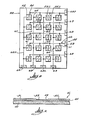
- Figure 8 illustrates a further embodiment of the diagnostic element of the invention wherein a multiplicity of layers 23, 24 are disposed on a single non-conductive base 22.
- Conductive means 28 for this embodiment comprises a series of individual electrical conductors 61 which each connect to a common conductor 62 which in turn connects to a terminal plate 63 mounted on the edge of base 22. Pairs of layers 23, 24 are arrayed in rows and columns on base 22.
- rows of plates 63 are disposed on adjacent sides of rectangular base 22.
- all but one of conductors 62 of second set 67 are located on the reverse side of base 22.
- These conductors 62 are illustrated by broken lines in Figure 8.
- Outer conductor 62A does not cross any conductors 62 of first set 66 and thus does not need to be on the other side of base 22, although it can be so located if desired.
- Individual conductors 61 connected to common conductors 62 of second set 67 on the reverse side of base 22 include portions 69 which extend through the thickness of base 22 and connect with such conductors 62 (shown by broken lines in Fig. 7).
- Ohmmeter 26 can be connected to various combinations of terminal plates 63 to measure resistance for each pair of layers 23, 24. To make such a measurement, ohmmeter 26 is connected to two plates 63 on different edges of base 22. In the embodiment of Fig. 8, connecting an ohmmeter to plates 63C, 63D would test the indicated pair of layers 23C, 24D.
- the foregoing embodiment allows a single diagnostic element according to the invention to test a single patient sample for a number of different substances, such as antigens, since each pair of layers 23, 24 can have a different substance bound therebetween, or have no substance bound therebetween so as to provide a control, as described above.
- the following procedure was used to make a suspension of gold particles labeled with antibodies according to the present invention.
- About 1 ml (milliliter) of a 1% w/v (weight/volume) solution of gold chloride in water were mixed with about 0.1 ml of Kodak D-19 photographic developer (containing a weak acid) to reduce the gold chloride to form gold particles.
- the resulting mixture was washed with distilled water by centrifugation at about 15,000 g to obtain a suspension of pure gold particles in water.
- Goat anti-rabbit IgG antibodies were added to a pH 9.6 carbonate buffer to form an aqueous 1:5,000 (w/v) antibody solution. 1.0 ml of this solution was added to the gold particles, and the resulting mixture was allowed to set overnight at room temperature. The gold particles from this mixture, bound with the goat anti-rabbit IgG, were washed by centrifugation at about 15,000 g with phosphate buffered saline to remove excess antibody.
- Titanium oxynitride (TiO x N y ). Titanium oxynitride flims of varying composition were deposited onto the glass slides by radio-frequency (rf) magnetron sputter deposition.
- the instrument used to deposit the titanium oxynitride coating was a Materials Research Corporation Model 822 Sputtersphere. A titanium target was used as the cathode.
- the system base pressure was 3 x 10 ⁇ 7 Torr.
- the system was backfilled with a mixture of nitrogen and oxygen. Sputtering occurred at a total pressure of 8 x 10 ⁇ 3 Torr.
- the forward power was 1,500W
- the target voltage was 314V
- reflected power was 0 watts
- cathode to anode distance was 21 ⁇ 2 inches and the sputtering time was 30 minutes.
- the oxynitride materials were formed by reactive deposition in an oxygen/nitrogen plasma.
- the ratio of oxygen to nitrogen was varied to change the film composition.
- the composition of the film was then determined with Auger electron spectroscopy.
- a nitrogen to oxygen molar ratio of .30 to .40 yielded a film having superior antigen adherence.
- the amount of antigen adherence on the TiO x N y films was comparable to that on plastic slides and was an order of magnitude larger than antigen adherence to uncoated glass under similar conditions.
- a gold-palladium alloy (60:40) was then evaporated onto the upper surface of each slide 40 to form an evenly distributed gold-palladium layer 41 having a thickness of 1,000 angstroms on each slide 40.
- a scratch (line) 42 was then made in the surface of each gold-palladium layer 41 between points 46, 47 using a sharp needle.
- a blunt instrument was used to rub away layer 41 in areas 48, 49.
- the result left a pair of 1,000 angstrom thick conductive layers 51, 52 separated by non-conductive line 42.
- An ohmmeter reading on areas 51, 52 (across line 42) gave a reading of greater than 2 million ohms.
- aqueous rabbit IGG solution was placed along the entire length of line 42 and incubated for 18 hours (overnight) to form an antigen layer 53
- the IGG solution was then removed and the slides 40 were rinsed with phosphate buffered saline solution.
- the previously prepared colloidal suspension of gold-tagged anti-rabbit-IGG gold particle diameters 0.1-0.5 mm was then applied to line 42.
- Figure 10 illustrates the results for a control slide processed in the same manner as slides 40 except that the control slide was not treated with rabbit IGG solution. As this microphotograph indicates, only a few small aggregates remained on this slide segment after rinsing with phosphate buffered saline solution.
Landscapes
- Health & Medical Sciences (AREA)
- Immunology (AREA)
- Life Sciences & Earth Sciences (AREA)
- Engineering & Computer Science (AREA)
- Molecular Biology (AREA)
- Biomedical Technology (AREA)
- Chemical & Material Sciences (AREA)
- Hematology (AREA)
- Urology & Nephrology (AREA)
- Biotechnology (AREA)
- Biochemistry (AREA)
- Cell Biology (AREA)
- Food Science & Technology (AREA)
- Medicinal Chemistry (AREA)
- Physics & Mathematics (AREA)
- Analytical Chemistry (AREA)
- Microbiology (AREA)
- General Health & Medical Sciences (AREA)
- General Physics & Mathematics (AREA)
- Pathology (AREA)
- Investigating Or Analyzing Materials By The Use Of Electric Means (AREA)
- Measuring Or Testing Involving Enzymes Or Micro-Organisms (AREA)
- Medicines Containing Antibodies Or Antigens For Use As Internal Diagnostic Agents (AREA)
Applications Claiming Priority (2)
| Application Number | Priority Date | Filing Date | Title |
|---|---|---|---|
| US843982 | 1986-03-25 | ||
| US06/843,982 US4794089A (en) | 1986-03-25 | 1986-03-25 | Method for electronic detection of a binding reaction |
Publications (2)
| Publication Number | Publication Date |
|---|---|
| EP0241771A2 true EP0241771A2 (fr) | 1987-10-21 |
| EP0241771A3 EP0241771A3 (fr) | 1990-04-25 |
Family
ID=25291474
Family Applications (1)
| Application Number | Title | Priority Date | Filing Date |
|---|---|---|---|
| EP87104369A Withdrawn EP0241771A3 (fr) | 1986-03-25 | 1987-03-25 | Procédé pour la détection électronique d'une réaction d'agglutination |
Country Status (4)
| Country | Link |
|---|---|
| US (1) | US4794089A (fr) |
| EP (1) | EP0241771A3 (fr) |
| JP (1) | JP2551575B2 (fr) |
| CA (1) | CA1256495A (fr) |
Cited By (5)
| Publication number | Priority date | Publication date | Assignee | Title |
|---|---|---|---|---|
| EP0519250A3 (en) * | 1991-06-10 | 1993-06-02 | Miles Inc. | Microparticle-labeled binding assay analyzed by microwave spectroscopy |
| WO1993016383A1 (fr) * | 1992-02-08 | 1993-08-19 | Genera Technologies Limited | Methodes d'analyse |
| WO1997021094A1 (fr) * | 1995-12-01 | 1997-06-12 | Innogenetics N.V. | Systeme de detection par mesure de l'impedance et procede pour le fabriquer |
| US6878539B1 (en) | 1998-12-23 | 2005-04-12 | Genetrix B.V. | Affinity sensor for detecting specific molecular binding events and use thereof |
| WO2008139016A1 (fr) | 2007-05-09 | 2008-11-20 | Consejo Superior De Investigaciones Científicas | Biocapteur impédancemétrique et ses applications |
Families Citing this family (28)
| Publication number | Priority date | Publication date | Assignee | Title |
|---|---|---|---|---|
| US5137827A (en) * | 1986-03-25 | 1992-08-11 | Midwest Research Technologies, Inc. | Diagnostic element for electrical detection of a binding reaction |
| AU4647589A (en) * | 1988-11-10 | 1990-05-28 | Midwest Research Technologies, Inc. | Method for electrical detection of a binding reaction |
| JP2550805B2 (ja) * | 1991-06-30 | 1996-11-06 | 株式会社島津製作所 | クロマトグラフの吸光分析装置 |
| GB2278235B (en) * | 1991-10-21 | 1996-05-08 | Holm Kennedy James W | Method and device for biochemical sensing |
| US6221673B1 (en) * | 1997-11-25 | 2001-04-24 | Microsensor Systems Inc. | Materials, method and apparatus for detection and monitoring of chemical species |
| IL124322A (en) * | 1998-05-04 | 2002-05-23 | Technion Res & Dev Foundation | Detection of an entity in a sample |
| US7347974B1 (en) | 1998-05-04 | 2008-03-25 | The United States Of America As Represented By The Secretary Of The Navy | Materials, method and apparatus for detection and monitoring of chemical species |
| IL126776A (en) | 1998-10-27 | 2001-04-30 | Technion Res & Dev Foundation | A method of investing gold |
| US20030087277A1 (en) * | 1998-12-23 | 2003-05-08 | Wolfgang Fritzsche | Means and methods for detection of binding of members of specific binding pairs |
| WO2001000876A1 (fr) * | 1999-06-25 | 2001-01-04 | Mirkin Chad A | Nanoparticules auxquelles sont rattaches des oligonucleotides et leurs utilisations |
| WO2001069241A2 (fr) | 2000-03-15 | 2001-09-20 | Aviva Biosciences Corporation | Appareil et procede pour l'analyse par electrorotation a haut rendement |
| CN1319761A (zh) | 2000-03-15 | 2001-10-31 | 清华大学 | 高通量电旋转检测的装置和方法 |
| WO2002103037A1 (fr) * | 2001-06-19 | 2002-12-27 | Molecular Circuitry, Inc. | Procede de detection conductimetrique |
| US20030022150A1 (en) * | 2001-07-24 | 2003-01-30 | Sampson Jeffrey R. | Methods for detecting a target molecule |
| GB2379018B (en) * | 2001-08-10 | 2006-02-22 | Univ Hull | Monitoring of chemical reactions |
| DE10158149A1 (de) * | 2001-11-28 | 2003-06-18 | Bayer Ag | Silangruppen enthaltende Polymere |
| US20040029288A1 (en) * | 2002-08-09 | 2004-02-12 | Arthur Snow | Nonlinear gold nanocluster chemical vapor sensor |
| DE10228260A1 (de) * | 2002-06-25 | 2004-01-22 | Bayer Ag | Methode und Vorrichtung zum impedimetrischen Nachweis eines oder mehrerer Analyten in einer Probe |
| EP1563089A4 (fr) * | 2002-08-30 | 2007-09-19 | Bayer Healthcare Llc | Dosages d'acide nucleique en rapport avec une phase solide, combinant une haute affinite avec une haute specificite |
| DE10328136A1 (de) * | 2003-06-23 | 2005-01-27 | Infineon Technologies Ag | Sensor-Element, Sensor-Array und Verfahren zum Erfassen von in einem Analyten möglicherweise enthaltenen Partikeln |
| JP4633347B2 (ja) * | 2003-08-27 | 2011-02-16 | ソニー株式会社 | 電子機器 |
| JP4389088B2 (ja) * | 2003-11-07 | 2009-12-24 | 公立大学法人大阪府立大学 | 電気抵抗型検出センサおよび検出方法 |
| EP1982166A4 (fr) * | 2006-01-20 | 2010-06-30 | Agency Science Tech & Res | Cellule de biocapteur et réseau de biocapteurs |
| WO2007127564A2 (fr) | 2006-04-26 | 2007-11-08 | Siemens Medical Solutions Diagnostics Gmbh | Dosage d'acides nucléiques sur phase solide combinant une capture et une détection à haute affinité par hybridation spécifique |
| KR100777973B1 (ko) * | 2006-07-13 | 2007-11-29 | 한국표준과학연구원 | 다중선형전극 센서 유닛으로 이루어진 바이오센서 |
| JP4969236B2 (ja) * | 2006-12-22 | 2012-07-04 | ローム株式会社 | 生体分子または生体関連物質の測定方法 |
| US20100173328A1 (en) * | 2009-01-07 | 2010-07-08 | National Applied Research Laboratories and Taipei Medical University | Apparatus for measuring a cell number and a quantity of a cellular protein expression and the method thereof |
| DE102009016712A1 (de) | 2009-04-09 | 2010-10-14 | Bayer Technology Services Gmbh | Einweg-Mikrofluidik-Testkassette zur Bioassay von Analyten |
Family Cites Families (29)
| Publication number | Priority date | Publication date | Assignee | Title |
|---|---|---|---|---|
| US3074853A (en) * | 1961-06-22 | 1963-01-22 | Hynson Westcott & Dunning Inc | Serological test card with color solid as visualizing agent |
| US4054646A (en) * | 1973-07-30 | 1977-10-18 | General Electric | Method and apparatus for detection of antibodies and antigens |
| US3853467A (en) * | 1973-08-15 | 1974-12-10 | Gen Electric | Method and apparatus for immunological detection of biological particles |
| US3926564A (en) * | 1974-02-25 | 1975-12-16 | Gen Electric | Substrate for immunological tests and method of fabrication thereof |
| SE407115B (sv) * | 1975-10-06 | 1979-03-12 | Kabi Ab | Forfarande och metelektroder for studium av enzymatiska och andra biokemiska reaktioner |
| US4238757A (en) * | 1976-03-19 | 1980-12-09 | General Electric Company | Field effect transistor for detection of biological reactions |
| US4206094A (en) * | 1976-06-09 | 1980-06-03 | California Institute Of Technology | Method for producing a biological reagent |
| US4157323A (en) * | 1976-06-09 | 1979-06-05 | California Institute Of Technology | Metal containing polymeric functional microspheres |
| SE7609263L (sv) * | 1976-08-20 | 1978-02-21 | Wadsworth Charlies | Forfaringssett for faststellande av kvantiteten av viss i en biologisk vetska loslig komponent, samt apparat for utovande av forfarandet |
| US4191739A (en) * | 1977-10-17 | 1980-03-04 | General Electric Company | Antigen-antibody reaction assay employing particle aggregation and resistive pulse analysis |
| US4219335A (en) * | 1978-09-18 | 1980-08-26 | E. I. Du Pont De Nemours And Company | Immunochemical testing using tagged reagents |
| SE431257B (sv) * | 1977-11-03 | 1984-01-23 | Du Pont | Sett och anordning for immunanalys med magnetisk metall eller metalloxid som merksubstans |
| US4180771A (en) * | 1977-12-02 | 1979-12-25 | Airco, Inc. | Chemical-sensitive field-effect transistor |
| NL7807532A (nl) * | 1978-07-13 | 1980-01-15 | Akzo Nv | Metaal-immunotest. |
| US4219411A (en) * | 1978-09-18 | 1980-08-26 | California Institute Of Technology | Cell sorting apparatus |
| US4225410A (en) * | 1978-12-04 | 1980-09-30 | Technicon Instruments Corporation | Integrated array of electrochemical sensors |
| US4233144A (en) * | 1979-04-16 | 1980-11-11 | Technicon Instruments Corporation | Electrode for voltammetric immunoassay |
| US4287300A (en) * | 1979-07-26 | 1981-09-01 | Syva Company | Charge effects in enzyme immunoassays |
| US4399099A (en) * | 1979-09-20 | 1983-08-16 | Buckles Richard G | Optical fiber apparatus for quantitative analysis |
| US4327073A (en) * | 1980-04-07 | 1982-04-27 | Huang Henry V | Automated method for quantitative analysis of biological fluids |
| DE3027256A1 (de) * | 1980-07-18 | 1982-02-18 | Robert Bosch Gmbh, 7000 Stuttgart | Mehrschichtsystem fuer waermeschutzanwendungen und verfahren zu seiner herstellung |
| US4444892A (en) * | 1980-10-20 | 1984-04-24 | Malmros Mark K | Analytical device having semiconductive organic polymeric element associated with analyte-binding substance |
| US4334880A (en) * | 1980-10-20 | 1982-06-15 | Malmros Mark K | Analytical device having semiconductive polyacetylene element associated with analyte-binding substance |
| US4420558A (en) * | 1981-02-12 | 1983-12-13 | Janssen Pharmaceutica N.V. | Bright field light microscopic method of enumerating and characterizing subtypes of white blood cells and their precursors |
| GB2095258B (en) * | 1981-03-19 | 1984-09-05 | Janssen Pharmaceutica Nv | A bright field light microscopic method of localizing tissue antigens |
| US4459360A (en) * | 1981-10-05 | 1984-07-10 | Mast Medical Industries, Ltd. | Multiple-component binding assay system and method of making and using it |
| JPS6029658A (ja) * | 1983-07-28 | 1985-02-15 | Mitsubishi Electric Corp | 尿素センサ |
| JPS60210752A (ja) * | 1984-04-03 | 1985-10-23 | Fuji Heavy Ind Ltd | 蓄鉛量検出装置 |
| AU588245B2 (en) * | 1984-06-13 | 1989-09-14 | Inverness Medical Switzerland Gmbh | Devices for use in chemical test procedures |
-
1986
- 1986-03-25 US US06/843,982 patent/US4794089A/en not_active Expired - Lifetime
-
1987
- 1987-03-24 CA CA000532785A patent/CA1256495A/fr not_active Expired
- 1987-03-25 EP EP87104369A patent/EP0241771A3/fr not_active Withdrawn
- 1987-03-25 JP JP62071319A patent/JP2551575B2/ja not_active Expired - Fee Related
Cited By (7)
| Publication number | Priority date | Publication date | Assignee | Title |
|---|---|---|---|---|
| EP0519250A3 (en) * | 1991-06-10 | 1993-06-02 | Miles Inc. | Microparticle-labeled binding assay analyzed by microwave spectroscopy |
| WO1993016383A1 (fr) * | 1992-02-08 | 1993-08-19 | Genera Technologies Limited | Methodes d'analyse |
| WO1997021094A1 (fr) * | 1995-12-01 | 1997-06-12 | Innogenetics N.V. | Systeme de detection par mesure de l'impedance et procede pour le fabriquer |
| US6440662B1 (en) | 1995-12-01 | 2002-08-27 | Innogenetics N.V. | Impedimetric detection system and method of production thereof |
| US6878539B1 (en) | 1998-12-23 | 2005-04-12 | Genetrix B.V. | Affinity sensor for detecting specific molecular binding events and use thereof |
| WO2008139016A1 (fr) | 2007-05-09 | 2008-11-20 | Consejo Superior De Investigaciones Científicas | Biocapteur impédancemétrique et ses applications |
| US8608919B2 (en) | 2007-05-09 | 2013-12-17 | Consejo Superior De Investigaciones Científicas | Impedimetric sensor and applications thereof |
Also Published As
| Publication number | Publication date |
|---|---|
| JP2551575B2 (ja) | 1996-11-06 |
| CA1256495A (fr) | 1989-06-27 |
| EP0241771A3 (fr) | 1990-04-25 |
| JPS6311861A (ja) | 1988-01-19 |
| US4794089A (en) | 1988-12-27 |
Similar Documents
| Publication | Publication Date | Title |
|---|---|---|
| EP0241771A2 (fr) | Procédé pour la détection électronique d'une réaction d'agglutination | |
| US5284748A (en) | Method for electrical detection of a binding reaction | |
| US4054646A (en) | Method and apparatus for detection of antibodies and antigens | |
| US3926564A (en) | Substrate for immunological tests and method of fabrication thereof | |
| US3960490A (en) | Method and apparatus for detecting immunologic reactions by diffusion in gel | |
| US4822566A (en) | Optimized capacitive sensor for chemical analysis and measurement | |
| US4011308A (en) | Method for surface immunological detection of biological particles by the use of tagged antibodies | |
| CA1049400A (fr) | Methode et appareil pour le dosage des particules biologiques ayant des proprietes immunologiques | |
| US3979184A (en) | Diagnostic device for visually detecting presence of biological particles | |
| US5192507A (en) | Receptor-based biosensors | |
| US6770190B1 (en) | Method of electrochemical analysis of an analyte | |
| WO1990005300A1 (fr) | Methode de detection electrique d'une reaction de liaison | |
| US4444892A (en) | Analytical device having semiconductive organic polymeric element associated with analyte-binding substance | |
| CA1039649A (fr) | Methode pour former des films d'un complexe immunologique en plusieurs couches | |
| US4916075A (en) | Differential homogeneous immunosensor device | |
| EP0342382A2 (fr) | Détection électrique de la réaction immunologique | |
| CA1259374A (fr) | Capteur capacitif pour les analyses et les mesures chimiques | |
| EP0096095B1 (fr) | Dispositif semi-conducteur, capteur et méthode pour déterminer la concentration d'une substance dans un milieu | |
| EP0553229A1 (fr) | Amelioration relative au dosage faisant appel a une liaison en phase solide. | |
| Maupas et al. | Impedance analysis of Si/SiO2 heterostructures grafted with antibodies: an approach for immunosensor development | |
| RU2107296C1 (ru) | Способ электрохимической индикации иммунохимически активных макромолекул в исследуемых растворах | |
| CA2159905A1 (fr) | Methode de detection d'especes biologiques et biodetecteur utile a cette fin | |
| JP2745683B2 (ja) | 免疫測定法 | |
| CA1049399A (fr) | Methode et appareil pour determiner la concentration de particules biologiques ayant des proprietes immunologiques | |
| CA1049398A (fr) | Methode et appareil pour detecter les particules biologiques ayant des proprietes immunologiques |
Legal Events
| Date | Code | Title | Description |
|---|---|---|---|
| PUAI | Public reference made under article 153(3) epc to a published international application that has entered the european phase |
Free format text: ORIGINAL CODE: 0009012 |
|
| AK | Designated contracting states |
Kind code of ref document: A2 Designated state(s): CH DE FR GB LI NL SE |
|
| PUAL | Search report despatched |
Free format text: ORIGINAL CODE: 0009013 |
|
| AK | Designated contracting states |
Kind code of ref document: A3 Designated state(s): CH DE FR GB LI NL SE |
|
| RHK1 | Main classification (correction) |
Ipc: G01N 33/543 |
|
| STAA | Information on the status of an ep patent application or granted ep patent |
Free format text: STATUS: THE APPLICATION IS DEEMED TO BE WITHDRAWN |
|
| 18D | Application deemed to be withdrawn |
Effective date: 19901026 |