EP0240135B1 - Dispositif de mémoire à ligne de Bloch et méthode de mise en oeuvre - Google Patents
Dispositif de mémoire à ligne de Bloch et méthode de mise en oeuvre Download PDFInfo
- Publication number
- EP0240135B1 EP0240135B1 EP87301591A EP87301591A EP0240135B1 EP 0240135 B1 EP0240135 B1 EP 0240135B1 EP 87301591 A EP87301591 A EP 87301591A EP 87301591 A EP87301591 A EP 87301591A EP 0240135 B1 EP0240135 B1 EP 0240135B1
- Authority
- EP
- European Patent Office
- Prior art keywords
- magnetic
- domain
- bloch
- stripe
- magnetic domain
- Prior art date
- Legal status (The legal status is an assumption and is not a legal conclusion. Google has not performed a legal analysis and makes no representation as to the accuracy of the status listed.)
- Expired - Lifetime
Links
Images


Classifications
-
- G—PHYSICS
- G11—INFORMATION STORAGE
- G11C—STATIC STORES
- G11C19/00—Digital stores in which the information is moved stepwise, e.g. shift registers
- G11C19/02—Digital stores in which the information is moved stepwise, e.g. shift registers using magnetic elements
- G11C19/08—Digital stores in which the information is moved stepwise, e.g. shift registers using magnetic elements using thin films in plane structure
- G11C19/0875—Organisation of a plurality of magnetic shift registers
- G11C19/0883—Means for switching magnetic domains from one path into another path, i.e. transfer switches, swap gates or decoders
-
- G—PHYSICS
- G11—INFORMATION STORAGE
- G11C—STATIC STORES
- G11C19/00—Digital stores in which the information is moved stepwise, e.g. shift registers
- G11C19/02—Digital stores in which the information is moved stepwise, e.g. shift registers using magnetic elements
- G11C19/08—Digital stores in which the information is moved stepwise, e.g. shift registers using magnetic elements using thin films in plane structure
- G11C19/0858—Generating, replicating or annihilating magnetic domains (also comprising different types of magnetic domains, e.g. "Hard Bubbles")
-
- G—PHYSICS
- G11—INFORMATION STORAGE
- G11C—STATIC STORES
- G11C19/00—Digital stores in which the information is moved stepwise, e.g. shift registers
- G11C19/02—Digital stores in which the information is moved stepwise, e.g. shift registers using magnetic elements
- G11C19/08—Digital stores in which the information is moved stepwise, e.g. shift registers using magnetic elements using thin films in plane structure
- G11C19/0866—Detecting magnetic domains
Definitions
- This invention relates to a Bloch line memory device and a method for operating same and in particular to a Bloch line memory device and a method for operating same, which are suitable for obtaining a good read-out margin and practical.
- a magnetic garnet film is used as a memory medium film as in a magnetic bubble memory device.
- their memory methods are considerably different. That is, in a Bloch line memory the presence and the absence of a vertical Bloch line pair existing in the wall around a stripe magnetic domain obtained by stretching a bubble correspond to "1" and "0", respectively, while in a prior art magnetic bubble memory the presence and the absence of a bubble correspond to "1" and "0" in data.
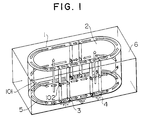
- Fig. 1 indicates this aspect.
- the arrow directed upward in a stripe magnetic domain 2 shows the direction of magnetization
- arrows 101 on the center line of the wall 1 show the direction of magnetization located at the wall center
- arrows 102 perpendicular to the wall 1 at the center line show the direction of magnetization at the center of the vertical Bloch line (hereinbelow called merely Bloch line).
- portions, where a pair of Bloch lines exist correspond to "1" in data and portions, where no Bloch lines exist, correspond to "0".
- the Bloch line used as information carrier is a microstructure of the domain wall existing in the wall 1 surrounding the magnetic domain.
- the Bloch line can exist stably in the domain wall and propagate freely along the domain wall. Consequently, when a number of stripe magnetic domains are arranged at their predetermined positions and Bloch lines are made to exist in the domain wall, they behave just as bubbles propagating in a minor loop of a magnetic bubble memory. For this reason a Bloch line memory is a shift resistor type memory similarly to a magnetic bubble memory.
- Bloch line The existence of the Bloch line is known since long ago and it is verified by experiments and their analysis that the mobility of the magnetic domain is reduced by the existence of the Bloch line. Consequently, for the magnetic bubble memory, for which the magnetic domain should be shifted, the bubble domain containing Bloch lines is called hard bubble and it has been tried to prevent its generation. To the contrary, for the Bloch line memory device, the existence of this Bloch line is positively utilized.
- the physical size of the Bloch line is about 1/10 of the width of the stripe magnetic domain, where the Bloch line exists, and a number of Bloch lines can exist in one stripe magnetic domain.
- a number of Bloch lines can exist in one stripe magnetic domain.
- the physical size of the Bloch line is about 1/10 of the width of the stripe magnetic domain, where the Bloch line exists, and a number of Bloch lines can exist in one stripe magnetic domain.
- a garnet film having stripe magnetic domains 1 ⁇ m wide developed for a magnetic bubble memory it is possible to make about 5 x 10⁶ Bloch lines exist per 1 cm3. Therefore, in the case where 2 Bloch lines are paired in the information medium, it is possible to realize a memory of 256 M bit/cm2.
- Bloch line memory device can have a large memory capacity, apart from the fact that the size is extremely small. It is due to the fact that in the Bloch line memory the magnetic field in the vertical direction is used for the propagation of information, while in the magnetic bubble memory information carriers are propagated by rotating an in-plane field. For this reason there is a high possibility that the propagation pattern is simplified in a plane, what acts so as to make it easier to increase the density for this type of memory elements.
- the write-in operation is effected basically by making electric current flow through a conductor disposed at the proximity of one stripe domain head so that a local magnetic field is generated there and reversing the magnetization in the domain wall. That is, it can be thought that the direction of magnetization indicated by "0" in Fig. 1 is reversed so that it is in accordance with the direction of magnetization in the "1" domain.
- Bloch lines are produced in this way. Further two Bloch lines are always paired. Consequently the Bloch line memory is constituted by making one pair of Bloch lines correspond to one information.
- the read-out of information is effected, after having transformed the presence or absence of the Bloch line into the presence or absence of the bubble domain.
- the transformation of the Bloch line into the bubble domain is effected by the method described by Konishi in an article published in IEEE Trans. Mag. 19 , No. 5 (1983) p. 1838 - p. 1840 and p. 1841 - p. 1843. That is, when a pair of Bloch lines exist, the direction of magnetization in the domain wall is reversed at the pair of Bloch lines as a border, as indicated in Fig. 1. When a pair of Bloch lines arrive at the stripe magnetic domain head, variations in this magnetization structure give rise to variations in chopping properties.
- Fig. 2 is a top view of the element indicated in Fig. 1, in which also the direction of magnetization seen from above is indicated by arrows.
- the presence or absence of the Bloch lines can be transformed into the presence or absence of the bubble.
- Bloch line memory It is possible to realize a Bloch line memory by forming a write-in, a memory and a read-out function portion described above in one element.
- Fig. 3A indicates a case where a pair of Bloch lines 4 arrive at the head portion of a stripe magnetic domain 2 and on the other hand Fig. 3B indicates a case where there are no pair of Bloch lines. In the two states, comparing the directions of the magnetizations 5 of the domain wall 1, it can be seen that the two are same.
- the magnetization of the domain wall varies, depending on whether a pair of Bloch lines exist or not, but the magnetization doesn't vary, depending on whether a pair of Bloch lines exist or not. This reason is that the magnetization reversed by one Bloch line is reversed again by the other Bloch line so that the direction of the magnetization returns finally to the initial one. For this reason, since the direction of the magnetizations 5 doesn't vary depending on the presence or absence of the pair of Bloch lines only by the prior art method, it can be understood that its presence or absence cannot be transformed into the presence or absence of the magnetic bubble domain.
- JP-A-59-101092 As measures for resolving this problem a method is disclosed in JP-A-59-101092.
- electric current is made to flow through a conductor superposed on the chopping conductor so that the position of the pair of Bloch lines is held and reading-out is carried out by effecting the chopping operation between the pair of Bloch lines.
- the presence or absence of the pair of Bloch lines can be transformed into the presence or absence of the bubble domain and thus the reading-out according to the prior art techniques is realized.
- EP-A-106358 also discloses a magnetic memory in which information is stored by the use of vertical Bloch lines in a stripe magnetic domain.
- the presence or absence of the Bloch line pairs dictates the type of information stored in the memory.
- the information is read out by chopping the end of the preselected stripe domain. This is done by supplying a local in-plane magnetic field to the end of the stripe domain head such that the pair of Bloch lines are split.
- the head of the stripe can then be chopped to form a bubble by a field generated by a chopping conduction, which is located between the Bloch lines.
- the present invention seeks to provide a practical Bloch line memory device, in which a pair of Bloch lines represent one bit information and a method for operating same.
- the present invention therefore provides a Bloch line memory device comprising: a magnetic medium film; means for holding a stripe magnetic domain at a desired region of the magnetic medium film, the stripe magnetic domain including at least one pair of Bloch lines; means for shifting said pair of Bloch lines towards a head portion of said stripe magnetic domain; means disposed at the proximity of the head portion of said stripe magnetic domain for chopping the stripe magnetic domain by bringing upper and lower sides of a domain wall of the stripe magnetic domain closer to each other; and means for applying an in-plane magnetic field (HC) to the magnetic medium film; wherein said device further comprises means for stretching said head portion of the strip magnetic domain in a direction substantially parallel to the magnetic medium film by applying a magnetic force ( HB) in a direction substantially opposite to a vertical bias magnetic field (H B ) perpendicular to the magnetic medium film, and for simultaneously splitting the pair of Bloch lines by applying the in-plane magnetic field (H C ) provided by the means for applying the in-plane magnetic field; and
- the direction of this in-plane magnetic field may be determined so that it is also opposite to the direction, along which the stripe magnetic domain stretches (Y axis direction).
- a force tending to make the magnetic energy small acts on the region surrounded by the pair of Bloch lines. Consequentially the region is enlarged by this force and the distance bewtween the two Bloch lines forming the pair of Bloch lines increases.
- one of the Bloch lines becomes more distant from the head portion of the stripe magnetic domain and the other is held stably at the head portion of the stripe magnetic domain.
- stripe magnetic domain chopping means disposed at the proximity of the head portion of the stripe domain chops the stripe magnetic domain, and on applying the in-plane magnetic field the end of the stripe domain is transformed into the magnetic bubble domain. This may then be detected by a magnetic bubble domain detecting means. After that, the application of the in-plane magnetic field is stopped.
- a hair-pin shaped conductor may be employed as the stripe magnetic domain chopping means which is disposed in the direction perpendicular to that of the stretching of the stripe magnetic domain or two conductors parallel to each other are used.
- a magnetic bubble domain detector utilizing the magneto-resitive effect by means of soft magnetic materials of a known type may be used as the magnetic bubble domain detecting means.
- the presence or absence of the pair of Bloch lines at the head portion of the stripe magnetic domain corresponds to whether the stripe magnetic domain is chopped or not and in turn whether it is transformed into the magnetic bubble domain or not. Consequently, according to this invention, it is possible to realize a practical Bloch line memory device.
- the present invention provides a method for operating a Bloch line memory device having a magnetic medium film comprising the steps of:
- the basic structure of the Bloch line memory consists of a stripe magnetic domain stabilizing pattern 11 and a stripe magnetic domain 2.
- a pattern formed by scooping a magnetic film about 1 ⁇ m thick is used as means for stabilizing stripe magnetic domains.
- Pairs of Bloch lines can move freely in the domain wall.
- Two methods are conceived for shifting these pairs of Bloch lines. One of them is a method, by which a magnetic field perpendicular to the surface of the film is applied thereto, and a gyroscopic force acting on the magnetization is utilized. The other is a method, by which an in-plane magnetic field parallel to the plane, where the magnetic film exists, is utilized.
- the pairs of Bloch lines are freely shifted by either one of the methods. However, in order to utilize the Bloch lines as memorized information, it is necessary to stabilize a pair of Bloch lines at a particular address position, corresponding to the propagation period. In this embodiment a pattern 9 indicated in Fig. 4 is used as this means.
- Fig. 4A shows the state before the reading-out.
- a pair of Bloch lines 4 is located at the head portion of a stripe magnetic domain 2.
- One 4-1 of the splitted Bloch lines is moved to the exterior of a conductor 10 by the magnetic field generated by the conductor 10.
- the other Bloch line 4-2 is located stably at the head portion of the stripe magnetic domain.
- This separation takes different periods of time, depending on the propagated distance of the Bloch lines. Usually, supposing that the conductor 5 is about 40 ⁇ m wide, it takes about 500 nano sec.
- the chopped magnetic domain 8 is detected by a method identical to that of the usual bubble memory techniques and thus the presence of the pair of Bloch lines can be read-out as digital data.
- the magnetization 5 Since there are no Bloch lines at the proximity of the head portion of the stripe magnetic domain, the magnetization 5 has different directions at the upper and the lower sides of the domain wall of the stripe magnetic domain, as indicated in Fig. 5B. In such a state it is difficult to chop the magnetic domain and no magnetic domain is chopped, if a chopping current I c2 is chosen.
- a conductor 10, 40 ⁇ m wide was used as means generating the in-plane magnetic field for splitting the pair of Bloch lines.
- the width of this conductor is so chosen that the in-plane magnetic field is generated with a high efficiency and usually it is thought that it is suitably from several to about 100 times as wide as the stripe magnetic domain. When it is still wider, the effective area of the device is reduced and thus it is not efficacious. To the contrary, when it is narrower than that, it is not desirable for generating the in-plane magnetic field with a high efficiency.
- a high coercive force film magnetized in the in-plane direction generates a stray in-plane magnetic field in the in-plane direction.
- the pair of Bloch lines are splitted and thus it becomes possible to read-out them.
- Figs. 6A, 6B and 6C indicate this structure.
- a pattern made of Tb-Fe-Co, etc. having its axis of easy magnetization in the in-plane direction (hereinbelow called in-plane magnetization film pattern) is disposed at the proximity of the head portion of the stripe magnetic domain.
- the in-plane magnetic field leaking out from the in-plane magnetization film has the direction H c '.
- the head portion of the stripe magnetic domain is stretched by applying a magnetic field - ⁇ H B , which is opposite to the vertical bias magnetic field H B , as indicated in Fig. 6B.
- the pair of Bloch lines are splitted, sensing the in-plane magnetic field, and thus it becomes possible to read-out them, just as in the case where the conductor is used, as described above.
- Fig. 8A indicates the stripe magnetic domain 2.
- Two pairs of Bloch lines 4 exist on the periphery of one stripe magnetic domain 2.
- the directions of the magnetizations between the pairs of Bloch lines are opposite to each other. As it is clearly seen from Fig. 1, this is because the magnetizations rotate continuously along the domain wall.
- Fig. 8A when a magnetic field H having the same direction as that of the magnetization in the region comprised between the pair of Bloch lines existing at the lower side of the domain wall is applied, the lower pair of Bloch lines are splitted and move to the two head portions of the stripe magnetic domain. For this reason, the information, which this pair of Bloch lines has disappears (Fig. 8B).
- Fig. 8C indicates this aspect.
- the Block lines 3 can exist stably at both the head portions.
- the pair of Bloch lines are written-in, owing to the continuity of the magnetization direction described above, the magnetization between the pair of Bloch lines is always opposite to that of the magnetic field Hip (Fig. 8D). For this reason, whether the pair of Bloch lines exist at the side, upper or lower, of the domain wall, they are not splitted and can exist stably.
- Fig. 9A indicates the case where the Bloch line 3 described above and a pair of Bloch lines 4 corresponding to an information "1" exist at the head portion of the stripe magnetic domain.
- Fig. 10A indicates the state, where only the Bloch line 3 exists at the head portion of the stripe magnetic domain.
- the Bloch line 3 is shifted to the position indicated in Fig. 10B.
- the Bloch line is shifted along the side, upper or lower, of the domain wall, the magnetizations of the domain wall after the shift are opposite to each other at the upper and lower sides of the domain wall. Therefore, even by the chopping operation indicated in Fig. 10C, no magnetic domain is chopped. Consequently reading-out the information is realized by detecting the presence or absence of the chopped magnetic domain by using means identical to that according to the prior art techniques, just as in Embodiment 1.
Landscapes
- Hall/Mr Elements (AREA)
- Magnetic Heads (AREA)
Claims (14)
- Dispositif de mémoire à lignes de Bloch comprenant :
une pellicule de milieu magnétique (6);
des moyens (9,11) pour maintenir un domaine magnétique en forme de bande (2) dans une région désirée de la pellicule de milieu magnétique (6), le domaine magnétique en forme de bande (2) comprenant au moins un couple de lignes de Bloch (4);
des moyens pour décaler ledit couple de lignes de Blooh (4) en direction d'une partie de tête dudit domaine magnétique en forme de bande;
des moyens (7) disposés à proximité de la partie de tête dudit domaine magnétique en forme de bande pour déoouper le domaine magnétique en forme de bande par rapprochement de côtés supérieur et inférieur d'une paroi du domaine magnétique en forme de bande (2); et
des moyens (10, 12) pour appliquer un champ magnétique dans le plan (HC) à la pellicule de milieu magnétique;
ledit dispositif comprenant en outre des moyens pour étirer ladite partie de tête du domaine magnétique en forme de bande (2) dans une direction sensiblement parallèle à la pellicule de milieu magnétique par application d'une force magnétique (ΔHB) dans une direction sensiblement opposée à un champ magnétique vertical de polarisation (HB) perpendiculaire à la pellicule de support magnétique, et diviser simultanément le couple de lignes de Bloch (4) par application du champ magnétique dans le plan (HC) produit par les moyens d'application du champ magnétique dans le plan;
caractérisé en ce que
les moyens pour étirer la partie de tête divisent le couple de lignes de Bloch (4) au voisinage de la ligne centrale de la partie de tête du domaine magnétique en forme de bande. - Dispositif de mémoire à lignes de Bloch selon la revendication 1, dans lequel lesdits moyens (10, 12) pour appliquer un champ magnétique dans le plan (HC) sont un conducteur possédant une largeur prédéterminée, ledit conducteur étant situé sur ladite pellicule de milieu magnétique (6) de sorte qu'il est superposé audit domaine magnétique en forme de bande.
- Dispositif de mémoire à lignes de Bloch selon la revendication 2, dans lequel des moyens pour envoyer un courant électrique prédéterminé sont raccordés audit conducteur.
- Dispositif de mémoire à lignes de Bloch selon la revendication 1, dans lequel lesdits moyens (10, 12) pour appliquer un champ magnétique dans le plan (HC) sont formés par une pellicule à force coercitive élevée, ladite pellicule à force coercitive élevée étant située sur ladite pellicule de milieu magnétique de sorte qu'elle est superposée audit domaine magnétique en forme de bande.
- Dispositif de mémoire à lignes de Bloch selon l'une quelconque des revendications précédentes, dans lequel une ligne de Bloch additionnelle (3) est située à chacune des deux extrémités dudit domaine magnétique en forme de bande (2).
- Dispositif de mémoire à lignes de Bloch selon l'une quelconque des revendications précédentes, dans lequel ladite pellicule de milieu magnétique est une pellicule de grenat magnétique.
- Dispositif de mémoire à lignes de Bloch selon l'une quelconque des revendications précédentes, dans lequel un domaine de bulle magnétique découpé par lesdits moyens servant à découper le domaine magnétique en forme de bande peut être détecté par des moyens de détection de domaines de bulles magnétiques.
- Dispositif de mémoire à lignes de Bloch selon l'une quelconque des revendications précédentes, dans lequel lesdits moyens (7) pour découper le domaine magnétique en forme de bande sont un conducteur en forme d'épingle à cheveux disposé dans une direction approximativement perpendiculaire à la direction d'étirage dudit domaine magnétique en forme de bande.
- Dispositif de mémoire à lignes de Bloch selon la revendication 1, dans lequel lesdits moyens (10, 12) pour appliquer un champ magnétique dans le plan (HC) sont formés par un conducteur possédant une largeur comprise entre plusieurs fois et environ 100 fois la largeur du domaine magnétique en forme de bande.
- Procédé pour faire fonctionner un dispositif de mémoire à lignes de Bloch possédant une pellicule de milieu magnétique (6), comprenant les étapes consistant à :(i) maintenir un domaine magnétique en forme de bande comprenant au moins un couple de lignes de Bloch dans une région désirée de la pellicule magnétique, et(ii) étirer la partie de tête d'un domaine magnétique en forme de bande par application d'une force magnétique (ΔHB) dans une direction sensiblement opposée à un champ magnétique vertical de polarisation (HB) perpendiculaire à la pellicule de milieu magnétique, et diviser simultanément le couple de lignes de Bloch en appliquant un champ magnétique dans un plan parallèle à celui de la pellicule de milieu magnétique,(iii) découper le domaine magnétique en forme de bande,
caractérisé en ce que :
l'étape (ii) est précédée d'un déplacement du couple de lignes de Bloch (4) amenant ces dernières au voisinage de la ligne centrale de la partie de tête du domaine magnétique en forme de bande. - Procédé pour faire fonctionner un dispositif de mémoire à lignes de Bloch selon la revendication 10, selon lequel la direction dudit champ magnétique dans le plan est approximativement parallèle et opposée à ladite direction d'étirage dudit domaine magnétique en forme de bande.
- Procédé pour faire fonctionner un dispositif de mémoire à lignes de Bloch selon la revendication 10 ou 11, selon lequel ledit champ magnétique dans le plan est un champ magnétique de fuite produit par une pellicule à force coercitive élevée (12) disposée à proximité de la partie de tête dudit domaine magnétique en forme de bande.
- Procédé pour faire fonctionner un dispositif de mémoire à lignes de Bloch selon l'une quelconque des revendications 10 à 12, selon lequel une ligne de Bloch est située dans chacune des deux parties de tête du domaine magnétique en forme de bande (2).
- Procédé pour faire fonctionner un dispositif de mémoire à lignes de Bloch selon l'une quelconque des revendications 10 à 13, selon lequel lesdits moyens pour découper le domaine magnétique en forme de bande sont constitués par un conducteur en forme d'épingle à cheveux disposé dans la direction approximativement perpendiculaire à l'étirage dudit domaine magnétique en forme de bande.
Applications Claiming Priority (2)
| Application Number | Priority Date | Filing Date | Title |
|---|---|---|---|
| JP41776/86 | 1986-02-28 | ||
| JP4177686 | 1986-02-28 |
Publications (3)
| Publication Number | Publication Date |
|---|---|
| EP0240135A2 EP0240135A2 (fr) | 1987-10-07 |
| EP0240135A3 EP0240135A3 (en) | 1989-11-02 |
| EP0240135B1 true EP0240135B1 (fr) | 1993-05-12 |
Family
ID=12617775
Family Applications (1)
| Application Number | Title | Priority Date | Filing Date |
|---|---|---|---|
| EP87301591A Expired - Lifetime EP0240135B1 (fr) | 1986-02-28 | 1987-02-24 | Dispositif de mémoire à ligne de Bloch et méthode de mise en oeuvre |
Country Status (4)
| Country | Link |
|---|---|
| US (1) | US5050122A (fr) |
| EP (1) | EP0240135B1 (fr) |
| JP (1) | JPS62275383A (fr) |
| DE (1) | DE3785787T2 (fr) |
Families Citing this family (1)
| Publication number | Priority date | Publication date | Assignee | Title |
|---|---|---|---|---|
| US9048410B2 (en) | 2013-05-31 | 2015-06-02 | Micron Technology, Inc. | Memory devices comprising magnetic tracks individually comprising a plurality of magnetic domains having domain walls and methods of forming a memory device comprising magnetic tracks individually comprising a plurality of magnetic domains having domain walls |
Citations (1)
| Publication number | Priority date | Publication date | Assignee | Title |
|---|---|---|---|---|
| EP0106358A2 (fr) * | 1982-10-18 | 1984-04-25 | Nec Corporation | Dispositif de mémoire magnétique pouvant mémoriser des informations dans une bande sous forme d'une paire de lignes Bloch verticales |
Family Cites Families (3)
| Publication number | Priority date | Publication date | Assignee | Title |
|---|---|---|---|---|
| US4001794A (en) * | 1975-04-21 | 1977-01-04 | International Business Machines Corporation | Method and apparatus for controlled generation of wall topology in magnetic domains |
| JPS59101092A (ja) * | 1982-12-02 | 1984-06-11 | Nec Corp | 磁気記憶方法 |
| JPS61248296A (ja) * | 1985-04-25 | 1986-11-05 | Nec Corp | 磁気記憶素子 |
-
1987
- 1987-02-19 US US07/016,656 patent/US5050122A/en not_active Expired - Fee Related
- 1987-02-20 JP JP62035520A patent/JPS62275383A/ja active Pending
- 1987-02-24 EP EP87301591A patent/EP0240135B1/fr not_active Expired - Lifetime
- 1987-02-24 DE DE8787301591T patent/DE3785787T2/de not_active Expired - Fee Related
Patent Citations (1)
| Publication number | Priority date | Publication date | Assignee | Title |
|---|---|---|---|---|
| EP0106358A2 (fr) * | 1982-10-18 | 1984-04-25 | Nec Corporation | Dispositif de mémoire magnétique pouvant mémoriser des informations dans une bande sous forme d'une paire de lignes Bloch verticales |
Also Published As
| Publication number | Publication date |
|---|---|
| US5050122A (en) | 1991-09-17 |
| JPS62275383A (ja) | 1987-11-30 |
| EP0240135A2 (fr) | 1987-10-07 |
| DE3785787T2 (de) | 1993-08-12 |
| DE3785787D1 (de) | 1993-06-17 |
| EP0240135A3 (en) | 1989-11-02 |
Similar Documents
| Publication | Publication Date | Title |
|---|---|---|
| EP0255044B1 (fr) | Dispositif de mémoire à ligne Bloch | |
| EP0106358A2 (fr) | Dispositif de mémoire magnétique pouvant mémoriser des informations dans une bande sous forme d'une paire de lignes Bloch verticales | |
| US3691540A (en) | Integrated magneto-resistive sensing of bubble domains | |
| US3723716A (en) | Single wall domain arrangement including fine-grained, field access pattern | |
| US4080591A (en) | Replicator for cross-tie wall memory system incorporating isotropic data track | |
| US4162537A (en) | Magnetic bubble memory | |
| EP0240135B1 (fr) | Dispositif de mémoire à ligne de Bloch et méthode de mise en oeuvre | |
| US3982234A (en) | Hard-magnetic film overlay apparatus and method for magnetic mobile domain control | |
| CA1109150A (fr) | Circuit de propagation de bulles magnetiques insensibles aux espaces intersticiels | |
| US3916395A (en) | Cylindrical magnetic domain storage device having wave-like magnetic wall | |
| US4059829A (en) | Multi state magnetic bubble domain cell for random access memories | |
| US4023150A (en) | Bubble translation system | |
| US3713119A (en) | Domain propagation arrangement | |
| US3736577A (en) | Domain transfer between adjacent magnetic chips | |
| US4142247A (en) | Conductor-driven magnetic bubble memory with an expander-detector arrangement | |
| US4246647A (en) | Differential magneto-resistive detector for cross-tie wall memory system | |
| US4949304A (en) | Bloch line memory device | |
| US3947830A (en) | Complementary transition structures for magnetic domain propagation | |
| US4027297A (en) | Gapless magnetic bubble propagation path structure | |
| JPH05347090A (ja) | ブロッホラインメモリ素子およびその動作方法 | |
| US4884236A (en) | Bloch line memory device | |
| US4228523A (en) | Conductor access bubble memory arrangement | |
| US5047978A (en) | Bloch line memory device | |
| JPH0223587A (ja) | ブロッホラインメモリ素子 | |
| JPS59909B2 (ja) | バブル磁区分割器 |
Legal Events
| Date | Code | Title | Description |
|---|---|---|---|
| PUAI | Public reference made under article 153(3) epc to a published international application that has entered the european phase |
Free format text: ORIGINAL CODE: 0009012 |
|
| AK | Designated contracting states |
Kind code of ref document: A2 Designated state(s): DE FR GB |
|
| PUAL | Search report despatched |
Free format text: ORIGINAL CODE: 0009013 |
|
| AK | Designated contracting states |
Kind code of ref document: A3 Designated state(s): DE FR GB |
|
| 17P | Request for examination filed |
Effective date: 19900321 |
|
| 17Q | First examination report despatched |
Effective date: 19910320 |
|
| GRAA | (expected) grant |
Free format text: ORIGINAL CODE: 0009210 |
|
| AK | Designated contracting states |
Kind code of ref document: B1 Designated state(s): DE FR GB |
|
| REF | Corresponds to: |
Ref document number: 3785787 Country of ref document: DE Date of ref document: 19930617 |
|
| ET | Fr: translation filed | ||
| PGFP | Annual fee paid to national office [announced via postgrant information from national office to epo] |
Ref country code: FR Payment date: 19931216 Year of fee payment: 8 |
|
| PGFP | Annual fee paid to national office [announced via postgrant information from national office to epo] |
Ref country code: GB Payment date: 19940214 Year of fee payment: 8 |
|
| PG25 | Lapsed in a contracting state [announced via postgrant information from national office to epo] |
Ref country code: DE Effective date: 19941101 |
|
| PG25 | Lapsed in a contracting state [announced via postgrant information from national office to epo] |
Ref country code: GB Effective date: 19950224 |
|
| GBPC | Gb: european patent ceased through non-payment of renewal fee |
Effective date: 19950224 |
|
| PG25 | Lapsed in a contracting state [announced via postgrant information from national office to epo] |
Ref country code: FR Effective date: 19951031 |
|
| REG | Reference to a national code |
Ref country code: FR Ref legal event code: ST |
|
| PLBE | No opposition filed within time limit |
Free format text: ORIGINAL CODE: 0009261 |