EP0239524B2 - Kraftstoffeinspritzpumpe mit Schrittmotorregelung - Google Patents
Kraftstoffeinspritzpumpe mit Schrittmotorregelung Download PDFInfo
- Publication number
- EP0239524B2 EP0239524B2 EP87630040A EP87630040A EP0239524B2 EP 0239524 B2 EP0239524 B2 EP 0239524B2 EP 87630040 A EP87630040 A EP 87630040A EP 87630040 A EP87630040 A EP 87630040A EP 0239524 B2 EP0239524 B2 EP 0239524B2
- Authority
- EP
- European Patent Office
- Prior art keywords
- stepper motor
- linkage
- reference position
- fuel
- rack
- Prior art date
- Legal status (The legal status is an assumption and is not a legal conclusion. Google has not performed a legal analysis and makes no representation as to the accuracy of the status listed.)
- Expired - Lifetime
Links
- 239000000446 fuel Substances 0.000 title claims description 35
- 238000002347 injection Methods 0.000 title claims description 15
- 239000007924 injection Substances 0.000 title claims description 15
- 230000005284 excitation Effects 0.000 claims description 9
- 230000004044 response Effects 0.000 claims description 8
- 230000033001 locomotion Effects 0.000 claims description 7
- 230000007246 mechanism Effects 0.000 description 9
- 230000001052 transient effect Effects 0.000 description 5
- 238000013459 approach Methods 0.000 description 3
- 238000002485 combustion reaction Methods 0.000 description 3
- 230000008878 coupling Effects 0.000 description 3
- 238000010168 coupling process Methods 0.000 description 3
- 238000005859 coupling reaction Methods 0.000 description 3
- 238000000034 method Methods 0.000 description 3
- 230000005355 Hall effect Effects 0.000 description 1
- 230000001133 acceleration Effects 0.000 description 1
- 230000005540 biological transmission Effects 0.000 description 1
- 230000006835 compression Effects 0.000 description 1
- 238000007906 compression Methods 0.000 description 1
- 230000036461 convulsion Effects 0.000 description 1
- 230000001419 dependent effect Effects 0.000 description 1
- 238000013461 design Methods 0.000 description 1
- 238000011161 development Methods 0.000 description 1
- 238000004146 energy storage Methods 0.000 description 1
- 238000003780 insertion Methods 0.000 description 1
- 230000037431 insertion Effects 0.000 description 1
- 230000007257 malfunction Effects 0.000 description 1
- 230000010355 oscillation Effects 0.000 description 1
- 230000010363 phase shift Effects 0.000 description 1
- 230000036316 preload Effects 0.000 description 1
- 238000005086 pumping Methods 0.000 description 1
- 230000000284 resting effect Effects 0.000 description 1
- 238000005096 rolling process Methods 0.000 description 1
- 230000003068 static effect Effects 0.000 description 1
Images

Classifications
-
- F—MECHANICAL ENGINEERING; LIGHTING; HEATING; WEAPONS; BLASTING
- F02—COMBUSTION ENGINES; HOT-GAS OR COMBUSTION-PRODUCT ENGINE PLANTS
- F02D—CONTROLLING COMBUSTION ENGINES
- F02D1/00—Controlling fuel-injection pumps, e.g. of high pressure injection type
- F02D1/02—Controlling fuel-injection pumps, e.g. of high pressure injection type not restricted to adjustment of injection timing, e.g. varying amount of fuel delivered
- F02D1/08—Transmission of control impulse to pump control, e.g. with power drive or power assistance
-
- F—MECHANICAL ENGINEERING; LIGHTING; HEATING; WEAPONS; BLASTING
- F02—COMBUSTION ENGINES; HOT-GAS OR COMBUSTION-PRODUCT ENGINE PLANTS
- F02D—CONTROLLING COMBUSTION ENGINES
- F02D1/00—Controlling fuel-injection pumps, e.g. of high pressure injection type
- F02D1/02—Controlling fuel-injection pumps, e.g. of high pressure injection type not restricted to adjustment of injection timing, e.g. varying amount of fuel delivered
- F02D1/08—Transmission of control impulse to pump control, e.g. with power drive or power assistance
- F02D1/10—Transmission of control impulse to pump control, e.g. with power drive or power assistance mechanical
-
- F—MECHANICAL ENGINEERING; LIGHTING; HEATING; WEAPONS; BLASTING
- F02—COMBUSTION ENGINES; HOT-GAS OR COMBUSTION-PRODUCT ENGINE PLANTS
- F02D—CONTROLLING COMBUSTION ENGINES
- F02D41/00—Electrical control of supply of combustible mixture or its constituents
- F02D41/30—Controlling fuel injection
- F02D41/38—Controlling fuel injection of the high pressure type
- F02D41/40—Controlling fuel injection of the high pressure type with means for controlling injection timing or duration
- F02D41/406—Electrically controlling a diesel injection pump
- F02D41/407—Electrically controlling a diesel injection pump of the in-line type
-
- F—MECHANICAL ENGINEERING; LIGHTING; HEATING; WEAPONS; BLASTING
- F02—COMBUSTION ENGINES; HOT-GAS OR COMBUSTION-PRODUCT ENGINE PLANTS
- F02D—CONTROLLING COMBUSTION ENGINES
- F02D2250/00—Engine control related to specific problems or objectives
- F02D2250/16—End position calibration, i.e. calculation or measurement of actuator end positions, e.g. for throttle or its driving actuator
-
- Y—GENERAL TAGGING OF NEW TECHNOLOGICAL DEVELOPMENTS; GENERAL TAGGING OF CROSS-SECTIONAL TECHNOLOGIES SPANNING OVER SEVERAL SECTIONS OF THE IPC; TECHNICAL SUBJECTS COVERED BY FORMER USPC CROSS-REFERENCE ART COLLECTIONS [XRACs] AND DIGESTS
- Y02—TECHNOLOGIES OR APPLICATIONS FOR MITIGATION OR ADAPTATION AGAINST CLIMATE CHANGE
- Y02T—CLIMATE CHANGE MITIGATION TECHNOLOGIES RELATED TO TRANSPORTATION
- Y02T10/00—Road transport of goods or passengers
- Y02T10/10—Internal combustion engine [ICE] based vehicles
- Y02T10/40—Engine management systems
Definitions
- the invention relates to fuel injection for internal combustion engines.
- a typical fuel injection pump for a diesel engine comprises a pressurized fuel source, a plunger valve which meters the fuel to each cylinder's fuel injector, a camshaft operating the plungers up and down, and a rack arrangement for rotationally positioning the plungers.
- the camshaft is driven in syntony (at the same speed) with an engine fuel pump drive shaft, but at a variable advance angle thereto.
- the advance angle determines the onset of injection.
- the rack is typically moved within a limited range of linear positions to determine a limited range of plunger rotational positions by a throttle control and a flyweight arrangement driven off of the camshaft.
- the rotational position of the plungers determines the end of fuel metering, and hence the fuel quantity delivered.
- a flyweight arrangement involves many moving parts.
- U.S Patent No. 4,502,437 discloses (in Fig. 6) positioning the pump rack with a stepping motor actuator (106), and having a reference stop (230) at the zero throttle position to initialize the stepper motor by causing it to move the pump rack linkage (202) in the direction of the reference stop. Reinitialization is assured at this point by providing as many pulses to the stepper motor as there are in the full stroke of the motor (see column 11, lines 36-50).
- U.S Patent No. 4,570,588 discloses (in Fig. 1) positioning a control rod (2) with a stepping motor (10) through the intermediary of a resiliently yieldable coupling comprising a coupling plate (11) fixed to the output shaft of the stepping motor and driving through coupling pins (12,12a) and a tension spring (14), a camwheel (7) that urges the control rod.
- the spring (14) acts as an energy storage device to alleviate the possibility of a phase shaft (position error) between the stepping motor and the control rod. This possibility may arise if the control rod load exceeds the stepping motor output.
- European Patent Application No. 0,069,111 discloses positioning a control rod (17) with a stepper motor (4) via a pinion gear (5) on the motor moving a toothed rack (6) that is coupled to the control rod via a double-acting resilient linkage that involves a prestressed compression spring (11).
- German patent application 32 37 499 discloses a fuel injector control device having a pivotable position lever urged by spring force against a fixed stop and by a stepper motor output member in the opposite direction. When the position lever contacts the stop the stepper motor is reset. The output member of the stepper motor is movable a few steps away from the position lever to provide a positive contact between the position lever and the stop for resetting.
- a similar device is also disclosed in German patent application 32 37 499 (Robert Bosch GmbH, 1982), except that in this known system, instead of providing a fixed stop, the stepper motor output shaft actuates a switch for resetting and is movable a few additional steps beyond the switch position to provide for a positive actuation of the switch.
- a fuel injection system for an engine comprising: a fuel injection pump; movable and positionable plunger means for injecting and metering fuel to the cylinder(s) of the engine; camshaft means connected to the engine for moving the plunger means and for causing the injecting of fuel to the cylinder(s); positionable pump rack means connected to the plunger means for positioning the plunger means and for causing the metering of fuel to the cylinder(s); and a stepper motor connected via a compliant preloaded linkage to the pump rack means for positioning the pump rack means in response to an engine operating parameter, wherein a distal rack member of the linkage is engaged with a stepper motor output pinion gear; controller means providing a desired position signal to the stepper motor; stop means limiting the distal movement of the distal portion of the linkage; a position sensor adjacent the
- the reference position is located a distance corresponding to at least one-quarter of the repeating stepper motor excitation coil sequence away from the stop.
- Fig. 1 is a schematic of a prior art fuel injection system.
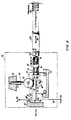
- Fig. 2 is a side view, partially broken away and partially in cross section of the stepper motor control for fuel injection of this invention.
- Fig. 1 shows a prior art fuel injection system.
- a pump drive shaft 10 is driven by an engine 12.
- the pump drive shaft 10 is coupled via a helically-splined sleeve 14 to the camshaft 16 of a fuel pump 18.
- Individual plungers 20 in the fuel pump 18 supply a metered fuel charge from a pressurized fuel source 22 to injectors 23 for the individual cylinders of the engine 12 in response to the urgings of individual lobes 24 on the camshaft 16.
- the sleeve 14 is axially positionable by servo actuators 26 to vary the relative angular position (timing) of the camshaft 16 with respect to the pump drive shaft 10, within a limited range of relative angular positions, while driving the camshaft in syntony with the fuel pump drive shaft.
- the camshaft timing determines the onset of injection.
- the servo actuators 26 are responsive to a control signal from a microprocessor-based fuel control 28, which receives as inputs, signals from engine sensors 30 indicative of engine operating parameters such as speed, position, temperature, load and throttle lever setting.
- a pump rack 32 is disposed tangentially to the plungers 20 and is attached thereto by suitable means 34.
- the rack 32 is longitudinally positionable, as indicated by the double-ended arrow 36, by an actuator 38.
- the plungers 20 are rotated simultaneously about their axes.
- the plungers 20 are provided with conventional helical slots which cooperate with spill ports, so that the angular position of the plungers about their axes determines the end of the injection event, and hence the quantity of fuel which is injected.
- Fig. 2 shows the mechanism of this invention within the phantom lines 38 for linearly-actuating a fuel injection pump rack 32A (similar to the rack 32 of Fig. 1).
- An electromechanical actuator such as a fine angle stepper motor 40, is mounted in a housing 42 and is responsive to a desired pump rack position signal on a line 44 from the electronic fuel control 28 for open-loop operation.
- the output shaft 46 of the motor 40 carries a pinion gear 48 having teeth 50.
- a preloaded, compliant linkage comprising a rack member 52, a spring 54, and a clevis member 56 is disposed in-line with the pump rack 32A, between the pinion gear 48 and the pump rack 32A, to position the pump rack 32A linearly (as indicated by the arrows 36) in response to the rotational position of the pinion gear 48 which is dictated by the controller.
- proximal refers to those elements or portions of elements disposed towards the pump rack 32A
- distal refers to those elements or portions of elements disposed away from the pump rack.
- the rack member 52 has two portions; a longitudinal rectangular portion 62, and a rod portion 64 extending longitudinally from the proximal end 66 of the rectangular portion 62 toward the pump rack 32A.
- One side 68 of the rectangular portion 62 has teeth 70 that mesh with the pinion gear teeth 50, and the opposite side 72 is provided with a longitudinal groove 74.
- a spring-loaded mechanism 76 is disposed in the housing 42 transverse to the rack member 52, and has a wheel 78 that rides in the groove 74.
- the wheel 78 is urged against the rack member 52, towards the pinion 48 by a spring 79.
- Zero backlash of the rack and the pinion is achieved by the profile of the teeth 50 and 70, and by the force of the spring 79 which loads the rack radially toward the pinion gear 48.
- the proximal end 92 of the clevis member 56 is transversely (parallel to the output shaft 46) pinned by a pin 93 to the distal end 94 of the pump rack 32A so that the rack member 52 can pivot towards the pinion gear 48, thereby insuring maximum engagement of the teeth 50, 70 in response to the urgings of the spring-loaded mechanism 76.
- the spring force of this mechanism 76 is determined by, and is a function of, the maximum force exerted by the pinion gear teeth 50 in meeting a mechanism load.
- the load is a force directed along the involute path of the teeth, which has a radial component that must be overcome by the spring in order for the teeth to remain in contact.
- the rack teeth 50 load both sides of one or more pinion teeth 70.
- the spring force will also compensate for wear with zero backlash.
- the design objective for the profile of the teeth 50 and 70 is to minimize backlash and sliding contact, and to maximize rolling contact.
- the spring stroke is limited by a disengagement stop so as to permit the rack teeth 70 to ride up on the pinion teeth 50, without permitting disengagement of the teeth. If the tooth load exceeds normally calculable values, such as may occur upon a pump rack seizure, tooth disengagement is prevented up to the point of outright tooth failure.
- the compliant linkage avoids the need for the tight control of centerline distance between pinion and rack, permitting the motor and mechanism load to be mounted in separate housings.
- the rod portion 64 of the rack member extends longitudinally into a longitudinal hole 80 in the distal end 90 of the clevis member 56.
- a press-fit pin 82 extends transversely through the proximal end 84 of the rod portion 64, and extends past the diameter of the rod portion 64 into a longitudinally elongated transverse slot 86 in the midsection of the clevis member 56.
- the rod portion 64 is not fully inserted into the hole 80 in the clevis portion 56. Rather, a section 88 of the rod portion 64 extends across a gap between the proximal end 66 of the rectangular portion 62 and the distal end 90 of the clevis member 56.
- the spring 54 is a compression-type spring and is disposed in a partially preloaded (precompressed) state about the section 88 of the rod portion (in practice, prior to insertion of the pin 82) to exert a separating force between the rack member 52 and the clevis member 56.
- the necessity for the preloaded spring 54 is now discussed.
- the linkage 52,54,56 avoids impact loads normally experienced with mechanisms driven by stepper motors, especially since in this context the stepper motor 40 has a characteristic motion which combines a high rotational rate of acceleration with oscillation (during operation) which could otherwise be damaging to a mechanism with backlash.
- Stepper motors offer a number of advantages over alternative motion control actuators such as solenoids, voice coil, and D.C. servo motors. Excellent static and dynamic accuracy is maintained over the life of the system, sometimes without the need for closed-loop control by means of a position feedback sensor (although position feedback for closed-loop control may certainly be used).
- a micro-computer based controller keeps track of the stepper motor commanded (desired) position, and sequences the stepper motor phase excitation necessary to move to a new location at a given step rate.
- the physical incremental motion of the stepper motor rotor must keep phase with the commanded electrical phase excitation. This is not possible if the load on the motor exceeds its torque. For instance, in the case of a diesel engine jerk pump such as the pump 18, fuel is compressed by the cam-driven plungers 20 and movement of the pump rack 32A during a plunger pumping stroke can result in high transient loads. These transient loads are of significant duration during low engine speeds as encountered during engine starting.
- the preloaded, compliant linkage 52,54,56 enables a smaller lighter, and lower cost stepper motor to be used for a given load, without compromising any of the advantages gained by using a stepper motor for the electromagnetic actuator.
- the stepper motor 40 is illustrated in its closed position, with the distal end 96 of the rack portion 52 resting against a stop 98 in the housing 42. This position is assured by a spring 99 which exerts a distally-directed force on the rack member 52 via the pump rack 32A. Moving the rack member 52 against the stop 98 to rereference position, as taught in the aforementioned U.S Patent No. 4,502,437 (Voss, 1985), is useful, but has some inherent limitations in the context of open-loop stepper motor control. If the stepper motor is always started on one particular coil excitation, it may not be on the correct excitation phase unless a suitable adjustment technique is provided to implement this function. In other words, the stop position may not equal "zero" steps for the chosen coil excitation, it may be physically displaced therefrom.
- a rack member position sensor 100 such as a Hall effect sensor, at a predetermined reference position slightly away from the stop 98 (in the proximal direction) to sense a corresponding reference position for the rack member.
- This reference position is stored in the controller.
- the reference position is located a distance corresponding to at least one-quarter of the repeating stepper motor excitation coil sequence away from the stop 98. (The stepper motor excitation coils are excited sequentially in a repeating pattern.) A sufficient number of step pulses are provided by the controller 28 to the stepper motor to insure positional correspondence between the software (step count from the stored reference position in the controller 28) and the hardware (position of the rack member 52).
- pump rack position and hence end of injection, is readily made dependent on a number of engine operating parameters, in a manner similar to the dependence of cam timing on these parameters; i.e., by development and implementation of suitable control algorithms in the controller 28.
Landscapes
- Engineering & Computer Science (AREA)
- Chemical & Material Sciences (AREA)
- Combustion & Propulsion (AREA)
- Mechanical Engineering (AREA)
- General Engineering & Computer Science (AREA)
- High-Pressure Fuel Injection Pump Control (AREA)
- Fuel-Injection Apparatus (AREA)
Claims (2)
- Kraftstoffeinspritzsystem für einen Motor (12), mit: einer Kraftstoffeinspritzpumpe (18);
bewegbaren und positionierbaren Stößeleinrichtungen (20) zum Einspritzen und Zumessen des Kraftstoffes in den (die) Zylinder des Motors (12);
einer Nockenwelleneinrichtung (16), die mit dem Motor (12) verbunden ist, zum Bewegen der Stößeleinrichtungen (20) und zum Bewirken des Einspritzens des Kraftstoffes in den (die) Zylinder;
einer positionierbaren Pumpenstangeneinrichtung (32A), die mit den Stößeleinrichtungen (20) verbunden ist, zum Positionieren der Stößeleinrichtungen (20) und zum Bewirken des Zumessens des Kraftstoffes in den (die) Zylinder; und einem Schrittmotor (40), der über ein nachgiebiges, vorgespanntes Gestänge mit der Pumpenstangeneinrichtung (32A) verbunden ist, zum Positionieren der Pumpenstangeneinrichtung (32A) in Abhängigkeit von einem Motorbetriebsparameter, wobei ein distaler Zahnstangenteil (52) des Gestänges mit einem Schrittmotorausgangsritzel (48) in Eingriff ist;
einer Reglereinrichtung (28), die ein Sollpositionssignal (44) an den Schrittmotor (40) abgibt;
einer Anschlageinrichtung (98) zum Begrenzen der distalen Bewegung des distalen Teils des Gestänges;
einem Positionssensor (100) an dem distalen Teil des Gestänges, der ein Signal an den Regler abgibt, welches eine vorbestimmte Bezugsposition des distalen Teils angibt, wobei die Bezugsposition von dem Anschlag versetzt ist;
einer Einrichtung zum Speichern eines Wertes für die vorbestimmte Bezugsposition in dem Regler;
einer Einrichtung zum Liefern von Impulsen von dem Regler zu dem Schrittmotor, um zu bewirken, daß sich der distale Teil des Gestänges von dem Anschlag weg zu der Bezugsposition bewegt; und
einer Einrichtung zum Neubeziehen des Impulszählwertes in dem Regler in Abhängigkeit von dem Signal aus dem Positionssensor, welches angibt, daß der distale Teil des Gestänges in der Bezugsposition ist. - System nach Anspruch 1, wobei:
die Bezugsposition in einem Abstand von der Anschlageinrichtung (98) ist, der wenigstens einem Viertel der sich wiederholenden Schrittmotorerregerspulensequenz entspricht.
Applications Claiming Priority (2)
| Application Number | Priority Date | Filing Date | Title |
|---|---|---|---|
| US84405586A | 1986-03-26 | 1986-03-26 | |
| US844055 | 1986-03-26 |
Publications (4)
| Publication Number | Publication Date |
|---|---|
| EP0239524A2 EP0239524A2 (de) | 1987-09-30 |
| EP0239524A3 EP0239524A3 (en) | 1988-01-27 |
| EP0239524B1 EP0239524B1 (de) | 1990-01-17 |
| EP0239524B2 true EP0239524B2 (de) | 1995-05-03 |
Family
ID=25291682
Family Applications (1)
| Application Number | Title | Priority Date | Filing Date |
|---|---|---|---|
| EP87630040A Expired - Lifetime EP0239524B2 (de) | 1986-03-26 | 1987-03-25 | Kraftstoffeinspritzpumpe mit Schrittmotorregelung |
Country Status (2)
| Country | Link |
|---|---|
| EP (1) | EP0239524B2 (de) |
| DE (1) | DE3761449D1 (de) |
Families Citing this family (1)
| Publication number | Priority date | Publication date | Assignee | Title |
|---|---|---|---|---|
| JPH0629595B2 (ja) * | 1989-03-03 | 1994-04-20 | いすゞ自動車株式会社 | スロットル制御装置 |
Family Cites Families (2)
| Publication number | Priority date | Publication date | Assignee | Title |
|---|---|---|---|---|
| JPS5115885Y2 (de) * | 1971-11-18 | 1976-04-26 | ||
| US4493303A (en) * | 1983-04-04 | 1985-01-15 | Mack Trucks, Inc. | Engine control |
-
1987
- 1987-03-25 DE DE8787630040T patent/DE3761449D1/de not_active Expired - Fee Related
- 1987-03-25 EP EP87630040A patent/EP0239524B2/de not_active Expired - Lifetime
Also Published As
| Publication number | Publication date |
|---|---|
| EP0239524A2 (de) | 1987-09-30 |
| EP0239524B1 (de) | 1990-01-17 |
| DE3761449D1 (de) | 1990-02-22 |
| EP0239524A3 (en) | 1988-01-27 |
Similar Documents
| Publication | Publication Date | Title |
|---|---|---|
| US4546749A (en) | Fuel injection apparatus | |
| US5103792A (en) | Processor based fuel injection control system | |
| EP0246373B1 (de) | Einspritzvorrichtung für Kraftstoff | |
| JPS61171874A (ja) | 2種燃料噴射装置 | |
| EP0221832A2 (de) | Kraftstoffeinspritzungssteuerung und Zeitpunkt- und Drehzahlgeber | |
| WO1996009472A1 (en) | Fuel injection nozzle | |
| US4850321A (en) | Preloaded compliant linkage for fuel injection pump rack | |
| JPH0551050B2 (de) | ||
| US5809954A (en) | Fuel injection timing system for unit injectors | |
| EP0239524B2 (de) | Kraftstoffeinspritzpumpe mit Schrittmotorregelung | |
| US4831983A (en) | Stepper motor control for fuel injection | |
| JP3540095B2 (ja) | ディーゼルエンジンの噴射時期制御装置における異常判定装置 | |
| JPH01182554A (ja) | 燃料噴射装置 | |
| EP0239523B1 (de) | Vorgespanntes elastisches Gestänge für die Regelstange einer Kraftstoffeinspritzpumpe | |
| US4403582A (en) | Fuel injection control system | |
| JPH0214543B2 (de) | ||
| US7255091B2 (en) | Fuel injector control system and method | |
| GB2069596A (en) | Fuel injection pump electrical fuel delivery control system | |
| EP0697511A2 (de) | Einrichtung zur Verstellung des Förderbeginnes eines Brennstoffeinspritzsystems | |
| EP0161781A1 (de) | Regler für Kraftstoffeinspritzpumpen | |
| US5647320A (en) | Method and device for assembling an injection pump element | |
| JP3518417B2 (ja) | コモンレール式燃料噴射装置 | |
| US5188077A (en) | Apparatus for a diesel engine | |
| JP3331689B2 (ja) | 燃料噴射制御装置 | |
| JP3147506B2 (ja) | 燃料噴射装置 |
Legal Events
| Date | Code | Title | Description |
|---|---|---|---|
| PUAI | Public reference made under article 153(3) epc to a published international application that has entered the european phase |
Free format text: ORIGINAL CODE: 0009012 |
|
| AK | Designated contracting states |
Kind code of ref document: A2 Designated state(s): DE FR GB IT |
|
| PUAL | Search report despatched |
Free format text: ORIGINAL CODE: 0009013 |
|
| RAP1 | Party data changed (applicant data changed or rights of an application transferred) |
Owner name: AIL CORPORATION |
|
| AK | Designated contracting states |
Kind code of ref document: A3 Designated state(s): DE FR GB IT |
|
| 17P | Request for examination filed |
Effective date: 19880607 |
|
| 17Q | First examination report despatched |
Effective date: 19890329 |
|
| GRAA | (expected) grant |
Free format text: ORIGINAL CODE: 0009210 |
|
| AK | Designated contracting states |
Kind code of ref document: B1 Designated state(s): DE FR GB IT |
|
| ET | Fr: translation filed | ||
| REF | Corresponds to: |
Ref document number: 3761449 Country of ref document: DE Date of ref document: 19900222 |
|
| ITF | It: translation for a ep patent filed | ||
| PLBI | Opposition filed |
Free format text: ORIGINAL CODE: 0009260 |
|
| 26 | Opposition filed |
Opponent name: ROBERT BOSCH GMBH Effective date: 19901012 |
|
| ITTA | It: last paid annual fee | ||
| PUAH | Patent maintained in amended form |
Free format text: ORIGINAL CODE: 0009272 |
|
| STAA | Information on the status of an ep patent application or granted ep patent |
Free format text: STATUS: PATENT MAINTAINED AS AMENDED |
|
| 27A | Patent maintained in amended form |
Effective date: 19950503 |
|
| AK | Designated contracting states |
Kind code of ref document: B2 Designated state(s): DE FR GB IT |
|
| ET3 | Fr: translation filed ** decision concerning opposition | ||
| ITF | It: translation for a ep patent filed | ||
| PGFP | Annual fee paid to national office [announced via postgrant information from national office to epo] |
Ref country code: GB Payment date: 19970213 Year of fee payment: 11 |
|
| PGFP | Annual fee paid to national office [announced via postgrant information from national office to epo] |
Ref country code: FR Payment date: 19970214 Year of fee payment: 11 |
|
| PG25 | Lapsed in a contracting state [announced via postgrant information from national office to epo] |
Ref country code: GB Free format text: LAPSE BECAUSE OF NON-PAYMENT OF DUE FEES Effective date: 19980325 |
|
| PG25 | Lapsed in a contracting state [announced via postgrant information from national office to epo] |
Ref country code: FR Free format text: THE PATENT HAS BEEN ANNULLED BY A DECISION OF A NATIONAL AUTHORITY Effective date: 19980331 |
|
| GBPC | Gb: european patent ceased through non-payment of renewal fee |
Effective date: 19980325 |
|
| REG | Reference to a national code |
Ref country code: FR Ref legal event code: ST |
|
| PGFP | Annual fee paid to national office [announced via postgrant information from national office to epo] |
Ref country code: DE Payment date: 20010313 Year of fee payment: 15 |
|
| PG25 | Lapsed in a contracting state [announced via postgrant information from national office to epo] |
Ref country code: DE Free format text: LAPSE BECAUSE OF NON-PAYMENT OF DUE FEES Effective date: 20021001 |
|
| PG25 | Lapsed in a contracting state [announced via postgrant information from national office to epo] |
Ref country code: IT Free format text: LAPSE BECAUSE OF NON-PAYMENT OF DUE FEES Effective date: 20050325 |
|
| APAH | Appeal reference modified |
Free format text: ORIGINAL CODE: EPIDOSCREFNO |