EP0231226B1 - Reflexionsvermindernder belag für ein optisches element aus organischem material - Google Patents
Reflexionsvermindernder belag für ein optisches element aus organischem material Download PDFInfo
- Publication number
- EP0231226B1 EP0231226B1 EP86904108A EP86904108A EP0231226B1 EP 0231226 B1 EP0231226 B1 EP 0231226B1 EP 86904108 A EP86904108 A EP 86904108A EP 86904108 A EP86904108 A EP 86904108A EP 0231226 B1 EP0231226 B1 EP 0231226B1
- Authority
- EP
- European Patent Office
- Prior art keywords
- reflection
- phototropic
- coating
- optical element
- organic material
- Prior art date
- Legal status (The legal status is an assumption and is not a legal conclusion. Google has not performed a legal analysis and makes no representation as to the accuracy of the status listed.)
- Expired - Lifetime
Links
- 238000000576 coating method Methods 0.000 title claims abstract description 24
- 239000011248 coating agent Substances 0.000 title claims abstract description 23
- 230000003287 optical effect Effects 0.000 title claims abstract description 17
- 239000011368 organic material Substances 0.000 title claims abstract description 16
- 239000000463 material Substances 0.000 claims description 11
- VYPSYNLAJGMNEJ-UHFFFAOYSA-N Silicium dioxide Chemical compound O=[Si]=O VYPSYNLAJGMNEJ-UHFFFAOYSA-N 0.000 claims description 10
- 235000012239 silicon dioxide Nutrition 0.000 claims description 5
- 239000000377 silicon dioxide Substances 0.000 claims description 5
- PLDDOISOJJCEMH-UHFFFAOYSA-N neodymium(3+);oxygen(2-) Chemical compound [O-2].[O-2].[O-2].[Nd+3].[Nd+3] PLDDOISOJJCEMH-UHFFFAOYSA-N 0.000 claims 2
- GWEVSGVZZGPLCZ-UHFFFAOYSA-N Titan oxide Chemical compound O=[Ti]=O GWEVSGVZZGPLCZ-UHFFFAOYSA-N 0.000 claims 1
- 229910003451 terbium oxide Inorganic materials 0.000 claims 1
- SCRZPWWVSXWCMC-UHFFFAOYSA-N terbium(iii) oxide Chemical compound [O-2].[O-2].[O-2].[Tb+3].[Tb+3] SCRZPWWVSXWCMC-UHFFFAOYSA-N 0.000 claims 1
- OGIDPMRJRNCKJF-UHFFFAOYSA-N titanium oxide Inorganic materials [Ti]=O OGIDPMRJRNCKJF-UHFFFAOYSA-N 0.000 claims 1
- 230000000694 effects Effects 0.000 abstract description 10
- 230000005284 excitation Effects 0.000 abstract description 5
- 230000003595 spectral effect Effects 0.000 abstract 2
- 239000000126 substance Substances 0.000 description 12
- 230000005855 radiation Effects 0.000 description 4
- 238000010521 absorption reaction Methods 0.000 description 3
- 239000006117 anti-reflective coating Substances 0.000 description 3
- 239000011159 matrix material Substances 0.000 description 3
- 229910044991 metal oxide Inorganic materials 0.000 description 3
- 150000004706 metal oxides Chemical class 0.000 description 3
- 229910004298 SiO 2 Inorganic materials 0.000 description 2
- 238000000862 absorption spectrum Methods 0.000 description 1
- 230000015572 biosynthetic process Effects 0.000 description 1
- 238000004040 coloring Methods 0.000 description 1
- 150000001875 compounds Chemical class 0.000 description 1
- 230000001419 dependent effect Effects 0.000 description 1
- 238000011161 development Methods 0.000 description 1
- 230000018109 developmental process Effects 0.000 description 1
- 239000011521 glass Substances 0.000 description 1
- 238000012986 modification Methods 0.000 description 1
- 230000004048 modification Effects 0.000 description 1
- 231100000289 photo-effect Toxicity 0.000 description 1
- 230000004936 stimulating effect Effects 0.000 description 1
- 239000000758 substrate Substances 0.000 description 1
Images
Classifications
-
- G—PHYSICS
- G02—OPTICS
- G02B—OPTICAL ELEMENTS, SYSTEMS OR APPARATUS
- G02B1/00—Optical elements characterised by the material of which they are made; Optical coatings for optical elements
- G02B1/10—Optical coatings produced by application to, or surface treatment of, optical elements
- G02B1/11—Anti-reflection coatings
- G02B1/111—Anti-reflection coatings using layers comprising organic materials
-
- G—PHYSICS
- G02—OPTICS
- G02C—SPECTACLES; SUNGLASSES OR GOGGLES INSOFAR AS THEY HAVE THE SAME FEATURES AS SPECTACLES; CONTACT LENSES
- G02C7/00—Optical parts
- G02C7/10—Filters, e.g. for facilitating adaptation of the eyes to the dark; Sunglasses
- G02C7/102—Photochromic filters
-
- G—PHYSICS
- G02—OPTICS
- G02C—SPECTACLES; SUNGLASSES OR GOGGLES INSOFAR AS THEY HAVE THE SAME FEATURES AS SPECTACLES; CONTACT LENSES
- G02C2202/00—Generic optical aspects applicable to one or more of the subgroups of G02C7/00
- G02C2202/16—Laminated or compound lenses
Definitions
- the invention relates to a reflection-reducing coating for an optical element made of organic material with phototropic properties, and in particular to such a spectacle lens.
- Phototropic is understood here to mean the property that the color impression and the darkening of the optical element change with the illuminance, ie. H. the radiation intensity changes.
- the phototropic properties of optical elements made of organic material are generally achieved by introducing organic substances with phototropic properties, for example spirooxazine compounds, into the matrix of the optical element or applying them to the optical element.
- the invention is therefore based on the object of specifying a reflection-reducing coating for an optical element made of organic material with phototropic properties.
- the antireflection coating provided according to the invention thus differs from that used hitherto both for spectacle lenses made of plastic without phototropic properties and for those with phototropic properties in that it has defined reflection properties not only in the range of visible light from 380 nm to 780 nm, but also in the range between 290 nm and 380 nm. So far, the curve shape has not been given attention below 380 nm.
- the reflection properties in the range between 290 nm and 380 nm can be significantly influenced by the color of the achieve phototropic effect.
- the properties of the reflection-reducing coating for an optical element made of organic material can be used Only fulfill phototropic properties with a layer system with more than three layers.
- Preferred embodiments of this layer system are characterized in claims 4 to 6.
- the course provided according to the invention between 290 nm and 380 nm can only be achieved satisfactorily if the high-index material has a refractive index n, which is at least Is 2.0.
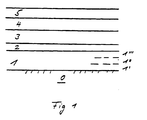
- the first layer 1 made of SiO 2 applied directly on the optical element 0, the second layer 2 made of a high-index metal oxide, the third layer 3 made of SiO 2 , the fourth layer 4 in turn consists of a high-index metal oxide and the fifth layer 5 consists of Si0 2 .
- the layer 1 into three sub-layers 1 ', 1 ", 1"', which consist of Si0 2 , a high-index metal oxide and Si0 2 .
- Table 1 shows the structure of the layer system with 5 layers and the refractive index n ⁇ of the high-index material for various high-index materials (hM), ie the index of refraction for light with a wavelength of 546.1 nm. It is assumed that the substrate 0 has a refractive index of (approximately) 1.502.
- Table 2 shows an embodiment for a layer system with 7 layers.
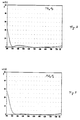
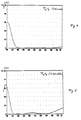
- FIGS. 2 to 5 show the reflection factors r (x) (in%) of the layer systems given in Tables 1 and 2 as a function of the wavelength ⁇ of the incident light. It can be clearly seen as a common property of all layer systems that the maximum value r (a) of the reflection in the range between 330 nm and 380 nm does not exceed 6%, while that according to reflection F ( ⁇ ) averaged over this wavelength range is less than 3%. In the range between 290 nm and 330 nm, the maximum value of the reflection exceeds the value 25%, the reflection averaged over this range being greater than 15%. The drop below 290 nm, which occurs with some reflection curves, is meaningless, since radiation in this wavelength range is irrelevant due to the absorption properties of the atmosphere.
- the layer system according to the invention is not only for phototropic optical elements with a refractive index of about 1.5, but also for elements with a higher refractive index. It is also possible to use a wide variety of materials with different refractive indices instead of the high-index materials given in the examples, provided that these are greater than or equal to 2.0. Different high-index materials can also be used in one layer system.
Landscapes
- Physics & Mathematics (AREA)
- Health & Medical Sciences (AREA)
- Ophthalmology & Optometry (AREA)
- General Physics & Mathematics (AREA)
- Optics & Photonics (AREA)
- General Health & Medical Sciences (AREA)
- Optical Filters (AREA)
- Eyeglasses (AREA)
- Surface Treatment Of Optical Elements (AREA)
Description
- Die Erfindung bezieht sich auf einen reflexionsvermindernden Belag für ein optisches Element aus organischem Material mit phototropen Eigenschaften, und insbesondere auf ein derartiges Brillenglas.
- In der Vergangenheit sind eine Reihe von Vorschlägen bekanntgeworden, optische Elemente aus organischem Material und insbesondere Brillengläser aus organischem Material phototrop auszugestalten. Unter « phototrop » wird hierbei die Eigenschaft verstanden, daß sich der Farbeindruck und die Eindunkelung des optischen Elements mit der Beleuchtungsstärke, d. h. der Strahlungsintensität ändert.
- Die phototropen Eigenschaften von optischen Elementen aus organischem Material werden in der Regel dadurch erzielt, daß organische Substanzen mit phototropen Eigenschaften, beispielsweise Spirooxazin-Verbindungen in die Matrix des optischen Elements eingebracht oder auf das optische Element aufgebracht werden.
- Andererseits werden gegenwärtig die meisten Brillengläser mit einem reflexionsvermindernden Belag versehen, der zumeist aus mehreren hoch- und niederbrechenden Schichten besteht. In der Literatur ist bislang der Frage, welcher reflexionsvermindernde Belag für ein Brillenglas aus organischem Material mit phototropen Eigenschaften am besten geeignet ist, keine Beachtung geschenkt. Bei tatsächlich ausgeführten Brillengläsem aus organischem Material mit phototropen Eigenschaften werden die gleichen reflexionsvermindemden Beläge aufgebracht wie sie auch für Brillengläser aus organischem Material ohne phototrope Eigenschaften verwendet werden.
- Erfindungsgemäß ist nun erkannt worden, daß sich die Eigenschaften von Brillengläsem aus organischem Material, in die phototrope Substanzen eingebracht oder auf die phototrope Substanzen aufgebracht sind, durch geeignete Wahl eines reflexionsvermindemden Belags beeinflussen lassen.
- Der Erfindung liegt deshalb die Aufgabe zugrunde, einen reflexionsvermindemden Belag für ein optisches Element aus organischem Material mit phototropen Eigenschaften anzugeben.
- Eine erfindungsgemäße Lösung dieser Aufgabe ist mit ihren Weiterbildungen in den Patentansprüchen gekennzeichnet.
- Erfindungsgemäß ist erkannt worden, daß ein reflexionsvermindemder Belag aus mehreren Schichten für ein optisches Element aus organischem Material mit phototropen Eigenschaften folgende Charakteristika besitzen muß :
- 1. Im Wellenlängenbereich zwischen 330 nm und 380 nm sollte die Reflexion möglichst niedrig sein, um eine ausreichende Anregung der phototropen Substanz bzw. bei Einbringung von mehreren Substanzen der verschiedenen Substanzen zu gewährleisten.
- 2. Im Wellenlängenbereich unterhalb 330 nm sollte die Reflexion stark ansteigen, da Strahlung in diesem Wellenlängenbereich, die den phototropen Effekt ebenfalls anregt, die Lebensdauer des Photoeffekts - wie ebenfalls erfindungsgemäß erkannt worden ist - herabsetzt.
- 3. Im Wellenlängenbereich unterhalb von 290 nm spielen die Reflexionseigenschaften des reflexionsvermindernden Belags keine entscheidende Rolle mehr, da die Absorptionseigenschaften der Atmosphäre verhindern, daß eine derartige Strahlung in nennenswertem Umfang die organischen Substanzen anregen und gegebenenfalls schädigen kann.
- Der erfindungsgemäß vorgesehene reflexionsvermindernde Belag unterscheidet sich damit von den bislang sowohl für Brillengläser aus Kunststoff ohne phototrope Eigenschaften als auch für solche mit phototropen Eigenschaften verwendeten Belägen dadurch, daß er definierte Reflexionseigenschaften nicht nur im Bereich des sichtbaren Lichts von 380 nm bis 780 nm, sondern auch im Bereich zwischen 290 nm und 380 nm hat. Unterhalb von 380 nm wurde bislang dem Kurvenverlauf keine Beachtung geschenkt.
- Der erfindungsgemäße Belag für ein optisches Element aus organischem Material und insbesondere ein Brillenglas mit phototropen Eigenschaften hat damit folgende Vorteile :
- Er gewährleistet eine ausreichende Anregung des phototropen Effekts in Abhängigkeit von der jeweiligen Beleuchtungsstär-ke. Damit ist bei Verwendung des erfindungsgemäßen reflexionsvermindemden Belags die Kinetik des phototropen Effekts besser als bei Verwendung von herkömmlichen Belägen.
- Er verhindert, daß durch Anregung des phototropen Effekts mit zu kurzwelligem Licht die Lebensdauer des phototropen Effekts herabgesetzt wird.
- Darüberhinaus ergeben sich durch die Verwendung des erfindungsgemäßen phototropen Belags noch weitere unerwartete Vorteile :
- Bedingt durch die unterschiedlichen sterischen Lagen der phototropen Moleküle in der KunststoffMatrix haben diese unterschiedliche Absorptions- und Kinetikeigenschaften. Durch eine geeignete Wahl der Reflexionseigenschaften des Belags läßt sich eine gezielte Anregung von in bestimmten sterischen Lagen eingebauten phototropen Molekülen und damit eine Beeinflussung der Kinetik und Farbe des phototropen Effekts erreichen.
- Baut man in die Matrix des optischen Elements, das beispielsweise aus organischem Material besteht, mindestens zwei unterschiedliche phototrope Substanzen ein, die unterschiedliche Absorptionsspektren besitzen, so kann man durch die Gestaltung der Reflexionseigenschaften im Bereich zwischen 290 nm und 380 nm eine wesentliche Beeinflussung der Farbe des phototropen Effekts erreichen.
- Wie weiterhin erfindungsgemäß erkannt worden ist, lassen sich die erfindungsgemäßen Eigenschaften des reflexionsvermindernden Belags für ein optisches Element aus organischem Material mit phototropen Eigenschaften nur mit einem Schichtsystem mit mehr als drei Schichten erfüllen. Bevorzugte Ausführungsformen dieses Schichtsystems sind in den Ansprüchen 4 bis 6 gekennzeichnet. Bei einem Belag der fünf Schichten aufweist, die abwechselnd aus Siliziumdioxid und einem hochbrechenden Material bestehen, läßt sich der erfindungsgemäß vorgesehene Verlauf zwischen 290 nm und 380 nm nur dann befriedigend erreichen, wenn das hochbrechende Material gemäß Anspruch 5 einen Brechungsindex n, hat, der mindestens 2,0 ist.
- Die Erfindung wird nachstehend anhand von Ausführungsbeispielen unter Bezugnahme auf die Zeichnung näher beschrieben, in der zeigen :
- Fig. 1 einen erfindungsgemäßen Belag mit 5 Schichten, und
- Fig. 2 bis 5 Reflexionskurven verschiedener Ausführungs beispiele.
- Fig. 1 zeigt einen erfindungsgemäßen Belag mit 5 Schichten, von denen die erste direkt auf dem optischen Element 0 aufgebrachte Schicht 1 aus Si02, die zweite Schicht 2 aus einem hochbrechenden Metalloxid, die dritte Schicht 3 aus Si02, die vierte Schicht 4 wiederum aus einem hochbrechenden Metalloxid und die fünfte Schicht 5 aus Si02 besteht.
- Ferner ist es auch möglich, die Schicht 1 in drei Teilschichten 1', 1", 1"' aufzuspalten, die aus Si02, einem hochbrechenden Metalloxid und Si02 bestehen.
- In der nachstehenden Tabelle 1 ist für verschiedene hochbrechende Materialien (hM) der Aufbau des Schichtsystems mit 5 Schichten sowie der Brechungsindex nµ des hochbrechenden Materials angegeben, d. h. der Brechungsindex für Licht mit der Wellenlänge 546,1 nm. Dabei ist vorausgesetzt, daß das Substrat 0 einen Brechungsindex von (etwa) 1,502 hat.

- In Tabelle 2 ist ein Ausführungsbeispiel für ein Schichtsystem mit 7 Schichten angegeben.

- In den Figuren 2 bis 5 sind die Reflexionsfaktoren r(x) (in %) der in Tabelle 1 bzw. 2 angegebenen Schichtsysteme als Funktion der Wellenlänge λ des auftreffenden Lichts angegeben. Man erkennt deutlich als gemeinsame Eigenschaft aller Schichtsysteme, daß der Maximalwert r(a) der Reflexion im Bereich zwischen 330 nm und 380 nm den Wert 6 % nicht übersteigt, während die gemäß

- Vorstehend ist die Erfindung exemplarisch beschrieben worden. Es versteht sich von selbst, daß innerhalb des erfindungsgemäßen Grundgedankens, die Lebensdauer, die Kinetik sowie bei Verwendung mehrerer sich unterschiedlich einfärbender phototroper Substanzen den Farbeindruck durch geeignete Ausbildung des reflexionsvermindernden Belags zu beeinflußen, die verschiedensten Modifikationen möglich sind.
- Beispielsweise ist das erfindungsgemäße Schichtsystem nicht nur für phototrope optische Elemente mit einem Brechungsindex von etwa 1,5, sondern auch für Elemente mit einem höheren Brechungsindex brauchbar. Auch ist es möglich, anstelle der in den Beispielen angegebenen hochbrechenden Materialien die verschiedensten Materialien mit anderen Brechungsindices zu verwenden, sofern diese größer/gleich 2,0 sind. Auch können unterschiedliche hochbrechende Materialien in einem Schichtsystem verwendet werden.
- Besonders vorteilhaft ist jedoch in jedem Falle die Einhaltung der erfindungsgemäß angegebenen Bedingung für das Dickenverhältnis. Es versteht sich jedoch von selbst, daß die angegebene Beziehung nur innerhalb gewisser, materialabhängiger Toleranzen erfüllt sein muß.
Claims (7)

verhalten, und daß die Summe der Dicken der zweiten bis vierten Schicht ebenfalls etwa X/2 ist, wobei die fünfte Schicht eine λ/4-Schicht ist (x = 350 nm).
Priority Applications (1)
| Application Number | Priority Date | Filing Date | Title |
|---|---|---|---|
| AT86904108T ATE49306T1 (de) | 1985-07-19 | 1986-07-21 | Reflexionsvermindernder belag fuer ein optisches element aus organischem material. |
Applications Claiming Priority (2)
| Application Number | Priority Date | Filing Date | Title |
|---|---|---|---|
| DE3525892 | 1985-07-19 | ||
| DE3525892A DE3525892C1 (de) | 1985-07-19 | 1985-07-19 | Reflexionsvermindernder Belag fuer ein optisches Element aus organischem Material |
Publications (2)
| Publication Number | Publication Date |
|---|---|
| EP0231226A1 EP0231226A1 (de) | 1987-08-12 |
| EP0231226B1 true EP0231226B1 (de) | 1990-01-03 |
Family
ID=6276248
Family Applications (1)
| Application Number | Title | Priority Date | Filing Date |
|---|---|---|---|
| EP86904108A Expired - Lifetime EP0231226B1 (de) | 1985-07-19 | 1986-07-21 | Reflexionsvermindernder belag für ein optisches element aus organischem material |
Country Status (6)
| Country | Link |
|---|---|
| US (1) | US4852974A (de) |
| EP (1) | EP0231226B1 (de) |
| JP (1) | JPS63500340A (de) |
| AU (1) | AU600445B2 (de) |
| DE (2) | DE3525892C1 (de) |
| WO (1) | WO1987000641A1 (de) |
Families Citing this family (57)
| Publication number | Priority date | Publication date | Assignee | Title |
|---|---|---|---|---|
| JPH03150509A (ja) * | 1989-11-08 | 1991-06-26 | Fujitsu Ltd | 導波路基板と光ファイバの接続方法及び該方法の実施に使用する紫外光遮断機能付き反射防止膜 |
| CA2162451A1 (en) * | 1994-12-22 | 1996-06-23 | John P. Murphy | Anti-reflective clarifier film for eyeglasses |
| JP3351666B2 (ja) * | 1995-10-20 | 2002-12-03 | 株式会社中戸研究所 | 防曇性反射防止膜、光学部品、及び防曇性反射防止膜の製造方法 |
| IT1282106B1 (it) * | 1996-01-31 | 1998-03-12 | Sola Optical Italia S P A | Substrato trasparente fotocromatico comprendente un rivestimento superficiale antiriflesso |
| AU726633B2 (en) * | 1996-01-31 | 2000-11-16 | Sola International Holdings Ltd | Transparent photochromic article including an anti-reflection surface coating |
| US6193670B1 (en) | 1997-02-14 | 2001-02-27 | Tricardia, Llc | Hemostatic agent delivery device having built-in pressure sensor |
| US5855559A (en) * | 1997-02-14 | 1999-01-05 | Tricardia, Inc. | Hemostatic agent delivery device having built-in pressure sensor |
| US5989462A (en) | 1997-07-31 | 1999-11-23 | Q2100, Inc. | Method and composition for producing ultraviolent blocking lenses |
| US6416307B1 (en) * | 1998-09-25 | 2002-07-09 | Q2100, Inc. | Plastic lens systems, compositions, and methods |
| US6419873B1 (en) | 1999-03-19 | 2002-07-16 | Q2100, Inc. | Plastic lens systems, compositions, and methods |
| US6960312B2 (en) | 2000-03-30 | 2005-11-01 | Q2100, Inc. | Methods for the production of plastic lenses |
| US6528955B1 (en) | 2000-03-30 | 2003-03-04 | Q2100, Inc. | Ballast system for a fluorescent lamp |
| US6723260B1 (en) | 2000-03-30 | 2004-04-20 | Q2100, Inc. | Method for marking a plastic eyeglass lens using a mold assembly holder |
| US6716375B1 (en) | 2000-03-30 | 2004-04-06 | Q2100, Inc. | Apparatus and method for heating a polymerizable composition |
| US6698708B1 (en) | 2000-03-30 | 2004-03-02 | Q2100, Inc. | Gasket and mold assembly for producing plastic lenses |
| US6632535B1 (en) | 2000-06-08 | 2003-10-14 | Q2100, Inc. | Method of forming antireflective coatings |
| JP4524877B2 (ja) * | 2000-07-17 | 2010-08-18 | コニカミノルタホールディングス株式会社 | 眼鏡用レンズ |
| US7052262B2 (en) | 2001-02-20 | 2006-05-30 | Q2100, Inc. | System for preparing eyeglasses lens with filling station |
| US6676398B2 (en) | 2001-02-20 | 2004-01-13 | Q2100, Inc. | Apparatus for preparing an eyeglass lens having a prescription reader |
| US6702564B2 (en) | 2001-02-20 | 2004-03-09 | Q2100, Inc. | System for preparing an eyeglass lens using colored mold holders |
| US6712331B2 (en) | 2001-02-20 | 2004-03-30 | Q2100, Inc. | Holder for mold assemblies with indicia |
| US6726463B2 (en) | 2001-02-20 | 2004-04-27 | Q2100, Inc. | Apparatus for preparing an eyeglass lens having a dual computer system controller |
| US6612828B2 (en) | 2001-02-20 | 2003-09-02 | Q2100, Inc. | Fill system with controller for monitoring use |
| US7060208B2 (en) | 2001-02-20 | 2006-06-13 | Q2100, Inc. | Method of preparing an eyeglass lens with a controller |
| US7051290B2 (en) | 2001-02-20 | 2006-05-23 | Q2100, Inc. | Graphical interface for receiving eyeglass prescription information |
| US7004740B2 (en) | 2001-02-20 | 2006-02-28 | Q2100, Inc. | Apparatus for preparing an eyeglass lens having a heating system |
| US7025910B2 (en) | 2001-02-20 | 2006-04-11 | Q2100, Inc | Method of entering prescription information |
| US6758663B2 (en) | 2001-02-20 | 2004-07-06 | Q2100, Inc. | System for preparing eyeglass lenses with a high volume curing unit |
| US7011773B2 (en) | 2001-02-20 | 2006-03-14 | Q2100, Inc. | Graphical interface to display mold assembly position in a lens forming apparatus |
| US6808381B2 (en) | 2001-02-20 | 2004-10-26 | Q2100, Inc. | Apparatus for preparing an eyeglass lens having a controller |
| US6962669B2 (en) | 2001-02-20 | 2005-11-08 | Q2100, Inc. | Computerized controller for an eyeglass lens curing apparatus |
| US7124995B2 (en) | 2001-02-20 | 2006-10-24 | Q2100, Inc. | Holder for mold assemblies and molds |
| US6863518B2 (en) | 2001-02-20 | 2005-03-08 | Q2100, Inc. | Mold filing apparatus having multiple fill stations |
| US6790022B1 (en) | 2001-02-20 | 2004-09-14 | Q2100, Inc. | Apparatus for preparing an eyeglass lens having a movable lamp mount |
| US6655946B2 (en) | 2001-02-20 | 2003-12-02 | Q2100, Inc. | Apparatus for preparing an eyeglass lens having a controller for conveyor and curing units |
| US6709257B2 (en) | 2001-02-20 | 2004-03-23 | Q2100, Inc. | Eyeglass lens forming apparatus with sensor |
| US6893245B2 (en) | 2001-02-20 | 2005-05-17 | Q2100, Inc. | Apparatus for preparing an eyeglass lens having a computer system controller |
| US7037449B2 (en) | 2001-02-20 | 2006-05-02 | Q2100, Inc. | Method for automatically shutting down a lens forming apparatus |
| US6875005B2 (en) | 2001-02-20 | 2005-04-05 | Q1200, Inc. | Apparatus for preparing an eyeglass lens having a gating device |
| US6790024B2 (en) | 2001-02-20 | 2004-09-14 | Q2100, Inc. | Apparatus for preparing an eyeglass lens having multiple conveyor systems |
| US7139636B2 (en) | 2001-02-20 | 2006-11-21 | Q2100, Inc. | System for preparing eyeglass lenses with bar code reader |
| US6899831B1 (en) | 2001-02-20 | 2005-05-31 | Q2100, Inc. | Method of preparing an eyeglass lens by delayed entry of mold assemblies into a curing apparatus |
| US7083404B2 (en) | 2001-02-20 | 2006-08-01 | Q2100, Inc. | System for preparing an eyeglass lens using a mold holder |
| US7045081B2 (en) | 2001-02-20 | 2006-05-16 | Q2100, Inc. | Method of monitoring components of a lens forming apparatus |
| US6676399B1 (en) | 2001-02-20 | 2004-01-13 | Q2100, Inc. | Apparatus for preparing an eyeglass lens having sensors for tracking mold assemblies |
| US6752613B2 (en) | 2001-02-20 | 2004-06-22 | Q2100, Inc. | Apparatus for preparing an eyeglass lens having a controller for initiation of lens curing |
| US6840752B2 (en) | 2001-02-20 | 2005-01-11 | Q2100, Inc. | Apparatus for preparing multiple eyeglass lenses |
| US7074352B2 (en) | 2001-02-20 | 2006-07-11 | Q2100, Inc. | Graphical interface for monitoring usage of components of a lens forming apparatus |
| US7044429B1 (en) | 2002-03-15 | 2006-05-16 | Q2100, Inc. | Methods and systems for coating eyeglass lens molds |
| US6464484B1 (en) | 2002-03-30 | 2002-10-15 | Q2100, Inc. | Apparatus and system for the production of plastic lenses |
| US7633681B2 (en) * | 2003-03-26 | 2009-12-15 | Intercast Usa, Inc. | Multilayer interference filter for photochromic lenses |
| US20060065989A1 (en) * | 2004-09-29 | 2006-03-30 | Thad Druffel | Lens forming systems and methods |
| WO2008020867A2 (en) * | 2005-11-21 | 2008-02-21 | Q2100, Inc. | Methods of making and using metal oxide nanoparticles |
| FR2968774B1 (fr) | 2010-12-10 | 2013-02-08 | Essilor Int | Article d'optique comportant un revetement antireflet a faible reflexion dans le domaine ultraviolet et le domaine visible |
| FR2996930B1 (fr) * | 2012-10-11 | 2017-11-24 | Essilor Int | Lentille ophtalmique photochromique |
| US9291746B2 (en) | 2014-02-25 | 2016-03-22 | iCoat Company, LLC | Visible spectrum anti-reflective coatings with reduced reflections in ultraviolet and infrared spectral bands |
| US10690944B2 (en) * | 2014-12-01 | 2020-06-23 | Hoya Lens Thailand Ltd. | Spectacle lens that reflects blue light, and spectacles equipped with the spectacle lens |
Family Cites Families (9)
| Publication number | Priority date | Publication date | Assignee | Title |
|---|---|---|---|---|
| US3410625A (en) * | 1963-08-05 | 1968-11-12 | Monsanto Co | Multi-layer interference film with outermost layer for suppression of pass-band reflectance |
| USRE27473E (en) * | 1970-10-21 | 1972-09-05 | Thin film coating for sunglasses | |
| CH564785A5 (de) * | 1972-12-08 | 1975-07-31 | Balzers Patent Beteilig Ag | |
| FR2276601A1 (fr) * | 1974-06-27 | 1976-01-23 | France Etat | Filtres de bande et application a la fabrication de lunettes de protection |
| JPS5195858A (en) * | 1975-01-14 | 1976-08-23 | ****** *** *ku***chi*se*ku*******ka*****************chi***ne******** | |
| US4313647A (en) * | 1975-12-23 | 1982-02-02 | Mamiya Koki Kabushiki Kaisha | Nonreflective coating |
| FR2371497A1 (fr) * | 1976-06-23 | 1978-06-16 | Nippon Kogaku Kk | Revetement anti-reflechissant pour support de resine synthetique |
| JPS6038681B2 (ja) * | 1978-09-27 | 1985-09-02 | キヤノン株式会社 | 紫外用多層膜 |
| DE3332872A1 (de) * | 1983-09-12 | 1985-04-04 | Optische Werke G. Rodenstock, 8000 München | Reflexionsvermindernder belag fuer ein optisches element aus organischem material |
-
1985
- 1985-07-19 DE DE3525892A patent/DE3525892C1/de not_active Expired
-
1986
- 1986-07-21 EP EP86904108A patent/EP0231226B1/de not_active Expired - Lifetime
- 1986-07-21 WO PCT/DE1986/000299 patent/WO1987000641A1/de not_active Ceased
- 1986-07-21 DE DE8686904108T patent/DE3668075D1/de not_active Expired - Fee Related
- 1986-07-21 AU AU61909/86A patent/AU600445B2/en not_active Ceased
- 1986-07-21 JP JP61504041A patent/JPS63500340A/ja active Pending
- 1986-07-21 US US07/041,101 patent/US4852974A/en not_active Expired - Fee Related
Also Published As
| Publication number | Publication date |
|---|---|
| AU6190986A (en) | 1987-02-10 |
| EP0231226A1 (de) | 1987-08-12 |
| WO1987000641A1 (fr) | 1987-01-29 |
| DE3668075D1 (de) | 1990-02-08 |
| DE3525892C1 (de) | 1986-10-02 |
| AU600445B2 (en) | 1990-08-16 |
| JPS63500340A (ja) | 1988-02-04 |
| US4852974A (en) | 1989-08-01 |
Similar Documents
| Publication | Publication Date | Title |
|---|---|---|
| DE3525892C1 (de) | Reflexionsvermindernder Belag fuer ein optisches Element aus organischem Material | |
| EP0438646B1 (de) | Rückblickspiegel für Fahrzeuge, insbesondere Kraftfahrzeuge | |
| DE10301665B4 (de) | Optische Vorrichtung mit Sperrschicht, optisches System und Projektor | |
| DE3345639C2 (de) | ||
| EP1260835B1 (de) | Ultraviolettlicht-Abschwächungsfilter | |
| DE4410275B4 (de) | Verfahren zur Realisierung eines optischen Dünnschicht-Bandpassfilters, ein optisches Dünnschicht-Bandpassfilter, ein optisches Bauelement damit sowie eine Verwendung des Bandpassfilters und eine Bräunungsanlage | |
| DE102008041869A1 (de) | Brillenlinse mit farbneutraler Antireflexbeschichtung und Verfahren zu deren Herstellung | |
| DE10056286B4 (de) | Substrat für Flüssigkristallanzeigeelemente | |
| DE3009533A1 (de) | Verfahren zur herstellung eines reflexverminderndenmehrschichtenbelages und optischer koerper mit reflexverminderndem mehrschichtenbelag | |
| EP0140096B1 (de) | Reflexionsvermindernder Belag für ein optisches Element aus organischem Material | |
| EP1156514A1 (de) | Glühlampe | |
| DE102017105372A1 (de) | Antireflex-Beschichtung | |
| EP0619504A1 (de) | Antireflex-Belag | |
| EP0355672B1 (de) | Sonnenschutzfilter | |
| WO1987001817A1 (fr) | Filtre protecteur contre des rayonnements | |
| DE4442045A1 (de) | Interferenzfilter | |
| EP0332177B1 (de) | Niederreflektierender, hochtransparenter in Durch- als auch in Aussenansicht neutral wirkender Sonnenschutz- und/oder wärmedämmender Belag für ein Substrat aus transparentem Material | |
| DE2240302B2 (de) | Optischer mehrschichtiger Antireflexbelag | |
| DE69724911T2 (de) | Explosionssichere Folie und Kathodenstrahlröhre | |
| DE4100831A1 (de) | Breitband-entspiegelungsschichtbelag | |
| DE112020000939T5 (de) | Farbenseh-Korrekturlinse und optische Komponente | |
| EP1463964A2 (de) | Struktierter farbfilter und herstellung eines solchen | |
| DE4100820C2 (de) | Vielschicht-Entspieglungsbelag | |
| DE102024136835B3 (de) | Mehrschichtige optische Scheibe mit einer Vielzahl von polygonalen Maschen und deren Herstellungsverfahren | |
| DE102020207504B4 (de) | Farbensehen-korrekturlinse und optische komponente |
Legal Events
| Date | Code | Title | Description |
|---|---|---|---|
| PUAI | Public reference made under article 153(3) epc to a published international application that has entered the european phase |
Free format text: ORIGINAL CODE: 0009012 |
|
| AK | Designated contracting states |
Kind code of ref document: A1 Designated state(s): AT BE CH DE FR GB IT LI LU NL SE |
|
| 17P | Request for examination filed |
Effective date: 19870729 |
|
| 17Q | First examination report despatched |
Effective date: 19881130 |
|
| ITF | It: translation for a ep patent filed | ||
| GRAA | (expected) grant |
Free format text: ORIGINAL CODE: 0009210 |
|
| AK | Designated contracting states |
Kind code of ref document: B1 Designated state(s): AT BE CH DE FR GB IT LI LU NL SE |
|
| REF | Corresponds to: |
Ref document number: 49306 Country of ref document: AT Date of ref document: 19900115 Kind code of ref document: T |
|
| ET | Fr: translation filed | ||
| GBT | Gb: translation of ep patent filed (gb section 77(6)(a)/1977) | ||
| REF | Corresponds to: |
Ref document number: 3668075 Country of ref document: DE Date of ref document: 19900208 |
|
| PLBE | No opposition filed within time limit |
Free format text: ORIGINAL CODE: 0009261 |
|
| STAA | Information on the status of an ep patent application or granted ep patent |
Free format text: STATUS: NO OPPOSITION FILED WITHIN TIME LIMIT |
|
| 26N | No opposition filed | ||
| PGFP | Annual fee paid to national office [announced via postgrant information from national office to epo] |
Ref country code: LU Payment date: 19920611 Year of fee payment: 7 |
|
| PGFP | Annual fee paid to national office [announced via postgrant information from national office to epo] |
Ref country code: AT Payment date: 19920615 Year of fee payment: 7 |
|
| PGFP | Annual fee paid to national office [announced via postgrant information from national office to epo] |
Ref country code: BE Payment date: 19920618 Year of fee payment: 7 |
|
| PGFP | Annual fee paid to national office [announced via postgrant information from national office to epo] |
Ref country code: SE Payment date: 19920622 Year of fee payment: 7 |
|
| PGFP | Annual fee paid to national office [announced via postgrant information from national office to epo] |
Ref country code: FR Payment date: 19920629 Year of fee payment: 7 |
|
| PGFP | Annual fee paid to national office [announced via postgrant information from national office to epo] |
Ref country code: GB Payment date: 19920707 Year of fee payment: 7 |
|
| PGFP | Annual fee paid to national office [announced via postgrant information from national office to epo] |
Ref country code: NL Payment date: 19920731 Year of fee payment: 7 |
|
| PGFP | Annual fee paid to national office [announced via postgrant information from national office to epo] |
Ref country code: CH Payment date: 19920805 Year of fee payment: 7 |
|
| EPTA | Lu: last paid annual fee | ||
| PG25 | Lapsed in a contracting state [announced via postgrant information from national office to epo] |
Ref country code: LU Free format text: LAPSE BECAUSE OF NON-PAYMENT OF DUE FEES Effective date: 19930721 Ref country code: GB Effective date: 19930721 Ref country code: AT Effective date: 19930721 |
|
| PG25 | Lapsed in a contracting state [announced via postgrant information from national office to epo] |
Ref country code: SE Effective date: 19930722 |
|
| PG25 | Lapsed in a contracting state [announced via postgrant information from national office to epo] |
Ref country code: LI Effective date: 19930731 Ref country code: CH Effective date: 19930731 Ref country code: BE Effective date: 19930731 |
|
| BERE | Be: lapsed |
Owner name: OPTISCHE WERKE G. RODENSTOCK Effective date: 19930731 |
|
| PG25 | Lapsed in a contracting state [announced via postgrant information from national office to epo] |
Ref country code: NL Effective date: 19940201 |
|
| NLV4 | Nl: lapsed or anulled due to non-payment of the annual fee | ||
| GBPC | Gb: european patent ceased through non-payment of renewal fee |
Effective date: 19930721 |
|
| PG25 | Lapsed in a contracting state [announced via postgrant information from national office to epo] |
Ref country code: FR Effective date: 19940331 |
|
| REG | Reference to a national code |
Ref country code: CH Ref legal event code: PL |
|
| REG | Reference to a national code |
Ref country code: FR Ref legal event code: ST |
|
| EUG | Se: european patent has lapsed |
Ref document number: 86904108.7 Effective date: 19940210 |
|
| PGFP | Annual fee paid to national office [announced via postgrant information from national office to epo] |
Ref country code: DE Payment date: 19970630 Year of fee payment: 12 |
|
| PG25 | Lapsed in a contracting state [announced via postgrant information from national office to epo] |
Ref country code: DE Free format text: LAPSE BECAUSE OF NON-PAYMENT OF DUE FEES Effective date: 19990501 |
|
| PG25 | Lapsed in a contracting state [announced via postgrant information from national office to epo] |
Ref country code: IT Free format text: LAPSE BECAUSE OF NON-PAYMENT OF DUE FEES;WARNING: LAPSES OF ITALIAN PATENTS WITH EFFECTIVE DATE BEFORE 2007 MAY HAVE OCCURRED AT ANY TIME BEFORE 2007. THE CORRECT EFFECTIVE DATE MAY BE DIFFERENT FROM THE ONE RECORDED. Effective date: 20050721 |