EP0225585B1 - Surface layer to reduce contact resistance in resistive printing ribbon - Google Patents
Surface layer to reduce contact resistance in resistive printing ribbon Download PDFInfo
- Publication number
- EP0225585B1 EP0225585B1 EP86116728A EP86116728A EP0225585B1 EP 0225585 B1 EP0225585 B1 EP 0225585B1 EP 86116728 A EP86116728 A EP 86116728A EP 86116728 A EP86116728 A EP 86116728A EP 0225585 B1 EP0225585 B1 EP 0225585B1
- Authority
- EP
- European Patent Office
- Prior art keywords
- ribbon
- layer
- coating
- resistivity
- resistive
- Prior art date
- Legal status (The legal status is an assumption and is not a legal conclusion. Google has not performed a legal analysis and makes no representation as to the accuracy of the status listed.)
- Expired - Lifetime
Links
Images



Classifications
-
- B—PERFORMING OPERATIONS; TRANSPORTING
- B41—PRINTING; LINING MACHINES; TYPEWRITERS; STAMPS
- B41M—PRINTING, DUPLICATING, MARKING, OR COPYING PROCESSES; COLOUR PRINTING
- B41M5/00—Duplicating or marking methods; Sheet materials for use therein
- B41M5/26—Thermography ; Marking by high energetic means, e.g. laser otherwise than by burning, and characterised by the material used
- B41M5/382—Contact thermal transfer or sublimation processes
- B41M5/3825—Electric current carrying heat transfer sheets
-
- Y—GENERAL TAGGING OF NEW TECHNOLOGICAL DEVELOPMENTS; GENERAL TAGGING OF CROSS-SECTIONAL TECHNOLOGIES SPANNING OVER SEVERAL SECTIONS OF THE IPC; TECHNICAL SUBJECTS COVERED BY FORMER USPC CROSS-REFERENCE ART COLLECTIONS [XRACs] AND DIGESTS
- Y10—TECHNICAL SUBJECTS COVERED BY FORMER USPC
- Y10S—TECHNICAL SUBJECTS COVERED BY FORMER USPC CROSS-REFERENCE ART COLLECTIONS [XRACs] AND DIGESTS
- Y10S428/00—Stock material or miscellaneous articles
- Y10S428/913—Material designed to be responsive to temperature, light, moisture
-
- Y—GENERAL TAGGING OF NEW TECHNOLOGICAL DEVELOPMENTS; GENERAL TAGGING OF CROSS-SECTIONAL TECHNOLOGIES SPANNING OVER SEVERAL SECTIONS OF THE IPC; TECHNICAL SUBJECTS COVERED BY FORMER USPC CROSS-REFERENCE ART COLLECTIONS [XRACs] AND DIGESTS
- Y10—TECHNICAL SUBJECTS COVERED BY FORMER USPC
- Y10S—TECHNICAL SUBJECTS COVERED BY FORMER USPC CROSS-REFERENCE ART COLLECTIONS [XRACs] AND DIGESTS
- Y10S428/00—Stock material or miscellaneous articles
- Y10S428/914—Transfer or decalcomania
Definitions
- This invention relates to an improved resistive ribbon for resistive ribbon thermal transfer printing, and more particularly to such a ribbon having an improved surface layer designed to reduce contact resistance and to provide higher quality printing.
- Resistive ribbon thermal transfer printing is well known in the art as a type of nonimpact printing. Printing is effected by the flow of a melted material (ink) from a transfer medium to a recording medium, such as paper.
- a ribbon is used having a resistive layer, a metal (Al) current return layer, and an ink layer.
- an ink release layer is located between the metal layer and the ink layer in order to facilitate the transfer of ink from the ribbon to the paper.
- electrical currents flow from printing electrodes into the resistive layer to a thin AI current return layer. This flow of current causes localized heating which melts the ink, allowing it to transfer to the paper which contacts the ink layer. High quality printing of the type used for computer terminal applications and typewriters is thereby possible.
- resistivity and other properties of the resistive layer are carefully controlled during fabrication.
- Contact resistance may be reduced by coating the top surface of the ribbon with a highly conductive material, as illustrated in the following references: U.S. Patent Nos. 4,309,117; 4,453,839; 4,477,198; and IBM Technical Disclosure Bulletins, appearing in Vol. 25, No. 7A, December 1982, at pages 3193 and 3194 to 3195.
- a two-ply resistive layer has a top-ply consisting of a low resistance material and a bottom-ply of high resistance material.
- the other cited patents and the Technical Disclosure Bulletins generally describe various embodiments using graphite for reduction of contact resistance.
- U.S. Patent 4,453,839 the resistive layer includes a light dusting of graphite while in U.S. Patent 4,477,198 the resistive ribbon has a more extensive coating of graphite powder on one side of the resistive layer.
- the graphite powder provides lubrication and enhanced electrical current-flow parameters.
- the Technical Disclosure Bulletins describe resistive ribbons for thermal transfer printing which utilize either a graphite-resin layer or an embedded graphite layer to improve the current-flow characteristics of the ribbon.
- the printing current requirements are reduced and their buildup of free graphite on the printhead is avoided, as is the transfer of graphite to the ink layer.
- the graphite also appears to reduce frictional wear on the printhead.
- the technology has recognized that contact resistance may be reduced by coating the top surface of the ribbon with a highly conductive material, such solutions may be unsatisfactory due to the spreading of current from the printing electrodes.
- the resistivity of this layer may be so low that printing current spreads in the layer and thereby causes a loss in print resolution.
- the coating layer In order to lower contact resistance and also to reduce spreading of the current, the coating layer must have a resistivity lower than that of the resistive layer in the ribbon.
- the sheet resistivity of the coating layer must be much higher than the sheet resistivity of the resistive layer in the ribbon. This means that the thickness of the coating material must be below a certain limit, which is determined in accordance with the materials used for both the coating layer and the resistive layer in the ribbon.
- resistivity and sheet resistivity have been recognized herein as being critical to the provision of a suitable layer for reducing contact resistance.
- the selection of a material to satisfy these properties and yet be readily fabricated as a thin layer having a sufficient degree of flexibility to be wound on a ribbon-bearing reel is not readily apparent.
- the contact layer should lower the power required for printing and reduce heating of the printhead, it must be a material which is extremely stable so as to have long shelf life, and in addition must be stable during the actual printing operation. This means that it must not be readily corrodible and that it won't be damaged, as by erosion, during printing.
- the contact resistance-reducing layer must adhere well to the resistive layer and be sufficiently thin that the total printing capacity of the ribbon is not substantially reduced.
- both sheet resistivity and bulk resistivity must be within certain ranges in order to provide effective contact resistance layers without impairing the printing operation.
- materials such as graphite
- metallic materials such as Cu
- the conductivity is so high that the materials must be produced as extremely thin coatings. This in turn provides conductive films which are easily eroded during printing and which are subject to corrosion.
- the coating is sufficiently thin that the total printing capacity of the ribbon is not substantially reduced and that it has a very smooth surface.
- an improved resistive printing ribbon having a coating thereon for reduction of contact resistance and for providing improved print quality.
- This coating is located on the resistive layer surface that is contacted by the printing electrodes.
- the resistive ribbons of this invention include as a minimum the contact resistance-reducing coating, a resistive layer through which current flows for localized heating, and a marking layer (ink).
- the material in the marking layer is capable of being melted by heat generated due to current flow in the resistive layer so that it can be transferred.
- the ribbon can include additional layers, such as a thin conductive layer used as a current return layer, and an ink-release layer to facilitate release of ink from the ribbon to the carrier on which printing is to occur.
- the improved coating materials of this invention are generally applied to the surface of the resistive layer remote from the marking layer (ink) and have particular electrical properties with respect to the electrical properties of the resistive layer.
- the resistivity p, of the coating layer is less than the resistivity p R of the resistive layer, where these resistivities can be measured in, for instance, ohm-cm.
- the sheet resistivity p,, of the coating layer is greater than the sheet resistivity p sR of the resistive layer, where this quantity is measured in, for instance, ohms/sq.
- Another way to express this latter requirement is by the following expression: where p, ⁇ PR , and where
- the improved coating materials of the present invention are Cr-N, Sn-SnO, ITO (indium tin oxide), Al-N, and Al-A1 2 0 3 . These materials can be easily deposited on conventional resistive layers by known techniques, such as RF or DC sputtering, or by evaporation. By varying parameters such as N 2 or 0 2 pressure, coatings of the desired thickness can be obtained in the desired resistivity ranges.
- the other layers of the ribbon can be comprised of materials which are generally known for these purposes.
- the resistive layer can be a carbon-loaded polycarbonate layer etc. of a type well known in the art, while the conductive current return layer is preferably a thin AI layer.
- Many types of ink-release layers and ink layers are known in the art, as can be seen by referring to, for instance, U.S. Patent 4,453,839. The composition of these various layers and their relative thicknesses are chosen in accordance with design requirements, as is well known in the art, and do not form a critical part of the present invention.
- coatings comprised of Cr-N, Sn-SnO x , ITO, Al-N and Al-A1 2 0 3 provide very suitable coatings to reduce contact resistance without unwanted current spreading. Coating layers of these materials can be produced with the proper values of resistivity and thickness in order to achieve these goals. Still further, these materials have resistivities which are easy to control during deposition and the coatings are stable and not eroded during printing. The smoothness of the coating material is excellent and therefore reduces abrasive wear of the print head due to sliding contact with the resistive ribbon.
- An aluminum current return layer having a thickness of about 100 nm is used, while the ink layer has a thickness of approximately 4-6 microns.
- a coating layer to reduce contact resistance typically has a thickness less than 1 micron, and preferably about 50-100 nm.
- the sheet resistivity of such a layer is generally in the range of about 1000-4000 ohms/sq. and preferably about 2000-3000 ohms/sq., while the resistivity is in the order of about 10- 2 ohms-cm.
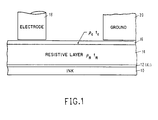
- FIG. 1 schematically illustrates a resistive printing ribbon in accordance with the present invention, where the printing ribbon includes an ink layer 10, an aluminum current return layer 12, a resistive layer 14, and the coating 16 for reduction of contact resistance.
- the resistivity and thickness of the resistance layer are denoted p R and t R
- the resistivity and thickness of the coating are denoted by p r and t c .
- a printing electrode 18 is shown, as is a portion of the grounded broad area, current return electrode 20.
- the coating materials of the present invention include Cr-N, Sn-SnO, ITO, Al-N and Al-A1 2 0 3 . These materials satisfy the two following criteria at reasonable values of thickness: i.e. The first condition ensures that a low contact resistance will be realized, while the second condition ensures that adverse current spreading will not occur. Both of these conditions are satisfied in coating layers having thicknesses significantly less than 1 micron, and preferably in the thickness range of about 50-200 nm.
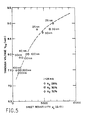
- FIG. 2 is a plot of resistivity p and growth rate for sputtered Cr-N films, plotted as a function of nitrogen content and nitrogen partial pressure in the sputtering gas mixture. These films were deposited on a resistive layer of a thermal transfer ribbon in a reactive sputtering system in which the target was Cr and sputtering occurred in a chamber including a nitrogen-argon gas mixture. In this sputtering apparatus, Cr and N 2 combined at the resistive layer substrate to produce the film of Cr-N. In addition to reactive sputtering, reactive evaporation can also be used.
- the growth rate of the Cr-N films is almost constant with nitrogen content. This allows films of the desired thickness to be easily and reproducibly grown. Further, the resistivity of these films is easy to control and very reproducible after several runs using the same nitrogen content.
- Fig. 3 is a plot of the through voltage V TH as a function of thickness of a Cr-N coating, for three values of nitrogen content. These coatings were deposited on the surface of a regular polycarbonate ribbon using different nitrogen content to control the resistivity of the coatings. The nitrogen contents 28 %, 30 %, and 32 % produced films having resistivity values of about 0.0006, 0.016, and 0.032 ohm-cm, respectively. The thickness of the films was varied from about 25 nm to about 400 nm.
- the through voltage versus thickness for different nitrogen content, measured at a printing current of 24mA, is plotted in FIG. 3.
- a reduction of through voltage was observed during the printing experiments on all samples coated with Cr-N.
- the through voltage decreases with increasing Cr-N thickness, and the slope of the voltage drop is steeper for lower resistivity films (i.e., lower N content), as expected.
- For thick (200-400 nm) films through voltage reduced from 9.5 V to about 6.5 V, but the optical density of printing was also reduced.
- FIGS. 5 and 6 show the through voltage as a function of sheet resistivity of the Cr-N films, for the resistivity ribbon described with respect to FIGS. 3 and 4.
- the resistive layer in the ribbon of FIG. 6 has a higher resistivity than the resistive layer in the ribbon of FIG. 5. It was found that, for Cr-N films having resistivities higher than about 5000 ohms/sq., only small gains in through voltage were obtained as the sheet resistivity increased. On the other hand, if the sheet resistivity of the coated films were less than about 1000 ohms/sq., the optical density of the printing was reduced at the same printing current, in comparison to a ribbon having no surface coating to reduce contact resistance. The best results were obtained when the sheet resistivity was in the range of about 2000-3000 ohms/sq. and the thickness of the Cr-N films was between about 50 and 100 nm. A reduction of through voltage between about 1.5 and 2.5 V was observed.
- the printing sample using the ribbon of FIG. 5 (low resistivity resistance layer) having a 50 Angstroms thick Cr-N layer (nitrogen content 30 % during sputtering) was compared to the printing sample of the same ribbon having no coating to reduce contact resistance.
- the printing quality of both ribbons was about equal at high currents.
- the coated ribbon is better at low printing currents.
- a through voltage for this coated ribbon is about 1.5 V lower than that for the uncoated ribbon, where the through voltage for the uncoated ribbon was about 9.5 V. This corresponds to about a 15% reduction of total printing power and maybe a 50 % reduction of power at the contact of the ribbon and the electrode.
- Films of Cr-N were deposited using an r.f. magnetron source. This system could be evacuated to less than 1.33 x 10 4 I.Lbar by a turbo molecular pump prior to introduction of the gas mixture. Argon and nitrogen gases of very high purity were then introduced through flow meters and their ratios were measured. During the sputtering process, the total power was set at 1500 W and the total pressure was set at 20 microns. The substrates were not biased and were not heated or cooled intentionally.
- the thicknesses of the films were determined by a surface profilometer and sheet resistivities were determined by the four point probe method.
- the composition of the films were measured with an electron micro-probe, and the structure of the films was measured by the x-ray diffraction method.
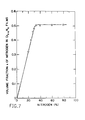
- the composition of these Cr-N films as a function of nitrogen content in the sputtering gas mixture is shown in FIG. 7.
- the volume fraction x of nitrogen in Cr-N films is almost linearly proportional to the nitrogen content when its value in the sputtering mixture is less than 30 %. For higher values, it remains constant at approximately 1:1 ratio (with slightly higher Cr content), independent of the nitrogen content in the sputtering gas mixture.
- the resistivity of these films initially increases with increasing nitrogen content in the sputtering mixture.
- the nitrogen content is greater than 30 % (partial pressure of nitrogen equals 7.98 abar)
- the resistivity is near its peak value and therefore it does not change very much with higher nitrogen content.
- Cr-N films can be reproducibly made using r.f. sputtering deposition.
- the resistivity values can be changed by three orders of magnitude by varying the nitrogen partial pressure during sputtering.
- the films can be divided into two categories, based on the structure and morphology measurements.
- One category is films made with nitrogen concentration of less than 30 % during the deposition process. In this category, the films exhibit both Cr and Cr-N phases, so that their properties depend on the relative concentration of both phases.
- the other category is films made with nitrogen concentration above 30 % during the deposition process. Films in this category have almost identical properties since they all have only one Cr-N phase. The transformation of getting rid of the excess Cr in the films is responsible for the sharp transition regions seen in FIGS. 2, 7 and 8.
- the resistive properties of the films are quite constant for deposition with sufficient nitrogen content to form only the Cr-N phase.
- the general principles described hereinabove can be applied to coatings of Sn-SnO, ITO, Al-N and Al-A1 2 0 3 , where the relative amounts of oxygen during the evaporation or sputtering process can be used to vary the resistivity of the coatings.
- the thickness and resistivity ranges for these materials are similar to those for the Cr-N coatings described in more detail hereinabove.
- the sheet resistivity of these coatings will be in the range of about 1000-4000 ohms/sq., and their resistivities in the order of about 10- 2 ohm-cm.
- the thicknesses and resistivities of these coatings can be varied depending upon the design of the rest of the layers comprising the resistive ribbon.
- thicker coatings having different resistivities can be tailored to resistive ribbons using higher printing currents and/or multiple layers therein, such as resistive layers, current return layers, release layers, and ink layers.
- suitable coatings comprising these materials can be deposited.
Landscapes
- Physics & Mathematics (AREA)
- Optics & Photonics (AREA)
- Impression-Transfer Materials And Handling Thereof (AREA)
- Thermal Transfer Or Thermal Recording In General (AREA)
- Duplication Or Marking (AREA)
Applications Claiming Priority (2)
| Application Number | Priority Date | Filing Date | Title |
|---|---|---|---|
| US06/806,892 US4699533A (en) | 1985-12-09 | 1985-12-09 | Surface layer to reduce contact resistance in resistive printing ribbon |
| US806892 | 1985-12-09 |
Publications (3)
| Publication Number | Publication Date |
|---|---|
| EP0225585A2 EP0225585A2 (en) | 1987-06-16 |
| EP0225585A3 EP0225585A3 (en) | 1988-12-14 |
| EP0225585B1 true EP0225585B1 (en) | 1992-09-16 |
Family
ID=25195074
Family Applications (1)
| Application Number | Title | Priority Date | Filing Date |
|---|---|---|---|
| EP86116728A Expired - Lifetime EP0225585B1 (en) | 1985-12-09 | 1986-12-02 | Surface layer to reduce contact resistance in resistive printing ribbon |
Country Status (4)
| Country | Link |
|---|---|
| US (1) | US4699533A (oth) |
| EP (1) | EP0225585B1 (oth) |
| JP (1) | JPS62135392A (oth) |
| DE (1) | DE3686757T2 (oth) |
Families Citing this family (6)
| Publication number | Priority date | Publication date | Assignee | Title |
|---|---|---|---|---|
| US4925324A (en) * | 1987-10-02 | 1990-05-15 | Alps Electric Co., Ltd. | Color ink ribbon for thermal printer |
| US4836106A (en) * | 1987-10-30 | 1989-06-06 | International Business Machines Corporation | Direct offset master by resistive thermal printing |
| US4810119A (en) * | 1987-10-30 | 1989-03-07 | International Business Machines Corporation | Resistive ribbon for high resolution printing |
| JP2734256B2 (ja) * | 1991-10-17 | 1998-03-30 | 富士ゼロックス株式会社 | 通電転写用インク媒体 |
| TW201330290A (zh) * | 2011-10-04 | 2013-07-16 | 應用奈米科技控股股份有限公司 | 藉外部誘發而自扁帶釋放材料之薄膜沈積 |
| CN107097551A (zh) * | 2017-05-04 | 2017-08-29 | 鹏码新材料(安徽)有限公司 | 一种环保型热转印碳带及其制备方法 |
Citations (3)
| Publication number | Priority date | Publication date | Assignee | Title |
|---|---|---|---|---|
| US4309117A (en) * | 1979-12-26 | 1982-01-05 | International Business Machines Corporation | Ribbon configuration for resistive ribbon thermal transfer printing |
| US4453839A (en) * | 1982-06-15 | 1984-06-12 | International Business Machines Corporation | Laminated thermal transfer medium for lift-off correction and embodiment with resistive layer composition including lubricating contact graphite coating |
| US4477198A (en) * | 1982-06-15 | 1984-10-16 | International Business Machines Corporation | Modified resistive layer in thermal transfer medium having lubricating contact graphite coating |
Family Cites Families (7)
| Publication number | Priority date | Publication date | Assignee | Title |
|---|---|---|---|---|
| US4103066A (en) * | 1977-10-17 | 1978-07-25 | International Business Machines Corporation | Polycarbonate ribbon for non-impact printing |
| US4320170A (en) * | 1980-12-08 | 1982-03-16 | International Business Machines Corporation | Polyurethane ribbon for non-impact printing |
| DE3218732C2 (de) * | 1981-05-20 | 1987-05-14 | Ricoh Co., Ltd., Tokio/Tokyo | Farbband für die elektrothermische schlaglose Aufzeichnung |
| US4470714A (en) * | 1982-03-10 | 1984-09-11 | International Business Machines Corporation | Metal-semiconductor resistive ribbon for thermal transfer printing and method for using |
| US4536437A (en) * | 1982-12-28 | 1985-08-20 | Ricoh Company, Ltd. | Electrothermic non-impact recording material |
| US4491431A (en) * | 1982-12-30 | 1985-01-01 | International Business Machines Corporation | Metal-insulator resistive ribbon for thermal transfer printing |
| US4692044A (en) * | 1985-04-30 | 1987-09-08 | International Business Machines Corporation | Interface resistance and knee voltage enhancement in resistive ribbon printing |
-
1985
- 1985-12-09 US US06/806,892 patent/US4699533A/en not_active Expired - Fee Related
-
1986
- 1986-10-31 JP JP61258679A patent/JPS62135392A/ja active Granted
- 1986-12-02 EP EP86116728A patent/EP0225585B1/en not_active Expired - Lifetime
- 1986-12-02 DE DE8686116728T patent/DE3686757T2/de not_active Expired - Fee Related
Patent Citations (3)
| Publication number | Priority date | Publication date | Assignee | Title |
|---|---|---|---|---|
| US4309117A (en) * | 1979-12-26 | 1982-01-05 | International Business Machines Corporation | Ribbon configuration for resistive ribbon thermal transfer printing |
| US4453839A (en) * | 1982-06-15 | 1984-06-12 | International Business Machines Corporation | Laminated thermal transfer medium for lift-off correction and embodiment with resistive layer composition including lubricating contact graphite coating |
| US4477198A (en) * | 1982-06-15 | 1984-10-16 | International Business Machines Corporation | Modified resistive layer in thermal transfer medium having lubricating contact graphite coating |
Also Published As
| Publication number | Publication date |
|---|---|
| US4699533A (en) | 1987-10-13 |
| DE3686757D1 (de) | 1992-10-22 |
| DE3686757T2 (de) | 1993-02-25 |
| JPH0356915B2 (oth) | 1991-08-29 |
| EP0225585A3 (en) | 1988-12-14 |
| JPS62135392A (ja) | 1987-06-18 |
| EP0225585A2 (en) | 1987-06-16 |
Similar Documents
| Publication | Publication Date | Title |
|---|---|---|
| AU593106B2 (en) | Laminated thermal transfer medium for correction | |
| EP0225585B1 (en) | Surface layer to reduce contact resistance in resistive printing ribbon | |
| JP4193268B2 (ja) | 薄膜形成装置および薄膜形成方法ならびに案内ガイドロール | |
| EP0008198B1 (en) | Electric recording material and method of electric recording | |
| US4477198A (en) | Modified resistive layer in thermal transfer medium having lubricating contact graphite coating | |
| US5132173A (en) | Magnetic recording medium having a silicon oxide protective layer with an electrical specific resistance of from 3.3×10¹³ to 5.0×15 ohm.cm | |
| US4421429A (en) | Resistive substrate for thermal printing ribbons comprising a mixture of thermosetting polyimide, thermoplastic polyimide, and conductive particulate material | |
| US4491431A (en) | Metal-insulator resistive ribbon for thermal transfer printing | |
| EP0036936A1 (en) | Electro-thermal printing ribbons | |
| US4419024A (en) | Silicon dioxide intermediate layer in thermal transfer medium | |
| EP0384783B1 (en) | Method of manufacturing a ribbon for non-impact printing of documents | |
| EP0200523B1 (en) | Resistive ribbon for use in resistive ribbon thermal transfer printing | |
| US4825040A (en) | Thermal head | |
| US4626480A (en) | Magnetic recording medium comprising a vacuum-deposited magnetic film of a magnetic material and a tungsten oxide and method for making the same | |
| GB2110245A (en) | Sputtered magnetic recording medium | |
| EP0655733B1 (en) | Magnetic recording medium and method for producing the same | |
| EP0600716B1 (en) | Magnetic recording medium | |
| JP2523839B2 (ja) | 磁気記録媒体の製造方法 | |
| JPH0790585A (ja) | 薄膜形成装置 | |
| US5118348A (en) | Magnetic ink for non impact printing of documents | |
| JPH0991653A (ja) | 記録媒体 | |
| Tanaka | Mechanism of humidity‐sensitive switching in electroformed silver thin films | |
| Shih et al. | Preparation and properties of resistive films | |
| JPH08287458A (ja) | 磁気記録媒体の製造方法および製造装置 | |
| Banks et al. | Lewis Research Center Ckudand, Ohio |
Legal Events
| Date | Code | Title | Description |
|---|---|---|---|
| PUAI | Public reference made under article 153(3) epc to a published international application that has entered the european phase |
Free format text: ORIGINAL CODE: 0009012 |
|
| AK | Designated contracting states |
Kind code of ref document: A2 Designated state(s): DE FR GB IT |
|
| 17P | Request for examination filed |
Effective date: 19871023 |
|
| PUAL | Search report despatched |
Free format text: ORIGINAL CODE: 0009013 |
|
| AK | Designated contracting states |
Kind code of ref document: A3 Designated state(s): DE FR GB IT |
|
| 17Q | First examination report despatched |
Effective date: 19900802 |
|
| RAP1 | Party data changed (applicant data changed or rights of an application transferred) |
Owner name: LEXMARK INTERNATIONAL, INC. |
|
| ITF | It: translation for a ep patent filed | ||
| 111Z | Information provided on other rights and legal means of execution |
Free format text: DE FR GB IT |
|
| GRAA | (expected) grant |
Free format text: ORIGINAL CODE: 0009210 |
|
| AK | Designated contracting states |
Kind code of ref document: B1 Designated state(s): DE FR GB IT |
|
| REF | Corresponds to: |
Ref document number: 3686757 Country of ref document: DE Date of ref document: 19921022 |
|
| ET | Fr: translation filed | ||
| PLBE | No opposition filed within time limit |
Free format text: ORIGINAL CODE: 0009261 |
|
| STAA | Information on the status of an ep patent application or granted ep patent |
Free format text: STATUS: NO OPPOSITION FILED WITHIN TIME LIMIT |
|
| 26N | No opposition filed | ||
| PGFP | Annual fee paid to national office [announced via postgrant information from national office to epo] |
Ref country code: FR Payment date: 19951114 Year of fee payment: 10 |
|
| PGFP | Annual fee paid to national office [announced via postgrant information from national office to epo] |
Ref country code: GB Payment date: 19951124 Year of fee payment: 10 |
|
| PGFP | Annual fee paid to national office [announced via postgrant information from national office to epo] |
Ref country code: DE Payment date: 19951129 Year of fee payment: 10 |
|
| PG25 | Lapsed in a contracting state [announced via postgrant information from national office to epo] |
Ref country code: GB Effective date: 19961202 |
|
| GBPC | Gb: european patent ceased through non-payment of renewal fee |
Effective date: 19961202 |
|
| PG25 | Lapsed in a contracting state [announced via postgrant information from national office to epo] |
Ref country code: FR Effective date: 19970829 |
|
| PG25 | Lapsed in a contracting state [announced via postgrant information from national office to epo] |
Ref country code: DE Effective date: 19970902 |
|
| REG | Reference to a national code |
Ref country code: FR Ref legal event code: ST |
|
| PG25 | Lapsed in a contracting state [announced via postgrant information from national office to epo] |
Ref country code: IT Free format text: LAPSE BECAUSE OF NON-PAYMENT OF DUE FEES;WARNING: LAPSES OF ITALIAN PATENTS WITH EFFECTIVE DATE BEFORE 2007 MAY HAVE OCCURRED AT ANY TIME BEFORE 2007. THE CORRECT EFFECTIVE DATE MAY BE DIFFERENT FROM THE ONE RECORDED. Effective date: 20051202 |