EP0220901A2 - Gerät zur Ätzung unter Mitwirkung eines Plasmas - Google Patents
Gerät zur Ätzung unter Mitwirkung eines Plasmas Download PDFInfo
- Publication number
- EP0220901A2 EP0220901A2 EP86308106A EP86308106A EP0220901A2 EP 0220901 A2 EP0220901 A2 EP 0220901A2 EP 86308106 A EP86308106 A EP 86308106A EP 86308106 A EP86308106 A EP 86308106A EP 0220901 A2 EP0220901 A2 EP 0220901A2
- Authority
- EP
- European Patent Office
- Prior art keywords
- wafer
- reactor
- plasma
- sidewalls
- electrode
- Prior art date
- Legal status (The legal status is an assumption and is not a legal conclusion. Google has not performed a legal analysis and makes no representation as to the accuracy of the status listed.)
- Granted
Links
Images
Classifications
-
- H—ELECTRICITY
- H01—ELECTRIC ELEMENTS
- H01J—ELECTRIC DISCHARGE TUBES OR DISCHARGE LAMPS
- H01J37/00—Discharge tubes with provision for introducing objects or material to be exposed to the discharge, e.g. for the purpose of examination or processing thereof
- H01J37/32—Gas-filled discharge tubes
- H01J37/32431—Constructional details of the reactor
- H01J37/3244—Gas supply means
Definitions
- the present invention relates to apparatus for manufacturing of integrated circuits.
- One of the basic problems in integrated circuit manufacturing is particulates. This problem is becoming more and more difficult, because of two trends in integrated circuit processing: First, as device dimensions become smaller and smaller, it is necessary to avoid the presence of smaller and smaller particles. This makes the job of making sure that a clean room is really clean increasingly difficult. For example, a clean room which is of class 1 (has one particle per cubic foot) for particles of one micron and larger may well be class 1000 or worse if particle sizes down to 100 angstroms are counted.
- particulates are not only an extremely important source of loss in integrated circuit manufacturing, but their importance will increase very rapidly in the coming years.
- a common problem with prior art plasma etching machines has been particulate generation.
- plasma etching stations are among the worst stations for deposition of particulates on the sensitive active area of the wafers.
- One particularly difficult area is the use of "shower head" gas distribution systems, where gas is distributed to the face of the wafer through multiple holes in the face of the active electrode. While this arrangement would seem to to be an attractive way to provide a highly uniform distribution of available process gasses over the face of the wafer, in practice, polymeric or other byproducts of the plasma phase reactions tend to deposit in the holes in the shower head, providing particulates which can be blown through and then immediately deposited on the wafer.
- Other arrangements for supplying process gasses have their own problems; problems of nonuniformity are common to many gas supply arrangements.
- a novel teaching of the present invention is that the flow of gasses to the wafer face should be dominated by diffusion. That is, this aspect of the present invention provides a low-pressure plasma etching (or reactive ion etching) station wherein there is no bulk gas flow over the wafer face. That is, the feed gas species (which are needed for the plasma reactions which will produce the desired ions and free radicals to actually effect etching) are transported into the high-field region close to the face of the plasma (where they will be available for dissociation), not by bulk flow of a gas stream, nor (preferably) even by turbulent eddy currents in a region where there is no overall average bulk flow, but by diffusion. This means that particulate transport by gas-flow-assisted transport to the face of the wafer is greatly reduced.
- the feed gas distributor is made of an insulating material.
- the feed gas distributor can thus be positioned reasonably close to the wafer face (i.e. less than one wafer diameter away) to help assure uniform availability of the reaction gasses, but there will not be a large potential drop across the dark zone in the plasma immediately adjacent to the feed gas distributor (as there would be if the distributor were made of a conductive material), and thus deposition of polymeric or other plasma reaction products on the feed gas distributor will be reduced. This means that transport of these reaction products to the wafer face as particulates will also be reduced.
- wafers are etched in a face down position, and a gas distributor is provided which is below the wafer face and has ports blowing away from the wafer. This helps to assure that the bulk gas flow is downward and away from the wafer face, and thus reduces the likelihood of transport of particulates to the wafer face.
- a gas distributor is provided which is below the wafer face and has ports blowing away from the wafer. This helps to assure that the bulk gas flow is downward and away from the wafer face, and thus reduces the likelihood of transport of particulates to the wafer face.
- the vacuum (exhaust) port is below the distributor.
- a further innovative feature taught by the present application is a plasma (or RIE) reactor for face down etching of wafers, wherein essentially all of the grounded metal reactor chamber walls seen by the plasma move as a unit to open and close the reactor. That is, a bellows (preferably vacuum tight) is provided which supports the counter electrode opposite the wafer, and also supports the chamber sidewalls and (preferably) the process gas distribution distributor, so that all of these elements move as a unit. By reducing mechanical movements in proximity to the wafer, generation of particulates thereby is reduced.
- the prior art of openable and closeable RIE reactors would typically use complex mechanical actuators, such as feedthroughs or cams, to clamp the wafers in place.
- the only moving mechanical elements are the wafer support pins, which are mounted on (and move only a short distance against the pressure of) an elastic support, so that the process chamber bottom portions can be closed against the powered electrode support when the plasma reactor is sealed to begin plasma etching.
- quartz top layer is provided on the chamber housing, as the layer which will mate to the powered electrode support.
- This quartz top layer helps to preserve a high area ratio of powered electrode area to ground plane area in the chamber, which provides enhanced ion bombardment on the powered electrode, which is well known to those skilled in the art. This enhanced bombardment is desirable to assist in anisotropic wafer etching.
- the use of quartz here is further advantageous in that it is transparent to a wide variety of ultraviolet wavelengths, so that optical end point detection, and operator inspection of the plasma etching operation, are both facilitated.
- the quartz top layer is also configured to provide excellent uniformity of ion bombardment. That is, the plasma is confined by quartz walls, for several centimeters away from the face of the wafer, to the shape of a cylinder having approximately the same width as the wafer. This collimation of the plasma provides improved uniformity of ion bombardment, which results in the advantage of more uniform etching. Walls made of quartz (or other high-temperature dielectric) are particularly well suited for this collimation, since they have less interaction with the plasma than metal walls would.
- a further innovative feature is that a light bleed of helium is preferably provided to the back side of the wafer. This helium bleed assures good and uniform thermal contact between the wafer and the powered electrode under vacuum.
- An apparatus for plasma-assisted etching of integrated circuits comprising: wafer supports for supporting a wafer containing partially fabricated integrated circuits face down, with the backside of said wafer adjacent to a powered electrode; a ground electrode positioned approximately in opposition to said powered electrode, said grounded electrode being supported by a base plate in fixed relation to reactor sidewalls; and a gas distributor which is fixed in relation to said grounded electrode; said grounded electrode and sidewalls being movable as a unit toward said powered electrode to effect a vacuum-tight seal between said powered electrode and sidewalls.
- a plasma reactor comprising: supports shaped to hold a partially fabricated integrated circuit wafer face down; connections to communicate rf power to said wafer; and a gas distributor comprising orifices connected to exude gas in proximity to said wafer face, said gas distributor consisting essentially of a non-conductive material.
- An apparatus for plasma-assisted etching of integrated circuits comprising: wafer supports for supporting a wafer containing partially fabricated integrated circuits face down, with the backside of said wafer adjacent to a powered electrode; a ground electrode positioned approximately in opposition to said powered electrode, said grounded electrode being supported by a base plate in fixed relation to reactor sidewalls; and a gas distributor consisting essentially of a non-conductive material which is fixed in relation to said grounded electrode, said gas distributor comprising orifices connected to exude gas in proximity to said wafer face; said grounded electrode and sidewalls being movable as a unit toward said powered electrode to effect a vacuum-tight seal between said powered electrode and sidewalls.
- a method for plasma-assisted etching of integrated circuit structures comprising the steps of: supporting a wafer face down; supplying a flow of process gasses to a chamber contiguous with the underside of said supported wafer; and applying rf power to said chamber to generate a plasma in proximity to the underside of said wafer; wherein said process gasses are supplied using an orifice pattern and pressure such that transport of said process gasses (and of reaction products of said process gasses) to said face of said wafer is dominated by diffusion.
- the present invention provides major new concepts in semiconductor processing apparatus.
- the presently preferred embodiments will now be discussed in great detail, but it must be appreciated that the novel concepts which are included in these embodiments could also be used in many other embodiments, and the scope of the invention is not delimited by the particular examples shown.
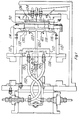
- Figure 1 shows a sample embodiment of the invention, as a single slice reactor which can be used for reactive ion etching.
- a very similar reactor design can be used for plasma etching, i.e. etching at pressures higher than 100 mTorr.
- plasma etching and “reactive ion etching” (or “RIE") are sometimes kept distinct in the art, with RIE being used to refer to etching under conditions where ion bombardment is large, i.e. at lower pressure and with the wafer mounted on the powered electrode.
- RIE reactive ion etching
- tapered pins 50 which are preferably made of a durable polymer, such as Ardel
- the whole lower assembly including the chamber 112, ground electrode 110, gas distributor 120, base plate 138, and top plate 114 are moved upward, using, e.g., an air cylinder or a vacuum feed through (not shown).
- a bellows 124 permits this vertical motion to occur while maintaining a vacuum-tight interface to the outside of the etch station.
- This vertical motion causes the backside of the wafer resting on pins 50 to make contact with the powered electrode 118, and at this point the sliding pin supports 130 which are attached to the underside of the tapered pins 50 retract slightly against a leaf spring 132. (Other elastic elements could be used in place of leaf spring 132, to assure a small amount of give in the pin supports 130, so that the wafer is not pressed against the powered electrode 118 with too much force.)
- a helium bleed port 134 is preferably provided to connect a helium supply to the back of the wafer.
- This helium supply means that the space between the low points of the powered electrode 118 and the wafer will be filled with helium, rather than vacuum, and this assures a reasonably low-thermal-resistance and highly repeatable thermal contact between the wafer and the powered electrode 118.
- Powered electrode 118 preferably includes coolant manifold spaces 136, to which coolant can be supplied.
- the tapered pins 50 are not mounted on sliding pin supports 130 supported by elastic elements 132, but are fixed. Since the helium bleed 134 assures good thermal contact between the back side of the wafer and the surface of the powered electrode 118, a tolerance of several thousands of an inch will still permit good rf coupling of the electrode 118 to the wafer, and still permit good thermal contact between the electrode 118 and the wafer. A tolerance of this magnitude should provide enough allowance for thermal expansions of chamber walls, variation in seal thickness, variation in wafer thickness, etc., to still permit reliable sealing of the lower chamber portion to the upper portion.
- the quartz faces 114 and 116 would preferably be shaped slightly differently, to minimize the lateral spread of the plasma adjacent to the face of the wafer.
- the presently preferred embodiment does use sliding pin supports 130, since they permit the quartz piece 114 to confine the plasma closely near the face of the wafer 48 as shown in Figure 2.
- Figure 2 shows the upper portion of the process station of Figure 1, in the closed position, with a wafer 48 held therein for processing.
- the helium bleed can be started through port 134.
- desired process gasses can be provided through a process gas distributor 120.
- the process gas distributor 120 is made of quartz, so that it does not pick up eddy currents from the rf power present. Moreover, since the surface of the quartz is highly insulating, the plasma boundary near the quartz will not have as much voltage nor as much current across it as the plasma boundary near a grounded conductive element would. This means that plasma-assisted reactions near the quartz will not occur at as high a rate as they would near a grounded conductive element, so that deposition is reduced.
- quartz is a fairly good thermal insulator, and the temperature of the susceptor may therefore by raised (by radiation from the plasma) to 100 or 200 degrees C. This is advantageous, since raising the temperature of the distributor will further reduce deposition on it.
- the generated plasma will fill the chamber between powered electrode 118 and ground electrode 110 fairly uniformly.
- the gas distributor 120 protrudes into the densest part of the plasma.
- the gas distributor 120 is preferably a ring, of perhaps one-half the diameter of the wafer being processed, with hollow supports which lead down to gas connections 140 mounted in the base plate 138.
- a quick-connect mounting is provided for the quartz distributor 120, so it can rapidly and easily be changed out as desired.
- the gas distributor 120 is, in the presently preferred embodiment, spaced away from the surface of the wafer by about four centimeters. This spacing, and the exact shape of the gas distributor 120, and the spacing of the ports 122 on the gas distributor, are none of them critical. These parameters can be changed if desired, but, if modified, they should be selected so that diffusion of process gasses and process gas products from the ports 122 in the gas distributor 120 provides: 1) diffusion-dominated transport of the process gasses and process gas products to the plasma boundary at the face of the wafer 48; and 2) a fairly uniform concentration of process gasses and process gas products at the plasma boundary next to the face of wafer 48. For example, the spacing of the distributor away from the wafer face could be anywhere in the range from one to fifteen cm.
- the ground plane electrode 110 is preferably cooled, using coolant lines 150 connected to manifold cavities inside the electrode 110. If additional cooling is needed, the walls 112 may also be cooled.
- lines 150 are preferably flexible hoses, to accomodate the vertical travel of the whole lower etching chamber (110, 112, 138, 120, 114) as described above.
- the gas supply tube 150 which supplies process gasses through connection 140 to the gas distributor 120, is preferably also flexible for the same reason. If flexure of these hoses is found to generate excess particulates, a gas feed outside the bellows 124, through the side of the base plate 138, could be used instead.
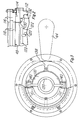
- Figure 3 shows a plan view of the reactor of Figure 1.
- the shape of the gas distributor 120 can be seen more clearly in this plan view. It can also be seen that the base plate 138 includes substantial spaces around the edge of the ground electrode 110, which provide a passage from the gas feed ports 122 to a vacuum pump below.
- the overall gas flow in this reactor is downward, away from the face of the wafer, which assists in reducing particulates.
- gas supply through gas distributor 120 is cut off, and the reactor can be pressure-equalized to its surroundings and opened, so that the wafer may be removed.
- a holding time may optionally be interposed, for thermal stabilization of the process station or for release of possible suspended particulates, before the reactor is opened.
- the present invention provides all of the advantages listed above, and others besides.
- the present invention can be very widely modified and varied, and its scope is not limited except as specified in the claims.
Landscapes
- Physics & Mathematics (AREA)
- Engineering & Computer Science (AREA)
- Plasma & Fusion (AREA)
- Chemical & Material Sciences (AREA)
- Analytical Chemistry (AREA)
- Drying Of Semiconductors (AREA)
- ing And Chemical Polishing (AREA)
Applications Claiming Priority (2)
| Application Number | Priority Date | Filing Date | Title |
|---|---|---|---|
| US06/790,707 US4685999A (en) | 1985-10-24 | 1985-10-24 | Apparatus for plasma assisted etching |
| US790707 | 1985-10-24 |
Publications (3)
| Publication Number | Publication Date |
|---|---|
| EP0220901A2 true EP0220901A2 (de) | 1987-05-06 |
| EP0220901A3 EP0220901A3 (en) | 1989-02-01 |
| EP0220901B1 EP0220901B1 (de) | 1992-03-04 |
Family
ID=25151523
Family Applications (1)
| Application Number | Title | Priority Date | Filing Date |
|---|---|---|---|
| EP86308106A Expired EP0220901B1 (de) | 1985-10-24 | 1986-10-20 | Gerät zur Ätzung unter Mitwirkung eines Plasmas |
Country Status (4)
| Country | Link |
|---|---|
| US (1) | US4685999A (de) |
| EP (1) | EP0220901B1 (de) |
| JP (1) | JPH084086B2 (de) |
| DE (1) | DE3684093D1 (de) |
Families Citing this family (8)
| Publication number | Priority date | Publication date | Assignee | Title |
|---|---|---|---|---|
| US4849068A (en) * | 1985-10-24 | 1989-07-18 | Texas Instruments Incorporated | Apparatus and method for plasma-assisted etching |
| US4904621A (en) * | 1987-07-16 | 1990-02-27 | Texas Instruments Incorporated | Remote plasma generation process using a two-stage showerhead |
| US4882299A (en) * | 1987-07-16 | 1989-11-21 | Texas Instruments Incorporated | Deposition of polysilicon using a remote plasma and in situ generation of UV light. |
| US4842686A (en) * | 1987-07-17 | 1989-06-27 | Texas Instruments Incorporated | Wafer processing apparatus and method |
| US4916091A (en) * | 1987-11-05 | 1990-04-10 | Texas Instruments Incorporated | Plasma and plasma UV deposition of SiO2 |
| US4967337A (en) * | 1988-10-11 | 1990-10-30 | Texas Instruments Incorporated | Automated diagnostic system |
| US5266527A (en) * | 1991-09-17 | 1993-11-30 | Texas Instruments Incorporated | Conformal wafer chuck for plasma processing having a non-planar surface |
| US7244311B2 (en) * | 2004-10-13 | 2007-07-17 | Lam Research Corporation | Heat transfer system for improved semiconductor processing uniformity |
Family Cites Families (9)
| Publication number | Priority date | Publication date | Assignee | Title |
|---|---|---|---|---|
| US4383885A (en) * | 1980-02-06 | 1983-05-17 | Bell Telephone Laboratories, Incorporated | Reactive sputter etching of polysilicon utilizing a chlorine etch gas |
| US4380488A (en) * | 1980-10-14 | 1983-04-19 | Branson International Plasma Corporation | Process and gas mixture for etching aluminum |
| US4340462A (en) * | 1981-02-13 | 1982-07-20 | Lam Research Corporation | Adjustable electrode plasma processing chamber |
| JPS5832410A (ja) * | 1981-08-06 | 1983-02-25 | ザ・パ−キン−エルマ−・コ−ポレイシヨン | ガス状減圧環境下で構造物を処理する方法及び装置 |
| US4411733A (en) * | 1982-06-18 | 1983-10-25 | Bell Telephone Laboratories, Incorporated | SPER Device for material working |
| JPS5964779A (ja) * | 1982-10-05 | 1984-04-12 | Victor Co Of Japan Ltd | 多チヤンバ−ドライエツチング装置 |
| FR2538987A1 (fr) * | 1983-01-05 | 1984-07-06 | Commissariat Energie Atomique | Enceinte pour le traitement et notamment la gravure de substrats par la methode du plasma reactif |
| EP0149089B1 (de) * | 1984-01-06 | 1989-11-23 | Tegal Corporation | Mehrfrequenz-Plasmagerät mit einer einzelnen Elektrode |
| US4547247A (en) * | 1984-03-09 | 1985-10-15 | Tegal Corporation | Plasma reactor chuck assembly |
-
1985
- 1985-10-24 US US06/790,707 patent/US4685999A/en not_active Expired - Fee Related
-
1986
- 1986-10-20 DE DE8686308106T patent/DE3684093D1/de not_active Expired - Lifetime
- 1986-10-20 EP EP86308106A patent/EP0220901B1/de not_active Expired
- 1986-10-24 JP JP61253516A patent/JPH084086B2/ja not_active Expired - Lifetime
Also Published As
| Publication number | Publication date |
|---|---|
| US4685999A (en) | 1987-08-11 |
| JPH084086B2 (ja) | 1996-01-17 |
| EP0220901A3 (en) | 1989-02-01 |
| DE3684093D1 (de) | 1992-04-09 |
| JPS62165332A (ja) | 1987-07-21 |
| EP0220901B1 (de) | 1992-03-04 |
Similar Documents
| Publication | Publication Date | Title |
|---|---|---|
| USRE40046E1 (en) | Processing system | |
| JP7454976B2 (ja) | 基板支持台、プラズマ処理システム及びエッジリングの交換方法 | |
| US20010054484A1 (en) | Plasma processor, cluster tool, and method of controlling plasma | |
| US4904621A (en) | Remote plasma generation process using a two-stage showerhead | |
| US4872938A (en) | Processing apparatus | |
| US4822450A (en) | Processing apparatus and method | |
| US4875989A (en) | Wafer processing apparatus | |
| KR100929448B1 (ko) | 기판 유지 기구 및 플라즈마 처리 장치 | |
| US4891488A (en) | Processing apparatus and method | |
| US4849067A (en) | Method for etching tungsten | |
| JPS63131520A (ja) | ドライエツチング装置 | |
| TWI629718B (zh) | 用於電漿切塊半導體晶圓的方法及裝置 | |
| CN105190862B (zh) | 用于对半导体晶圆进行等离子切片的方法和设备 | |
| KR20020073273A (ko) | 진공 응용을 위한 기체 냉각 정전기 핀 척 | |
| US4685999A (en) | Apparatus for plasma assisted etching | |
| US20210319988A1 (en) | Substrate support stage, plasma processing system, and method of mounting edge ring | |
| JP4283366B2 (ja) | プラズマ処理装置 | |
| US6057694A (en) | Testing method including the removal of insulative films for electrical contact and apparatus therefor | |
| US4855016A (en) | Method for etching aluminum film doped with copper | |
| US4849068A (en) | Apparatus and method for plasma-assisted etching | |
| US7723236B2 (en) | Gas setting method, gas setting apparatus, etching apparatus and substrate processing system | |
| JPS63283025A (ja) | 多接点カソードを備えたプラズマストリッパー | |
| US4842687A (en) | Method for etching tungsten | |
| US4830705A (en) | Method for etch of GaAs | |
| JPH11149999A (ja) | プラズマ処理装置 |
Legal Events
| Date | Code | Title | Description |
|---|---|---|---|
| PUAI | Public reference made under article 153(3) epc to a published international application that has entered the european phase |
Free format text: ORIGINAL CODE: 0009012 |
|
| AK | Designated contracting states |
Kind code of ref document: A2 Designated state(s): DE FR GB NL |
|
| PUAL | Search report despatched |
Free format text: ORIGINAL CODE: 0009013 |
|
| AK | Designated contracting states |
Kind code of ref document: A3 Designated state(s): DE FR GB NL |
|
| 17P | Request for examination filed |
Effective date: 19890731 |
|
| 17Q | First examination report despatched |
Effective date: 19891018 |
|
| GRAA | (expected) grant |
Free format text: ORIGINAL CODE: 0009210 |
|
| AK | Designated contracting states |
Kind code of ref document: B1 Designated state(s): DE FR GB NL |
|
| PG25 | Lapsed in a contracting state [announced via postgrant information from national office to epo] |
Ref country code: NL Effective date: 19920304 Ref country code: FR Effective date: 19920304 |
|
| REF | Corresponds to: |
Ref document number: 3684093 Country of ref document: DE Date of ref document: 19920409 |
|
| EN | Fr: translation not filed | ||
| NLV1 | Nl: lapsed or annulled due to failure to fulfill the requirements of art. 29p and 29m of the patents act | ||
| PLBE | No opposition filed within time limit |
Free format text: ORIGINAL CODE: 0009261 |
|
| STAA | Information on the status of an ep patent application or granted ep patent |
Free format text: STATUS: NO OPPOSITION FILED WITHIN TIME LIMIT |
|
| 26N | No opposition filed | ||
| PGFP | Annual fee paid to national office [announced via postgrant information from national office to epo] |
Ref country code: DE Payment date: 20011030 Year of fee payment: 16 |
|
| REG | Reference to a national code |
Ref country code: GB Ref legal event code: IF02 |
|
| PG25 | Lapsed in a contracting state [announced via postgrant information from national office to epo] |
Ref country code: DE Free format text: LAPSE BECAUSE OF NON-PAYMENT OF DUE FEES Effective date: 20030501 |
|
| PGFP | Annual fee paid to national office [announced via postgrant information from national office to epo] |
Ref country code: GB Payment date: 20030915 Year of fee payment: 18 |
|
| PG25 | Lapsed in a contracting state [announced via postgrant information from national office to epo] |
Ref country code: GB Free format text: LAPSE BECAUSE OF NON-PAYMENT OF DUE FEES Effective date: 20041020 |
|
| GBPC | Gb: european patent ceased through non-payment of renewal fee |
Effective date: 20041020 |