EP0217352A2 - Verfahren zur Verbesserung von ferromagnetischem Chromdioxid - Google Patents
Verfahren zur Verbesserung von ferromagnetischem Chromdioxid Download PDFInfo
- Publication number
- EP0217352A2 EP0217352A2 EP86113416A EP86113416A EP0217352A2 EP 0217352 A2 EP0217352 A2 EP 0217352A2 EP 86113416 A EP86113416 A EP 86113416A EP 86113416 A EP86113416 A EP 86113416A EP 0217352 A2 EP0217352 A2 EP 0217352A2
- Authority
- EP
- European Patent Office
- Prior art keywords
- chromium dioxide
- magnetic
- chromium
- recording media
- dioxide
- Prior art date
- Legal status (The legal status is an assumption and is not a legal conclusion. Google has not performed a legal analysis and makes no representation as to the accuracy of the status listed.)
- Granted
Links
Classifications
-
- G—PHYSICS
- G11—INFORMATION STORAGE
- G11B—INFORMATION STORAGE BASED ON RELATIVE MOVEMENT BETWEEN RECORD CARRIER AND TRANSDUCER
- G11B5/00—Recording by magnetisation or demagnetisation of a record carrier; Reproducing by magnetic means; Record carriers therefor
- G11B5/62—Record carriers characterised by the selection of the material
- G11B5/68—Record carriers characterised by the selection of the material comprising one or more layers of magnetisable material homogeneously mixed with a bonding agent
- G11B5/70—Record carriers characterised by the selection of the material comprising one or more layers of magnetisable material homogeneously mixed with a bonding agent on a base layer
- G11B5/706—Record carriers characterised by the selection of the material comprising one or more layers of magnetisable material homogeneously mixed with a bonding agent on a base layer characterised by the composition of the magnetic material
- G11B5/70626—Record carriers characterised by the selection of the material comprising one or more layers of magnetisable material homogeneously mixed with a bonding agent on a base layer characterised by the composition of the magnetic material containing non-metallic substances
- G11B5/70636—CrO2
Definitions
- the invention relates to a method for improving ferromagnetic chromium dioxide with regard to its processability in the production of magnetic recording media and their magnetic and recording properties.
- Magnetic recording media containing chromium dioxide generally show superior magnetic properties compared to recording media based on other magnetic oxides.
- US Pat. No. 3,512,930 describes the treatment of chromium dioxide powder with a reducing agent, while according to DE-A 23 25 132 the action of gaseous reducing agents is said to increase the Curie point.
- aluminum oxide coatings US Pat. No. 3,687,726) or those made from poorly soluble metal phosphates (US Pat. No. 3,686,031) are produced.
- the application of metal compounds whose cations are capable of forming poorly soluble chromates has also become known.
- JA-A 21200/76 proposes the superficial application of magnetic iron oxides to coat the chromium dioxide particles, while according to DE-A 27 49 757 iron (III) -containing oxide precipitates are applied to the chromium dioxide.
- the chromium dioxide used To produce high-quality magnetic recording media, it is necessary for the chromium dioxide used to have good processability in addition to suitable magnetic values and sufficient climatic stability. This includes easy dispersibility in the organization African medium of the layer composition and the achievement of a smooth magnetic layer surface immediately after the application of the chromium dioxide-containing dispersion on the carrier material even before additional smoothing.
- a smooth layer surface is important for video tapes, for example, for a good signal-to-noise ratio.
- Other important parameters for the quality of magnetic recording media are high remanent magnetization, high preferred direction of magnetization (directional factor), low noise and high copy loss.
- a chromium dioxide obtained by reacting oxides of trivalent and hexavalent chromium at elevated pressure and temperature in the presence of water and modifier and aftertreated in a known manner can be improved in accordance with the task if a chromium dioxide prepared in this way is used 210 to 280 ° C is annealed in an inert gas atmosphere, with the proviso that the resulting material consists only of the crystalline phases of chromium dioxide and the ortho-rhombic CrOOH.
- the chromium dioxide used for the process according to the invention is produced by known and generally customary processes, as described, for example, in EP-B 27 640. It may be expedient to subject this chromium dioxide material to mechanical treatment before the tempering process according to the invention, such as dry or wet grinding, or to compress it mechanically or to predisperse it. In a preferred embodiment, the chromium dioxide is treated with reducing agents in aqueous and / or organic suspension before the tempering and then filtered, washed and optionally dried. In a similarly advantageous manner, a chromium dioxide material can be used which already has ortho-rhombic CrOOH at least partially on its surface, for example through a reaction with water either as part of the customary manufacturing process or through a separate aftertreatment.
- the chromium dioxide which has been prepared and optionally treated as described, is then heated in an inert gas atmosphere, for example in a nitrogen and / or noble gas stream, at 210 to 280 ° C.
- an inert gas atmosphere for example in a nitrogen and / or noble gas stream, at 210 to 280 ° C.
- a conventional type of oven such as in a rotary tube, fixed bed or fluidized bed oven, in a continuous or discontinuous manner. Depending on the set temperature, times between 30 minutes and 6 hours are sufficient.
- the chromium dioxide treated in this way shows two crystalline phases in the X-ray diffraction spectrum, that of the chromium dioxide and that of the ortho-rhombic CrOOH.
- the peak positions found by the analysis of the X-ray diffraction spectra correspond to the lattice spacings of the CrO2 (110) with 3.128 ⁇ 0.005 ⁇ and the ortho-rhombic CrOOH (110) with 3.220 ⁇ 0.005 ⁇ .
- Further X-ray diffraction lines, either defined or not defined, for oxidic chromium compounds cannot be detected.
- a chromium dioxide material is obtainable, the particle structure of a CrO2 core and an ortho-rhombic CrOOH shell fulfills the task of simultaneously improving important application parameters with sufficiently good climatic stability.
- the detection of this core / shell particle model can e.g. using the known technique of secondary ion mass spectroscopy (SIMS) by recording depth profiles. This measurement method is among others in "Ullmann's Encyclopedia of Technical Chemistry", 4th edition, volume 5, pages 519 to 576.
- the advantageous properties of the chromium dioxides produced according to the invention become clear when used as a magnetic material for the production of magnetic recording media. Processing takes place according to known methods.
- 2 to 5 parts by weight of chromium dioxide with a part of the binder or mixture and the suitable dispersing aids, lubricants and other conventional additives in a total amount of up to 10% by weight of the chromium dioxide are processed to give a dispersion.
- the dispersion obtained in this way is filtered and applied with a conventional coating machine, for example by means of a ruler, onto the non-magnetic carrier in one or more thin layers or onto a magnetogram carrier already provided with another magnetic layer in a thin layer.
- the chromium dioxide particles may be magnetically aligned.
- the coated film webs are passed under a magnetic layer between heated polished rollers under pressure. According to this, the thicknesses of the magnetic layers are usually between 1.5 and 12 ⁇ m.
- the known polymer binders such as vinyl chloride copolymers, acrylate copolymers, polyvinyl acetals, such as polyvinyl formal or polyvinyl butyral, higher molecular weight epoxy resins, polyurethanes and mixtures of these and similar binders can be used as binders for the magnetic layers.
- the elastomeric and practically isocyanate-free linear polyester urethanes, which are soluble in a volatile organic solvent, have proven to be advantageous, such as those obtained by reacting a polyester from an aliphatic dicarboxylic acid with 4 to 6 C atoms, such as adipic acid, and at least one aliphatic diol with 3 to 10 C.
- -Atoms such as 1,2- or 1,3-propylene glycol, 1,4-butanediol, diethylene glycol, neopentyl glycol or 1,8-octanediol, with a diisocyanate with 6 to 24 and in particular 8 to 20 carbon atoms, such as tolylene diisocyanate or 4,4'-diisocyanatodiphenylmethane, preferably in the presence of a smaller amount of a glycol having 4 to 10 carbon atoms, such as 1,4-butanediol, which brings about chain extension, can be prepared.
- polyester urethanes of adipic acid, 1,4-butanediol and 4,4'-diisocyanatodiphenylmethane are preferred.
- Preferred polyester urethanes have a Shore A hardness of 70 to 100, a strength of 400 to 420 kp / cm2 and an elongation of about 440 to 560%.
- Polymer binders based on a copolymer of 70 to 95 and in particular 75 to 90% by weight of vinyl chloride and 5 to 30 and in particular 10 to 25% by weight of an alkyl ester of an olefinically unsaturated carboxylic acid having 3 to 5 carbon atoms have also proven successful.
- the magnetic recording media produced using the chromium dioxides produced according to the invention have improved sensitivity and also controllability both at high and low levels with sufficiently good climatic stability compared to the known chromium dioxide-containing recording media.
- the method according to the invention is explained in more detail with reference to the following examples and is related to comparative experiments with the prior art.
- the magnetic values of the powder samples were compared with a Vibration magnetometer measured at a magnetic field of 160 kA / m or after pre-magnetization in the pulse magnetizer in a vibration magnetometer.
- Specific remanence (M r / ⁇ ) and saturation (M m / ⁇ ) are given in [nTm3 / g].
- the specific surface area S N2 of the pigments is determined according to BET in m2 / g, ie nitrogen is adsorbed on weighed, evacuated, gas-free pigment samples. The difference in amount of nitrogen before and after adsorption is converted into the occupied area and compared to the initial weight.
- the surface smoothness of the magnetic layer on the magnetic recording media was determined both by measuring the gloss with a commercially available reflectometer at a radiation angle of 85 ° and 20 ° (see, inter alia, W. Lehmann "Color and gloss measuring devices", Control, July 1984, pages 64 to 66 ) as well as by measuring the average roughness depth R z according to DIN 4768.
- the climatic stability was determined at 65 ° C and 95% relative humidity. Under these conditions, a magnetic recording medium is stored in the climatic cabinet for 14 days and then the remanent magnetization at room temperature measured. The M r value (M r (t)) measured according to the climatic stress is given in relation to the initial value (M r (o)).
- the magnetic properties are determined using a vibration magnetometer with a measuring field of 160 kA / m.
- the coercive force H c in [kA / m], the remanent magnetization M r and the saturation magnetization M s in [mT] are measured, and the alignment factor Rf is calculated as the quotient from the remanence along the preferred magnetic direction to that in the transverse direction.
- the electromagnetic properties of the magnetic recording media were determined according to DIN 45 512, sheet II, based on the IEC II reference band certainly.
- a chromium dioxide produced according to Example 1 of EP-B 27 640 was dried in air at 120 ° C. (sample 1). The material was then suspended in a ratio of 1:10 in a 13% solution of sodium sulfite in water and after 30 minutes filtered off at room temperature, washed with water and spray-dried (sample 2).
- sample 2 20 parts of sample 2, which had a BET value of 26 m 2 / g, were then annealed in a rotary tube furnace in a stream of nitrogen at the temperatures given in table 1 (samples 3-7). For comparison a sample was also annealed in the air stream (sample 8). The measurement results are given in Table 1.
- a chromium dioxide produced according to Example 1 of EP-B 27 640 but with a doping of 1.3% by weight of iron oxide was dried at 120 ° C. under nitrogen (sample 9). It was then treated in a stirred vessel at 90 ° C. in an aqueous suspension in the presence of 10% by weight sodium sulfite for 2 hours, then filtered, washed with water and dried in a water jet vacuum within 15 hours (sample 10).
- sample 10 100 parts of sample 10, which had a BET value of 30 m 2 / g, were then annealed in a rotary tube furnace in a stream of nitrogen at the temperature and time period given in table 2 (samples 11 to 14). The measurement results are shown in Table 2.
Landscapes
- Paints Or Removers (AREA)
- Inorganic Compounds Of Heavy Metals (AREA)
- Hard Magnetic Materials (AREA)
Abstract
Description
- Die Erfindung betrifft ein Verfahren zur Verbesserung von ferromagnetischem Chromdioxid hinsichtlich seiner Verarbeitbarkeit bei der Herstellung von magnetischen Aufzeichnungsträgern sowie deren magnetischen und Aufzeichnungs-Eigenschaften.
- Die Herstellung von nadelförmigem ferromagnetischem Chromdioxid und die Verwendung dieses Materials für magnetische Aufzeichnungsträger ist vielfach beschrieben. Magnetische Aufzeichnungsträger, die Chromdioxid enthalten, zeigen im allgemeinen gegenüber Aufzeichnungsträgern auf Basis anderer magnetischer Oxide überlegene magnetische Eigenschaften.
- Es ist jedoch auch bekannt, daß sich die magnetischen Eigenschaften von nichtstabilisiertem Chromdioxid enthaltenden Aufzeichnungsträgern im Laufe der Zeit verschlechtern. Ferromagnetisches Chromdioxid in Pulverform ist bei Ausschluß von Feuchtigkeit weitgehend stabil, auch ist eine Änderung der magnetischen Eigenschaften über lange Zeit nicht feststellbar. Es wurde aber beobachtet, daß Chromdioxid sowohl von Wasser als auch von anderen Materialien, wie beispielsweise den bei der Herstellung von magnetischen Aufzeichnungsträgern verwendeten organischen Polymerbindemitteln unter Zersetzung zu nichtmagnetischen Bestandteilen angegriffen wird. Bei magnetischen Aufzeichnungsträgern bedeutet dies neben einem Verlust bei den magnetischen und somit elektroakustischen Eigenschaften u.U. auch eine Beeinträchtigung der mechanischen Werte. Diese Verschlechterung wird bei höheren Temperaturen noch beschleunigt. Es hat daher nicht an Versuchen gefehlt, diese Nachteile zu beseitigen. So beschreibt die US-A 3 512 930 die Behandlung von Chromdioxid-Pulver mit einem Reduktionsmittel, während gemäß der DE-A 23 25 132 die Einwirkung von gasförmigen Reduktionsmitteln den Curie-Punkt erhöhen soll. Nach anderen Verfahren werden Aluminiumoxid-Überzüge (US-A 3 687 726) oder solche aus schwerlöslichen Metallphosphaten (US-A 3 686 031) erzeugt. Auch das Aufbringen von Metallverbindungen, deren Kationen zur Bildung schwerlöslicher Chromate befähigt sind, ist bereits bekannt geworden. Die JA-A 21200/76 schlägt zur Umhüllung der Chromdioxid-Teilchen das oberflächliche Aufbringen magnetischer Eisenoxide vor, während gemäß der DE-A 27 49 757 Eisen-(III)-haltige oxidische Niederschläge auf das Chromdioxid aufgebracht werden.
- Zur Herstellung hochwertiger magnetischer Aufzeichnungsträger ist es erforderlich, daß das eingesetzte Chromdioxid neben geeigneten magnetischen Werten und einer ausreichenden Klimastabilität auch eine gute Verarbeitbarket aufweist. Hierzu gehören eine leichte Dispergierbarkeit im orga nischen Medium der Schichtzusammensetzung und das Erzielen einer glatten Magnetschicht-Oberfläche unmittelbar nach dem Auftragen der das Chromdioxid enthaltenden Dispersion auf das Trägermaterial bereits vor einer zusätzlichen Glättung. Eine glatte Schichtoberfläche ist beispielsweise bei Videobändern für einen günstigen Rausch- und Störabstand wichtig. Weitere wichtige Parameter für die Qualität magnetischer Aufzeichnungsträger sind hohe remanente Magnetisierung, hohe Vorzugsrichtung der Magnetisierung (Richtfaktor), geringes Rauschen und hohe Kopierdämpfung.
- Es bestand daher die Aufgabe ein Verfahren zur Verbesserung der Anwendungseigenschaften von nadelförmigem ferromagnetischem Chromdioxid bereitzustellen, welches sich dadurch auszeichnet, daß damit magnetische Aufzeichnungsträger wirtschaftlich mit hoher Oberflächenglätte, verbesserter Remanenz und besserem Richtfaktor bei gleichzeitig ausreichend guter Bandklimastabilität hergestellt werden können.
- Es wurde nun gefunden, daß sich ein durch Umsetzen von Oxiden des 3-wertigen und 6-wertigen Chroms bei erhöhtem Druck und erhöhter Temperatur in Gegenwart von Wasser und Modifizierungsmittel erhaltenes und in bekannter Weise nachbehandeltes Chromdioxid aufgabengemäß verbessern läßt, wenn ein derart hergestelltes Chromdioxid bei 210 bis 280°C in einer Inertgasatmosphäre getempert wird, mit der Maßgabe, daß das resultierende Material nur aus den kristallinen Phasen des Chromdioxid und des ortho-rhombischen CrOOH besteht.
- Im Rahmen des erfindungsgemäßen Verfahrens hat es sich als zweckmäßig herausgestellt, die Temperung des Chromdioxids in einer Stickstoffatmosphäre bei 210 bis 280°C durchzuführen, wobei eine Behandlungsdauer zwischen 30 Minuten und 6 Stunden ausreichend ist.
- Das für das erfindungsgemäße Verfahren eingesetzte Chromdioxid wird nach bekannten und allgemein üblichen Verfahren hergestellt, wie beispielsweise in der EP-B 27 640 beschrieben. Es kann gegebenenfalls zweckmäßig sein, dieses Chromdioxidmaterial vor dem erfindungsgemäßen Temperprozeß einer mechanischen Behandlung zu unterwerfen, wie z.B. einer Trocken- oder Naßmahlung oder es auch mechanisch zu verdichten oder bereits vorzudispergieren. In einer bevorzugten Ausführungsform wird das Chromdioxid vor dem Tempern in wäßriger und/oder organischer Suspension mit Reduktionsmitteln behandelt und anschließend filtriert, gewaschen und gegebenenfalls getrocknet. In gleich vorteilhafter Weise läßt sich ein Chromdioxidmaterial einsetzen, das beispielsweise durch eine Reaktion mit Wasser entweder im Rahmen des üblichen Herstellungsprozesses oder durch eine gesonderte Nachbehandlung bereits zumindest teilweise auf seiner Oberfläche ortho-rhombisches CrOOH aufweist.
- Zur Durchführung des erfindungsgemäßen Verfahrens wird nun das wie beschrieben hergestellte und gegebenenfalls behandelte Chromdioxid in einer Inertgasatmosphäre, wie beispielsweise in einem Stickstoff- und/oder Edelgasstrom, bei 210 bis 280°C getempert. Dies geschieht in einem Ofen üblicher Bauart, wie beispielsweise in einem Drehrohr-, Festbett- oder Wirbelbettofen, in kontinuierlicher oder diskontinuierlicher Weise. Je nach eingestellter Tempertemperatur sind hierfür Zeiten zwischen 30 Minuten und 6 Stunden ausreichend.
- Das so behandelte Chromdioxid zeigt im Röntgenbeugungsspektrum zwei kristalline Phasen, die des Chromdioxids und die des ortho-rhombischen CrOOH. Die durch die Analyse der Röntgenbeugungsspektren gefundenen Peaklagen entsprechen den Netzebenenabständen des CrO₂ (110) mit 3,128 ± 0,005 Å und des ortho-rhombischen CrOOH (110) mit 3,220 ± 0,005 Å. Weitere, entweder definierten oder nicht definierten oxidischen Chromverbindungen zuzuordnenden Röntgenbeugungslinien sind nicht nachweisbar.
- Mit dem erfindungsgemäßen Verfahren ist ein Chromdioxidmaterial erhältlich, dessen Teilchenaufbau aus einem CrO₂-Kern und einer ortho-rhombischen CrOOH-Hülle die gestellte Aufgabe der gleichzeitigen Verbesserung von wichtigen anwendungstechnischen Parametern bei ausreichend guter Klimastabilität erfüllt. Der Nachweis dieses Kern/Hülle-Teilchenmodells kann z.B. mit der bekannten Technik der Sekundärionen-Massenspektroskopie (SIMS) durch Aufnahme von Tiefenprofilen geführt werden. Diese Meßmethode ist u.a. in "Ullmann's Encyklopädie der technischen Chemie", 4. Auflage, Band 5, Seiten 519 bis 576 beschrieben.
- Die vorteilhaften Eigenschaften der gemäß der Erfindung hergestellten Chromdioxide werden bei der Verwendung als magnetisches Material zur Herstellung von magnetischen Aufzeichnungsträgern deutlich. Die Verarbeitung erfolgt nach bekannten Methoden. Für die Herstellung der Magnetschicht werden 2 bisw 5 Gew.-Teile Chromdioxid mit einem Teil des Bindemittels bzw. -gemisches sowie den geeigneten Dispergierhilfsmitteln, Gleitmitteln und weiteren üblichen Zusatzstoffen in einer Gesamtmenge bis zu 10 Gew.% des Chromdioxids zu einer Dispersion verarbeitet. Die so erhaltene Dispersion wird filtriert und mit einer üblichen Beschichtungsmaschine, z.B. mittels eines Linealgießers, auf den unmagnetischen Träger in einer oder mehreren dünnen Schichten oder auf einen mit einer anderen Magnetschicht bereits versehenen Magnetogrammträger in dünner Schicht aufgetragen. Vor Trocknung der flüssigen Beschichtungsmischung bei Temperaturen zwischen 50 und 90°C wird gegebenenfalls eine magnetische Ausrichtung der Chromdioxidteilchen vorgenommen. Für eine spezielle Oberflächenvergütung der Magnetschicht werden die beschichteten Folienbahnen zwischen geheizten polierten Walzen unter Druck hindurchgeführt. Danach betragen die Dicken der Magnetschichten üblicherweise zwischen 1,5 und 12 µm.
- Als Bindemittel für die Magnetschichten können die bekannten Polymerbindemittel verwendet werden, wie Vinylchlorid-Copolymere, Acrylat-Copolymere, Polyvinylacetale, wie Polyvinylformal oder Polyvinylbutyral, höhermolekulare Epoxidharze, Polyurethane und Gemische dieser und ähnlicher Bindemittel. Als vorteilhaft haben sich die in einem flüchtigen organischen Lösungsmittel löslichen elastomeren und praktisch isocyanatgruppenfreien linearen Polyesterurethane erwiesen, wie sie durch Umsetzung eines Polyesters aus einer aliphatischen Dicarbonsäure mit 4 bis 6 C-Atomen, wie Adipinsäure, und mindestens einem aliphatischen Diol mit 3 bis 10 C-Atomen, wie 1,2- oder 1,3-Propylenglykol, 1,4-Butandiol, Diethylenglykol, Neopentylglykol oder 1,8-Octandiol, mit einem Diisocyanat mit 6 bis 24 und insbesondere 8 bis 20 C-Atomen, wie Toluylendiisocyanat oder 4,4'-Diisocyanatodiphenylmethan, bevorzugt in Gegenwart einer kleineren Menge eines Glykols mit 4 bis 10 C-Atomen, wie 1,4-Butandiol, das eine Kettenverlängerung bewirkt, hergestellt werden können. Bevorzugt sind solche Polyesterurethane aus Adipinsäure, 1,4-Butandiol und 4,4'- Diisocyanatodiphenylmethan. Bevorzugte Polyesterurethane haben eine Shore-Härte A von 70 bis 100, eine Festigkeit von 400 bis 420 kp/cm² und eine Dehnung von etwa 440 bis 560 %. Gut bewährt haben sich auch Polymerbindemittel auf der Basis eines Copolymerisates aus 70 bis 95 und insbesondere 75 bis 90 Gew.% Vinylchlorid und 5 bis 30 und insbesondere 10 bis 25 Gew.% eines Alkylesters einer olefinisch ungesättigten Carbonsäure mit 3 bis 5 C-Atomen, wie Acrylsäure, Methacrylsäure oder Maleinsäure, und bevorzugt mit 1 bis 3 C-Atomen im Alkylrest. Hervorzuheben sind hierbei die entsprechenden Vinylchlorid-Copolymerisate mit mindestens einem C₁- bis C₃-Dialkylmaleinat, wie Copolymerisate aus 70 bis 90 Gew.% Vinylchlorid, 5 bis 15 Gew.% Dimethylmaleinat und 5 bis 15 Gew.% Diethylmaleinat. Der K-Wert nach H. Fikentscher liegt für die besonders geeigneten Polymerbindemittel zwischen 40 und 60.
- Die unter Verwendung der erfindungsgemäß hergestellten Chromdioxide gefertigten magnetischen Aufzeichnungsträger weisen gegenüber den bekannten Chromdioxid enthaltenden Aufzeichnungsträgern eine verbesserte Empfindlichkeit und auch Aussteuerbarkeit sowohl in den Höhen als auch in den Tiefen bei einer ausreichend guten Klimastabilität auf.
- Anhand der folgenden Beispiele wird das erfindungsgemäße Verfahren näher erläutert und mit Vergleichsversuchen zum Stand der Technik in Beziehung gesetzt. Die magnetischen Werte der Pulverproben wurden mit einem Schwingmagnetometer bei einem magnetischen Feld von 160 kA/m oder nach Vormagnetisierung im Impulsmagnetisierer in einem Schwingmagnetometer gemessen. Die Werte der Koerzitivfeldstärke, Hc, gemessen in [kA/m], wurden bei den Pulvermessungen auf eine Stopfdichte von ρ = 1,3 g/cm³ bezogen. Spezifische Remanenz (Mr/ρ) und Sättigung (Mm/ρ) sind jeweils in [nTm³/g] angegeben. Die spezifische Oberfläche SN₂ der Pigmente wird nach BET in m²/g bestimmt, d.h. an gewogenen evakuierten, gasfreien Pigmentproben wird Stickstoff adsorbiert. Die Differenzmenge Stickstoff vor und nach Adsorption wird in belegte Fläche umgerechnet und ins Verhältnis zur Einwaage gesetzt.
- An den magnetischen Aufzeichnungsträgern wurde die Oberflächenglätte der Magnetschicht sowohl durch eine Glanzmessung mit einem handelsüblichen Reflektometer bei einem Strahlungswinkel von 85° und von 20° erfaßt (siehe u.a. W. Lehmann "Farb- und Glanzmeßgeräte", Kontrolle, Juli 1984, Seiten 64 bis 66) als auch durch die Messung der mittleren Rauhtiefe Rz nach DIN 4768. Die Klimastabilität wurde bei 65°C und 95 % relativer Feuchte bestimmt und zwar wird hierzu unter diesen Bedingungen ein magnetischer Aufzeichnungsträger im Klimaschrank 14 Tage gelagert und anschließend die remanente Magnetisierung bei Raumtemperatur gemessen. Angegeben wird der nach der Klimabeanspruchung gemessene Mr-Wert (Mr(t)) im Verhältnis zum Ausgangswert (Mr(o)). Die Bestimmung der magnetischen Eigenschaften erfolgt mittels eines Schwingmagnetometers bei einem Meßfeld von 160 kA/m. Dabei wird die Koerzitivstärke Hc in [kA/m], die remanente Magnetisierung Mr und die Sättigungsmagnetisierung Ms in [mT] gemessen, sowie der Ausrichtfaktor Rf als der Quotient aus der Remanenz längs der magnetischen Vorzugsrichtung zu derjenigen in Querrichtung errechnet. Die elektromagnetischen Eigenschaften der magnetischen Aufzeichnungsträger wurden nach DIN 45 512, Blatt II, bezogen auf das IEC II-Bezugsbandbestimmt.

- Ein gemäß Beispiel 1 der EP-B 27 640 hergestelltes Chromdioxid wurde bei 120°C an Luft getrocknet (Probe 1). Dann wurde das Material im Verhältnis 1:10 in einer 13 %igen Lösung von Natriumsulfit in Wasser suspendiert und nach 30 Minuten bei Raumtemperatur abfiltriert, mit Wasser gewaschen und sprühgetrocknet (Probe 2).
- Nun wurden jeweils 20 Teile der Probe 2, die einen BET-Wert von 26 m²/g aufwies, in einem Drehrohrofen im Stickstoffstrom bei den in der Tabelle 1 angegebenen Temperaturen getempert (Proben 3-7). Zum Vergleich wurde außerdem eine Probe im Luftstrom getempert (Probe 8). Die Meßergebnisse sind in Tabelle 1 angegeben.

- Ein gemäß Beispiel 1 der EP-B 27 640 jedoch mit Dotierung von 1,3 Gew.% Eisenoxid hergestelltes Chromdioxid wurde bei 120°C unter Stickstoff getrocknet (Probe 9). Danach wurde es in einem Rührgefäß bei 90°C in einer wäßrigen Suspension in Gegenwart von 10 Gew.% Natriumsulfit 2 Stunden lang behandelt, anschließend filtriert, mit Wasser gewaschen und innerhalb von 15 Stunden im Wasserstrahlvakuum getrocknet (Probe 10).
- Nun wurden jeweils 100 Teile der Probe 10, die einen BET-Wert von 30 m²/g aufwies, in einem Drehrohrofen im Stickstoffstrom bei der in Tabelle 2 angegebenen Temperatur und Zeitdauer getempert (Proben 11 bis 14). Die Meßergebnisse sind in Tabelle 2 angegeben.

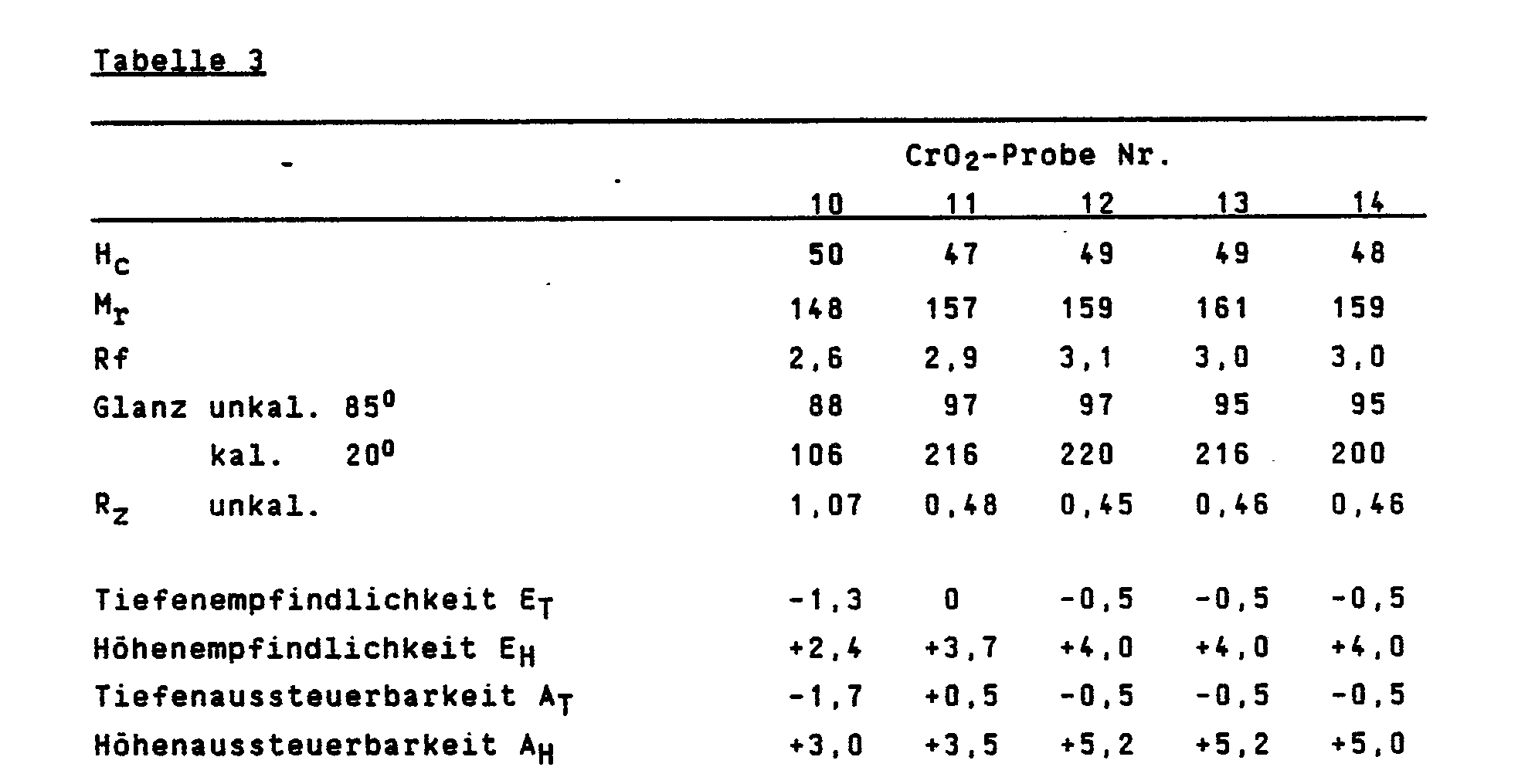
- In einer 250 Volumenteile fassenden und mit 100 Volumenteilen Stahlkugeln mit einem Durchmesser von 1,5 mm gefüllten Mühle wurden jeweils 40 Teile der in Tabelle 3 angegebenen Chromdioxidproben mit 175 Teilen einer 13 %igen Lösung eines thermoplastischen Polyesterurethans aus Adipinsäure, 1,4-Butandiol, 4,4'-Diisocyanatodiphenylmethan in einem Gemisch aus gleichen Teilen Tetrahydrofuran und Dioxan, 150 Teile einer 13 %igen Lösung eines handelsüblichen Polyvinylformals in einer Mischung aus gleichen Teilen Tetrahydrofuran und Dioxan, 24 Teile eines Lösungsmittelgemisches aus gleichen Teilen Tetrahydrofuran und Dioxan und 1 Teil Zinkoleat gemischt und 4 Stunden dispergiert. Danach wurden nochmal die gleichen Mengen der beiden Bindemittellösungen, 13,5 Teile des genannten Lösungsmittelgemisches sowie 0,1 Teile eines handelsüblichen Silikonöls zugefügt und weitere 30 Minuten dispergiert. Anschließend wurde die Dispersion filtriert und auf einer üblichen Beschichtungsmaschine mittels eines Linealgießers und einer solchen Dicke auf eine 10 µm dicke Polyethylenterephthalatfolie aufgebracht, daß sich nach dem Trocknen und Kalandrieren eine Trockenschichtdicke von 5,5 µm ergab. Unmittelbar nach dem Aufgießen der flüssigen Dispersion wurden die nadelförmigen Chromdioxidteichen durch ein Magnetfeld längs der Aufzeichnungsrichtung orientiert. An der Oberfläche der Magnetschicht wurde die mittlere Rauhigkeit Rz und der Glanzwert sowohl vor dem Kalandrieren als auch nach dem Kalandrieren bestimmt.
- Die Meßergebnisse sind in Tabelle 3 angegeben.
Claims (3)
Applications Claiming Priority (2)
| Application Number | Priority Date | Filing Date | Title |
|---|---|---|---|
| DE3535465 | 1985-10-04 | ||
| DE19853535465 DE3535465A1 (de) | 1985-10-04 | 1985-10-04 | Verfahren zur verbesserung von ferromagnetischem chromdioxid |
Publications (3)
| Publication Number | Publication Date |
|---|---|
| EP0217352A2 true EP0217352A2 (de) | 1987-04-08 |
| EP0217352A3 EP0217352A3 (en) | 1988-07-06 |
| EP0217352B1 EP0217352B1 (de) | 1989-08-02 |
Family
ID=6282763
Family Applications (1)
| Application Number | Title | Priority Date | Filing Date |
|---|---|---|---|
| EP86113416A Expired EP0217352B1 (de) | 1985-10-04 | 1986-09-30 | Verfahren zur Verbesserung von ferromagnetischem Chromdioxid |
Country Status (4)
| Country | Link |
|---|---|
| US (1) | US4781851A (de) |
| EP (1) | EP0217352B1 (de) |
| JP (1) | JPS6283318A (de) |
| DE (2) | DE3535465A1 (de) |
Families Citing this family (4)
| Publication number | Priority date | Publication date | Assignee | Title |
|---|---|---|---|---|
| DE3536116A1 (de) * | 1985-10-10 | 1987-04-16 | Basf Ag | Verfahren zur stabilisierung von nadelfoermigem ferromagnetischem chromdioxid |
| US4935325A (en) * | 1987-09-10 | 1990-06-19 | Canon Kabushiki Kaisha | Toner and image forming method using magnetic material with specific tap density and linseed oil absorption |
| DE4412611C2 (de) * | 1994-04-13 | 2003-02-27 | Emtec Magnetics Gmbh | Verfahren zur Herstellung von feinteiligem ferromagnetischem Chromdioxid |
| DE19714161A1 (de) * | 1997-04-05 | 1998-10-08 | Emtec Magnetics Gmbh | Magnetischer Aufzeichnungsträger |
Family Cites Families (6)
| Publication number | Priority date | Publication date | Assignee | Title |
|---|---|---|---|---|
| US3512930A (en) * | 1969-05-07 | 1970-05-19 | Du Pont | Stabilized ferromagnetic chromium dioxide |
| US3686031A (en) * | 1969-11-26 | 1972-08-22 | Du Pont | Metal phosphate coated ferromagnetic chromium oxide and its preparation |
| JPS5523770B2 (de) * | 1972-05-17 | 1980-06-25 | ||
| DE2942646A1 (de) * | 1979-10-22 | 1981-04-30 | Basf Ag, 6700 Ludwigshafen | Verfahren zur herstellung von ferromagnetischem chromdioxid |
| IT1209139B (it) * | 1979-11-16 | 1989-07-10 | Montedison Spa | Procedimento per stabilizzare il biossido di cromo ferromagnetico. |
| DE3513723A1 (de) * | 1985-04-17 | 1986-10-23 | Basf Ag, 6700 Ludwigshafen | Verfahren zur herstellung von ferromagnetischem chromdioxid |
-
1985
- 1985-10-04 DE DE19853535465 patent/DE3535465A1/de not_active Withdrawn
-
1986
- 1986-09-12 JP JP61214256A patent/JPS6283318A/ja active Pending
- 1986-09-30 EP EP86113416A patent/EP0217352B1/de not_active Expired
- 1986-09-30 DE DE8686113416T patent/DE3664826D1/de not_active Expired
-
1987
- 1987-08-28 US US07/091,306 patent/US4781851A/en not_active Expired - Fee Related
Also Published As
| Publication number | Publication date |
|---|---|
| DE3664826D1 (en) | 1989-09-07 |
| EP0217352A3 (en) | 1988-07-06 |
| JPS6283318A (ja) | 1987-04-16 |
| US4781851A (en) | 1988-11-01 |
| DE3535465A1 (de) | 1987-04-09 |
| EP0217352B1 (de) | 1989-08-02 |
Similar Documents
| Publication | Publication Date | Title |
|---|---|---|
| DE69310223T2 (de) | Magnetische Eisenoxidteilchen, Verfahren zur Herstellung und magnetischer Aufnahmeträger | |
| EP0018009B1 (de) | Modifitiertes nadelförmiges magnetisches Eisenoxid und Verfahren zu seiner Herstellung sowie dessen Verwendung zur Herstellung von magnetischen Aufzeichnungsträgern | |
| EP0014903B1 (de) | Verfahren zur Herstellung von nadelförmigem kobalthaltigem magnetischem Eisenoxid | |
| EP0014902A1 (de) | Verfahren zur Herstellung von nadelförmigem kobalthaltigem magnetischem Eisenoxid | |
| DE2705967C2 (de) | Verfahren zur Herstellung von nadelförmigem kobalthaltigem magnetischem Eisenoxid | |
| EP0027640B1 (de) | Verfahren zur Herstellung von ferromagnetischem Chromdioxid sowie seine Verwendung zur Herstellung von magnetischen Aufzeichnungsträgern | |
| DE2556188C3 (de) | Flexible Mehrschichtmagnetogrammträger | |
| EP0217352B1 (de) | Verfahren zur Verbesserung von ferromagnetischem Chromdioxid | |
| EP0198110B1 (de) | Verfahren zur Herstellung von ferromagnetischem Chromdioxid | |
| EP0293685B1 (de) | Verfahren zur Herstellung von stabilisiertem nadelförmigem ferromagnetischem Chromdioxid | |
| DE3516884A1 (de) | Verfahren zur herstellung nadelfoermiger, im wesentlichen aus eisen bestehender ferromagnetischer metallteilchen | |
| EP0087578B1 (de) | Nadelförmiges ferrimagnetisches Eisenoxid und Verfahren zu seiner Herstellung | |
| EP0433838B1 (de) | Verfahren zur Herstellung von stabilisiertem Chromdioxid und magnetischer Aufzeichnungsträger enthaltend dieses Material | |
| DE2749757C2 (de) | ||
| EP0218234B1 (de) | Verfahren zur Stabilisierung von nadelförmigem ferromagnetischem Chromdioxid | |
| DE3536116A1 (de) | Verfahren zur stabilisierung von nadelfoermigem ferromagnetischem chromdioxid | |
| EP0355755B1 (de) | Chromdioxidmaterial, Verfahren zu dessen Herstellung sowie magnetische Aufzeichnungsträger enthaltend dieses Chromdioxidmaterial | |
| EP0110115A1 (de) | Nadelförmige ferromagnetische Chromdioxidteilchen | |
| EP0239087B1 (de) | Verfahren zur Stabilisierung von nadelförmigem ferromagnetischem Chromdioxid | |
| EP0201822B1 (de) | Verfahren zur Herstellung nadelförmiger, kobalthaltiger ferrimagnetischer Eisenoxide | |
| DE3600624A1 (de) | Verfahren zur stabilisierung von nadelfoermigem ferromagnetischem chromdioxid | |
| EP0047368B1 (de) | Nadelförmiges magnetisches Eisenoxid und Verfahren zu seiner Herstellung | |
| EP0147709B1 (de) | Verfahren zur Herstellung kobalthaltiger, isotroper magnetischer Eisenoxide und deren Verwendung | |
| EP0256459A2 (de) | Verfahren zur Herstellung von nadelförmigem, ferrimagnetischem Eisenoxid | |
| DE4005211A1 (de) | Verfahren zum stabilisieren von hochkoerzitivem chromdioxidmaterial |
Legal Events
| Date | Code | Title | Description |
|---|---|---|---|
| PUAI | Public reference made under article 153(3) epc to a published international application that has entered the european phase |
Free format text: ORIGINAL CODE: 0009012 |
|
| AK | Designated contracting states |
Kind code of ref document: A2 Designated state(s): DE FR GB NL |
|
| PUAL | Search report despatched |
Free format text: ORIGINAL CODE: 0009013 |
|
| AK | Designated contracting states |
Kind code of ref document: A3 Designated state(s): DE FR GB NL |
|
| 17P | Request for examination filed |
Effective date: 19880603 |
|
| 17Q | First examination report despatched |
Effective date: 19881121 |
|
| GRAA | (expected) grant |
Free format text: ORIGINAL CODE: 0009210 |
|
| AK | Designated contracting states |
Kind code of ref document: B1 Designated state(s): DE FR GB NL |
|
| REF | Corresponds to: |
Ref document number: 3664826 Country of ref document: DE Date of ref document: 19890907 |
|
| GBT | Gb: translation of ep patent filed (gb section 77(6)(a)/1977) | ||
| ET | Fr: translation filed | ||
| PLBE | No opposition filed within time limit |
Free format text: ORIGINAL CODE: 0009261 |
|
| STAA | Information on the status of an ep patent application or granted ep patent |
Free format text: STATUS: NO OPPOSITION FILED WITHIN TIME LIMIT |
|
| 26N | No opposition filed | ||
| PGFP | Annual fee paid to national office [announced via postgrant information from national office to epo] |
Ref country code: FR Payment date: 19930804 Year of fee payment: 8 |
|
| PGFP | Annual fee paid to national office [announced via postgrant information from national office to epo] |
Ref country code: GB Payment date: 19930916 Year of fee payment: 8 |
|
| PGFP | Annual fee paid to national office [announced via postgrant information from national office to epo] |
Ref country code: NL Payment date: 19930930 Year of fee payment: 8 |
|
| PG25 | Lapsed in a contracting state [announced via postgrant information from national office to epo] |
Ref country code: GB Effective date: 19940930 |
|
| PG25 | Lapsed in a contracting state [announced via postgrant information from national office to epo] |
Ref country code: NL Effective date: 19950401 |
|
| NLV4 | Nl: lapsed or anulled due to non-payment of the annual fee | ||
| GBPC | Gb: european patent ceased through non-payment of renewal fee |
Effective date: 19940930 |
|
| PG25 | Lapsed in a contracting state [announced via postgrant information from national office to epo] |
Ref country code: FR Effective date: 19950531 |
|
| REG | Reference to a national code |
Ref country code: FR Ref legal event code: ST |
|
| PGFP | Annual fee paid to national office [announced via postgrant information from national office to epo] |
Ref country code: DE Payment date: 19981123 Year of fee payment: 13 |
|
| PG25 | Lapsed in a contracting state [announced via postgrant information from national office to epo] |
Ref country code: DE Free format text: LAPSE BECAUSE OF NON-PAYMENT OF DUE FEES Effective date: 20000701 |