EP0215615B1 - Method of operating a quadrupole ion trap - Google Patents
Method of operating a quadrupole ion trap Download PDFInfo
- Publication number
- EP0215615B1 EP0215615B1 EP86306857A EP86306857A EP0215615B1 EP 0215615 B1 EP0215615 B1 EP 0215615B1 EP 86306857 A EP86306857 A EP 86306857A EP 86306857 A EP86306857 A EP 86306857A EP 0215615 B1 EP0215615 B1 EP 0215615B1
- Authority
- EP
- European Patent Office
- Prior art keywords
- ions
- reagent
- analyte
- mass
- dimensional field
- Prior art date
- Legal status (The legal status is an assumption and is not a legal conclusion. Google has not performed a legal analysis and makes no representation as to the accuracy of the status listed.)
- Expired
Links
- 238000005040 ion trap Methods 0.000 title claims description 23
- 238000000034 method Methods 0.000 title claims description 22
- 150000002500 ions Chemical class 0.000 claims description 87
- 239000003153 chemical reaction reagent Substances 0.000 claims description 51
- 238000000262 chemical ionisation mass spectrometry Methods 0.000 claims description 42
- 239000012491 analyte Substances 0.000 claims description 25
- 238000004458 analytical method Methods 0.000 claims description 7
- 239000000203 mixture Substances 0.000 claims description 2
- 238000001228 spectrum Methods 0.000 description 37
- VNWKTOKETHGBQD-UHFFFAOYSA-N methane Chemical compound C VNWKTOKETHGBQD-UHFFFAOYSA-N 0.000 description 30
- 239000007789 gas Substances 0.000 description 17
- 239000002245 particle Substances 0.000 description 14
- 238000006243 chemical reaction Methods 0.000 description 10
- JGHZJRVDZXSNKQ-UHFFFAOYSA-N methyl octanoate Chemical compound CCCCCCCC(=O)OC JGHZJRVDZXSNKQ-UHFFFAOYSA-N 0.000 description 10
- 239000000047 product Substances 0.000 description 10
- ZMANZCXQSJIPKH-UHFFFAOYSA-N Triethylamine Chemical compound CCN(CC)CC ZMANZCXQSJIPKH-UHFFFAOYSA-N 0.000 description 9
- 238000000451 chemical ionisation Methods 0.000 description 8
- 238000001819 mass spectrum Methods 0.000 description 8
- SNICXCGAKADSCV-JTQLQIEISA-N (-)-Nicotine Chemical compound CN1CCC[C@H]1C1=CC=CN=C1 SNICXCGAKADSCV-JTQLQIEISA-N 0.000 description 6
- 238000010586 diagram Methods 0.000 description 6
- 229960002715 nicotine Drugs 0.000 description 6
- SNICXCGAKADSCV-UHFFFAOYSA-N nicotine Natural products CN1CCCC1C1=CC=CN=C1 SNICXCGAKADSCV-UHFFFAOYSA-N 0.000 description 6
- KWTSXDURSIMDCE-QMMMGPOBSA-N (S)-amphetamine Chemical compound C[C@H](N)CC1=CC=CC=C1 KWTSXDURSIMDCE-QMMMGPOBSA-N 0.000 description 5
- 239000005641 Methyl octanoate Substances 0.000 description 5
- 229940025084 amphetamine Drugs 0.000 description 5
- 239000012634 fragment Substances 0.000 description 5
- 230000007935 neutral effect Effects 0.000 description 5
- 238000010894 electron beam technology Methods 0.000 description 4
- 230000005284 excitation Effects 0.000 description 4
- 230000005532 trapping Effects 0.000 description 4
- 230000015572 biosynthetic process Effects 0.000 description 3
- 238000013467 fragmentation Methods 0.000 description 3
- 238000006062 fragmentation reaction Methods 0.000 description 3
- 238000004949 mass spectrometry Methods 0.000 description 3
- 238000013459 approach Methods 0.000 description 2
- 150000001793 charged compounds Chemical class 0.000 description 2
- 230000008878 coupling Effects 0.000 description 2
- 238000010168 coupling process Methods 0.000 description 2
- 238000005859 coupling reaction Methods 0.000 description 2
- 230000000694 effects Effects 0.000 description 2
- 206010001497 Agitation Diseases 0.000 description 1
- YUBJPYNSGLJZPQ-UHFFFAOYSA-N Dithiopyr Chemical compound CSC(=O)C1=C(C(F)F)N=C(C(F)(F)F)C(C(=O)SC)=C1CC(C)C YUBJPYNSGLJZPQ-UHFFFAOYSA-N 0.000 description 1
- 230000004075 alteration Effects 0.000 description 1
- 150000001875 compounds Chemical class 0.000 description 1
- 238000003795 desorption Methods 0.000 description 1
- 238000001514 detection method Methods 0.000 description 1
- 238000006073 displacement reaction Methods 0.000 description 1
- 238000010494 dissociation reaction Methods 0.000 description 1
- 230000005593 dissociations Effects 0.000 description 1
- 230000005684 electric field Effects 0.000 description 1
- 230000005686 electrostatic field Effects 0.000 description 1
- 238000005086 pumping Methods 0.000 description 1
- 150000005839 radical cations Chemical class 0.000 description 1
- 230000002311 subsequent effect Effects 0.000 description 1
Images



Classifications
-
- H—ELECTRICITY
- H01—ELECTRIC ELEMENTS
- H01J—ELECTRIC DISCHARGE TUBES OR DISCHARGE LAMPS
- H01J49/00—Particle spectrometers or separator tubes
- H01J49/26—Mass spectrometers or separator tubes
- H01J49/34—Dynamic spectrometers
- H01J49/42—Stability-of-path spectrometers, e.g. monopole, quadrupole, multipole, farvitrons
- H01J49/4205—Device types
- H01J49/424—Three-dimensional ion traps, i.e. comprising end-cap and ring electrodes
-
- H—ELECTRICITY
- H01—ELECTRIC ELEMENTS
- H01J—ELECTRIC DISCHARGE TUBES OR DISCHARGE LAMPS
- H01J49/00—Particle spectrometers or separator tubes
- H01J49/004—Combinations of spectrometers, tandem spectrometers, e.g. MS/MS, MSn
- H01J49/0081—Tandem in time, i.e. using a single spectrometer
-
- H—ELECTRICITY
- H01—ELECTRIC ELEMENTS
- H01J—ELECTRIC DISCHARGE TUBES OR DISCHARGE LAMPS
- H01J49/00—Particle spectrometers or separator tubes
- H01J49/02—Details
- H01J49/10—Ion sources; Ion guns
- H01J49/14—Ion sources; Ion guns using particle bombardment, e.g. ionisation chambers
- H01J49/145—Ion sources; Ion guns using particle bombardment, e.g. ionisation chambers using chemical ionisation
-
- H—ELECTRICITY
- H01—ELECTRIC ELEMENTS
- H01J—ELECTRIC DISCHARGE TUBES OR DISCHARGE LAMPS
- H01J49/00—Particle spectrometers or separator tubes
- H01J49/26—Mass spectrometers or separator tubes
- H01J49/34—Dynamic spectrometers
- H01J49/42—Stability-of-path spectrometers, e.g. monopole, quadrupole, multipole, farvitrons
- H01J49/426—Methods for controlling ions
- H01J49/427—Ejection and selection methods
- H01J49/429—Scanning an electric parameter, e.g. voltage amplitude or frequency
Definitions
- the present invention relates to a method of operating a quadrupole ion trap for chemical ionization mass spectrometry.
- Ion trap mass spectrometers or quadrupole ion stores
- quadrupole ion stores have been known for many years, and are devices in which ions are formed and contained within a physical structure by means of electrostatic fields, such as RF, DC and a combination thereof.
- electrostatic fields such as RF, DC and a combination thereof.
- a quadrupole electric field provides an ion storage region by the use of a hyperbolic electrode structure or a spherical electrode structure which provides an equivalent qaudrupole trapping field.
- Mass storage is generally achieved by operating the trap electrodes with values of RF voltage (V), its frequency (f), DC voltage (U) and device size (r0) such that ions having their mass-to-charge ratios within a finite range are stably trapped inside the device.
- the aforementioned parameters are sometimes referred to as scanning parameters and have a fixed relationship to the mass-to-charge ratios of the trapped ions.
- scanning parameters there is a distinctive secular frequency for each value of mass-to-charge ratio.
- these secular frequencies can be determined by a frequency tuned circuit which couples to the oscillating motion of the ions within the trap, and then the mass-to-charge ratio may be determined by use of an analyzing technique.
- CI Chemical ionization mass spectrometry
- CI mass spectrometry ionization of a sample (analyte) of interest is effected by gas-phase ion/molecule reactions rather than by electron impact, photon impact, or field ionization/desorption.
- CI offers the capability of controlling sample fragmentation through the choice of appropriate reagent gas. In particular, since fragmentation is often reduced relative to that obtained with electron impact, simple spectra can often be obtained with enhanced molecular weight information.
- ICR ion cyclotron resonance
- such method is characterised by the steps of ionising the mixture whereby low mass reagent ions and low mass analyte ions are trapped; changing the three dimensional field while allowing the reagent ions and analyte molecules to react to form product ions and trap higher mass product ions; and scanning the three dimensional field to successively eject the product ions.
- the invention provides a method of operating a quadrupole ion trap to obtain CI mass spectra that offers advantages over the methods previously used with quadrupole traps and the methods previously reported for ICR instruments.
- the quadrupole ion trap is used for both the reaction of neutral sample molecules with reagent ions and for mass analysis of the products. Fragments from electron impact of the analyte can be suppressed by creating conditions within the trap under which reagent ions are stored during ionisation but most analyte ions are not.
- FIG. 1 There is shown in FIG. 1 at 10 a three-dimensional ion trap which includes a ring electrode 11 and two end caps 12 and 13 facing each other.
- the field required for trapping is formed by coupling the RF voltage between the ring electrode 11 and the two end cap electrodes 12 and 13 which are common mode grounded through coupling transformer 32 as shown.
- a supplementary RF generator 35 is coupled to the end caps 12, 13 to supply a radio frequency voltage V2 cos ⁇ 2t between the end caps to resonate trapped ions at their axial resonant frequencies.
- a filament 17 which is fed by a filament power supply 18 is disposed to provide an ionizing electron beam for ionizing the sample molecules introduced into the ion storage region 16.
- a cylindrical gate electrode and lens 19 is powered by a filament lens controller 21. The gate electrode provides control to gate the electron beam on and off as desired.
- End cap 12 includes an aperture through which the electron beam projects.
- the opposite end cap 13 is perforated 23 to allow unstable ions in the fields of the ion trap to exit and be detected by an electron multiplier 24 which generates an ion signal on line 26.
- An electrometer 27 converts the signal on line 26 from current to voltage.
- the signal is summed and stored by the unit 28 and processed in unit 29.
- Controller 31 is connected to the fundamental RF generator 14 to allow the magnitude and/or frequency of the fundamental RF voltage to be varied for providing mass selection.
- the controller 31 is also connected to the supplementary RF generator 35 to allow the magnitude and/or frequency of the supplementary RF voltage to be varied or gated.
- the controller on line 33 gates the filament lens controller 21 to provide an ionizing electron beam only at time periods other than the scanning interval. Mechanical and operating details of ion trap are described in EP-A-0113207.
- the symmetric three dimensional fields in the ion trap 10 lead to the well known stability diagram shown in FIG. 2.
- the values of a and q must be within the stability envelope if it is to be trapped within the quadrupole fields of the ion trap device.
- the type of trajectory a charged particle has in a described three-dimensional quadrupole field depends on how the specific mass of the particle, m/e, and the applied field parameters, U, V, r0 and ⁇ combined to map onto the stability diagram. If the scanning parameters combine to map inside the stability envelope then the given particle has a stable trajectory in the defined field. A charged particle having a stable trajectory in a three-dimensional quadrupole field is constrained to an orbit about the center of the field. Such particles can be thought of as trapped by the field. If for a particle m/e, U, V, r0 and ⁇ combine to map outside the stability envelope on the stability diagram, then the given particle has an unstable trajectory in the defined field. Particles having unstable trajectories in a three-dimensional quadrupole field obtain displacements from the center of the field which approach infinity over time. Such particles can be thought of escaping the field and are consequently considered untrappable.
- the locus of all possible mass-to-charge ratios maps onto the stability diagram as a single straight line running through the origin with a slope equal to _2U/V. (This locus is also referred to as the scan line.) That portion of the loci of all possible mass-to-charge ratios that maps within the stability region defines the region of mass-to-charge ratios particles may have if they are to be trapped in the applied field.
- the range of specific masses to trappable particles can be selected. If the ratio of U to V is chosen so that the locus of possible specific masses maps through an apex of the stability region (line A of FIG.
- the ion trap is operated in the chemical ionization mode as follows: Reagent gases are introduced into the trap at pressures between 1.33 ⁇ 10 _6 and 1.33 ⁇ 10 _1 Pa (10 _8 and 10 _3 torr) and analytic gases are introduced into the ion trap at pressures between (1.33 ⁇ 10 _3 and 1.33 ⁇ 10 _6 Pa 10 _5 and 10 _8 torr). Both the reagent and analytic gases are at low pressures in contrast to conventional chemical ionization. The reagent and analytic molecules are ionized with the three dimensional trapping field selected to store only low mass reagent and analytic ions.
- the low mass reagent ions and reagent neutral molecules interact to form additional ions.
- the low mass ions are stored in the ion trap.
- the reagent ions interact with analytic molecules to form analytic ion fragments.
- the three dimensional field is then changed to thereby store higher mass analytic ions formed by the chemical ionization reaction between the reagent ions and the analytic molecules.
- the stored fragment analytic ions are then ejected by changing the three dimensional field whereby analytic ions of increasing mass are successively ejected.
- the RF and DC potentials on the trap may be adjusted so that during ionization only species of less than m/z 30 will be trapped.
- a suitable delay period after ionization will allow the formation of reagent ions (CH5+ and C2H5+), and then the conditions in the trap can be changed so that both the reagent ions and any analyte ions that may form will be trapped.
- the products can then be analyzed by mass-selective ejection from the trap.
- the products are mass-analyzed by scanning the RF voltage and successively ejecting the product ions to give a CI mass spectrum.
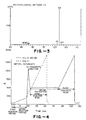
- Figure 3 shows a methane chemical ionization spectrum of triethylamine, a compound which shows little molecular ion under electron impact conditions.
- Figure 4 shows the RF scan-programs used in one embodiment of the present invention.
- the reagent ions are produced in the first reaction period and the analyte ions are formed during the second reaction period.
- the analyte ions may be subjected to ms/ms by the method described, in copending application Serial No. assigned to a common assignee, and shown in the solid line, Figure 4. Briefly, during the period marked "ms/ms excitation," an AC voltage is applied across the end-caps at the resonant frequency of the ion to be investigated. This effects collision-included dissociation, and the products are analyzed in the usual way.
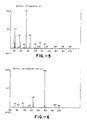
- Figure 5 shows an electron impact spectrum of methyl octanoate
- Figure 6 shows the corresponding methane CI spectrum obtained under the conditions shown in Figure 4. Again, the M+1 ion is very prominent in the CI spectrum.
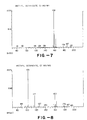
- Figure 7 shows the result of the ms/ms RF program of Figure 4, except that no excitation voltage is used, and Figure 8 uses the same RF-program as Figure 7, but an AC Voltage at the resonant frequency of m/z 159 was applied to produce an ms/ms spectrum.
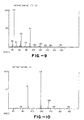
- Figure 9 shows an electron impact spectrum of amphetamine (molecular weight 135 ⁇ ), in which very little molecular ion is present.
- Figure 10 is the corresponding methane CI spectrum
- Figure 11 uses the ms/ms RF program but without an excitation voltage.
- Figure 12 uses the same RF-programs as Figure 11, but an excitation voltage at the resonant frequency of m/z 136 was applied to produce an ms/ms spectrum.
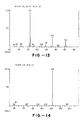
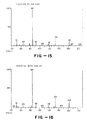
- Figures 13-17 show mass spectra of nicotine under various conditions.
- the He pressure was about 2.5 ⁇ 1.33 ⁇ 10 _2 Pa (2.5 ⁇ 10 _4 torr) and the background pressure about 3.5 ⁇ 1.33 ⁇ 10 _5 Pa (3.5 ⁇ 10 _7 torr).
- Figure 13 shows the spectrum obtained with ion impact with Nh3 present at about 4 ⁇ 1.33 ⁇ 10 _3 Pa (4 ⁇ 10 _5 torr).
- Figure 14 shows the chemical ionization spectrum for the same conditions.
- Figure 15 shows the EI spectrum without NH3 present. This shows substantially the same EI spectrum as with NH3 present.
- Figure 16 shows the EI spectrum with CH4 present at about 2.5 ⁇ 1.33 ⁇ 10 _3 Pa (2.5 ⁇ 10 _5 torr). This shows substantially the same EI spectrum.
- Figure 17 shows the CI spectrum under the same conditions.
- FIG. 18 depicts the general scanning techniques to produce EI or CI spectra, with the continuous presence of reagent gas, using the ion trap.
- the EI scan function is represented by the solid line and the CI scan function is represented by the dashed line.
- EI spectra are produced by setting the initial RF voltage (A), during ionization, at a level such that all m/z's up to and including the molecular weight of the CI reagent gas are not stored. At this RF voltage, any radical cations or fragment ions of the reagent gas which are formed during ionization are unstable (not trappable) and very quickly, within a few RF cycles, exit the device.
- A initial RF voltage
- the ability to achieve chemical ionization and to perform mass analysis with a quadrupole ion trap to acquire high quality mass spectra should greatly increase the availability and use of CI mass spectrometry.
Landscapes
- Chemical & Material Sciences (AREA)
- Analytical Chemistry (AREA)
- Physics & Mathematics (AREA)
- Engineering & Computer Science (AREA)
- Plasma & Fusion (AREA)
- Other Investigation Or Analysis Of Materials By Electrical Means (AREA)
- Electron Tubes For Measurement (AREA)
Applications Claiming Priority (2)
| Application Number | Priority Date | Filing Date | Title |
|---|---|---|---|
| US773339 | 1985-09-06 | ||
| US06/773,339 US4686367A (en) | 1985-09-06 | 1985-09-06 | Method of operating quadrupole ion trap chemical ionization mass spectrometry |
Publications (3)
| Publication Number | Publication Date |
|---|---|
| EP0215615A2 EP0215615A2 (en) | 1987-03-25 |
| EP0215615A3 EP0215615A3 (en) | 1988-05-18 |
| EP0215615B1 true EP0215615B1 (en) | 1991-02-27 |
Family
ID=25097933
Family Applications (1)
| Application Number | Title | Priority Date | Filing Date |
|---|---|---|---|
| EP86306857A Expired EP0215615B1 (en) | 1985-09-06 | 1986-09-04 | Method of operating a quadrupole ion trap |
Country Status (5)
| Country | Link |
|---|---|
| US (1) | US4686367A (enExample) |
| EP (1) | EP0215615B1 (enExample) |
| JP (1) | JP2716696B2 (enExample) |
| CA (1) | CA1241373A (enExample) |
| DE (1) | DE3677678D1 (enExample) |
Cited By (1)
| Publication number | Priority date | Publication date | Assignee | Title |
|---|---|---|---|---|
| DE4324233C1 (de) * | 1993-07-20 | 1995-01-19 | Bruker Franzen Analytik Gmbh | Verfahren zur Auswahl der Reaktionspfade in Ionenfallen |
Families Citing this family (32)
| Publication number | Priority date | Publication date | Assignee | Title |
|---|---|---|---|---|
| GB8625529D0 (en) * | 1986-10-24 | 1986-11-26 | Griffiths I W | Control/analysis of charged particles |
| US4771172A (en) * | 1987-05-22 | 1988-09-13 | Finnigan Corporation | Method of increasing the dynamic range and sensitivity of a quadrupole ion trap mass spectrometer operating in the chemical ionization mode |
| US4945234A (en) * | 1989-05-19 | 1990-07-31 | Extrel Ftms, Inc. | Method and apparatus for producing an arbitrary excitation spectrum for Fourier transform mass spectrometry |
| DE69218759T2 (de) * | 1991-01-09 | 1997-10-16 | Graeme James Currie | Verfahren zur analyse von fettsäuren in triacylglycerolen |
| US5162650A (en) * | 1991-01-25 | 1992-11-10 | Finnigan Corporation | Method and apparatus for multi-stage particle separation with gas addition for a mass spectrometer |
| US5206507A (en) * | 1991-02-28 | 1993-04-27 | Teledyne Mec | Mass spectrometry method using filtered noise signal |
| US5134286A (en) * | 1991-02-28 | 1992-07-28 | Teledyne Cme | Mass spectrometry method using notch filter |
| US5196699A (en) * | 1991-02-28 | 1993-03-23 | Teledyne Mec | Chemical ionization mass spectrometry method using notch filter |
| US5200613A (en) * | 1991-02-28 | 1993-04-06 | Teledyne Mec | Mass spectrometry method using supplemental AC voltage signals |
| US5105081A (en) * | 1991-02-28 | 1992-04-14 | Teledyne Cme | Mass spectrometry method and apparatus employing in-trap ion detection |
| US5182451A (en) * | 1991-04-30 | 1993-01-26 | Finnigan Corporation | Method of operating an ion trap mass spectrometer in a high resolution mode |
| US5206509A (en) * | 1991-12-11 | 1993-04-27 | Martin Marietta Energy Systems, Inc. | Universal collisional activation ion trap mass spectrometry |
| DE69333589T2 (de) * | 1992-05-29 | 2005-02-03 | Varian, Inc., Palo Alto | Verfahren zum Betreiben eines Ionenfallen-Massenspektrometers |
| US5381006A (en) * | 1992-05-29 | 1995-01-10 | Varian Associates, Inc. | Methods of using ion trap mass spectrometers |
| EP0786796B1 (en) * | 1992-05-29 | 2000-07-05 | Varian, Inc. | Methods of using ion trap mass spectrometers |
| WO1998011428A1 (fr) * | 1996-09-13 | 1998-03-19 | Hitachi, Ltd. | Spectrometre de masse |
| JP2000111414A (ja) | 1998-10-09 | 2000-04-21 | Hyakuryaku Kigyo Kofun Yugenkoshi | 医療体温計 |
| CA2450351C (en) * | 2001-06-11 | 2010-09-21 | Isis Pharmaceuticals Inc. | Systems and methods for inducing infrared multiphoton dissociation with a hollow fiber waveguide |
| US8097416B2 (en) | 2003-09-11 | 2012-01-17 | Ibis Biosciences, Inc. | Methods for identification of sepsis-causing bacteria |
| US8288523B2 (en) | 2003-09-11 | 2012-10-16 | Ibis Biosciences, Inc. | Compositions for use in identification of bacteria |
| US8546082B2 (en) * | 2003-09-11 | 2013-10-01 | Ibis Biosciences, Inc. | Methods for identification of sepsis-causing bacteria |
| DE102005025497B4 (de) * | 2005-06-03 | 2007-09-27 | Bruker Daltonik Gmbh | Leichte Bruckstückionen mit Ionenfallen messen |
| US8334506B2 (en) | 2007-12-10 | 2012-12-18 | 1St Detect Corporation | End cap voltage control of ion traps |
| US7973277B2 (en) | 2008-05-27 | 2011-07-05 | 1St Detect Corporation | Driving a mass spectrometer ion trap or mass filter |
| US8258462B2 (en) * | 2008-09-05 | 2012-09-04 | Thermo Finnigan Llc | Methods of calibrating and operating an ion trap mass analyzer to optimize mass spectral peak characteristics |
| US7804065B2 (en) * | 2008-09-05 | 2010-09-28 | Thermo Finnigan Llc | Methods of calibrating and operating an ion trap mass analyzer to optimize mass spectral peak characteristics |
| US8299421B2 (en) | 2010-04-05 | 2012-10-30 | Agilent Technologies, Inc. | Low-pressure electron ionization and chemical ionization for mass spectrometry |
| US9214321B2 (en) | 2013-03-11 | 2015-12-15 | 1St Detect Corporation | Methods and systems for applying end cap DC bias in ion traps |
| WO2014149847A2 (en) | 2013-03-15 | 2014-09-25 | Riaz Abrar | Ionization within ion trap using photoionization and electron ionization |
| JP6943897B2 (ja) * | 2019-01-18 | 2021-10-06 | 日本電子株式会社 | マススペクトル処理装置及び方法 |
| CN111276385B (zh) * | 2020-02-13 | 2020-12-08 | 清华大学 | 质谱仪的离子激发检测方法 |
| DE112022003505T5 (de) * | 2021-07-12 | 2024-04-25 | Quadrocore Corp. | Elektronenstossionisation innerhalb von hochfrequenz-einschlussfelder |
Family Cites Families (3)
| Publication number | Priority date | Publication date | Assignee | Title |
|---|---|---|---|---|
| US3527939A (en) * | 1968-08-29 | 1970-09-08 | Gen Electric | Three-dimensional quadrupole mass spectrometer and gauge |
| US4540884A (en) * | 1982-12-29 | 1985-09-10 | Finnigan Corporation | Method of mass analyzing a sample by use of a quadrupole ion trap |
| US4650999A (en) * | 1984-10-22 | 1987-03-17 | Finnigan Corporation | Method of mass analyzing a sample over a wide mass range by use of a quadrupole ion trap |
-
1985
- 1985-09-06 US US06/773,339 patent/US4686367A/en not_active Expired - Lifetime
-
1986
- 1986-09-04 DE DE8686306857T patent/DE3677678D1/de not_active Expired - Fee Related
- 1986-09-04 EP EP86306857A patent/EP0215615B1/en not_active Expired
- 1986-09-05 JP JP61209402A patent/JP2716696B2/ja not_active Expired - Fee Related
- 1986-09-05 CA CA000517545A patent/CA1241373A/en not_active Expired
Cited By (1)
| Publication number | Priority date | Publication date | Assignee | Title |
|---|---|---|---|---|
| DE4324233C1 (de) * | 1993-07-20 | 1995-01-19 | Bruker Franzen Analytik Gmbh | Verfahren zur Auswahl der Reaktionspfade in Ionenfallen |
Also Published As
| Publication number | Publication date |
|---|---|
| EP0215615A3 (en) | 1988-05-18 |
| EP0215615A2 (en) | 1987-03-25 |
| JPS62115641A (ja) | 1987-05-27 |
| DE3677678D1 (de) | 1991-04-04 |
| US4686367A (en) | 1987-08-11 |
| CA1241373A (en) | 1988-08-30 |
| JP2716696B2 (ja) | 1998-02-18 |
Similar Documents
| Publication | Publication Date | Title |
|---|---|---|
| US4686367A (en) | Method of operating quadrupole ion trap chemical ionization mass spectrometry | |
| EP0292187B1 (en) | Method of using an ion trap in the chemical ionization mode | |
| EP0409362B1 (en) | Method of operating an ion trap | |
| US4818869A (en) | Method of isolating a single mass or narrow range of masses and/or enhancing the sensitivity of an ion trap mass spectrometer | |
| US4234791A (en) | Tandem quadrupole mass spectrometer for selected ion fragmentation studies and low energy collision induced dissociator therefor | |
| CA1207918A (en) | Method of mass analyzing a sample by use of a quadrupole ion trap | |
| US5101105A (en) | Neutralization/chemical reionization tandem mass spectrometry method and apparatus therefor | |
| US7642509B2 (en) | Top-down protein analysis in mass spectrometers with ion traps | |
| EP1051731B1 (en) | Method of analyzing ions in an apparatus including a time of flight mass spectrometer and a linear ion trap | |
| CA2066893C (en) | Method of operating an ion trap mass spectrometer in a high resolution mode | |
| US5128542A (en) | Method of operating an ion trap mass spectrometer to determine the resonant frequency of trapped ions | |
| EP1051733B1 (en) | Method of and apparatus for selective collision-induced dissociation of ions in a quadrupole ion guide | |
| US6787767B2 (en) | Mass analyzing method using an ion trap type mass spectrometer | |
| EP0878828B1 (en) | Method and apparatus for analysing and detecting a charge-neutral liquid or gas sample | |
| US6838665B2 (en) | Ion trap type mass spectrometer |
Legal Events
| Date | Code | Title | Description |
|---|---|---|---|
| PUAI | Public reference made under article 153(3) epc to a published international application that has entered the european phase |
Free format text: ORIGINAL CODE: 0009012 |
|
| AK | Designated contracting states |
Kind code of ref document: A2 Designated state(s): CH DE FR GB IT LI NL SE |
|
| PUAL | Search report despatched |
Free format text: ORIGINAL CODE: 0009013 |
|
| AK | Designated contracting states |
Kind code of ref document: A3 Designated state(s): CH DE FR GB IT LI NL SE |
|
| 17P | Request for examination filed |
Effective date: 19880622 |
|
| 17Q | First examination report despatched |
Effective date: 19890724 |
|
| GRAA | (expected) grant |
Free format text: ORIGINAL CODE: 0009210 |
|
| AK | Designated contracting states |
Kind code of ref document: B1 Designated state(s): CH DE FR GB IT LI NL SE |
|
| PG25 | Lapsed in a contracting state [announced via postgrant information from national office to epo] |
Ref country code: IT Free format text: LAPSE BECAUSE OF FAILURE TO SUBMIT A TRANSLATION OF THE DESCRIPTION OR TO PAY THE FEE WITHIN THE PRE;WARNING: LAPSES OF ITALIAN PATENTS WITH EFFECTIVE DATE BEFORE 2007 MAY HAVE OCCURRED AT ANY TIME BEFORE 2007. THE CORRECT EFFECTIVE DATE MAY BE DIFFERENT FROM THE ONE RECORDED.SCRIBED TIME-LIMIT Effective date: 19910227 Ref country code: LI Effective date: 19910227 Ref country code: CH Effective date: 19910227 Ref country code: NL Effective date: 19910227 Ref country code: SE Effective date: 19910227 |
|
| REF | Corresponds to: |
Ref document number: 3677678 Country of ref document: DE Date of ref document: 19910404 |
|
| ET | Fr: translation filed | ||
| REG | Reference to a national code |
Ref country code: CH Ref legal event code: PL |
|
| NLV1 | Nl: lapsed or annulled due to failure to fulfill the requirements of art. 29p and 29m of the patents act | ||
| PLBI | Opposition filed |
Free format text: ORIGINAL CODE: 0009260 |
|
| 26 | Opposition filed |
Opponent name: BRUKER-FRANZEN ANALYTIK GMBH Effective date: 19911127 |
|
| PLBN | Opposition rejected |
Free format text: ORIGINAL CODE: 0009273 |
|
| STAA | Information on the status of an ep patent application or granted ep patent |
Free format text: STATUS: OPPOSITION REJECTED |
|
| 27O | Opposition rejected |
Effective date: 19960621 |
|
| REG | Reference to a national code |
Ref country code: GB Ref legal event code: 732E |
|
| REG | Reference to a national code |
Ref country code: GB Ref legal event code: IF02 |
|
| PGFP | Annual fee paid to national office [announced via postgrant information from national office to epo] |
Ref country code: FR Payment date: 20030918 Year of fee payment: 18 |
|
| PGFP | Annual fee paid to national office [announced via postgrant information from national office to epo] |
Ref country code: GB Payment date: 20040908 Year of fee payment: 19 |
|
| PGFP | Annual fee paid to national office [announced via postgrant information from national office to epo] |
Ref country code: DE Payment date: 20041102 Year of fee payment: 19 |
|
| PG25 | Lapsed in a contracting state [announced via postgrant information from national office to epo] |
Ref country code: FR Free format text: LAPSE BECAUSE OF NON-PAYMENT OF DUE FEES Effective date: 20050531 |
|
| REG | Reference to a national code |
Ref country code: FR Ref legal event code: ST |
|
| PG25 | Lapsed in a contracting state [announced via postgrant information from national office to epo] |
Ref country code: GB Free format text: LAPSE BECAUSE OF NON-PAYMENT OF DUE FEES Effective date: 20050904 |
|
| APAH | Appeal reference modified |
Free format text: ORIGINAL CODE: EPIDOSCREFNO |
|
| PG25 | Lapsed in a contracting state [announced via postgrant information from national office to epo] |
Ref country code: DE Free format text: LAPSE BECAUSE OF NON-PAYMENT OF DUE FEES Effective date: 20060401 |
|
| GBPC | Gb: european patent ceased through non-payment of renewal fee |
Effective date: 20050904 |