EP0206578A2 - Gerät zur Stabilisierung eines Leistungssystems - Google Patents
Gerät zur Stabilisierung eines Leistungssystems Download PDFInfo
- Publication number
- EP0206578A2 EP0206578A2 EP86304233A EP86304233A EP0206578A2 EP 0206578 A2 EP0206578 A2 EP 0206578A2 EP 86304233 A EP86304233 A EP 86304233A EP 86304233 A EP86304233 A EP 86304233A EP 0206578 A2 EP0206578 A2 EP 0206578A2
- Authority
- EP
- European Patent Office
- Prior art keywords
- power system
- power
- generator
- pss
- deviation
- Prior art date
- Legal status (The legal status is an assumption and is not a legal conclusion. Google has not performed a legal analysis and makes no representation as to the accuracy of the status listed.)
- Granted
Links
Images



Classifications
-
- H—ELECTRICITY
- H02—GENERATION; CONVERSION OR DISTRIBUTION OF ELECTRIC POWER
- H02P—CONTROL OR REGULATION OF ELECTRIC MOTORS, ELECTRIC GENERATORS OR DYNAMO-ELECTRIC CONVERTERS; CONTROLLING TRANSFORMERS, REACTORS OR CHOKE COILS
- H02P9/00—Arrangements for controlling electric generators for the purpose of obtaining a desired output
- H02P9/10—Control effected upon generator excitation circuit to reduce harmful effects of overloads or transients, e.g. sudden application of load, sudden removal of load, sudden change of load
- H02P9/105—Control effected upon generator excitation circuit to reduce harmful effects of overloads or transients, e.g. sudden application of load, sudden removal of load, sudden change of load for increasing the stability
Definitions
- This invention relates to a power system stabilizing apparatus with a power system stabilizer (PSS) for a synchronous generator.
- PSS power system stabilizer
- the automatic voltage regulators have been widely applied with the output thereof being transmitted to the exciter for controlling the field current in order to maintain the terminal voltage of synchronous generator at a constant predetermined level.
- AVR automatic voltage regulators
- the response of the AVR is too quick, a negative control.effect may take place in the synchronous generator, resulting in disorder of the overall system stabilization, therefore, the power system 4 stabilizing apparatus with PSS is applied to prevent such disorder effect.
- Fig. 1 shows a block diagram of the power system stabilizing apparatus for synchronous generator, which is disclosed in Japanese Patent Publication No. 53-44204 (1978).
- Fig. 1 designates an input terminal giving a deviation from the reference terminal voltage of a generator
- 2 designates PPS
- 3 designates the input terminal of the PPS
- 4 designates a damping circuit
- 5 designates an adder circuit subtracting the output of the damping circuit 4 from the sum of the deviation from the input terminal 1 and the output of the PSS
- 6 designates an AVR controlling an exciter 7 by the output of the above adder circuit 4 and 7 designates an exciter, which is controlled by the above AVR 6, so as to supply the field current to the generator (not shown)
- 2a designates a filter circuit which is used to define the domain range of the PSS 2 corresponding to input signals 3 of the PSS 2 and featured with the transfer function; where T R and T H are the time constants of the set filter constructing the above filter circuit 2a and of the high pass filter respectively.
- 2b is a phase compensation circuit for time delays of the AVR 6, the exciter 7, the generator, etc. and is a advance/delay circuit with an amplification effect, which is normally represented in the form; where K is a gain of PSS 2 while T 11 and T 12 arc a delay time constant and an advance time constant respectively.
- 2c designates a limiter which limits the output signals of the PSS 2 to be a signal level appropriate to the entire exciting system shown in Fig. 4.
- revolution deviation of the generator rotor, frequency deviation of the generator terminal voltage, output deviation of the generator itself, etc. are used as the input signals of the PPS 2.
- the input terminal receives the corresponding deviation signal, which is amplified by the AVR 6 and inputted to the exciter 7, where the deviation signal is further amplified, supplied to the field windings of the generator and so controlled that the deviation from its reference value of the generator terminal voltage returns to zero.
- the damping circuit 4 is used to stabilize the above control action and to feedback the output thereof to the adder circuit 5, as mentioned before.
- the output of the PSS 2 is added supplementarily to such a control in order to improve the stabilization of the power system.
- the filter circuit 2a cuts off direct current and high frequency portion of this input signal, which is then inputted to the amplification and phase compensation circuit 2b for amplification and phase compensation.
- the amplification and phase compensation circuit 2b is controlled to less than its appropriate level through the limiter 2c and then fed to the adder circuit 5, therefore, the output of the exciter 7 is controlled in such a manner that drift motion of the generator can be prevented.
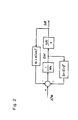
- Fig. 2 is showing a block diagram with linear approximation of drift motion of a generator representing a one-machine infinite system as described, for instance, in Bulletin of Electric Cooperative Researches, Vol. 34, No. 5.
- Fig. 2 is showing a block diagram with linear approximation of drift motion of a generator representing a one-machine infinite system as described, for instance, in Bulletin of Electric Cooperative Researches, Vol. 34, No. 5.
- K 1 means a synchronizing torque factor to be generated by a generator with constant field crossing fluxes
- K l ' means the synchronizing torque factor to be generated by the AVR
- K" means the synchronizing torque factor to be generated by the PSS 2
- D means a braking torque factor to be generated by the generator with constant field crossing fluxes
- D' means a braking torque factor to be generated by the AVR 6
- D" means a braking torque factor to be generated by the PSS 2.
- D' tends to take a negative value in cases where the phase angle 8 increases at the power factor being near to 1.0.
- the value of D+ D' becomes negative sometimes, resulting in failure of static stability due to insufficient braking power.
- the PSS 2 is added to generate the braking power D" for the stabilization required.
- Fig. 3 where the synchronizing torque and the braking torque are taken as the abscissa and the ordinate respectively.
- Both the synchronizing torque and the braking torque of a synchronous generator with constant field crossing fluxes are positive, and the sum of the torques (shown as K 1 +D) is found in the first quadrant, while the braking torque to be generated by the AVR 6 being negative, the sum of the braking torque and the synchronizing torque (shown as K 1 ' + D') is found in the forth quadrant and the sum of the torques generated by the AVR 6 and the generator with constant field crossing fluxes (shown as K 1 +K 1 '+D+D' )takes a value of approximately equal to zero or sometimes a negative value, resulting in failure of the static stabilization.
- This invention has an object to solve the problems described above and to provide a power system stabilizing apparatus for synchronous generator, which is provided with two PSSs, the characteristics of one PSS being preset so as to increase the braking power while the characteristics of the other PSS being preset to increase the synchronizing power and their phase compensation elements (time constants) can be varied in accordance with the drift amount, so that the synchronizing power in the transcient domain is increased sufficiently for improving the transcient stability while the braking power in the static domain is increased sufficiently for increasing the static stability.
- Fig. 4 shows a block diagram of the apparatus of the preset invention, wherein deviation of the terminal voltage of a synchronous generator (not shown) from its reference value is supplied to the input terminal 1 and added in the adder circuit 5 the outputs of the PSSs 2 and 8 and subtracted the output of the damping circuit 4.
- the output of the adder circuit 5 is given to the AVR 6, while an output required for making the terminal voltage of the synchronous generator reference value is given to an exciter 7, which supplies the corresponding exciting current to field windings of the synchronous generator.
- Both PSSs 2 and 8 are provided with filter circuits 2a and 8a, amplification and phase compensation circuits 2b and 8b and limiter circuits 2c and 8c respectively.
- the drift amount of the synchronous generator is given to input terminals 3 and 11 and outputs of the limiter 2c and 8c are inputted to the adder circuit 5, as described before.
- the PSS 2 is preset to have characteristics as shown in Fig. 3, that is, effectiveness for increasing the braking power.
- the PSS 8 has a preset characteristic for increasing the synchronizing power, namely, there being no difference of construction between the filter circuits 2a, 8a and the limiter circuits 2c, 8c, while the amplification and phase compensation circuit 8b having the transfer function; where C 2 is a constant, T 21 and T 22 are a delay time constant and an. advance time constant respectively. which is different from that of another amplification and phase compensation circuit 2b.
- the phase compensation elements (time constants) of these amplification and phase compensation circuits 2b and 8b can be varied and adjusted according to output of the drift amount judging circuit 9, as described later.
- the PSS 2 gives a sum of a braking torque for cancelling the braking torque generated by the AVR 6 and a synchronizing torque for increasing further the existing synchronizing power (shown as K 1 "+D"), resulting in the total sum of synchronizing torques (K 1 +K 1 '+K 1 "+D+D'+D") greater than K 1 +K 1 '+D+D'.
- the input terminal 11 of the first PSS 8 receives the revolution deviation of the.generator or the frequency deviation of the terminal voltage as drift amount of the synchronous generator, while the input terminal 3 of the second PSS 2 receives the output deviation of the synchronous generator.
- the drift amount judging circuit 9 judges whether the drift amount of the synchronous generator, i.e. the .revolution deviation of the generator, the frequency deviation of the terminal voltage or the output deviation of the generator exceeds a predetermined threshold value or not by using them as the input signals.
- the phase compensation elements (time constants) of amplification and phase compensation circuits 2b, 8b are so varied respectively for the phase compensation of the first PSS 8 to advance while the phase compensation of the second PSS 2 to delay.
- the phase compensation of the first PSS 8 is delayed while the phase of the second PSS 2 is advanced.
- the K I " value of the first PSS 8 increases according to the former's phase compensation, improving the synchronousstability in the transcient domain.
- the latter's phase compensation makes D" of the second PSS 8 increase, improving the stability in the static domain.
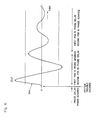
- Fig. 6 shows the relation between change of the revolution deviation ⁇ and phase advance and delay control of the both PSSs 2 and 8 in cases of a trouble in the system connected with the generator.
- the chain lines in Fig. 6 are showing the threshold values.
- the apparatus of this invention acts as follows; it is supposed that the revolution of deviation the generator is inputted to the input terminal 10 of the drift amount judging circuit 9 and the input terminal 11 of the first PSS 8.
- the revolution deviation ⁇ of the generator varies as shown in Fig. 6.
- the revolution deviation ⁇ of the generator takes the value of nearly zero in normal running conditions, where the phase compensation of the second PSS 2 is advanced to increase the braking power while the phase compensation of the first PSS 8 is delayed to increase the synchronizing power.
- the ⁇ change, as shown in Fig. 6, in system troubles is detected by the drift amount judging circuit 9 so that at the same time with the trouble occurrence, the phase compensation of the second PSS 2 is delayed while that of the first PSS 8 is advanced. This situation continues until the peak value of ⁇ exceeds a predetermined level and then each phase compensation is returned to the original value respectively.
- the above embodiment utilizes the switchover in two steps of each phase compensation element according to the revolution deviation, finer switchover in n steps gives the same effect, as described above.
- the number of revolution of the generator, the frequency of the terminal voltage, and the output of the generator itself can be inputted as the input signals to the first and second PSS 8 and 2, whereby the deviation signals are gained in each PSS 8 and 2.
Landscapes
- Engineering & Computer Science (AREA)
- Power Engineering (AREA)
- Control Of Eletrric Generators (AREA)
- Supply And Distribution Of Alternating Current (AREA)
Applications Claiming Priority (2)
| Application Number | Priority Date | Filing Date | Title |
|---|---|---|---|
| JP121917/85 | 1985-06-05 | ||
| JP60121917A JPS61280714A (ja) | 1985-06-05 | 1985-06-05 | 電力系統安定化装置 |
Publications (3)
| Publication Number | Publication Date |
|---|---|
| EP0206578A2 true EP0206578A2 (de) | 1986-12-30 |
| EP0206578A3 EP0206578A3 (en) | 1987-09-30 |
| EP0206578B1 EP0206578B1 (de) | 1991-02-27 |
Family
ID=14823108
Family Applications (1)
| Application Number | Title | Priority Date | Filing Date |
|---|---|---|---|
| EP86304233A Expired EP0206578B1 (de) | 1985-06-05 | 1986-06-04 | Gerät zur Stabilisierung eines Leistungssystems |
Country Status (4)
| Country | Link |
|---|---|
| US (1) | US4733156A (de) |
| EP (1) | EP0206578B1 (de) |
| JP (1) | JPS61280714A (de) |
| DE (1) | DE3677642D1 (de) |
Cited By (2)
| Publication number | Priority date | Publication date | Assignee | Title |
|---|---|---|---|---|
| EP0308621A3 (en) * | 1987-09-19 | 1989-10-18 | Mitsubishi Denki Kabushiki Kaisha | Power system stabilizer |
| EP0713287A1 (de) * | 1994-11-15 | 1996-05-22 | Kabushiki Kaisha Toshiba | Leistungssystemstabilisierung für einen Generator |
Families Citing this family (11)
| Publication number | Priority date | Publication date | Assignee | Title |
|---|---|---|---|---|
| US4999564A (en) * | 1989-10-12 | 1991-03-12 | General Electric Company | Power system stabilizer system having improved integrity checking scheme |
| US5440222A (en) * | 1991-07-15 | 1995-08-08 | Mitsubishi Denki Kabushiki Kaisha | Excitation control apparatus for synchronous machine |
| US5703791A (en) * | 1994-02-17 | 1997-12-30 | Hitachi, Ltd. | Electric power system stabilization control apparatus and method thereof |
| JP2846261B2 (ja) * | 1994-11-30 | 1999-01-13 | 三菱電機株式会社 | 電力系統安定化装置 |
| GB9610265D0 (en) * | 1996-05-16 | 1996-07-24 | Univ Manchester | Generator transfer function regulator |
| US5818208A (en) * | 1996-12-19 | 1998-10-06 | Abb Power T&D Company Inc. | Flicker controllers using voltage source converters |
| JP3435066B2 (ja) * | 1998-07-31 | 2003-08-11 | 三菱電機株式会社 | 電力系統安定化装置及び電力系統安定化方法 |
| US6819087B2 (en) * | 2002-12-27 | 2004-11-16 | General Electric Company | Distributed resource (DR) stabilization control for microgrid applications |
| US7904346B2 (en) * | 2002-12-31 | 2011-03-08 | Ebay Inc. | Method and system to adjust a seller fixed price offer |
| US7345456B2 (en) * | 2005-01-24 | 2008-03-18 | Basler Electric Company | Power system stabilizer providing excitation limiter functions |
| CN108141168B (zh) | 2015-09-11 | 2021-12-07 | 瓦锡兰芬兰有限公司 | 电力系统、控制发电机的励磁的方法和调压器、存储介质 |
Family Cites Families (8)
| Publication number | Priority date | Publication date | Assignee | Title |
|---|---|---|---|---|
| DE1238992B (de) * | 1963-11-16 | 1967-04-20 | Bbc Brown Boveri & Cie | Stabilitaetswinkel-Begrenzungsregler fuer Synchrongeneratoren |
| CH514953A (de) * | 1970-04-20 | 1971-10-31 | Bbc Brown Boveri & Cie | Anordnung an einer Synchronmaschine zur Stabilisierung von deren Polradbewegung |
| JPS5513240B2 (de) * | 1973-04-04 | 1980-04-07 | ||
| JPS5344204A (en) * | 1976-10-04 | 1978-04-20 | Kansai Paint Co Ltd | Method of producing photosensitive resin |
| JPS5574400A (en) * | 1978-11-30 | 1980-06-04 | Toshiba Corp | System stabilizer |
| JPS55160998A (en) * | 1979-06-01 | 1980-12-15 | Tokyo Electric Power Co Inc:The | Controller for synchronous machine |
| DE2945599C2 (de) * | 1979-11-12 | 1985-07-11 | Siemens AG, 1000 Berlin und 8000 München | Einrichtung zur Pendelungsdämpfung von geregelten elektrischen Maschinen |
| DE3026360C2 (de) * | 1980-07-11 | 1985-01-17 | Siemens AG, 1000 Berlin und 8000 München | Schaltungsanordnung zur Bedämpfung von Leistungspendelungen von Synchrongeneratoren in Netzen |
-
1985
- 1985-06-05 JP JP60121917A patent/JPS61280714A/ja active Granted
-
1986
- 1986-06-03 US US06/870,011 patent/US4733156A/en not_active Expired - Lifetime
- 1986-06-04 EP EP86304233A patent/EP0206578B1/de not_active Expired
- 1986-06-04 DE DE8686304233T patent/DE3677642D1/de not_active Expired - Lifetime
Cited By (3)
| Publication number | Priority date | Publication date | Assignee | Title |
|---|---|---|---|---|
| EP0308621A3 (en) * | 1987-09-19 | 1989-10-18 | Mitsubishi Denki Kabushiki Kaisha | Power system stabilizer |
| EP0713287A1 (de) * | 1994-11-15 | 1996-05-22 | Kabushiki Kaisha Toshiba | Leistungssystemstabilisierung für einen Generator |
| US5698968A (en) * | 1994-11-15 | 1997-12-16 | Kabushiki Kaisha Toshiba | Power system stabilizer for generator |
Also Published As
| Publication number | Publication date |
|---|---|
| EP0206578B1 (de) | 1991-02-27 |
| EP0206578A3 (en) | 1987-09-30 |
| DE3677642D1 (de) | 1991-04-04 |
| JPH0350492B2 (de) | 1991-08-01 |
| JPS61280714A (ja) | 1986-12-11 |
| US4733156A (en) | 1988-03-22 |
Similar Documents
| Publication | Publication Date | Title |
|---|---|---|
| US4733156A (en) | Power system stabilizing apparatus | |
| EP0308621B1 (de) | Anordnung zur Stabilisierung eines Leistungssystems | |
| US4037144A (en) | Control device for use in shunt motor | |
| EP0688095B1 (de) | Generator-Motor-Vorrichtung mit variabler Geschwindigkeit, geeignet zur Genauigkeitsverbesserung eines Stromversorgungssystems | |
| US4767976A (en) | Control system for PWM inverter | |
| EP0570976B1 (de) | Elektrisches Energieversorgungssystem | |
| EP0456521B1 (de) | Vorrichtung zur Regelung eines Leistungssystems | |
| US5256944A (en) | Motor speed control method and apparatus with drooping compensation independent of acceleration or deceleration current and time constant of motor | |
| US4859924A (en) | Inverter | |
| US3477014A (en) | Electrical control systems with stabilizing control means | |
| US4713741A (en) | Excitation control apparatus for rotary electric machine | |
| JPH01129800A (ja) | 同期機の励磁制御装置 | |
| EP0682405B1 (de) | Vorrichtung zur Regelung eines Aufzugmotors | |
| JPS6057320B2 (ja) | 系統安定化装置 | |
| JP2540202B2 (ja) | 発電機の多変数制御システムにおける補正制御方式 | |
| JPH0681557B2 (ja) | 同期機励磁制御装置 | |
| EP0271777A2 (de) | Spannungsschutzschalter für eine Kraftanlage mit variabler Frequenz | |
| JPS6226279B2 (de) | ||
| JPH01186185A (ja) | 駆動電動機の速度制御装置 | |
| JPS59122312A (ja) | 静止形保護継電器 | |
| JPH0345995B2 (de) | ||
| US4996519A (en) | Method and apparatus for monitoring an amplifier | |
| JPS6160675B2 (de) | ||
| JPH0343878B2 (de) | ||
| JP3092858B2 (ja) | 系統安定化システム |
Legal Events
| Date | Code | Title | Description |
|---|---|---|---|
| PUAI | Public reference made under article 153(3) epc to a published international application that has entered the european phase |
Free format text: ORIGINAL CODE: 0009012 |
|
| AK | Designated contracting states |
Kind code of ref document: A2 Designated state(s): CH DE GB LI |
|
| PUAL | Search report despatched |
Free format text: ORIGINAL CODE: 0009013 |
|
| AK | Designated contracting states |
Kind code of ref document: A3 Designated state(s): CH DE GB LI |
|
| 17P | Request for examination filed |
Effective date: 19871112 |
|
| 17Q | First examination report despatched |
Effective date: 19891208 |
|
| GRAA | (expected) grant |
Free format text: ORIGINAL CODE: 0009210 |
|
| AK | Designated contracting states |
Kind code of ref document: B1 Designated state(s): CH DE GB LI |
|
| REF | Corresponds to: |
Ref document number: 3677642 Country of ref document: DE Date of ref document: 19910404 |
|
| PLBE | No opposition filed within time limit |
Free format text: ORIGINAL CODE: 0009261 |
|
| STAA | Information on the status of an ep patent application or granted ep patent |
Free format text: STATUS: NO OPPOSITION FILED WITHIN TIME LIMIT |
|
| 26N | No opposition filed | ||
| PGFP | Annual fee paid to national office [announced via postgrant information from national office to epo] |
Ref country code: GB Payment date: 19920505 Year of fee payment: 7 |
|
| PG25 | Lapsed in a contracting state [announced via postgrant information from national office to epo] |
Ref country code: GB Effective date: 19930604 |
|
| GBPC | Gb: european patent ceased through non-payment of renewal fee |
Effective date: 19930604 |
|
| PGFP | Annual fee paid to national office [announced via postgrant information from national office to epo] |
Ref country code: DE Payment date: 20010528 Year of fee payment: 16 |
|
| PGFP | Annual fee paid to national office [announced via postgrant information from national office to epo] |
Ref country code: CH Payment date: 20010529 Year of fee payment: 16 |
|
| PG25 | Lapsed in a contracting state [announced via postgrant information from national office to epo] |
Ref country code: LI Free format text: LAPSE BECAUSE OF NON-PAYMENT OF DUE FEES Effective date: 20020630 Ref country code: CH Free format text: LAPSE BECAUSE OF NON-PAYMENT OF DUE FEES Effective date: 20020630 |
|
| PG25 | Lapsed in a contracting state [announced via postgrant information from national office to epo] |
Ref country code: DE Free format text: LAPSE BECAUSE OF NON-PAYMENT OF DUE FEES Effective date: 20030101 |
|
| REG | Reference to a national code |
Ref country code: CH Ref legal event code: PL |