EP0206514B1 - Doppeltiegel zum Ziehen von Einkristallen - Google Patents
Doppeltiegel zum Ziehen von Einkristallen Download PDFInfo
- Publication number
- EP0206514B1 EP0206514B1 EP19860303816 EP86303816A EP0206514B1 EP 0206514 B1 EP0206514 B1 EP 0206514B1 EP 19860303816 EP19860303816 EP 19860303816 EP 86303816 A EP86303816 A EP 86303816A EP 0206514 B1 EP0206514 B1 EP 0206514B1
- Authority
- EP
- European Patent Office
- Prior art keywords
- crucible
- inner crucible
- melt
- boron nitride
- sinkers
- Prior art date
- Legal status (The legal status is an assumption and is not a legal conclusion. Google has not performed a legal analysis and makes no representation as to the accuracy of the status listed.)
- Expired
Links
Images


Classifications
-
- C—CHEMISTRY; METALLURGY
- C30—CRYSTAL GROWTH
- C30B—SINGLE-CRYSTAL GROWTH; UNIDIRECTIONAL SOLIDIFICATION OF EUTECTIC MATERIAL OR UNIDIRECTIONAL DEMIXING OF EUTECTOID MATERIAL; REFINING BY ZONE-MELTING OF MATERIAL; PRODUCTION OF A HOMOGENEOUS POLYCRYSTALLINE MATERIAL WITH DEFINED STRUCTURE; SINGLE CRYSTALS OR HOMOGENEOUS POLYCRYSTALLINE MATERIAL WITH DEFINED STRUCTURE; AFTER-TREATMENT OF SINGLE CRYSTALS OR A HOMOGENEOUS POLYCRYSTALLINE MATERIAL WITH DEFINED STRUCTURE; APPARATUS THEREFOR
- C30B15/00—Single-crystal growth by pulling from a melt, e.g. Czochralski method
- C30B15/10—Crucibles or containers for supporting the melt
- C30B15/12—Double crucible methods
Definitions
- the present invention relates to a double crucible useful for carrying out crystal growth. More particularly, the present invention pertains to a double crucible used for producing high quality single crystals having a uniform concentration of an impurity doped therein, throughout the whole length of the crystal produced, according to Czochralski method.
- single crystals of various kind of semiconductors have been used for realizing different semiconductor elements or devices.
- qualities of semiconductors are significantly influenced by the crystalline structure thereof, that is they may be determined by the crystalline structure.
- Czochralski method hereunder, referred to as CZ method, for simplicity
- CZ method for simplicity
- This CZ method generally comprises melting a starting material for growing single crystal in an inert gas (for instance, Ar) atmosphere of zero to 10' Pa (zero to 100 atms), immersing a seed crystal in molten starting material (melt) around its surface region and then pulling the seed crystal while growing and depositing single crystal around the seed crystal.
- an inert gas for instance, Ar
- the CZ method has widely been utilized conventionally, when single crystals of semiconductors such as silicon (Si), germanium (Ge) or the like, which have a relatively low dissociation pressure at the crystal growth temperature, are produced.
- melt of a starting material for single crystal is directly in contact with a crucible containing the same.
- This causes impurity contamination of the resulting single crystal, which is originated from material of the crucible.
- the material for the crucible should carefully be selected so as not to cause contamination of melt contained therein or it is required to provide with any means for preventing such contamination or for removing impurities from the melt or the growing crystal.
- the multiple ingot producing method comprises a plurality of crystal growing steps and is characterized in that each crystal growing step is stopped at an instant when a desired impurity concentration is attained in the growing single crystal and then the growth operation is repeated after making up ingredient and impurity to a crucible and adjusting the impurity concentration in the crucible to a desired level.
- the size of the single crystal ingot obtained according to the method is largely restricted and relatively small.
- the dopant evaporation method is characterized in that the adjustment of the impurity concentration is performed by adjusting the degree of evaporation of impurity by lowering the inner pressure of a pulling furnace used.
- the dopant evaporation method is effective only if it is applied to a method in which an impurity (or dopant) having a high evaporation velocity is used and thus the use of the method is substantially restricted and is not applied to cases where impurities having a relatively low evaporation velocity are used.
- double crucible method is an improved CZ or LEC method in which a double crucible consisting of an outer crucible and an inner crucible having a-hole communicating the inner space and outer space thereof, at the bottom portion, is used during the single crystal pulling procedures.
- the inner crucible of the double crucible is suspended in the melt contained in the outer crucible at the vicinity of the single crystal-melt or melt-liquid encapsulant interface due to the balance between gravitational force (or weight of the inner crucible) and buoyancy acting on the inner crucible.
- the melt of starting materials in the outer crucible exclusively flows into the inner crucible through the communicating hole formed at the bottom or the lower portion of the side wall in accordance with the degree of solidification or as the grown crystal is pulled up.
- the concentration of impurity in the inner crucible is maintained at a desired constant value irrespective of the degree of solidification (or amount of the crystal grown).
- the melt of the starting material may be covered with a liquid encapsulant so that the component of the melt would not escape from the crucible due to dissociation and/or evaporation.
- the distribution of the impurity concentration along the length of the crystal produced may be controlled according to the mechanism discussed above in the double crucible technique. According to this method, there is no restriction such as encountered in the two methods explained above and further single crystals having uniform distribution of impurity may possibly be obtained. In this method, the convection of melt is also restricted in some degree due to the presence of the inner crucible, which is deemed to be preferred to obtain single crystals having a uniform quality.
- the inner crucible simply floats in the vicinity of the melt-liquid encapsulant interface and therefore, the inner crucible is rather unstable and strongly influenced by any external forces such as mechanical vibrations, which cause the fluctuation of the single crystal- melt interface, the destruction of the thermal stability of the interface (uniform temperature distribution around the interface) and the modulation of the melt convection. Such phenomenon causes, in turn, the formation of polycrystals.
- the vibration (or upward and downward movement) of th'e inner crucible entrains the movement of the inner crucible such as vibration, thereby the melt flows in or out the inner crucible through a communicating hole thereof depending on the behavior of the inner crucible. This makes it impossible to maintain a constant concentration of melt, more precisely a uniform impurity concentration, in the inner crucible.
- the double crucible method is effective to obtain a single crystal having a uniform impurity distribution compared with the multiple ingot producing technique and the dopant evaporation method and it has widely been utilized in this field.
- the double. crucible method also has different disadvantages to be overcome, due to the inherent reason concerning the double crucible structure, since the inner crucible is in the floating state during the crystal growth operations. It is quite significant to eliminate the above mentioned difficulties encountered in practicing the double crucible method, thereby providing a method for growing high quality single crystals of uniform dopant or impurity distribution throughout the whole length thereof and, in turn, improving qualities of the semiconductor devices formed using such single crystal and assuring their high reliability.
- a principal object of the present invention resides in improving the double crucible method among others, which may possibly permit the production of single crystals of quite uniform impurity distribution;
- the purpose of the invention resides in improving double crucible itself, in particular, the construction of inner crucible used therein, which is inherently unstable against the action of external forces and stabilizing the double crucible.
- Another purpose of this invention is to provide a method for producing single crystals in a pull furnace in which the double crucible improved according to the present invention is utilized.
- a further object of the present invention is to provide single crystals having an excellent quality such as highly uniform dopant distribution utilizing the improved double crucible.
- the above mentioned and other purposes of the present invention can be accomplished by providing a method for growing single crystals according to the double crucible method using an apparatus comprising an inner crucible (30,40) and an outer crucible (3) said inner crucible (30, 40) having at least one communicating hole (34) at the lower portion thereof, characterized in that the area S 1 of the cross section of the inner crucible wall at the melt of starting material-single crystal interface is enlarged and determined so that the following requirement is satisfied: wherein p M is the density of the melt of the starting material and PB is the density of a liquid encapsulant eventually used, and that the cross sectional area S 2 of the internal space of the outer crucible (3) at the melt-single crystal interface is determined so as to fulfil the following requirement:
- the double crucible employed in the method of the present invention will now be described in more detail with reference to the following attached drawings: wherein
- the double crucible method is considered to be one of the most, preferred methods for growing crystals and according to this method, the formation of single crystals having a uniform dopant distribution may be expected.
- the dopant concentration in the inner crucible or the dopant distribution in crystals obtained according to CZ method substantially varies along the crystal length due to the segregation phenomenon (Curve A), while it is found that the dopant distribution in crystals obtained according to the double crucible method is almost uniform throughout the whole length of the crystal grown except for the extremity produced at the end of the growth operation (see Curve B of Fig. 1).
- Fig. 2 shows an example of a conventional double crucible applied to LEC method.
- the double crucible is, in this example, composed of an outer crucible 3 containing melt 1 of starting material for crystal growth and a liquid encapsulant 2 therein and an inner crucible 4 disposed in the outer crucible 3.
- the inner crucible 4 floats around the interface between the liquid encapsulant 2 and the melt 1 of starting material due to the balance between the weight of the inner crucible (or gravitational force) and the buoyancy originated in the liquid encapsulant 2 and the melt 1 and thus the internal volume of the inner crucible is surely maintained at a constant value.
- the conventional double crucible as shown in Fig. 2 has many problems to be solved, in particular, those resulting from the fact that the inner crucible is in the float state and unstable. This causes various kinds of disadvantages such as those already mentioned above.
- the inventors have deeply required into and studied on the construction of the conventionally double crucible and found that the disadvantages encountered in the conventional double crucible are mainly caused due to the small sectional area of the inner crucible at the interface of the melt.
- the crucible is greatly affected by the action of an external force such as mechanical vibration and thereby disadvantages such as turbulence of the melt surface, distribution of dopant concentration in single crystals produced and the formation of polycrystals.
- the inventors have, thus, found that these problems can surely be overcome by careful selection of materials for the crucible and by increasing the cross sectional area at the melt-liquid encapsulant or melt-growing crystal interface.
- the weight (W) of the inner crucible 4 is represented by the following equation: wherein Pc means the density of the material for the crucible.
- the stability of the inner crucible may generally be estimated based on the strength of restoring force acting on the inner crucible just when the melt depth m in the inner crucible is intentionally changed by a constant value from its equilibrium depth. That is, the strength of the restoring force (the magnitude of the buoyancy) serving to recover the equilibrium state defined by the above relation (3), when the melt depth is changed by dm from the equilibrium state, is expressed by the following equation: Moreover, the equation (4) can further be simplified as follows: since the sectional area of the wall of the inner crucible at the melt-liquid encapsulant interface (S,) is equal to n(Df-Db)/4.
- the term (p M -p B ) is constant, if once the starting material and the kind of the liquid encapsulant are specified. Therefore, the equation (5) teaches the fact that the more the sectional area S, is large, the more the strength of the term dFv/dm becomes high as well as the more the stability of the inner crucible becomes high.
- the occurrence of vibrations due to, for example, the action of an accidental external force can effectively be prevented or even if the vibration is caused, the amplitude of the vibration caused by the action of such external force can easily be restricted to a minimum value and furthermore, the relaxation time of the vibration can remarkably be reduced by increasing the cross sectional area of the inner crucible according to the present invention.
- the area S, of the cross section of the inner crucible wall must be more than 24.33 cm 2 , since the densities of GaAs and B 2 0 3 are 5.71 g/cm 3 and 1.60 g/cm 3 respectively, according to the condition (a).
- the cross sectional area S 2 of the outer crucible should be selected so that the condition (b): S I /S 2 >1/100 would always be satisfied.
- sectional areas 5, and S 2 may easily be calculated on the basis of the physical properties of the starting materials and liquid encapsulant interested or selected and thus a desired double crucible can easily be designed.
- the double crucible according to the present invention permits the reduction of deviation from the equilibrium state even if the inner crucible is affected by an external force and causes, for instance, vibration and the reduction of the relaxation time of the vibration (or time needed for restoring the equilibrium state).
- the double crucible of the present invention further makes it possible to solve the problems such as the formation of polycrystals due to the vibration of fluctuation or the interface and the variation of the dopant concentration in the inner crucible and thus uniform and high quality single crystals of semiconductors can be provided according to a single crystal manufacturing process utilizing the double crucible of the present invention.
- Figs. 3a, 3b and 4a to 4d Two different and preferred examples of the double crucibles according to the present invention are illustratively shown in Figs. 3a, 3b and 4a to 4d in which, for simplicity of the explanation, only the inner crucible or a part thereof is shown.
- the inner crucible 30 is comprised of a body 31 of crucible having thick wall, sinkers 32 embedded within the body 31 and a coating film 33 which covers the whole surface of the body 31.
- the inner crucible 30 has at least one communicating hole 34 at the bottom portion of the body 31 (in this embodiment, there are two such holes), which permits the passage of the melt of starting material and dopants (impurities) contained in the outer crucible (not shown), these being preferentially flowing into the inner crucible corresponding to the degree of consumption of them contained therein.
- the inner surface of the communicating hole 34 is also covered with the coating film 33.
- the sinker 32 may also be disposed on the side wall of the body 31 or at the bottom thereof (see the dotted line in Fig. 3b). In such cases, the sinkers 32 should symmetrically be arranged in line with the central axis so that the center of gravity of the body of crucible and that of the sinkers may coincide with each other.
- the number of sinkers used is not limited to a certain number and the sinkers of any shape may also be used in the present invention. While, if the sinker is disposed on the side wall of the body, it is preferred to use at least 2 sinkers to maintain the inner crucible in the horizontal state and its length along the horizontal direction may preferably be long enough to assure the horizontal position of the crucible. When the sinker is disposed on the bottom of the body, only a single sinker may, however, be used. Moreover, the sinkers 32 may be placed on not only the side wall but the bottom of the body 31 as shown in Fig. 3b by dotted line.
- Examples of the preferred material for producing the double crucible according to the present invention include materials which may be processed without any difficulty and have a low density as well as which are stable around the temperature of the melt of the starting material.
- a material for double crucible as carbon, aluminium nitride (AIN), boron nitride (BN), silicon nitride (SiN) as the typical examples therefor.
- AIN aluminium nitride
- BN boron nitride
- SiN silicon nitride
- Mo molybdenum
- tungsten (W), tantalum (Ta), lead (Pb) gallium (Ga), indium (In) may also be utilized as the material for the sinker.
- the coating film material there may be mentioned such as known materials for conventional crucible, for instance, PBN, AIN, BN, quartz, which does not have a tendency to contaminate the melt of the starting material.
- These coating films may be deposited on the surface of the body and the inner surface of the communicating hole, by a conventional technique for forming thin films such as chemical vapour deposition method (CVD method). The thickness thereof is not critical and generally in the order of approximately 100 11m which is sufficient to achieve a desired effect.
- FIG. 4a Another preferred embodiment of the double crucible according to the present invention is illustrated in Fig. 4a.
- This embodiment is composed of, as in the case shown in Figs. 3a and 3b, a body of the inner crucible 40, floaters 41 disposed on the side wall of the body at the interface of the melt of the starting material for growing single crystal, sinkers 42 placed on the floaters 41, coating films 44 and 45 which cover the surface of the floater 41 (eventually the surface of the sinker 42) and the inner surface of the communicating hole 45 formed at the bottom of the body 40.
- the assembly of the floater 41 and the body 40 of the inner crucible may be performed, for example, by utilizing a screw bolt 46 (made from, for instance, PBN or BN) which has no tendency to contaminate the melt and is stable at the temperature of the melt.
- a screw bolt 46 made from, for instance, PBN or BN
- the sinker 42 does not, in general, contact with the melt of the starting material and therefore, there is no problem of the contamination of the melt due to the sinker and therefore, the sinker must not always be covered with coating film 44.
- the material for each element of the double crucible there may be mentioned such as conventional materials used for manufacturing crucible (this is because, in this embodiment, the side wall must not be thick) as the material for the body 40 and the preferred material for coating film 44 is PBN which does not cause contamination of the melt; the preferred material for floater 41 is BN, carbon, SiN, AIN having a low density so as to increase the cross sectional area thereof.
- the communicating hole 43 may be covered with a film 45 of quartz, PBN, BN causing only a small frictional force against the melt of the starting material or it may also be formed by the combination of a bolt 47 and a nut 48 of BN, PBN as shown in Fig. 4e.
- the sinker 42 may also be disposed at the lower part of the floater 41 (see Fig. 4b), at the bottom of the body 40 (see Fig. 4d), or on the side wall of the body 40 (see Fig. 4c) and these embodiments also falls within this invention.
- the sinker 42 may also be possible to embed the sinker 42 within the floater 41 or within the body 40 of the inner crucible. In these cases, the sinker must be covered with, for instance, PBN or the like if the sinker directly contacts with the melt and causes contamination thereof.
- Desired number of the sinkers should be arranged symmetrically along the central axis of the crucible so that the center of gravity of the body or the whole body inclusive of floaters coincides with that of the sinkers 42.
- the identical attention must be paid in arranging the floaters 41 around the side wall of the inner crucible.
- the double crucible according to the present invention has an extremely high stability because of its large cross sectional area which permits the reduction of the magnitude of the motion such as the vibration caused by external forces. Therefore, a lot of disadvantages encountered in the conventional double crucible method, which, in particular, permits the production of single crystals having a uniform impurity distribution, can almost be eliminated without any difficulties and the use of such double crucible enables the double crucible method to exhibit its inherent characteristics mentioned above. That is to say, the double crucible of the present invention makes it possible to produce high quality single crystals of semiconductors having a uniform impurity concentration throughout the whole length of the crystals grown, in an improved high yield. This, in turn, makes it possible to remarkably improve the yield of wafers per ingot obtained in the above method employing the new double crucible and significantly reduce the cost for manufacturing single crystals.
- the double crucible according to the present invention may be used in different kinds of pulling furnace and applied effectively to CZ method, LEC method depending on the nature and the kind of starting materials and/or single crystals to be grown.
- the double crucible according to the present invention permits the growth of single crystals such as Si, Ge which may optionally be doped with a various kinds of dopant (or impurity) as well as the single crystals of III-V or II-VI compound semiconductors optionally doped with impurity and surely provides single crystal products having an excellent quality, in an improved high yield or productivity.
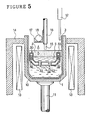
- Fig. 5 shows an apparatus for growing single crystal according to LEC method, in which the double crucible of the present invention is incorporated therein.
- GaAs single crystal containing In as impurity was produced.
- the double crucible used herein is provided with an inner crucible 30 as shown in Fig. 3a, which is constituted by a carbon body 31, sinkers 32 of Mo embedded in the body 31 and film 33 covering the surface of the body and the inner surface of the communicating hole 34, the film being composed of PBN deposited according to CVD technique.
- the size of the inner crucible is equal to 148 mm (outer diameter: D 1 )x110 mm (inner diameter: D 2 ), with the net depth H of 40 mm.
- a crucible of PBN having the inner diameter of 150 mm is used, which is supported by a lower shaft 11 through a susceptor 10.
- a susceptor 10 To the outer crucible 3, about 4 Kg of GaAs starting material and 12 g of In were charged and then the inner crucible 30 was disposed on the charged materials while supporting the crucible with a movable tool 12 and further 800 g of liquid encapsulant 2 (B 2 0 3 ) was charged thereon.
- the upper shaft 16 is provided with a tool 17 on which about 48 g InAs 18 is disposed.
- the melt of InAs 18 was dropped in the inner crucible 30 and thus In was introduced therein.
- the In concentration of the melt in the outer crucible 3 was set at 0.3%, while that of the melt in the inner crucible 30 was set at 3.0%.
- the segregation coefficient of In with respect to GaAs is equal to 0.1, while the In concentration in the inner melt 5 contained in the crucible 30 is maintained at a desired constant value because the melt in the outer crucible 3 preferentially flows into the inner crucible 30 through the communicating hole 34 is proportional to the degree of crystal growth (or degree of solidification).
- GaAs single crystal was also produced according to the conventional LEC method under the same conditions as mentioned before, except that a conventional double crucible was used.
- a conventional double crucible was used.
- the resulting single crystal ingot only 1 Kg thereof at the front part had the dislocation density of the order of 0. to 1,000/cm 2 .
- the single crystal obtained according to the double crucible of this invention is highly pure and a semi-insulating crystal having the electric resistivity of at least-107 ⁇ ⁇ cm.
- the double crucible according to the present invention has been explained in detail, in connection with the preferred and non-limitative embodiments, it is not intended to restrict the scope of the invention to the particular form as set forth above, on the contrary, it is intended to cover various kinds of alternatives, modifications and equivalents as may be included within the invention as defined by the appended claims.
- modification there may be mentioned such as the double crucible in which the side wall of the inner crucible is thick and floaters are also disposed, realized by combining the embodiments shown in Figs. 3 and 4 as well as a double crucible which may float around the melt-liquid encapsulant interface, while eliminating the use of the sinkers by careful selection of the material for producing floaters.
Landscapes
- Chemical & Material Sciences (AREA)
- Engineering & Computer Science (AREA)
- Crystallography & Structural Chemistry (AREA)
- Materials Engineering (AREA)
- Metallurgy (AREA)
- Organic Chemistry (AREA)
- Liquid Deposition Of Substances Of Which Semiconductor Devices Are Composed (AREA)
- Crystals, And After-Treatments Of Crystals (AREA)
Claims (13)

und daß der Querschnittsbereich 52 des Innenraums des äußeren Tiegels (3) an der Grenzschicht zwischen Schmelze und Einkristall so festgelegt ist, daß die folgende Beziehung erfüllt ist:

Applications Claiming Priority (2)
| Application Number | Priority Date | Filing Date | Title |
|---|---|---|---|
| JP10878885A JPS61266389A (ja) | 1985-05-21 | 1985-05-21 | 結晶内不純物均一化用二重るつぼ |
| JP108788/85 | 1985-05-21 |
Publications (2)
| Publication Number | Publication Date |
|---|---|
| EP0206514A1 EP0206514A1 (de) | 1986-12-30 |
| EP0206514B1 true EP0206514B1 (de) | 1990-01-10 |
Family
ID=14493493
Family Applications (1)
| Application Number | Title | Priority Date | Filing Date |
|---|---|---|---|
| EP19860303816 Expired EP0206514B1 (de) | 1985-05-21 | 1986-05-20 | Doppeltiegel zum Ziehen von Einkristallen |
Country Status (4)
| Country | Link |
|---|---|
| EP (1) | EP0206514B1 (de) |
| JP (1) | JPS61266389A (de) |
| CA (1) | CA1272106A (de) |
| DE (1) | DE3668194D1 (de) |
Families Citing this family (4)
| Publication number | Priority date | Publication date | Assignee | Title |
|---|---|---|---|---|
| JP2709644B2 (ja) * | 1990-04-25 | 1998-02-04 | 東芝セラミックス 株式会社 | シリコン単結晶製造用石英るつぼの製造方法 |
| US5047112A (en) * | 1990-08-14 | 1991-09-10 | The United States Of America As Represented By The United States Department Of Energy | Method for preparing homogeneous single crystal ternary III-V alloys |
| IL128827A0 (en) * | 1999-03-04 | 2000-01-31 | Solmecs Israel Ltd | Apparatus for growing single crystals |
| JP5257959B2 (ja) * | 2009-04-24 | 2013-08-07 | 独立行政法人産業技術総合研究所 | 窒化アルミニウム単結晶の製造装置、窒化アルミニウム単結晶の製造方法 |
Family Cites Families (3)
| Publication number | Priority date | Publication date | Assignee | Title |
|---|---|---|---|---|
| US2944875A (en) * | 1953-07-13 | 1960-07-12 | Raytheon Co | Crystal-growing apparatus and methods |
| US3671203A (en) * | 1968-05-29 | 1972-06-20 | Hughes Aircraft Co | Method and apparatus for czochralski growth of large crystals |
| BE794122A (fr) * | 1972-01-18 | 1973-07-16 | Philips Nv | Werkwijze voor het vervaardigen van eenkristallijne halfgeleiderlichamen en halfgeleiderinrichtingen, in het bijzonder stralingsdetectoren die dergelijke eenkristallijne halfgeleiderlichamen |
-
1985
- 1985-05-21 JP JP10878885A patent/JPS61266389A/ja active Pending
-
1986
- 1986-05-20 DE DE8686303816T patent/DE3668194D1/de not_active Expired - Lifetime
- 1986-05-20 EP EP19860303816 patent/EP0206514B1/de not_active Expired
- 1986-05-20 CA CA000509522A patent/CA1272106A/en not_active Expired
Also Published As
| Publication number | Publication date |
|---|---|
| CA1272106A (en) | 1990-07-31 |
| EP0206514A1 (de) | 1986-12-30 |
| JPS61266389A (ja) | 1986-11-26 |
| DE3668194D1 (de) | 1990-02-15 |
Similar Documents
| Publication | Publication Date | Title |
|---|---|---|
| USRE39778E1 (en) | Method of preparing group III-V compound semiconductor crystal | |
| US4911780A (en) | LEC method for growing a single crystal of compound semiconductors | |
| EP0160373B1 (de) | Einkristall einer III-V-Halbleiterverbindung mit niedriger Versetzungsdichte | |
| US4944834A (en) | Process of pulling a crystal | |
| US5021225A (en) | Crystal pulling apparatus and crystal pulling method using the same | |
| EP0162467B1 (de) | Vorrichtung zur Züchtung von Einkristallen aus zersetzbaren Verbindungen | |
| EP0392210B1 (de) | Verfahren zur Züchtung eines Einkristalls | |
| EP0153119B1 (de) | Einkristall einer III-V-Halbleiterverbindung mit kleiner Versetzungsdichte | |
| EP0206514A1 (de) | Doppeltiegel zum Ziehen von Einkristallen | |
| US5612014A (en) | Compound semiconductor crystal | |
| US5873938A (en) | Single crystal pulling apparatus | |
| JP2003286024A (ja) | 一方向凝固シリコンインゴット及びこの製造方法並びにシリコン板及び太陽電池用基板及びスパッタリング用ターゲット素材 | |
| EP0210439B1 (de) | Verfahren zur Züchtung von Einkristallen einer zersetzbaren Halbleiterverbindung | |
| JP2529934B2 (ja) | 単結晶の製造方法 | |
| US7229494B2 (en) | Production method for compound semiconductor single crystal | |
| JP2010030868A (ja) | 半導体単結晶の製造方法 | |
| JPH03237088A (ja) | 単結晶成長方法 | |
| JPH07110798B2 (ja) | 単結晶製造装置 | |
| JPH0543381A (ja) | 溶融層法用単結晶成長装置及び該装置を用いた単結晶中の酸素濃度制御方法 | |
| JPH03193689A (ja) | 化合物半導体の結晶製造方法 | |
| JP2700145B2 (ja) | 化合物半導体単結晶の製造方法 | |
| JPH0561239B2 (de) | ||
| JP3013125B2 (ja) | 引き上げ成長方法及び装置 | |
| JP3451658B2 (ja) | 混晶半導体単結晶の成長方法 | |
| JPH08104591A (ja) | 単結晶成長装置 |
Legal Events
| Date | Code | Title | Description |
|---|---|---|---|
| PUAI | Public reference made under article 153(3) epc to a published international application that has entered the european phase |
Free format text: ORIGINAL CODE: 0009012 |
|
| AK | Designated contracting states |
Kind code of ref document: A1 Designated state(s): DE FR GB |
|
| 17P | Request for examination filed |
Effective date: 19870226 |
|
| 17Q | First examination report despatched |
Effective date: 19880818 |
|
| GRAA | (expected) grant |
Free format text: ORIGINAL CODE: 0009210 |
|
| AK | Designated contracting states |
Kind code of ref document: B1 Designated state(s): DE FR GB |
|
| REF | Corresponds to: |
Ref document number: 3668194 Country of ref document: DE Date of ref document: 19900215 |
|
| ET | Fr: translation filed | ||
| PLBE | No opposition filed within time limit |
Free format text: ORIGINAL CODE: 0009261 |
|
| STAA | Information on the status of an ep patent application or granted ep patent |
Free format text: STATUS: NO OPPOSITION FILED WITHIN TIME LIMIT |
|
| 26N | No opposition filed | ||
| REG | Reference to a national code |
Ref country code: GB Ref legal event code: IF02 |
|
| PGFP | Annual fee paid to national office [announced via postgrant information from national office to epo] |
Ref country code: FR Payment date: 20020508 Year of fee payment: 17 |
|
| PGFP | Annual fee paid to national office [announced via postgrant information from national office to epo] |
Ref country code: GB Payment date: 20020515 Year of fee payment: 17 |
|
| PGFP | Annual fee paid to national office [announced via postgrant information from national office to epo] |
Ref country code: DE Payment date: 20020529 Year of fee payment: 17 |
|
| PG25 | Lapsed in a contracting state [announced via postgrant information from national office to epo] |
Ref country code: GB Free format text: LAPSE BECAUSE OF NON-PAYMENT OF DUE FEES Effective date: 20030520 |
|
| PG25 | Lapsed in a contracting state [announced via postgrant information from national office to epo] |
Ref country code: DE Free format text: LAPSE BECAUSE OF NON-PAYMENT OF DUE FEES Effective date: 20031202 |
|
| GBPC | Gb: european patent ceased through non-payment of renewal fee |
Effective date: 20030520 |
|
| PG25 | Lapsed in a contracting state [announced via postgrant information from national office to epo] |
Ref country code: FR Free format text: LAPSE BECAUSE OF NON-PAYMENT OF DUE FEES Effective date: 20040130 |
|
| REG | Reference to a national code |
Ref country code: FR Ref legal event code: ST |