EP0202752A1 - Alkylierungsverfahren - Google Patents
Alkylierungsverfahren Download PDFInfo
- Publication number
- EP0202752A1 EP0202752A1 EP86302656A EP86302656A EP0202752A1 EP 0202752 A1 EP0202752 A1 EP 0202752A1 EP 86302656 A EP86302656 A EP 86302656A EP 86302656 A EP86302656 A EP 86302656A EP 0202752 A1 EP0202752 A1 EP 0202752A1
- Authority
- EP
- European Patent Office
- Prior art keywords
- naphthalene
- zeolite
- zsm
- catalyst
- xylene
- Prior art date
- Legal status (The legal status is an assumption and is not a legal conclusion. Google has not performed a legal analysis and makes no representation as to the accuracy of the status listed.)
- Granted
Links
Images
Classifications
-
- C—CHEMISTRY; METALLURGY
- C07—ORGANIC CHEMISTRY
- C07C—ACYCLIC OR CARBOCYCLIC COMPOUNDS
- C07C6/00—Preparation of hydrocarbons from hydrocarbons containing a different number of carbon atoms by redistribution reactions
- C07C6/08—Preparation of hydrocarbons from hydrocarbons containing a different number of carbon atoms by redistribution reactions by conversion at a saturated carbon-to-carbon bond
- C07C6/12—Preparation of hydrocarbons from hydrocarbons containing a different number of carbon atoms by redistribution reactions by conversion at a saturated carbon-to-carbon bond of exclusively hydrocarbons containing a six-membered aromatic ring
- C07C6/123—Preparation of hydrocarbons from hydrocarbons containing a different number of carbon atoms by redistribution reactions by conversion at a saturated carbon-to-carbon bond of exclusively hydrocarbons containing a six-membered aromatic ring of only one hydrocarbon
-
- C—CHEMISTRY; METALLURGY
- C07—ORGANIC CHEMISTRY
- C07C—ACYCLIC OR CARBOCYCLIC COMPOUNDS
- C07C2/00—Preparation of hydrocarbons from hydrocarbons containing a smaller number of carbon atoms
- C07C2/54—Preparation of hydrocarbons from hydrocarbons containing a smaller number of carbon atoms by addition of unsaturated hydrocarbons to saturated hydrocarbons or to hydrocarbons containing a six-membered aromatic ring with no unsaturation outside the aromatic ring
- C07C2/64—Addition to a carbon atom of a six-membered aromatic ring
- C07C2/66—Catalytic processes
-
- C—CHEMISTRY; METALLURGY
- C07—ORGANIC CHEMISTRY
- C07C—ACYCLIC OR CARBOCYCLIC COMPOUNDS
- C07C2/00—Preparation of hydrocarbons from hydrocarbons containing a smaller number of carbon atoms
- C07C2/86—Preparation of hydrocarbons from hydrocarbons containing a smaller number of carbon atoms by condensation between a hydrocarbon and a non-hydrocarbon
- C07C2/861—Preparation of hydrocarbons from hydrocarbons containing a smaller number of carbon atoms by condensation between a hydrocarbon and a non-hydrocarbon the non-hydrocarbon contains only halogen as hetero-atoms
-
- C—CHEMISTRY; METALLURGY
- C07—ORGANIC CHEMISTRY
- C07C—ACYCLIC OR CARBOCYCLIC COMPOUNDS
- C07C6/00—Preparation of hydrocarbons from hydrocarbons containing a different number of carbon atoms by redistribution reactions
- C07C6/08—Preparation of hydrocarbons from hydrocarbons containing a different number of carbon atoms by redistribution reactions by conversion at a saturated carbon-to-carbon bond
- C07C6/12—Preparation of hydrocarbons from hydrocarbons containing a different number of carbon atoms by redistribution reactions by conversion at a saturated carbon-to-carbon bond of exclusively hydrocarbons containing a six-membered aromatic ring
- C07C6/126—Preparation of hydrocarbons from hydrocarbons containing a different number of carbon atoms by redistribution reactions by conversion at a saturated carbon-to-carbon bond of exclusively hydrocarbons containing a six-membered aromatic ring of more than one hydrocarbon
-
- C—CHEMISTRY; METALLURGY
- C07—ORGANIC CHEMISTRY
- C07C—ACYCLIC OR CARBOCYCLIC COMPOUNDS
- C07C2529/00—Catalysts comprising molecular sieves
- C07C2529/04—Catalysts comprising molecular sieves having base-exchange properties, e.g. crystalline zeolites, pillared clays
- C07C2529/06—Crystalline aluminosilicate zeolites; Isomorphous compounds thereof
- C07C2529/40—Crystalline aluminosilicate zeolites; Isomorphous compounds thereof of the pentasil type, e.g. types ZSM-5, ZSM-8 or ZSM-11
Definitions
- the present invention relates to the alkylation of multi-ring aromatic hydrocarbon compounds, of both the condensed ring type and the carbon-linked ring type, or their derivatives.
- Multi-ring aromatic hydrocarbon compounds are well-known and their properties and reactions are described in some detail in the technical literature.
- the alkylation of these compounds has attracted some attention in the past and a number of proposals have been made for the catalysed production of their alkylated derivatives.
- the alkylation of naphthalene with propylene over a solid phosphoric acid catalyst has been described as well as the use of aluminium chloride promoted by amyl chloride as catalyst in the production of amyl naphthalene using pentenes as the alkylating agent.
- the dialkylated derivatives are valuable products and, for example, B-substituted naphthalenes and para-substituted biphenyls are useful as intermediates for monomers of high value polymers.
- zeolites A number of crystalline aluminosilicates known as zeolites has been described and these materials are now finding favour as catalysts in certain reactions. For example, it has been proposed in German OLS No 3,334,084 to use a zeolite of the Pentasil-type as catalyst in a gas-phase process for the alkylation of naphthalene or alkylnaphthalenes with methanol or dimethylether.
- European Patent No 87720 describes the isomerisation, disproportionation and transalkylation of naphthalene and methylnapthalenes over a zeolite catalyst derived from H-ZSM-5. However, examination of the examples in this patent shows no clear y-methylation selectivity ie selectivity to the more highly desired B-substituted naphthalenes.
- alkylation and transalkylation processes of the kind described in the prior art appear to have inherent disadvantages in that the alkylation or transalkylation is not very selective and a number of unwanted, low value side-products are obtained.
- a process for the production of alkylated derivatives of multi-ring aromatic hydrocarbon compounds comprises contacting a multi-ring aromatic hydrocarbon compound with an alkylating agent in the presence of a catalyst comprising a crystalline medium- or large-pore zeolite or zeolitic material, the alkylating agent being selected from the group consisting of olefinic hydrocarbons, alkyl halides and alkyl aromatic hydrocarbons.
- Preferred alkylating agents include ethylene, propylene, methyl chloride, toluene, trialkyl benzenes for example trimethylbenzenes, alkyl naphthalenes, for example methyl naphthalene, higher alkyl benzenes, for example ethyl-benzene and diethylbenzene, and more preferably a xylene or a mixture of xylenes. It is preferred to operate the process in the absence of alcohols and the corresponding ethers, for example methanol and dimethylether. The Applicants' experiments indicate that mixed xylenes are likely to be a preferred alkylating agent for the alkylation of naphthalene hydrocarbons.
- the multi-ring aromatic hydrocarbon compound may comprise either a condensed ring compound for example naphthalene or a naphthalene derivative or a carbon-linked ring compound for example biphenyl or biphenyl derivative, or an aromatic compound which contains both these features.
- the catalyst comprises a medium- or large-pore zeolite or zeolitic material and by "medium- or large-pore” we mean zeolites having pores of a diameter which is at least 5 A.
- these preferred zeolites include zeolites of the ZSM-5 type, ZSM-11 and zeolite EU-1.
- Zeolite ZSM-5 has been described extensively in the technical literature, for example in US Patent No. 3 702 886.
- Zeolite ZSM-11 has been described in US Patent No 3,709,979 and zeolite EU-1 in European Patent No. 42,226.
- Other suitable zeolites are mordenites, type L and zeolite omega.
- the preferred catalyst comprises a zeolite of rather larger pore size, for example of 7.0 A or greater.
- Typical of such zeolites are the faujasites. which also have been described extensively in the technical literature. Mordenite, type L, Nu-2 and zeolite omega are also suitable.
- the zeolite is preferably at least in part in the protonic form.
- Such forms of the zeolite may be prepared from forms containing metallic cations by known techniques, notably exchange with ammonium ions followed by calcination or exchange with acids, for example aqueous hydrochloric acid.
- the cations present may beneficially include multivalent cations, for 3+ 2+ example lanthanum (La ) and calcium (Ca ).
- Regeneration of the zeolite may be carried out by heating it in the presence of an oxidising gas, for example an air nitrogen mixture.
- the zeolite catalyst may be used in the form of suitable aggregates which are prepared by well-known techniques, for example tabletting with or without a binder, for example alumina, or by inclusion in a matrix, for example silica-alumina, in a manner analogous to that often used in the manufacture of fluid catalytic cracking catalysts.
- the external surface of the zeolite may be poisoned so as to reduce or remove catalytic activity thereon, especially the catalysis of unwanted reactions, for example isomerisation of the selectively alkylated multi-ring aromatic hydrocarbons of the process.
- zeolites treated with magnesium and/or phosphorus compounds have beneficial properties in the process of this invention.
- the process of this invention may be carried out in either the liquid phase or the gas phase either in continuous or batch operation using, for example, a fixed-bed, fluidised bed or slurry reactor. If desired, the process may also be carried out in mixed phase (liquid-gas) system and the Applicants believe that it may be advantageous to use a counter-current flow of the multi-ring aromatic reactant and the alkylating agent where one of these reactants is substantially in the liquid phase and a significant proportion of the other, prior to the reaction, is in the gas phase under the reaction conditions.
- the preferred reaction temperature is likely to be in the range 200 to 600°C, more preferably 300 to 500°C.
- the desired product of the process may be separated from the reaction mixture in a conventional manner, for example by distillation. Unreacted reactants or undesired products, for example mono-alkylated products where di-alkylated products are desired, or vice versa, may be recycled.
- zeolite ZSM-5 is a useful catalyst for the alkylation of naphthalene and of 2-methylnaphthalene using either xylenes or 1, 2, 4-trimethylbenzene as the alkylating agent. It is known that ZSM-5 can catalyse the methylation of naphthalene and it is presumed that the pores of ZSM-5 can accommodate the relatively small transition state involved in the direct methylation of naphthalene with methanol. However it is very surprising that the bulky transition state expected to be involved in transmethylation between xylene and napththalene or 2-methyl- naphthalene can be accommodated. Indeed it is stated in the chemical literature that the pores of ZSM-5 cannot accommodate effective methyl transfer between molecules more bulky than toluene (see for example Discussions of the Faraday Soc 72 331-343 (1981)).
- the process of this invention has several advantages over direct alkylation using alcohols.
- methylation using methanol as the alkylating agent a very large proportion ( > 80%) of the methanol is converted to a complex and non- recyclable mixture of olefins, paraffins and aromatics.
- alkylation using xylenes the only consumption of xylene other than in the required reaction is in a small amount of disproportionation to produce 1,2,4-trimethylbenzene and toluene. The latter compounds can be recovered as a useful product or re-cycled to the alkylation process.
- naphthalene or dimethylnaphthalene is ethylated or propylated by reaction with the ethylene or propylene produced from the methanol. Indeed it can happen that more can be produced of the unwanted ethyl product, for example ethyl methylnaphthalene, when the desired product is 2,6- dimethylnaphthalene.
- the by-products in this case 1-methylnaphthalene and dimethylnaphthalenes other than the p- or ⁇ '- isomers
- the by-products in this case 1-methylnaphthalene and dimethylnaphthalenes other than the p- or ⁇ '- isomers
- the alkylation of naphthalene by the process of this invention leads to the selective production of p-substituted naphthalenes such as 2-methylnaphthalene, and ⁇ , ⁇ ' disubstituted products such as 2,6-dimethylnaphthalene and 2,7-dimethylnaphthalene.
- Examples A, B and C are comparative examples of a direct methylation process not according to this invention.
- the catalyst used in examples A, B and 1 to 5 was a sample of zeolite ZSM-5 having a silica to alumina mole ratio of 100:1 and a crystallite size of ⁇ .
- This example illustrates the direct methylation of a 3:1 molar mixture of 2-methylnaphthalene and 1-methylnaphthalene which was passed through the microreactor at a rate of 50 mmol/h with 50 mmol/h methanol and 500ml/h of nitrogen.
- the reactor contained 10 mls of zeolite ZSM-5 as a catalyst and the reaction temperature was 450°C.
- Methanol conversion was 100%, mainly to olefins, paraffins and non-naphthalene aromatics.
- the proportions of naphthalene products obtained after 15 minutes reaction were as follows (in mol %).
- Example A was repeated except that the reaction temperature was 350°C. As in Example A, methanol conversion was 100%, mainly to olefins, paraffins and aromatics. The proportions of the naphthalene products obtained after 30 minutes reaction were as follows (in mol X):
- This comparative example illustrates the methylation of naphthalene using xylenes as the methylating agent and an amorphous silica-alumina catalyst.
- the experiment was carried out at 400°C in a flow system similar to that used for the examples of the process of the invention, as hereinafter described.
- Over the silica-alumina catalyst (10g) was passed a stream consisting of nitrogen (650 ml/hr), naphthalene (12.5 mmol/hr) and para-xylene (50 mmol/hr. After 3 hours the proportions of naphthalene compounds (mol %) in the product stream were:
- the single ring aromatic compounds present in the product stream were mainly toluene and benzene.
- This example illustrates the methylation of 2-methylnaphthalene with xylenes.
- the reaction was carried out in the microreactor at 400°C over 10 ml of zeolite ZSM-5 catalyst and at flow rates of 12.5 mmol/h for the methylnaphthalene, 50 mmol/h for o-xylene and 500 ml/hr for diluent nitrogen.
- the single ring products were mainly a close-to-equilibrium mixture of o-, m- and p-xylene together with toluene and traces of benzene and 1,2,4-trimethylbenzene.
- the proportions of naphthalene products obtained after 15 minutes reaction were (in mol
- This example illustrates the methylation of naphthalene with xylenes.
- the reaction conditions and flow rates were the same as in example 1 with naphthalene replacing 2-methylnaphthalene.
- the ortho-xylene was converted mainly to a close-to-equilibrium mixture of o-, m- and p-xylene together with some toluene and traces of benzene and 1, 2, 4-trimethylbenzene.
- the proportions of naphthalene products obtained after 15 minutes reaction time were (in mol X):
- This example illustrates the methylation of 2-methyl- naphthalene with itself.
- a 3:1 molar mixture of 2-methylnaphthalene and 1- methylnaphthalene was passed though the microreactor at 450°C and a flow rate of 50 mmol/hr with 500ml/h nitrogen diluent.
- the reactor contained 10 mls of zeolite ZSM-5 as catalyst.
- This example demonstrates selectivity in the methylation of biphenyl using the same zeolite ZSM-5 catalyst as that employed in Examples 1 to 3.
- the selectivity is for 4-methylbiphenyl and 4,4'-dimethylbiphenyl.
- Ortho-xylene was fed to provide the xylenes methylating agent.
- the reaction was carried out in the micro-reactor at 400°C over 10 mls of ZSM-5 catalyst and at flow rates of 12.5 mmol/h for biphenyl, 50 mmol/h for o-xylene and 500 ml/h for diluent nitrogen.
- the ortho-xylene was converted mainly to a close-to-equilibrium mixture of o-, m- and p-xylene together with some toluene and traces of benzene and 1,2,4-trimethyl benzene.
- the proportions (mole X) of biphenyl products obtained were:
- This example illustrates naphthalene methylation feeding p-xylene to provide the methylation agent.
- a different sample of zeolite ZSM-5 catalyst was used.
- a larger catalyst charge and lower liquid feed rates were used thereby enabling a higher conversion to be achieved.
- the example also demonstrates that the catalyst has an acceptable life-time.
- the reaction was carried out in the microreactor at 400°C over 30 ml of zeolite ZSM-5 catalyst and at flow rates of 6.25 mmol/h for naphthalene, 25 mmol/h for p-xylene and 500 ml/h for diluent nitrogen.
- the conversion was held constant and the rate of conversion was allowed to slowly fall with time.
- the conversion may be held at a constant rate by adjusting the temperature, as required, during the course of the reaction.
- H-ZSM-5 a zeolite that can shape- selectively produce para-xylene in toluene disproportionation and methylation, can not only methylate naphthalene with methanol but also methylate naphthalene with xylenes.
- methylation of naphthalene or methylnaphthalene with xylene using this catalyst give a clean reaction with co-production of toluene and benzene, both useful chemicals. The only undesirable by-product is a small amount of trimethylbenzene.
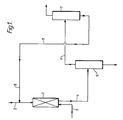
- a further embodiment of the invention comprises the methylation of biphenyl, as illustrated in the accompanying flow diagram.
- Biphenyl feedstock from a supply enters the reactor 1 along line 2 while mixed xylenes from a supply which is not shown but which for example may be the separation stage of a BTX aromatics process enters along line 3.
- the reactor 1 contains a fixed bed of zeolite catalyst and is operated at a temperature in the range 250 to 300°C and at a pressure up to 20 atmospheres.
- the liquid residence time in the reactor is typically in the range of a few minutes to a few hours while a total molar feed rate of bicyclic hydrocarbons relative to that of xylenes is in the range 0.1:1 to 2:1, especially about 0.5:1, is appropriate.
- the products of the reaction together with unreacted feedstocks are removed from the reactor and passed along line 4 to a distillation unit 5.
- the catalyst used in examples 7 to 10 was a sample of zeolite ZSM-5 doped with compounds of magnesium and phosphorus. It was prepared by impregnating the zeolite with aqueous diammonium hydrogen phosphate solution followed by drying at 120°C and then calcining at 500°C. After cooling, the sample was impregnated with aqueous magnesium acetate solution followed by drying at 120°C and calcination at 500°C.
- the catalyst was used in the form of 1/8-inch (32 mm) extrudates, bound with alumina and it contained 3.5 wt% phosphorus and 2.4 wt% magnesium.
- This example illustrates the use of the phosphorus/ magnesium-containing ZSM-5 catalyst for the methylation of naphthalene using xylenes as the methylating agent.
- Nitrogen (650 ml/hr), naphthalene (12.7 mmol/hr) and para-xylene (50.7 mmol/hr) were flowed through a bed of the catalyst (25 g) at 400°C. After two hours the proportions (in mol X) of naphthalene compounds in the product stream were:
- the single ring aromatic compounds in the product stream consisted largely of an equilibrium mixture of xylenes together with toluene and some benzene.
- This example illustrates the selective methylation of 2-methylnaphthalene using xylenes as the methylating agent.
- the reaction conditions and flow rates were the same as in example 7 except that 2-methylnaphthalene replaced the naphthalene feed. After two hours the proportions (in mol X) of naphthalene compounds in the product stream were:
- composition of the single-ring aromatic compounds in the product stream was substantially the same as in example 7.
- composition of the single ring aromatic compounds in the product stream was substantially the same as in example 7.
- This example illustrates the methylation of naphthalene using xylenes as the methylating agent in a very similar way to example 7.
- the same type of zeolitic catalyst was used and the reaction temperature and ratio of reactants were unchanged. However a larger amount of catalyst and lower flow rates were used so that the space velocity was only about 25X of that used in example 7. After 6 hours the proportions (in mol X) of naphthalene compounds in the product stream were:
- Examples 7 to 10 illustrate the ⁇ -selectivity of the process of the invention and example 10 in particular shows that high y-selectivity is retained even at high conversion of the compound undergoing alkylation.
- This example illustrates the use of zeolite ZSM-11 as a catalyst for the selective methylation of naphthalene using xylenes as the methylating agent.
- Nitrogen (650 ml/hr), naphthalene (12.5 mmol/hr) and para-xylene (49.8 mmol/hr) were flowed through a bed of pelleted ZSM-11 catalyst (7.8 g) at 400°C. After 1 hour the proportions (in mol X) of naphthalene compounds in the product stream were:
- This example illustrates a liquid-phase embodiment of the process of the invention.
- ZSM-5 zeolite catalyst 10 g
- naphthalene 5 g
- ortho-xylene 95 g
- Hydrogen was introduced at 100 atmospheres and the reaction mixture heated to 325°C for 4 hours.
- the only naphthalene derivatives which were detected were 1- and 2-methyl-naphthalene in ratio 1:20 respectively, corresponding to 2.0% of the naphthalene originally charged.
- dialkylated biphenyls and naphthalenes will be valuable raw materials for the production of the corresponding dicarboxylic, dihydroxy and monocarboxylic-monohydroxy derivatives, all having potential as the monomers of high value polymers.
Landscapes
- Chemical & Material Sciences (AREA)
- Organic Chemistry (AREA)
- Chemical Kinetics & Catalysis (AREA)
- Organic Low-Molecular-Weight Compounds And Preparation Thereof (AREA)
- Low-Molecular Organic Synthesis Reactions Using Catalysts (AREA)
Applications Claiming Priority (4)
| Application Number | Priority Date | Filing Date | Title |
|---|---|---|---|
| GB8510196 | 1985-04-22 | ||
| GB858510196A GB8510196D0 (en) | 1985-04-22 | 1985-04-22 | Alkylation process |
| GB8528382 | 1985-11-18 | ||
| GB858528382A GB8528382D0 (en) | 1985-11-18 | 1985-11-18 | Transalkylation process |
Publications (2)
| Publication Number | Publication Date |
|---|---|
| EP0202752A1 true EP0202752A1 (de) | 1986-11-26 |
| EP0202752B1 EP0202752B1 (de) | 1991-09-18 |
Family
ID=26289152
Family Applications (1)
| Application Number | Title | Priority Date | Filing Date |
|---|---|---|---|
| EP86302656A Expired - Lifetime EP0202752B1 (de) | 1985-04-22 | 1986-04-10 | Alkylierungsverfahren |
Country Status (3)
| Country | Link |
|---|---|
| EP (1) | EP0202752B1 (de) |
| DE (1) | DE3681493D1 (de) |
| NZ (1) | NZ215816A (de) |
Cited By (19)
| Publication number | Priority date | Publication date | Assignee | Title |
|---|---|---|---|---|
| US4795847A (en) * | 1987-02-04 | 1989-01-03 | Rutgerswerke Aktiengesellschaft | Preparation of 2,6-dialkyl-naphthalenes |
| EP0306961A1 (de) * | 1987-09-09 | 1989-03-15 | Nippon Petrochemicals Company, Limited | Verfahren zur Herstellung von m-Benzyltoluol |
| EP0347500A1 (de) * | 1986-12-25 | 1989-12-27 | Nippon Steel Chemical Co., Ltd. | Verfahren zur Herstellung von Äthylbiphenylen |
| US4891448A (en) * | 1987-11-23 | 1990-01-02 | The Dow Chemical Company | Alkylation of polycyclic aromatic compounds to alkylates enriched in the para-substituted isomers |
| WO1990003961A1 (en) * | 1988-10-05 | 1990-04-19 | Catalytica, Inc. | Process for selective diisopropylation of naphthyl compounds using shape selective acidic crystalline molecular sieve catalysts |
| WO1990003960A1 (en) * | 1988-10-05 | 1990-04-19 | Catalytica, Inc. | Process for selective manufacture of 2,6-dialkylnaphthalenes |
| US4943553A (en) * | 1986-12-25 | 1990-07-24 | Nippon Steel Chemical Co., Ltd. | Method of making ethylbiphenyls |
| WO1991003443A1 (en) * | 1989-09-08 | 1991-03-21 | Catalytica, Inc. | A process for the production of 4,4'-dialkylated biphenyl compounds |
| WO1991005751A1 (en) * | 1989-10-17 | 1991-05-02 | Catalytica, Inc. | Selective diethylation of naphthalene to 2,6-diethylnaphthalene |
| US5015797A (en) * | 1987-11-23 | 1991-05-14 | The Dow Chemical Company | Alkylation of polycyclic aromatic compounds to alkylates enriched in the linear- and near linear-substituted isomers |
| EP0432132A1 (de) * | 1988-03-28 | 1991-06-12 | Tosoh Corporation | Verfahren für die Herstellung von mono- und diisopropylnaphthalen |
| US5026942A (en) * | 1988-10-05 | 1991-06-25 | Catalytica, Inc. | Process for selective diisopropylation of naphthyl compounds using shape selective acidic crystalline molecular sieve catalysts |
| US5073655A (en) * | 1988-10-06 | 1991-12-17 | Mobil Oil Corp. | Method for preparing diarylalkanes |
| EP0511207A4 (de) * | 1989-12-21 | 1992-09-03 | Mobil Oil Corp | Verfahren zur katalytischen disproportionierung von methylnaphthalenen. |
| US5198595A (en) * | 1987-11-23 | 1993-03-30 | The Dow Chemical Company | Alkylation of aromatic compounds |
| US5243116A (en) * | 1987-11-23 | 1993-09-07 | The Dow Chemical Company | Alkylation of aromatic compounds |
| WO1997049654A1 (de) * | 1996-06-24 | 1997-12-31 | Hoechst Research & Technology Deutschland Gmbh & Co. Kg | Verfahren zur selektiven heterogen-katalytischen synthese von 4-methyl- und 4,4'-dimethylbiphenyl |
| US10800718B2 (en) | 2016-10-04 | 2020-10-13 | Exxonmobil Chemical Patents Inc. | Disproportionation and transalkylation of heavy aromatic hydrocarbons |
| CN114805000A (zh) * | 2022-05-23 | 2022-07-29 | 煤炭科学技术研究院有限公司 | 一种萘烷基化制备2-甲基萘的方法 |
Citations (5)
| Publication number | Priority date | Publication date | Assignee | Title |
|---|---|---|---|---|
| US3716596A (en) * | 1968-04-18 | 1973-02-13 | Mobil Oil Corp | Alkylation and dealkylation of aromatics in the presence of crystalline aluminosilicates |
| FR2163552A1 (de) * | 1971-12-14 | 1973-07-27 | Sun Research Dev | |
| US4112056A (en) * | 1977-05-02 | 1978-09-05 | Mobil Oil Corporation | Preparation of zeolites |
| EP0009894A1 (de) * | 1978-09-11 | 1980-04-16 | Mobil Oil Corporation | Regeneration eines Zeolith-Katalysators |
| EP0094693A2 (de) * | 1982-05-19 | 1983-11-23 | Teijin Petrochemical Industries Ltd. | Kristalliner Alumosilikat-Zeolith und Verfahren zu dessen Herstellung |
-
1986
- 1986-04-10 EP EP86302656A patent/EP0202752B1/de not_active Expired - Lifetime
- 1986-04-10 DE DE8686302656T patent/DE3681493D1/de not_active Expired - Lifetime
- 1986-04-14 NZ NZ21581686A patent/NZ215816A/xx unknown
Patent Citations (5)
| Publication number | Priority date | Publication date | Assignee | Title |
|---|---|---|---|---|
| US3716596A (en) * | 1968-04-18 | 1973-02-13 | Mobil Oil Corp | Alkylation and dealkylation of aromatics in the presence of crystalline aluminosilicates |
| FR2163552A1 (de) * | 1971-12-14 | 1973-07-27 | Sun Research Dev | |
| US4112056A (en) * | 1977-05-02 | 1978-09-05 | Mobil Oil Corporation | Preparation of zeolites |
| EP0009894A1 (de) * | 1978-09-11 | 1980-04-16 | Mobil Oil Corporation | Regeneration eines Zeolith-Katalysators |
| EP0094693A2 (de) * | 1982-05-19 | 1983-11-23 | Teijin Petrochemical Industries Ltd. | Kristalliner Alumosilikat-Zeolith und Verfahren zu dessen Herstellung |
Cited By (24)
| Publication number | Priority date | Publication date | Assignee | Title |
|---|---|---|---|---|
| US4943553A (en) * | 1986-12-25 | 1990-07-24 | Nippon Steel Chemical Co., Ltd. | Method of making ethylbiphenyls |
| EP0347500A1 (de) * | 1986-12-25 | 1989-12-27 | Nippon Steel Chemical Co., Ltd. | Verfahren zur Herstellung von Äthylbiphenylen |
| US4795847A (en) * | 1987-02-04 | 1989-01-03 | Rutgerswerke Aktiengesellschaft | Preparation of 2,6-dialkyl-naphthalenes |
| EP0306961A1 (de) * | 1987-09-09 | 1989-03-15 | Nippon Petrochemicals Company, Limited | Verfahren zur Herstellung von m-Benzyltoluol |
| US5015797A (en) * | 1987-11-23 | 1991-05-14 | The Dow Chemical Company | Alkylation of polycyclic aromatic compounds to alkylates enriched in the linear- and near linear-substituted isomers |
| US4891448A (en) * | 1987-11-23 | 1990-01-02 | The Dow Chemical Company | Alkylation of polycyclic aromatic compounds to alkylates enriched in the para-substituted isomers |
| US5243116A (en) * | 1987-11-23 | 1993-09-07 | The Dow Chemical Company | Alkylation of aromatic compounds |
| EP0317907A3 (en) * | 1987-11-23 | 1990-11-28 | The Dow Chemical Company | Alkylation of polycyclic aromatic compounds to alkylates enriched in the para-substituted isomers |
| US5198595A (en) * | 1987-11-23 | 1993-03-30 | The Dow Chemical Company | Alkylation of aromatic compounds |
| EP0432132A1 (de) * | 1988-03-28 | 1991-06-12 | Tosoh Corporation | Verfahren für die Herstellung von mono- und diisopropylnaphthalen |
| US5003122A (en) * | 1988-10-05 | 1991-03-26 | Catalytica, Inc. | Process for selective diisopropylation of naphthyl compounds using shape selective acidic crystalline molecular sieve catalysts |
| WO1990003961A1 (en) * | 1988-10-05 | 1990-04-19 | Catalytica, Inc. | Process for selective diisopropylation of naphthyl compounds using shape selective acidic crystalline molecular sieve catalysts |
| US5003120A (en) * | 1988-10-05 | 1991-03-26 | Catalytica, Inc. | Process for selective manufacture of 2,6-diisopropylnaphthalenes with equilibration reactor |
| WO1990003960A1 (en) * | 1988-10-05 | 1990-04-19 | Catalytica, Inc. | Process for selective manufacture of 2,6-dialkylnaphthalenes |
| US5026942A (en) * | 1988-10-05 | 1991-06-25 | Catalytica, Inc. | Process for selective diisopropylation of naphthyl compounds using shape selective acidic crystalline molecular sieve catalysts |
| US5073655A (en) * | 1988-10-06 | 1991-12-17 | Mobil Oil Corp. | Method for preparing diarylalkanes |
| US5026940A (en) * | 1989-09-08 | 1991-06-25 | Catalytica, Inc. | Manufacture of 4,4'-diisopropylbiphenyl |
| WO1991003443A1 (en) * | 1989-09-08 | 1991-03-21 | Catalytica, Inc. | A process for the production of 4,4'-dialkylated biphenyl compounds |
| WO1991005751A1 (en) * | 1989-10-17 | 1991-05-02 | Catalytica, Inc. | Selective diethylation of naphthalene to 2,6-diethylnaphthalene |
| EP0511207A4 (de) * | 1989-12-21 | 1992-09-03 | Mobil Oil Corp | Verfahren zur katalytischen disproportionierung von methylnaphthalenen. |
| WO1997049654A1 (de) * | 1996-06-24 | 1997-12-31 | Hoechst Research & Technology Deutschland Gmbh & Co. Kg | Verfahren zur selektiven heterogen-katalytischen synthese von 4-methyl- und 4,4'-dimethylbiphenyl |
| US10800718B2 (en) | 2016-10-04 | 2020-10-13 | Exxonmobil Chemical Patents Inc. | Disproportionation and transalkylation of heavy aromatic hydrocarbons |
| CN114805000A (zh) * | 2022-05-23 | 2022-07-29 | 煤炭科学技术研究院有限公司 | 一种萘烷基化制备2-甲基萘的方法 |
| CN114805000B (zh) * | 2022-05-23 | 2023-09-26 | 煤炭科学技术研究院有限公司 | 一种萘烷基化制备2-甲基萘的方法 |
Also Published As
| Publication number | Publication date |
|---|---|
| NZ215816A (en) | 1988-11-29 |
| EP0202752B1 (de) | 1991-09-18 |
| DE3681493D1 (de) | 1991-10-24 |
Similar Documents
| Publication | Publication Date | Title |
|---|---|---|
| EP0202752B1 (de) | Alkylierungsverfahren | |
| US4870222A (en) | Alkylation/transalkylation process | |
| US5198595A (en) | Alkylation of aromatic compounds | |
| US5430211A (en) | Process of preparing ethylbenzene or substituted derivatives thereof | |
| CN103635447A (zh) | 用烯烃烷基化芳香烃类的方法 | |
| CN1167652C (zh) | 用含丙烯和乙烯的稀物料流烷基化芳族化合物的方法 | |
| EP0950650B1 (de) | Verfahren zur Herstellung von 2,6-Dimethylnaphthalen | |
| JPH0899914A (ja) | 4−メチルビフェニルおよび4,4’−ジメチルビフェニルの製造法 | |
| WO1982001866A1 (en) | Methanol conversion to hydrocarbons with zeolites and co-catalysts | |
| EP0141514A2 (de) | Para-selektive Konvertierungen von aromatischen Kohlenwasserstoffen unter Verwendung von Zeolith-Katalysatoren mit Silica-Bindung | |
| EP0148147A2 (de) | Verfahren zur selektiven para-Alkylierung von aromatischen Kohlenwasserstoffen | |
| US5202516A (en) | Process of recovering monoalkylbenzene and pure 1,3,5-trialkylbenzene from a mixture of dialkyl- and trialkylbenzenes | |
| US7019186B2 (en) | Process for the preparation of 2,6-dimethylnaphthalene | |
| WO1989012613A1 (en) | Improved process for the transalkylation of polyalkylbenzenes | |
| WO2021038406A1 (en) | Process for treating polyalkylaromatic hydrocarbons | |
| EP1069102B1 (de) | Verfahren zur Herstellung von 2,6-Dimethylnaphthalene aus petrochemischen Beschickungen | |
| JPS61267530A (ja) | アルキレ−シヨン法 | |
| RU2818090C2 (ru) | Способ обработки полиалкилароматических углеводородов | |
| EP2396292B1 (de) | Integriertes verfahren zur herstellung von ethylbenzol und cumol | |
| WO2008014904A1 (en) | Alkylation of aromatic compounds using zeolite itq-33 | |
| Ashton et al. | Shape selective alkylation reactions over medium pore high silica zeolites | |
| JPH05320074A (ja) | 2,6−ジアルキルナフタレンの製造方法 | |
| HK1067884A (en) | Process for the preparation 2,6-dimethylnaphthalene |
Legal Events
| Date | Code | Title | Description |
|---|---|---|---|
| PUAI | Public reference made under article 153(3) epc to a published international application that has entered the european phase |
Free format text: ORIGINAL CODE: 0009012 |
|
| AK | Designated contracting states |
Kind code of ref document: A1 Designated state(s): BE CH DE FR GB IT LI NL |
|
| 17P | Request for examination filed |
Effective date: 19870502 |
|
| 17Q | First examination report despatched |
Effective date: 19880222 |
|
| GRAA | (expected) grant |
Free format text: ORIGINAL CODE: 0009210 |
|
| AK | Designated contracting states |
Kind code of ref document: B1 Designated state(s): BE CH DE FR GB IT LI NL |
|
| ITF | It: translation for a ep patent filed | ||
| REF | Corresponds to: |
Ref document number: 3681493 Country of ref document: DE Date of ref document: 19911024 |
|
| ET | Fr: translation filed | ||
| PG25 | Lapsed in a contracting state [announced via postgrant information from national office to epo] |
Ref country code: GB Effective date: 19920410 |
|
| PG25 | Lapsed in a contracting state [announced via postgrant information from national office to epo] |
Ref country code: LI Effective date: 19920430 Ref country code: CH Effective date: 19920430 Ref country code: BE Effective date: 19920430 |
|
| PLBE | No opposition filed within time limit |
Free format text: ORIGINAL CODE: 0009261 |
|
| STAA | Information on the status of an ep patent application or granted ep patent |
Free format text: STATUS: NO OPPOSITION FILED WITHIN TIME LIMIT |
|
| 26N | No opposition filed | ||
| BERE | Be: lapsed |
Owner name: IMPERIAL CHEMICAL INDUSTRIES P.L.C. Effective date: 19920430 |
|
| PG25 | Lapsed in a contracting state [announced via postgrant information from national office to epo] |
Ref country code: NL Effective date: 19921101 |
|
| GBPC | Gb: european patent ceased through non-payment of renewal fee | ||
| NLV4 | Nl: lapsed or anulled due to non-payment of the annual fee | ||
| PG25 | Lapsed in a contracting state [announced via postgrant information from national office to epo] |
Ref country code: FR Effective date: 19921230 |
|
| REG | Reference to a national code |
Ref country code: CH Ref legal event code: PL |
|
| PG25 | Lapsed in a contracting state [announced via postgrant information from national office to epo] |
Ref country code: DE Effective date: 19930101 |
|
| REG | Reference to a national code |
Ref country code: FR Ref legal event code: ST |
|
| PG25 | Lapsed in a contracting state [announced via postgrant information from national office to epo] |
Ref country code: IT Free format text: LAPSE BECAUSE OF NON-PAYMENT OF DUE FEES;WARNING: LAPSES OF ITALIAN PATENTS WITH EFFECTIVE DATE BEFORE 2007 MAY HAVE OCCURRED AT ANY TIME BEFORE 2007. THE CORRECT EFFECTIVE DATE MAY BE DIFFERENT FROM THE ONE RECORDED. Effective date: 20050410 |