EP0200480A2 - Nichtflüchtige Speicherzelle und nichtflüchtige RAM-Speicherzelle mit einer solchen Zelle - Google Patents
Nichtflüchtige Speicherzelle und nichtflüchtige RAM-Speicherzelle mit einer solchen Zelle Download PDFInfo
- Publication number
- EP0200480A2 EP0200480A2 EP86303102A EP86303102A EP0200480A2 EP 0200480 A2 EP0200480 A2 EP 0200480A2 EP 86303102 A EP86303102 A EP 86303102A EP 86303102 A EP86303102 A EP 86303102A EP 0200480 A2 EP0200480 A2 EP 0200480A2
- Authority
- EP
- European Patent Office
- Prior art keywords
- capacitor
- transistor
- memory cell
- node
- tunnel
- Prior art date
- Legal status (The legal status is an assumption and is not a legal conclusion. Google has not performed a legal analysis and makes no representation as to the accuracy of the status listed.)
- Withdrawn
Links
Images
Classifications
-
- G—PHYSICS
- G11—INFORMATION STORAGE
- G11C—STATIC STORES
- G11C14/00—Digital stores characterised by arrangements of cells having volatile and non-volatile storage properties for back-up when the power is down
Definitions
- the present invention relates to a non-volatile memory cell and non-volatile random access memory (NVRAM) cell utilising the same.
- NVRAM non-volatile random access memory
- an SRAM cell has the advantage that the access time is short and the data can be re-written without limitation, but a disadvantage is that the cell is volatile.
- an EEPROM cell has the advantage that it is non-volatile, but the disadvantage that a long access time is required and the number of times data can be re-written is limited.
- the data can be written into or read out from the NVRAM cell in a short time, and also the data can be re-written without any limitation.
- the power supply voltage of the NVRAM cell is turned off, using advantageous properties the / of the EEPROM cell, the data in the SRAM cell portion can be stored in the EEPROM cell portion, and the data stored in the EEPROM cell portion can be recalled to the SRAM cell portion when the power supply voltage is disadvantage turned on.
- the / of the long access time of the EEPROM cell has little effect on the NVRAM cell because the the data access is required only for/short time whilst the power supply voltage of the NVRAM cell is turned on and off.
- the NVRAM cell has a-problem that its size becomes large; accordingly, proposals have been made to reduce the cell size for increasing the packing density of a memory device consisting of NVRAM cells.
- the SRAM cell portion therein simply consists of a few components of a flip-flop circuit, so that the EEPROM cell portion therein becomes a subject for increasing the packing density of the NVRAM cell.
- the U.S. Patent Appln. S.N. 659,191 invented by the inventor of the present invention gave a solution to the above problem by increasing the packing density of the EEPROM cell portion.
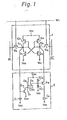
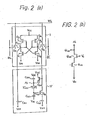
- a prior of the accompanying drawings art NVRAM cell is such as shown in Fig. 1/ and an NVRAM that cell proposed in/ Patent Application is such as shown in Fig. 2(a).
- the NVRAM cell functions as a memory matrix element of a memory device, wherein the a element is designated by/respective word line WL and respective pair of bit lines BL and BL of the memory device.
- the NVRAM cell of Fig. 1 consists of an SRAM cell portion 1 and an EEPROM cell portion 2 and the NVRAM cell of Fig. 2(a) consists of an SRAM cell portion 1 and an EEPROM cell portion 17; the SRAM cell portions 1 of Figs. 1 and 2(a) are the same. Comparing Figs. 1 and 2(a), it can be seen that the improvement of the packing density of the NVR A M cell is achieved by reducing the circuit components of the EEPROM cell portion 2.
- FIG. 2(b) shows a modified partial circuit of Fig. 2(a); i.e., in Fig. 2(b), instead of removing the capacitor C 62 in Fig. 2(a), a control transistor Q 100 is placed between the node N 2 and the transistor Q 61 .
- the details of the function of the NVRAM cell in Figs. 1 , 2(a) and 2(b) are well discussed in U.S. Patent Appln. S.N. 659,191, so the explanation of these details is not repeated here.
- the NVRAM cell shown in Fig. 2(a) is most useful, because, as seen from Fig. 2(a), the NVRAM cell of Fig. 2(a) has the structure of removing the connection between the node N 1 of the SRAM cell portion 1 and the circuit of the EEPROM cell portion 2, so that the NVRAM cell of Fig. 2(a) is effective not only for increasing the packing density of the NVRAM cell but also for increasing the freedom for design of the structure of the NVRAM cell.
- the EEPROM cell portion 17 operates with two kinds of power sources V H1 and V H2 .
- the two kinds of power sources make the peripheral circuitry of the NVRAM cell a little more complicated, (which, however, is not so negative factor for the NVRAM cell of Fig. 2(a)).
- the two kinds of power supply voltage bring new problems to the NVRAM cell of Fig. 2(a) as follows.
- a non-volatile memory cell comprising:
- a non-volatile random-access memory cell by combining the non-volatile memory cell of the preceding paragraph with a volatile memory cell comprising:
- An embodiment of the present invention may provide an NVRAM cell constituted by a volatile static type random-access memory (SRAM) cell portion and a non-volatile electrically erasable programmable read-only memory (EEPROM) cell portion.
- SRAM static type random-access memory
- EEPROM electrically erasable programmable read-only memory
- An embodiment of the present invention may increase the packing density of a memory device consisting of NVRAM cells whilst keeping the reliability high.
- An embodiment of the present invention may give more freedom in the design of the semiconductor structure of the NVRAM cell.
- An embodiment of the present invention may increase the yield rate of production of memory devices consisting of NVRAM cells.
- An embodiment of the present invention may reduce the time for storing or re-calling data into or out from the EEPROM cell portion of an NVRAM cell.
- An embodiment of the present invention may increase the life of an NVRAM cell.
- An embodiment of the present invention may provide an NVRAM cell in which repetition of the charging for storing a datum (item of data) can be made any number of times.
- an improved EEPROM cell portion combined with an SRAM cell portion.
- the improved EEPROM cell portion operates under only one power supply voltage called a writing voltage when the power supply-voltage for the SRAM cell portion is intended to be turned off.
- the improved EEPROM cell portion comprises:a memory transistor having a floating gate on which charge is stored such that the polarity of the charge is determined in correspondence with the level of the bit signal at one node of the flip-flop circuit in the SRAM cell portion; a capacitor circuit comprising a tunnel capacitor; and two transistors for controlling the polarity of the charge being stored at the floating gate in cooperation with a tunnel current of the tunnel capacitor.
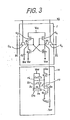
- Fig. 3 shows a circuit diagram of an NVRAM cell embodying the present invention.
- the NVRAM cell consists of an SRAM cell portion 1, which may be the same as SRAM cell portion 1 in Fig. 1 or 2(a), and an EEPROM cell portion 20.
- a plurality of the NVRAM cells 1 form a memory device (an NVRAM device) having the structure of a memory matrix, and a each NVRAM cell is designated by/respective word-line WL and respective pair of bit-lines BL and BL.
- the SRAM cell portion 1 comprises four metal insulator semiconductor (MIS) transistors Q 1 , Q 2 , Q 3 , and Q 4 (the transistors Q 1 and Q 2 are the ordinary enhancement type, and the transistors Q 3 and Q 4 are the depletion type which are distinguished from the enhancement type in the Figure by a black dot) which are cross-coupled at nodes N 1 and N 2 forming an ordinary data flip-flop circuit.
- MIS metal insulator semiconductor
- the EEPROM cell portion 20 is a non-volatile memory cell which comprises a memory MIS transistor Q 8 having a floating gate FG, the MIS transistors Q 7 and Q 11 , and a capacitor circuit consisting of a capacitor module CM 2 , capacitors C 4 and C 5 , and tunnel capacitor TC 3 .
- the capacitor module C M2 , the tunnel capacitor TC 3 , and the capacitor C 5 are made from depletion type MIS shown their transistors (each/having a black dot)each having/ drain and source connected together.
- the capacitor module CM 2 has static capacitance between a between common electrode D 4 and an electrode D 5 and/the common electrode D 4 and an electrode D 6 ;
- the tunnel capacitor TC 3 which can is a capacitor/function by a tunnel effect and whose (relatively small) capacitance is selected so as to be sufficiently small/ compared with the capacitance of the capacitor module CM 2 and the capacitor C 5 ;
- the capacitor C 4 is selected to have a value sufficiently large compared with-that of the capacitor C 3 of the S RA M cell portion 1.
- the transistors Q 7 and Q 11 each function as a switch corresponding to a signal level H or L applied to the gate; however, they operate oppositely to each other, i.e., the transistor Q 11 switches OFF and ON corresponding to ON and OFF operations of the transistor Q 7 .
- this NVRAM cell embodying the present the invention is divided into/following modes: (1).Store Mode 1 held (The mode of storing a datum held in the SRAM cell portion 1 into the EEPROM cell portion 20 when the potential at the node N 1 is L and that at the node N 2 is H), (2) Store Mode 2 (The store mode when the potential at the node N 1 is H and that at the node N 2 is L), (3) Recall Mode 1 (The mode of recalling the data stored in the EEPROM cell portion 20 back to the SRAM cell portion 1 when a negative charge is stored at the floating gate FG of the transistor Q 8 ), and (4) Recall Mode 2 (The same recall mode but when a positive charge is stored at floating gate these FG).
- the NVRAM cell operates as follows. (1) Store Mode 1 is raised
- V voltage at the node N 2
- the transistor Q 7 is ON (reference symbol V SS is a low potential such as earth potential), so that the potential at the node N 4 becomes L and the transistor Q 11 becomes OFF.
- the writing voltage V HH is applied to a series circuit consisting of the capacitor formed between the electrodes D 4 and D 5 , the capacitor formed between the electrodes D 4 and D 6 , and the tunnel capacitor TC 3 .
- the static capacitance of the capacitor module CM 2 is sufficiently larger than greater that of the tunnel capacitor TC 3 so that the/ part of the writing voltage V HH is applied to the tunnel capacitor TC 3 .
- electrons move from the node N 4 to.the floating gate FG of the transistor Q 8 through the tunnel capacitor TC 3 by the tunnel effect, so that a negative charge is stored at the floating gate FG, which makes the transistor Q 8 OFF, and the negative charge stored at the floating gate FG is retained for a long period, even though the power supply voltage V CC and the writing voltage V HH are turned off.
- the transistor Q 8 is called a memory transistor.
- the transistor Q 8 Since the potential at the node N 2 is L, the transistor Q 8 becomes OFF, so that the node N 4 goes into a floating state; however, when the writing voltage V HH is applied, the potential at the node N 4 risesup, which turns ON the transistor Q 11 . Accordingly, the writing voltage V HH is applied to the series circuit consisting of the capacitor C 5 , the tunnel capacitor TC 3 , and the capacitor formed between the electrodes D 4 and D 6 . Thus the greater part of the writing voltage V HH is applied to the tunnel capacitor TC 3 ,because the capacitance of the tunnel the capacitor is sufficiently small compared with/other capacitance of the capacitors in the series circuit as mentioned before.
- the power supply voltage V CC for the memory is set cell 1 is set to 0 V.
- the transistor Q 8 is cut off, disconnecting the connection between the node N 2 and the capacitor C 4 . Therefore, when the power supply voltage V CC (5 V) is turned on, since the capacitor C 3 is connected to the node N 1 and the capacitor C 4 is disconnected from the node N 2' the potential at the node N 1 becomes L because only the load at the node N 1 is heavy, and the potential at the node N 2 becomes H.
- the data stored in the EEPROM cell portion 20 is recalled to the NVRAM cell when the power supply voltage is turned on.
- the power supply voltage V CC for the memory is set cell 1/to 0 V.
- a positive charge exists at the floating gate FG, so that the transistor Q 8 is ON connecting the node N 2 to the capacitor C 4 . Therefore, when the power supply voltage V CC (5 V) is turned on, since the capacitance of the capacitor C 4 is selected so as to be larger than that of the capacitor C 3 , the flip-flop circuit in the SRAM cell portion 1 functions so that the potential at the N 1 becomes H and that at the N 2 becomes L.
- the data stored in the EEPROM cell portion 20 is recalled to the NVRAM cell when the power supply voltage is turned on.
- the EEPROM cell portion 20 uses only one writing voltage V HH ; therefore, which the it does not share the problems/ NVRAM cell, shown in Fig. 2, had . That is, the problems of the previously proposed NVRAM cell taking too much time to store and recall data, having a short life and being difficult to give enough holding time, may all be solved in this embodiment of the present invention.
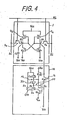
- Fig. 4 is a circuit diagram of an NVRAM cell showing another embodiment of the present invention.
- the function and the operation of Fig. 4 are similar to those of Fig. 3.
- the circuit from the node N 2 to the earth potential V SS through the transistor Q 8 and the capacitor similar way C 5 in Fig. 3 is modified in a to the modified partial circuit shown in Fig. 2(b); i.e., the capacitor C 4 in Fig. 3 is omitted, and a control transistor Q 10 is placed between the node N 2 and the transistor Q 8 for switching the connection between the node N 2 and the memory transistor Q 8 ; the switching action is made by a control voltage V c applied to the gate of the transistor Q 10 .
- an embodiment of the present invention provides / a non-volatile random access memory (NVRAM) cell includ.ing a volatile static type random access memory cell consisting of a flop-flip circuit having two nodes on which a paired bit signal may be accessed and a non-volatile electrically erasable programmable read-only memory (EEPROM) cell consisting of a memory transistor having a floating gate, a capacitor circuit, to which a voltage called a writing voltage is applied, including a tunnel capacitor, and two transistors for determining the polarity S of charge to be stored at the floating gate with a tunnel current in the tunnel capacitor corresponding to the level of the bit signal existing at one of the two nodes in the flip-flop circuit.
- NVRAM non-volatile random access memory
- EEPROM electrically erasable programmable read-only memory
- the EEPROM cell When the power supply voltage of the NVRAM cell is turned off, the EEPROM cell stores the positive or negative charge at the floating gate corresponding to the bit signal level at the node in the flip-flop circuit holding the charge after the power supply voltage and the writing voltage are turned off. When the power supply voltage is turned on, the EEPROM cell recalls the the the state of the flip-flop circuit so as to be/same as before using the charge stored at the floating gate.
Landscapes
- Static Random-Access Memory (AREA)
- Semiconductor Memories (AREA)
Applications Claiming Priority (2)
| Application Number | Priority Date | Filing Date | Title |
|---|---|---|---|
| JP87718/85 | 1985-04-24 | ||
| JP60087718A JPS61246995A (ja) | 1985-04-24 | 1985-04-24 | 不揮発性ランダムアクセスメモリ装置 |
Publications (2)
| Publication Number | Publication Date |
|---|---|
| EP0200480A2 true EP0200480A2 (de) | 1986-11-05 |
| EP0200480A3 EP0200480A3 (de) | 1988-08-03 |
Family
ID=13922681
Family Applications (1)
| Application Number | Title | Priority Date | Filing Date |
|---|---|---|---|
| EP86303102A Withdrawn EP0200480A3 (de) | 1985-04-24 | 1986-04-24 | Nichtflüchtige Speicherzelle und nichtflüchtige RAM-Speicherzelle mit einer solchen Zelle |
Country Status (3)
| Country | Link |
|---|---|
| US (1) | US4703456A (de) |
| EP (1) | EP0200480A3 (de) |
| JP (1) | JPS61246995A (de) |
Cited By (2)
| Publication number | Priority date | Publication date | Assignee | Title |
|---|---|---|---|---|
| EP0295036A3 (de) * | 1987-06-08 | 1991-06-26 | Fujitsu Limited | Halbleiterspeicheranordnung |
| US5189641A (en) * | 1987-06-08 | 1993-02-23 | Fujitsu Limited | Non-volatile random access memory device |
Families Citing this family (36)
| Publication number | Priority date | Publication date | Assignee | Title |
|---|---|---|---|---|
| JPS62217493A (ja) * | 1986-02-27 | 1987-09-24 | Fujitsu Ltd | 半導体不揮発性記憶装置 |
| JPS62256296A (ja) * | 1986-04-30 | 1987-11-07 | Fujitsu Ltd | 半導体不揮発性記憶装置 |
| JPS644062A (en) * | 1987-06-26 | 1989-01-09 | Seiko Instr & Electronics | Nonvolatile ram |
| US4853893A (en) * | 1987-07-02 | 1989-08-01 | Ramtron Corporation | Data storage device and method of using a ferroelectric capacitance divider |
| US4910708A (en) * | 1987-07-02 | 1990-03-20 | Ramtron Corporation | Dram with programmable capacitance divider |
| US4918654A (en) * | 1987-07-02 | 1990-04-17 | Ramtron Corporation | SRAM with programmable capacitance divider |
| US4914627A (en) * | 1987-07-02 | 1990-04-03 | Ramtron Corporation | One transistor memory cell with programmable capacitance divider |
| JPS6414798A (en) * | 1987-07-09 | 1989-01-18 | Fujitsu Ltd | Non-volatile memory device |
| JP2645417B2 (ja) * | 1987-09-19 | 1997-08-25 | 富士通株式会社 | 不揮発性メモリ装置 |
| US5434811A (en) * | 1987-11-19 | 1995-07-18 | National Semiconductor Corporation | Non-destructive read ferroelectric based memory circuit |
| JP2885607B2 (ja) * | 1993-05-17 | 1999-04-26 | 日本電気アイシーマイコンシステム株式会社 | 半導体メモリ |
| DE4342821C1 (de) * | 1993-12-15 | 1994-12-15 | Sgs Thomson Microelectronics | Elektronische Speicherschaltung |
| US5602776A (en) * | 1994-10-17 | 1997-02-11 | Simtek Corporation | Non-Volatile, static random access memory with current limiting |
| US5880991A (en) * | 1997-04-14 | 1999-03-09 | International Business Machines Corporation | Structure for low cost mixed memory integration, new NVRAM structure, and process for forming the mixed memory and NVRAM structure |
| US6424011B1 (en) | 1997-04-14 | 2002-07-23 | International Business Machines Corporation | Mixed memory integration with NVRAM, dram and sram cell structures on same substrate |
| US6163480A (en) * | 1997-12-29 | 2000-12-19 | Honeywell International Inc. | Memory with high integrity memory cells |
| US6373095B1 (en) | 1998-02-25 | 2002-04-16 | International Business Machines Corporation | NVRAM cell having increased coupling ratio between a control gate and floating gate without an increase in cell area |
| US6021066A (en) * | 1999-01-04 | 2000-02-01 | International Business Machines Corporation | NVRAM array architecture utilizing common bitline and wordline |
| US6452856B1 (en) * | 1999-02-26 | 2002-09-17 | Micron Technology, Inc. | DRAM technology compatible processor/memory chips |
| US6259126B1 (en) | 1999-11-23 | 2001-07-10 | International Business Machines Corporation | Low cost mixed memory integration with FERAM |
| US6496802B1 (en) | 2000-01-07 | 2002-12-17 | Mp3.Com, Inc. | System and method for providing access to electronic works |
| DE102004055006B4 (de) * | 2004-11-15 | 2012-09-13 | Infineon Technologies Ag | Flipflop mit zusätzlicher Zustandsspeicherung bei Abschaltung |
| US8072834B2 (en) * | 2005-08-25 | 2011-12-06 | Cypress Semiconductor Corporation | Line driver circuit and method with standby mode of operation |
| US20080151654A1 (en) | 2006-12-22 | 2008-06-26 | Allan James D | Method and apparatus to implement a reset function in a non-volatile static random access memory |
| US7881118B2 (en) * | 2007-05-25 | 2011-02-01 | Cypress Semiconductor Corporation | Sense transistor protection for memory programming |
| US8064255B2 (en) * | 2007-12-31 | 2011-11-22 | Cypress Semiconductor Corporation | Architecture of a nvDRAM array and its sense regime |
| US8482964B2 (en) * | 2008-12-31 | 2013-07-09 | Stmicroelectronics, Inc. | Robust SRAM memory cell capacitor plate voltage generator |
| US9177644B2 (en) | 2012-08-15 | 2015-11-03 | Aplus Flash Technology, Inc. | Low-voltage fast-write PMOS NVSRAM cell |
| US8964470B2 (en) | 2012-09-25 | 2015-02-24 | Aplus Flash Technology, Inc. | Method and architecture for improving defect detectability, coupling area, and flexibility of NVSRAM cells and arrays |
| US9001583B2 (en) | 2012-10-15 | 2015-04-07 | Aplus Flash Technology, Inc. | On-chip HV and LV capacitors acting as the second back-up supplies for NVSRAM auto-store operation |
| US9177645B2 (en) | 2012-10-19 | 2015-11-03 | Aplus Flash Technology, Inc. | 10T NVSRAM cell and cell operations |
| US8929136B2 (en) | 2012-10-26 | 2015-01-06 | Aplus Flash Technology, Inc. | 8T NVSRAM cell and cell operations |
| US8971113B2 (en) | 2012-10-30 | 2015-03-03 | Aplus Flash Technology, Inc. | Pseudo-8T NVSRAM cell with a charge-follower |
| US8976588B2 (en) | 2012-11-01 | 2015-03-10 | Aplus Flash Technology, Inc. | NVSRAM cells with voltage flash charger |
| US9515094B2 (en) * | 2013-06-26 | 2016-12-06 | Semiconductor Energy Laboratory Co., Ltd. | Storage device and semiconductor device |
| RU2668716C2 (ru) * | 2017-10-23 | 2018-10-02 | Общество с ограниченной ответственностью "МЭМС-РЕЗЕРВ" | Сегнетоэлектрический элемент памяти и сумматор |
Family Cites Families (6)
| Publication number | Priority date | Publication date | Assignee | Title |
|---|---|---|---|---|
| US4274012A (en) * | 1979-01-24 | 1981-06-16 | Xicor, Inc. | Substrate coupled floating gate memory cell |
| US4408303A (en) * | 1981-12-28 | 1983-10-04 | Mostek Corporation | Directly-coupled and capacitively coupled nonvolatile static RAM cell |
| US4527258A (en) * | 1982-09-30 | 1985-07-02 | Mostek Corporation | E2 PROM having bulk storage |
| US4510584A (en) * | 1982-12-29 | 1985-04-09 | Mostek Corporation | MOS Random access memory cell with nonvolatile storage |
| US4630238A (en) * | 1983-10-14 | 1986-12-16 | Fujitsu Limited | Semiconductor memory device |
| JP3100137B2 (ja) * | 1989-06-07 | 2000-10-16 | セイコーエプソン株式会社 | 半導体集積装置 |
-
1985
- 1985-04-24 JP JP60087718A patent/JPS61246995A/ja active Pending
-
1986
- 1986-04-23 US US06/858,465 patent/US4703456A/en not_active Expired - Fee Related
- 1986-04-24 EP EP86303102A patent/EP0200480A3/de not_active Withdrawn
Cited By (2)
| Publication number | Priority date | Publication date | Assignee | Title |
|---|---|---|---|---|
| EP0295036A3 (de) * | 1987-06-08 | 1991-06-26 | Fujitsu Limited | Halbleiterspeicheranordnung |
| US5189641A (en) * | 1987-06-08 | 1993-02-23 | Fujitsu Limited | Non-volatile random access memory device |
Also Published As
| Publication number | Publication date |
|---|---|
| JPS61246995A (ja) | 1986-11-04 |
| EP0200480A3 (de) | 1988-08-03 |
| US4703456A (en) | 1987-10-27 |
Similar Documents
| Publication | Publication Date | Title |
|---|---|---|
| EP0200480A2 (de) | Nichtflüchtige Speicherzelle und nichtflüchtige RAM-Speicherzelle mit einer solchen Zelle | |
| US5986932A (en) | Non-volatile static random access memory and methods for using same | |
| US5914895A (en) | Non-volatile random access memory and methods for making and configuring same | |
| US4432072A (en) | Non-volatile dynamic RAM cell | |
| US4460978A (en) | Nonvolatile static random access memory cell | |
| US4879690A (en) | Static random access memory with reduced soft error rate | |
| US4400799A (en) | Non-volatile memory cell | |
| US4193128A (en) | High-density memory with non-volatile storage array | |
| US6064590A (en) | Non-volatile static random access memory device | |
| JPH0411953B2 (de) | ||
| US4536859A (en) | Cross-coupled inverters static random access memory | |
| EP0233453B1 (de) | Assoziativspeicherzelle | |
| EP0481532B1 (de) | Halbleiterspeicheranordnung | |
| EP0088421B1 (de) | Halbleiterspeicheranordnung mit Tunneldioden | |
| EP0334550B1 (de) | Nichtflüchtige RAM-Zelle | |
| KR100200765B1 (ko) | 레이아웃 면적이 감소되는 sram 셀 | |
| EP0223784A1 (de) | Dynamischer speicher mit erhöhter datengültigkeitszeitdauer. | |
| US4615020A (en) | Nonvolatile dynamic ram circuit | |
| CA1046641A (en) | Switched capacitor non-volatile mnos random access memory cell | |
| EP0168246A2 (de) | Aktive Erhöhungsschaltung | |
| US4161791A (en) | Automatic refresh memory cell | |
| KR20000052483A (ko) | 감소된 표면적을 갖는 sram 메모리 셀 | |
| US4418401A (en) | Latent image ram cell | |
| US4768166A (en) | Semiconductor static memory device with cell grounding means for reduced power consumption | |
| EP0040001B1 (de) | Dynamische Halbleiterspeicheranordnung mit reduzierten Taktimpulsen |
Legal Events
| Date | Code | Title | Description |
|---|---|---|---|
| PUAI | Public reference made under article 153(3) epc to a published international application that has entered the european phase |
Free format text: ORIGINAL CODE: 0009012 |
|
| AK | Designated contracting states |
Kind code of ref document: A2 Designated state(s): DE FR GB |
|
| PUAL | Search report despatched |
Free format text: ORIGINAL CODE: 0009013 |
|
| AK | Designated contracting states |
Kind code of ref document: A3 Designated state(s): DE FR GB |
|
| 17P | Request for examination filed |
Effective date: 19880923 |
|
| 17Q | First examination report despatched |
Effective date: 19881128 |
|
| STAA | Information on the status of an ep patent application or granted ep patent |
Free format text: STATUS: THE APPLICATION IS DEEMED TO BE WITHDRAWN |
|
| 18D | Application deemed to be withdrawn |
Effective date: 19890530 |
|
| RIN1 | Information on inventor provided before grant (corrected) |
Inventor name: ARAKAWA, HIDEKIC/O FUJITSU LTD. |