EP0195931A1 - Wasserverdünnbare Überzugsmittel zur Herstellung von Basisschichten bei Zweischichtlackierung - Google Patents
Wasserverdünnbare Überzugsmittel zur Herstellung von Basisschichten bei Zweischichtlackierung Download PDFInfo
- Publication number
- EP0195931A1 EP0195931A1 EP86102145A EP86102145A EP0195931A1 EP 0195931 A1 EP0195931 A1 EP 0195931A1 EP 86102145 A EP86102145 A EP 86102145A EP 86102145 A EP86102145 A EP 86102145A EP 0195931 A1 EP0195931 A1 EP 0195931A1
- Authority
- EP
- European Patent Office
- Prior art keywords
- weight
- meth
- water
- solvents
- base
- Prior art date
- Legal status (The legal status is an assumption and is not a legal conclusion. Google has not performed a legal analysis and makes no representation as to the accuracy of the status listed.)
- Granted
Links
- 239000008199 coating composition Substances 0.000 title claims abstract description 11
- XLYOFNOQVPJJNP-UHFFFAOYSA-N water Substances O XLYOFNOQVPJJNP-UHFFFAOYSA-N 0.000 title claims description 21
- 235000020354 squash Nutrition 0.000 title 1
- 239000002904 solvent Substances 0.000 claims abstract description 37
- 239000000049 pigment Substances 0.000 claims abstract description 31
- 229920001577 copolymer Polymers 0.000 claims abstract description 24
- 238000002360 preparation method Methods 0.000 claims abstract description 23
- 230000000694 effects Effects 0.000 claims abstract description 20
- 239000006185 dispersion Substances 0.000 claims abstract description 15
- 229910052751 metal Inorganic materials 0.000 claims abstract description 14
- 239000002184 metal Substances 0.000 claims abstract description 14
- 239000000945 filler Substances 0.000 claims abstract description 9
- 229920000642 polymer Polymers 0.000 claims abstract description 9
- 229920005989 resin Polymers 0.000 claims abstract description 5
- 239000011347 resin Substances 0.000 claims abstract description 5
- CERQOIWHTDAKMF-UHFFFAOYSA-N Methacrylic acid Chemical compound CC(=C)C(O)=O CERQOIWHTDAKMF-UHFFFAOYSA-N 0.000 claims description 16
- 239000000203 mixture Substances 0.000 claims description 15
- 239000011248 coating agent Substances 0.000 claims description 14
- 239000007787 solid Substances 0.000 claims description 13
- 239000000243 solution Substances 0.000 claims description 13
- LFQSCWFLJHTTHZ-UHFFFAOYSA-N Ethanol Chemical compound CCO LFQSCWFLJHTTHZ-UHFFFAOYSA-N 0.000 claims description 12
- 239000003973 paint Substances 0.000 claims description 10
- QGZKDVFQNNGYKY-UHFFFAOYSA-N Ammonia Chemical compound N QGZKDVFQNNGYKY-UHFFFAOYSA-N 0.000 claims description 9
- 230000009477 glass transition Effects 0.000 claims description 8
- MYRTYDVEIRVNKP-UHFFFAOYSA-N 1,2-Divinylbenzene Chemical compound C=CC1=CC=CC=C1C=C MYRTYDVEIRVNKP-UHFFFAOYSA-N 0.000 claims description 7
- 238000001704 evaporation Methods 0.000 claims description 6
- 230000008020 evaporation Effects 0.000 claims description 6
- 238000006386 neutralization reaction Methods 0.000 claims description 6
- 229920002554 vinyl polymer Polymers 0.000 claims description 6
- VZCYOOQTPOCHFL-OWOJBTEDSA-N Fumaric acid Chemical compound OC(=O)\C=C\C(O)=O VZCYOOQTPOCHFL-OWOJBTEDSA-N 0.000 claims description 5
- 125000003118 aryl group Chemical group 0.000 claims description 5
- 229910021529 ammonia Inorganic materials 0.000 claims description 4
- 238000009835 boiling Methods 0.000 claims description 4
- 125000003178 carboxy group Chemical group [H]OC(*)=O 0.000 claims description 4
- 150000001875 compounds Chemical class 0.000 claims description 4
- 239000004922 lacquer Substances 0.000 claims description 4
- VZCYOOQTPOCHFL-UHFFFAOYSA-N trans-butenedioic acid Natural products OC(=O)C=CC(O)=O VZCYOOQTPOCHFL-UHFFFAOYSA-N 0.000 claims description 4
- ZHNUHDYFZUAESO-OUBTZVSYSA-N aminoformaldehyde Chemical compound N[13CH]=O ZHNUHDYFZUAESO-OUBTZVSYSA-N 0.000 claims description 3
- 239000007864 aqueous solution Substances 0.000 claims description 3
- 125000002573 ethenylidene group Chemical group [*]=C=C([H])[H] 0.000 claims description 3
- 125000000524 functional group Chemical group 0.000 claims description 3
- 239000003209 petroleum derivative Substances 0.000 claims description 3
- 125000000391 vinyl group Chemical group [H]C([*])=C([H])[H] 0.000 claims description 3
- OFOBLEOULBTSOW-UHFFFAOYSA-N Propanedioic acid Natural products OC(=O)CC(O)=O OFOBLEOULBTSOW-UHFFFAOYSA-N 0.000 claims description 2
- 239000001530 fumaric acid Substances 0.000 claims description 2
- 125000002768 hydroxyalkyl group Chemical group 0.000 claims description 2
- VZCYOOQTPOCHFL-UPHRSURJSA-N maleic acid Chemical compound OC(=O)\C=C/C(O)=O VZCYOOQTPOCHFL-UPHRSURJSA-N 0.000 claims description 2
- 239000011976 maleic acid Substances 0.000 claims description 2
- 150000002763 monocarboxylic acids Chemical class 0.000 claims description 2
- 230000002349 favourable effect Effects 0.000 abstract description 6
- 239000011877 solvent mixture Substances 0.000 abstract description 4
- 150000001412 amines Chemical class 0.000 abstract description 3
- 229920006243 acrylic copolymer Polymers 0.000 abstract description 2
- 239000010410 layer Substances 0.000 description 17
- 239000000178 monomer Substances 0.000 description 12
- OKKJLVBELUTLKV-UHFFFAOYSA-N Methanol Chemical compound OC OKKJLVBELUTLKV-UHFFFAOYSA-N 0.000 description 11
- 238000000576 coating method Methods 0.000 description 11
- 229910052782 aluminium Inorganic materials 0.000 description 9
- XAGFODPZIPBFFR-UHFFFAOYSA-N aluminium Chemical compound [Al] XAGFODPZIPBFFR-UHFFFAOYSA-N 0.000 description 9
- LRHPLDYGYMQRHN-UHFFFAOYSA-N N-Butanol Chemical compound CCCCO LRHPLDYGYMQRHN-UHFFFAOYSA-N 0.000 description 8
- WNZQDUSMALZDQF-UHFFFAOYSA-N 2-benzofuran-1(3H)-one Chemical class C1=CC=C2C(=O)OCC2=C1 WNZQDUSMALZDQF-UHFFFAOYSA-N 0.000 description 7
- 239000011230 binding agent Substances 0.000 description 7
- 239000003795 chemical substances by application Substances 0.000 description 6
- UEEJHVSXFDXPFK-UHFFFAOYSA-N N-dimethylaminoethanol Chemical compound CN(C)CCO UEEJHVSXFDXPFK-UHFFFAOYSA-N 0.000 description 5
- 238000000034 method Methods 0.000 description 5
- 239000000080 wetting agent Substances 0.000 description 5
- NIXOWILDQLNWCW-UHFFFAOYSA-M Acrylate Chemical compound [O-]C(=O)C=C NIXOWILDQLNWCW-UHFFFAOYSA-M 0.000 description 4
- NIXOWILDQLNWCW-UHFFFAOYSA-N Acrylic acid Chemical compound OC(=O)C=C NIXOWILDQLNWCW-UHFFFAOYSA-N 0.000 description 4
- 229920000877 Melamine resin Polymers 0.000 description 4
- PPBRXRYQALVLMV-UHFFFAOYSA-N Styrene Chemical compound C=CC1=CC=CC=C1 PPBRXRYQALVLMV-UHFFFAOYSA-N 0.000 description 4
- GWEVSGVZZGPLCZ-UHFFFAOYSA-N Titan oxide Chemical compound O=[Ti]=O GWEVSGVZZGPLCZ-UHFFFAOYSA-N 0.000 description 4
- 230000015572 biosynthetic process Effects 0.000 description 4
- 238000004132 cross linking Methods 0.000 description 4
- 239000012972 dimethylethanolamine Substances 0.000 description 4
- 239000000975 dye Substances 0.000 description 4
- LYCAIKOWRPUZTN-UHFFFAOYSA-N ethylene glycol Natural products OCCO LYCAIKOWRPUZTN-UHFFFAOYSA-N 0.000 description 4
- ZXEKIIBDNHEJCQ-UHFFFAOYSA-N isobutanol Chemical compound CC(C)CO ZXEKIIBDNHEJCQ-UHFFFAOYSA-N 0.000 description 4
- 239000003960 organic solvent Substances 0.000 description 4
- ARXJGSRGQADJSQ-UHFFFAOYSA-N 1-methoxypropan-2-ol Chemical compound COCC(C)O ARXJGSRGQADJSQ-UHFFFAOYSA-N 0.000 description 3
- SMZOUWXMTYCWNB-UHFFFAOYSA-N 2-(2-methoxy-5-methylphenyl)ethanamine Chemical compound COC1=CC=C(C)C=C1CCN SMZOUWXMTYCWNB-UHFFFAOYSA-N 0.000 description 3
- -1 2-hydroxypropyl Chemical group 0.000 description 3
- OKTJSMMVPCPJKN-UHFFFAOYSA-N Carbon Chemical compound [C] OKTJSMMVPCPJKN-UHFFFAOYSA-N 0.000 description 3
- 239000004215 Carbon black (E152) Substances 0.000 description 3
- SECXISVLQFMRJM-UHFFFAOYSA-N N-Methylpyrrolidone Chemical group CN1CCCC1=O SECXISVLQFMRJM-UHFFFAOYSA-N 0.000 description 3
- 229920003180 amino resin Polymers 0.000 description 3
- MTHSVFCYNBDYFN-UHFFFAOYSA-N anhydrous diethylene glycol Natural products OCCOCCO MTHSVFCYNBDYFN-UHFFFAOYSA-N 0.000 description 3
- 125000000129 anionic group Chemical group 0.000 description 3
- 229960002887 deanol Drugs 0.000 description 3
- 239000002270 dispersing agent Substances 0.000 description 3
- 229930195733 hydrocarbon Natural products 0.000 description 3
- 150000002430 hydrocarbons Chemical class 0.000 description 3
- 238000002372 labelling Methods 0.000 description 3
- 239000002245 particle Substances 0.000 description 3
- 238000006116 polymerization reaction Methods 0.000 description 3
- 239000007921 spray Substances 0.000 description 3
- 238000005507 spraying Methods 0.000 description 3
- BNCADMBVWNPPIZ-UHFFFAOYSA-N 2-n,2-n,4-n,4-n,6-n,6-n-hexakis(methoxymethyl)-1,3,5-triazine-2,4,6-triamine Chemical compound COCN(COC)C1=NC(N(COC)COC)=NC(N(COC)COC)=N1 BNCADMBVWNPPIZ-UHFFFAOYSA-N 0.000 description 2
- CSCPPACGZOOCGX-UHFFFAOYSA-N Acetone Chemical compound CC(C)=O CSCPPACGZOOCGX-UHFFFAOYSA-N 0.000 description 2
- 239000004925 Acrylic resin Substances 0.000 description 2
- 229920000178 Acrylic resin Polymers 0.000 description 2
- PAYRUJLWNCNPSJ-UHFFFAOYSA-N Aniline Chemical compound NC1=CC=CC=C1 PAYRUJLWNCNPSJ-UHFFFAOYSA-N 0.000 description 2
- RTZKZFJDLAIYFH-UHFFFAOYSA-N Diethyl ether Chemical compound CCOCC RTZKZFJDLAIYFH-UHFFFAOYSA-N 0.000 description 2
- UQSXHKLRYXJYBZ-UHFFFAOYSA-N Iron oxide Chemical compound [Fe]=O UQSXHKLRYXJYBZ-UHFFFAOYSA-N 0.000 description 2
- 239000004640 Melamine resin Substances 0.000 description 2
- 229910000831 Steel Inorganic materials 0.000 description 2
- XLOMVQKBTHCTTD-UHFFFAOYSA-N Zinc monoxide Chemical compound [Zn]=O XLOMVQKBTHCTTD-UHFFFAOYSA-N 0.000 description 2
- 239000002253 acid Substances 0.000 description 2
- 239000004411 aluminium Substances 0.000 description 2
- 239000012752 auxiliary agent Substances 0.000 description 2
- DKPFZGUDAPQIHT-UHFFFAOYSA-N butyl acetate Chemical compound CCCCOC(C)=O DKPFZGUDAPQIHT-UHFFFAOYSA-N 0.000 description 2
- 239000006229 carbon black Substances 0.000 description 2
- 239000011247 coating layer Substances 0.000 description 2
- 230000000052 comparative effect Effects 0.000 description 2
- 238000001035 drying Methods 0.000 description 2
- IVJISJACKSSFGE-UHFFFAOYSA-N formaldehyde;1,3,5-triazine-2,4,6-triamine Chemical compound O=C.NC1=NC(N)=NC(N)=N1 IVJISJACKSSFGE-UHFFFAOYSA-N 0.000 description 2
- 238000010528 free radical solution polymerization reaction Methods 0.000 description 2
- 229920001519 homopolymer Polymers 0.000 description 2
- 239000003999 initiator Substances 0.000 description 2
- 230000003287 optical effect Effects 0.000 description 2
- 238000010422 painting Methods 0.000 description 2
- 229920003009 polyurethane dispersion Polymers 0.000 description 2
- 230000035484 reaction time Effects 0.000 description 2
- 238000010992 reflux Methods 0.000 description 2
- 239000003381 stabilizer Substances 0.000 description 2
- 239000010959 steel Substances 0.000 description 2
- 238000003860 storage Methods 0.000 description 2
- HGDULKQRXBSKHL-UHFFFAOYSA-N 1,1-bis(2-methylprop-2-enoyloxy)propyl 2-methylprop-2-enoate Chemical compound CC(=C)C(=O)OC(CC)(OC(=O)C(C)=C)OC(=O)C(C)=C HGDULKQRXBSKHL-UHFFFAOYSA-N 0.000 description 1
- RYHBNJHYFVUHQT-UHFFFAOYSA-N 1,4-Dioxane Chemical compound C1COCCO1 RYHBNJHYFVUHQT-UHFFFAOYSA-N 0.000 description 1
- QEDJMOONZLUIMC-UHFFFAOYSA-N 1-tert-butyl-4-ethenylbenzene Chemical compound CC(C)(C)C1=CC=C(C=C)C=C1 QEDJMOONZLUIMC-UHFFFAOYSA-N 0.000 description 1
- SBASXUCJHJRPEV-UHFFFAOYSA-N 2-(2-methoxyethoxy)ethanol Chemical group COCCOCCO SBASXUCJHJRPEV-UHFFFAOYSA-N 0.000 description 1
- BFSVOASYOCHEOV-UHFFFAOYSA-N 2-diethylaminoethanol Chemical compound CCN(CC)CCO BFSVOASYOCHEOV-UHFFFAOYSA-N 0.000 description 1
- WUPHOULIZUERAE-UHFFFAOYSA-N 3-(oxolan-2-yl)propanoic acid Chemical compound OC(=O)CCC1CCCO1 WUPHOULIZUERAE-UHFFFAOYSA-N 0.000 description 1
- DBCAQXHNJOFNGC-UHFFFAOYSA-N 4-bromo-1,1,1-trifluorobutane Chemical compound FC(F)(F)CCCBr DBCAQXHNJOFNGC-UHFFFAOYSA-N 0.000 description 1
- GAWIXWVDTYZWAW-UHFFFAOYSA-N C[CH]O Chemical group C[CH]O GAWIXWVDTYZWAW-UHFFFAOYSA-N 0.000 description 1
- RYGMFSIKBFXOCR-UHFFFAOYSA-N Copper Chemical compound [Cu] RYGMFSIKBFXOCR-UHFFFAOYSA-N 0.000 description 1
- 229910000881 Cu alloy Inorganic materials 0.000 description 1
- 101100453960 Drosophila melanogaster klar gene Proteins 0.000 description 1
- 229920003264 Maprenal® Polymers 0.000 description 1
- WGLPBDUCMAPZCE-UHFFFAOYSA-N Trioxochromium Chemical compound O=[Cr](=O)=O WGLPBDUCMAPZCE-UHFFFAOYSA-N 0.000 description 1
- 239000005083 Zinc sulfide Substances 0.000 description 1
- HZEWFHLRYVTOIW-UHFFFAOYSA-N [Ti].[Ni] Chemical compound [Ti].[Ni] HZEWFHLRYVTOIW-UHFFFAOYSA-N 0.000 description 1
- 239000013543 active substance Substances 0.000 description 1
- 239000000654 additive Substances 0.000 description 1
- 229920003015 aliphatic polyurethane dispersion Polymers 0.000 description 1
- IRERQBUNZFJFGC-UHFFFAOYSA-L azure blue Chemical compound [Na+].[Na+].[Na+].[Na+].[Na+].[Na+].[Na+].[Na+].[Al+3].[Al+3].[Al+3].[Al+3].[Al+3].[Al+3].[S-]S[S-].[O-][Si]([O-])([O-])[O-].[O-][Si]([O-])([O-])[O-].[O-][Si]([O-])([O-])[O-].[O-][Si]([O-])([O-])[O-].[O-][Si]([O-])([O-])[O-].[O-][Si]([O-])([O-])[O-] IRERQBUNZFJFGC-UHFFFAOYSA-L 0.000 description 1
- 239000011805 ball Substances 0.000 description 1
- QFFVPLLCYGOFPU-UHFFFAOYSA-N barium chromate Chemical compound [Ba+2].[O-][Cr]([O-])(=O)=O QFFVPLLCYGOFPU-UHFFFAOYSA-N 0.000 description 1
- 229940083898 barium chromate Drugs 0.000 description 1
- 239000011324 bead Substances 0.000 description 1
- 238000007664 blowing Methods 0.000 description 1
- 229910052980 cadmium sulfide Inorganic materials 0.000 description 1
- 229910052799 carbon Inorganic materials 0.000 description 1
- 150000001735 carboxylic acids Chemical class 0.000 description 1
- 239000003054 catalyst Substances 0.000 description 1
- 229920002678 cellulose Polymers 0.000 description 1
- 238000006243 chemical reaction Methods 0.000 description 1
- 229910000423 chromium oxide Inorganic materials 0.000 description 1
- UMUXBDSQTCDPJZ-UHFFFAOYSA-N chromium titanium Chemical compound [Ti].[Cr] UMUXBDSQTCDPJZ-UHFFFAOYSA-N 0.000 description 1
- 238000004040 coloring Methods 0.000 description 1
- 238000009500 colour coating Methods 0.000 description 1
- 229910052802 copper Inorganic materials 0.000 description 1
- 239000010949 copper Substances 0.000 description 1
- XCJYREBRNVKWGJ-UHFFFAOYSA-N copper(II) phthalocyanine Chemical compound [Cu+2].C12=CC=CC=C2C(N=C2[N-]C(C3=CC=CC=C32)=N2)=NC1=NC([C]1C=CC=CC1=1)=NC=1N=C1[C]3C=CC=CC3=C2[N-]1 XCJYREBRNVKWGJ-UHFFFAOYSA-N 0.000 description 1
- 230000007797 corrosion Effects 0.000 description 1
- 238000005260 corrosion Methods 0.000 description 1
- XMYLSWOTJKUSHE-UHFFFAOYSA-N cyanamide;lead Chemical compound [Pb].NC#N XMYLSWOTJKUSHE-UHFFFAOYSA-N 0.000 description 1
- 230000006735 deficit Effects 0.000 description 1
- SBZXBUIDTXKZTM-UHFFFAOYSA-N diglyme Chemical compound COCCOCCOC SBZXBUIDTXKZTM-UHFFFAOYSA-N 0.000 description 1
- 125000000118 dimethyl group Chemical group [H]C([H])([H])* 0.000 description 1
- 239000003995 emulsifying agent Substances 0.000 description 1
- 230000007613 environmental effect Effects 0.000 description 1
- 150000002148 esters Chemical class 0.000 description 1
- STVZJERGLQHEKB-UHFFFAOYSA-N ethylene glycol dimethacrylate Substances CC(=C)C(=O)OCCOC(=O)C(C)=C STVZJERGLQHEKB-UHFFFAOYSA-N 0.000 description 1
- SZVJSHCCFOBDDC-UHFFFAOYSA-N ferrosoferric oxide Chemical compound O=[Fe]O[Fe]O[Fe]=O SZVJSHCCFOBDDC-UHFFFAOYSA-N 0.000 description 1
- 238000009472 formulation Methods 0.000 description 1
- 150000002334 glycols Chemical class 0.000 description 1
- 229910002804 graphite Inorganic materials 0.000 description 1
- 239000010439 graphite Substances 0.000 description 1
- RBTKNAXYKSUFRK-UHFFFAOYSA-N heliogen blue Chemical compound [Cu].[N-]1C2=C(C=CC=C3)C3=C1N=C([N-]1)C3=CC=CC=C3C1=NC([N-]1)=C(C=CC=C3)C3=C1N=C([N-]1)C3=CC=CC=C3C1=N2 RBTKNAXYKSUFRK-UHFFFAOYSA-N 0.000 description 1
- FUZZWVXGSFPDMH-UHFFFAOYSA-N hexanoic acid Chemical compound CCCCCC(O)=O FUZZWVXGSFPDMH-UHFFFAOYSA-N 0.000 description 1
- 125000002887 hydroxy group Chemical group [H]O* 0.000 description 1
- WGCNASOHLSPBMP-UHFFFAOYSA-N hydroxyacetaldehyde Natural products OCC=O WGCNASOHLSPBMP-UHFFFAOYSA-N 0.000 description 1
- 230000001771 impaired effect Effects 0.000 description 1
- 238000010348 incorporation Methods 0.000 description 1
- 238000002347 injection Methods 0.000 description 1
- 239000007924 injection Substances 0.000 description 1
- 239000001023 inorganic pigment Substances 0.000 description 1
- 125000003010 ionic group Chemical group 0.000 description 1
- MOUPNEIJQCETIW-UHFFFAOYSA-N lead chromate Chemical compound [Pb+2].[O-][Cr]([O-])(=O)=O MOUPNEIJQCETIW-UHFFFAOYSA-N 0.000 description 1
- 239000004611 light stabiliser Substances 0.000 description 1
- 239000007788 liquid Substances 0.000 description 1
- 238000004519 manufacturing process Methods 0.000 description 1
- 239000000463 material Substances 0.000 description 1
- 229940056960 melamin Drugs 0.000 description 1
- JDSHMPZPIAZGSV-UHFFFAOYSA-N melamine Chemical compound NC1=NC(N)=NC(N)=N1 JDSHMPZPIAZGSV-UHFFFAOYSA-N 0.000 description 1
- 238000002156 mixing Methods 0.000 description 1
- 229910001000 nickel titanium Inorganic materials 0.000 description 1
- VWBWQOUWDOULQN-UHFFFAOYSA-N nmp n-methylpyrrolidone Chemical compound CN1CCCC1=O.CN1CCCC1=O VWBWQOUWDOULQN-UHFFFAOYSA-N 0.000 description 1
- 239000012860 organic pigment Substances 0.000 description 1
- 238000005191 phase separation Methods 0.000 description 1
- 239000004014 plasticizer Substances 0.000 description 1
- 229920000728 polyester Polymers 0.000 description 1
- 229920001225 polyester resin Polymers 0.000 description 1
- 239000004645 polyester resin Substances 0.000 description 1
- 229920001228 polyisocyanate Polymers 0.000 description 1
- 239000005056 polyisocyanate Substances 0.000 description 1
- 229920000193 polymethacrylate Polymers 0.000 description 1
- 229920005553 polystyrene-acrylate Polymers 0.000 description 1
- 239000000843 powder Substances 0.000 description 1
- HJWLCRVIBGQPNF-UHFFFAOYSA-N prop-2-enylbenzene Chemical compound C=CCC1=CC=CC=C1 HJWLCRVIBGQPNF-UHFFFAOYSA-N 0.000 description 1
- BDERNNFJNOPAEC-UHFFFAOYSA-N propan-1-ol Chemical compound CCCO BDERNNFJNOPAEC-UHFFFAOYSA-N 0.000 description 1
- 239000013557 residual solvent Substances 0.000 description 1
- 230000000717 retained effect Effects 0.000 description 1
- 239000004576 sand Substances 0.000 description 1
- 238000004904 shortening Methods 0.000 description 1
- 229920002050 silicone resin Polymers 0.000 description 1
- 239000007858 starting material Substances 0.000 description 1
- 238000003756 stirring Methods 0.000 description 1
- NVKTUNLPFJHLCG-UHFFFAOYSA-N strontium chromate Chemical compound [Sr+2].[O-][Cr]([O-])(=O)=O NVKTUNLPFJHLCG-UHFFFAOYSA-N 0.000 description 1
- 239000000126 substance Substances 0.000 description 1
- 239000000758 substrate Substances 0.000 description 1
- 239000002562 thickening agent Substances 0.000 description 1
- JOUDBUYBGJYFFP-FOCLMDBBSA-N thioindigo Chemical compound S\1C2=CC=CC=C2C(=O)C/1=C1/C(=O)C2=CC=CC=C2S1 JOUDBUYBGJYFFP-FOCLMDBBSA-N 0.000 description 1
- 239000013008 thixotropic agent Substances 0.000 description 1
- 239000004408 titanium dioxide Substances 0.000 description 1
- OGIDPMRJRNCKJF-UHFFFAOYSA-N titanium oxide Inorganic materials [Ti]=O OGIDPMRJRNCKJF-UHFFFAOYSA-N 0.000 description 1
- 239000002966 varnish Substances 0.000 description 1
- 239000001993 wax Substances 0.000 description 1
- 239000011787 zinc oxide Substances 0.000 description 1
- 229910052984 zinc sulfide Inorganic materials 0.000 description 1
- NDKWCCLKSWNDBG-UHFFFAOYSA-N zinc;dioxido(dioxo)chromium Chemical compound [Zn+2].[O-][Cr]([O-])(=O)=O NDKWCCLKSWNDBG-UHFFFAOYSA-N 0.000 description 1
- DRDVZXDWVBGGMH-UHFFFAOYSA-N zinc;sulfide Chemical compound [S-2].[Zn+2] DRDVZXDWVBGGMH-UHFFFAOYSA-N 0.000 description 1
Classifications
-
- C—CHEMISTRY; METALLURGY
- C09—DYES; PAINTS; POLISHES; NATURAL RESINS; ADHESIVES; COMPOSITIONS NOT OTHERWISE PROVIDED FOR; APPLICATIONS OF MATERIALS NOT OTHERWISE PROVIDED FOR
- C09D—COATING COMPOSITIONS, e.g. PAINTS, VARNISHES OR LACQUERS; FILLING PASTES; CHEMICAL PAINT OR INK REMOVERS; INKS; CORRECTING FLUIDS; WOODSTAINS; PASTES OR SOLIDS FOR COLOURING OR PRINTING; USE OF MATERIALS THEREFOR
- C09D125/00—Coating compositions based on homopolymers or copolymers of compounds having one or more unsaturated aliphatic radicals, each having only one carbon-to-carbon double bond, and at least one being terminated by an aromatic carbocyclic ring; Coating compositions based on derivatives of such polymers
- C09D125/02—Homopolymers or copolymers of hydrocarbons
- C09D125/04—Homopolymers or copolymers of styrene
- C09D125/08—Copolymers of styrene
- C09D125/14—Copolymers of styrene with unsaturated esters
-
- C—CHEMISTRY; METALLURGY
- C09—DYES; PAINTS; POLISHES; NATURAL RESINS; ADHESIVES; COMPOSITIONS NOT OTHERWISE PROVIDED FOR; APPLICATIONS OF MATERIALS NOT OTHERWISE PROVIDED FOR
- C09D—COATING COMPOSITIONS, e.g. PAINTS, VARNISHES OR LACQUERS; FILLING PASTES; CHEMICAL PAINT OR INK REMOVERS; INKS; CORRECTING FLUIDS; WOODSTAINS; PASTES OR SOLIDS FOR COLOURING OR PRINTING; USE OF MATERIALS THEREFOR
- C09D133/00—Coating compositions based on homopolymers or copolymers of compounds having one or more unsaturated aliphatic radicals, each having only one carbon-to-carbon double bond, and at least one being terminated by only one carboxyl radical, or of salts, anhydrides, esters, amides, imides, or nitriles thereof; Coating compositions based on derivatives of such polymers
- C09D133/04—Homopolymers or copolymers of esters
- C09D133/06—Homopolymers or copolymers of esters of esters containing only carbon, hydrogen and oxygen, the oxygen atom being present only as part of the carboxyl radical
- C09D133/062—Copolymers with monomers not covered by C09D133/06
- C09D133/066—Copolymers with monomers not covered by C09D133/06 containing -OH groups
-
- C—CHEMISTRY; METALLURGY
- C08—ORGANIC MACROMOLECULAR COMPOUNDS; THEIR PREPARATION OR CHEMICAL WORKING-UP; COMPOSITIONS BASED THEREON
- C08L—COMPOSITIONS OF MACROMOLECULAR COMPOUNDS
- C08L57/00—Compositions of unspecified polymers obtained by reactions only involving carbon-to-carbon unsaturated bonds
-
- C—CHEMISTRY; METALLURGY
- C08—ORGANIC MACROMOLECULAR COMPOUNDS; THEIR PREPARATION OR CHEMICAL WORKING-UP; COMPOSITIONS BASED THEREON
- C08L—COMPOSITIONS OF MACROMOLECULAR COMPOUNDS
- C08L61/00—Compositions of condensation polymers of aldehydes or ketones; Compositions of derivatives of such polymers
- C08L61/20—Condensation polymers of aldehydes or ketones with only compounds containing hydrogen attached to nitrogen
Definitions
- the invention relates to water-thinnable coating compositions for use in pigments and, if appropriate, fillers, organic auxiliary solvents and base layers containing conventional auxiliary agents ("base coats") of two-coat top coats, in particular in base layers containing metal pigments, based on acrylate copolymers.
- top coats have been applied in two separate steps, first using a pigmented coating agent (base coat) and then a transparent top coat, i.e. H. usually a clear coat that contains no or only transparent pigments.
- base coat a pigmented coating agent
- transparent top coat i.e. H. usually a clear coat that contains no or only transparent pigments.
- Metallic pigments are used in the base layer to achieve a so-called "metallic" effect of the top coat.
- Coating agents In industrial practice of automotive painting, coating agents are currently used for this purpose, which contain a high content of organic solvents. For economic reasons and to reduce the environmental impact, efforts have been made for many years to reduce these organic solvents in the coating compositions as much as possible. Coating agents have therefore become known which predominantly contain water as a solvent or dispersant and in which only contain small amounts of organic solvents.
- US Pat. No. 3,862,071 describes a water-dilutable binder system for metallic paints made from a water-soluble acrylic copolymer and hexamethoxymethylmelamine, which is in a dispersoid form due to incomplete neutralization with amines.
- An essential property of metallic paint binders namely the fixation of the metal pigment particles in a position that is favorable for the optical aspect, is achieved in this case by adding a water-insoluble copolymer.
- binder mixtures contained therein have their rheological properties, which are used to orient and fix the strongly anisotropic metal pigment flakes in the interest of an optical Favorable metal effect are required, through the dispersoid binder components and additional rheology-influencing components such as thixotropic agents or fillers.
- the invention further relates to the use of the preparations characterized according to the main claim as base layers for two-coat top coats, in particular for metallic effect paints.
- the preparations according to the invention produce coatings with a particularly good metal effect, especially when metallic pigments are used, since they lead to a very favorable arrangement and fixation of the metallic pigments in the paint film. But even when using conventional, non-metallic pigments, coatings with an excellent decorative effect are obtained.
- a particular advantage of the coating compositions is that when a further coating layer is applied to the predried but not yet baked film, they show very little or no dissolving.
- Tg glass transition temperature of the copolymer in ° K
- 40 to 60% of the monomer units are vinyl or vinylidene monomers which, apart from the a, B-ethylenic double bond, have no functional group (group A).
- groups A include the C 1 to C 12 alkanol esters of acrylic or methacrylic acid and aromatic monomers such as styrene, vinyl toluene, p-tert-butyl styrene and the like.
- component (A) Another component of component (A) are 30 to 40% by weight of C 2 to C 4 hydroxyalkyl esters of acrylic or methacrylic acid (group Ab). Hydroxyethyl (meth) acrylate and 2-hydroxypropyl (meth) acrylate are preferably used. This group can, advantageously only partially, be replaced by N-methylol (meth) acrylic acid amide (group Ac).
- the carboxyl groups necessary for the water solubility given at least partial neutralization are introduced by using 2 to 8% by weight of ⁇ , ⁇ -ethylenically unsaturated carboxylic acids, in particular acrylic or methacrylic acid (Af).
- the monomer composition can also contain up to 0.8% by weight, based on the total monomers, of a poly- ⁇ , ⁇ -ethylenically unsaturated compound.
- Divinylbenzene is preferably used as such.
- Other compounds of this type are di- or triacrylates, such as ethylene glycol dimethacrylate or propanetriol trimethacrylate.
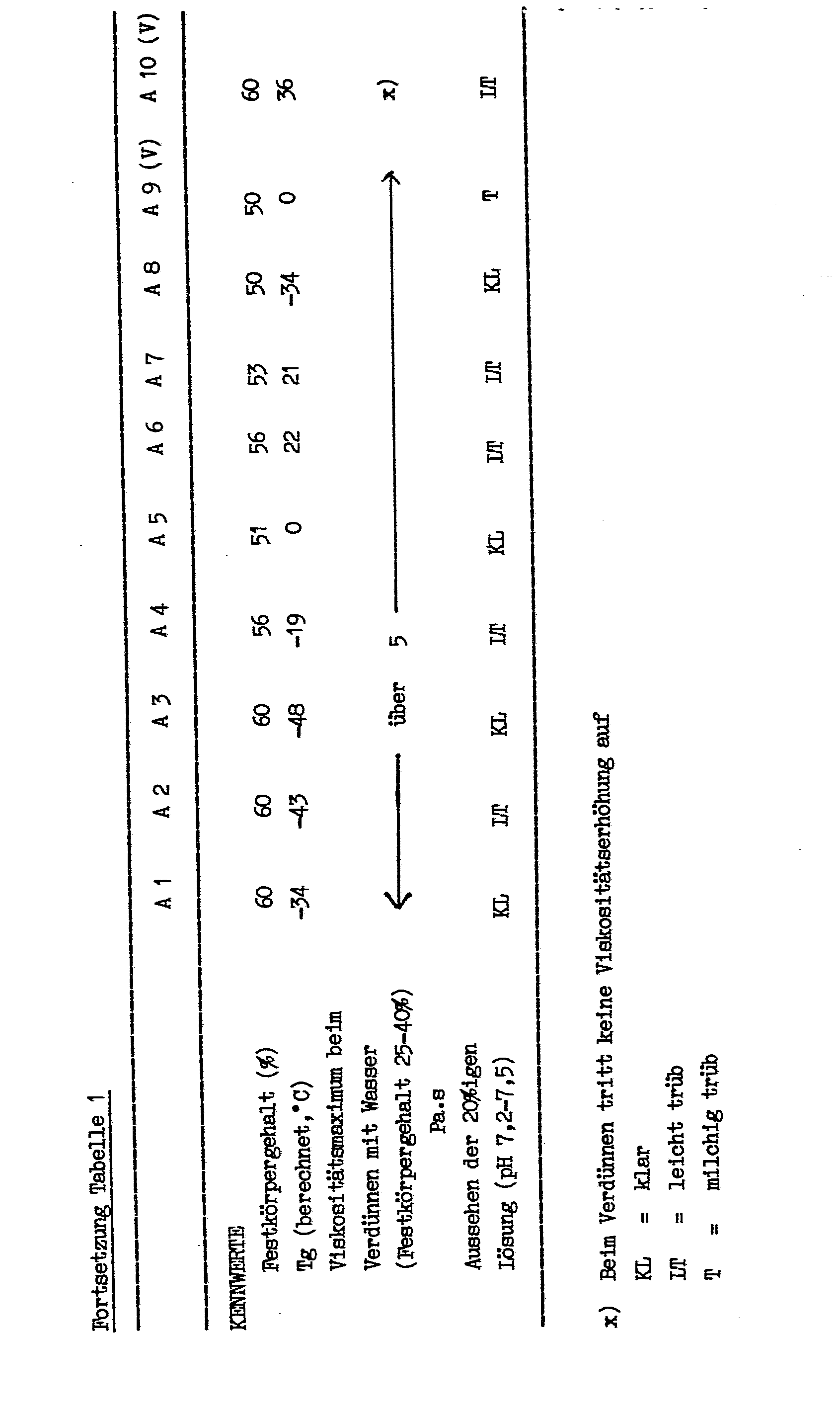
- the proportions are chosen within the specified range so that after neutralization of the 60% by weight solution with ammonia up to a pH of 7.2 to 7.5 when diluted with water, the copolymers have a clear or at most a slightly cloudy 20 % By weight solution.
- the pH is determined in the 20% aqueous solution. It is essential for the resins of component (A) according to the invention that their solubility properties are retained even when polyfunctional monomers : group (Ag) are used.
- Another criterion of the copolymers is their viscosity behavior. If the ratio between the ionic groups and the other monomers is selected correctly, the polymers which can be used according to the invention show when diluted with water after adjusting the pH with ammonia to 7.2 to 7.5, a strong increase in viscosity, which must have a maximum of more than 5 Pa.s at a solids content between 25 and 40%.
- Essential to the present invention is the solvent mixture mentioned in the claim as component (B), which represents a proportion of 10 to 40% by weight of the preparation. 20 to 35% by weight of the solvent mixture are preferably used.
- This solvent mixture consists of 20 to 80% by weight of one or more solvents with an evaporation number (according to DIN 53 170) of less than 30 (group Ba) or one or more solvents with an evaporation number of over 60 (group Bb), wherein the solvents of group (Bb) are completely miscible with water at normal temperature, but are not miscible with a specified gasoline hydrocarbon.
- the gasoline hydrocarbon is specified by a boiling range of 80 to 110 ° C, as well as by an aromatic content of at most 5% by weight.
- the group (Ba) includes solvents such as methanol, ethanol, propanol, acetone, dioxane, propylene glycol monomethyl ether.
- the preferred solvent in this group is ethanol. All or part of the solvents in this group can be used as the polymerization medium for component (A).
- Group (Bb) includes, for example, glycols and glycol ethers such as ethylene glycol, diethylene glycol, diethylene glycol monomethyl or ethyl ether.
- a particularly preferred solvent is N-methylpyrrolidone.
- coloring or effect-giving component (C) which amounts to 1 to 30% by weight of the preparation, depending on the intended use, the usual or known inorganic or organic pigments or dyes or dyes or metal pigments or combinations of these for solid-color coating or effect coating Products are used.
- dyes or pigments for example, titanium dioxide, graphite, carbon black, zinc chromate, strontium chromate, barium chromate, lead chromate, lead cyanamide, lead silicochromate, zinc oxide, cadmium sulfide, chromium oxide, zinc sulfide, nickel titanium yellow, chromium titanium yellow, iron oxide red, iron oxide black, ultramarine complexe, halogenated phthalide blue, phthalide blue, phthalide redolene, phthalocyanine blue, phthalide Thioindigo pigments used.
- metal pigments are used individually or in a mixture, such as copper, copper alloys, aluminum and steel, preferably aluminum in an at least predominant proportion, in an amount of from 0.5 to 25% by weight, based on the total solids content of the Coating agents on binders.
- the proportions are chosen so that the desired metal effect is not suppressed.
- the preparations can moreover contain up to 20% of one or a mixture of different aqueous polymer dispersions (component D).
- component D aqueous polymer dispersions
- these dispersions which can be based on polymers, polycondensates or polyaddition resins, must of course be stable in the environment of the overall preparation. This applies in particular with regard to the pH value, the solvents present and the pigments or fillers.
- Preferred dispersions are poly (meth) acrylates or styrene-acrylate copolymer dispersions, as are commercially available in large numbers.
- dispersions based on polyesters and, in some cases, particularly inexpensive polyurethane dispersions can also be used.
- a preferred quantity range for all dispersions is 5 to 15% by weight of the preparation.
- the preparations contain up to 20% by weight of an amino-formaldehyde condensate (component E).
- component E amino-formaldehyde condensate
- the preferred range for this component is between 3 and 12% by weight based on the entire preparation.
- Water-soluble or water-compatible melamine-formaldehyde condensates, the methylol groups of which are partially or completely etherified with methanol, are preferably used.
- the copolymer (A) which is in solution, preferably in ethanol, is neutralized to a pH of 7.0 to 7.5 with an amine, preferably a tertiary alkanolamine, such as dimethyl or diethyl ethanolamine .
- an amine preferably a tertiary alkanolamine, such as dimethyl or diethyl ethanolamine .
- color pastes are produced with the pigments or fillers on appropriate dispersing devices such as sand, bead or ball mills.
- proportions of water and / or the solvent of component (B) or of the amino resin (component E) can also be used.
- conventional dispersing or wetting agents can also be used.
- Metal pigments are expediently predispersed with part of the solvent component (B) before incorporation into the binder.
- the pigment preparations thus obtained are coated with residual polymer (A) and amino resin (E) and prediluted with residual solvent (mixture) (B) and water. Then the dispersion (D) is optionally added and the pH is adjusted to 6.5-9, preferably 7.0 to 8.0. Furthermore, the solids content and the viscosity are adjusted to the values adapted to the respective application conditions.
- the ready-to-use coating compositions generally have a solids content of 10 to 30% by weight and their run-out time in accordance with DIN 53211/20 * C is 13 to 25 seconds, preferably 15 to 18 seconds.
- Their water content is 50 to 80% by weight, that of organic solvents 10 to 40% by weight, based in each case on the total coating agent.
- the coating agents according to the invention can also contain other conventional additives such as thickeners, fillers, plasticizers, stabilizers, light stabilizers, wetting agents, dispersing agents, leveling agents, waxes, defoamers and catalysts, individually or in Mixture contained in the usual amounts. These substances can be added to the individual components and / or the overall mixture. The addition of other solvents customary in the paint industry may of course only be carried out to such an extent that the rheological characteristics of the coating agent are not impaired.
- the application takes place with the usual devices, whereby in the case of metallic effect basecoats a particularly uniform and bright effect is achieved when using the air spray process.
- basecoats a particularly uniform and bright effect is achieved when using the air spray process.
- electrostatic or air-assisted electrostatic application processes or combinations of these processes can also be used.
- the coating compositions according to the invention are notable for very good applicability when spraying. The favorable properties are primarily caused by the rheological behavior of the polymerization component (A) in an aqueous environment, which is further enhanced by the selected solvent system (B).
- wet-on-wet can be painted over with a transparent top coat.
- a shortening of the flash-off time is desired, or in the case of very high air humidity, it is advisable to switch on a warm-blowing zone before applying the transparent coating varnish.
- the quantities for the starting materials and key figures for this component are summarized in Table 1.
- the preparation takes place according to the usual methods of solution polymerization. Part of the solvent used as the polymerization medium is placed in a reaction vessel equipped with a stirrer, reflux condenser, thermometer and addition vessel. At the reflux temperature, the mixture of the monomers, the remaining solvent and the initiator and regulator are uniformly added from the addition vessel over the course of 4 hours. After a further 3 hours of reaction time, further initiator is added. After a further 2 hours of reaction time, part of the solvent is distilled off.
- the clear coat is adjusted with the above-mentioned KW solvent to a spray viscosity corresponding to a flow time in accordance with DIN 53211/23 ° C of 22 seconds.
- the dry film thickness is 40 ⁇ m.
- Examples 13 and 14 are comparative examples with base layers in which component (A) does not show the required properties, in particular a corresponding viscosity ratio.
Landscapes
- Chemical & Material Sciences (AREA)
- Life Sciences & Earth Sciences (AREA)
- Engineering & Computer Science (AREA)
- Materials Engineering (AREA)
- Wood Science & Technology (AREA)
- Organic Chemistry (AREA)
- Paints Or Removers (AREA)
- Application Of Or Painting With Fluid Materials (AREA)
Abstract
Description
- Die Erfindung betrifft wasserverdünnbare Überzugsmittel zur Verwendung in Pigmente sowie gegebenenfalls Füllstoffe, organische Hilfslösemittel und übliche Hilfsstoffe enthaltenden Basisschichten ("base coats") von Zweischicht-Decklackierungen, insbesonders in Metallpigmente enthaltenden Basisschichten, auf der Basis von Acrylatcopolymeren.
- Bei der Automobillackierung, aber auch in anderen Bereichen, in denen man Überzüge mit guter dekorativer Wirkung und gleichzeitig einen guten Korrosionsschutz wünscht, ist es üblich, Substrate mit mehreren, übereinander angeordneten Überzugsschichten zu versehen.
- In neuerer Zeit werden Decklackierungen in zwei getrennten Arbeitsgängen appliziert.Hierbei wird zunächst ein pigmentiertes Überzugsmittel (Basisschicht) und anschließend eine transparente Deckschicht, d. h. in der Regel ein Klarlack, der keine oder nur transparente Pigmente enthält, aufgebracht. Zur Erzielung eines sogenannten "metallic"-Effektes des Decklackes werden in der Basisschicht metallische Pigmente verwendet.
- In der industriellen Praxis der Automobillackierung werden derzeit für diesen Zweck Überzugsmittel verwendet, die einen hohen Gehalt an organischen Lösemitteln enthalten. Aus wirtschaftlichen Gründen und zur Verringerung der Umweltbelastung ist man seit vielen Jahren bemüht, diese organischen Lösemittel in den Überzugsmitteln so weit wie möglich zu verringern. Es sind daher Überzugsmittel bekannt geworden, die als Löse- oder Dispergiermittel überwiegend Wasser enthalten und in denen organische Lösemittel nur noch in geringen Mengen enthalten sind.
- So wird in der US 38 62 071 ein wasserverdünnbares Bindemittelsystem für Metallic-Lacke aus einem wasserlöslichen Acrylcopolymerisat und Hexamethoxymethylmelamin beschrieben, welches durch unvollständige Neutralisation mit Aminen in einer dispersoiden Form vorliegt. Eine wesentliche Eigenschaft von.Metallic-Lackbinde- mitteln, nämlich die Fixierung der Metallpigmentteilchen in einer für den optischen Aspekt günstigen Lage, wird in diesem Fall durch Zusatz eines wasserunlöslichen Copolymerisats erreicht.
- Gemäß GB 20 73 609 wird dieser Effekt in einer Basisschicht für eine Zweischichtlackierung durch Verwendung intern vernetzter Copolymerdispersionen ("Mikrogele") erhalten.
- Auch gemäß EP-A 1 00 29 597 wird der gewünschte Effekt durch einen teilweise dispersoiden Charakter des wasserlöslichen Acrylatcopolymeren erreicht, wobei dieser durch ein abgestimmtes Verhältnis zwischen den Hydroxyl-und Carboxylgruppen bedingt ist.
- In anderen Fällen wird versucht, die Eigenschaften der Basisschicht durch Mitverwendung von Polyurethandispersionen (DE 32 10 051) oder Einbau von Celluloseestern (DE 32 16 549) zu erreichen.
- Allen oben erwähnten Zubereitungen haftet der wesentliche Nachteil an, daß die darin enthaltenen Bindemittelmischungen ihre rheologischen Eigenschaften, welche zur Orientierung und Fixierung der stark anisotropen Metallpigmentblättchen im Interesse eines optisch günstigen Metalleffektes erforderlich sind, durch die dispersoiden Bindemittelanteile und zusätzliche rheologiebeeinflussende Komponenten, wie Thixotropiermittel oder Füllstoffe erhalten.
- Diese Maßnahmen sind jedoch entweder mit Beeinträchtigungen in bezug auf die Lagerbeständigkeit der Zubereitungen bzw. der Applizierbarkeit, insbesonders auf elektrostatischen Hochrotationszerstäuberanlagen, oder in bezug auf die Wetterfestigkeit der Lackfilme verbunden.
- Überraschenderweise wurde nun gefunden, daß man wasserverdünnbare Zubereitungen für Basisschichten auf Acrylatbasis, insbesonders für Metalleffektlacke erhält, welche die Nachteile der bekannten Produkte nicht aufweisen, wenn für die Formulierung der Zubereitungen neben den ausgewählten Bindemitteln spezifische Losemittelkombinationen herangezogen werden.
- Die Erfindung betrifft demgemäß wasserverdünnbare Überzugsmittel zur Verwendung in Pigmente sowie gegebenenfalls Füllstoffe, organische Hilfslösemittel und übliche Hilfsstoffe enthaltenden Basisschichten ("base coats") von Zweischicht-Decklackierungen, insbesonders in Metallpigmente enthaltenden Basisschichten, auf der Basis von Acrylatcopolymeren, welche dadurch gekennzeichnet sind, daß die Basisschicht enthält
- (A) 10 bis 40 Gew.-%, vorzugsweise 15 bis 30 Gew.-% mindestens eines Copolymerisates mit einer Glasübergangstemperatur zwischen - 55°C und + 25°C, vorzugsweise zwischen -50'C und 0°C und aufgebaut aus
- (Aa)40 bis 60 Gew.-% Vinyl- oder Vinylidenverbindungen, welche außer der a,B-ethylenischen Doppelbindung keine weiteren funktionellen Gruppen aufweisen,
- (Ab)30 bis 40 Gew.-% Hydroxyalkylester der (Meth)acrylsäure, Maleinsäure oder Fumarsäure und/oder
- (Ac)30 bis 40 Gew.-% N-Methylol(meth)acrylsäureamid,
- (Ad) 2 bis 17 Gew.-% (Meth)acrylsäureamid,
- (Ae) 0 bis 8 Gew.-% alkoxymethyliertes N-Methylol(meth)-acrylsäureamid,
- (Af) 2 bis 8 Gew.-% α,ß-ethylenisch ungesättigte Monocarbonsäuren, vorzugsweise (Meth)acrylsäure und
- (Ag) 0 bis 0,8 Gew.-% einer di-a,ß-ungesättigten Verbindung, vorzugsweise Divinylbenzol, mit der Maßgabe, daß eine 60 Gew.-%ige Lösung des Copolymerisats in Ethanol nach Neutralisation der Carboxylgruppen mit Ammoniak bis zum Erreichen eines pH-Wertes von 7,2 bis 7,5 (gemessen in 20%iger wäßriger Lösung) mit Wasser klar oder nur mit leichter Trübung bis zu einem Festkörpergehalt von 20 % verdünnbar ist, und die Lösung beim Verdünnen mit Wasser bei einem Festkörper von 25 bis 40 % ein Viskositätsmaximum von mehr als 5 Pa.s aufweist,
- (B) 5 bis 40 Gew.-%, vorzugsweise 15 bis 35 Gew.-% eines Gemisches aus
- (Ba)20 bis 80 Gew.-% einem oder mehreren Lösemitteln mit einer Verdunstungszahl (nach DIN 53170) von weniger als 30 und
- (Bb)20 bis 80 Gew.-% einem oder mehreren bei Normaltemperatur vollständig mit Wasser mischbaren, jedoch mit einem Benzinkohlenwasserstofflösemittel mit einem Siedebereich von 80 bis 110*C und einem Aromatengehalt von maximal 5 % nicht mischbaren Lösemittel, welches eine Verdunstungszahl von über 60 aufweist,
- (C) 1 bis 30 Gew.-% einer oder mehrerer farb- und/oder effektgebenden Komponenten,
- (D) 0 bis 20 Gew.-%, vorzugsweise 5 bis 15 Gew.-% einer oder mehrerer im Milieu der Lackpräparation stabilen Dispersion auf Basis von Vinylpolymeren, Polykondensaten oder Polyadditionsharzen und
- (E) 0 bis 20 Gew.-%, vorzugsweise 3 bis 12 Gew.-% eines oder mehrerer teilweise oder vollständig veretherter Amino-Formaldehyd-Kondensate.
- Die Erfindung betrifft weiterhin die Verwendung der gemäß Hauptanspruch gekennzeichneten Zubereitungen als Basisschichten für Zweischicht-Decklackierungen, insbesonders für Metalleffektlacke.
- Die erfindungsgemäßen Zubereitungen ergeben insbesondere bei Verwendung von metallischen Pigmenten Überzüge mit einem besonders guten Metall-Effekt, da sie zu einer sehr günstigen Anordnung und Fixierung der metallischen Pigmente im Lackfilm führen. Aber auch bei Verwendung konventioneller, nicht metallischer Pigmente ergeben sich Überzüge mit ausgezeichneter dekorativer Wirkung. Ein besonderer Vorteil der Uberzugsmittel liegt darin, daß sie beim Aufbringen einer weiteren Überzugsschicht auf den vorgetrockneten aber noch nicht eingebrannten Film nur ein sehr geringes oder kein Anlösen zeigen.
- Im einzelnen bestehen die erfindungsgemäßen Basisschichten aus den folgenden Komponenten und spezifischen Materialien:
- Die Komponente (A) stellt ein in bekannter Weise nach einem Verfahren der Lösungspolymerisation hergestelltes Polymerisat dar. Anspruchsgemäß weist das Polymerisat eine Glasübergangstemperatur (Tg) zwischen -55°C und + 25°C. Bevorzugt werden Polymerisate mit einer Glasübergangstemperatur zwischen -50'C und 0°C.
- Eine angenäherte Berechnung der Glasübergangstemperatur aus der Glasübergangstemperatur der Homopolymeren der eingesetzten Monomeren kann nach folgender Formel erfolgen:

Tg = Glasübergangstemperatur des Copolymeren in °K Tgi = Glasübergangstemperatur des Homopolymerisates
des Monomeren i in °K
Ki = Anteil des Monomeren i im Copolymeren in Gew.-% - Für den Aufbau der Copolymerisate (Komponente A) werden folgende Gruppen von Monomeren eingesetzt.
- 40 bis 60 % der Monomerbausteine sind Vinyl- oder Vinylidenmonomere, welche außer der a,B-ethylenischen Doppelbindung keine funktionelle Gruppe tragen (Gruppe A). Dazu zählen die C1- bis C12-Alkanolester der Acryl- bzw. Methacrylsäure und aromatische Monomere wie Styrol, Vinyltoluol, p-tert.Butylstyrol u.ä.
- Ein weiterer Bestandteil der Komponente (A) sind 30 bis 40 Gew.-% C2-bis C4-Hydroxyalkylester der Acryl-oder Methacrylsäure (Gruppe Ab). Bevorzugt werden Hydroxyethyl(meth)acrylat und 2-Hydroxypropyl-(meth)acrylat eingesetzt. Diese Gruppe kann, vorteilhafterweise nur teilweise, durch N-Methylol(meth)acrylsäureamid (Gruppe Ac) ersetzt werden.
- Als weitere Gruppen werden 2 bis 17 Gew.-% (Meth)acrylsäureamid (Gruppe Ad) und 0 bis 8 Gew.-% C1-bis C4-alko- xylierte (Meth)acrylsäureamide (Ae) eingesetzt.
- Die für die nach zumindest teilweiser Neutralisation gegebene Wasserlöslichkeit notwendigen Carboxylgruppen werden durch die Verwendung von 2 bis 8 Gew.-% von a,ß-ethylenisch ungesättigten Carbonsäuren, insbesonders Acryl- oder Methacrylsäure eingeführt (Af).
- Gegebenenfalls kann die Monomerenzusammensetzung überdies bis zu 0,8 Gew.-%, bezogen auf die Gesamtmonomeren, einer mehrfach-α,β-ethylenisch ungesättigten Verbindung enthalten. Als solche kommt vorzugsweise Divinylbenzol zum Einsatz. Weitere Verbindungen dieser Art sind Di- oder Triacrylate, wie Ethylenglykoldimethacrylat oder Propantrioltrimethacrylat.
- Die Mengenverhältnisse werden innerhalb des angegebenen Rahmens so gewählt, daß die Copolymerisate nach Neutralisation der 60 Gew.-%igen Lösung mit Ammoniak bis zu einem pH-Wert von 7,2 bis 7,5 beim Verdünnen mit Wasser eine klare oder höchstens leicht trübe 20 Gew.%ige Lösung ergeben. Die Bestimmung des pH-Wertes erfolgt in der 20%igen wäßrigen Lösung. Es ist für die erfindungsgemäßen Harze der Komponente (A) wesentlich, daß ihre Löslichkeitseigenschaften auch bei Verwendung von mehrfunktionellen Monomeren:der Gruppe (Ag) erhalten bleiben.
- Ein weiteres Kriterium der Copolymerisate liegt in ihrem Viskositätsverhalten. Bei richtiger Auswahl des Verhältnisses zwischen den ionischen Gruppierungen und den übrigen Monomeren zeigen die erfindungsgemäß einsetzbaren Polymerisate beim Verdünnen mit Wasser nach Einstellung des pH-Wertes mit Ammoniak auf 7,2 bis 7,5 einen starken Viskositätsanstieg, welcher bei einem Festkörpergehalt zwischen 25 und 40 % ein Maximum von mehr als 5 Pa.s aufweisen muß.
- Wesentlich für die vorliegende Erfindung ist das im Anspruch als Komponente (B) angeführte Lösemittelgemisch, welches einen Anteil von 10 bis 40 Gew.-% der Zubereitung darstellt. Vorzugsweise werden 20 bis 35 Gew.-% des Lösesmittelgemisches eingesetzt.
- Dieses Lösemittelgemisch besteht aus jeweils 20 bis 80 Gew.-% eines oder mehrerer Lösemittel mit einer Verdunstungszahl (nach DIN 53 170) von weniger als 30 (Gruppe Ba) bzw. einem oder mehreren Lösemitteln mit einer Verdunstungszahl von über 60 (Gruppe Bb), wobei die Lösemittel der Gruppe (Bb) bei Normaltemperatur vollständig mit Wasser mischbar sind, jedoch mit einem spezifizierten Benzinkohlenwasserstoff nicht mischbar sind. Der Benzinkohlenwasserstoff ist durch einen Siedebereich von 80 bis 110°C, sowie durch einen Aromatengehalt von maximal 5 Gew.-% spezifiziert.
- Zur Gruppe (Ba) gehören Lösemittel wie Methanol, Ethanol, Propanol, Aceton, Dioxan, Propylenglykolmonomethylether. Bevorzugtes Lösemittel dieser Gruppe ist Ethanol. Die Lösemittel dieser Gruppe können zur Gänze oder teilweise als Polymerisationsmedium für die Komponente (A) dienen.
- Zur Gruppe (Bb) gehören beispielsweise Glykole und Glykolether wie Ethylenglykol, Diethylenglykol, Diethylenglykolmonomethyl- bzw. -ethylether. Ein besonders bevorzugtes Lösemittel ist N-Methylpyrrolidon.
- Die Nichtmischbarkeit dieser Lösemittel wird durch Mischen bei Raumtemperatur von gleichen Teilen des Lösemittels mit dem spezifizierten Benzinkohlenwasserstoff geprüft und äußert sich durch eine relativ rasche Ausbildung von zwei getrennten Phasen.
- Als farbgebende bzw. effektgebende Komponente (C), welche 1 bis 30 Gew.-% der Zubereitung beträgt, können je nach Einsatzzweck die für Uni-Lackierung oder für Effektlackierung üblichen und bekannten anorganischen oder organischen Pigmente oder Farbstoffe bzw. Metallpigmente bzw. Kombinationen dieser Produkte eingesetzt werden.
- Als Farbstoffe bzw. Pigmente werden beispielsweise Titandioxid, Graphit, Ruß, Zinkchromat, Strontiumchromat, Bariumchromat, Bleichromat, Bleicyanamid, Bleisilicochromat, Zinkoxid, Cadmiumsulfid, Chromoxid, Zinksulfid, Nickeltitangelb, Chromtitangelb, Eisenoxidrot, Eisenoxidschwarz, Ultramarinblau, Phthalocyaninkomplexe, Naphtholrot, Chinacridone, halogenierte Thioindigo-Pigmente eingesetzt.
- Als besonders bevorzugte Pigmente werden Metallpigmente einzeln oder im Gemisch, wie Kupfer, Kupferlegierungen, Aluminium und Stahl, vorzugsweise Aluminium in wenigstens überwiegendem Anteil, verwendet, und zwar in einer Menge von 0,5 bis 25 Gew.-% bezogen auf den gesamten Festkörpergehalt der Überzugsmittel an Bindemitteln. Bei Mischungen aus einem oder mehreren der obengenannten nichtmetalllischen Pigmente bzw. Farbstoffe mit Metallpigmenten werden die Anteile so gewählt, daß der erwünschte Metall-Effect nicht unterdrückt wird.
- Zur Erzielung günstiger Eigenschaften bezüglich der Applizierbarkeit (Spritzbarkeit) und einer rascheren Antrocknung der Basisschicht durch physikalische Trocknung können die Zubereitungen überdies bis zu 20 % einer oder eine Mischung verschiedener wäßriger Polymerdispersionen enthalten (Komponente D). Diese Dispersionen, welche auf Basis von Polymerisaten, Polykondensaten oder Polyadditionsharzen aufgebaut sein können, müssen selbstverständlich im Milieu der Gesamtzubereitung stabil sein. Dies gilt insbesonders in bezug auf den pH-Wert, die vorhandenen Lösemittel und die Pigmente bzw. Füllstoffe. Bevorzugte Dispersionen sind Poly(meth)acrylate oder Styrol-Acrylat-Copolymerdispersionen, wie sie im Handel in großer Zahl zur Verfügung stehen. Weiters sind auch Dispersionen auf Basis von Polyestern und in manchen Fällen besonders günstig Polyurethandispersionen einsetzbar. Ein bevorzugter Mengenbereich für alle Dispersionen liegt bei 5 bis 15 Gew.-% der Zubereitung.
- Zur Vernetzung der Filme enthalten die Zubereitungen, soferne sie nicht im ausreichenden Maße selbstvernetzende Eigenschaften aufweisen, bis zu 20 Gew.-% eines Amino-Formaldehyd-Kondensates (Komponente E). Der bevorzugte Bereich für diese Komponente liegt zwischen 3 und 12 Gew.-% bezogen auf die gesamte Zubereitung. Bevorzugt werden wasserlösliche oder wasserverträgliche Melamin-Formaldehyd-Kondensate, deren Methylolgruppen teilweise oder vollständig mit Methanol verethert sind, eingesetzt.
- Bei der Herstellung der Überzugsmittel wird das Copolymerisat (A), welches in Lösung, vorzugsweise in Ethanol vorliegt mit einem Amin, vorzugsweise einem tertiären Alkanolamin, wie Dimethyl- oder Diethyl-ethanolamin auf einem pH-Wert von 7,0 bis 7,5 neutralisiert. Mit einem Teil der neutralisierten Komponente (A) werden auf entsprechenden Dispergiergeräten wie Sand-, Perl- oder Kugelmühlen mit den Pigmenten bzw. Füllstoffen Farbpasten hergestellt. Bei Bedarf können dabei auch Anteile Wasser und/oder des Lösungsmittels der Komponente (B) oder des Aminoharzes (Komponente E) mitverwendet werden. Überdies können auch übliche Dispergier- oder Netzmittel zur Anwendung kommen. Metallpigmente werden zweckmäßig vor der Einarbeitung in das Bindemittel mit einem Teil der Lösemittelkomponente (B) vordispergiert.
- Die so erhaltenen Pigmentzubereitungen werden mit restlichem Polymerisat (A) und Aminoharz (E) aufgelackt und mit restlichem Lösungsmittel(gemisch) (B) und Wasser vorverdünnt. Danach wird gegebenenfalls die Dispersion (D) zugesetzt und der pH-Wert auf 6,5 - 9, vorzugsweise 7,0 bis 8,0 eingestellt. Weiterhin werden der Festkörpergehalt und die Viskosität auf die den jeweiligen Applikationsbedingungen angepaßten Werte eingestellt.
- Die gebrauchsfertigen Überzugsmittel weisen in der Regel einen Festkörpergehalt von 10 bis 30 Gew.-% auf, und ihre Auslaufzeit nach DIN 53211/20*C beträgt 13 bis 25 Sekunden, vorzugsweise 15 bis 18 Sekunden. Ihr Wasseranteil beträgt 50 bis 80 Gew.-%, der an organischen Lösungsmitteln 10 bis 40 Gew.-%, jeweils bezogen auf das gesamte Überzugsmittel.
- Die erfindungsgemäßen Überzugsmittel können auch weitere übliche Zusätze wie Verdickungsmittel, Füllstoffe, Weichmacher, Stabilisatoren,Lichtschutzmittel, Netzmittel, Dispergierhilfsmittel, Verlaufmittel, Wachse, Entschäumer und Katalysatoren einzeln oder im Gemisch in den üblichen Mengen enthalten. Diese Substanzen können den Einzelkomponenten und/oder der Gesamtmischung zugesetzt werden. Der Zusatz anderer in der Lackindustrie üblichen Lösemittel darf selbstverständlich nur in einem Ausmaß erfolgen, daß die rheologische Charakteristik des Überzugsmittels nicht beeinträchtigt wird.
- Die Applikation erfolgt mit den praxisüblichen Vorrichtungen, wobei im Falle von Metalleffekt-Basislacken bei Verwendung des Luftspritzverfahrens ein besonders gleichmäßiger und heller Effekt erzielt wird. Jedoch können auch rein elektrostatische oder luftunterstützte elektrostatische Auftragsverfahren oder Kombinationen dieser Verfahren zur Anwendung kommen. Die erfindungsgemäßen Überzugsmittel zeichnen sich durch eine sehr gute Applizierbarkeit beim Spritzauftrag aus. Die günstigen Eigenschaften werden vor allem durch das rheologische Verhalten der Polymerisationskomponente (A) im wäßrigen Milieu bewirkt, welches durch das ausgewählte Lösemittelsystem (B) noch verstärkt wird.
- Nach einer Ablüftzeit von 5 - 10 Minuten bei Raumtemperatur kann naß-auf-naß mit einem transparenten Uberzugslack überlackiert werden. In bestimmten Fällen, z. B. falls eine Verkürzung der Ablüftzeit gewünscht wird, oder im Falle einer sehr hohen Luftfeuchtigkeit, empfiehlt sich das Einschalten einer Warmblaszone vor dem Auftrag des transparenten Uberzugslackes.
- Als transparente Uberzugslacke kommen konventionelle lösungsmittelhaltige, wasserverdünnbare oder PulverLacke in Frage. In besonderer Weise eignen sich dafür 2-Komponenten-Klarlacke auf Basis von Acryl- und/oder Polyesterharzen, welche mit Polyisocyanaten. gehärtet werden, oder 1-Komponenten-Klarlacke auf Acrylharz-Melaminharz-Basis. Der Mehrschichtüberzug wird dann gemäß den Anforderungen des Uberzugs-Klarlackes bei der erforderlichen Temperatur ausgehärtet.
- Die folgenden Beispiele erläutern die Erfindung, ohne sie zu beschränken. Alle Angaben in Teilen oder Prozenten beziehen sich, soferne nichts anderes angegeben ist, auf Gewichtseinheiten.
- Die Mengenangaben für die Ausgangsmaterialien und Kennzahlen dieser Komponente sind in der Tabelle 1 zusammengefaßt. Die Herstellung erfolgt nach den üblichen Methoden der Lösungspolymerisation. Dabei wird ein Teil des als Polymerisationsmedium dienenden Lösemittels in einem mit Rührer, Rückflußkühler, Thermometer und Zugabegefäß ausgestatteten Reaktionsgefäß vorgelegt. Bei Rückflußtemperatur wird die Mischung der Monomeren, des restlichen Lösemittels sowie Initiator und Regler innerhalb von 4 Stunden aus dem Zugabegefäß gleichmäßig zugegeben. Nach weiteren 3 Stunden Reaktionszeit wird weiterer Initiator zugegeben. Nach weiteren 2 Stunden Reaktionszeit wird ein Teil des Lösemittels abdestilliert.
- Als Komponente (C) werden in den Beispielen folgende Pigmentzubereitungen eingesetzt:
- (C1) 43,25 Tle Aluminiumpaste (1) 56,18 Tle Propylenglykolmonomethylether 0,57 Tle anionisches Netzmittel (2)
100,00- (1) Aluminiumpaste Typ 4 gemäß ISO R 1247 ca. 68%ig an 99,99 %igem Aluminium, Teilchengröße unter 44 µm, mit speziellen Emulgatoren und Stabilisatoren für den Einsatz in Wasserlacken (Handelsname TOYO 8160 SE, Toyo Aluminium KK, Japan)
- (2) Hochmolekulare, ungesättigte Polycarbonsäure kombiniert mit lackverträglichem Siliconharz (Wirksubstanz 50 %, klare gelbe Flüssigkeit, Flammpunkt ca 28'C; Handelsname BYK P 104 S, BYK-Mallinckrodt, BRD)
- (C2) 24,40 Tle Copolymer (A3) 0,90 Tle Dimethylethanolamin 8,50 Tle Propylenglykolmonomethylether 0,30 Tle anionisches Netzmittel (siehe C1) 8,30 Tle N-Methylpyrrolidon 57,60 Tle Ti02 (Rutil-Typ) 100,00
- (C3) 26,80 Tle Copolymer (A3) 5,30 Tle Dimethylethanolaminlösung (10%ig in H20) 61,10 Tle H20 0,30 Tle anionisches Netzmittel (siehe C1) 6,50 Tle HOSTAPERMBLAU B3G (HOECHST AG, BRD) 100,00
- (C4) wie (C3), jedoch als Farbpigment 6,50 Tle Farbruß (PRINTEX U)
-
- (D1) Selbstvernetzende, feindisperse Copolymerisatdispersion auf Basis Styrol/Acrylat, Festkörpergehalt: ca. 45 %; pH-Wert (DIN 53785): 3 - 4; Mindestfilmbildetemperatur: 0°C (z. B. MOWILITH LDM 7130, HOECHST AG, BRD)
- (D2) Wäßrige, einkomponentige aliphatische Polyurethandispersion; Festkörpergehalt: ca. 34 %; pH-Wert (DIN 53785): 7,5 - 8,5; Mindestfilmbildetemperatur: unter 0°C (z. B. NEO-REZ R-961, Polyvinyl Chemie, NE)
- (D3) Mittelviskose, feinteilige Acrylsäureester-copolymer-Dispersion; Festkörpergehalt: ca. 46 %; pH-Wert: 8 - 9; Mindestfilmbildetemperatur: ca. 40'C (z. B. MOWILITH LDM 7760, HOECHST AG, BRD)
-
- (E1) Handelsübliches wasserlösliches, partiell mit Methanol verethertes Melamin-Formaldehyd-Kondensat; im Mittel ca. 5 - 6 Methylolgruppen, davon verethert ca. 3 - 4; Festkörpergehalt: 62 % Lösemittel, Diethylenglykoldimethylether (z. B. RESYDROL WM 501, VIANOVA,AT)
- (E2) Handelsübliches Hexamethoxymethylmelamin Festkörpergehalt: ca. 95 % (z. B. MAPRENAL VMF 3904, HOECHST AG, BRD) Beispiele 1 - 14: Die Zusammensetzung und Eigenschaften der Basisschicht-Zubereitungen und der Zweischichtlackierungen sind in der Tabelle 2 zusammengefaßt. Die einzelnen Komponenten werden in der angegebenen Reihenfolge unter gutem Rühren vermischt, falls erforderlich mit Wasser auf eine Auslaufzeit von 15 bis18 Sekunden (DIN 53211, 20°C) eingestellt und durch Spritzen
auf gereinigten Stahlblechen bzw. im Aufbau auf K-ETL-Grundierung / Automobilfüller appliziert. Der Auftrag erfolgte mit einer Luftspritzpistole (Düsendurchmesser 1,2 mm) bei einem Spritzdruck von 6 bis 7 bar in drei Passagen. Vor dem Überspritzen mit dem Klarlack wurde die Basisschicht 5 Minuten bei 60°C getrocknet. - Als Deckschicht für die Zweischichtlackierung wurde ein Klarlack folgender Zusammensetzung verwendet:
- 56,8 Tlen eines handelsüblichen fremdvernetzenden Acrylharzes (60%ig in SHELLSOL A/Butylacetat, Viskosität ca. 1000 mPa.s/25°C; Säurezahl 12 - 22 mg KOH/g; z. B. VIACRY SC 341, VIANOVA, AT),
- 22,9 Tlen eines mit Isobutanol veretherten Melamin harzes (60%ig in Butanol, Viskosität ca. (800 mPa.s/25°C, VIAMIN MF 514, VIANOVA, AT),
- 13,75 Tlen eines aromatenreichen Kohlenwasserstofflösemittels (Siedebereich 160 - 182°C, Anilinpunkt 15°C, Kauri-Butanol-Wert 90) und
- 6,55 Tlen Butanol.
- Der Klarlack wird mit dem obengenannten KW-Lösemittel auf eine Spritzviskosität entsprechend einer Auslaufzeit gemäß DIN 53211/23°C von 22 Sekunden eingestellt.
- Nach dem Einbrennen (25 Minuten / 140°C) resultiert eine Trockenfilmstärke von 40 µm.
- Die Beispiele 13 und 14 sind Vergleichsbeispiele mit Basisschichten, in denen die Komponente (A) nicht die geforderten Eigenschaften, insbesonders ein entsprechendes Viskositätsverhälten zeigt.




-
- (V) Vergleichsbeispiel
- DMEA Dimethylethanolamin (10%ige Lösung in Wasser)
- NMP N-Methylpyrrolidon
- (I) Prüfung der Lagerstabilität der Basislacke (7 Tage bei 50'C) K keine Veränderung K- leichte Phasentrennung V Vergrauen der Aluminiumpigmentteilchen
- (II) Prüfung des Applikationsverhaltens G starkes Ablaufen, "Gardinenbildung"
- (III) Beurteilung der eingebrannten 2-Schichtlackierung
- 1 einwandfreier Effekt, hoher Glanz
- 2 einwandfreier Effekt bei noch zufriedenstellendem Glanz
- 3 wolkiger Effekt, mäßiger Glanz
Claims (3)
Applications Claiming Priority (2)
| Application Number | Priority Date | Filing Date | Title |
|---|---|---|---|
| AT0057185A AT381499B (de) | 1985-02-27 | 1985-02-27 | Wasserverduennbare ueberzugsmittel, verfahren zur herstellung und ihre verwendung fuer basisschichtenbei zweischicht-decklackierung |
| AT571/85 | 1985-02-27 |
Publications (2)
| Publication Number | Publication Date |
|---|---|
| EP0195931A1 true EP0195931A1 (de) | 1986-10-01 |
| EP0195931B1 EP0195931B1 (de) | 1988-10-12 |
Family
ID=3494127
Family Applications (1)
| Application Number | Title | Priority Date | Filing Date |
|---|---|---|---|
| EP86102145A Expired EP0195931B1 (de) | 1985-02-27 | 1986-02-19 | Wasserverdünnbare Überzugsmittel zur Herstellung von Basisschichten bei Zweischichtlackierung |
Country Status (6)
| Country | Link |
|---|---|
| US (1) | US4730020A (de) |
| EP (1) | EP0195931B1 (de) |
| JP (1) | JPS61203179A (de) |
| AT (1) | AT381499B (de) |
| CA (1) | CA1279743C (de) |
| DE (1) | DE3660918D1 (de) |
Cited By (14)
| Publication number | Priority date | Publication date | Assignee | Title |
|---|---|---|---|---|
| EP0266152A3 (en) * | 1986-10-27 | 1989-10-11 | Nippon Paint Co., Ltd. | Method of painting |
| EP0393578A3 (de) * | 1989-04-15 | 1992-01-08 | Nippon Paint Co., Ltd. | Wässrige Harzzusammensetzung |
| EP0421609A3 (en) * | 1989-09-05 | 1992-02-12 | E.I. Du Pont De Nemours And Company | Waterbased acrylic coating composition |
| WO1992017554A1 (de) * | 1991-03-30 | 1992-10-15 | Basf Lacke + Farben Aktiengesellschaft | Mischsystem zur herstellung wasserverdünnbarer überzugsmittel |
| WO1993023177A1 (de) * | 1992-05-20 | 1993-11-25 | Basf Lacke + Farben Aktiengesellschaft | Verfahren zur herstellung einer zweischichtigen lackierung und für dieses verfahren geeignete wässrige lacke |
| US6410646B1 (en) | 1997-03-07 | 2002-06-25 | Basf Coatings Ag | Method for producing scratch resistant coatings, especially for producing multi-layer enamels |
| US6534185B1 (en) | 1998-10-31 | 2003-03-18 | Basf Coatings Ag | Coating agent with a macromer unit for the production of multi-layered coatings |
| US6555613B1 (en) | 1999-03-10 | 2003-04-29 | Basf Coatings Ag | Polyurethane and its use for producing solvent-free coating substances |
| US6555612B1 (en) | 1999-01-28 | 2003-04-29 | Basf Coatings Ag | Aqueous coating material and modular system for producing same |
| US6828381B1 (en) | 1999-08-27 | 2004-12-07 | Basf Coatings Ag | Sol-gel coating |
| US6872765B1 (en) | 1999-03-06 | 2005-03-29 | Basf Coatings Ag | Sol-gel coating for single-layer or multi-layer varnishes |
| WO2010071952A1 (en) * | 2008-12-22 | 2010-07-01 | Technosolutions Assessoria Ltda | Flexographic printing process with wet on wet capability |
| US7932317B1 (en) | 1999-05-08 | 2011-04-26 | Basf Coatings Ag | Aqueous coating material and modular system for producing same |
| EP3815898A1 (de) | 2019-10-28 | 2021-05-05 | Covestro Deutschland AG | Schichtenverbund aus polycarbonat und polycarbonatblend zur verbesserten lackierbarkeit |
Families Citing this family (26)
| Publication number | Priority date | Publication date | Assignee | Title |
|---|---|---|---|---|
| JPH0788492B2 (ja) * | 1986-10-31 | 1995-09-27 | 東洋インキ製造株式会社 | 水性塗料組成物 |
| CA2014539C (en) * | 1989-04-17 | 2000-07-25 | Shinichiro Umeda | Water borne metallic coating composition |
| DK0399427T3 (da) * | 1989-05-23 | 1994-06-06 | Basf Corp | Vandig metal-basisbelægning med forbedret stabilitet og udseende |
| US5051464A (en) * | 1989-09-01 | 1991-09-24 | E. I. Du Pont De Nemours And Company | Waterborne acrylourethane pigment dispersant polymer |
| US5266406A (en) * | 1989-11-08 | 1993-11-30 | E. I. Du Pont De Nemours And Company | Waterbased methylol (meth)acrylamide acrylic polymer and an acrylic hydrosol coating composition |
| DE4009931A1 (de) * | 1990-03-28 | 1991-10-02 | Basf Lacke & Farben | Verfahren zur herstellung eines mehrschichtigen ueberzugs, waessrige beschichtungszusammensetzungen, wasserverduennbare polyacrylatharze und verfahren zur herstellung von wasserverduennbaren polyacrylatharzen |
| DE4009857A1 (de) * | 1990-03-28 | 1991-10-02 | Basf Lacke & Farben | Verfahren zur herstellung einer mehrschichtigen lackierung und fuer dieses verfahren geeignete waessrige basislacke |
| US5166254A (en) * | 1990-12-03 | 1992-11-24 | E. I. Du Pont De Nemours And Company | Waterbased coating composition of methylol (meth)acrylamide acrylic polymer, acrylic hydrosol and melamine crosslinking agent |
| ATE139034T1 (de) * | 1991-12-21 | 1996-06-15 | Roehm Gmbh | Ir-reflektierender körper |
| DE4301991A1 (de) * | 1993-01-26 | 1994-07-28 | Herberts Gmbh | Modulsystem und dessen Verwendung bei Verfahren zur Herstellung von wäßrigen Überzugsmitteln |
| US5362518A (en) * | 1994-03-09 | 1994-11-08 | Johnson Rodney J | Method for watercolor painting using rock salt |
| US5464888A (en) * | 1994-03-31 | 1995-11-07 | Minnesota Mining And Manufacturing Company | Curable sealer and/or adhesive composition, and a method for coating same in a wet state with a base coat paint, and coated substrates formed thereby |
| US6277188B1 (en) | 1994-08-02 | 2001-08-21 | Basf Corporation | Refinish paint containing special effect pigment |
| JP3208022B2 (ja) * | 1994-10-21 | 2001-09-10 | 本田技研工業株式会社 | メタリック塗料の塗装方法 |
| WO1998027166A2 (de) | 1996-12-18 | 1998-06-25 | Basf Coatings Ag | Beschichtungsmittel und verfahren zu dessen herstellung |
| WO1998027134A1 (de) * | 1996-12-18 | 1998-06-25 | Basf Coatings Ag | Beschichtungsmittel und verfahren zu dessen herstellung |
| DE19908001A1 (de) | 1999-02-25 | 2000-08-31 | Basf Coatings Ag | Hochkratzfeste Mehrschichtlackierung, Verfahren zu ihrer Herstellung und ihre Verwendung |
| AU3805400A (en) | 1999-02-25 | 2000-09-14 | Basf Coatings Aktiengesellschaft | Utilization of tricyclodecandimethanol for producing multilayer lacquers |
| DE19914898C2 (de) | 1999-04-01 | 2002-10-24 | Basf Coatings Ag | Vernetzungsmittel für auf der Basis von Pyrimidin für thermisch härtbare Zusammensetzungen und deren Verwendung |
| DE19914896A1 (de) | 1999-04-01 | 2000-10-05 | Basf Coatings Ag | Thermisch und/oder mit aktinischer Strahlung härtbarer wäßriger Beschichtungsstoff und seine Verwendung |
| DE19930665A1 (de) * | 1999-07-02 | 2001-01-11 | Basf Coatings Ag | Basislack und seine Verwendung zur Herstellung von farb- und/oder effektgebenden Basislackierungen und Mehrschichtlackierung |
| DE19933500A1 (de) * | 1999-07-16 | 2001-01-18 | Basf Ag | Verfahren zur Beschichtung von mineralischen Formkörpern |
| DE19938759A1 (de) | 1999-08-16 | 2001-02-22 | Basf Coatings Ag | Beschichtungsstoff und seine Verwendung zur Herstellung hochkratzfester mehrschichtiger Klarlackierungen |
| DE19940857A1 (de) | 1999-08-27 | 2001-03-01 | Basf Coatings Ag | Sol-Gel-Überzug für einschichtige oder mehrschichtige Lackierungen |
| JP4920355B2 (ja) * | 2006-09-08 | 2012-04-18 | 川尻 和美 | 幼児用座席保護カバー、及びこの幼児用座席保護カバーを備えてなる幼児用座席 |
| JP6270728B2 (ja) * | 2013-05-08 | 2018-01-31 | 関西ペイント株式会社 | アルミニウムホイール用のプライマー塗料組成物 |
Citations (3)
| Publication number | Priority date | Publication date | Assignee | Title |
|---|---|---|---|---|
| US3862071A (en) * | 1973-05-15 | 1975-01-21 | Du Pont | Aqueous Thermosetting Acrylic Enamel Containing Metallic Flake Pigment |
| EP0029597A1 (de) * | 1979-11-21 | 1981-06-03 | E.I. Du Pont De Nemours And Company | Eine wässerige, durch Wärme vernetzbare acrylische Überzugszusammensetzung, damit überzogene Gegenstände und Verfahren zur Herstellung dieser überzogenen Gegenstände |
| EP0071071A1 (de) * | 1981-07-16 | 1983-02-09 | Hoechst Aktiengesellschaft | Verfahren zur Herstellung einer wässrigen Copolymerisat-Dispersion und Verwendung dieser Dispersion |
Family Cites Families (5)
| Publication number | Priority date | Publication date | Assignee | Title |
|---|---|---|---|---|
| DE2749386A1 (de) * | 1977-11-04 | 1979-05-10 | Roehm Gmbh | Dispersionen hydrophiler acrylharze |
| US4195005A (en) * | 1977-11-18 | 1980-03-25 | Mobil Oil Corporation | Aqueous can coatings of improved impermeability |
| DE2926631A1 (de) * | 1979-07-02 | 1981-01-29 | Wacker Chemie Gmbh | Waessrige dispersion auf grundlage von (meth-)acrylsaeurederivaten, ihre herstellung und verwendung |
| GB2099832B (en) * | 1981-03-31 | 1984-11-28 | Showa Denko Kk | Binder composition for paper-coating materials |
| US4442257A (en) * | 1981-05-18 | 1984-04-10 | Scm Corporation | Low temperature cure latexes |
-
1985
- 1985-02-27 AT AT0057185A patent/AT381499B/de not_active IP Right Cessation
-
1986
- 1986-02-19 DE DE8686102145T patent/DE3660918D1/de not_active Expired
- 1986-02-19 EP EP86102145A patent/EP0195931B1/de not_active Expired
- 1986-02-26 CA CA000502789A patent/CA1279743C/en not_active Expired - Lifetime
- 1986-02-26 JP JP61039339A patent/JPS61203179A/ja active Granted
- 1986-02-27 US US06/833,162 patent/US4730020A/en not_active Expired - Fee Related
Patent Citations (3)
| Publication number | Priority date | Publication date | Assignee | Title |
|---|---|---|---|---|
| US3862071A (en) * | 1973-05-15 | 1975-01-21 | Du Pont | Aqueous Thermosetting Acrylic Enamel Containing Metallic Flake Pigment |
| EP0029597A1 (de) * | 1979-11-21 | 1981-06-03 | E.I. Du Pont De Nemours And Company | Eine wässerige, durch Wärme vernetzbare acrylische Überzugszusammensetzung, damit überzogene Gegenstände und Verfahren zur Herstellung dieser überzogenen Gegenstände |
| EP0071071A1 (de) * | 1981-07-16 | 1983-02-09 | Hoechst Aktiengesellschaft | Verfahren zur Herstellung einer wässrigen Copolymerisat-Dispersion und Verwendung dieser Dispersion |
Cited By (25)
| Publication number | Priority date | Publication date | Assignee | Title |
|---|---|---|---|---|
| EP0266152A3 (en) * | 1986-10-27 | 1989-10-11 | Nippon Paint Co., Ltd. | Method of painting |
| EP0393578A3 (de) * | 1989-04-15 | 1992-01-08 | Nippon Paint Co., Ltd. | Wässrige Harzzusammensetzung |
| EP0421609A3 (en) * | 1989-09-05 | 1992-02-12 | E.I. Du Pont De Nemours And Company | Waterbased acrylic coating composition |
| US6448326B1 (en) | 1991-03-03 | 2002-09-10 | Basf Coatings Ag | Mixer system for the preparation of water-thinnable coating compositions |
| WO1992017554A1 (de) * | 1991-03-30 | 1992-10-15 | Basf Lacke + Farben Aktiengesellschaft | Mischsystem zur herstellung wasserverdünnbarer überzugsmittel |
| EP0752455A1 (de) * | 1991-03-30 | 1997-01-08 | BASF Lacke + Farben AG | Mischsystem zur Herstellung wasserverdünnbarer Überzugsmittel |
| WO1993023177A1 (de) * | 1992-05-20 | 1993-11-25 | Basf Lacke + Farben Aktiengesellschaft | Verfahren zur herstellung einer zweischichtigen lackierung und für dieses verfahren geeignete wässrige lacke |
| US5503939A (en) * | 1992-05-20 | 1996-04-02 | Basf Lacke + Farben, Ag | Process for the production of a two-coat finish, and aqueous paints suitable for this process |
| US6620884B2 (en) | 1997-03-07 | 2003-09-16 | Basf Coatings Ag | Method for producing scratch resistant coatings, especially for producing multi-layer enamels |
| US6410646B1 (en) | 1997-03-07 | 2002-06-25 | Basf Coatings Ag | Method for producing scratch resistant coatings, especially for producing multi-layer enamels |
| US6534185B1 (en) | 1998-10-31 | 2003-03-18 | Basf Coatings Ag | Coating agent with a macromer unit for the production of multi-layered coatings |
| US6555612B1 (en) | 1999-01-28 | 2003-04-29 | Basf Coatings Ag | Aqueous coating material and modular system for producing same |
| US6872765B1 (en) | 1999-03-06 | 2005-03-29 | Basf Coatings Ag | Sol-gel coating for single-layer or multi-layer varnishes |
| US6555613B1 (en) | 1999-03-10 | 2003-04-29 | Basf Coatings Ag | Polyurethane and its use for producing solvent-free coating substances |
| US7932317B1 (en) | 1999-05-08 | 2011-04-26 | Basf Coatings Ag | Aqueous coating material and modular system for producing same |
| US6828381B1 (en) | 1999-08-27 | 2004-12-07 | Basf Coatings Ag | Sol-gel coating |
| US8729147B2 (en) | 2008-12-22 | 2014-05-20 | Technosolutions Assessoria Ltda | Ink for use in a flexographic printing process with wet on wet capability |
| WO2010071952A1 (en) * | 2008-12-22 | 2010-07-01 | Technosolutions Assessoria Ltda | Flexographic printing process with wet on wet capability |
| RU2517015C2 (ru) * | 2008-12-22 | 2014-05-27 | Текносолюшнз Ассессория Лтда | Способ флексографической печати, включающий возможность печати по влажному слою |
| AU2009329841B2 (en) * | 2008-12-22 | 2015-02-05 | Technosolutions Assessoria Ltda | Flexographic printing process with wet on wet capability |
| CN102264545B (zh) * | 2008-12-22 | 2015-05-20 | 技术解决顾问有限公司 | 可进行湿压湿印刷的柔性版印刷方法 |
| US9238740B2 (en) | 2008-12-22 | 2016-01-19 | Technosolutions Assessoria Ltda | Apparatus for flexographic printing process with wet on wet capability |
| US9404000B2 (en) | 2008-12-22 | 2016-08-02 | Technosolutions Assessoria Ltda | Flexographic printing process with wet on wet capability |
| EP3815898A1 (de) | 2019-10-28 | 2021-05-05 | Covestro Deutschland AG | Schichtenverbund aus polycarbonat und polycarbonatblend zur verbesserten lackierbarkeit |
| WO2021083925A1 (de) | 2019-10-28 | 2021-05-06 | Covestro Intellectual Property Gmbh & Co. Kg | Schichtenverbund aus polycarbonat und polycarbonatblend zur verbesserten lackierbarkeit |
Also Published As
| Publication number | Publication date |
|---|---|
| CA1279743C (en) | 1991-01-29 |
| EP0195931B1 (de) | 1988-10-12 |
| ATA57185A (de) | 1986-03-15 |
| AT381499B (de) | 1986-10-27 |
| JPH0248188B2 (de) | 1990-10-24 |
| US4730020A (en) | 1988-03-08 |
| DE3660918D1 (en) | 1988-11-17 |
| JPS61203179A (ja) | 1986-09-09 |
Similar Documents
| Publication | Publication Date | Title |
|---|---|---|
| EP0195931B1 (de) | Wasserverdünnbare Überzugsmittel zur Herstellung von Basisschichten bei Zweischichtlackierung | |
| EP0902731B1 (de) | Verfahren zur herstellung von mehrschichtigen überzügen | |
| EP0391271B2 (de) | Wässriges hitzehärtbares überzugsmittel auf Polyester- und Acrylbasis, Verfahren zu dessen Herstellung und dessen Verwendung | |
| DE4143688B4 (de) | Verwendung eines Mischsystems sowie Verfahren zur Herstellung von Wasserbasislacken und von wasserverdünnbaren Überzugsmitteln | |
| EP2245097A1 (de) | Wässrige beschichtungszusammensetzung, verfahren zur herstellung und ihre verwendung | |
| DE69816788T2 (de) | Metallack-zusammensetzung auf wasserbasis und verfahren zur herstellung eines überzugs | |
| EP0480959A1 (de) | Verfahren zur herstellung einer mehrschichtigen lackierung und basislack zur herstellung der basisschicht einer mehrschichtigen lackierung. | |
| DE19652841A1 (de) | Verfahren zur Herstellung von mehrschichtigen Überzügen | |
| WO2003000807A2 (de) | Lösemittelhaltiger beschichtungsstoff enthaltend ein pulver und seine verwendung | |
| EP1261524A2 (de) | Verfahren zur herstellung von mehrschichtlackierungen auf elektrisch leitfähigen substraten | |
| EP0069936B1 (de) | Verfahren zur Herstellung von stabilen wässrigen Dispersionen und deren Verwendung als Bindemittel zur Herstellung von Lacken, insbesondere Zweischicht-Metalleffekt-Lacksystemen | |
| EP0052224B1 (de) | Pigmentpasten und deren Verwendung | |
| DE3122030C2 (de) | ||
| DE69127728T2 (de) | Wässerige Metallic-Grundierungszusammensetzung auf Basis von Acryl-Latex-Harzen unter Verwendung eines wasserverdünnbaren Harzes als Medium für das Aluminium und Hectorit-Ton zur Rheologie-Regelung | |
| DE69309863T2 (de) | Mica enthaltende Pigmentzusammensetzung | |
| DE19741554A1 (de) | Härtbare Beschichtungszusammensetzung | |
| DE69513660T2 (de) | Verfahren zur herstellung von mehrschichtlackierungen, basisschichtzusammensetzung sowie verfahren zur lackierung | |
| EP0996507A2 (de) | Verfahren zur herstellung mehrschichtiger überzüge | |
| EP0973839B1 (de) | Mischsystem zur herstellung wasserverdünnbarer überzugsmittel | |
| EP1678265A1 (de) | Effektpigmente enthaltende pigmentpasten, verfahren zu ihrer herstellung und ihre verwendung | |
| DE2818093A1 (de) | Verfahren zur herstellung einer oberflaechenbeschichtung | |
| WO2001018129A1 (de) | Mischsystem zur herstellung wasserverdünnbarer überzugsmittel | |
| EP0662993B1 (de) | Verfahren zur herstellung einer autoreparaturlackierung | |
| EP0882102B1 (de) | Verfahren zur herstellung von wässrigen beschichtungsmitteln für die lackierung von fahrzeuginnenräumen | |
| DE3828051C3 (de) | Verfahren zur Herstellung von lagerstabilen, wasserverdünnbaren Überzugsmitteln und Verwendung |
Legal Events
| Date | Code | Title | Description |
|---|---|---|---|
| PUAI | Public reference made under article 153(3) epc to a published international application that has entered the european phase |
Free format text: ORIGINAL CODE: 0009012 |
|
| 17P | Request for examination filed |
Effective date: 19860219 |
|
| AK | Designated contracting states |
Kind code of ref document: A1 Designated state(s): BE CH DE FR GB IT LI NL SE |
|
| RTI1 | Title (correction) | ||
| 17Q | First examination report despatched |
Effective date: 19870915 |
|
| GRAA | (expected) grant |
Free format text: ORIGINAL CODE: 0009210 |
|
| AK | Designated contracting states |
Kind code of ref document: B1 Designated state(s): BE CH DE FR GB IT LI NL SE |
|
| ITF | It: translation for a ep patent filed | ||
| REF | Corresponds to: |
Ref document number: 3660918 Country of ref document: DE Date of ref document: 19881117 |
|
| GBT | Gb: translation of ep patent filed (gb section 77(6)(a)/1977) | ||
| ET | Fr: translation filed | ||
| PLBE | No opposition filed within time limit |
Free format text: ORIGINAL CODE: 0009261 |
|
| STAA | Information on the status of an ep patent application or granted ep patent |
Free format text: STATUS: NO OPPOSITION FILED WITHIN TIME LIMIT |
|
| 26N | No opposition filed | ||
| PGFP | Annual fee paid to national office [announced via postgrant information from national office to epo] |
Ref country code: FR Payment date: 19910114 Year of fee payment: 6 |
|
| PGFP | Annual fee paid to national office [announced via postgrant information from national office to epo] |
Ref country code: GB Payment date: 19910116 Year of fee payment: 6 |
|
| PGFP | Annual fee paid to national office [announced via postgrant information from national office to epo] |
Ref country code: SE Payment date: 19910121 Year of fee payment: 6 |
|
| PGFP | Annual fee paid to national office [announced via postgrant information from national office to epo] |
Ref country code: CH Payment date: 19910122 Year of fee payment: 6 Ref country code: BE Payment date: 19910122 Year of fee payment: 6 |
|
| PGFP | Annual fee paid to national office [announced via postgrant information from national office to epo] |
Ref country code: DE Payment date: 19910129 Year of fee payment: 6 |
|
| ITTA | It: last paid annual fee | ||
| PGFP | Annual fee paid to national office [announced via postgrant information from national office to epo] |
Ref country code: NL Payment date: 19910228 Year of fee payment: 6 |
|
| PG25 | Lapsed in a contracting state [announced via postgrant information from national office to epo] |
Ref country code: GB Effective date: 19920219 |
|
| PG25 | Lapsed in a contracting state [announced via postgrant information from national office to epo] |
Ref country code: SE Effective date: 19920220 |
|
| PG25 | Lapsed in a contracting state [announced via postgrant information from national office to epo] |
Ref country code: BE Effective date: 19920228 |
|
| PG25 | Lapsed in a contracting state [announced via postgrant information from national office to epo] |
Ref country code: LI Effective date: 19920229 Ref country code: CH Effective date: 19920229 |
|
| BERE | Be: lapsed |
Owner name: VIANOVA KUNSTHARZ A.G. Effective date: 19920228 |
|
| PG25 | Lapsed in a contracting state [announced via postgrant information from national office to epo] |
Ref country code: NL Effective date: 19920901 |
|
| GBPC | Gb: european patent ceased through non-payment of renewal fee | ||
| NLV4 | Nl: lapsed or anulled due to non-payment of the annual fee | ||
| PG25 | Lapsed in a contracting state [announced via postgrant information from national office to epo] |
Ref country code: FR Effective date: 19921030 |
|
| REG | Reference to a national code |
Ref country code: CH Ref legal event code: PL |
|
| PG25 | Lapsed in a contracting state [announced via postgrant information from national office to epo] |
Ref country code: DE Effective date: 19921103 |
|
| REG | Reference to a national code |
Ref country code: FR Ref legal event code: ST |
|
| EUG | Se: european patent has lapsed |
Ref document number: 86102145.9 Effective date: 19920904 |
|
| PG25 | Lapsed in a contracting state [announced via postgrant information from national office to epo] |
Ref country code: IT Free format text: LAPSE BECAUSE OF NON-PAYMENT OF DUE FEES;WARNING: LAPSES OF ITALIAN PATENTS WITH EFFECTIVE DATE BEFORE 2007 MAY HAVE OCCURRED AT ANY TIME BEFORE 2007. THE CORRECT EFFECTIVE DATE MAY BE DIFFERENT FROM THE ONE RECORDED. Effective date: 20050219 |