EP0194902A1 - Verfahren und Einrichtung zur Spreizbandübertragung, insbesondere zur Informationsübertragung auf ein elektrisches Energieverteilungsnetz - Google Patents
Verfahren und Einrichtung zur Spreizbandübertragung, insbesondere zur Informationsübertragung auf ein elektrisches Energieverteilungsnetz Download PDFInfo
- Publication number
- EP0194902A1 EP0194902A1 EP86400089A EP86400089A EP0194902A1 EP 0194902 A1 EP0194902 A1 EP 0194902A1 EP 86400089 A EP86400089 A EP 86400089A EP 86400089 A EP86400089 A EP 86400089A EP 0194902 A1 EP0194902 A1 EP 0194902A1
- Authority
- EP
- European Patent Office
- Prior art keywords
- frequency
- signal
- information
- transmission
- circuit
- Prior art date
- Legal status (The legal status is an assumption and is not a legal conclusion. Google has not performed a legal analysis and makes no representation as to the accuracy of the status listed.)
- Granted
Links
Images


Classifications
-
- H—ELECTRICITY
- H04—ELECTRIC COMMUNICATION TECHNIQUE
- H04B—TRANSMISSION
- H04B3/00—Line transmission systems
- H04B3/54—Systems for transmission via power distribution lines
- H04B3/542—Systems for transmission via power distribution lines the information being in digital form
-
- H—ELECTRICITY
- H02—GENERATION; CONVERSION OR DISTRIBUTION OF ELECTRIC POWER
- H02J—ELECTRIC POWER NETWORKS; CIRCUIT ARRANGEMENTS OR SYSTEMS FOR SUPPLYING OR DISTRIBUTING ELECTRIC POWER; SYSTEMS FOR STORING ELECTRIC ENERGY
- H02J13/00—Circuit arrangements for providing remote monitoring or remote control of equipment in a power distribution network
- H02J13/13—Circuit arrangements for providing remote monitoring or remote control of equipment in a power distribution network characterised by the transmission of data to equipment in the power network
- H02J13/1311—Circuit arrangements for providing remote monitoring or remote control of equipment in a power distribution network characterised by the transmission of data to equipment in the power network using the power network as support for the transmission
- H02J13/1313—Circuit arrangements for providing remote monitoring or remote control of equipment in a power distribution network characterised by the transmission of data to equipment in the power network using the power network as support for the transmission using pulsed signals
-
- H—ELECTRICITY
- H04—ELECTRIC COMMUNICATION TECHNIQUE
- H04L—TRANSMISSION OF DIGITAL INFORMATION, e.g. TELEGRAPHIC COMMUNICATION
- H04L1/00—Arrangements for detecting or preventing errors in the information received
- H04L1/02—Arrangements for detecting or preventing errors in the information received by diversity reception
-
- H—ELECTRICITY
- H04—ELECTRIC COMMUNICATION TECHNIQUE
- H04B—TRANSMISSION
- H04B2203/00—Indexing scheme relating to line transmission systems
- H04B2203/54—Aspects of powerline communications not already covered by H04B3/54 and its subgroups
- H04B2203/5404—Methods of transmitting or receiving signals via power distribution lines
- H04B2203/5416—Methods of transmitting or receiving signals via power distribution lines by adding signals to the wave form of the power source
-
- H—ELECTRICITY
- H04—ELECTRIC COMMUNICATION TECHNIQUE
- H04B—TRANSMISSION
- H04B2203/00—Indexing scheme relating to line transmission systems
- H04B2203/54—Aspects of powerline communications not already covered by H04B3/54 and its subgroups
- H04B2203/5404—Methods of transmitting or receiving signals via power distribution lines
- H04B2203/542—Methods of transmitting or receiving signals via power distribution lines using zero crossing information
-
- H—ELECTRICITY
- H04—ELECTRIC COMMUNICATION TECHNIQUE
- H04B—TRANSMISSION
- H04B2203/00—Indexing scheme relating to line transmission systems
- H04B2203/54—Aspects of powerline communications not already covered by H04B3/54 and its subgroups
- H04B2203/5429—Applications for powerline communications
- H04B2203/5433—Remote metering
-
- H—ELECTRICITY
- H04—ELECTRIC COMMUNICATION TECHNIQUE
- H04B—TRANSMISSION
- H04B2203/00—Indexing scheme relating to line transmission systems
- H04B2203/54—Aspects of powerline communications not already covered by H04B3/54 and its subgroups
- H04B2203/5462—Systems for power line communications
- H04B2203/5491—Systems for power line communications using filtering and bypassing
-
- Y—GENERAL TAGGING OF NEW TECHNOLOGICAL DEVELOPMENTS; GENERAL TAGGING OF CROSS-SECTIONAL TECHNOLOGIES SPANNING OVER SEVERAL SECTIONS OF THE IPC; TECHNICAL SUBJECTS COVERED BY FORMER USPC CROSS-REFERENCE ART COLLECTIONS [XRACs] AND DIGESTS
- Y02—TECHNOLOGIES OR APPLICATIONS FOR MITIGATION OR ADAPTATION AGAINST CLIMATE CHANGE
- Y02E—REDUCTION OF GREENHOUSE GAS [GHG] EMISSIONS, RELATED TO ENERGY GENERATION, TRANSMISSION OR DISTRIBUTION
- Y02E60/00—Enabling technologies; Technologies with a potential or indirect contribution to GHG emissions mitigation
-
- Y—GENERAL TAGGING OF NEW TECHNOLOGICAL DEVELOPMENTS; GENERAL TAGGING OF CROSS-SECTIONAL TECHNOLOGIES SPANNING OVER SEVERAL SECTIONS OF THE IPC; TECHNICAL SUBJECTS COVERED BY FORMER USPC CROSS-REFERENCE ART COLLECTIONS [XRACs] AND DIGESTS
- Y04—INFORMATION OR COMMUNICATION TECHNOLOGIES HAVING AN IMPACT ON OTHER TECHNOLOGY AREAS
- Y04S—SYSTEMS INTEGRATING TECHNOLOGIES RELATED TO POWER NETWORK OPERATION, COMMUNICATION OR INFORMATION TECHNOLOGIES FOR IMPROVING THE ELECTRICAL POWER GENERATION, TRANSMISSION, DISTRIBUTION, MANAGEMENT OR USAGE, i.e. SMART GRIDS
- Y04S40/00—Systems for electrical power generation, transmission, distribution or end-user application management characterised by the use of communication or information technologies, or communication or information technology specific aspects supporting them
- Y04S40/12—Systems for electrical power generation, transmission, distribution or end-user application management characterised by the use of communication or information technologies, or communication or information technology specific aspects supporting them characterised by data transport means between the monitoring, controlling or managing units and monitored, controlled or operated electrical equipment
- Y04S40/121—Systems for electrical power generation, transmission, distribution or end-user application management characterised by the use of communication or information technologies, or communication or information technology specific aspects supporting them characterised by data transport means between the monitoring, controlling or managing units and monitored, controlled or operated electrical equipment using the power network as support for the transmission
Definitions
- the present invention relates to a spread band transmission method and system in particular for the transmission of information over an electrical energy distribution network, in particular a low voltage network.
- a particular, but not exclusive, field of application of the invention is that of the automatic transmission to a central point of indications of electricity meters or other fluid assigned to several respective apartments or dwellings, so as to allow a remote meter reading.
- the network is a difficult medium to use for transmitting information reliably.
- the examination of the transmission characteristic of a distribution network reveals significant variations in the attenuation as a function of the frequency with real transmission holes for certain frequencies, these variations being different from a network. to another.
- noise There are many types of noise. Some are fixed frequency signals from the opening of inductive loads; these are impulsive noises whose amplitude can be relatively high. A second source of noise is the harmonics of the network frequency, but they are quite strongly attenuated from a few kHz. There is also a Gaussian background noise whose amplitude, for example, can be of the order of lmV in a frequency band of 50 Hz centered on 100 kHz. Can still be added disturbances such as those caused by televisions and intercoms.
- the object of the invention is to provide such a method with which the reliability of the transmission and the detection on reception are further improved.
- the distribution of the coding frequencies in several bands spaced apart from each other reduces the sensitivity of the transmission to variations in the attenuation of the transmission channel as a function of the frequency, thereby improving the reliability of the transmission.
- each demodulator being assigned to a particular frequency band, it can be associated with the input a corresponding bandpass filter.
- each demodulator only processes the components of the received signal which are in a band limited compared to that extended used for the transmission, which allows an improved detection.
- the quality of the detection comes not only from the assignment of each demodulator to a particular frequency band, but also from the fact that the frequencies of the same rank in the combinations or successions of coding frequencies are in different bands.
- the detection takes place in a particular demodulator as a function of the value of the information element. This value is found by combining the information obtained at the output of the demodulators for the different ranks.
- the information to be transmitted is a digital word formed from binary information elements (bits)
- a low level bit (0) is coded by a predetermined succession of N coding frequencies fl to fN and a high level bit (1) is added by another predetermined succession of these N frequencies.
- the coding frequencies are different from each other and are distributed in two bands spaced from each other.
- the coding is performed so that the n th me frequency of the combination coding a 0 bit and the nth frequency of the combination encoding a bit 1 are not in the same band, regardless of the value of the integer n between 1 and N inclusive.
- two demodulators are used which are assigned respectively to the two bands in which the coding frequencies are distributed.
- the locally generated signals reproduce, with a substantially fixed frequency offset, the two combinations of coding frequencies.
- the components of these signals which are in one of the bands are applied to one of the demodulators while the other components which are in the other band are applied to the other demodulator. Contrary to the known decoders used in spread band transmission systems by frequency hopping, there is therefore not a demodulator assigned to bit 0 and a demodulator assigned to bit 1.
- the method according to the invention is more particularly intended for the transmission of information over an electrical energy distribution network, between at least one transmitter and one receiver.
- a trigger signal is sent on the network and the information signal is sent by the transmitter on the network in response to the detection of the trigger signal.
- the trigger signal is detected by each transmitter and the information signal is transmitted by each transmitter with a predetermined time delay, specific to this transmitter, according to the detection of the trigger signal.
- the invention also aims to provide a transmission system allowing the implementation of the method defined above.
- the receiver can comprise a circuit for transmitting a trigger signal on the network and the or each transmitter comprises a circuit for detecting signal of trigger to control the transmission of the information signal in response to detection of the trigger signal.
- the order for triggering the system is given by another transmitting device, for example a transmitting device located on the medium voltage network and controlling several systems. connected to low voltage.
- a transmitting device located on the medium voltage network and controlling several systems. connected to low voltage.
- the receiver of the transmission system on the low voltage is provided with means for receiving or detecting the trigger signal making it possible to determine the instant of triggering of the system.
- each transmitter includes a timing circuit connected to the trigger signal detection circuit to control the transmission of the information signal with a predetermined delay, specific to this transmitter, after detection of the trigger signal.
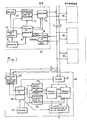
- the transmission system shown diagrammatically in FIG. 1 is intended for the transmission of information over a low voltage network between several similar transmitters 10 and a single receiver 20 each connected between a P phase conductor and a neutral conductor N.
- Each transmitter 10 is for example associated with a meter, such as an electricity, water or gas meter, assigned to an apartment or a dwelling.
- the receiver 20 is for example arranged at the low voltage transformer station serving the apartments or dwellings with which the transmitters are associated.
- Each transmitter 10 includes a register 11 which is copied the information to be transmitted, for example, without limitation, the indication of a counter (not shown). This information is in the form of a digital word of several bits.
- a frequency synthesis and sequence control circuit 12 receives each bit to be transmitted and converts each bit in the form of a signal consisting of a succession of predetermined coding frequencies.
- a first preprogrammed frequency combination is used to encode a low level bit (0) and a second preprogrammed frequency combination is used to encode a high level bit (1). So, for each bit, the signal produced by the circuit 12 is in the form of a train of pulses whose frequency varies per jump periodically during the transmission time of this bit, these pulses being generated by dividing the frequency of a clock 13.
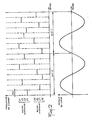
- FIG. 2 A example of the successive frequency values used to code the bits is illustrated in FIG. 2. In this example, a bit 0 and a bit 1 are transmitted successively for two consecutive periods T of the line signal on the conductor P. The variation of amplitude of this signal is also shown in Figure 2; it can be seen that the start of the codags of each bit is synchronized with the zero crossing of the network signal.
- the pulses produced by the circuit 12 are used by an injector 14 to inject signals on the low voltage network on two wires connected respectively to a P phase conductor and to a neutral N conductor.
- a circuit 17 can be interposed between the register 11 and the frequency generation part 12 to add coding redundancy bits. This block allows the detection of erroneous bits on reception using a complementary decoder. Any coding method known per se can be used in circuit 17.
- the reading of the bits in the register 11, the coding of the data by the circuit 17 and the operation of the circuit 12 are controlled by synchronization signals praduit by a synchronization circuit 15 from, on the one hand, a derived voltage of the network and, on the other hand, of the clock signal 13.
- a circuit 16 has inputs connected to the network to detect a trigger signal sent over the network either from a central point at medium voltage in the case of the use of a centralized remote control system, or from the receiver 20. In response upon detection of the trigger signal, circuit 16 controls the start of the transmission of the coded information signal.
- the detection circuit 16 of a transmitter comprises a delay circuit which defines a time delay specific to this transmitter so that the transmissions from different transmitters follow one another in a pre-established order following the emission of the trigger signal.
- the receiver 20 comprises an input circuit 21 having inputs connected to the conductors N and P. After filtering and amplification through this circuit 21, the information signal received is applied in parallel to two demodulators 22, 23 whose outputs are connected to a bit determination circuit 24.
- Each demodulator 22, 23 receives two signals 90 ° out of phase with each other and produced by a frequency synthesis and sequence control circuit, respectively 25, 26.
- the coding frequencies used on transmission are, in this example, distributed for equal parts in two frequency bands spaced from one another and, in the combinations of N frequencies used to code the bits 0 and l, the n th frequencies are not chosen in the same band, whatever the value of n between 1 and N inclusive.
- This characteristic emerges from the example illustrated in FIG. 2, an example according to which eight coding frequencies f1 to f8 are used distributed equally in an upper band and a lower band.
- the demodulators 22 and 23 are assigned respectively to one and to the other frequency band.
- the demodulator 22 receives from circuit 25 two mutually phase-shifted signals of 90 0 which reproduce, with a fixed frequency offset, the N / 2 coding frequencies of the upper band, in the order of their use for coding bits 0 and 1.
- the demodulator 23 then receives from circuit 26 two mutually phase-shifted signals by 90 ° which reproduce, with a fixed frequency offset, the N / 2 coding frequencies of the lower band, in the order of their use for coding bits 0 and 1.
- the coding frequency sequences of bits 0 and 1 are chosen so that the time interval T / N during which any frequency is sent, whether in the upper band or in the lower band, for coding a bit 1 does not follow or precede the time interval during which the same frequency is sent to code a bit 0. This is so in the example illustrated in FIG. 2. In this way, when there are temporal inaccuracies between the synchronization of the receiver and that of a transmitter, the intercorrelation between the code of a bit 1 and that of a bit 0 is minimized.
- the combined use of the fixed frequency offset and two locally generated signals with a mutual phase shift of 90 ° allows intermediate frequency detection with a single sideband.
- the signals produced by circuits 25 and 26 are in the form of a wave train whose frequency varies per jump with the same jump period as that used for transmission, and are generated from the division of the frequency of a clock 27.
- the operation of the circuits 25, 26 is controlled by synchronization signals praduit by a synchronization circuit 28 from, on the one hand, a signal derived from the mains voltage and, on the other hand, the signal from the clock 27.
- a trigger circuit 29 is connected to the conductors N and P to either transmit the trigger signal itself, or receive the system trigger order, issued from a central point (for example at medium voltage if a call is made to the centralized remote control ⁇ .
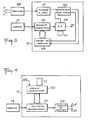
- FIG. 3 illustrates the circuit 15 for synchronizing a transmitter. Correlating the signal to reception requires not only frequency information, but also time information. All transmitters 10 must therefore be synchronized with receiver 20. This synchronization is based on the detection of the network voltage going to zero.
- the circuit 15 has two inputs connected respectively to the conductors N and P via a pre-filtering circuit 149 which, in the example illustrated, is housed in the injector 14.
- the pre-filter 149 is a low-pass filter intended to attenuate the harmonics of the network (50 Hz or 60 Hz) and the transmit-receive signals.
- the output signal of the pre-filter 149 is shaped by means of a circuit 151 which detects zero crossings and produces a square logic signal at the frequency of the network.
- a circuit 151 which detects zero crossings and produces a square logic signal at the frequency of the network.
- the shaping circuit 151 it is preferable for the shaping circuit 151 to have hysteresis (for example a Schmitt flip-flop) to prevent the oscillations caused by noise around zero.
- the output of the shaping circuit 151 drives a phase detector 152, another input of which is connected to the output of a frequency divider by N, 154.
- the phase detector 151 has two outputs connected to a coding circuit 155 of reaction. A signal is produced on one or the other of the outputs of the phase detector 152 according to the direction of the phase shift between the sigr to the received by this detector and aver an amplitude function of this phase shift.
- the circuit 155 converts the signal received from the phase detector 152 into a digital reaction code which determines the dividing coefficient of a programmable frequency divider 153 connected between the clock 13 and the frequency divider 154.
- the circuits 152 , 153; 154 and 155 constitute a phase locked loop (or "PLL" in English notation) whose clock is constituted by circuit 13 of the transmitter.
- PLL phase locked loop
- the structure and operation of such a phase locked loop are well known per se and therefore do not require a more detailed description.
- the division coefficient N of the divider 154 is fixed and equal to the number of frequencies used to form the coding combination for each bit 0 or 1 per network period.
- the divider 154 in the form of a counter by N, provides a numerical coefficient of jump CS which, during each period of the network, successively takes the values 0 to N-1 to return to 0 at the start of the following period.
- the hopping coefficient CS is used in the frequency synthesizer 12 to identify the time intervals at each frequency hopping.
- the divider 154 provides a signal HB at the bit frequency (bit clock) usable in other parts of the system to control events to be synchronized to the bit rate.
- phase locking loop described above makes it possible to effectively enslave the frequency of the synchronization signals to that of the network, despite the variations of the latter around its nominal value. For good accuracy, it is best to use a second order phase lock loop.
- FIG. 4 illustrates the circuit 12 for frequency synthesis and sequence control.
- Each bit of the information to be transmitted is coded by a succession of N predetermined coding frequencies, for example 8 frequencies.
- the coding frequencies are generated by dividing the frequency of the clock 13 by means of a programmable divider 121 connected between the clock 13 and an output encoder 123.
- the division coefficient of the programmable divider 121 is provided by a combinational logic circuit 122 which receives, on the one hand, the bit to be coded and, on the other hand, the jump coefficient CS provided by the synchronization circuit 15 described more high.
- the bit to be encoded is read at the rate of the bit in. register 11 or in the data encoder 17 when the latter is present.
- the combinational logic circuit 122 transforms the jump coefficient identifying a time interval within a period of the network into a predetermined division coefficient depending on the bit to be coded. There is thus obtained at the output of the divider 121 a pulse train whose frequency varies over the duration of a period of the network in synchronism with the jumps defined by the synchronization circuit.
- the digital word supplied by the circut 122 is a predetermined logical combination of the digital word representing the jump coefficient with the bit to be transmitted.
- the jump coefficient and the bit to be transmitted can be used as address elements to read the division coefficient to be applied to the divider 121 in a ROM type memory.
- FIG. 5 An embodiment of the output encoder 123 which can be used in conjunction with the injector 14 described below is illustrated in FIG. 5.
- the encoder 123 comprises three flip-flops 1231, 1232, 1233 each wired in divider by two and connected in cascade, each flip-flop being actuated on the falling edge of the received signal.
- the frequency of the output signal from the divider 121 is thus divided by two by the flip-flop 1231, again by two by the flip-flop 1232 and a last time by two by the flip-flop 1233.
- the lines (a), (b) and (c) represent the signals on the outputs Q of flip-flops 1231, 1232, 1233.
- the output Q of flip-flop 1232 is also connected to the data input D of a fourth flip-flop 1234 and to an input of an AND gate 1235 to two entrances.
- the flip-flop 1234 has its clock input CK connected to the output of the divider 121 and its inverted output Q connected to the second input of the door 1235, thus forming with the latter a monostable type circuit.
- Lines (d) and (e) represent the signals on the Q output of the flip-flop 1234 and on the output of the gate 1235.
- the Q output of the flip-flop 1233 is connected to a first lsb output of the encoder 123 via a switch 1236 controlled by the Q output of the flip-flop 1231, and this same Q output of the flip-flop 1233 is connected to a second msb output of the encoder 123 by means of a switch 1237 controlled by the output of the gate 1235.
- the signals on the lsb and msb outputs are applied to a digital-analog converter in the injector l4 to give a signal in stair steps constituting an approximation of a sinusoid (line (f) of FIG. 5) whose fundamental frequency is the eighth of the output frequency of the divider 121.
- the number N of different frequencies used to code each bit is equal to eight. Of course, a number other than eight could be chosen.
- frequencies fl to f8 equal respectively to 87.4 kHz, 74.9 kHz, 65.5 kHz, 58.2 kHz, 52 , 4 kHz, 47.6 kHz, 43.7 kHz and 40.3 kHz.
- the three-state signals at output lsb and msb of the encoder 123 are therefore applied to the input of the injector 14 (FIG. 6) and are combined by a set of resistors in a digital-analog converter 141 to form the signal in steps d sinusoidal staircase shown in line (f) of Figure 5.
- the output signal of the converter 141 is applied to the input of a linear amplifier 142 provided with a low-pass filter whose cut-off frequency is beyond the highest coding frequency and whose function is to smooth out the steepest discontinuities at the output of the converter 121.
- the amplifier 122 is designed to allow an average power of the order of 50 to 250 mW to be supplied to excite the network.
- a switch 143 is connected to the output of the amplifier 142 and is controlled by an on / off signal produced by the detection circuit 16 to close the switch 145 in response to the reception of a trip order.
- the switch 143 In non-transmission mode, the switch 143 has a high impedance to the electrical network in the frequency band used; in this way, the signals transmitted from an injector of another transmitter and transmitted over the same low voltage network are not attenuated.
- the switch 143 is closed and the low output impedance of the amplifier 142 ensures the injection of a suitable voltage (for example 1 V rms) even when the network has a low characteristic impedance.
- An impedance transformer 144 is interposed between the switch 143 and the electrical network.
- the primary is connected between the switch output and the transmitter ground.
- the secondary has fewer turns than the primary, is isolated from it, and is connected in series with a capacitor C between the neutral conductor N and the phase conductor P.
- the capacitor C makes it possible to strongly attenuate the signal of power at the network frequency and prevents it from attacking the amplifier 142 through the transformer 144.
- the capacitor C has a low impedance at high frequency to allow coupling without too much loss of the output of the network transmitter.
- the transmitter 10 also comprises supply circuits (not shown) intended to supply the supply voltages necessary for the operation of the circuits of the transmitter.
- Supply voltages are obtained by rectifying voltages derived from the network.
- FIG. 7 illustrates the input and synchronization circuits of the receiver 10.
- the input circuit 21 comprises a differential amplifier 211 of which a first channel comprises a resistor R1 connected between the conductor P and the inverting input of an operational amplifier Al, and of which a second channel comprises a resistor R2 connected in series between the conductor N and the non-inverting input of amplifier Al.
- the output of amplifier Al is connected to its inverting input by a resistor R3 while a resistor R4 connects the non-inverting input to a floating mass MF.
- the output of the differential stage 211 drives a bandpass filter 212 which attenuates the low frequencies of the network (in particular the frequency of the network and its harmonics) and limits the upper band beyond the highest frequency used for coding. (for example around 100 kHz).
- the signal leaving the filter 212 is processed by a gain-controlled amplifier 213, the feedback circuit connected between the output of the amplifier and its gain control input using a peak detector 214.
- a gain-controlled amplifier 213 the feedback circuit connected between the output of the amplifier and its gain control input using a peak detector 214.
- FIG. 7 also shows the synchronization circuit 28. It is similar to that of the transmitter and uses, like it, the network voltage.
- the output signal of the differential stage 2ll is filtered by means of a low-pass filter 215 allowing the frequency of the network to pass and is shaped by means of a circuit 281 which detects the zero crossings and produces a signal square logic at the grid frequency.
- the output of the shaping circuit 281 drives a phase-locked loop formed by a phase detector 282, a feedback coding circuit 285, a programmable frequency divider 283 and a frequency divider by N, 284.
- This loop phase lock operates in the same way as that formed by the components 152, 153, 154 and 155 of the circuit 15 described above, and uses the clock 27 of the receiver.
- This clock is preferably at a higher frequency than that of the clock 13 of the transmitter, this to increase the precision on the frequencies generated by dividing the clock frequency in order to demodulate the information received with an intermediate frequency substantially fixed.
- the programmable divider 283 includes a greater number of division stages than the divider 153 of the circuit 15 of the transmitter. For the rest, the phase locked loops of the transmitter and the receiver have the same characteristics, defined by the feedback coding circuit, so that the transmitter and the receiver are synchronized independently of the variations in the frequency of the network.
- the synchronization circuit 28 delivers digital jump coefficients CS ′ and a signal HB I at the frequency of the bit in the same way as the circuit 15 of the transmitter.
- the circuit 28 delivers a signal FS at the jump frequency, taken at the output of the divider 283 and intended to be used for resetting filter elements in the demodulators 22, 23.
- the frequency synthesis and sequence control circuits 25 and 26 supply the demodulators 22, 23 with the frequencies necessary for decoding the received signal.
- the circuits 25, 26 are analogous to the corresponding circuit 12 of the transmitter.
- FIG. 8 illustrates one of the circuits 25 and 26, for example the circuit 25.
- a programmable frequency divider 251 receives the signal from the clock 27 and divides the frequency thereof by a coefficient supplied by a combinational logic circuit 252 as a function of the jump coefficient CS 'received from the circuit 28. Unlike the logic circuit 122 of the transmitter's frequency synthesizer, the logic circuit 252 does not receive a bit in addition to the jump coefficient.
- the output signal of the divider 251 is transformed by an output coding circuit 253 into two mutually 90 ° SIN and COS signals to attack the demodulator 22 associated with the circuit 25.
- the output coding circuit 253 comprises two flip-flops 2531 and 2532 wired in divider by two and connected in series, each flip-flop being actuated on the falling edge of the received signal.
- the signal COS whose frequency is equal to a quarter of that of the output signal of the divider 251.
- a third flip-flop 2533 is actuated on the rising edge of the output Q of the flip-flop 2531 and receives the COS signal on its data input D.
- the Q output of the flip-flop 2533 provides the signal SIN, 90 ° out of phase with the COS signal and with the same frequency as the latter.
- -Q output states of flip-flops 2531, 2532 and 2533 are shown in lines (a), (b), (c) in Figure 9.
- the frequencies fl to fN used for the coding of the bits to be transmitted are distributed in two distinct bands: fl to f (N / 2) and f (N / 2 + 1) to fN.
- the frequencies of m & n rank n are chosen so as not to belong to the same band; moreover, when a frequency is used in n th position of the combination coding a bit 1, one avoids using this same frequency at the (n-1) th or (n + 1) th position in the combination coding a bit 0 (see figure 2).
- the frequencies wire to f'N locally generated in the receiver have values shifted by a substantially fixed quantity fI with respect to the values of the frequencies fl to fN used in the transmitter and, in accordance with another characteristic of the invention, the receiver demodulators 22 and 23 are assigned respectively to the upper band, frequencies f'1 to f '(N / 2), and to the lower band, frequencies f' (N / 2 + 1) to f'N.
- the frequency synthesis circuit 25, associated with the demodulator 22, is designed to generate a succession of N frequencies chosen from the N / 2 frequencies of the upper band f'1 to f '(N / 2), the n th frequency of this succession corresponding, to within the offset fr, to the n th frequency fnl of the combination coding a bit 1 or the n th frequency fn0 of the combination coding a bit 0 depending on whether fnl or fn0 is in the upper band (only one of both being there necessarily).
- the frequency synthesis circuit 26 associated with the demodulator 23 generates a succession of N frequencies chosen from the N / 2 frequencies of the lower band f '(N / 2 + 1) to f'N, the n th frequency of this succession corresponding, to within the offset fr, to the n frequency fnl of the combination coding a bit 1 or to the n th frequency fn0 of the combination coding a bit 0 depending on whether fnl or fn0 is in the lower band.
- the division coefficients used in the programmable divider 251 of circuit 25 are equal to 55, 65, 75 and 85 and those used in the corresponding programmable divider of circuit 26 are equal to 96, 107, 118 and 129.
- the intermediate frequency f1 therefore has a substantially fixed value, on average equal to 5.54 kHz.
- a bandpass filter 221 is placed at the input of the demodulator 22 and receives the signal coming from the output of the amplifier 213 of the input circuit 21.
- the function of this filter is to attenuate all the frequencies not lying not in the band assigned to the receiver.
- the output of the filter 221 is connected in parallel to two multiplication channels each comprising an analog multiplier 222, 223 in series with a low-pass filter 224, 225.
- the multipliers 222, 223 also receive the locally generated SIN and COS signals respectively in circuit 25.
- the outputs of filters 224, 225 are recombined by means of an adder 226, after having been mutually phase-shifted by 90 ° by means of phase-shifters 227a, 227b which phase-shift respectively by + 45 ° and -45 ° filters 224, 225.
- the purpose of multiplying the received signal with the locally generated signals is to effect the frequency change allowing recovery of the intermediate frequency signal fI.
- the use of a single multiplier would lead to two lateral bands being obtained, one representing the wanted useful signal and the other noise. This is why two multiplication channels are used in a manner known per se to carry out a detection in single lateral band, the channels receiving local signals in quadrature and an additional phase shift of 90 ° being introduced between the two channels, at the intermediate frequency. , but before summing mixed frequencies.
- the output of the adder 226 drives a bandpass filter 228 centered on the intermediate frequency fI.
- the intermediate frequency filter 228 is made up of several cells of the second order connected in cascade and its output is applied to a peak detector 229 whose output level represents the energy detected at the frequency of the signal sought.
- Each cell 2280 of the filter 228 (only one of which is shown in more detail in FIG. 9) is formed by a parallel resonance circuit 2281 of the LC type excited by a current generator 2282 controlled by the input voltage applied to this cell .
- the cascading of several (k) cells having different characteristics allows the realization of a filter of an order 2k optimized to let pass the desired band and strongly attenuate the signals out of band.
- a switch 2283 is connected in parallel with the resonant circuit 2281 of each cell 2280 to allow the output of the filter 228 to be reset to zero at the rate of the frequency hopping (signal FS supplied by the circuit 28). In this way, at each new frequency, the old resonance state is deleted in order to detect only the energy received during the duration of a frequency jump. Thus, the decision taken in the bit determination circuit 24 is, at each jump, independent of the previous states.
- the peak detection circuit 229 is reset to zero at each jump and the sampling control input of the peak detector 229 is only activated from the middle approximately one jump period, delaying the FS signal giving the rhythm of the frequency jump. This avoids detecting the output level of the resonant cicuits of the filter 228 immediately after restarting the filtering, at a time when the filter cells have a significant initial noise.
- the analysis window thus defined covers the end of each period during which the response of the cells is representative of the signal received.
- a comparator 241 receives the signals E1 and E2 available at the output of the demodulators 22 and 23 and provides a signal at logic level 1 or 0 depending on whether the energy detected by the demodulator 22 is higher or lower than that detected by the demodulator 23.
- a logic correlator circuit 242 is provided for comparing the successive states of the output of comparator 241, at the rate of the frequency hopping (N times the frequency of the network, ie 400 Hz in the example considered with a sector at 50 Hz), with the values they should take when the received bit is 1 (or 0).
- the results of these comparisons relating to successive fractions of bit are added up in a counting circuit 243 during the transmission time of a complete bit, that is to say a period of the sector as illustrated by FIG. 2.
- the counter is reset to zero at the start of each bit.
- the state of the counter 243 is interpreted by the logic circuit 244 at the end of each bit, to exit on a conductor 245 the logic state 1 if the overall result is favorable to 1 (more than four decisions out of eight favorable to 1) or the logical state 0 if the overall result is favorable to 0 (less than four decisions out of eight favorable to 1).
- the overall result is neither favorable to 1 nor favorable to 0 (four comparisons out of eight in favor of 1), this case is assimilated to noise and a second output 246 is activated. It will be noted that it would be possible to code each bit by a succession of an odd number of frequencies in order in all cases to arrive at a majority decision. One can moreover widen the number of possibilities of exits to be interpreted like a noise to have a greater reliability on the decisions taken on the value of the bits.
- the output of the logic circuit 244 is connected to a decoder 247 whose function is the opposite of that of the circuit 17, that is to say the detection and possibly correcting the erroneous bits.
- the triggering order of the system can be sent from a central point at medium voltage (centralized remote control system), or from the receiver 20 located at low voltage.
- the circuit 29 for receiving the trigger word from the receiver 20 is similar to the circuit for receiving the trigger word located at the transmitter.
- the circuit 29 constitutes a trigger signal transmitter.
- An embodiment of such a transmission circuit is illustrated in FIG. 12; it uses a switch and a resonant circuit which operate in class D.
- a frequency divider 291 provides a train of excitation pulses from the clock 27.
- the division coefficient is fixed and determined so that the frequency from the divider falls in the center of the pass band of the circuit output filter 29.
- the divider 291 has an additional control input for controlling the operation or stopping of the divider in order to produce an all-or-nothing modulation.
- the modulation codes usually used in a centralized remote control system can be produced.
- the output of the divider 291 controls a switch 292 connected in series with a resonant circuit 293 between ground and a terminal at a supply voltage + V.
- the resonant circuit 293 comprises a capacitor C3 in parallel on the primary of a transformer T3.
- the output of circuit 29 is formed by the secondary of transformer T3 connected in series with a capacitor C4 between the neutral conductor N and the phase conductor P; this output is analogous to that of the injector 14 of the transmitter. It will be noted in this connection that the injection mode used in the circuit 29 described above can also be used in the injection circuits of the transmitters.
- the trigger signal produced by circuit 29 is detected by circuit 16 of the transmitter.
- the detection circuit 16 can be constituted by a remote-controlled relay such as that described in US Pat. No. 4,361,766. This known relay is intended to control any desired operation at the end of a programmable time interval counted from the reception of an order in the form of signals superimposed on the voltage of a distribution network to which the relay is connected.
Landscapes
- Engineering & Computer Science (AREA)
- Power Engineering (AREA)
- Computer Networks & Wireless Communication (AREA)
- Signal Processing (AREA)
- Cable Transmission Systems, Equalization Of Radio And Reduction Of Echo (AREA)
- Digital Transmission Methods That Use Modulated Carrier Waves (AREA)
- Control Of Motors That Do Not Use Commutators (AREA)
- Transition And Organic Metals Composition Catalysts For Addition Polymerization (AREA)
- Small-Scale Networks (AREA)
- Radio Relay Systems (AREA)
Priority Applications (1)
| Application Number | Priority Date | Filing Date | Title |
|---|---|---|---|
| AT86400089T ATE66108T1 (de) | 1985-02-14 | 1986-01-17 | Verfahren und einrichtung zur spreizbanduebertragung, insbesondere zur informationsuebertragung auf ein elektrisches energieverteilungsnetz. |
Applications Claiming Priority (2)
| Application Number | Priority Date | Filing Date | Title |
|---|---|---|---|
| FR8502135A FR2577733B1 (fr) | 1985-02-14 | 1985-02-14 | Procede et systeme de transmission en bande etalee, notamment pour la transmission d'informations sur un reseau de distribution d'energie electrique |
| FR8502135 | 1985-02-14 |
Publications (2)
| Publication Number | Publication Date |
|---|---|
| EP0194902A1 true EP0194902A1 (de) | 1986-09-17 |
| EP0194902B1 EP0194902B1 (de) | 1991-08-07 |
Family
ID=9316283
Family Applications (1)
| Application Number | Title | Priority Date | Filing Date |
|---|---|---|---|
| EP86400089A Expired - Lifetime EP0194902B1 (de) | 1985-02-14 | 1986-01-17 | Verfahren und Einrichtung zur Spreizbandübertragung, insbesondere zur Informationsübertragung auf ein elektrisches Energieverteilungsnetz |
Country Status (9)
| Country | Link |
|---|---|
| US (1) | US4763103A (de) |
| EP (1) | EP0194902B1 (de) |
| JP (1) | JP2505150B2 (de) |
| AT (1) | ATE66108T1 (de) |
| AU (1) | AU577668B2 (de) |
| CA (1) | CA1248590A (de) |
| DE (1) | DE3680690D1 (de) |
| FR (1) | FR2577733B1 (de) |
| ZA (1) | ZA861119B (de) |
Cited By (3)
| Publication number | Priority date | Publication date | Assignee | Title |
|---|---|---|---|---|
| EP0178804A3 (de) * | 1984-10-13 | 1987-10-14 | Standard Telephones And Cables Public Limited Company | Fernlesung von Zählern |
| EP0200016A3 (en) * | 1985-05-02 | 1988-03-30 | Waldsee Electronic Gmbh | Information transmission method using electrical power distribution networks |
| EP0395494A3 (de) * | 1989-04-26 | 1992-01-02 | SCHLUMBERGER INDUSTRIES, INC. (a Delaware corporation) | Verfahren und Vorrichtung für Übertragungen mit Trägerfrequenz über die Starkstromleitungen |
Families Citing this family (29)
| Publication number | Priority date | Publication date | Assignee | Title |
|---|---|---|---|---|
| US4903279A (en) * | 1986-09-30 | 1990-02-20 | Aisin Seiki Kabushiki Kaisha | Receiver for spread spectrum communication and receiving method for the same |
| US4864588A (en) * | 1987-02-11 | 1989-09-05 | Hillier Technologies Limited Partnership | Remote control system, components and methods |
| WO1990015394A1 (en) * | 1989-06-02 | 1990-12-13 | Aisi Research Corporation | Appliance interface for exchanging data |
| US5090024A (en) * | 1989-08-23 | 1992-02-18 | Intellon Corporation | Spread spectrum communications system for networks |
| US4963853A (en) * | 1989-10-16 | 1990-10-16 | Emerson Electric Co. | Simultaneous inbound multi-channel communication system using electricity distribution network |
| US5005169A (en) * | 1989-11-16 | 1991-04-02 | Westinghouse Electric Corp. | Frequency division multiplex guardband communication system for sending information over the guardbands |
| US5452344A (en) * | 1992-05-29 | 1995-09-19 | Datran Systems Corporation | Communication over power lines |
| US5377224A (en) * | 1993-10-07 | 1994-12-27 | Northern Telecom Limited | Acquisition of frequency bursts in PCN |
| US5818821A (en) | 1994-12-30 | 1998-10-06 | Intelogis, Inc. | Universal lan power line carrier repeater system and method |
| CA2154298C (en) * | 1995-07-20 | 2002-06-18 | Robert S. Hannebauer | Spread spectrum data communicator |
| US5903612A (en) * | 1996-11-08 | 1999-05-11 | Alcatel Alsthom Compagnie Generale D'electricite | Method to synchronize data and a transmitter and a receiver realizing said method |
| ATE201118T1 (de) * | 1996-11-08 | 2001-05-15 | Cit Alcatel | Datenübertragungssynchronisierungsverfahren zwischen einem sender und einem empfänger |
| RU2128396C1 (ru) * | 1997-07-25 | 1999-03-27 | Гриценко Владимир Васильевич | Способ передачи и приема информации и устройство для его осуществления |
| US6055435A (en) * | 1997-10-16 | 2000-04-25 | Phonex Corporation | Wireless telephone connection surge suppressor |
| US5970127A (en) * | 1997-10-16 | 1999-10-19 | Phonex Corporation | Caller identification system for wireless phone jacks and wireless modem jacks |
| US6107912A (en) * | 1997-12-08 | 2000-08-22 | Phonex Corporation | Wireless modem jack |
| CZ297034B6 (cs) * | 1998-03-17 | 2006-08-16 | Virtuální informacní systém | |
| US6480510B1 (en) | 1998-07-28 | 2002-11-12 | Serconet Ltd. | Local area network of serial intelligent cells |
| US6246868B1 (en) | 1998-08-14 | 2001-06-12 | Phonex Corporation | Conversion and distribution of incoming wireless telephone signals using the power line |
| US6243571B1 (en) | 1998-09-21 | 2001-06-05 | Phonex Corporation | Method and system for distribution of wireless signals for increased wireless coverage using power lines |
| US6842459B1 (en) | 2000-04-19 | 2005-01-11 | Serconet Ltd. | Network combining wired and non-wired segments |
| IL154921A (en) | 2003-03-13 | 2011-02-28 | Mosaid Technologies Inc | A telephone system that includes many separate sources and accessories for it |
| WO2010033245A1 (en) * | 2008-09-22 | 2010-03-25 | Silver Spring Networks, Inc. | Power line communication using frequency hopping |
| CN102511153B (zh) * | 2011-11-16 | 2014-09-03 | 华为技术有限公司 | 一种微波预失真信号生成方法和装置 |
| US11333737B2 (en) * | 2012-08-03 | 2022-05-17 | Sonitor Technologies As | Location system using ultrasound |
| GB201213846D0 (en) * | 2012-08-03 | 2012-09-19 | Sonitor Technologies As | Location system |
| CN111711266A (zh) * | 2019-12-04 | 2020-09-25 | 李天广 | 一种基于电力线的网络通信系统、方法及装置 |
| CN114070691B (zh) * | 2021-11-15 | 2023-05-30 | 杭州电子科技大学温州研究院有限公司 | 一种植入式能量与数据分时无线传输系统及其设计方法 |
| CN114362177B (zh) * | 2022-03-16 | 2022-06-28 | 深圳友讯达科技股份有限公司 | 一种基于多频率特征电流信号的户变拓扑关系识别方法 |
Citations (3)
| Publication number | Priority date | Publication date | Assignee | Title |
|---|---|---|---|---|
| FR2251138A1 (de) * | 1973-11-09 | 1975-06-06 | Philips Nv | |
| US3909527A (en) * | 1973-09-18 | 1975-09-30 | Mitsubishi Electric Corp | Frequency shift keying system and method |
| EP0041193A1 (de) * | 1980-05-29 | 1981-12-09 | Société Anonyme dite SAFT | Informationsübertragungssystem |
Family Cites Families (8)
| Publication number | Priority date | Publication date | Assignee | Title |
|---|---|---|---|---|
| CH604409A5 (de) * | 1977-05-17 | 1978-09-15 | Landis & Gyr Ag | |
| JPS5434610A (en) * | 1977-08-23 | 1979-03-14 | Boeicho Gijutsu Kenkyu Honbuch | Method of synchronizing in demodulation of spectrum pattern modulated wave |
| US4239940A (en) * | 1978-12-26 | 1980-12-16 | Bertrand Dorfman | Carrier current communications system |
| US4306308A (en) * | 1979-09-14 | 1981-12-15 | Rca Corporation | Symbols communication system |
| US4553101A (en) * | 1983-09-21 | 1985-11-12 | General Dynamis Electronics Division | Fast frequency hopping demodulation system with serial accumulation of signal |
| US4583231A (en) * | 1983-11-02 | 1986-04-15 | General Electric Company | Method of, and apparatus for, frequency-hopped frequency-shift-keyed digital data communications |
| US4616364A (en) * | 1984-06-18 | 1986-10-07 | Itt Corporation | Digital hopped frequency, time diversity system |
| US4597087A (en) * | 1984-10-19 | 1986-06-24 | Itt Corporation | Frequency hopping data communication system |
-
1985
- 1985-02-14 FR FR8502135A patent/FR2577733B1/fr not_active Expired
-
1986
- 1986-01-17 DE DE8686400089T patent/DE3680690D1/de not_active Expired - Lifetime
- 1986-01-17 EP EP86400089A patent/EP0194902B1/de not_active Expired - Lifetime
- 1986-01-17 AT AT86400089T patent/ATE66108T1/de not_active IP Right Cessation
- 1986-02-06 CA CA000501247A patent/CA1248590A/en not_active Expired
- 1986-02-11 AU AU53434/86A patent/AU577668B2/en not_active Ceased
- 1986-02-13 US US06/829,055 patent/US4763103A/en not_active Expired - Lifetime
- 1986-02-14 ZA ZA861119A patent/ZA861119B/xx unknown
- 1986-02-14 JP JP61030618A patent/JP2505150B2/ja not_active Expired - Lifetime
Patent Citations (3)
| Publication number | Priority date | Publication date | Assignee | Title |
|---|---|---|---|---|
| US3909527A (en) * | 1973-09-18 | 1975-09-30 | Mitsubishi Electric Corp | Frequency shift keying system and method |
| FR2251138A1 (de) * | 1973-11-09 | 1975-06-06 | Philips Nv | |
| EP0041193A1 (de) * | 1980-05-29 | 1981-12-09 | Société Anonyme dite SAFT | Informationsübertragungssystem |
Non-Patent Citations (1)
| Title |
|---|
| IEEE TRANSACTIONS ON AEROSPACE AND NAVIGATIONAL ELECTRONICS, vol. ANE-11, no. 4, décembre 1964, pages 285-291, IEEE, New York, US; K.W. OTTEN: "Digital HF communication system for long-distance air-to-ground communication" * |
Cited By (3)
| Publication number | Priority date | Publication date | Assignee | Title |
|---|---|---|---|---|
| EP0178804A3 (de) * | 1984-10-13 | 1987-10-14 | Standard Telephones And Cables Public Limited Company | Fernlesung von Zählern |
| EP0200016A3 (en) * | 1985-05-02 | 1988-03-30 | Waldsee Electronic Gmbh | Information transmission method using electrical power distribution networks |
| EP0395494A3 (de) * | 1989-04-26 | 1992-01-02 | SCHLUMBERGER INDUSTRIES, INC. (a Delaware corporation) | Verfahren und Vorrichtung für Übertragungen mit Trägerfrequenz über die Starkstromleitungen |
Also Published As
| Publication number | Publication date |
|---|---|
| JP2505150B2 (ja) | 1996-06-05 |
| EP0194902B1 (de) | 1991-08-07 |
| AU5343486A (en) | 1986-08-21 |
| ZA861119B (en) | 1986-10-29 |
| DE3680690D1 (de) | 1991-09-12 |
| AU577668B2 (en) | 1988-09-29 |
| JPS61193544A (ja) | 1986-08-28 |
| CA1248590A (en) | 1989-01-10 |
| FR2577733B1 (fr) | 1988-03-25 |
| FR2577733A1 (fr) | 1986-08-22 |
| US4763103A (en) | 1988-08-09 |
| ATE66108T1 (de) | 1991-08-15 |
Similar Documents
| Publication | Publication Date | Title |
|---|---|---|
| EP0194902B1 (de) | Verfahren und Einrichtung zur Spreizbandübertragung, insbesondere zur Informationsübertragung auf ein elektrisches Energieverteilungsnetz | |
| EP0419337B1 (de) | Kodierungsverfahren für ein digitales Signal, Kodierer und Dekodierer zur Durchführung des Verfahrens, Regenerierungsverfahren und Regenerator dafür | |
| EP0013343B1 (de) | Verfahren und Vorrichtung zur Auffindung einer Pseudo-Zufallsfolge von 0 Grad- und 180 Grad-Phasenänderungen der Trägerwelle in einem Datenempfänger | |
| FR2511170A1 (fr) | Systeme de poursuite de seuil automatique | |
| FR2533095A1 (fr) | Procede et dispositif de demodulation d'une onde porteuse modulee en phase par une onde sous-porteuse qui est modulee en deplacement de phase par des signaux en bande de base | |
| CH619330A5 (de) | ||
| FR2667750A1 (fr) | Reseau cable et dispositif modulateur-demodulateur pour un tel reseau. | |
| FR2496363A1 (fr) | Procede et dispositif de detection de la sequence d'apprentissage d'un egaliseur auto-adaptatif | |
| EP0012884B1 (de) | Verfahren und Vorrichtung zur Auffindung einer Pseudo-Zufallsfolge zweier Symbole in einem Datenempfänger, welcher eine Doppelzeitenbandmodulation mit Quadraturträgern verwendet | |
| FR2681488A1 (fr) | Dispositif de communication sur spectre disperse. | |
| EP0428444B1 (de) | Verfahren zur Synchronisationssuche beim Empfang eines Spreizspektrumsignals | |
| EP0031762B1 (de) | Modulator-Demodulator zur Übertragung durch eine vierpegelige doppelte Amplitudenmodulation auf Quadraturträgern | |
| EP0820157A2 (de) | Verfahren zur digitalen Differenzialdemodulation | |
| FR2613560A1 (fr) | Egaliseur automatique pour transmission numerique | |
| FR2526617A1 (fr) | Systeme de transmission synchrone de donnees a l'aide d'une porteuse modulee d'amplitude d'enveloppe constante | |
| EP0737868B1 (de) | Verzögerungsregelschleife für GPS Empfänger | |
| FR2858730A1 (fr) | Procede pour ameliorer la resolution de mesures de temps et l'alignement dans des reseaux de transmission par paquets au moyen d'une modulation temporelle | |
| FR2598050A1 (fr) | Dispositif de decodage pour code cmi | |
| FR2460050A1 (fr) | Systeme de transmission hyperfrequence de donnees numeriques | |
| CH626477A5 (de) | ||
| FR2566979A1 (fr) | Extracteur de rythme pour systeme de transmission de donnees | |
| EP0272956B1 (de) | Digitalübertragungssystem mit kohärenter Demodulation, geeignet zur gleichzeitigen Übertragung von zwei binären Signalen | |
| EP0128065B1 (de) | Verfahren, um ein Anregungssignal für einen Kanal- oder linearen Prädiktionsynthesizer zu erzeugen und Anregungssignalgenerator für diesen Synthesizer | |
| BE893937R (fr) | Codage sans composante continue, pour un ensemble de traitement de l'information | |
| FR2509559A1 (fr) | Procede de transmission numerique d'images video du type television et emetteur-recepteur correspondant |
Legal Events
| Date | Code | Title | Description |
|---|---|---|---|
| PUAI | Public reference made under article 153(3) epc to a published international application that has entered the european phase |
Free format text: ORIGINAL CODE: 0009012 |
|
| AK | Designated contracting states |
Kind code of ref document: A1 Designated state(s): AT BE CH DE FR GB IT LI NL SE |
|
| 17P | Request for examination filed |
Effective date: 19861230 |
|
| RAP1 | Party data changed (applicant data changed or rights of an application transferred) |
Owner name: SCHLUMBERGER INDUSTRIES |
|
| 17Q | First examination report despatched |
Effective date: 19890510 |
|
| GRAA | (expected) grant |
Free format text: ORIGINAL CODE: 0009210 |
|
| ITF | It: translation for a ep patent filed | ||
| AK | Designated contracting states |
Kind code of ref document: B1 Designated state(s): AT BE CH DE FR GB IT LI NL SE |
|
| REF | Corresponds to: |
Ref document number: 66108 Country of ref document: AT Date of ref document: 19910815 Kind code of ref document: T |
|
| REF | Corresponds to: |
Ref document number: 3680690 Country of ref document: DE Date of ref document: 19910912 |
|
| GBT | Gb: translation of ep patent filed (gb section 77(6)(a)/1977) | ||
| PLBE | No opposition filed within time limit |
Free format text: ORIGINAL CODE: 0009261 |
|
| STAA | Information on the status of an ep patent application or granted ep patent |
Free format text: STATUS: NO OPPOSITION FILED WITHIN TIME LIMIT |
|
| 26N | No opposition filed | ||
| EAL | Se: european patent in force in sweden |
Ref document number: 86400089.8 |
|
| REG | Reference to a national code |
Ref country code: FR Ref legal event code: D6 |
|
| REG | Reference to a national code |
Ref country code: GB Ref legal event code: IF02 |
|
| REG | Reference to a national code |
Ref country code: FR Ref legal event code: GC |
|
| PGFP | Annual fee paid to national office [announced via postgrant information from national office to epo] |
Ref country code: CH Payment date: 20030130 Year of fee payment: 18 |
|
| PG25 | Lapsed in a contracting state [announced via postgrant information from national office to epo] |
Ref country code: LI Free format text: LAPSE BECAUSE OF NON-PAYMENT OF DUE FEES Effective date: 20040131 Ref country code: CH Free format text: LAPSE BECAUSE OF NON-PAYMENT OF DUE FEES Effective date: 20040131 |
|
| REG | Reference to a national code |
Ref country code: FR Ref legal event code: DG |
|
| REG | Reference to a national code |
Ref country code: CH Ref legal event code: PL |
|
| PGFP | Annual fee paid to national office [announced via postgrant information from national office to epo] |
Ref country code: NL Payment date: 20050103 Year of fee payment: 20 |
|
| PGFP | Annual fee paid to national office [announced via postgrant information from national office to epo] |
Ref country code: SE Payment date: 20050107 Year of fee payment: 20 |
|
| PGFP | Annual fee paid to national office [announced via postgrant information from national office to epo] |
Ref country code: FR Payment date: 20050110 Year of fee payment: 20 |
|
| PGFP | Annual fee paid to national office [announced via postgrant information from national office to epo] |
Ref country code: GB Payment date: 20050112 Year of fee payment: 20 Ref country code: AT Payment date: 20050112 Year of fee payment: 20 |
|
| PGFP | Annual fee paid to national office [announced via postgrant information from national office to epo] |
Ref country code: DE Payment date: 20050113 Year of fee payment: 20 |
|
| PGFP | Annual fee paid to national office [announced via postgrant information from national office to epo] |
Ref country code: IT Payment date: 20050129 Year of fee payment: 20 |
|
| REG | Reference to a national code |
Ref country code: GB Ref legal event code: PE20 |
|
| PGFP | Annual fee paid to national office [announced via postgrant information from national office to epo] |
Ref country code: BE Payment date: 20050419 Year of fee payment: 20 |
|
| REG | Reference to a national code |
Ref country code: GB Ref legal event code: 732E |
|
| REG | Reference to a national code |
Ref country code: FR Ref legal event code: TP |
|
| PG25 | Lapsed in a contracting state [announced via postgrant information from national office to epo] |
Ref country code: GB Free format text: LAPSE BECAUSE OF EXPIRATION OF PROTECTION Effective date: 20060116 |
|
| PG25 | Lapsed in a contracting state [announced via postgrant information from national office to epo] |
Ref country code: NL Free format text: LAPSE BECAUSE OF EXPIRATION OF PROTECTION Effective date: 20060117 |
|
| NLS | Nl: assignments of ep-patents |
Owner name: ACTARIS SAS Effective date: 20051212 |
|
| NLT1 | Nl: modifications of names registered in virtue of documents presented to the patent office pursuant to art. 16 a, paragraph 1 |
Owner name: SCHLUMBERGER S.A. |
|
| NLV7 | Nl: ceased due to reaching the maximum lifetime of a patent |
Effective date: 20060117 |
|
| EUG | Se: european patent has lapsed | ||
| BE20 | Be: patent expired |
Owner name: *ACTARIS S.A.S. Effective date: 20060117 |
|
| BECH | Be: change of holder |
Owner name: *ACTARIS S.A.S. Effective date: 20051221 |