EP0194580A2 - Neue Imidazolylverbindungen und Verfahren zu ihrer Herstellung - Google Patents
Neue Imidazolylverbindungen und Verfahren zu ihrer Herstellung Download PDFInfo
- Publication number
- EP0194580A2 EP0194580A2 EP86102933A EP86102933A EP0194580A2 EP 0194580 A2 EP0194580 A2 EP 0194580A2 EP 86102933 A EP86102933 A EP 86102933A EP 86102933 A EP86102933 A EP 86102933A EP 0194580 A2 EP0194580 A2 EP 0194580A2
- Authority
- EP
- European Patent Office
- Prior art keywords
- radical
- alkyl
- atoms
- formula
- hydrogen
- Prior art date
- Legal status (The legal status is an assumption and is not a legal conclusion. Google has not performed a legal analysis and makes no representation as to the accuracy of the status listed.)
- Granted
Links
- 238000000034 method Methods 0.000 title claims abstract description 17
- 230000008569 process Effects 0.000 title claims abstract description 12
- 238000002360 preparation method Methods 0.000 title claims abstract description 9
- 150000002460 imidazoles Chemical class 0.000 title description 4
- 229940079865 intestinal antiinfectives imidazole derivative Drugs 0.000 title description 4
- 150000001875 compounds Chemical class 0.000 claims abstract description 76
- 150000003839 salts Chemical class 0.000 claims abstract description 21
- 239000002253 acid Substances 0.000 claims abstract description 20
- 239000003814 drug Substances 0.000 claims abstract description 6
- 125000004432 carbon atom Chemical group C* 0.000 claims description 123
- 239000001257 hydrogen Substances 0.000 claims description 60
- 229910052739 hydrogen Inorganic materials 0.000 claims description 60
- 125000000217 alkyl group Chemical group 0.000 claims description 54
- -1 tetraalkylammonium ion Chemical class 0.000 claims description 46
- 125000003545 alkoxy group Chemical group 0.000 claims description 39
- 150000002431 hydrogen Chemical class 0.000 claims description 38
- 229910052736 halogen Inorganic materials 0.000 claims description 37
- 150000002367 halogens Chemical class 0.000 claims description 37
- UFHFLCQGNIYNRP-UHFFFAOYSA-N Hydrogen Chemical compound [H][H] UFHFLCQGNIYNRP-UHFFFAOYSA-N 0.000 claims description 33
- 125000002023 trifluoromethyl group Chemical group FC(F)(F)* 0.000 claims description 33
- 239000004215 Carbon black (E152) Substances 0.000 claims description 26
- 229930195733 hydrocarbon Natural products 0.000 claims description 26
- RAXXELZNTBOGNW-UHFFFAOYSA-N imidazole Natural products C1=CNC=N1 RAXXELZNTBOGNW-UHFFFAOYSA-N 0.000 claims description 19
- CIUQDSCDWFSTQR-UHFFFAOYSA-N [C]1=CC=CC=C1 Chemical compound [C]1=CC=CC=C1 CIUQDSCDWFSTQR-UHFFFAOYSA-N 0.000 claims description 17
- 125000000753 cycloalkyl group Chemical group 0.000 claims description 16
- 125000001997 phenyl group Chemical group [H]C1=C([H])C([H])=C(*)C([H])=C1[H] 0.000 claims description 16
- 125000003178 carboxy group Chemical group [H]OC(*)=O 0.000 claims description 15
- 229930195735 unsaturated hydrocarbon Natural products 0.000 claims description 8
- 125000006656 (C2-C4) alkenyl group Chemical group 0.000 claims description 7
- 125000003349 3-pyridyl group Chemical group N1=C([H])C([*])=C([H])C([H])=C1[H] 0.000 claims description 7
- 229910052751 metal Inorganic materials 0.000 claims description 7
- 239000002184 metal Substances 0.000 claims description 7
- QGZKDVFQNNGYKY-UHFFFAOYSA-O Ammonium Chemical compound [NH4+] QGZKDVFQNNGYKY-UHFFFAOYSA-O 0.000 claims description 6
- WKBOTKDWSSQWDR-UHFFFAOYSA-N Bromine atom Chemical compound [Br] WKBOTKDWSSQWDR-UHFFFAOYSA-N 0.000 claims description 6
- 150000002148 esters Chemical class 0.000 claims description 6
- 125000001495 ethyl group Chemical group [H]C([H])([H])C([H])([H])* 0.000 claims description 6
- 229910052740 iodine Inorganic materials 0.000 claims description 6
- ZAMOUSCENKQFHK-UHFFFAOYSA-N Chlorine atom Chemical compound [Cl] ZAMOUSCENKQFHK-UHFFFAOYSA-N 0.000 claims description 5
- 150000001408 amides Chemical class 0.000 claims description 5
- GDTBXPJZTBHREO-UHFFFAOYSA-N bromine Substances BrBr GDTBXPJZTBHREO-UHFFFAOYSA-N 0.000 claims description 5
- 229910052794 bromium Inorganic materials 0.000 claims description 5
- 125000002496 methyl group Chemical group [H]C([H])([H])* 0.000 claims description 5
- 239000001301 oxygen Substances 0.000 claims description 5
- 229910052760 oxygen Inorganic materials 0.000 claims description 5
- 125000002924 primary amino group Chemical group [H]N([H])* 0.000 claims description 5
- 150000003335 secondary amines Chemical class 0.000 claims description 5
- 150000003512 tertiary amines Chemical class 0.000 claims description 5
- 125000004105 2-pyridyl group Chemical group N1=C([*])C([H])=C([H])C([H])=C1[H] 0.000 claims description 4
- QVGXLLKOCUKJST-UHFFFAOYSA-N atomic oxygen Chemical compound [O] QVGXLLKOCUKJST-UHFFFAOYSA-N 0.000 claims description 4
- 125000003236 benzoyl group Chemical group [H]C1=C([H])C([H])=C(C([H])=C1[H])C(*)=O 0.000 claims description 4
- 125000001589 carboacyl group Chemical group 0.000 claims description 4
- 239000000460 chlorine Substances 0.000 claims description 4
- 229910052801 chlorine Inorganic materials 0.000 claims description 4
- 150000001768 cations Chemical class 0.000 claims description 3
- LMBFAGIMSUYTBN-MPZNNTNKSA-N teixobactin Chemical compound C([C@H](C(=O)N[C@@H]([C@@H](C)CC)C(=O)N[C@@H](CO)C(=O)N[C@H](CCC(N)=O)C(=O)N[C@H]([C@@H](C)CC)C(=O)N[C@@H]([C@@H](C)CC)C(=O)N[C@@H](CO)C(=O)N[C@H]1C(N[C@@H](C)C(=O)N[C@@H](C[C@@H]2NC(=N)NC2)C(=O)N[C@H](C(=O)O[C@H]1C)[C@@H](C)CC)=O)NC)C1=CC=CC=C1 LMBFAGIMSUYTBN-MPZNNTNKSA-N 0.000 claims description 3
- 239000000969 carrier Substances 0.000 claims description 2
- 239000002552 dosage form Substances 0.000 claims description 2
- 239000000825 pharmaceutical preparation Substances 0.000 claims description 2
- 125000005078 alkoxycarbonylalkyl group Chemical group 0.000 claims 2
- 150000002500 ions Chemical class 0.000 claims 2
- SNOOUWRIMMFWNE-UHFFFAOYSA-M sodium;6-[(3,4,5-trimethoxybenzoyl)amino]hexanoate Chemical compound [Na+].COC1=CC(C(=O)NCCCCCC([O-])=O)=CC(OC)=C1OC SNOOUWRIMMFWNE-UHFFFAOYSA-M 0.000 claims 2
- 125000001931 aliphatic group Chemical group 0.000 claims 1
- 125000005843 halogen group Chemical group 0.000 claims 1
- 108090000623 proteins and genes Proteins 0.000 claims 1
- 108010069102 Thromboxane-A synthase Proteins 0.000 abstract description 8
- 229940079593 drug Drugs 0.000 abstract description 3
- XEKOWRVHYACXOJ-UHFFFAOYSA-N Ethyl acetate Chemical compound CCOC(C)=O XEKOWRVHYACXOJ-UHFFFAOYSA-N 0.000 description 45
- 239000000243 solution Substances 0.000 description 19
- 239000000203 mixture Substances 0.000 description 15
- 238000012360 testing method Methods 0.000 description 15
- VEXZGXHMUGYJMC-UHFFFAOYSA-N Hydrochloric acid Chemical compound Cl VEXZGXHMUGYJMC-UHFFFAOYSA-N 0.000 description 14
- 210000001772 blood platelet Anatomy 0.000 description 14
- YZXBAPSDXZZRGB-DOFZRALJSA-N arachidonic acid Chemical class CCCCC\C=C/C\C=C/C\C=C/C\C=C/CCCC(O)=O YZXBAPSDXZZRGB-DOFZRALJSA-N 0.000 description 13
- 150000003254 radicals Chemical class 0.000 description 13
- RTZKZFJDLAIYFH-UHFFFAOYSA-N Diethyl ether Chemical compound CCOCC RTZKZFJDLAIYFH-UHFFFAOYSA-N 0.000 description 12
- YMWUJEATGCHHMB-UHFFFAOYSA-N Dichloromethane Chemical compound ClCCl YMWUJEATGCHHMB-UHFFFAOYSA-N 0.000 description 9
- 230000015572 biosynthetic process Effects 0.000 description 9
- DSNBHJFQCNUKMA-SCKDECHMSA-N thromboxane A2 Chemical compound OC(=O)CCC\C=C/C[C@@H]1[C@@H](/C=C/[C@@H](O)CCCCC)O[C@@H]2O[C@H]1C2 DSNBHJFQCNUKMA-SCKDECHMSA-N 0.000 description 9
- HEMHJVSKTPXQMS-UHFFFAOYSA-M Sodium hydroxide Chemical compound [OH-].[Na+] HEMHJVSKTPXQMS-UHFFFAOYSA-M 0.000 description 8
- WYURNTSHIVDZCO-UHFFFAOYSA-N Tetrahydrofuran Chemical compound C1CCOC1 WYURNTSHIVDZCO-UHFFFAOYSA-N 0.000 description 8
- 238000006243 chemical reaction Methods 0.000 description 8
- 239000012071 phase Substances 0.000 description 8
- KAQKFAOMNZTLHT-OZUDYXHBSA-N prostaglandin I2 Chemical compound O1\C(=C/CCCC(O)=O)C[C@@H]2[C@@H](/C=C/[C@@H](O)CCCCC)[C@H](O)C[C@@H]21 KAQKFAOMNZTLHT-OZUDYXHBSA-N 0.000 description 8
- UIIMBOGNXHQVGW-UHFFFAOYSA-M Sodium bicarbonate Chemical compound [Na+].OC([O-])=O UIIMBOGNXHQVGW-UHFFFAOYSA-M 0.000 description 7
- 230000002776 aggregation Effects 0.000 description 7
- 238000004220 aggregation Methods 0.000 description 7
- 208000037265 diseases, disorders, signs and symptoms Diseases 0.000 description 7
- 229960001123 epoprostenol Drugs 0.000 description 7
- 230000005764 inhibitory process Effects 0.000 description 7
- CSCPPACGZOOCGX-UHFFFAOYSA-N Acetone Chemical compound CC(C)=O CSCPPACGZOOCGX-UHFFFAOYSA-N 0.000 description 6
- WEVYAHXRMPXWCK-UHFFFAOYSA-N Acetonitrile Chemical compound CC#N WEVYAHXRMPXWCK-UHFFFAOYSA-N 0.000 description 6
- LYCAIKOWRPUZTN-UHFFFAOYSA-N Ethylene glycol Chemical compound OCCO LYCAIKOWRPUZTN-UHFFFAOYSA-N 0.000 description 6
- 238000005481 NMR spectroscopy Methods 0.000 description 6
- CDBYLPFSWZWCQE-UHFFFAOYSA-L Sodium Carbonate Chemical compound [Na+].[Na+].[O-]C([O-])=O CDBYLPFSWZWCQE-UHFFFAOYSA-L 0.000 description 6
- YXFVVABEGXRONW-UHFFFAOYSA-N Toluene Chemical compound CC1=CC=CC=C1 YXFVVABEGXRONW-UHFFFAOYSA-N 0.000 description 6
- 229940114079 arachidonic acid Drugs 0.000 description 6
- 235000021342 arachidonic acid Nutrition 0.000 description 6
- 206010012601 diabetes mellitus Diseases 0.000 description 6
- 201000010099 disease Diseases 0.000 description 6
- YIBNHAJFJUQSRA-YNNPMVKQSA-N prostaglandin H2 Chemical compound C1[C@@H]2OO[C@H]1[C@H](/C=C/[C@@H](O)CCCCC)[C@H]2C\C=C/CCCC(O)=O YIBNHAJFJUQSRA-YNNPMVKQSA-N 0.000 description 6
- RZWIIPASKMUIAC-VQTJNVASSA-N thromboxane Chemical compound CCCCCCCC[C@H]1OCCC[C@@H]1CCCCCCC RZWIIPASKMUIAC-VQTJNVASSA-N 0.000 description 6
- 125000000094 2-phenylethyl group Chemical group [H]C1=C([H])C([H])=C(C([H])=C1[H])C([H])([H])C([H])([H])* 0.000 description 5
- 208000019695 Migraine disease Diseases 0.000 description 5
- 208000007536 Thrombosis Diseases 0.000 description 5
- 239000008346 aqueous phase Substances 0.000 description 5
- 125000001797 benzyl group Chemical group [H]C1=C([H])C([H])=C(C([H])=C1[H])C([H])([H])* 0.000 description 5
- 239000003921 oil Substances 0.000 description 5
- 235000019198 oils Nutrition 0.000 description 5
- 210000004623 platelet-rich plasma Anatomy 0.000 description 5
- 150000003180 prostaglandins Chemical class 0.000 description 5
- 238000010992 reflux Methods 0.000 description 5
- 208000010110 spontaneous platelet aggregation Diseases 0.000 description 5
- 239000000126 substance Substances 0.000 description 5
- VZGDMQKNWNREIO-UHFFFAOYSA-N tetrachloromethane Chemical compound ClC(Cl)(Cl)Cl VZGDMQKNWNREIO-UHFFFAOYSA-N 0.000 description 5
- JRTVLKHKSSSYJA-UHFFFAOYSA-N 1-(6-ethylnaphthalen-2-yl)ethanone Chemical compound C1=C(C(C)=O)C=CC2=CC(CC)=CC=C21 JRTVLKHKSSSYJA-UHFFFAOYSA-N 0.000 description 4
- 238000005160 1H NMR spectroscopy Methods 0.000 description 4
- SNMYUAOLUSBVFN-UHFFFAOYSA-N 6-(1-imidazol-1-ylethyl)naphthalene-2-carboxylic acid;hydrochloride Chemical compound Cl.C=1C=C2C=C(C(O)=O)C=CC2=CC=1C(C)N1C=CN=C1 SNMYUAOLUSBVFN-UHFFFAOYSA-N 0.000 description 4
- OKTJSMMVPCPJKN-UHFFFAOYSA-N Carbon Chemical compound [C] OKTJSMMVPCPJKN-UHFFFAOYSA-N 0.000 description 4
- FAPWRFPIFSIZLT-UHFFFAOYSA-M Sodium chloride Chemical compound [Na+].[Cl-] FAPWRFPIFSIZLT-UHFFFAOYSA-M 0.000 description 4
- 239000002585 base Substances 0.000 description 4
- 238000000338 in vitro Methods 0.000 description 4
- 238000005259 measurement Methods 0.000 description 4
- LQNUZADURLCDLV-UHFFFAOYSA-N nitrobenzene Chemical compound [O-][N+](=O)C1=CC=CC=C1 LQNUZADURLCDLV-UHFFFAOYSA-N 0.000 description 4
- YLQBMQCUIZJEEH-UHFFFAOYSA-N tetrahydrofuran Natural products C=1C=COC=1 YLQBMQCUIZJEEH-UHFFFAOYSA-N 0.000 description 4
- 238000011282 treatment Methods 0.000 description 4
- FRVVSASPFYGYFT-UHFFFAOYSA-N 1-[6-(1-bromoethyl)naphthalen-2-yl]ethanone Chemical compound C1=C(C(C)=O)C=CC2=CC(C(Br)C)=CC=C21 FRVVSASPFYGYFT-UHFFFAOYSA-N 0.000 description 3
- DVRIIDSCHHEKRA-UHFFFAOYSA-N 1-[6-(1-imidazol-1-ylethyl)naphthalen-2-yl]ethanone Chemical compound C=1C=C2C=C(C(C)=O)C=CC2=CC=1C(C)N1C=CN=C1 DVRIIDSCHHEKRA-UHFFFAOYSA-N 0.000 description 3
- QTBSBXVTEAMEQO-UHFFFAOYSA-N Acetic acid Chemical compound CC(O)=O QTBSBXVTEAMEQO-UHFFFAOYSA-N 0.000 description 3
- 206010002383 Angina Pectoris Diseases 0.000 description 3
- 201000001320 Atherosclerosis Diseases 0.000 description 3
- NOTFZGFABLVTIG-UHFFFAOYSA-N Cyclohexylethyl acetate Chemical compound CC(=O)OCCC1CCCCC1 NOTFZGFABLVTIG-UHFFFAOYSA-N 0.000 description 3
- LFQSCWFLJHTTHZ-UHFFFAOYSA-N Ethanol Chemical compound CCO LFQSCWFLJHTTHZ-UHFFFAOYSA-N 0.000 description 3
- PEDCQBHIVMGVHV-UHFFFAOYSA-N Glycerine Chemical compound OCC(O)CO PEDCQBHIVMGVHV-UHFFFAOYSA-N 0.000 description 3
- 206010019233 Headaches Diseases 0.000 description 3
- WHXSMMKQMYFTQS-UHFFFAOYSA-N Lithium Chemical compound [Li] WHXSMMKQMYFTQS-UHFFFAOYSA-N 0.000 description 3
- OFOBLEOULBTSOW-UHFFFAOYSA-N Malonic acid Chemical compound OC(=O)CC(O)=O OFOBLEOULBTSOW-UHFFFAOYSA-N 0.000 description 3
- 241001465754 Metazoa Species 0.000 description 3
- OKKJLVBELUTLKV-UHFFFAOYSA-N Methanol Chemical compound OC OKKJLVBELUTLKV-UHFFFAOYSA-N 0.000 description 3
- ZMXDDKWLCZADIW-UHFFFAOYSA-N N,N-Dimethylformamide Chemical compound CN(C)C=O ZMXDDKWLCZADIW-UHFFFAOYSA-N 0.000 description 3
- MUBZPKHOEPUJKR-UHFFFAOYSA-N Oxalic acid Chemical compound OC(=O)C(O)=O MUBZPKHOEPUJKR-UHFFFAOYSA-N 0.000 description 3
- KWYUFKZDYYNOTN-UHFFFAOYSA-M Potassium hydroxide Chemical compound [OH-].[K+] KWYUFKZDYYNOTN-UHFFFAOYSA-M 0.000 description 3
- VYPSYNLAJGMNEJ-UHFFFAOYSA-N Silicium dioxide Chemical compound O=[Si]=O VYPSYNLAJGMNEJ-UHFFFAOYSA-N 0.000 description 3
- DHKHKXVYLBGOIT-UHFFFAOYSA-N acetaldehyde Diethyl Acetal Natural products CCOC(C)OCC DHKHKXVYLBGOIT-UHFFFAOYSA-N 0.000 description 3
- 125000002777 acetyl group Chemical class [H]C([H])([H])C(*)=O 0.000 description 3
- 229940077464 ammonium ion Drugs 0.000 description 3
- 210000004369 blood Anatomy 0.000 description 3
- 239000008280 blood Substances 0.000 description 3
- 229950005499 carbon tetrachloride Drugs 0.000 description 3
- KRKNYBCHXYNGOX-UHFFFAOYSA-N citric acid Chemical compound OC(=O)CC(O)(C(O)=O)CC(O)=O KRKNYBCHXYNGOX-UHFFFAOYSA-N 0.000 description 3
- UREBWPXBXRYXRJ-UHFFFAOYSA-N ethyl acetate;methanol Chemical compound OC.CCOC(C)=O UREBWPXBXRYXRJ-UHFFFAOYSA-N 0.000 description 3
- 231100000869 headache Toxicity 0.000 description 3
- 229910052744 lithium Inorganic materials 0.000 description 3
- JHFBPFFBIZTBLE-UHFFFAOYSA-N methyl 6-[(5-methylimidazol-1-yl)methyl]naphthalene-2-carboxylate Chemical compound C1=CC2=CC(C(=O)OC)=CC=C2C=C1CN1C=NC=C1C JHFBPFFBIZTBLE-UHFFFAOYSA-N 0.000 description 3
- 208000010125 myocardial infarction Diseases 0.000 description 3
- 229940094443 oxytocics prostaglandins Drugs 0.000 description 3
- NLKNQRATVPKPDG-UHFFFAOYSA-M potassium iodide Chemical compound [K+].[I-] NLKNQRATVPKPDG-UHFFFAOYSA-M 0.000 description 3
- 239000000741 silica gel Substances 0.000 description 3
- 229910002027 silica gel Inorganic materials 0.000 description 3
- 229910000030 sodium bicarbonate Inorganic materials 0.000 description 3
- 235000017557 sodium bicarbonate Nutrition 0.000 description 3
- 229910000029 sodium carbonate Inorganic materials 0.000 description 3
- XLYOFNOQVPJJNP-UHFFFAOYSA-N water Substances O XLYOFNOQVPJJNP-UHFFFAOYSA-N 0.000 description 3
- 125000004178 (C1-C4) alkyl group Chemical group 0.000 description 2
- RYHBNJHYFVUHQT-UHFFFAOYSA-N 1,4-Dioxane Chemical compound C1COCCO1 RYHBNJHYFVUHQT-UHFFFAOYSA-N 0.000 description 2
- WQNVXLSZFIYEDC-UHFFFAOYSA-N 1-(4-methylimidazol-1-yl)ethanone Chemical compound CC(=O)N1C=NC(C)=C1 WQNVXLSZFIYEDC-UHFFFAOYSA-N 0.000 description 2
- RJTJVVYSTUQWNI-UHFFFAOYSA-N 2-ethylnaphthalene Chemical compound C1=CC=CC2=CC(CC)=CC=C21 RJTJVVYSTUQWNI-UHFFFAOYSA-N 0.000 description 2
- XLSZMDLNRCVEIJ-UHFFFAOYSA-N 4-methylimidazole Chemical compound CC1=CNC=N1 XLSZMDLNRCVEIJ-UHFFFAOYSA-N 0.000 description 2
- XKRFYHLGVUSROY-UHFFFAOYSA-N Argon Chemical compound [Ar] XKRFYHLGVUSROY-UHFFFAOYSA-N 0.000 description 2
- 206010003225 Arteriospasm coronary Diseases 0.000 description 2
- XTHFKEDIFFGKHM-UHFFFAOYSA-N Dimethoxyethane Chemical compound COCCOC XTHFKEDIFFGKHM-UHFFFAOYSA-N 0.000 description 2
- IAZDPXIOMUYVGZ-UHFFFAOYSA-N Dimethylsulphoxide Chemical compound CS(C)=O IAZDPXIOMUYVGZ-UHFFFAOYSA-N 0.000 description 2
- 239000005977 Ethylene Substances 0.000 description 2
- VZCYOOQTPOCHFL-OWOJBTEDSA-N Fumaric acid Chemical compound OC(=O)\C=C\C(O)=O VZCYOOQTPOCHFL-OWOJBTEDSA-N 0.000 description 2
- AEMRFAOFKBGASW-UHFFFAOYSA-N Glycolic acid Chemical compound OCC(O)=O AEMRFAOFKBGASW-UHFFFAOYSA-N 0.000 description 2
- 206010020772 Hypertension Diseases 0.000 description 2
- DGAQECJNVWCQMB-PUAWFVPOSA-M Ilexoside XXIX Chemical compound C[C@@H]1CC[C@@]2(CC[C@@]3(C(=CC[C@H]4[C@]3(CC[C@@H]5[C@@]4(CC[C@@H](C5(C)C)OS(=O)(=O)[O-])C)C)[C@@H]2[C@]1(C)O)C)C(=O)O[C@H]6[C@@H]([C@H]([C@@H]([C@H](O6)CO)O)O)O.[Na+] DGAQECJNVWCQMB-PUAWFVPOSA-M 0.000 description 2
- 208000022559 Inflammatory bowel disease Diseases 0.000 description 2
- KFZMGEQAYNKOFK-UHFFFAOYSA-N Isopropanol Chemical compound CC(C)O KFZMGEQAYNKOFK-UHFFFAOYSA-N 0.000 description 2
- PCLIMKBDDGJMGD-UHFFFAOYSA-N N-bromosuccinimide Chemical compound BrN1C(=O)CCC1=O PCLIMKBDDGJMGD-UHFFFAOYSA-N 0.000 description 2
- NBIIXXVUZAFLBC-UHFFFAOYSA-N Phosphoric acid Chemical compound OP(O)(O)=O NBIIXXVUZAFLBC-UHFFFAOYSA-N 0.000 description 2
- KEAYESYHFKHZAL-UHFFFAOYSA-N Sodium Chemical compound [Na] KEAYESYHFKHZAL-UHFFFAOYSA-N 0.000 description 2
- QAOWNCQODCNURD-UHFFFAOYSA-N Sulfuric acid Chemical compound OS(O)(=O)=O QAOWNCQODCNURD-UHFFFAOYSA-N 0.000 description 2
- 108090000190 Thrombin Proteins 0.000 description 2
- 208000001435 Thromboembolism Diseases 0.000 description 2
- WETWJCDKMRHUPV-UHFFFAOYSA-N acetyl chloride Chemical compound CC(Cl)=O WETWJCDKMRHUPV-UHFFFAOYSA-N 0.000 description 2
- 239000012346 acetyl chloride Substances 0.000 description 2
- 125000002252 acyl group Chemical group 0.000 description 2
- VSCWAEJMTAWNJL-UHFFFAOYSA-K aluminium trichloride Chemical compound Cl[Al](Cl)Cl VSCWAEJMTAWNJL-UHFFFAOYSA-K 0.000 description 2
- 208000008784 apnea Diseases 0.000 description 2
- 206010003119 arrhythmia Diseases 0.000 description 2
- 230000006793 arrhythmia Effects 0.000 description 2
- 210000002565 arteriole Anatomy 0.000 description 2
- 125000003118 aryl group Chemical group 0.000 description 2
- 208000006673 asthma Diseases 0.000 description 2
- WPYMKLBDIGXBTP-UHFFFAOYSA-N benzoic acid Chemical compound OC(=O)C1=CC=CC=C1 WPYMKLBDIGXBTP-UHFFFAOYSA-N 0.000 description 2
- 230000037396 body weight Effects 0.000 description 2
- 125000002057 carboxymethyl group Chemical group [H]OC(=O)C([H])([H])[*] 0.000 description 2
- 238000005119 centrifugation Methods 0.000 description 2
- 230000002490 cerebral effect Effects 0.000 description 2
- 125000000113 cyclohexyl group Chemical group [H]C1([H])C([H])([H])C([H])([H])C([H])(*)C([H])([H])C1([H])[H] 0.000 description 2
- 125000001511 cyclopentyl group Chemical group [H]C1([H])C([H])([H])C([H])([H])C([H])(*)C1([H])[H] 0.000 description 2
- XBDQKXXYIPTUBI-UHFFFAOYSA-N dimethylselenoniopropionate Natural products CCC(O)=O XBDQKXXYIPTUBI-UHFFFAOYSA-N 0.000 description 2
- 238000001035 drying Methods 0.000 description 2
- 230000023597 hemostasis Effects 0.000 description 2
- 239000012442 inert solvent Substances 0.000 description 2
- 208000027866 inflammatory disease Diseases 0.000 description 2
- 230000002401 inhibitory effect Effects 0.000 description 2
- 208000028867 ischemia Diseases 0.000 description 2
- 230000000302 ischemic effect Effects 0.000 description 2
- 210000003734 kidney Anatomy 0.000 description 2
- 210000000713 mesentery Anatomy 0.000 description 2
- WQEXYPHMPPGJQP-UHFFFAOYSA-N methyl 6-(1h-imidazol-2-ylmethyl)naphthalene-2-carboxylate Chemical compound C1=CC2=CC(C(=O)OC)=CC=C2C=C1CC1=NC=CN1 WQEXYPHMPPGJQP-UHFFFAOYSA-N 0.000 description 2
- XBTKJZFLHRRZQG-UHFFFAOYSA-N methyl 6-(bromomethyl)naphthalene-2-carboxylate Chemical compound C1=C(CBr)C=CC2=CC(C(=O)OC)=CC=C21 XBTKJZFLHRRZQG-UHFFFAOYSA-N 0.000 description 2
- 206010027599 migraine Diseases 0.000 description 2
- 150000007522 mineralic acids Chemical class 0.000 description 2
- 210000000056 organ Anatomy 0.000 description 2
- 150000007524 organic acids Chemical class 0.000 description 2
- 239000012074 organic phase Substances 0.000 description 2
- BWHMMNNQKKPAPP-UHFFFAOYSA-L potassium carbonate Substances [K+].[K+].[O-]C([O-])=O BWHMMNNQKKPAPP-UHFFFAOYSA-L 0.000 description 2
- 239000000047 product Substances 0.000 description 2
- 230000035755 proliferation Effects 0.000 description 2
- 238000011321 prophylaxis Methods 0.000 description 2
- 238000001953 recrystallisation Methods 0.000 description 2
- 230000009467 reduction Effects 0.000 description 2
- 229920006395 saturated elastomer Polymers 0.000 description 2
- 239000011780 sodium chloride Substances 0.000 description 2
- 239000001509 sodium citrate Substances 0.000 description 2
- NLJMYIDDQXHKNR-UHFFFAOYSA-K sodium citrate Chemical compound O.O.[Na+].[Na+].[Na+].[O-]C(=O)CC(O)(CC([O-])=O)C([O-])=O NLJMYIDDQXHKNR-UHFFFAOYSA-K 0.000 description 2
- 239000012312 sodium hydride Substances 0.000 description 2
- 229910000104 sodium hydride Inorganic materials 0.000 description 2
- 239000002904 solvent Substances 0.000 description 2
- 125000001424 substituent group Chemical group 0.000 description 2
- 239000006228 supernatant Substances 0.000 description 2
- 239000000829 suppository Substances 0.000 description 2
- 239000003826 tablet Substances 0.000 description 2
- 229960004072 thrombin Drugs 0.000 description 2
- JOXIMZWYDAKGHI-UHFFFAOYSA-N toluene-4-sulfonic acid Chemical compound CC1=CC=C(S(O)(=O)=O)C=C1 JOXIMZWYDAKGHI-UHFFFAOYSA-N 0.000 description 2
- VZCYOOQTPOCHFL-UHFFFAOYSA-N trans-butenedioic acid Natural products OC(=O)C=CC(O)=O VZCYOOQTPOCHFL-UHFFFAOYSA-N 0.000 description 2
- URAYPUMNDPQOKB-UHFFFAOYSA-N triacetin Chemical compound CC(=O)OCC(OC(C)=O)COC(C)=O URAYPUMNDPQOKB-UHFFFAOYSA-N 0.000 description 2
- 210000004881 tumor cell Anatomy 0.000 description 2
- 230000002792 vascular Effects 0.000 description 2
- 210000003462 vein Anatomy 0.000 description 2
- 125000004209 (C1-C8) alkyl group Chemical group 0.000 description 1
- WBYWAXJHAXSJNI-VOTSOKGWSA-M .beta-Phenylacrylic acid Natural products [O-]C(=O)\C=C\C1=CC=CC=C1 WBYWAXJHAXSJNI-VOTSOKGWSA-M 0.000 description 1
- NRSUJHVFEVGDPH-UHFFFAOYSA-N 1-(7-ethylnaphthalen-1-yl)ethanone Chemical compound C1=CC=C(C(C)=O)C2=CC(CC)=CC=C21 NRSUJHVFEVGDPH-UHFFFAOYSA-N 0.000 description 1
- YNCPXBIZAPNQIJ-UHFFFAOYSA-N 1h-imidazole;sodium Chemical compound [Na].C1=CNC=N1 YNCPXBIZAPNQIJ-UHFFFAOYSA-N 0.000 description 1
- XSAYZAUNJMRRIR-UHFFFAOYSA-N 2-acetylnaphthalene Chemical class C1=CC=CC2=CC(C(=O)C)=CC=C21 XSAYZAUNJMRRIR-UHFFFAOYSA-N 0.000 description 1
- 125000004493 2-methylbut-1-yl group Chemical group CC(C*)CC 0.000 description 1
- BMYNFMYTOJXKLE-UHFFFAOYSA-N 3-azaniumyl-2-hydroxypropanoate Chemical compound NCC(O)C(O)=O BMYNFMYTOJXKLE-UHFFFAOYSA-N 0.000 description 1
- UPXRTVAIJMUAQR-UHFFFAOYSA-N 4-(9h-fluoren-9-ylmethoxycarbonylamino)-1-[(2-methylpropan-2-yl)oxycarbonyl]pyrrolidine-2-carboxylic acid Chemical compound C1C(C(O)=O)N(C(=O)OC(C)(C)C)CC1NC(=O)OCC1C2=CC=CC=C2C2=CC=CC=C21 UPXRTVAIJMUAQR-UHFFFAOYSA-N 0.000 description 1
- ZCYVEMRRCGMTRW-UHFFFAOYSA-N 7553-56-2 Chemical compound [I] ZCYVEMRRCGMTRW-UHFFFAOYSA-N 0.000 description 1
- 206010003178 Arterial thrombosis Diseases 0.000 description 1
- 239000005711 Benzoic acid Substances 0.000 description 1
- KETPYDSGKVDYJD-UHFFFAOYSA-N COC(=O)C1=C(C2=CC=C(C=C2C=C1)N1C=NC=C1C)C Chemical compound COC(=O)C1=C(C2=CC=C(C=C2C=C1)N1C=NC=C1C)C KETPYDSGKVDYJD-UHFFFAOYSA-N 0.000 description 1
- 229920002134 Carboxymethyl cellulose Polymers 0.000 description 1
- WBYWAXJHAXSJNI-SREVYHEPSA-N Cinnamic acid Chemical compound OC(=O)\C=C/C1=CC=CC=C1 WBYWAXJHAXSJNI-SREVYHEPSA-N 0.000 description 1
- 101000862089 Clarkia lewisii Glucose-6-phosphate isomerase, cytosolic 1A Proteins 0.000 description 1
- 241000557626 Corvus corax Species 0.000 description 1
- XDTMQSROBMDMFD-UHFFFAOYSA-N Cyclohexane Chemical compound C1CCCCC1 XDTMQSROBMDMFD-UHFFFAOYSA-N 0.000 description 1
- FEWJPZIEWOKRBE-JCYAYHJZSA-N Dextrotartaric acid Chemical compound OC(=O)[C@H](O)[C@@H](O)C(O)=O FEWJPZIEWOKRBE-JCYAYHJZSA-N 0.000 description 1
- MYMOFIZGZYHOMD-UHFFFAOYSA-N Dioxygen Chemical compound O=O MYMOFIZGZYHOMD-UHFFFAOYSA-N 0.000 description 1
- 108090000790 Enzymes Proteins 0.000 description 1
- 102000004190 Enzymes Human genes 0.000 description 1
- 240000000378 Helianthus x laetiflorus Species 0.000 description 1
- WSMYVTOQOOLQHP-UHFFFAOYSA-N Malondialdehyde Chemical compound O=CCC=O WSMYVTOQOOLQHP-UHFFFAOYSA-N 0.000 description 1
- BAVYZALUXZFZLV-UHFFFAOYSA-O Methylammonium ion Chemical compound [NH3+]C BAVYZALUXZFZLV-UHFFFAOYSA-O 0.000 description 1
- 208000007101 Muscle Cramp Diseases 0.000 description 1
- GRYLNZFGIOXLOG-UHFFFAOYSA-N Nitric acid Chemical compound O[N+]([O-])=O GRYLNZFGIOXLOG-UHFFFAOYSA-N 0.000 description 1
- CTQNGGLPUBDAKN-UHFFFAOYSA-N O-Xylene Chemical compound CC1=CC=CC=C1C CTQNGGLPUBDAKN-UHFFFAOYSA-N 0.000 description 1
- 239000005662 Paraffin oil Substances 0.000 description 1
- 239000002202 Polyethylene glycol Substances 0.000 description 1
- 102000004005 Prostaglandin-endoperoxide synthases Human genes 0.000 description 1
- 108090000459 Prostaglandin-endoperoxide synthases Proteins 0.000 description 1
- 241000700159 Rattus Species 0.000 description 1
- UIIMBOGNXHQVGW-DEQYMQKBSA-M Sodium bicarbonate-14C Chemical compound [Na+].O[14C]([O-])=O UIIMBOGNXHQVGW-DEQYMQKBSA-M 0.000 description 1
- DWAQJAXMDSEUJJ-UHFFFAOYSA-M Sodium bisulfite Chemical compound [Na+].OS([O-])=O DWAQJAXMDSEUJJ-UHFFFAOYSA-M 0.000 description 1
- 208000006011 Stroke Diseases 0.000 description 1
- KDYFGRWQOYBRFD-UHFFFAOYSA-N Succinic acid Natural products OC(=O)CCC(O)=O KDYFGRWQOYBRFD-UHFFFAOYSA-N 0.000 description 1
- 206010049418 Sudden Cardiac Death Diseases 0.000 description 1
- 235000019486 Sunflower oil Nutrition 0.000 description 1
- FEWJPZIEWOKRBE-UHFFFAOYSA-N Tartaric acid Natural products [H+].[H+].[O-]C(=O)C(O)C(O)C([O-])=O FEWJPZIEWOKRBE-UHFFFAOYSA-N 0.000 description 1
- 208000001407 Vascular Headaches Diseases 0.000 description 1
- 206010047139 Vasoconstriction Diseases 0.000 description 1
- 206010047163 Vasospasm Diseases 0.000 description 1
- PFWSCYNWTPLNCZ-UHFFFAOYSA-N [6-(1h-imidazol-2-ylmethyl)naphthalen-2-yl]methanol Chemical compound C1=CC2=CC(CO)=CC=C2C=C1CC1=NC=CN1 PFWSCYNWTPLNCZ-UHFFFAOYSA-N 0.000 description 1
- 235000011054 acetic acid Nutrition 0.000 description 1
- 150000007513 acids Chemical class 0.000 description 1
- 230000006978 adaptation Effects 0.000 description 1
- 239000000443 aerosol Substances 0.000 description 1
- 150000001298 alcohols Chemical class 0.000 description 1
- 229910000147 aluminium phosphate Inorganic materials 0.000 description 1
- 239000005557 antagonist Substances 0.000 description 1
- 239000007864 aqueous solution Substances 0.000 description 1
- 239000007900 aqueous suspension Substances 0.000 description 1
- 229910052786 argon Inorganic materials 0.000 description 1
- 230000007214 atherothrombosis Effects 0.000 description 1
- RKUNBYITZUJHSG-SPUOUPEWSA-N atropine Chemical compound O([C@H]1C[C@H]2CC[C@@H](C1)N2C)C(=O)C(CO)C1=CC=CC=C1 RKUNBYITZUJHSG-SPUOUPEWSA-N 0.000 description 1
- 235000010233 benzoic acid Nutrition 0.000 description 1
- 230000005540 biological transmission Effects 0.000 description 1
- GRSTVVGJSKHCCS-UHFFFAOYSA-N bis(1h-imidazol-2-yl)methanone Chemical class N=1C=CNC=1C(=O)C1=NC=CN1 GRSTVVGJSKHCCS-UHFFFAOYSA-N 0.000 description 1
- 230000017531 blood circulation Effects 0.000 description 1
- 210000004204 blood vessel Anatomy 0.000 description 1
- 244000309464 bull Species 0.000 description 1
- KDYFGRWQOYBRFD-NUQCWPJISA-N butanedioic acid Chemical compound O[14C](=O)CC[14C](O)=O KDYFGRWQOYBRFD-NUQCWPJISA-N 0.000 description 1
- 239000002775 capsule Substances 0.000 description 1
- 125000003917 carbamoyl group Chemical group [H]N([H])C(*)=O 0.000 description 1
- 125000006297 carbonyl amino group Chemical group [H]N([*:2])C([*:1])=O 0.000 description 1
- 239000001768 carboxy methyl cellulose Substances 0.000 description 1
- 235000010948 carboxy methyl cellulose Nutrition 0.000 description 1
- 239000008112 carboxymethyl-cellulose Substances 0.000 description 1
- 210000000748 cardiovascular system Anatomy 0.000 description 1
- 230000003727 cerebral blood flow Effects 0.000 description 1
- 239000007795 chemical reaction product Substances 0.000 description 1
- 238000004587 chromatography analysis Methods 0.000 description 1
- 229930016911 cinnamic acid Natural products 0.000 description 1
- 235000013985 cinnamic acid Nutrition 0.000 description 1
- 235000015165 citric acid Nutrition 0.000 description 1
- 238000004140 cleaning Methods 0.000 description 1
- 239000003026 cod liver oil Substances 0.000 description 1
- 235000012716 cod liver oil Nutrition 0.000 description 1
- 206010009887 colitis Diseases 0.000 description 1
- 239000012230 colorless oil Substances 0.000 description 1
- 238000004440 column chromatography Methods 0.000 description 1
- 230000001595 contractor effect Effects 0.000 description 1
- 238000001816 cooling Methods 0.000 description 1
- 239000006071 cream Substances 0.000 description 1
- 238000002425 crystallisation Methods 0.000 description 1
- 230000008025 crystallization Effects 0.000 description 1
- 125000000582 cycloheptyl group Chemical group [H]C1([H])C([H])([H])C([H])([H])C([H])([H])C([H])(*)C([H])([H])C1([H])[H] 0.000 description 1
- XBPCUCUWBYBCDP-UHFFFAOYSA-O dicyclohexylazanium Chemical compound C1CCCCC1[NH2+]C1CCCCC1 XBPCUCUWBYBCDP-UHFFFAOYSA-O 0.000 description 1
- SBZXBUIDTXKZTM-UHFFFAOYSA-N diglyme Chemical compound COCCOCCOC SBZXBUIDTXKZTM-UHFFFAOYSA-N 0.000 description 1
- 230000010339 dilation Effects 0.000 description 1
- 208000035475 disorder Diseases 0.000 description 1
- 239000006185 dispersion Substances 0.000 description 1
- 230000002526 effect on cardiovascular system Effects 0.000 description 1
- 239000000839 emulsion Substances 0.000 description 1
- 210000002889 endothelial cell Anatomy 0.000 description 1
- 229940088598 enzyme Drugs 0.000 description 1
- 150000002170 ethers Chemical class 0.000 description 1
- 125000001301 ethoxy group Chemical group [H]C([H])([H])C([H])([H])O* 0.000 description 1
- OAYLNYINCPYISS-UHFFFAOYSA-N ethyl acetate;hexane Chemical compound CCCCCC.CCOC(C)=O OAYLNYINCPYISS-UHFFFAOYSA-N 0.000 description 1
- 238000011156 evaluation Methods 0.000 description 1
- 230000002349 favourable effect Effects 0.000 description 1
- 150000003948 formamides Chemical class 0.000 description 1
- 239000001530 fumaric acid Substances 0.000 description 1
- 235000011087 fumaric acid Nutrition 0.000 description 1
- 230000002496 gastric effect Effects 0.000 description 1
- 210000001035 gastrointestinal tract Anatomy 0.000 description 1
- 239000001087 glyceryl triacetate Substances 0.000 description 1
- 235000013773 glyceryl triacetate Nutrition 0.000 description 1
- 238000005911 haloform reaction Methods 0.000 description 1
- 230000002140 halogenating effect Effects 0.000 description 1
- 238000004128 high performance liquid chromatography Methods 0.000 description 1
- 230000007062 hydrolysis Effects 0.000 description 1
- 238000006460 hydrolysis reaction Methods 0.000 description 1
- 238000001727 in vivo Methods 0.000 description 1
- 238000011534 incubation Methods 0.000 description 1
- 238000001802 infusion Methods 0.000 description 1
- 238000002347 injection Methods 0.000 description 1
- 239000007924 injection Substances 0.000 description 1
- 238000001990 intravenous administration Methods 0.000 description 1
- 239000011630 iodine Substances 0.000 description 1
- 125000000959 isobutyl group Chemical group [H]C([H])([H])C([H])(C([H])([H])[H])C([H])([H])* 0.000 description 1
- 125000001449 isopropyl group Chemical group [H]C([H])([H])C([H])(*)C([H])([H])[H] 0.000 description 1
- 229960004184 ketamine hydrochloride Drugs 0.000 description 1
- 230000003902 lesion Effects 0.000 description 1
- 239000007788 liquid Substances 0.000 description 1
- VZCYOOQTPOCHFL-UPHRSURJSA-N maleic acid Chemical compound OC(=O)\C=C/C(O)=O VZCYOOQTPOCHFL-UPHRSURJSA-N 0.000 description 1
- 239000011976 maleic acid Substances 0.000 description 1
- 229940118019 malondialdehyde Drugs 0.000 description 1
- 229910052987 metal hydride Inorganic materials 0.000 description 1
- 150000004681 metal hydrides Chemical class 0.000 description 1
- 125000000956 methoxy group Chemical group [H]C([H])([H])O* 0.000 description 1
- UWNODPLEXFFSNG-UHFFFAOYSA-N methyl 6-(1-imidazol-1-ylethyl)naphthalene-2-carboxylate Chemical compound C1=CC2=CC(C(=O)OC)=CC=C2C=C1C(C)N1C=CN=C1 UWNODPLEXFFSNG-UHFFFAOYSA-N 0.000 description 1
- WBYWAXJHAXSJNI-UHFFFAOYSA-N methyl p-hydroxycinnamate Natural products OC(=O)C=CC1=CC=CC=C1 WBYWAXJHAXSJNI-UHFFFAOYSA-N 0.000 description 1
- 210000003205 muscle Anatomy 0.000 description 1
- APVPOHHVBBYQAV-UHFFFAOYSA-N n-(4-aminophenyl)sulfonyloctadecanamide Chemical compound CCCCCCCCCCCCCCCCCC(=O)NS(=O)(=O)C1=CC=C(N)C=C1 APVPOHHVBBYQAV-UHFFFAOYSA-N 0.000 description 1
- 125000004108 n-butyl group Chemical group [H]C([H])([H])C([H])([H])C([H])([H])C([H])([H])* 0.000 description 1
- 125000003136 n-heptyl group Chemical group [H]C([H])([H])C([H])([H])C([H])([H])C([H])([H])C([H])([H])C([H])([H])C([H])([H])* 0.000 description 1
- 125000001280 n-hexyl group Chemical group C(CCCCC)* 0.000 description 1
- 125000000740 n-pentyl group Chemical group [H]C([H])([H])C([H])([H])C([H])([H])C([H])([H])C([H])([H])* 0.000 description 1
- 238000006386 neutralization reaction Methods 0.000 description 1
- 230000003472 neutralizing effect Effects 0.000 description 1
- 229910017604 nitric acid Inorganic materials 0.000 description 1
- 229940021182 non-steroidal anti-inflammatory drug Drugs 0.000 description 1
- 235000005985 organic acids Nutrition 0.000 description 1
- 239000003960 organic solvent Substances 0.000 description 1
- 235000006408 oxalic acid Nutrition 0.000 description 1
- 230000001575 pathological effect Effects 0.000 description 1
- 230000001991 pathophysiological effect Effects 0.000 description 1
- 230000035778 pathophysiological process Effects 0.000 description 1
- 239000003208 petroleum Substances 0.000 description 1
- 230000000144 pharmacologic effect Effects 0.000 description 1
- 230000035790 physiological processes and functions Effects 0.000 description 1
- 210000002381 plasma Anatomy 0.000 description 1
- 229920000570 polyether Polymers 0.000 description 1
- 229920001223 polyethylene glycol Polymers 0.000 description 1
- 229920000642 polymer Polymers 0.000 description 1
- 239000001267 polyvinylpyrrolidone Substances 0.000 description 1
- 229920000036 polyvinylpyrrolidone Polymers 0.000 description 1
- 235000013855 polyvinylpyrrolidone Nutrition 0.000 description 1
- 229910000027 potassium carbonate Inorganic materials 0.000 description 1
- LPNYRYFBWFDTMA-UHFFFAOYSA-N potassium tert-butoxide Chemical compound [K+].CC(C)(C)[O-] LPNYRYFBWFDTMA-UHFFFAOYSA-N 0.000 description 1
- 238000011533 pre-incubation Methods 0.000 description 1
- 239000002244 precipitate Substances 0.000 description 1
- 230000002265 prevention Effects 0.000 description 1
- 235000019260 propionic acid Nutrition 0.000 description 1
- 108010064377 prostacyclin synthetase Proteins 0.000 description 1
- IUVKMZGDUIUOCP-BTNSXGMBSA-N quinbolone Chemical compound O([C@H]1CC[C@H]2[C@H]3[C@@H]([C@]4(C=CC(=O)C=C4CC3)C)CC[C@@]21C)C1=CCCC1 IUVKMZGDUIUOCP-BTNSXGMBSA-N 0.000 description 1
- 239000000700 radioactive tracer Substances 0.000 description 1
- 239000011541 reaction mixture Substances 0.000 description 1
- 230000029058 respiratory gaseous exchange Effects 0.000 description 1
- 208000023504 respiratory system disease Diseases 0.000 description 1
- 125000002914 sec-butyl group Chemical group [H]C([H])([H])C([H])([H])C([H])(*)C([H])([H])[H] 0.000 description 1
- 210000002460 smooth muscle Anatomy 0.000 description 1
- 239000011734 sodium Substances 0.000 description 1
- 229910052708 sodium Inorganic materials 0.000 description 1
- 235000010267 sodium hydrogen sulphite Nutrition 0.000 description 1
- NVIFVTYDZMXWGX-UHFFFAOYSA-N sodium metaborate Chemical compound [Na+].[O-]B=O NVIFVTYDZMXWGX-UHFFFAOYSA-N 0.000 description 1
- 239000008279 sol Substances 0.000 description 1
- 238000001228 spectrum Methods 0.000 description 1
- 238000013223 sprague-dawley female rat Methods 0.000 description 1
- 238000013222 sprague-dawley male rat Methods 0.000 description 1
- 239000007858 starting material Substances 0.000 description 1
- 238000010972 statistical evaluation Methods 0.000 description 1
- 150000005846 sugar alcohols Polymers 0.000 description 1
- 239000002600 sunflower oil Substances 0.000 description 1
- 238000003786 synthesis reaction Methods 0.000 description 1
- 239000011975 tartaric acid Substances 0.000 description 1
- 235000002906 tartaric acid Nutrition 0.000 description 1
- 238000002560 therapeutic procedure Methods 0.000 description 1
- 238000004809 thin layer chromatography Methods 0.000 description 1
- 229960002622 triacetin Drugs 0.000 description 1
- DRDCQJADRSJFFD-UHFFFAOYSA-N tris-hydroxymethyl-methyl-ammonium Chemical compound OC[N+](C)(CO)CO DRDCQJADRSJFFD-UHFFFAOYSA-N 0.000 description 1
- 238000011144 upstream manufacturing Methods 0.000 description 1
- 208000019553 vascular disease Diseases 0.000 description 1
- 230000025033 vasoconstriction Effects 0.000 description 1
- 239000005526 vasoconstrictor agent Substances 0.000 description 1
- 230000024883 vasodilation Effects 0.000 description 1
- 238000005406 washing Methods 0.000 description 1
- BPICBUSOMSTKRF-UHFFFAOYSA-N xylazine Chemical compound CC1=CC=CC(C)=C1NC1=NCCCS1 BPICBUSOMSTKRF-UHFFFAOYSA-N 0.000 description 1
- 229960001600 xylazine Drugs 0.000 description 1
- 239000008096 xylene Substances 0.000 description 1
Classifications
-
- C—CHEMISTRY; METALLURGY
- C07—ORGANIC CHEMISTRY
- C07D—HETEROCYCLIC COMPOUNDS
- C07D231/00—Heterocyclic compounds containing 1,2-diazole or hydrogenated 1,2-diazole rings
- C07D231/02—Heterocyclic compounds containing 1,2-diazole or hydrogenated 1,2-diazole rings not condensed with other rings
- C07D231/10—Heterocyclic compounds containing 1,2-diazole or hydrogenated 1,2-diazole rings not condensed with other rings having two or three double bonds between ring members or between ring members and non-ring members
- C07D231/12—Heterocyclic compounds containing 1,2-diazole or hydrogenated 1,2-diazole rings not condensed with other rings having two or three double bonds between ring members or between ring members and non-ring members with only hydrogen atoms, hydrocarbon or substituted hydrocarbon radicals, directly attached to ring carbon atoms
-
- A—HUMAN NECESSITIES
- A61—MEDICAL OR VETERINARY SCIENCE; HYGIENE
- A61P—SPECIFIC THERAPEUTIC ACTIVITY OF CHEMICAL COMPOUNDS OR MEDICINAL PREPARATIONS
- A61P7/00—Drugs for disorders of the blood or the extracellular fluid
- A61P7/02—Antithrombotic agents; Anticoagulants; Platelet aggregation inhibitors
-
- C—CHEMISTRY; METALLURGY
- C07—ORGANIC CHEMISTRY
- C07D—HETEROCYCLIC COMPOUNDS
- C07D233/00—Heterocyclic compounds containing 1,3-diazole or hydrogenated 1,3-diazole rings, not condensed with other rings
- C07D233/54—Heterocyclic compounds containing 1,3-diazole or hydrogenated 1,3-diazole rings, not condensed with other rings having two double bonds between ring members or between ring members and non-ring members
- C07D233/56—Heterocyclic compounds containing 1,3-diazole or hydrogenated 1,3-diazole rings, not condensed with other rings having two double bonds between ring members or between ring members and non-ring members with only hydrogen atoms or radicals containing only hydrogen and carbon atoms, attached to ring carbon atoms
-
- C—CHEMISTRY; METALLURGY
- C07—ORGANIC CHEMISTRY
- C07D—HETEROCYCLIC COMPOUNDS
- C07D249/00—Heterocyclic compounds containing five-membered rings having three nitrogen atoms as the only ring hetero atoms
- C07D249/02—Heterocyclic compounds containing five-membered rings having three nitrogen atoms as the only ring hetero atoms not condensed with other rings
- C07D249/08—1,2,4-Triazoles; Hydrogenated 1,2,4-triazoles
Definitions
- Imidazole and its 1-substituted derivatives inhibit thromboxane synthetase (H.-H. Tai, Biochem. And Biophys. Pes. Comm. 80, 236 (1978)).
- TXA 2 The enzyme thromboxane synthetase catalyzes the conversion of Prostaglan within the Arachidonkladonkladon Vietnamese - dinendoperoxide (PGH 2 or PGG 2) in the biologically highly active thromboxane A 2 (TXA 2), which induces platelet aggregation and has strong konstriktiv on the smooth muscle.
- PSH 2 or PGG 2 Arachidonkladonkladonkladoperoxide
- TXA 2 biologically highly active thromboxane A 2
- TXA 2 plays an essential role in hemostasis, in pathological situations with an increased tendency to vascular cramps and / or thrombosis.
- TXA 2 has a strong contracting effect on the bronchial muscles in vitro and in vivo (B. Samuelson, Angew. Chem., 95, 854 (1983 Colour
- the new 1-imidazolylalkylnaphthoic acids, their acid derivatives and 1-imidazolylalkylnaphthylmethanols described in the present invention are distinguished by a specific inhibitory action on the enzyme thromboxane synthetase.
- the compounds are therefore suitable for the prophylaxis or for the treatment of diseases with disturbed (increased) thrombocyte aggregation tendency, as well as with pathologically increased thromboxane levels, which are associated with ischemia, angina pectorics, thromboembolic diseases, atherosclerosis, coronary spasms, arrhythmias, cerebral ischemic attacks, co-migraines and other vascular disorders p fritien, myocardial infarction, hypertension, respiratory disorders such as asthma and apnea, Inflammatory diseases as well as microvascular complications in diabetes mellitus can be found.
- the compounds of the invention have a favorable effect.
- EP-A2-0073663 relates inter alia to 1-imidazolylalkylnaphthoic acid derivatives which are pharmacologically active.
- substituents R 2 particular preference is given to: hydrogen, straight-chain or branched alkyl having up to 6 carbon atoms, in particular C1-C4-alkyl, a cycloaliphatic hydrocarbon radical having 5-7 C atoms, in particular C 5 -C 7 -cycloalkyl, Phenyl-C 1 -C 3 -alkyl, in particular benzyl or 2-phenylethyl, phenyl, which is preferably unsubstituted in the core or 1-2 times with C 1 -C 3 -alkyl, in particular methyl or ethyl, with C 1 -C 3 - Alkoxy, especially methoxy or ethoxy, is substituted with halogen or with trifluoromethyl, or 3-pyridyl, which can be substituted in the 4- or 5-position with C 1 -C 4 alkyl, in particular with methyl or ethyl.
- 0 straight-chain or branched alkyl having up to
- Y preferably has the meaning -CO 2 R 3 , or CH 2 -OH, the following meanings preferably being suitable for R 3 , R 4 and R 5 :
- R 3 hydrogen, straight-chain or branched alkyl having 1-6 C atoms, in particular C 1 -C 4 alkyl, a straight-chain or branched unsaturated, aliphatic hydrocarbon radical having up to 4 C atoms, in particular C 2 -C 4 alkenyl a cycloaliphatic hydrocarbon radical with 5-7 C atoms, in particular C 5 -C 7 cycloalkyl, phenyl-C 1 -C 3 alkyl, in particular phenethyl or benzyl, or a physiologically compatible metal, NH 4 - or an ammonium ion, which is derived from a primary, secondary or tertiary amine, in particular:
- Hydrogen methyl, ethyl, n-butyl, n-pentyl, n-hexyl, n-heptyl, 2-propyl, 2-butyl, 2-pentyl, 3-hexyl, 2-methylpropyl, 2-methylbutyl, 4,4- Dimethylpentyl, 5,5-dimethylhexyl, cyclopentyl, cyclohexyl, cycloheptyl, methylammonium, dicyclohexylammonium, tris (hydroxymethyl) methylammonium.
- R 4 hydrogen, straight-chain or branched alkyl having up to 6 carbon atoms, in particular C 1 -C 4 -alkyl, C5-C7-cycloalkyl, in particular cyclopentyl and cyclohexyl, phenyl-C 1 -C 3 -alkyl, in particular benzyl and 2-phenylethyl or a phenyl radical.
- R 5 hydrogen, straight-chain or branched alkyl having up to 6 C atoms, in particular C 1 -C 4 alkyl.
- R 1 is hydrogen or C 1 -C 4 alkyl or phenyl each in the 5-position
- R 2 is hydrogen or C 1 -C 2 alkyl
- Y is COOH or COO-R 3 group, where R 3 is C 1 -C 4 alkyl, and the physiologically tolerated acid addition salts.
- the invention further encompasses acid addition salts of the described compounds with inorganic or organic acids, e.g. Hydrochloric acid, hydrobromic acid, sulfuric acid, phosphoric acid, nitric acid, acetic acid, propionic acid, oxalic acid, malonic acid, glycolic acid, succinic acid, maleic acid, fumaric acid, tartaric acid, citric acid, benzoic acid or cinnamic acid.
- inorganic or organic acids e.g. Hydrochloric acid, hydrobromic acid, sulfuric acid, phosphoric acid, nitric acid, acetic acid, propionic acid, oxalic acid, malonic acid, glycolic acid, succinic acid, maleic acid, fumaric acid, tartaric acid, citric acid, benzoic acid or cinnamic acid.
- One or more of the optional measures can be carried out; the order of measures c) and d) is arbitrary.
- the starting compounds of formula II are either known or can be obtained by methods described in the literature. They are obtained, for example, by halogenating a compound of the formula V wherein R has the meanings given for formula I and Y 'for formula II.
- 2-acetylnaphthalene derivatives of the general formula V can be prepared by known processes (for example J. Org. Chem., 49, 384 (1984) or Eur. J. Med. Chem.-Chim. Ther., 19, 5 (1984)) will.
- the imidazolyl ketones of formula IV can in a haloform reaction with chlorine, bromine or iodine in the presence of a strong base such as.
- the compounds of general formula I show a specific inhibition of thromboxane synthetase and can therefore be used as a medicament for the prophylaxis or treatment of diseases with disturbed, i.e. H. increased aggregation tendency of the platelets, as well as with pathologically elevated thromboxane levels, such as those associated with ischemia, angina pectoris, thrombo-embolic diseases, atherosclerosis, coronary spasms, arrhythmias, cerebral ischemic attacks, migraines and other vascular headaches, myocardial infarction, apnea, hypertension, asthma, breathing disorders Inflammatory diseases and microvascular complications in diabetes mellitus are used.
- the compounds of the invention influence diseases with increased thromboxane levels in various organs, e.g. B. in the kidney or gastrointestinal area with colitis or in "inflammatory bowel disease".
- the compounds are also suitable for slowing down or even preventing the proliferation of tumor cells.
- ProstacycIin (PGI 2 ) and thromboxane A 2 (TXA 2 ) from we of considerable importance.
- Prostacyclin which is preferably formed in the endothelial cells of the blood vessels from prostaglandin endoperoxide H2 ( PGH2 ), causes one
- thromboxane A2 The physiological antagonist of prostacyclin is thromboxane A2 ', which is primarily synthesized from PGH 2 in the platelets. This reaction is catalyzed by the enzyme thromboxane sythetase.
- TXA 2 causes platelet aggregation and vasoconstriction. It is the strongest known vasoconstrictor in the human organism (see AG Herman, PM Vonhoutte, H. Denolin, A. Goossens, Cardiovascular Pharmacology of the Prostaglandins, Raven Press, New York, 1982).
- TXA 2 has been associated with various anginas, myocardial infarction, sudden cardiac death and strokes (Thromb. Haemostasis 38, 132 (1977); Platelets, Prostaglandins and Cardiovascular System, Florence, February 1984).
- migraines Another area where disruption of PCI 2 / TXA 2 balance is considered a contributing factor is migraines.
- Migraine headache is associated with changes in intra- and extracerebral blood flow, especially with a reduction in cerebral blood flow before headache and subsequent dilation in both areas of the vessel during the headache phase. Platelets from migraine patients have a greater tendency to aggregate than those from normal individuals (J. clin. Pathol. 24, 250 (1971); J. Headache, 17, 101 (1977); Lancet 19 78 , 501).
- Nonsteroidal anti-inflammatory drugs inhibit cyclooxygenase, which catalyzes the conversion of arachidonic acid into PGH 2 via PGG 2 . They therefore intervene in both the biosynthesis of thromboxane A 2 and that of prostacyclin. Valuable would thus compounds which specifically block the formation of thromboxane A 2 by inhibition of thromboxane synthetase, and at the same time not affect the formation of P rostacyclin.
- the investigational product is usually tested in five different concentrations in PRP from three different donors. Dose-effect curves are created from the respective maximum aggregation auituits and IC 50 values are determined graphically. The measurements are taken in the period of 1 - 6 hours after the blood is drawn.
- IC 50 values of the compounds according to the invention for the inhibition of arachidonic acid-induced aggregation of human thrombocytes were determined in vitro using the method described above: * (IC 50 is the concentration that causes 50% inhibition of arachidonic acid-induced aggregation.)
- TXB 2 -specific antibody NNN, Drcieich
- TXA 2 is unstable under the test conditions and therefore cannot be measured. Instead, the stable hydrolysis product TXB 2 is measured ).
- the tests of the compounds according to the invention in the laser-induced thrombosis model are carried out on male or female Sprague-Dawley rats with a body weight of approx. 200 g.
- the animals to be examined are treated with 0.1 mg of Atropinum sulf. sol. sc premedicated and anesthetized ip with 100 mg ketamine hydrochloride and 4 mg xylazine per kg body weight.
- Arterioles of the mesentery with a diameter of 12 - 25 ⁇ m are used for the examination.
- the exposed mesentery is hyperfused with warmed phys. NaCl (37 0 C) or overlaid with degassed paraffin oil.
- the beam of the 4 W argon laser (Spectra Physics, Darmstadt, FRG) is coaxially converted into the inverted beam path of a microscope (ICM 405, LD-Epilan 40) using a beam adaptation and adjustment system (BTG, Munich, FRG) /0.60; Zeiss, Oberkochen, FRG).
- the wavelength used is 514.5 nm with an energy above the lens of 40 mW.
- the exposure time p ro single shot lasts 1/15 sec.
- the diameter of the effective laser beam on the vessel is 10 / ⁇ m, with repeated exposure the next shot is 5 ⁇ m upstream directly on the vessel wall.
- test substances were administered in 0.9% sodium chloride solution (containing 1% carboxymethyl cellulose or in appropriate solubilizers) to the test animals in various doses orally one hour before the start of the test; Control animals were treated in a corresponding manner, but without test substances.
- the examinations were carried out randomly as a double-blind study.
- the number of shots was counted to induce a defined thrombus.
- the frequency of the laser flashes was one lesion every 2 minutes, all thrombi formed during the observation period having a minimum size of 1/4 vessel radius being counted and measured.
- the statistical evaluation of the test results was carried out using the x 2 test (L. Cavalli-Sforza, Biometrie, Stuttgart, 1969, p. 49 f.).
- the compounds of the formula ! I specifically block the formation of thromboxane A 2 by inhibiting thromboxane synthetase without influencing prostacyclin formation and are therefore suitable for the prevention or treatment of the diseases listed above which respond to inhibition of thromboxane synthetase.
- the invention therefore further relates to the use of the compounds of the formula I and their salts for the treatment of the diseases listed, and to pharmaceutical preparations based on the compounds according to the invention.
- the compounds of formula I are administered in various dosage forms, e.g. B. orally in the form of tablets, capsules or liquids, rectally in the form of suppositories, parenterally, subcutaneously or intramuscularly, intravenous administration being preferred in emergency situations.
- the compounds of the formula I according to the invention can be used as free bases or in the form of their physiologically acceptable inorganic or organic acid addition salts.
- the free bases and acid addition salts can be in the form of their aqueous solutions or suspensions or else dissolved or suspended in pharmacologically acceptable organic solvents such as mono- or polyhydric alcohols such as. As ethanol, ethylene glycol or glycerol, in triacetin, in alcohol-acetaldehyde-diacetal mixtures, oils such as. B. sunflower oil or cod liver oil, ethers such. B. diethylene glycol dimethyl ether or polyethers such. B. polyethylene glycol or in the presence of other pharmacologically acceptable polymer carriers such. B. polyvinyl pyrrolidone are used.
- the compounds are effective in doses of 0.01 mg / kg to 10 mg / kg.
- the single dose administered can be between 1 mg and 500 mg.
- the preferred daily dose for oral administration is between 1 mg and 1 g.
- the mixture is heated under reflux with 44.3 ml (49.6 g, 0.8 mol) of ethylene glycol and 0.5 g of p-toluenesulfonic acid in 800 ml of toluene until no more water is separated off, and thus converted into the isomeric ethylene acetals.
- the reaction solution is washed with sodium bicarbonate solution and then concentrated in vacuo. This gives 97.4 g (102%) of a mixture of two isomeric ethylene acetals, of which 40 g is separated into the isomers by chromatography using cyclohexane / ethyl acetate mixtures on silica gel.
- aqueous phase is adjusted to pH 7 with sodium bicarbonate and the precipitate is filtered off with suction. With the addition of a little activated carbon, the residue is recrystallized from ethyl acetate. 7.16 g (75%) of 6- (1-imidazolylmethyl) -2-naphthoic acid methyl ester are obtained. Mp 144-6 ° C.
Landscapes
- Chemical & Material Sciences (AREA)
- Organic Chemistry (AREA)
- Health & Medical Sciences (AREA)
- Medicinal Chemistry (AREA)
- Engineering & Computer Science (AREA)
- Diabetes (AREA)
- Chemical Kinetics & Catalysis (AREA)
- General Chemical & Material Sciences (AREA)
- Bioinformatics & Cheminformatics (AREA)
- Nuclear Medicine, Radiotherapy & Molecular Imaging (AREA)
- Hematology (AREA)
- Pharmacology & Pharmacy (AREA)
- Life Sciences & Earth Sciences (AREA)
- Animal Behavior & Ethology (AREA)
- General Health & Medical Sciences (AREA)
- Public Health (AREA)
- Veterinary Medicine (AREA)
- Pharmaceuticals Containing Other Organic And Inorganic Compounds (AREA)
- Medicines That Contain Protein Lipid Enzymes And Other Medicines (AREA)
Abstract

Description
- Imidazol und seine 1-substituierten Derivate hemmen die Thromboxan-Synthetase (H.-H. Tai, Biochem. and Biophys. Pes. Comm. 80, 236 (1978)).
- Das Enzym Thromboxan-Synthetase katalysiert innerhalb des Arachidonsäuremetablismus die Umwandlung der Prostaglan- dinendoperoxide (PGH2 bzw. PGG2) in das biologisch hochaktive Thromboxan A2 (TXA2), das die Aggregation der Blutplättchen induziert und auf die glatte Muskulatur stark konstriktiv wirkt. TXA2 spielt eine wesentliche Rolle bei der Haemostase, bei pathologischen Situationen mit erhöhter Tendenz zu Gefäßkrämpfen und bzw. oder Thrombose. Weiterhin wirkt TXA2 in vitro und in vivo stark kontrahierend auf die Bronchialmuskulatur (B. Samuelson, Angew. Chem., 95, 854 (1983».
- Die in der vorliegenden Erfindung beschriebenen, neuen 1-Imidazolylalkylnaphthoesäuren, deren Säurederivate und 1-Imidazolylalkylnaphthylmethanole zeichnen sich durch eine spezifische Hemmwirkung auf das Enzym Thromboxan-Synthetase aus.
- Die Verbindungen eignen sich daher zur Prophylaxe oder zur Behandlung von Krankheiten mit gestörter (erhöhter) Thrombozytenaggregationsneigung, sowie bei pathologisch erhöhten Thromboxanspiegeln, die bei Ischämie, Angina pectorics, thromboembolischen Erkrankungen, Atherosklerose, Koronarkrämpfen, Arrhythmien, cerebralen ischämischen Anfällen, Migräne und anderen vaskulären Kopfschmerzen, Myokardinfarkt, Hypertension, Atmungsstörungen wie Asthma und Apnoe, Entzündungskrankheiten sowie mikrovaskulären Komplikationen bei Diabetes mellitus gefunden werden. Die erfindungsgemäßen Verbindungen beeinflussen günstig. Erkrankungen mit erhöhten Thromboxanspiegeln in verschiedenen Organen, beispielsweise im Bereich der Nieren oder im Magen-Darm-Trakt bei Collitis oder bei "inflammatory bowel disease". Zudem sind die Verbindungen geeignet, die Proliferation von Tumorzellen zu verlangsamen oder zu verhindern. EP-A2-0073663 betrifft u.a. 1-Imidazolylalkylnaphthoesäurederivate, welche pharmakologisch wirksam sind.
- Gegenstand der vorliegenden Erfindung sind neue 6-(1-Imidazolylalkyl)-2-naphthoesäuren, deren Derivate und 6-(1-Imidazolylalkyl)-2-naphthylmethanole der allgemeinen Formel I,

- R Wasserstoff, oder in 2-, 4- oder 5-Position einen geradkettigen oder verzweigten Alkylrest mit bis zu 8 C-Atomen, einen geradkettigen oder verzweigten ungesättigten Kohlenwasserstoffrest mit bis zu 8 C-Atomen und 1-3 Doppel- oder Dreifachbindungen, wobei die aliphatischen Reste ihrerseits 1- bis 3-fach substituiert sein können mit Halogen, mit einem Carboxy- oder Carbalkoxyrest mit bis zu 6 C-Atomen, Alkoxy mit bis zu 6 C-Atomen, Cycloalkyl mit 3-8 C-Atomen oder mit einem Phenyl-, a- oder ß-Furyl- oder a-oder ß-Thienylrest, welche ihrerseits im Kern mit Halogen, Trifluormethyl und/oder Alkyl oder Alkoxy mit bis zu 6 C-Atomen 1- bis 3-fach substituiert sein können, einen geradkettigen oder verzweigten Alkoxyrest mit bis zu 6 C-Atomen oder einen Phenylrest, der im Kern 1-3-fach mit Halogen, Trifluormethyl, Alkyl oder Alkoxy mit bis zu 6 C-Atomen substituiert sein kann,
- R2 Wasserstoff, einen cycloaliphatischen Kohlenwasserstoffrest mit 3-8 C-Atomen, einen geradkettigen oder verzweigten Alkylrest mit bis zu 8 C-Atomen, einen geradkettigen oder verzweigten ungesättigten Kohlenwasserstoffrest mit bis zu 8 C-Atomen und 1-3 Doppel-oder Dreifachbindungen, wobei die aliphatischen Reste ihrerseits 1-3-fach substituiert sein können mit Alkoxy mit bis zu 6 C-Atomen, mit Cycloalkyl mit 3-8 C-Atomen oder mit einem Phenylrest, der seinerseits 1-3fach im Kern mit Halogen, Trifluormethyl, Alkyl oder Alkoxy mit jeweils bis zu 6 C-Atomen substituiert sein kann, einen Carboxy- oder Carbalkoxyrest mit bis zu 6 C-Atomen, einen Phenylrest, der seinerseits im Kern 1-3-fach mit Halogen, Trifluormethyl, Alkyl oder Alkoxy mit jeweils bis zu 6 C-Atomen substituiert sein kann oder einen 2-, 3- oder 4-Pyridylrest, der in 4-oder 5-Stellung mit Alkyl mit 1-4 C-Atomen substituiert sein kann,
- Y einen Rest der Formel -CO2R3,

- R3 Wasserstoff, einen geradkettigen oder verzweigten Alkylrest mit bis zu 8 C-Atomen, einen geradkettigen oder verzweigten ungesättigten aliphatischen Kohlenwasserstoffrest mit bis zu 6 C-Atomen, einen cycloaliphatischen Kohlenwasserstoffrest mit 3-7 C-Atomen, einen araliphatischen Kohlenwasserstoffrest mit 7-10 C-Atomen oder ein physiologisch verträgliches Metall-, NH4- oder ein Ammoniumion, das sich von einem primä- ren, sekundären oder tertiären Amin ableitet, oder ein Tetraalkylammoniumion,
- R 4 Wasserstoff, einen geradkettigen oder verzweigten Alkylrest mit bis zu 8 C-Atomen, einen cycloaliphatischen Kohlenwasserstoffrest mit 3-7 C-Atomen, einen araliphatischen Kohlenwasserstoffrest mit 7-10 C-Atomen, der im Kern 1-3fach substituiert sein kann mit Halogen, Trifluormethyl, Alkyl und/oder Älkoxy mit je 1-6 C-Atomen oder einen Phenylrest, der im Kern 1-3- fach substituiert sein kann mit Halogen, Trifluormethyl, Alkyl und/oder Alkoxy mit je 1-6 C-Atomen,
- R5 Wasserstoff, einen geradkettigen oder verzweigten Alkylrest mit bis zu 8 C-Atomen, einen cycloaliphatischen Kohlenwasserstoffrest mit 3-7 C-Atomen oder
- R 4 und R 5 zusammen eine -(CH2)p-Gruppe mit p = 3-6 oder eine (CH2)q-Z-(CH2)q-Gruppe mit q = 2 oder 3 und Z = Sauerstoff oder eine N-R -Gruppe, wobei
- R6 Wasserstoff oder einen geradkettigen oder verzweigten Alkylrest mit 1-6 C-Atomen, bedeutet,
- Unter den Substituenten R1 sind bevorzugt:
- Wasserstoff,oder in 5-Position geradkettiges oder verzweigtes Alkyl mit bis zu 6 C-Atomen, insbesondere C1-C4-Alkyl, ein geradkettiger oder verzweigter ungesättigter, aliphatischer Kohlenwasserstoffrest mit bis zu 4 C-Atomen, insbesondere C2-C4-Alkenyl, Phenyl-C1-C3-alkyl, insbesondere Benzyl oder 2-Phenylethyl, ein Carboxalkylrest mit 2 bis 4 C-Atomen, insbesondere Carboxymethyl oder Carboxyethyl oder ein Alkoxycarbonylalkylrest mit bis zu 7 C-Atomen, insbesondere Ethoxy- oder Methoxycarbonylmethyl oder Ethoxy-oder Methoxycarbonylethyl oder Phenyl.
- Unter den Substituenten R2 sind besonders bevorzugt: Wasserstoff, geradkettiges oder verzweigtes Alkyl mit bis zu 6 C-Atomen, insbesondere C1-C4-Alkyl, ein cycloaliphatischer Kohlenwasserstoffrest mit 5-7 C-Atomen, insbesondere C5-C7-Cycloalkyl, Phenyl-C1-C3-alkyl, insbesondere Benzyl oder 2-Phenylethyl, Phenyl, das im Kern bevorzugt unsubstituiert ist oder 1-2fach mit C1-C3-Alkyl, insbesondere Methyl oder Ethyl, mit C1-C3-Alkoxy, insbesondere Methoxy oder Ethoxy, mit Halogen oder mit Trifluormethyl substituiert ist, oder 3-Pyridyl, das in 4- oder 5-Stellung mit C1 -C4-Alkyl, insbesondere mit Methyl oder Ethyl substituiert sein kann. 0
- Y hat bevorzugt die Bedeutung -CO2R3,

- R3: Wasserstoff, geradkettiges oder verzweigtes Alkyl mit 1-6 C-Atomen, insbesondere C1-C4-Alkyl, ein geradkettiger oder verzweigter ungesättigter, aliphatischer Kohlenwasserstoffrest mit bis zu 4 C-Atomen, insbesondere C2-C4-Alkenyl, ein cycloaliphatischer Kohlenwasserstoffrest mit 5-7 C-Atomen, insbesondere C5-C7-Cycloalkyl, Phenyl-C1-C3-alkyl, insbesondere Phenethyl oder Benzyl, oder ein physiologisch verträgliches Metall-, NH4- oder ein Ammoniumion, das sich von einem primären, sekundären oder tertiären Amin ableitet, insbesondere:
- Wasserstoff, Methyl, Ethyl, n-Butyl, n-Pentyl, n-Hexyl, n-Heptyl, 2-Propyl, 2-Butyl, 2-Pentyl, 3-Hexyl, 2-Methylpropyl, 2-Methylbutyl, 4,4-Dimethylpentyl, 5,5-Dimethylhexyl, Cyclopentyl, Cyclohexyl, Cycloheptyl, Methylammonium, Dicyclohexylammonium, Tris-(hydroxymethyl)-methylammonium.
- R4: Wasserstoff, geradkettiges oder verzweigtes Alkyl mit bis zu 6 C-Atomen, insbesondere C1-C4-Alkyl, C5-C7-Cycloalkyl, insbesondere Cyclopentyl und Cyclohexyl, Phenyl-C1-C3-alkyl, insbesondere Benzyl und 2-Phenylethyl oder ein Phenylrest.
- R5: Wasserstoff, geradkettiges oder verzweigtes Alkyl mit bis zu 6 C-Atomen, insbesondere C1-C4-Alkyl.
- und R5 können zusammen bevorzugt bedeuten: Eine -(CA2)p-Gruppe mit p = 4 oder 5 oder eine -(CH2)2-0-(CH2)2-Gruppe.
- Von ganz besonderer Bedeutung sind Verbindungen der Formel I, worin R1 Wasserstoff oder C1-C4-Alkyl oder Phenyl jeweils in 5-Stellung, R2 Wasserstoff oder C1-C2-Alkyl und Y die COOH- oder COO-R3-Gruppe, wobei R3 C1-C4-Alkyl bedeutet, darstellen sowie die physiologisch verträglichen Säureadditionssalze.
- Ferner umfaßt die Erfindung Säureadditionssalze der beschriebenen Verbindungen mit anorganischen oder organischen Säuren, z.B. Chlorwasserstoffsäure, Bromwasserstoffsäure, Schwefelsäure, Phosphorsäure, Salpetersäure, Essigsäure, Propionsäure, Oxalsäure, Malonsäure, Glykolsäure, Bernsteinsäure, Maleinsäure, Fumarsäure, Weinsäure, Citronensäure, Benzoesäure oder Zimtsäure.
- Gegenstand der Erfindung ist ferner ein Verfahren zur Herstellung von Verbindungen der Formel I, das dadurch gekennzeichnet ist, daß man
- a) eine Verbindung der Formel II

- Y' die Reste -C-CH3 oder -COOR7 bedeutet, wobei R C1-C8-Alkyl darstellt, und Hal Chlor oder Brom bedeutet, umsetzt mit einem Imidazol der Formel III
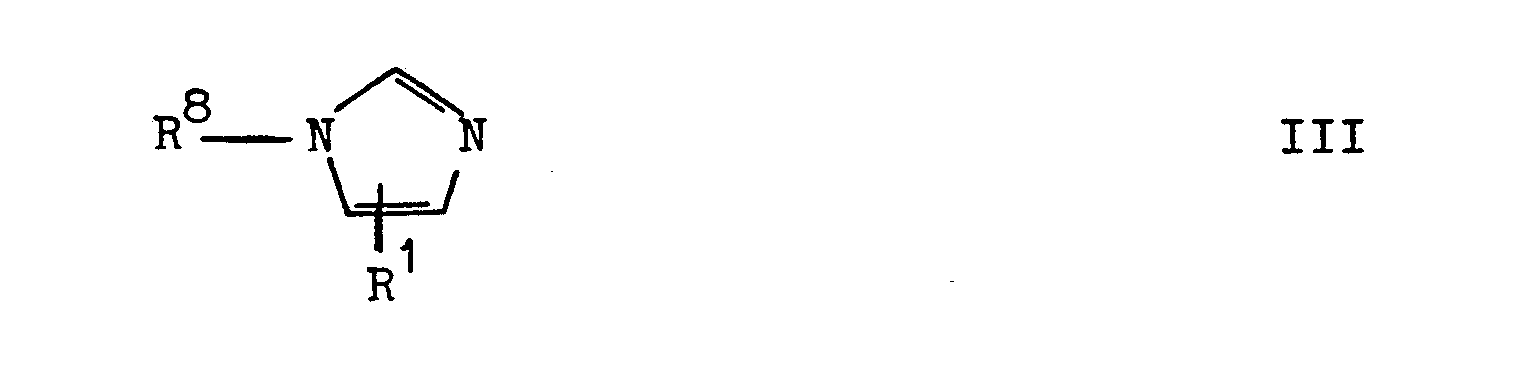

- Y' die Reste -C-CH3 oder -COOR7 bedeutet, wobei R C1-C8-Alkyl darstellt, und Hal Chlor oder Brom bedeutet, umsetzt mit einem Imidazol der Formel III
- b) gegebenenfalls eine Verbindung der Formel IV worin Y' den 0 Rest -C-CH3 darstellt, oxidiert zu einer Verbindung der Formel I worin Y den Rest -COOH bedeutet,
- c) gegebenenfalls eine Verbindung der Formel I worin Y den Rest -COOR3 darstellt, wobei R3 die zur Formel I genannten Bedeutungen hat, jedoch nicht Wasserstoff oder ein Kation darstellt, hydrolysiert zu einer Verbindung der Formel I, worin Y den Rest -COOH darstellt,
- d) gegebenenfalls eine Verbindung der Formel I worin Y den Rest -COOH darstellt, in die entsprechenden Ester oder Salze der Formel I, worin Y den Rest -COOR3 mit R3≠Was- serstoff bedeutet, oder in die entsprechenden Amide der Formel I, worin Y den Rest -C-NR4R5 darstellt, wobei R 4 und R5 die zur Formel I genannten Bedeutungen haben, überführt, oder
- e) gegebenenfalls eine Verbindung der Formel I worin Y den Rest -CO0R3 darstellt, reduziert zu einer Verbindung der Formel I, worin Y den Rest -CH20H darstellt, und
- f) gegebenenfalls eine erhaltene Verbindung der Formel I in die Säureadditionssalze überführt.
- Es können eine oder mehrere der Gegebenenfallsmaßnahmen durchgeführt werden; die Reihenfolge der Maßnahmen c) und d) ist beliebig.
- Die Ausgangsverbindungen der Formel II sind entweder bekannt oder können nach in der Literatur beschriebenen Methoden erhalten werden. So erhält man sie z.B. durch Halogenierung einer Verbindung der Formel V

- 2-Acetylnaphthalinderivate der allgemeinen Formel V können nach bekannten Verfahren (z.B. J. Org. Chem., 49, 384 (1984) bzw. Eur. J. Med. Chem.-Chim. Ther., 19, 5 (1984)) hergestellt werden.
- Verbindungen der Formel II mit Y' = CO2R7 können u.a. nach dem in DOS 23 63 416 beschriebenen Verfahren erhalten werden.
- Imidazolderivate der Formel III mit R8 = Acyl können nach literaturbekannten Verfahren (z.B. J. Amer. Chem. Soc., 74, 6274 (1952) oder J. Org. Chem., 45, 4038 (1980)) hergestellt werden.
- Verbindungen der Formel I mit Y = C02R3, worin R3 Alkyl bedeutet, und Verbindungen der Formel IV werden zweckmäßigerweise erhalten durch Umsetzung von Imidazolderivaten der Formel III mit R8 = Wasserstoff mit Verbindungen der Formel II in Gegenwart von geeigneten starken Basen wie z.B. Natriumhydrid, Natriumhydroxid, Natriumalkoholat, Kalium-t-butylat oder Kaliumcarbonat in einem inerten Lösungsmittel wie Aether, Tetrahydrofuran, Dimethoxyethan, Dioxan, Toluol, Xylol, Aceton, Formamiden, Dimethylsulfoxid oder Alkoholen zwischen 0° und 180°C.
- Verbindungen der Formel I mit Y = C02R3 mit R3 = Alkyl, bzw. Verbindungen der Formel IV werden ebenfalls erhalten, wenn man Imidazolderivate der Formel III mit R8 = Acyl mit Verbindungen der Formel II in einem geeigneten Lösungsmittel, insbesondere Acetonitril, bei Temperaturen zwischen 0° und 80°C umsetzt. (s. Chem. Pharm. Bull., 30, 4242 (1982)).
- Die Imidazolylketone der Formel IV können in einer Haloform-Reaktion mit Chlor, Brom oder Jod in Gegenwart einer starken Base wie z. B. Natrium- oder Kaliumhydroxyd zu Verbindungen der Formel I oxidiert werden, in denen Y eine Carboxylqruppe bedeutet.
- Nach literaturbekannten Verfahren lassen sich aus Verbindungen der Formel I mit Y = Carboxyl die entsprechenden Ester, Amide bzw. Salze herstellen.
- Die Reduktion der Ester- bzw. Säurefunktion in Verbindungen der Formel 1 zu Verbindungen der Formel 1 mit Y = CH2-OH gelingt u. a. mit komplexen Metallhydriden wie Lithiumalanat oder Natriumboranat in einem geeigneten inerten Lösungsmittel.
- Sofern die einzelnen Reaktionsprodukte nicht bereits in genügend reiner Form anfallen, so daß sie für den folgenden Reaktionsschritt eingesetzt werden können, empfiehlt sich eine Reinigung mittels Kristallisation oder Säulen-, Dünnschicht- oder Hochdruckflüssigkeitschromatographie.
- Die Verbindungen der allg. Formel I zeigen eine spezifische Hemmung der Thromboxan-Synthetase und können deshalb als Arzneimittel zur Prophylaxe oder Behandlung von Krankheiten mit gestörter, d. h. erhöhter Aggregationsneigung der Thrombocyten, sowie bei pathologisch erhöhten Thromboxanspiegeln, wie sie bei Ischämie, Angina pectoris, thrombo-embolischen Erkrankungen, Atherosklerose, Koronarkrämpfen, Arrhythmien, cerebralen ischämischen Anfällen, Migräne und anderen vaskulären Kopfschmerzen, Myokardinfarkt, Hypertension, Atmungsstörungen wie Asthma oder Apnoe, Entzündungskrankheiten sowie mikrovaskulären Komplikationen bei der Diabetes mellitus qefunden werden, verwendet werden. Die erfindungsgemäßen Verbindunqen beeinflussen Erkrankunqen mit erhöhten Thromboxanspiegeln in verschiedenen Organen günstig, z. B. im Nieren- oder im Magen-Darm-Bereich bei Colitis oder bei "inflammatory bowel disease". Die Verbindungen sind zudem geeignet, die Proliferation von Tumorzellen zu verlangsamen oder sogar zu verhindern.
- Die Metaboliten der Arachidonsäure sind an einer Reihe von physiologischen und pathophysiologischen Prozessen beteiligt. Bei der Regulation des Tonus der Blutgefäße und der Thrombocytenaggregation sind ProstacycIin (PGI2) und Thromboxan A2(TXA2) von wesentlicher Bedeutung. Prostacyclin, das bevorzugt in den Endothelzellen der Blutgefäße aus Prostaglandinendoperoxid H2 (PGH2) gebildet wird, bewirkt eine
- Vasodilation und verhindert gleichzeitig die Aggregation der Thrombocyten. Die Umwandlung von PGH2 in Prostacyclin wird durch die Prostacyclin-Synthetase katalysiert. Der physiologische Gegenspieler von Prostacyclin ist Thromboxan A2' das vornehmlich in den Blutplättchen aus PGH2 synthetisiert wird. Diese Reaktion wird durch das Enzym Thromboxan-Sythetase katalysiert. TXA2 bewirkt eine Aggregation der Blutblättchen und führt zu einer Vasokonstriktion. Es ist bislang der stärkste bekannte Vasokonstriktor im menschlichen Organismus (s. A. G. Herman, P. M. Vonhoutte, H. Denolin, A. Goossens, Cardiovascular Pharmacology of the Prostaglandins, Raven Press, New York, 1982). Störungen im Gleichgewicht zwischen Prostacyclin und Thromboxan A2 führen zu pathophysiologischen Situationen. Bei gleichbleibenden PGI2-Spiegeln führt eine Erhöhung des Thromboxan-Spiegels daher zu einer Blutplättchenaggregation und zu GefäBspasmen sowie zu einer erhöhten Anfälligkeit gegenüber Atherothrombose (Lancet 1977, 479; Science 1976, 1135; Amer. J. Cardiology 41, 787 (1978); Lancet 1977, 1216;). Bei der experimentellen Atherosklerose ist die Bildung von PGI2 inhibiert bei gleichzeitig erhöhter Thromboxan A2-Bildung (Prostaglandins 14, 1025 und 1035 (1977)). Aus diesem Grunde wird TXA2 mit verschiedenen Anginen, myocardialer Infarktbildung, plötzlichem Herztod und Schlaganfällen in Verbindung gebracht (Thromb. Haemostasis 38, 132 (1977); Platelets, Prostaglandins and Cardiovascular System, Florenz, Februar 1984).
- Ein weiteres Gebiet, auf dem eine Störung des PCI2/ TXA2-Gleichgewichtes als ein bei tragender Faktor angesehen wird, ist die Migräne. Der Migränekopfschmerz ist mit Veränderungen des intra- und extracerebralen Blutflusses verbunden, insbesondere mit einer vor dem Auftreten des Kopfschmerzes erfolgenden Reduzierung des cerebralen Blutflusses und nachfolgender Dilatation in beiden Gefäßbereichen während der Kopfschmerzphase. Thrombocyten von Migränepatienten besitzen eine größere Neigung zur Aggregation als diejenigen von normalen Individuen (J. clin. Pathol. 24, 250 (1971); J. Headache, 17, 101 (1977); Lancet 19
78 , 501). - Bei Patienten mit Diabetes mellitus wird ein Ungleichgewicht zwischen Prostacyclin und Thromboxan A2 als Ursache für die mikrovaskulären Komplikationen angesehen. Thrombocyten von Diabetespatienten bilden erhöhte Mengen an TXA2 und Malondialdehyd (Symposium "Diabetes and Thrombosis - Implications für Therapy", Leeds, Großbritannien, April 1979). Es wurde außerdem gezeigt, daß bei Ratten mit experimentell erzeugter Diabetes die vaskuläre PCI2-Bildung gehemmt ist, während die TXA2-Synthese in den Plättchen erhöht ist (IV. Int. Prostaglandin Conference, Washington DC, Mai 1979).
- Nichtsteroidale Antiinflammatorika hemmen die Cyclooxygenase, die die Umwandlung der Arachidonsäure in PGH2 über PGG2 katalysiert. Sie greifen daher sowohl in die Biosynthese des Thromboxan A2 als auch in die des Prostacyclins ein. Wertvoller wären somit Verbindungen, die spezifisch die Bildung von Thromboxan A2 durch Hemmung der Thromboxan-Synthetase blockieren und gleichzeitig die Bildung von Prostacyclin nicht beeinflussen.
- Gesund erscheinenden männlichen und weiblichen Freiwilligen, die im vorangegangenen Zeitraum von 10 Tagen keine Medikamente eingenommen haben, wird durch vorsichtige Kanülierung der Antekubitalvene Blut entnommen, das sofort mit Natriumcitrat (a d 0.38 %) stabilisiert wird. Durch 15 minütiges Zentrifugieren bei 140 x g erhält man im Überstand plättchenreiches Plasma (PRP), dessen Thrombocytengehalt im Bereich 2.5 - 3.5x 10⁸/ ml (Coulter Counter) liegen sollte. Die Plättchenaggregation wird optisch durch Messung der Lichttransmission in einem Born'schen Aggregometer verfolgt. Das Gesamtvolumen des Testansatzes beträgt 0.25 ml. Die Vorinkubationszeit mit Prüfpräparat beträgt 10 min bei 37°C, die Aggregationsinduktion erfolgt danach mit 2 x 10⁻⁴ M Arachidonsäure. Das Prüfpräparat wird in der Regel in fünf verschiedenen Konzentrationen in PRP aus drei verschiedenen Spendern getestet. Aus den jeweiligen maximalen Aggregationsauiplituden werden Dosis-Wirkungskurven erstellt und graphisch IC50-Werte bestimmt. Die Messungen erfolgen im Zeitraum von 1 - 6 Stunden nach der Blutentnahme.
- Von den erfindungsgemäßen Verbindungen wurden nach der oben beschriebenen Methode folgende IC50-Werte für die Hemmung der Arachidonsäure-induzierten Aggregation von Humanthrombocyten in vitro ermittelt :

- -Gesund erscheinenden männlichen und weiblichen Freiwilligcn, die im vorangegangenen Zeitraum von 10 Tagen keine Medikamente eingenommen haben, wird durch vorsichtige Kanülicrung der Antekubitalvene Blut entnommen, das sofort mit Natriumzitrat (a d. 0,38 %) stabilisiert wird. Durch 15 minütiges Zentrifugieren bei 140 x g erhält man im Überstand plättchenreiches Plasma (PRP), dessen Thrombozytengehalt im Bereich 2,5 - 3,5˙108 /ml licgen sollte. Durch crneutes Zeutrifugieren (10 min bei 2000 x g) werden die Thrombozyten sedimentiert und anschließend in Tyrode-Lösung re-solubilisiert (ca. 7˙107 Flättchen / ml, Gesamtvolumen pro Messung 0,5 ml). Nach Zugabe von Testsubstanz wird 10 min bei 37° C inkubiert, anschließend 7,2˙10-7 M Arachidonsäure und 0,5 E Thrombin zugesetzt und 30 min bei 37°C inkubiert. Hierauf wird im Eisbad abgestoppt und nach Zugabe von Tracer und TXB2-spezifischem Antikörper (NEN, Drcieich) der TXB2-Gchalt radioimmunologisch bestimmt (TXA2 ist unter den Versuchsbedingungen instabil und daher nicht meBbar. Statt dessen wird das stabile Hydrolyseprodukt TXB2 gemessen) . Meßgröße ist der rela- tive TXB2-Gehalt in den Thrombozyten-Inkubationen aus zwei bis drei verschiedenen Spendern mit und ohne (= 100%) Prüfsubstanz.
- Nach der oben beschriebenen Methode wurden von den erfindungsgemäßen Verbindungen z.B. folgende Werte für die TXB2-Freisetzung nach Gabe von Testsubstanz ermittelt:


- Die Untersuchungen der erfindungsgemäßen Verbindungen im Laser-induzierten Thrombosemodell erfolgt an männlichen oder weiblichen Sprague-Dawley-Ratten mit einem Körpergewicht von ca 200 g. Die zu untersuchenden Tiere werden mit 0.1 mg Atropinum sulf. sol. s.c. prämediziert und mit 100 mg Ketaminhydrochlorid und 4 mg Xylazin pro kg Körpergewicht i.p. anästhetisiert. Zur Untersuchung dienen Arteriolen des Mesenteriums mit einem Durchmesser von 12 - 25µm. Während der Messung erfolgt eine Hyperfundierung des exponierten Mesenteriums mit erwärmter phys. NaCl (370C) oder eine Überschichtung mit entgastem Paraffinöl.
- Der Strahl des 4 W Argon-Lasers (Fa. Spectra Physics, Darmstadt, FRG) wird mittels einer Strahladaptions- und -justieranlage (Fa. BTG, München, FRG) koaxial in den invertierten Strahlengang eines Mikroskopes (ICM 405, LD-Epilan 40/0.60; Fa. Zeiss, Oberkochen, FRG) eingebracht. Die benutzte Wellenlänge beträgt 514.5 nm mit einer Energie oberhalb des Objektives von 40 mW. Die Expositionszeit pro Einzelschuß dauert 1/15 sec. Der Durchmesser des effektiven Laserstrahls auf dem Gefäß beträgt 10/µm, bei wiederholter Exposition erfolgt der nächste Schuß jeweils 5µm stromaufwärts unmittelbar an der Gefäßwand. Alle Meßvorgänge werden per Videokamera (Sony, Trinicon-Röhre) aufgenommen und auf einem Recorder (Sony, U-matic 3/4) gespeichert. Im Durchlichtverfahren des gleichen Mikroskops wird bei kleiner Vergrößerung (LD-Epilan 8/0.20) ein Überblicksbild der zu untersuchenden Endstrombahn geliefert. Ein Videoanalyser sowie ein Korrelator dient zur Bestimmung der Strömungsgeschwindigkeit in der untersuchten Arteriole. Die Testsubstanzen wurden in 0.9 % Natriumchlorid-Lösung (enthielt 1 % Carboxymethylzellulose oder in entsprechenden Lösungsvermittlern) den Versuchstieren in verschiedenen Dosierungen oral eine Stunde vor Versuchsbeginn verabreicht; Kontrolltiere wurden in entsprechender Weise, aber ohne Testsubstanzen, behandelt. Die Untersuchungen wurden randomisierend als Doppelblindstudie durchgeführt.
- Es wurde die Anzahl der Schüsse gezählt, um einen definierten Thrombus zu induzieren. Die Frequenz der Laserblitze betrugeine Läsion alle 2 Minuten, wobei alle während des Beobachtungszeitraumes gebildeten Thromben von einer Mindestgröße von 1/4 Gefäßradius ausgezählt und vermessen wurden. Die statistische Auswertung der Versuchsergebnisse erfolgte mit Hilfe des x2-Testes (L. Cavalli-Sforza, Biometrie, Stuttgart, 1969, S 49 f.).

- Die Verbindungen der Formel!I blockieren spezifisch die Bildung von Thromboxan A2 durch Hemmung der Thromboxan-Synthetase ohne Beeinflussung der Prostacyclinbildung und eignen sich daher zur Vorbeugung oder zur Behandlung der oben aufgeführten Erkrankungen, die auf eine Hemmung der Thromboxan-Synthetase ansprechen.
- Die Erfindung betrifft daher ferner die Verwendung der Verbindungen der Formel I und von deren Salzen zur Behandlung der aufgeführten Erkrankungen sowie pharmazeutische Präparate auf Basis der erfindungsgemäßen Verbindungen. Die Verbindungen der Formel I werden in verschiedenen Dosierungsformen verabreicht, z. B. oral in Form von Tabletten, Kapseln oder Flüssigkeiten, rektal in Form von Suppositorien, parenteral, subkutan oder intramuskulär, wobei intravenöse Verabreichung in Notsituationen bevorzugt wird.
- Die erfindungsgemäßen Verbindungen der Formel I können als freie Basen oder in Form ihrer physiologisch unbedenklichen anorganischen oder organischen Säureadditionssalze zur Anwendung kommen. Die freien Basen und Säureadditionssalze können in Form ihrer wässrigen Lösungen oder Suspensionen oder auch gelöst oder suspendiert in pharmakologisch unbedenklichen organischen Lösungsmitteln wie ein- oder mehrwertigen Alkoholen wie z. B. Ethanol, Ethylenglykol oder Glycerin, in Triacetin,in Alkohol-Acetaldehyd-diacetalgemischen, ölen wie z. B. Sonnenblumenöl oder Lebertran, Ethern wie z. B. Diethylenglykoldimethylether oder auch Polyethern wie z. B. Polyethylenglykol oder auch in Gegenwart anderer pharmakologisch unbedenklicher Polymerträger wie z. B. Polyvinylpyrrolidon zur Anwendung gelangen.
- Als Zubereitungen können die üblichen galenischen Infusions- oder Injektionslösungen und Tabletten sowie örtlich anwendbare Zubereitungen wie Cremes, Emulsionen Suppositorien oder Aerosole in Frage kommen.
- Die Verbindungen sind in Dosen von 0,01 mg/kg bis 10 mg/kg wirksam. Die verabreichte Einzeldosis kann zwischen 1 mg bis 500 mg liegen. Bei oraler Applikation liegt die bevorzugte Tagesdosis zwischen 1 mg und 1 g.
- 50 g (0,6 Mol) 4-Methylimidazol werden in 500 ml abs. Ether gelöst. Nach Zutropfen von 23,6 g (0,3 Mol) Acetylchlorid in 75 ml abs. Ether bei Raumtemperatur wird 11
- Stunden unter Rückfluß erhitzt. Es wird vom Rückstand abfiltriert und die Lösung in Vakuum eingeengt. Erhalten werden 11,45 g (31 %) 1-Acetyl-4-methylimidazol als. farbloses Ö1.
- 1H-NMR (CDCl3, 60 MHz) δ = 2,15 und 2,5 (2s, 6H; 2 x CH3), 7,05 (s, 1H; C-5-H), 7,95 (s, 1H; C-2-H).
- 2 g (7,16 mMol) 6-Brommethyl-2-naphthoesäuremethylester und 1,07 g (8,6 mMol) 1-Acetyl-4-methylimidazol werden in abs. Acetonitril unter Rückfluß erhitzt (8 Stunden). Nach Einengen der Reaktionslösung wird der Rückstand in 2 N-HCl aufgenommen und mit Essigester extrahiert. Die Essigesterphasen werden verworfen. Nach Neutralisieren der wäßrigen Phase mit Natriumcarbonat wird mit Essigester extrahiert, die Essigesterphase getrocknet und im Vakuum eingeengt. Durch Verreiben des Rückstandes mit Ether werden 1,4 g (70 %) 6-(5-Methylimidazol-1-ylmethyl)-2-naphthoesäureme- thylester erhalten. Schmp. 101-2 °C.
- 1H-NMR (CDCl3, 60 MHz) δ = 2,1 (d, J = 1,5 Hz, 3H; C-CH3), 3,95 (s, 3H; OCH3), 5,2 (s, 2H; CH2), 6,85-8,55 (m, 8H; arom. H).
- 100 g (0,75 Mol) Aluminiumchlorid werden in 200 ml dest. Nitrobenzol gelöst. Bei 70 °C wird eine Lösung von 100 g (0,64 Mol) 2-Ethylnaphthalin und 52 ml (57,4g, 0,73 Mol) Acetylchlorid in 400 ml dest. Nitrobenzol zugetropft und vier Stunden nachgerührt. Die Reaktionsmischung wird auf Eis gegeben und mit 300 ml 2 N HC1 angesäuert, über Klärschicht filtriert und die Phasen getrennt. Die organische Phase wird mit 2 N HCl, NatriumcarbonatLösung undschlieBlich mit Wasser gewaschen; die wäßrigen Phasen werden mit Dichlormethan reextrahiert. Nach Trocknen der organischen Phasen wird im Vakuum destilliert. Erhalten werden 80,3 g (63 %) eines 5 : 2-Gemisches aus 2-Acetyl-6-ethylnaphthalin und 1-Acetyl-7-ethylnaphthalin. Sdp. 0,2 : 125 °C.
- Zur Trennung der Isomeren wird das Gemisch mit 44,3 ml (49,6 g, 0,8 Mol) Ethylenglykol und 0,5 g p-Toluolsulfonsäure in 800 ml Toluol am Wasserabscheider unter Rückfluß erhitzt, bis kein Wasser mehr abgeschieden wird, und somit in die isomeren Ethylenacetale überführt. Die Reaktionslösung wird mit Natriumbicarbonatlösung gewaschen und anschließend im Vakuum eingeengt. Erhalten werden 97,4 g ( 102 %) eines Gemisches aus zwei isomeren Ethylen- acetalen,von dem 40 g durch Chromatographie mit Cyclohexan-Essigester-Gemischen über Kieselgel in die Isomeren getrennt wird. Erhalten werden 11,5 g (47,5 mMol) 7-Ethyl-1-naphthylmethylketonethylenacetal als öl, RF(Cyclohexan-Essigester 7 : 1) 0,38 und 25,5 g eines öls, aus dem 16,1 g (31 %) 6-Ethyl-2-naphthylmethyl-ketonethylenacetal durch Umkristallisieren aus Petrolether isoliert werden.
- Schmp. 66-68 °C, RF (Cyclohexan-Essigester 7 : 1) : 0,30.
- Anschließend werden 16,1 g (66,4 mMol) 6-Ethyl-2-naph- thylmethylketonethylenacetal in 100 ml Tetrahydrofuran gelöst, mit 100 ml Methanol und 100 ml 2 N HCl versetzt und drei Stunden unter Rückflüß erhitzt. Nach Einengen der Lösung auf die Hälfte des Volumens wird mit ges. Natriumbicarbonatlösung neutralisiert und mit Essigester extrahiert. Die Essigesterphase wird getrocknet und im Vakuum eingeengt. Erhalten werden 12,9 g (98 %) 2-Acetyl-6-ethylnaphthalin als ö1. RF (Cyclohexan-Essigester 7 : 1) : 0,19.
- 1H-NMR (CDCl3, 60 MHz) δ = 1,3 (t, 3H; CH2-CH3), 2,65 (s, 3H; CH3-CO), 2,8 (q, 2H; CH2), 7,1-8,0 (m, 5H; arom. H), 8,3 (s, 1H; C-1-H).
- 12,8 g (64,6 mMol) 2-Acetyl-6-ethylnaphthalin, 10, 92 g (61,35 mMol) N-Bromsuccinimid und 0,1 g Azo-bis-isobutyroitril werden in 280 ml abs. Tetrachlormethan eine Stunde unter Rückfluß erhitzt. Es wird vom Rückstand abfiltriert, mit heißem Tetrachlormethan nachgewaschen und die Tetrachlormethanlösung im Vakuum eingeengt. Durch Umkristallisieren des Rückstandes aus n-Hexan-Essigester werden 9,84 g (58 %) 2-Acetyl-6-(1-bromethyl)naphthalin erhalten. Schmp. 64-66 °C.
- 1H-NMR (CDCl3, 60 Mhz) δ = 2,1 (d, 3H; CH-CH3), 2,7 (s, 3H; C(O)-CF3), 5,3 (q, 1H; CH), 7,4-8,1 (m, 5H; arom. H), 8,3 (s, 1H; C-1-H).
- 9,82 g (35,4 mMol) 2-Acetyl-6-(1-bromethyl)naphthalin, 6,38 g (70,9 mMol) Natriumimidazolid (aus 3,1 g (70,9 mMol) Natriumhydrid-Dispersion (55 %) und 4,83 g (70,9 mMol) Imidazol) und 0,588 g (3,54 mMol) Kaliumjodid werden in 100 ml abs. N,N-Dimethylformamid bei 100 °C gerührt. (24 Stunden). Anschließend wird im Vakuum eingeengt, in 4 N HCl aufgenommen, mit Essigester extrahiert und die wäßrige Phase mit Natriumcarbonatlösung neutralisiert. Dann wird 4 x mit Dichlormethan extrahiert, die'Dichlormethanphase getrocknet und im Vakuum eingeengt. Der Rückstand wird mit Essigester-Methanol 8 : 1 über Kieselgel filtriert. Erhalten werden 6,48 g (70 %) 2-Acetyl-6-[1-(imidazol-1-yl)ethyl]naphthalin als öl. RF (Essigester-Methanol 8 : 1) : 0,15.
- 1H-NMR (CDCl3, 60 MHz) δ = 1,95 (d, 3H, J = 7Hz; CH3), 2,7 (s, 3H; CH3), 5,5 (q, 1H; CH), 6,9-8,1 (m, 8H; arom.H), 8,4 (s, 1H; C-1-H).
- 9,72 g (0,243 Mol) Natriumhydroxid werden in 50 ml Wasser gelöst und bei 0 bis 10°C mit 3,75 ml (11,65 g, 72,9 mMol) Brom versetzt. Bei 0 bis 10°C wird eine Lösung von 6,4 g ( 2.4,3 mMol) 2-Acetyl-6-[1-(imidazol-1-yl)ethyl] naphthalin in 15 ml Dioxan zugetropft. Es wird 3 Stunden bei Raumtemperatur gerührt. Nach Zugabe von 40 ml ges. Natriumbisulfit-Lösung wird 30 Minuten gerührt. Es wird mit Ether extrahiert und die wäßrige Phase dann mit 2 N HCl auf PH 1 eingestellt und im Vakuum eingeengt. Der Rückstand wird mit Isopropanol ausgekocht. Erhalten werden nach Umkristallisieren aus 2 N HCl 3,12 g (43 %) 6-[1-(Imidazol-1-yl)ethyl]-2-naphthoesäure-Hydrochlorid. Schmp. 246-9 °C (Zers.).
- 1H-NMR (D20, 60 MHz) δ = 2,0 (d, 3H; CH3), 6,0 (q, 1H; CH3), 7,1-8,8 (m, 9H; arom. H).
- 10 g (35,8 mMol) 6-Brommethyl-2-naphthoesäuremethylester und 9,75 g (0,143 Mol) Imidazol werden in 300 ml Dimethoxyethan 3 Stunden unter Rückfluß erhitzt. Nach Einengen der Reaktionslösung wird in 2 N HCl aufgenommen, mit Essigester extrahiert und die Essigesterphase verworfen.
- Die wäßrige Phase wird mit Natriambicarbonat auf PH 7 eingestellt und der Niederschlag abgesaugt. Unter Zusatz von wenig Aktivkohle wird der Rückstand aus Essigester umkristallisiert. Erhalten werden 7,16 g (75 %) 6-(1-Imida- zolylmethyl)-2-naphthoesäuremethylester. Schmp. 144-6 °C.
- IR (KBr) 1710 cm-1. 1H-NMR (CDCl3, 60 MHz) δ= 4,0 (s, 3H; CH3), 5,3 (s, 2H; CH2), 6,9-8,2 (m, 8H; arom. H), 8,55 (s, 1H; C-1-H).
- Zu 28,5 mg (0,75 mMol) Lithiumalanat in 1 ml abs. Tetrahydrofuran werden 0,2 g (0,75 mMol) 6-(1-Imidazolylme- thyl)-2-naphthoesäuremethylester im 5 ml abs. Tetrahydrofuran zugetropft. Man läßt über Nacht bei Raumtemperatur stehen. Durch Zugabe von 2 N HCl wird überschüssiges Lithiumalanat zersetzt. Nach Neutralisieren mit Natriumbicarbonat wird mit Essigester extrahiert und die Essiges - terphase getrocknet und im Vakuum eingeengt. Erhalten werden 0,13 g (73 %) 6-(1-Imidazolylmethyl)-2-naphthyl- methanol. Schmp. 122-5 °C.
- 1H-NMR (CDCl3, 60 MHz) δ= 3,1 (b, 1H; OH) 4,8 (s, 2H; CH2-O), 5,2 (s, 2H; CH2-N), 6,8-7,9 (m, 9H; arom. H).
- 3,31 g (11,8 mMol) 6-(5-Methylimidazol-1-yl)methyl-2-naphthoesäuremethylester werden drei Stunden in 40 ml 2N HCl unter Rückfluß erhitzt, mit Aktivkohle versetzt und heiß filtriert. Beim Abkühlen kristallisiert das Hydrochlorid der Säure aus. Erhalten werden nach Absaugen, Nachwaschen mit Aceton und Trocknen 3,03 g (85 %) 6-(5-Methylimidazol- l-yl)-methyl-2-naphthoesäure-Hydrochlorid. Schmp.: 289-90°C.
- 1H-NMR (D2O, 60 MHz) 6=2,15 (s,3H; CH3), 5,45 (s, 2H; CH2), 7,1-8,7 (m, 8H; arom. H).
- 1,26 g (4,2 mMol) 6-[1-(Imidazol-1-yl) ethyl]-2-naphthoe- säure-hydrochlorid werden in 25 ml gesättigter methanolischer HCl-Lösung eine Stunde unter Rückfluß erhitzt und dann im Vakuum eingeengt. Der Rückstand.wird in gesättigter Natriumbicarbonatlsg. aufgenommen und mit Essigester extrahiert. Nach Trocknen und Einengen der Essigesterlösung wird der Rückstand über Kieselgel chromatographiert (Essigester-Methanol 8 : 1). Erhalten werden 530 mg (45 %) 6-[1-(Imidaaol-1-yl)ethyl]-2-naphthoesäuremethyl- ester. Schmp. 103-6 °C.
- 1H-NMR (CDCl3, 60 MHz) δ = 1,95 (d, 3H; CH3), 3,95 (s, 3H; OCH3), 5,5 (q, 1H; CH), 6,9-8,6 (m, 9H; arom. H).
mit Ausnahme der Verbindungen der Formel I, worin R und R2 gleichzeitig Wasserstoff sind wenn Y die Gruppe CO2R3 mit R3 = H oder Alkyl oder die Gruppe CONH2 darstellt.
Claims (10)

sowie die physiologisch verträglichen Säureadditionssalze
mit Ausnahme der Verbindungen der Formel I worin R1 und R 2 gleichzeitig Wasserstoff sind und Y die Gruppe CO2R3 mit R3=H oder Alkyl oder die Gruppe -CONH2 darstellt.
sowie die physiologisch verträglichen Säureadditionssalze.


mit Ausnahme der Verbindungen der Formel I worin R1 und R2 gleichzeitig Wasserstoff und Y die Gruppe C02R3 mit R3 =H oder Alkyl oder die Gruppe -CONH2 darstellt, dadurch gekennzeichnet, daß man


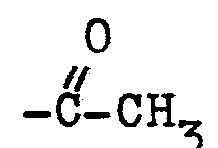

sowie von deren physiologisch verträglichen Säureadditionssalzen,
mit Ausnahme der Verbindungen der Formel I worin R1 und R2 gleichzeitig Wasserstoff und Y die Gruppe CO2R3 mit R3=H oder Alkyl oder die Gruppe -CONH2 darstellt, dadurch gekennzeichnet, daß man


Priority Applications (1)
| Application Number | Priority Date | Filing Date | Title |
|---|---|---|---|
| AT86102933T ATE49754T1 (de) | 1985-03-13 | 1986-03-05 | Neue imidazolylverbindungen und verfahren zu ihrer herstellung. |
Applications Claiming Priority (2)
| Application Number | Priority Date | Filing Date | Title |
|---|---|---|---|
| DE19853508905 DE3508905A1 (de) | 1985-03-13 | 1985-03-13 | Neue imidazolylverbindungen und verfahren zu ihrer herstellung |
| DE3508905 | 1985-03-13 |
Publications (3)
| Publication Number | Publication Date |
|---|---|
| EP0194580A2 true EP0194580A2 (de) | 1986-09-17 |
| EP0194580A3 EP0194580A3 (en) | 1987-07-22 |
| EP0194580B1 EP0194580B1 (de) | 1990-01-24 |
Family
ID=6265031
Family Applications (1)
| Application Number | Title | Priority Date | Filing Date |
|---|---|---|---|
| EP86102933A Expired - Lifetime EP0194580B1 (de) | 1985-03-13 | 1986-03-05 | Neue Imidazolylverbindungen und Verfahren zu ihrer Herstellung |
Country Status (9)
| Country | Link |
|---|---|
| US (1) | US4778817A (de) |
| EP (1) | EP0194580B1 (de) |
| JP (1) | JPS61212565A (de) |
| AT (1) | ATE49754T1 (de) |
| DE (2) | DE3508905A1 (de) |
| DK (1) | DK114186A (de) |
| ES (1) | ES8802033A1 (de) |
| GR (1) | GR860680B (de) |
| PT (1) | PT82174B (de) |
Cited By (2)
| Publication number | Priority date | Publication date | Assignee | Title |
|---|---|---|---|---|
| EP1028110A4 (de) * | 1997-10-02 | 2001-05-23 | Yukijirushi Nyugyo Kabushiki K | Dihydronaphthalinderivate und verfahren zur herstellung derselben |
| US6559157B2 (en) | 1997-10-02 | 2003-05-06 | Daiichi Pharmaceutical Co., Ltd. | Dihydronaphthalene compounds |
Families Citing this family (2)
| Publication number | Priority date | Publication date | Assignee | Title |
|---|---|---|---|---|
| DE3811574A1 (de) * | 1988-03-31 | 1989-10-19 | Schering Ag | N-substituierte imidazole, verfahren zu ihrer herstellung sowie ihre verwendung in arzneimitteln |
| US20070261288A1 (en) * | 2006-05-10 | 2007-11-15 | Sps Marketing Inc. | Gun-cleaning Tool and System |
Family Cites Families (4)
| Publication number | Priority date | Publication date | Assignee | Title |
|---|---|---|---|---|
| EP0003732B1 (de) * | 1978-02-01 | 1983-10-19 | The Wellcome Foundation Limited | Imidazolderivate und deren Salze, deren Herstellung sowie deren pharmazeutische Zusammensetzungen |
| IE49744B1 (en) * | 1979-02-22 | 1985-12-11 | Wellcome Found | Imidazole derivatives and salts thereof,their synthesis,and pharmaceutical formulations |
| ZA825413B (en) * | 1981-08-26 | 1983-06-29 | Pfizer | Thromboxane synthetase inhibitors, processes for their production, and pharmaceutical compositions comprising them |
| PH22076A (en) * | 1983-08-25 | 1988-05-20 | Daiichi Seiyaku Co | Benzocycloalkane derivative |
-
1985
- 1985-03-13 DE DE19853508905 patent/DE3508905A1/de not_active Withdrawn
-
1986
- 1986-03-05 DE DE8686102933T patent/DE3668451D1/de not_active Expired - Fee Related
- 1986-03-05 AT AT86102933T patent/ATE49754T1/de not_active IP Right Cessation
- 1986-03-05 EP EP86102933A patent/EP0194580B1/de not_active Expired - Lifetime
- 1986-03-11 ES ES552872A patent/ES8802033A1/es not_active Expired
- 1986-03-11 US US06/838,565 patent/US4778817A/en not_active Expired - Fee Related
- 1986-03-12 JP JP61052748A patent/JPS61212565A/ja active Pending
- 1986-03-12 DK DK114186A patent/DK114186A/da unknown
- 1986-03-12 PT PT82174A patent/PT82174B/pt not_active IP Right Cessation
- 1986-03-12 GR GR860680A patent/GR860680B/el unknown
Cited By (2)
| Publication number | Priority date | Publication date | Assignee | Title |
|---|---|---|---|---|
| EP1028110A4 (de) * | 1997-10-02 | 2001-05-23 | Yukijirushi Nyugyo Kabushiki K | Dihydronaphthalinderivate und verfahren zur herstellung derselben |
| US6559157B2 (en) | 1997-10-02 | 2003-05-06 | Daiichi Pharmaceutical Co., Ltd. | Dihydronaphthalene compounds |
Also Published As
| Publication number | Publication date |
|---|---|
| DE3508905A1 (de) | 1986-09-18 |
| ES8802033A1 (es) | 1988-03-16 |
| US4778817A (en) | 1988-10-18 |
| EP0194580A3 (en) | 1987-07-22 |
| JPS61212565A (ja) | 1986-09-20 |
| GR860680B (en) | 1986-07-14 |
| PT82174A (de) | 1986-04-01 |
| ATE49754T1 (de) | 1990-02-15 |
| EP0194580B1 (de) | 1990-01-24 |
| DK114186D0 (da) | 1986-03-12 |
| ES552872A0 (es) | 1988-03-16 |
| DK114186A (da) | 1986-09-14 |
| PT82174B (pt) | 1988-07-29 |
| DE3668451D1 (de) | 1990-03-01 |
Similar Documents
| Publication | Publication Date | Title |
|---|---|---|
| DE2923815C2 (de) | ||
| DE3008632C2 (de) | ||
| DE3855501T2 (de) | Chinolin-derivate als antagonisten von leukotrien d 4? | |
| EP0173172A2 (de) | Neue 3-Pyridylverbindungen und Verfahren zu ihrer Herstellung | |
| DD147943A5 (de) | Verfahren zur herstellung von alkyl-imidazol-derivaten | |
| DD202290A5 (de) | Verfahren zur herstellung von indolderivaten | |
| DE3001762A1 (de) | Imidazol-derivate, verfahren zu ihrer herstellung und solche derivate enthaltende arzneimittel | |
| DE69705324T2 (de) | N-hydroxyharnstoffderivate und sie enthaltende medizinische zubereitungen | |
| DE69112074T2 (de) | Disubstituierte arylverbindungen welche eine selektive leukotrien-b4 antagonistische aktivität aufweisen. | |
| EP0090978A2 (de) | Imidazolylphenyl-tetrahydropyridazine, Verfahren zu ihrer Herstellung und diese enthaltende pharmazeutische Präparate | |
| EP0177960A2 (de) | Tetrahydronaphtalinderivate, Verfahren und Zwischenprodukte zu deren Herstellung sowie diese enthaltende Arzneimittel | |
| DE69317651T2 (de) | Indol derivate als steroid 5 alpha-reductase inhibitoren | |
| EP0425906A2 (de) | Substituierte Cycloalkano[b]dihydroindol- und -indolsulfonamide | |
| EP0716082A1 (de) | Heterocyclisch substituierte Oxy-phenyl-(phenyl) glycinolamide mit antiatherosklerotischer Wirkung | |
| DE3902031A1 (de) | Substituierte azolylmethylcycloalkan-derivate, ihre herstellung und verwendung sowie diese enthaltende arzneimittel | |
| DE69214113T2 (de) | Neue Pyrrolidinderivate, Verfahren zu ihrer Herstellung und diese enthaltende Arzneimittel | |
| EP0194580B1 (de) | Neue Imidazolylverbindungen und Verfahren zu ihrer Herstellung | |
| EP0194579B1 (de) | Neue 3-Pyridylmethylnaphthylderivate, Verfahren zu ihrer Herstellung und ihre Verwendung als Arzneimittel | |
| EP0071059B1 (de) | 6-(5-(Omega-(1-Imidazolyl)-alkyl)-thien-2-yl)-3-oxo-2,3,4,5-tetrahydropyridazine und deren Säureadditionssalze, Verfahren zu ihrer Herstellung und diese enthaltende pharmazeutische Präparate | |
| DE3306146A1 (de) | Pyridin-derivate und ihre verwendung als arzneimittel | |
| DE3049959C2 (de) | ||
| DE69518647T2 (de) | Pyridyl-imidazol-derivate und verfahren zu ihrer herstellung | |
| EP0169408B1 (de) | Neue Imidazolylverbindungen, Verfahren zu ihrer Herstellung und ihre Verwendung als Arzneimittel | |
| DE10305089A1 (de) | Neue heteroarylsubstituierte Acetonderivate als Hemmstoffe der Phospholiphase A2 | |
| DE68922287T2 (de) | Imidazol und Pyridyl-Derivate von Phenyl substituierten 1,4-Dihydropyridinen und Verfahren zu ihrer Herstellung. |
Legal Events
| Date | Code | Title | Description |
|---|---|---|---|
| PUAI | Public reference made under article 153(3) epc to a published international application that has entered the european phase |
Free format text: ORIGINAL CODE: 0009012 |
|
| AK | Designated contracting states |
Kind code of ref document: A2 Designated state(s): AT BE CH DE FR GB IT LI LU NL SE |
|
| PUAL | Search report despatched |
Free format text: ORIGINAL CODE: 0009013 |
|
| AK | Designated contracting states |
Kind code of ref document: A3 Designated state(s): AT BE CH DE FR GB IT LI LU NL SE |
|
| 17P | Request for examination filed |
Effective date: 19871001 |
|
| 17Q | First examination report despatched |
Effective date: 19880504 |
|
| GRAA | (expected) grant |
Free format text: ORIGINAL CODE: 0009210 |
|
| AK | Designated contracting states |
Kind code of ref document: B1 Designated state(s): AT BE CH DE FR GB IT LI LU NL SE |
|
| REF | Corresponds to: |
Ref document number: 49754 Country of ref document: AT Date of ref document: 19900215 Kind code of ref document: T |
|
| ITF | It: translation for a ep patent filed | ||
| REF | Corresponds to: |
Ref document number: 3668451 Country of ref document: DE Date of ref document: 19900301 |
|
| ET | Fr: translation filed | ||
| GBT | Gb: translation of ep patent filed (gb section 77(6)(a)/1977) | ||
| PLBE | No opposition filed within time limit |
Free format text: ORIGINAL CODE: 0009261 |
|
| STAA | Information on the status of an ep patent application or granted ep patent |
Free format text: STATUS: NO OPPOSITION FILED WITHIN TIME LIMIT |
|
| 26N | No opposition filed | ||
| ITTA | It: last paid annual fee | ||
| PGFP | Annual fee paid to national office [announced via postgrant information from national office to epo] |
Ref country code: FR Payment date: 19920214 Year of fee payment: 7 |
|
| PGFP | Annual fee paid to national office [announced via postgrant information from national office to epo] |
Ref country code: CH Payment date: 19920217 Year of fee payment: 7 |
|
| PGFP | Annual fee paid to national office [announced via postgrant information from national office to epo] |
Ref country code: SE Payment date: 19920221 Year of fee payment: 7 Ref country code: GB Payment date: 19920221 Year of fee payment: 7 |
|
| PGFP | Annual fee paid to national office [announced via postgrant information from national office to epo] |
Ref country code: AT Payment date: 19920228 Year of fee payment: 7 |
|
| PGFP | Annual fee paid to national office [announced via postgrant information from national office to epo] |
Ref country code: LU Payment date: 19920311 Year of fee payment: 7 Ref country code: BE Payment date: 19920311 Year of fee payment: 7 |
|
| PGFP | Annual fee paid to national office [announced via postgrant information from national office to epo] |
Ref country code: NL Payment date: 19920331 Year of fee payment: 7 |
|
| PGFP | Annual fee paid to national office [announced via postgrant information from national office to epo] |
Ref country code: DE Payment date: 19920513 Year of fee payment: 7 |
|
| EPTA | Lu: last paid annual fee | ||
| PG25 | Lapsed in a contracting state [announced via postgrant information from national office to epo] |
Ref country code: LU Free format text: LAPSE BECAUSE OF NON-PAYMENT OF DUE FEES Effective date: 19930305 Ref country code: GB Effective date: 19930305 Ref country code: AT Effective date: 19930305 |
|
| PG25 | Lapsed in a contracting state [announced via postgrant information from national office to epo] |
Ref country code: SE Effective date: 19930306 |
|
| PG25 | Lapsed in a contracting state [announced via postgrant information from national office to epo] |
Ref country code: LI Effective date: 19930331 Ref country code: CH Effective date: 19930331 Ref country code: BE Effective date: 19930331 |
|
| BERE | Be: lapsed |
Owner name: HOECHST A.G. Effective date: 19930331 |
|
| PG25 | Lapsed in a contracting state [announced via postgrant information from national office to epo] |
Ref country code: NL Effective date: 19931001 |
|
| GBPC | Gb: european patent ceased through non-payment of renewal fee |
Effective date: 19930305 |
|
| NLV4 | Nl: lapsed or anulled due to non-payment of the annual fee | ||
| PG25 | Lapsed in a contracting state [announced via postgrant information from national office to epo] |
Ref country code: FR Effective date: 19931130 |
|
| REG | Reference to a national code |
Ref country code: CH Ref legal event code: PL |
|
| PG25 | Lapsed in a contracting state [announced via postgrant information from national office to epo] |
Ref country code: DE Effective date: 19931201 |
|
| REG | Reference to a national code |
Ref country code: FR Ref legal event code: ST |
|
| EUG | Se: european patent has lapsed |
Ref document number: 86102933.8 Effective date: 19931008 |
|
| PG25 | Lapsed in a contracting state [announced via postgrant information from national office to epo] |
Ref country code: IT Free format text: LAPSE BECAUSE OF NON-PAYMENT OF DUE FEES;WARNING: LAPSES OF ITALIAN PATENTS WITH EFFECTIVE DATE BEFORE 2007 MAY HAVE OCCURRED AT ANY TIME BEFORE 2007. THE CORRECT EFFECTIVE DATE MAY BE DIFFERENT FROM THE ONE RECORDED. Effective date: 20050305 |
|
| REG | Reference to a national code |
Ref country code: NL Ref legal event code: TC Owner name: MOUNT SINAI SCHOOL OF MEDICINE, US Effective date: 20110512 |