EP0193154B1 - Potentialverursachendes Element für einen Immunosensor - Google Patents
Potentialverursachendes Element für einen Immunosensor Download PDFInfo
- Publication number
- EP0193154B1 EP0193154B1 EP86102363A EP86102363A EP0193154B1 EP 0193154 B1 EP0193154 B1 EP 0193154B1 EP 86102363 A EP86102363 A EP 86102363A EP 86102363 A EP86102363 A EP 86102363A EP 0193154 B1 EP0193154 B1 EP 0193154B1
- Authority
- EP
- European Patent Office
- Prior art keywords
- film
- polypyrrole
- antigen
- antibody
- electrode
- Prior art date
- Legal status (The legal status is an assumption and is not a legal conclusion. Google has not performed a legal analysis and makes no representation as to the accuracy of the status listed.)
- Expired - Lifetime
Links
- 229920000128 polypyrrole Polymers 0.000 claims abstract description 59
- 239000000427 antigen Substances 0.000 claims abstract description 45
- 102000036639 antigens Human genes 0.000 claims abstract description 45
- 108091007433 antigens Proteins 0.000 claims abstract description 45
- 229920000123 polythiophene Polymers 0.000 claims abstract description 43
- 239000012528 membrane Substances 0.000 claims abstract description 38
- 238000006116 polymerization reaction Methods 0.000 claims abstract description 37
- KAESVJOAVNADME-UHFFFAOYSA-N Pyrrole Chemical compound C=1C=CNC=1 KAESVJOAVNADME-UHFFFAOYSA-N 0.000 claims abstract description 32
- YTPLMLYBLZKORZ-UHFFFAOYSA-N Thiophene Chemical compound C=1C=CSC=1 YTPLMLYBLZKORZ-UHFFFAOYSA-N 0.000 claims description 30
- 238000000034 method Methods 0.000 claims description 16
- 229930192474 thiophene Natural products 0.000 claims description 15
- 239000002904 solvent Substances 0.000 claims description 13
- 150000001412 amines Chemical class 0.000 claims description 10
- ZNZYKNKBJPZETN-WELNAUFTSA-N Dialdehyde 11678 Chemical compound N1C2=CC=CC=C2C2=C1[C@H](C[C@H](/C(=C/O)C(=O)OC)[C@@H](C=C)C=O)NCC2 ZNZYKNKBJPZETN-WELNAUFTSA-N 0.000 claims description 9
- SXRSQZLOMIGNAQ-UHFFFAOYSA-N Glutaraldehyde Chemical compound O=CCCCC=O SXRSQZLOMIGNAQ-UHFFFAOYSA-N 0.000 claims description 8
- VVJKKWFAADXIJK-UHFFFAOYSA-N Allylamine Chemical compound NCC=C VVJKKWFAADXIJK-UHFFFAOYSA-N 0.000 claims description 6
- HMJBXEZHJUYJQY-UHFFFAOYSA-N 4-(aminomethyl)octane-1,8-diamine Chemical compound NCCCCC(CN)CCCN HMJBXEZHJUYJQY-UHFFFAOYSA-N 0.000 claims description 5
- 239000000203 mixture Substances 0.000 claims description 5
- 230000005611 electricity Effects 0.000 claims description 4
- LEQAOMBKQFMDFZ-UHFFFAOYSA-N glyoxal Chemical compound O=CC=O LEQAOMBKQFMDFZ-UHFFFAOYSA-N 0.000 claims description 4
- NAQMVNRVTILPCV-UHFFFAOYSA-N hexane-1,6-diamine Chemical compound NCCCCCCN NAQMVNRVTILPCV-UHFFFAOYSA-N 0.000 claims description 4
- 238000007654 immersion Methods 0.000 claims description 4
- PWGJDPKCLMLPJW-UHFFFAOYSA-N 1,8-diaminooctane Chemical compound NCCCCCCCCN PWGJDPKCLMLPJW-UHFFFAOYSA-N 0.000 claims description 2
- UMHJEEQLYBKSAN-UHFFFAOYSA-N Adipaldehyde Chemical compound O=CCCCCC=O UMHJEEQLYBKSAN-UHFFFAOYSA-N 0.000 claims description 2
- WSMYVTOQOOLQHP-UHFFFAOYSA-N Malondialdehyde Chemical compound O=CCC=O WSMYVTOQOOLQHP-UHFFFAOYSA-N 0.000 claims description 2
- PCSMJKASWLYICJ-UHFFFAOYSA-N Succinic aldehyde Chemical compound O=CCCC=O PCSMJKASWLYICJ-UHFFFAOYSA-N 0.000 claims description 2
- 229940015043 glyoxal Drugs 0.000 claims description 2
- 229940118019 malondialdehyde Drugs 0.000 claims description 2
- 229920006254 polymer film Polymers 0.000 abstract description 9
- 239000010408 film Substances 0.000 description 73
- 239000000243 solution Substances 0.000 description 49
- BASFCYQUMIYNBI-UHFFFAOYSA-N platinum Chemical compound [Pt] BASFCYQUMIYNBI-UHFFFAOYSA-N 0.000 description 29
- WEVYAHXRMPXWCK-UHFFFAOYSA-N Acetonitrile Chemical compound CC#N WEVYAHXRMPXWCK-UHFFFAOYSA-N 0.000 description 21
- 229910052697 platinum Inorganic materials 0.000 description 11
- 229920000642 polymer Polymers 0.000 description 8
- 108091003079 Bovine Serum Albumin Proteins 0.000 description 7
- 229940098773 bovine serum albumin Drugs 0.000 description 7
- 229920002284 Cellulose triacetate Polymers 0.000 description 6
- YMWUJEATGCHHMB-UHFFFAOYSA-N Dichloromethane Chemical compound ClCCl YMWUJEATGCHHMB-UHFFFAOYSA-N 0.000 description 6
- NNLVGZFZQQXQNW-ADJNRHBOSA-N [(2r,3r,4s,5r,6s)-4,5-diacetyloxy-3-[(2s,3r,4s,5r,6r)-3,4,5-triacetyloxy-6-(acetyloxymethyl)oxan-2-yl]oxy-6-[(2r,3r,4s,5r,6s)-4,5,6-triacetyloxy-2-(acetyloxymethyl)oxan-3-yl]oxyoxan-2-yl]methyl acetate Chemical compound O([C@@H]1O[C@@H]([C@H]([C@H](OC(C)=O)[C@H]1OC(C)=O)O[C@H]1[C@@H]([C@@H](OC(C)=O)[C@H](OC(C)=O)[C@@H](COC(C)=O)O1)OC(C)=O)COC(=O)C)[C@@H]1[C@@H](COC(C)=O)O[C@@H](OC(C)=O)[C@H](OC(C)=O)[C@H]1OC(C)=O NNLVGZFZQQXQNW-ADJNRHBOSA-N 0.000 description 6
- 238000006243 chemical reaction Methods 0.000 description 5
- 239000000126 substance Substances 0.000 description 5
- CSCPPACGZOOCGX-UHFFFAOYSA-N Acetone Chemical compound CC(C)=O CSCPPACGZOOCGX-UHFFFAOYSA-N 0.000 description 4
- IJGRMHOSHXDMSA-UHFFFAOYSA-N Atomic nitrogen Chemical compound N#N IJGRMHOSHXDMSA-UHFFFAOYSA-N 0.000 description 4
- 239000007864 aqueous solution Substances 0.000 description 4
- 239000003795 chemical substances by application Substances 0.000 description 4
- 238000005406 washing Methods 0.000 description 4
- XLYOFNOQVPJJNP-UHFFFAOYSA-N water Substances O XLYOFNOQVPJJNP-UHFFFAOYSA-N 0.000 description 4
- QTBSBXVTEAMEQO-UHFFFAOYSA-N Acetic acid Chemical compound CC(O)=O QTBSBXVTEAMEQO-UHFFFAOYSA-N 0.000 description 3
- 102000008186 Collagen Human genes 0.000 description 3
- 108010035532 Collagen Proteins 0.000 description 3
- OKKJLVBELUTLKV-UHFFFAOYSA-N Methanol Chemical compound OC OKKJLVBELUTLKV-UHFFFAOYSA-N 0.000 description 3
- ZMXDDKWLCZADIW-UHFFFAOYSA-N N,N-Dimethylformamide Chemical compound CN(C)C=O ZMXDDKWLCZADIW-UHFFFAOYSA-N 0.000 description 3
- FAPWRFPIFSIZLT-UHFFFAOYSA-M Sodium chloride Chemical compound [Na+].[Cl-] FAPWRFPIFSIZLT-UHFFFAOYSA-M 0.000 description 3
- HSFWRNGVRCDJHI-UHFFFAOYSA-N alpha-acetylene Natural products C#C HSFWRNGVRCDJHI-UHFFFAOYSA-N 0.000 description 3
- 239000012491 analyte Substances 0.000 description 3
- 229920001436 collagen Polymers 0.000 description 3
- 239000011521 glass Substances 0.000 description 3
- 239000007788 liquid Substances 0.000 description 3
- 238000005259 measurement Methods 0.000 description 3
- 229920001197 polyacetylene Polymers 0.000 description 3
- RYHBNJHYFVUHQT-UHFFFAOYSA-N 1,4-Dioxane Chemical compound C1COCCO1 RYHBNJHYFVUHQT-UHFFFAOYSA-N 0.000 description 2
- LFQSCWFLJHTTHZ-UHFFFAOYSA-N Ethanol Chemical compound CCO LFQSCWFLJHTTHZ-UHFFFAOYSA-N 0.000 description 2
- VEXZGXHMUGYJMC-UHFFFAOYSA-N Hydrochloric acid Chemical compound Cl VEXZGXHMUGYJMC-UHFFFAOYSA-N 0.000 description 2
- JUJWROOIHBZHMG-UHFFFAOYSA-N Pyridine Chemical compound C1=CC=NC=C1 JUJWROOIHBZHMG-UHFFFAOYSA-N 0.000 description 2
- WYURNTSHIVDZCO-UHFFFAOYSA-N Tetrahydrofuran Chemical compound C1CCOC1 WYURNTSHIVDZCO-UHFFFAOYSA-N 0.000 description 2
- 229940081735 acetylcellulose Drugs 0.000 description 2
- 239000002253 acid Substances 0.000 description 2
- 239000003125 aqueous solvent Substances 0.000 description 2
- 230000015572 biosynthetic process Effects 0.000 description 2
- 229920002301 cellulose acetate Polymers 0.000 description 2
- 239000011248 coating agent Substances 0.000 description 2
- 238000000576 coating method Methods 0.000 description 2
- 238000007796 conventional method Methods 0.000 description 2
- 238000001514 detection method Methods 0.000 description 2
- 150000004985 diamines Chemical class 0.000 description 2
- ZOMNIUBKTOKEHS-UHFFFAOYSA-L dimercury dichloride Chemical class Cl[Hg][Hg]Cl ZOMNIUBKTOKEHS-UHFFFAOYSA-L 0.000 description 2
- 239000003792 electrolyte Substances 0.000 description 2
- 229940072221 immunoglobulins Drugs 0.000 description 2
- 239000000463 material Substances 0.000 description 2
- 229910052751 metal Inorganic materials 0.000 description 2
- 239000002184 metal Substances 0.000 description 2
- -1 methylethyl Chemical group 0.000 description 2
- 239000000178 monomer Substances 0.000 description 2
- 150000002825 nitriles Chemical class 0.000 description 2
- 229910052757 nitrogen Inorganic materials 0.000 description 2
- LYGJENNIWJXYER-UHFFFAOYSA-N nitromethane Chemical compound C[N+]([O-])=O LYGJENNIWJXYER-UHFFFAOYSA-N 0.000 description 2
- VLTRZXGMWDSKGL-UHFFFAOYSA-M perchlorate Inorganic materials [O-]Cl(=O)(=O)=O VLTRZXGMWDSKGL-UHFFFAOYSA-M 0.000 description 2
- VLTRZXGMWDSKGL-UHFFFAOYSA-N perchloric acid Chemical compound OCl(=O)(=O)=O VLTRZXGMWDSKGL-UHFFFAOYSA-N 0.000 description 2
- RUOJZAUFBMNUDX-UHFFFAOYSA-N propylene carbonate Chemical compound CC1COC(=O)O1 RUOJZAUFBMNUDX-UHFFFAOYSA-N 0.000 description 2
- 238000001179 sorption measurement Methods 0.000 description 2
- 238000003756 stirring Methods 0.000 description 2
- 238000005728 strengthening Methods 0.000 description 2
- 125000005207 tetraalkylammonium group Chemical group 0.000 description 2
- JBRZTFJDHDCESZ-UHFFFAOYSA-N AsGa Chemical compound [As]#[Ga] JBRZTFJDHDCESZ-UHFFFAOYSA-N 0.000 description 1
- OKTJSMMVPCPJKN-UHFFFAOYSA-N Carbon Chemical compound [C] OKTJSMMVPCPJKN-UHFFFAOYSA-N 0.000 description 1
- 229910001218 Gallium arsenide Inorganic materials 0.000 description 1
- 108060003951 Immunoglobulin Proteins 0.000 description 1
- 239000004793 Polystyrene Substances 0.000 description 1
- 229920005654 Sephadex Polymers 0.000 description 1
- 239000012507 Sephadex™ Substances 0.000 description 1
- 229910021607 Silver chloride Inorganic materials 0.000 description 1
- GWEVSGVZZGPLCZ-UHFFFAOYSA-N Titan oxide Chemical compound O=[Ti]=O GWEVSGVZZGPLCZ-UHFFFAOYSA-N 0.000 description 1
- RTAQQCXQSZGOHL-UHFFFAOYSA-N Titanium Chemical compound [Ti] RTAQQCXQSZGOHL-UHFFFAOYSA-N 0.000 description 1
- SMEGJBVQLJJKKX-HOTMZDKISA-N [(2R,3S,4S,5R,6R)-5-acetyloxy-3,4,6-trihydroxyoxan-2-yl]methyl acetate Chemical compound CC(=O)OC[C@@H]1[C@H]([C@@H]([C@H]([C@@H](O1)O)OC(=O)C)O)O SMEGJBVQLJJKKX-HOTMZDKISA-N 0.000 description 1
- 150000007513 acids Chemical class 0.000 description 1
- 150000001298 alcohols Chemical class 0.000 description 1
- 125000000217 alkyl group Chemical group 0.000 description 1
- 229910052782 aluminium Inorganic materials 0.000 description 1
- XAGFODPZIPBFFR-UHFFFAOYSA-N aluminium Chemical compound [Al] XAGFODPZIPBFFR-UHFFFAOYSA-N 0.000 description 1
- 150000001408 amides Chemical class 0.000 description 1
- QVGXLLKOCUKJST-UHFFFAOYSA-N atomic oxygen Chemical compound [O] QVGXLLKOCUKJST-UHFFFAOYSA-N 0.000 description 1
- 150000008359 benzonitriles Chemical class 0.000 description 1
- 239000007853 buffer solution Substances 0.000 description 1
- 125000004432 carbon atom Chemical group C* 0.000 description 1
- 239000003575 carbonaceous material Substances 0.000 description 1
- 229920002678 cellulose Polymers 0.000 description 1
- 239000001913 cellulose Substances 0.000 description 1
- 229920001940 conductive polymer Polymers 0.000 description 1
- 238000010790 dilution Methods 0.000 description 1
- 239000012895 dilution Substances 0.000 description 1
- FVJFRFUSHCIRKP-UHFFFAOYSA-N disodium;hydrogen borate Chemical compound [Na+].[Na+].OB([O-])[O-] FVJFRFUSHCIRKP-UHFFFAOYSA-N 0.000 description 1
- 239000012153 distilled water Substances 0.000 description 1
- 238000004070 electrodeposition Methods 0.000 description 1
- 238000004146 energy storage Methods 0.000 description 1
- 150000002170 ethers Chemical class 0.000 description 1
- 229920001002 functional polymer Polymers 0.000 description 1
- 229910021397 glassy carbon Inorganic materials 0.000 description 1
- PCHJSUWPFVWCPO-UHFFFAOYSA-N gold Chemical compound [Au] PCHJSUWPFVWCPO-UHFFFAOYSA-N 0.000 description 1
- 229910052737 gold Inorganic materials 0.000 description 1
- 239000010931 gold Substances 0.000 description 1
- 239000010439 graphite Substances 0.000 description 1
- 229910002804 graphite Inorganic materials 0.000 description 1
- QAOWNCQODCNURD-UHFFFAOYSA-M hydrogensulfate Chemical compound OS([O-])(=O)=O QAOWNCQODCNURD-UHFFFAOYSA-M 0.000 description 1
- 102000018358 immunoglobulin Human genes 0.000 description 1
- 229910017053 inorganic salt Inorganic materials 0.000 description 1
- 229910044991 metal oxide Inorganic materials 0.000 description 1
- 150000004706 metal oxides Chemical class 0.000 description 1
- 150000002739 metals Chemical class 0.000 description 1
- 239000001301 oxygen Substances 0.000 description 1
- 229910052760 oxygen Inorganic materials 0.000 description 1
- 239000008363 phosphate buffer Substances 0.000 description 1
- 239000002798 polar solvent Substances 0.000 description 1
- 229920002401 polyacrylamide Polymers 0.000 description 1
- 229920000414 polyfuran Polymers 0.000 description 1
- 229920001184 polypeptide Polymers 0.000 description 1
- 229920001296 polysiloxane Polymers 0.000 description 1
- 229920002223 polystyrene Polymers 0.000 description 1
- 238000002360 preparation method Methods 0.000 description 1
- 230000002265 prevention Effects 0.000 description 1
- 102000004196 processed proteins & peptides Human genes 0.000 description 1
- 108090000765 processed proteins & peptides Proteins 0.000 description 1
- 102000004169 proteins and genes Human genes 0.000 description 1
- 108090000623 proteins and genes Proteins 0.000 description 1
- UMJSCPRVCHMLSP-UHFFFAOYSA-N pyridine Natural products COC1=CC=CN=C1 UMJSCPRVCHMLSP-UHFFFAOYSA-N 0.000 description 1
- 229920006395 saturated elastomer Polymers 0.000 description 1
- HKZLPVFGJNLROG-UHFFFAOYSA-M silver monochloride Chemical compound [Cl-].[Ag+] HKZLPVFGJNLROG-UHFFFAOYSA-M 0.000 description 1
- 239000012279 sodium borohydride Substances 0.000 description 1
- 229910000033 sodium borohydride Inorganic materials 0.000 description 1
- ZNVGYHOBTCWGTO-UHFFFAOYSA-N solutin Natural products Cc1cc(O)cc2OC(C)(O)C(=O)c12 ZNVGYHOBTCWGTO-UHFFFAOYSA-N 0.000 description 1
- CBXCPBUEXACCNR-UHFFFAOYSA-N tetraethylammonium Chemical compound CC[N+](CC)(CC)CC CBXCPBUEXACCNR-UHFFFAOYSA-N 0.000 description 1
- WGHUNMFFLAMBJD-UHFFFAOYSA-M tetraethylazanium;perchlorate Chemical compound [O-]Cl(=O)(=O)=O.CC[N+](CC)(CC)CC WGHUNMFFLAMBJD-UHFFFAOYSA-M 0.000 description 1
- YLQBMQCUIZJEEH-UHFFFAOYSA-N tetrahydrofuran Natural products C=1C=COC=1 YLQBMQCUIZJEEH-UHFFFAOYSA-N 0.000 description 1
- 239000010409 thin film Substances 0.000 description 1
- XOLBLPGZBRYERU-UHFFFAOYSA-N tin dioxide Chemical compound O=[Sn]=O XOLBLPGZBRYERU-UHFFFAOYSA-N 0.000 description 1
- 229910001887 tin oxide Inorganic materials 0.000 description 1
- OGIDPMRJRNCKJF-UHFFFAOYSA-N titanium oxide Inorganic materials [Ti]=O OGIDPMRJRNCKJF-UHFFFAOYSA-N 0.000 description 1
- WFKWXMTUELFFGS-UHFFFAOYSA-N tungsten Chemical compound [W] WFKWXMTUELFFGS-UHFFFAOYSA-N 0.000 description 1
- 238000009834 vaporization Methods 0.000 description 1
- 230000008016 vaporization Effects 0.000 description 1
Images



Classifications
-
- G—PHYSICS
- G01—MEASURING; TESTING
- G01N—INVESTIGATING OR ANALYSING MATERIALS BY DETERMINING THEIR CHEMICAL OR PHYSICAL PROPERTIES
- G01N7/00—Analysing materials by measuring the pressure or volume of a gas or vapour
-
- G—PHYSICS
- G01—MEASURING; TESTING
- G01N—INVESTIGATING OR ANALYSING MATERIALS BY DETERMINING THEIR CHEMICAL OR PHYSICAL PROPERTIES
- G01N33/00—Investigating or analysing materials by specific methods not covered by groups G01N1/00 - G01N31/00
- G01N33/48—Biological material, e.g. blood, urine; Haemocytometers
- G01N33/50—Chemical analysis of biological material, e.g. blood, urine; Testing involving biospecific ligand binding methods; Immunological testing
- G01N33/53—Immunoassay; Biospecific binding assay; Materials therefor
- G01N33/543—Immunoassay; Biospecific binding assay; Materials therefor with an insoluble carrier for immobilising immunochemicals
- G01N33/544—Immunoassay; Biospecific binding assay; Materials therefor with an insoluble carrier for immobilising immunochemicals the carrier being organic
- G01N33/545—Synthetic resin
-
- G—PHYSICS
- G01—MEASURING; TESTING
- G01N—INVESTIGATING OR ANALYSING MATERIALS BY DETERMINING THEIR CHEMICAL OR PHYSICAL PROPERTIES
- G01N33/00—Investigating or analysing materials by specific methods not covered by groups G01N1/00 - G01N31/00
- G01N33/48—Biological material, e.g. blood, urine; Haemocytometers
- G01N33/50—Chemical analysis of biological material, e.g. blood, urine; Testing involving biospecific ligand binding methods; Immunological testing
- G01N33/53—Immunoassay; Biospecific binding assay; Materials therefor
- G01N33/543—Immunoassay; Biospecific binding assay; Materials therefor with an insoluble carrier for immobilising immunochemicals
- G01N33/54366—Apparatus specially adapted for solid-phase testing
- G01N33/54373—Apparatus specially adapted for solid-phase testing involving physiochemical end-point determination, e.g. wave-guides, FETS, gratings
- G01N33/5438—Electrodes
Definitions
- the present invention relates to an immunosensor and more particularly to a potential-causing element for use in an immunosensor.
- Immunosensors are used to determine relatively large proteins or polypeptides through an antigen-antibody reaction.
- a potential-causing element electrode or membrane having an antigen (or an antibody) thereon is immersed in a solution containing a corresponding antibody (or antigen).
- a potential (electric-potential) caused across the electrode or the membrane due to the formation of an antigen-antibody complex is detected to determine qualitatively or quantitatively the presence of the corresponding antibody (or the antigen).
- the immunosensor potential-causing electrode as mentioned above has typically been prepared in one of the following manners:
- the former method can be carried out by treating titanium wire or tungsten wire, as the electrode body, with an acid such as hydrochloric acid so as to form an oxide-film thereon, followed by a treatment with an aqueous solution containing cyan-bromide.
- the resultant electrode is then immersed in an antigen- or antibody-containing solution to bind or fix the antigen or antibody thereon.
- the surface of the electrode body is coated with a film of a polymer, such as cellulose acetate, sephadex, polystyrene or polyacrylamide, by means of solution-coating, covalent bonding, electrodeposition or vaporization techniques.
- An antigen or an antibody is then fixed onto the surface of the coated electrode body.
- An immunosensor potential-causing element can also be used in the form of a membrane.
- a membrane is typically prepared by coating a glass plate with a solution containing triacetyl cellulose or collagen. The resultant film of triacetyl cellulose or collagen is removed from the glass plate and then subjected to a treatment by which an antigen or an antibody is bound or fixed onto the triacetyl cellulose or the collagen film.
- the conventional methods require rather sophisticated techniques for obtaining the electrodes or the membranes for immunosensors. Particularly, it is hard with such methods to control the processing parameters so as to obtain a membrane or an electrode which will develop the desired immunoresponse suitable for use in an immunosensor.
- US-A-4 334 880 describes an analytical device with a semiconductive polyacetylene element.
- the polyacetylene of the element is associated with a binding substance having specific affinity for the analyte.
- the semiconductive properties of polyacetylene are utilized for determining the concentration of the analyte.
- the semiconductive element In the presence of the analyte, the semiconductive element varies its resistance and in order to measure the respective resistance, an external voltage is applied.
- Document D3 (FR-A-2 384 789) describes the use of dialdehydes and an amine in the fixation of biological binding substances to a polymer.
- the primary object of the present invention is to provide a novel potential-causing element for use in immunosensor, which can be prepared in a relatively easy manner to obtain desired immunoresponse characteristics.
- Polypyrrole and polythiophene are polymers having the following repeating units, respectively.
- polypyrrole or polythiophene can be prepared by means of electrolytic polymerisation, in which the operating parameters can be easily controlled to produce polypyrrole or polythiophene film suitable for use as the immunosensor element when an antigen or an antibody is bound thereon.
- polypyrrole or polythiophene will provide highly sensitive membrane or electrodes for immunosensors, particularly when produced as a film having a specific range of thickness.
- the present invention therefore provides a potential-causing electrode for use in immunosensors, comprising a film of polypyrrole or polythiophene bound with an antigen or an antibody and an electrode body overcoated with said film, in which said polypyrrole film or polythiophene film preferably has a thickness in the range of about 0.05 ⁇ m to about 0.25 ⁇ m.
- a potential-causing element in the form of a membrane, for use in an immunosensor, comprising a film of polypyrrole or polythiophene bound with an antigen or an antibody, in which said polypyrrole film or polythiophene film preferably has a thickness in the range of about 0.5 ⁇ m to about 5 ⁇ m.
- the potential-causing element according to the present invention can be prepared through electrolytic polymerization (electrochemical polymerization) of pyrrole or thiophene, by the process as described below, which is another aspect of the present invention.
- pyrrole or thiophene is dissolved in a solvent to form a solution.
- the solvent is a polar solvent which will dissolve pyrrole or thiophene (monomer) but will not dissolve polypyrrole or polythiophene (polymer).
- solvents may be exemplified by nitriles such as acetonitrile and benzonitriles; amides such as dimethyl formamide; amines such as pyridine; ethers such as tetrahydrofuran and 1,4-dioxane; acids such as acetic acid; alcohols such as methanol and ethanol.
- solvents such as propylene carbonate, nitromethane, methylene chloride, acetone, methylethyl ketane, water and the like. Pyrrole or thiophene is dissolved in one or more of these solvents, in a concentration generally in the range of 20 to 200 milimoles/l.
- an electrolyt such as tetraalkylammonium-boron-tetrafluoride, tetraalkylammonium perchlorate, tetraalkylammonium-phosphorus-hexafluoride, and tetraalkyl hydrogensulfate, in which the alkyls have 1 to 10 carbon atoms.
- tetraalkylammonium-boron-tetrafluoride tetraalkylammonium perchlorate or the like in an amount of 50 to 100 milimoles/l.
- 1,4-Dioxane, propylene carbonate, acetone or nitromethane is used concurrently with the addition of tetrabutylammonium-boron-tetrafluoride or tetraethylammonium perchlorate in an amount of 50 to 100 milimoles/l.
- a relatively conductive solvent such as water
- the addition of an ordinary inorganic salt, a buffer solution and tetraethylammonium is preferred.
- a working electrode an electrode on which the polypyrrole film or polythiophene film is to be formed
- a counter electrode e.g. Ag/AgClO4 electrode
- materials for the working electrode there may be mentioned metals such as platinum, aluminum and gold; metal oxides such as tin oxide and titanium oxide; semiconductive substances such as silicone and gallium arsenide; and carbonaceous substances such as graphite and glassy carbon. These electrodes can be used in any shape known in the art.
- the electrolytic polymerization of pyrrole or thiophene is carried out by the passage of electricity through the solution between the electrodes, preferably with oxygen dissolved in the solution having been removed, and most preferably under an atmosphere of nitrogen. Immediately after the passage of electricity is started, the film of polypyrrole or polythiophene (black in color) starts to be formed on the working electrode (electrode body).
- a polymer film (polypyrrole film or polythiophene film) is prepared through electrolytic polymerization
- the thickness of the film can be easily controlled so as to obtain an immunosensor potential-causing element which will exhibit desired immunoresponse characteristics.
- the film thickness or the film formation rate is determined by electric charge and current density, depending upon the type of solvent used and other operating parameters.
- a polymer film of a thickness of about 50 to 250 nm is produced by the electric charge of 20 to 100 mC/cm2 at a current density of 20 to 100 ⁇ A/cm2, while the use of an aqueous solvent for producing a polymer film of the same thickness requires about ten times as much current density and about 5 to 20 times as much electric charge.
- an electrolytic polymerization solution is added with a fixation-improving (binding-improving) agent as described later, a higher current density and a higher electric charge are required for producing a polymer film of the same degree of thickness.
- the monomer-containing solution for the electrolytic polymerization may be added with film-strengthening agent(s) such as acetyl cellulose (e.g. bromoacetyl cellulose or triacetyl cellulose) in an amount of about 1 to 2%.
- film-strengthening agent(s) such as acetyl cellulose (e.g. bromoacetyl cellulose or triacetyl cellulose) in an amount of about 1 to 2%.
- the solvent system must be so selected that it will sufficiently dissolve the film-strengthening agent as well as pyrrole or thiophene.
- a mixture of solvents such as acetonitrile plus methylene chloride (3:2), is preferably used.
- the electrode body (working electrode) on which a polypyrrole film or a polythiophene film has been formed in the manner as described above is then immersed in a solution containing an antigen or an antibody for binding or fixing the antigen or the antibody thereon, following a washing operation.
- the polypyrrole film or the polythiophene film is separated or exfoliated from an electrode body, washed and then immersed in an antigen- or antibody-containing solution for obtaining a potential-causing element rather than a potential-causing electrode.
- a preferred solution containing an antigen or an antibody is, for example, one which has been adjusted to pH 7.0 with a phosphate buffer.
- the operation of immersing the polymer film-formed electrode or the polymer film in the antigen- or antibody-containing solution must be carefully conducted so that the antigen or the antibody is bound or fixed onto the polymer film in a highly dense and homogeneous state in order to prevent the adsorption of any non-specific substance, i.e. reactions other than the desired antigen-antibody reaction which is to be detected by the immunosensor.
- the prevention of such non-specific adsorption may be enhanced by the treatment of the antigen-or antibody-fixed electrode or film (membrane) with a suitable agent such as BSA (bovine serum albumin).
- the fixation or binding of an antigen or an antibody onto the polymer can be carried out concurrently with the polymerization of pyrrole or thiophene by adding in advance the antigen or the antibody into a pyrrole-or thiophene-containing solution for electrolytic polymerization where an aqueous solvent is used.
- an aqueous solvent is used.
- This procedure is advantageous in that the polypyrrole film or polythiophene film on which an antigen or an antibody is fixed can be produced in a single step.
- dialdehydes such as glyoxal, malondialdehyde, succinaldehyde, glutaraldehyde and adipinaldehyde
- amines such as allylamine, 1,8-octanediamine, 4-amino-methyl-1,8-octanediamine and hexamethylene diamine, and mixtures thereof.
- a polypyrrole film- or polythiophene film-coated electrode or a polypyrrole film or polythiophene film produced by the electrolytic polymerization is treated with a solution containing the dialdehyde or diamine as described above, prior to the immersion of such electrode or film into the antigen- or antibody-containing solution.
- the dialdehyde or amine may be present in the polymerization solution containing pyrrole or thiophene so that the treatment with such a dialdehyde or amine is carried out concurrently with the polymerization.
- the polypyrrole film or polythiophene film thus treated with the dialdehyde or diamine is found to have a highly improved fixation (binding) characteristic with an antigen or an antibody, thereby providing a potential-causing element (electrode or membrane) with a high immunoresponse.
- the polypyrrole film or polythiophene film, on which an antigen or an antibody is fixed or bound can be treated with sodium hydrogen borate or the like so as to stabilize the fixation between the polymer and the antigen (or the antibody) and also improve the degree of freedom of the fixed antigen or antibody.
- antigens include various immunoglobulins (IgG, IgM, IgA, etc.), anti-immunoglobulins, albumines, and hCG.
- the antigen (or antibody) fixed-polypyrrole or polythiophene film prepared in the above-mentioned manner can be used as a potential-causing element for an immunosensor, in the form of an electrode in which an electrode body is coated with the antigen (or antibody) fixed-film, or in the form of a membrane in which the antigen (or antibody) fixed-film is used singly.
- the thickness of the potential-causing element in the form of a membrane is preferably about 10 to 20 times as large as that of the element in the form of an electrode, since it is difficult to exfoliate an extremely thin film from the electrode body. It has been found that polypyrrole film is more preferable than polythiophene film as the former is easier to be handled as a membrane and exhibits higher fixation characteristics with an antigen or an antibody.
- FIG. 1 illustrates a typical example of immunosensor system including an electrode 10 according to the present invention, which comprises an antigen (or an antibody) -bound polypyrrole or polythiophene film overcoating an electrode body, and a reference electrode 11.
- the reference electrode 11 is any suitable electrode used in the art, such as saturated calomel electrode and Ag/AgCl electrode.
- the working electrode 10 is immersed in an antibody (or an antigen) -containing solution 12 in a container 16.
- the solution 12 is connected with the electrode liquid of the reference electrode through a connecting tube (or bridge) 14 having a filter 13.
- the electric potential (more specifically, the change in the potential) caused across the working electrode 10 due to antigen-antibody reaction is detected by a voltmeter (not shown), while the solution 12 is preferably stirred with a stirring device such as a magnetic stirrer 15.
- the solution containing the antibody (or the antigen) is usually a saline solution, PBS or the like.
- Figure 2 illustrates an example of immunosensor system where an antigen (or an antibody) -bound polypyrrole or polythiophene is used as it is, i.e. in the form of a membrane, for measuring the membrane potential (more specifically, the change in membrane potential) due to the antigen-antibody reaction.
- the system of Figure 2 includes the antigen (or the antibody) -bound polypyrrole or polythiophene membrane 21 provided between two saturated calomel electrodes 23, 24 as reference electrodes.
- the membrane 21 is mounted on a glass tube 28 containing a dilution liquid (a saline solution or PBS) 29, the concentration of which is about one tenth of that of a saline solution or PBS used to prepare a solution containing an antibody (or an antigen) to be detected.
- the electrode 23 is connected with the liquid 29 through a bridge 25 while the electrode 24 is connected with the solution 22 in a container 30 through a bridge 26.
- the measurement of a membrane potential across the membrane 21, preferably while stirring the solution 22 with a magnetic stirrer 31, with such system provides the detection of the aimed antibody (or the antigen) in the solution.
- a solution for electrolytic polymerization was prepared by dissolving pyrrole and tetraethylammonium-boron-tetrafluoride, each being at the concentration of 0.1 mole/l, in acetonitrile.
- a working electrode made of platinum wire (1 mm in diameter and 4 mm in length) and a counter electrode made of platinum plate.
- the passages of electricity under an atmosphere at the current density of 20 ⁇ A/cm2 with varying electric charge resulted in platinum electrodes overcoated with polypyrrole film of varying thickness which was measured by an electron microscope.
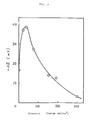
- Such film thickness can be expressed in terms of electric charge (mC/cm2) as shown in Figure 3, where the electric charge of 80 mC/cm2 was found to correspond to the thickness of about 200 nm (0.2 ⁇ m) under this process condition.
- Each of the polypyrrole film-overcoated electrodes was immersed for 20 minutes in a solution containing anti-IgG at the concentration of 2.32 x 10 ⁇ 3 mg/ml so as to fix the anti-IgG on the polypyrrole film.
- the change in electrode potential (- ⁇ E/mV) was measured before and after the fixation of the anti-IgG, the change being a criterion or measure of the degree of the fixation.
- the results were given in Figure 3, which demonstrates that the polypyrrole film highly adsorbs the anti-IgG. It is particularly noted that the film having a thickness of about 50 to 250 nm (corresponding to the electric charge of 20 to 100 mC/cm2) exhibits a good response.
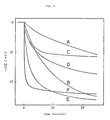
- Example 2 With the same solution for electrolytic polymerization as used in Example 1, six electrodes were prepared by forming a polypyrrole film on working electrodes of platinum wire (each being 1 mm in diameter and 6 mm in length), followed by the fixation of IgG on the film, under the conditions described below:
- Electrodes A through F were immersed, as working electrode in the immunosensor system as shown by Figure 1, in a solution containing anti-IgG at the concentration of 8.52 x 10 ⁇ 3 mg/ml. Measurement was made, with each Electrode, of the potential (more strictly, the change in electric potential), - ⁇ E/mV, caused while the Electrode was immersed in the anti-IgG containing solution. The results are given in Figure 4, which demonstrates that all the Electrodes exhibit immunoresponse. It is particularly noted that the Electrodes B, C, D, E and F (which have been prepared by the methods including the fixation-improving treatment with amine or dialdehyde) exhibit remarkable immunoresponse characteristics.
- the immunoresponse of Electrode F was measured with anti-IgG-containing solutions with varying concentrations of the anti-IgG, in the manner as described in Example 2.
- the results are given in Fig. 5, which demonstrates that the detection of anti-IgG can be sufficiently made as low as about 10 ⁇ 5 mg/ml by using the electrode according to the present invention.
- the results are also summarized in Fig. 6 in terms of the potential change after 20 minutes against the logarithmic concentration of anti-IgG, which provides a good linearity. It was found that a linearity for calibration can also be obtained with respect to other lapses of time after the immersion of the electrode in the solution.
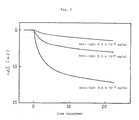
- a solution for electrolytic polymerization was prepared by adding IgG in an aqueous solutin saturated with pyrrole, so that the concentration of IgG was 15 mg/ml.
- a platinum electrode 0.5 mm in diameter and 5.8 mm in length
- Electrolytic polymerization was conducted under the atmosphere of nitrogen at a current density of 1 mA/cm2 and an electric charge of 400 mC/cm2 (100 ⁇ A, six minutes) to obtain a polypyrrole film-coated platinum electrode with the IgG being fixed on the film where the thickness of the film is 100 nm (0.1 ⁇ ).
- the electrode thus obtained was used as a working electrode in the immunosensor system as illustrated in Fig. 1 to determine the immunoresponse to anti-IgG-containing solutions of varying anti-IgG concentrations, with satisfactory results as shown in Fig. 7.
- electrolytic polymerization was carried out at an electric charge of 1.6 C/cm2 to form a polypyrrole film on a platinum plate, followed by washing with acetonitrile or in distilled water to obtain a membrane having a thickness of 4 ⁇ m.
- the membrane was treated with a mixture of 4-aminomethyl-1,8-octanediamine and 50% aqueous solution of glutaraldehyde (10:1 by volume) for one day and then immersed in a solution containing IgG at a concentration of 150 mg/ml for two days so as to fully fix the IgG on the membrane.
- the membrane after the immersion was used as a working membrane in the immunosensor system as illustrated in Fig. 2 to determine its immunoresponse to anti-IgG. As a result, there was observed a clear change in electric potential, which fact indicates a high adaptability of the membrane to the immunosensor.
- IgG-fixed polythiophene membrane was prepared by using thiophene instead of pyrrole in Example 5.
- the IgG-fixed polythiophene membrane was found to exhibit a good response to anti-IgG (although slightly lover than the polypyrrole membrane in Example 5).
Landscapes
- Health & Medical Sciences (AREA)
- Immunology (AREA)
- Life Sciences & Earth Sciences (AREA)
- Engineering & Computer Science (AREA)
- Chemical & Material Sciences (AREA)
- Biomedical Technology (AREA)
- Hematology (AREA)
- Molecular Biology (AREA)
- Urology & Nephrology (AREA)
- Pathology (AREA)
- Analytical Chemistry (AREA)
- General Physics & Mathematics (AREA)
- General Health & Medical Sciences (AREA)
- Biochemistry (AREA)
- Physics & Mathematics (AREA)
- Cell Biology (AREA)
- Medicinal Chemistry (AREA)
- Food Science & Technology (AREA)
- Microbiology (AREA)
- Biotechnology (AREA)
- Polyoxymethylene Polymers And Polymers With Carbon-To-Carbon Bonds (AREA)
- Medicines Containing Antibodies Or Antigens For Use As Internal Diagnostic Agents (AREA)
- Fire-Detection Mechanisms (AREA)
- Investigating Or Analyzing Materials By The Use Of Electric Means (AREA)
- Saccharide Compounds (AREA)
Claims (9)
- Potentialverursachende Elektrode für Immunosensoren, mit einem Film von Polypyrrol oder Polythiophen, der mit einem Antigen oder einem Antikörper verbunden ist und mit einem Elektrodenkörper, der mit dem Film umhüllt ist, wobei der Polypyrrol- oder Polythiophenfilm eine Dicke im Bereich von ungefähr 0,05 µm bis ungefähr 0,25 µm aufweist.
- Potentialverursachende Membran für Immunosensoren, mit einem Film aus Polypyrrol oder Polythiophen, der mit einem Antigen oder einem Antikörper verbunden ist, wobei der Polypyrrol- oder Polythiophenfilm eine Dicke im Bereich von ungefähr 0,5 µm bis ungefähr 5 µm aufweist.
- Verfahren zum Herstellen eines potentialverursachenden Elements nach Anspruch 1 oder 2 für Immunosensoren, mit den Schritten: Herstellen einer Lösung für die elektrolytische Polymerisation durch Lösen von Pyrrol oder Thiophen in einem Lösungsmittel, Anordnen einer Arbeitselektrode und einer Gegenelektrode in der Lösung für die elektrolytische Polymerisation, Durchführen der elektrolytischen Polymerisation der Pyrrol oder Thiophen enthaltenden Lösung, in dem Elektrizität durch die Lösung zwischen den Elektroden mit einer gesteuerten Stromdichte und elektrischen Ladung durchgeleitet wird, um einen Polypyrrol- oder Polythiophenfilm einer gewünschten Dicke auf der Arbeitselektrode auszubilden, und Anbringen eines Antigens oder eines Antikörpers auf dem Polypyrrol- oder Polythiophenfilm.
- Verfahren nach Anspruch 3, ferner mit dem Schritt: Ablösen des Polypyrrol- oder Polythiophenfilms von der Arbeitselektrode, um das potentialverursachende Element in Form einer Membran zur Verfügung zu stellen.
- Verfahren nach Anspruch 3, wobei der Schritt zum Anbringen des Antigens oder des Antikörpers auf dem Polypyrrol- oder Polythiophenfilm nach der elektrolytischen Polymerisation durch Eintauchen der Arbeitselektrode oder der Membran, auf der der Polypyrrol- oder Polythiophenfilm ausgebildet wurde, in eine Antigen oder Antikörper enthaltende Lösung ausgeführt wird.
- Verfahren nach Anspruch 3, wobei der Schritt zum Anbringen des Antigens oder des Antikörpers auf dem Polypyrrol- oder Polythiophenfilm gleichzeitig mit der elektrolytischen Polymerisation von Pyrrol oder Thiophen durch vorheriges Zugeben des Antigens oder des Antikörpers zu der Pyrrol oder Thiophen enthaltenden Lösung für die elektrolytische Polymerisation ausgeführt wird.
- Verfahren nach Anspruch 3, ferner mit dem Schritt: Behandeln des Polypyrrol- oder Polythiophenfilms mit einem Dialdehyd, das aus einer Gruppe, bestehend aus Glyoxal, Malondialdehyd, Succinaldehyd, Glutardialdehyd, Adipinaldehyd und einer Mischung davon, ausgewählt ist oder mit einem Amin, das aus einer Gruppe, bestehend aus Allylamin, 1,8-Octandiamin, 4-Amino-methyl-1,8-octandiamin, Hexamethylendiamin und einer Mischung davon ausgewählt ist.
- Verfahren nach Anspruch 7, wobei die Behandlung mit dem Dialdehyd oder dem Amin vor dem Eintauchen der Elektrode oder der Membran in die Antigen oder Antikörper enthaltende Lösung ausgeführt wird.
- Verfahren nach Anspruch 7, wobei die Behandlung mit dem Dialdehyd oder dem Amin gleichzeitig mit der elektrolytischen Polymerisation durch vorheriges Zugeben des Dialdehyds oder des Amins zu der Lösung für die elektrolytische Polymerisation ausgeführt wird.
Priority Applications (1)
| Application Number | Priority Date | Filing Date | Title |
|---|---|---|---|
| AT86102363T ATE72333T1 (de) | 1985-02-25 | 1986-02-24 | Potentialverursachendes element fuer einen immunosensor. |
Applications Claiming Priority (2)
| Application Number | Priority Date | Filing Date | Title |
|---|---|---|---|
| JP60036839A JPH0697219B2 (ja) | 1985-02-25 | 1985-02-25 | 免疫センサー用電極及びその製造方法 |
| JP36839/85 | 1985-02-25 |
Publications (3)
| Publication Number | Publication Date |
|---|---|
| EP0193154A2 EP0193154A2 (de) | 1986-09-03 |
| EP0193154A3 EP0193154A3 (en) | 1988-07-06 |
| EP0193154B1 true EP0193154B1 (de) | 1992-01-29 |
Family
ID=12480918
Family Applications (1)
| Application Number | Title | Priority Date | Filing Date |
|---|---|---|---|
| EP86102363A Expired - Lifetime EP0193154B1 (de) | 1985-02-25 | 1986-02-24 | Potentialverursachendes Element für einen Immunosensor |
Country Status (6)
| Country | Link |
|---|---|
| EP (1) | EP0193154B1 (de) |
| JP (1) | JPH0697219B2 (de) |
| KR (1) | KR920009421B1 (de) |
| AT (1) | ATE72333T1 (de) |
| CA (1) | CA1241057A (de) |
| DE (1) | DE3683656D1 (de) |
Families Citing this family (19)
| Publication number | Priority date | Publication date | Assignee | Title |
|---|---|---|---|---|
| JPH0721478B2 (ja) * | 1986-03-31 | 1995-03-08 | 財団法人化学及血清療法研究所 | 免疫センサ−用作用膜 |
| DE3888767T2 (de) * | 1987-03-13 | 1994-08-04 | Japan Government | Methode zur Erzeugung einer Biomikroelektrode. |
| JPS6428556A (en) * | 1987-07-23 | 1989-01-31 | Bridgestone Corp | Enzyme electrode |
| WO1989011649A1 (en) * | 1988-05-16 | 1989-11-30 | Wollongong Uniadvice Limited | Antibody containing electrode |
| CA2048692A1 (en) * | 1989-03-13 | 1990-09-14 | Anthony Guiseppi-Elie | Surface functionalized and derivatized conducting polymers and method for producing same |
| DE3916432A1 (de) * | 1989-05-20 | 1990-11-22 | Cammann Karl | Verfahren und vorrichtung zur konzentrationsbestimmung eines antikoerper-antigenpaares |
| CA2043807A1 (en) | 1990-07-19 | 1992-01-20 | Matthew K. Musho | Conductive sensors and their use in diagnostic assays |
| RU2032908C1 (ru) * | 1991-04-26 | 1995-04-10 | Институт геохимии и аналитической химии им.В.И.Вернадского РАН | Устройство для определения биологически активных соединений в биологических жидкостях и способ изготовления чувствительного элемента |
| DK0700520T3 (da) * | 1993-05-29 | 1998-03-02 | Cambridge Life Sciences | Sensorer baseret på polymeromdannelse |
| GB2278447A (en) * | 1993-05-29 | 1994-11-30 | Cambridge Life Sciences | Dielectric porosity change immunoassay |
| JPH11513490A (ja) | 1995-10-02 | 1999-11-16 | カトット,モハメド,ダブリュ. | 生物学的活性ポリマー |
| GB9622304D0 (en) | 1996-10-26 | 1996-12-18 | Univ Manchester | Sensor |
| RU2107296C1 (ru) * | 1997-02-20 | 1998-03-20 | Дмитрий Александрович ФАРМАКОВСКИЙ | Способ электрохимической индикации иммунохимически активных макромолекул в исследуемых растворах |
| RU2161653C2 (ru) * | 1998-08-24 | 2001-01-10 | ФАРМАКОВСКИЙ Дмитрий Александрович | Способ количественного электрохимического анализа биомолекул |
| EP1003033A1 (de) * | 1998-11-17 | 2000-05-24 | Interuniversitair Micro-Elektronica Centrum Vzw | Sensor mit einer Oligomerbindeschicht, Verfahren zur Herstellung des Sensors und Arrays von solchen Sensoren |
| EP1003032A1 (de) * | 1998-11-17 | 2000-05-24 | Interuniversitair Micro-Elektronica Centrum Vzw | Sensor mit einem Oligomerbindeschicht, Verfahren zur Herstellung des Sensors und Arrays von solchen Sensoren |
| US6856125B2 (en) * | 2001-12-12 | 2005-02-15 | Lifescan, Inc. | Biosensor apparatus and method with sample type and volume detection |
| AU2013212574C1 (en) * | 2012-01-27 | 2017-03-30 | University Of Tennessee Research Foundation | Method and apparatus for detection of a biomarker by alternating current electrokinetics |
| KR20200136908A (ko) * | 2018-03-29 | 2020-12-08 | 티로리틱스 에이비 | 전기화학 디바이스를 위한 개선된 전극 |
Family Cites Families (4)
| Publication number | Priority date | Publication date | Assignee | Title |
|---|---|---|---|---|
| US4140662A (en) * | 1977-03-25 | 1979-02-20 | Ortho Diagnostics, Inc. | Attachment of proteins to inert particles |
| US4280815A (en) * | 1979-06-18 | 1981-07-28 | Technicon Instruments Corporation | Electrochemiluminescent immunoassay and apparatus therefor |
| JPS56115727A (en) * | 1980-02-19 | 1981-09-11 | Kuraray Co Ltd | Carrier for immobilizing physiologically active substance |
| US4334880A (en) * | 1980-10-20 | 1982-06-15 | Malmros Mark K | Analytical device having semiconductive polyacetylene element associated with analyte-binding substance |
-
1985
- 1985-02-25 JP JP60036839A patent/JPH0697219B2/ja not_active Expired - Fee Related
-
1986
- 1986-02-24 EP EP86102363A patent/EP0193154B1/de not_active Expired - Lifetime
- 1986-02-24 CA CA000502505A patent/CA1241057A/en not_active Expired
- 1986-02-24 AT AT86102363T patent/ATE72333T1/de not_active IP Right Cessation
- 1986-02-24 DE DE8686102363T patent/DE3683656D1/de not_active Expired - Fee Related
- 1986-02-25 KR KR1019860001298A patent/KR920009421B1/ko not_active Expired
Also Published As
| Publication number | Publication date |
|---|---|
| DE3683656D1 (de) | 1992-03-12 |
| JPS61195346A (ja) | 1986-08-29 |
| KR920009421B1 (ko) | 1992-10-16 |
| JPH0697219B2 (ja) | 1994-11-30 |
| ATE72333T1 (de) | 1992-02-15 |
| EP0193154A3 (en) | 1988-07-06 |
| KR860006705A (ko) | 1986-09-13 |
| EP0193154A2 (de) | 1986-09-03 |
| CA1241057A (en) | 1988-08-23 |
Similar Documents
| Publication | Publication Date | Title |
|---|---|---|
| EP0193154B1 (de) | Potentialverursachendes Element für einen Immunosensor | |
| US4839017A (en) | Potential-causing membrane for immunosensor | |
| US6770190B1 (en) | Method of electrochemical analysis of an analyte | |
| Lillie et al. | Electrochemical impedance spectroscopy as a platform for reagentless bioaffinity sensing | |
| EP0311768B1 (de) | Immunosensor | |
| Ottova et al. | Self-assembled BLMs: biomembrane models and biosensor applications | |
| JPH07301615A (ja) | 液体媒質中の認識対の構成員である被検体の決定のための電気生化学的方法および系ならびにその電極 | |
| Nishitani et al. | Polymeric nanofilter biointerface for potentiometric small-biomolecule recognition | |
| US4997526A (en) | Assaying for a biologically active component | |
| Rezaei et al. | Stainless steel modified with an aminosilane layer and gold nanoparticles as a novel disposable substrate for impedimetric immunosensors | |
| Herlem et al. | pH sensing at Pt electrode surfaces coated with linear polyethylenimine from anodic polymerization of ethylenediamine | |
| Li et al. | Development and modeling of an ultrasensitive label-free electrochemical immunosensor for okadaic acid based on polythionine-modified three-dimensional gold nanoelectrode ensembles | |
| Ameur et al. | Impedimetric measurements on polarized functionalized platinum electrodes: application to direct immunosensing | |
| Ameur et al. | Sensitive immunodetection through impedance measurements onto gold functionalized electrodes | |
| Ouerghi et al. | Adjunction of avidin to a cysteamine self-assembled monolayer for impedimetric immunosensor | |
| JP2614905B2 (ja) | 免疫センサ | |
| Tang et al. | Direct and rapid detection of diphtherotoxin via potentiometric immunosensor based on nanoparticles mixture and polyvinyl butyral as matrixes | |
| WO1996002001A1 (en) | Electrochemical immunoassay | |
| Ouerghi et al. | Electrodeposited biotinylated polypyrrole as an immobilization method for impedimetric immunosensors | |
| WO1989011649A1 (en) | Antibody containing electrode | |
| JPH01142454A (ja) | 交流検出型化学物質計測法 | |
| Ramanaviciene et al. | Molecularly imprinted polypyrrole for sensor design | |
| Fu et al. | Reagentless immunosensing assay via electrochemical impedance for hepatitis B surface antigen monitoring based on polypyrrole and gold nanoparticles as matrices | |
| WO2009027708A2 (en) | Pulsed electrochemical sensor | |
| Taniguchi et al. | A potentiometric immunoglobulin G sensor based on a polypyrrole modified platinum electrode |
Legal Events
| Date | Code | Title | Description |
|---|---|---|---|
| PUAI | Public reference made under article 153(3) epc to a published international application that has entered the european phase |
Free format text: ORIGINAL CODE: 0009012 |
|
| AK | Designated contracting states |
Kind code of ref document: A2 Designated state(s): AT BE CH DE FR GB IT LI NL SE |
|
| PUAL | Search report despatched |
Free format text: ORIGINAL CODE: 0009013 |
|
| AK | Designated contracting states |
Kind code of ref document: A3 Designated state(s): AT BE CH DE FR GB IT LI NL SE |
|
| 17P | Request for examination filed |
Effective date: 19881227 |
|
| 17Q | First examination report despatched |
Effective date: 19900607 |
|
| GRAA | (expected) grant |
Free format text: ORIGINAL CODE: 0009210 |
|
| AK | Designated contracting states |
Kind code of ref document: B1 Designated state(s): AT BE CH DE FR GB IT LI NL SE |
|
| PG25 | Lapsed in a contracting state [announced via postgrant information from national office to epo] |
Ref country code: IT Free format text: LAPSE BECAUSE OF FAILURE TO SUBMIT A TRANSLATION OF THE DESCRIPTION OR TO PAY THE FEE WITHIN THE PRE;WARNING: LAPSES OF ITALIAN PATENTS WITH EFFECTIVE DATE BEFORE 2007 MAY HAVE OCCURRED AT ANY TIME BEFORE 2007. THE CORRECT EFFECTIVE DATE MAY BE DIFFERENT FROM THE ONE RECORDED.SCRIBED TIME-LIMIT Effective date: 19920129 Ref country code: CH Effective date: 19920129 Ref country code: NL Effective date: 19920129 Ref country code: SE Effective date: 19920129 Ref country code: LI Effective date: 19920129 Ref country code: AT Effective date: 19920129 Ref country code: BE Effective date: 19920129 |
|
| REF | Corresponds to: |
Ref document number: 72333 Country of ref document: AT Date of ref document: 19920215 Kind code of ref document: T |
|
| ET | Fr: translation filed | ||
| REF | Corresponds to: |
Ref document number: 3683656 Country of ref document: DE Date of ref document: 19920312 |
|
| REG | Reference to a national code |
Ref country code: CH Ref legal event code: PL |
|
| NLV1 | Nl: lapsed or annulled due to failure to fulfill the requirements of art. 29p and 29m of the patents act | ||
| PLBE | No opposition filed within time limit |
Free format text: ORIGINAL CODE: 0009261 |
|
| STAA | Information on the status of an ep patent application or granted ep patent |
Free format text: STATUS: NO OPPOSITION FILED WITHIN TIME LIMIT |
|
| 26N | No opposition filed | ||
| PGFP | Annual fee paid to national office [announced via postgrant information from national office to epo] |
Ref country code: GB Payment date: 19980209 Year of fee payment: 13 |
|
| PGFP | Annual fee paid to national office [announced via postgrant information from national office to epo] |
Ref country code: FR Payment date: 19980216 Year of fee payment: 13 |
|
| PGFP | Annual fee paid to national office [announced via postgrant information from national office to epo] |
Ref country code: DE Payment date: 19980429 Year of fee payment: 13 |
|
| PG25 | Lapsed in a contracting state [announced via postgrant information from national office to epo] |
Ref country code: GB Free format text: LAPSE BECAUSE OF NON-PAYMENT OF DUE FEES Effective date: 19990224 |
|
| GBPC | Gb: european patent ceased through non-payment of renewal fee |
Effective date: 19990224 |
|
| PG25 | Lapsed in a contracting state [announced via postgrant information from national office to epo] |
Ref country code: FR Free format text: LAPSE BECAUSE OF NON-PAYMENT OF DUE FEES Effective date: 19991029 |
|
| PG25 | Lapsed in a contracting state [announced via postgrant information from national office to epo] |
Ref country code: DE Free format text: LAPSE BECAUSE OF NON-PAYMENT OF DUE FEES Effective date: 19991201 |
|
| REG | Reference to a national code |
Ref country code: FR Ref legal event code: ST |