EP0190401A2 - Sicherheitseinrichtung für ein elektromotorisch angetriebenes Werkzeug - Google Patents
Sicherheitseinrichtung für ein elektromotorisch angetriebenes Werkzeug Download PDFInfo
- Publication number
- EP0190401A2 EP0190401A2 EP85113500A EP85113500A EP0190401A2 EP 0190401 A2 EP0190401 A2 EP 0190401A2 EP 85113500 A EP85113500 A EP 85113500A EP 85113500 A EP85113500 A EP 85113500A EP 0190401 A2 EP0190401 A2 EP 0190401A2
- Authority
- EP
- European Patent Office
- Prior art keywords
- relay
- safety device
- motor
- safety
- circuit
- Prior art date
- Legal status (The legal status is an assumption and is not a legal conclusion. Google has not performed a legal analysis and makes no representation as to the accuracy of the status listed.)
- Granted
Links
Images


Classifications
-
- H—ELECTRICITY
- H02—GENERATION; CONVERSION OR DISTRIBUTION OF ELECTRIC POWER
- H02H—EMERGENCY PROTECTIVE CIRCUIT ARRANGEMENTS
- H02H7/00—Emergency protective circuit arrangements specially adapted for specific types of electric machines or apparatus or for sectionalised protection of cable or line systems, and effecting automatic switching in the event of an undesired change from normal working conditions
- H02H7/08—Emergency protective circuit arrangements specially adapted for specific types of electric machines or apparatus or for sectionalised protection of cable or line systems, and effecting automatic switching in the event of an undesired change from normal working conditions for dynamo-electric motors
- H02H7/093—Emergency protective circuit arrangements specially adapted for specific types of electric machines or apparatus or for sectionalised protection of cable or line systems, and effecting automatic switching in the event of an undesired change from normal working conditions for dynamo-electric motors against increase beyond, or decrease below, a predetermined level of rotational speed
Definitions
- the invention relates to a safety device for an electromotive tool, in particular a hand tool, according to the preamble of claim 1.
- Known power tools are switched on and off via a main switch.
- the motor is controlled via control electronics that control their actual values, e.g. B. receives from a tachometer generator. If the control electronics fail, the speed of the motor may increase to an unacceptable extent. This means that e.g. B. with angle grinders, the speed can become so high that the grinding wheel bursts. Therefore, the demand was made that the engine is switched off in the event of failure of the control electronics.
- centrifugal switch as already described in DE-PS 638 928, offers a solution for this.
- this type of engine speed-dependent shutdown is very complex and therefore very expensive due to the mechanical parts. This arrangement is also very susceptible to contamination. B. on the functional accuracy.
- the solution found is characterized in that a relay is arranged parallel to the motor, which acts on the power supply to the motor via a relay contact.
- the relay is controlled by a tachometer generator and a safety circuit connected to it.
- the safety circuit consists of a resonant circuit for the tachometer generator, a rectifier, a threshold switch, an ignition amplifier and a power unit.
- the pulse coming from the power section excites the relay, which then is held on the one hand and on the other hand cuts the power supply to the motor.
- the self-holding of the relay continues until the main switch is interrupted.
- Another advantageous solution is obtained by arranging the safety circuit in series with the main switch.
- the relay is activated via the main switch and thus enables the power supply for the motor. If the set maximum value for the speed is reached, in this case a thyristor, which is arranged in parallel to the relay, conducts the current past the relay so that the relay drops out and the power supply to the motor is interrupted, despite the main switch being switched on.
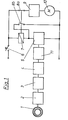
- a first embodiment of the safety device is shown schematically.
- the tachometer generator 1 provides an analog signal for the actual rotation Number of motor 10. This signal is converted via the resonant circuit 2 and the converter 3 into a direct current signal and meets a threshold switch 4. If the value selected by the threshold switch 4 is exceeded, the power unit 5 receives a signal via the ignition amplifier 11.
- Das Power section 5, here for example a triac then no longer blocks the passage to the relay 7 lying in series, so that the relay 7 can pick up and interrupt the power supply to the motor 10 via the relay contact 8a. So that the motor 10 does not start again when the speed falls below the set speed, not only the relay contact 8a but also the relay contact 8b is actuated when the relay 7 is pulled up. With the relay contact 8b, the power section 5 is bridged, so that the relay 7 remains locked until the main switch 6 is opened.
- Fig. 2 shows the embodiment of Fig.1.
- the inductance L and the capacitor C1 form the resonant circuit 2.
- the resonance frequency of the resonant circuit can be determined by the choice of the capacitor C1.
- the steep rise in resonance of the tacho voltage around the switch-off point / favors the switching behavior of the subsequent threshold switch 4.
- the induced tacho voltage is rectified in converter 3 and can be set via the voltage divider R1 and R2.
- the resistance value that is set at resistor R1 is used to eliminate motor leakage.
- the measure for the threshold voltage is indicated by the Zener diode D2.
- the subsequent amplifier circuit which is formed by the transistor T2, the resistors R5 and R6 and the capacitor C3, ignites the triac 5 when the threshold value is reached.
- FIG. 3 A second embodiment is shown in FIG. 3.
- the safety device here consists of the same elements as in the aforementioned example.
- the switch-off signal Via a tachometer generator 21, a resonant circuit 22, a rectifier 23 and an adjustable threshold switch 24, the switch-off signal reaches an ignition amplifier 31 which, however, gives a signal to a thyristor 25 when the permissible speed is exceeded.
- the thyristor 25 becomes conductive, the potential at the parallel relay 27 drops and the relay contact 28 opens.
- the power supply to the motor 30 is interrupted.
- the current flow through the main switch 26 now runs through the thyristor 25.
- the load circuit remains interrupted until the main switch 26 is switched on again.
- FIG. 4 shows the embodiment according to FIG. 3 in a discrete structure and differs from that in FIG. 2 Embodiment shown in that the amplifier circuit 31 consists of the transistor T2, the resistors R6 and R7 and the capacitor C3, which supplies the firing pulse for the thyristor 25.
- the thyristor 25 can be replaced by a transistor circuit with which the power supply for the relay 27 can be short-circuited.
- the circuits shown in the two exemplary embodiments of the safety device represent an inexpensive, functionally reliable and easy-to-implement addition to existing control electronics 9, 29 in the power tool.
Landscapes
- Finish Polishing, Edge Sharpening, And Grinding By Specific Grinding Devices (AREA)
- Protection Of Generators And Motors (AREA)
- Ignition Installations For Internal Combustion Engines (AREA)
- Control Of Direct Current Motors (AREA)
- Control Of Electric Motors In General (AREA)
Abstract
Description
- Die Erfindung bezieht sich auf eine Sicherheitseinrichtung für ein elektromotorisch angetriebenes Werkzeug, insbesondere Handwerkzeug, nach dem Oberbegriff des Anspruchs 1.
- Derzeit bekannte Elektrowerkzeuge werden über einen Hauptschalter ein- und ausgeschaltet. Die Regelung des Motors erfolgt über eine Regelelektronik, die ihre IstWerte z. B. von einem Tachogenerator erhält. Bei Ausfall der Regelelektronik kann es vorkommen, daß die Drehzahl des Motors in unzulässigem Maße ansteigt. Dies bedeutet, daß z. B. bei Winkelschleifern die Drehzahl so hoch werden kann, daß es zum Bersten der Schleifscheibe kommt. Deshalb wurde die Forderung aufgestellt, daß bei Ausfall der Regelelektronik der Motor abgeschaltet wird.
- Eine Lösung hierfür bietet der Fliehkraftschalter, wie er bereits in der DE-PS 638 928 beschrieben ist. Diese Art der drehzahlabhängigen Abschaltung des Motors ist jedoch durch die mechanischen Teile sehr aufwendig und somit sehr kostspielig. Auch ist diese Anordnung sehr anfällig gegen Verschmutzung, das wirkt sich z. B. auf die Funktionsgenauigkeit aus.
- Es wurde deshalb nach einer Möglichkeit gesucht, eine drehzahlabhängige Motorabschaltung zu schaffen, die mit geringem Aufwand realisiert werden kann, preiswert ist und deren eingestellter Abschaltwert über die gesamte Lebensdauer des Geräts gleich bleibt.
- Die gefundene Lösung ist dadurch gekennzeichnet, daß parallel zum Motor ein Relais angeordnet ist, das auf die Stromzufuhr des Motors über einen Relaiskontakt einwirkt. Das Relais wird über einen Tachogenerator und eine daran anschließende Sicherheitsschaltung angesteuert. Die Sicherheitsschaltung besteht aus einem Resonanzschwingkreis für den Tachogenerator, einem Gleichrichter, einem Schwellwertschalter, einem Zündverstärker und einem Leistungsteil. Der aus dem Leistungsteil kommende Impuls erregt das Relais, das dann einerseits in Selbsthaltung gebracht wird und andererseits die Stromzufuhr für den Motor unterbricht. Die Selbsthaltung des Relais hält so lange an, bis der Hauptschalter unterbrochen wird.
- Eine weitere vorteilhafte Lösung ergibt sich dadurch, daß man die Sicherheitsschaltung in Reihe zum Hauptschalter anordnet. Dabei wird das Relais über den Hauptschalter aktiviert und somit die Stromversorgung für den Motor ermöglicht. Ist der eingestellte Maximalwert für die Drehzahl erreicht, leitet in diesem Fall ein Thyristor, der parallel zum Relais angeordnet ist, den Strom am Relais vorbei, so daß das Relais abfällt und die Stromversorgung für den Motor, trotz eingeschaltetem Hauptschalter, unterbrochen ist.
- Beschrieben wird die Sicherheitseinrichtung anhand von Zeichnungen. Es zeigen:
- Fig. 1 ein Blockschaltbild der Sicherheitseinrichtung;
- Fig. 2 ein detailliertes Schaltbild nach Fig. 1;
- Fig. 3 ein Blockschaltbild einer Variante nach Fig. 1;
- Fig. 4 ein detailliertes Schaltbild nach Fig. 3.
- In Fig. 1 ist schematisch ein erstes Ausführungsbeispiel der Sicherheitseinrichtung dargestellt. Der Tachogenerator 1 liefert ein analoges Signal zur tatsächlichen Drehzahl des Motors 10. Dieses Signal wird über den Resonanzschwingkreis 2 und den Wandler 3 in ein Gleichstromsignal umgewandelt und trifft auf einen Schwellwertschalter 4. Ist der durch den Schwellwertschalter 4 vorgewählte Wert-überschritten, erhält das Leistungsteil 5 ein Signal über den Zündverstärker 11. Das Leistungsteil 5, hier beispielsweise ein Triac, sperrt dann nicht mehr den Durchgang zu dem in Reihe liegenden Relais 7, so daß das Relais 7 anziehen und die Stromzufuhr zum Motor 10, über den Relaiskontakt 8a, unterbrechen kann. Damit der Motor 10 beim Unterschreiten der eingestellten Drehzahl nicht wieder anläuft, wird beim Anziehen des Relais 7 nicht nur der Relaiskontakt 8a, sondern auch der Relaiskontakt 8b betätigt. Mit dem Relaiskontakt 8b wird das Leistungsteil 5 überbrückt, so daß das Relais 7 in Selbsthaltung verharrt, bis der Hauptschalter 6 geöffnet wird.
- Fig. 2 zeigt das Ausführungsbeispiel nach Fig.1.in diskretem Aufbau. Die Induktivität L und der Kondensator C1 bilden den Schwingkreis 2. Die Resonanzfrequenz des Schwingkreises kann durch die Wahl des Kondensators C1 bestimmt werden. Der steile Resonanzanstieg der Tachospannung um den Abschaltpunkt/begünstigt das Schaltverhalten des nachfolgenden Schwellwertschalters 4. Die induzierte Tachospannung wird im Wandler 3 gleichgerichtet und kann über den Spannungsteiler R1 und R2 eingestellt werden. Der Widerstandswert, der am Widerstand R1 eingestellt wird, dient der Eliminierung von Motorstreuungen. Das Maß für die Schwellwertspannung ist durch die Zenerdiode D2 angegeben. Die nachfolgende Verstärkerschaltung, die durch den Transistor T2, die Widerstände R5 und R6 und den Kondensator C3 gebildet wird, zündet den Triac 5 bei Erreichen des Schwellwerts.
- Ein zweites Ausführungsbeispiel ist in Fig. 3 dargestellt. Im Prinzip besteht hier die Sicherheitseinrichtung aus den gleichen Elementen wie beim vorgenannten Beispiel. Über einen Tachogenerator 21, einen Resonanzschwingkreis 22, einen Gleichrichter 23 und einen einstellbaren Schwellwertschalter 24 erreicht das Abschaltsignal einen Zündverstärker 31, der hier jedoch beim Überschreiten der zulässigen Drehzahl ein Signal auf einen Thyristor 25 gibt. Der Thyristor 25 wird leitend, das Potential am parallel liegenden Relais 27 fällt ab und der Relaiskontakt 28 öffnet sich. Die Stromzufuhr für den Motor 30 ist unterbrochen. Der Stromfluß über den Hauptschalter 26 läuft nun über den Thyristor 25. Der Lastkreis bleibt so lange unterbrochen, bis der Hauptschalter 26 erneut eingeschaltet wird.
- Fig. 4 zeigt das Ausführungsbeispiel nach Fig. 3 in diskretem Aufbau und unterscheidet sich von dem in Fig. 2 dargestellten Ausführungsbeispiel dadurch, daß die Verstärkerschaltung 31 aus dem Transistor T2, den Widerständen R6 und R7 und dem Kondensator C3 besteht, die den Zündimpuls für den Thyristor 25 liefert.
- Ein Fachmann wird auch leicht erkennen können, daß bei der hier dargestellten Lösung der Thyristor 25 durch eine Transistorschaltung ersetzt werden kann, mit der die Stromversorgung für das Relais 27 kurzgeschlossen werden kann.
- Die in den beiden Ausführungsbeispielen der Sicherheitseinrichtung dargestellten Schaltungen stellen eine preiswerte, funktionssichere und leicht zu realisierende Ergänzung zu einer vorhandenen Regelelektronik 9, 29 im Elektrowerkzeug dar. Sie bieten dem Bedienendenbeim Ausfall der Regelelektronik Schutz vor den Gefahren einer unkontrolliert drehenden Maschine.
Claims (5)
Applications Claiming Priority (2)
| Application Number | Priority Date | Filing Date | Title |
|---|---|---|---|
| DE3504074 | 1985-02-07 | ||
| DE3504074A DE3504074C2 (de) | 1985-02-07 | 1985-02-07 | Sicherheitseinrichtung für ein elektromotorisch angetriebenes Werkzeug |
Publications (3)
| Publication Number | Publication Date |
|---|---|
| EP0190401A2 true EP0190401A2 (de) | 1986-08-13 |
| EP0190401A3 EP0190401A3 (en) | 1987-08-19 |
| EP0190401B1 EP0190401B1 (de) | 1990-02-28 |
Family
ID=6261847
Family Applications (1)
| Application Number | Title | Priority Date | Filing Date |
|---|---|---|---|
| EP85113500A Expired - Lifetime EP0190401B1 (de) | 1985-02-07 | 1985-10-24 | Sicherheitseinrichtung für ein elektromotorisch angetriebenes Werkzeug |
Country Status (4)
| Country | Link |
|---|---|
| US (1) | US4847721A (de) |
| EP (1) | EP0190401B1 (de) |
| JP (1) | JPS61182758A (de) |
| DE (1) | DE3504074C2 (de) |
Cited By (2)
| Publication number | Priority date | Publication date | Assignee | Title |
|---|---|---|---|---|
| GB2237156A (en) * | 1989-10-17 | 1991-04-24 | Samsung Electronics Co Ltd | Control apparatus for food processing apparatus |
| DE4021560A1 (de) * | 1990-07-06 | 1992-01-16 | Telefunken Electronic Gmbh | Elektrisches werkzeug mit motorantrieb |
Families Citing this family (11)
| Publication number | Priority date | Publication date | Assignee | Title |
|---|---|---|---|---|
| DE3520099A1 (de) * | 1985-06-05 | 1986-12-11 | C. & E. Fein Gmbh & Co, 7000 Stuttgart | Sicherheitseinrichtung fuer ein elektromotorisch angetriebenes werkzeug |
| DE3937446A1 (de) * | 1989-11-10 | 1991-05-16 | Peter Neef | Verfahren und vorrichtung zur erweiterung einer stillstands-schutzfunktion fuer elektromotoren |
| DE4132208C1 (de) * | 1991-09-27 | 1993-02-04 | Fraunhofer-Gesellschaft Zur Foerderung Der Angewandten Forschung Ev, 8000 Muenchen, De | |
| JPH07274571A (ja) * | 1994-03-30 | 1995-10-20 | Matsushita Electric Ind Co Ltd | 回転センサー付直流モータ |
| US5744921A (en) * | 1996-05-02 | 1998-04-28 | Siemens Electric Limited | Control circuit for five-phase brushless DC motor |
| US7075195B2 (en) | 2002-01-14 | 2006-07-11 | Safestart System, Llc | Electrical safety lockout mechanism for power tools and other hazardous machinery |
| US10369718B2 (en) | 2004-12-15 | 2019-08-06 | Canis Major Tool Company Llc | Flush cut saw |
| US9108334B2 (en) * | 2004-12-15 | 2015-08-18 | Canis Major Tool Company Llc | Flush cut saw |
| BR102012027771A2 (pt) * | 2012-10-29 | 2014-06-24 | Delphi Tech Inc | Sistema e método para controle de um motor elétrico |
| US9555554B2 (en) | 2013-05-06 | 2017-01-31 | Milwaukee Electric Tool Corporation | Oscillating multi-tool system |
| EP4613432A1 (de) | 2016-06-24 | 2025-09-10 | Black & Decker Inc. | Steuerungsschema zum betrieb eines schnurlosen elektrowerkzeugs auf basis der batterietemperatur |
Family Cites Families (13)
| Publication number | Priority date | Publication date | Assignee | Title |
|---|---|---|---|---|
| DE1248782B (de) * | ||||
| DE638928C (de) * | 1934-11-16 | 1936-11-25 | Fein C & E | Fliehkraftschalter, insbesondere fuer Elektromotoren, mit in axialer Richtung schwingendem Fliehkoerper |
| US2818535A (en) * | 1955-08-01 | 1957-12-31 | Westinghouse Electric Corp | Safety control circuits for electric motors |
| US3284668A (en) * | 1963-10-28 | 1966-11-08 | Bendix Corp | Electronic speed sensor |
| FR1557850A (de) * | 1968-01-02 | 1969-02-21 | ||
| DE2419744A1 (de) * | 1974-04-24 | 1975-11-20 | Wilke Richard | Regelbare elektrische abschaltvorrichtung zum schutz vor unter- und ueberdrehzahlen einer welle |
| US3958164A (en) * | 1974-12-10 | 1976-05-18 | Bethlehem Steel Corporation | Protective panel circuit |
| US4161681A (en) * | 1977-03-17 | 1979-07-17 | General Electric Company | Prime mover, method of operating such and circuit |
| US4196462A (en) * | 1978-05-30 | 1980-04-01 | General Electric Company | Protective control circuit for induction motors |
| JPS56109854U (de) * | 1980-01-19 | 1981-08-25 | ||
| US4412158A (en) * | 1980-02-21 | 1983-10-25 | Black & Decker Inc. | Speed control circuit for an electric power tool |
| JPS5717018A (en) * | 1980-07-07 | 1982-01-28 | Richo Denshi Kogyo Kk | Method and device for preventing runaway of machine tool |
| DE3520099A1 (de) * | 1985-06-05 | 1986-12-11 | C. & E. Fein Gmbh & Co, 7000 Stuttgart | Sicherheitseinrichtung fuer ein elektromotorisch angetriebenes werkzeug |
-
1985
- 1985-02-07 DE DE3504074A patent/DE3504074C2/de not_active Expired - Fee Related
- 1985-10-24 EP EP85113500A patent/EP0190401B1/de not_active Expired - Lifetime
- 1985-12-27 JP JP60299624A patent/JPS61182758A/ja active Granted
-
1987
- 1987-08-12 US US07/086,190 patent/US4847721A/en not_active Expired - Fee Related
Cited By (3)
| Publication number | Priority date | Publication date | Assignee | Title |
|---|---|---|---|---|
| GB2237156A (en) * | 1989-10-17 | 1991-04-24 | Samsung Electronics Co Ltd | Control apparatus for food processing apparatus |
| GB2237156B (en) * | 1989-10-17 | 1993-09-08 | Samsung Electronics Co Ltd | Improvements relating to food processing apparatus |
| DE4021560A1 (de) * | 1990-07-06 | 1992-01-16 | Telefunken Electronic Gmbh | Elektrisches werkzeug mit motorantrieb |
Also Published As
| Publication number | Publication date |
|---|---|
| JPH0543456B2 (de) | 1993-07-01 |
| JPS61182758A (ja) | 1986-08-15 |
| DE3504074A1 (de) | 1986-08-07 |
| EP0190401A3 (en) | 1987-08-19 |
| US4847721A (en) | 1989-07-11 |
| DE3504074C2 (de) | 1993-10-21 |
| EP0190401B1 (de) | 1990-02-28 |
Similar Documents
| Publication | Publication Date | Title |
|---|---|---|
| EP0190401B1 (de) | Sicherheitseinrichtung für ein elektromotorisch angetriebenes Werkzeug | |
| DE3900780A1 (de) | Schutzeinrichtung fuer den anlasser eines motors | |
| EP0562063B1 (de) | Steuersystem für die elektrische kraftstoffpumpe einer brennkraftmaschine | |
| DE2718658C2 (de) | ||
| EP0205730B1 (de) | Sicherheitseinrichtung für ein elektromotorisch angetriebenes Werkzeug | |
| DE2265344B2 (de) | Zündschaltung für eine rein induktive Zündeinrichtung bei Brennkraftmaschinen | |
| DE2952791C2 (de) | Einrichtung zum Schutz gegen Überspannungen | |
| DE2458068A1 (de) | Batterieladesystem fuer kraftfahrzeug | |
| DE2904038A1 (de) | Detektoranordnung fuer die akkumulatorbatterie-ladeanordnung eines kraftfahrzeugs | |
| DE2340214A1 (de) | Zuendanordnung fuer brennkraftmaschine | |
| DE2453979A1 (de) | Spannungswandler, insbesondere fuer elektrofahrzeuge | |
| DE69809985T2 (de) | Elektronisch gesteuerter Anlasser für Kraftfahrzeug | |
| CH639155A5 (de) | Drehzahlsteuereinrichtung fuer eine haushaltnaehmaschine. | |
| CH626199A5 (de) | ||
| EP0141166A2 (de) | Schaltanordnung für Elektrowerkzeuge | |
| DE2825830A1 (de) | Zuendeinrichtung fuer brennkraftmaschinen | |
| DE69811193T2 (de) | Verbesserungen an Steuervorrichtungen für Anlasser von Kraftfahrzeugen | |
| DE3206187A1 (de) | Anlassvorrichtung | |
| DE3428898A1 (de) | Elektrische sicherheitseinrichtung fuer ein deichselgefuehrt verfahrbares staplerfahrzeug | |
| EP0352593A2 (de) | Überwachungseinrichtung für einen Lüfter | |
| DE2415138C3 (de) | Anordnung zur Drehzahlsteuerung eines Universalmotors | |
| DE2155223A1 (de) | Anordnung zur drehzahlbegrenzung von brennkraftmaschinen | |
| DE4019914C2 (de) | ||
| DE2351106C3 (de) | AnIaB- und Schutzeinrichtung für einen Gleichstrommotor | |
| DE29710183U1 (de) | Elektrische Steueranordnung für ein Fahrzeug |
Legal Events
| Date | Code | Title | Description |
|---|---|---|---|
| PUAI | Public reference made under article 153(3) epc to a published international application that has entered the european phase |
Free format text: ORIGINAL CODE: 0009012 |
|
| AK | Designated contracting states |
Kind code of ref document: A2 Designated state(s): FR GB IT NL SE |
|
| PUAL | Search report despatched |
Free format text: ORIGINAL CODE: 0009013 |
|
| AK | Designated contracting states |
Kind code of ref document: A3 Designated state(s): FR GB IT NL SE |
|
| 17P | Request for examination filed |
Effective date: 19870727 |
|
| 17Q | First examination report despatched |
Effective date: 19881215 |
|
| GRAA | (expected) grant |
Free format text: ORIGINAL CODE: 0009210 |
|
| AK | Designated contracting states |
Kind code of ref document: B1 Designated state(s): FR GB IT NL SE |
|
| ITF | It: translation for a ep patent filed | ||
| ET | Fr: translation filed | ||
| GBT | Gb: translation of ep patent filed (gb section 77(6)(a)/1977) | ||
| PLBE | No opposition filed within time limit |
Free format text: ORIGINAL CODE: 0009261 |
|
| STAA | Information on the status of an ep patent application or granted ep patent |
Free format text: STATUS: NO OPPOSITION FILED WITHIN TIME LIMIT |
|
| 26N | No opposition filed | ||
| ITTA | It: last paid annual fee | ||
| PGFP | Annual fee paid to national office [announced via postgrant information from national office to epo] |
Ref country code: SE Payment date: 19940614 Year of fee payment: 10 |
|
| PGFP | Annual fee paid to national office [announced via postgrant information from national office to epo] |
Ref country code: FR Payment date: 19940922 Year of fee payment: 10 |
|
| PGFP | Annual fee paid to national office [announced via postgrant information from national office to epo] |
Ref country code: GB Payment date: 19941014 Year of fee payment: 10 |
|
| PGFP | Annual fee paid to national office [announced via postgrant information from national office to epo] |
Ref country code: NL Payment date: 19941031 Year of fee payment: 10 |
|
| EAL | Se: european patent in force in sweden |
Ref document number: 85113500.4 |
|
| PG25 | Lapsed in a contracting state [announced via postgrant information from national office to epo] |
Ref country code: GB Effective date: 19951024 |
|
| PG25 | Lapsed in a contracting state [announced via postgrant information from national office to epo] |
Ref country code: SE Effective date: 19951025 |
|
| PG25 | Lapsed in a contracting state [announced via postgrant information from national office to epo] |
Ref country code: NL Effective date: 19960501 |
|
| GBPC | Gb: european patent ceased through non-payment of renewal fee |
Effective date: 19951024 |
|
| PG25 | Lapsed in a contracting state [announced via postgrant information from national office to epo] |
Ref country code: FR Effective date: 19960628 |
|
| EUG | Se: european patent has lapsed |
Ref document number: 85113500.4 |
|
| NLV4 | Nl: lapsed or anulled due to non-payment of the annual fee |
Effective date: 19960501 |
|
| REG | Reference to a national code |
Ref country code: FR Ref legal event code: ST |