EP0188381B1 - Electrically conductive adhesive, method for its manufacture and biomedical electrode - Google Patents
Electrically conductive adhesive, method for its manufacture and biomedical electrode Download PDFInfo
- Publication number
- EP0188381B1 EP0188381B1 EP86300267A EP86300267A EP0188381B1 EP 0188381 B1 EP0188381 B1 EP 0188381B1 EP 86300267 A EP86300267 A EP 86300267A EP 86300267 A EP86300267 A EP 86300267A EP 0188381 B1 EP0188381 B1 EP 0188381B1
- Authority
- EP
- European Patent Office
- Prior art keywords
- water
- range
- weight
- meth
- acrylate
- Prior art date
- Legal status (The legal status is an assumption and is not a legal conclusion. Google has not performed a legal analysis and makes no representation as to the accuracy of the status listed.)
- Expired - Lifetime
Links
- 239000000853 adhesive Substances 0.000 title claims description 34
- 230000001070 adhesive effect Effects 0.000 title claims description 31
- 238000000034 method Methods 0.000 title claims description 20
- 238000004519 manufacturing process Methods 0.000 title claims description 5
- NIXOWILDQLNWCW-UHFFFAOYSA-M Acrylate Chemical compound [O-]C(=O)C=C NIXOWILDQLNWCW-UHFFFAOYSA-M 0.000 claims description 28
- 239000000178 monomer Substances 0.000 claims description 27
- XLYOFNOQVPJJNP-UHFFFAOYSA-N water Substances O XLYOFNOQVPJJNP-UHFFFAOYSA-N 0.000 claims description 26
- 150000005846 sugar alcohols Polymers 0.000 claims description 22
- 239000000203 mixture Substances 0.000 claims description 21
- 125000004435 hydrogen atom Chemical group [H]* 0.000 claims description 12
- 125000002496 methyl group Chemical group [H]C([H])([H])* 0.000 claims description 9
- 125000000217 alkyl group Chemical group 0.000 claims description 8
- 125000004432 carbon atom Chemical group C* 0.000 claims description 8
- 238000004132 cross linking Methods 0.000 claims description 8
- 150000003839 salts Chemical class 0.000 claims description 8
- 239000003999 initiator Substances 0.000 claims description 7
- 239000003505 polymerization initiator Substances 0.000 claims description 6
- 230000000379 polymerizing effect Effects 0.000 claims description 6
- 239000000376 reactant Substances 0.000 claims description 6
- 239000002253 acid Substances 0.000 claims description 4
- 238000006116 polymerization reaction Methods 0.000 claims description 4
- 150000007513 acids Chemical class 0.000 claims description 3
- 150000001735 carboxylic acids Chemical class 0.000 claims description 2
- 239000000243 solution Substances 0.000 description 30
- -1 acrylate salts Chemical class 0.000 description 15
- PEDCQBHIVMGVHV-UHFFFAOYSA-N Glycerine Chemical compound OCC(O)CO PEDCQBHIVMGVHV-UHFFFAOYSA-N 0.000 description 10
- LYCAIKOWRPUZTN-UHFFFAOYSA-N Ethylene glycol Chemical compound OCCO LYCAIKOWRPUZTN-UHFFFAOYSA-N 0.000 description 8
- 239000012790 adhesive layer Substances 0.000 description 8
- 229920000642 polymer Polymers 0.000 description 7
- DNIAPMSPPWPWGF-UHFFFAOYSA-N Propylene glycol Chemical compound CC(O)CO DNIAPMSPPWPWGF-UHFFFAOYSA-N 0.000 description 6
- FAPWRFPIFSIZLT-UHFFFAOYSA-M Sodium chloride Chemical compound [Na+].[Cl-] FAPWRFPIFSIZLT-UHFFFAOYSA-M 0.000 description 6
- MTHSVFCYNBDYFN-UHFFFAOYSA-N diethylene glycol Chemical compound OCCOCCO MTHSVFCYNBDYFN-UHFFFAOYSA-N 0.000 description 6
- 239000000463 material Substances 0.000 description 6
- XDLMVUHYZWKMMD-UHFFFAOYSA-N 3-trimethoxysilylpropyl 2-methylprop-2-enoate Chemical compound CO[Si](OC)(OC)CCCOC(=O)C(C)=C XDLMVUHYZWKMMD-UHFFFAOYSA-N 0.000 description 5
- ATJFFYVFTNAWJD-UHFFFAOYSA-N Tin Chemical compound [Sn] ATJFFYVFTNAWJD-UHFFFAOYSA-N 0.000 description 5
- 150000001252 acrylic acid derivatives Chemical class 0.000 description 5
- 239000012456 homogeneous solution Substances 0.000 description 5
- 229920006267 polyester film Polymers 0.000 description 5
- XAEFZNCEHLXOMS-UHFFFAOYSA-M potassium benzoate Chemical compound [K+].[O-]C(=O)C1=CC=CC=C1 XAEFZNCEHLXOMS-UHFFFAOYSA-M 0.000 description 5
- 239000000126 substance Substances 0.000 description 5
- SMZOUWXMTYCWNB-UHFFFAOYSA-N 2-(2-methoxy-5-methylphenyl)ethanamine Chemical compound COC1=CC=C(C)C=C1CCN SMZOUWXMTYCWNB-UHFFFAOYSA-N 0.000 description 4
- NIXOWILDQLNWCW-UHFFFAOYSA-N 2-Propenoic acid Natural products OC(=O)C=C NIXOWILDQLNWCW-UHFFFAOYSA-N 0.000 description 4
- KFNGWPXYNSJXOP-UHFFFAOYSA-N 3-(2-methylprop-2-enoyloxy)propane-1-sulfonic acid Chemical compound CC(=C)C(=O)OCCCS(O)(=O)=O KFNGWPXYNSJXOP-UHFFFAOYSA-N 0.000 description 4
- IJGRMHOSHXDMSA-UHFFFAOYSA-N Atomic nitrogen Chemical compound N#N IJGRMHOSHXDMSA-UHFFFAOYSA-N 0.000 description 4
- 235000011187 glycerol Nutrition 0.000 description 4
- 238000010438 heat treatment Methods 0.000 description 4
- 239000010410 layer Substances 0.000 description 4
- WOBHKFSMXKNTIM-UHFFFAOYSA-N Hydroxyethyl methacrylate Chemical compound CC(=C)C(=O)OCCO WOBHKFSMXKNTIM-UHFFFAOYSA-N 0.000 description 3
- 239000005062 Polybutadiene Substances 0.000 description 3
- 239000012298 atmosphere Substances 0.000 description 3
- ISAOCJYIOMOJEB-UHFFFAOYSA-N desyl alcohol Natural products C=1C=CC=CC=1C(O)C(=O)C1=CC=CC=C1 ISAOCJYIOMOJEB-UHFFFAOYSA-N 0.000 description 3
- 239000011888 foil Substances 0.000 description 3
- 229910052751 metal Inorganic materials 0.000 description 3
- 239000002184 metal Substances 0.000 description 3
- 238000002156 mixing Methods 0.000 description 3
- 125000006353 oxyethylene group Chemical group 0.000 description 3
- 229920002857 polybutadiene Polymers 0.000 description 3
- 230000001681 protective effect Effects 0.000 description 3
- 238000000926 separation method Methods 0.000 description 3
- 239000011780 sodium chloride Substances 0.000 description 3
- BDHFUVZGWQCTTF-UHFFFAOYSA-N sulfonic acid Chemical compound OS(=O)=O BDHFUVZGWQCTTF-UHFFFAOYSA-N 0.000 description 3
- PUPZLCDOIYMWBV-UHFFFAOYSA-N (+/-)-1,3-Butanediol Chemical compound CC(O)CCO PUPZLCDOIYMWBV-UHFFFAOYSA-N 0.000 description 2
- 239000012956 1-hydroxycyclohexylphenyl-ketone Substances 0.000 description 2
- OMIGHNLMNHATMP-UHFFFAOYSA-N 2-hydroxyethyl prop-2-enoate Chemical compound OCCOC(=O)C=C OMIGHNLMNHATMP-UHFFFAOYSA-N 0.000 description 2
- NYUTUWAFOUJLKI-UHFFFAOYSA-N 3-prop-2-enoyloxypropane-1-sulfonic acid Chemical compound OS(=O)(=O)CCCOC(=O)C=C NYUTUWAFOUJLKI-UHFFFAOYSA-N 0.000 description 2
- URDOJQUSEUXVRP-UHFFFAOYSA-N 3-triethoxysilylpropyl 2-methylprop-2-enoate Chemical compound CCO[Si](OCC)(OCC)CCCOC(=O)C(C)=C URDOJQUSEUXVRP-UHFFFAOYSA-N 0.000 description 2
- KWOLFJPFCHCOCG-UHFFFAOYSA-N Acetophenone Chemical compound CC(=O)C1=CC=CC=C1 KWOLFJPFCHCOCG-UHFFFAOYSA-N 0.000 description 2
- NLXLAEXVIDQMFP-UHFFFAOYSA-N Ammonia chloride Chemical compound [NH4+].[Cl-] NLXLAEXVIDQMFP-UHFFFAOYSA-N 0.000 description 2
- YIVJZNGAASQVEM-UHFFFAOYSA-N Lauroyl peroxide Chemical compound CCCCCCCCCCCC(=O)OOC(=O)CCCCCCCCCCC YIVJZNGAASQVEM-UHFFFAOYSA-N 0.000 description 2
- TWRXJAOTZQYOKJ-UHFFFAOYSA-L Magnesium chloride Chemical compound [Mg+2].[Cl-].[Cl-] TWRXJAOTZQYOKJ-UHFFFAOYSA-L 0.000 description 2
- CERQOIWHTDAKMF-UHFFFAOYSA-N Methacrylic acid Chemical compound CC(=C)C(O)=O CERQOIWHTDAKMF-UHFFFAOYSA-N 0.000 description 2
- WCUXLLCKKVVCTQ-UHFFFAOYSA-M Potassium chloride Chemical compound [Cl-].[K+] WCUXLLCKKVVCTQ-UHFFFAOYSA-M 0.000 description 2
- 235000015125 Sterculia urens Nutrition 0.000 description 2
- 240000001058 Sterculia urens Species 0.000 description 2
- 244000028419 Styrax benzoin Species 0.000 description 2
- 235000000126 Styrax benzoin Nutrition 0.000 description 2
- 235000008411 Sumatra benzointree Nutrition 0.000 description 2
- 229960002130 benzoin Drugs 0.000 description 2
- 239000012965 benzophenone Substances 0.000 description 2
- MQDJYUACMFCOFT-UHFFFAOYSA-N bis[2-(1-hydroxycyclohexyl)phenyl]methanone Chemical compound C=1C=CC=C(C(=O)C=2C(=CC=CC=2)C2(O)CCCCC2)C=1C1(O)CCCCC1 MQDJYUACMFCOFT-UHFFFAOYSA-N 0.000 description 2
- WERYXYBDKMZEQL-UHFFFAOYSA-N butane-1,4-diol Chemical compound OCCCCO WERYXYBDKMZEQL-UHFFFAOYSA-N 0.000 description 2
- 150000007942 carboxylates Chemical class 0.000 description 2
- 239000004020 conductor Substances 0.000 description 2
- 239000006071 cream Substances 0.000 description 2
- 238000010586 diagram Methods 0.000 description 2
- 230000000694 effects Effects 0.000 description 2
- 229920001971 elastomer Polymers 0.000 description 2
- 239000003792 electrolyte Substances 0.000 description 2
- 239000004744 fabric Substances 0.000 description 2
- 235000019382 gum benzoic Nutrition 0.000 description 2
- 239000004615 ingredient Substances 0.000 description 2
- 230000001678 irradiating effect Effects 0.000 description 2
- KWGKDLIKAYFUFQ-UHFFFAOYSA-M lithium chloride Chemical compound [Li+].[Cl-] KWGKDLIKAYFUFQ-UHFFFAOYSA-M 0.000 description 2
- 238000005259 measurement Methods 0.000 description 2
- 229920005615 natural polymer Polymers 0.000 description 2
- 229910052757 nitrogen Inorganic materials 0.000 description 2
- 239000004745 nonwoven fabric Substances 0.000 description 2
- 229920000728 polyester Polymers 0.000 description 2
- YPFDHNVEDLHUCE-UHFFFAOYSA-N propane-1,3-diol Chemical compound OCCCO YPFDHNVEDLHUCE-UHFFFAOYSA-N 0.000 description 2
- 239000005060 rubber Substances 0.000 description 2
- 239000000758 substrate Substances 0.000 description 2
- 229920001059 synthetic polymer Polymers 0.000 description 2
- 238000012719 thermal polymerization Methods 0.000 description 2
- JNELGWHKGNBSMD-UHFFFAOYSA-N xanthone Chemical compound C1=CC=C2C(=O)C3=CC=CC=C3OC2=C1 JNELGWHKGNBSMD-UHFFFAOYSA-N 0.000 description 2
- QNODIIQQMGDSEF-UHFFFAOYSA-N (1-hydroxycyclohexyl)-phenylmethanone Chemical compound C=1C=CC=CC=1C(=O)C1(O)CCCCC1 QNODIIQQMGDSEF-UHFFFAOYSA-N 0.000 description 1
- MSAHTMIQULFMRG-UHFFFAOYSA-N 1,2-diphenyl-2-propan-2-yloxyethanone Chemical compound C=1C=CC=CC=1C(OC(C)C)C(=O)C1=CC=CC=C1 MSAHTMIQULFMRG-UHFFFAOYSA-N 0.000 description 1
- DKEGCUDAFWNSSO-UHFFFAOYSA-N 1,8-dibromooctane Chemical compound BrCCCCCCCCBr DKEGCUDAFWNSSO-UHFFFAOYSA-N 0.000 description 1
- IMDHDEPPVWETOI-UHFFFAOYSA-N 1-(4-tert-butylphenyl)-2,2,2-trichloroethanone Chemical compound CC(C)(C)C1=CC=C(C(=O)C(Cl)(Cl)Cl)C=C1 IMDHDEPPVWETOI-UHFFFAOYSA-N 0.000 description 1
- UQPSUOMVULWXSP-UHFFFAOYSA-N 1-benzyl-2-ethylanthracene-9,10-dione Chemical compound CCC1=CC=C2C(=O)C3=CC=CC=C3C(=O)C2=C1CC1=CC=CC=C1 UQPSUOMVULWXSP-UHFFFAOYSA-N 0.000 description 1
- JZAJPKUVLHNQOH-UHFFFAOYSA-N 1-butylperoxybutane;2-methyl-2-(2-methylbutan-2-ylperoxy)butane Chemical compound CCCCOOCCCC.CCC(C)(C)OOC(C)(C)CC JZAJPKUVLHNQOH-UHFFFAOYSA-N 0.000 description 1
- OAMHTTBNEJBIKA-UHFFFAOYSA-N 2,2,2-trichloro-1-phenylethanone Chemical compound ClC(Cl)(Cl)C(=O)C1=CC=CC=C1 OAMHTTBNEJBIKA-UHFFFAOYSA-N 0.000 description 1
- CHUGKEQJSLOLHL-UHFFFAOYSA-N 2,2-Bis(bromomethyl)propane-1,3-diol Chemical compound OCC(CO)(CBr)CBr CHUGKEQJSLOLHL-UHFFFAOYSA-N 0.000 description 1
- PIZHFBODNLEQBL-UHFFFAOYSA-N 2,2-diethoxy-1-phenylethanone Chemical compound CCOC(OCC)C(=O)C1=CC=CC=C1 PIZHFBODNLEQBL-UHFFFAOYSA-N 0.000 description 1
- KWVGIHKZDCUPEU-UHFFFAOYSA-N 2,2-dimethoxy-2-phenylacetophenone Chemical compound C=1C=CC=CC=1C(OC)(OC)C(=O)C1=CC=CC=C1 KWVGIHKZDCUPEU-UHFFFAOYSA-N 0.000 description 1
- OZAIFHULBGXAKX-UHFFFAOYSA-N 2-(2-cyanopropan-2-yldiazenyl)-2-methylpropanenitrile Chemical compound N#CC(C)(C)N=NC(C)(C)C#N OZAIFHULBGXAKX-UHFFFAOYSA-N 0.000 description 1
- YHYCMHWTYHPIQS-UHFFFAOYSA-N 2-(2-hydroxyethoxy)-1-methoxyethanol Chemical compound COC(O)COCCO YHYCMHWTYHPIQS-UHFFFAOYSA-N 0.000 description 1
- PRAMZQXXPOLCIY-UHFFFAOYSA-N 2-(2-methylprop-2-enoyloxy)ethanesulfonic acid Chemical compound CC(=C)C(=O)OCCS(O)(=O)=O PRAMZQXXPOLCIY-UHFFFAOYSA-N 0.000 description 1
- XMNIXWIUMCBBBL-UHFFFAOYSA-N 2-(2-phenylpropan-2-ylperoxy)propan-2-ylbenzene Chemical compound C=1C=CC=CC=1C(C)(C)OOC(C)(C)C1=CC=CC=C1 XMNIXWIUMCBBBL-UHFFFAOYSA-N 0.000 description 1
- JAHNSTQSQJOJLO-UHFFFAOYSA-N 2-(3-fluorophenyl)-1h-imidazole Chemical compound FC1=CC=CC(C=2NC=CN=2)=C1 JAHNSTQSQJOJLO-UHFFFAOYSA-N 0.000 description 1
- UMLWXYJZDNNBTD-UHFFFAOYSA-N 2-(dimethylamino)-1-phenylethanone Chemical compound CN(C)CC(=O)C1=CC=CC=C1 UMLWXYJZDNNBTD-UHFFFAOYSA-N 0.000 description 1
- XHZPRMZZQOIPDS-UHFFFAOYSA-N 2-Methyl-2-[(1-oxo-2-propenyl)amino]-1-propanesulfonic acid Chemical compound OS(=O)(=O)CC(C)(C)NC(=O)C=C XHZPRMZZQOIPDS-UHFFFAOYSA-N 0.000 description 1
- WFSMVVDJSNMRAR-UHFFFAOYSA-N 2-[2-(2-ethoxyethoxy)ethoxy]ethanol Chemical compound CCOCCOCCOCCO WFSMVVDJSNMRAR-UHFFFAOYSA-N 0.000 description 1
- COORVRSSRBIIFJ-UHFFFAOYSA-N 2-[2-(2-hydroxyethoxy)ethoxy]-1-methoxyethanol;prop-2-enoic acid Chemical compound OC(=O)C=C.COC(O)COCCOCCO COORVRSSRBIIFJ-UHFFFAOYSA-N 0.000 description 1
- WBSXINVZPSZFFL-UHFFFAOYSA-N 2-[2-[2-[2-[2-[2-[2-[2-(2-hydroxyethoxy)ethoxy]ethoxy]ethoxy]ethoxy]ethoxy]ethoxy]ethoxy]-1-methoxyethanol Chemical compound COC(O)COCCOCCOCCOCCOCCOCCOCCOCCO WBSXINVZPSZFFL-UHFFFAOYSA-N 0.000 description 1
- JQUDJGPHZMBOEN-UHFFFAOYSA-N 2-[2-[2-[2-[2-[2-[2-[2-(2-hydroxyethoxy)ethoxy]ethoxy]ethoxy]ethoxy]ethoxy]ethoxy]ethoxy]-1-methoxyethanol;prop-2-enoic acid Chemical compound OC(=O)C=C.COC(O)COCCOCCOCCOCCOCCOCCOCCOCCO JQUDJGPHZMBOEN-UHFFFAOYSA-N 0.000 description 1
- TXBCBTDQIULDIA-UHFFFAOYSA-N 2-[[3-hydroxy-2,2-bis(hydroxymethyl)propoxy]methyl]-2-(hydroxymethyl)propane-1,3-diol Chemical compound OCC(CO)(CO)COCC(CO)(CO)CO TXBCBTDQIULDIA-UHFFFAOYSA-N 0.000 description 1
- ZCDADJXRUCOCJE-UHFFFAOYSA-N 2-chlorothioxanthen-9-one Chemical compound C1=CC=C2C(=O)C3=CC(Cl)=CC=C3SC2=C1 ZCDADJXRUCOCJE-UHFFFAOYSA-N 0.000 description 1
- KMNCBSZOIQAUFX-UHFFFAOYSA-N 2-ethoxy-1,2-diphenylethanone Chemical compound C=1C=CC=CC=1C(OCC)C(=O)C1=CC=CC=C1 KMNCBSZOIQAUFX-UHFFFAOYSA-N 0.000 description 1
- WFUGQJXVXHBTEM-UHFFFAOYSA-N 2-hydroperoxy-2-(2-hydroperoxybutan-2-ylperoxy)butane Chemical compound CCC(C)(OO)OOC(C)(CC)OO WFUGQJXVXHBTEM-UHFFFAOYSA-N 0.000 description 1
- QPXVRLXJHPTCPW-UHFFFAOYSA-N 2-hydroxy-2-methyl-1-(4-propan-2-ylphenyl)propan-1-one Chemical compound CC(C)C1=CC=C(C(=O)C(C)(C)O)C=C1 QPXVRLXJHPTCPW-UHFFFAOYSA-N 0.000 description 1
- XMLYCEVDHLAQEL-UHFFFAOYSA-N 2-hydroxy-2-methyl-1-phenylpropan-1-one Chemical compound CC(C)(O)C(=O)C1=CC=CC=C1 XMLYCEVDHLAQEL-UHFFFAOYSA-N 0.000 description 1
- 125000000954 2-hydroxyethyl group Chemical group [H]C([*])([H])C([H])([H])O[H] 0.000 description 1
- YXYJVFYWCLAXHO-UHFFFAOYSA-N 2-methoxyethyl 2-methylprop-2-enoate Chemical compound COCCOC(=O)C(C)=C YXYJVFYWCLAXHO-UHFFFAOYSA-N 0.000 description 1
- HFCUBKYHMMPGBY-UHFFFAOYSA-N 2-methoxyethyl prop-2-enoate Chemical compound COCCOC(=O)C=C HFCUBKYHMMPGBY-UHFFFAOYSA-N 0.000 description 1
- AUZRCMMVHXRSGT-UHFFFAOYSA-N 2-methylpropane-1-sulfonic acid;prop-2-enamide Chemical compound NC(=O)C=C.CC(C)CS(O)(=O)=O AUZRCMMVHXRSGT-UHFFFAOYSA-N 0.000 description 1
- AGBXYHCHUYARJY-UHFFFAOYSA-N 2-phenylethenesulfonic acid Chemical compound OS(=O)(=O)C=CC1=CC=CC=C1 AGBXYHCHUYARJY-UHFFFAOYSA-N 0.000 description 1
- GQTFHSAAODFMHB-UHFFFAOYSA-N 2-prop-2-enoyloxyethanesulfonic acid Chemical compound OS(=O)(=O)CCOC(=O)C=C GQTFHSAAODFMHB-UHFFFAOYSA-N 0.000 description 1
- KTALPKYXQZGAEG-UHFFFAOYSA-N 2-propan-2-ylthioxanthen-9-one Chemical compound C1=CC=C2C(=O)C3=CC(C(C)C)=CC=C3SC2=C1 KTALPKYXQZGAEG-UHFFFAOYSA-N 0.000 description 1
- FGSFVBRPCKXYDI-UHFFFAOYSA-N 2-triethoxysilylethyl 2-methylprop-2-enoate Chemical compound CCO[Si](OCC)(OCC)CCOC(=O)C(C)=C FGSFVBRPCKXYDI-UHFFFAOYSA-N 0.000 description 1
- PSLRXNFNXYNXEK-UHFFFAOYSA-N 2-triethoxysilylethyl prop-2-enoate Chemical compound CCO[Si](OCC)(OCC)CCOC(=O)C=C PSLRXNFNXYNXEK-UHFFFAOYSA-N 0.000 description 1
- RDCTZTAAYLXPDJ-UHFFFAOYSA-N 2-trimethoxysilylethyl 2-methylprop-2-enoate Chemical compound CO[Si](OC)(OC)CCOC(=O)C(C)=C RDCTZTAAYLXPDJ-UHFFFAOYSA-N 0.000 description 1
- BUJVPKZRXOTBGA-UHFFFAOYSA-N 2-trimethoxysilylethyl prop-2-enoate Chemical compound CO[Si](OC)(OC)CCOC(=O)C=C BUJVPKZRXOTBGA-UHFFFAOYSA-N 0.000 description 1
- VYZKQGGPNIFCLD-UHFFFAOYSA-N 3,3-dimethylhexane-2,2-diol Chemical compound CCCC(C)(C)C(C)(O)O VYZKQGGPNIFCLD-UHFFFAOYSA-N 0.000 description 1
- XDQWJFXZTAWJST-UHFFFAOYSA-N 3-triethoxysilylpropyl prop-2-enoate Chemical compound CCO[Si](OCC)(OCC)CCCOC(=O)C=C XDQWJFXZTAWJST-UHFFFAOYSA-N 0.000 description 1
- KBQVDAIIQCXKPI-UHFFFAOYSA-N 3-trimethoxysilylpropyl prop-2-enoate Chemical compound CO[Si](OC)(OC)CCCOC(=O)C=C KBQVDAIIQCXKPI-UHFFFAOYSA-N 0.000 description 1
- 239000004342 Benzoyl peroxide Substances 0.000 description 1
- OMPJBNCRMGITSC-UHFFFAOYSA-N Benzoylperoxide Chemical compound C=1C=CC=CC=1C(=O)OOC(=O)C1=CC=CC=C1 OMPJBNCRMGITSC-UHFFFAOYSA-N 0.000 description 1
- UXVMQQNJUSDDNG-UHFFFAOYSA-L Calcium chloride Chemical compound [Cl-].[Cl-].[Ca+2] UXVMQQNJUSDDNG-UHFFFAOYSA-L 0.000 description 1
- FBPFZTCFMRRESA-FSIIMWSLSA-N D-Glucitol Natural products OC[C@H](O)[C@H](O)[C@@H](O)[C@H](O)CO FBPFZTCFMRRESA-FSIIMWSLSA-N 0.000 description 1
- FBPFZTCFMRRESA-JGWLITMVSA-N D-glucitol Chemical compound OC[C@H](O)[C@@H](O)[C@H](O)[C@H](O)CO FBPFZTCFMRRESA-JGWLITMVSA-N 0.000 description 1
- LFQSCWFLJHTTHZ-UHFFFAOYSA-N Ethanol Chemical compound CCO LFQSCWFLJHTTHZ-UHFFFAOYSA-N 0.000 description 1
- DGAQECJNVWCQMB-PUAWFVPOSA-M Ilexoside XXIX Chemical compound C[C@@H]1CC[C@@]2(CC[C@@]3(C(=CC[C@H]4[C@]3(CC[C@@H]5[C@@]4(CC[C@@H](C5(C)C)OS(=O)(=O)[O-])C)C)[C@@H]2[C@]1(C)O)C)C(=O)O[C@H]6[C@@H]([C@H]([C@@H]([C@H](O6)CO)O)O)O.[Na+] DGAQECJNVWCQMB-PUAWFVPOSA-M 0.000 description 1
- WHXSMMKQMYFTQS-UHFFFAOYSA-N Lithium Chemical compound [Li] WHXSMMKQMYFTQS-UHFFFAOYSA-N 0.000 description 1
- NQSMEZJWJJVYOI-UHFFFAOYSA-N Methyl 2-benzoylbenzoate Chemical compound COC(=O)C1=CC=CC=C1C(=O)C1=CC=CC=C1 NQSMEZJWJJVYOI-UHFFFAOYSA-N 0.000 description 1
- 239000004677 Nylon Substances 0.000 description 1
- ALQSHHUCVQOPAS-UHFFFAOYSA-N Pentane-1,5-diol Chemical compound OCCCCCO ALQSHHUCVQOPAS-UHFFFAOYSA-N 0.000 description 1
- 239000004698 Polyethylene Substances 0.000 description 1
- 239000004743 Polypropylene Substances 0.000 description 1
- ZLMJMSJWJFRBEC-UHFFFAOYSA-N Potassium Chemical compound [K] ZLMJMSJWJFRBEC-UHFFFAOYSA-N 0.000 description 1
- OFOBLEOULBTSOW-UHFFFAOYSA-N Propanedioic acid Natural products OC(=O)CC(O)=O OFOBLEOULBTSOW-UHFFFAOYSA-N 0.000 description 1
- 229910021607 Silver chloride Inorganic materials 0.000 description 1
- 239000005864 Sulphur Substances 0.000 description 1
- ZJCCRDAZUWHFQH-UHFFFAOYSA-N Trimethylolpropane Chemical compound CCC(CO)(CO)CO ZJCCRDAZUWHFQH-UHFFFAOYSA-N 0.000 description 1
- 150000008062 acetophenones Chemical class 0.000 description 1
- 239000012711 adhesive precursor Substances 0.000 description 1
- 230000002411 adverse Effects 0.000 description 1
- 230000032683 aging Effects 0.000 description 1
- 235000019270 ammonium chloride Nutrition 0.000 description 1
- 125000000129 anionic group Chemical group 0.000 description 1
- RWCCWEUUXYIKHB-UHFFFAOYSA-N benzophenone Chemical compound C=1C=CC=CC=1C(=O)C1=CC=CC=C1 RWCCWEUUXYIKHB-UHFFFAOYSA-N 0.000 description 1
- 150000008366 benzophenones Chemical class 0.000 description 1
- 235000019400 benzoyl peroxide Nutrition 0.000 description 1
- 230000015572 biosynthetic process Effects 0.000 description 1
- BMRWNKZVCUKKSR-UHFFFAOYSA-N butane-1,2-diol Chemical compound CCC(O)CO BMRWNKZVCUKKSR-UHFFFAOYSA-N 0.000 description 1
- 125000006226 butoxyethyl group Chemical group 0.000 description 1
- 239000001110 calcium chloride Substances 0.000 description 1
- 229910001628 calcium chloride Inorganic materials 0.000 description 1
- 239000011203 carbon fibre reinforced carbon Substances 0.000 description 1
- 150000001768 cations Chemical class 0.000 description 1
- 239000003795 chemical substances by application Substances 0.000 description 1
- HNEGQIOMVPPMNR-IHWYPQMZSA-N citraconic acid Chemical compound OC(=O)C(/C)=C\C(O)=O HNEGQIOMVPPMNR-IHWYPQMZSA-N 0.000 description 1
- 229940018557 citraconic acid Drugs 0.000 description 1
- 239000011231 conductive filler Substances 0.000 description 1
- 229920001940 conductive polymer Polymers 0.000 description 1
- 238000010276 construction Methods 0.000 description 1
- 238000007796 conventional method Methods 0.000 description 1
- 239000003431 cross linking reagent Substances 0.000 description 1
- 238000005520 cutting process Methods 0.000 description 1
- 239000012954 diazonium Substances 0.000 description 1
- REQPQFUJGGOFQL-UHFFFAOYSA-N dimethylcarbamothioyl n,n-dimethylcarbamodithioate Chemical compound CN(C)C(=S)SC(=S)N(C)C REQPQFUJGGOFQL-UHFFFAOYSA-N 0.000 description 1
- SZXQTJUDPRGNJN-UHFFFAOYSA-N dipropylene glycol Chemical compound OCCCOCCCO SZXQTJUDPRGNJN-UHFFFAOYSA-N 0.000 description 1
- 239000003814 drug Substances 0.000 description 1
- 230000005611 electricity Effects 0.000 description 1
- 125000005448 ethoxyethyl group Chemical group [H]C([H])([H])C([H])([H])OC([H])([H])C([H])([H])* 0.000 description 1
- STVZJERGLQHEKB-UHFFFAOYSA-N ethylene glycol dimethacrylate Chemical compound CC(=C)C(=O)OCCOC(=O)C(C)=C STVZJERGLQHEKB-UHFFFAOYSA-N 0.000 description 1
- ACCCMOQWYVYDOT-UHFFFAOYSA-N hexane-1,1-diol Chemical compound CCCCCC(O)O ACCCMOQWYVYDOT-UHFFFAOYSA-N 0.000 description 1
- 229920001477 hydrophilic polymer Polymers 0.000 description 1
- WGCNASOHLSPBMP-UHFFFAOYSA-N hydroxyacetaldehyde Natural products OCC=O WGCNASOHLSPBMP-UHFFFAOYSA-N 0.000 description 1
- 239000012535 impurity Substances 0.000 description 1
- 238000005304 joining Methods 0.000 description 1
- 239000007788 liquid Substances 0.000 description 1
- 229910052744 lithium Inorganic materials 0.000 description 1
- 229910001629 magnesium chloride Inorganic materials 0.000 description 1
- VZCYOOQTPOCHFL-UPHRSURJSA-N maleic acid Chemical compound OC(=O)\C=C/C(O)=O VZCYOOQTPOCHFL-UPHRSURJSA-N 0.000 description 1
- 239000011976 maleic acid Substances 0.000 description 1
- YLHXLHGIAMFFBU-UHFFFAOYSA-N methyl phenylglyoxalate Chemical compound COC(=O)C(=O)C1=CC=CC=C1 YLHXLHGIAMFFBU-UHFFFAOYSA-N 0.000 description 1
- LVHBHZANLOWSRM-UHFFFAOYSA-N methylenebutanedioic acid Natural products OC(=O)CC(=C)C(O)=O LVHBHZANLOWSRM-UHFFFAOYSA-N 0.000 description 1
- 239000011259 mixed solution Substances 0.000 description 1
- 125000004108 n-butyl group Chemical group [H]C([H])([H])C([H])([H])C([H])([H])C([H])([H])* 0.000 description 1
- SLCVBVWXLSEKPL-UHFFFAOYSA-N neopentyl glycol Chemical compound OCC(C)(C)CO SLCVBVWXLSEKPL-UHFFFAOYSA-N 0.000 description 1
- MOFOBJHOKRNACT-UHFFFAOYSA-N nickel silver Chemical compound [Ni].[Ag] MOFOBJHOKRNACT-UHFFFAOYSA-N 0.000 description 1
- 239000010956 nickel silver Substances 0.000 description 1
- 239000012299 nitrogen atmosphere Substances 0.000 description 1
- 229920001778 nylon Polymers 0.000 description 1
- 238000004806 packaging method and process Methods 0.000 description 1
- 239000002245 particle Substances 0.000 description 1
- WXZMFSXDPGVJKK-UHFFFAOYSA-N pentaerythritol Chemical compound OCC(CO)(CO)CO WXZMFSXDPGVJKK-UHFFFAOYSA-N 0.000 description 1
- 230000002085 persistent effect Effects 0.000 description 1
- 229910052698 phosphorus Inorganic materials 0.000 description 1
- 239000011574 phosphorus Substances 0.000 description 1
- 239000004033 plastic Substances 0.000 description 1
- 229920003023 plastic Polymers 0.000 description 1
- 229920000573 polyethylene Polymers 0.000 description 1
- 229920000139 polyethylene terephthalate Polymers 0.000 description 1
- 239000005020 polyethylene terephthalate Substances 0.000 description 1
- 229920001155 polypropylene Polymers 0.000 description 1
- 239000011591 potassium Substances 0.000 description 1
- 229910052700 potassium Inorganic materials 0.000 description 1
- 239000001103 potassium chloride Substances 0.000 description 1
- 235000011164 potassium chloride Nutrition 0.000 description 1
- LLLCSBYSPJHDJX-UHFFFAOYSA-M potassium;2-methylprop-2-enoate Chemical compound [K+].CC(=C)C([O-])=O LLLCSBYSPJHDJX-UHFFFAOYSA-M 0.000 description 1
- 239000002243 precursor Substances 0.000 description 1
- YNZOICUNEVJUEJ-UHFFFAOYSA-N propane-1,2,3-triol Chemical compound OCC(O)CO.OCC(O)CO.OCC(O)CO YNZOICUNEVJUEJ-UHFFFAOYSA-N 0.000 description 1
- 125000006225 propoxyethyl group Chemical group [H]C([H])([H])C([H])([H])C([H])([H])OC([H])([H])C([H])([H])* 0.000 description 1
- 238000010526 radical polymerization reaction Methods 0.000 description 1
- 150000003254 radicals Chemical class 0.000 description 1
- 239000002994 raw material Substances 0.000 description 1
- 239000012779 reinforcing material Substances 0.000 description 1
- 229910052709 silver Inorganic materials 0.000 description 1
- 239000004332 silver Substances 0.000 description 1
- HKZLPVFGJNLROG-UHFFFAOYSA-M silver monochloride Chemical compound [Cl-].[Ag+] HKZLPVFGJNLROG-UHFFFAOYSA-M 0.000 description 1
- 239000011734 sodium Substances 0.000 description 1
- 229910052708 sodium Inorganic materials 0.000 description 1
- 239000002904 solvent Substances 0.000 description 1
- 239000000600 sorbitol Substances 0.000 description 1
- 230000001954 sterilising effect Effects 0.000 description 1
- 230000004936 stimulating effect Effects 0.000 description 1
- CIHOLLKRGTVIJN-UHFFFAOYSA-N tert‐butyl hydroperoxide Chemical compound CC(C)(C)OO CIHOLLKRGTVIJN-UHFFFAOYSA-N 0.000 description 1
- 230000001225 therapeutic effect Effects 0.000 description 1
- YRHRIQCWCFGUEQ-UHFFFAOYSA-N thioxanthen-9-one Chemical compound C1=CC=C2C(=O)C3=CC=CC=C3SC2=C1 YRHRIQCWCFGUEQ-UHFFFAOYSA-N 0.000 description 1
- VZCYOOQTPOCHFL-UHFFFAOYSA-N trans-butenedioic acid Natural products OC(=O)C=CC(O)=O VZCYOOQTPOCHFL-UHFFFAOYSA-N 0.000 description 1
- ZIBGPFATKBEMQZ-UHFFFAOYSA-N triethylene glycol Chemical compound OCCOCCOCCO ZIBGPFATKBEMQZ-UHFFFAOYSA-N 0.000 description 1
- JLGLQAWTXXGVEM-UHFFFAOYSA-N triethylene glycol monomethyl ether Chemical compound COCCOCCOCCO JLGLQAWTXXGVEM-UHFFFAOYSA-N 0.000 description 1
- QXJQHYBHAIHNGG-UHFFFAOYSA-N trimethylolethane Chemical compound OCC(C)(CO)CO QXJQHYBHAIHNGG-UHFFFAOYSA-N 0.000 description 1
- 239000002759 woven fabric Substances 0.000 description 1
- 210000000707 wrist Anatomy 0.000 description 1
Images
Classifications
-
- H—ELECTRICITY
- H01—ELECTRIC ELEMENTS
- H01B—CABLES; CONDUCTORS; INSULATORS; SELECTION OF MATERIALS FOR THEIR CONDUCTIVE, INSULATING OR DIELECTRIC PROPERTIES
- H01B1/00—Conductors or conductive bodies characterised by the conductive materials; Selection of materials as conductors
- H01B1/06—Conductors or conductive bodies characterised by the conductive materials; Selection of materials as conductors mainly consisting of other non-metallic substances
- H01B1/12—Conductors or conductive bodies characterised by the conductive materials; Selection of materials as conductors mainly consisting of other non-metallic substances organic substances
- H01B1/122—Ionic conductors
-
- C—CHEMISTRY; METALLURGY
- C08—ORGANIC MACROMOLECULAR COMPOUNDS; THEIR PREPARATION OR CHEMICAL WORKING-UP; COMPOSITIONS BASED THEREON
- C08G—MACROMOLECULAR COMPOUNDS OBTAINED OTHERWISE THAN BY REACTIONS ONLY INVOLVING UNSATURATED CARBON-TO-CARBON BONDS
- C08G77/00—Macromolecular compounds obtained by reactions forming a linkage containing silicon with or without sulfur, nitrogen, oxygen or carbon in the main chain of the macromolecule
- C08G77/04—Polysiloxanes
-
- C—CHEMISTRY; METALLURGY
- C09—DYES; PAINTS; POLISHES; NATURAL RESINS; ADHESIVES; COMPOSITIONS NOT OTHERWISE PROVIDED FOR; APPLICATIONS OF MATERIALS NOT OTHERWISE PROVIDED FOR
- C09J—ADHESIVES; NON-MECHANICAL ASPECTS OF ADHESIVE PROCESSES IN GENERAL; ADHESIVE PROCESSES NOT PROVIDED FOR ELSEWHERE; USE OF MATERIALS AS ADHESIVES
- C09J143/00—Adhesives based on homopolymers or copolymers of compounds having one or more unsaturated aliphatic radicals, each having only one carbon-to-carbon double bond, and containing boron, silicon, phosphorus, selenium, tellurium, or a metal; Adhesives based on derivatives of such polymers
- C09J143/04—Homopolymers or copolymers of monomers containing silicon
-
- C—CHEMISTRY; METALLURGY
- C09—DYES; PAINTS; POLISHES; NATURAL RESINS; ADHESIVES; COMPOSITIONS NOT OTHERWISE PROVIDED FOR; APPLICATIONS OF MATERIALS NOT OTHERWISE PROVIDED FOR
- C09J—ADHESIVES; NON-MECHANICAL ASPECTS OF ADHESIVE PROCESSES IN GENERAL; ADHESIVE PROCESSES NOT PROVIDED FOR ELSEWHERE; USE OF MATERIALS AS ADHESIVES
- C09J4/00—Adhesives based on organic non-macromolecular compounds having at least one polymerisable carbon-to-carbon unsaturated bond ; adhesives, based on monomers of macromolecular compounds of groups C09J183/00 - C09J183/16
Definitions
- This invention relates to a substance suitable for use as an electrically conductive adhesive, a method for the manufacture thereof, and a bio-medical electrode using the electrically conductive adhesive as an essential component thereof.
- Electrodes to be used for the living body are known in the field of clinical medicine.
- an electrode is provided with an electrically conductive material such as a metallic plate having a conductive wire connected thereto.
- This wire is connected to a therapeutic apparatus or to a medical measuring instrument.
- an electrically conductive paste, cream or gel is applied to the skin of a patient for the purpose of improving the electrical connection between the skin and the electrically conductive material of the electrode.
- the electrically conductive paste, cream, or gel which has been used to date for this purpose is slimy and unpleasant.
- the practice of using such a material entails the troublesome chore of removing the material after use by wiping; and there are people who find this irritating.
- the so-called dry type electrode using an electrically conductive adhesive as its basic component was developed.
- the electrically conductive adhesive serves to enhance the flow of electricity between the skin and the electrode and ensures adhesion of the electrode to the skin.
- One known version of this dry electrode uses an adhesive agent incorporating therein an electrically conductive filler formed to particles of metal or a metal salt. This version has a problem concerning the ability to transmit electric signals.
- Another known version of the dry electrode makes use of a natural polymer such as karaya rubber.
- the natural polymer is liable to be affected by such factors as origin and weather conditions and it is not easy to get constant quality owing to variability of its impurity content. So studies have been under way in search of an electrically conductive synthetic polymer suitable for an adhesive agent in dry electrodes.
- an adhesive incorporating a cohesive synthetic hydrophilic polymer containing at least 5 mol% of a carboxylate monomer unit, the polymer being non-stimulating yet highly adaptable US-A 4 273 135
- an adhesive agent formed of a water-soluble monomer, a nonionic water soluble interpolymer of a water-soluble monomer with a water-insoluble monomer, or a nonionic water insoluble interpolymer of a water-soluble monomer with a water-insoluble monomer containing at least 15% of water-soluble monomer Japanese Patent Laid-open SHO 56(1981)-36 940
- an electrically conductive adhesive obtained by radically polymerizing a water-soluble polyhydric alcohol, an unsaturated carboxylate soluble in the polyhydric alcohol, and a radically polymerizable polyfunctional unsaturated monomer (WO-A 8102 097).
- WO 8 102 097 (3 M's) describes a conductive adhesive.
- the adhesive is a polymer formed from an adhesive precursor comprising a water soluble polyhydric alcohol (such as ethylene glycol), an ionic unsaturated polymerisable material (such as acrylate salts), a free radical initiator, and also a cross-linking agent such as ethylene glycol-bis-methacrylate.
- EP 12 402 also describes an electrically conductive polymer which has adhesive properties.
- the polymer is formed by polymerising 2-acrylamido-2-methylpropane-sulphonic acid in water and/or an alcohol such as propylene glycol.
- An object of this invention is to provide a novel electrically conductive adhesive and a method for its manufacture.
- Another object of this invention is to provide a biomedical electrode using the novel electrically conductive adhesive as its essential component.
- the invention provides an electrically conductive adhesive which is formable by polymerizing and cross-linking (a) a radically polymerizable ionic unsaturated monomer soluble in a mixture of a water-soluble polyhydric alcohol and water, (b) a trialkoxysilylalkyl (meth)acrylate, represented by the general formula I: wherein R1 represents a hydrogen atom or a methyl group, R 2 represents an alkyl group of 1 or 2 carbon atoms, and n is an integer of the value of 2 or 3, and (c) a (meth)acrylate represented by the general formula II: wherein R 1 represents a hydrogen atom or a methyl group, R 3 represents a hydrogen atom or an alkyl group of 1 to 4 carbon atoms, and m is an integer of the value of from 1 to 23, in the presence of (d) a water-soluble polyhydric alcohol and (e).
- a trialkoxysilylalkyl (meth)acrylate represented by the general formula I:
- Ingredients (d) and (e) will generally be present in such proportions that ingredient (a) is soluble in a mixture of them in those proportions.
- the invention provides a method for the manufacture of an electrically conductive adhesive, the method comprising polymerizing and cross-linking (a) a radically polymerizable ionic unsaturated monomer soluble in a mixture of a water-soluble polyhydric alcohol with water, (b) a trialkoxysilylalkyl (meth)acrylate represented by general formula I, and (c) a (meth)acrylate represented by general formula II in the presence of a mixture of (d) a water-soluble polyhydric alcohol and (e) water, and (f) a polymerization initiator soluble in the mixture of the water-soluble polyhydric alcohol and water.
- the invention provides a biomedical electrode having an electrically conductive adhesive in accordance with the first aspect as an essential component.
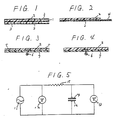
- FIGS 1-4 are cross sections illustrating a typical biomedical electrode embodying the present invention.
- Figure 5 is a circuit diagram for measurement of the electrode pair impedance of a biomedical electrode embodying this invention.
- water-soluble polyhydric alcohol examples include ethylene glycol, diethylene glycol, triethylene glycol, propylene glycol, trimethylene glycol, dipropylene glycol, 1,2-butanediol, 1,3-butanediol, 1,4-butanediol, 1,5-pentanediol, hexanediol, neopentyl glycol, dibromoneo- pentyl glycol, trimethyl pentanediol, trimethylol ethane, trimethylol propane, pentaerythritol, dipentaerythritol, glycerin diglycerol and sorbitol.
- the amount of the water-soluble polyhydric alcohol to be used may be in the range of from 10 to 80% by weight, preferably from 30 to 70% by weight, based on the total amount of the reactants used.
- the amount of water to be used in combination with the water-soluble polyhydric alcohol may be in the range of from 5 to 40% by weight, preferably from 7 to 30% by weight.
- this water may be used in conjunction with an electrolyte, such as sodium chloride, potassium chloride, lithium chloride, ammonium chloride, calcium chloride, or magnesium chloride.
- the amount of the electrolyte so used may be in the range of from 0.5 to 20% by weight, preferably from 3 to 15% by weight, based on the amount of water.
- the ionic monomer to be used in the present invention is required to be soluble in the mixture of the aforementioned water-soluble polyhydric alcohol with water. Preferably, it is an anionic monomer.
- the amount of the ionic monomer to be used may be in the range of from 10 to 40% by weight, preferably 15 to 30% by weight, based on the amount of the reactants used.
- Desirable examples of the ionic monomer are unsaturated organic carboxylic acids such as acrylic acid, methacrylic acid, maleic acid, itaconic acid, and citraconic acid and salts thereof, preferably acrylic acid and methacrylic acid and salts thereof, unsaturated organic sulphonic acids such as styrene sulphonic acid, methalfyl sulphonic acid, 2-sulphoethyl acrylate, 2-sulphoethyl methacrylate, 3-sulphopropyl acrylate, 3-sulphopropyl methacrylate, acrylamide-2-methylpropane sulphonic acid and their salts, and other radically polymerizable ionic monomers containing a carbon-carbon double bond, preferably sulphonic acid derivatives.
- unsaturated organic carboxylic acids such as acrylic acid, methacrylic acid, maleic acid, itaconic acid, and citraconic acid and salts thereof, preferably acrylic acid and methacrylic acid and salts thereof
- Unsaturated organic sulphonic acids are especially preferred.
- the ionic monomers enumerated above particu- lady desirable selections are 3-sulphopropyl-(meth)-acrylate, their salts, 2-acrylamide-2-methyl propane sulphonic acid, and their salts.
- Example of the cations involved in the formation of such salts include sodium, potassium, lithium, and ammonium ions. These ionic monomers may be used singly or in the form of a mixture of two or more of them.
- Typical examples of the trialkoxysilyalkyl (meth)acrylate represented by the general formula I: wherein R1 represents a hydrogen atom or a methyl group, R2 represents an alkyl group of 1 or 2 carbon atoms, and n is an integer of the value of 2 or 3 (preferably 3) include 2-trimethoxysilylethyl acrylate, 2-trimethoxysilylethyl methacrylate, 2-triethoxysilylethyl acrylate, 2-triethoxysilylethyl methacrylate, 3-trimethoxysilylpropyl acrylate, 3-trimethoxysilylpropyl methacrylate, 3-triethoxysilylpropyl acrylate and 3-triethoxysilylpropyl methacrylate.
- 3-trimethoxysilylpropyl (meth)acrylates and 3-triethoxysilylpropyl (meth)acrylates are particularly desirable selections.
- These trialkoxysilylalkyl (meth)acrylates are used either singly or in the form of a mixture of two or more of them.
- the amount of (meth)acrylate to be used may be in the range of from 0.05 to 1% by weight, preferably 0.1 to 0.5% by weight, based on the total amount of the reactants used.
- 2-hydroxyethyl (meth)acrylate, methoxytriethylene glycol monoacrylate, and methoxynonaethylene glycol monoacrylate prove particularly desirable, and 2-hydroxyethyl methacrylate is most desirable.
- These (meth)acrylates are used either singly or in the form of a mixture of two or more members.
- the amount of a (meth)acrylate to be used may be in the range of 2 to 30% by weight, preferably 5 to 20% by weight, based on the total amount of the reactants used.
- the electrically conductive adhesive of the present invention may be manufactured by any of the conventional methods available for radical polymerization.
- An example is a method which comprises mixing the aforementioned monomers, the polyhydric alcohol and water in a prescribed ratio and heating the mixture; another example comprises preparing the same mixture and irradiating the mixture with light, preferably ultraviolet light, in the presence of a photopolymerization initiator; or a method combining the two methods described above may be used.
- the method which comprises irradiating the mixture with light, particularly ultraviolet light, in the presence of a photopolymerization initiator proves desirable because the irradiation serves to promote cross-linking.
- thermal polymerization initiators examples include azobisisobutylonitrile, benzoyl peroxide, lauroyl peroxide, methylethyl ketone peroxide, lauroyl peroxide, cyclohexane peroxide, t-butylhydroperoxide, di-1-butyl peroxide di-t-amyl peroxide, dicumyl peroxide, and 1-butyl perbenzoate.
- the amount of the thermal polymerization initiator to be used is usually in the range of from 0.05 to 1% by weight, preferably from 0.1 to 0.5% by weight, based on the total amount of the monomers used.
- the heating temperature is in the range of from 50 ° to 90°C, preferably from 60 ° to 80 ° C.
- the heating time is in the range of from 0.5 to 6 hours, preferably 1 to 3 hours.
- photopolymerization initiators include benzoin alkyl ethers such as benzoin, benzoin isopropyl ether, and benzoin isobutyl ether; benzophenones such as benzophenone, and methyl-o-benzoyl benzoate; acetophenones such as acetophenone, trichloroacetophenone, 2,2-diethoxyacetophenone, p-t-butyltrichloro-acetophenone, 2,2-dimethoxy-2-phenylacetophenone, and 2-dimethylamino-acetophenone; thioxanthones such as xanthone, thioxanthone, 2-chlorothioxanthone, and 2-isopropyl thioxanthone; benzyl 2-ethyl anthraquinone, methylbenzoyl formate, 2-hydroxy-2-methyl-1-phenyl propane-1-one, 2-hydroxy-4'-isopropy
- the amount of the photopolymerization initiator to be used is usually in the range of from 0.05 to 1% by weight, preferably 0.1 to 0.5% by weight, based on the total amount of the monomers used.
- the dosage of the ultraviolet light irradiation with the light from an ultraviolet lamp (chemical lamp) having a 6W power output (1.2 m tube length) separated by a distance of 15 cm, for example, may be continued for from 2 to 60 minutes, preferably from 4 to 20 minutes.
- the mixture to be polymerized may incorporate a sensitizer such as an amine compound, a sulphur compound, or a phosphorus compound when necessary or desirable.
- An adhesive of the present invention may be produced by being polymerized on a substrate destined to form an electrode. Alternatively it may be produced applying a partially polymerized precursor on a substrate and then continuing polymerization until completion. Further, it may be produced by polymerizing on material which is capable of peeling but which does not constitute the electrode; such material may be a film or a plate, etc. Alternatively, the adhesive may be produced between such materials.
- the adhesive may further incorporate a tackifier such as karaya rubber in a proportion which does not impair the objects of the invention.
- a tackifier such as karaya rubber in a proportion which does not impair the objects of the invention.
- An electrically conductive adhesive of the present invention can be manufactured by adopting a method which comprises blending a mixture of component monomers, solvent, etc with a polymerization initiator, and simultaneously effecting polymerization and cross-linking of the resultant blend.
- the method of has the advantage that it permits a gelled adhesive of a desired shape to be produced through a single operational step from low viscosity raw materials. It is useful particularly because the composition involved in this invention can undergo polymerization and cross-linking simultaneously if a photopolymerization initiator is used and the mixture is irradiated with ultraviolet light.
- an electrically conductive adhesive obtained as described above can be used in a variety of constructions of biomedical electrodes.
- the electrode can be constructed to suit the particular purpose of use, so long as it includes an electrically conductive adhesive.
- the biomedical electrode illustrated in Figure 1 comprises an electrically conductive adhesive layer 2 Incorporating a reinforcing material 1 (such as a woven fabric like tricot or a non-woven fabric) and a protective film 3 (such as polyethylene terephthalate, polyethylene, or polypropylene) covering the opposite sides of the electrically conductive layer 2.
- the biomedical electrode is stripped of the protective film 2, attached on one side to the subject under test (such as the human body), and connected on the other side to a measuring instrument.
- Figure 2 illustrates another typical biomedical electrode embodying this invention. It comprises an electrically conductive adhesive layer 2, an electrode 4 of metal foil superposed on the surface of the electrically conductive adhesive layer 2, and a protective film 3 covering the surface of the electrode 4.
- the electrode 4 is connected to a measuring instrument and, at the same time, the remaining surface of the electrically conductive adhesive layer 2 is held in contact with the subject under test.
- FIG. 3 illustrates yet another typical biomedical electrode embodying this invention. It comprises a support member 7 (circular in shape, for example) made of a plastics substance, an electrode 6 incorporated in the support 7 in such a manner as to protrude from both its sides, and an electrically conductive adhesive layer 2 (circular in shape, for example) superposed on one side of the support 7 and being of enough height to prevent the electrode protruding from the same side of the support 7, and a sponge layer 5 formed along the boundary of the electrically conductive adhesive layer 2.
- the electrode 6 is connected to a measuring instrument and the electrically conductive adhesive layer 2 is pressed against the subject under test.
- the sponge layer 5 is readily deformed by pressure so as to seal the space between the electrically conductive gel and the exterior atmosphere, it plays a part in preventing a change in electrical properties due to an ingress of sterilizing solution.
- FIG 4 illustrates a further typical biomedical electrode embodying the present invention. This is equivalent to the electrode of Figure 3, except that the sponge layer 5 is omitted and the electrically conductive adhesive layer 7 is enlarged to fill the space left by the omission.
- the homogeneous solution was cast to a thickness of 1 mm.
- the solution held the polyester film was kept under an atmosphere of nitrogen and irradiated for 5 minutes with ultraviolet light emitted from two parallel 30 W chemical lamps (63 cm in bulb length) (product of Toshiba and marketed under product code FL30SBL) kept at a distance of 15 cm from.
- the solution under treatment A water-containing gel, having a viscosity proper to the skin and a cohesive force enough to avoid being torn on separation from the polyester film or on separation from the skin, was obtained. When this gel was left standing in the air, it showed substantially no increase or decrease of weight.
- An electric circuit of the configuration shown in Figure 5 was obtained by cutting two squares of 3 cm from the gel obtained as described above, joining the two gel squares 14 and 14 face to face, and nipping the joined squares with nickel silver plates.
- An alternating current at 10 Hz was generated by an oscillator 11 and potential differences V 1 and V 2 were measured with voltage testers 12 and 13.
- the electrode pair impedance was found to be 400 ohms. Even after a lapse of 24 hours, the value was 500 ohms.
- the same pair of electrodes were attached one each to the wrists of a human subject, they registered an impedance of 20 kilohms. (In the diagram, the numerical symbol 15 denotes a resistance.)
- a solution was prepared by following the procedure of Example 1, except that [alpha-methoxyno- na(oxyethylene)-omega-yQacrylate was used in the place of [alpha-methoxytri(oxyethylen)-omega-yQ- acrylate.
- a non-woven fabric of nylon (10 g in unit weight) was mounted and the solution was poured thereon to a thickness of about 1.5 mm.
- the solution on the film was irradiated with ultraviolet light for 5 minutes in an atmosphere of nitrogen.
- the water-containing gel so obtained had satisfactory viscosity and cohesiveness.
- the electrode pair impedance measured as in Example 1 was 600 ohms and the impedance measured through a human body was 30 kilohms.
- a solution was obtained by following the procedure of Example 1, except that the potassium salt of 2-acrylamide-2-methylpropane sulphonic acid was used in the place of the potassium salt of sulphopropyl methacrylate.
- a knitted fabric of polyester 75 denier was held at a height of 1 mm and the solution was poured thereon in a thickness of about 2 mm. Consequently, there was obtained a water-containing gel incorporating therein the knitted fabric of polyester.
- the electrode pair impedance measured as in Example 1 was 900 ohms and the impedance measured through a human body was 40 kilohms.
- a water-containing gel similar to the gel of Example 3 was obtained by following the procedure of Example 1, except that potassium methacrylate was used in the place of potassium salt of sulphopropyl methacrylate and 3-triethoxysilylpropyl methacrylate was used in the place of 3-trimethoxysilylpropyl methacrylate.
- the electrode pair impedance measured as in Example 1 was 1 kilohm and the impedance measured through a human body was 40 kilohms.
- the solution was poured into a space 2 of a shape made up as shown in Figure 3 (numerical symbols 5 and 7 are foamed polybutadiene having independent cells, numerical 6 is a metallic foil treated with silver/silver chloride on the surface, the polybutadiene 5 and 7 is 42 mm in outer diameter and 1 mm in thickness, 25 mm in inner diameter, and the surface of the polybutadiene 5 is treated with the adhesive), and was irradiated by ultraviolet light in a nitrogen atmosphere by a similar manner to Example 1.
- the two electrode thus obtained were superposed and electrode pair impedance was measured to obtain 300 ohms at 10 Hz.
- solution B 2,500 parts of the potassium salt of 3-sulphopropyl acrylate was dissolved.
- the solution so produced was designated as solution B.
- the solution designated as a homogeneous solution was obtained by mixing 1,250 parts of solution A, 4,800 parts of solution B, 6,400 parts of glycerin, and 32 parts of acrylic acid.
- this homogeneous solution was cast to a thickness of 1 mm and irradiated for 30 minutes with the ultraviolet light from chemical lamps. There was thus obtained a water-containing gel adhering to the tin foil. The gel adhered fast to the tin foil.
- the gel as deposited fast on the tin foil was cut to obtain two squares of 3 cm and lead wires were connected to the tin foils to complete a circuit similar to the circuit of Example 1.
- the electrode pair impedance was 400 ohms and the impedance measured through a human body was 20 kilohms.
Landscapes
- Chemical & Material Sciences (AREA)
- Organic Chemistry (AREA)
- Physics & Mathematics (AREA)
- Spectroscopy & Molecular Physics (AREA)
- Health & Medical Sciences (AREA)
- Chemical Kinetics & Catalysis (AREA)
- Medicinal Chemistry (AREA)
- Polymers & Plastics (AREA)
- Measurement And Recording Of Electrical Phenomena And Electrical Characteristics Of The Living Body (AREA)
- Electrotherapy Devices (AREA)
- Adhesives Or Adhesive Processes (AREA)
- Polymerisation Methods In General (AREA)
- Paints Or Removers (AREA)
- Addition Polymer Or Copolymer, Post-Treatments, Or Chemical Modifications (AREA)
- Macromonomer-Based Addition Polymer (AREA)
- Measurement Of The Respiration, Hearing Ability, Form, And Blood Characteristics Of Living Organisms (AREA)
- Conductive Materials (AREA)
Applications Claiming Priority (2)
| Application Number | Priority Date | Filing Date | Title |
|---|---|---|---|
| JP548885 | 1985-01-16 | ||
| JP5488/85 | 1985-01-16 |
Publications (3)
| Publication Number | Publication Date |
|---|---|
| EP0188381A2 EP0188381A2 (en) | 1986-07-23 |
| EP0188381A3 EP0188381A3 (en) | 1986-11-20 |
| EP0188381B1 true EP0188381B1 (en) | 1990-05-16 |
Family
ID=11612625
Family Applications (1)
| Application Number | Title | Priority Date | Filing Date |
|---|---|---|---|
| EP86300267A Expired - Lifetime EP0188381B1 (en) | 1985-01-16 | 1986-01-16 | Electrically conductive adhesive, method for its manufacture and biomedical electrode |
Country Status (4)
| Country | Link |
|---|---|
| US (2) | US4842768A (enExample) |
| EP (1) | EP0188381B1 (enExample) |
| JP (1) | JPH0668101B2 (enExample) |
| DE (1) | DE3671320D1 (enExample) |
Families Citing this family (35)
| Publication number | Priority date | Publication date | Assignee | Title |
|---|---|---|---|---|
| US4798773A (en) * | 1986-11-21 | 1989-01-17 | Mitsubishi Petrochemical Co., Ltd. | Solid polymer electrolyte composition |
| US5183599A (en) * | 1990-01-19 | 1993-02-02 | Smuckler Jack H | Rapid curing, electrically conductive adhesive |
| WO1993000857A1 (en) * | 1991-07-12 | 1993-01-21 | Ludlow Corporation | Biomedical electrode |
| JPH05306380A (ja) * | 1991-11-20 | 1993-11-19 | Sekisui Chem Co Ltd | ホットメルト粘着剤組成物及びそれを塗布した粘着テープ、ラベルもしくはシート |
| JPH0815486B2 (ja) * | 1992-03-17 | 1996-02-21 | 日本光電工業株式会社 | 生体用電極の製造方法 |
| ES2076922T1 (es) * | 1994-03-04 | 1995-11-16 | Sartomer Co Inc | Composiciones endurecibles y endurecidas con base de agua y un procedimiento para adherir un recubrimiento o adhesivo a un substrato. |
| US5674275A (en) * | 1994-04-06 | 1997-10-07 | Graphic Controls Corporation | Polyacrylate and polymethacrylate ester based hydrogel adhesives |
| US5614586A (en) * | 1994-04-06 | 1997-03-25 | Graphic Controls Corporation | Polyacrylate and Polymethacrylate ester based hydrogel adhesives |
| US6673852B1 (en) | 1995-07-11 | 2004-01-06 | Nihon Kohden Corporation | Conductive composition for biological electrode |
| US6495627B1 (en) * | 1995-07-11 | 2002-12-17 | Nihon Kohden Corporation | Conductive composition for biological electrode |
| US6800278B1 (en) | 1996-10-28 | 2004-10-05 | Ballard Medical Products, Inc. | Inherently antimicrobial quaternary amine hydrogel wound dressings |
| US5800685A (en) * | 1996-10-28 | 1998-09-01 | Cardiotronics Systems, Inc. | Electrically conductive adhesive hydrogels |
| US5846197A (en) * | 1998-03-16 | 1998-12-08 | Beth Israel Deaconess Medical Center | Compensating for magnetization transfer effects in multislice and three-dimensional MRI blood flow mapping studies |
| AU5180199A (en) | 1998-07-31 | 2000-02-21 | First Water Limited | Bioadhesive compositions and biomedical electrodes containing them |
| EP1026219A1 (en) * | 1999-02-02 | 2000-08-09 | First Water Limited | Bioadhesive compositions |
| US20020013539A1 (en) * | 2000-07-28 | 2002-01-31 | David Hung | Methods and devices for diagnosis of precancer and cancer in breast milk ducts |
| US7136691B2 (en) * | 2002-09-04 | 2006-11-14 | 3M Innovative Properties Company | Biomedical electrodes |
| JP2004231673A (ja) * | 2003-01-28 | 2004-08-19 | Kao Corp | 被膜形成樹脂 |
| US7045559B2 (en) * | 2003-12-18 | 2006-05-16 | Kimberly-Clark Worldwide, Inc. | Electrically conductive adhesive hydrogels with solubilizer |
| US20050136023A1 (en) * | 2003-12-18 | 2005-06-23 | Kimberly-Clark Worldwide, Inc. | Electrically conductive adhesive hydrogels with a thermally activated chemical initiator |
| US20050136077A1 (en) * | 2003-12-18 | 2005-06-23 | Kimberly-Clark Worldwide, Inc. | Electrically conductive adhesive hydrogels with two initiators |
| US7495055B2 (en) * | 2004-12-29 | 2009-02-24 | Kimberly-Clark Worldwide, Inc. | Multi-purpose adhesive composition |
| US20070048249A1 (en) | 2005-08-24 | 2007-03-01 | Purdue Research Foundation | Hydrophilized bactericidal polymers |
| US20080057811A1 (en) * | 2006-08-31 | 2008-03-06 | Kimberly-Clark Worldwide, Inc. | Multifunctional hydrogel-web composites for enhanced absorbency applications and methods of making the same |
| US7678716B2 (en) * | 2006-08-31 | 2010-03-16 | Kimberly-Clark Worldwide, Inc. | Hydrogel-web composites for thermal energy transfer applications and methods of making the same |
| US7869855B2 (en) * | 2006-09-28 | 2011-01-11 | Tyco Healthcare Group Lp | Medical apparatus with releasable applicator |
| US7816412B2 (en) * | 2007-02-23 | 2010-10-19 | Conmed Corporation | Electrically conductive hydrogels |
| JP5827584B2 (ja) * | 2012-03-09 | 2015-12-02 | 積水化成品工業株式会社 | 粘着性ハイドロゲル及びその用途 |
| WO2015146840A1 (ja) * | 2014-03-28 | 2015-10-01 | 積水化成品工業株式会社 | 高含水粘着性ゲル、高含水粘着性ゲル製造用組成物および電極パッド |
| JP6744848B2 (ja) * | 2016-09-13 | 2020-08-19 | 信越化学工業株式会社 | 粘着剤組成物、生体電極、及び生体電極の製造方法 |
| JP6761384B2 (ja) * | 2016-09-29 | 2020-09-23 | 信越化学工業株式会社 | 粘着剤組成物、生体電極、及び生体電極の製造方法 |
| JP6761386B2 (ja) * | 2016-09-29 | 2020-09-23 | 信越化学工業株式会社 | 粘着剤組成物、生体電極、生体電極の製造方法、及び塩 |
| US20180340046A1 (en) | 2017-05-27 | 2018-11-29 | Poly Group LLC | Dispersible antimicrobial complex and coatings therefrom |
| PL3638740T3 (pl) | 2017-06-16 | 2024-10-14 | Poly Group LLC | Polimerowy przeciwdrobnoustrojowy środek powierzchniowo czynny |
| JPWO2023176479A1 (enExample) * | 2022-03-15 | 2023-09-21 |
Family Cites Families (9)
| Publication number | Priority date | Publication date | Assignee | Title |
|---|---|---|---|---|
| US3998215A (en) * | 1968-12-18 | 1976-12-21 | Minnesota Mining And Manufacturing Company | Bio-medical electrode conductive gel pads |
| DE2935238A1 (de) * | 1977-08-19 | 1981-03-19 | Minnesota Mining and Manufacturing Co., 55101 Saint Paul, Minn. | Biomedizinische elektrode |
| US4273135A (en) * | 1977-08-19 | 1981-06-16 | Minnesota Mining And Manufacturing Company | Biomedical electrode |
| ES486582A1 (es) * | 1978-12-11 | 1980-06-16 | Medtronic Inc | Perfeccionamientos en electrodos, en especial los destinadosa su aplicacion a la piel |
| JPS5636940A (en) * | 1979-09-03 | 1981-04-10 | Minnesota Mining & Mfg | Living body medical electrode |
| FR2464078A1 (fr) * | 1979-09-04 | 1981-03-06 | Minnesota Mining & Mfg | Electrode biomedicale seche, a usage unique |
| BR8009020A (pt) * | 1980-01-23 | 1981-11-17 | Minnesota Mining & Mfg | Adesivo condutor e eletrodo biomedico |
| FR2565413B1 (fr) * | 1984-05-29 | 1986-08-29 | Elf Aquitaine | Materiau macromoleculaire a conduction ionique pour la realisation d'electrolytes ou d'electrodes |
| US4848353A (en) * | 1986-09-05 | 1989-07-18 | Minnesota Mining And Manufacturing Company | Electrically-conductive, pressure-sensitive adhesive and biomedical electrodes |
-
1986
- 1986-01-15 US US06/819,146 patent/US4842768A/en not_active Expired - Fee Related
- 1986-01-16 JP JP61005005A patent/JPH0668101B2/ja not_active Expired - Fee Related
- 1986-01-16 EP EP86300267A patent/EP0188381B1/en not_active Expired - Lifetime
- 1986-01-16 DE DE8686300267T patent/DE3671320D1/de not_active Expired - Fee Related
-
1988
- 1988-08-03 US US07/227,988 patent/US4947847A/en not_active Expired - Fee Related
Also Published As
| Publication number | Publication date |
|---|---|
| US4947847A (en) | 1990-08-14 |
| JPH0668101B2 (ja) | 1994-08-31 |
| EP0188381A2 (en) | 1986-07-23 |
| DE3671320D1 (de) | 1990-06-21 |
| JPS61268767A (ja) | 1986-11-28 |
| US4842768A (en) | 1989-06-27 |
| EP0188381A3 (en) | 1986-11-20 |
Similar Documents
| Publication | Publication Date | Title |
|---|---|---|
| EP0188381A2 (en) | Electrically conductive adhesive, method for its manufacture and biomedical electrode | |
| US5800685A (en) | Electrically conductive adhesive hydrogels | |
| KR101478566B1 (ko) | 점착성 하이드로겔용 조성물 및 그 용도 | |
| EP0043850B1 (en) | Method of manufacturing a dry biomedical electrode | |
| CA2588700C (en) | Process for making pressure sensitive adhesive hydrogels | |
| EP3123974B1 (en) | Water-rich adherent gel, composition for manufacturing water-rich adherent gel, and electrode pad | |
| JP2010065222A (ja) | 伝導性組成物および方法 | |
| JP2625179B2 (ja) | 親水性感圧接着剤組成物および該組成物で構成された生体医学用電極 | |
| US20070196320A1 (en) | Bioadhesive compositions and their use in medical electrodes | |
| JPWO2018062030A1 (ja) | ハイドロゲル | |
| US20060029652A1 (en) | Absorbent hydrogel compositions | |
| WO1997024376A1 (en) | Use of pendant photoreactive moieties on polymer precursors to prepare hydrophilic pressure sensitive adhesives | |
| JP2005213455A (ja) | 導電性粘着剤組成物、その製造法ならびに導電性粘着剤組成物を用いた生体用電極 | |
| JP4222913B2 (ja) | 粘着性ハイドロゲル | |
| JP2803886B2 (ja) | 導電性ゲルおよびこれを用いた電極用パッド | |
| DE4336301C2 (de) | Elektrisch leitfähige Hydrogelzusammensetzung, Verfahren zur Herstellung eines Hydrogels und deren Verwendung | |
| JPS62227957A (ja) | 接着性被膜形成材 | |
| JPH04266742A (ja) | 医療用導電性粘着剤 | |
| MXPA99003935A (en) | Electrically conductive adhesive hydrogels | |
| JPH0783743B2 (ja) | 医療用導電性粘着剤 | |
| JPH05202262A (ja) | ゲル状組成物およびその構造体 |
Legal Events
| Date | Code | Title | Description |
|---|---|---|---|
| PUAI | Public reference made under article 153(3) epc to a published international application that has entered the european phase |
Free format text: ORIGINAL CODE: 0009012 |
|
| AK | Designated contracting states |
Kind code of ref document: A2 Designated state(s): DE FR GB SE |
|
| PUAL | Search report despatched |
Free format text: ORIGINAL CODE: 0009013 |
|
| AK | Designated contracting states |
Kind code of ref document: A3 Designated state(s): DE FR GB SE |
|
| 17P | Request for examination filed |
Effective date: 19870505 |
|
| 17Q | First examination report despatched |
Effective date: 19881004 |
|
| GRAA | (expected) grant |
Free format text: ORIGINAL CODE: 0009210 |
|
| AK | Designated contracting states |
Kind code of ref document: B1 Designated state(s): DE FR GB SE |
|
| REF | Corresponds to: |
Ref document number: 3671320 Country of ref document: DE Date of ref document: 19900621 |
|
| ET | Fr: translation filed | ||
| PLBE | No opposition filed within time limit |
Free format text: ORIGINAL CODE: 0009261 |
|
| STAA | Information on the status of an ep patent application or granted ep patent |
Free format text: STATUS: NO OPPOSITION FILED WITHIN TIME LIMIT |
|
| 26N | No opposition filed | ||
| REG | Reference to a national code |
Ref country code: GB Ref legal event code: 732 |
|
| PGFP | Annual fee paid to national office [announced via postgrant information from national office to epo] |
Ref country code: GB Payment date: 19930108 Year of fee payment: 8 |
|
| PGFP | Annual fee paid to national office [announced via postgrant information from national office to epo] |
Ref country code: FR Payment date: 19930111 Year of fee payment: 8 |
|
| PGFP | Annual fee paid to national office [announced via postgrant information from national office to epo] |
Ref country code: SE Payment date: 19930115 Year of fee payment: 8 |
|
| PGFP | Annual fee paid to national office [announced via postgrant information from national office to epo] |
Ref country code: DE Payment date: 19930209 Year of fee payment: 8 |
|
| PG25 | Lapsed in a contracting state [announced via postgrant information from national office to epo] |
Ref country code: GB Effective date: 19940116 |
|
| PG25 | Lapsed in a contracting state [announced via postgrant information from national office to epo] |
Ref country code: SE Effective date: 19940117 |
|
| GBPC | Gb: european patent ceased through non-payment of renewal fee |
Effective date: 19940116 |
|
| PG25 | Lapsed in a contracting state [announced via postgrant information from national office to epo] |
Ref country code: FR Effective date: 19940930 |
|
| PG25 | Lapsed in a contracting state [announced via postgrant information from national office to epo] |
Ref country code: DE Effective date: 19941001 |
|
| REG | Reference to a national code |
Ref country code: FR Ref legal event code: ST |
|
| EUG | Se: european patent has lapsed |
Ref document number: 86300267.1 Effective date: 19940810 |