EP0184752A2 - Neue 2,4-Diaminopyrimidine - Google Patents
Neue 2,4-Diaminopyrimidine Download PDFInfo
- Publication number
- EP0184752A2 EP0184752A2 EP85115278A EP85115278A EP0184752A2 EP 0184752 A2 EP0184752 A2 EP 0184752A2 EP 85115278 A EP85115278 A EP 85115278A EP 85115278 A EP85115278 A EP 85115278A EP 0184752 A2 EP0184752 A2 EP 0184752A2
- Authority
- EP
- European Patent Office
- Prior art keywords
- alkyl
- halogen
- formula
- general formula
- steht
- Prior art date
- Legal status (The legal status is an assumption and is not a legal conclusion. Google has not performed a legal analysis and makes no representation as to the accuracy of the status listed.)
- Withdrawn
Links
Classifications
-
- C—CHEMISTRY; METALLURGY
- C07—ORGANIC CHEMISTRY
- C07D—HETEROCYCLIC COMPOUNDS
- C07D239/00—Heterocyclic compounds containing 1,3-diazine or hydrogenated 1,3-diazine rings
- C07D239/02—Heterocyclic compounds containing 1,3-diazine or hydrogenated 1,3-diazine rings not condensed with other rings
- C07D239/24—Heterocyclic compounds containing 1,3-diazine or hydrogenated 1,3-diazine rings not condensed with other rings having three or more double bonds between ring members or between ring members and non-ring members
- C07D239/28—Heterocyclic compounds containing 1,3-diazine or hydrogenated 1,3-diazine rings not condensed with other rings having three or more double bonds between ring members or between ring members and non-ring members with hetero atoms or with carbon atoms having three bonds to hetero atoms with at the most one bond to halogen, directly attached to ring carbon atoms
- C07D239/32—One oxygen, sulfur or nitrogen atom
- C07D239/42—One nitrogen atom
-
- A—HUMAN NECESSITIES
- A01—AGRICULTURE; FORESTRY; ANIMAL HUSBANDRY; HUNTING; TRAPPING; FISHING
- A01N—PRESERVATION OF BODIES OF HUMANS OR ANIMALS OR PLANTS OR PARTS THEREOF; BIOCIDES, e.g. AS DISINFECTANTS, AS PESTICIDES OR AS HERBICIDES; PEST REPELLANTS OR ATTRACTANTS; PLANT GROWTH REGULATORS
- A01N43/00—Biocides, pest repellants or attractants, or plant growth regulators containing heterocyclic compounds
- A01N43/48—Biocides, pest repellants or attractants, or plant growth regulators containing heterocyclic compounds having rings with two nitrogen atoms as the only ring hetero atoms
- A01N43/54—1,3-Diazines; Hydrogenated 1,3-diazines
-
- C—CHEMISTRY; METALLURGY
- C07—ORGANIC CHEMISTRY
- C07D—HETEROCYCLIC COMPOUNDS
- C07D239/00—Heterocyclic compounds containing 1,3-diazine or hydrogenated 1,3-diazine rings
- C07D239/02—Heterocyclic compounds containing 1,3-diazine or hydrogenated 1,3-diazine rings not condensed with other rings
- C07D239/24—Heterocyclic compounds containing 1,3-diazine or hydrogenated 1,3-diazine rings not condensed with other rings having three or more double bonds between ring members or between ring members and non-ring members
- C07D239/28—Heterocyclic compounds containing 1,3-diazine or hydrogenated 1,3-diazine rings not condensed with other rings having three or more double bonds between ring members or between ring members and non-ring members with hetero atoms or with carbon atoms having three bonds to hetero atoms with at the most one bond to halogen, directly attached to ring carbon atoms
- C07D239/46—Two or more oxygen, sulphur or nitrogen atoms
- C07D239/48—Two nitrogen atoms
Definitions
- the present invention relates to new 2,4-diaminopyrimidines, processes for their preparation and their use as crop protection agents, in particular as herbicides.
- the new pyrimidine derivatives of the formula (I) according to the invention are structurally distinguished from the previously known pyrimidines in particular in that the 2-amino group contains a straight-chain or branched alkyl chain which is interrupted by oxygen or sulfur and that an unsubstituted amino group is in the 4-position.
- the active compounds of the formula (I) according to the invention are, with the same compatibility with culture, significantly more effective than the previously known pyrimidine derivatives, such as e.g. 2,4-biscyclopropylamino-5,6-dichloropyrimidine (known from DE-OS 2 630 140).
- pyrimidine derivatives such as e.g. 2,4-biscyclopropylamino-5,6-dichloropyrimidine (known from DE-OS 2 630 140).
- the halopyrimidines used as starting materials are generally defined by the formula (II).
- R 2 is preferably or particularly preferably those radicals which have already been mentioned as preferred or particularly preferred for these substituents in the description of the substances of the formula (I) and X is chlorine or fluorine.
- the halopyrimidines of the formula (II) are known in some cases or can be prepared by known processes (cf. examples).
- Formula (III) provides a general definition of the amines used as starting materials.
- R 3 , R 4 , Y and Z preferably or particularly preferably represent those radicals which have already been mentioned as preferred or particularly preferred for these substituents in the description of the substances of the formula (I) according to the invention.
- the amines of the formula (III) are known or can be prepared by known processes in an analogous manner to the known compounds (cf. for example Houben-Weyl, Methods of Organic Chemistry, Volume XI / 1, p. 548, p. 561 ff. , 4th edition 1957; US 2,764,615).
- Formula (VI) provides a general definition of the 4-aminopyrimidine derivatives used as starting materials.
- R and R 2 preferably or particularly preferably represent those radicals which are preferred or particular already in the description of the substances of the formula (I) according to the invention were preferred and X for chlorine or fluorine.
- Some of the 4-aminopyrimidine derivatives of the formula (VI) are known or can be prepared by known processes (cf. examples).
- Organic solvents and water are suitable as diluents for process variants (A) and (B) according to the invention.
- Preferred organic solvents are hydrocarbons such as toluene, aliphatic ketones such as acetone, methyl ethyl ketone and diethyl ketone, cycloaliphatic ethers such as tetrahydrofuran or dioxane. Mixtures of various organic solvents and mixtures of water-miscible organic solvents with water are also suitable as diluents.
- Process variants (A) and (B) according to the invention can be carried out using acid binders.
- alkaline earth and alkali metal hydroxides such as calcium, sodium or potassium hydroxide, ammonia and tertiary aliphatic amines such as e.g. Triethylamine, but also amine starting product (III) used in excess is particularly suitable.
- the reaction temperatures can be varied within a wide range in the process according to the invention.
- the first process step in procedure (A) is generally carried out at temperatures from -30 to + 150 ° C, preferably from -20 to + 50 ° C; in the second stage of the process one generally works mean at 80 to 150 ° C, preferably at 90 to 130 ° C.
- Procedure (B) is generally carried out at 80 to 150 ° C., preferably at 90 to 130 ° C.
- the reaction is carried out in the pressure range from 1 to about 10 bar.
- the isomer mixtures obtained in both process variants can be separated in a simple manner by known methods, in particular by recrystallization, chromatography or steam distillation (see, for example, DE-OS 2 006 145, DE-OS 2 630 140, EP 0 114 575), so that have the desired isomers isolated in a sufficiently pure form.
- the active compounds according to the invention can be used as defoliants, desiccants, haulm killers and in particular as weed killers. Weeds in the broadest sense are understood to mean all plants that grow up in places where they are undesirable. Whether the substances according to the invention act as total or selective herbicides depends essentially on the amount used.
- the compounds are suitable for total weed control, e.g. on industrial and track systems and on paths and squares with and without tree cover.
- the compounds for weed control in permanent crops e.g. Forestry, ornamental trees, fruit, wine, citrus, nut, banana, coffee, tea, rubber, oil palm, cocoa, berry fruit and hop plants and for selective weed control in annual crops.
- the active compounds according to the invention can - especially in the post-emergence process - for selective weed control in monocotyledon crops, e.g. in corn, cereals and rice, and dicotyledonous cultures, e.g. in cotton and soy.
- the new active ingredients are significantly more effective for corn, cereals and rice as well as for cotton and soybeans than the previously known compound 2,4-biscyclopropylamino-5,6-dichloropyrimidine.
- the active ingredients can be converted into the customary formulations, such as solutions, emulsions, wettable powders, suspensions, powders, dusts, pastes, soluble powders, granules, suspension emulsion concentrates, active ingredient-impregnated natural and synthetic substances and very fine encapsulations in polymeric substances.
- formulations are prepared in a known manner, e.g. B. by mixing the active ingredients with extenders, that is liquid solvents and / or solid carriers, optionally using surface-active agents, ie emulsifiers and / or dispersants and / or foam-generating agents.
- extenders that is liquid solvents and / or solid carriers
- surface-active agents ie emulsifiers and / or dispersants and / or foam-generating agents.
- organic solvents can also be used as auxiliary solvents.
- auxiliary solvents e.g. organic solvents
- aromatics such as xylene, toluene, or alkylnaphthalenes
- chlorinated aromatics and chlorinated aliphatic hydrocarbons such as chlorobenzenes, chlorethylenes or methylene chloride
- aliphatic hydrocarbons such as cyclohexane or paraffins, e.g.
- Petroleum fractions mineral and vegetable oils, alcohols such as butanol or glycol and their ethers and esters, ketones such as acetone, methyl ethyl ketone, methyl isobutyl ketone or cyclohexanone, strongly polar solvents such as dimethylformamide and dimethyl sulfoxide, and water.
- alcohols such as butanol or glycol and their ethers and esters
- ketones such as acetone, methyl ethyl ketone, methyl isobutyl ketone or cyclohexanone
- strongly polar solvents such as dimethylformamide and dimethyl sulfoxide, and water.
- Possible solid carriers are: B. ammonium salts and natural rock powders, such as kaolins, clays, talc, chalk, quartz, attapulgite, montmorillonite or diatomaceous earth and synthetic rock powders, such as highly disperse silica, aluminum oxide and silicates, are suitable as solid carriers for granules: e.g.
- Suitable emulsifying and / or foam-generating agents are: for example nonionic and anionic emulsifiers, such as polyoxyethylene fatty acid esters, polyoxyethylene fatty alcohol ethers, for example alkylaryl polyglycol ethers, alkyl sulfonates, alkyl sulfates, aryl sulfonates and protein hydrolyzates;
- emulsifiers such as polyoxyethylene fatty acid esters, polyoxyethylene fatty alcohol ethers, for example alkylaryl polyglycol ethers, alkyl sulfonates, alkyl sulfates, aryl sulfonates and protein hydrolyzates
- dispersants for example lignin sulfite waste liquor and methyl cellulose.
- Adhesives such as carboxymethyl cellulose, natural and synthetic powdery, granular or latex-shaped polymers, such as gum arabic, polyvinyl alcohol, polyvinyl acetate, and natural phospholipids, such as cephalins and lecithins and synthetic phospholipids, can be used in the formulations.
- Other additives can be mineral and vegetable oils.
- Dyes such as inorganic pigments, e.g. Iron oxide, titanium oxide, ferrocyan blue and organic dyes such as alizarin, azo and metal phthalocyanine dyes and trace nutrients such as salts of iron, manganese, boron, copper, cobalt, molybdenum and zinc can be used.
- the formulations generally contain between 0.1 and 95 percent by weight of active compound, preferably between 0.5 and 90%.
- the active compounds according to the invention can also be used for weed control in a mixture with known herbicides, finished formulations or tank mixes being possible.
- ureas eg methabenzthiazuron
- Diphenyl ether e.g. alachlor, metolachlor
- Phenoxyalkane carboxylic acids for example 2,4-D, 2,4-DP, MCPA, MCPP and their derivatives
- Aryloxy- and hetaryloxyphenoxypropionic acid e.g.
- triazines eg atrazine, simazine
- Triazinones e.g. metribuzin and 4-amino-6-tert-butyl-.
- Triazinediones e.g. ametridione
- Cyclohexanediones e.g. sethoxydim
- Benzonitrile e.g. Joxynil
- Bentazon 3-ethylthio-1,2,4-triazin-5 (4H) -one
- Triazinediones e.g. ametridione
- Cyclohexanediones e.g. sethoxydim
- Benzonitrile e.g. Joxynil
- Bentazon ethylthio-1,2,4-triazin-5
- a mixture with other known active compounds such as fungicides, insecticides, acaricides, nematicides, bird repellants, plant nutrients and agents which improve soil structure, is also possible.
- the active compounds can be used as such, in the form of their formulations or in the use forms prepared therefrom by further dilution, such as ready-to-use solutions, suspensions, emulsions, powders, pastes and granules. They are used in the usual way, e.g. by pouring, spraying, spraying, sprinkling.
- the active compounds according to the invention can be applied both before and after emergence of the plants. They can also be worked into the soil before sowing.
- the amount of active ingredient used can vary over a wide range. It essentially depends on the type of effect desired. In general, the application rates are between 0.01 and 15 kg of active ingredient per hectare of soil, preferably between 0.05 and 10 kg per ha.
- Solvent 5 parts by weight of acetone emulsifier: 1 part by weight of alkylaryl polyglycol ether
- active compound 1 part by weight of active compound is mixed with the stated amount of solvent, the stated amount of emulsifier is added and the concentrate is diluted with water to the desired concentration.
- Test plants which have a height of 5-15 cm are sprayed with the active substance preparation in such a way that the desired amounts of active substance are applied per unit area.
- the concentration of the spray liquor is chosen so that the desired amounts of active compound are applied in 2000 l of water / ha.
- the degree of damage to the plants is rated in% damage compared to the development of the untreated control.
Landscapes
- Organic Chemistry (AREA)
- Chemical & Material Sciences (AREA)
- Life Sciences & Earth Sciences (AREA)
- Dentistry (AREA)
- Health & Medical Sciences (AREA)
- Engineering & Computer Science (AREA)
- Plant Pathology (AREA)
- General Health & Medical Sciences (AREA)
- Wood Science & Technology (AREA)
- Zoology (AREA)
- Environmental Sciences (AREA)
- Pest Control & Pesticides (AREA)
- Agronomy & Crop Science (AREA)
- Agricultural Chemicals And Associated Chemicals (AREA)
- Plural Heterocyclic Compounds (AREA)
Abstract

in welcher
- R1 für Wasserstoff oder Halogen steht, R2 für gegebenenfalls durch Halogen substituiertes Alkyl, Halogen oder Alkoxy steht, R 3 für Alkyl steht,
- R4 für Wasserstoff oder Alkyl steht, Y für Sauerstoff oder Schwefel steht und Z für verzweigtes oder unverzweigtes Alkylen steht, Verfahren zu ihrer Herstellung und ihre Verwendung als Pflanzenschutzmittel, insbesondere als Herbizide.
Description
- Die vorliegende Erfindung betrifft neue 2,4-Diaminopyrimidine, Verfahren zu ihrer Herstellung sowie ihre Verwendung als Pflanzenschutzmittel, insbesondere als Herbizide.
- Es ist bereits bekannt, daß bestimmte 2,4-Diaminopyrimidine, z.B. 2,4-Biscyclopropylamino-5,6-dichlorpyrimidin, als Herbizide eingesetzt werden können (vgl. DE-OS 2 006 145, DE-OS 2 630 140). Ihre Wirkung bei niedrigen Aufwandmengen ist jedoch bei verschiedenen Schadpflanzen nicht befriedigend.
- Es wurden nun neue 2,4-Diaminopyrimidine der allgemeinen Formel (I)
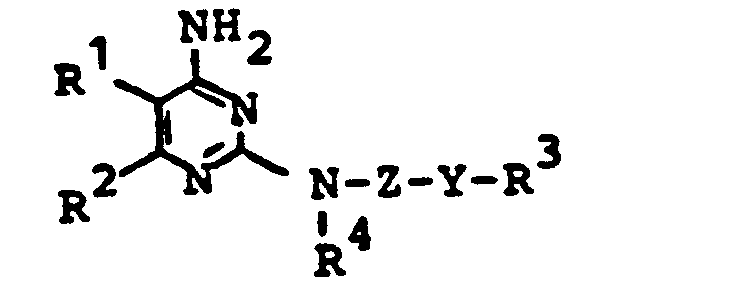
- R1 für Wasserstoff oder Halogen steht,
- R 2 für gegebenenfalls durch Halogen substituiertes Alkyl, für Halogen oder Alkoxy steht,
- R 3 für Alkyl steht,
- R 4 für Wasserstoff oder Alkyl steht,
- Y für Sauerstoff oder Schwefel steht und
- Z für verzweigtes oder unverzweigtes Alkylen steht,
aufgefunden. - Weiterhin wurde gefunden, daß man die Pyrimidinderivate der allgemeinen Formel (I) erhält, wenn man entweder
- (A) Halogenpyrimidine der allgemeinen Formel (II)

in welcher - R1 und R2 die oben angegebene Bedeutung haben und X für Halogen (bevorzugt Fluor oder Chlor) steht,
zunächst mit einem Amin der Formel (III)
worin - 3 4 R 3, R 4, Y und Z die oben angegebene Bedeutung haben,
in Gegenwart eines säurebindenden Mittels und gegebenenfalls in Gegenwart eines Verdünnungsmittels zu einem Gemisch der isomeren Pyrimidinderivate der allgemeinen Formel (IVa) und (IVb)
worin - R1, R 2, R 3, R 4, X, Y und Z die oben angegebene Bedeutung haben,
umsetzt (1. Stufe) und anschließend nach Trennung der beiden Isomeren die Pyrimidinderivate der Formel (IVa) in einem weiteren Reaktionsschritt mit Ammoniak (V)
in Gegenwart eines säurebindenden Mittels und gegebenenfalls in Gegenwart eines Verdünnungsmittels zu Pyrimidinderivaten der Formel (I) umsetzt (2. Stufe),
oder - (B) 4-Aminopyrimidinderivate der allgemeinen Formel (VI)

worin- 1 2 R , R 2 und X die oben angegebene Bedeutung haben, mit einem Amin der Formel (III) - wiederum unter den gleichen Reaktionsbedindungen wie bei Verfahren (A) - zu Pyrimidinderivaten der Formel (I)

worin - R1, R2, R3, R4, Y und Z die oben angegebene Bedeutung haben,
umsetzt.
- 1 2 R , R 2 und X die oben angegebene Bedeutung haben, mit einem Amin der Formel (III) - wiederum unter den gleichen Reaktionsbedindungen wie bei Verfahren (A) - zu Pyrimidinderivaten der Formel (I)
- Hierbei erhält man, wenn R2 für Halogen steht, ein Gemisch der isomeren Pyrimidinderivate der allgemeinen Formel (I) und (Ia)

worin - R1, R2, R3, R4, X, Y und Z die oben angegebene Bedeutung haben, aus dem das gewünschte Pyrimidinderivat der allgemeinen Formel (I) abgetrennt wird.
- Außerdem wurde gefunden, daß die neuen Pyrimidinderivate der allgemeinen Formel (I) starke herbizide Eigenschaften aufweisen.
- Die erfindungsgemäßen neuen Pyrimidinderivate der Formel (I) zeichnen sich gegenüber den vorbekannten Pyrimidinen strukturell insbesondere dadurch aus, daß die 2-Aminogruppe eine geradkettige oder verzweigte, durch Sauerstoff oder Schwefel unterbrochene Alkylkette enthält und daß in 4-Stellung eine unsubstituierte Aminogruppe steht.
- Uberraschenderweise sind die erfindungsgemäßen Wirkstoffe der Formel (I), bei gleicher Kulturverträglichkeit, deutlich wirksamer als die vorbekannten Pyrimidinderivate, wie z.B. 2,4-Biscyclopropyl- amino-5,6-dichlorpyrimidin (bekannt aus DE-OS 2 630 140).
- Von den erfindungsgemäßen Pyrimidinderivaten der Formel (I) sind bevorzugt diejenigen, in denen
- R 1 für Wasserstoff, Chlor oder Fluor steht,
- R 2 für Chlor, Fluor, Alkoxy mit 1-6 C-Atomen oder für gegebenenfalls durch Chlor und/oder Fluor substituiertes Alkyl mit 1-6 C-Atomen steht,
- R 3 für Alkyl mit 1-6 C-Atomen steht,
- R 4 für Wasserstoff oder Alkyl mit 1-6 C-Atomen steht,
- Y für Sauerstoff oder Schwefel steht und Z für eine verzweigte oder unverzweigte Alkylengruppe mit 2 bis 10 C-Atomen steht.
- Aus dieser Stoffgruppe sind solche Verbindungen der Formel (I) besonders bevorzugt, in denen
- R1 für Wasserstoff, Chlor oder Fluor steht,
- R 2 für Chlor, Fluor, Alkoxy mit 1-3 C-Atomen oder für gegebenenfalls durch Chlor und/oder Fluor substituiertes Alkyl mit 1 oder 2 C-Atomen steht,
- R 3 für Alkyl mit 1-4 C-Atomen steht,
- R 4 für Wasserstoff oder Alkyl mit 1-4 C-Atomen steht,
- Y für Sauerstoff oder Schwefel steht und
- Z für eine verzweigte oder unverzweigte Alkylengruppe mit 2-7 C-Atomen steht.
- Verwendet man gemäß Verfahren (A) beispielsweise 2,4,6-Trichlorpyrimidin und 3-Methoxypropylamin als Ausgangsstoffe und setzt das hierbei gebildete 4,6-Dichlor-2-(3-methoxypropylamino)-pyrimidin weiter mit Ammoniak um, so kann der Reaktionsablauf zusammenfassend durch das folgende Formelschema wiedergegeben werden:

- Verwendet man gemäß Verfahren (B) beispielsweise 4-Amino-2,5,6-trichlorpyrimidin als Ausgangsstoff und setzt es mit 3-Methoxypropylamin um, so kann der Reaktionsablauf zusammenfassend durch das folgende Formelschema wiedergegeben werden:

- Isolierung durch Isomerentrennung (Kristallisation). Die als Ausgangsstoffe verwendeten Halogenpyrimidine sind durch die Formel (II) allgemein definiert. In dieser Formel stehen Rund R 2 vorzugsweise bzw. besonders bevorzugt für diejenigen Reste, die schon bei der Beschreibung der erfindungsgemäßen Stoffe der Formel (I) als bevorzugt bzw. besonders bevorzugt für diese Substituenten genannt wurden und X für Chlor oder Fluor. Die Halogenpyrimidine der Formel (II) sind zum Teil bekannt bzw. können nach bekannten Verfahren hergestellt werden (vgl. Beispiele).
- Die weiterhin als Ausgangsstoffe verwendeten Amine sind durch die Formel (III) allgemein definiert. In dieser Formel stehen R3, R4, Y und Z vorzugsweise bzw. besonders bevorzugt für diejenigen Reste, die schon bei der Beschreibung der erfindungsgemäßen Stoffe der Formel (I) als bevorzugt bzw. besonders bevorzugt für diese Substituenten genannt wurden. Die Amine der Formel (III) sind bekannt oder lassen sich nach bekannten Verfahren in analoger Weise wie die bekannten Verbindungen herstellen (vgl. z.B. Houben-Weyl, Methoden der organischen Chemie, Band XI/1, S. 548, S. 561 ff., 4. Auflage 1957; US 2 764 615).
- Die als Ausgangsstoffe verwendeten 4-Aminopyrimidinderivate sind durch die Formel (VI) allgemein definiert. In dieser Formel stehen R und R2 vorzugsweise bzw. besonders bevorzugt für diejenigen Reste, die schon bei der Beschreibung der erfindungsgemäßen Stoffe der Formel (I) als bevorzugt oder besonders bevorzugt genannt wurden und X für Chlor oder Fluor. Die 4-Aminopyrimidinderivate der Formel (VI) sind zum Teil bekannt bzw. können nach bekannten Verfahren hergestellt werden (vgl. Beispiele).
- Als Verdünnungsmittel für die erfindungsgemäßen Verfahrensvarianten (A) und (B) kommen organische Lösungsmittel sowie Wasser infrage. Bevorzugte organische Lösungsmittel sind Kohlenwasserstoffe wie Toluol, aliphatische Ketone wie Aceton, Methylethylketon und Diethylketon, cycloaliphatische Ether wie Tetrahydrofuran oder Dioxan. Auch Gemische verschiedener organischer Lösungsmittel und Gemische von mit Wasser mischbaren organischen Lösungsmitteln mit Wasser sind als Verdünnungsmittel geeignet.
- Die erfindungsgemäßen Verfahrensvarianten (A) und (B) können unter Verwendung von Säurebindemitteln durchgeführt werden. Als solche sind Erdalkali- und Alkalimetallhydroxide, wie Calcium-, Natrium- oder Kaliumhydroxid, ferner Ammoniak sowie tertiäre aliphatische Amine wie z.B. Triethylamin, aber auch im Oberschuß eingesetztes Amin-Ausgangsprodukt (III) besonders geeignet.
- Die Reaktionstemperaturen können bei den erfindungsgemäßen Verfahren in einem größeren Bereich variiert werden. Die erste Verfahrensstufe bei Verfahrensweise (A) wird im allgemeinen bei Temperaturen von -30 bis +150°C, vorzugsweise von -20 bis +50°C durchgeführt; bei der zweiten Verfahrensstufe arbeitet man im allgemeinen bei 80 bis 150°C, bevorzugt bei 90 bis 130°C. Bei Verfahrensweise (B) arbeitet man im allgemeinen bei 80 bis 150°C, bevorzugt bei 90 bis 130°C.
- Die Umsetzung wird im Druckbereich von 1 bis etwa 10 bar durchgeführt.
- Bei der Durchführung des erfindungsgemäßen Verfahrens (A) setzt man auf 1 Mol Halogenpyrimidin der Formel (II) in der ersten Stufe im allgemeinen 1 bis 1,1 Mol Amin der Formel (III) und 1 bis 1,2 Mol Säurebinder ein, wobei als Säurebinder das Amin (III) verwendet werden kann. Bevorzugt wird unter Einsatz stöchiometrischer Molverhältnisse gearbeitet. Für die zweite Verfahrensstufe sowie Verfahrensvariante (B) gilt Entsprechendes.
- Die bei beiden Verfahrensvarianten anfallenden Isomerengemische können in einfacher Weise nach bekannten Methoden getrennt werden, insbesondere durch Umkristallisation, Chromatographie oder Wasserdampfdestillation (vgl. z.B. DE-OS 2 006 145, DE-OS 2 630 140, EP 0 114 575), so daß sich die jeweils gewünschten Isomeren in ausreichend reiner Form isolieren lassen.
- Die erfindungsgemäßen Wirkstoffe können als Defoliants, Desiccants, Krautabtötungsmittel und insbesondere als Unkrautvernichtungsmittel verwendet werden. Unter Unkraut im weitesten Sinne sind alle Pflanzen zu verstehen, die an Orten aufwachsen, wo sie unerwünscht sind. Ob die erfindungsgemäßen Stoffe als totale oder selektive Herbizide wirken, hängt im wesentlichen von der angewendeten Menge ab.
- Die erfindungsgemäßen Wirkstoffe können z.B. bei den folgenden Pflanzen verwendet werden:
- Dikotyle Unkräuter der Gattungen: Sinapis, Lepidium, Galium, Stellaria, Matricaria, Anthemis, Galinsoga, Chenopodium, Urtica, Senecio, Amaranthus, Portulaca, Xanthium, Convolvulus, Ipomoea, Polygonum, Sesbania, Ambrosia, Cirsium, Carduus, Sonchus, Solanum, Rorippa, Rotala, Lindernia, Lamium, Veronica, Abutilon, Emex, Datura, Viola, Galeopsis, Papaver, Centaurea.
- Dikotyle Kulturen der Gattungen: Gossypium, Glycine, Beta, Daucus, Phaseolus, Pisum, Solanum, Linum, Ipomoea, Vicia, Nicotiana, Lycopersicon, Arachis, Brassica, Lactuca, Cucumis, Cucurbita.
- Monokotyle Unkräuter der Gattungen: Echinochloa, Setaria, Panicum, Digitaria, Phleum, Poa, Festuca, Eleusine, Brachiaria, Lolium, Bromus, Avena, Cyperus, Sorghum, Agropyron, Cynodon, Monochoria, Fimbristylis, Sagittaria, Eleocharis, Scirpus, Paspalum, Ischaemum, Sphenoclea, Dactyloctenium, Agrostis, Alopecurus, Apera.
- Monokotyle Kulturen der Gattungen: Oryza, Zea, Triticum, Hordeum, Avena, Secale, Sorghum, Panicum, Saccharum, Ananas, Asparagus, Allium.
- Die Verwendung der erfindungsgemäßen Wirkstoffe ist jedoch keineswegs auf diese Gattungen beschränkt, sondern erstreckt sich in gleicher Weise auch auf andere Pflanzen.
- Die Verbindungen eignen sich in Abhängigkeit von der Konzentration zur Totalunkrautbekämpfung z.B. auf Industrie-und Gleisanlagen und auf Wegen und Plätzen mit und ohne Baumbewuchs. Ebenso können die Verbindungen zur Unkrautbekämpfung in Dauerkulturen, z.B. Forst-, Ziergehölz-, Obst-, Wein-, Citrus-, Nuß-, Bananen-, Kaffee-, Tee-, Gummi-, ölpalm-, Kakao-, Beerenfrucht- und Hopfenanlagen und zur selektiven Unkrautbekämpfung in einjährigen Kulturen eingesetzt werden.
- Die erfindungsgemäßen Wirkstoffe können - insbesondere im Nachauflaufverfahren - zur selektiven Unkrautbekämpfung in monokotylen Kulturen, z.B. in Mais, Getreide und Reis, und dikotylen Kulturen, z.B. in Baumwolle und Soja, eingesetzt werden. Die neuen Wirkstoffe sind bei gleicher Verträglichkeit sowohl für Mais, Getreide und Reis als auch für Baumwolle und Soja deutlich wirksamer als die vorbekannte Verbindung 2,4-Biscyclopropylamino-5,6-dichlorpyrimidin.
- Die Wirkstoffe können in die üblichen Formulierungen überführt werden, wie Lösungen, Emulsionen, Spritzpulver, Suspensionen, Pulver, Stäubemittel, Pasten, lösliche Pulver, Granulate, Suspensions-Emulsions-Konzentrate, Wirkstoffimprägnierte Natur- und synthetische Stoffe sowie Feinstverkapselungen in polymeren Stoffen.
- Diese Formulierungen werden in bekannter Weise hergestellt, z. B. durch Vermischen der Wirkstoffe mit Streckmitteln, also flüssigen Lösungsmitteln und/oder festen Trägerstoffen, gegebenenfalls unter Verwendung von oberflächenaktiven Mitteln, also Emulgiermitteln und/oder Dispergiermitteln und/oder schaumerzeugenden Mitteln.
- Im Falle der Benutzung von Wasser als Streckmittel können z.B. auch organische Lösungsmittel als Hilfslösungsmittel verwendet werden. Als flüssige Lösungsmittel kommen im wesentlichen in Frage: Aromaten, wie Xylol, Toluol, oder Alkylnaphthaline, chlorierte Aromaten und chlorierte aliphatische Kohlenwasserstoffe, wie Chlorbenzole, Chlorethylene oder Methylenchlorid, aliphatische Kohlenwasserstoffe, wie Cyclohexan oder Paraffine, z.B. Erdölfraktionen, mineralische und pflanzliche öle, Alkohole, wie Butanol oder Glycol sowie deren Ether und Ester, Ketone wie Aceton, Methylethylketon, Methylisobutylketon oder Cyclohexanon, stark polare Lösungsmittel, wie Dimethylformamid und Dimethylsulfoxid, sowie Wasser.
- Als feste Trägerstoffe kommen in Frage: z. B. Ammoniumsalze und natürliche Gesteinsmehle, wie Kaoline, Tonerden, Talkum, Kreide, Quarz, Attapulgit, Montmorillonit oder Diatomeenerde und synthetische Gesteinsmehle, wie hochdisperse Kieselsäure, Aluminiumoxid und Silikate, als feste Trägerstoffe für Granulate kommen in Frage: z.B. gebrochene und fraktionierte natürliche Gesteine wie Calcit, Marmor, Bims, Sepiolith, Dolomit sowie synthetische Granulate aus anorganischen und organischen Mehlen sowie Granulate aus organischem Material wie Sägemehl, Kokosnußschalen, Maiskolben und Tabakstengeln; als Emulgier- und/oder schaumerzeugende Mittel kommen in Frage: z.B. nichtionogene und anionische Emulgatoren, wie Polyoxyethylen-Fettsäure-Ester, Polyoxyethylen-FettalkoholEther, z.B. Alkylaryl-polyglykolether, Alkylsulfonate, Alkylsulfate, Arylsulfonate sowie Eiweißhydrolysate; als Dispergiermittel kommen in Frage: z.B. Lignin-Sulfitablaugen und Methylcellulose.
- Es können in den Formulierungen Haftmittel wie Carboxymethylcellulose, natürliche und synthetische pulvrige, körnige oder latexförmige Polymere verwendet werden, wie Gummiarabicum, Polyvinylalkohol, Polyvinylacetat, sowie natürliche Phospholipide, wie Kephaline und Lecithine und synthetische Phospholipide. Weitere Additive können mineralische und vegetabile öle sein.
- Es können Farbstoffe wie anorganische Pigmente, z.B. Eisenoxid, Titanoxid, Ferrocyanblau und organische Farbstoffe, wie Alizarin-, Azo- und Metallphthalocyaninfarbstoffe und Spurennährstoffe wie Salze von Eisen, Mangan, Bor, Kupfer, Kobalt, Molybdän und Zink verwendet werden.
- Die Formulierungen enthalten im allgemeinen zwischen 0,1 und 95 Gewichtsprozent Wirkstoff, vorzugsweise zwischen 0,5 und 90 %.
- Die erfindungsgemäßen Wirkstoffe können als solche oder in ihren Formulierungen auch in Mischung mit bekannten Herbiziden zur Unkrautbekämpfung Verwendung finden, wobei Fertigformulierungen oder Tankmischungen möglich sind.
- Als Mischpartner bei der Herbizid-Anwendung kommen infrage: Harnstoffe (z.B. Methabenzthiazuron); Diphenylether, Acetanilide (z.B. Alachlor, Metolachlor); Phenoxyalkancarbonsäuren (z.B. 2,4-D, 2,4-DP, MCPA, MCPP und deren Derivate); Aryloxy- und Hetaryloxyphenoxy-propionsäure (z.B. 2-L4-(3,S-Dichlor-2-pyri- dyloxy)-phenoxy7-propionsäure-(trimethylsilylmethyl)-ester; 2-
[4 -(3,5-Dichlor-2-pyridyloxy)-phenoxy]-propionsäure-(2,2-diethoxy)-ethylester; 2-[4-(3,5-Dichlor-2-pyridyloxy)-phenoxy7-propionsäure-(2-benzyl- oxy)-ethylester): Triazine (z.B. Atrazin, Simazin); Triazinone (z.B. Metribuzin und 4-Amino-6-tert.-butyl-. 3-ethylthio-1,2,4-triazin-5(4H)-on); Triazindione (z.B. Ametridione); Cyclohexandione (z.B. Sethoxydim); Benzonitrile (z.B. Joxynil) und Bentazon. - Auch eine Mischung mit anderen bekannten Wirkstoffen, wie Fungiziden, Insektiziden, Akariziden, Nematiziden, Schutzstoffen gegen Vogelfraß, Pflanzennährstoffen und Bodenstrukturverbesserungsmitteln ist möglich.
- Die Wirkstoffe können als solche, in Form ihrer Formulierungen oder den daraus durch weiteres Verdünnen bereiteten Anwendungsformen, wie gebrauchsfertige Lösungen, Suspensionen, Emulsionen, Pulver, Pasten und Granulate angewandt werden. Die Anwendung geschieht in üblicher Weise, z.B. durch Gießen, Spritzen, Sprühen, Streuen.
- Die erfindungsgemäßen Wirkstoffe können sowohl vor als auch nach dem Auflaufen der Pflanzen appliziert werden. Sie können auch vor der Saat in den Boden eingearbeitet werden.
- Die angewandte Wirkstoffmenge kann in einem größeren Bereich schwanken. Sie hängt im wesentlichen von der Art des gewünschten Effektes ab. Im allgemeinen liegen die Aufwandmengen zwischen 0,01 und 15 kg Wirkstoff pro Hektar Bodenfläche, vorzugsweise zwischen 0,05 und 10 kg pro ha.
- Die Herstellung und die Verwendung der erfindungsgemäßen Wirkstoffe geht aus den nachfolgenden Beispielen hervor.
-

- Zu 50 g (0,27 Mol) 2,4,6-Trichlorpyrimidin, gelöst in 300 ml Tetrahydrofuran, werden bei -30°C 48 g (0,54 Mol) 3-Methoxypropylamin getropft. Nach Auftauen auf Raumtemperatur und sechsstündigem Nachrühren gibt man das Reaktionsgemisch in Eiswasser, extrahiert mit Dichlormethan, trocknet über Natriumsulfat und entfernt das Solvens. Der resultierende Rückstand wird einer Wasserdampfdestillation unterzogen, wobei 10,6 g (16,6 % der Theorie) des gewünschten Pyrimidins als Feststoff übergehen, Fp. 48°C.
- 10 g (0,042 Mol) 4,6-Dichlor-2-(3-methoxypropyl- amino)-pyrimidin werden in 100 ml Dioxan gelöst und mit 60 ml wäßriger Ammoniaklösung versetzt. Nach vierstündigem Erhitzen zum Sieden wird das Reaktionsgemisch mit 1 Liter Eiswasser versetzt und mit Dichlormethan extrahiert. Nach Trocknen über Natriumsulfat und Einengen wird der verbleibende Rückstand mit Waschbenzin aufgekocht, abfiltriert und getrocknet. Man erhält 5,6 g (61,6 % der Theorie) des gewünschten Pyrimidins, Fp. 141°C.
-
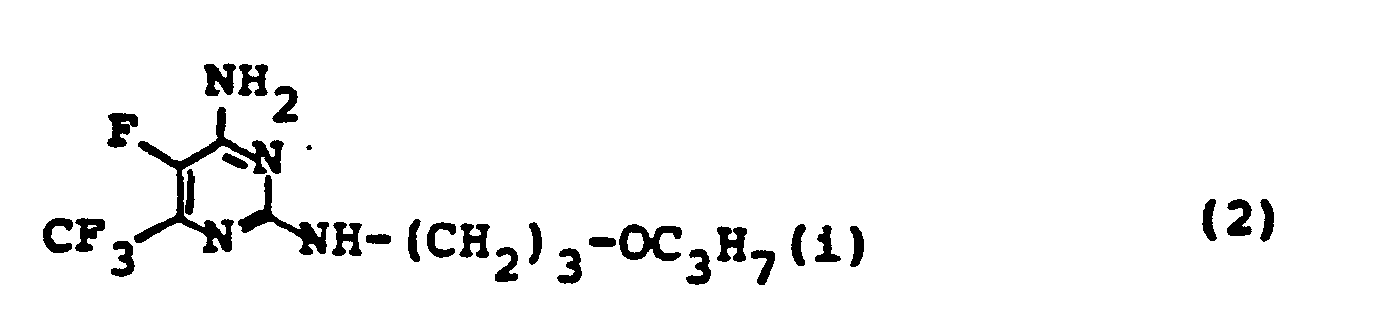
- 5 g (0,025 Mol) 4-Amino-2,5-difluor-6-trifluormethyl- pyrimidin werden in 150 ml Dioxan gelöst. Hierzu tropft man 2,9 g (0,025 Mol) 3-Isopropoxypropylamin und 2,5 g (0,025 Mol) Triethylamin und erhitzt fünf Stunden zum Sieden. Das Reaktionsgemisch wird abgekühlt, in Eiswasser gerührt und der resultierende Feststoff wird abgesaugt, getrocknet und aus Waschbenzin umkrisallisiert. Man erhält 4 g (54 % der Theorie) des gewünschten Pyrimidins, Fp. 87°C.
-

- 1850 g (9,31 Mol) 4-Amino-2,5,6-trichlorpyrimidin werden in 4 Liter Tetrahydrofuran gelöst. Hierzu tropft man 1659 g (18,62 Mol) 3-Methoxypropylamin über einen Zeitraum von 6 Stunden. Nach fünfstündigem Erhitzen zum Sieden wird die abgekühlte Reaktionsmischung in 20 Liter Wasser eingerührt. Der resultierende Feststoff wird abgesaugt, getrocknet, mit 7 Liter Dichlormethan verrührt und wiederum abgesaugt. Nach zweimaligem Umkristallisieren des so gewonnenen Feststoffs aus Toluol erhält man 743 g (31,8 % der Theorie) des gewünschten Pyrimidins, Fp. 114°C.
-

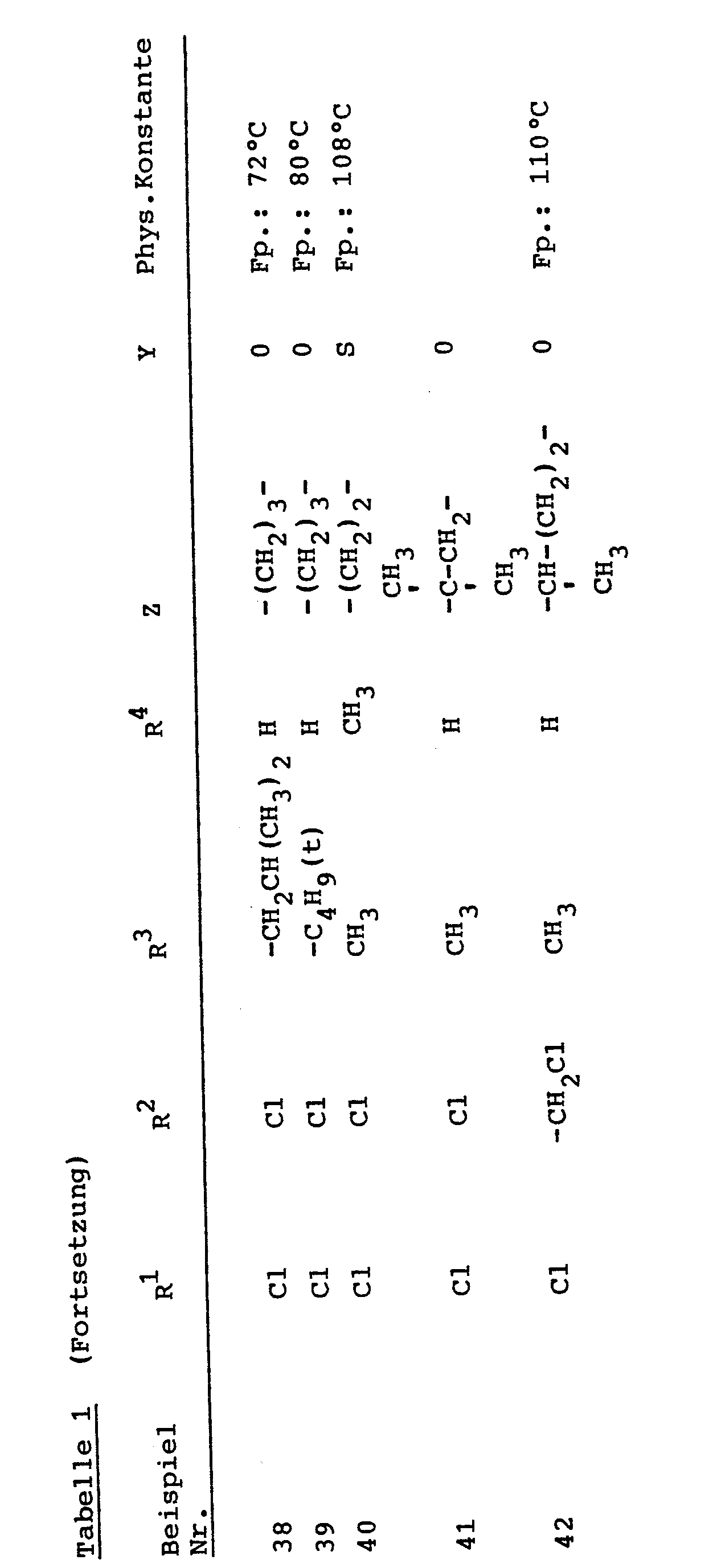
- Auf analogem Wege können die in der nachfolgenden Tabelle 1 genannten Pyrimidinderivate der allgemeinen Formel (I)

- hergestellt werden.


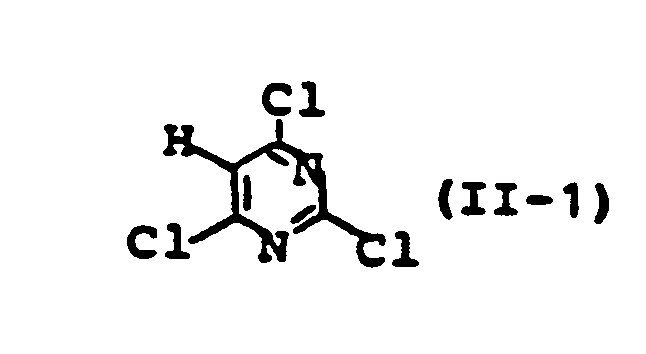
- Die als Ausgangsstoffe verwendeten Halogenpyrimidine der Formeln (II-1) bis (II-8) und deren Herstellung sind bekannt oder können in analoger Weise nach dort beschriebenen Verfahren erhalten werden:
- Gabriel; Ber. 33, 3666 (1900).

- R. Behrend; Justus Liebigs Ann. Chem. 229, 1 (1885).

- S. C. Childress et al.; J. Am. Chem. Soc. 72, 4271 (1950).
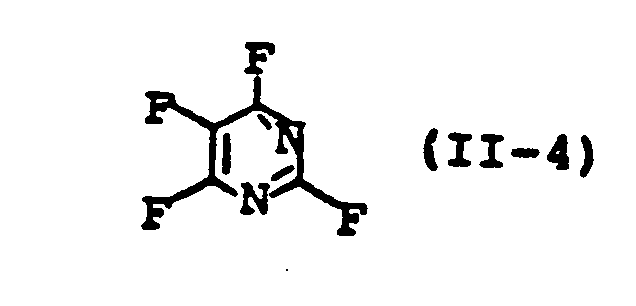
- E. Klauke et al.; J. Fluorine Chem. 21, 495 (1982).

- H. Schröder et al .; J. org. Chem. 27, 2580 (1962).

- E. Klauke et al.; J. Fluorine Chem.

- DE-OS 3 131 735
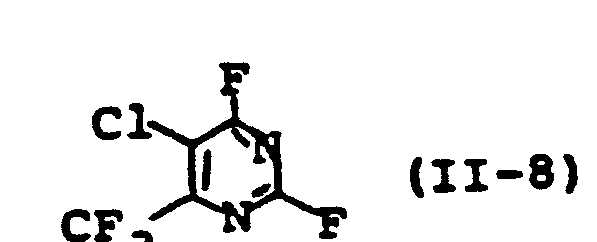
- E. Klauke et al.; J. Fluorine Chem. 21, 495 (1982).
- Die als Ausgangsstoffe verwendeten Aminopyrimidine der Formeln (VI-1) bis (VI-5) und deren Herstellung sind bekannt oder können in analoger Weise nach dort beschriebenen Verfahren erhalten werden:

- H. Bretschneider et al.; Monatsh. Chem. 92, 128 (1961).

- S. C. Childress et al.; J. Am. Chem. Soc. 72, 4271 (1950).

- H. Schroeder et al.; J. Org. Chem. 27, 2580 (1962).
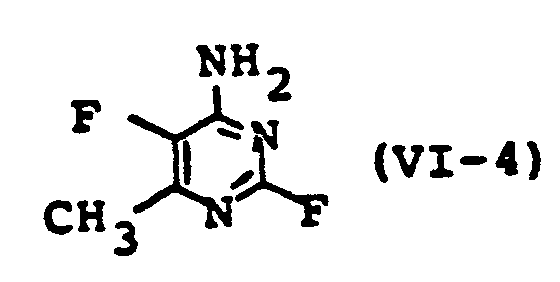
- E. Klauke et al.; J. Fluorine Chem. 21, 495 (1982).

- E. Klauke et al.; J. Fluorine Chem. 21, 495 (1982).
- In den folgenden Anwendungsbeispielen wurde die nachstehend aufgeführte Verbindung als Vergleichssubstanz herangezogen:
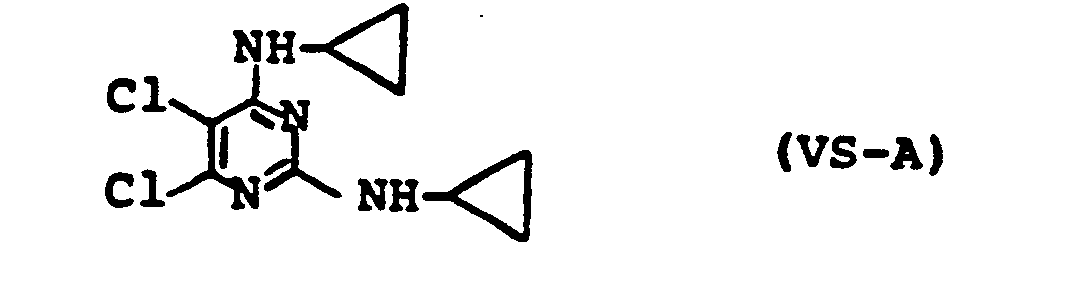
- Zur Herstellung einer zweckmäßigen Wirkstoffzubereitung vermischt man 1 Gewichtsteil Wirkstoff mit der angegebenen Menge Lösungsmittel, gibt die angegebene Menge Emulgator zu und verdünnt das Konzentrat mit Wasser auf die gewünschte Konzentration.
- Mit der Wirkstoffzubereitung spritzt man Testpflanzen, welche eine Höhe von 5 - 15 cm haben so, daß die jeweils gewünschten Wirkstoffmengen pro Flächeneinheit ausgebracht werden. Die Konzentration der Spritzbrühe wird so gewählt, daß in 2000 1 Wasser/ha die jeweils gewünschten Wirkstoffmengen ausgebracht werden. Nach drei Wochen wird der Schädigungsgrad der Pflanzen bonitiert in % Schädigung im Vergleich zur Entwicklung der unbehandelten Kontrolle.
- Es bedeuten:
- O % = keine Wirkung (wie unbehandelte Kontrolle)
- 100 % = totale Vernichtung
- Eine deutliche überlegenheit in der Wirksamkeit gegenüber dem Stand der Technik zeigen bei diesem Test z.B. die Verbindungen gemäß folgender Herstellungsbeispiele: (3), (4).
Claims (8)

in welcher

gemäß Anspruch 1.

gemäß Anspruch 1.

in welcher

in Gegenwart eines säurebindenden Mittels und gegebenenfalls in Gegenwart eines Verdünnungsmittels zu einem Gemisch der isomeren Pyrimidinderivate der allgemeinen Formel (IVa) und (IVb)

worin

in Gegenwart eines säurebindenden Mittels und. gegebenenfalls in Gegenwart eines Verdünnungsmittels zu Pyrimidinderivaten der Formel (I) umsetzt (2. Stufe),
oder

mit einem Amin der Formel (III) - wiederum unter den gleichen Reaktionsbedingungen wie bei Verfahren (A) - zum Pyrimidinderivat der Formel (I)

worin
umsetzt und für den Fall, wenn R2 für Halogen steht, aus dem erhaltenen Gemisch der isomeren Pyrimidinderivate der allgemeinen Formel
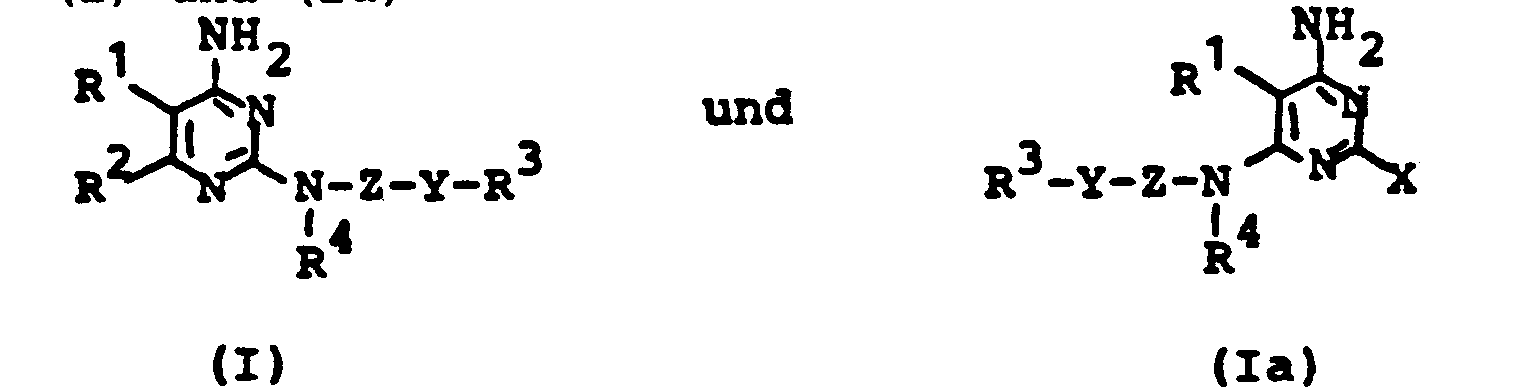
worin R1, R 2, R3,R4, X, Y und Z die oben angegebene Bedeutung haben, das gewünschte Pyrimidinderivat der allgemeinen Formel (I) abtrennt.
Applications Claiming Priority (2)
| Application Number | Priority Date | Filing Date | Title |
|---|---|---|---|
| DE19843445293 DE3445293A1 (de) | 1984-12-12 | 1984-12-12 | Neue 2,4-diaminopyrimidine |
| DE3445293 | 1984-12-12 |
Publications (2)
| Publication Number | Publication Date |
|---|---|
| EP0184752A2 true EP0184752A2 (de) | 1986-06-18 |
| EP0184752A3 EP0184752A3 (de) | 1987-05-06 |
Family
ID=6252574
Family Applications (1)
| Application Number | Title | Priority Date | Filing Date |
|---|---|---|---|
| EP85115278A Withdrawn EP0184752A3 (de) | 1984-12-12 | 1985-12-02 | Neue 2,4-Diaminopyrimidine |
Country Status (9)
| Country | Link |
|---|---|
| US (1) | US4627872A (de) |
| EP (1) | EP0184752A3 (de) |
| AU (1) | AU576279B2 (de) |
| BR (1) | BR8506192A (de) |
| CA (1) | CA1248952A (de) |
| DE (1) | DE3445293A1 (de) |
| DK (1) | DK573385A (de) |
| HU (1) | HUT39962A (de) |
| ZA (1) | ZA859516B (de) |
Cited By (4)
| Publication number | Priority date | Publication date | Assignee | Title |
|---|---|---|---|---|
| EP0254183A3 (de) * | 1986-07-25 | 1988-03-23 | Bayer Ag | Neue 2,4-Diaminopyrimidine |
| US8217064B2 (en) | 2007-12-20 | 2012-07-10 | Envivo Pharmaceuticals, Inc. | Tetrasubstituted benzenes |
| US9771378B2 (en) | 2014-01-15 | 2017-09-26 | Denali Therapeutics, Inc. | Fused morpholinopyrimidines and methods of use thereof |
| US9802927B2 (en) | 2015-06-10 | 2017-10-31 | Denali Therapeutics, Inc. | Oxadiazine compounds and methods of use thereof |
Families Citing this family (7)
| Publication number | Priority date | Publication date | Assignee | Title |
|---|---|---|---|---|
| DE3601800A1 (de) * | 1986-01-22 | 1987-07-23 | Bayer Ag | Neue 2,4-diamino-6-halogenalkylpyrimidine |
| US4895849A (en) * | 1986-10-08 | 1990-01-23 | Ube Industries, Ltd. | Aralkylaminopyrimidine compounds which are useful as for producing thereof and insecticides |
| GB8713695D0 (en) * | 1987-06-11 | 1987-07-15 | Beecham Group Plc | Process |
| US5176735A (en) * | 1990-06-28 | 1993-01-05 | Uniroyal Chemical Company, Inc. | Method of desiccating plants employing 3-carbonylphenyl uracil derivatives |
| US5696259A (en) * | 1994-05-11 | 1997-12-09 | Fmc Corporation | 2,4-diamino-5-iodopyrimidines useful as pesticide intermediates |
| EP1013647B1 (de) * | 1998-12-21 | 2002-11-27 | Lonza AG | Verfahren zur Herstellung von N-(Amino-4,6-dihalogenpyrimidin)-formamiden |
| US20090297714A1 (en) * | 2008-06-02 | 2009-12-03 | Xerox Corporation | Flush pigment for solid inkjet ink |
Family Cites Families (4)
| Publication number | Priority date | Publication date | Assignee | Title |
|---|---|---|---|---|
| US3892554A (en) * | 1969-02-14 | 1975-07-01 | Sandoz Ltd | 2-Amino-4-isopropylamino-6-chloro-pyrimidine in maize, wheat, potatoes, onions and leeks |
| CH617833A5 (de) * | 1975-07-07 | 1980-06-30 | Ciba Geigy Ag | |
| IT1211096B (it) * | 1981-08-20 | 1989-09-29 | Lpb Ist Farm | Pirimidine e s.triazinici adattivita' ipolipidemizzante. |
| DE3417264A1 (de) * | 1984-05-10 | 1985-11-14 | Bayer Ag, 5090 Leverkusen | Neue 2,4-diamino-6-halogen-5-alkylthio-pyrimidine |
-
1984
- 1984-12-12 DE DE19843445293 patent/DE3445293A1/de not_active Withdrawn
-
1985
- 1985-12-02 EP EP85115278A patent/EP0184752A3/de not_active Withdrawn
- 1985-12-05 US US06/806,053 patent/US4627872A/en not_active Expired - Fee Related
- 1985-12-10 CA CA000497232A patent/CA1248952A/en not_active Expired
- 1985-12-10 AU AU51071/85A patent/AU576279B2/en not_active Ceased
- 1985-12-11 HU HU854739A patent/HUT39962A/hu unknown
- 1985-12-11 BR BR8506192A patent/BR8506192A/pt unknown
- 1985-12-11 DK DK573385A patent/DK573385A/da not_active Application Discontinuation
- 1985-12-12 ZA ZA859516A patent/ZA859516B/xx unknown
Cited By (6)
| Publication number | Priority date | Publication date | Assignee | Title |
|---|---|---|---|---|
| EP0254183A3 (de) * | 1986-07-25 | 1988-03-23 | Bayer Ag | Neue 2,4-Diaminopyrimidine |
| US8217064B2 (en) | 2007-12-20 | 2012-07-10 | Envivo Pharmaceuticals, Inc. | Tetrasubstituted benzenes |
| US8367863B2 (en) | 2007-12-20 | 2013-02-05 | Envivo Pharmaceuticals, Inc. | Tetrasubstituted benzenes |
| US8664249B2 (en) | 2007-12-20 | 2014-03-04 | Envivo Pharmaceuticals, Inc. | Tetrasubstituted benzenes |
| US9771378B2 (en) | 2014-01-15 | 2017-09-26 | Denali Therapeutics, Inc. | Fused morpholinopyrimidines and methods of use thereof |
| US9802927B2 (en) | 2015-06-10 | 2017-10-31 | Denali Therapeutics, Inc. | Oxadiazine compounds and methods of use thereof |
Also Published As
| Publication number | Publication date |
|---|---|
| CA1248952A (en) | 1989-01-17 |
| AU5107185A (en) | 1986-06-19 |
| ZA859516B (en) | 1986-08-27 |
| EP0184752A3 (de) | 1987-05-06 |
| US4627872A (en) | 1986-12-09 |
| AU576279B2 (en) | 1988-08-18 |
| DK573385D0 (da) | 1985-12-11 |
| DK573385A (da) | 1986-06-13 |
| HUT39962A (en) | 1986-11-28 |
| BR8506192A (pt) | 1986-08-26 |
| DE3445293A1 (de) | 1986-06-12 |
Similar Documents
| Publication | Publication Date | Title |
|---|---|---|
| DE3623302A1 (de) | Nicotinsaeurederivate | |
| EP0137358A2 (de) | 1,3-Diaryl-5-methylen-perhydropyrimidin-2-one | |
| EP0302312A2 (de) | Neue Aryloxy (bzw. thio)-aminopyrimidine | |
| DE3445293A1 (de) | Neue 2,4-diaminopyrimidine | |
| EP0173958A2 (de) | 1-(2-Oxyaminocarbonylphenylsulfonyl)-3-heteroaryl-harnstoffe | |
| EP0073974A2 (de) | Fluorhaltige 4,6-Diamino-s-triazine, Verfahren und neue Zwischenprodukte zu ihrer Herstellung und ihre Verwendung als Herbizide | |
| EP0138002A2 (de) | Herbizide Mittel enthaltend Photosynthesehemmer-Herbizide in Kombination mit Pyridincarbonsäureamiden | |
| EP0049416B1 (de) | Substituierte 6-Halogen-tert.-butyl-1,2,4-triazin-5-one, Verfahren zu ihrer Herstellung sowie ihre Verwendung als Herbizide | |
| EP0173320A1 (de) | Substituierte Carbonylphenylsulfonylguanidine | |
| EP0173322B1 (de) | (1-(2-Oxyaminosulfonylphenylsulfonyl)-3-heteroaryl-harnstoffe | |
| EP0173957A1 (de) | Sulfonyliso(thio)harnstoff- Derivate | |
| EP0173319A1 (de) | Substituierte Arylsulfonylguanidine | |
| EP0173318A1 (de) | Fluoralkoxyphenylsulfonylguanidine | |
| EP0015452A1 (de) | 6-Substituierte 3-Dimethylamino-4-methyl-1,2,4-triazin-5-(4H)-one, Verfahren zu ihrer Herstellung und ihre Verwendung als Herbizide | |
| DE3417264A1 (de) | Neue 2,4-diamino-6-halogen-5-alkylthio-pyrimidine | |
| EP0254183A2 (de) | Neue 2,4-Diaminopyrimidine | |
| DE3808739A1 (de) | Pyrimidin-derivate | |
| EP0230244A2 (de) | Neue 2,4-Diamino-6-halogenalkylpyrimidine | |
| EP0217038B1 (de) | Benzo-[b]-1,4,5,7-dithiadiazepin-1,1,4,4-tetraoxydderivate | |
| EP0126358A2 (de) | Optisch aktive Propionsäure-ester-Derivate | |
| EP0173316A2 (de) | 1-(2-Oxyaminosulfonylphenylsulfonyl)-3-heteroaryl-iso-(thio)-harnstoffe | |
| EP0173323A1 (de) | Amidinoazole | |
| EP0173313A2 (de) | Heteroarylthioharnstoffe | |
| EP0094538A2 (de) | Fluorhaltige 4,6-Diamino-s-triazine, Verfahren und neue Zwischenprodukte zu ihrer Herstellung und ihre Verwendung als Herbizide | |
| EP0173315A1 (de) | Oxyguanidin-Derivate |
Legal Events
| Date | Code | Title | Description |
|---|---|---|---|
| PUAI | Public reference made under article 153(3) epc to a published international application that has entered the european phase |
Free format text: ORIGINAL CODE: 0009012 |
|
| 17P | Request for examination filed |
Effective date: 19851202 |
|
| AK | Designated contracting states |
Kind code of ref document: A2 Designated state(s): AT BE CH DE FR GB IT LI NL SE |
|
| PUAL | Search report despatched |
Free format text: ORIGINAL CODE: 0009013 |
|
| AK | Designated contracting states |
Kind code of ref document: A3 Designated state(s): AT BE CH DE FR GB IT LI NL SE |
|
| 17Q | First examination report despatched |
Effective date: 19881018 |
|
| STAA | Information on the status of an ep patent application or granted ep patent |
Free format text: STATUS: THE APPLICATION HAS BEEN WITHDRAWN |
|
| 18W | Application withdrawn |
Withdrawal date: 19890824 |
|
| R18W | Application withdrawn (corrected) |
Effective date: 19890824 |
|
| RIN1 | Information on inventor provided before grant (corrected) |
Inventor name: KUEHLE, ENGELBERT, DR. Inventor name: SANTEL, HANS-JOACHIM, DR. Inventor name: SCHWAMBORN, MICHAEL, DR. Inventor name: SCHMIDT, ROBERT R., DR. Inventor name: EUE, LUDWIG, DR. |