EP0181529B1 - Optisch aktives 2-(4-Chlorphenoxymethyl)-3,3-dimethyl-1-(1,2,4-triazol-1-yl)-2-butanol, ein Verfahren zu dessen Herstellung und dessen Verwendung als Antimykotikum - Google Patents
Optisch aktives 2-(4-Chlorphenoxymethyl)-3,3-dimethyl-1-(1,2,4-triazol-1-yl)-2-butanol, ein Verfahren zu dessen Herstellung und dessen Verwendung als Antimykotikum Download PDFInfo
- Publication number
- EP0181529B1 EP0181529B1 EP85113314A EP85113314A EP0181529B1 EP 0181529 B1 EP0181529 B1 EP 0181529B1 EP 85113314 A EP85113314 A EP 85113314A EP 85113314 A EP85113314 A EP 85113314A EP 0181529 B1 EP0181529 B1 EP 0181529B1
- Authority
- EP
- European Patent Office
- Prior art keywords
- dimethyl
- triazol
- butanol
- chlorophenoxymethyl
- optically active
- Prior art date
- Legal status (The legal status is an assumption and is not a legal conclusion. Google has not performed a legal analysis and makes no representation as to the accuracy of the status listed.)
- Expired - Lifetime
Links
- 238000000034 method Methods 0.000 title claims description 24
- 238000002360 preparation method Methods 0.000 title claims description 5
- 239000003429 antifungal agent Substances 0.000 title claims 2
- BTANRVKWQNVYAZ-UHFFFAOYSA-N 2-butanol Substances CCC(C)O BTANRVKWQNVYAZ-UHFFFAOYSA-N 0.000 title 1
- 239000000203 mixture Substances 0.000 claims description 16
- 239000002253 acid Substances 0.000 claims description 10
- 239000003085 diluting agent Substances 0.000 claims description 10
- 238000006243 chemical reaction Methods 0.000 claims description 9
- 150000007513 acids Chemical class 0.000 claims description 8
- OCQPZTCGZAFWSG-UHFFFAOYSA-N 1-(4-chlorophenoxy)-3,3-dimethyl-2-(1,2,4-triazol-1-ylmethyl)butan-2-ol Chemical compound C1=NC=NN1CC(O)(C(C)(C)C)COC1=CC=C(Cl)C=C1 OCQPZTCGZAFWSG-UHFFFAOYSA-N 0.000 claims description 7
- 150000002148 esters Chemical class 0.000 claims description 7
- ZDZOJEUYRFMJHH-UHFFFAOYSA-N 2-tert-butyl-2-[(4-chlorophenoxy)methyl]oxirane Chemical compound C=1C=C(Cl)C=CC=1OCC1(C(C)(C)C)CO1 ZDZOJEUYRFMJHH-UHFFFAOYSA-N 0.000 claims description 5
- NSPMIYGKQJPBQR-UHFFFAOYSA-N 4H-1,2,4-triazole Chemical compound C=1N=CNN=1 NSPMIYGKQJPBQR-UHFFFAOYSA-N 0.000 claims description 4
- MFEDKMBNKNOUPA-UHFFFAOYSA-N (2-bromo-4,7-dimethyl-3-oxo-7-bicyclo[2.2.1]heptanyl)methanesulfonic acid Chemical compound C1CC2(C)C(=O)C(Br)C1C2(CS(O)(=O)=O)C MFEDKMBNKNOUPA-UHFFFAOYSA-N 0.000 claims description 2
- XUJHKPSBHDQIOD-UHFFFAOYSA-N (2-bromo-7,7-dimethyl-3-oxo-4-bicyclo[2.2.1]heptanyl)methanesulfonic acid Chemical compound C1CC2(CS(O)(=O)=O)C(=O)C(Br)C1C2(C)C XUJHKPSBHDQIOD-UHFFFAOYSA-N 0.000 claims description 2
- 150000003852 triazoles Chemical class 0.000 claims description 2
- JEHUZVBIUCAMRZ-UHFFFAOYSA-N 1,1'-binaphthyl-2,2'-diyl hydrogenphosphate Chemical compound O1P(O)(=O)OC2=CC=C(C=CC=C3)C3=C2C2=C1C=CC1=CC=CC=C21 JEHUZVBIUCAMRZ-UHFFFAOYSA-N 0.000 claims 1
- MIOPJNTWMNEORI-UHFFFAOYSA-N camphorsulfonic acid Chemical compound C1CC2(CS(O)(=O)=O)C(=O)CC1C2(C)C MIOPJNTWMNEORI-UHFFFAOYSA-N 0.000 claims 1
- 239000004480 active ingredient Substances 0.000 description 22
- HEDRZPFGACZZDS-UHFFFAOYSA-N Chloroform Chemical compound ClC(Cl)Cl HEDRZPFGACZZDS-UHFFFAOYSA-N 0.000 description 18
- WEVYAHXRMPXWCK-UHFFFAOYSA-N Acetonitrile Chemical compound CC#N WEVYAHXRMPXWCK-UHFFFAOYSA-N 0.000 description 15
- -1 β-hydroxyethyl-azolyl Chemical class 0.000 description 15
- WYURNTSHIVDZCO-UHFFFAOYSA-N Tetrahydrofuran Chemical compound C1CCOC1 WYURNTSHIVDZCO-UHFFFAOYSA-N 0.000 description 13
- YMWUJEATGCHHMB-UHFFFAOYSA-N Dichloromethane Chemical compound ClCCl YMWUJEATGCHHMB-UHFFFAOYSA-N 0.000 description 12
- LFQSCWFLJHTTHZ-UHFFFAOYSA-N Ethanol Chemical compound CCO LFQSCWFLJHTTHZ-UHFFFAOYSA-N 0.000 description 11
- 150000001875 compounds Chemical class 0.000 description 10
- YLQBMQCUIZJEEH-UHFFFAOYSA-N tetrahydrofuran Natural products C=1C=COC=1 YLQBMQCUIZJEEH-UHFFFAOYSA-N 0.000 description 10
- XEKOWRVHYACXOJ-UHFFFAOYSA-N Ethyl acetate Chemical compound CCOC(C)=O XEKOWRVHYACXOJ-UHFFFAOYSA-N 0.000 description 9
- PEDCQBHIVMGVHV-UHFFFAOYSA-N Glycerine Chemical compound OCC(O)CO PEDCQBHIVMGVHV-UHFFFAOYSA-N 0.000 description 8
- 239000000825 pharmaceutical preparation Substances 0.000 description 8
- 239000000126 substance Substances 0.000 description 8
- VYPSYNLAJGMNEJ-UHFFFAOYSA-N Silicium dioxide Chemical compound O=[Si]=O VYPSYNLAJGMNEJ-UHFFFAOYSA-N 0.000 description 7
- 239000000969 carrier Substances 0.000 description 7
- 235000014113 dietary fatty acids Nutrition 0.000 description 7
- 239000000194 fatty acid Substances 0.000 description 7
- 229930195729 fatty acid Natural products 0.000 description 7
- ZWEHNKRNPOVVGH-UHFFFAOYSA-N 2-Butanone Chemical compound CCC(C)=O ZWEHNKRNPOVVGH-UHFFFAOYSA-N 0.000 description 6
- CSCPPACGZOOCGX-UHFFFAOYSA-N Acetone Chemical compound CC(C)=O CSCPPACGZOOCGX-UHFFFAOYSA-N 0.000 description 6
- ZMXDDKWLCZADIW-UHFFFAOYSA-N N,N-Dimethylformamide Chemical compound CN(C)C=O ZMXDDKWLCZADIW-UHFFFAOYSA-N 0.000 description 6
- 235000019441 ethanol Nutrition 0.000 description 6
- BWHMMNNQKKPAPP-UHFFFAOYSA-L potassium carbonate Chemical compound [K+].[K+].[O-]C([O-])=O BWHMMNNQKKPAPP-UHFFFAOYSA-L 0.000 description 6
- XLYOFNOQVPJJNP-UHFFFAOYSA-N water Substances O XLYOFNOQVPJJNP-UHFFFAOYSA-N 0.000 description 6
- 230000000843 anti-fungal effect Effects 0.000 description 5
- 239000003814 drug Substances 0.000 description 5
- 239000003826 tablet Substances 0.000 description 5
- KORIJXKQGMTQTO-UHFFFAOYSA-N 1h-pyrrol-2-ylmethanol Chemical class OCC1=CC=CN1 KORIJXKQGMTQTO-UHFFFAOYSA-N 0.000 description 4
- KZMGYPLQYOPHEL-UHFFFAOYSA-N Boron trifluoride etherate Chemical compound FB(F)F.CCOCC KZMGYPLQYOPHEL-UHFFFAOYSA-N 0.000 description 4
- 0 C*C(C*1N=CN=C1)(COc(cc1)ccc1Cl)O Chemical compound C*C(C*1N=CN=C1)(COc(cc1)ccc1Cl)O 0.000 description 4
- 241000233866 Fungi Species 0.000 description 4
- FAPWRFPIFSIZLT-UHFFFAOYSA-M Sodium chloride Chemical compound [Na+].[Cl-] FAPWRFPIFSIZLT-UHFFFAOYSA-M 0.000 description 4
- 229930182558 Sterol Natural products 0.000 description 4
- 244000052616 bacterial pathogen Species 0.000 description 4
- 239000002585 base Substances 0.000 description 4
- 230000037396 body weight Effects 0.000 description 4
- 239000002775 capsule Substances 0.000 description 4
- 238000011534 incubation Methods 0.000 description 4
- 238000002844 melting Methods 0.000 description 4
- 230000008018 melting Effects 0.000 description 4
- 239000000546 pharmaceutical excipient Substances 0.000 description 4
- 239000006187 pill Substances 0.000 description 4
- 150000003432 sterols Chemical class 0.000 description 4
- 235000003702 sterols Nutrition 0.000 description 4
- MIOPJNTWMNEORI-GMSGAONNSA-N (S)-camphorsulfonic acid Chemical compound C1C[C@@]2(CS(O)(=O)=O)C(=O)C[C@@H]1C2(C)C MIOPJNTWMNEORI-GMSGAONNSA-N 0.000 description 3
- 241000222120 Candida <Saccharomycetales> Species 0.000 description 3
- KFZMGEQAYNKOFK-UHFFFAOYSA-N Isopropanol Chemical compound CC(C)O KFZMGEQAYNKOFK-UHFFFAOYSA-N 0.000 description 3
- GUBGYTABKSRVRQ-QKKXKWKRSA-N Lactose Natural products OC[C@H]1O[C@@H](O[C@H]2[C@H](O)[C@@H](O)C(O)O[C@@H]2CO)[C@H](O)[C@@H](O)[C@H]1O GUBGYTABKSRVRQ-QKKXKWKRSA-N 0.000 description 3
- OKKJLVBELUTLKV-UHFFFAOYSA-N Methanol Chemical compound OC OKKJLVBELUTLKV-UHFFFAOYSA-N 0.000 description 3
- DNIAPMSPPWPWGF-UHFFFAOYSA-N Propylene glycol Chemical compound CC(O)CO DNIAPMSPPWPWGF-UHFFFAOYSA-N 0.000 description 3
- HEMHJVSKTPXQMS-UHFFFAOYSA-M Sodium hydroxide Chemical compound [OH-].[Na+] HEMHJVSKTPXQMS-UHFFFAOYSA-M 0.000 description 3
- ZMANZCXQSJIPKH-UHFFFAOYSA-N Triethylamine Chemical compound CCN(CC)CC ZMANZCXQSJIPKH-UHFFFAOYSA-N 0.000 description 3
- 239000003513 alkali Substances 0.000 description 3
- 235000012216 bentonite Nutrition 0.000 description 3
- 230000015572 biosynthetic process Effects 0.000 description 3
- 239000008298 dragée Substances 0.000 description 3
- 239000000839 emulsion Substances 0.000 description 3
- 150000002118 epoxides Chemical class 0.000 description 3
- RTZKZFJDLAIYFH-UHFFFAOYSA-N ether Substances CCOCC RTZKZFJDLAIYFH-UHFFFAOYSA-N 0.000 description 3
- 238000002474 experimental method Methods 0.000 description 3
- 235000011187 glycerol Nutrition 0.000 description 3
- 239000008187 granular material Substances 0.000 description 3
- 230000005764 inhibitory process Effects 0.000 description 3
- 238000004519 manufacturing process Methods 0.000 description 3
- 230000003287 optical effect Effects 0.000 description 3
- 239000012074 organic phase Substances 0.000 description 3
- 230000000144 pharmacologic effect Effects 0.000 description 3
- 229920001223 polyethylene glycol Polymers 0.000 description 3
- 229910000027 potassium carbonate Inorganic materials 0.000 description 3
- 239000000843 powder Substances 0.000 description 3
- BDERNNFJNOPAEC-UHFFFAOYSA-N propan-1-ol Chemical compound CCCO BDERNNFJNOPAEC-UHFFFAOYSA-N 0.000 description 3
- 150000003839 salts Chemical class 0.000 description 3
- 239000000377 silicon dioxide Substances 0.000 description 3
- 239000007787 solid Substances 0.000 description 3
- 239000007921 spray Substances 0.000 description 3
- 239000000829 suppository Substances 0.000 description 3
- 239000000725 suspension Substances 0.000 description 3
- 238000003786 synthesis reaction Methods 0.000 description 3
- 239000000454 talc Substances 0.000 description 3
- 229910052623 talc Inorganic materials 0.000 description 3
- 235000012222 talc Nutrition 0.000 description 3
- PUPZLCDOIYMWBV-UHFFFAOYSA-N (+/-)-1,3-Butanediol Chemical compound CC(O)CCO PUPZLCDOIYMWBV-UHFFFAOYSA-N 0.000 description 2
- 125000003626 1,2,4-triazol-1-yl group Chemical group [*]N1N=C([H])N=C1[H] 0.000 description 2
- RYHBNJHYFVUHQT-UHFFFAOYSA-N 1,4-Dioxane Chemical compound C1COCCO1 RYHBNJHYFVUHQT-UHFFFAOYSA-N 0.000 description 2
- 229920001817 Agar Polymers 0.000 description 2
- 241000416162 Astragalus gummifer Species 0.000 description 2
- VTYYLEPIZMXCLO-UHFFFAOYSA-L Calcium carbonate Chemical compound [Ca+2].[O-]C([O-])=O VTYYLEPIZMXCLO-UHFFFAOYSA-L 0.000 description 2
- 241000222122 Candida albicans Species 0.000 description 2
- 208000007163 Dermatomycoses Diseases 0.000 description 2
- 241001480036 Epidermophyton floccosum Species 0.000 description 2
- IAYPIBMASNFSPL-UHFFFAOYSA-N Ethylene oxide Chemical compound C1CO1 IAYPIBMASNFSPL-UHFFFAOYSA-N 0.000 description 2
- DGAQECJNVWCQMB-PUAWFVPOSA-M Ilexoside XXIX Chemical compound C[C@@H]1CC[C@@]2(CC[C@@]3(C(=CC[C@H]4[C@]3(CC[C@@H]5[C@@]4(CC[C@@H](C5(C)C)OS(=O)(=O)[O-])C)C)[C@@H]2[C@]1(C)O)C)C(=O)O[C@H]6[C@@H]([C@H]([C@@H]([C@H](O6)CO)O)O)O.[Na+] DGAQECJNVWCQMB-PUAWFVPOSA-M 0.000 description 2
- CSNNHWWHGAXBCP-UHFFFAOYSA-L Magnesium sulfate Chemical compound [Mg+2].[O-][S+2]([O-])([O-])[O-] CSNNHWWHGAXBCP-UHFFFAOYSA-L 0.000 description 2
- 208000031888 Mycoses Diseases 0.000 description 2
- KAESVJOAVNADME-UHFFFAOYSA-N Pyrrole Chemical compound C=1C=CNC=1 KAESVJOAVNADME-UHFFFAOYSA-N 0.000 description 2
- UIIMBOGNXHQVGW-DEQYMQKBSA-M Sodium bicarbonate-14C Chemical compound [Na+].O[14C]([O-])=O UIIMBOGNXHQVGW-DEQYMQKBSA-M 0.000 description 2
- 229920002472 Starch Polymers 0.000 description 2
- 229920001615 Tragacanth Polymers 0.000 description 2
- 241001045770 Trichophyton mentagrophytes Species 0.000 description 2
- XLOMVQKBTHCTTD-UHFFFAOYSA-N Zinc monoxide Chemical compound [Zn]=O XLOMVQKBTHCTTD-UHFFFAOYSA-N 0.000 description 2
- AXOANQIAFIDYQE-UHFFFAOYSA-N [2-[(4-chlorophenoxy)methyl]-2-hydroxy-3,3-dimethylbutyl] (7,7-dimethyl-3-oxo-4-bicyclo[2.2.1]heptanyl)methanesulfonate Chemical compound C1CC(C2(C)C)CC(=O)C12CS(=O)(=O)OCC(O)(C(C)(C)C)COC1=CC=C(Cl)C=C1 AXOANQIAFIDYQE-UHFFFAOYSA-N 0.000 description 2
- 235000010419 agar Nutrition 0.000 description 2
- 229940121375 antifungal agent Drugs 0.000 description 2
- 150000007980 azole derivatives Chemical class 0.000 description 2
- 239000000440 bentonite Substances 0.000 description 2
- 229910000278 bentonite Inorganic materials 0.000 description 2
- SVPXDRXYRYOSEX-UHFFFAOYSA-N bentoquatam Chemical compound O.O=[Si]=O.O=[Al]O[Al]=O SVPXDRXYRYOSEX-UHFFFAOYSA-N 0.000 description 2
- SESFRYSPDFLNCH-UHFFFAOYSA-N benzyl benzoate Chemical compound C=1C=CC=CC=1C(=O)OCC1=CC=CC=C1 SESFRYSPDFLNCH-UHFFFAOYSA-N 0.000 description 2
- 230000002051 biphasic effect Effects 0.000 description 2
- 229940095731 candida albicans Drugs 0.000 description 2
- 239000006071 cream Substances 0.000 description 2
- 201000010099 disease Diseases 0.000 description 2
- 208000037265 diseases, disorders, signs and symptoms Diseases 0.000 description 2
- 230000000694 effects Effects 0.000 description 2
- 150000002170 ethers Chemical class 0.000 description 2
- 239000003925 fat Substances 0.000 description 2
- 235000019197 fats Nutrition 0.000 description 2
- 239000000945 filler Substances 0.000 description 2
- 239000000706 filtrate Substances 0.000 description 2
- 238000009472 formulation Methods 0.000 description 2
- 239000000499 gel Substances 0.000 description 2
- 239000011521 glass Substances 0.000 description 2
- BXWNKGSJHAJOGX-UHFFFAOYSA-N hexadecan-1-ol Chemical compound CCCCCCCCCCCCCCCCO BXWNKGSJHAJOGX-UHFFFAOYSA-N 0.000 description 2
- RAXXELZNTBOGNW-UHFFFAOYSA-N imidazole Natural products C1=CNC=N1 RAXXELZNTBOGNW-UHFFFAOYSA-N 0.000 description 2
- 238000011081 inoculation Methods 0.000 description 2
- 150000002576 ketones Chemical class 0.000 description 2
- JVTAAEKCZFNVCJ-UHFFFAOYSA-N lactic acid Chemical compound CC(O)C(O)=O JVTAAEKCZFNVCJ-UHFFFAOYSA-N 0.000 description 2
- 239000007788 liquid Substances 0.000 description 2
- HQKMJHAJHXVSDF-UHFFFAOYSA-L magnesium stearate Chemical compound [Mg+2].CCCCCCCCCCCCCCCCCC([O-])=O.CCCCCCCCCCCCCCCCCC([O-])=O HQKMJHAJHXVSDF-UHFFFAOYSA-L 0.000 description 2
- VLKZOEOYAKHREP-UHFFFAOYSA-N methyl pentane Natural products CCCCCC VLKZOEOYAKHREP-UHFFFAOYSA-N 0.000 description 2
- 150000002825 nitriles Chemical class 0.000 description 2
- 231100000252 nontoxic Toxicity 0.000 description 2
- 230000003000 nontoxic effect Effects 0.000 description 2
- 235000015097 nutrients Nutrition 0.000 description 2
- 239000003921 oil Substances 0.000 description 2
- 235000019198 oils Nutrition 0.000 description 2
- 239000002674 ointment Substances 0.000 description 2
- 239000003960 organic solvent Substances 0.000 description 2
- 238000007911 parenteral administration Methods 0.000 description 2
- 239000006072 paste Substances 0.000 description 2
- 239000011541 reaction mixture Substances 0.000 description 2
- 239000011780 sodium chloride Substances 0.000 description 2
- 239000000243 solution Substances 0.000 description 2
- 239000002904 solvent Substances 0.000 description 2
- 241000894007 species Species 0.000 description 2
- 235000019698 starch Nutrition 0.000 description 2
- 239000007858 starting material Substances 0.000 description 2
- 238000003756 stirring Methods 0.000 description 2
- 235000010487 tragacanth Nutrition 0.000 description 2
- 239000000196 tragacanth Substances 0.000 description 2
- 229940116362 tragacanth Drugs 0.000 description 2
- 238000005406 washing Methods 0.000 description 2
- 239000001993 wax Substances 0.000 description 2
- QBYIENPQHBMVBV-HFEGYEGKSA-N (2R)-2-hydroxy-2-phenylacetic acid Chemical compound O[C@@H](C(O)=O)c1ccccc1.O[C@@H](C(O)=O)c1ccccc1 QBYIENPQHBMVBV-HFEGYEGKSA-N 0.000 description 1
- JNYAEWCLZODPBN-JGWLITMVSA-N (2r,3r,4s)-2-[(1r)-1,2-dihydroxyethyl]oxolane-3,4-diol Chemical class OC[C@@H](O)[C@H]1OC[C@H](O)[C@H]1O JNYAEWCLZODPBN-JGWLITMVSA-N 0.000 description 1
- 229940058015 1,3-butylene glycol Drugs 0.000 description 1
- HBAQYPYDRFILMT-UHFFFAOYSA-N 8-[3-(1-cyclopropylpyrazol-4-yl)-1H-pyrazolo[4,3-d]pyrimidin-5-yl]-3-methyl-3,8-diazabicyclo[3.2.1]octan-2-one Chemical class C1(CC1)N1N=CC(=C1)C1=NNC2=C1N=C(N=C2)N1C2C(N(CC1CC2)C)=O HBAQYPYDRFILMT-UHFFFAOYSA-N 0.000 description 1
- QTBSBXVTEAMEQO-UHFFFAOYSA-N Acetic acid Chemical compound CC(O)=O QTBSBXVTEAMEQO-UHFFFAOYSA-N 0.000 description 1
- GUBGYTABKSRVRQ-XLOQQCSPSA-N Alpha-Lactose Chemical compound O[C@@H]1[C@@H](O)[C@@H](O)[C@@H](CO)O[C@H]1O[C@@H]1[C@@H](CO)O[C@H](O)[C@H](O)[C@H]1O GUBGYTABKSRVRQ-XLOQQCSPSA-N 0.000 description 1
- 239000005995 Aluminium silicate Substances 0.000 description 1
- 241001480043 Arthrodermataceae Species 0.000 description 1
- 241000228212 Aspergillus Species 0.000 description 1
- 241001225321 Aspergillus fumigatus Species 0.000 description 1
- 241000228245 Aspergillus niger Species 0.000 description 1
- 239000004604 Blowing Agent Substances 0.000 description 1
- OYPRJOBELJOOCE-UHFFFAOYSA-N Calcium Chemical compound [Ca] OYPRJOBELJOOCE-UHFFFAOYSA-N 0.000 description 1
- 229920002134 Carboxymethyl cellulose Polymers 0.000 description 1
- 229920000742 Cotton Polymers 0.000 description 1
- XDTMQSROBMDMFD-UHFFFAOYSA-N Cyclohexane Chemical compound C1CCCCC1 XDTMQSROBMDMFD-UHFFFAOYSA-N 0.000 description 1
- FBPFZTCFMRRESA-FSIIMWSLSA-N D-Glucitol Natural products OC[C@H](O)[C@H](O)[C@@H](O)[C@H](O)CO FBPFZTCFMRRESA-FSIIMWSLSA-N 0.000 description 1
- FBPFZTCFMRRESA-KVTDHHQDSA-N D-Mannitol Chemical compound OC[C@@H](O)[C@@H](O)[C@H](O)[C@H](O)CO FBPFZTCFMRRESA-KVTDHHQDSA-N 0.000 description 1
- FBPFZTCFMRRESA-JGWLITMVSA-N D-glucitol Chemical compound OC[C@H](O)[C@@H](O)[C@H](O)[C@H](O)CO FBPFZTCFMRRESA-JGWLITMVSA-N 0.000 description 1
- FEWJPZIEWOKRBE-JCYAYHJZSA-N Dextrotartaric acid Chemical compound OC(=O)[C@H](O)[C@@H](O)C(O)=O FEWJPZIEWOKRBE-JCYAYHJZSA-N 0.000 description 1
- 241001480035 Epidermophyton Species 0.000 description 1
- 239000004593 Epoxy Substances 0.000 description 1
- 239000004606 Fillers/Extenders Substances 0.000 description 1
- 108010010803 Gelatin Proteins 0.000 description 1
- 241000206672 Gelidium Species 0.000 description 1
- WQZGKKKJIJFFOK-GASJEMHNSA-N Glucose Natural products OC[C@H]1OC(O)[C@H](O)[C@@H](O)[C@@H]1O WQZGKKKJIJFFOK-GASJEMHNSA-N 0.000 description 1
- 241000282412 Homo Species 0.000 description 1
- UFHFLCQGNIYNRP-UHFFFAOYSA-N Hydrogen Chemical compound [H][H] UFHFLCQGNIYNRP-UHFFFAOYSA-N 0.000 description 1
- 229930195725 Mannitol Natural products 0.000 description 1
- 241001465754 Metazoa Species 0.000 description 1
- 229920000168 Microcrystalline cellulose Polymers 0.000 description 1
- 235000019483 Peanut oil Nutrition 0.000 description 1
- 229920003171 Poly (ethylene oxide) Polymers 0.000 description 1
- 239000004952 Polyamide Substances 0.000 description 1
- IWYDHOAUDWTVEP-UHFFFAOYSA-N R-2-phenyl-2-hydroxyacetic acid Natural products OC(=O)C(O)C1=CC=CC=C1 IWYDHOAUDWTVEP-UHFFFAOYSA-N 0.000 description 1
- KEAYESYHFKHZAL-UHFFFAOYSA-N Sodium Chemical compound [Na] KEAYESYHFKHZAL-UHFFFAOYSA-N 0.000 description 1
- CZMRCDWAGMRECN-UGDNZRGBSA-N Sucrose Chemical compound O[C@H]1[C@H](O)[C@@H](CO)O[C@@]1(CO)O[C@@H]1[C@H](O)[C@@H](O)[C@H](O)[C@@H](CO)O1 CZMRCDWAGMRECN-UGDNZRGBSA-N 0.000 description 1
- 229930006000 Sucrose Natural products 0.000 description 1
- FEWJPZIEWOKRBE-UHFFFAOYSA-N Tartaric acid Natural products [H+].[H+].[O-]C(=O)C(O)C(O)C([O-])=O FEWJPZIEWOKRBE-UHFFFAOYSA-N 0.000 description 1
- 244000299461 Theobroma cacao Species 0.000 description 1
- 235000009470 Theobroma cacao Nutrition 0.000 description 1
- 241000223238 Trichophyton Species 0.000 description 1
- 241000222126 [Candida] glabrata Species 0.000 description 1
- 239000002250 absorbent Substances 0.000 description 1
- 230000002745 absorbent Effects 0.000 description 1
- 239000003655 absorption accelerator Substances 0.000 description 1
- 239000013543 active substance Substances 0.000 description 1
- 239000000654 additive Substances 0.000 description 1
- 239000008272 agar Substances 0.000 description 1
- 150000001298 alcohols Chemical class 0.000 description 1
- 235000010443 alginic acid Nutrition 0.000 description 1
- 229920000615 alginic acid Polymers 0.000 description 1
- 229910001854 alkali hydroxide Inorganic materials 0.000 description 1
- 150000008044 alkali metal hydroxides Chemical class 0.000 description 1
- 150000003973 alkyl amines Chemical group 0.000 description 1
- XAGFODPZIPBFFR-UHFFFAOYSA-N aluminium Chemical compound [Al] XAGFODPZIPBFFR-UHFFFAOYSA-N 0.000 description 1
- 229910052782 aluminium Inorganic materials 0.000 description 1
- WNROFYMDJYEPJX-UHFFFAOYSA-K aluminium hydroxide Chemical compound [OH-].[OH-].[OH-].[Al+3] WNROFYMDJYEPJX-UHFFFAOYSA-K 0.000 description 1
- 235000012211 aluminium silicate Nutrition 0.000 description 1
- 150000001408 amides Chemical class 0.000 description 1
- 230000000845 anti-microbial effect Effects 0.000 description 1
- 150000003974 aralkylamines Chemical class 0.000 description 1
- 229940091771 aspergillus fumigatus Drugs 0.000 description 1
- 125000003943 azolyl group Chemical group 0.000 description 1
- 229960002903 benzyl benzoate Drugs 0.000 description 1
- WQZGKKKJIJFFOK-VFUOTHLCSA-N beta-D-glucose Chemical compound OC[C@H]1O[C@@H](O)[C@H](O)[C@@H](O)[C@@H]1O WQZGKKKJIJFFOK-VFUOTHLCSA-N 0.000 description 1
- 239000011230 binding agent Substances 0.000 description 1
- 230000004071 biological effect Effects 0.000 description 1
- 239000008280 blood Substances 0.000 description 1
- 210000004369 blood Anatomy 0.000 description 1
- 235000019437 butane-1,3-diol Nutrition 0.000 description 1
- 229910052791 calcium Inorganic materials 0.000 description 1
- 229910000019 calcium carbonate Inorganic materials 0.000 description 1
- 235000010216 calcium carbonate Nutrition 0.000 description 1
- 239000000378 calcium silicate Substances 0.000 description 1
- 229910052918 calcium silicate Inorganic materials 0.000 description 1
- 235000013539 calcium stearate Nutrition 0.000 description 1
- 239000008116 calcium stearate Substances 0.000 description 1
- OYACROKNLOSFPA-UHFFFAOYSA-N calcium;dioxido(oxo)silane Chemical compound [Ca+2].[O-][Si]([O-])=O OYACROKNLOSFPA-UHFFFAOYSA-N 0.000 description 1
- 229910052799 carbon Inorganic materials 0.000 description 1
- 125000004432 carbon atom Chemical group C* 0.000 description 1
- 150000004649 carbonic acid derivatives Chemical class 0.000 description 1
- 239000001768 carboxy methyl cellulose Substances 0.000 description 1
- 235000010948 carboxy methyl cellulose Nutrition 0.000 description 1
- 239000008112 carboxymethyl-cellulose Substances 0.000 description 1
- 239000004359 castor oil Substances 0.000 description 1
- 235000019438 castor oil Nutrition 0.000 description 1
- 239000003054 catalyst Substances 0.000 description 1
- 239000001913 cellulose Substances 0.000 description 1
- 235000010980 cellulose Nutrition 0.000 description 1
- 229920002678 cellulose Polymers 0.000 description 1
- 229960000541 cetyl alcohol Drugs 0.000 description 1
- 239000007795 chemical reaction product Substances 0.000 description 1
- 239000003795 chemical substances by application Substances 0.000 description 1
- 238000013375 chromatographic separation Methods 0.000 description 1
- 238000000576 coating method Methods 0.000 description 1
- 239000003086 colorant Substances 0.000 description 1
- 239000012230 colorless oil Substances 0.000 description 1
- 238000004440 column chromatography Methods 0.000 description 1
- 235000005687 corn oil Nutrition 0.000 description 1
- 239000002285 corn oil Substances 0.000 description 1
- 235000012343 cottonseed oil Nutrition 0.000 description 1
- 239000002385 cottonseed oil Substances 0.000 description 1
- 239000012043 crude product Substances 0.000 description 1
- 230000037304 dermatophytes Effects 0.000 description 1
- 150000002009 diols Chemical class 0.000 description 1
- 239000007884 disintegrant Substances 0.000 description 1
- 229940079593 drug Drugs 0.000 description 1
- 239000003995 emulsifying agent Substances 0.000 description 1
- 125000003700 epoxy group Chemical group 0.000 description 1
- 229940093499 ethyl acetate Drugs 0.000 description 1
- 239000010642 eucalyptus oil Substances 0.000 description 1
- 229940044949 eucalyptus oil Drugs 0.000 description 1
- 238000000605 extraction Methods 0.000 description 1
- 235000003599 food sweetener Nutrition 0.000 description 1
- SZMNOLSLNRNAJC-UHFFFAOYSA-N formaldehyde;propane-1,2,3-triol Chemical compound O=C.OCC(O)CO SZMNOLSLNRNAJC-UHFFFAOYSA-N 0.000 description 1
- 238000001640 fractional crystallisation Methods 0.000 description 1
- 238000004817 gas chromatography Methods 0.000 description 1
- 210000001035 gastrointestinal tract Anatomy 0.000 description 1
- 229920000159 gelatin Polymers 0.000 description 1
- 239000008273 gelatin Substances 0.000 description 1
- 235000019322 gelatine Nutrition 0.000 description 1
- 235000011852 gelatine desserts Nutrition 0.000 description 1
- 239000008103 glucose Substances 0.000 description 1
- 235000001727 glucose Nutrition 0.000 description 1
- ZEMPKEQAKRGZGQ-XOQCFJPHSA-N glycerol triricinoleate Natural products CCCCCC[C@@H](O)CC=CCCCCCCCC(=O)OC[C@@H](COC(=O)CCCCCCCC=CC[C@@H](O)CCCCCC)OC(=O)CCCCCCCC=CC[C@H](O)CCCCCC ZEMPKEQAKRGZGQ-XOQCFJPHSA-N 0.000 description 1
- 150000008282 halocarbons Chemical class 0.000 description 1
- IPCSVZSSVZVIGE-UHFFFAOYSA-N hexadecanoic acid Chemical compound CCCCCCCCCCCCCCCC(O)=O IPCSVZSSVZVIGE-UHFFFAOYSA-N 0.000 description 1
- 238000004128 high performance liquid chromatography Methods 0.000 description 1
- 239000003906 humectant Substances 0.000 description 1
- 150000004678 hydrides Chemical class 0.000 description 1
- 239000001257 hydrogen Substances 0.000 description 1
- 229910052739 hydrogen Inorganic materials 0.000 description 1
- 150000002460 imidazoles Chemical class 0.000 description 1
- 150000007529 inorganic bases Chemical class 0.000 description 1
- 229940079865 intestinal antiinfectives imidazole derivative Drugs 0.000 description 1
- 238000002955 isolation Methods 0.000 description 1
- NLYAJNPCOHFWQQ-UHFFFAOYSA-N kaolin Chemical compound O.O.O=[Al]O[Si](=O)O[Si](=O)O[Al]=O NLYAJNPCOHFWQQ-UHFFFAOYSA-N 0.000 description 1
- 239000004310 lactic acid Substances 0.000 description 1
- 235000014655 lactic acid Nutrition 0.000 description 1
- 239000008101 lactose Substances 0.000 description 1
- 239000006210 lotion Substances 0.000 description 1
- 239000000314 lubricant Substances 0.000 description 1
- 235000019359 magnesium stearate Nutrition 0.000 description 1
- 229910052943 magnesium sulfate Inorganic materials 0.000 description 1
- 235000019341 magnesium sulphate Nutrition 0.000 description 1
- 229960002510 mandelic acid Drugs 0.000 description 1
- 239000000594 mannitol Substances 0.000 description 1
- 235000010355 mannitol Nutrition 0.000 description 1
- 239000001525 mentha piperita l. herb oil Substances 0.000 description 1
- 244000005700 microbiome Species 0.000 description 1
- 235000019813 microcrystalline cellulose Nutrition 0.000 description 1
- 239000008108 microcrystalline cellulose Substances 0.000 description 1
- 229940016286 microcrystalline cellulose Drugs 0.000 description 1
- 238000002156 mixing Methods 0.000 description 1
- CQDGTJPVBWZJAZ-UHFFFAOYSA-N monoethyl carbonate Chemical compound CCOC(O)=O CQDGTJPVBWZJAZ-UHFFFAOYSA-N 0.000 description 1
- 238000003541 multi-stage reaction Methods 0.000 description 1
- 239000004006 olive oil Substances 0.000 description 1
- 235000008390 olive oil Nutrition 0.000 description 1
- 150000007530 organic bases Chemical class 0.000 description 1
- 239000012188 paraffin wax Substances 0.000 description 1
- 239000002245 particle Substances 0.000 description 1
- 244000052769 pathogen Species 0.000 description 1
- 230000001717 pathogenic effect Effects 0.000 description 1
- 239000000312 peanut oil Substances 0.000 description 1
- 235000019477 peppermint oil Nutrition 0.000 description 1
- 239000003208 petroleum Substances 0.000 description 1
- WVDDGKGOMKODPV-ZQBYOMGUSA-N phenyl(114C)methanol Chemical compound O[14CH2]C1=CC=CC=C1 WVDDGKGOMKODPV-ZQBYOMGUSA-N 0.000 description 1
- 235000011007 phosphoric acid Nutrition 0.000 description 1
- 150000003016 phosphoric acids Chemical class 0.000 description 1
- 229920002647 polyamide Polymers 0.000 description 1
- 229920000647 polyepoxide Polymers 0.000 description 1
- 229920000642 polymer Polymers 0.000 description 1
- 229920001296 polysiloxane Polymers 0.000 description 1
- 239000001267 polyvinylpyrrolidone Substances 0.000 description 1
- 235000013855 polyvinylpyrrolidone Nutrition 0.000 description 1
- 229920000036 polyvinylpyrrolidone Polymers 0.000 description 1
- BDAWXSQJJCIFIK-UHFFFAOYSA-N potassium methoxide Chemical compound [K+].[O-]C BDAWXSQJJCIFIK-UHFFFAOYSA-N 0.000 description 1
- 239000003755 preservative agent Substances 0.000 description 1
- 229960004063 propylene glycol Drugs 0.000 description 1
- 238000004445 quantitative analysis Methods 0.000 description 1
- 150000003856 quaternary ammonium compounds Chemical class 0.000 description 1
- 238000010992 reflux Methods 0.000 description 1
- 238000007142 ring opening reaction Methods 0.000 description 1
- CVHZOJJKTDOEJC-UHFFFAOYSA-N saccharin Chemical compound C1=CC=C2C(=O)NS(=O)(=O)C2=C1 CVHZOJJKTDOEJC-UHFFFAOYSA-N 0.000 description 1
- 229940081974 saccharin Drugs 0.000 description 1
- 235000019204 saccharin Nutrition 0.000 description 1
- 239000000901 saccharin and its Na,K and Ca salt Substances 0.000 description 1
- 239000008159 sesame oil Substances 0.000 description 1
- 235000011803 sesame oil Nutrition 0.000 description 1
- 239000000741 silica gel Substances 0.000 description 1
- 229910002027 silica gel Inorganic materials 0.000 description 1
- 239000011734 sodium Substances 0.000 description 1
- 229910052708 sodium Inorganic materials 0.000 description 1
- CDBYLPFSWZWCQE-UHFFFAOYSA-L sodium carbonate Substances [Na+].[Na+].[O-]C([O-])=O CDBYLPFSWZWCQE-UHFFFAOYSA-L 0.000 description 1
- 229910000029 sodium carbonate Inorganic materials 0.000 description 1
- 239000012312 sodium hydride Substances 0.000 description 1
- 229910000104 sodium hydride Inorganic materials 0.000 description 1
- 239000000600 sorbitol Substances 0.000 description 1
- 239000008107 starch Substances 0.000 description 1
- 230000001954 sterilising effect Effects 0.000 description 1
- 238000004659 sterilization and disinfection Methods 0.000 description 1
- 125000001424 substituent group Chemical group 0.000 description 1
- 239000000758 substrate Substances 0.000 description 1
- 229960004793 sucrose Drugs 0.000 description 1
- BDHFUVZGWQCTTF-UHFFFAOYSA-M sulfonate Chemical compound [O-]S(=O)=O BDHFUVZGWQCTTF-UHFFFAOYSA-M 0.000 description 1
- 150000003460 sulfonic acids Chemical class 0.000 description 1
- 239000000375 suspending agent Substances 0.000 description 1
- 239000003765 sweetening agent Substances 0.000 description 1
- 230000009885 systemic effect Effects 0.000 description 1
- 239000011975 tartaric acid Substances 0.000 description 1
- 235000002906 tartaric acid Nutrition 0.000 description 1
- HLZKNKRTKFSKGZ-UHFFFAOYSA-N tetradecan-1-ol Chemical compound CCCCCCCCCCCCCCO HLZKNKRTKFSKGZ-UHFFFAOYSA-N 0.000 description 1
- 235000019871 vegetable fat Nutrition 0.000 description 1
- 239000000080 wetting agent Substances 0.000 description 1
- 239000011787 zinc oxide Substances 0.000 description 1
Classifications
-
- C—CHEMISTRY; METALLURGY
- C07—ORGANIC CHEMISTRY
- C07D—HETEROCYCLIC COMPOUNDS
- C07D231/00—Heterocyclic compounds containing 1,2-diazole or hydrogenated 1,2-diazole rings
- C07D231/02—Heterocyclic compounds containing 1,2-diazole or hydrogenated 1,2-diazole rings not condensed with other rings
- C07D231/10—Heterocyclic compounds containing 1,2-diazole or hydrogenated 1,2-diazole rings not condensed with other rings having two or three double bonds between ring members or between ring members and non-ring members
- C07D231/12—Heterocyclic compounds containing 1,2-diazole or hydrogenated 1,2-diazole rings not condensed with other rings having two or three double bonds between ring members or between ring members and non-ring members with only hydrogen atoms, hydrocarbon or substituted hydrocarbon radicals, directly attached to ring carbon atoms
-
- C—CHEMISTRY; METALLURGY
- C07—ORGANIC CHEMISTRY
- C07D—HETEROCYCLIC COMPOUNDS
- C07D233/00—Heterocyclic compounds containing 1,3-diazole or hydrogenated 1,3-diazole rings, not condensed with other rings
- C07D233/54—Heterocyclic compounds containing 1,3-diazole or hydrogenated 1,3-diazole rings, not condensed with other rings having two double bonds between ring members or between ring members and non-ring members
- C07D233/56—Heterocyclic compounds containing 1,3-diazole or hydrogenated 1,3-diazole rings, not condensed with other rings having two double bonds between ring members or between ring members and non-ring members with only hydrogen atoms or radicals containing only hydrogen and carbon atoms, attached to ring carbon atoms
-
- C—CHEMISTRY; METALLURGY
- C07—ORGANIC CHEMISTRY
- C07D—HETEROCYCLIC COMPOUNDS
- C07D249/00—Heterocyclic compounds containing five-membered rings having three nitrogen atoms as the only ring hetero atoms
- C07D249/02—Heterocyclic compounds containing five-membered rings having three nitrogen atoms as the only ring hetero atoms not condensed with other rings
- C07D249/08—1,2,4-Triazoles; Hydrogenated 1,2,4-triazoles
Definitions
- the present invention relates to a new optically active azolylcarbinol derivative, a process for its production from a known, racemic oxirane and its use as an antifungal.
- racemic azole derivatives can be cleaved in the classical way into the optical antipodes by reacting them in a first step with optically active acids, optionally in the presence of a diluent; then in a second stage the corresponding salts are separated on the basis of their different solubility, and then in a third stage the optical antipodes are freed from the corresponding salts with the aid of bases, if appropriate in the presence of a diluent (cf., for example, EP-A 0 004 918 and DE-A 3 302 122).
- this method is not applicable to all azole derivatives.
- racemic 2- (4-chlorophenoxymethyl) -3,3-dimethyl-1- (1,2,4-triazol-1-yl) -2-butanol has good antifungal properties (cf. EP -A 0 043 419).
- the pharmacological properties of this compound are different for the isolated enantiomers.
- the (-) - enantiomer of 2- (4-chlorophenoxymethyl) -3,3-dimethyl-1- (1,2,4-triazol-1-yl) -2-butanol of formula (I) shows very good general antifungal activity, in particular a higher sterol synthesis inhibition and thus better pharmacological properties than the known corresponding racemate.
- the substance according to the invention thus represents a valuable enrichment in pharmacy.
- optically active azolylcarbinol derivative of the formula (I) can be prepared in high yield by the process according to the invention. Based on the prior art, it was expected that without a catalyst, e.g. Boron trifluoride etherate, the desired ring opening does not occur.
- a catalyst e.g. Boron trifluoride etherate
- the process according to the invention has the advantage of obtaining the optical antipodes of the azolyl derivative of the formula (I) in high yield, in which the classic racemate resolution method does not lead to the goal.
- racemic 2- (4-chlorophenoxymethyl) -2-tert-butyl-oxirane of the formula to be used as a starting material is known (cf. e.g. EP-A 0 040 345).
- the racemic compound corresponding to the optically active azolylcarbinol derivative of the formula (I) is also known.
- the oxirane of the formula (II) is reacted in the 1st stage with optically active sulfonic acids.
- optically active sulfonic acids preferably include camphor-10-sulfonic acid, 3-bromo-10-camphorsulfonic acid and 3-bromo-8-camphorsulfonic acid.
- Optically active phosphoric acids such as 1,1'-binaphthyl-2,2'-diylphosphate of the formula, may be mentioned in particular
- Inert organic solvents are suitable as diluents when carrying out the first stage of the process according to the invention.
- These preferably include nitriles, such as acetonitrile; Ketones such as methyl ethyl ketone or acetone; Ethers such as tetrahydrofuran or dioxane; and halogenated hydrocarbons such as chloroform or methylene chloride.
- reaction temperatures can be varied within a substantial range when carrying out the first stage of the process according to the invention. In general, temperatures between 0 and 100 ° C, preferably between 10 and 60 ° C.
- the two diastereomeric compounds are separated in a conventional manner on the basis of different physicochemical properties, such as, for example, by fractional crystallization or chromatographic separation methods.
- Inert organic solvents are also suitable as diluents when carrying out the second stage of the process according to the invention.
- These preferably include nitriles, such as acetonitrile; Alcohols such as ethanol or propanol; Ketones such as methyl ethyl ketone or acetone; Esters, such as ethyl acetate; Ethers such as tetrahydrofuran or dioxane; and amides such as dimethylformamide.
- Suitable bases for carrying out the second stage of the process according to the invention are all inorganic and organic bases which can usually be used. These preferably include alkali carbonates, such as sodium and Potassium carbonate; Alkali hydroxides, such as sodium hydroxide; Alkali alcoholates such as sodium and potassium methylate and ethylate; Alkali hydrides such as sodium hydride; as well as lower tertiary alkylamines, cycloalkylamines and aralkylamines, such as in particular triethylamine.
- alkali carbonates such as sodium and Potassium carbonate
- Alkali hydroxides such as sodium hydroxide
- Alkali alcoholates such as sodium and potassium methylate and ethylate
- Alkali hydrides such as sodium hydride
- lower tertiary alkylamines, cycloalkylamines and aralkylamines such as in particular triethylamine.
- reaction temperatures can be varied within a substantial range when carrying out the second stage of the process according to the invention. In general, temperatures between 0 and 150 ° C, preferably between 40 and 120 ° C.
- optically active azolylcarbinol derivative which can be prepared by the process according to the invention shows outstanding biological effects, the individual antipode having a better activity than the corresponding racemate.
- the compound of formula (I) according to the invention has antimicrobial, in particular strong antifungal, effects. It has a very broad spectrum of antifungal effects, in particular against dermatophytes and sprout fungi as well as biphasic fungi, e.g. against Candida species, such as Candida albicans, Epidermophyton species, such as Epidermophyton floccosum, Aspergillus species, such as Aspergillus niger and Aspergillus fumigatus, Trichophton species, such as Trichophyton mentagrophytes, Microsporon species, such as Microsporon felineis, and Torulopsis, as well as Torulopsis glabrata.
- Candida species such as Candida albicans
- Epidermophyton species such as Epidermophyton floccosum
- Aspergillus species such as Aspergillus niger and Aspergillus fumigatus
- Trichophton species such as Trichophyton mentagrophytes
- Indications for use in human medicine include:
- Indications in veterinary medicine can include the following:
- the present invention includes pharmaceutical preparations which, in addition to non-toxic, inert pharmaceutically suitable excipients, contain the active ingredient according to the invention or which consist of the active ingredient according to the invention.
- the present invention also includes pharmaceutical preparations in dosage units.
- the preparations are in the form of individual parts, for example tablets, dragées, capsules, pills, suppositories and ampoules, the active ingredient content of which corresponds to a fraction or a multiple of a single dose.
- the dosage units can be, for example, 1, 2, 3 or 4 single doses or 1 ⁇ 2, 1 3rd or 1 ⁇ 4 of a single dose.
- a single dose preferably contains the amount of active ingredient which is administered in one application and which usually corresponds to a whole, a half or a third or a quarter of a daily dose.
- Non-toxic, inert, pharmaceutically suitable excipients are to be understood as solid, semi-solid or liquid diluents, fillers or formulation auxiliaries of all kinds.
- Tablets, dragees, capsules, pills, granules, suppositories, solutions, suspensions and emulsions, pastes, ointments, gels, creams, lotions, powders and sprays may be mentioned as preferred pharmaceutical preparations.
- Tablets, coated tablets, capsules, pills and granules can be the active ingredient in addition to the usual carriers, such as (a) fillers and extenders, for example starches, lactose, cane sugar, glucose, mannitol and silica, (b) binders, for example carboxymethyl cellulose, alginates, gelatin, polyvinylpyrrolidone, (c) humectants, for example glycerol, (d) disintegrants, e.g. agar-agar, calcium carbonate and sodium bicarbonate, (e) retarders, e.g. paraffin and (f) absorption accelerators, e.g. quaternary ammonium compounds, (g) wetting agents, e.g.
- fillers and extenders for example starches, lactose, cane sugar, glucose, mannitol and silica
- binders for example carboxymethyl cellulose, alginates, gelatin, polyvinylpyrrolidone
- cetyl alcohol glycerol monstearate
- absorbents e.g. kaolin and bentonite
- lubricants for example talc, calcium and magnesium stearate and solid polyethylene glycols or mixtures of the substances listed under (a) to (i).
- the tablets, dragees, capsules, pills and granules can be provided with the customary coatings and casings optionally containing opacifying agents and can be composed in such a way that they release the active ingredient only or preferably in a certain part of the intestinal tract, if necessary with a delay, Polymer substances and waxes can be used.
- the active ingredient can optionally also be in microencapsulated form with one or more or the above-mentioned carriers.
- suppositories can contain the usual water-soluble, water-insoluble carriers, e.g. Polyethylene glycols, fats, e.g. Cocoa fat and higher esters (e.g. C14 alcohol with C16 fatty acid) or mixtures of these substances.
- water-soluble, water-insoluble carriers e.g. Polyethylene glycols, fats, e.g. Cocoa fat and higher esters (e.g. C14 alcohol with C16 fatty acid) or mixtures of these substances.
- ointments, pastes, creams and gels can contain the usual carriers, e.g. animal and vegetable fats, waxes, paraffins, starch, tragacanth, cellulose derivatives, polyethylene glycols, silicones, bentonites, silica, talc and zinc oxide or mixtures of these substances.
- carriers e.g. animal and vegetable fats, waxes, paraffins, starch, tragacanth, cellulose derivatives, polyethylene glycols, silicones, bentonites, silica, talc and zinc oxide or mixtures of these substances.
- powders and sprays can contain the usual carriers, for example milk sugar, talc, silica, aluminum hydroxide, calcium silicate and polyamide powder or mixtures of these substances, sprays can also contain the usual Contain blowing agents such as chlorofluorocarbons.
- solutions and emulsions can contain the usual carriers such as solvents, solubilizers and emulsifiers, e.g. Water, ethyl alcohol, isopropyl alcohol, ethyl carbonate, ethyl acetate, benzyl alcohol, benzyl benzoate, propylene glycol, 1,3-butylene glycol, dimethylformamide, oils, especially cottonseed oil, peanut oil, corn oil, olive oil, castor oil and sesame oil, glycerin, glycerol formaldehyde, tetrahydrofuran fatty acid, tetrahydrofuran fatty acid, tetrahydrofuran fatty acid, tetrahydrofuran fatty acid, tetrahydrofuran fatty acid, tetrahydrofuran fatty acid, tetrahydrofuran fatty acid, tetrahydrofuran fatty acid, tetrahydrofuran fatty acid,
- solutions and emulsions can also be in sterile and blood isotonic form.
- suspensions can contain the usual carriers, such as liquid diluents, e.g. Water, ethyl alcohol, propyl alcohol, suspending agents e.g. ethoxylated isostearyl alcohols, polyoxyethylene sorbitol and sorbitan esters, microcrystalline cellulose, aluminum metahydroxide, bentonite, agar and tragacanth or mixtures of these substances.
- liquid diluents e.g. Water, ethyl alcohol, propyl alcohol, suspending agents e.g. ethoxylated isostearyl alcohols, polyoxyethylene sorbitol and sorbitan esters, microcrystalline cellulose, aluminum metahydroxide, bentonite, agar and tragacanth or mixtures of these substances.
- the formulation forms mentioned can also contain colorants, preservatives and additives which improve the smell and taste, e.g. Peppermint oil and eucalyptus oil and sweeteners, e.g. Contain saccharin.
- the therapeutically active compound should preferably be present in the pharmaceutical preparations listed above in a concentration of about 0.1 to 99.5, preferably 0.5 to 95,% by weight of the total mixture.
- the pharmaceutical preparations listed above can also contain other pharmaceutical active ingredients.
- the pharmaceutical preparations listed above are prepared in a customary manner by known methods, for example by mixing the active ingredient with the excipient or excipients.
- the present invention also includes the use of the active ingredient according to the invention for the production of pharmaceutical preparations which contain the active ingredient according to the invention, for human and veterinary medicine to prevent, improve and / or cure the diseases listed above.
- the active substance or the pharmaceutical preparations can be administered locally, orally, parenterally, intraperitoneally and / or rectally, preferably parenterally, in particular intravenously.
- the active compound according to the invention in total amounts of about 2.5 to about 200, preferably 5 to 150 mg / kg of body weight per 24 hours, optionally in the form of several individual doses to achieve the desired results.
- the active compound according to the invention is used in total amounts of about 2.5 to about 200, preferably 5 to 150, mg / kg of body weight per 24 hours and in the case of parenteral administration in total amounts of about 2.5 to about 50, preferably 1 to 25, mg / kg body weight administered per 24 hours.
- Kimmig-Medium has the following composition:
- the incubation of the Candida cultures lasted 48 hours. After the incubation, the overgrown culture flasks were emptied into centrifuge glasses and centrifuged at 5,000 rpm for 15 minutes. After washing the centrifugate with physiological NaCl solution and centrifuging again, the sedimented germs were taken up in a mixture of chloroform and methanol (2: 1) for further processing.
Landscapes
- Chemical & Material Sciences (AREA)
- Organic Chemistry (AREA)
- Pharmaceuticals Containing Other Organic And Inorganic Compounds (AREA)
- Plural Heterocyclic Compounds (AREA)
- Agricultural Chemicals And Associated Chemicals (AREA)
Description
- Die vorliegende Erfindung betrifft ein neues optisch aktives Azolylcarbinol-Derivat, ein Verfahren zu dessen Herstellung aus einem bekannten, racemischem Oxiran und dessen Verwendung als Antimykotikum.
- Es ist bereits bekannt geworden, daß man bestimmte racemische Azol-Derivate auf dem klassischen Weg in die optischen Antipoden spalten kann, indem man sie in einer ersten Stufe mit optisch aktiven Säuren, gegebenenfalls in Gegenwart eines Verdünnungsmittels, umsetzt; dann in einer zweiten Stufe die entsprechenden Salze aufgrund ihrer unterschiedlichen Löslichkeit trennt, und danach in einer dritten Stufe die optischen Antipoden aus den entsprechenden Salzen mit Hilfe von Basen, gegebenenfalls in Gegenwart eines Verdünnungsmittels, in Freiheit setzt (vgl. z.B. EP-A 0 004 918 und DE-A 3 302 122). Dieses Verfahren ist jedoch nicht auf alle Azol-Derivate anwendbar. Wie eigene Versuche zeigten, ist es nicht möglich, kristalline Salze von β-Hydroxyethyl-azolyl-Derivaten vom Typ der Verbindung der Formel (I) mit optisch aktiven Säuren herzustellen.
- Außerdem ist bekannt, daß Epoxide mit Säuren geöffnet werden können (vgl. Houben-Weyl, Methoden der organischen Chemie, Band VI/3, S. 448 ff (1965)). Auch dieses Verfahren ist jedoch nicht auf alle Epoxide übertragbar. Wie eigene Versuche zeigten, ist es nicht möglich, mit optisch aktiven Säuren, wie beispielsweise Mandelsäure oder Weinsäure, Epoxide vom Typ der Verbindung der Formel (II) zu öffnen. Die gewünschte Reaktion konnte erst durch Zusatz von Bortrifluoridetherat zur Reaktionslösung erreicht werden.
- Ferner ist aus der EP-A 0 098 942 bekannt, daß optisch aktive 3-Alkylthio-2-dichlorphenyl-1-imidazol-1-yl-2-propanole der Formel

- Es ist auch bereits bekannt geworden, daß racemisches 2-(4-Chlorphenoxymethyl)-3,3-dimethyl-1-(1,2,4-triazol-1-yl)-2-butanol gute antimykotische Eigenschaften aufweist (vgl. EP-A 0 043 419). Die pharmakologischen Eigenschaften dieser Verbindung sind jedoch für die isolierten Enantiomeren unterschiedlich.
- Schließlich sind aus der US-A 4 036 970 bestimmte Imidazol-Derivate bekannt, die zur Bekämpfung von humanpathogenen Pilzen eingesetzt werden können. Es werden jedoch keine Verbindungen beschrieben, in denen das Kohlenstoffatom in 2-Stellung zum Imidazol-Rest nur Substituenten trägt, die von Wasserstoff verschieden sind. Außerdem wird keine optisch aktive Verbindung speziell offenbart.
- Es wurde nun das (-)-Enantiomere von 2-(4-Chlorphenoxymethyl)-3,3-dimethyl-1-(1,2,4-triazol-1-yl)-2-butanol der Formel
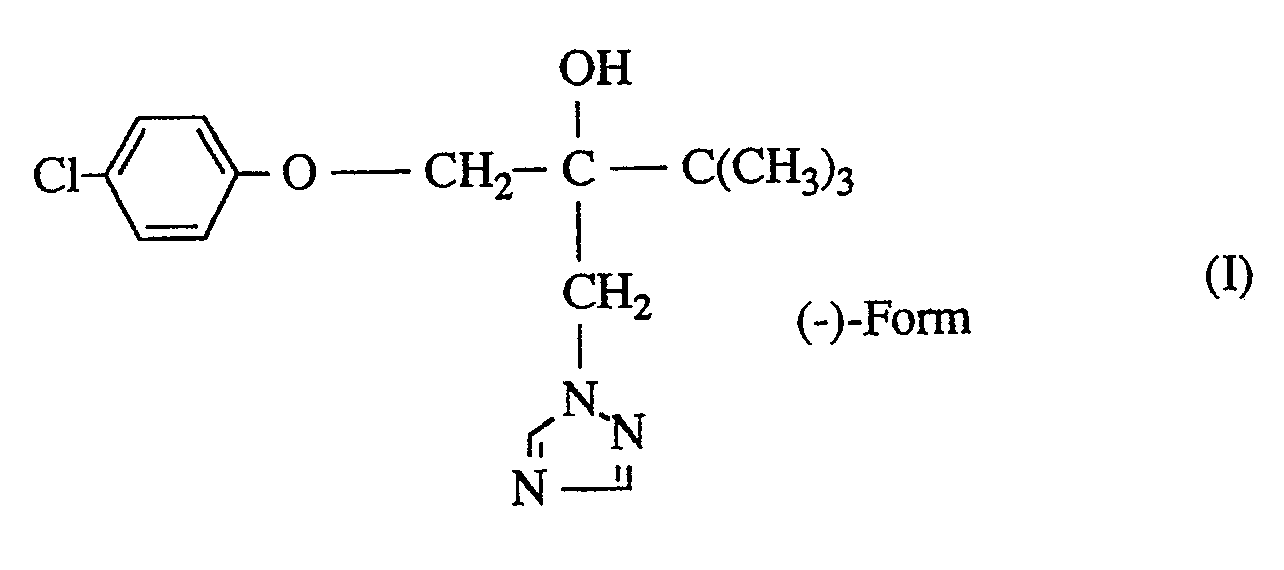
- Weiterhin wurde gefunden, daß man das (-)-Enantiomere von 2-(4-Chlorphenoxymethyl)-3,3-dimethyl-1-(1,2,4-triazol-1-yl)-2-butanol erhält, wenn man in einer 1. Stufe racemisches 2-(4-Chlorphenoxymethyl)-2-tert.-butyl-oxiran der Formel

- Überraschenderweise zeigt das (-)-Enantiomere von 2-(4-Chlorphenoxymethyl)-3,3-dimethyl-1-(1,2,4-triazol-1-yl)-2-butanol der Formel (I) bei sehr guter allgemeiner antimykotischer Wirksamkeit insbesondere eine höhere Sterolsynthese-Hemmung und somit bessere pharmakologische Eigenschaften als das bekannte entsprechende Racemat. Der erfindungsgemäße Stoff stellt somit eine wertvolle Bereicherung der Pharmazie dar.
- Es ist auch als äußerst überraschend zu bezeichnen, daß sich das optisch aktive Azolylcarbinol-Derivat der Formel (I) nach dem erfindungsgemäßen Verfahren in hoher Ausbeute herstellen läßt. Aufgrund des Standes der Technik war zu erwarten, daß ohne Katalysator, wie z.B. Bortrifluoridetherat, die gewünschte Ringöffnung nicht eintritt.
- Das erfindungsgemäße Verfahren besitzt den Vorteil, die optischen Antipoden des Azolyl-Derivates der Formel (I) in hoher Ausbeute zu erhalten, bei dem die klassische Methode der Racematspaltung nicht zum Ziel führt.
- Verwendet man neben dem 2-(4-Chlorphenoxymethyl)-2-tert.-butyl-oxiran als Ausgangsstoff die d(+)-Campher-10-sulfonsäure als optisch aktive Säure, so kann der Reaktionsablauf durch das folgende Formelschema wiedergegeben werden:

-

- Das als Ausgangsstoff zu verwendende racemische 2-(4-Chlorphenoxymethyl)-2-tert.-butyl-oxiran der Formel ist bekannt (vgl. z.B. EP-A 0 040 345).
- Die dem optisch aktiven Azolylcarbinol-Derivat der Formel (I) entsprechende racemische Verbindung ist ebenfalls bekannt.
- Bei der Durchführung des erfindungsgemäßen Verfahrens wird das Oxiran der Formel (II) in der 1. Stufe mit optisch aktiven Sulfonsäuren umgesetzt. Hierzu gehören vorzugsweise Campher-10-sulfonsäure, 3-Brom-10-camphersulfonsäure und 3-Brom-8-camphersulfonsäure.
- In bestimmten Fällen können auch andere starke, optisch aktive Säuren eingesetzt werden. Hierbei seien insbesondere optisch aktive Phosphorsäuren genannt, wie beispielsweise 1,1'-Binaphthyl-2,2'-diylphosphat der Formel

- Als Verdünnungsmittel kommen bei der Durchführung der ersten Stufe des erfindungsgemäßen Verfahrens inerte organische Lösungsmittel in Frage. Hierzu gehören vorzugsweise Nitrile, wie Acetonitril; Keton, wie Methylethylketon oder Aceton; Ether, wie Tetrahydrofuran oder Dioxan; und halogenierte Kohlenwasserstoffe, wie Chloroform oder Methylenchlorid.
- Die Reaktionstemperaturen können bei der Durchführung der ersten Stufe des erfindungsgemäßen Verfahrens in einem größeren Bereich variiert werden. Im allgemeinen arbeitet man bei Temperaturen zwischen 0 und 100°C, vorzugsweise zwischen 10 und 60°C.
- Bei der Durchführung der ersten Stufe des erfindungsgemäßen Verfahrens arbeitet man vorzugsweise in äquimolaren Mengen. Die Trennung der beiden diastereomeren Verbindungen erfolgt in üblicher Art und Weise aufgrund unterschiedlicher physikochemischer Eigenschaften, wie beispielsweise durch fraktionierte Kristallisation oder chromatographische Trennmethoden.
- Als Verdünnungsmittel kommen bei der Durchführung der zweiten Stufe des erfidungsgemäßen Verfahrens ebenfalls inerte organische Lösungsmittel in Frage. Hierzu gehören vorzugsweise Nitrile, wie Acetonitril; Alkohole, wie Ethanol oder Propanol; Ketone, wie Methylethylketon oder Aceton; Ester, wie Essigester; Ether, wie Tetrahydrofuran oder Dioxan; und Amide, wie Dimethylformamid.
- Als Basen kommen bei der Durchführung der zweiten Stufe des erfindungsgemäßen Verfahrens alle üblicherweise verwendbaren anorganischen und organischen Basen in Betracht. Hierzu gehören vorzugsweise Alkalicarbonate, wie z.B. Natrium- und Kaliumcarbonat; Alkalihydroxide, wie z.B. Natriumhydroxid; Alkalialkoholate, wie z.B. Natrium- und Kaliummethylat und -ethylat; Alkalihydride, wie z.B. Natriumhydrid; sowie niedere tertiäre Alkylamine, Cycloalkylamine und Aralkylamine, wie insbesondere Triethylamin.
- Die Reaktionstemperaturen können bei der Durchführung der zweiten Stufe des erfindungsgemäßen Verfahrens in einem größeren Bereich variiert werden. Im allgemeinen arbeitet man bei Temperaturen zwischen 0 und 150°C, vorzugsweise zwischen 40 und 120°C.
- Bei der Durchführung der zweiten Stufe des erlindungsgemäßen Verfahrens setzt man vorzugsweise auf 1 Mol Ester 1 bis 4 Mol Azol und gegebenenfalls 1 bis 2 Mol Base ein. Die Isolierung des Endproduktes erfolgt in allgemein üblicher Weise.
- Das nach dem erfindungsgemäßen Verfahren herstellbare optisch aktive Azolylcarbinol-Derivat zeigt hervorragende biologische Wirkungen, wobei der einzelne Antipode eine bessere Wirksamkeit als das entsprechende Racemat hat.
- Die erfindungsgemäße Verbindung der Formel (I) weist antimikrobielle, insbesondere starke antimykotische Wirkungen auf. Sie besitzt ein sehr breites antimykotisches Wirkungsspektrum, insbesondere gegen Dermatophyten und Sproßpilze sowie biphasische Pilze, z.B. gegen Candida-Arten, wie Candida albicans, Epidermophyton-Arten, wie Epidermophyton floccosum, Aspergillus-Arten, wie Aspergillus niger und Aspergillus fumigatus, Trichophton-Arten, wie Trichophyton mentagrophytes, Microsporon-Arten, wie Microsporon felineum sowie Torulopsis-Arten, wie Torulopsis glabrata. Die Aufzählung dieser Mikroorganismen stellt keinesfalls eine Beschränkung der bekämpfbaren Keime dar, sondern hat nur erläuternden Charakter.
- Als Indikationsgebiete in der Humanmedizin können beispielsweise genannt werden:
- Dermatomykosen und Systemmykosen durch Trichophyton mentagrophytes und andere Trichophytonarten, Microsporonarten, Epidermophyton floccosum, Sproßpilze und biphasische Pilze sowie Schimmelpilze hervorgerufen.
- Als Indikationsgebiete in der Tiermedizin können beispielsweise aufgeführt werden:
- Alle Dermatomykosen und Systemmykosen, insbesondere solche, die durch die obengenannten Erreger hervorgerufen werden.
- Zur vorliegenden Erfindung gehören phamarzeutische Zubereitungen, die neben nichttoxischen, inerten pharmazeutisch geeigneten Trägerstoffen den erfindungsgemäßen Wirkstoff enthalten oder die aus dem erfindungsgemäßen Wirkstoff bestehen.
- Zur vorliegenden Erfindung gehören auch pharmazeutische Zubereitungen in Dosierungseinheiten. Dies bedeutet, daß die Zubereitungen in Form einzelner Teile, z.B. Tabletten, Dragees, Kapseln, Pillen, Suppositorien und Ampullen vorliegen, deren Wirkstoffgehalt einem Bruchteil oder einem Vielfachen einer Einzeldosis entspricht. Die Dosierungseinheiten können z.B. 1, 2, 3 oder 4 Einzeldosen oder ½,

- Unter nichttoxischen, inerten pharmazeutisch geeigneten Trägerstoffen sind feste, halbfeste oder flüssige Verdünnungsmittel, Füllstoffe oder Formulierungshilfsmittel jeder Art zu verstehen.
- Als bevorzugte pharmazeutische Zubereitungen seien Tabletten, Dragees, Kapseln, Pillen, Granulate, Suppositorien, Lösungen, Suspensionen und Emulsionen, Pasten, Salben, Gele, Cremes, Lotions, Puder und Sprays genannt.
- Tableten, Dragees, Kapseln, Pillen und Granulate können den Wirkstoff neben den üblichen Trägerstoffen enthalten, wie (a) Füll- und Streckmittel, z.B. Stärken, Milchzucker, Rohrzucker, Glucose, Mannit und Kieselsäure, (b) Bindemittel, z.B. Carboxymethylcellulose, Alginate, Gelatine, Polyvinylpyrrolidon, (c) Feuchthaltemittel, z.B. Glycerin, (d) Sprengmittel, z.B. Agar-Agar, Calciumcarbonat und Natriumbicarbonat, (e) Lösungsverzögerer, z.B. Paraffin und (f) Resorptionsbeschleuniger, z.B. quarternäre Ammoniumverbindungen, (g) Netzmittel, z.B. Cetylalkohol, Glycerinmonstearat, (h) Absorptionsmittel, z.B. Kaolin und Bentonit und (i) Gleitmittel, z.B. Talkum, Calcium- und Magnesiumstearat und feste Polyethylenglykole oder Gemische der unter (a) bis (i) aufgeführten Stoffe.
- Die Tabletten, Dragees, Kapseln, Pillen und Granulaten können mit den üblichen gegebenenfalls Opakisierungsmittel enthaltenden Überzügen und Hüllen versehen sein und so zusammengesetzt sein, daß sie den Wirkstoff nur oder bevorzugt in einem bestimmten Teil des Intestinaltraktes, gegebenenfalls verzögert abgeben, wobei als Einbettungsmassen z.B. Polymersubstanzen und Wachse verwendet werden können.
- Der Wirkstoff kann gegebenenfalls mit einem oder mehreren oder oben angegebenen Trägerstoffe auch in mikroverkapselter Form vorliegen.
- Suppositorien können neben dem Wirkstoff die üblichen wasserlöslichen wasserunlöslichen Trägerstoffe enthalten, z.B. Polyethylenglykole, Fette, z.B. Kakaofett und höhere Ester (z.B. C₁₄-Alkohol mit C₁₆-Fettsäure) oder Gemische dieser Stoffe.
- Salben, Pasten, Cremes und Gele können neben dem Wirkstoff die üblichen Trägerstoffe enthalten, z.B. tierische und pflanzliche Fette, Wachse, Paraffine, Stärke, Tragant, Cellulosederivate, Polyethylenglykole, Silicone, Bentonite, Kieselsäure, Talkum und Zinkoxid oder Gemische dieser Stoffe.
- Puder und Sprays können neben dem Wirkstoff die üblichen Trägerstoffe enthalten, z.B. Milchzucker, Talkum, Kieselsäure, Aluminiumhydroxid, Calciumsilikat und Polyamidpulver oder Gemische dieser Stoffe, Sprays können zusätzlich die üblichen Treibmittel z.B. Chlorfluorkohlenwasserstoffe enthalten.
- Lösungen und Emulsionen können neben dem Wirkstoff die üblichen Trägerstoffe wie Lösungsmittel, Lösungsvermittler und Emulgatoren, z.B. Wasser, Ethylalkohol, Isopropylalkohol, Ethylcarbonat, Ethylacetat, Benzylalkohol, Benzylbenzoat, Propylenglykol, 1,3-Butylenglykol, Dimethylformamid, Öle, insbesondere Baumwollsaatöl, Erdnußöl, Maiskeimöl, Olivenöl, Ricinusöl und Sesamöl, Glycerin, Glycerinformal, Tetrahydrofurfurylalkohol, Polyethylenglykole und Fettsäureester des Sorbitans oder Gemische dieser Stoffe enthalten.
- Zur parenteralen Applikation können die Lösungen und Emulsionen auch in steriler und blutisotonischer Form vorliegen.
- Suspensionen können neben dem Wirkstoff die üblichen Trägerstoffe, wie flüssige Verdünnungsmittel, z.B. Wasser, Ethylalkohol, Propylalkohol, Suspendiermittel, z.B. ethoxylierte Isostearylalkohole, Polyoxyethylensorbit- und Sorbitanester, mikrokristalline Cellulose, Aluminiummetahydroxid, Bentonit, Agar-Agar und Tragant oder Gemische dieser Stoffe enthalten.
- Die genannten Formulierungsformen können auch Färbemittel, Konservierungsstoffe sowie geruchs- und geschmacksverbessernde Zusätze, z.B. Pfefferminzöl und Eukalyptusöl und Süßmittel, z.B. Saccharin enthalten.
- Die therapeutisch wirksame Verbindung soll in den oben aufgeführten pharmazeutischen Zubereitungen vorzugsweise in einer Konzentration von etwa 0,1 bis 99,5, vorzugsweise von 0,5 bis 95, Gew.-% der Gesamtmischung vorhanden sein.
- Die oben aufgeführten pharmazeutischen Zubereitungen können außer dem erfindungsgemäßen Wirkstoff auch weitere pharmazeutische Wirkstoffe enthalten.
- Die Herstellung der oben aufgeführten pharmazeutischen Zubereitungen erfolgt in üblicher Weise nach bekannten Methoden, z.B. durch Mischen der Wirkstoffes mit dem oder den Trägerstoffen.
- Zur vorliegenden Erfindung gehört auch die Verwendung des erfindungsgemäßen Wirkstoffs zur Herstellung von pharmazeutischen Zubereitungen, die den erfindungsgemäßen Wirkstoff enthalten, für die Human- und Veterinärmedizin zur Verhütung, Besserung und/oder Heilung der oben aufgeführten Erkrankungen.
- Der Wirkstoff oder die pharmazeutischen Zubereitungen können lokal, oral, parenteral, intraperitoneal und/oder rektal, vorzugsweise parenteral, insbesondere intravenös appliziert werden.
- Im allgemeinen hat es sich sowohl in der Human- als auch in der Veterinärmedizin als vorteilhaft erwiesen, den erfindungsgemäßen Wirkstoff in Gesamtmengen von etwa 2,5 bis etwa 200, vorzugsweise 5 bis 150 mg/kg Körpergewicht je 24 Stunden, gegebenenfalls in Form mehrerer Einzelgaben zur Erzielung der gewünschten Ergebnisse zu verabreichen.
- Bei oraler Applikation wird der erfindungsgemäße Wirkstoff in Gesamtmengen von etwa 2,5 bis etwa 200, vorzugsweise 5 bis 150, mg/kg Körpergewicht je 24 Stunden und bei parenteraler Applikation in Gesamtmengen von etwa 2,5 bis etwa 50, vorzugsweise 1 bis 25, mg/kg Körpergewicht je 24 Stunden verabreicht.
- Es kann jedoch erforderlich sein, von den genannten Dosierungen abzuweichen und zwar in Abhängigkeit von der Art und dem Körpergewicht des zu behandelnden Objektes der Art und der Schwere der Erkrankung, der Art der Zubereitung und der Applikation des Arzneimittels sowie dem Zeitraum bzw. Intervall, innerhalb welchem die Verabreichung erfolgt. So kann es in einigen Fällen ausreichend sein, mit weniger als der obengenannten Menge Wirkstoff auszukommen, während in anderen Fällen die oben angeführte Wirkstoffmenge überschritten werden muß. Die Festlegung der jeweils erforderlichen optimalen Dosierung und Applikationsart der Wirkstoffe kann durch jeden Fachmann aufgrund seines Fachwissens leicht erfolgen.
-

- Zu 12 g (0,05 Mol) racemischen 2-(4-Chlorphenoxymethyl)-2-tert.-butyl-oxiran in 150 ml Acetonitril werden bei 20°C unter Rühren 12,5 g (0,05 Mol) d(+)-Campher-10-sulfonsäure gegeben. Man läßt über Nacht bei Raumtemperatur stehen, gießt in Wasser und extrahiert mit Methylenchlorid. Die organische Phase wird zweimal mit Wasser gewaschen, über Magnesiumsulfat getrocknet und im Vakuum eingeengt. Man erhält 18 g an Diastereomerengemisch des d(+)-Campher-10-sulfonsäure-[2-(4-chlorphenoxymethyl)-3,3-dimethyl-2-hydroxy-1-butyl]-esters als viskoses Öl, aus dem teilweise ein reines Diasteromer (Fp:103°C) auskristallisiert.
- Mittels HPLC an Kieselgel im System Hexan/Isopropylether wird das Diastereomerengemisch getrennt. Man erhält
- a) 5,2 g Fraktion 1 als farbloses Öl mit einem Drehwinkel von [α]

- b) 5,0 g Fraktion 2 vom Schmelzpunkt 103°C mit einem Drehwinkel von [α]

-

- 5,2 g (11 mMol) d(+)Campher-l0-sulfonsäure-[2-(4-chlorphenoxymethyl)-3,3-dimethyl-2-hydroxy-1-butyl]-ester gemäß Fraktion 1 der ersten Stufe werden mit 3 g (43 mMol) 1,2,4-Triazol und 3 g (21 mMol) Kaliumcarbonat in 60 ml Acetonitril unter Rühren 8 Stunden unter Rückfluß erhitzt. Anschließend gibt man das Reaktionsgemisch auf Wasser, extrahiert mit Methylenchlorid und engt die organische Phase ein. Das Rohprodukt wird mittels Säulenchromatographie im System Chloroform/Essigester (3:1) gereinigt. Man erhält 2,2 g (68 % der Theorie) vom (-)-Antipoden des 2-(4-Chlorphenoxymethyl)-3,3-dimethyl-1-(1,2,4-triazol-1-yl)-2-butanols vom Schmelzpunkt 57°C mit einem Drehwinkel von [α]

-

- Vergleich hierzu Beispiel 1,1. Stufe, Fraktion 2.
-

- 8,0 g (17 mMol) d(+)-Campher-10-sulfonsäure-[2-(4-chlorphenoxymethyl)-3,3-dimethyl-2-hydroxy-1-butyl]-ester gemäß Fraktion 2 der 1. Stufe des Beispiels 1 werden mit 5 g (72 mMol) 1,2,4-Triazol und 5 g (35 mMol) Kaliumcarbonat in 80 ml Acetonitril unter Rühren 8 Stunden unter Rückfluß erhitzt. Anschließend gibt man das Reaktionsgemisch auf Wasser, extrahiert mit Methylenchlorid und engt die organische Phase ein. Der ölige Rückstand wird in Cyclohexan gelöst. Hierbei kristallisiert das symmetrische Triazolderivat aus (1,2 g vom Schmelzpunkt 220°C), welches abfiltriert wird.
- Das Filtrat wird im Vakuum eingeengt und der ölige Rückstand wird mit Petrolether zur Kristallisation gebracht. Man erhält 3,2 g (57 % der Theorie) vom (+)-Antipode des 2-(4-Chlorphenoxymethyl)-3,3-dimethyl-1-(1,2,4-triazol-1-yl)-2-butanols vom Schmelzpunkt 57°C mit einem Drehwinkel von [α]

- Anzucht der Keime und Inkubation mit den Wirkstoffen:
- 250 ml Enghals-Erlenmeyerkolben wurden mit 95 ml Nährlösung nach Kimmig gefüllt und mit dichtsitzenden Wattestopfen verschlossen. Kimmig-Medium hat folgende Zusammensetzung:

- Nach dem Sterilisieren (15 Minuten hei 120°C) wurden die Kolben beimpft. Zur Beimpfung dienten: 48-Stunden-Kulturen auf Kimmig-Schrägröhrchen. Zum Abschwemmen wurde sterile physiologische NaCl-Lösung verwendet, und die Kulturoberflächen wurden mit einem Glasspatel abgerieben. Anschließend wurden die Keimsuspensionen, über sterile Gazefilter filtriert. Für jeden Kolben wurden aus den Filtraten photometrischer Keiminokula von 5 x 10⁷ Keimen pro 5 ml Kimmig-Medium hergestellt und diese den Kolben zugesetzt. Die Zahl wahrscheinlich keimfähiger Partikel pro ml Nährsubstrat in den Kolben betrug damit ca. 5 x 10⁵/ml.
- Nach Beimfpung wurden die Kolben in einem Schüttelschrank (Clim-O-shake, A. Kühner, Basel) bei 28°C und einer Schüttelfrequenz von 95 UpM bebrütet. Die Wirkstoffe - gelöst in jeweils 1 ml absolutem Ethanol - wurden unmittelbar vor der Bebrütung zugesetzt. Bei den wirkstofffreien Kontrollkolben wurde nur 1 ml Ethanol zugegeben.
- Die Bebrütung der Candida-Kulturen dauerte 48 Stunden. Nach der Bebrütung wurden die bewachsenen Kulturkolben in Zentrifugengläser entleert und diese 15 Minuten bei 5.000 UpM zentrifugiert. Nach Waschen des Zentrifugates mit physiologischer NaCl-Lösung und erneutem Zentrifugieren wurden die sedimentierten Keime zur weiteren Verarbeitung in einem Gemisch aus Chloroform und Methanol (2:1) aufgenommen.
- Extraktion mit Isolierung der Sterole erfolgte nach Ann. hytopathol. 10, 1980, 45.
- Die quantitative Analyse wurde gaschromatographisch entsprechend Phytochem. 18,1979, 445 durchgeführt.

- Diese Ergebnisse zeigen die bessere Sterolsynthese-Hemmung der erfindungsgemäßen (-)-Antipode im Vergleich mit der entsprechenden (+)-Antipode und dem Racemat, was zu besseren pharmakologischen Eigenschaften der (-)-Antipode führt.
Claims (6)
- (-)-Enantiomer von 2-(4-Chlorphenoxymethyl)-3,3-dimethyl-1-(1,2,4-triazol-1-yl)-2-butanol der Formel

- Verfahren zur Herstellung des (-)-Enantiomeren von 2-(4-Chlorphenoxymethyl)-3,3-dimethyl-1-(1,2,4-triazol-1-yl)-2-butanol der Formel


- Verfahren gemäß Anspruch 2, dadurch gekennzeichnet daß man Campher-10-sulfonsäure, 3-Brom-10-camphersulfonsäure, 3-Brom-8-camphersulfonsäure oder 1,1'-Binaphthyl-2,2-diyl-phosphat als starke optisch aktive Säuren einsetzt.
- Verfahren gemäß Anspruch 2, dadurch gekennzeichnet, daß man beim ersten Reaktionsschritt im Temperaturbereich von 0 bis 100°C, beim zweiten im Temperaturbereich von 0 bis 150°C arbeitet.
- Verfahren gemäß Anspruch 2, dadurch gekennzeichnet, daß man im ersten Reaktionsschritt äquimolare Mengen der Komponenten, im zweiten Reaktionsschritt pro Mol Ester mit 1 bis 4 Mol Triazol und gegebenenfalls 1 bis 2 Mol Base einsetzt.
- Verwendung des (-)-Enantiomeren von 2-(4-Chlorphenoxymethyl)-3,3-dimethyl-1-(1,2,4-triazol-1-yl)-2-butanol der Formel (I) gemäß Anspruch 1 zur Herstellung von antimykotischen Mitteln.
Priority Applications (1)
| Application Number | Priority Date | Filing Date | Title |
|---|---|---|---|
| AT85113314T ATE62011T1 (de) | 1984-11-02 | 1985-10-21 | Optisch aktives 2-(4-chlorphenoxymethyl)-3,3dimethyl-1-(1,2,4-triazol-1-yl)-2-butanol, ein verfahren zu dessen herstellung und dessen verwendung als antimykotikum. |
Applications Claiming Priority (4)
| Application Number | Priority Date | Filing Date | Title |
|---|---|---|---|
| DE3440112 | 1984-11-02 | ||
| DE3440118 | 1984-11-02 | ||
| DE19843440118 DE3440118A1 (de) | 1984-11-02 | 1984-11-02 | Optisch aktives 2-(4-chlorphenoxymethyl)-3,3-dimethyl-1-(1,2,4-triazol-l-yl)-2-butanol, verfahren zu seiner herstellung sowie seine verwendung als antimykotikum |
| DE19843440112 DE3440112A1 (de) | 1984-11-02 | 1984-11-02 | Verfahren zur herstellung optisch aktiver azolylcarbinol-derivate |
Publications (3)
| Publication Number | Publication Date |
|---|---|
| EP0181529A2 EP0181529A2 (de) | 1986-05-21 |
| EP0181529A3 EP0181529A3 (en) | 1986-11-12 |
| EP0181529B1 true EP0181529B1 (de) | 1991-03-27 |
Family
ID=25826192
Family Applications (1)
| Application Number | Title | Priority Date | Filing Date |
|---|---|---|---|
| EP85113314A Expired - Lifetime EP0181529B1 (de) | 1984-11-02 | 1985-10-21 | Optisch aktives 2-(4-Chlorphenoxymethyl)-3,3-dimethyl-1-(1,2,4-triazol-1-yl)-2-butanol, ein Verfahren zu dessen Herstellung und dessen Verwendung als Antimykotikum |
Country Status (13)
| Country | Link |
|---|---|
| US (1) | US4783538A (de) |
| EP (1) | EP0181529B1 (de) |
| KR (1) | KR860004033A (de) |
| AU (1) | AU578500B2 (de) |
| CA (1) | CA1260482A (de) |
| DE (1) | DE3582305D1 (de) |
| DK (1) | DK162989C (de) |
| ES (1) | ES8702376A1 (de) |
| FI (1) | FI854284A7 (de) |
| GR (1) | GR852624B (de) |
| HU (1) | HU193615B (de) |
| IL (1) | IL76892A (de) |
| PT (1) | PT81413B (de) |
Cited By (1)
| Publication number | Priority date | Publication date | Assignee | Title |
|---|---|---|---|---|
| CN102659696A (zh) * | 2012-05-04 | 2012-09-12 | 北京颖泰嘉和生物科技有限公司 | 一种提高戊唑醇抗结块性的方法 |
Families Citing this family (4)
| Publication number | Priority date | Publication date | Assignee | Title |
|---|---|---|---|---|
| DE3627673A1 (de) * | 1986-08-14 | 1988-02-25 | Bayer Ag | Verfahren zur herstellung optisch aktiver 2-hydroxyethyl-azol-derivate |
| DE3703082A1 (de) * | 1987-02-03 | 1988-08-11 | Bayer Ag | Verfahren zur herstellung optisch aktiver 2-hydroxyethyl-azol-derivate |
| DE3716558A1 (de) * | 1987-05-18 | 1988-12-01 | Bayer Ag | Hydroxyalkyl-azolyl-derivate |
| DE3716560A1 (de) * | 1987-05-18 | 1988-12-01 | Bayer Ag | Hydroxyalkyl-triazolyl-derivate |
Family Cites Families (11)
| Publication number | Priority date | Publication date | Assignee | Title |
|---|---|---|---|---|
| US4036970A (en) * | 1975-07-28 | 1977-07-19 | Syntex (U.S.A.) Inc. | Imidazol-1-yl propane derivatives |
| DE3018865A1 (de) * | 1980-05-16 | 1981-11-26 | Bayer Ag, 5090 Leverkusen | Antimikrobielle mittel |
| AU542623B2 (en) * | 1980-05-16 | 1985-02-28 | Bayer Aktiengesellschaft | 1-hydroxyethyl-azole derivatives |
| GB2080795A (en) * | 1980-07-28 | 1982-02-10 | Ici Ltd | Separation of optical isomers of 1-(4-chlorophenyl)-4,4-dimethyl-2- (1,2,4-triazol-1-yl)-pentan-3-ol |
| EP0131684B1 (de) * | 1980-08-18 | 1992-03-11 | Imperial Chemical Industries Plc | Verwendung von Triazolyläthanol-Derivate und deren Zusammensetzungen als nichtlandwirtschaftliche Fungizide |
| AU544099B2 (en) * | 1980-12-15 | 1985-05-16 | Sumitomo Chemical Company, Limited | Triazolylpentenols |
| DE3202601A1 (de) * | 1982-01-27 | 1983-08-04 | Bayer Ag, 5090 Leverkusen | Substituierte 1 -hydroxyalkyl-azolyl-derivate, verfahren zu ihrer herstellung sowie ihrer verwendung als fungizide und pflanzenwachstumsregulatoren |
| US4504372A (en) * | 1982-03-12 | 1985-03-12 | Ciba-Geigy Corporation | Acid-curable composition containing a masked curing catalyst, and a process for its preparation |
| JPS58203973A (ja) * | 1982-05-24 | 1983-11-28 | Sumitomo Chem Co Ltd | 光学活性なイミダゾリルアルコ−ル誘導体およびその製造法 |
| GB8302500D0 (en) * | 1983-01-29 | 1983-03-02 | Pfizer Ltd | Antifungal agents |
| DE3407005A1 (de) * | 1983-09-26 | 1985-04-04 | Bayer Ag, 5090 Leverkusen | Hydroxyethylazolyl-oxim-derivate |
-
1985
- 1985-10-21 EP EP85113314A patent/EP0181529B1/de not_active Expired - Lifetime
- 1985-10-21 DE DE8585113314T patent/DE3582305D1/de not_active Expired - Lifetime
- 1985-10-25 US US06/791,237 patent/US4783538A/en not_active Expired - Fee Related
- 1985-10-31 GR GR852624A patent/GR852624B/el unknown
- 1985-10-31 ES ES548432A patent/ES8702376A1/es not_active Expired
- 1985-10-31 HU HU854174A patent/HU193615B/hu not_active IP Right Cessation
- 1985-10-31 KR KR1019850008082A patent/KR860004033A/ko not_active Ceased
- 1985-10-31 FI FI854284A patent/FI854284A7/fi not_active IP Right Cessation
- 1985-10-31 CA CA000494353A patent/CA1260482A/en not_active Expired
- 1985-10-31 IL IL76892A patent/IL76892A/xx unknown
- 1985-10-31 PT PT81413A patent/PT81413B/pt not_active IP Right Cessation
- 1985-11-01 DK DK504285A patent/DK162989C/da active
- 1985-11-04 AU AU49380/85A patent/AU578500B2/en not_active Ceased
Cited By (2)
| Publication number | Priority date | Publication date | Assignee | Title |
|---|---|---|---|---|
| CN102659696A (zh) * | 2012-05-04 | 2012-09-12 | 北京颖泰嘉和生物科技有限公司 | 一种提高戊唑醇抗结块性的方法 |
| CN102659696B (zh) * | 2012-05-04 | 2014-07-16 | 北京颖泰嘉和生物科技有限公司 | 一种提高戊唑醇抗结块性的方法 |
Also Published As
| Publication number | Publication date |
|---|---|
| EP0181529A3 (en) | 1986-11-12 |
| HUT40791A (en) | 1987-02-27 |
| FI854284A0 (fi) | 1985-10-31 |
| US4783538A (en) | 1988-11-08 |
| AU578500B2 (en) | 1988-10-27 |
| AU4938085A (en) | 1986-05-08 |
| PT81413B (pt) | 1988-02-17 |
| HU193615B (en) | 1987-11-30 |
| FI854284A7 (fi) | 1986-05-03 |
| EP0181529A2 (de) | 1986-05-21 |
| IL76892A0 (en) | 1986-02-28 |
| DK504285A (da) | 1986-05-03 |
| CA1260482A (en) | 1989-09-26 |
| DK162989B (da) | 1992-01-06 |
| DK504285D0 (da) | 1985-11-01 |
| KR860004033A (ko) | 1986-06-16 |
| IL76892A (en) | 1989-12-15 |
| ES8702376A1 (es) | 1986-12-16 |
| DE3582305D1 (de) | 1991-05-02 |
| DK162989C (da) | 1992-05-25 |
| ES548432A0 (es) | 1986-12-16 |
| GR852624B (de) | 1986-03-03 |
| PT81413A (en) | 1985-11-01 |
Similar Documents
| Publication | Publication Date | Title |
|---|---|---|
| EP0043419B1 (de) | Antimykotisches Mittel | |
| EP0011768B1 (de) | Hydroxypropyl-triazole, Verfahren zu ihrer Herstellung und diese Verbindungen enthaltende Arzneimittel | |
| EP0011769A1 (de) | Hydroxyethyl-azole, Verfahren zu ihrer Herstellung sowie ihre Verwendung als Arzneimittel | |
| EP0237963A2 (de) | 2-Azolylmethyl-2-aryl-1,3-dioxolane und deren Salze, Verfahren zu ihrer Herstellung, sie enthaltende Mittel und ihre Verwendung | |
| EP0120276B1 (de) | Substituierte Di-bzw. Triazolylalkyl-carbinole, Verfahren zu ihrer Herstellung und ihre Verwendung als antimykotische Mittel | |
| EP0005250B1 (de) | Hydroxypropyl-imidazole, Verfahren zu ihrer Herstellung sowie diese enthaltende Arzneimittel | |
| EP0003796B1 (de) | Substituierte Diphenyl-imidazolyl-methane, Verfahren zu ihrer Herstellung sowie sie enthaltende Arzneimittel | |
| EP0180850A2 (de) | Antimykotische Azolylmethyl-cyclopropyl-carbinol Derivate | |
| EP0088874B1 (de) | Azolyl-phenoxy-tetrahydrofuran-2-yliden-methane, Verfahren zu ihrer Herstellung sowie antimikrobielle Mittel, die diese Stoffe enthalten | |
| EP0118070B1 (de) | Substituierte 1,3-Diazolyl-2-propanole, Verfahren zu ihrer Herstellung und ihre Verwendung als antimykotische Mittel | |
| EP0085843B1 (de) | Antimykotisches Mittel | |
| EP0180835A2 (de) | Antimykotische Azolylcyclopropylcarbinolderivate | |
| EP0181529B1 (de) | Optisch aktives 2-(4-Chlorphenoxymethyl)-3,3-dimethyl-1-(1,2,4-triazol-1-yl)-2-butanol, ein Verfahren zu dessen Herstellung und dessen Verwendung als Antimykotikum | |
| EP0085842B1 (de) | Antimykotische Mittel | |
| EP0104300B1 (de) | Diazolyl-alkanole, Verfahren zu ihrer Herstellung und ihre Verwendung als antimykotische Mittel | |
| EP0105166A1 (de) | Substituierte tert.-Butanol-Derivate, Verfahren zu ihrer Herstellung und diese enthaltende antimykotische Mittel | |
| EP0011770B1 (de) | Fluorenyl-azolylmethyl-carbinole, Verfahren zu ihrer Herstellung, Arzneimittel, die diese Verbindungen enthalten und Verfahren zur Herstellung dieser Arzneimittel | |
| EP0057863B1 (de) | Antimikrobielle Mittel | |
| EP0022969B1 (de) | Antimykotische Mittel, die Azolyl-alkenole enthalten und ihre Herstellung | |
| EP0090993A2 (de) | Substituierte Hydroxyalkyl-azole, Verfahren zu ihrer Herstellung und ihre Verwendung als Antimykotika | |
| EP0031883B1 (de) | Antimikrobielle Mittel enthaltend Hydroxybutylimidazol-Derivate | |
| EP0308781A2 (de) | Antimykotische Mittel | |
| EP0041615B1 (de) | Verwendung von Imidazolyl-vinyl-ketonen und-carbinolen als antimikrobielle Mittel | |
| EP0019730B1 (de) | Antimykotisches Mittel, Verfahren zur Herstellung dieses Mittels | |
| EP0169474B1 (de) | Substituierte Hydroxyalkyl-azole, Verfahren zu ihrer Herstellung sowie diese enthaltende antimykotische Mittel |
Legal Events
| Date | Code | Title | Description |
|---|---|---|---|
| PUAI | Public reference made under article 153(3) epc to a published international application that has entered the european phase |
Free format text: ORIGINAL CODE: 0009012 |
|
| 17P | Request for examination filed |
Effective date: 19851021 |
|
| AK | Designated contracting states |
Kind code of ref document: A2 Designated state(s): AT BE CH DE FR GB IT LI NL SE |
|
| PUAL | Search report despatched |
Free format text: ORIGINAL CODE: 0009013 |
|
| AK | Designated contracting states |
Kind code of ref document: A3 Designated state(s): AT BE CH DE FR GB IT LI NL SE |
|
| 17Q | First examination report despatched |
Effective date: 19890502 |
|
| GRAA | (expected) grant |
Free format text: ORIGINAL CODE: 0009210 |
|
| AK | Designated contracting states |
Kind code of ref document: B1 Designated state(s): AT BE CH DE FR GB IT LI NL SE |
|
| PG25 | Lapsed in a contracting state [announced via postgrant information from national office to epo] |
Ref country code: SE Effective date: 19910327 |
|
| REF | Corresponds to: |
Ref document number: 62011 Country of ref document: AT Date of ref document: 19910415 Kind code of ref document: T |
|
| ITF | It: translation for a ep patent filed | ||
| GBT | Gb: translation of ep patent filed (gb section 77(6)(a)/1977) | ||
| REF | Corresponds to: |
Ref document number: 3582305 Country of ref document: DE Date of ref document: 19910502 |
|
| ET | Fr: translation filed | ||
| PLBE | No opposition filed within time limit |
Free format text: ORIGINAL CODE: 0009261 |
|
| STAA | Information on the status of an ep patent application or granted ep patent |
Free format text: STATUS: NO OPPOSITION FILED WITHIN TIME LIMIT |
|
| 26N | No opposition filed | ||
| PGFP | Annual fee paid to national office [announced via postgrant information from national office to epo] |
Ref country code: DE Payment date: 19920914 Year of fee payment: 8 |
|
| PGFP | Annual fee paid to national office [announced via postgrant information from national office to epo] |
Ref country code: FR Payment date: 19920929 Year of fee payment: 8 Ref country code: AT Payment date: 19920929 Year of fee payment: 8 |
|
| PGFP | Annual fee paid to national office [announced via postgrant information from national office to epo] |
Ref country code: GB Payment date: 19921012 Year of fee payment: 8 |
|
| PGFP | Annual fee paid to national office [announced via postgrant information from national office to epo] |
Ref country code: BE Payment date: 19921021 Year of fee payment: 8 |
|
| PGFP | Annual fee paid to national office [announced via postgrant information from national office to epo] |
Ref country code: NL Payment date: 19921031 Year of fee payment: 8 |
|
| PGFP | Annual fee paid to national office [announced via postgrant information from national office to epo] |
Ref country code: CH Payment date: 19921112 Year of fee payment: 8 |
|
| PG25 | Lapsed in a contracting state [announced via postgrant information from national office to epo] |
Ref country code: GB Effective date: 19931021 Ref country code: AT Effective date: 19931021 |
|
| PG25 | Lapsed in a contracting state [announced via postgrant information from national office to epo] |
Ref country code: LI Effective date: 19931031 Ref country code: CH Effective date: 19931031 Ref country code: BE Effective date: 19931031 |
|
| BERE | Be: lapsed |
Owner name: BAYER A.G. Effective date: 19931031 |
|
| PG25 | Lapsed in a contracting state [announced via postgrant information from national office to epo] |
Ref country code: NL Effective date: 19940501 |
|
| GBPC | Gb: european patent ceased through non-payment of renewal fee |
Effective date: 19931021 |
|
| NLV4 | Nl: lapsed or anulled due to non-payment of the annual fee | ||
| PG25 | Lapsed in a contracting state [announced via postgrant information from national office to epo] |
Ref country code: FR Effective date: 19940630 |
|
| REG | Reference to a national code |
Ref country code: CH Ref legal event code: PL |
|
| PG25 | Lapsed in a contracting state [announced via postgrant information from national office to epo] |
Ref country code: DE Effective date: 19940701 |
|
| REG | Reference to a national code |
Ref country code: FR Ref legal event code: ST |