EP0179679B1 - Polysaccharides membranaires utiles notamment comme médicament et procédé pour leur préparation - Google Patents
Polysaccharides membranaires utiles notamment comme médicament et procédé pour leur préparation Download PDFInfo
- Publication number
- EP0179679B1 EP0179679B1 EP85401740A EP85401740A EP0179679B1 EP 0179679 B1 EP0179679 B1 EP 0179679B1 EP 85401740 A EP85401740 A EP 85401740A EP 85401740 A EP85401740 A EP 85401740A EP 0179679 B1 EP0179679 B1 EP 0179679B1
- Authority
- EP
- European Patent Office
- Prior art keywords
- polysaccharide
- content
- polysaccharides
- molecular weight
- proteoglycans
- Prior art date
- Legal status (The legal status is an assumption and is not a legal conclusion. Google has not performed a legal analysis and makes no representation as to the accuracy of the status listed.)
- Expired
Links
Images

Classifications
-
- A—HUMAN NECESSITIES
- A61—MEDICAL OR VETERINARY SCIENCE; HYGIENE
- A61K—PREPARATIONS FOR MEDICAL, DENTAL OR TOILETRY PURPOSES
- A61K31/00—Medicinal preparations containing organic active ingredients
- A61K31/70—Carbohydrates; Sugars; Derivatives thereof
- A61K31/715—Polysaccharides, i.e. having more than five saccharide radicals attached to each other by glycosidic linkages; Derivatives thereof, e.g. ethers, esters
-
- A—HUMAN NECESSITIES
- A61—MEDICAL OR VETERINARY SCIENCE; HYGIENE
- A61K—PREPARATIONS FOR MEDICAL, DENTAL OR TOILETRY PURPOSES
- A61K39/00—Medicinal preparations containing antigens or antibodies
- A61K39/39—Medicinal preparations containing antigens or antibodies characterised by the immunostimulating additives, e.g. chemical adjuvants
-
- A—HUMAN NECESSITIES
- A61—MEDICAL OR VETERINARY SCIENCE; HYGIENE
- A61P—SPECIFIC THERAPEUTIC ACTIVITY OF CHEMICAL COMPOUNDS OR MEDICINAL PREPARATIONS
- A61P37/00—Drugs for immunological or allergic disorders
- A61P37/02—Immunomodulators
- A61P37/04—Immunostimulants
-
- C—CHEMISTRY; METALLURGY
- C12—BIOCHEMISTRY; BEER; SPIRITS; WINE; VINEGAR; MICROBIOLOGY; ENZYMOLOGY; MUTATION OR GENETIC ENGINEERING
- C12P—FERMENTATION OR ENZYME-USING PROCESSES TO SYNTHESISE A DESIRED CHEMICAL COMPOUND OR COMPOSITION OR TO SEPARATE OPTICAL ISOMERS FROM A RACEMIC MIXTURE
- C12P19/00—Preparation of compounds containing saccharide radicals
- C12P19/04—Polysaccharides, i.e. compounds containing more than five saccharide radicals attached to each other by glycosidic bonds
-
- C—CHEMISTRY; METALLURGY
- C12—BIOCHEMISTRY; BEER; SPIRITS; WINE; VINEGAR; MICROBIOLOGY; ENZYMOLOGY; MUTATION OR GENETIC ENGINEERING
- C12P—FERMENTATION OR ENZYME-USING PROCESSES TO SYNTHESISE A DESIRED CHEMICAL COMPOUND OR COMPOSITION OR TO SEPARATE OPTICAL ISOMERS FROM A RACEMIC MIXTURE
- C12P21/00—Preparation of peptides or proteins
- C12P21/005—Glycopeptides, glycoproteins
-
- A—HUMAN NECESSITIES
- A61—MEDICAL OR VETERINARY SCIENCE; HYGIENE
- A61K—PREPARATIONS FOR MEDICAL, DENTAL OR TOILETRY PURPOSES
- A61K39/00—Medicinal preparations containing antigens or antibodies
- A61K2039/555—Medicinal preparations containing antigens or antibodies characterised by a specific combination antigen/adjuvant
- A61K2039/55511—Organic adjuvants
- A61K2039/55583—Polysaccharides
Definitions
- the present invention relates to a low molecular weight polysaccharide (approximately 90,000) obtained from membrane proteoglycans of bacterial origin as well as a process for its preparation and its use as a medicament, in particular an immunostimulating collar, in particular for activation of NK cells (Natural Killer), and as an adjuvant in vaccines.
- a low molecular weight polysaccharide approximately 90,000 obtained from membrane proteoglycans of bacterial origin
- an immunostimulating collar in particular for activation of NK cells (Natural Killer), and as an adjuvant in vaccines.
- French Patent No. 7,835,649 filed December 19, 1978 describes a detoxified membrane proteoglycan isolated from a non-encapsulated and non-pathogenic mutant strain of Klebsiella pneumoniae biotype a.
- This proteoglycan has a molecular weight greater than 2,000,000 daltons and exerts adjuvant properties characteristic with respect to the production of antibodies against the antigens which are associated with it. On the other hand, it has no notable stimulating activity of NK cells. Examples are given of its use as an adjuvant in vaccine formulas.
- French Patent No. 8,203,921 filed March 9, 1982 describes the obtaining, from the preceding proteoglycan and by the action of lysozyme, of a proteoglycan fraction of molecular weight between 200,000 and 400,000 daltons.
- This proteoglycan fraction has a new property that of very strongly stimulating the activity of NK cells via an induction of endogenous interferon.
- This fraction no longer has the adjuvant properties of the detoxified proteoglycan described above.
- This new polysaccharide obtained from membrane proteoglycans of soluble bacterial origin is characterized by a low molecular weight (90,000 ⁇ 10,000) and by its particular composition; it contains, in fact, only one hexose, galactose, and a single hexosamine, glucosamine, to which are connected peptides corresponding to the amino acids analyzed.
- this polysaccharide is practically free from fatty acids, nucleic acids and proteins, it is a well-characterized product whose structure has moreover been determined.
- This polysaccharide can be prepared by various methods.
- Klebsiella pneumoniae which is the subject of a deposit at the National Collection of Culture of Microorganisms (CNCM) under the n ° 145-1-lP.
- CNCM National Collection of Culture of Microorganisms
- the soluble proteoglycans are preferably prepared by solubilization of crude membrane proteoglycans obtained by the implementation of methods described in the prior art, in particular by the methods described in French patent No. 7,835,649. These are, essentially, of a process which, starting from a ground cell, separates the membranes by several centrifugations.
- the crude proteoglycans obtained are treated with a base, in particular an alkali hydroxide, preferably sodium hydroxide, at a molarity of between 0.3 and 1 M, preferably 0.5 M, the treatment being continued for a few hours, for example 1 hour, at a temperature between 50 and 60 ° C, for example 56 ° C, preferably with stirring.
- a base in particular an alkali hydroxide, preferably sodium hydroxide
- the medium used is more basic to ensure more complete hydrolysis of the crude proteoglycans.
- the suspension is neutralized with an acid, for example hydrochloric acid, then it is clarified by eliminating the insoluble residue by precipitation, in particular by centrifugation, for example 60 minutes at 30,000 g.
- an acid for example hydrochloric acid
- the supernatant which constitutes the soluble proteoglycans, is collected and can be lyophilized.
- the membrane polysaccharide of bacterial origin before the desired molecular weight is then isolated from the supernatant by a fractionation process, preferably a chromatographic fractionation.
- the elution fraction is collected from the column containing the polysaccharide of molecular weight between 80,000 and 100,000.
- This chromatographic fractionation can be carried out using an agarose resin such as Sepharose CL2B (trademark Pharmacia, Sweden), but other fractionation techniques can be used.
- the polysaccharide can then be purified, in one embodiment of the invention, by eliminating in particular proteins of molecular weight close to that of the isolated polysaccharide, for example by enzymatic hydrolysis of said proteins, in particular by the action of proteinase, followed by separation of the purified polysaccharides by a fractionation process, preferably chromatographic fractionation.
- the fraction containing the polysaccharide can then be collected and optionally lyophilized.
- the lyophilisate thus obtained constitutes the polysaccharide forming the subject of the present invention.
- the present invention also relates to the use of these proteoglycans as a medicament, either alone or in combination with a vaccinating agent.
- adjuvant properties have been demonstrated with regard to vaccines, in particular ribosomal vaccines, that is to say vaccines in which the vaccinating agent consists of ribosomes, but other agents vaccinants can be used.
- the biomass of the Klebsiella pneumoniae 145-1-IP strain is dispersed in 0.01 M Tris HCI buffer, pH 7, containing ice-cold 0.15 M NaCl and then subjected to mechanical grinding intended to break the cell walls.
- the bacterial lysate is clarified by centrifugation for 10 minutes at 7,500 g and then the supernatant is centrifuged for 60 minutes at 30,000 g.
- the pellet is dispersed in an aqueous 0.15 M NaCl solution.
- the suspension obtained is again clarified for 10 minutes at 7,500 g and then centrifuged for 45 minutes at 30,000 g.
- the pellet is taken up in distilled water and then again subjected to a centrifugation cycle at 7,500 g and then at 30,000 g.
- the crude membrane proteoglycan pellet is then taken up in 1/4 of the initial volume of sterile distilled water, the suspension is clarified for 10 minutes at 7,500 g and the supernatant is lyophilized.
- the lyophilized crude membrane proteoglycans are dispersed in NaOH (0.5 M) and then hydrolysed for 1 hour at 56 ° C. After cooling, the suspension is neutralized by HCl. The suspension is then clarified by centrifugation for 60 minutes at 30,000 g and then the supernatant is collected. The filtrate is lyophilized.
- the above lyophilisate is dissolved in 0.01 M Tris HCI buffer, pH 7, then subjected to a first chromatographic fractionation on a column (60 x 2.6 cm) of Sepharose CL2B (trademark Pharmacia, Sweden) (gel of agarose of determined porosity) balanced in the same buffer.
- Sepharose CL2B trademark Pharmacia, Sweden
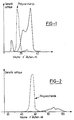
- Figure 1 gives an example of the chromatographic separation obtained at this stage with indication of the precise location of the polysaccharide peak shown in dotted lines.
- the elution fraction from the column containing the polysaccharide is collected, dialyzed against distilled water and then lyophilized.
- This fraction is still slightly contaminated with proteins of molecular weight very close to that of the polysaccharide (70,000 to 100,000). These proteins will therefore be hydrolyzed by the action of an enzyme before a final chromatographic fractionation step.
- the above lyophilisate is dissolved in 0.01 M Tris HCl buffer, pH 7.3, containing 1 mM EDTA at a rate of 20 mg / ml. 50 mg / ml of proteinase K (proteolytic enzyme from Tritirachium album) is then added to this solution and then incubated for 2 hours at 37 ° C. with shaking.
- proteinase K proteolytic enzyme from Tritirachium album
- the contaminating proteins whose molecular weight has been reduced by proteolysis are separated from the polysaccharide by chromatography on Sephacryl S 200 (trademark Pharmacia, Sweden) (polyacrylamide gel of defined porosity).
- Figure 2 gives an example of the chromatographic separation obtained at this stage.
- the fraction containing the pure polysaccharide is then collected, concentrated and dialyzed continuously against distilled water on a membrane whose cutoff threshold is at 10,000 daltons, sterilized by filtration on a 0.2 ⁇ membrane and then lyophilized.
- the lyophilisate thus obtained constitutes the polysaccharide of Klebsiella pneumoniae which is the subject of the present patent.
- the target cells are YAC-1 cells (Moloney lymphoma) sensitive to NK cells, labeled with 5t Cr.
- the measurement of the lysis is made by counting the 51 Cr released for effector cell / target cell ratios of 200/1, 100/1, 50/1, for 4 hours of incubation.
- Target cells YAC-1 (Moloney lymphoma) sensitive to NK cells.
- the polysaccharide is injected intraperitoneally at a dose of 15 ⁇ g in 0.2 ml of physiological saline buffered 3 days before the measurement of NK activity. Control mice receive only physiological saline under the same conditions.
- the spleen cells are then removed and incubated as above with target cells 51 Cr-labeled in effector cell / target cell ratios of 200/1, 100/1, 50/1, 25/1 for 4 hours.
- the 51 Cr released is measured to determine the percentage of lysed target cells.
- mice are immunized with a constant dose of Streptococcus pyogenes ribosomes supplemented with variable doses of polysaccharide.
- the specific antibody response against the ribosomes is then measured by the ELISA technique.
- Control groups are treated one with physiological saline, the other with the standard dose of crude membrane proteoglycan from Klebsiella pneumiae (crude PGM).
- the animals are punctured on the 21st day and the anti-ribosome antibody titers of Streptococcus pyogenic antibodies are determined by the ELISA technique.
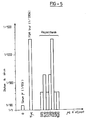
- results indicate the last dilution of the serum giving a positive response in ELISA, and are represented in the form of a histogram below.
- FIG. 5 is a representation in the form of a histogram of the ELISA assay of the specific antibody response as a function of the dose of polysaccharide associated with the antigen.
- Antigen 10 ⁇ g of S. pyogenes ribosomes per injection.
Landscapes
- Health & Medical Sciences (AREA)
- Chemical & Material Sciences (AREA)
- Life Sciences & Earth Sciences (AREA)
- Organic Chemistry (AREA)
- General Health & Medical Sciences (AREA)
- Engineering & Computer Science (AREA)
- Wood Science & Technology (AREA)
- Zoology (AREA)
- Chemical Kinetics & Catalysis (AREA)
- General Chemical & Material Sciences (AREA)
- Microbiology (AREA)
- Pharmacology & Pharmacy (AREA)
- Animal Behavior & Ethology (AREA)
- Immunology (AREA)
- Public Health (AREA)
- Veterinary Medicine (AREA)
- Medicinal Chemistry (AREA)
- Bioinformatics & Cheminformatics (AREA)
- Epidemiology (AREA)
- Biotechnology (AREA)
- Molecular Biology (AREA)
- Biochemistry (AREA)
- General Engineering & Computer Science (AREA)
- Genetics & Genomics (AREA)
- Mycology (AREA)
- Nuclear Medicine, Radiotherapy & Molecular Imaging (AREA)
- Polysaccharides And Polysaccharide Derivatives (AREA)
- Preparation Of Compounds By Using Micro-Organisms (AREA)
- Pharmaceuticals Containing Other Organic And Inorganic Compounds (AREA)
- Medicines Containing Material From Animals Or Micro-Organisms (AREA)
- Medicines Containing Antibodies Or Antigens For Use As Internal Diagnostic Agents (AREA)
- Separation Using Semi-Permeable Membranes (AREA)
- Artificial Filaments (AREA)
- Measuring Or Testing Involving Enzymes Or Micro-Organisms (AREA)
Description
- La présente invention concerne un polysaccharide de faible poids moléculaire (environ 90 000) obtenu à partir de protéoglycanes membranaires d'origine bactérienne ainsi qu'un procédé pour sa préparation et son utilisation à titre de médicament, en particulier col immunostimulant, notamment pour l'activation des cellules NK (Natural Killer), et comme adjuvant dans les vaccins.
- Le brevet français n° 7 835 649 déposé le 19 décembre 1978 décrit un protéoglycane membranaire détoxifié, isolé d'une souche mutante non capsulée et non pathogène de Klebsiella pneumoniae biotype a. Ce protéoglycane possède un poids moléculaire supérieur à 2 000 000 de daltons et exerce des propriétés adjuvantes caractéristiques vis-à-vis de la production d'anticorps contre les antigènes qui lui sont associés. Il ne possède par contre pas d'activité stimulante notable des cellules NK. Des exemples sont donnés de son utilisation comme adjuvant dans des formules de vaccins.
- Le brevet français n° 8 203 921 déposé le 9 mars 1982 décrit l'obtention, à partir du protéoglycane précédent et par action du lysozyme, d'une fraction protéoglycanique de poids moléculaire compris entre 200 000 et 400 000 daltons. Cette fraction protéoglycanique possède une propriété nouvelle celle de stimuler très fortement l'activité des cellules NK via une induction d'interféron endogène. Cette fraction, par contre, ne possède plus les propriétés adjuvantes du protéoglycane détoxifié décrit précédemment.
- La présente invention concerne un nouveau composé provenant, en particulier, de membranes bactériennes; il s'agit d'un polysaccharide ayant un poids moléculaire compris entre 80 000 et 100 000 daltons et ayant la composition suivante sous forme lyophilisée:
- . teneur en galactose, 66 ± 6 %
- . teneur en hexoses autres que le galactose, < 1 %
- . teneur en hexosamines (glucosamine), 8,5 ± 2 %
- . teneur en amino-acides, 5 ± 2 %
- . teneur en acides gras, < 1 %
- . teneur en acides nucléiques, < 0,005 %
- . teneur en protéines, < 0,3 %
- Ce nouveau polysaccharide obtenu à partir de protéoglycanes membranaires d'origine bactérienne solubles est caractérisé par un poids moléculaire faible (90 000 ± 10 000) et par sa composition particulière; il ne contient, en effet, qu'un seul hexose, le galactose, et une seule hexosamine, la glucosamine, sur laquelle sont branchés des peptides correspondant aux acides aminés analysés. Comme en outre ce polysaccharide est pratiquement exempt d'acides gras, d'acides nucléiques et de protéines, il s'agit d'un produit bien caractérisé dont la structure a d'ailleurs pu être déterminée.
- L'étude de la structure du polysaccharide au moyen des méthodes classiques telles que oxydation périodique, méthylation, chromatographie gazeuse couplée à la spectrométrie de masse, RMN, etc., a permis de définir de façon précise la séquence d'enchaînement de ses constituants.
- Les résultats obtenus montrent que ce polysaccharide est formé de l'enchaînement répété d'unités monomériques ayant la structure suivante:

- Galp = galacto pyranose (sous formes a et β),
- Ce polysaccharide peut être préparé par différents procédés.
- Le procédé préféré selon la présente invention, qui permet de préparele polysaccharide membranaire d'origine bactérienne tel que décrit précédement est caracterisé en ce que:
- a) à partir d'une souche de bactérie gram négatif, on extrait des membranes les protéoglycanes solubles dans l'eau;
- b) à partir desdits protéoglycanes solubles, on isole des polysaccharides de poids moléculaire compris entre 80 000 et 100 000; et
- c) on purifie, si nécessaire, les polysaccharides isolés en éliminant les protéines présentes dans la fraction isolée.
- Parmi les bactéries gram négatif susceptibles d'être mises en oeuvre, on peut citer Klebsiella pneumoniae, Serratia marcescens et Escherichia coli; en particulier Klebsiella pneumoniae qui fait l'objet d'un dépot à la Collection Nationale de Culture de Microorganismes (CNCM) sous le n° 145-1-lP.
- Les protéoglycanes solubles sont préparés, de préférence, par solubilisation de protéoglycanes membranaires bruts obtenus par la mise en oeuvre de procédés décrits dans la technique antérieure, en particulier par les procédés décrits dans le brevet français n° 7 835 649. Il s'agit, essentiellement, d'un procédé qui, à partir d'un broyat cellulaire, sépare les membranes par plusieurs centrifugations.
- Les protéoglycanes bruts obtenus sont traités par une base, en particulier un hydroxyde alcalin, de préférence la soude, à une molarité comprise entre 0,3 et 1 M, de préférence 0,5 M, le traitement étant poursuivi quelques heures, par exemple 1 heure, à une température comprise entre 50 et 60° C, par exemple 56° C, de préférence sous agitation.
- Par rapport au procédé décrit dans le brevet français n° 7 835 649, le milieu utilisé est plus basique pour assurer une hydrolyse plus complète des protéoglycanes bruts.
- Afin d'éliminer l'excès de réactif, après refroidissement, on neutralise la suspension par un acide, par exemple l'acide chlorhydrique, puis on la clarifie en éliminant le résidu insoluble par précipitation, en particulier par centrifugation, par exemple 60 minutes à 30 000 g.
- Le surnageant, qui constitue les protéoglycanes solubles, est recueilli et peut être lyophilisé.
- Le polysaccharide membranaire d'origine bactérienne avant le poids moléculaire désiré est alors isolé du surnageant par un procédé de fractionnement, de préférence un fractionnement chromatographique. On recueille la fraction d'élution de la colonne contenant le polysaccharide de poids moléculaire compris entre 80 000 et 100 000.
- Ce fractionnement chromatographique peut être effectué en utilisant une résine d'agarose telle que la Sépharose CL2B (marque commerciale Pharmacia, Suède), mais d'autres techniques de fractionnement peuvent être mises en oeuvre.
- Le polysaccharide peut, alors, être purifié, dans un mode de réalisation de l'invention, en éliminant en particulier les protéines de poids moléculaire proche de celui du polysaccharide isolé, par exemple par hydrolyse enzymatique desdites protéines, en particulier par action de protéinase, suivie d'une séparation des polysaccharides purifiés par un procédé de fractionnement, de préférence un fractionnement chromatographique.
- La fraction contenant le polysaccharide peut être alors recueillie et éventuellement lyophilisée. Le lyophilisat ainsi obtenu constitue le polysaccharide faisant l'objet de la présente invention.
- La présente invention concerne également l'utilisation de ces protéoglycanes à titre de médicament, soit seuls, soit en association avec un agent vaccinant.
- En effet, le polysaccharide selon l'invention possède des propriétés immunostimulantes dont les principes sont:
- . un pouvoir adjuvant, notamment à des doses très faibles, des vaccins, en particulier ribosomaux;
- . une capacité élevée de stimulation des cellules NK, in vitro et in vivo.
- Ainsi, il a été mis en évidence pour ces produits une forte activation des cellules NK in vivo sur des souris vis-à-vis du lymphome de Moloney (cellule YAC.1).
- En outre, on a mis en évidence des propriétés adjuvantes vis-à-vis des vaccins, notamment des vaccins ribosomaux, c'est-à-dire les vaccins dans lesquels l'agent vaccinant est constitué par des ribosomes, mais d'autres agents vaccinants peuvent être utilisés.
- Il est clair, compte tenu des activités mises en évidence, que la nature des compositions pharmaceutiques ainsi que les posologies à mettre en oeuvre, pourront varier dans une très large gamme. En effet, l'activation des cellules NK pourra dépendre grandement des cellules cibles visées et de l'état du patient. De même, dans le cas des adjuvants, seule une étude d'optimisation pourra permettre de fixer le rapport entre l'adjuvant et l'agent vaccinant ainsi que les posologies.
- Les exemples ci-après permettront de mettre en évidence d'autres caractéristiques et avantages de la présente invention.
- Les figures ci-annexées illustrent certains aspects particuliers de l'invention. Sur ces figures:
- . la figure 1 est une courbe chromatographique sur CL2B Sépharose du protéoglycane hydrolysé par NaOH 0,5 N,
- . la 2 est une courbe chromatographique sur Séphacryl S 200 (marque commerciale) polysaccharide traité par la protéinase,
- . la figure 3 représente les courbes d'activation des cellules NK in vitro (exemple 6),
- . la figure 4 représente les courbes d'activation des cellules NK in vivo (exemple 7),
- . la figure 5 représente un histogramme du dosage ELISA obtenu dans l'exemple 8.
- La biomasse de la souche de Klebsiella pneumoniae 145-1-IP est dispersée dans du tampon Tris HCI 0,01 M, pH 7, contenant NaCI 0,15 M glacé puis soumise à un broyage mécanique destiné à rompre les parois cellulaires.
- Le lysat bactérien est clarifié par une centrifugation de 10 minutes à 7 500 g puis le surnageant est centrifugé pendant 60 minutes à 30 000 g.
- Le culot est dispersé dans une solution aqueuse de NaCI 0,15 M. La suspension obtenue est à nouveau clarifiée 10 minutes à 7 500 g puis centrifugée 45 minutes à 30 000 g.
- Le culot est repris dans l'eau distillée puis à nouveau soumis à un cycle de centrifugation à 7 500 g puis à 30 000 g.
- Le culot de protéoglycanes membranaires bruts est alors repris dans 1/4 du volume initial d'eau distillée stérile, la suspension est clarifiée 10 minutes à 7 500 g et le surnageant est lyophilisé.
- Les protéoglycanes membranaires bruts lyophilisés sont dispersés dans NaOH (0,5 M) puis hydrolysés pendant 1 heure à 56°C. Après refroidissement, la suspension est neutralisée par HCI. La suspension est alors clarifiée par centrifugation 60 minutes à 30 000 g puis le surnageant est recueilli. Le filtrat est lyophilisé.
- Le lyophilisat précèdent est dissous dans du tampon Tris HCI 0,01 M, pH 7, puis soumis à un premier fractionnement chromatographique sur une colonne (60 x 2,6 cm) de Sépharose CL2B (marque commerciale Pharmacia, Suède) (gel d'agarose de porosité déterminée) équilibrée dans le même tampon.
- La figure 1 donne un exemple de la séparation chromatographique obtenue à ce stade avec indication de la localisation précise du pic de polysaccharide représenté en pointillé.
- On remarque sur ce chromatogramme que le pic de polysaccharide est complètement séparé d'un pic de poids moléculaire très supérieur élué en tête de la colonne et incomplètement séparé d'un ensemble de fractions protéiques d'un poids moléculaire inférieur proche de celui du polysaccharide, éluées à la suite de ce dernier.
- La fraction d'élution de la colonne contenant le polysaccharide est recueillie, dialysée contre de l'eau distillée puis lyophilisée.
- Cette fraction est encore légèrement contaminée par des protéines de poids moléculaire très proche de celui du polysaccharide (70 000 à 100 000). Ces protéines vont donc être hydrolysées par l'action d'une enzyme avant une ultime étape de fractionnement chromatographique.
- Le lyophilisat précèdent est dissous dans du tampon Tris HCI 0,01 M, pH 7,3, contenant 1 mM d'EDTA à raison de 20 mg/ml. On ajoute alors à cette solution 50 mg/ml de protéinase K (enzyme protéolytique de Tritirachium album) puis on incube pendant 2 heures à 37°C sous agitation.
- Les protéines contaminantes dont le poids moléculaire a été réduit par protéolyse sont séparées du polysaccharide par chromatographie sur Séphacryl S 200 (marque commerciale Pharmacia, Suède) (gel de polyacrylamide de porosité définie).
- La figure 2 donne un exemple de la séparation chromatographique obtenue à ce stade.
- On remarque sur ce chromatogramme que le pic de polysaccharide représenté en pointillé se trouve cette fois complètement séparé de celui des protéines hydrolysées représentées en trait plein, dont l'élution de la colonne se trouve ainsi fortement retardée par rapport au polysaccharide.
- La fraction contenant le polysaccharide pur est alors recueillie, concentrée et dialysée en continu contre de l'eau distillée sur une membrane dont le seuil de coupure se situe a 10 000 daltons, stérilisée par filtration sur membrane 0,2 µ puis lyophilisée.
- Le lyophilisat ainsi obtenu constitue le polysaccharide de Klebsiella pneumoniae faisant l'objet du présent brevet.
- 107 cellules spléniques des souris normales par ml de milieu RPMI 1640 additionné de 5 % de sérum foetal de veau.
- Incubation à 37° C dans une étuve à C02 avec des quantités variables de polysaccharide.
- Les cellules cibles sont des cellules YAC-1 (lymphome de Moloney) sensibles aux cellules NK, marquées au 5t Cr.
- La mesure de la lyse est faite par comptage du 51Cr libéré pour des rapports cellules effectrices/cellules cibles de 200/1, 100/1, 50/1, pendant 4 heures d'incubation.
- Ils sont extrêmement nets et font apparaître une augmentation hautement significative du pourcentage de cellules cibles lysées (P < 0,01) dès la dose de 1 pg/ml.
- La figure 3 donne un exemple des résultats obtenus au cours de cette étude.
- Cellules cibles: YAC-1 (lymphome de Moloney) sensibles aux cellules NK.
- Le polysaccharide est injecté par voie intrapéritonéale à la dose de 15 µg dans 0,2 ml de sérum physiologique tamponné 3 jours avant la mesure de l'activité NK. Des souris témoins ne reçoivent que du sérum physiologique dans les mêmes conditions.
- Les cellules spléniques sont ensuite prélevées et incubées comme précédemment avec des cellules cibles marquées au 51Cr dans des rapports cellules effectrices/cellules cibles de 200/1, 100/1, 50/1, 25/1 pendant 4 heures. Le 51Cr libéré est mesuré pour déterminer le pourcentage de cellules cibles lysées.
- On observe une augmentation hautement significative de l'activité NK chez les animaux traités par le polysaccharide comparativement aux animaux témoins.
- La figure 4 donne un exemple des résultats obtenus au cours de cette étude.
- Exemple d'étude des propriétés adjuvantes du polysaccharide vis-à-vis d'un antigène ribosomal de Streptococcus pyogenes groupe A.
- Des souris sont immunisées avec une dose constante de ribosomes de Streptococcus pyogenes additionnés de doses variables de polysaccharide. La réponse anticorps spécifiques contre les ribosomes est ensuite mesurée par la technique ELISA.
- Des groupes témoins sont traités l'un par du sérum physiologique, l'autre par la dose standard de protéoglycane membranaire brut de Klebsiella pneumiae (PGM brut).
- 9 lots de 10 souris NMRI femelles âgées de 8 semaines. Chaque animal reçoit 5 injections en 15 jours.

- Les animaux sont ponctionnés le 21 ème jour et les titres en anticorps anti-ribosomes de Streptococcus pyogènes sont déterminés par la technique ELISA.
- Les résultats indiquent la dernière dilution du sérum donnant une réponse positive en ELISA, et sont représentés sous forme d'histogramme ci-après.
- La figure 5 est une représentation sous forme d'histogramme du dosage ELISA de la réponse anticorps spécifique en fonction de la dose de polysaccharide associée à l'antigène.
- Antigène: 10 µg de ribosomes de S. pyogenes par injection.
- Ces résultats montrent qu'une dose de 2,5 µg de polysaccharide à le même effet adjuvant qu'une dose de 15 µg de PGM bruts, soit une activité spécifique 6 fois supérieure dans ces conditions.
ce qui correspond à la formule développée suivante:

Claims (13)
et pour poids moléculaire: 90 000 ± 10 000.


Priority Applications (1)
| Application Number | Priority Date | Filing Date | Title |
|---|---|---|---|
| AT85401740T ATE41785T1 (de) | 1984-09-10 | 1985-09-06 | Membranoese polysaccharide, verwendbar insbesondere als arzneimittel und verfahren zu ihrer herstellung. |
Applications Claiming Priority (2)
| Application Number | Priority Date | Filing Date | Title |
|---|---|---|---|
| FR8413844A FR2570081B1 (fr) | 1984-09-10 | 1984-09-10 | Polysaccharides membranaires utiles notamment comme medicament et procede pour leur preparation |
| FR8413844 | 1984-09-10 |
Publications (2)
| Publication Number | Publication Date |
|---|---|
| EP0179679A1 EP0179679A1 (fr) | 1986-04-30 |
| EP0179679B1 true EP0179679B1 (fr) | 1989-03-29 |
Family
ID=9307567
Family Applications (1)
| Application Number | Title | Priority Date | Filing Date |
|---|---|---|---|
| EP85401740A Expired EP0179679B1 (fr) | 1984-09-10 | 1985-09-06 | Polysaccharides membranaires utiles notamment comme médicament et procédé pour leur préparation |
Country Status (10)
| Country | Link |
|---|---|
| US (1) | US4734403A (fr) |
| EP (1) | EP0179679B1 (fr) |
| JP (1) | JP2521428B2 (fr) |
| AT (1) | ATE41785T1 (fr) |
| AU (1) | AU571349B2 (fr) |
| CA (1) | CA1259045A (fr) |
| DE (1) | DE3569122D1 (fr) |
| ES (1) | ES8605041A1 (fr) |
| FR (1) | FR2570081B1 (fr) |
| ZA (1) | ZA856804B (fr) |
Families Citing this family (13)
| Publication number | Priority date | Publication date | Assignee | Title |
|---|---|---|---|---|
| EP0240098A3 (fr) * | 1986-04-04 | 1989-05-10 | Kabushiki Kaisha Ueno Seiyaku Oyo Kenkyujo | Oligo et Polysaccharides pour le traitement des maladies causées par des rétrovirus |
| FR2598434B1 (fr) * | 1986-05-12 | 1988-09-16 | Pf Medicament | Nouveaux immunomodulateurs obtenus par hemisynthese a partir d'un polysaccharide bacterien isole d'une souche mutante non capsulee de klebsiella pneumoniae |
| EP0285357A3 (fr) * | 1987-03-31 | 1989-10-25 | Kabushiki Kaisha Ueno Seiyaku Oyo Kenkyujo | Lutte contre les rétrovirus |
| FR2614306B1 (fr) * | 1987-04-22 | 1989-07-28 | Pf Medicament | Nouveau derive de d.25, procede de preparation, utilisation a titre d'agent immunostimulant et compositions pharmaceutiques le contenant. |
| US5057502A (en) * | 1987-06-02 | 1991-10-15 | Walsh William E | Composition and topical and systemic treatments of conditions caused by heavy, oily or greasy secretions |
| US4898852A (en) * | 1987-06-02 | 1990-02-06 | Walsh William E | Cyclopolgalcturonic acid composition and treatment |
| US4960763A (en) * | 1988-04-18 | 1990-10-02 | Weyerhaeuser Company | Method of using bacterial cellulose as a dietary fiber component |
| CA1330303C (fr) * | 1989-02-20 | 1994-06-21 | Libor Henry Nikl | Composition et methode permettant d'accroitre l'efficacite d'un vaccin pour les poissons |
| FR2644059B1 (fr) * | 1989-03-08 | 1994-03-04 | Fabre Medicament Pierre | Compositions aerosols destinees a l'imagerie, au diagnostic et a la therapie ciblee de foyers inflammatoires et tumoraux |
| FR2650506B1 (fr) * | 1989-07-11 | 1991-11-08 | Roussel Uclaf | Galactanne extrait de klebsiella, procede d'obtention et application a titre de medicament |
| JP3875754B2 (ja) * | 1995-11-17 | 2007-01-31 | シスメックス株式会社 | フローサイトメータ用標準液 |
| US6444210B1 (en) | 1996-07-03 | 2002-09-03 | Her Majesty the Queen in right of Canada, as represented by the Minister of National Defence of Her Majesty′s Canadian Goverment | Bacterial and synthetic polysaccharide immunomodulators that enhance general immunity |
| JP4653465B2 (ja) * | 2004-10-25 | 2011-03-16 | 泰信 小林 | ナチュラルキラー細胞の増殖促進方法およびそれに用いる培養組成物 |
Family Cites Families (4)
| Publication number | Priority date | Publication date | Assignee | Title |
|---|---|---|---|---|
| FR2490496A1 (fr) * | 1980-09-19 | 1982-03-26 | Roussel Uclaf | Nouvelles glycoproteines immunostimulantes extraites de klebsiella pneumoniae, leur procede d'obtention, leur application a titre de medicaments et les compositions les renfermant |
| AU8334682A (en) * | 1981-04-30 | 1982-11-24 | Zenyaku Kogyo Kabushiki Kaisha | Polysaccharide ps=a isolated from the plant of genus epimedium violaceium morr. et decne., process for its preparation, and infection-preventing agent and immunostimulating agent containing the ploysaccharide as effective ingredient |
| JPS58129001A (ja) * | 1982-01-28 | 1983-08-01 | Takeda Chem Ind Ltd | 新規免疫活性多糖質およびその製造法 |
| FR2523154A1 (fr) * | 1982-03-09 | 1983-09-16 | Fabre Sa Pierre | Procede de preparation de proteoglycanes immunostimulants inducteurs d'interferon, proteoglycanes obtenus et medicaments les contenant |
-
1984
- 1984-09-10 FR FR8413844A patent/FR2570081B1/fr not_active Expired
-
1985
- 1985-08-29 US US06/770,737 patent/US4734403A/en not_active Expired - Fee Related
- 1985-08-30 AU AU46912/85A patent/AU571349B2/en not_active Ceased
- 1985-09-03 CA CA000489876A patent/CA1259045A/fr not_active Expired
- 1985-09-05 ZA ZA856804A patent/ZA856804B/xx unknown
- 1985-09-06 AT AT85401740T patent/ATE41785T1/de active
- 1985-09-06 DE DE8585401740T patent/DE3569122D1/de not_active Expired
- 1985-09-06 EP EP85401740A patent/EP0179679B1/fr not_active Expired
- 1985-09-09 ES ES546783A patent/ES8605041A1/es not_active Expired
- 1985-09-10 JP JP60198699A patent/JP2521428B2/ja not_active Expired - Lifetime
Also Published As
| Publication number | Publication date |
|---|---|
| JP2521428B2 (ja) | 1996-08-07 |
| US4734403A (en) | 1988-03-29 |
| JPS6176420A (ja) | 1986-04-18 |
| AU571349B2 (en) | 1988-04-14 |
| FR2570081B1 (fr) | 1987-01-09 |
| CA1259045A (fr) | 1989-09-05 |
| ES546783A0 (es) | 1986-03-01 |
| DE3569122D1 (en) | 1989-05-03 |
| EP0179679A1 (fr) | 1986-04-30 |
| AU4691285A (en) | 1986-03-27 |
| ZA856804B (en) | 1986-04-30 |
| FR2570081A1 (fr) | 1986-03-14 |
| ES8605041A1 (es) | 1986-03-01 |
| ATE41785T1 (de) | 1989-04-15 |
Similar Documents
| Publication | Publication Date | Title |
|---|---|---|
| EP0024493B1 (fr) | Vaccin pneumocoqual multivalent | |
| EP0302781B1 (fr) | Procédé d'obtention de polyosides capsulaires de staphylocoques, applications de ces polyosides et souches pour la mise en oeuvre du procédé | |
| EP0035429B1 (fr) | Complexe vaccinal contenant un antigène spécifique et vaccin le contenant | |
| JP2007228974A (ja) | グルカンの酵素処理 | |
| EP0157899A2 (fr) | Vaccin pneumococcique multivalent et sa préparation | |
| EP0179679A1 (fr) | Polysaccharides membranaires utiles notamment comme médicament et procédé pour leur préparation | |
| IL42545A (en) | Water-soluble extracts of mycobacteria their preparation and pharmaceutical compositions containing them | |
| EP0562107A1 (fr) | Oligoside derive d'un polyoside antigenique issu d'un agent pathogene | |
| EP0089266B1 (fr) | Procédé de préparation de protéoglycanes immunostimulants inducteurs d'interféron, protéoglycanes obtenus et médicament les contenant | |
| KR930004473A (ko) | 세균의 지질-함유 캡슐 다당류를 지질-부재 다당류로 전환시키는 방법 | |
| CA2513813C (fr) | Procede d'isolement de lipopolysaccharides | |
| EP0238407B1 (fr) | Procédés industriels de fabrication de vaccins ribosomaux et vaccins ribosomaux obtenus | |
| JPH03501123A (ja) | グラム陰性非腸内病原性桿菌に対する獣医学用の無細胞ワクチンの調製方法 | |
| CH620691A5 (fr) | ||
| CA1268900A (fr) | Immunomodulateurs obtenus par hemisynthese a partir d'un polysaccharide bacterien isole d'une souche mutante non capsulee de klebsiella pneumoniae | |
| EP0082072B1 (fr) | Procédé de production d'un vaccin biochimique contre les fièvres à salmonelles | |
| WO2004003215A1 (fr) | Procede d'isolation d'une fraction biologiquement active contenant des s-lipopolysaccharides naturels cliniquement acceptables, obtenus a partir de bacteries produisant des lipopolysaccharides endotoxiques | |
| EP0288382B1 (fr) | Nouveau dérivé de D.25, procédé de préparation, utilisation à titre d'agent immunostimulant et compositions pharmaceutiques le contenant | |
| EP1158993B1 (fr) | Fractions membranaires bacteriennes a effet adjuvant | |
| JP2002095493A (ja) | 酢酸菌の菌膜を形成する多糖及びその精製方法 | |
| EP0408444A2 (fr) | Galactanne extrait de Klebsiella, procédé d'obtention et application À titre de médicament | |
| FR2734160A1 (fr) | Utilisation d'un compose comportant une structure glycanique pour le blocage d'anticorps et procede d'obtention d'un tel produit | |
| WO2001087326A1 (fr) | UTILISATION D'UNE PROTEINE OmpA D'ENTEROBACTERIE COMME AGENT ANTIMICROBIEN |
Legal Events
| Date | Code | Title | Description |
|---|---|---|---|
| PUAI | Public reference made under article 153(3) epc to a published international application that has entered the european phase |
Free format text: ORIGINAL CODE: 0009012 |
|
| AK | Designated contracting states |
Kind code of ref document: A1 Designated state(s): AT BE CH DE FR GB IT LI LU NL SE |
|
| 17P | Request for examination filed |
Effective date: 19860422 |
|
| 17Q | First examination report despatched |
Effective date: 19880311 |
|
| GRAA | (expected) grant |
Free format text: ORIGINAL CODE: 0009210 |
|
| RAP1 | Party data changed (applicant data changed or rights of an application transferred) |
Owner name: PIERRE FABRE MEDICAMENT |
|
| ITF | It: translation for a ep patent filed | ||
| AK | Designated contracting states |
Kind code of ref document: B1 Designated state(s): AT BE CH DE FR GB IT LI LU NL SE |
|
| REF | Corresponds to: |
Ref document number: 41785 Country of ref document: AT Date of ref document: 19890415 Kind code of ref document: T |
|
| GBT | Gb: translation of ep patent filed (gb section 77(6)(a)/1977) | ||
| REF | Corresponds to: |
Ref document number: 3569122 Country of ref document: DE Date of ref document: 19890503 |
|
| PLBE | No opposition filed within time limit |
Free format text: ORIGINAL CODE: 0009261 |
|
| STAA | Information on the status of an ep patent application or granted ep patent |
Free format text: STATUS: NO OPPOSITION FILED WITHIN TIME LIMIT |
|
| 26N | No opposition filed | ||
| ITTA | It: last paid annual fee | ||
| EPTA | Lu: last paid annual fee | ||
| EAL | Se: european patent in force in sweden |
Ref document number: 85401740.7 |
|
| PGFP | Annual fee paid to national office [announced via postgrant information from national office to epo] |
Ref country code: NL Payment date: 19960819 Year of fee payment: 12 |
|
| PGFP | Annual fee paid to national office [announced via postgrant information from national office to epo] |
Ref country code: AT Payment date: 19960823 Year of fee payment: 12 |
|
| PGFP | Annual fee paid to national office [announced via postgrant information from national office to epo] |
Ref country code: GB Payment date: 19960830 Year of fee payment: 12 |
|
| PGFP | Annual fee paid to national office [announced via postgrant information from national office to epo] |
Ref country code: LU Payment date: 19960901 Year of fee payment: 12 |
|
| PGFP | Annual fee paid to national office [announced via postgrant information from national office to epo] |
Ref country code: DE Payment date: 19960919 Year of fee payment: 12 |
|
| PGFP | Annual fee paid to national office [announced via postgrant information from national office to epo] |
Ref country code: SE Payment date: 19960920 Year of fee payment: 12 |
|
| PGFP | Annual fee paid to national office [announced via postgrant information from national office to epo] |
Ref country code: CH Payment date: 19960926 Year of fee payment: 12 |
|
| PGFP | Annual fee paid to national office [announced via postgrant information from national office to epo] |
Ref country code: FR Payment date: 19960930 Year of fee payment: 12 |
|
| PGFP | Annual fee paid to national office [announced via postgrant information from national office to epo] |
Ref country code: BE Payment date: 19961009 Year of fee payment: 12 |
|
| PG25 | Lapsed in a contracting state [announced via postgrant information from national office to epo] |
Ref country code: LU Free format text: LAPSE BECAUSE OF NON-PAYMENT OF DUE FEES Effective date: 19970906 Ref country code: GB Free format text: LAPSE BECAUSE OF NON-PAYMENT OF DUE FEES Effective date: 19970906 Ref country code: AT Free format text: LAPSE BECAUSE OF NON-PAYMENT OF DUE FEES Effective date: 19970906 |
|
| PG25 | Lapsed in a contracting state [announced via postgrant information from national office to epo] |
Ref country code: SE Free format text: LAPSE BECAUSE OF NON-PAYMENT OF DUE FEES Effective date: 19970907 |
|
| PG25 | Lapsed in a contracting state [announced via postgrant information from national office to epo] |
Ref country code: LI Free format text: LAPSE BECAUSE OF NON-PAYMENT OF DUE FEES Effective date: 19970930 Ref country code: FR Free format text: THE PATENT HAS BEEN ANNULLED BY A DECISION OF A NATIONAL AUTHORITY Effective date: 19970930 Ref country code: CH Free format text: LAPSE BECAUSE OF NON-PAYMENT OF DUE FEES Effective date: 19970930 Ref country code: BE Free format text: LAPSE BECAUSE OF NON-PAYMENT OF DUE FEES Effective date: 19970930 |
|
| BERE | Be: lapsed |
Owner name: PIERRE FABRE MEDICAMENT Effective date: 19970930 |
|
| PG25 | Lapsed in a contracting state [announced via postgrant information from national office to epo] |
Ref country code: NL Free format text: LAPSE BECAUSE OF NON-PAYMENT OF DUE FEES Effective date: 19980401 |
|
| GBPC | Gb: european patent ceased through non-payment of renewal fee |
Effective date: 19970906 |
|
| REG | Reference to a national code |
Ref country code: CH Ref legal event code: PL |
|
| NLV4 | Nl: lapsed or anulled due to non-payment of the annual fee |
Effective date: 19980401 |
|
| PG25 | Lapsed in a contracting state [announced via postgrant information from national office to epo] |
Ref country code: DE Free format text: LAPSE BECAUSE OF NON-PAYMENT OF DUE FEES Effective date: 19980603 |
|
| EUG | Se: european patent has lapsed |
Ref document number: 85401740.7 |
|
| REG | Reference to a national code |
Ref country code: FR Ref legal event code: ST |