EP0176572B1 - Gewinnung von aleuron-zellen aus getreideweizen - Google Patents
Gewinnung von aleuron-zellen aus getreideweizen Download PDFInfo
- Publication number
- EP0176572B1 EP0176572B1 EP85901907A EP85901907A EP0176572B1 EP 0176572 B1 EP0176572 B1 EP 0176572B1 EP 85901907 A EP85901907 A EP 85901907A EP 85901907 A EP85901907 A EP 85901907A EP 0176572 B1 EP0176572 B1 EP 0176572B1
- Authority
- EP
- European Patent Office
- Prior art keywords
- particles
- testa
- pericarp
- air
- aleurone cell
- Prior art date
- Legal status (The legal status is an assumption and is not a legal conclusion. Google has not performed a legal analysis and makes no representation as to the accuracy of the status listed.)
- Expired - Lifetime
Links
- 108010050181 aleurone Proteins 0.000 title claims abstract description 111
- 235000015099 wheat brans Nutrition 0.000 title claims abstract description 16
- 238000011084 recovery Methods 0.000 title claims description 6
- 239000002245 particle Substances 0.000 claims abstract description 297
- 239000000203 mixture Substances 0.000 claims abstract description 48
- 238000000034 method Methods 0.000 claims abstract description 27
- 238000000926 separation method Methods 0.000 claims abstract description 17
- 238000003621 hammer milling Methods 0.000 claims abstract description 9
- 230000005684 electric field Effects 0.000 claims abstract description 3
- 230000000694 effects Effects 0.000 claims description 11
- 238000005194 fractionation Methods 0.000 claims description 7
- 238000004513 sizing Methods 0.000 claims description 5
- 238000004519 manufacturing process Methods 0.000 claims description 3
- 230000000452 restraining effect Effects 0.000 claims description 3
- 238000007786 electrostatic charging Methods 0.000 abstract description 3
- 238000007600 charging Methods 0.000 abstract description 2
- 235000013339 cereals Nutrition 0.000 description 9
- 235000013312 flour Nutrition 0.000 description 7
- 241000209140 Triticum Species 0.000 description 6
- 235000021307 Triticum Nutrition 0.000 description 6
- 235000013305 food Nutrition 0.000 description 4
- 235000013325 dietary fiber Nutrition 0.000 description 3
- 235000016709 nutrition Nutrition 0.000 description 3
- 239000000463 material Substances 0.000 description 2
- 230000035764 nutrition Effects 0.000 description 2
- 235000008935 nutritious Nutrition 0.000 description 2
- 238000002360 preparation method Methods 0.000 description 2
- 108090000623 proteins and genes Proteins 0.000 description 2
- 102000004169 proteins and genes Human genes 0.000 description 2
- KPZGRMZPZLOPBS-UHFFFAOYSA-N 1,3-dichloro-2,2-bis(chloromethyl)propane Chemical compound ClCC(CCl)(CCl)CCl KPZGRMZPZLOPBS-UHFFFAOYSA-N 0.000 description 1
- 241000196324 Embryophyta Species 0.000 description 1
- 241001465754 Metazoa Species 0.000 description 1
- 239000004677 Nylon Substances 0.000 description 1
- 240000007594 Oryza sativa Species 0.000 description 1
- 235000007164 Oryza sativa Nutrition 0.000 description 1
- 244000062793 Sorghum vulgare Species 0.000 description 1
- 241000269319 Squalius cephalus Species 0.000 description 1
- 240000008042 Zea mays Species 0.000 description 1
- 235000016383 Zea mays subsp huehuetenangensis Nutrition 0.000 description 1
- 235000002017 Zea mays subsp mays Nutrition 0.000 description 1
- 239000000654 additive Substances 0.000 description 1
- 235000015895 biscuits Nutrition 0.000 description 1
- 235000008429 bread Nutrition 0.000 description 1
- 239000000470 constituent Substances 0.000 description 1
- 238000010276 construction Methods 0.000 description 1
- 230000001419 dependent effect Effects 0.000 description 1
- 238000010586 diagram Methods 0.000 description 1
- 230000008030 elimination Effects 0.000 description 1
- 238000003379 elimination reaction Methods 0.000 description 1
- 238000000605 extraction Methods 0.000 description 1
- 238000000227 grinding Methods 0.000 description 1
- 235000013402 health food Nutrition 0.000 description 1
- 230000006698 induction Effects 0.000 description 1
- 229910052500 inorganic mineral Inorganic materials 0.000 description 1
- 238000010849 ion bombardment Methods 0.000 description 1
- 235000009973 maize Nutrition 0.000 description 1
- 238000003801 milling Methods 0.000 description 1
- 239000011707 mineral Substances 0.000 description 1
- 229920001778 nylon Polymers 0.000 description 1
- 235000009566 rice Nutrition 0.000 description 1
- 238000007873 sieving Methods 0.000 description 1
- 238000011282 treatment Methods 0.000 description 1
- 235000013311 vegetables Nutrition 0.000 description 1
- 235000013343 vitamin Nutrition 0.000 description 1
- 239000011782 vitamin Substances 0.000 description 1
- 229940088594 vitamin Drugs 0.000 description 1
- 229930003231 vitamin Natural products 0.000 description 1
- 235000019156 vitamin B Nutrition 0.000 description 1
- 239000011720 vitamin B Substances 0.000 description 1
- 150000003722 vitamin derivatives Chemical class 0.000 description 1
Images

Classifications
-
- B—PERFORMING OPERATIONS; TRANSPORTING
- B03—SEPARATION OF SOLID MATERIALS USING LIQUIDS OR USING PNEUMATIC TABLES OR JIGS; MAGNETIC OR ELECTROSTATIC SEPARATION OF SOLID MATERIALS FROM SOLID MATERIALS OR FLUIDS; SEPARATION BY HIGH-VOLTAGE ELECTRIC FIELDS
- B03C—MAGNETIC OR ELECTROSTATIC SEPARATION OF SOLID MATERIALS FROM SOLID MATERIALS OR FLUIDS; SEPARATION BY HIGH-VOLTAGE ELECTRIC FIELDS
- B03C7/00—Separating solids from solids by electrostatic effect
-
- A—HUMAN NECESSITIES
- A23—FOODS OR FOODSTUFFS; TREATMENT THEREOF, NOT COVERED BY OTHER CLASSES
- A23L—FOODS, FOODSTUFFS OR NON-ALCOHOLIC BEVERAGES, NOT OTHERWISE PROVIDED FOR; PREPARATION OR TREATMENT THEREOF
- A23L33/00—Modifying nutritive qualities of foods; Dietetic products; Preparation or treatment thereof
- A23L33/20—Reducing nutritive value; Dietetic products with reduced nutritive value
- A23L33/21—Addition of substantially indigestible substances, e.g. dietary fibres
-
- A—HUMAN NECESSITIES
- A23—FOODS OR FOODSTUFFS; TREATMENT THEREOF, NOT COVERED BY OTHER CLASSES
- A23L—FOODS, FOODSTUFFS OR NON-ALCOHOLIC BEVERAGES, NOT OTHERWISE PROVIDED FOR; PREPARATION OR TREATMENT THEREOF
- A23L7/00—Cereal-derived products; Malt products; Preparation or treatment thereof
- A23L7/10—Cereal-derived products
- A23L7/115—Cereal fibre products, e.g. bran, husk
Definitions
- This invention relates to a method and apparatus for the physical separation and recovery of a highly enriched fraction of aleurone cell particles from commercial wheat bran, in which a fraction of aleurone cell particles and pericarp-testa particles obtained by hammer-milling of wheat bran is subjected to size-classification/particle electrification/particle electrostatic fractionation treatments, whereby highly purified aleurone cell particles are obtained.
- Wheat bran is the outer layer of the wheat caryopsis and is itself composed of layers of different cell types.
- the outer layers of the bran arise from the parent plant and are the seed-coat or pericarp-testa.
- the inner layer is the aleurone, which is the outer-most layer of the endosperm.
- the aleurone cells which comprise more than half the weight of wheat bran, are thick-walled and enclose the cell contents, which are rich in protein of high nutritional value and B-vitamins.
- Aleurone cells are important constituents in animal feed-stuffs and a source of dietary fibre in human nutrition. Aleurone particles thus constitute a potentially useful commodity as a relatively cheap source of "dietary fibre” and are of a particular commerical interest on that account due to the current emphasis on "dietary fibre” in nutrition.
- the bran peripheral-testa and aleurone
- some adhering starchy endosperm is collected in the bran and pollard streams. Separation and recovery of aleurone particles from the bran by known methods has been unsatisfactory.
- Electrostatic separation of the electrostatically charged remaining aleurone cell particles from electrostatically charged pericarp-testa particles relies upon the different dielectric constants of those particles.
- electrostatic charging of the remaining aleurone particles and pericarp-testa particles may possibly be effected by conductive induction or by ion bombardment (corona discharge), we have found that it is much more convenient to effect the electrostatic charging of said particles by triboelectrification, which can be conveniently induced by air elutriation of said particles.
- said method involves the use of an elutriator column which comprises:
- the air elutriator and electrostatic separator apparatus which is suitable for the production of a highly enriched fraction of aleurone cell particles from a size-classified product mixture predominantly of pericarp-testa particles and aleurone cell particles obtained from commercial wheat bran by hammer-milling in which the wheat bran has been broken and reduced into aleurone cell particles and pericarp-testa particles having particle sizes within the sieve mesh range of larger than about 130 ⁇ m and smaller than about 290 ⁇ m, then size-classified to be within the sieve mesh range of larger than about 130 ⁇ m and smaller than bout 290 ⁇ m, said apparatus being adapted to remove those particles which are smaller than about 40 ⁇ m from said product mixture and electrostatically charge the remaining aleurone cell particles and pericarp-testa particles for electrostatic fractionation, comprises: an elutriator column adapted for effecting air elutriation of said size-classified product mixture of aleurone cell particles and pericarp-testa particles in
- a particles baffle plate is disposed from the downstream end of the electrostatic separator electrodes for restraining the flow of any non-deflected particles to a particles recycle bin for return of any such restrained particles to the elutriator column.
- Production scale apparatus suitable for carrying out the method of the invention can be interfaced by cereal processors or millers or the like, with various types of mills including conventional flour mills, for example as an alternative to sieving for resolution or partial resolution of some mill streams components.
- Other applications of the method and apparatus of the invention in the cereal food industry include the preparation of aleurone and non-aleurone enriched fractions for use in speciality goods, e.g. biscuits, health foods or as additives to non-cereal foods; the enrichment of flour with aleurone to increase protein, vitamin and mineral content (bread baked with aleurone at 1% of flour has been found to be satisfactory) at the same time increasing the flour extraction rate; as a means of separating nutritious from non-nutritious parts of cereals other than wheat, e.g. sorghum, maize, rice; and the resolution of mixtures of particles of non-cereal vegetable origin.
- A represents a source of whole wheat grain
- B represents commercial flour produced from the whole wheat grain
- C represents a hammer-mill grinder having a tip speed of about 90 m/sec (15 - 20,000 feet/minute) into which the commercial flour is fed for hammer-milling to break and reduce the bran into particles which consist predominantly of pericarp-testa particles and aleurone cell particles
- D represents a multiscreen sifter into which the pericarp-testa and aleurone cell particles are fed for preliminary sizing within the mesh range of larger than about 130 ⁇ m mesh and smaller than about 290 ⁇ m mesh
- E' represents a flow outlet from the multiscreen sifter for discard-particles which are smaller than about 130 ⁇ m mesh
- E2 represents a flow outlet from the multiscreen sifter for recycle particles which are larger than about 290 ⁇ m mesh and are returned to the hammer-mill grinder
- the hammer-milling of the wheat bran for mechanical separation of the aleurone cell particles from the pericarp-testa can be high speed hammer-milling with a tip speed in the range of 15,000-20,000 ft/min. as described by Stevens, D.J., supra , or as described by Bacic, A. and Stone B.A., (1981), Aust. J. Plant Physiol. 8 , 483-474, whereby the bran layer is broken into particles which consist predominantly either of pericarp-testa or aleurone cells.
- Preliminary sieve sizing of the hammer-milled bran in step (II) (i) of said method in which the hammer-milled bran is sized to a narrow range, normally about 130 ⁇ m to about 290 ⁇ m, more preferably larger than about 135 ⁇ m and smaller than about 225 ⁇ m mesh (nylon) sieves, is important for the success of the subsequent fractionation step (II) (ii) of said method, in effecting fractionation of the aleurone cell particles from the pericarp-testa particles.
- the preliminary sieve sizing of the hammer-milled bran can be effected by a multiscreen sifter, the hammer-milled bran being sifted into: (a) a hammer-mill recycle fraction larger than about 290 ⁇ m mesh size; (b) a processing fraction preferably between about 225 ⁇ m mesh size and about 135 ⁇ m mesh size; and (c) a discard fraction smaller than about 130 ⁇ m mesh size.
- the size-classified particles product mixture which is preferably between about 225 ⁇ m mesh size and about 135 ⁇ m mesh size, is subjected to air elutriation and electrostatic separation according to the method of the invention.
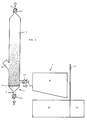
- the air elutriator column 1 for effecting air elutriation of the size-classified particles product mixture which has the two-fold purpose of removing said very fine and light particles and at the same time electrostatically charging the remaining aleurone cell particles and pericarp-testa particles through rubbing against one another and with the walls of the elutriator column 1, is provided with air inlet means 2 disposed in the base 3 of the elutriator column 1 for introducing a stream of filtered dry compressed air into the elutriator column 1 to entrain said size-classified product mixture of aleurone cell particles and pericarp-testa particles.
- a porous diaphragm 4 is disposed near the base 3 of the elutriator column 1 for dispersing the stream of filtered dry compressed air delivered to the base 3 of said elutriator column 1 for dispersing the stream of filtered dry compressed air delivered to the base 3 of said elutriator column 1 to effect entrainment of said size-classified product mixture of aleurone cell particles and pericarp-testa particles;
- a closable inlet chute 5 is disposed in the side wall of the elutriator column 1 above the porous diaphragm 4 for feeding said size-classified mixture of aleurone cell particles and pericarp-testa particles into the elutriator column 1; and
- a closable exhaust air vent 6 is disposed at or near the top of the elutriator column 1 for exit of exhaust air carrying pericarp-testa particles smaller than about 40 ⁇ m entrained therewith for the removal of those particles for the elutriator
- An electrostatic separator 7 is disposed relatively adjacent the side wall of the elutriator column 1, with spaced-apart negative and positive electrode plates 8 and 9 for deflecting electrostatically charged remaining aleurone cell particles and pericarp-testa particles entrained in a stream of air directed from the elutriator column into the space between said electrodes 8 and 9. Said stream of air with entrained particles is directed between said electrodes 8 and 9 by means of a product mixture outlet nozzle 10 located above the porous diaphragm 4 and extending outwardly from the side wall of the elutriator column 1 in the direction of said electrodes 8 and 9.
- An aleurone cell particles fraction bin 11 and a pericarp-testa particles fraction bin 12 are disposed beneath the negative and positive electrode plates of the electrostatic separator for receiving said deflected particles, respectively.
- a particles baffle plate 13 is disposed from the downstream end of the electrostatic separator electrodes for restraining the flow of any non-deflected particles to a particles recycle bin 14 for return of any such particles to the elutriator column, and preferably a cyclone separator (not shown) is disposed in the exhaust air vent 6 downstream of said exhaust air vent control valve for collection of those particles which are smaller than about 40 ⁇ m removed from the elutriator column by entrainment in the exhaust air.
- Air flow control valve 16 disposed in air inlet means 2 is associated with compressed air pump means (not shown) to deliver/control the air stream rate of filtered dry compressed air to the elutriator column for elutriation of said product mixture and to deliver/control the stream of compressed air to the product mixture outlet nozzle 10 for directing entrained electrostatically charged remaining aleurone cell particles and pericarp-testa particles, between the negative and positive electrode plates 8 and 9 of the electrostatic separator 7 for electrostatic deflection.
- Air flow control valve 17 disposed in product mixture outlet nozzle 10 controls the air stream rate to the negative and positive electrode plates 8 and 9 of the electrostatic separator 7.
- a processing amount of the sized-fraction of aleurone cell particles and pericarp-testa particles within the sieve range of larger than about 130 ⁇ m and smaller than about 290 ⁇ m is fed into the elutriator column 1 via the chute 5, which is then closed and the compressed air pump means is energised to deliver a stream of filtered dry compressed air into the elutriator column 2, the air control valves 15/16 being open and the air control valve 17 being closed.
- the air control valve 15 When those particles which are smaller than about 40 ⁇ m in said processing amount of aleurone cell particles and pericarp-testa particles have been removed from the elutriator column 1 via the exhaust air vent 6, the air control valve 15 is closed and the air control valve 17 is opened whereby the remaining aleurone cell particles and pericarp-testa particles are discharged from the elutriator column 1 by the flow of air under positive pressure in a fine stream to direct said remaining particles between the two electrostatic plates 8 and 9 held at a high potential difference, typically 10 000 volts.
- the differential in electrostatic charge of the different particles in the mixture of particles causes them to be deflected according to their electrostatic charge so that the fractions can be collected in the separate receiver bins 11 and 12 located beneath the electrostatic separator plates 8 and 9, any non-deflected particles contacting the baffle plate 13 and diverting to the recycle receiver bin 14 for return to the electrostatic separator 7 for electrostatic deflection as indicated.
Landscapes
- Life Sciences & Earth Sciences (AREA)
- Food Science & Technology (AREA)
- Health & Medical Sciences (AREA)
- Nutrition Science (AREA)
- Chemical & Material Sciences (AREA)
- Engineering & Computer Science (AREA)
- Polymers & Plastics (AREA)
- Mycology (AREA)
- Electrostatic Separation (AREA)
- Bakery Products And Manufacturing Methods Therefor (AREA)
- Polysaccharides And Polysaccharide Derivatives (AREA)
- Apparatuses For Bulk Treatment Of Fruits And Vegetables And Apparatuses For Preparing Feeds (AREA)
- Micro-Organisms Or Cultivation Processes Thereof (AREA)
Claims (4)
- Verfahren zur physischen Trennung und Wiedergewinnung von in handelsüblicher Weisenkleie vorhandenen Aleuronzellteilchen und Pericarp-Testa-Teilchen, umfassend(A) das Mahlen von handelsüblicher Weizenkleie in einer Hammermühle, wobei die Kleie zerbrochen und zu Teilchen reduziert wird, die vorwiegend aus Pericarp-Testa-Teilchen und Aleuronzellteilchen bestehen, mit Teilchengrössen innerhalb einer Siebmaschenweite von mehr als 130 µm und weniger als 290 µm,(B) die Trennung der Aleuronzellteilchen von den Pericarp-Testa-Teilchen durch:(i) Siebung der in der Hammermühle gemahlten Kleie nach Teilchengrösse, so dass eine grössengesiebte Fraktion von Teilchen innerhalb des Siebmaschenweitenbereiches von mehr als ca. 130 µm und weniger als ca. 290 µm erhalten wird,(ii) Grössenklassifizierung dieser Teilchenfraktion innerhalb des Siebmaschenweitenbereiches von mehr als ca. 130 µm und weniger als ca. 290 µm, um die Teilchen zu entfernen, die weniger als ca. 40 µm gross sind, und differentielle elektrostatische Aufladung der verbliebenen Aleuronzellteilchen und der Pericarp-Testa-Teilchen durch Reibungselektrifizierung, durch Elutration dieser Teilchen mit einem im wesentlichen trockener Luftstrom innerhalb des Siebmaschenweitenbereiches von ca. 130 µm bis 290 µm Maschenweite in einer Elutrationssäule zur Entfernung der Teilchen mit einer Grösse von weniger als ca. 40 µm, und differentielle Aufladung der verbleibenden Aleuronzellteilchen und Pericarp-Testa-Teilchen durch gegenseitige Reibung und/oder Reibung an der Wand der Elutrationssäule, sowie(iii) elektrostatische Trennung der grössenklassifizierten verbleibenden Aleuronzellteilchen von den Pericarp-Testa-Teilchen durch Einleitung eines diese elektrostatisch geladenen verbleibenden Aleuronzellteilchen und Pericarp-Testa-Teilchen mitsichführenden Luftstromes durch ein mittels einer elektrostatischen Trennanlage erzeugten elektrischen Feldes, wobei diese Teilchen im Luftstrome durch die Unterschiedlichkeit ihrer elektrischen Ladung fraktioniert und in getrennte Auffangkammern abgelenkt werden.
- Verfahren nach Anspruch 1, dadurch gekennzeichnet, dass die Elutrationssäule folgendes umfasst:- auf Lufteinlass mit einem Luftregelventil, angebracht an oder nahe an den Boden der Elutrationssäule und geeignet zur Regelung eines Stromes von filtrierter, trockenkomprimierter Luft, die in die Elutrationssäule durch Luftkomprimierungsmittel eingebracht wird, um das erwähnte, grössenklassifizierte Produktgemisch von Aleuronzellteilchen und Perikarp-Testa-Teilchen mitzunehmen;- ein in der Nähe des Bodens der Elutrationssäule poröses angebrachtes Diaphragma, um den Strom der gefilterten, trockenkomprimierten Luft, die zum Boden der Säule geliefert wird, zu verteilen, um das grössenklassifizierte Produktgemische von Aleuronzellteilchen und Pericarp-Testateilchen mitzunehmen,- eine oberhalb des porösen Diaphragmas in der Seitenwand der Elutrationssäule angebrachte, verschliessbare Eingaberinne zur Eingabe des grössenklazzifizierten Gemisches von Aleuronzellteilchen und Pericarp-Testa-Teilchen in die Elutrationssäule zur Elutration mit Luft, um Teilchen von einer Grösse von weniger als 40 µm zu entfernen und die verbleibenden Aleuronzellteilchen und Pericarp-Testa-Teilchen elektrostatisch durch Reibung untereinander und/oder mit der Seitenwand der Elutrationssäule aufzuladen,- eine Luftauslassöffnung mit einem Luftregelventil an oder in der Nähe des oberen Endes der Elutrationssäule zum Auslass der die Teilchen mit einer Grösse von weniger als etwa 40 µm mitsichführenden Abluft zur Entfernung der Teilchen mit einer Grösse von weniger als 40 µm aus der Elutrationssäule,- eine Produktgemischauslassdüse, mit einem in der Seitenwand der Elutrationssäule angebrachten und oberhalb des porösen Diaphragmas vorhandenen Lufregelventil, zur Einleitung eines Luftstromes mit mitgeführten, elektrostatisch aufgeladenen, verbliebenen Aleuronzellteilchen und Pericarp-Testa-Teilchen aus der Elutrationssäule zwischen negative und positive Elektrodenplatten der elektrostatischen Trennanlage zur elektrostatischen Ablenkung durch die unterschiedlichen elektrischen Ladungen dieser Teilchen,- worin die elektrostatische Trennanlage relativ nahe an der Seitenwand der Elutrationssäule angebracht ist, und mit gesonderten negativen und positiven Elektrodenplatten zur elektrostatischen Ablenkung der verbliebenen, von einem von der Elutrationssäule durch die Produktauslassdüse in den Zwischenraum zwischen den Elektroden eingeleiteten Luftstrom mitgeführten Aleuronzellteilchen und Pericarp-Testa-Teilchen; und worin das Verfahren folgende Stufen umfasst:- Eingabe einer zur Behandlung vorgesehenen Menge der grössengesiebten Fraktion von Aleuronzellteilchen und Pericarp-Testa-Teilchen innerhalb des Siebmaschenweitenbereiches von mehr als etwa 130 µm und weniger als etwa 290 µm in die Elutrationssäule durch die verschliessbare Eingaberinne;- Verschliessen der Eingaberinne, Schliessen des Luftregelventiles in der Produktgemischauslassdüse, Öffnen des Luftregelventiles in der Luftauslassöffnung, und Akti-vierung der Luftverdichtungspumpenmittel;- Unterwerfen der zur Behandlung vorgesehenen Menge der grössengesiebten Fraktion von Aleuronzellteichen und Pericarp-Testa-Teilchen in der Elutrationssäule einer Elutration im trockenen Luftstrom bis zur Entfernung jener Teilchen von einer geringeren Grösse als etwa 40 µm in der zu behandelnden Menge von Aleuronzellteilchen und Pericarp-Testa-Teilchen aus der Elutrationssäule über die Luftauslassöffnung; sowie- Aktivierung der Elektrodenplatten der elektrostatischer Trennanlage und Öffnung des Luftregelventiles in der Produktgemischauslassdüse, sodass das Gemisch der elektrostatisch aufgeladenen verbleibenden Aleuronzellteichen und Pericarp-Testa-Teilchen von der Elutrationssäule durch einen Luftstrom unter positivem Druck als feiner Strahl zwischen den Elektrodenplatten gerichtet wird, wobei die Teilchen durch ihre unterschiedlichen elektrischen Ladungen in getrennte, unterhalb der Elektrodenplatten der elektrostatischen Trennanlage vorhandene, Auffangkammern abgelenkt werden.
- Zur Produktion einer hochangereicherten Fraktion von Aleuronzellteilchen und Pericarp-Testa-Teilchen geeignete Luftelutrations- und elektrostatische Trennungsanlage, ausgehend von einem grössenklassifizierten Produktgemisch bestehend vorwiegend aus Pericarp-Testa-Teilchen und Aleuronzellteilchen, erhalten durch Mahlen von handelsüblicher Weizenkleie in einer Hammermühle, wobei die Weizenkleie zerkleinert und zu Aleuronzellteilchen und Pericarp-Testa-Teilchen reduziert wurde, mit Teilchengrössen innerhalb des Siebmaschenbereiches von mehr als etwa 130 µm und weniger als etwa 290 µm, wobei die Anlage zur Entfernung von Teilchen mit einer Grösse kleiner als etwa 40 µm aus dem genannten Produktgemisch und zur elektrostatischen Aufladung der verbleibenden Aleuronzellteilchen und Pericarp-Testa-Teilchen zur elektrostatischen Trennung ausgelegt ist, wobei die Anlage auch: eine Elutrationssäule, ausgelegt zur Erzielung der Elutration mit Luft des besagten grössenklassifizierten Gemisches von Aleuronzellteichen und Pericarp-Testa-Teilchen in besagter Säule umfasst;- an oder nahe des unteren Teiles der Elutrationssäule angeordnete Lufteinlassmittel die zum Einbringung eines Stromes filtrierter, trockenkomprimierter Luft in die Elutrationssäule zur Elutration des darin befindlichen, grössenklassifizierten Produktgemisches von Aleuronzellteilchen und Perikarp-Testa-Teilchen, geeignet sind;- ein poröses in der Nähe des unteren Teiles der Elutrationssäule angebrachte Diaphragma, um den Strom der filtrierten Luft, die an den unteren Teil der Säule geliefert wird, zu verteilen, zwecks Erzielung der Mitführung des besagten, darin befindlichen, grössenklassifizierten Produktgemisches von Aleuronzellteilchen und Pericarp-Testa-Teilchen,- eine oberhalb des porösen Diaphragmas in der Seitenwand der Elutrationssäule angebrachte, verschliessbare Eingaberinne zur Eingabe des grössenklassifizierten Gemisches von Aleuronzellteilchen und Pericarp-Testa-Teilchen in die Elutrationssäule zur Elutration mit Luft, zur Entfernung von Teilchen mit einer Grösse von weniger als 40 µm und zur elektrostatischen Aufladung der verbleibenden Aleuronzellteilchen und Pericarp-Testa-Teilchen durch Reibung unter einander und/oder mit der Seitenwand der Elutrationssäule,- eine verschliessbare Luftauslassöffnung mit Verschlussmitteln an oder in der Nähe des oberen Endes der Elutrationssäule zum Auslass der die Teilchen mit einer Grösse von weniger als etwa 40 µm enthaltenden Abluft zur Entfernung der besagten Teilchen mit einer Grösse von weniger als 40 µm aus der Elutrationssäule,- eine relativ nahe an der Seitenwand der Elutrationssäule angebrachte elektrostatische Trennanlage mit gesonderten negativen und positiven Elektrodenplatten zur elektrostatischen Ablenkung der verbleibenden, von einem von der Elutrationssäule durch die Produktauslassdüse in den Zwischenraum zwischen den Elektroden geleiteten Luftstrom mitgeführten Aleuronzellteilchen und Pericarp-Testa-Teilchen;- eine in der Seitenwand der Elutrationssäule angebrachten und oberhalb des porösen Diaphragmas vorgesehenen Produktgemischauslassdüse zum Einführen eines feinen Luftstromes mit darin enthaltenen, elektrostatisch aufgeladenen, verbleibenden Aleuronzellteilchen und Pericarp-Testa-Teilches zwischen negative und positive Elektrodenplatten der elektrostatischen Trennanlage zur elektrostatischen Ablenkung;- eine Aleuronzellteilchenfraktion-Kammer und eine Pericarp-Testa-Teilchen-Kammer, die unterhalb der negativen und positiven Elektrodenplatten der elektrostatischen Trennanlage zur Aufnahme jeweiliger abgelenkter Teilchen vorgesehen sind;- Luftverdichtungspumpmittel mit damit verbundenen Luftstromregelmitteln, die zur Abgabe eines Stromes filtrierterter, trockenkomprimierter Luft an die Elutrationssäule zur Elutration des Produktgemisches und für die Abgabe eines feinen Luftstrahles an den Auslassmitteln zur Einführung der mitgeführten, elektrostatisch aufgeladenen, verbleibenden Aleuronzellteilchen und Pericarp-Testa-Teilchen zwischen die negativen und positiven Elektrodenplatten der elektrostatischen Trennanlage zur elektrostatischen Ablenkung durch die unterschiedlichen elektrischen Ladungen besagter Teilchen vorgesehen sind sowie;- eine Zyklontrennvorrichtung in der Abluftöffnung auf der Auslasseite der Luftauslassverschlussmittel zum Aufsammeln jener Teilchen, die kleiner als etwa 40 µm sind und von der Elutrationssäule durch Mitnahme in der Abluft entfernt wurden.
- Vorrichtung nach Anspruch 3, dadurch gekennzeichnet, dass eine Teilchen-Prallplatte an der Austrittseite der Elektrodenplatten der elektrostatischen Trennanlage angebracht ist, um den Strom von nicht-abgelenkten Teilchen zwangsläufig einer Teilchen-Wiederverwertungs-Kammer zuzuleiten, zwecks Zurückleitung jedes solcher abgeleiteten Teilchen zur Elutrationssäule.
Priority Applications (1)
| Application Number | Priority Date | Filing Date | Title |
|---|---|---|---|
| AT85901907T ATE71856T1 (de) | 1984-04-02 | 1985-03-29 | Gewinnung von aleuron-zellen aus getreideweizen. |
Applications Claiming Priority (2)
| Application Number | Priority Date | Filing Date | Title |
|---|---|---|---|
| AUPG437784 | 1984-04-02 | ||
| AU4377/84 | 1984-04-02 |
Publications (3)
| Publication Number | Publication Date |
|---|---|
| EP0176572A1 EP0176572A1 (de) | 1986-04-09 |
| EP0176572A4 EP0176572A4 (de) | 1989-01-18 |
| EP0176572B1 true EP0176572B1 (de) | 1992-01-22 |
Family
ID=3770565
Family Applications (1)
| Application Number | Title | Priority Date | Filing Date |
|---|---|---|---|
| EP85901907A Expired - Lifetime EP0176572B1 (de) | 1984-04-02 | 1985-03-29 | Gewinnung von aleuron-zellen aus getreideweizen |
Country Status (8)
| Country | Link |
|---|---|
| US (1) | US4746073A (de) |
| EP (1) | EP0176572B1 (de) |
| JP (1) | JPS61501829A (de) |
| AT (1) | ATE71856T1 (de) |
| AU (1) | AU568742B2 (de) |
| CA (1) | CA1230320A (de) |
| DE (1) | DE3585254D1 (de) |
| WO (1) | WO1985004349A1 (de) |
Cited By (1)
| Publication number | Priority date | Publication date | Assignee | Title |
|---|---|---|---|---|
| DE10145257A1 (de) * | 2001-09-13 | 2003-04-03 | Buehler Ag | Gewinnung von reinem Aleuron |
Families Citing this family (18)
| Publication number | Priority date | Publication date | Assignee | Title |
|---|---|---|---|---|
| DE3705621C2 (de) * | 1986-02-25 | 1997-01-09 | Otsuka Pharma Co Ltd | Heterocyclisch substituierte Chinoloncarbonsäurederivate |
| DE3705004A1 (de) * | 1987-02-17 | 1988-08-25 | Organ Faser Technology Co | Verfahren zum trennen von teilen aus elektrisch nichtleitendem material, insbesondere kunststoff und/oder papier, aus muell und vorrichtung zur durchfuehrung des verfahrens |
| US5397066A (en) * | 1993-01-22 | 1995-03-14 | Mobil Oil Corporation | Separation of plastic materials |
| KR100333894B1 (ko) * | 1999-09-09 | 2002-04-25 | 명호근 | 기류충돌 마찰대전형 정전분리법을 이용한 미분체 |
| DE10041156A1 (de) * | 2000-08-21 | 2002-03-07 | Buehler Ag | Verfahren zur Aufbereitung von Kleie |
| ES2271058T3 (es) * | 2000-08-21 | 2007-04-16 | Buhler Ag | Procedimiento de extraccion de aleurona del salvado. |
| US7709033B2 (en) * | 2001-02-26 | 2010-05-04 | Biovelop International B.V. | Process for the fractionation of cereal brans |
| SE526999C2 (sv) * | 2001-02-26 | 2005-12-06 | Biovelop Internat Bv | Förfarande för extraktion av cellväggskomponenter och mindre tillgängliga proteiner från cerealiekli väsentligen fria från lösliga föreningar |
| DE10154462A1 (de) | 2001-11-08 | 2003-05-22 | Buehler Ag | Verfahren zum Isolieren von Aleuronteilchen |
| DE10157626A1 (de) * | 2001-11-26 | 2003-06-05 | Buehler Ag | Darreichungsformen von Aleuron |
| JP2006518195A (ja) * | 2003-02-20 | 2006-08-10 | ビューラー アーゲー | 糊粉製品とその製造方法 |
| DE10320076A1 (de) * | 2003-02-20 | 2004-09-02 | Bühler AG | Aleuronprodukt und Verfahren zu seiner Herstellung |
| WO2007021333A2 (en) | 2005-08-09 | 2007-02-22 | Camfil Farr, Inc. | Integrated containment system |
| US8783588B2 (en) | 2011-11-10 | 2014-07-22 | Applied Milling Systems, Inc. | Recovery of aleurone-rich flour from bran |
| CN102894262B (zh) * | 2012-10-24 | 2014-02-05 | 江南大学 | 一种麦麸糊粉的制备方法 |
| JP6170331B2 (ja) * | 2013-04-24 | 2017-07-26 | 株式会社日清製粉グループ本社 | 微粉ふすまの製造方法 |
| WO2017024574A1 (zh) * | 2015-08-13 | 2017-02-16 | 山东知食坊食品科技有限公司 | 纯物理干法提取小麦糊粉层内容物及其生产工艺和生产线 |
| EP4201974A1 (de) | 2021-12-23 | 2023-06-28 | LANXESS Deutschland GmbH | Polymere carbodiimide, verfahren zu deren herstellung und deren verwendung |
Family Cites Families (15)
| Publication number | Priority date | Publication date | Assignee | Title |
|---|---|---|---|---|
| US2135716A (en) * | 1937-02-27 | 1938-11-08 | Ritter Products Corp | Method and apparatus for separating foodstuff of the nature of cocoa beans |
| US2561396A (en) * | 1946-10-09 | 1951-07-24 | Standard Oil Dev Co | Segregation of solid particles |
| GB706705A (en) * | 1950-04-17 | 1954-04-07 | Quaker Oats Co | Improvements in or relating to method and apparatus for the electrostatic separationof corn from its impurities |
| US2683685A (en) * | 1951-07-28 | 1954-07-13 | Standard Oil Dev Co | Elutriation of finely divided solids |
| US2848108A (en) * | 1956-12-31 | 1958-08-19 | Gen Mills Inc | Method and apparatus for electrostatic separation |
| US3059772A (en) * | 1960-09-28 | 1962-10-23 | Int Minerals & Chem Corp | Electrostatic separation in non-uniform field |
| GB1043245A (en) * | 1962-06-20 | 1966-09-21 | Reclamation Trades Res Organis | Improvements in and relating to the separation of mixtures of textile fibres |
| US3291302A (en) * | 1963-10-28 | 1966-12-13 | Gen Mills Inc | Conveying and separating appartus and process |
| US3493109A (en) * | 1967-08-04 | 1970-02-03 | Consiglio Nazionale Ricerche | Process and apparatus for electrostatically separating ores with charging of the particles by triboelectricity |
| US4031242A (en) * | 1975-09-11 | 1977-06-21 | Abbott Laboratories | Diacylated derivatives of γ-glutamyl dopamine |
| ZA786457B (en) * | 1977-12-16 | 1979-10-31 | Seed Systems Inc | Electrostatic seed processing method and apparatus |
| US4208260A (en) * | 1978-05-09 | 1980-06-17 | Du Pont Of Canada, Limited | Treatment of comminuted proteinaceous material under the influence of an electric field |
| US4226703A (en) * | 1978-08-11 | 1980-10-07 | Imperial Group Limited | Electro-static tobacco separator |
| US4279740A (en) * | 1979-02-19 | 1981-07-21 | Marusho Industrial Co., Ltd. | Light-material segregating method and apparatus |
| US4435430A (en) * | 1983-01-20 | 1984-03-06 | General Foods Corporation | Enzyme-saccharified all natural, ready-to-eat cereal from whole cereal grain |
-
1985
- 1985-03-29 CA CA000477868A patent/CA1230320A/en not_active Expired
- 1985-03-29 WO PCT/AU1985/000066 patent/WO1985004349A1/en not_active Ceased
- 1985-03-29 EP EP85901907A patent/EP0176572B1/de not_active Expired - Lifetime
- 1985-03-29 DE DE8585901907T patent/DE3585254D1/de not_active Expired - Lifetime
- 1985-03-29 AT AT85901907T patent/ATE71856T1/de not_active IP Right Cessation
- 1985-03-29 AU AU42306/85A patent/AU568742B2/en not_active Ceased
- 1985-03-29 JP JP60501710A patent/JPS61501829A/ja active Pending
-
1987
- 1987-06-10 US US07/059,238 patent/US4746073A/en not_active Expired - Fee Related
Cited By (1)
| Publication number | Priority date | Publication date | Assignee | Title |
|---|---|---|---|---|
| DE10145257A1 (de) * | 2001-09-13 | 2003-04-03 | Buehler Ag | Gewinnung von reinem Aleuron |
Also Published As
| Publication number | Publication date |
|---|---|
| DE3585254D1 (de) | 1992-03-05 |
| JPS61501829A (ja) | 1986-08-28 |
| AU4230685A (en) | 1985-11-01 |
| US4746073A (en) | 1988-05-24 |
| AU568742B2 (en) | 1988-01-07 |
| WO1985004349A1 (en) | 1985-10-10 |
| ATE71856T1 (de) | 1992-02-15 |
| EP0176572A4 (de) | 1989-01-18 |
| EP0176572A1 (de) | 1986-04-09 |
| CA1230320A (en) | 1987-12-15 |
Similar Documents
| Publication | Publication Date | Title |
|---|---|---|
| EP0176572B1 (de) | Gewinnung von aleuron-zellen aus getreideweizen | |
| US7641134B2 (en) | Method for isolating aleurone particles | |
| EP3107662B1 (de) | System und verfahren zur kornfraktionierung | |
| US4986997A (en) | Method of separating wheat germ from whole wheat | |
| CA1279846C (en) | Process for separating fiber from dry-milled corn | |
| US3399839A (en) | Dry milling corn process | |
| CN102076418A (zh) | 生产面粉和/或粗粒面粉的装置和方法 | |
| CA1125724A (en) | Process for the treatment of oats | |
| US20160128365A1 (en) | Methods and system for wheat milling | |
| US3975263A (en) | Material separation apparatus and method | |
| US20240390942A1 (en) | Curvilinear classification of feed stock | |
| US20160143346A1 (en) | Fiber separation from grains and grain products using electrostatic methods | |
| US3222183A (en) | Sorghum genus flour fractionation process | |
| US4865721A (en) | Vertical-drop grain aspirator | |
| EP0418801A1 (de) | Verfahren zum Mahlen von Getreide wie Weizen oder Mais, und entsprechende Vorrichtung | |
| US7523831B2 (en) | Classification of splinters and wood chips | |
| US20040121057A1 (en) | Process and installation for warm dehulling soya | |
| US3001727A (en) | Flour milling process | |
| US3017993A (en) | Air classification system | |
| Pandya et al. | Fiber separation from ground corn flour using an electrostatic method | |
| JP2000262929A (ja) | 破砕材料の選別方法および装置 | |
| CN119076388A (zh) | 一种谷物杂质含量视觉识别检验装置 | |
| EP0108597A2 (de) | Schälmühle und Verfahren zum Enthülsen von Körnern | |
| US3414201A (en) | Talc beneficiation method | |
| US4801374A (en) | Apparatus for the treatment of seed materials |
Legal Events
| Date | Code | Title | Description |
|---|---|---|---|
| PUAI | Public reference made under article 153(3) epc to a published international application that has entered the european phase |
Free format text: ORIGINAL CODE: 0009012 |
|
| 17P | Request for examination filed |
Effective date: 19851121 |
|
| AK | Designated contracting states |
Kind code of ref document: A1 Designated state(s): AT BE CH DE FR GB IT LI LU NL SE |
|
| A4 | Supplementary search report drawn up and despatched |
Effective date: 19890118 |
|
| 17Q | First examination report despatched |
Effective date: 19890914 |
|
| GRAA | (expected) grant |
Free format text: ORIGINAL CODE: 0009210 |
|
| AK | Designated contracting states |
Kind code of ref document: B1 Designated state(s): AT BE CH DE FR GB IT LI LU NL SE |
|
| PG25 | Lapsed in a contracting state [announced via postgrant information from national office to epo] |
Ref country code: IT Free format text: LAPSE BECAUSE OF FAILURE TO SUBMIT A TRANSLATION OF THE DESCRIPTION OR TO PAY THE FEE WITHIN THE PRESCRIBED TIME-LIMIT;WARNING: LAPSES OF ITALIAN PATENTS WITH EFFECTIVE DATE BEFORE 2007 MAY HAVE OCCURRED AT ANY TIME BEFORE 2007. THE CORRECT EFFECTIVE DATE MAY BE DIFFERENT FROM THE ONE RECORDED. Effective date: 19920122 Ref country code: AT Effective date: 19920122 Ref country code: BE Effective date: 19920122 Ref country code: NL Effective date: 19920122 Ref country code: CH Effective date: 19920122 Ref country code: LI Effective date: 19920122 Ref country code: SE Effective date: 19920122 |
|
| REF | Corresponds to: |
Ref document number: 71856 Country of ref document: AT Date of ref document: 19920215 Kind code of ref document: T |
|
| REF | Corresponds to: |
Ref document number: 3585254 Country of ref document: DE Date of ref document: 19920305 |
|
| PG25 | Lapsed in a contracting state [announced via postgrant information from national office to epo] |
Ref country code: LU Free format text: LAPSE BECAUSE OF NON-PAYMENT OF DUE FEES Effective date: 19920331 |
|
| PG25 | Lapsed in a contracting state [announced via postgrant information from national office to epo] |
Ref country code: GB Effective date: 19920422 |
|
| REG | Reference to a national code |
Ref country code: CH Ref legal event code: PL |
|
| EN | Fr: translation not filed | ||
| PG25 | Lapsed in a contracting state [announced via postgrant information from national office to epo] |
Ref country code: FR Effective date: 19920612 |
|
| NLV1 | Nl: lapsed or annulled due to failure to fulfill the requirements of art. 29p and 29m of the patents act | ||
| PLBE | No opposition filed within time limit |
Free format text: ORIGINAL CODE: 0009261 |
|
| STAA | Information on the status of an ep patent application or granted ep patent |
Free format text: STATUS: NO OPPOSITION FILED WITHIN TIME LIMIT |
|
| PG25 | Lapsed in a contracting state [announced via postgrant information from national office to epo] |
Ref country code: DE Effective date: 19921201 |
|
| GBPC | Gb: european patent ceased through non-payment of renewal fee | ||
| 26N | No opposition filed | ||
| REG | Reference to a national code |
Ref country code: FR Ref legal event code: ST |