EP0170822B1 - 2,3-Dihydrobenz-4-oxa-1-thiine - Google Patents
2,3-Dihydrobenz-4-oxa-1-thiine Download PDFInfo
- Publication number
- EP0170822B1 EP0170822B1 EP85107111A EP85107111A EP0170822B1 EP 0170822 B1 EP0170822 B1 EP 0170822B1 EP 85107111 A EP85107111 A EP 85107111A EP 85107111 A EP85107111 A EP 85107111A EP 0170822 B1 EP0170822 B1 EP 0170822B1
- Authority
- EP
- European Patent Office
- Prior art keywords
- compound
- compounds
- oxidation
- weight
- halogen
- Prior art date
- Legal status (The legal status is an assumption and is not a legal conclusion. Google has not performed a legal analysis and makes no representation as to the accuracy of the status listed.)
- Expired
Links
- 0 *C1C2(CC2)CC2C1C2 Chemical compound *C1C2(CC2)CC2C1C2 0.000 description 2
Classifications
-
- C—CHEMISTRY; METALLURGY
- C09—DYES; PAINTS; POLISHES; NATURAL RESINS; ADHESIVES; COMPOSITIONS NOT OTHERWISE PROVIDED FOR; APPLICATIONS OF MATERIALS NOT OTHERWISE PROVIDED FOR
- C09K—MATERIALS FOR MISCELLANEOUS APPLICATIONS, NOT PROVIDED FOR ELSEWHERE
- C09K15/00—Anti-oxidant compositions; Compositions inhibiting chemical change
- C09K15/04—Anti-oxidant compositions; Compositions inhibiting chemical change containing organic compounds
- C09K15/12—Anti-oxidant compositions; Compositions inhibiting chemical change containing organic compounds containing sulfur and oxygen
-
- C—CHEMISTRY; METALLURGY
- C07—ORGANIC CHEMISTRY
- C07D—HETEROCYCLIC COMPOUNDS
- C07D327/00—Heterocyclic compounds containing rings having oxygen and sulfur atoms as the only ring hetero atoms
- C07D327/02—Heterocyclic compounds containing rings having oxygen and sulfur atoms as the only ring hetero atoms one oxygen atom and one sulfur atom
- C07D327/06—Six-membered rings
Definitions
- the invention relates to the preparation of the compounds I and their use as antioxidants for organic materials and organic materials which contain the compounds I.
- Type I 'compounds in which R 1 to R 4 have the meaning given above and R 'represents H or an organic radical, that is to say those which represent the structural unit of the chroman contain, are commonly known as antioxidants.
- alpha-tocopherol (vitamin E) is derived from chroman and various chroman derivatives are described in EP-A 0 036 160, EP-A-0 036 169 and EP-A-0 057 427, among others.
- the compounds I according to the invention differ from the known chroman derivatives in principle only by a sulfur atom instead of a —CH 2 grouping in the 4-position of the chroman skeleton, but are surprisingly superior in their effectiveness as antioxidants to the corresponding chroman compounds.
- the compounds I can be obtained by methods known per se, the essential synthesis step being the ring-closing condensation of a quinone 11 with a thioglycol III is.
- This ring closure condensation easily takes place at 40 ° -160 ° C, preferably 50-110 ° C, preferably in the presence of an acid, with simultaneous elimination of water.
- Particularly suitable acids are mineral acids such as hydrochloric acid and phosphoric acid, the concentration of which is expediently such that the reaction mixture has a pH which is below 1.
- compounds I are to be prepared with ether or thioether grouping
- the linkage reactions take place with the elimination of acids, e.g. B. of hydrohalic acid, it is advisable to bind this by means of a base such as sodium hydroxide solution, pyridine or trimethylamine, and it is one of the other reactions such as addition to an olefinic group or the esterification of an alcohol with an acid, so the presence of a strong acid such as p-toluenesulfonic acid or an acidic ion exchanger is appropriate.
- a base such as sodium hydroxide solution, pyridine or trimethylamine
- the corresponding hydroxy compound can also be halogenated.
- the starting compounds II are known or are available in a known manner (see, for example, Houben-Weyl, «Methods of Organic Chemistry, 4th Edition, Volume 7 / 3a, pages 23-596. The same applies to the thioglycols III (Houben-Weyl, 4th edition, volume 9, pages 22-23) and the mono- or bifunctional compounds IV.
- R l- R 3 is methyl, which is an aliphatic C 2-4 hydrocarbon radical containing up to C 18 as R in the molecule and in which n is 1. Since it was also found that sulfur in thioether and thiol functions enhances the antioxidative effect, the definition-containing sulfur-containing hydrocarbons are preferred as radicals R 4 .
- Such residues are, for example, ⁇ CH 2 ⁇ SH, ⁇ CH 2 ⁇ CH 2 ⁇ S ⁇ CH 2 ⁇ CH 2 - and ⁇ CH (SH) ⁇ CH 3 .
- the compounds I according to the invention are outstandingly suitable as antioxidants for stabilizing organic materials against oxidative and thermal-oxidative influences.
- Such materials are, for example, plastics, food and feed and particularly sensitive substances such as dyes, vitamins, unsaturated fats as well as pharmaceutical, veterinary and cosmetic active substances and preparations.
- the concentration of I in the organic materials is generally between 0.005 and 50% by weight. In the case of plastics, food and feed, concentrations between 0.005 and 1% by weight are normally sufficient, whereas in the case of vitamins and similar highly sensitive substances they can be up to 50% by weight.
- the compounds I not only bring about a significant increase in the resistance to aging but also the processing stability.
- the antioxidative effect of the compounds I is enhanced by aliphatic and cycloaliphatic polyols as synergists.
- Such polyols which should contain at least 2, preferably 3-6, free alcoholic hydroxyl groups in the molecule are, for example, ethylene glycol, glycerol and trimethylolpropane and, above all, sugars and hydrogenated sugars such as sorbitol.
- the hydroxyl groups of the polyols can also, for. T. etherified with alkanols or esterified with fatty acids.
- the concentration of the polyols in the organic materials is between 0.005 and 90% by weight, the sum of the concentrations of I and the polyols being up to 99% by weight. In the case of less sensitive materials such as plastics and food and feed, the concentration is about 0.001-0.3% by weight, the ratio of the concentration of I and the polyols preferably being between 1: 1 and 1:10.
- the compounds I also enrich the synthetic possibilities for the production of tocopherol-like substances.
- rest A The following are the rest as rest A and the rest referred to as rest B.
- This compound was prepared in the manner described in Example 1 from trimethylquinone and propane-2-ol-1-thiol in 60% yield; Mp 86-87 ° C.
- This compound was prepared analogously to Example 6 from the compound A ⁇ CH 2 ⁇ OH and stearic acid in 61% yield; Mp 69-71 ° C.
- This compound was prepared analogously to Example 3 from the compound B ⁇ CH 2 ⁇ OH and stearic acid in 77% yield, beige crystals, mp. 54-56 ° C.
- Pork lard each containing 0.02% by weight of different antioxidants, was subjected to the so-called peroxide test (Oil and Soap, Volume 15, 1938, p. 184).
- the samples were stored under air at 80 ° C until they had a peroxide number (POZ) of 50. The longer this time t, the more effective the antioxidant.
- Canthaxanthin which serves as an additive to laying hen feed, was mixed with 4% by weight of the antioxidant A ⁇ CH 2 ⁇ O ⁇ CO ⁇ C 17 H 35 according to Example 7 and processed with gelatin as usual to form a dry powder. This powder was then mixed in a concentration of 200 ppm of active ingredient with commercially available layer hen feed and stored for 8 weeks at 40 ° C. and 70% relative atmospheric humidity, after which the canthaxanthin content was still 66% of the original concentration.
- Pure polypropylene powder with an average molecular weight of 10,000 was mixed with 0.1% by weight of an antioxidant or a mixture of different antioxidants and extruded at 250 ° C. and comminuted into granules. Extrusion and granulation were repeated several times, the melt index MFI of the respective granulate sample being measured at 190 ° C. in accordance with DIN 53 135 after the 1st, 3rd, 5th and 8th of these processes. The higher the melt index, the greater the degradation of the polypropylene due to the thermal load during extrusion and the lower the processing stability.
- Example 11 The material according to Example 11 was processed according to DIN 53 383 (oven aging) at 220 ° C. first into granules and then at 220 ° C. into sheets of 20 ⁇ 20 ⁇ 1 mm 3 , which were stored in a forced-air heating cabinet with fresh air supply at 140 ° C. .
Landscapes
- Chemical & Material Sciences (AREA)
- Organic Chemistry (AREA)
- Engineering & Computer Science (AREA)
- Materials Engineering (AREA)
- Anti-Oxidant Or Stabilizer Compositions (AREA)
- Organic Low-Molecular-Weight Compounds And Preparation Thereof (AREA)
- Compositions Of Macromolecular Compounds (AREA)
- Fodder In General (AREA)
- Food Preservation Except Freezing, Refrigeration, And Drying (AREA)
- Medicinal Preparation (AREA)
- Cosmetics (AREA)
Description
- Die vorliegende Erfindung betrifft 2,3-Dihydrobenz-4-oxa-1-thiine der allgemeinen Formel I

- R1-R3 Wasserstoff, Methyl, Methoxy oder, im Falle von R2 und R3, gemeinsam einen annellierten Benzolring ;
- R4 Wasserstoff, einen m-wertigen aliphatischen Kohlenwasserstoffrest, der durch Schwefel unterbrochen sein und/oder Thiolgruppen als Substituenten tragen kann, oder, falls n gleich null ist, Halogen ;
- X ―O―, ―S― oder ―O―CO―;
- m 1 oder 2 ;
- n null oder 1.
- Außerdem betrifft die Erfindung die Herstellungen der Verbindungen I und deren Verwendung als Antioxidantien für organische Materialien sowie organische Materialien, welche die Verbindungen I enthalten.
- Verbindungen des Typs I'


- Entsprechend der Aufgabe, die Technik um Antioxidantien zu bereichern, die noch wirksamer sind als die bisher bekannten Chromanderivate I', wurden die eingangs definierten Dihydrobenzoxathiine gefunden.
- Die erfindungsgemäßen Verbindungen I unterscheiden sich von den bekannten Chromanderivaten prinzipiell lediglich durch ein Schwefelatom anstelle einer -CH2-Gruppierung in 4-Stellung des Chromangerüstes, sind aber in ihrer Wirksamkeit als Antioxidantien den entsprechenden Chromanverbindungen überraschenderweise überlegen.
- Die Verbindungen I sind nach an sich bekannten Methoden erhältlich, wobei der wesentliche Syntheseschritt die Ringschlußkondensation eines Chinons 11
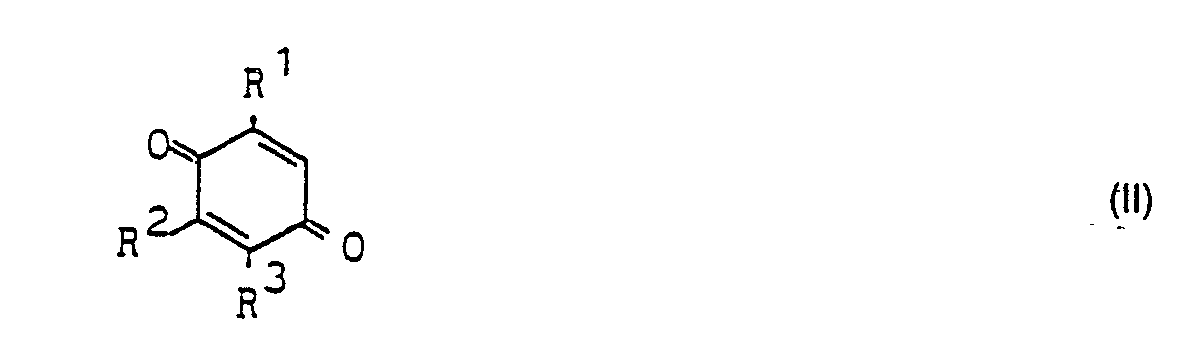

- Diese Ringschlußkondensation findet bei 40°-160°C, vorzugsweise 50-110°C, vorzugsweise in Gegenwart einer Säure, unter gleichzeitiger Wasserabspaltung leicht statt. Als Säuren eignen sich insbesondere Mineralsäuren wie Salzsäure und Phosphorsäure, wobei deren Konzentration zweckmäßigerweise so bemessen wird, daß das Reaktionsgemisch einen pH-Wert aufweist, der unter 1 liegt.
- Im allgemeinen empfiehlt es sich, die Umsetzung von II und III in Gegenwart eines Lösungs- oder Verdünnungsmittels vorzunehmen, wobei Wasser bevorzugt wird. Weiterhin kommen wasserlösliche Lösungsmittel wie Alkohole, Tetrahydrofuran und Dioxan sowie deren Mischungen mit Wasser in Betracht. Auch nicht wassermischbare Lösungsmittel wie Toluol, Petrolether und Chlorbenzol können verwendet werden.
- Zur Synthese derjenigen Verbindungen I, in denen R4 einen der definitionsgemäßen Kohlenwasserstoffreste bedeutet, kann man auf die vorgenannte Verfahrensweise zunächst auch eine der übrigen Verbindungen I mit m = 1 herstellen, also eine solche mit der Seitenkettengruppierung
- ―CH2―OH
- ―CH2―SH oder
- ―CH2―Hal (Hal = Halogen, insbesondere CI und Br), die dann anschließend in an sich bekannter Weise mit einer Verbindung IV

- Sollen beispielsweise Verbindungen I mit Ether- oder Thioethergruppierung hergestellt werden, setzt man eine Verbindung I mit der Seitenkettengruppierung (―CH2―OH) bzw. (―CH2―SH) beispielsweise mit einer Halogenverbindung IV (Y = Halogen) oder einer olefinischen Verbindung IV (Y = ICH2 = CH-]) um, oder man läßt eine Verbindung I mit der Seitenkettengruppierung ―CH2―Hal umgekehrt mit einem Alkohol bzw. Thiol IV (Y = [HO-] bzw. [HS―]) reagieren.
- Verbindungen I mit der Estergruppierung ―CH2―O―CO― können z. B. durch Veresterung oder Umesterung (Y = [-COOH], [-CO Hai], [―CO―O―CH3]) hergestellt werden.
- Verlaufen die Verknüpfungsreaktionen unter Abspaltung von Säuren, z. B. von Halogenwasserstoffsäure, so empfiehlt es sich, diese mittels einer Base wie Natronlauge, Pyridin oder Trimethylamin zu binden, und handelt es sich um eine der übrigen Reaktionen wie die Addition an eine olefinische Gruppe oder um die Veresterung eines Alkohls mit einer Säure, so ist die Gegenwart einer starken Säure wie p-Toluolsulfonsäure oder eines sauren lonenaustauschers zweckmäßig.
- Im übrigen gehören die genannten Verknüpfungsreaktionen zu den Standardoperationen der präparativen Chemie, so daß nähere Erläuterungen hierzu entbehrlich sind.
- Bedeutet die Gruppierung (―Xn―R4) Halogen, kann man auch die entsprechende Hydroxyverbindung halogenieren.
- Die Ausgangsverbindungen II sind bekannt oder in bekannter Weise zugänglich (s. z. B. Houben-Weyl, « Methoden der Organischen Chemie, 4. Auflage, Band 7/3a, Seiten 23-596. Das gleiche gilt für die Thioglycole III (Houben-Weyl, 4. Auflage, Band 9, Seiten 22-23) und die mono- bzw. bifunktionellen Verbindungen IV.
- Da die Verbindungen I naturgemäß oxidationsempfindlich sind, ist es zweckmäßig, alle Operationen unter Schutzgasatmosphäre, beispielsweise unter Stickstoff, vorzunehmen.
- Under den Verbindungen I werden diejenigen bevorzugt, in denen Rl-R3 Methyl bedeuten, die einen aliphatischen C2- bis C18-Kohlenwasserstoffrest als Rest R4 im Molekül enthalten und in denen n für 1 steht. Da weiterhin gefunden wurde, daß Schwefel in Thioether- und Thiolfunktion den antioxidativen Effekt verstärkt, werden die definitionsgemäßen schwefelhaltigen Kohlenwasserstoffe als Reste R4 bevorzugt. Solche Reste sind beispielsweise ―CH2―SH, ―CH2―CH2―S―CH2―CH2― und ―CH(SH)―CH3.
- Die erfindungsgemäßen Verbindungen I eignen sich hervorragend als Antioxidantien zur Stabilisierung von organischen Materialien gegen oxidative und thermisch-oxidative Einflüsse. Solche Materialien sind beispielsweise Kunststoffe, Lebens- und Futtermittel und besonders empfindliche Stoffe wie Farbstoffe, Vitamine, ungesättigte Fette sowie pharmazeutische, veterinärmedizinische und kosmetische Wirkstoffe und Zubereitungen.
- Die Konzentration von I in den organischen Materialien liegt allgemein zwischen 0,005 unf 50 Gew.%. Im Falle von Kunststoffen, Lebens- und Futtermitteln reichen Konzentrationen zwischen 0,005 und 1 Gew.% normalerweise aus, wogegen sie im Falle von Vitaminen und ähnlichen hochempfindlichen Stoffen bis zu 50 Gew.% betragen können.
- Bei Kunststoffen, vor allem bei Polypropylen, bewirken die Verbindungen I nicht nur eine deutliche Erhöhung der Alterungsbeständigkeit sondern auch der Verarbeitungsstabilität.
- Der antioxidative Effekt der Verbindungen I wird, wie weiterhin gefunden wurde, von aliphafischen und cycloaliphatischen Polyolen als Synergisten verstärkt. Solche Polyole, die mindestens 2, vorzugsweise 3-6 freie alkoholische Hydroxylgruppen im Molekül enthalten sollen, sind beispielsweise Ethylenglykol, Glycerin und Trimethylolpropan sowie vor allem Zucker und hydrierte Zucker wie Sorbit. Die Hydroxylgruppen der Polyole können auch z. T. mit Alkanolen verethert oder mit Fettsäuren verestert sein.
- Die Konzentration der Polyole in den organischen Materialien liegt zwischen 0,005 und 90 Gew.%, wobei die Summe der Konzentrationen von I und den Polyolen bis zu 99 Gew.% betragen kann. Im Falle weniger empfindlicher Materialien wie Kunststoffen und Lebens- und Futtermitteln beträgt die Konzentration von etwa 0,001-0,3 Gew.%, wobei das Verhältnis der Konzentration von I und der Polyole vorzugsweise zwischen 1 :1 und 1 :10 liegt.
- Die Verbindungen I bereichem ferner die Synthesemöglichkeiten zur Herstelung tocopherolähnlicher Substanzen.
- Im folgenden werden der Rest


- Eine Lösung aus 151 g (1,4 mol) Propan-1,2-diol-3-thiol, 1 I Wasser und 25 ml konzentrierter Salzsäure wurde unter Stickstoffatmosphäre bei 50 °C mit 150 g (1,0 mol) geschmolzenem Trimethylchinon versetzt und 2,5 h zum Sieden erhitzt. Beim anschließenden Abkühlen- fiel die oben gennante Verbindung in Form beigeweißer Kristalle an.
- Die Kristalle wurden abgetrennt, mit warmem und kaltem Wasser gewaschen, über Calciumchlorid getrocknet und aus 500 ml Acetonitril umkristallisiert ; Ausbeute 177 g. Aus der Mutterlauge wurden weitere 46 g des Produktes gewonnen, so daß die Gesamtausbeute 92 % betrug ; Smp. 118-120°C.
- 48 g (0,2 mol) des Verfahrensproduktes von Beispiel 1 wurden portionsweise zu einem Bromierungsreagens gegeben, welches aus 55 g (0,21 mol) Triphenylphosphin, 1 I trockenem Methylenchlorid und 34 g (0,212 mol) Brom bereitet worden war. Die dunkelbraune Lösung wurde 3 h auf Siedetemperatur erwärmt (ca. 40 °C) erwärmt und sodann in 1 I einer 5 Gew.%igen Natriumhydrogencarbonatlösung eingerührt.
- Danach wurde die organische Phase abgetrennt, mit verdünnter NaCI-Lösung gewaschen, mit NaPS04 getrocknet und im Vakuum-Rotationsverdampfer eingedampft. Der Rückstand wurde mit 250 ml Diethylether aufgenommen, wobei sich Triphenylphosphinoxid abschied. Die verbleibende organische Phase wurde eingeengt und mit 200 ml eines Gemisches aus 3 Vol.-Teilen Cyclohexan und 1 Vol.-Teil Ethylacetat aufgenommen, über Kieselgel filtriert und mit ca. 2 I desselben Lösungsmittelgemisches nachgewaschen. Beim Einengen des Filtrates fiel die obengennante Bromverbindung in Form bräunlicher Kristalle aus, die nach Auskochen mit Petrolether einen Smp. von 87-88 °C hatten ; Ausbeute 75 %.
- Eine Lösung aus 30,2 g (0,28 mol) Propan-1,2-diol-3-thiol, 200 ml Wasser und 5 ml konzentrierter Salzsäure wurde bei 50 °C unter Stickstoffatmosphäre portionsweise mit 34,4 g (0,2 mol) gepulvertem 2-Methyl-1,4-naphthochinon versetzt und 2 h zum Sieden erhitzt. Danach wurde die wäßrige Phase bei 70 °C abgetrennt und die verbleibende Schmelze zweimal bei dieser Temperatur mit dem gleichen Volumen Wasser gewaschen. Beim anschließenden Suspendieren in kaltem Wasser fiel das Produkt als hellgraue Kristallmsse an, die abgetrennt und nach dem Trocknen über CaCI2 aus 200 ml Acetonitril umkristallisiert wurde. Hellgraue bis farblose Kristalle, Smp. 142-144 °C, Ausbeute rd. 70 %.
- Dieser Verbindung wurde auf die im Beispiel 1 beschriebene Weise aus Trimethylchinon und Propane-2-ol-1-thiol in 60 %iger Ausbeute hergestellt ; Smp. 86-87 °C.
- 24 g (0,1 mol) des Verfahrensproduktes von Beispiel 1 wurden unter Stickstoffatmosphäre zusammen mit 8,9 g (0,05 mol) Thiodipropionsäure und 0,5 g p-Toluolsulfonsäure in 50 ml Toluol erhitzt, wobei das Wasser ausgekreist wurde. Nach 3 bis 4 h wurde das Gemisch abkühlt, wobei ein Teil des Produktes ausfiel. Das Gemisch wurde mit Methylenchlorid wieder in Lösung gebracht, mit verdünnter NaHCO3-Lösung ausgeschüttelt, mit Wasser gewaschen, getrocknet, mit 2 g Aktivkohle behandelt und im Vakuum-Rotationsverdampfer eigeengt. Der Rückstand wurde aus ca. 50 ml Isopropanol umkristallisiert; Ausbeute 62 % ; Smp. 81-83 °C.
- Diese Verbindung wurde analog Beispiel 6 aus der Verbindung A―CH2―OH und Stearinsäure in 61 %iger Ausbeute hergestellt ; Smp. 69-71 °C.
- Diese Verbindung wurde analog Beispiel 3 aus der Verbindung B―CH2―OH und Stearinsäure in 77 %iger Ausbeute hergestellt, beige Kristalle, Smp. 54-56 °C.
- Stabilisierende Wirkung verschiedener Antioxidantien in Schweineschmalz
- Schweineschmalz mit je einem Gehalt von 0,02 Gew.% verschiedener Antioxidantien wurde dem sogennanten Peroxid-Test (Oil and Soap, Band 15, 1938, S. 184) unterworfen, Hierbei wurden die Proben solange unter Luftzutritt bei 80 °C gelagert, bis sie eine Peroxidzahl (POZ) von 50 hatten. Je länger diese Zeit t dauert, desto wirksamer ist das Antioxidans.
- Die Versuchsergebnisse, die für sich selbst sprechen, sind in der Tabelle 1 zu entnehmen.

- Canthaxanthin, das als Zusatz zu Legehennenfutter dient, wurde mit 4 Gew.% des Antioxidans A―CH2―O―CO―C17H35 gemäß Beispiel 7 vermischt und mit Gelatine wie üblich zu einem Trockenpulver verarbeitet. Dieses Pulver wurde sodann in einer Konzentration von 200 ppm Wirkstoff mit handelsüblichem Legehennenfutter vermischt und 8 Wochen bei 40 °C und 70 % relativen Luftfeuchtigkeit gelagert, wonach der Canthaxanthin-Gehalt noch 66 % der ursprünglichen Konzentration betrug.
- In einer Vergleichsprobe ohne Zusatz eines Antioxidans war kein Canthaxanthin mehr nachweisbar, und bei Verwendung des Antioxidans gemäß Versuch 3 V in Tabelle 1 betrug der Wirkstoffgehalt nur noch 43%.
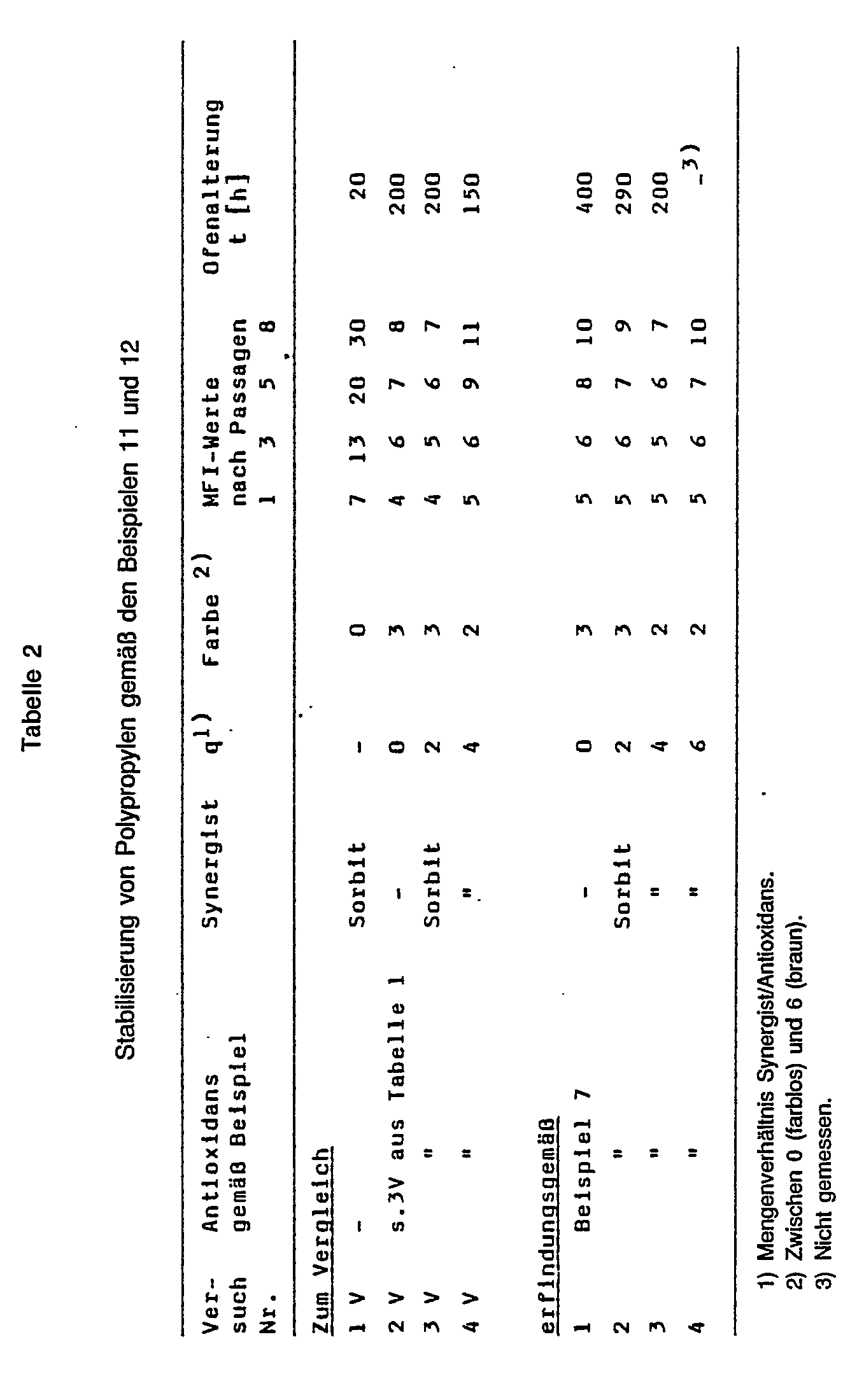
- Reines Polypropylenpulver des mittleren Molekulargewichtes 10 000 wurde mit jeweils 0,1 Gew.% eines Antioxidans bzw. einer Mischung verschiedener Antioxidantien vermischt und bei 250 °C extrudiert und zu Granulat zerkleinert. Extrusion und Granulierung wurden mehrfach wiederholt, wobei nach dem 1., 3., 5. und 8. dieser Vorgänge der Schmelzindex MFI der jeweiligen Granulatprobe bei 190 °C nach DIN 53 135 gemessen wurde. Je höher der Schmelzindex, desto größer ist der Abbau des Polypropylens infolge der thermischen Belastung bei der Extrusion und desto geringer ist die Verarbeitungsstabilität.
- Außerdem wurde die Färbung festgestellt, welche das Material nach der 8. Extrusion auswies.
- Die Ergebnisse der Versuche sind der Tabelle 2 zu entnehmen.
- Das Material gemäß Beispiel 11 wurde nach DIN 53 383 (Ofenalterung) bei 220 °C zunächst zu Granulat und sodann bei 220 °C zu Platten von 20 x 20 x 1 mm3 verarbeitet, die in einem Umluftwärmeschrank mit Frischluftzufuhr bei 140 °C gelagert wurden.
- Hierbei versprödeten die Platten, wobei jeweils die Zeit t festgestellt wurde, die einem bestimmten, für alle Versuche gleichen Versprödungsgrad entsprach. Diese Zeit ist nicht nur ein unmittelbares Maß für die Ofenalterung sondern indirekt auch für die Langzeitstabilität.
Claims (6)


Applications Claiming Priority (2)
| Application Number | Priority Date | Filing Date | Title |
|---|---|---|---|
| DE19843421977 DE3421977A1 (de) | 1984-06-14 | 1984-06-14 | 2,3-dihydrobenz-4-oxa-1-thiine |
| DE3421977 | 1984-06-14 |
Publications (3)
| Publication Number | Publication Date |
|---|---|
| EP0170822A2 EP0170822A2 (de) | 1986-02-12 |
| EP0170822A3 EP0170822A3 (en) | 1986-12-03 |
| EP0170822B1 true EP0170822B1 (de) | 1989-08-30 |
Family
ID=6238275
Family Applications (1)
| Application Number | Title | Priority Date | Filing Date |
|---|---|---|---|
| EP85107111A Expired EP0170822B1 (de) | 1984-06-14 | 1985-06-10 | 2,3-Dihydrobenz-4-oxa-1-thiine |
Country Status (5)
| Country | Link |
|---|---|
| US (1) | US4621109A (de) |
| EP (1) | EP0170822B1 (de) |
| JP (1) | JPS6122078A (de) |
| CA (1) | CA1242734A (de) |
| DE (2) | DE3421977A1 (de) |
Families Citing this family (1)
| Publication number | Priority date | Publication date | Assignee | Title |
|---|---|---|---|---|
| EP2276754B1 (de) | 2008-04-17 | 2014-12-03 | Basf Se | Stabilisierung und oberflächenveränderung organischer stoffe |
Family Cites Families (3)
| Publication number | Priority date | Publication date | Assignee | Title |
|---|---|---|---|---|
| GB731495A (en) * | 1952-07-16 | 1955-06-08 | Bayer Ag | Heterocyclic ether-sulphones |
| DE1167851B (de) * | 1958-11-14 | 1964-04-16 | Thomae Gmbh Dr K | Verfahren zur Herstellung von basisch substituierten Benzo-1, 4-thioxanen |
| DE3010505A1 (de) * | 1980-03-19 | 1981-10-01 | Basf Ag, 6700 Ludwigshafen | Chromanderivate, verfahren zu ihrer herstellung, ihre verwendung als stabilisatoren von organischen materialien sowie diese stabilisatoren enthaltende organische materialien |
-
1984
- 1984-06-14 DE DE19843421977 patent/DE3421977A1/de not_active Withdrawn
-
1985
- 1985-06-10 EP EP85107111A patent/EP0170822B1/de not_active Expired
- 1985-06-10 DE DE8585107111T patent/DE3572662D1/de not_active Expired
- 1985-06-11 US US06/743,682 patent/US4621109A/en not_active Expired - Fee Related
- 1985-06-12 CA CA000483820A patent/CA1242734A/en not_active Expired
- 1985-06-14 JP JP60128381A patent/JPS6122078A/ja active Pending
Also Published As
| Publication number | Publication date |
|---|---|
| EP0170822A2 (de) | 1986-02-12 |
| JPS6122078A (ja) | 1986-01-30 |
| US4621109A (en) | 1986-11-04 |
| DE3572662D1 (de) | 1989-10-05 |
| CA1242734A (en) | 1988-10-04 |
| EP0170822A3 (en) | 1986-12-03 |
| DE3421977A1 (de) | 1985-12-19 |
Similar Documents
| Publication | Publication Date | Title |
|---|---|---|
| EP0036169B1 (de) | Chromanderivate, Verfahren zu ihrer Herstellung, ihre Verwendung als Stabilisatoren von organischen Materialien sowie diese Stabilisatoren enthaltende organische Materialien | |
| DE69033299T2 (de) | Verwendung von Carnosolsäure wegen seiner anticarcinogenen und antiviralen Eigenschaften | |
| DE2451934C2 (de) | 1,9-Dihydroxy- und l,9-Dialkanoyloxy-3alkyl- | |
| DE2714263A1 (de) | Pharmazeutische zubereitungen, enthaltend triazolopyrimidine | |
| DE69527980T2 (de) | Chalcone und ihre ester mit antiproliferativer aktivität in gebärmutter, ovar- und brusttumoren | |
| DE2858733C2 (de) | ||
| EP0057427B1 (de) | Chromanderivate | |
| DE3587499T2 (de) | Primycinkomponenten und verfahren zur trennung des antibiotischen komplexes. | |
| DE3221170C2 (de) | ||
| CH621780A5 (de) | ||
| EP0170822A2 (de) | 2,3-Dihydrobenz-4-oxa-1-thiine | |
| DE2302935A1 (de) | Semi-synthetische antibiotika mit makrocyclischer lactonstruktur | |
| DE69016914T2 (de) | Phospholipidderivate. | |
| CH678853A5 (de) | ||
| DE60112482T2 (de) | Verbindungen mit antioxidierender Wirkung, diese enthaltende Zusammensetzungen zur Nahrungsmittelergänzung sowie Verfahren zu deren Herstellung | |
| DE2229950A1 (de) | Verfahren zur Herstellung von Alkyl-7-deoxy-7RS tief n -alpha-thiolincosaminiden | |
| DE3882623T2 (de) | Phosphorsaeurediester und salze davon. | |
| CH639373A5 (de) | N-alkenylmoranolin derivate. | |
| DE2632115C2 (de) | ||
| DE3041130C2 (de) | ||
| EP0007347B1 (de) | Lipidsenkende Alkylenglykolderivate und Verfahren zu ihrer Herstellung | |
| DE3045288C2 (de) | ||
| EP0268039B1 (de) | Ester von 3-tert.Butyl- bzw. 3-tert.-Butyl-5-alkyl-4-hydroxyphenyl-(alkan-)-carbonsäuren mit Oxethylaten von Polythiolen, Verfahren zu ihrer Herstellung und ihre Verwendung als Stabilisatoren | |
| EP0473825A1 (de) | Nicht-solvatierte Kristallform "A" des 3-(-4-Cinnamyl-1-piperazinyl)-iminomethylrifamyzins SV und Verfahren zu seiner Herstellung | |
| EP0183194A2 (de) | Menadioncholinbisulfit-Addukt und Verfahren zu dessen Herstellung |
Legal Events
| Date | Code | Title | Description |
|---|---|---|---|
| PUAI | Public reference made under article 153(3) epc to a published international application that has entered the european phase |
Free format text: ORIGINAL CODE: 0009012 |
|
| AK | Designated contracting states |
Designated state(s): BE CH DE FR GB IT LI NL |
|
| PUAL | Search report despatched |
Free format text: ORIGINAL CODE: 0009013 |
|
| AK | Designated contracting states |
Kind code of ref document: A3 Designated state(s): BE CH DE FR GB IT LI NL |
|
| 17P | Request for examination filed |
Effective date: 19861031 |
|
| 17Q | First examination report despatched |
Effective date: 19871123 |
|
| GRAA | (expected) grant |
Free format text: ORIGINAL CODE: 0009210 |
|
| AK | Designated contracting states |
Kind code of ref document: B1 Designated state(s): BE CH DE FR GB IT LI NL |
|
| ITF | It: translation for a ep patent filed | ||
| REF | Corresponds to: |
Ref document number: 3572662 Country of ref document: DE Date of ref document: 19891005 |
|
| GBT | Gb: translation of ep patent filed (gb section 77(6)(a)/1977) | ||
| ET | Fr: translation filed | ||
| PLBE | No opposition filed within time limit |
Free format text: ORIGINAL CODE: 0009261 |
|
| STAA | Information on the status of an ep patent application or granted ep patent |
Free format text: STATUS: NO OPPOSITION FILED WITHIN TIME LIMIT |
|
| 26N | No opposition filed | ||
| PGFP | Annual fee paid to national office [announced via postgrant information from national office to epo] |
Ref country code: FR Payment date: 19910515 Year of fee payment: 7 Ref country code: CH Payment date: 19910515 Year of fee payment: 7 |
|
| PGFP | Annual fee paid to national office [announced via postgrant information from national office to epo] |
Ref country code: BE Payment date: 19910527 Year of fee payment: 7 |
|
| PGFP | Annual fee paid to national office [announced via postgrant information from national office to epo] |
Ref country code: GB Payment date: 19910603 Year of fee payment: 7 |
|
| PGFP | Annual fee paid to national office [announced via postgrant information from national office to epo] |
Ref country code: DE Payment date: 19910619 Year of fee payment: 7 |
|
| ITTA | It: last paid annual fee | ||
| PGFP | Annual fee paid to national office [announced via postgrant information from national office to epo] |
Ref country code: NL Payment date: 19910630 Year of fee payment: 7 |
|
| PG25 | Lapsed in a contracting state [announced via postgrant information from national office to epo] |
Ref country code: GB Effective date: 19920610 |
|
| PG25 | Lapsed in a contracting state [announced via postgrant information from national office to epo] |
Ref country code: DE Effective date: 19920623 |
|
| PG25 | Lapsed in a contracting state [announced via postgrant information from national office to epo] |
Ref country code: LI Effective date: 19920630 Ref country code: CH Effective date: 19920630 Ref country code: BE Effective date: 19920630 |
|
| BERE | Be: lapsed |
Owner name: BASF A.G. Effective date: 19920630 |
|
| PG25 | Lapsed in a contracting state [announced via postgrant information from national office to epo] |
Ref country code: NL Effective date: 19930101 |
|
| GBPC | Gb: european patent ceased through non-payment of renewal fee |
Effective date: 19920610 |
|
| NLV4 | Nl: lapsed or anulled due to non-payment of the annual fee | ||
| PG25 | Lapsed in a contracting state [announced via postgrant information from national office to epo] |
Ref country code: FR Effective date: 19930226 |
|
| REG | Reference to a national code |
Ref country code: CH Ref legal event code: PL |
|
| REG | Reference to a national code |
Ref country code: FR Ref legal event code: ST |