EP0170034B1 - Verfahren zur Herstellung von Chlor-phenyl-phosphanen - Google Patents
Verfahren zur Herstellung von Chlor-phenyl-phosphanen Download PDFInfo
- Publication number
- EP0170034B1 EP0170034B1 EP85107671A EP85107671A EP0170034B1 EP 0170034 B1 EP0170034 B1 EP 0170034B1 EP 85107671 A EP85107671 A EP 85107671A EP 85107671 A EP85107671 A EP 85107671A EP 0170034 B1 EP0170034 B1 EP 0170034B1
- Authority
- EP
- European Patent Office
- Prior art keywords
- triphenylphosphine
- reaction
- dichloride
- chlorodiphenylphosphine
- phenyl
- Prior art date
- Legal status (The legal status is an assumption and is not a legal conclusion. Google has not performed a legal analysis and makes no representation as to the accuracy of the status listed.)
- Expired
Links
- YYDZNOUMWKJXMG-UHFFFAOYSA-N chloro(phenyl)phosphane Chemical class ClPC1=CC=CC=C1 YYDZNOUMWKJXMG-UHFFFAOYSA-N 0.000 title claims description 8
- 238000004519 manufacturing process Methods 0.000 title description 3
- RIOQSEWOXXDEQQ-UHFFFAOYSA-N triphenylphosphine Chemical compound C1=CC=CC=C1P(C=1C=CC=CC=1)C1=CC=CC=C1 RIOQSEWOXXDEQQ-UHFFFAOYSA-N 0.000 claims description 45
- 238000006243 chemical reaction Methods 0.000 claims description 24
- XGRJZXREYAXTGV-UHFFFAOYSA-N chlorodiphenylphosphine Chemical compound C=1C=CC=CC=1P(Cl)C1=CC=CC=C1 XGRJZXREYAXTGV-UHFFFAOYSA-N 0.000 claims description 22
- 238000000034 method Methods 0.000 claims description 19
- 125000003118 aryl group Chemical group 0.000 claims description 10
- 239000002253 acid Substances 0.000 claims description 5
- 150000001805 chlorine compounds Chemical class 0.000 claims description 5
- 238000002360 preparation method Methods 0.000 claims description 2
- QPQGTZMAQRXCJW-UHFFFAOYSA-N [chloro(phenyl)phosphoryl]benzene Chemical compound C=1C=CC=CC=1P(=O)(Cl)C1=CC=CC=C1 QPQGTZMAQRXCJW-UHFFFAOYSA-N 0.000 description 15
- 150000001875 compounds Chemical class 0.000 description 12
- IMDXZWRLUZPMDH-UHFFFAOYSA-N dichlorophenylphosphine Chemical compound ClP(Cl)C1=CC=CC=C1 IMDXZWRLUZPMDH-UHFFFAOYSA-N 0.000 description 12
- IBDMRHDXAQZJAP-UHFFFAOYSA-N dichlorophosphorylbenzene Chemical compound ClP(Cl)(=O)C1=CC=CC=C1 IBDMRHDXAQZJAP-UHFFFAOYSA-N 0.000 description 10
- 239000007858 starting material Substances 0.000 description 10
- XYFCBTPGUUZFHI-UHFFFAOYSA-N Phosphine Chemical compound P XYFCBTPGUUZFHI-UHFFFAOYSA-N 0.000 description 8
- 238000006392 deoxygenation reaction Methods 0.000 description 7
- FAIAAWCVCHQXDN-UHFFFAOYSA-N phosphorus trichloride Chemical compound ClP(Cl)Cl FAIAAWCVCHQXDN-UHFFFAOYSA-N 0.000 description 7
- FIQMHBFVRAXMOP-UHFFFAOYSA-N triphenylphosphane oxide Chemical group C=1C=CC=CC=1P(C=1C=CC=CC=1)(=O)C1=CC=CC=C1 FIQMHBFVRAXMOP-UHFFFAOYSA-N 0.000 description 7
- -1 aromatic phosphorus-chlorine compounds Chemical class 0.000 description 6
- 125000001931 aliphatic group Chemical group 0.000 description 5
- 150000007513 acids Chemical class 0.000 description 4
- 125000001997 phenyl group Chemical group [H]C1=C([H])C([H])=C(*)C([H])=C1[H] 0.000 description 4
- 229910000073 phosphorus hydride Inorganic materials 0.000 description 4
- 239000011541 reaction mixture Substances 0.000 description 4
- VGXKCBXTQFGNJF-UHFFFAOYSA-N ClP(Cl)=O.C1=CC=CC=C1 Chemical compound ClP(Cl)=O.C1=CC=CC=C1 VGXKCBXTQFGNJF-UHFFFAOYSA-N 0.000 description 3
- 238000004821 distillation Methods 0.000 description 3
- 239000000203 mixture Substances 0.000 description 3
- OWGJXSYVHQEVHS-UHFFFAOYSA-N 1-dichlorophosphorylethane Chemical compound CCP(Cl)(Cl)=O OWGJXSYVHQEVHS-UHFFFAOYSA-N 0.000 description 2
- NJLHHACGWKAWKL-UHFFFAOYSA-N ClP(Cl)=O Chemical class ClP(Cl)=O NJLHHACGWKAWKL-UHFFFAOYSA-N 0.000 description 2
- 101000939500 Homo sapiens UBX domain-containing protein 11 Proteins 0.000 description 2
- QLZHNIAADXEJJP-UHFFFAOYSA-N Phenylphosphonic acid Chemical compound OP(O)(=O)C1=CC=CC=C1 QLZHNIAADXEJJP-UHFFFAOYSA-N 0.000 description 2
- 102100029645 UBX domain-containing protein 11 Human genes 0.000 description 2
- QARVLSVVCXYDNA-UHFFFAOYSA-N bromobenzene Chemical compound BrC1=CC=CC=C1 QARVLSVVCXYDNA-UHFFFAOYSA-N 0.000 description 2
- 239000003054 catalyst Substances 0.000 description 2
- 230000000052 comparative effect Effects 0.000 description 2
- JHNJGLVSPIMBLD-UHFFFAOYSA-N dichloro(ethyl)phosphane Chemical compound CCP(Cl)Cl JHNJGLVSPIMBLD-UHFFFAOYSA-N 0.000 description 2
- LWNLXVXSCCLRRZ-UHFFFAOYSA-N dichlorophosphane Chemical class ClPCl LWNLXVXSCCLRRZ-UHFFFAOYSA-N 0.000 description 2
- 125000000623 heterocyclic group Chemical group 0.000 description 2
- SCLFRABIDYGTAZ-UHFFFAOYSA-N methylphosphonic acid dichloride Chemical compound CP(Cl)(Cl)=O SCLFRABIDYGTAZ-UHFFFAOYSA-N 0.000 description 2
- 238000001394 phosphorus-31 nuclear magnetic resonance spectrum Methods 0.000 description 2
- 238000010992 reflux Methods 0.000 description 2
- 230000007704 transition Effects 0.000 description 2
- 239000004952 Polyamide Substances 0.000 description 1
- 241001620634 Roger Species 0.000 description 1
- PWKWDCOTNGQLID-UHFFFAOYSA-N [N].[Ar] Chemical compound [N].[Ar] PWKWDCOTNGQLID-UHFFFAOYSA-N 0.000 description 1
- 238000005904 alkaline hydrolysis reaction Methods 0.000 description 1
- 239000012298 atmosphere Substances 0.000 description 1
- QVGXLLKOCUKJST-UHFFFAOYSA-N atomic oxygen Chemical compound [O] QVGXLLKOCUKJST-UHFFFAOYSA-N 0.000 description 1
- 238000005660 chlorination reaction Methods 0.000 description 1
- 239000000460 chlorine Substances 0.000 description 1
- 239000013065 commercial product Substances 0.000 description 1
- 238000001816 cooling Methods 0.000 description 1
- 238000011161 development Methods 0.000 description 1
- SXIWNIQDOJKDGB-UHFFFAOYSA-N dichloro-phenyl-sulfanylidene-$l^{5}-phosphane Chemical compound ClP(Cl)(=S)C1=CC=CC=C1 SXIWNIQDOJKDGB-UHFFFAOYSA-N 0.000 description 1
- 238000005516 engineering process Methods 0.000 description 1
- 238000002474 experimental method Methods 0.000 description 1
- 238000010438 heat treatment Methods 0.000 description 1
- 239000008240 homogeneous mixture Substances 0.000 description 1
- KNQVWTDLQQGKSV-UHFFFAOYSA-O hydroxy-oxo-phenylphosphanium Chemical compound O[P+](=O)C1=CC=CC=C1 KNQVWTDLQQGKSV-UHFFFAOYSA-O 0.000 description 1
- 239000011261 inert gas Substances 0.000 description 1
- 239000000543 intermediate Substances 0.000 description 1
- 238000011835 investigation Methods 0.000 description 1
- 238000005259 measurement Methods 0.000 description 1
- 239000012299 nitrogen atmosphere Substances 0.000 description 1
- MPQXHAGKBWFSNV-UHFFFAOYSA-N oxidophosphanium Chemical class [PH3]=O MPQXHAGKBWFSNV-UHFFFAOYSA-N 0.000 description 1
- 239000001301 oxygen Substances 0.000 description 1
- 229910052760 oxygen Inorganic materials 0.000 description 1
- 239000004476 plant protection product Substances 0.000 description 1
- 229920002647 polyamide Polymers 0.000 description 1
- 229920000642 polymer Polymers 0.000 description 1
- 239000000047 product Substances 0.000 description 1
- 150000003839 salts Chemical class 0.000 description 1
- 239000002904 solvent Substances 0.000 description 1
- 239000003381 stabilizer Substances 0.000 description 1
- 150000004763 sulfides Chemical class 0.000 description 1
- TUQOTMZNTHZOKS-UHFFFAOYSA-N tributylphosphine Chemical compound CCCCP(CCCC)CCCC TUQOTMZNTHZOKS-UHFFFAOYSA-N 0.000 description 1
- BDZBKCUKTQZUTL-UHFFFAOYSA-N triethyl phosphite Chemical compound CCOP(OCC)OCC BDZBKCUKTQZUTL-UHFFFAOYSA-N 0.000 description 1
Classifications
-
- C—CHEMISTRY; METALLURGY
- C07—ORGANIC CHEMISTRY
- C07F—ACYCLIC, CARBOCYCLIC OR HETEROCYCLIC COMPOUNDS CONTAINING ELEMENTS OTHER THAN CARBON, HYDROGEN, HALOGEN, OXYGEN, NITROGEN, SULFUR, SELENIUM OR TELLURIUM
- C07F9/00—Compounds containing elements of Groups 5 or 15 of the Periodic Table
- C07F9/02—Phosphorus compounds
- C07F9/28—Phosphorus compounds with one or more P—C bonds
- C07F9/50—Organo-phosphines
- C07F9/52—Halophosphines
-
- C—CHEMISTRY; METALLURGY
- C07—ORGANIC CHEMISTRY
- C07F—ACYCLIC, CARBOCYCLIC OR HETEROCYCLIC COMPOUNDS CONTAINING ELEMENTS OTHER THAN CARBON, HYDROGEN, HALOGEN, OXYGEN, NITROGEN, SULFUR, SELENIUM OR TELLURIUM
- C07F9/00—Compounds containing elements of Groups 5 or 15 of the Periodic Table
- C07F9/02—Phosphorus compounds
- C07F9/28—Phosphorus compounds with one or more P—C bonds
- C07F9/50—Organo-phosphines
- C07F9/53—Organo-phosphine oxides; Organo-phosphine thioxides
- C07F9/5325—Aromatic phosphine oxides or thioxides (P-C aromatic linkage)
Definitions
- Plant protection products are obtained, for example - starting from dichlorophenylphosphine - via the phenylthiophosphonic acid dichloride C 6 H s P (S) C) 2 .
- benzenephosphonous acid C 6 H r P (O) (OH) H is also available in a known manner, which, by itself or in the form of its salts, is of considerable economic importance as a stabilizer for polyamides.
- triphenylphosphine also converts with dichlorophenylphosphine to chlorodiphenylphosphine (DE-A-3 216 379):
- Aliphatic chlorophosphanes can also be obtained, inter alia, by deoxygenation of the chlorides of aliphatic PO acids.
- So z. B. according to the method disclosed in SU copyright certificate 362026 methylphosphonic dichloride with an aliphatic phosphine - especially with tri-n-butylphosphane (nC 4 H 9 ) 3 P and tri-i-amylphosphine (iC 5 H 11 ) 3 P - at temperatures implemented between 175 and 220 ° C, the oxygen of the methylphosphonic dichloride being transferred to the aliphatic phosphine.
- the implementation is based on the following reaction equation:
- R 2 aliphatic radical are aromatic (or heterocyclic) aliphatic phosphinic acid chlorides
- R 2 CI around aromatic (or heterocyclic) phosphonic acid dichlorides.
- diphenylphosphinoyl chloride C 6 H S j 2 P (O) CI can be deoxygenated by means of triphenylphosphine to chlorodiphenylphosphine; the chlorodiphenylphosphine can in turn then deoxygenate the dichloride of benzenephosphonic acid to dichloro -phenyl-phosphane can be used.
- the yields of the two individual reactions a) and b) are consistently between about 60 and 100% of theory. Th.
- the starting materials of the individual reaction b) (benzenephosphonic dichloride and chloro-diphenylphosphane) fall purely formally under the general formulas of the starting materials for the process according to DE-A-32 44 031; as has only now been found through intensive investigation and reworking of this reaction, as in the process of DE-A-32 44 031 typical C 6 H 5 -CI exchange reaction in the case of heating benzenephosphonic acid dichloride with chlorodiphenylphosphine, is found only in extraordinary subordinate Measure instead.
- the reaction that takes place practically exclusively here is the deoxygenation of benzene phosphonic acid dichloride.
- the starting compounds for the process according to the invention are diphenylphosphinic acid chloride and triphenylphosphine or benzenephosphonic dichloride and chlorodiphenylphosphine.
- Diphenylphosphinic acid chloride is e.g. B. obtained by alkaline hydrolysis of triphenylphosphine oxide and subsequent chlorination, for example with SOCI 2 .
- Triphenylphosphine is a common commercial product, the production of which hardly needs to be reported.
- Benzene phosphonic acid dichloride is easily e.g. B. by reaction of bromobenzene with triethyl phosphite / Ni catalyst with subsequent action of COCI 2 or SOCI 2 available.
- Chlorodiphenylphosphine is accessible by deoxygenation of diphenylphosphinoyl chloride according to individual reaction a) of the process according to the invention or, if appropriate, also by the methods of the prior art mentioned at the beginning.
- the starting compounds diphenylphosphinoyl chloride and triphenylphosphine or benzenephosphonic dichloride and chlorodiphenylphosphine are first mixed.
- diphenylphosphinic acid chloride and triphenylphosphine homogeneous mixtures may only arise at higher temperatures.
- the components are advantageously used in a stoichiometric molar ratio of approximately 1: 1. However, excesses of one or the other component are possible, an excess of the oxygen-absorbing compound being expedient.
- the mixture of the starting materials is preferably reacted under excess pressure, in particular under the (autogenous) pressure which arises in a closed reaction vessel.
- the response time here is between about one and thirty hours.
- the mixture of starting materials is preferably reacted at atmospheric pressure.
- the mixture of the starting materials is expediently metered into a heated reaction zone with the aid of a metering device.
- a reaction zone is, for. B. an electrically heated pipe.
- the reaction mixture emerging from the reaction zone is collected in a receiver. It can be advantageous to cool.
- the response times here are practically of the order of seconds or minutes.
- the process can be carried out continuously or batchwise.
- reaction mixtures are worked up in the customary manner, for. B. with the help of distillation processes.
- triphenylphosphine oxide When triphenylphosphine oxide is obtained, its tendency to crystallize can also be used to crystallize off the main amount of triphenylphosphane oxide (if appropriate using a suitable solvent).
- the invention represents a considerable enrichment of the technology.
Landscapes
- Chemical & Material Sciences (AREA)
- Organic Chemistry (AREA)
- Health & Medical Sciences (AREA)
- Life Sciences & Earth Sciences (AREA)
- Biochemistry (AREA)
- General Health & Medical Sciences (AREA)
- Molecular Biology (AREA)
Description
- Die Erfindung bezieht sich auf ein verbessertes Verfahren zur Herstellung von Chlor-phenyl-phosphanen. Unter Chlorphenyl-phosphanen werden hier die unter die allgemeine Formel

fallenden beiden Verbindungen Dichlor-phenyl-phosphan

- Sie sind hauptsächlich wertvolle Zwischenprodukte auf verschiedenen Sachgebieten wie z. B. dem Pflanzenschutz- und Polymeren-Sektor.
- Zu Pflanzenschutzmitteln kommt man beispielsweise - ausgehend von Dichlor-Phenyl-phosphan - auf dem Weg über das Phenylthiophosphonsäuredichlorid C6HsP(S)C)2. Aus Dichlor-phenyl-phosphan ist weiterhin auf bekannte Weise etwa auch benzolphosphonige Säure C6HrP(O) (OH)H erhältlich, die für sich oder in Form ihrer Salze als Stabilisator für Polyamide von erheblicher wirtschaftlicher Bedeutung ist.
- Aus Chlor-diphenyl-phosphan lassen sich auf dem Weg über die entsprechenden Diphenylphosphinigsäureester (C6H5)2POR (R=organischer Rest) z. B. Acylphosphanoxidverbindungen herstellen die als Photoinitiatoren für photopolymerisierbare Messen geeignet sind (EP-A-7508).
- Zur Herstellung der Chlor-phenyl-phosphane ist eine Reihe verschiedener Methoden bekannt. So werden z. B. nach dem in der DE-A-3 216 381 beschriebenen Verfahren Chlor-diphenyl-phosphan und Dichlor-phenyl-phosphan durch Umsetzung von Triphenylphosphan (C6Hs)sP mit Phosphortrichlorid PCI3 bei Temperaturen zwischen etwa 320 und 700 °C ohne den Zusatz irgendwelcher Katalysatoren erhalten ; die Umsetzung verläuft nach folgender Gleichung :

- Durch einen Überschuß an Triphenylphosphan (Molverhältnis Triphenylphosphan : Phosphortrichlorid ≥ 2 : 1) läßt sich die Reaktion in Richtung auf das Chlor-diphenylphosphan,
- durch einen Überschuß an Phosphortrichlorid (Molverhältnis Triphenylphosphan : Phosphortrichlorid = 1 : ≥ 2) in Richtung auf das Dichlor-phenyl-phosphan lenken ; hierfür sind folgende Reaktionsgleichungen maßgebend:
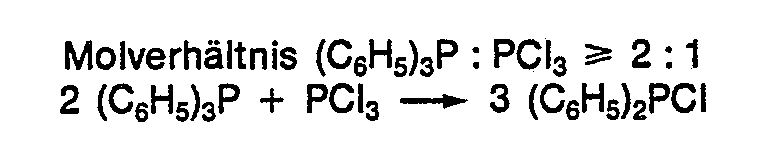

- Praktisch bei den gleichen Temperaturen setzt sich Triphenylphosphan auch mit Dichlor-phenyl-phosphan zu Chlordiphenyl-phosphan um (DE-A-3 216 379) :

- In ähnlicher Weise reagiert Phosphortrichlorid mit Chlor-diphenyl-phosphan zu Dichlor-phenyl-phosphan (DE-A-3 216 380) :

- Bei sämtlichen vorerwähnten Reaktionen wird eine Phenylgruppe der Phenylgruppen-reicheren P-Verbindung gegen ein CI-Atom der CI-reicheren P-Verbindung ausgetauscht.
- Ebenso auf dem Austausch von Phenylgruppen gegen CI-Atome beruht das in der DE-A-3244031 beschriebene Verfahren zur Herstellung aromatischer Phosphor-chlor-Verbindungen durch Umsetzung von Phosphanoxyden oder -sulfiden der Formel A)


- Wenn in den Verbindungen der Formel A) X = 0 und m = 3, handelt es sich um Triphenylphosphanoxyd ;
- wenn in den Verbindungen der Formel B) n = 3, resultiert das Phosphortrichlorid. Die Umsetzung des Triphenylphosphanoxyds mit Phosphortrichlorid liefert zunächst Chlordiphenyl-phosphanoxyd (= Diphenylphosphinsäurechlorid) und Dichlor-phenyl-phosphan :

- Das Dichlor-phenyl-phosphan kann sich mit weiterem Triphenylphosphanoxid zu Chlor-diphenylphosphanoxyd (= Diphenylphosphinsäurechlorid) und Chlor-diphenyl-phosphan umsetzen :

- Die Reaktion verläuft umso besser, je Phenylgruppen-reicher die Ausgangsverbindungen A) und je CI-reicher die anderen Ausgangsverbindung B) sind. Ein Ausführungsbeispiel für die Umsetzung etwa des Dichlor-phenyl-phosphanoxyds (= Verbindung der Formel A) mit X = 0 und m = 1 ;.= Benzolphosphonsäuredichlorid) mit Chlor-diphenyl-phosphan (= Verbindung der Formel B) mit n = 1) enthält die DE-A-32 44 031 nicht.
- Aliphatische Chlor-phosphane können u. a. auch durch Desoxygenierung der Chloride aliphatischer P-O-Säuren erhalten werden. So wird z. B. nach dem in dem SU-Urheberschein 362026 offenbarten Verfahren Methylphosphonsäuredichlorid mit einem aliphatischen Phosphan - speziell mit tri-n-butylphosphan (n-C4H9)3P und Tri-i-amylphosphan (i-C5H11)3P - bei Temperaturen zwischen 175 und 220 °C umgesetzt, wobei der Sauerstoff des Methylphosphonsäuredichlorids auf des aliphatische Phosphan übertragen wird. Der Umsetzung liegt folgende Reaktionsgleichung zu Grunde :

- Ersetzt man hier jedoch das aliphatische Phosphan durch das technisch besser zugängliche und billigere Triphenylphosphan, so wird - wie eigene Versuche gezeigt haben - nur eine für praktische Bedürfnisse unzureichende Ausbeute an Dichlor-alkyl-phosphan erhalten (weniger als 30 % d. Th.).
- Nach dem in der älteren, nicht vorveröffentlichen EP-A-122587 vorgeschlagenen Verfahren gelingt die Desoxygenierung mittels Triphenylphosphan dann, wenn man als zu desoxygenierende P-O-Verbindungen die Chloride von P-O-Säuren der folgenden Formel einsetzt :

- Für R2 = aliphatischer Rest handelt es sich um aromatisch- (oder heterocyclisch-) aliphatische Phosphinsäurechloride,
- für R2 = CI um aromatische (oder heterocyclische) Phosphonsäuredichloride.
- Durch diese Umsetzung, die normalerweise bei Temperaturen zwischen etwa 100 und etwa 350 °C abläuft, werden aromatische und heterocyclische Dichlorphosphane sowie aromatisch- und heterocyclisch-aliphatische Monochlorphosphane in Ausbeuten zwischen etwa 75 und 100 % d. Th. erhalten ; der Umsetzung liegt folgende Reaktionsgleichung zugrunde :

- Ein Chlor-phenyl-phosphan ist nach dieser Umsetzung dann erhältlich, wenn man als Ausgangsverbindung Benzolphosphonsäuredichlorid (= Verbindung der vorstehend angegebenen allgemeinen Formel mit R1 = C6H5 und R2 = CI) einsetzt:

- In weiterer Ausbildung dieser Desoxygenierungsreaktion wurde nun gefunden, daß sich auch Diphenylphosphinsäurechlorid (C6HSj2P(O)CI mittels Triphenylphosphan zu Chlordiphenyl-phosphan desoxygenieren läßt ; das Chlor-diphenylphosphan kann dann seinerseits wieder zur Desoxygenierung des Dichlorids der Benzolphosphonsäure zu Dichlor-phenyl-phosphan verwendet werden.
- Erfindungsgegenstand ist daher ein Verfahren zur Herstellung von Chlor-phenyl-phosphanen der Formel

- dadurch gekennzeichnet, daß man Chloride aromatischer P-O-Säuren der Formel

- im Falle n = 2 mit Triphenylphosphan, und
- im Falle n = 1 mit Chlor-diphenyl-phosphan
- bei Temperaturen zwischen 300 und 600 °C umsetzt. Dabei laufen folgende Desoxygenierungsreaktionen ab:


- Die Ausbeuten der beiden Einzelreaktionen a) und b) liegen durchweg zwischen etwa 60 und 100 % d. Th.
- Das Gelingen und die mit hoher Ausbeute verlaufende Desoxygenierung der Chloride rein aromatischer P-O-Säuren (Diphenylphosphinsäurechlorid, Benzolphosphonsäuredichlorid) mittels eines aromatischen Phosphans (Triphenyl-phosphan, Chlor-diphenyl-phosphan) waren überraschend, weil sich rein aliphatische Phosphonsäuredichloride mit dem (aromatischen) Triphenylphosphan nur sehr unvollständig zu den entsprechenden Dichlorphosphanen desoxygenieren lassen. Die Ausgangsstoffe der Einzelreaktion b) (Benzolphosphonsäuredichlorid und Chlor-diphenylphosphan) fallen zwar rein formal auch unter die allgemeinen Formeln der Ausgangsstoffe für das Verfahren gemäß DE-A-32 44 031 ; wie durch intensive Untersuchung und Nacharbeitung dieser Reaktion erst jetzt gefunden wurde, findet wie für das Verfahren der DE-A-32 44 031 typische C6H5-CI-Austauschreaktion im Falle des Erhitzens von Benzolphosphonsäuredichlorid mit Chlor-diphenyl-phosphan nur in außerordentlichen untergeordnetem Maß statt. Die hier praktisch ausschließlich ablaufende Reaktion ist die Desoxygenierung des Benzolphosphonsäuredichlorids.
- Die Ausgangsverbindungen für das erfindungsgemäße Verfahren sind Diphenylphosphinsäurechlorid und Triphenylphosphan bzw. Benzolphosphonsäuredichlorid und Chlordiphenyl-phosphan.
- Diphenylphosphinsäurechlorid wird z. B. durch alkalische Hydrolyse von Triphenylphosphanoxyd und nachfolgende Chlorierung beispielsweise mit SOCI2 erhalten.
- Triphenylphosphan ist ein gängiges Handelsprodukt, über dessen Herstellung kaum berichtet zu werden braucht.
- Benzolphosphonsäuredichlorid ist leicht z. B. durch Umsetzung von Brombenzol mit Triäthylphosphit/Ni-Katalysator mit nachfolgender Einwirkung von COCI2 oder SOCI2 erhältlich.
- Chlor-diphenyl-phosphan ist durch Desoxygenierung von Diphenylphosphinsäurechlorid gemäß Einzelreaktion a) des erfindungsgemäßen Verfahrens oder gegebenenfalls auch durch die eingangs erwähnten Methoden des Standes der Technik zugänglich.
- Zur Durchführung des erfindungsgemäßen Verfahrens werden die Ausgangsverbindungen Diphenylphosphinsäurechlorid und Triphenylphosphan bzw. Benzolphosphonsäuredichlorid und Chlor-diphenyl- phosphan zunächst vermischt. Insbesondere zwischen Diphenylphosphinsäurechlorid und Triphenyl- phosphan ergeben sich homogene Mischungen gegebenenfalls erst bei höheren Temperaturen. Die Komponenten werden zweckmäßig im stöchiometrischen Molverhältnis von etwa 1 : 1 eingesetzt. Überschüsse der einen oder anderen Komponente sind jedoch möglich, wobei ein Überschuß von der sauerstoffaufnehmenden Verbindung zweckmäßig ist.
- Im Temperaturbereich zwischen 300 und 500 °C, vorzugsweise zwischen 350 und 450 °C, wird das Gemisch der Ausgangsstoffe bevorzugt unter Überdruck, insbesondere unter dem sich in einem geschlossenen Reaktionsgefäß einstellenden (autogenen) Druck, umgesetzt. Die Reaktionszeit liegt hier zwischen etwa einer und dreißig Stunden.
- Im Temperaturbereich zwischen 500 und 600 °C, vorzugsweise zwischen 500 und 550 °C, wird das Gemisch der Ausgangstoffe bevorzugt bei Atmosphärendruck umgesetzt. Bei der Druckführung dieser Verfahrensvariante wird zweckmäßig das Gemisch der Ausgansstoffe mit Hilfe einer Dosiervorrichtung in eine geheizte Reaktionszone eindosiert. Als Reaktionszone eignet sich z. B. ein elektrisch geheiztes Rohr. Das aus der Reaktionszone austretende Reaktionsgemisch wird in einer Vorlage gesammelt. Dabei kann es vorteilhaft sein zu kühlen. Die Reaktionszeiten liegen hier praktisch nur in der Größenordnung von Sekunden oder Minuten.
- Es kann zweckmäßig sein, unter Inertgasatmosphäre (Stickstoff Argon, etc.) zu arbeiten, insbesondere bei der Verfahrensvariante, die bei 500 bis 600 °C durchgeführt wird.
- Sowohl die kontinuierliche als auch die diskontinuierliche Durchführung des Verfahrens sind möglich.
- Die Aufarbeitung der Reaktionsgemische erfolgt auf übliche Weise, z. B. mit Hilfe von Destillationsverfahren. Bei dem Anfall von Triphenylphosphanoxyd kann auch dessen Kristallisationstendenz genutzt werden, die Hauptmenge des anfallenden Triphenylphosphanoxyds (gegebenenfalls unter Verwendung eines geeigneten Lösungsmittels) kristallin abzutrennen.
- Wegen der leichten Zugänglichkeit der Ausgangsprodukte, der einfachen Durchführbarkeit der Reaktion sowie der hohen Ausbeuten an Chlor-phenyl-phosphanen stellt die Erfindung eine erhebliche Bereicherung der Technik dar.
- Die folgenden Beispiele sollen der weiteren Erläuterung der Erfindung dienen. Auf die Erfindungsbeispiele folgt noch ein Vergleichsbeispiel, welches zeigt, daß bei der Umsetzung eines aliphatischen Phosphonsäuredichlorids mit Triphenylphosphan nur relativ wenig Dichlorphosphan entsteht.
- 20 g (= 0,0846 mol) Diphenylphosphinsäurechlorid und 30 g (= 0,115 mol) Triphenylphosphan wurden 20 Stunden bei 400 °C in einem 90 ml-Druckrohr gehalten. Das anfallende Reaktionsgemisch wurde mit einer kleinen Kolonne andestilliert bei 26,6 Pa bis zu einer Innentemperatur von etwa 185 °C. Das Destillat betrug 32 g. Es enthielt auf Grund eines 31P-NMR-Spektrums unter anderem 30,1 % Chlor- diphenyl-phosphan und 15 % Diphenylphosphinsäurechlorid. Das entspricht bei einem Umsatz von 76 % einer Ausbeute von 68 % d. Th., bezogen auf eingesetztes Diphenylphosphinsäurechlorid.
- 20 g (= 0,1025 mol) Benzolphosphonsäuredichlorid und 40 g (= 0,1815 mol) Chlor-diphenyl- phosphan wurden 20 Stunden bei 370 °C in einem 90 ml-Druckrohr gehalten. Das anfallende Reaktionsgemisch wurde ohne Kolonne bei 26,6 Pa biz zu einer Innentemperatur von ca. 200 °C destilliert. Dabei wurden 55 g Destillat erhalten. Das Destillat bestand auf Grund eines 31P-NMR-Spektrum aus 30,9 % Dichlor-phenyl-phosphan, 28,9 % Chlor-diphenyl-phosphan, 31,8 % Diphenylphosphinsäurechlorid. 3.8% nicht umgesetztes Benzolphosphonsäuredichlorid, 1,5 % Triphenylphosphanoxid und 3,1 % Triphenylphosphan. Die angegebenen einzelnen Komponenten lassen sich destillativ trennen, 30,9 % von 55 g ergeben ca. 17 g Dichlor-phenyl-phosphan. Ohne Berücksichtigung des wiederzugewinnenden Benzolphosphonsäuredichlorids ergibt das eine Ausbeute von ca. 93 % d. Th., bezogen auf eingesetztes Benzolphosphonsäuredichtorid.
- 67.2 g (= 0,46 Mol) Ethanphosphonsäuredichlorid und 60 g (= 0,23 Mol) Triphenylphosphan wurden unter Stickstoffatmosphäre bei 195 °C unter schwachem Rückfluß gerührt. Während 22 Stunden sank die Innentemperatur unter Rückflußbedingungen auf 185 °C. Nach dem Abkühlen wurde bei 5,07 kPa destilliert. Dabei wurden bei einer Übergangstemperatur von 26 °C ca. 8 g Dichlor-ethyl-phosphan, die in einer gekühlten Vorlage kondensierten, und dann bei einer Übergangstemperatur von 80 °C bis zu einer Innentemperatur von 200 °C 37 g Ethanphosphonsäuredichlorid erhalten. Der Destillationsrückstand wurde anschließend bei 0,1 kPa destilliert. Dabei wurden ca. 45 g nicht umgesetztes Triphenylphosphan erhalten.
- Bezogen auf das eingesetzte Triphenylphosphan beträgt die Ausbeute an Dichlor-ethyl-phosphan ca. 27 % d. Th.
Claims (3)


bei Temperaturen zwischen 300 und 600 °C umsetzt.
Applications Claiming Priority (2)
| Application Number | Priority Date | Filing Date | Title |
|---|---|---|---|
| DE19843424182 DE3424182A1 (de) | 1984-06-30 | 1984-06-30 | Verfahren zur herstellung von chlor-phenyl-phosphanen |
| DE3424182 | 1984-06-30 |
Publications (2)
| Publication Number | Publication Date |
|---|---|
| EP0170034A1 EP0170034A1 (de) | 1986-02-05 |
| EP0170034B1 true EP0170034B1 (de) | 1988-07-27 |
Family
ID=6239553
Family Applications (1)
| Application Number | Title | Priority Date | Filing Date |
|---|---|---|---|
| EP85107671A Expired EP0170034B1 (de) | 1984-06-30 | 1985-06-21 | Verfahren zur Herstellung von Chlor-phenyl-phosphanen |
Country Status (4)
| Country | Link |
|---|---|
| US (1) | US4708824A (de) |
| EP (1) | EP0170034B1 (de) |
| JP (1) | JPS6118794A (de) |
| DE (2) | DE3424182A1 (de) |
Families Citing this family (3)
| Publication number | Priority date | Publication date | Assignee | Title |
|---|---|---|---|---|
| US4990674A (en) * | 1989-06-14 | 1991-02-05 | Occidental Chemical Corporation | Synthesis of aliphatic aromatic phosphine oxides |
| CN107936056B (zh) * | 2017-12-21 | 2019-07-16 | 河南省科学院化学研究所有限公司 | 一种二芳基磷溴化合物的制备方法 |
| CN107936057B (zh) * | 2017-12-21 | 2019-07-16 | 河南省科学院化学研究所有限公司 | 一种二芳基磷氯化合物的制备方法 |
Family Cites Families (11)
| Publication number | Priority date | Publication date | Assignee | Title |
|---|---|---|---|---|
| US3024278A (en) * | 1959-10-01 | 1962-03-06 | Monsanto Chemicals | Chemical process |
| US3094559A (en) * | 1960-05-05 | 1963-06-18 | Stauffer Chemical Co | Method for the preparation of diphenylphosphinous chloride |
| US3579576A (en) * | 1964-02-25 | 1971-05-18 | Sun Oil Co | Organophosphorus compounds and a process for the making thereof |
| SU362026A1 (ru) * | 1970-04-24 | 1972-12-13 | Способ получения метилдихлорфосфина | |
| BE791257A (fr) * | 1971-11-10 | 1973-05-10 | Poudres & Explosifs Ste Nale | Procede de preparation d'oxydes et de sulfures de phosphines etnouveauxsulfures de phosphines |
| DE2965566D1 (en) * | 1978-07-14 | 1983-07-07 | Basf Ag | Acylphosphinoxide compounds, their preparation and their use |
| DE3216381A1 (de) * | 1982-05-03 | 1983-11-03 | Hoechst Ag, 6230 Frankfurt | Verfahren zur herstellung von chlor-phenyl-phosphanen |
| DE3216379A1 (de) * | 1982-05-03 | 1983-11-03 | Hoechst Ag, 6230 Frankfurt | Verfahren zur herstellung von chlor-diphenyl-phosphan |
| DE3216380A1 (de) * | 1982-05-03 | 1983-11-03 | Hoechst Ag, 6230 Frankfurt | Verfahren zur herstellung von dichlor-phenyl-phosphan |
| DE3244031A1 (de) * | 1982-11-27 | 1984-05-30 | Hoechst Ag, 6230 Frankfurt | Verfahren zur herstellung aromatischer phosphor-chlor-verbindungen |
| DE3313921A1 (de) * | 1983-04-16 | 1984-10-18 | Hoechst Ag, 6230 Frankfurt | Verfahren zur herstellung organischer chlorphosphane |
-
1984
- 1984-06-30 DE DE19843424182 patent/DE3424182A1/de not_active Withdrawn
-
1985
- 1985-06-21 EP EP85107671A patent/EP0170034B1/de not_active Expired
- 1985-06-21 DE DE8585107671T patent/DE3563969D1/de not_active Expired
- 1985-06-28 US US06/750,030 patent/US4708824A/en not_active Expired - Fee Related
- 1985-06-28 JP JP60140671A patent/JPS6118794A/ja active Pending
Also Published As
| Publication number | Publication date |
|---|---|
| US4708824A (en) | 1987-11-24 |
| DE3563969D1 (en) | 1988-09-01 |
| EP0170034A1 (de) | 1986-02-05 |
| JPS6118794A (ja) | 1986-01-27 |
| DE3424182A1 (de) | 1986-01-09 |
Similar Documents
| Publication | Publication Date | Title |
|---|---|---|
| DE19923619C2 (de) | Verfahren zur Herstellung von Dialkylphosphinsäuren und deren Salzen | |
| DE2441878A1 (de) | Verfahren zur herstellung von phosphon- und phosphinsaeuren | |
| EP1036079B1 (de) | Verfahren zur alkylierung von elementarem phosphor | |
| EP0080149B1 (de) | Verfahren zur Herstellung phosphoniger Säuren | |
| DE19851730C2 (de) | Verfahren zur Alkylierung von elementarem Phosphor und Verwendung der Produkte | |
| DE2540283C3 (de) | Verfahren zur Herstellung von carboxylgruppenhaltigen organischen Phosphorverbindungen | |
| EP0170034A1 (de) | Verfahren zur Herstellung von Chlor-phenyl-phosphanen | |
| EP0093420B2 (de) | Verfahren zur Herstellung von Chlor-phenyl-phosphanen | |
| EP0480307A2 (de) | Verfahren zur Herstellung von Acylaminomethanphosphonsäuren | |
| EP0090213A1 (de) | Verfahren zur Herstellung von Derivaten der Vinylphosphon- oder Vinylpyrophosphonsäure | |
| DE3216379A1 (de) | Verfahren zur herstellung von chlor-diphenyl-phosphan | |
| DE1044813B (de) | Verfahren zur Herstellung von organischen Phosphinsäuren | |
| EP0144743B1 (de) | Verfahren zur Herstellung organischer Chlorphosphane | |
| EP0130439B1 (de) | Verfahren zur Herstellung von Derivaten der Vinylphosphon-, oder Vinylpyrophosphonsäure | |
| DE2511932C2 (de) | Verfahren zur Herstellung von tert.-Hydroxyalkylphosphinoxiden | |
| EP0184753A2 (de) | Verfahren zur Herstellung von alpha-Aminoalkylphosphon- und von alpha-Aminoalkylphosphinsäuren | |
| DE2254062C3 (de) | Verfahren zur Herstellung von Tetrachloralkyl-phosphorsäureester-dichloriden undTetrachloralkyl-thiophosphorsäureesterdichloriden | |
| DE3313921A1 (de) | Verfahren zur herstellung organischer chlorphosphane | |
| EP0115011A1 (de) | Verfahren zur Herstellung von Aryldichlorphosphanen | |
| DE1793778C3 (de) | Neues sekundäres Phosphinoxyd | |
| DE3622786A1 (de) | Verfahren zur herstellung von vinyldiphosphonsaeure und ihren salzen | |
| DE1806707C3 (de) | Verfahren zur Herstellung von sekundären Phosphinoxyden | |
| AT273164B (de) | Verfahren zur Herstellung von Äthan-1-hydroxy-1,1-diphosphonsäure | |
| EP0568012A2 (de) | Bisphosphinoalkane | |
| DE3415070A1 (de) | Verfahren zur herstellung der alkali- und erdalkali-salze von diarylphosphinsaeuren |
Legal Events
| Date | Code | Title | Description |
|---|---|---|---|
| PUAI | Public reference made under article 153(3) epc to a published international application that has entered the european phase |
Free format text: ORIGINAL CODE: 0009012 |
|
| AK | Designated contracting states |
Designated state(s): CH DE FR GB IT LI NL |
|
| 17P | Request for examination filed |
Effective date: 19860405 |
|
| 17Q | First examination report despatched |
Effective date: 19870619 |
|
| GRAA | (expected) grant |
Free format text: ORIGINAL CODE: 0009210 |
|
| AK | Designated contracting states |
Kind code of ref document: B1 Designated state(s): CH DE FR GB IT LI NL |
|
| REF | Corresponds to: |
Ref document number: 3563969 Country of ref document: DE Date of ref document: 19880901 |
|
| ITF | It: translation for a ep patent filed | ||
| GBT | Gb: translation of ep patent filed (gb section 77(6)(a)/1977) | ||
| ET | Fr: translation filed | ||
| PLBE | No opposition filed within time limit |
Free format text: ORIGINAL CODE: 0009261 |
|
| STAA | Information on the status of an ep patent application or granted ep patent |
Free format text: STATUS: NO OPPOSITION FILED WITHIN TIME LIMIT |
|
| 26N | No opposition filed | ||
| PGFP | Annual fee paid to national office [announced via postgrant information from national office to epo] |
Ref country code: DE Payment date: 19890816 Year of fee payment: 5 |
|
| PGFP | Annual fee paid to national office [announced via postgrant information from national office to epo] |
Ref country code: CH Payment date: 19890821 Year of fee payment: 5 |
|
| PGFP | Annual fee paid to national office [announced via postgrant information from national office to epo] |
Ref country code: GB Payment date: 19900529 Year of fee payment: 6 |
|
| ITTA | It: last paid annual fee | ||
| PG25 | Lapsed in a contracting state [announced via postgrant information from national office to epo] |
Ref country code: LI Effective date: 19900630 Ref country code: CH Effective date: 19900630 |
|
| PGFP | Annual fee paid to national office [announced via postgrant information from national office to epo] |
Ref country code: NL Payment date: 19900630 Year of fee payment: 6 |
|
| PGFP | Annual fee paid to national office [announced via postgrant information from national office to epo] |
Ref country code: FR Payment date: 19900820 Year of fee payment: 6 |
|
| REG | Reference to a national code |
Ref country code: CH Ref legal event code: PL |
|
| PG25 | Lapsed in a contracting state [announced via postgrant information from national office to epo] |
Ref country code: DE Effective date: 19910301 |
|
| PG25 | Lapsed in a contracting state [announced via postgrant information from national office to epo] |
Ref country code: GB Effective date: 19910621 |
|
| PG25 | Lapsed in a contracting state [announced via postgrant information from national office to epo] |
Ref country code: NL Effective date: 19920101 |
|
| NLV4 | Nl: lapsed or anulled due to non-payment of the annual fee | ||
| GBPC | Gb: european patent ceased through non-payment of renewal fee | ||
| PG25 | Lapsed in a contracting state [announced via postgrant information from national office to epo] |
Ref country code: FR Effective date: 19920228 |
|
| REG | Reference to a national code |
Ref country code: FR Ref legal event code: ST |