EP0169455B1 - Non-unique names for broadcast messages - Google Patents
Non-unique names for broadcast messages Download PDFInfo
- Publication number
- EP0169455B1 EP0169455B1 EP85108692A EP85108692A EP0169455B1 EP 0169455 B1 EP0169455 B1 EP 0169455B1 EP 85108692 A EP85108692 A EP 85108692A EP 85108692 A EP85108692 A EP 85108692A EP 0169455 B1 EP0169455 B1 EP 0169455B1
- Authority
- EP
- European Patent Office
- Prior art keywords
- name
- station
- stations
- entities
- unique
- Prior art date
- Legal status (The legal status is an assumption and is not a legal conclusion. Google has not performed a legal analysis and makes no representation as to the accuracy of the status listed.)
- Expired - Lifetime
Links
Images


Classifications
-
- H—ELECTRICITY
- H04—ELECTRIC COMMUNICATION TECHNIQUE
- H04L—TRANSMISSION OF DIGITAL INFORMATION, e.g. TELEGRAPHIC COMMUNICATION
- H04L12/00—Data switching networks
- H04L12/02—Details
- H04L12/16—Arrangements for providing special services to substations
- H04L12/18—Arrangements for providing special services to substations for broadcast or conference, e.g. multicast
-
- H—ELECTRICITY
- H04—ELECTRIC COMMUNICATION TECHNIQUE
- H04L—TRANSMISSION OF DIGITAL INFORMATION, e.g. TELEGRAPHIC COMMUNICATION
- H04L69/00—Network arrangements, protocols or services independent of the application payload and not provided for in the other groups of this subclass
-
- G—PHYSICS
- G06—COMPUTING OR CALCULATING; COUNTING
- G06F—ELECTRIC DIGITAL DATA PROCESSING
- G06F1/00—Details not covered by groups G06F3/00 - G06F13/00 and G06F21/00
-
- H—ELECTRICITY
- H04—ELECTRIC COMMUNICATION TECHNIQUE
- H04L—TRANSMISSION OF DIGITAL INFORMATION, e.g. TELEGRAPHIC COMMUNICATION
- H04L12/00—Data switching networks
Definitions
- the present invention relates to use of ali- as/logical names, in place of physical addresses, for establishing communications between entities in a data processing network. More particularly it relates to methods for adapting stations in a communications system to be able to multicast information to various selected groups of entiting on a non-unique basis.
- the present invention seeks to provide a method for enabling processors in the foregoing local area network environment to adopt names on either a unique or non-unique basis, which would in effect be transparent to the name adoption process described in the above referenced European Patent Application reference, and thereby minimize the signalling traffic and processing loads added to the network for achieving such adoption.
- the present invention provides a method for allowing data processing systems attached to nodes of a local area data communication network to direct communications in a multicast form to selectively established groups of entities.
- the basis for such communications is established by the presently defined method of allowing such systems to adopt logical names for respectively served entities on a non- unique basis.
- the invention provides a method for adapting stations to be able to multicast information to various selected groups of entities in a data communication system comprising plural data processing stations linked through communication media for exchanging formatted messages containing data signals, each station directly serving plural entities and containing a Name Table designating logical names currently adopted for representing respective entities, said names being adopted by broadcasting a Name Check request type message from the adopting station to all other stations, over the network formed by said media, and adopting the name if the request message is unacknowledged by said other stations, said stations using said names to share access to entities served by other stations and to establish communication links with such shared entities by respective names adopted at their serving stations, characterized in that it comprises :
- the invention also provides a method for adapting a data communication system to support communications between entities on either a unique or non- unique basis, in a data communication system for linking multiple data processing stations through media for conducting signal communications, each station directly serving plural entities and containing a Name Table for designating logical names currently adopted for representing respective entities relative to said signal communications, characterized in that it comprises :
- primitive networks A - D (the term "primitive”, as presently used, refers to a network linked by a single medium or even a single channel on one medium) contain respective media/channels 12A, 12B, 12C, 12D having respective nodes or taps 13A, 13B, 13C, 13D, these nodes serving respective communication and data processing facilities 14A, 14B, 14C, 14D.
- Bridging facilities shown at 15 -18, link media 12A - 12D to form a complex network configuration (i.e., a network containing plural primitive sub-networks.
- the bridging facilities may couple to respective media through nodes either physically separate from the nodes 13A - 13D or they may reside physically within any of the facilities 14A - 14D and share respective nodes.
- Each primitive network may serve multiple processing facilities or stations 14 through nodes 13 of the respective medium/channel.
- Bridging facilities of the type represented at 15 - 18, are presently well known in the art. Such facilities are described, for example, in U.S. patents US-A-4,287,592 and US-A-4,365,331.
- the facilities may include programmed microprocessors and storage units permitting them to perform sophisticated buffering and format translation operations on information signals in transit between linked media/channels.
- bridge facility 15 links media/channels 12A and 12B
- bridge 16 links media/channels 12A and 12C
- bridge 17 links media/channels 12B and 12C
- bridge 18 links media/channels 12C and 12D.
- the foregoing processing facilities (14A - 14D) operate through respective network nodes (13A - 13D), in the manner described in the above cited European Patent Application, to adopt logical (alias) names for respective entities (operators, programs, data sets, etc., served at the respective node sites). These names are characterized as logical because they need have no direct associations with physical locations of respective entities.
- the adoption procedure is characterized by communications over the network which do not require any intermediate handling to translate logical names into address parameters representing specific nodes or sites in the network.
- the station seeking to adopt a name or originate a session sends the object name (the name proposed for adoption or the name representing the entity to be linked in a session) out over the network in a broadcast "name checking" request message.
- Stations receiving the request compare the name to names currently adopted at respective stations, and return a reply message to the request originator if a match is detected. Such comparisons are made relative to en- tires in Name Tables maintained at the station facilities 14A - 14D.
- a reply to a request relating to name adoption is treated as indicating conflicting usage and the name is rejected.
- the reply indicates existence of an entity known by the called name, and the session establishment process is continued with other communications not presently relevant.
- the problem addressed by the present invention relates to the foregoing practice of requiring stations receiving a name checking request communication and detecting local adoption of the object name specified in the request, to return a reply/ack- nowledgement communication. It is recognized presently that, for certain applications, it is desirable to allow for multiple adoption of a single name to represent a group of entities, and thereby allow network users to transfer information to all members of the group in a "multicasting" operation.
- Multicasting is like broadcasting which is conventionally used in contemporary networks, but differs in that it allows the receiving stations to selectively process or ignore the communicated information, depending on their current name adoption states, and furthermore allows steering of the communicated information directly to entities associated with the group name (e.g., to a specific storage file such as "accounts receivable” or “budget”).
- the present invention concerns a method for providing selective group sharing of logical names, in the foregoing representative environment, and applications thereof for multicast transfer of information in said network.
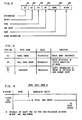
- Figs. 2 and 3 Formats of information signals relevant to understanding the present invention are indicated in Figs. 2 and 3. Such signals contain address fields 101 and 102, respectively defining destination and origin nodes. The field 103 distinguishes the message type. Several presently relevant types of messages are shown in Fig. 3. Hop count field 104 contains a number which may be used to restrict the number of bridges through which the signal information is allowed to pass (see foregoing co-pending application references). Field 105 contains a logical name which determines the handling of the respective message at receiving nodes. Field 106 may contain other (not presently relevant) information.
- message types presently of interest include: name checking requests (Name Check and Call Name Check) and their not-shown acknowledgements (see the referenced "Distributed Control" application for more details of these messages and their handling), and datagrams.
- Name checking requests and datagrams are sent over the network in a broadcast form. Stations receiving a name checking message compare the communicated name 105 with names in a local name table (Fig. 4), and return an acknowledgement if a match is detected. Stations receiving a datagram also compare the communicated name with names in their Name Tables, and either transfer the accompanying information to internal storage for processing or ignore it, depending on whether or not a match is found. Datagrams are not acknowledged.
- Name checking requests comprise Name Check and Call Name Check types. Name Check is used in connection with name adoption, and Call Name Check is used for session establishment. If a Name Check is acknowledged, the station originating the request rejects the acknowledged name. If a Call Name Check is acknowledged, the station originating that request initiates further communications pertaining to session establishment.
- the Name Tables used for name comparison at receiving stations contain at least one status bit for distinguishing unique and non-unique states of respective name entries (see footnote, Fig. 4).
- the processing facility serving the respective station sets this status or tag bit when the name is adopted.
- the selection of the tagged state is transparent to the other network stations, but, as explained next, it affects the operation of the adopting station in response to subsequent name checking messages.
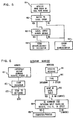
- a station receiving a name checking message compares the communicated name with entries in its Name Table as in the system described in the above cited European Patent Application (152, Fig. 5). However, the transfer of acknowledging signals is conditioned on two factors. If a match is detected and the matching entry is marked unique (153, Fig. 5), an acknowledgement is returned to the request originator (154, Fig. 5). Conversely, if one of these conditions is not satisfied (match not found or matching entry found with non-unique mark), the request is ignored (155, Fig. 5).
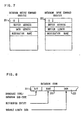
- Figs. 6 - 8 indicates how datagrams are treated at sending and receiving stations of the network; Fig. 7 indicates the form of command descriptors which may be used to originate and receptively process the data parts of datagrams; and Fig. 8 indicates the typical form of a datagram.
- NEB/DO Network Control Block Datagram Output descriptor
- Fig. 7 a respective Network Control Block Datagram Output descriptor
- This command identifies the location in the processor's memory of the data to be communicated. That data is fetched, appended to the control information forming the datagram (172, Fig. 6), and sent out over the network (173, Fig. 6). It is sent in a broadcast form, and therefore its control information at least will be examined at stations receiving the respective signals.
- the type field (103, Fig. 3) is recognized as that of a datagram (182, Fig. 6), causing the station to perform the operations associated with reception handling of datagrams.
- the name communicated in the datagram is compared to the entries in the respective Name Table (183, Fig. 6), and if no match is found the communication is ignored. If a match is found, but the station is not currently prepared for datagram input processing ("No" condition at 184), the communication is not processed further (although a signal may be sent via the network to the datagram originator, informing the latter station of this condition).
- NEB/DI Network Control Block Data- tram Input descriptor
- Respective control fields 201 and 202 in these arrays, contain command operation codes designating the required functions.
- Each descriptor has a "buffer address” defining the location in the respective system's memory from or to which the related data transfer operation is to be conducted.
- the output command array contains a "data length” field indicating the number of bytes of data to be transferred, and the input array contains a "buffer length” field indicating the number of bytes which can be accepted.
- Each array contains a "destination name" which is the logical name of the intended receiving entity or group of entities. If the name is unique in the network, the respective datagram is effectively steered to a single entity. If the name has been adopted on a non-unique basis, the datagram may be passed to a group of plural entities.
- each datagram contains control information 221, designating its broadcast destination and datagram type, a destination name 222 defining its processing destination entity, and a variable length data field 223.
- control information 221 designating its broadcast destination and datagram type
- destination name 222 defining its processing destination entity
- Station 001 in this figure represents a typical processor serving a worker in department "XYZ”
- station 007 represents a processor serving a manager of that department.
- the name "John Doe” is entered in the local Name Table and marked as unique (256, Fig. 9). If one or more acknowledgements return, the name is rejected and the operator is prompted (257, Fig. 9) to select another name (e.g., "John Doe - 1"), whereupon the name checking process 254, 255 is repeated.
- the system After verifying prior adoption of the operator's name (step 253) or completing adoption of a suitable name (step 256), the system prompts the operator to select a "mailbox name" (258) which will later be used for receptive handling of datagrams relative to this operator.
- the operator keys "Dept. XYZ" (step 259), and the system conducts a Name Check communication relative to that name (step 260) with intention of adopting the name on a non-unique basis if no acknowledgements are received. If the department name has been correctly handled at other stations (i.e., tagged non-unique if and when adopted), there will be no acknowledgements, and the name will be adopted at station 001 (step 261).
- the station is then receptive to other communications, or "on- line" (stage 262). This procedure is repeated at other worker stations, each station adopting "Dept. XYZ" as non-unique and being able to do so because the related Name Checks will not be acknowledged (since stations have also marked their entries as non-unique).
- the manager may choose to direct a private communication to "John Doe” and interact with his computer for that purpose.
- his station system will direct a session call (Call Name Check) to "John Doe” (285) and assuming that the manager has used the name currently adopted for the operator at station 001, the session will be established through a response from station 001 and other communications (286).
- the session will be assigned a session number "# S1" unique to that session (thus, the manager and John Doe could be conducting other private communications concurrently, under other session numbers).
- station 007's computer sends the private message keyed in by the manager specifically to "John Doe" (see 287, 288); and note that John Doe's computer can only receive this message in a buffer prepared for John Doe, and only present that message to John Doe, even if John Doe and others are using the same workstation at different times.
Landscapes
- Engineering & Computer Science (AREA)
- Computer Networks & Wireless Communication (AREA)
- Signal Processing (AREA)
- Computer Security & Cryptography (AREA)
- Theoretical Computer Science (AREA)
- Physics & Mathematics (AREA)
- General Engineering & Computer Science (AREA)
- General Physics & Mathematics (AREA)
- Data Exchanges In Wide-Area Networks (AREA)
- Small-Scale Networks (AREA)
- Computer And Data Communications (AREA)
Applications Claiming Priority (2)
| Application Number | Priority Date | Filing Date | Title |
|---|---|---|---|
| US631566 | 1984-07-20 | ||
| US06/631,566 US4644470A (en) | 1984-07-20 | 1984-07-20 | Non-unique names for broadcast messages |
Publications (3)
| Publication Number | Publication Date |
|---|---|
| EP0169455A2 EP0169455A2 (en) | 1986-01-29 |
| EP0169455A3 EP0169455A3 (en) | 1988-02-03 |
| EP0169455B1 true EP0169455B1 (en) | 1990-09-26 |
Family
ID=24531763
Family Applications (1)
| Application Number | Title | Priority Date | Filing Date |
|---|---|---|---|
| EP85108692A Expired - Lifetime EP0169455B1 (en) | 1984-07-20 | 1985-07-12 | Non-unique names for broadcast messages |
Country Status (11)
| Country | Link |
|---|---|
| US (1) | US4644470A (enExample) |
| EP (1) | EP0169455B1 (enExample) |
| JP (1) | JPS6132631A (enExample) |
| KR (1) | KR890002315B1 (enExample) |
| AU (1) | AU574802B2 (enExample) |
| BR (1) | BR8503043A (enExample) |
| CA (1) | CA1226070A (enExample) |
| DE (1) | DE3579860D1 (enExample) |
| ES (1) | ES8705131A1 (enExample) |
| HK (1) | HK9491A (enExample) |
| SG (1) | SG102090G (enExample) |
Families Citing this family (39)
| Publication number | Priority date | Publication date | Assignee | Title |
|---|---|---|---|---|
| JPS6170654A (ja) * | 1984-09-14 | 1986-04-11 | Hitachi Ltd | 分散処理システムにおける資源管理方式 |
| US5014192A (en) * | 1985-05-06 | 1991-05-07 | Motorola Computer X, Inc. | System for locating a file in a logical ring by sequentially forwarding access request with file system name and file name |
| US4800488A (en) * | 1985-11-12 | 1989-01-24 | American Telephone And Telegraph Company, At&T Bell Laboratories | Method of propagating resource information in a computer network |
| US4899274A (en) * | 1985-11-21 | 1990-02-06 | International Business Machines Corporation | Dynamic terminal address allocation by the terminal itself in a data processing system |
| GB8604052D0 (en) * | 1986-02-19 | 1986-03-26 | Monicell Ltd | Communication system |
| US4831518A (en) * | 1986-08-26 | 1989-05-16 | Bull Hn Information Systems Inc. | Multiprocessor interrupt rerouting mechanism |
| US4766534A (en) * | 1986-10-16 | 1988-08-23 | American Telephone And Telegraph Company, At&T Bell Laboratories | Parallel processing network and method |
| US5060150A (en) * | 1987-01-05 | 1991-10-22 | Motorola, Inc. | Process creation and termination monitors for use in a distributed message-based operating system |
| WO1989002129A1 (en) * | 1987-09-04 | 1989-03-09 | Digital Equipment Corporation | Session control in network for digital data processing system which supports multiple transfer protocols |
| JP2594979B2 (ja) * | 1987-10-23 | 1997-03-26 | 株式会社日立製作所 | マルチプロセツサシステム |
| AU601328B2 (en) * | 1988-05-26 | 1990-09-06 | Digital Equipment Corporation | Temporary state preservation for a distributed file service |
| US5023772A (en) * | 1988-10-31 | 1991-06-11 | International Business Machines Corporation | Method and system for storing messages based upon a non-queried name assignment |
| US5109486A (en) * | 1989-01-06 | 1992-04-28 | Motorola, Inc. | Distributed computer system with network and resource status monitoring |
| US5282270A (en) * | 1990-06-06 | 1994-01-25 | Apple Computer, Inc. | Network device location using multicast |
| NL9001423A (nl) * | 1990-06-21 | 1992-01-16 | Nederland Ptt | Interactief communicatie- en transportsysteem voor stilstaande beelden. |
| WO1992013309A1 (en) * | 1991-01-23 | 1992-08-06 | Sun Microsystems, Inc. | Method and apparatus for scoped interprocess message switching |
| US5341374A (en) * | 1991-03-01 | 1994-08-23 | Trilan Systems Corporation | Communication network integrating voice data and video with distributed call processing |
| DE4227346C2 (de) * | 1991-08-19 | 1999-09-09 | Sequent Computer Systems Inc | Gerät zur Datenübertragung zwischen mehreren, mit einem SCSI-Bus verbundenen Einheiten |
| US5243596A (en) * | 1992-03-18 | 1993-09-07 | Fischer & Porter Company | Network architecture suitable for multicasting and resource locking |
| DE69333457T2 (de) | 1992-12-09 | 2004-11-25 | Discovery Communications, Inc. | Digitale Kopfstelle für Kabelfernsehverteilsystem |
| US7401286B1 (en) * | 1993-12-02 | 2008-07-15 | Discovery Communications, Inc. | Electronic book electronic links |
| US8073695B1 (en) | 1992-12-09 | 2011-12-06 | Adrea, LLC | Electronic book with voice emulation features |
| US7849393B1 (en) | 1992-12-09 | 2010-12-07 | Discovery Communications, Inc. | Electronic book connection to world watch live |
| US7336788B1 (en) * | 1992-12-09 | 2008-02-26 | Discovery Communicatoins Inc. | Electronic book secure communication with home subsystem |
| US7835989B1 (en) * | 1992-12-09 | 2010-11-16 | Discovery Communications, Inc. | Electronic book alternative delivery systems |
| US7509270B1 (en) * | 1992-12-09 | 2009-03-24 | Discovery Communications, Inc. | Electronic Book having electronic commerce features |
| US7298851B1 (en) * | 1992-12-09 | 2007-11-20 | Discovery Communications, Inc. | Electronic book security and copyright protection system |
| US5371735A (en) * | 1993-03-04 | 1994-12-06 | International Business Machines Corporation | Communication network with non-unique device identifiers and method of establishing connection paths in such a network |
| US9053640B1 (en) | 1993-12-02 | 2015-06-09 | Adrea, LLC | Interactive electronic book |
| US7865567B1 (en) | 1993-12-02 | 2011-01-04 | Discovery Patent Holdings, Llc | Virtual on-demand electronic book |
| US7861166B1 (en) | 1993-12-02 | 2010-12-28 | Discovery Patent Holding, Llc | Resizing document pages to fit available hardware screens |
| US8095949B1 (en) | 1993-12-02 | 2012-01-10 | Adrea, LLC | Electronic book with restricted access features |
| US5483652A (en) * | 1994-01-24 | 1996-01-09 | Digital Equipment Corporation | Mechanism for locating without search discrete application resources known by common name only in a distributed network computing environment |
| US5539920A (en) * | 1994-04-28 | 1996-07-23 | Thomson Consumer Electronics, Inc. | Method and apparatus for processing an audio video interactive signal |
| US5649152A (en) * | 1994-10-13 | 1997-07-15 | Vinca Corporation | Method and system for providing a static snapshot of data stored on a mass storage system |
| US5835953A (en) * | 1994-10-13 | 1998-11-10 | Vinca Corporation | Backup system that takes a snapshot of the locations in a mass storage device that has been identified for updating prior to updating |
| TW250616B (en) * | 1994-11-07 | 1995-07-01 | Discovery Communicat Inc | Electronic book selection and delivery system |
| US5881269A (en) * | 1996-09-30 | 1999-03-09 | International Business Machines Corporation | Simulation of multiple local area network clients on a single workstation |
| GB2341057A (en) * | 1998-08-28 | 2000-03-01 | Ibm | Allocating names to network resources for shared access |
Family Cites Families (4)
| Publication number | Priority date | Publication date | Assignee | Title |
|---|---|---|---|---|
| US4363093A (en) * | 1980-03-10 | 1982-12-07 | International Business Machines Corporation | Processor intercommunication system |
| US4430651A (en) * | 1981-08-27 | 1984-02-07 | Burroughs Corporation | Expandable and contractible local area network system |
| US4718005A (en) * | 1984-05-03 | 1988-01-05 | International Business Machines Corporation | Distributed control of alias name usage in networks |
| US4644468A (en) * | 1984-07-20 | 1987-02-17 | International Business Machines Corp. | Name usage support through distributed processing networks linked by bridges and/or gateways |
-
1984
- 1984-07-20 US US06/631,566 patent/US4644470A/en not_active Expired - Lifetime
-
1985
- 1985-03-29 JP JP6402685A patent/JPS6132631A/ja active Granted
- 1985-04-30 KR KR1019850002922A patent/KR890002315B1/ko not_active Expired
- 1985-05-02 CA CA000480619A patent/CA1226070A/en not_active Expired
- 1985-06-25 BR BR8503043A patent/BR8503043A/pt not_active IP Right Cessation
- 1985-07-12 EP EP85108692A patent/EP0169455B1/en not_active Expired - Lifetime
- 1985-07-12 DE DE8585108692T patent/DE3579860D1/de not_active Expired - Lifetime
- 1985-07-15 AU AU44900/85A patent/AU574802B2/en not_active Expired
- 1985-07-19 ES ES545389A patent/ES8705131A1/es not_active Expired
-
1990
- 1990-12-21 SG SG1020/90A patent/SG102090G/en unknown
-
1991
- 1991-01-31 HK HK94/91A patent/HK9491A/en not_active IP Right Cessation
Also Published As
| Publication number | Publication date |
|---|---|
| JPH0515334B2 (enExample) | 1993-03-01 |
| AU574802B2 (en) | 1988-07-14 |
| EP0169455A3 (en) | 1988-02-03 |
| ES545389A0 (es) | 1987-04-16 |
| KR890002315B1 (ko) | 1989-06-28 |
| EP0169455A2 (en) | 1986-01-29 |
| SG102090G (en) | 1991-02-14 |
| CA1226070A (en) | 1987-08-25 |
| AU4490085A (en) | 1986-01-23 |
| JPS6132631A (ja) | 1986-02-15 |
| DE3579860D1 (de) | 1990-10-31 |
| BR8503043A (pt) | 1986-03-11 |
| HK9491A (en) | 1991-02-08 |
| ES8705131A1 (es) | 1987-04-16 |
| US4644470A (en) | 1987-02-17 |
| KR860001653A (ko) | 1986-03-20 |
Similar Documents
| Publication | Publication Date | Title |
|---|---|---|
| EP0169455B1 (en) | Non-unique names for broadcast messages | |
| EP0160263B1 (en) | Distributed control of alias name usage in networks | |
| US5245608A (en) | Logical grouping of layer entities in a layered communication architecture | |
| EP0169454B1 (en) | Name usage support through distributed processing networks linked by bridges and/or gateways | |
| US5420916A (en) | Signaling network having common signaling node for protocol conversion | |
| EP0637149A2 (en) | Method and apparatus for providing multicast virtual circuits | |
| EP0409397A2 (en) | Distributed data processing system | |
| WO1998040820A1 (en) | A communications system for client-server data processing systems | |
| CA2346590C (en) | Packet communication system, mobile communication system, and addressing method for communication | |
| JPH01503269A (ja) | データ通信ネツトワーク | |
| US6892247B2 (en) | Method and system for active publishing using a slave assigned to a master system to detect, evaluate and make the message available to an application associated with the slave | |
| CA2066146A1 (en) | Method for transmitting data to a plurality of data stations | |
| JP2002529808A (ja) | 分散処理によって実行されるデータ処理要求を評価する方法及び装置 | |
| JP2000029806A (ja) | 計算機システムのlanアダプタ負荷分散方式 | |
| AU1943600A (en) | Method of communication between distant objects | |
| US6928074B1 (en) | Method of transmitting data, a broadcast module, and a terminal for implementing the method | |
| US6031839A (en) | Data communication system and communication terminal equipment | |
| JPS59161952A (ja) | 通信パス確立方式 | |
| EP0589447A2 (en) | Method for joining a plurality of networks and seceding therefrom | |
| JPH0226430A (ja) | 同送処理方式 | |
| JP2594313B2 (ja) | 半二重セション管理処理方式 | |
| JPH07111698B2 (ja) | セション管理処理方法 | |
| JPH06120952A (ja) | 通信制御装置 | |
| JPH04179348A (ja) | 電文受信制御方式 | |
| JPS63115436A (ja) | デ−タ伝送制御方式 |
Legal Events
| Date | Code | Title | Description |
|---|---|---|---|
| PUAI | Public reference made under article 153(3) epc to a published international application that has entered the european phase |
Free format text: ORIGINAL CODE: 0009012 |
|
| AK | Designated contracting states |
Designated state(s): BE CH DE FR GB IT LI NL SE |
|
| 17P | Request for examination filed |
Effective date: 19860523 |
|
| PUAL | Search report despatched |
Free format text: ORIGINAL CODE: 0009013 |
|
| AK | Designated contracting states |
Kind code of ref document: A3 Designated state(s): BE CH DE FR GB IT LI NL SE |
|
| 17Q | First examination report despatched |
Effective date: 19891107 |
|
| GRAA | (expected) grant |
Free format text: ORIGINAL CODE: 0009210 |
|
| AK | Designated contracting states |
Kind code of ref document: B1 Designated state(s): BE CH DE FR GB IT LI NL SE |
|
| REF | Corresponds to: |
Ref document number: 3579860 Country of ref document: DE Date of ref document: 19901031 |
|
| ET | Fr: translation filed | ||
| ITF | It: translation for a ep patent filed | ||
| PLBE | No opposition filed within time limit |
Free format text: ORIGINAL CODE: 0009261 |
|
| STAA | Information on the status of an ep patent application or granted ep patent |
Free format text: STATUS: NO OPPOSITION FILED WITHIN TIME LIMIT |
|
| ITTA | It: last paid annual fee | ||
| 26N | No opposition filed | ||
| EAL | Se: european patent in force in sweden |
Ref document number: 85108692.6 |
|
| PGFP | Annual fee paid to national office [announced via postgrant information from national office to epo] |
Ref country code: BE Payment date: 19950707 Year of fee payment: 11 |
|
| PGFP | Annual fee paid to national office [announced via postgrant information from national office to epo] |
Ref country code: SE Payment date: 19950717 Year of fee payment: 11 |
|
| PGFP | Annual fee paid to national office [announced via postgrant information from national office to epo] |
Ref country code: NL Payment date: 19950725 Year of fee payment: 11 |
|
| PGFP | Annual fee paid to national office [announced via postgrant information from national office to epo] |
Ref country code: CH Payment date: 19951106 Year of fee payment: 11 |
|
| PG25 | Lapsed in a contracting state [announced via postgrant information from national office to epo] |
Ref country code: SE Effective date: 19960713 |
|
| PG25 | Lapsed in a contracting state [announced via postgrant information from national office to epo] |
Ref country code: LI Effective date: 19960731 Ref country code: CH Effective date: 19960731 Ref country code: BE Effective date: 19960731 |
|
| BERE | Be: lapsed |
Owner name: INTERNATIONAL BUSINESS MACHINES CORP. Effective date: 19960731 |
|
| PG25 | Lapsed in a contracting state [announced via postgrant information from national office to epo] |
Ref country code: NL Effective date: 19970201 |
|
| REG | Reference to a national code |
Ref country code: CH Ref legal event code: PL |
|
| NLV4 | Nl: lapsed or anulled due to non-payment of the annual fee |
Effective date: 19970201 |
|
| EUG | Se: european patent has lapsed |
Ref document number: 85108692.6 |
|
| REG | Reference to a national code |
Ref country code: GB Ref legal event code: IF02 |
|
| PGFP | Annual fee paid to national office [announced via postgrant information from national office to epo] |
Ref country code: GB Payment date: 20040701 Year of fee payment: 20 |
|
| PGFP | Annual fee paid to national office [announced via postgrant information from national office to epo] |
Ref country code: FR Payment date: 20040721 Year of fee payment: 20 |
|
| PGFP | Annual fee paid to national office [announced via postgrant information from national office to epo] |
Ref country code: DE Payment date: 20040802 Year of fee payment: 20 |
|
| PG25 | Lapsed in a contracting state [announced via postgrant information from national office to epo] |
Ref country code: GB Free format text: LAPSE BECAUSE OF EXPIRATION OF PROTECTION Effective date: 20050711 |
|
| REG | Reference to a national code |
Ref country code: GB Ref legal event code: PE20 |