EP0168608A2 - Substituierte Carbonsäureanilide - Google Patents
Substituierte Carbonsäureanilide Download PDFInfo
- Publication number
- EP0168608A2 EP0168608A2 EP85106804A EP85106804A EP0168608A2 EP 0168608 A2 EP0168608 A2 EP 0168608A2 EP 85106804 A EP85106804 A EP 85106804A EP 85106804 A EP85106804 A EP 85106804A EP 0168608 A2 EP0168608 A2 EP 0168608A2
- Authority
- EP
- European Patent Office
- Prior art keywords
- optionally substituted
- carbon atoms
- alkyl
- formula
- halogen
- Prior art date
- Legal status (The legal status is an assumption and is not a legal conclusion. Google has not performed a legal analysis and makes no representation as to the accuracy of the status listed.)
- Withdrawn
Links
- 0 CC1=CC(*=C)=NC(*C(CC2)=C(*3)C(*)C3C2NC(C(*)(*)*)=O)*1 Chemical compound CC1=CC(*=C)=NC(*C(CC2)=C(*3)C(*)C3C2NC(C(*)(*)*)=O)*1 0.000 description 9
- XIPFMBOWZXULIA-UHFFFAOYSA-N CC(C)(C)C(N)=O Chemical compound CC(C)(C)C(N)=O XIPFMBOWZXULIA-UHFFFAOYSA-N 0.000 description 1
- HICJECYUZNPQGG-KIYNQFGBSA-N CC(CCN1C)[C@@H](C)C=C1Sc(cc1)ccc1N Chemical compound CC(CCN1C)[C@@H](C)C=C1Sc(cc1)ccc1N HICJECYUZNPQGG-KIYNQFGBSA-N 0.000 description 1
- QJXNCDKICRYINC-UHFFFAOYSA-N CC1NC(OCc(cc2)ccc2[N+]([O-])=O)=NC(C)=C1 Chemical compound CC1NC(OCc(cc2)ccc2[N+]([O-])=O)=NC(C)=C1 QJXNCDKICRYINC-UHFFFAOYSA-N 0.000 description 1
- FEIHCAFTYDPAHR-UHFFFAOYSA-N CNc(cc1)ccc1S Chemical compound CNc(cc1)ccc1S FEIHCAFTYDPAHR-UHFFFAOYSA-N 0.000 description 1
- HCATUIMBJIDQDT-UHFFFAOYSA-N Cc1nc(C)nc(C)c1 Chemical compound Cc1nc(C)nc(C)c1 HCATUIMBJIDQDT-UHFFFAOYSA-N 0.000 description 1
- PAFZNILMFXTMIY-UHFFFAOYSA-N NC1CCCCC1 Chemical compound NC1CCCCC1 PAFZNILMFXTMIY-UHFFFAOYSA-N 0.000 description 1
Classifications
-
- C—CHEMISTRY; METALLURGY
- C07—ORGANIC CHEMISTRY
- C07D—HETEROCYCLIC COMPOUNDS
- C07D239/00—Heterocyclic compounds containing 1,3-diazine or hydrogenated 1,3-diazine rings
- C07D239/02—Heterocyclic compounds containing 1,3-diazine or hydrogenated 1,3-diazine rings not condensed with other rings
- C07D239/24—Heterocyclic compounds containing 1,3-diazine or hydrogenated 1,3-diazine rings not condensed with other rings having three or more double bonds between ring members or between ring members and non-ring members
- C07D239/28—Heterocyclic compounds containing 1,3-diazine or hydrogenated 1,3-diazine rings not condensed with other rings having three or more double bonds between ring members or between ring members and non-ring members with hetero atoms or with carbon atoms having three bonds to hetero atoms with at the most one bond to halogen, directly attached to ring carbon atoms
- C07D239/46—Two or more oxygen, sulphur or nitrogen atoms
- C07D239/58—Two sulfur atoms
-
- A—HUMAN NECESSITIES
- A01—AGRICULTURE; FORESTRY; ANIMAL HUSBANDRY; HUNTING; TRAPPING; FISHING
- A01N—PRESERVATION OF BODIES OF HUMANS OR ANIMALS OR PLANTS OR PARTS THEREOF; BIOCIDES, e.g. AS DISINFECTANTS, AS PESTICIDES OR AS HERBICIDES; PEST REPELLANTS OR ATTRACTANTS; PLANT GROWTH REGULATORS
- A01N43/00—Biocides, pest repellants or attractants, or plant growth regulators containing heterocyclic compounds
- A01N43/48—Biocides, pest repellants or attractants, or plant growth regulators containing heterocyclic compounds having rings with two nitrogen atoms as the only ring hetero atoms
- A01N43/54—1,3-Diazines; Hydrogenated 1,3-diazines
-
- C—CHEMISTRY; METALLURGY
- C07—ORGANIC CHEMISTRY
- C07D—HETEROCYCLIC COMPOUNDS
- C07D239/00—Heterocyclic compounds containing 1,3-diazine or hydrogenated 1,3-diazine rings
- C07D239/02—Heterocyclic compounds containing 1,3-diazine or hydrogenated 1,3-diazine rings not condensed with other rings
- C07D239/24—Heterocyclic compounds containing 1,3-diazine or hydrogenated 1,3-diazine rings not condensed with other rings having three or more double bonds between ring members or between ring members and non-ring members
- C07D239/28—Heterocyclic compounds containing 1,3-diazine or hydrogenated 1,3-diazine rings not condensed with other rings having three or more double bonds between ring members or between ring members and non-ring members with hetero atoms or with carbon atoms having three bonds to hetero atoms with at the most one bond to halogen, directly attached to ring carbon atoms
- C07D239/32—One oxygen, sulfur or nitrogen atom
- C07D239/34—One oxygen atom
-
- C—CHEMISTRY; METALLURGY
- C07—ORGANIC CHEMISTRY
- C07D—HETEROCYCLIC COMPOUNDS
- C07D239/00—Heterocyclic compounds containing 1,3-diazine or hydrogenated 1,3-diazine rings
- C07D239/02—Heterocyclic compounds containing 1,3-diazine or hydrogenated 1,3-diazine rings not condensed with other rings
- C07D239/24—Heterocyclic compounds containing 1,3-diazine or hydrogenated 1,3-diazine rings not condensed with other rings having three or more double bonds between ring members or between ring members and non-ring members
- C07D239/28—Heterocyclic compounds containing 1,3-diazine or hydrogenated 1,3-diazine rings not condensed with other rings having three or more double bonds between ring members or between ring members and non-ring members with hetero atoms or with carbon atoms having three bonds to hetero atoms with at the most one bond to halogen, directly attached to ring carbon atoms
- C07D239/32—One oxygen, sulfur or nitrogen atom
- C07D239/38—One sulfur atom
-
- C—CHEMISTRY; METALLURGY
- C07—ORGANIC CHEMISTRY
- C07D—HETEROCYCLIC COMPOUNDS
- C07D239/00—Heterocyclic compounds containing 1,3-diazine or hydrogenated 1,3-diazine rings
- C07D239/02—Heterocyclic compounds containing 1,3-diazine or hydrogenated 1,3-diazine rings not condensed with other rings
- C07D239/24—Heterocyclic compounds containing 1,3-diazine or hydrogenated 1,3-diazine rings not condensed with other rings having three or more double bonds between ring members or between ring members and non-ring members
- C07D239/28—Heterocyclic compounds containing 1,3-diazine or hydrogenated 1,3-diazine rings not condensed with other rings having three or more double bonds between ring members or between ring members and non-ring members with hetero atoms or with carbon atoms having three bonds to hetero atoms with at the most one bond to halogen, directly attached to ring carbon atoms
- C07D239/46—Two or more oxygen, sulphur or nitrogen atoms
- C07D239/52—Two oxygen atoms
-
- C—CHEMISTRY; METALLURGY
- C07—ORGANIC CHEMISTRY
- C07D—HETEROCYCLIC COMPOUNDS
- C07D239/00—Heterocyclic compounds containing 1,3-diazine or hydrogenated 1,3-diazine rings
- C07D239/02—Heterocyclic compounds containing 1,3-diazine or hydrogenated 1,3-diazine rings not condensed with other rings
- C07D239/24—Heterocyclic compounds containing 1,3-diazine or hydrogenated 1,3-diazine rings not condensed with other rings having three or more double bonds between ring members or between ring members and non-ring members
- C07D239/28—Heterocyclic compounds containing 1,3-diazine or hydrogenated 1,3-diazine rings not condensed with other rings having three or more double bonds between ring members or between ring members and non-ring members with hetero atoms or with carbon atoms having three bonds to hetero atoms with at the most one bond to halogen, directly attached to ring carbon atoms
- C07D239/46—Two or more oxygen, sulphur or nitrogen atoms
- C07D239/56—One oxygen atom and one sulfur atom
Definitions
- the present invention relates to new substituted carboxylic acid anilides, several processes for their preparation and their use as herbicides.
- pyrimidinyl-2-ethers and thioethers are suitable as herbicides (cf. JP-OS 9 474/1967, US Pat. Nos. 3, 126, 271 and US Pat. Nos. 3, 250, 775).
- the 2-phenoxy-4,6-dimethyl-pyrimidine and the 2- (4-chloro-benzylmer- capto) -4,6-dimethyl-pyrimidine can be used to control weeds.
- the herbicidal potency of these substances is not always sufficient.
- the substituted carboxylic acid anilides of the formula (I) according to the invention have significantly better herbicidal properties than the constitutionally most similar previously known substances.
- the carboxylic acid anilides of the formula (I) according to the invention can be used much better for weed control than the 2-phenoxy-4,6-dimethyl-pyrimidine, which is a structurally similar previously known active ingredient of the same type of action.
- the substituted carboxylic acid anilides according to the invention are generally defined by the formula (I).
- X stands for oxygen or sulfur.
- the radical R 1 preferably represents hydrogen, fluorine, chlorine, Bromine, straight-chain or branched alkyl having 1 to 4 carbon atoms, trifluoromethyl, phenyl optionally substituted by chlorine, trifluoromethyl and / or methyl, alkoxy having 1 to 4 carbon atoms or alkyl mercapto having 1 to 4 carbon atoms.
- R preferably represents chlorine, bromine or methyl.
- the index n preferably stands for 0 or 1.
- R 3 preferably stands for hydrogen, fluorine, chlorine, bromine, alkyl with 1 to 4 carbon atoms optionally substituted by fluorine, chlorine and / or bromine, optionally with fluorine, chlorine, bromine, trifluoromethyl, Methoxy and / or methyl substituted phenyl, optionally substituted by fluorine, chlorine, bromine, trifluoromethyl, methoxy and / or methyl or for the radicals -OR 6 or -SO -R 6 , where R is preferably for optionally by fluorine, chlorine and / or bromine-substituted alkyl having 1 to 4 carbon atoms or phenyl optionally substituted by fluorine, chlorine, bromine and / or alkyl having 1 to 4 carbon atoms and the index m being 0, 1 or 2.
- R 4 and R 5 independently of one another are preferably fluorine, chlorine, bromine or alkyl having 1 to 4 carbon atoms which is optionally substituted by fluorine, chlorine and / or bromine.
- R 4 and R 5 together with the adjacent carbon atom, preferably represent a saturated or unsaturated carbocyclic ring with 3 to 7 ring carbon atoms which is optionally substituted by fluorine, chlorine and / or alkyl having 1 to 4 carbon atoms.
- Formula (II) provides a general definition of the aniline derivatives required as starting materials in process (a) according to the invention.
- R ', R 2 , X and n preferably have those meanings which have already been mentioned preferably in connection with the description of the substances of the formula (I) according to the invention for these radicals or this index.
- Formula (IV) defines the pyrimidine derivatives required as starting materials in process (c) above.
- R 1 preferably has those meanings which have preferably been mentioned for this radical in connection with the description of the substances of the formula (I) according to the invention.
- Hal preferably represents fluorine, chlorine or bromine.
- pyrimidine derivatives of the formula (IV) are known or can be prepared in a simple manner by methods known in principle.
- pyrimidine derivatives of the formula (IV) are obtained by reacting 2-hydroxy-pyrimidine derivatives (dihydro-pyrimidone-2 derivatives) with inorganic acid halides, such as phosphorus oxychloride or phosphorus pentachloride, or else by reacting corresponding 2-amino-pyrimidine derivatives with nitrous acid in the presence of hydrohalic acids.
- Formula (VI) defines the 4-amino (thio) phenols which are further required as starting materials in process (c).
- R 2 , X and n preferably have those meanings which have already been mentioned preferably in connection with the description of the substances of the formula (I) according to the invention for these radicals or for this index.
- the 4-amino (thio) phenols of the formula (VI) are known or can be prepared in a simple manner by methods known in principle.
- Alkali and alkaline earth oxides, hydroxides and carbonates such as sodium hydroxide, potassium hydroxide, calcium oxide, sodium carbonate and potassium carbonate are preferably usable, furthermore alkali alcoholates, amides and hydrides such as sodium methylate, sodium ethylate, potassium tert. butylate, sodium amide and sodium hydride.
- All customary inert organic solvents can be used as diluents when carrying out process (c).
- Hydrocarbons such as gasoline, toluene and xylene, ethers such as dioxane, glycol dimethyl ether and diglycol dimethyl ether, furthermore nitriles such as acetonitrile, and also strongly polar solvents such as dimethyl sulfoxide, sulfolane and dimethylformamide are preferred.
- reaction temperatures can be varied within a substantial range when carrying out process (c). In general, temperatures between 0 ° C and 200 ° C, preferably between 50 ° C and 150 ° C.
- reaction according to process (c) is generally carried out under normal pressure.
- Formula (VII) defines the 2- (4-nitro (thio) phenoxy) pyrimidine derivatives required as starting materials in process (d).
- R 1 , R 2 , X and n preferably have those meanings which are already in connection with the description the substances of the formula (I) according to the invention were preferably mentioned for these radicals or for this index.
- Suitable as reducing agents in process (d) are all those substances which are usually used for the reduction of aromatic nitro compounds.
- Elemental metals such as iron, zinc and tin
- metal compounds in lower valence levels such as iron (II) and tin (II) salts
- non-metal compounds in low valence levels such as, for example, salts of hydrogen sulfide, alkali metal sulfites and alkalidithionites.
- the reduction can also be carried out by catalytic hydrogenation with hydrogen in the presence of a catalyst, such as Raney nickel.
- Suitable diluents in process (d) are all customary organic solvents suitable for such reductions.
- the reaction temperatures can be varied within a substantial range. They correspond to the temperatures used in analog reactions.
- the acid halides of the formula (III a) are known or can be prepared in a simple manner by methods known in principle.
- Suitable acid binders for the reaction according to process (a, variant ⁇ ) are all customary acid acceptors.
- Tertiary amines such as triethylamine, pyridine and N, N-dimethylaniline, furthermore alkaline earth metal oxides, such as magnesium and calcium oxide, and also alkali metal and alkaline earth metal carbonates, such as sodium carbonate, potassium carbonate and calcium carbonate, are preferably usable.
- alkaline earth metal oxides such as magnesium and calcium oxide
- alkali metal and alkaline earth metal carbonates such as sodium carbonate, potassium carbonate and calcium carbonate
- Diluents which can be used in process (a, maniadl) according to the invention are all solvents which are inert to acid halides.
- Hydrocarbons such as gasoline, benzene, toluene, xylene and tetralin are preferably usable, furthermore halogenated hydrocarbons such as methylene chloride, chloroform, carbon tetrachloride, chlorobenzene and o-dichlorobenzene, also ketones such as acetone and methyl isopropyl ketone, furthermore ethers such as diethyl ether, tetrahydrofuran and Dioxane, moreover carboxylic acid esters, such as ethyl acetate, and also strongly polar solvents, such as dimethyl sulfoxide and sulfolane. If the hydrolysis stability of the acid halide permits, the reaction can also be carried out in the presence of water.
- reaction temperatures can be varied within a substantial range when carrying out the process (a, avadj). If one works without solvents and acid binders, the procedure is generally such that the components are initially at temperatures between -20 ° C. and +20 ° C can react and then heated to temperatures between 70 and 200 ° C. If one works in the presence of a diluent and an acid binder, the are Reaction temperatures in general between -20 ° C and + 100 ° C, preferably between 0 ° C and 50 ° C.
- the process (a, variant ⁇ ) according to the invention is generally carried out under normal pressure.
- the starting materials of the formulas (II) and (III a) are generally used in approximately equivalent amounts. However, it is also possible to use one or the other component in a larger excess.
- the processing is then carried out using customary methods.
- the general procedure is to remove precipitated salts and to concentrate the remaining reaction mixture by stripping off the diluent. If one works in the presence of water or of water-miscible solvents, the procedure can also be such that the reaction mixture is diluted with water, the resulting mixture is suctioned off or extracted with a water-immiscible organic solvent, the organic phase is washed, concentrated and the the remaining residue may be subjected to customary cleaning procedures.
- the symmetrical carboxylic anhydrides of the formula (III b) are known or can be prepared in a simple manner by methods known in principle.
- the diluents which can be used in carrying out the process (a, variant ⁇ ) are preferably those diluents which are also preferred in the process (a, variant ⁇ ). Otherwise, an excess carboxylic acid anhydride of the formula (III b) can also act as a diluent.
- reaction temperatures can also be varied within a substantial range in the process according to the invention (a, variant ⁇ ). In general, temperatures between -20 ° C and + 150 ° C, preferably between 0 and 100 ° C.
- the process (a, variant ⁇ ) according to the invention is generally carried out under normal pressure.
- the starting materials of the formulas (II) and (III b) are generally used in approximately equivalent amounts. However, it is also possible to use the carboxylic anhydride in a larger excess. The processing takes place according to usual methods.
- the procedure is to remove diluent and excess carboxylic acid anhydride and the carboxylic acid formed by distillation or by washing with an organic solvent or with water.
- R 3 , R 4 and R 5 preferably have those meanings which have already been mentioned for these radicals in connection with the description of the substances of the formula (I) according to the invention.
- R preferably represents alkyl having 1 or 2 carbon atoms or phenyl.
- the diluents which can be used in carrying out the process (a, variant) according to the invention are preferably those diluents which are also preferred in the process (a, variant ⁇ ).
- excess acid anhydride of the formula (III c) can also act as a diluent.
- reaction temperatures can also be varied within a substantial range in the process (a, variant f) according to the invention. In general one works with temperature fittings between -20 ° C and + 150 ° C, preferably between 0 and 100 ° C.
- the process (a, variant f) according to the invention is generally carried out under normal pressure.
- Diluents which can be used when carrying out process (a, variant ⁇ ) according to the invention are preferably those diluents which are also preferred in process (a, variant ⁇ ).
- reaction temperatures can also be varied within a substantial range in the process (a, variant) according to the invention. In general, temperatures between -20 ° C and + 150 ° C, preferably between 0 and 100 ° C.
- the process (a, variant ⁇ ) according to the invention is generally carried out under normal pressure.
- Formula (V) clearly defines the acylaniline derivatives required as starting materials in process (b) according to the invention.
- R 2 , R 3 , R 4 , R 5 , X and n preferably have those meanings which have already been mentioned in connection with the description of the substances of the formula (I), preferably for these radicals or for this index.
- All customary acid acceptors can be used as acid binders when carrying out process (b) according to the invention.
- Alkali metal and alkaline earth metal oxides, hydroxides and carbonates such as sodium hydroxide, potassium hydroxide, magnesium oxide, calcium oxide, sodium carbonate, potassium carbonate and calcium carbonate, furthermore alkali metal and alkaline earth metal amides and hydrides, such as sodium amide, sodium hydride and calcium hydride, and also also are preferably usable Alkali metal alcoholates, such as sodium methylate, sodium ethylate and potassium tert-butoxide.
- Hydrocarbons such as toluene and xylene are preferably usable, furthermore ethers such as dibutyl ether, tetrahydrofuran, dioxane, glycol dimethyl ether and diglycol dimethyl ether, also nitriles such as acetonitrile and propionitrile and also polar ones Solvents such as nitrobenzene, dimethyl sulfoxide, sulfolane, dimethylformamide and N-methyl-pyrrolidone.
- ethers such as dibutyl ether, tetrahydrofuran, dioxane, glycol dimethyl ether and diglycol dimethyl ether, also nitriles such as acetonitrile and propionitrile and also polar ones
- Solvents such as nitrobenzene, dimethyl sulfoxide, sulfolane, dimethylformamide and N-methyl-pyrrolidone.
- reaction temperatures can be varied within a substantial range when carrying out process (b) according to the invention. In general, temperatures between 0 and 200 ° C, preferably between 50 and 150 ° C.
- Process (b) according to the invention is generally carried out under normal pressure.
- reaction components of the formulas (IV) and (V) are generally employed in approximately equimolar amounts. However, it is also possible to use one or the other component in a larger excess. In addition, an equimolar amount of acid-binding agent is generally also used. However, it may also be advantageous to add the acid binder in an excess of up to one molar. In particular, the general procedure is to add the acid-binding agent to a mixture of the reaction components in a suitable diluent.
- a salt is first produced from the acylaniline derivative of the formula (V) and the acid binder and this is then reacted with a pyrimidine derivative of the formula (IV).
- a salt is first produced from the acylaniline derivative of the formula (V) and the acid binder and this is then reacted with a pyrimidine derivative of the formula (IV).
- the acylaniline derivative of the formula (V) it is also possible to use the acylaniline derivative of the formula (V) to produce a salt separately from an acid binder, then to isolate it and then to react it with a pyrimidine derivative of the formula (IV) in the presence of a suitable diluent without further addition of an acid binder.
- the processing is carried out according to the usual methods.
- the active compounds according to the invention can be used as defoliants, desiccants, haulm killers and in particular as weed killers. Weeds in the broadest sense are understood to mean all plants that grow up in places where they are undesirable. Whether the substances according to the invention act as total or selective herbicides depends essentially on the amount used.
- the compounds are suitable for total weed control, e.g. on industrial and track systems and on paths and squares with and without tree cover.
- the compounds for weed control in permanent crops e.g. Forestry, ornamental trees, fruit, wine, citrus, nut, banana, coffee, tea, rubber, oil palm, cocoa, berry fruit and hop plants and for selective weed control in annual crops.
- the active compounds according to the invention are particularly suitable for the selective control of mono- and dicotyledon weeds in monocotyledon crops, such as, for example, maize and cereals.
- the active compounds according to the invention also have a strong microbicidal action and can be used practically to combat unwanted microorganisms.
- the active ingredients are suitable for use as pesticides.
- Fungicidal agents in crop protection are used to control Plasmodiophoromycetes, Oomycetes, Chytridiomycetes, Zygomycetes, Ascomycetes, Basidiomycetes, Deuteromycetes.
- the active compounds according to the invention can be used with particular advantage for combating Pyricularia oryzae in rice, against botrytis and for combating bean rust.
- the substances according to the invention are also distinguished by an insecticidal activity. They have a good root systemic effectiveness.
- the active ingredients can be converted into the customary formulations, such as solutions, emulsions, wettable powders, suspensions, powders, dusts, pastes, soluble powders, granules, suspension emulsion concentrates, active ingredient-impregnated natural and synthetic substances and very fine encapsulations in polymeric substances.
- formulations are made in a known manner, e.g. by mixing the active ingredients with extenders, that is to say liquid solvents and / or solid carriers, optionally using surface-active agents, that is to say emulsifiers and / or dispersants and / or foam-generating agents.
- extenders that is to say liquid solvents and / or solid carriers
- surface-active agents that is to say emulsifiers and / or dispersants and / or foam-generating agents.
- organic solvents can also be used as auxiliary solvents.
- auxiliary solvents e.g. organic solvents
- aromatics such as xylene, toluene, or alkylnaphthalenes
- chlorinated aromatics and chlorinated aliphatic hydrocarbons such as chlorobenzenes, chlorethylenes or methylene chloride
- aliphatic hydrocarbons such as cyclohexane or paraffins, e.g.
- Petroleum fractions mineral and vegetable oils, alcohols such as butanol or glycol and their ethers and esters, ketones such as acetone, methyl ethyl ketone, methyl isobutyl ketone or cyclohexanone, strongly polar solvents such as dimethylformamide and dimethyl sulfoxide, and water.
- alcohols such as butanol or glycol and their ethers and esters
- ketones such as acetone, methyl ethyl ketone, methyl isobutyl ketone or cyclohexanone
- strongly polar solvents such as dimethylformamide and dimethyl sulfoxide, and water.
- Adhesives such as carboxymethyl cellulose, natural and synthetic powdery, granular or latex-shaped polymers, such as gum arabic, polyvinyl alcohol, polyvinyl acetate, and natural phospholipids, such as cephalins and lecithins and synthetic phospholipids, can be used in the formulations.
- Other additives can be mineral and vegetable oils.
- Dyes such as inorganic pigments, e.g. Iron oxide, titanium oxide, ferrocyan blue and organic dyes such as alizarin, azo and metal phthalocyanine dyes and trace nutrients such as salts of iron, manganese, boron, copper, cobalt, molybdenum and zinc can be used.
- the formulations generally contain between 0.1 and 95 percent by weight of active compound, preferably between 0.5 and 90%.
- the active compounds according to the invention can also be used for weed control in a mixture with known herbicides, finished formulations or tank mixes being possible.
- a mixture with other known active compounds such as fungicides, insecticides, acaricides, nematicides, bird repellants, plant nutrients and agents which improve soil structure, is also possible.
- the active compounds can be used as such, in the form of their formulations or in the use forms prepared therefrom by further dilution, such as ready-to-use solutions, suspensions, emulsions, powders, pastes and granules.
- the application happens in the usual way, e.g. B. by pouring, spraying, spraying, scattering.
- the active compounds according to the invention can be applied both before and after emergence of the plants. They can also be worked into the soil before sowing.
- the amount of active ingredient used can vary over a wide range when the substances according to the invention are used as herbicides. It essentially depends on the type of effect desired. In general, the application rates are between 0.01 and 10 kg of active ingredient per hectare of soil, preferably between 0.05 and 5 kg per ha.
- the application rate can be varied within a substantial range depending on the type of application.
- the active substance concentrations in the treatment of parts of plants in the use forms are generally between 1 and 0.0001% by weight, preferably between 0.5 and 0.001% by weight.
- active ingredient concentrations of 0.00001 to 0.1% by weight, preferably 0.0001 to 0.02% are required at the site of action.
- active compound 1 part by weight of active compound is mixed with the stated amount of solvent, the stated amount of emulsifier is added and the concentrate is diluted with water to the desired concentration.
- Test plants which have a height of 5-15 cm are sprayed with the active substance preparation in such a way that the desired amounts of active substance are applied per unit area.
- the concentration of the spray liquor is chosen so that the desired amounts of active compound are applied in 2000 l of water / ha.
- the degree of damage to the plants is rated in% damage compared to the development of the untreated control.
- the compound according to Example 45 in the selective control of galinsoga, galium, sinapis, stellaria, echinochloa, panicum and poa in wheat and corn shows a substantially better herbicidal activity than the comparison substance (A).
- active compound 1 part by weight of active compound is mixed with the stated amount of solvent, the stated amount of emulsifier is added and the concentrate is diluted with water to the desired concentration.
- the active ingredient preparation is intimately mixed with soil.
- the treated soil is filled into pots and planted with cabbage (Brassica oleracea).
- the active ingredient can be taken up from the soil by the plant roots and transported to the leaves.
- the root systemic effect of the active ingredient is derived from the number of killings. It is 100% when all test animals have been killed and 0% when as many test insects are still alive as in the untreated control.
Landscapes
- Chemical & Material Sciences (AREA)
- Organic Chemistry (AREA)
- Life Sciences & Earth Sciences (AREA)
- Agronomy & Crop Science (AREA)
- Pest Control & Pesticides (AREA)
- Plant Pathology (AREA)
- Health & Medical Sciences (AREA)
- Engineering & Computer Science (AREA)
- Dentistry (AREA)
- General Health & Medical Sciences (AREA)
- Wood Science & Technology (AREA)
- Zoology (AREA)
- Environmental Sciences (AREA)
- Agricultural Chemicals And Associated Chemicals (AREA)
- Organic Low-Molecular-Weight Compounds And Preparation Thereof (AREA)
Abstract
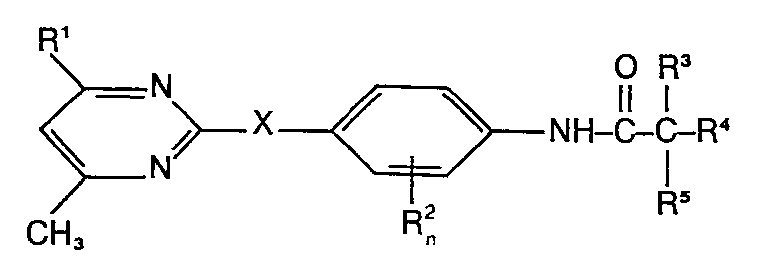
in welcher
- X für Sauerstoff oder Schwefel steht,
- R' für Wasserstoff, Halogen, Alkyl mit 1 bis 6 Kohlenstoffatomen, Trifluormethyl, gegebenenfalls substituiertes Phenyl, Alkoxy mit 1 bis 6 Kohlenstoffatomen oder Alkylmercapto mit 1 bis 6 Kohlenstoffatomen steht,
- R2 für Halogen oder Methyl steht,
- n für 0, 1 oder 2 steht,
- R3 für Wasserstoff, Halogen, gegebenenfalls substituiertes Alkyl mit 1 bis 6 Kohlenstoffatomen, gegebenenfalls substituiertes Aryl, gegebenenfalls substituiertes Aralkyl oder für die Reste -OR6 oder -SOm -R6 steht, wobei
- R6 für gegebenenfalls substituiertes Alkyl mit 1 bis 6 Kohlenstoffatomen oder für gegebenenfalls substituiertes Aryl steht und
- m für 0, 1 oder 2 steht, und
- R4 und R5 unabhängig voneinander für Halogen oder gegebenenfalls substituiertes Alkyl mit 1 bis 6 Kohlenstoffatomen stehen oder
- R4 und R5 gemeinsam mit dem angrenzenden Kohlenstoffatom für einen gegebenenfalls substituierten, gesättigten oder ungesättigten carbocyclischen Ring mit 3 bis 8 Ring-Kohlenstoffatomen stehen,
mehrere Verfahren zur Herstellung der neuen Stoffe und deren Verwendung als Herbizide.
Description
- Die vorliegende Erfindung betrifft neue substituierte Carbonsäureanilide, mehrere Verfahren zu ihrer Herstellung und ihre Verwendung als Herbizide.
- Es ist bereits bekannt, daß bestimmte Carbonsäureanilide herbizide Eigenschaften besitzen (vgl. R. Wegler "Chemie der Pflanzenschutz- und Schädlingsbekämpfungsmittel" Bd. 2, Seiten 311-314, Springer-Verlag, Berlin 1970). So kann zum Beispiel das Propionsäure-3,4-dichloranilid zur Unkrautbekämpfung eingesetzt werden. Die Wirkung dieser Verbindung ist gut, jedoch werden bei geringen Aufwandmengen einige Unkräuter nicht immer voll erfaßt. Außerdem läßt auch die Selektivität in manchen Fällen zu wünschen übrig.
- Ferner ist bekannt, daß zahlreiche Pyrimidinyl-2-ether und -thioether als Herbizide geeignet sind (vgl. JP-OS 9 474/ 1967, US-PS 3, 126, 271 und US-PS 3, 250, 775). Zum Beispiel können das 2-Phenoxy-4,6-dimethyl-pyrimidin und das 2- (4-Chlor-benzylmer- capto)-4,6-dimethyl-pyrimidin zur Bekämpfung von Unkräutern verwendet werden. Die herbizide Potenz dieser Stoffe ist aber nicht immer ausreichend.
- Weiterhin ist bekannt, daß niedere Acylderivate von 4-Pyridyloxy-(bzw. thio)-anilinen herbizide Eigenschaften aufweisen (vgl. DE-OS 2, 501, 648, JP-OS 55-122 763 und JP-OS 56-123 970). Darüberhinaus sind auch herbizid wirksame Acylderivate von 4-Pyrimidyloxy-anilinen bekannt, die in der 5-Stellung des Pyrimidylrestes durch Halogen oder Trifluormethyl substituiert sind, dagegen in den Positionen 4 und 6 keinen Substituenten enthalten (vgl. JP-OS 56-029 576). Auch die Wirksamkeit dieser Stoffe ist jedoch für praktische Zwecke nicht immer befriedigend.
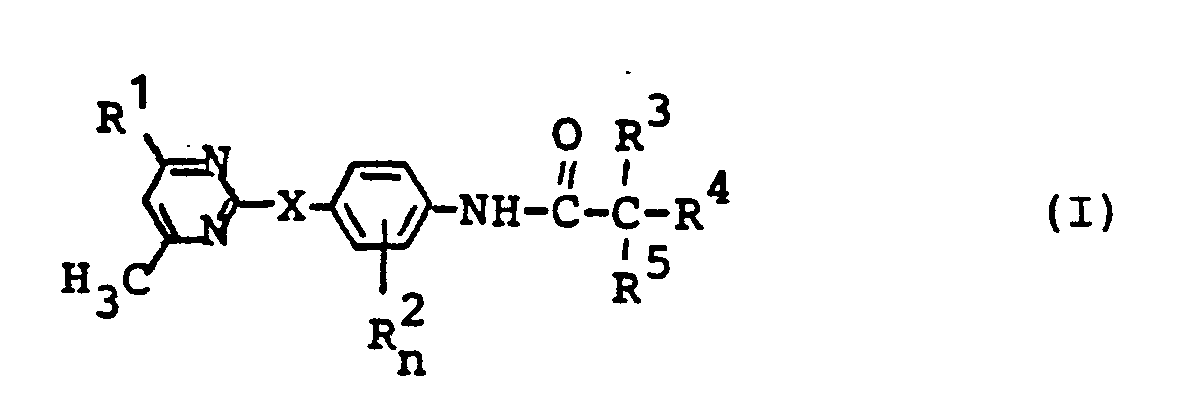
- Es wurden nun neue substituierte Carbonsäureanilide der Formel
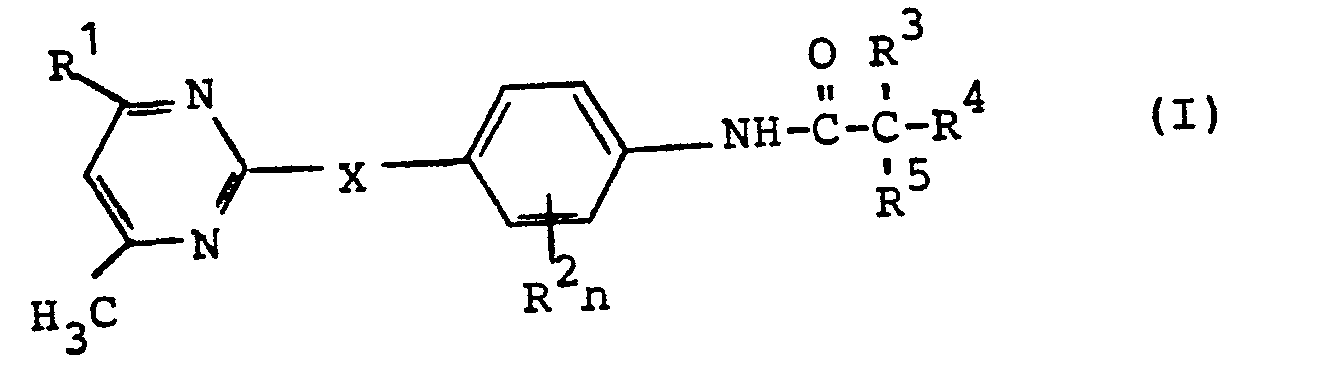
in welcher - X für Sauerstoff oder Schwefel steht,
- R1 für Wasserstoff, Halogen, Alkyl mit 1 bis 6 Kohlenstoffatomen, Trifluormethyl, gegebenenfalls substituiertes Phenyl, Alkoxy mit 1 bis 6 Kohlenstoffatomen oder Alkylmercapto mit 1 bis 6 Kohlenstoffatomen steht,
- R 2 für Halogen oder Methyl steht,
- n für 0,1 oder 2 steht,
- R3 für Wasserstoff, Halogen, gegebenenfalls substituiertes Alkyl mit 1 bis 6 Kohlenstoffatomen, gegebenenfalls substituiertes Aryl, gegebenenfalls substituiertes Aralkyl oder für die Reste -OR6 oder -SOm-R6 steht, wobei
- R6 für gegebenenfalls substituiertes Alkyl mit 1 bis 6 Kohlenstoffatomen oder für gegebenenfalls substituiertes Aryl steht und
- m für 0,1 oder 2 steht,
und - R 4 und R 5 unabhängig voneinander für Halogen oder gegebenenfalls substituiertes Alkyl mit 1 bis 6 Kohlenstoffatomen stehen oder
- R 4 und R 5 gemeinsam mit dem angrenzenden Kohlenstoffatom für einen gegebenenfalls substituierten, gesättigten oder ungesättigten carbocyclischen Ring mit 3 bis 8 Ring-Kohlenstoffatomen stehen,
- Weiterhin wurde gefunden, daß man substituierte Carbonsäureanilide der Formel (I) erhält, wenn man
- a) Anilin-Derivate der Formel

in welcher- R1, R2, X und n die oben angegebene Bedeutung haben,
entweder - α) mit Säurehalogeniden der Formel

in welcher - R 3, R 4 und R 5 die oben angegebene Bedeutung haben
und - Y für Halogen steht,
gegebenenfalls in Gegenwart eines Verdünnungsmittels und gegebenenfalls in Gegenwart eines Säurebindemittels umsetzt,
oder - R1, R2, X und n die oben angegebene Bedeutung haben,
- ß) mit symmetrischen Carbonsäureanhydriden der Formel

in welcher- R 3,R 4 und R5 die oben angegebene Bedeutung haben,
- gegebenenfalls in Gegenwart eines Verdünnungsmittels umsetzt,
oder - mit asymmetrischen Säureanhydriden der Formel

in welcher - R 3,R 4 und R 5 die oben angegebene Bedeutung haben und
- R für Alkyl mit 1 bis 4 Kohlenstoffatomen oder Phenyl steht,
gegebenenfalls in Gegenwart eines Verdünnungsmittels umsetzt,
oder - ) mit Verbindungen der Formel


in welcher- R 3, R 4 und R 5 die oben angegebene Bedeutung haben,
- gegebenenfalls in Gegenwart eines Verdünnungsmittels umsetzt,
oder - b) Pyrimidin-Derivate der Formel

in welcher- R1 die oben angegebene Bedeutung hat und
- Hal für Halogen steht,
- mit Acylanilin-Derivaten der Formel

in welcher - R2, R3, R4, R , X und n die oben angegebene Bedeutung haben,
- in Gegenwart eines Verdünnungsmittels umsetzt.
- Schließlich wurde gefunden, daß sich die neuen substituierten Carbonsäureanilide der Formel (I) durch hervorragende herbizide Wirksamkeit auszeichnen.
- Überraschenderweise besitzen die erfindungsgemäßen substituierten Carbonsäureanilide der Formel (I) wesentlich bessere herbizide Eigenschaften als die konstitutionell ähnlichsten vorbekannten Stoffe. So lassen sich die erfindungsgemäßen Carbonsäureanilide der Formel (I) wesentlich besser zur Unkrautbekämpfung verwenden als das 2-Phenoxy-4,6-dimethyl-pyrimidin, welches ein strukturell ähnlicher vorbekannter Wirkstoff gleicher Wirkungsart ist.
- Die erfindungsgemäßen substituierten Carbonsäureanilide sind durch die Formel (I) allgemein definiert. In dieser Formel steht X für Sauerstoff oder Schwefel. Der Rest R1 steht vorzugsweise für Wasserstoff, Fluor, Chlor, Brom, geradkettiges oder verzweigtes Alkyl mit 1 bis 4 Kohlenstoffatomen, Trifluormethyl, gegebenenfalls durch Chlor, Trifluormethyl und/oder Methyl substituiertes Phenyl, Alkoxy mit 1 bis 4 Kohlenstoffatomen oder Alkylmercapto mit 1 bis 4 Kohlenstoffatomen. R steht vorzugsweise für Chlor, Brom oder Methyl. Der Index n steht vorzugsweise für 0 oder 1. R3 steht vorzugsweise für Wasserstoff, Fluor, Chlor, Brom, gegebenenfalls durch Fluor, Chlor und/oder Brom substituiertes Alkyl mit 1 bis 4 Kohlenstoffatomen, gegebenenfalls durch Fluor, Chlor, Brom, Trifluormethyl, Methoxy und/ oder Methyl substituiertes Phenyl, gegebenenfalls durch Fluor, Chlor, Brom, Trifluormethyl, Methoxy und/oder Methyl substituiertes Benzyl oder für die Reste -OR6 oder -SO -R6, worin R vorzugsweise für gegebenenfalls durch Fluor, Chlor und/oder Brom substituiertes Alkyl mit 1 bis 4 Kohlenstoffatomen oder für gegebenenfalls durch Fluor, Chlor, Brom und/oder Alkyl mit 1 bis 4 Kohlenstoffatomen substituiertes Phenyl steht und der Index m für 0, 1 oder 2 steht. R4 und R5 stehen unabhängig voneinander vorzugsweise für Fluor, Chlor, Brom oder gegebenenfalls durch Fluor, Chlor und/oder Brom substituiertes Alkyl mit 1 bis 4 Kohlenstoffatomen. Außerdem stehen R4 und R5 auch gemeinsam mit dem angrenzenden Kohlenstoffatom vorzugsweise für einen gegebenenfalls durch Fluor, Chlor und/oder Alkyl mit 1 bis 4 Kohlenstoffatomen substituierten gesättigten oder ungesättigten carbocyclischen Ring mit 3 bis 7 Ring -Kohlenstoffatomen.
- Eine besonders bevorzugte Gruppe erfindungsgemäßer Stoffe sind diejenigen substituierten Carbonsäureanilide der Formel (I), in denen
- X für Sauerstoff oder Schwefel steht,
- R1 für Wasserstoff, Alkyl mit 1 bis 4 Kohlenstoffatomen, Alkoxy mit 1 bis 4 Kohlenstoffatomen oder Trifluormethyl steht,
- R 2 für Chlor, Brom oder Methyl steht,
- n für 0 oder 1 steht,
- R 3 für Fluor, Chlor, Brom, gegebenenfalls durch Fluor und/oder Chlor substituiertes Alkyl mit 1 bis 4 kohlenstoffatomen, gegebenenfalls durch Fluor, Chlor und/oder Methyl substituiertes Phenyl, gegebenenfalls durch Fluor, Chlor und/oder Methyl substituiertes Benzyl oder für die Reste -OR6 oder -SOm R6 steht, worin
- R6 für gegebenenfalls durch Fluor und/oder Chlor substituiertes Alkyl mit 1 bis 4 Kohlenstoffatomen oder für gegebenenfalls durch Fluor, Chlor und/ oder Alkyl mit 1 bis 4 Kohlenstoffatomen substituiertes Phenyl steht und
- m für 0, 1 oder 2 steht,
und - R 4 und R5 unabhängig voneinander für Fluor, Chlor oder gegebenenfalls durch Fluor und/oder Chlor substituiertes Alkyl mit 1 bis 4 Kohlenstoffatomen stehen
oder - R 4 und R5 gemeinsam mit dem angrenzenden Kohlenstoffatom für einen gegebenenfalls durch Fluor, Chlor, Methyl, Ethyl, n-Propyl, iso-Propyl, n-Butyl, isoButyl, sek.-Butyl und/oder tert.-Butyl substituierten gesättigten oder ungesättigten carbocyclischen Ring mit 3 bis 7 Ring-Kohlenstoffatomen stehen.
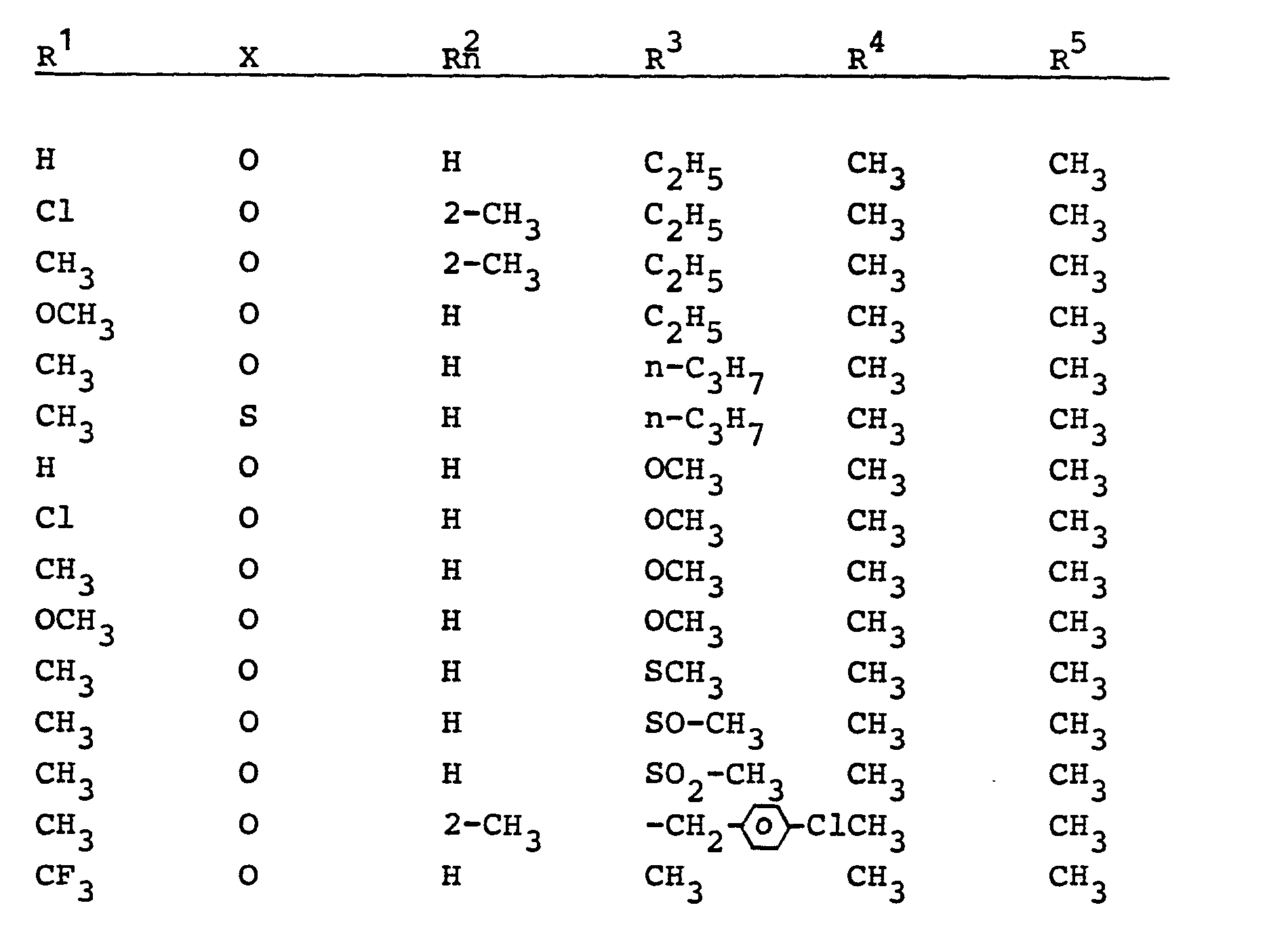
- Als Beispiele für substituierte Carbonsäureanilide der Formel (I) seien die in der folgenden Tabelle 1 aufgeführten Stoffe genannt.
-

- Verwendet man 4-(4,6-Dimethyl-pyrimidyl-2-oxy)-anilin und Pivalsäurechlorid als Ausgangsstoffe, so kann der Verlauf des erfindungsgemäßen Verfahrens (a, Variante α) durch das folgende Formelschema wiedergegeben werden:
-


- Verwendet man 4-(4,6-Dimethyl-pyrimidyl-2-mercapto)-anilin undα-Methoxy-isobuttersäure-kohlensäure-ethylester-anhydrid als Ausgangsstoffe, so kann der Verlauf des erfindungsgemäßen Verfahrens (a, Variante ) durch das folgende Formelschema wiedergegeben werden:
-

-

-

- Die Anilin-Derivate der Formel (II) sind teilweise bekannt. Sie lassen sich herstellen, indem man
- c) Pyrimidin-Derivate der Formel

in welcher- R1 und Hal die oben angegebene Bedeutung haben,
- mit 4-Amino-(thio)-phenolen der Formel
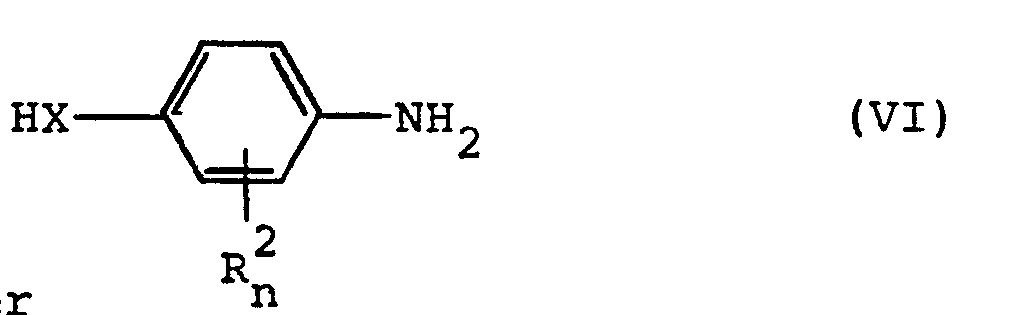
in welcher - R 2, X und n die oben angegebene Bedeutung haben,
- in Gegenwart eines Säurebindemittels sowie gegebenenfalls in Gegenwart eines Verdünnungsmittel umsetzt,
oder - d) 2-(4-Nitro-(thio)-Phenoxy)-pyrimidin-Derivate der Formel

in welcher- R1, R2, X und n die oben angegebene Bedeutung haben,
- Die bei dem obigen Verfahren (c) als Ausgangsstoffe benötigten Pyrimidin-Derivate sind durch die Formel (IV) definiert. In dieser Formel hat R1 vorzugsweise diejenigen Bedeutungen, die bereits im Zusammenhang mit der Beschreibung der erfindungsgemäßen Stoffe der Formel (I) vorzugsweise für diesen Rest genannt wurden. Hal steht vorzugsweise für Fluor, Chlor oder Brom.
- Als Beispiele für Pyrimidin-Derivate der Formel (IV) seien genannt:
- 2-Chlor-4-methyl-pyrimidin
- 2-Brom-4-methyl-pyrimidin
- 2,4-Dichlor-6-methyl-pyrimidin
- 2-Chlor-4-methoxy-6-methylpyrimidin
- 2-Chlor-4-methylmercapto-6-methyl-pyrimidin
- 2-Chlor-4,6-dimethyl-pyrimidin
- 2-Fluor-4,6-dimethyl-pyrimidin
- 2-Chlor-4-methyl-6-propyl-pyrimidin
- 2-Chlor-4-methyl-6-isopropyl-pyrimidin
- 2-Chlor-4-methyl-6-trifluormethyl-pyrimidin
- 2-Chlor-4-methyl-6-phenyl-pyrimidin
- 2-Chlor-4-methyl-6-(4-chlor-phenyl)-pyrimidin
- 2-Chlor-4-methyl-6-(4-methyl-phenyl)-pyrimidin
- 2-Chlor-4-methyl-6-(3-trifluormethyl-phenyl)-pyrimidin
- Die Pyrimidin-Derivate der Formel (IV) sind bekannt oder lassen sich nach im Prinzip bekannten Methoden in einfacher Weise herstellen. So erhält man Pyrimidin-Derivate der Formel (IV) zum Beispiel dadurch, daß man 2-Hydroxy-pyrimidin-Derivate (Dihydro-pyri- midon-2-Derivate) mit anorganischen Säurehalogeniden, wie zum Beispiel Phosphoroxychlorid oder Phosphorpentachlorid, umsetzt, oder auch dadurch, daß man entsprechende 2-Amino-pyrimidin-Derivate mit Salpetriger Säure in Gegenwart von Halogenwasserstoffsäuren umsetzt.
- Die bei dem Verfahren (c) weiterhin als Ausgangsstoffe benötigten 4-Amino-(thio)-phenole sind durch die Formel (VI) definiert. In dieser Formel haben R2, X und n vorzugsweise diejenigen Bedeutungen, die bereits im Zusammenhang mit der Beschreibung der erfindungsgemäßen Stoffe der Formel (I) vorzugsweise für diese Reste bzw. für diesen Index genannt wurden.
- Als Beispiele für 4-Amino-(thio)-phenole der Formel (VI) seien genannt:
- 4-Amino-phenol
- 2-Chlor-4-amino-phenol
- 3-Chlor-4-amino-phenol
- 2,5-Dichlor-4-amino-phenol
- 2,6-Dichlor-4-amino-phenol
- 2-Methyl-4-amino-phenol
- 3-Methyl-4-amino-phenol
- 2-Chlor-5-methyl-4-amino-phenol
- 4-Amino-thiophenol
- 2-Chlor-4-amino-thiophenol
- 3-Chlor-4-amino-thiophenol
- 2-Methyl-4-amino-thiophenol
- 3-Methyl-4-amino-thiophenol
- Die 4-Amino-(thio)-phenole der Formel (VI) sind bekannt oder lassen sich nach im Prinzip bekannten Methoden in einfacher Weise herstellen.
- Als Säurebindemittel können bei der Durchführung des Verfahrens (c) alle üblicherweise für derartige Umsetzungen verwendbaren Säureakzeptoren verwendet werden. Vorzugsweise verwendbar sind Alkali- und Erdalkalioxide, -hydroxide und -carbonate, wie Natriumhydroxid, Kaliumhydroxid, Calciumoxid, Natriumcarbonat und Kaliumcarbonat, ferner Alkali-alkoholate, -amide und -hydride, wie zum Beispiel Natrium-methylat, Natriumethylat, Kalium-tert.-butylat, Natrium-amid und Natrium-hydrid.
- Als Verdünnungsmittel können bei der Durchführung des Verfahrens (c) alle üblichen inerten organischen Solventien verwendet werden. Vorzugsweise in Frage kommen Kohlenwasserstoffe, wie Benzin, Toluol und Xylol, ferner Ether, wie Dioxan, Glykoldimethylether und Diglykoldimethylether, außerdem Nitrile, wie Acetonitril, und auch stark polare Solventien, wie Dimethylsulfoxid, Sulfolan und Dimethylformamid.
- Die Reaktionstemperaturen können bei der Durchführung des Verfahrens (c) innerhalb eines größeren Bereiches variiert werden. Im allgemeinen arbeitet man bei Temperaturen zwischen 0°C und 200°C, vorzugsweise zwischen 50°C und 150°C.
- Die Umsetzung nach dem Verfahren (c) wird im allgemeinen unter Normaldruck vorgenommen.
- Bei der Durchführung des Verfahrens (c) setzt man die Ausgangsstoffe der Formeln (IV) und(VI) im allgemeinen in angenähert äquimolaren Mengen um. Es ist jedoch auch möglich, die eine oder andere Komponente in einem größeren Überschuß zu verwenden. Die Aufarbeitung erfolgt nach üblichen Methoden.
- Die bei dem Verfahren (d) als Ausgangsstoffe benötigten 2-(4-Nitro-(thio)-phenoxy)-pyrimidin-Derivate sind durch die Formel (VII) definiert. In dieser Formel haben R1, R2, X und n vorzugsweise diejenigen Bedeutungen, die bereits im Zusammenhang mit der Beschreibung der erfindungsgemäßen Stoffe der Formel (I) vorzugsweise für diese Reste bzw. für diesen Index genannt wurden.
- Die Verbindungen der Formel (VII) sind bekannt oder lassen sich nach im Prinzip bekannten Methoden in einfacher Weise herstellen. So erhält man Verbindungen der Formel (VII) zum Beispiel dadurch, daß man Pyrimidin-Derivate der Formel

in welcher - R und Hal die oben angegebene Bedeutung haben,
- mit 4-Nitro-(thio)-phenolen der Formel

in welcher - R 2, X und n die oben angegebene Bedeutung haben,
- Als Reduktionsmittel kommen bei dem Verfahren (d) alle diejenigen Stoffe in Frage, die üblicherweise zur Reduktion aromatischer Nitroverbindungen eingesetzt werden. Vorzugsweise verwendbar sind elementare Metalle, wie Eisen, Zink und Zinn, ferner Metallverbindungen in niederen Wertigkeitsstufen, wie Eisen (II)- und Zinn (II)-Salze, und außerdem Nichtmetall-Verbindungen in niederen Wertigkeitsstufen, wie zum Beispiel Salze des Schwefelwasserstoffes, Alkalisulfite und Alkalidithionite. Im übrigen kann die Reduktion auch durch katalytische Hydrierung mit Wasserstoff in Gegenwart eines Katalysators, wie zum Beispiel Raney-Nickel, erfolgen.
- Als Verdünnungsmittel kommen bei dem Verfahren (d) alle üblichen für derartige Reduktionen geeigneten organischen Solventien in Betracht. Die Reaktionstemperaturen können innerhalb eines größeren Bereiches variiert werden. Sie entsprechen den Temperaturen, die bei analogen Reaktionen angewandt werden.
- Die Durchführung der Reduktion nach dem Verfahren (d) und die Aufarbeitung des anfallenden Reaktionsgemisches erfolgen nach üblichen Methoden.
- Die bei dem erfindungsgemäßen Verfahren (a, Variante α) als Reaktionskomponenten benötigten Säurehalogenide sind durch die Formel (III a) eindeutig definiert. In dieser Formel haben R3, R4 und R5 vorzugsweise diejenigen Bedeutungen, die bereits im Zusammenhang mit der Beschreibung der erfindungsgemäßen Stoffe der Formel (I) vorzugsweise für diese Reste genannt wurden. Y steht vorzugsweise für Fluor, Chlor und Brom.
- Als Beispiele für Säurehalogenide der Formel (III a) seien die Chloride der folgenden Säuren genannt:
- Trichloressigsäure
- Trifluoressigsäure
- α,α-Dichlorpropionsäure
- Isobuttersäure
- α -Chlor-isobuttersäure
- α-Brom-isobuttersäure
- α-Methoxy-isobuttersäure
- α-Phenoxy-isobuttersäure
- d-(4-Chlor-phenoxy)-isobuttersäure
- α-(2-Methyl-4-chlor-phenoxy)-isobuttersäure
- α-Methylmercapto-isobuttersäure
- α-Methylsulfonyl-isobuttersäure
- α-Methyl-buttersäure
- Pivalinsäure
- ß-Fluor-pivalinsäure
- ß-Chlor-pivalinsäure
- ß,ß'-Difluor-pivalinsäure
- ß,ß'-Dichlor-pivalinsäure
- β,β'β"-Trifluor-pivalinsäure
- ß,ß'ß"-Trichlor-pivalinsäure
- α,α-Dimethyl-valeriansäure
- α-Methyl-α-ethyl-buttersäure
- α,α-Dimethyl-phenylessigsäure
- α,α-Dimethyl-(4-chlor-phenyl)-essigsäure
- α,α-Dimethyl-(3,4-dichlor-phenyl)-essigsäure
- α,α-Dimethyl-(3-trifluormethyl-phenyl)-essigsäure
- α-Benzyl-isobuttersäure
- o(--(4-Chlor-benzyl)-isobuttersäure
- α-(4-Methoxy-benzyl)-isobuttersäure
- Cyclopropan-carbonsäure
- 1-Methyl-cyclopropan-carbonsäure
- 2,2-Dichlor-1-methyl-cyclopropan-carbonsäure Cyclopentan-carbonsäure
- 1-Methyl-cyclopentan-carbonsäure
- Cyclohexan-carbonsäure
- 1-Methyl-cyclohexan-carbonsäure
- 1-Methyl-4-isopropyl-cyclohexan-carbonsäure
- Die Säurehalogenide der Formel (III a) sind bekannt oder lassen sich nach im Prinzip bekannten Methoden in einfacher Weise herstellen.
- Als Säurebindemittel kommen bei der Umsetzung nach dem erfindungsgemäßen Verfahren (a, Variante α) alle üblichen Säureakzeptoren in Betracht. Vorzugsweise verwendbar sind tertiäre Amine, wie Triethylamin, Pyridin und N,N-Dimethyl-anilin, ferner Erdalkalimetalloxide, wie Magnesium- und Calciumoxid, außerdem Alkali- und Erdalkali-metall-carbonate, wie Natriumcarbonat, Kaliumcarbonat und Calciumcarbonat. Es ist auch möglich, die jeweiligen Anilin-Derivate der Formel (II) gleichzeitig als Säurebindemittel zu verwenden. Dazu muß die betreffende Anilin-Verbindung dann zumindest in solcher Menge eingesetzt werden, daß der freiwerdende Halogenwasserstoff gebunden werden kann.
- Als Verdünnungsmittel können bei dem erfindungsgemäßen Verfahren (a, Variantedl) alle gegenüber Säurehalogeniden inerten Solventien eingesetzt werden. Vorzugsweise verwendbar sind Kohlenwasserstoffe, wie Benzin, Benzol, Toluol, Xylol und Tetralin, ferner Halogenkohlenwasserstoffe, wie Methylenchlorid, Chloroform, Tetrachlorkohlenstoff, Chlorbenzol und o-Dichlorbenzol, außerdem Ketone, wie Aceton und Methyl-isopropylketon, weiterhin Ether, wie Diethylether, Tetrahydrofuran und Dioxan, darüberhinaus Carbonsäureester, wie Ethylacetat, und auch stark polare Solventien, wie Dimethylsulfoxid und Sulfolan. Wenn die Hydrolysestabilität des Säurehalogenids es zuläßt, kann die Umsetzung auch in Gegenwart von Wasser durchgeführt werden.
- Die Reaktionstemperaturen können bei der Durchführung des erfindungsgemäßen Verfahrens (a, Variantedj innerhalb eines größeren Bereiches variiert werden. Arbeitet man ohne Lösungsmittel und Säurebindemittel, so geht man im allgemeinen so vor, daß man die Komponenten zunächst bei Temperaturen zwischen -20°C und +20°C reagieren läßt und danach auf Temperaturen zwischen 70 und 200°C erhitzt. Arbeitet man in Gegenwart eines Verdünnungsmittels und eines Säurebindemittels, so liegen die Reaktionstemperaturen im allgemeinen zwischen -20°C und +100°C, vorzugsweise zwischen 0°C und 50°C.
- Das erfindungsgemäße Verfahren (a, Variante α) wird im allgemeinen unter Normaldruck durchgeführt.
- Bei der Durchführung des erfindungsgemäßen Verfahrens (a, Variante J) werden die Ausgangsstoffe der Formeln (II) und (III a) im allgemeinen in angenähert äquivalenten Mengen verwendet. Es ist jedoch auch möglich, die eine oder andere Komponente in einem größeren Überschuß einzusetzen. Die Aufarbeitung erfolgt danach üblichen Methoden. Im allgemeinen geht man so vor, daß man ausgefallene Salze entfernt und das verbleibende Reaktionsgemisch durch Abziehen des Verdünnungsmittels einengt. Arbeitet man in Gegenwart von Wasser oder von mit Wasser mischbaren Solventien, so kann man auch so verfahren, daß man das Reaktionsgemisch mit Wasser verdünnt, das entstehende Gemisch abgesaugt oder mit einem Wasser wenig mischbaren organischen Lösungsmittel extrahiert, die organische Phase wäscht, einengt und den verbleibenden Rückstand gegebenenfalls üblichen Reinigungsverfahren unterwirft.
- Die bei dem erfindungsgemäßen Verfahren (a, Variante ß) als Reaktionskomponenten benötigten symmetrischen Carbonsäure-anhydride sind durch die Formel (III b) eindeutig definiert. In dieser Formel haben R 3, R 4 und R 5 vorzugsweise diejenigen Bedeutungen, die bereits im Zusammenhang mit der Beschreibung der erfindungsgemäßen Stoffe der Formel (I) vorzugsweise für diese Reste genannt wurden.
- Die symmetrischen Carbonsäureanhydride der Formel (III b) sind bekannt oder lassen sich nach im Prinzip bekannten Methoden in einfacher Weise herstellen.
- Als Verdünnungsmittel können bei der Durchführung des erfindungsgemäßen Verfahrens (a, Variante ß) vorzugsweise diejenigen Verdünnungsmittel verwendet werden, die auch bei dem Verfahren (a, Variante δ) vorzugsweise in Betracht kommen. Im übrigen kann auch ein im Überschuß eingesetztes Carbonsäureanhydrid der Formel (III b) gleichzeitig als Verdünnungsmittel fungieren.
- Die Reaktionstemperaturen können auch bei dem erfindungsgemäßen Verfahren (a, Variante ß) innerhalb eines größeren Bereiches variiert werden. Im allgemeinen arbeitet man bei Temperaturen zwischen -20°C und +150°C, vorzugsweise zwischen 0 und 100°C.
- Das erfindungsgemäße Verfahren (a, Variante ß) wird im allgemeinen unter Normaldruck durchgeführt.
- Bei der Durchführung des erfindungsgemäßen Verfahrens (a, Variante ß) werden die Ausgangsstoffe der Formeln (II) und (III b) im allgemeinen in angenähert äquivalenten Mengen verwendet. Es ist jedoch auch möglich, das Carbonsäureanhydrid in einem größeren Überschuß einzusetzen. Die Aufarbeitung erfolgt nach üblichen Methoden.
- Im allgemeinen geht man so vor, daß man Verdünnungsmittel und im überschuß vorhandenes Carbonsäureanhydrid sowie die entstehende Carbonsäure durch Destillation oder durch Waschen mit einem organischen Lösungsmittel oder mit Wasser entfernt.
- Die bei dem erfindungsgemäßen Verfahren (a, Varianter) als Reaktionskomponenten benötigten asymmetrischen Säureanhydride sind durch die Formel (III c) eindeutig definiert. In dieser Formel haben R3, R 4 und R 5 vorzugsweise diejenigen Bedeutungen, die bereits im Zusammenhang mit der Beschreibung der erfindungsgemäßen Stoffe der Formel (I) vorzugsweise für diese Reste genannt wurden. R steht vorzugsweise für Alkyl mit 1 oder 2 Kohlenstoffatomen oder für Phenyl.
- Die asymmetrischen Säureanhydride der Formel (III c) sind bekannt oder lassen sich nach im Prinzip bekannten Methoden in einfacher Weise herstellen. So erhält man Verbindungen der Formel (III c) dadurch, daß man Carbonsäuren der Formel

in welcher - R 3, R 4 und R 5 die oben angegebene Bedeutung haben,
- mit Kohlensäure-ester-chloriden der Formel

in welcher - R die oben angegebene Bedeutung hat,
- Als Verdünnungsmittel können bei der Durchführung des erfindungsgemäßen Verfahrens (a, Variante ) vorzugsweise diejenigen Verdünnungsmittel verwendet werden, die auch bei dem Verfahren (a, Variante α) vorzugsweise in Betracht kommen. Im übrigen kann auch im Überschuß eingesetztes Säureanhydrid der Formel (III c) gleichzeitig als Verdünnungsmittel fungieren.
- Die Reaktionstemperaturen können auch bei dem erfindungsgemäßen Verfahren (a, Variantef) innerhalb eines größeren Bereiches variiert werden. Im allgemeinen arbeitet man bei Tempearaturen zwischen -20°C und +150°C, vorzugsweise zwischen 0 und 100°C.
- Das erfindungsgemäße Verfahren (a, Variantef) wird im allgemeinen unter Normaldruck durchgeführt.
- Bei der Durchführung des erfindungsgemäßen Verfahrens (a, Variante δ) werden die Ausgangsstoffe der Formeln (II) und (III c) im allgemeinen in angenähert äquivalenten Mengen verwendet. Es ist jedoch auch möglich, das Säureanhydrid in einem größeren Überschuß einzusetzen. Die Aufarbeitung erfolgt nach üblichen Methoden.
- Die bei dem erfindungsgemäßen Verfahren (a, Variante ) als Reaktionskomponenten benötigten Verbindungen sind durch die Formel (III d) eindeutig definiert. In dieser Formel haben R3, R4 und R5 vorzugsweise diejenigen Bedeutungen, die bereits im Zusammenhang mit der Beschreibung der erfindungsgemäßen Stoffe der Formel (I) vorzugsweise für diese Reste genannt wurden.
- Die Verbindungen der Formel (III d) sind bekannt oder lassen sich nach im Prinzip bekannten Verfahren in einfacher Weise herstellen. So erhält man Verbindungen der Formel (III d) dadurch, daß man Carbonsäuren der Formel
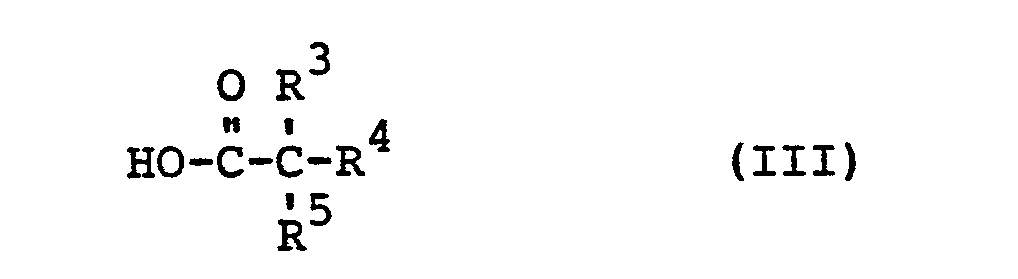
in welcher - R 3, R 4 und R die oben angegebene Bedeutung haben,
- Als Verdünnungsmittel können bei der Durchführung des erfindungsgemäßen Verfahrens (a, Variante δ) vorzugsweise diejenigen Verdünnungsmittel verwendet werden, die auch bei dem Verfahren (a, Variante α) vorzugsweise in Betracht kommen.
- Die Reaktionstemperaturen können auch bei dem erfindungsgemäßen Verfahren (a, Variante ) innerhalb eines größeren Bereiches variiert werden. Im allgemeinen arbeitet man bei Temperaturen zwischen -20°C und +150°C, vorzugsweise zwischen 0 und 100°C.
- Das erfindungsgemäße Verfahren (a, Variante δ) wird im allgemeinen unter Normaldruck durchgeführt.
- Bei der Durchführung des erfindungsgemäßen Verfahrens (a, Variante δ) werden die Ausgangsstoffe der Formeln (II) und (III d) im allgemeinen in angenähert äquivalenten Mengen verwendet. Die Aufarbeitung erfolgt nach üblichen Methoden.
- Die bei dem erfindungsgemäßen Verfahren (b) als Ausgangsstoffe benötigten Pyrimidin-Derivate wurden bereits im Zusammenhang mit der Beschreibung des Verfahrens (c) abgehandelt.
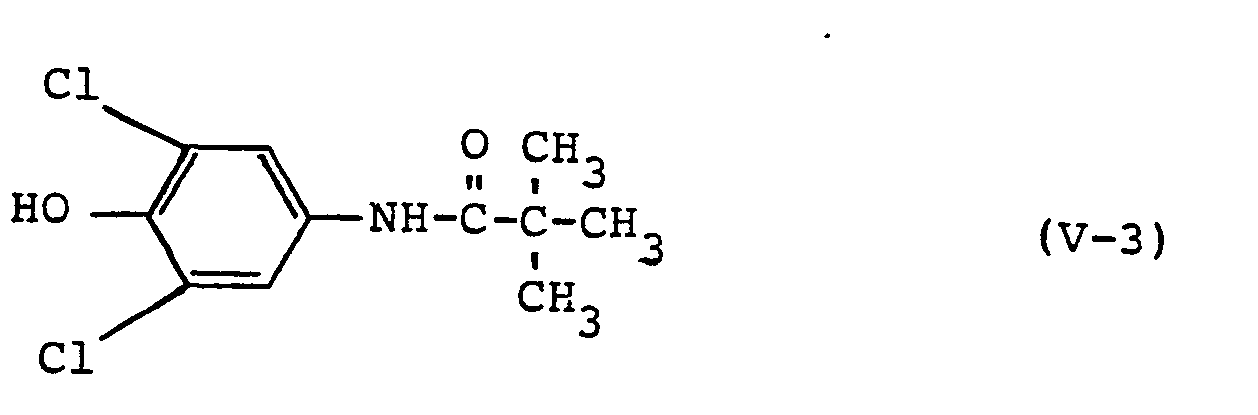
- Die bei dem erfindungsgemäßen Verfahren (b) weiterhin als Ausgangsstoffe benötigten Acylanilin-Derivate sind durch die Formel (V) eindeutig definiert. In dieser Formel haben R 2, R 3, R 4, R 5, X und n vorzugsweise diejenigen Bedeutungen, die bereits im Zusammenhang mit der Beschreibung der Stoffe der Formel (I) vorzugsweise für diese Reste bzw. für diesen Index genannt wurden.
- Die Verbindungen der Formel (V) sind bekannt oder lassen sich nach im Prinzip bekannten Methoden in einfacher Weise herstellen. So erhält man Acylanilin-Derivate der Formel (V) zum Beispiel dadurch, daß man 4-Amino-(thio)-phenole der Formel
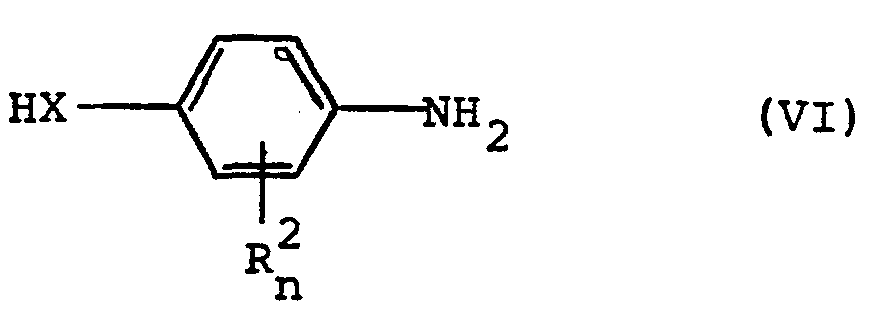
in welcher - R2, X und n die oben angegebene Bedeutung haben,
mit Säurehalogeniden der Formel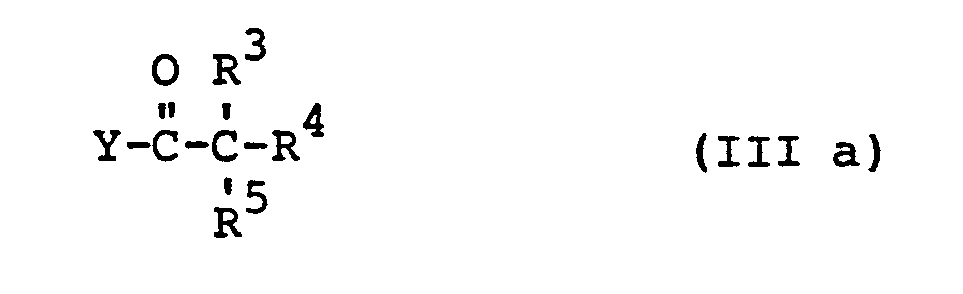
in welcher - R 3, R 4, R 5 und Y die oben angegebene Bedeutung haben,
- Als Säurebindemittel können bei der Durchführung des erfindungsgemäßen Verfahrens (b) alle üblichen Säureakzeptoren eingesetzt werden. Vorzugsweise verwendbar sind Alkalimetall- und Erdalkalimetall-oxide, -hydroxide und -carbonate, wie Natriumhydroxid, Kaliumhydroxid, Magnesiumoxid, Calciumoxid, Natriumcarbonat, Kaliumcarbonat und Calciumcarbonat, ferner Alkalimetall-und Erdalkalimetallamide und -hydride, wie Natriumamid, Natriumhydrid und Calciumhydrid, und außerdem auch Alkalimetall-alkoholate, wie Natrium-methylat, Natriumethylat und Kalium-tert.-butylat.
- Als Verdünnungsmittel können bei dem erfindungsgemäßen Verfahren (b) alle üblichen inerten organischen Solventien eingesetzt werden. Vorzugsweise verwendbar sind Kohlenwasserstoffe, wie Toluol und Xylol, ferner Ether, wie Dibutylether, Tetrahydrofuran, Dioxan, Glykoldimethylether und Diglykoldimethylether, außerdem Nitrile, wie Acetonitril und Propionitril, und weiterhin polare Lösungsmittel, wie Nitrobenzol, Dimethylsulfoxid, Sulfolan, Dimethylformamid und N-Methyl-pyrrolidon.
- Die Reaktionstemperaturen können bei der Durchführung des erfindungsgemäßen Verfahrens (b) innerhalb eines größeren Bereiches variiert werden. Im allgemeinen arbeitet man bei Temperaturen zwischen 0 und 200°C, vorzugsweise zwischen 50 und 150°C.
- Das erfindungsgemäße Verfahren (b) wird im allgemeinen unter Normaldruck durchgeführt.
- Bei der Durchführung des erfindungsgemäßen Verfahrens (b) setzt man die Reaktionskomponenten der Formeln (IV) und (V) im allgemeinen in etwa äquimolaren Mengen ein. Es ist jedoch auch möglich, die eine oder andere Komponente in einem größeren Uberschuß zu verwenden. Außerdem setzt man im allgemeinen auch eine äquimolare Menge an säurebindendem Mittel ein. Es kann jedoch auch von Vorteil sein, das Säurebindemittel in einem bis zu einmolaren Uberschuß hinzuzufügen. Im einzelnen geht man im allgemeinen so vor, daß man das säurebindende Mittel zu einer Mischung der Reaktionskomponenten in einem geeigneten Verdünnungsmittel gibt. Man kann aber auch in der Weise verfahren, daß man zunachst aus dem Acylanilin-Derivat der Formel (V) und dem Säurebindemittel ein Salz erzeugt und dieses dann mit einem PyrimidinDerivat der Formel (IV) umsetzt. Weiterhin ist es auch möglich, aus dem Acylanilin-Derivat der Formel (V) mit einem Säurebindemittel zunächst separat ein Salz herzustellen, dieses dann zu isolieren und anschließend in Gegenwart eines geeigneten Verdünnungsmittels ohne weitere Zugabe eines Säurebindemittels mit einem Pyrimidin-Derivat der Formel (IV) umzusetzen. -Die Aufarbeitung erfolgt jeweils nach üblichen Methoden.
- Die erfindungsgemäßen Wirkstoffe können als Defoliants, Desiccants, Krautabtötungsmittel und insbesondere als Unkrautvernichtungsmittel verwendet werden. Unter Unkraut im weitesten Sinne sind alle Pflanzen zu verstehen, die an Orten aufwachsen, wo sie unerwünscht sind. Ob die erfindungsgemäßen Stoffe als totale oder selektive Herbizide wirken, hängt im wesentlichen von der angewendeten Menge ab.
- Die erfindungsgemäßen Wirkstoffe können z.B. bei den folgenden Pflanzen verwendet werden:
- Dikotyle Unkräuter der Gattungen: Sinapis, Lepidium, Galium, Stellaria, Matricaria, Anthemis, Galinsoga, Chenopodium, Urtica, Senecio, Amaranthus, Portulaca, Xanthium, Convolvulus, Ipomoea, Polygonum, Sesbania, Ambrosia, Cirsium, Carduus, Sonchus, Solanum, Rorippa, Rotala, Lindernia, Lamium, Veronica, Abutilon, Emex, Datura, Viola, Galeopsis, Papaver, Centaurea.
- Dikotyle Kulturen der Gattungen: Gossypium, Glycine, Beta, Daucus, Phaseolus, Pisum, Solanum, Linum, Ipomoea, Vicia, Nicotiana, Lycopersicon, Arachis, Brassica, Lactuca, Cucumis, Cucurbita.
- Monokotyle Unkräuter der Gattungen: Echinochloa, Setaria, Panicum, Digitaria, Phleum, Poa, Festuca, Eleusine, Brachiaria, Lolium, Bromus, Avena, Cyperus, Sorghum, Agropyron, Cynodon, Monochoria, Fimbristylis, Sagittaria, Eleocharis, Scirpus, Paspalum, Ischaemum, Sphenoclea, Dactyloctenium, Agrostis, Alopecurus, Apera.
- Monokotyle Kulturen der Gattungen: Oryza, Zea, Triticum, Hordeum, Avena, Secale, Sorghum, Panicum, Saccharum, Ananas, Asparagus, Allium.
- Die Verwendung der erfindungsgemäßen Wirkstoffe ist jedoch keineswegs auf diese Gattungen beschränkt, sondern erstreckt sich in gleicher Weise auch auf andere Pflanzen.
- Die Verbindungen eignen sich in Abhängigkeit von der Konzentration zur Totalunkrautbekämpfung z.B. auf Industrie-und Gleisanlagen und auf Wegen und Plätzen mit und ohne Baumbewuchs. Ebenso können die Verbindungen zur Unkrautbekämpfung in Dauerkulturen, z.B. Forst-, Ziergehölz-, Obst-, Wein-, Citrus-, Nuß-, Bananen-, Kaffee-, Tee-, Gummi-, ölpalm-, Kakao-, Beerenfrucht- und Hopfenanlagen und zur selektiven Unkrautbekämpfung in einjährigen Kulturen eingesetzt werden.
- Die erfindungsgemäßen Wirkstoffe eignen sich besonders gut zur selektiven Bekämpfung mono- und dikotyler Unkräuter in monokotylen Kulturen, wie zum Beispiel Mais und Getreide.
- Die erfindungsgemäßen Wirkstoffe weisen auch eine starke mikrobizide Wirkung auf und können zur Bekämpfung von unerwünschten Mikroorganismen praktisch eingesetzt werden. Die Wirkstoffe sind für den Gebrauch als Pflanzenschutzmittel geeignet.
- Fungizide Mittel im Pflanzenschutz werden eingesetzt zur Bekämpfung von Plasmodiophoromycetes, Oomycetes, Chytridiomycetes, Zygomycetes, Ascomycetes, Basidiomycetes, Deuteromycetes.
- Die gute Pflanzenverträglichkeit der Wirkstoffe in den zur Bekämpfung von Pflanzenkrankheiten notwendigen Konzentrationen erlaubt eine Behandlung von oberirdischen Pflanzenteilen, von Pflanz- und Saatgut, und des Bodens.
- Die erfindungsgemäßen Wirkstoffe lassen sich mit besonderem Vorteil zur Bekämpfung von Pyricularia oryzae bei Reis, gegen Botrytis und zur Bekämpfung von Bohnenrost verwenden.
- Im übrigen zeichnen sich die erfindungsgemäßen Stoffe auch durch eine insektizide Wirksamkeit aus. Sie besitzen dabei eine gute wurzelsystemische Wirksamkeit. Die Wirkstoffe können in die üblichen Formulierungen überführt werden, wie Lösungen, Emulsionen, Spritzpulver, Suspensionen, Pulver, Stäubemittel, Pasten, lösliche Pulver, Granulate, Suspensions-Emulsions-Konzentrate, wirkstoffimprägnierte Natur- und synthetische Stoffe sowie Feinstverkapselungen in polymeren Stoffen.
- Diese Formulierungen werden in bekannter Weise hergestellt, z.B. durch Vermischen der Wirkstoffe mit Streckmitteln, also flüssigen Lösungsmitteln und/oder festen Trägerstoffen, gegebenenfalls unter Verwendung von oberflächenaktiven Mitteln, also Emulgiermitteln und/oder Dispergiermitteln und/oder schaumerzeugenden Mitteln.
- Im Falle der Benutzung von Wasser als Streckmittel können z.B. auch organische Lösungsmittel als Hilfslösungsmittel verwendet werden. Als flüssige Lösungsmittel kommen im wesentlichen in Frage: Aromaten, wie Xylol, Toluol, oder Alkylnaphthaline, chlorierte Aromaten und chlorierte aliphatische Kohlenwasserstoffe, wie Chlorbenzole, Chlorethylene oder Methylenchlorid, aliphatische Kohlenwasserstoffe, wie Cyclohexan oder Paraffine, z.B. Erdölfraktionen, mineralische und pflanzliche öle, Alkohole, wie Butanol oder Glycol sowie deren Ether und Ester, Ketone wie Aceton, Methylethylketon, Methylisobutylketon oder Cyclohexanon, stark polare Lösungsmittel, wie Dimethylformamid und Dimethylsulfoxid, sowie Wasser.
- Als feste Trägerstoffe kommen in Frage:
- z. B. Ammoniumsalze und natürliche Gesteinsmehle, wie Kaoline, Tonerden, Talkum, Kreide, Quarz, Attapulgit, Montmorillonit oder Diatomeenerde und synthetische Gesteinsmehle, wie hochdisperse Kieselsäure, Aluminiumoxid und Silikate, als feste Trägerstoffe für Granulate kommen in Frage: z.B. gebrochene und fraktionierte natürliche Gesteine wie Calcit, Marmor, Bims, Sepiolith, Dolomit sowie synthetische Granulate aus anorganischen und organischen Mehlen sowie Granulate aus organischem Material wie Sägemehl, Kokosnußschalen, Maiskolben und Tabakstengeln; als Emulgier- und/oder schaumerzeugende Mittel kommen in Frage: z.B. nichtionogene und anionische Emulgatoren, wie Polyoxyethylen-Fettsäure-Ester, Polyoxyethylen-FettalkoholEther, z.B. Alkylaryl-polyglykolether, Alkylsulfonate, Alkylsulfate, Arylsulfonate sowie Eiweißhydrolysate; als Dispergiermittel kommen in Frage: z.B. Lignin-Sulfitablaugen und Methylcellulose.
- Es können in den Formulierungen Haftmittel wie Carboxymethylcellulose, natürliche und synthetische pulvrige, körnige oder latexförmige Polymere verwendet werden, wie Gummiarabicum, Polyvinylalkohol, Polyvinylacetat, sowie natürliche Phospholipide, wie Kephaline und Lecithine und synthetische Phospholipide. Weitere Additive können mineralische und vegetabile öle sein.
- Es können Farbstoffe wie anorganische Pigmente, z.B. Eisenoxid, Titanoxid, Ferrocyanblau und organische Farbstoffe, wie Alizarin-, Azo- und Metallphthalocyaninfarbstoffe und Spurennährstoffe wie Salze von Eisen, Mangan, Bor, Kupfer, Kobalt, Molybdän und Zink verwendet werden.
- Die Formulierungen enthalten im allgemeinen zwischen 0,1 und 95 Gewichtsprozent Wirkstoff, vorzugsweise zwischen 0,5 und 90 %.
- Die erfindungsgemäßen Wirkstoffe können als solche oder in ihren Formulierungen auch in Mischung mit bekannten Herbiziden zur Unkrautbekämpfung Verwendung finden, wobei Fertigformulierungen oder Tankmischungen möglich sind.
- Für die Mischungen kommen bekannte Herbizide wie z. B. N-(2-Benzthiazolyl)-N,N'-dimethyl-harnstoff, 3-(3-Chlor-4-methylphenyl)-1,1-dimethylharnstoff, 3-(4-Isopropylphenyl)-1,1-dimethylharnstoff, 4-Amino-6-(1,1-dimethylethyl)-3-methylthio-1,2,4-triazin-5(4H)-on, 4-Amino-6-(1,1-dimethyl-ethyl)-3-ethylthio-1,2,4-triazin-5(4H)-on, 1-Amino-6-ethylthio-3-(2,2-dimethylpropyl)-1,3,5-triazin-2,4-(1H, 3H)-dion, 4-Amino-3-methyl-6-phenyl-1,2,4-triazin-5(4H)-on, 2-Chlor-4-ethylamino-6-isopropyl-amino-1,3,5-triazin, das R-Enantiomere des 2-L4-(3,5-Dichlor-pyridin-2-oxy)-phenoxY/-propionsäure-(trimethylsilyl)-methylesters, das R-Enantiomere des 2-[4-(3,5-Dichlorpyridyl-2-oxy)-phenoxy]-propionsäure-(2-benzyloxy)-ethylesters, 2,4-Dichlorphenoxyessigsäure, 2-(2,4-Dichlorphenoxy)-propionsäure, 4-Chlor-2-methyl-phenoxy-essigsäure, 2-(2-Methyl-4-chlor-phenoxy)-propionsäure, 3,5-Dijod-4-hydroxy-benzonitril, 3,5-Dibrom-4-hydroxy-benzonitril sowie Diphenylether und Phenylpyridazine, wie zum Beispiel Pyridate. Einige Mischungen zeigen überraschenderweise auch synergistische Wirkung.
- Auch eine Mischung mit anderen bekannten Wirkstoffen, wie Fungiziden, Insektiziden, Akariziden, Nematiziden, Schutzstoffen gegen Vogelfraß, Pflanzennährstoffen und Bodenstrukturverbesserungsmitteln ist möglich.
- Die Wirkstoffe können als solche, in Form ihrer Formulierungen oder den daraus durch weiteres Verdünnen bereiteten Anwendungsformen, wie gebrauchsfertige Lösungen, Suspensionen, Emulsionen, Pulver, Pasten und Granulate angewandt werden. Die Anwendung geschieht in üblicher Weise, z. B. durch Gießen, Spritzen, Sprühen, Streuen.
- Die erfindungsgemäßen Wirkstoffe können bei einer Verwendung als Herbizide sowohl vor als auch nach dem Auflaufen der Pflanzen appliziert werden. Sie können auch vor der Saat in den Boden eingearbeitet werden.
- Die angewandte Wirkstoffmenge kann beim Einsatz der erfindungsgemäßen Stoffe als Herbizide in einem größeren Bereich schwanken. Sie hängt im wesentlichen von der Art des gewünschten Effektes ab. Im allgemeinen liegen die Aufwandmengen zwischen 0,01 und 10 kg Wirkstoff pro Hektar Bodenfläche, vorzugsweise zwischen 0,05 und 5 kg pro ha.
- Auch beim Einsatz der erfindungsgemäßen Stoffe als Fungizide kann die Aufwandmenge je nach Art der Applikation in einem größeren Bereich variiert werden. So liegen die Wirkstoffkonzentrationen bei der Behandlung von Pflanzenteilen in den Anwendungsformen im allgemeinen zwischen 1 und 0,0001 Gew.-%, vorzugsweise zwischen 0,5 und 0,001 Gew.-%. Bei der Saatgutbehandlung werden im allgemeinen Wirkstoffmengen von 0,001 bis 50 g je kg Saatgut, vorzugsweise 0,01 bis 10 g, benötigt. Bei Behandlung des Bodens sind Wirkstoffkonzentrationen von 0.00001 bis 0,1 Gew.-%, vorzugsweise von 0,0001 bis 0,02 %, am Wirkungsort erforderlich.
- Die Herstellung und die Verwendung der erfindungsgemäßen Wirkstoffe geht aus den nachfolgenden Beispielen hervor.
-
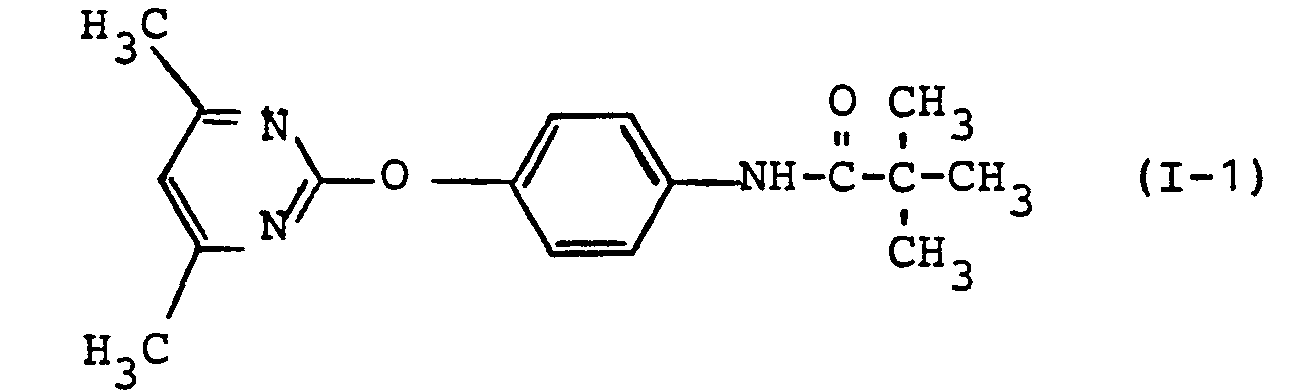
- 21,5 g (0,1 Mol) 2-(4-Amino-phenoxy)-4,6-dimethyl-pyrimidin wurden in 150 ml Tetrahydrofuran gelöst. Man gab 10,1 g (0,1Mol) Triethylamin hinzu und tropfte dann bei einer Temperatur von 10 bis 15°C unter Rühren 12 g (0,1 Mol) Pivalsäurechlorid ein. Das Gemisch wurde 2 Stunden bei Raumtemperatur nachgerührt. Danach wurde aufgearbeitet, indem man das abgeschiedene Festprodukt absaugte und das Filtrat unter vermindertem Druck eindampfte. Es verblieben 27,5 g (92 % der Theorie) an 2-(4-Pivaloylamino-phenoxy)-4,6-dimethyl-pyrimidin in Form eines Festproduktes.
- Schmelzpunkt: 190-191°C (nach Umkristallisation aus Essigester)
-

- 11,8 g (0,1 Mol)o6-Methoxy-isobuttersäure wurden in 150 ml Tetrahydrofuran gelöst und mit 10,1 g (0,1 Mol) Triethylamin versetzt. Hierzu tropfte man bei 10 - 15°C unter Rühren 10,85 g (0,1 Mol) Kohlensäureethylesterchlorid. Die Mischung wurde 2 Stunden bei Raumtemperatur nachgerührt und anschließend portionsweise mit 23,1 g (0,1 Mol)2-(4-Amino-phenylmercapto)-4,6-dimethyl-pyrimidin versetzt. Man rührte 1 Stunde bei Raumtemperatur nach und kochte noch 2 Stunden unter Rückfluß. Das Reaktionsgemisch wurde abgekühlt und dann in 1 Liter schwach mit Salzsäure angesäuertes Wasser eingerührt. Die abgeschiedenen Kristalle wurden abgesaugt, mit Wasser gewaschen und an der Luft getrocknet. Man erhielt 27,4 g (83 % der Theorie) 2-(4-(α-Methoxy-isobutyrylamino)-phenylmercapto)-4,6-dimethyl-pyrimidin.
- Schmelzpunkt: 123 - 125°C (nach Umkristallisation aus Waschbenzin)
-

- 22,8 g (0,1 Mol) 3-Chlor-4-pivaloylamino-phenol wurden in 150 ml Dimethylsulfoxid gelöst. Hierzu gab man bei Raumtemperatur unter Rühren portionsweise 5,6 g (0,1 Mol) pulverisiertes Kaliumhydroxid. Man rührte 30 Minuten bei Raumtemperatur nach und fügte dann portionsweise 14,25 g (0,1 Mol) 2-Chlor-4,6-dimethyl-pyrimidin hinzu. Die Mischung wurde innerhalb einer Stunde auf 120°C erhitzt und noch 5 Stunden bei dieser Temperatur nachgerührt. Anschließend wurde das Gemisch abgekühlt und in 1 Liter Wasser eingegossen. Die Kristalle wurden abgesaugt und an der Luft getrocknet. Man erhielt 25,5 g (76,5 % der Theorie) 2-(3-Chlor-4-pivaloylamino-phenoxy)-4,6-dimethylpyrimidin.
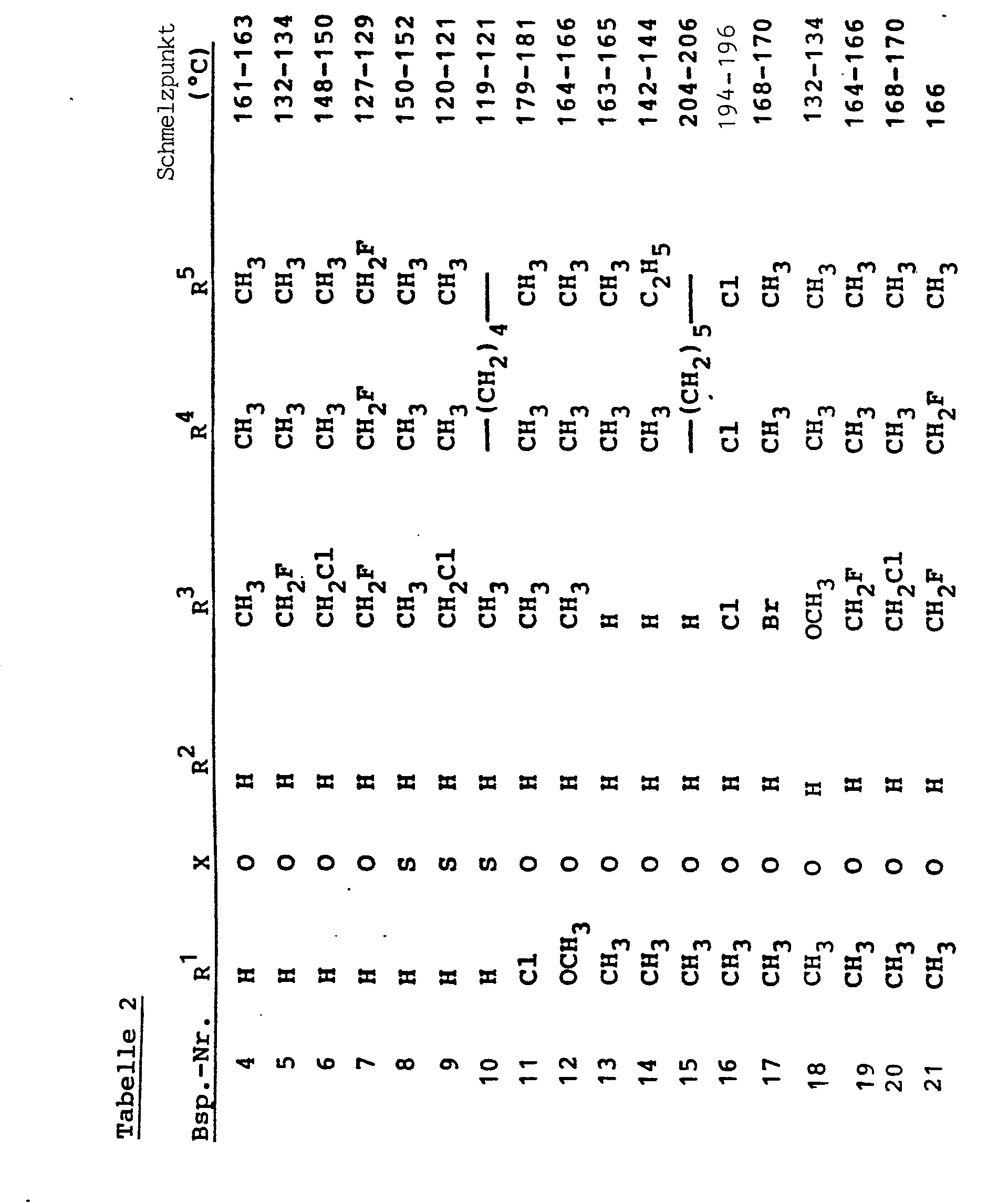
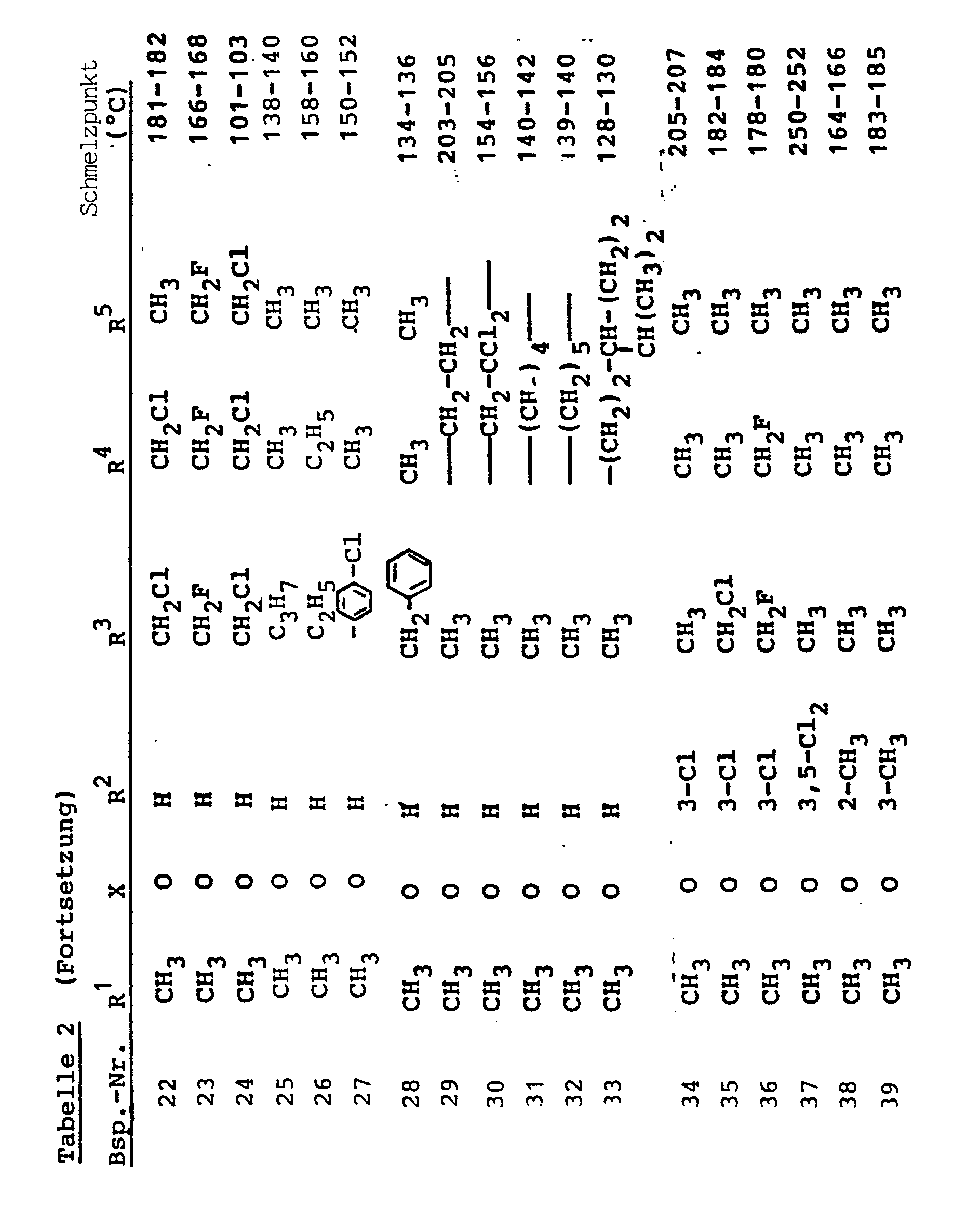
- Nach den in den vorausgehenden Beispielen und in der Beschreibung angegebenen Methoden wurden auch die in der folgenden Tabelle formelmäßig aufgeführten Stoffe der Formel (I) hergestellt.
-


-

- 24,5 g (0,1 Mol) 2-(4-Nitro-phenoxy)-4,6-dimethylpyri- midin wurden in 150 ml Dioxan gelöst und mit Wasserstoff in Gegenwart von Raney-Nickel unter einem Druck von 50 bar bei einer Temperatur zwischen 20 und 50°C erschöpfend hydriert. Danach wurde der Katalysator abgesaugt und das Filtrat unter vermindertem Druck eingedampft. Man erhielt 20,4 g (95 % der Theorie) an 2-(4-Amino- phenoxy)-4,6-dimethylpyrimidin in Form einer Festsubstanz.
- Schmelzpunkt: 170 - 171°C (nach Umkristallisation aus Essigester)
- Nach der im Beispiel 75 angegebenen Methode wurden auch die in den folgenden Beispielen aufgeführten Stoffe der Formel (II) hergestellt.
-
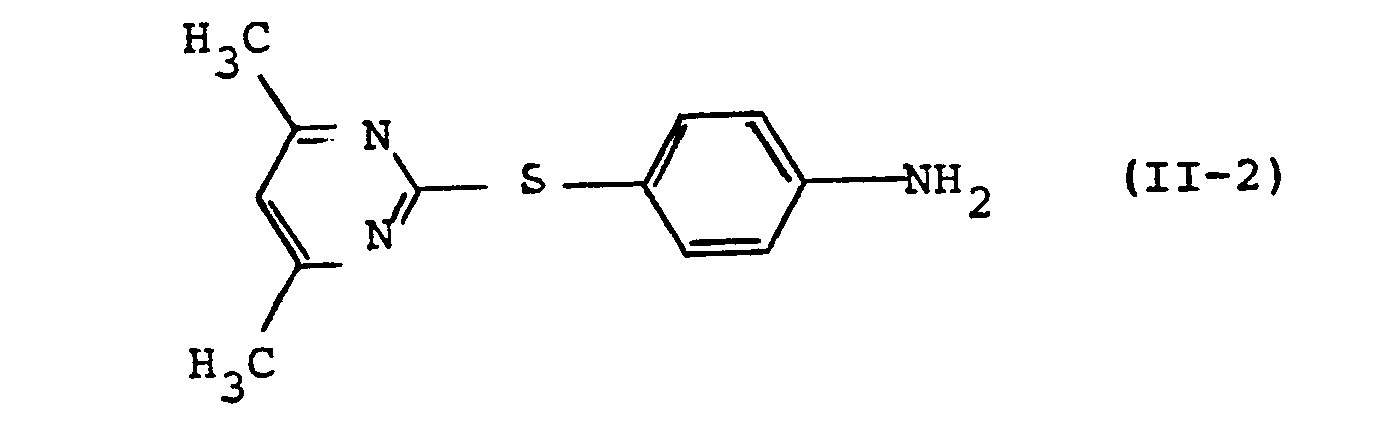
- Schmelzpunkt: 170 - 172°C (nach Umkristallisation aus Essigester)
-

-

- 109 g (1 Mol) 4-Amino-phenol wurden in 500 ml Dimethylsulfoxid gelöst. Nach Zugabe von 56 g (1 Mol) pulverisiertem Kaliumhydroxid verrührte man das Gemisch 30 Minuten bei Raumtemperatur und trug dann portionsweise 143 g (1 Mol) 2-Chlor-4,6-dimethyl-pyrimidin ein.
- Die Mischung wurde 5 Stunden auf 100°C erwärmt, abgekühlt und dann in 3 Liter Wasser eingerührt. Das Kristallisat wurde abgesaugt, mehrfach mit Wasser gewaschen und getrocknet. Man erhielt 119 g (55,3 % der Theorie) 2-(4-Amino-phenoxy)-4,6-dimethyl-pyrimidin.
- Schmelzpunkt: 170 - 171°C (nach Umkristallisation aus Ethanol)
- Nach der im Beispiel 78 angegebenen Methode wurden auch die in den folgenden Beispielen aufgeführten Stoffe der Formel (II) hergestellt.
-

-

-

-

- Schmelzpunkt: 108 - 110°C.
-

- Schmelzpunkt: 168 - 170°C.
- Nach der im Beispiel 83 angegebenen Methode wurden auch die in den folgenden Beispielen aufgeführten Stoffe der Formel (V) hergestellt.
-

-
-

- Schmelzpunkt: 150 - 152°C (nach Umkristallisation aus Toluol)
-

- In dem nachfolgenden Verwendungsbeispiel wurde die folgende Verbindung als Vergleichssubstanz eingesetzt:
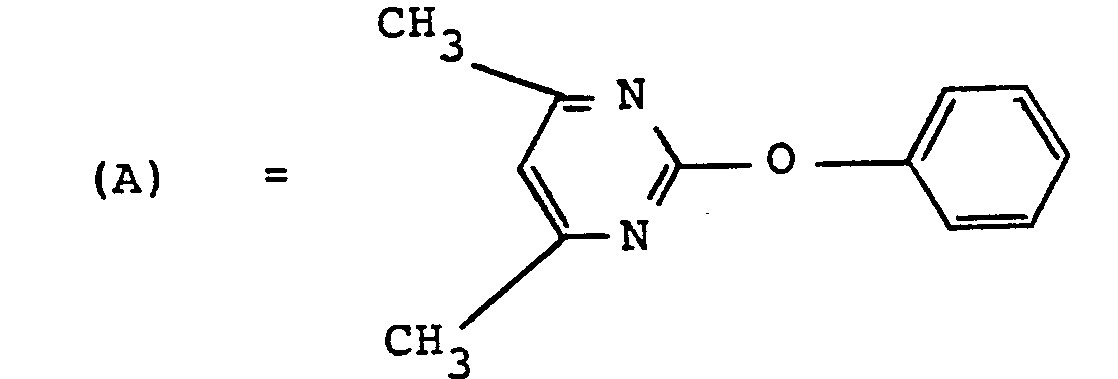
- 2-Phenoxy-4,6-dimethyl-pyrimidin (bekannt aus US-PS 3, 126, 271)
- Post-emergence-Test
- Lösungsmittel: 5 Gewichtsteile Aceton
- Emulgator: 1 Gewichtsteil Alkylarylpolyglykolether
- Zur Herstellung einer zweckmäßigen Wirkstoffzubereitung vermischt man 1 Gewichtsteil Wirkstoff mit der angegebenen Menge Lösungsmittel, gibt die angegebene Menge Emulgator zu und verdünnt das Konzentrat mit Wasser auf die gewünschte Konzentration.
- Mit der Wirkstoffzubereitung spritzt man Testpflanzen, welche eine Höhe von 5 - 15 cm haben so, daß die jeweils gewünschten Wirkstoffmengen pro Flächeneinheit ausgebracht werden. Die Konzentration der Spritzbrühe wird so gewählt, daß in 2000 1 Wasser/ha die jeweils gewünschten Wirkstoffmengen ausgebracht werden. Nach drei Wochen wird der Schädigungsgrad der Pflanzen bonitiert in % Schädigung im Vergleich zur Entwicklung der unbehandelten Kontrolle.
- Es bedeuten:
- 0 % = keine Wirkung (wie unbehandelte Kontrolle)
- 100 % = totale Vernichtung
- In diesem Test zeigt die Verbindung gemäß Beispiel45 bei der selektiven Bekämpfung von Galinsoga, Galium, Sinapis, Stellaria, Echinochloa, Panicum und Poa in Weizen und Mais eine wesentlich bessere herbizide Wirksamkeit als die Vergleichssubstanz (A).
- Grenzkonzentrations-Test / Wurzelsystemische Wirkung
- Testinsekt: Myzus persicae
- Lösungsmittel: 3 Gewichtsteile Aceton
- Emulgator: 1 Gewichtsteil Alkylarylpolyglykolether
- Zur Herstellung einer zweckmäßigen Wirkstoffzubereitung vermischt man 1 Gewichtsteil Wirkstoff mit der angegebenen Menge Lösungsmittel, gibt die angegebene Menge Emulgator zu und verdünnt das Konzentrat mit Wasser auf die gewünschte Konzentration.
- Die Wirkstoffzubereitung wird innig mit Boden vermischt. Dabei spielt die Konzentration des Wirkstoffs in der Zubereitung praktisch keine Rolle, entscheidend ist allein die Wirkstoffzubereitung pro Volumeneinheit Boden, welche in ppm (= mg/1) angegeben wird. Man füllt den behandelten Boden in Töpfe und bepflanzt diese mit Kohl (Brassica oleracea). Der Wirkstoff kann so von den Pflanzenwurzeln aus dem Boden aufgenommen und in die Blätter transportiert werden.
- Für den Nachweis des wurzelsystemischen Effektes werden nach 7 Tagen ausschließlich die Blätter mit den obengenannten Testtieren besetzt. Nach weiteren 2 Tagen erfolgt die Auswertung durch Zählen oder Schätzen der toten Tiere. Aus den Abtötungszahlen wird die wurzelsystemische Wirkung des Wirkstoffs abgeleitet. Sie ist 100 %, wenn alle Testtiere abgetötet sind und 0 %, wenn noch genau so viele Testinsekten leben wie bei der unbehandelten Kontrolle.
- In diesem Test zeichnen sich die Verbindungen gemäß Beispielen (14), (20) und (38) durch eine sehr gute Wirksamkeit aus.
gefunden.
in Gegenwart eines Säurebindemittels und gegebenenfalls in Gegenwart eines Verdünnungsmittels bei Temperaturen zwischen 0°C und 200°C, vorzugsweise zwischen 50°C und 150°C, umsetzt. Als Säurebindemittel und Verdünnungsmittel kommen hierbei vorzugsweise diejenigen Stoffe in Betracht, die bereits im Zusammenhang mit dem Verfahren (c) als vorzugsweise verwendbare Säureakzeptoren und Solventien genannt wurden.
in Gegenwart eines Verdünnungsmittels, wie zum Beispiel Methylenchlorid, und in Gegenwart eines Säurebindemittels, wie zum Beispiel Triethylamin, bei Temperaturen zwischen -20°C und +100°C, vorzugsweise zwischen 0 und 50°C, umsetzt. Die asymmetrischen Säureanhydride der Formel (III c) werden im allgemeinen nicht in reiner Form isoliert, sondern in der anfallenden Form, gegebenenfalls nach vorheriger Entfernung von Verdünnungsmittel und/ oder Salzen, weiter verwendet.
mit Dicyclohexylcarbodiimid der Formel

umsetzt.
gegebenenfalls in Gegenwart eines Verdünnungsmittels und gegebenenfalls in Gegenwart eines Säurebindemittels umsetzt. Die Reaktionsbedingungen entsprechen dabei denjenigen, die auch bei der Durchführung des Verfahrens (a, VariantecL) angewandt werden.
Claims (7)

in welcher
und
und

in welcher
und
dadurch gekennzeichnet, daß man
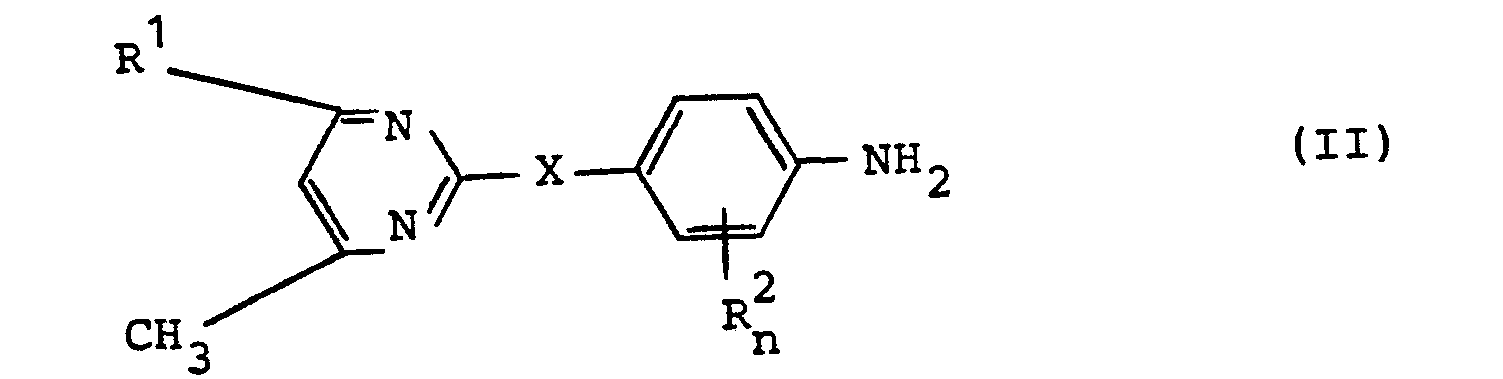
in welcher
entweder

in welcher
gegebenenfalls in Gegenwart eines Verdünnungsmittels und gegebenenfalls in Gegenwart eines Säurebindemittels umsetzt,
oder

in welcher
gegebenenfalls in Gegenwart eines Verdünnungsmittels umsetzt,
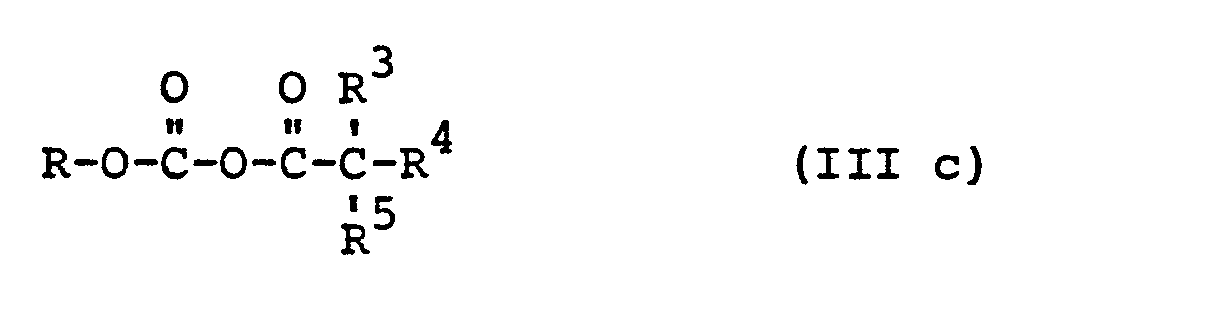
in welcher
gegebenenfalls in Gegenwart eines Verdünnungsmittels umsetzt.
oder
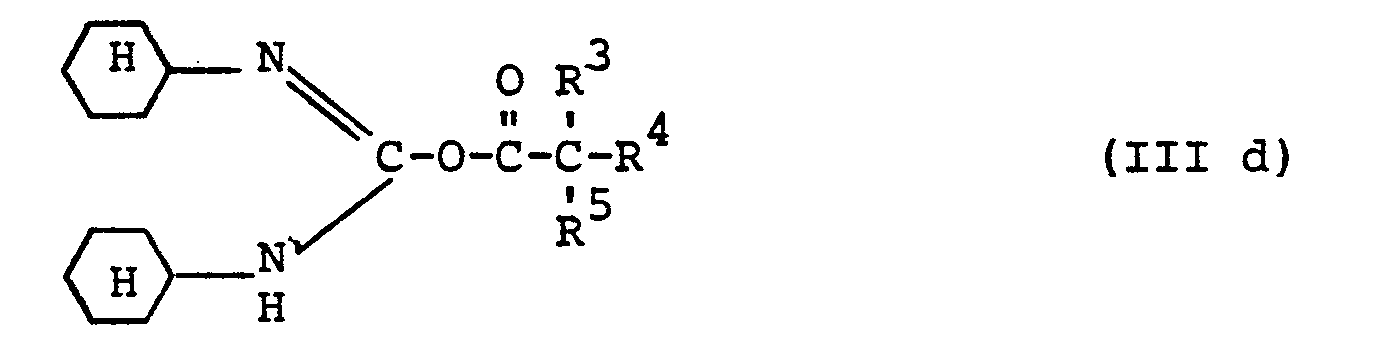
in wlcher
gegebenenfalls in Gegenwart eines Verdünnungsmittels umsetzt,
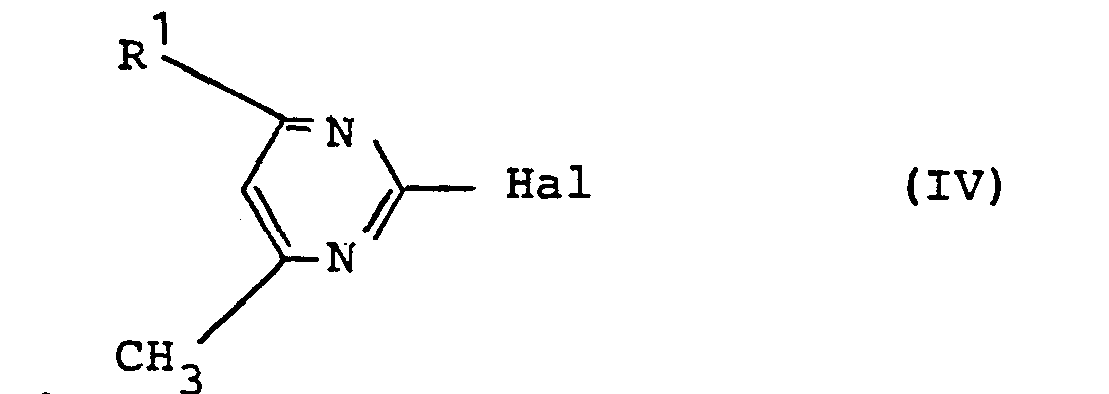
in welcher
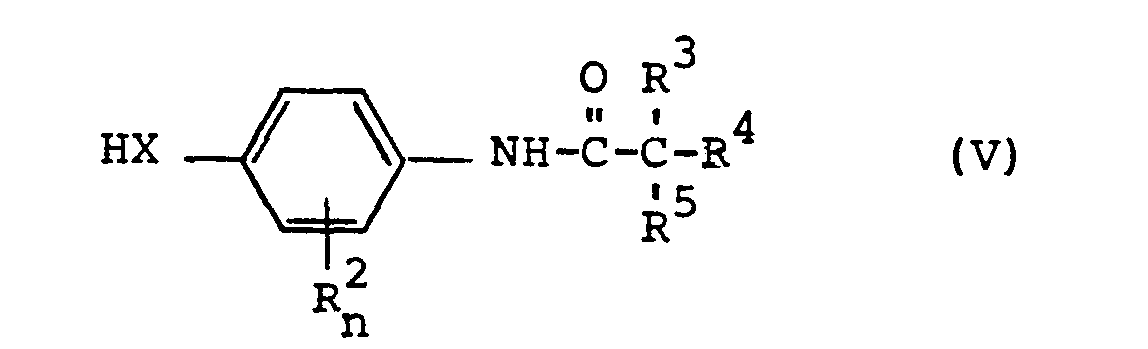
in welcher
in Gegenwart eines Säurebindemittels und gegebenenfalls in Gegenwart eines Verdünnungsmittels umsetzt.
Applications Claiming Priority (2)
| Application Number | Priority Date | Filing Date | Title |
|---|---|---|---|
| DE19843422077 DE3422077A1 (de) | 1984-06-14 | 1984-06-14 | Substituierte carbonsaeureanilide |
| DE3422077 | 1984-06-14 |
Publications (2)
| Publication Number | Publication Date |
|---|---|
| EP0168608A2 true EP0168608A2 (de) | 1986-01-22 |
| EP0168608A3 EP0168608A3 (de) | 1986-03-19 |
Family
ID=6238341
Family Applications (1)
| Application Number | Title | Priority Date | Filing Date |
|---|---|---|---|
| EP85106804A Withdrawn EP0168608A3 (de) | 1984-06-14 | 1985-06-03 | Substituierte Carbonsäureanilide |
Country Status (8)
| Country | Link |
|---|---|
| US (1) | US4627871A (de) |
| EP (1) | EP0168608A3 (de) |
| JP (1) | JPS6117572A (de) |
| DE (1) | DE3422077A1 (de) |
| DK (1) | DK268485A (de) |
| HU (1) | HU195194B (de) |
| IL (1) | IL75483A (de) |
| ZA (1) | ZA854450B (de) |
Cited By (3)
| Publication number | Priority date | Publication date | Assignee | Title |
|---|---|---|---|---|
| EP0226885A1 (de) * | 1985-12-13 | 1987-07-01 | Bayer Ag | Pyrimidylmercapto-acylanilide |
| EP0229283A1 (de) * | 1985-12-13 | 1987-07-22 | Bayer Ag | Pyrimidyl-thio-carbonsäureanilide |
| EP0219835A3 (de) * | 1985-10-18 | 1988-02-10 | Stauffer Chemical Company | Acylaminoaryloxy- und Arylthiopyrimidine |
Families Citing this family (5)
| Publication number | Priority date | Publication date | Assignee | Title |
|---|---|---|---|---|
| US4888047A (en) * | 1985-10-18 | 1989-12-19 | Ici Americas Inc. | Acylaminoaryloxy and arylthio pyrimidines as herbicides |
| US4847258A (en) * | 1986-08-26 | 1989-07-11 | Ciba-Geigy Corporation | Substituted benzoylphenylureas compounds useful as pesticides |
| JPH01109312U (de) * | 1988-01-18 | 1989-07-24 | ||
| WO2001068585A1 (en) * | 2000-03-14 | 2001-09-20 | Fujisawa Pharmaceutical Co., Ltd. | Novel amide compounds |
| CN120202188A (zh) | 2022-11-15 | 2025-06-24 | 日本农药株式会社 | 酰胺化合物或其盐、含有所述化合物的用于农业和园艺的杀菌剂、及其使用方法 |
Family Cites Families (5)
| Publication number | Priority date | Publication date | Assignee | Title |
|---|---|---|---|---|
| US3126271A (en) * | 1964-03-24 | Method of controlling weeds | ||
| US3250775A (en) * | 1963-02-06 | 1966-05-10 | Stauffer Chemical Co | Process for preparing benzylmercapto pyrimidines |
| US3931201A (en) * | 1974-01-22 | 1976-01-06 | The Dow Chemical Company | Substituted pyridinyloxy(thio)phenyl -acetamides, -ureas and urea derivatives |
| NZ188244A (en) * | 1977-09-13 | 1981-04-24 | Ici Australia Ltd | 2-substituted pyrimidines compositions growth regulating processes |
| NZ192708A (en) * | 1979-02-16 | 1984-12-14 | Ici Australia Ltd | Substituted pyrimidines and compositions |
-
1984
- 1984-06-14 DE DE19843422077 patent/DE3422077A1/de not_active Withdrawn
-
1985
- 1985-05-24 US US06/737,977 patent/US4627871A/en not_active Expired - Fee Related
- 1985-06-03 EP EP85106804A patent/EP0168608A3/de not_active Withdrawn
- 1985-06-11 IL IL75483A patent/IL75483A/xx unknown
- 1985-06-13 ZA ZA854450A patent/ZA854450B/xx unknown
- 1985-06-13 DK DK268485A patent/DK268485A/da not_active Application Discontinuation
- 1985-06-14 JP JP60128398A patent/JPS6117572A/ja active Pending
- 1985-06-14 HU HU852366A patent/HU195194B/hu unknown
Cited By (5)
| Publication number | Priority date | Publication date | Assignee | Title |
|---|---|---|---|---|
| EP0219835A3 (de) * | 1985-10-18 | 1988-02-10 | Stauffer Chemical Company | Acylaminoaryloxy- und Arylthiopyrimidine |
| EP0226885A1 (de) * | 1985-12-13 | 1987-07-01 | Bayer Ag | Pyrimidylmercapto-acylanilide |
| EP0229283A1 (de) * | 1985-12-13 | 1987-07-22 | Bayer Ag | Pyrimidyl-thio-carbonsäureanilide |
| US4765824A (en) * | 1985-12-13 | 1988-08-23 | Bayer Aktiengesellschaft | Pyrimidyl-thio-carboxanilides |
| US4797146A (en) * | 1985-12-13 | 1989-01-10 | Bayer Aktiengesellschaft | Herbicidal 2-[4-substituted carboxyamino-phenyl mercapto)]-subsituted pyrimidines |
Also Published As
| Publication number | Publication date |
|---|---|
| DK268485A (da) | 1985-12-15 |
| IL75483A0 (en) | 1985-10-31 |
| HUT38321A (en) | 1986-05-28 |
| DE3422077A1 (de) | 1985-12-19 |
| JPS6117572A (ja) | 1986-01-25 |
| IL75483A (en) | 1988-11-30 |
| ZA854450B (en) | 1986-02-26 |
| EP0168608A3 (de) | 1986-03-19 |
| DK268485D0 (da) | 1985-06-13 |
| HU195194B (en) | 1988-04-28 |
| US4627871A (en) | 1986-12-09 |
Similar Documents
| Publication | Publication Date | Title |
|---|---|---|
| EP0137358A2 (de) | 1,3-Diaryl-5-methylen-perhydropyrimidin-2-one | |
| EP0096354B1 (de) | Substituierte Pyridyl-phenyl-ether | |
| EP0256396A1 (de) | Triazolo-pyrimidin-2-sulfonamide | |
| EP0168608A2 (de) | Substituierte Carbonsäureanilide | |
| EP0068260B1 (de) | Substituierte Phenoxypropionate, Verfahren zu ihrer Herstellung und ihre Verwendung als Herbizide | |
| EP0173320A1 (de) | Substituierte Carbonylphenylsulfonylguanidine | |
| DE3335477A1 (de) | 2-aryl-2-halogenalkyl-oxirane | |
| EP0173319A1 (de) | Substituierte Arylsulfonylguanidine | |
| DE3219789A1 (de) | Phenoxypropionsaeure-derivate, verfahren zu ihrer herstellung und ihre verwendung als herbizide | |
| EP0243868A2 (de) | Pyridylthio-acylanilide | |
| EP0226885A1 (de) | Pyrimidylmercapto-acylanilide | |
| EP0127808A1 (de) | Optisch aktive Phenoxypropionsäure-Derivate | |
| DE3425123A1 (de) | Optisch aktive phenoxypropionsaeure-derivate | |
| EP0307753A2 (de) | Sulfonyliso(thio)harnstoffe sowie ein Verfahren und neue Zwischenprodukte zu ihrer Herstellung | |
| EP0060423B1 (de) | 2-Pyridyloxy-acetanilide, Verfahren zu ihrer Herstellung und ihre Verwendung als Herbizide | |
| DE3502266A1 (de) | Optisch aktive phenoxypropionsaeure-derivate | |
| DE3431933A1 (de) | Heteroarylthioharnstoffe | |
| DE3035021A1 (de) | 3-dimethylamino-4-methyl-6-phenyl-1, 2,4-triazin-5-one, verfahren zu ihrer herstellung sowie ihre verwendung als herbizide | |
| EP0126361A1 (de) | Optisch aktive Propionsäure-Derivate | |
| EP0037525A1 (de) | Substituierte Acetanilide, Verfahren zu ihrer Herstellung und ihre Verwendung als Herbizide | |
| EP0089538A1 (de) | Optisch aktive Phenoxybenzoesäure-Derivate, Verfahren zu ihrer Herstellung und ihre Verwendung als Herbizide | |
| DE3510794A1 (de) | 6-t-butyl-3-methylthio-4-sulfimido-1,2,4- triazin-5-one | |
| EP0220635A1 (de) | Phenoxybenzoesäure-Derivate | |
| EP0229283A1 (de) | Pyrimidyl-thio-carbonsäureanilide | |
| EP0155566A1 (de) | Chlorierte Phosphorylmethylcarbonylpyrazol-Derivate |
Legal Events
| Date | Code | Title | Description |
|---|---|---|---|
| PUAI | Public reference made under article 153(3) epc to a published international application that has entered the european phase |
Free format text: ORIGINAL CODE: 0009012 |
|
| 17P | Request for examination filed |
Effective date: 19850603 |
|
| AK | Designated contracting states |
Designated state(s): AT BE CH DE FR GB IT LI NL |
|
| PUAL | Search report despatched |
Free format text: ORIGINAL CODE: 0009013 |
|
| AK | Designated contracting states |
Kind code of ref document: A3 Designated state(s): AT BE CH DE FR GB IT LI NL |
|
| 17Q | First examination report despatched |
Effective date: 19860822 |
|
| STAA | Information on the status of an ep patent application or granted ep patent |
Free format text: STATUS: THE APPLICATION HAS BEEN WITHDRAWN |
|
| 18W | Application withdrawn |
Withdrawal date: 19890227 |
|
| RIN1 | Information on inventor provided before grant (corrected) |
Inventor name: EUE, LUDWIG, DR. Inventor name: SCHMIDT, ROBERT, R. DR. Inventor name: SANTEL, HANS-JOACHIM Inventor name: SASSE, KLAUS, DR. |