EP0163224B2 - Verfahren zur Herstellung von Acyloxybenzolsulfonsäuren - Google Patents
Verfahren zur Herstellung von Acyloxybenzolsulfonsäuren Download PDFInfo
- Publication number
- EP0163224B2 EP0163224B2 EP85106135A EP85106135A EP0163224B2 EP 0163224 B2 EP0163224 B2 EP 0163224B2 EP 85106135 A EP85106135 A EP 85106135A EP 85106135 A EP85106135 A EP 85106135A EP 0163224 B2 EP0163224 B2 EP 0163224B2
- Authority
- EP
- European Patent Office
- Prior art keywords
- acid
- formula
- acyloxybenzenesulfonic
- complexing agent
- chlorosulfonic acid
- Prior art date
- Legal status (The legal status is an assumption and is not a legal conclusion. Google has not performed a legal analysis and makes no representation as to the accuracy of the status listed.)
- Expired - Lifetime
Links
- 239000002253 acid Substances 0.000 title claims abstract description 34
- 238000000034 method Methods 0.000 title claims description 14
- 238000002360 preparation method Methods 0.000 title claims description 6
- 150000007513 acids Chemical class 0.000 title abstract description 13
- XTHPWXDJESJLNJ-UHFFFAOYSA-N chlorosulfonic acid Substances OS(Cl)(=O)=O XTHPWXDJESJLNJ-UHFFFAOYSA-N 0.000 claims abstract description 19
- KEQGZUUPPQEDPF-UHFFFAOYSA-N 1,3-dichloro-5,5-dimethylimidazolidine-2,4-dione Chemical compound CC1(C)N(Cl)C(=O)N(Cl)C1=O KEQGZUUPPQEDPF-UHFFFAOYSA-N 0.000 claims abstract description 18
- 239000008139 complexing agent Substances 0.000 claims abstract description 16
- 229910052784 alkaline earth metal Inorganic materials 0.000 claims abstract description 15
- -1 alkaline earth metal salts Chemical class 0.000 claims abstract description 14
- 238000006277 sulfonation reaction Methods 0.000 claims abstract description 14
- ISWSIDIOOBJBQZ-UHFFFAOYSA-N Phenol Chemical compound OC1=CC=CC=C1 ISWSIDIOOBJBQZ-UHFFFAOYSA-N 0.000 claims abstract description 13
- 238000006386 neutralization reaction Methods 0.000 claims abstract description 12
- 239000003795 chemical substances by application Substances 0.000 claims abstract description 9
- 150000001340 alkali metals Chemical class 0.000 claims abstract description 8
- 229910052783 alkali metal Inorganic materials 0.000 claims abstract description 7
- 230000032050 esterification Effects 0.000 claims abstract description 5
- 238000005886 esterification reaction Methods 0.000 claims abstract description 5
- 239000007864 aqueous solution Substances 0.000 claims description 12
- 150000003839 salts Chemical class 0.000 claims description 11
- 125000004432 carbon atom Chemical group C* 0.000 claims description 10
- WHOZNOZYMBRCBL-OUKQBFOZSA-N (2E)-2-Tetradecenal Chemical compound CCCCCCCCCCC\C=C\C=O WHOZNOZYMBRCBL-OUKQBFOZSA-N 0.000 claims description 6
- 229940044654 phenolsulfonic acid Drugs 0.000 claims description 6
- XLYOFNOQVPJJNP-UHFFFAOYSA-N water Substances O XLYOFNOQVPJJNP-UHFFFAOYSA-N 0.000 claims description 6
- 125000000217 alkyl group Chemical group 0.000 claims description 4
- 230000015572 biosynthetic process Effects 0.000 claims description 4
- 239000007788 liquid Substances 0.000 claims description 4
- RYHBNJHYFVUHQT-UHFFFAOYSA-N 1,4-Dioxane Chemical compound C1COCCO1 RYHBNJHYFVUHQT-UHFFFAOYSA-N 0.000 claims description 3
- BVKZGUZCCUSVTD-UHFFFAOYSA-M Bicarbonate Chemical compound OC([O-])=O BVKZGUZCCUSVTD-UHFFFAOYSA-M 0.000 claims description 3
- BVKZGUZCCUSVTD-UHFFFAOYSA-L Carbonate Chemical compound [O-]C([O-])=O BVKZGUZCCUSVTD-UHFFFAOYSA-L 0.000 claims description 3
- SMZOUWXMTYCWNB-UHFFFAOYSA-N 2-(2-methoxy-5-methylphenyl)ethanamine Chemical compound COC1=CC=C(C)C=C1CCN SMZOUWXMTYCWNB-UHFFFAOYSA-N 0.000 claims description 2
- NIXOWILDQLNWCW-UHFFFAOYSA-N 2-Propenoic acid Natural products OC(=O)C=C NIXOWILDQLNWCW-UHFFFAOYSA-N 0.000 claims description 2
- 229910019142 PO4 Inorganic materials 0.000 claims description 2
- OFOBLEOULBTSOW-UHFFFAOYSA-N Propanedioic acid Natural products OC(=O)CC(O)=O OFOBLEOULBTSOW-UHFFFAOYSA-N 0.000 claims description 2
- 229910001385 heavy metal Inorganic materials 0.000 claims description 2
- VZCYOOQTPOCHFL-UPHRSURJSA-N maleic acid Chemical compound OC(=O)\C=C/C(O)=O VZCYOOQTPOCHFL-UPHRSURJSA-N 0.000 claims description 2
- 239000011976 maleic acid Substances 0.000 claims description 2
- 238000002156 mixing Methods 0.000 claims description 2
- NBIIXXVUZAFLBC-UHFFFAOYSA-K phosphate Chemical compound [O-]P([O-])([O-])=O NBIIXXVUZAFLBC-UHFFFAOYSA-K 0.000 claims description 2
- 239000010452 phosphate Substances 0.000 claims description 2
- OJMIONKXNSYLSR-UHFFFAOYSA-N phosphorous acid Chemical compound OP(O)O OJMIONKXNSYLSR-UHFFFAOYSA-N 0.000 claims description 2
- 229920000642 polymer Polymers 0.000 claims description 2
- 229940095064 tartrate Drugs 0.000 claims description 2
- VZCYOOQTPOCHFL-UHFFFAOYSA-N trans-butenedioic acid Natural products OC(=O)C=CC(O)=O VZCYOOQTPOCHFL-UHFFFAOYSA-N 0.000 claims description 2
- 150000001263 acyl chlorides Chemical class 0.000 claims 2
- FEWJPZIEWOKRBE-JCYAYHJZSA-N Dextrotartaric acid Chemical compound OC(=O)[C@H](O)[C@@H](O)C(O)=O FEWJPZIEWOKRBE-JCYAYHJZSA-N 0.000 claims 1
- 229910000272 alkali metal oxide Inorganic materials 0.000 claims 1
- 229910001860 alkaline earth metal hydroxide Inorganic materials 0.000 claims 1
- 230000000694 effects Effects 0.000 claims 1
- 125000001997 phenyl group Chemical group [H]C1=C([H])C([H])=C(*)C([H])=C1[H] 0.000 claims 1
- ZMXDDKWLCZADIW-UHFFFAOYSA-N N,N-Dimethylformamide Chemical compound CN(C)C=O ZMXDDKWLCZADIW-UHFFFAOYSA-N 0.000 description 9
- HEMHJVSKTPXQMS-UHFFFAOYSA-M Sodium hydroxide Chemical compound [OH-].[Na+] HEMHJVSKTPXQMS-UHFFFAOYSA-M 0.000 description 6
- GEKPNPPFAYJZRD-UHFFFAOYSA-N 3,5,5-trimethylhexanoyl chloride Chemical compound ClC(=O)CC(C)CC(C)(C)C GEKPNPPFAYJZRD-UHFFFAOYSA-N 0.000 description 5
- 239000003513 alkali Substances 0.000 description 5
- 239000000203 mixture Substances 0.000 description 5
- 159000000000 sodium salts Chemical class 0.000 description 5
- NGNBDVOYPDDBFK-UHFFFAOYSA-N 2-[2,4-di(pentan-2-yl)phenoxy]acetyl chloride Chemical compound CCCC(C)C1=CC=C(OCC(Cl)=O)C(C(C)CCC)=C1 NGNBDVOYPDDBFK-UHFFFAOYSA-N 0.000 description 4
- IJGRMHOSHXDMSA-UHFFFAOYSA-N Atomic nitrogen Chemical compound N#N IJGRMHOSHXDMSA-UHFFFAOYSA-N 0.000 description 4
- VEXZGXHMUGYJMC-UHFFFAOYSA-N Hydrochloric acid Chemical compound Cl VEXZGXHMUGYJMC-UHFFFAOYSA-N 0.000 description 4
- JUJWROOIHBZHMG-UHFFFAOYSA-N Pyridine Chemical compound C1=CC=NC=C1 JUJWROOIHBZHMG-UHFFFAOYSA-N 0.000 description 4
- IXCSERBJSXMMFS-UHFFFAOYSA-N hydrogen chloride Substances Cl.Cl IXCSERBJSXMMFS-UHFFFAOYSA-N 0.000 description 4
- 229910000041 hydrogen chloride Inorganic materials 0.000 description 4
- 239000000243 solution Substances 0.000 description 4
- 238000001694 spray drying Methods 0.000 description 4
- 150000001408 amides Chemical class 0.000 description 3
- 150000001412 amines Chemical class 0.000 description 3
- 238000006243 chemical reaction Methods 0.000 description 3
- RAXXELZNTBOGNW-UHFFFAOYSA-N imidazole Natural products C1=CNC=N1 RAXXELZNTBOGNW-UHFFFAOYSA-N 0.000 description 3
- 238000004519 manufacturing process Methods 0.000 description 3
- 229910052757 nitrogen Inorganic materials 0.000 description 3
- 239000011541 reaction mixture Substances 0.000 description 3
- ZHNUHDYFZUAESO-UHFFFAOYSA-N Formamide Chemical group NC=O ZHNUHDYFZUAESO-UHFFFAOYSA-N 0.000 description 2
- MHAJPDPJQMAIIY-UHFFFAOYSA-N Hydrogen peroxide Chemical compound OO MHAJPDPJQMAIIY-UHFFFAOYSA-N 0.000 description 2
- QAOWNCQODCNURD-UHFFFAOYSA-N Sulfuric acid Chemical compound OS(O)(=O)=O QAOWNCQODCNURD-UHFFFAOYSA-N 0.000 description 2
- 150000001342 alkaline earth metals Chemical class 0.000 description 2
- WTEOIRVLGSZEPR-UHFFFAOYSA-N boron trifluoride Chemical compound FB(F)F WTEOIRVLGSZEPR-UHFFFAOYSA-N 0.000 description 2
- 239000006227 byproduct Substances 0.000 description 2
- 239000003153 chemical reaction reagent Substances 0.000 description 2
- 230000000052 comparative effect Effects 0.000 description 2
- 238000001816 cooling Methods 0.000 description 2
- 238000001035 drying Methods 0.000 description 2
- 230000007062 hydrolysis Effects 0.000 description 2
- 238000006460 hydrolysis reaction Methods 0.000 description 2
- XLYOFNOQVPJJNP-UHFFFAOYSA-M hydroxide Chemical compound [OH-] XLYOFNOQVPJJNP-UHFFFAOYSA-M 0.000 description 2
- JDSHMPZPIAZGSV-UHFFFAOYSA-N melamine Chemical compound NC1=NC(N)=NC(N)=N1 JDSHMPZPIAZGSV-UHFFFAOYSA-N 0.000 description 2
- 239000000047 product Substances 0.000 description 2
- UMJSCPRVCHMLSP-UHFFFAOYSA-N pyridine Natural products COC1=CC=CN=C1 UMJSCPRVCHMLSP-UHFFFAOYSA-N 0.000 description 2
- 230000009257 reactivity Effects 0.000 description 2
- 239000007787 solid Substances 0.000 description 2
- 238000003756 stirring Methods 0.000 description 2
- 150000003457 sulfones Chemical class 0.000 description 2
- AKEJUJNQAAGONA-UHFFFAOYSA-N sulfur trioxide Chemical compound O=S(=O)=O AKEJUJNQAAGONA-UHFFFAOYSA-N 0.000 description 2
- RIOQSEWOXXDEQQ-UHFFFAOYSA-N triphenylphosphine Chemical compound C1=CC=CC=C1P(C=1C=CC=CC=1)C1=CC=CC=C1 RIOQSEWOXXDEQQ-UHFFFAOYSA-N 0.000 description 2
- 238000010626 work up procedure Methods 0.000 description 2
- URDCARMUOSMFFI-UHFFFAOYSA-N 2-[2-[bis(carboxymethyl)amino]ethyl-(2-hydroxyethyl)amino]acetic acid Chemical compound OCCN(CC(O)=O)CCN(CC(O)=O)CC(O)=O URDCARMUOSMFFI-UHFFFAOYSA-N 0.000 description 1
- GZVHEAJQGPRDLQ-UHFFFAOYSA-N 6-phenyl-1,3,5-triazine-2,4-diamine Chemical compound NC1=NC(N)=NC(C=2C=CC=CC=2)=N1 GZVHEAJQGPRDLQ-UHFFFAOYSA-N 0.000 description 1
- 229910015900 BF3 Inorganic materials 0.000 description 1
- KXDAEFPNCMNJSK-UHFFFAOYSA-N Benzamide Chemical class NC(=O)C1=CC=CC=C1 KXDAEFPNCMNJSK-UHFFFAOYSA-N 0.000 description 1
- RWSOTUBLDIXVET-UHFFFAOYSA-N Dihydrogen sulfide Chemical class S RWSOTUBLDIXVET-UHFFFAOYSA-N 0.000 description 1
- KCXVZYZYPLLWCC-UHFFFAOYSA-N EDTA Chemical compound OC(=O)CN(CC(O)=O)CCN(CC(O)=O)CC(O)=O KCXVZYZYPLLWCC-UHFFFAOYSA-N 0.000 description 1
- UFHFLCQGNIYNRP-UHFFFAOYSA-N Hydrogen Chemical compound [H][H] UFHFLCQGNIYNRP-UHFFFAOYSA-N 0.000 description 1
- DGAQECJNVWCQMB-PUAWFVPOSA-M Ilexoside XXIX Chemical compound C[C@@H]1CC[C@@]2(CC[C@@]3(C(=CC[C@H]4[C@]3(CC[C@@H]5[C@@]4(CC[C@@H](C5(C)C)OS(=O)(=O)[O-])C)C)[C@@H]2[C@]1(C)O)C)C(=O)O[C@H]6[C@@H]([C@H]([C@@H]([C@H](O6)CO)O)O)O.[Na+] DGAQECJNVWCQMB-PUAWFVPOSA-M 0.000 description 1
- FEWJPZIEWOKRBE-JCYAYHJZSA-L L-tartrate(2-) Chemical compound [O-]C(=O)[C@H](O)[C@@H](O)C([O-])=O FEWJPZIEWOKRBE-JCYAYHJZSA-L 0.000 description 1
- 229920000877 Melamine resin Polymers 0.000 description 1
- QPCDCPDFJACHGM-UHFFFAOYSA-N N,N-bis{2-[bis(carboxymethyl)amino]ethyl}glycine Chemical compound OC(=O)CN(CC(O)=O)CCN(CC(=O)O)CCN(CC(O)=O)CC(O)=O QPCDCPDFJACHGM-UHFFFAOYSA-N 0.000 description 1
- 229920002125 Sokalan® Polymers 0.000 description 1
- CIUQDSCDWFSTQR-UHFFFAOYSA-N [C]1=CC=CC=C1 Chemical compound [C]1=CC=CC=C1 CIUQDSCDWFSTQR-UHFFFAOYSA-N 0.000 description 1
- YDONNITUKPKTIG-UHFFFAOYSA-N [Nitrilotris(methylene)]trisphosphonic acid Chemical compound OP(O)(=O)CN(CP(O)(O)=O)CP(O)(O)=O YDONNITUKPKTIG-UHFFFAOYSA-N 0.000 description 1
- NJYZCEFQAIUHSD-UHFFFAOYSA-N acetoguanamine Chemical compound CC1=NC(N)=NC(N)=N1 NJYZCEFQAIUHSD-UHFFFAOYSA-N 0.000 description 1
- 239000012190 activator Substances 0.000 description 1
- 125000002252 acyl group Chemical group 0.000 description 1
- 230000010933 acylation Effects 0.000 description 1
- 238000005917 acylation reaction Methods 0.000 description 1
- 125000001931 aliphatic group Chemical group 0.000 description 1
- 125000003236 benzoyl group Chemical group [H]C1=C([H])C([H])=C(C([H])=C1[H])C(*)=O 0.000 description 1
- 239000007844 bleaching agent Substances 0.000 description 1
- 150000001805 chlorine compounds Chemical class 0.000 description 1
- 230000009918 complex formation Effects 0.000 description 1
- 230000000536 complexating effect Effects 0.000 description 1
- 150000001875 compounds Chemical class 0.000 description 1
- 229920001577 copolymer Polymers 0.000 description 1
- 125000004122 cyclic group Chemical group 0.000 description 1
- 239000003599 detergent Substances 0.000 description 1
- 235000014113 dietary fatty acids Nutrition 0.000 description 1
- MTHSVFCYNBDYFN-UHFFFAOYSA-N diethylene glycol Chemical group OCCOCCO MTHSVFCYNBDYFN-UHFFFAOYSA-N 0.000 description 1
- SZXQTJUDPRGNJN-UHFFFAOYSA-N dipropylene glycol Chemical compound OCCCOCCCO SZXQTJUDPRGNJN-UHFFFAOYSA-N 0.000 description 1
- 238000002845 discoloration Methods 0.000 description 1
- 235000019524 disodium tartrate Nutrition 0.000 description 1
- 150000002148 esters Chemical class 0.000 description 1
- 150000002170 ethers Chemical class 0.000 description 1
- 238000001704 evaporation Methods 0.000 description 1
- 230000008020 evaporation Effects 0.000 description 1
- 229930195729 fatty acid Natural products 0.000 description 1
- 239000000194 fatty acid Substances 0.000 description 1
- 150000004665 fatty acids Chemical class 0.000 description 1
- 238000004108 freeze drying Methods 0.000 description 1
- 239000011521 glass Substances 0.000 description 1
- 125000003187 heptyl group Chemical group [H]C([*])([H])C([H])([H])C([H])([H])C([H])([H])C([H])([H])C([H])([H])C([H])([H])[H] 0.000 description 1
- 229910052739 hydrogen Inorganic materials 0.000 description 1
- 239000001257 hydrogen Substances 0.000 description 1
- 239000012442 inert solvent Substances 0.000 description 1
- 229910000403 monosodium phosphate Inorganic materials 0.000 description 1
- 235000019799 monosodium phosphate Nutrition 0.000 description 1
- 125000003136 n-heptyl group Chemical group [H]C([H])([H])C([H])([H])C([H])([H])C([H])([H])C([H])([H])C([H])([H])C([H])([H])* 0.000 description 1
- MGFYIUFZLHCRTH-UHFFFAOYSA-N nitrilotriacetic acid Chemical compound OC(=O)CN(CC(O)=O)CC(O)=O MGFYIUFZLHCRTH-UHFFFAOYSA-N 0.000 description 1
- 125000002347 octyl group Chemical group [H]C([*])([H])C([H])([H])C([H])([H])C([H])([H])C([H])([H])C([H])([H])C([H])([H])C([H])([H])[H] 0.000 description 1
- 238000010943 off-gassing Methods 0.000 description 1
- 150000002894 organic compounds Chemical class 0.000 description 1
- 229960003330 pentetic acid Drugs 0.000 description 1
- 125000001147 pentyl group Chemical group C(CCCC)* 0.000 description 1
- 150000002989 phenols Chemical class 0.000 description 1
- ACVYVLVWPXVTIT-UHFFFAOYSA-N phosphinic acid Chemical compound O[PH2]=O ACVYVLVWPXVTIT-UHFFFAOYSA-N 0.000 description 1
- 229920000233 poly(alkylene oxides) Polymers 0.000 description 1
- 238000007127 saponification reaction Methods 0.000 description 1
- 230000035945 sensitivity Effects 0.000 description 1
- 239000000344 soap Substances 0.000 description 1
- 239000011734 sodium Substances 0.000 description 1
- 229910052708 sodium Inorganic materials 0.000 description 1
- HELHAJAZNSDZJO-OLXYHTOASA-L sodium L-tartrate Chemical compound [Na+].[Na+].[O-]C(=O)[C@H](O)[C@@H](O)C([O-])=O HELHAJAZNSDZJO-OLXYHTOASA-L 0.000 description 1
- AJPJDKMHJJGVTQ-UHFFFAOYSA-M sodium dihydrogen phosphate Chemical compound [Na+].OP(O)([O-])=O AJPJDKMHJJGVTQ-UHFFFAOYSA-M 0.000 description 1
- 239000001433 sodium tartrate Substances 0.000 description 1
- RPACBEVZENYWOL-XFULWGLBSA-M sodium;(2r)-2-[6-(4-chlorophenoxy)hexyl]oxirane-2-carboxylate Chemical compound [Na+].C=1C=C(Cl)C=CC=1OCCCCCC[C@]1(C(=O)[O-])CO1 RPACBEVZENYWOL-XFULWGLBSA-M 0.000 description 1
- NKAAEMMYHLFEFN-ZVGUSBNCSA-M sodium;(2r,3r)-2,3,4-trihydroxy-4-oxobutanoate Chemical compound [Na+].OC(=O)[C@H](O)[C@@H](O)C([O-])=O NKAAEMMYHLFEFN-ZVGUSBNCSA-M 0.000 description 1
- 230000003068 static effect Effects 0.000 description 1
- 239000000126 substance Substances 0.000 description 1
- 239000000758 substrate Substances 0.000 description 1
- IIACRCGMVDHOTQ-UHFFFAOYSA-N sulfamic acid Chemical compound NS(O)(=O)=O IIACRCGMVDHOTQ-UHFFFAOYSA-N 0.000 description 1
- 238000004448 titration Methods 0.000 description 1
- 125000005270 trialkylamine group Chemical group 0.000 description 1
- 150000003918 triazines Chemical class 0.000 description 1
- NCPXQVVMIXIKTN-UHFFFAOYSA-N trisodium;phosphite Chemical compound [Na+].[Na+].[Na+].[O-]P([O-])[O-] NCPXQVVMIXIKTN-UHFFFAOYSA-N 0.000 description 1
- 125000002948 undecyl group Chemical group [H]C([*])([H])C([H])([H])C([H])([H])C([H])([H])C([H])([H])C([H])([H])C([H])([H])C([H])([H])C([H])([H])C([H])([H])C([H])([H])[H] 0.000 description 1
- 229920003176 water-insoluble polymer Polymers 0.000 description 1
Classifications
-
- C—CHEMISTRY; METALLURGY
- C07—ORGANIC CHEMISTRY
- C07C—ACYCLIC OR CARBOCYCLIC COMPOUNDS
- C07C303/00—Preparation of esters or amides of sulfuric acids; Preparation of sulfonic acids or of their esters, halides, anhydrides or amides
- C07C303/42—Separation; Purification; Stabilisation; Use of additives
-
- C—CHEMISTRY; METALLURGY
- C07—ORGANIC CHEMISTRY
- C07C—ACYCLIC OR CARBOCYCLIC COMPOUNDS
- C07C309/00—Sulfonic acids; Halides, esters, or anhydrides thereof
Definitions
- the invention relates to a process for the preparation of the alkali and alkaline earth metal salts of acyloxybenzosulfonic acids by sulfonation of phenol in the presence of a small amount of a complexing agent for the sulfonating agent S0 3 or chlorosulfonic acid, subsequent esterification and neutralization to give the alkali metal or alkaline earth metal salt.
- acyloxybenzenesulfonic acids as activated esters are acylating agents for amines, mercaptans, hydrogen peroxide and other compounds with active hydrogen.
- acylating agents such as the salts of acyloxybenzenesulfonic acids, e.g. B. the known benzoyl or acetyl-p-oxybenzenesulfonates, useful.
- US Pat. No. 3,503,888 discloses the use of salts of acyloxybenzenesulfonic acids in toilet soaps.
- US Pat. No. 3,503,888 describes a procedure for the preparation of acyloxybenzosulfonic acids in which phenol is sulfonated with SO 3 and the phenolsulfonic acid obtained is esterified with a fatty acid chloride.
- the object of the invention is to provide a process which is easy to carry out on an industrial scale for the preparation of the alkali and alkaline earth metal salts of acyloxybenzenesulfonic acids and which makes the salts accessible in high purity and in good yields.
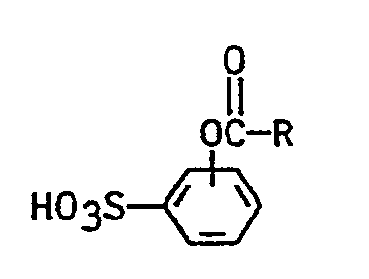
- the invention relates to a process for the preparation of the alkali and alkaline earth metal salts of acyloxybenzenesulfonic acids of the formula in which R denotes a straight-chain or branched saturated alkyl radical having 5 to 11 carbon atoms or a phenyl radical, characterized by sulfonation of phenol with SO 3 or chlorosulfonic acid, subsequent esterification and salt formation, characterized in that the sulfonation in the presence of 0.2 to 20 Mol% of a complexing agent for S0 3 or chlorosulfonic acid, based on the S0 3 or chlorosulfonic acid, is carried out at from 20 to 80 ° C., adding the complexing agent to the molten phenol and then adding the sulfonating agent and the phenolsulfonic acid obtained directly with an acid chloride Formula CI-COR, in which R has the meanings given for the formula, is reacted at 25 to 55 ° C.
- R denotes
- liquid acyloxybenzenesulfonic acid of formula 1 obtained with an aqueous solution of alkali metal or alkaline earth metal in the form of the hydroxide, carbonate or Bicarbonate in water at temperatures from 0 to 60 ° C below gu ter mixing so that a pH range of 3.0 to 5.5 is maintained and, if appropriate, the salt obtained is isolated in a conventional manner from the aqueous solution.
- the essence of the invention consists in the addition of small amounts of an agent which has a complexing effect on SO 3 and chlorosulfonic acid, as can be seen, for example, from the monograph by Gilbert.
- This addition allows the sulfonation to be carried out at relatively low temperatures with good yields and high purity of phenol sulfonic acid.
- the known 1: 1 adducts of SO 3 or chlorosulfonic acid do not react, or react only very slowly, in the temperature range according to the invention.
- a larger amount of the complexing agent used eg. B. an amine, additional work-up effort if a product that is as pure as possible is to be obtained.
- Dioxane, polyalkylene oxides, such as diethylene and dipropylene glycol, the end groups of which are closed by alkyl radicals having 1 to 18 carbon atoms, formamide, aliphatic substituted by 1 or 2 alkyl radicals having 1 to 4 carbon atoms on the amide nitrogen, may be mentioned individually as complex-forming compounds
- Carboxamides with 1 to 10 carbon atoms such as dimethylformamide, diethyl- or dibutyiformamide, benzoic acid amides, cyclic 5- to 7-membered amides optionally substituted on nitrogen by an alkyl radical with 1 to 4 carbon atoms, such as N-methylpyrrolidone-2, N -Methylpiperidon-2, s-caprolactam, triazine derivatives, such as melamine, benzoguanamine, acetoguanamine, trialkylamines with 1 to 6 carbon atoms in the alkyl, N, N-Cl-C4-dialkyl
- N, N-disubstituted formamides having 1 to 4 carbon atoms in the alkyl, in particular the dimethylformamide, and the 1,4-dioxane are particularly preferred.
- alkyl radicals having 5 to 11 carbon atoms are, for example, pentyl, heptyl, 2-ethylpentyl, octyl, branched octyl radicals and undecyl.
- n-heptyl n-octyl and 3,5,5-trimethyipentyi are particularly preferred.
- the technically available mixtures which generally contain at least 95% defined acid chloride CI-COR, can expediently be used in the production.
- 3,5,5-trimethylhexanoic acid chloride is often referred to as isonanoic acid chloride.
- the radical O-OR is preferably in the p-position with a proportion of o-compound due to the reaction mixtures formed.
- a molar ratio of about 1: 1 is advantageously maintained in order, for example, to avoid sulfone formation and disulfonation and other by-products.
- the molar amount of sulfonating agent should advantageously not be exceeded by more than 5 mol%.
- the hydrogen chloride formed when using chlorosulfonic acid can be easily caused by outgassing, e.g. B. under reduced pressure at 10 to 40 mbar, practically completely removed.
- the phenolsulfonic acid obtained is advantageously reacted directly with a corresponding acid chloride at 35 to 45 ° C., in a molar ratio, calculated on the phenol used.
- the hydrogen chloride formed is removed, as indicated above.
- the sulfonations described here, including the subsequent esterifications, can be carried out batchwise or continuously. In the continuous embodiment, one can proceed, for example, by combining the reaction components in a tubular reactor or in a cascade of stirred tanks.
- the liquid acyloxybenzenesulfonic acids obtained are very sensitive to hydrolysis as activated phenol esters, it is advantageous to convert the liquid acyloxybenzenesulfonic acids obtained into their alkali metal or alkaline earth metal salts.
- the sodium salt is particularly preferred.
- the salt obtained can, if appropriate, be isolated in a conventional manner from the aqueous solution in solid form.
- the neutralization process in which acyloxybenzenesulfonic acids can be neutralized without significant saponification, is the subject of the unpublished EP-A-140251.
- the procedure is such that the liquid acyloxybenzenesulfonic acid and a 5 to 50% strength by weight aqueous solution of alkali or alkaline earth metal in the form of the hydroxide, carbonate or bicarbonate at temperatures from 0 to 60 ° C., preferably 10, are simultaneously used in water to 40 ° C, run in with stirring so that a pH range of 2.5 to 7.0, preferably 3.0 to 5.5, is maintained.
- This neutralization can be carried out batchwise or continuously.
- the components water, acyloxybenzenesulfonic acid and alkali are combined in a static or dynamic mixer.
- This neutralization process can be used to prepare stable aqueous solutions of the acyloxybenzenesulfonates in concentrations of 20 to 60% by weight. From these solutions, the pure salts in are isolated in a conventional manner, for example by evaporation, roller drying, spray drying, freeze drying or fluidized bed drying.
- this special neutralization is carried out in the presence of 1 to 2% by weight, based on the acyloxybenzenesulfonic acid, of a water-soluble phosphate, phosphite, tartrate or a complexing agent for heavy metals or a polymer made from acrylic acid and / or maleic acid.
- a water-soluble phosphate, phosphite, tartrate or a complexing agent for heavy metals or a polymer made from acrylic acid and / or maleic acid As a rule, the water-soluble sodium salts are used
- aqueous solutions are then much less colored and are less susceptible to discoloration during further processing if the neutralization is carried out in the presence of these substances.
- the following may be mentioned in detail, for example: sodium dihydrogen phosphate, disodium tartrate, sodium hydrogen tartrate, sodium phosphite, hypophosphorous acid, nitrilotriacetic acid, ethylenediaminetetraacetic acid, diethylenetriaminepentaacetic acid, hydroxyethylethylenediaminetriacetic acid, nitrilotrimethylenephosphonic acid and sodium / polycarbonsodium acid and polycarboxylic acid or polycarboxylic acid or polycarbonsodium acid or polycarboxylic acid or polycarboxylic acid or polycarboxylic acid or polycarboxylic acid.
- the polyacrylic acids used have K values from 15 to 120 and the acrylic acid-maleic acid copolymers have K values from 30 to 100, in each case measured as a completely neutralized Na salt in a 1% strength by weight aqueous solution at 25 ° C.
- acyloxybenzenesulfonic acid content of the reaction mixture is expediently determined after neutralization with aqueous sodium hydroxide solution and spray drying of the isolated sodium salts by two-phase titration according to DIN / ISO 2271. Parts are parts by weight.
- the crude acyloxybenzenesulfonic acid is neutralized as described above and the sodium salt is isolated from the aqueous solution by spray drying.
Landscapes
- Chemical & Material Sciences (AREA)
- Organic Chemistry (AREA)
- Organic Low-Molecular-Weight Compounds And Preparation Thereof (AREA)
- Low-Molecular Organic Synthesis Reactions Using Catalysts (AREA)
Description
- Die Erfindung betrifft ein Verfahren zur Herstellung der Alkali- und Erdalkalisalze von Acyloxybenzosulfonsäuren durch Sulfonierung von Phenol in Gegenwart einer geringen Mengen eines Komplexbildners für das sulfonierende Agens S03 oder Chlorsulfonsäure, anschließende Veresterung und Neutralisation zum Alkali-oder Erdalkalisalz.
- Es ist bekannt, daß Acyloxybenzolsulfonsäuren als aktivierte Ester Acylierungsmittel für Amine, Mercaptane, Wasserstoffperoxid und andere Verbindungen mit aktivem Wasserstoff sind. Für manche Anwendungen, wie die Acylierung von Feststoffen oder von wasserunlöslichen polymeren Verbindungen oder bei der Anwendung in Waschmitteln als Kaltbleichaktivatoren, beispielsweise gemäß EP-Anmeldung 28432, GB-PS 864 798, US-PS 4 412 934 oder der DE-AS 2 602 510, sind wasserlösliche Acylierungsmittel, wie die Salze von Acyloxybenzolsulfonsäuren, z. B. die bekannten Benzoyl- oder Acetyl-p-oxybenzolsulfonate, zweckmäßig.
- Weiterhin geht beispielsweise aus der US-PS 3 503 888 die Verwendung von Salzen von Acyloxybenzolsulfonsäuren in Toilettenseifen hervor. In der US-PS 3 503 888 wird eine Verfahrensweise zur Herstellung von Acyloxybenzosulfonsäuren beschrieben, bei der man Phenol mit S03 sulfoniert und die erhaltene Phenolsulfonsäure mit einem Fettsäurechlorid verestert.
- Wesentlich für die Herstellung von Acyloxybenzolsulfonsäuren ist, daß wegen ihrer Hydrolyseempfindlichkeit unter Ausschluß von Wasser gearbeitet werden muß. Aus diesem Grunde scheidet Schwefelsäure als übliches Sulfonierungsmittel für Phenol aus. Nachteilig an dem in der US-PS 3 503 888 beschriebenen Verfahren ist, daß die Sulfonierung nicht optimal abläuft. Sie verläuft unter Bildung von Gemischen aus o- und p-Isomeren und es entsteht eine Reihe unerwünschter Nebenprodukte, wie Sulfone und deren Folgeprodukte, die eine spätere Aufarbeitung im Hinblick auf ein gut rieselfähiges Salz stören können, da sie eine leichte Verbackbarkeit verursachen.
- Der Monographie E. E. Gilbert, Sulfonation and Related Reactions, Interscience Publishers John Wiley a. Sons, New York, 1965, Kapitel 1, kann beispielsweise entnommen werden, daß SO3 und Chlorsulfonsäure mit den verschiedensten organischen Verbindungen, wie Aminen, Pyridin, Ethem, Amiden u. a., Komplexe (meist 1 : 1-Addukte) bilden und daß diese Komplexe mildere Sulfonierungsreagentien sind als S03 oder Chlorsulfonsäure selbst. Durch diese Komplexbildung kann die Reaktivität des sulfonierenden Reagens beeinflußt werden. In der Regel laufen die Sulfonierungen mit diesen Komplexen bei höheren Temperaturen ab als ohne Komplexbildner und werden häufig in Gegenwart eines inerten Lösungsmittels oder eines Überschusses an Komplexbildner durchgeführt. Die Durchsicht der genannten Literaturstelle zeigt, daß die Reaktivität eines solchen Komplexes im Hinblick auf das zu sulfonierende Substrat nicht ohne weiteres vorausgesagt werden kann.
- Aufgabe derErfindung ist es, ein in technischem Maßstab leicht durchzuführendes Verfahren zur Herstellung der Alkali- und Erdalkalisalze von Acyloxybenzolsulfonsäuren zur Verfügung zu stellen, durch das die Salze in hoher Reinheit und in guten Ausbeuten zugänglich werden.
- Es wurde nun überraschenderweise gefunden, daß die Sulfonierung von Phenol vorteilhaft bei niederen Temperaturen in Gegenwart von wesentlich geringeren Mengen an Komplexbildnern als es einem 1 : :1-Komplex entspricht, durchgeführt werden kann.
- Gegenstand der Erfindung ist ein Verfahren zur Herstellung derAlkali- und Erdalkalisalze von Acyloxybenzolsulfonsäuren der Formel

- Das Wesentliche der Erfindung besteht in dem Zusatz von geringen Mengen eines für S03 und Chlorsulfonsäure komplexbildend wirkenden Agens, wie es beispielsweise der gennanten Monographie von Gilbert entnommen werden kann. Dieser Zusatz gestattet, die Sulfonierung bei relativ niederen Temperaturen mit guten Ausbeuten und hoher Reinheitan Phenolsulfonsäure durchzuführen. Erstaunlicherweise reagieren die bekannten 1 : 1-Addukte des S03 oderder Chlorsulfonsäure in dem erfindungsgemäßen Temperaturbereich nicht oder nur sehr langsam. Zudem bereitet eine größere Menge des eingesetzten Komplexbildners, z. B. eines Amins, zusätzlichen Aufwand bei der Aufarbeitung, wenn ein möglichst reines Produkt erhalten werden soll.
- In einzelnen seien als komplexbildend wirkende Verbindungen genannt Dioxan, Polyalkylenoxide, wie Diethylen- und Dipropylenglykol, deren Endgruppen durch Alkylreste mit 1 bis 18 C-Atomen verschlossen sind, Formamid, durch 1 oder 2 Alkylreste mit 1 bis 4 C-Atomen am Amidstickstoff substituierte aliphatische Carbonsäureamide mit 1 bis 10 C-Atomen, wie Dimethylformamid, Diethyl- oder Dibutyiformamid, Benzoesäureamide, gegebenenfalls am Stickstoff durch einen Alkylrest mit 1 bis 4 C-Atomen substituierte cyclische 5- bis 7-gliedrige Amide, wie N-Methylpyrrolidon-2, N-Methylpiperidon-2, s-Caprolactam, Triazinderivate, wie Melamin, Benzoguanamin, Acetoguanamin, Trialkylamine mit 1 bis 6 C-Atomen im Alkyl, N,N-Cl-C4-Dialkyl-cyclo- hexylamine, Pyridin, Triphenylphosphin, Amidosulfonsäure, Imidazol oder Bortrifluorid. Gegebenenfalls können auch Mischungen dieser Komplexbildner verwendet werden.
- Davon sind die N,N-disubstituierten Formamide mit 1 bis 4 C-Atomen im Alkyl, insbesondere das Dimethylformamid, und das 1,4-Dioxan besonders bevorzugt.
- Für R kommen als Alkylreste mit 5 bis 11 C-Atomen beispielsweise Pentyl, Heptyl, 2-Ethylpentyl, Octyl, verzweigte Octylreste, Undecyl in Betracht.
- Von den Resten für R sind besonders bevorzugt n-Heptyl, n-Octyl und 3,5,5-Trimethyipentyi.
- Bei der Herstellung können anstelle der reinen Säurechloride zweckmäßig die technisch erhältlichen Gemische, die in der Regel mindestens 95% definiertes Säurechlorid CI-COR enthalten, eingesetzt werden. Dabei wird das 3,5,5-Trimethylhexansäurechlorid im technischen Sprachgebrauch häufig als Isonansäurechlorid bezeichnet.
- Im übrigen steht in der Formel der Rest-O-OR aufgrund der entstehenden Reaktionsgemische bevorzugt in der p-Stellung mit einem Anteil an o-Verbindung.
- Bei der Umsetzung des zu sulfonierenden Phenols mit S03 oder Chlorsulfonsäure wird vorteilhaft ein Molverhältnis von etwa 1 : 1 eingehalten, um beispielsweise Sulfonbildung und Disulfonierungen und weitere Nebenprodukte zu vermeiden. Die molare Menge an Sulfonierungsmittel sollte zweckmäßig um nicht mehr als 5 Mol% überschritten werden.
- Der bei Verwendung von Chlorsulfonsäure entstehende Chlorwasserstoff kann ohne Schwierigkeiten durch Ausgasen, z. B. unter vermindertem Druck bei 10 bis 40 mbar, praktisch vollständig entfernt werden.
- Die erhaltene Phenolsulfonsäure wird vorteilhaft direkt mit einem entsprechenden Säurechlorid bei 35 bis 45 °C, in molarem Verhältnis, berechnet auf eingesetztes Phenol, umgesetz. Nach der Beendigung der Reaktion wird, wie oben angegeben, der entstandene Chlorwasserstoff entfernt.
- Die hier beschriebenen Sulfonierungen einschließlich der nachfolgenden Veresterungen können diskontinuiertich oder kontinuierlich durchgeführt werden. Bei der kontinuierlichen Ausführungsform kann man beispielsweise so vorgehen, daß man die Reaktionskomponenten in einem Rohrreaktor oder in einer Rührkesselkaskade zusammenführt.
- Aus praktischen Gründen und wegen der Zersetzlichkeit der gewonnenen Acyloxybenzolsulfonsäuren, die als aktivierte Phenolester sehr hydrolyseempfindlich sind, ist es vorteilhaft, die erhaltenen flüssigen Acyloxybenzolsulfonsäuren in ihre Alkali- oder Erdalkalisalze zu überführen. Davon ist das Natriumsalz besonders bevorzugt.
- Das erhaltene Salz kann ggf. in an sich üblicher Weise aus der wäßrigen Lösung in fester Form isoliert, werden.
- Das Neutralisationsverfahren, bei dem Acyloxybenzolsulfonsäuren ohne nennenswerte Verseifung neutralisiert werden können, ist übrigens Gegenstand der nicht vorveröffentlichten EP-A-140251. Im einzelnen geht man so vor, daß man in Wasser gleichzeitig die flüssige Acyloxybenzolsulfonsäure und eine 5 bis 50 gew.%ige wäßrige Lösung von Alkali- oder Erdalkali in Form des Hydroxids, Carbonats oder Bicarbonats bei Temperaturen von 0 bis 60 °C, bevorzugt 10 bis 40 °C, unter Rühren so einlaufen läßt, daß ein pH-Wert-Bereich von 2,5 bis 7,0, bevorzugt 3,0 bis 5,5, eingehalten wird.
- Diese Neutralisation kann diskontinuierlich oder kontinuierlich durchgeführt werden. Bei der kontinuierlichen Arbeitsweise werden die Komponenten Wasser, Acyloxybenzolsulfonsäure und Alkali in einem statischen oder dynamischen Mischer zusammengeführt.
- Durch dieses Neutralisationsverfahren können stabile wäßrige Lösungen der Acyloxybenzolsulfonate in Konzentrationen von 20 bis 60 Gew.% hergestellt werden. Aus diesen Lösungen können die reinen Salze in an sich üblicher Weise, beispielsweise durch Eindampfen, Walzentrocknen, Sprühtrocknen, Gefriertrocknen oder Wirbelbetttrocknen isoliert werden.
- In einer besonders bevorzugten Ausführungsform wird diese spezielle Neutralisation in Gegenwart von 1 bis 2 Gew.%, bezogen auf die Acyloxybenzolsulfonsäure, von einem wasserlöslichen Phosphat, Phosphit, Tartrat oder einem Komplexbildner für Schwermetalle oder einem Polymeren aus Acrylsäure und/oder Maleinsäure durchgeführt. Dabei werden in der Regel die wasserlöslichen Natriumsalze verwendet
- Die wäßrigen Lösungen sind dann wesentlich weniger gefärbt und neigen bei derWeiterverarbeitung weniger zu Verfärbungen, wenn man die Neutralisation in Gegenwart dieser Stoffe durchführt. Im einzelnen seien beispielsweise genannt: Natriumdihydrogenphosphat, Dinatriumtartrat, Natriumhydrogentartrat, Natriumphosphit, unterphosphorige Säure, Nitrilotriessigsäure, Ethylendiamintetraessigsäure, Diethylentriaminpentaessigsäure, Hydroxyethylethylendiamintriessigsäure, Nitrilotrimethylenphosphonsäure oder Polycarbonsäuren aus Acrylsäure und/oder Maleinsäure und ihre Natriumsalze. Die verwendeten Polyacrylsäuren weisen K-Werte von 15 bis 120 und die Acrylsäure-Maleinsäure-Copolymerisate K-Werte von 30 bis 100 auf, jeweils gemessen als vollständig neutralisiertes Na-Salz in 1 gew.%iger wäßriger Lösung bei 25 °C.
- Die vorliegenden Beispiele werden mit technischem 3,5,5-Trimethyihexansäurechtorid (Isononanoylchlorid) durchgeführt. Andere Acylreste verhalten sich völlig analog. Der Gehalt der Reaktionsmischung an Acyloxybenzolsulfonsäure wird zweckmäßigerweise nach der Neutralisation mit wäßriger Natronlauge und Sprühtrocknung an den isolierten Natriumsalzen durch Zweiphasentitration nach DIN/ISO 2271 bestimmt Teile sind Gewichtsteile.
- 1. Allgemeine Vorschrift für Beispiele 1 bis 8 und Vergleichsbeispiele A und B:
- 94 Teile Phenol werden geschmolzen und mit Komplexbildner gemäß Tabelle 1 versetzt. Bei 45 bis 50 °C werden innerhalb von 1 bis 2 Stunden unter Kühlung 122 Teile Chlorsulfonsäure oder 84 Teile Schwefeltrioxid zugegeben. Es wird 1 Stunde lang bei 50 °C nachgerührt und dann werden innerhalb von 1 bis 2 Stunden bei maximal 45°C 176,5 Teile 3,5,5-Trimethylhexansäurechlorid zugegeben. Nach 1 Stunde wird untervermindertem Druck bei 10 bis 20 mbar der gelöste Chlorwasserstoff praktisch vollständig entfernt.
- 100 Teile der erhaltenen rohen Acyloxybenzolsulfonsäure läßt man unter gutem Rühren zu 100 Teilen Wasser zulaufen. Gleichzeitig wird 50 gew.%ige wäßrige Natronlauge so zugetropft, daß sich in der wäßrigen Lösung ein pH-Wert von 3,0 bis 5,5 (Verfolgung mittels Glaselektrode) einstellt. Die Temperatur der Reaktionsmischung wird durch Kühlung unter 50°C gehalten. Nach dem Ende der Zugabe der Acyloxybenzolsulfonsäure wird die Lösung auf einen pH-Wert von 5,5 eingestellt. Das Natriumsalz wird durch Sprühtrocknung aus der wäßrigen Lösung isoliert
- In 73 Teilen Dimethylformamid werden 94 Teile Phenol gelöst und anschließend auf 40 °C erwärmt. Diese Mischung wird bei 40 bis 50 °C innerhalb zwei Stunden mit 119 Teilen Chlorsulfonsäure sulfoniert, 30 Minuten bei 50 °C nachgerührt und anschließend bei 50 °C im Vakuum entgast. Bei 40 bis 50 °C werden 176,5 Teile 3,5,5-Trimethylhexansäurechlorid zugefügt und nach einer Stunde der gelöste Chlorwasserstoff unter vermindertem Druck bei 10 bis 20 mbar und 50 °C praktisch vollständig entfernt
- Die rohe Acyloxybenzolsulfonsäure wird wie vorstehend beschrieben neutralisiert und das Natriumsalz durch Sprühtrocknen aus der wäßrigen Lösung isoliert.
- Die Ergebnisse sind in Tabelle 1 zusammengefaßt. Die Ergebnisse zeigen, daß für eine großtechnische Verfahrensweise gegenüber den Vergleichsversuchen die Ausbeuten in nicht vorhersehbarer Weise verbessert wurden.

Claims (5)
Priority Applications (1)
| Application Number | Priority Date | Filing Date | Title |
|---|---|---|---|
| AT85106135T ATE25076T1 (de) | 1984-05-26 | 1985-05-18 | Verfahren zur herstellung von acyloxybenzolsulfonsaeuren. |
Applications Claiming Priority (2)
| Application Number | Priority Date | Filing Date | Title |
|---|---|---|---|
| DE3419793 | 1984-05-26 | ||
| DE19843419793 DE3419793A1 (de) | 1984-05-26 | 1984-05-26 | Verfahren zur herstellung von acyloxybenzolsulfonsaeuren und ihrer alkali- und erdalkalisalze |
Publications (3)
| Publication Number | Publication Date |
|---|---|
| EP0163224A1 EP0163224A1 (de) | 1985-12-04 |
| EP0163224B1 EP0163224B1 (de) | 1987-01-21 |
| EP0163224B2 true EP0163224B2 (de) | 1991-10-16 |
Family
ID=6236993
Family Applications (1)
| Application Number | Title | Priority Date | Filing Date |
|---|---|---|---|
| EP85106135A Expired - Lifetime EP0163224B2 (de) | 1984-05-26 | 1985-05-18 | Verfahren zur Herstellung von Acyloxybenzolsulfonsäuren |
Country Status (7)
| Country | Link |
|---|---|
| US (1) | US4705649A (de) |
| EP (1) | EP0163224B2 (de) |
| JP (1) | JPS60258155A (de) |
| AT (1) | ATE25076T1 (de) |
| CA (1) | CA1285286C (de) |
| DE (2) | DE3419793A1 (de) |
| ES (1) | ES8604123A1 (de) |
Families Citing this family (4)
| Publication number | Priority date | Publication date | Assignee | Title |
|---|---|---|---|---|
| US5124475A (en) * | 1991-03-01 | 1992-06-23 | Stepan Company | Preparation of p-phenyl sulfonate esters of acyl glycolic acids |
| DE10139663A1 (de) * | 2001-08-11 | 2003-02-20 | Clariant Gmbh | Verfahren zur Herstellung von Acyloxybenzolsulfonaten |
| US6790981B2 (en) | 2002-12-13 | 2004-09-14 | Clariant Finance (Bvi) Limited | Process for the preparation of acyloxybenzenesulfonates |
| DE102007026216A1 (de) * | 2007-06-05 | 2008-12-11 | Clariant International Ltd. | Feste Partikel von hydrophoben Bleichaktivatoren |
Family Cites Families (9)
| Publication number | Priority date | Publication date | Assignee | Title |
|---|---|---|---|---|
| CA495938A (en) * | 1953-09-08 | General Aniline And Film Corporation | Process of preparing 2,4-dihydroxybenzenesulfonic acid | |
| DE638072C (de) * | 1935-04-14 | 1936-11-09 | Merkel & Kienlin G M B H | Verfahren zur Herstellung von Oxyarylcarbonsaeureestern |
| US2854476A (en) * | 1955-04-21 | 1958-09-30 | Universal Oil Prod Co | Method of sulfonation with a sulfur trioxide addition product |
| GB864798A (en) * | 1958-03-20 | 1961-04-06 | Unilever Ltd | Bleaching processes and compositions |
| US3503888A (en) * | 1965-02-16 | 1970-03-31 | Dow Chemical Co | Synthetic detergent bar |
| GB1354876A (en) * | 1970-05-15 | 1974-06-05 | Albright & Wilson | Sulphonating/sulphating agents |
| GB1519351A (en) * | 1975-01-29 | 1978-07-26 | Unilever Ltd | Preparation of acetoxy arylene sulphonates |
| ATE5896T1 (de) * | 1979-11-03 | 1984-02-15 | The Procter & Gamble Company | Granulare waschmittelzusammensetzungen. |
| US4412934A (en) * | 1982-06-30 | 1983-11-01 | The Procter & Gamble Company | Bleaching compositions |
-
1984
- 1984-05-26 DE DE19843419793 patent/DE3419793A1/de not_active Withdrawn
-
1985
- 1985-05-15 CA CA000481647A patent/CA1285286C/en not_active Expired - Lifetime
- 1985-05-18 AT AT85106135T patent/ATE25076T1/de active
- 1985-05-18 EP EP85106135A patent/EP0163224B2/de not_active Expired - Lifetime
- 1985-05-18 DE DE8585106135T patent/DE3560060D1/de not_active Expired
- 1985-05-24 JP JP60110602A patent/JPS60258155A/ja active Pending
- 1985-05-24 ES ES543482A patent/ES8604123A1/es not_active Expired
-
1986
- 1986-11-07 US US06/928,696 patent/US4705649A/en not_active Expired - Fee Related
Also Published As
| Publication number | Publication date |
|---|---|
| DE3560060D1 (en) | 1987-02-26 |
| EP0163224B1 (de) | 1987-01-21 |
| JPS60258155A (ja) | 1985-12-20 |
| ES8604123A1 (es) | 1986-01-16 |
| US4705649A (en) | 1987-11-10 |
| ES543482A0 (es) | 1986-01-16 |
| DE3419793A1 (de) | 1985-11-28 |
| CA1285286C (en) | 1991-06-25 |
| EP0163224A1 (de) | 1985-12-04 |
| ATE25076T1 (de) | 1987-02-15 |
Similar Documents
| Publication | Publication Date | Title |
|---|---|---|
| EP0140251B2 (de) | Verfahren zur Herstellung von Alkali- und Erdalkalisalzen von Acyloxibenzolsulfonsäuren | |
| EP0287846B1 (de) | 2-Hydroxy-3-amino-propionsäure-N,N-diessigsäure und ihre Derivate, ihre Herstellung und Verwendung insbesondere als Komplexbildner und diese enthaltende Wasch- und Reinigungsmittel | |
| EP0163225B2 (de) | Verfahren zur Herstellung von Acyloxybenzolsulfonsäuren und ihrer Alkali- und Erdalkalisalze | |
| US3855284A (en) | Process for the manufacture of phosphonic acids and phosphonates having at least two phosphorus atoms | |
| EP0163224B1 (de) | Verfahren zur Herstellung von Acyloxybenzolsulfonsäuren | |
| DE1543637C3 (de) | Verfahren zur Herstellung farbloser kristalliner Diphenylsulfone | |
| DE2716030C3 (de) | Verfahren zur Herstellung von Monoalkalisalzes der 1-Amino-8-naphthol-3,6-disulfonsäure | |
| EP0180732B1 (de) | Verfahren zur Herstellung von 3-Acylamino-4-alkoxy-phenyl-beta-hydroxysulfonen und -sulfon-schwefelsäureestern | |
| EP0037510B1 (de) | Verfahren zur Herstellung von 1-Naphthylamin-4,6-disulfonsäure und 1-Naphthylamin-2,4,6-trisulfonsäure | |
| DE1804833C3 (de) | Verfahren zur Herstellung von Methallylsulfonsäure und deren Salzen | |
| US2606202A (en) | Monosulfuric acid esters of polyalkylene glycols | |
| EP0379109B1 (de) | Glycerinaminocarboxylate, ihre Herstellung und Verwendung | |
| EP0008055B1 (de) | Verfahren zur Herstellung von Di-(N-methyl-N-phenyl-thiuram)-disulfid | |
| DE3872441T2 (de) | Verfahren zur herstellung von propanon-1,3-disulfonsaeure. | |
| DE2339463A1 (de) | Verfahren zur herstellung eines methallylsulfonats | |
| DE3402622C2 (de) | Verfahren zur Herstellung von Diphenyl-4,4'-disulfonsäure | |
| EP0037509B1 (de) | Verfahren zur Herstellung von 1-Naphthylamin-4.7-disulfonsäure | |
| DE1568385B2 (de) | Verfahren zur herstellung von alpha-methylencarbonsaeureestern aliphatischer hydroxysulfonsaeuren | |
| DE2750990C2 (de) | ||
| EP0052307A1 (de) | Verfahren zur Herstellung von 1-Naphthylamin-4.6-disulfonsäure und 1-Naphthylamin-2.4.6-trisulfonsäure | |
| DE3901612A1 (de) | Alkylglucosid-aminocarboxylate, ihre herstellung und ihre verwendung als komplexbildner fuer schwermetalle | |
| DE19521620A1 (de) | Aufarbeitungsverfahren für ß-Sulfatoethyl-anilin-sulfonsäuren | |
| DE4041966A1 (de) | 2-carboxymethylsulfonyl-propan-1,3-disulfonate und verfahren zu ihrer herstellung | |
| DE4130333A1 (de) | Verfahren zur isolierung von 2-naphthylamin-1,5-disulfonsaeure | |
| EP0014366A1 (de) | Verfahren zur Herstellung des Magnesiumsalzes von 2-Nitronaphthalin-4,8-disulfonsäure (Nitro-Armstrong-Säure) |
Legal Events
| Date | Code | Title | Description |
|---|---|---|---|
| PUAI | Public reference made under article 153(3) epc to a published international application that has entered the european phase |
Free format text: ORIGINAL CODE: 0009012 |
|
| AK | Designated contracting states |
Designated state(s): AT BE CH DE FR GB IT LI NL SE |
|
| 17P | Request for examination filed |
Effective date: 19851213 |
|
| 17Q | First examination report despatched |
Effective date: 19860626 |
|
| GRAA | (expected) grant |
Free format text: ORIGINAL CODE: 0009210 |
|
| AK | Designated contracting states |
Kind code of ref document: B1 Designated state(s): AT BE CH DE FR GB IT LI NL SE |
|
| REF | Corresponds to: |
Ref document number: 25076 Country of ref document: AT Date of ref document: 19870215 Kind code of ref document: T |
|
| ITF | It: translation for a ep patent filed | ||
| REF | Corresponds to: |
Ref document number: 3560060 Country of ref document: DE Date of ref document: 19870226 |
|
| ET | Fr: translation filed | ||
| PLBI | Opposition filed |
Free format text: ORIGINAL CODE: 0009260 |
|
| PLBI | Opposition filed |
Free format text: ORIGINAL CODE: 0009260 |
|
| 26 | Opposition filed |
Opponent name: BAYER AG, LEVERKUSEN KONZERNVERWALTUNG RP PATENTAB Effective date: 19871003 |
|
| NLR1 | Nl: opposition has been filed with the epo |
Opponent name: BAYER AG |
|
| 26 | Opposition filed |
Opponent name: HOECHST AKTIENGESELLSCHAFT, FRANKFURT Effective date: 19871020 |
|
| NLR1 | Nl: opposition has been filed with the epo |
Opponent name: HOECHST AKTIENGESELLSCHAFT |
|
| ITTA | It: last paid annual fee | ||
| PUAH | Patent maintained in amended form |
Free format text: ORIGINAL CODE: 0009272 |
|
| STAA | Information on the status of an ep patent application or granted ep patent |
Free format text: STATUS: PATENT MAINTAINED AS AMENDED |
|
| 27A | Patent maintained in amended form |
Effective date: 19911016 |
|
| AK | Designated contracting states |
Kind code of ref document: B2 Designated state(s): AT BE CH DE FR GB IT LI NL SE |
|
| ITF | It: translation for a ep patent filed | ||
| REG | Reference to a national code |
Ref country code: CH Ref legal event code: AEN |
|
| NLR2 | Nl: decision of opposition | ||
| ET3 | Fr: translation filed ** decision concerning opposition | ||
| NLR3 | Nl: receipt of modified translations in the netherlands language after an opposition procedure | ||
| PGFP | Annual fee paid to national office [announced via postgrant information from national office to epo] |
Ref country code: FR Payment date: 19920409 Year of fee payment: 8 |
|
| PGFP | Annual fee paid to national office [announced via postgrant information from national office to epo] |
Ref country code: SE Payment date: 19920410 Year of fee payment: 8 Ref country code: CH Payment date: 19920410 Year of fee payment: 8 |
|
| PGFP | Annual fee paid to national office [announced via postgrant information from national office to epo] |
Ref country code: AT Payment date: 19920416 Year of fee payment: 8 |
|
| PGFP | Annual fee paid to national office [announced via postgrant information from national office to epo] |
Ref country code: GB Payment date: 19920430 Year of fee payment: 8 |
|
| PGFP | Annual fee paid to national office [announced via postgrant information from national office to epo] |
Ref country code: BE Payment date: 19920506 Year of fee payment: 8 |
|
| PGFP | Annual fee paid to national office [announced via postgrant information from national office to epo] |
Ref country code: DE Payment date: 19920514 Year of fee payment: 8 |
|
| PGFP | Annual fee paid to national office [announced via postgrant information from national office to epo] |
Ref country code: NL Payment date: 19920531 Year of fee payment: 8 |
|
| PG25 | Lapsed in a contracting state [announced via postgrant information from national office to epo] |
Ref country code: DE Effective date: 19930513 |
|
| PG25 | Lapsed in a contracting state [announced via postgrant information from national office to epo] |
Ref country code: GB Effective date: 19930518 Ref country code: AT Effective date: 19930518 |
|
| PG25 | Lapsed in a contracting state [announced via postgrant information from national office to epo] |
Ref country code: SE Effective date: 19930519 |
|
| PG25 | Lapsed in a contracting state [announced via postgrant information from national office to epo] |
Ref country code: LI Effective date: 19930531 Ref country code: CH Effective date: 19930531 Ref country code: BE Effective date: 19930531 |
|
| BERE | Be: lapsed |
Owner name: BASF A.G. Effective date: 19930531 |
|
| PG25 | Lapsed in a contracting state [announced via postgrant information from national office to epo] |
Ref country code: NL Effective date: 19931201 |
|
| GBPC | Gb: european patent ceased through non-payment of renewal fee |
Effective date: 19930518 |
|
| NLV4 | Nl: lapsed or anulled due to non-payment of the annual fee | ||
| PG25 | Lapsed in a contracting state [announced via postgrant information from national office to epo] |
Ref country code: FR Effective date: 19940131 |
|
| REG | Reference to a national code |
Ref country code: CH Ref legal event code: PL |
|
| REG | Reference to a national code |
Ref country code: FR Ref legal event code: ST |
|
| EUG | Se: european patent has lapsed |
Ref document number: 85106135.8 Effective date: 19931210 |