EP0157584A2 - Apparat und Verfahren für die Beschichtung eines Polymerisationswirbelbettreaktors mit einem Pulver mit katalytischer Aktivität - Google Patents
Apparat und Verfahren für die Beschichtung eines Polymerisationswirbelbettreaktors mit einem Pulver mit katalytischer Aktivität Download PDFInfo
- Publication number
- EP0157584A2 EP0157584A2 EP85302113A EP85302113A EP0157584A2 EP 0157584 A2 EP0157584 A2 EP 0157584A2 EP 85302113 A EP85302113 A EP 85302113A EP 85302113 A EP85302113 A EP 85302113A EP 0157584 A2 EP0157584 A2 EP 0157584A2
- Authority
- EP
- European Patent Office
- Prior art keywords
- powder
- comprised
- intermediate chamber
- bed reactor
- metering device
- Prior art date
- Legal status (The legal status is an assumption and is not a legal conclusion. Google has not performed a legal analysis and makes no representation as to the accuracy of the status listed.)
- Granted
Links
Images


Classifications
-
- B—PERFORMING OPERATIONS; TRANSPORTING
- B01—PHYSICAL OR CHEMICAL PROCESSES OR APPARATUS IN GENERAL
- B01J—CHEMICAL OR PHYSICAL PROCESSES, e.g. CATALYSIS OR COLLOID CHEMISTRY; THEIR RELEVANT APPARATUS
- B01J3/00—Processes of utilising sub-atmospheric or super-atmospheric pressure to effect chemical or physical change of matter; Apparatus therefor
- B01J3/02—Feed or outlet devices therefor
-
- B—PERFORMING OPERATIONS; TRANSPORTING
- B01—PHYSICAL OR CHEMICAL PROCESSES OR APPARATUS IN GENERAL
- B01J—CHEMICAL OR PHYSICAL PROCESSES, e.g. CATALYSIS OR COLLOID CHEMISTRY; THEIR RELEVANT APPARATUS
- B01J8/00—Chemical or physical processes in general, conducted in the presence of fluids and solid particles; Apparatus for such processes
- B01J8/0015—Feeding of the particles in the reactor; Evacuation of the particles out of the reactor
- B01J8/0035—Periodical feeding or evacuation
-
- C—CHEMISTRY; METALLURGY
- C08—ORGANIC MACROMOLECULAR COMPOUNDS; THEIR PREPARATION OR CHEMICAL WORKING-UP; COMPOSITIONS BASED THEREON
- C08F—MACROMOLECULAR COMPOUNDS OBTAINED BY REACTIONS ONLY INVOLVING CARBON-TO-CARBON UNSATURATED BONDS
- C08F2/00—Processes of polymerisation
- C08F2/34—Polymerisation in gaseous state
-
- B—PERFORMING OPERATIONS; TRANSPORTING
- B01—PHYSICAL OR CHEMICAL PROCESSES OR APPARATUS IN GENERAL
- B01J—CHEMICAL OR PHYSICAL PROCESSES, e.g. CATALYSIS OR COLLOID CHEMISTRY; THEIR RELEVANT APPARATUS
- B01J2208/00—Processes carried out in the presence of solid particles; Reactors therefor
- B01J2208/00743—Feeding or discharging of solids
- B01J2208/00769—Details of feeding or discharging
- B01J2208/00778—Kinetic energy reducing devices in the flow channel
-
- Y—GENERAL TAGGING OF NEW TECHNOLOGICAL DEVELOPMENTS; GENERAL TAGGING OF CROSS-SECTIONAL TECHNOLOGIES SPANNING OVER SEVERAL SECTIONS OF THE IPC; TECHNICAL SUBJECTS COVERED BY FORMER USPC CROSS-REFERENCE ART COLLECTIONS [XRACs] AND DIGESTS
- Y10—TECHNICAL SUBJECTS COVERED BY FORMER USPC
- Y10S—TECHNICAL SUBJECTS COVERED BY FORMER USPC CROSS-REFERENCE ART COLLECTIONS [XRACs] AND DIGESTS
- Y10S526/00—Synthetic resins or natural rubbers -- part of the class 520 series
- Y10S526/901—Monomer polymerized in vapor state in presence of transition metal containing catalyst
-
- Y—GENERAL TAGGING OF NEW TECHNOLOGICAL DEVELOPMENTS; GENERAL TAGGING OF CROSS-SECTIONAL TECHNOLOGIES SPANNING OVER SEVERAL SECTIONS OF THE IPC; TECHNICAL SUBJECTS COVERED BY FORMER USPC CROSS-REFERENCE ART COLLECTIONS [XRACs] AND DIGESTS
- Y10—TECHNICAL SUBJECTS COVERED BY FORMER USPC
- Y10S—TECHNICAL SUBJECTS COVERED BY FORMER USPC CROSS-REFERENCE ART COLLECTIONS [XRACs] AND DIGESTS
- Y10S526/00—Synthetic resins or natural rubbers -- part of the class 520 series
- Y10S526/904—Monomer polymerized in presence of transition metal containing catalyst at least part of which is supported on a polymer, e.g. prepolymerized catalysts
-
- Y—GENERAL TAGGING OF NEW TECHNOLOGICAL DEVELOPMENTS; GENERAL TAGGING OF CROSS-SECTIONAL TECHNOLOGIES SPANNING OVER SEVERAL SECTIONS OF THE IPC; TECHNICAL SUBJECTS COVERED BY FORMER USPC CROSS-REFERENCE ART COLLECTIONS [XRACs] AND DIGESTS
- Y10—TECHNICAL SUBJECTS COVERED BY FORMER USPC
- Y10S—TECHNICAL SUBJECTS COVERED BY FORMER USPC CROSS-REFERENCE ART COLLECTIONS [XRACs] AND DIGESTS
- Y10S526/00—Synthetic resins or natural rubbers -- part of the class 520 series
- Y10S526/919—Catalyst injection technique in addition polymerization processes
Definitions
- the invention relates to a device and process for introducing a powder with catalytic activity into a fluidised-bed reactor in which there is carried out a polymerisation or copolymerisation of gaseous alpha-olefins.
- alpha-olefins such as ethylene, or mixtures of alpha-olefins such as ethylene, propylene, 1-butene, 1-hexene, 4-methyl-l-pentene can be polymerised in the gaseous state in the presence of a catalyst system consisting, for example, (a) of a solid catalyst comprising a compound of a transition metal of Groups IV, V and VI of the Periodic Table of Elements, in particular titanium, it being possible for this solid catalyst also to comprise magnesium, and (b) of a cocatalyst comprising an organo-metallic compound of a metal of Groups II and III of the said Periodic Table of Elements, in particular an organo-aluminium compound.
- a catalyst system consisting, for example, (a) of a solid catalyst comprising a compound of a transition metal of Groups IV, V and VI of the Periodic Table of Elements, in particular titanium, it being possible for this solid catalyst also to comprise magnesium, and (b) of a co
- polymerisations and copolymerisations of alpha-olefins by means of the very active catalysts described above or of equivalent catalysts may be carried out according to a process utilising the fluidised-bed technique.
- These polymerisations and copolymerisations are then generally effected in a reactor with vertical axis in which the polymer particles in formation are maintained in the fluidised state by a rising gas stream containing the olefin or olefins to be polymerised.
- a reactor normally comprises in its lower part a perforated or porous plate, sometimes referred to as the fluidisation plate, which makes it possible to distribute the gaseous stream in the reaction medium and to maintain the polymer particles in the fluidised state above the bed.
- the fluidisation plate comprises a device for introducing solid catalyst into the fluidised-bed and a system for discharging the polymer produced, making it possible to maintain the level of the fluidised-bed constant.
- appliances comprising in general a storage enclosure for solid catalyst in powder form can be used, this enclosure being connected to a feed chamber provided with filling and emptying valves, and also feed piping connecting the said feed chamber to the fluidised-bed reactor.
- the desired quantity of solid catalyst has been introduced into the feed chamber, the latter is pressurised with an inert gas at a pressure greater than that prevailing in the reactor, then the outlet valve is abruptly opened to permit the conveyance of solid catalyst through the feed piping into the fluidised-bed reactor.
- Another device very similar to the preceding one, consists in using, instead of the feed chamber provided with its filling and emptying valves, a metering device which must be gas-tight under pressure and whose job is to deliver a given quantity of a solid catalyst in powder form into the fluidised bed reactor.
- This metering device which may be of the rotary type, comprises an internal chamber with a double aperture, which may be alternately filled with solid catalyst from the storage enclosure and emptied of the said solid catalyst under the pressure of a carrier gas which entrains it by a rapid current through the feed piping to the fluidised-bed.
- the solid catalyst which emerges into the fluidised-bed reactor in the form of a dense and compacted powder penetrates deeply into the fluidised-bed, but disperses with difficulty.
- the poor dispersion of the catalyst inside the fluidised-bed results in causing runaways of the polymerisation reaction, sources of hot spots, and possibly agglomerates of molten polymer, leading to the stoppage of the reaction.
- a solid catalyst may be introduced according to a continuous process into a fluidised-bed reactor, in particular in order to maintain constant conditions in the reaction medium.
- a very special feeding device comprising in particular, feed piping of the capillary type, having for example an internal diameter comprised between 0.76 and 3.2 mm.
- An inert carrier gas conveys the solid catalyst through this capillary-type piping to the fluidised-bed reactor at a rate such that the solid catalyst is present in the form of a dispersion or suspension of low concentration in the said inert carrier gas. Because of this the solid catalyst which emerges into the fluidised-bed reactor disperses easily inside the fluidised-bed, but with a low degree of penetration into the bed.
- a device and process have now been found making it possible to introduce a catalytically active powder into a fluidised-bed reactor in which there is carried out polymerisation or copolymerisation of gaseous alpha-olefins, whilst avoiding the above-mentioned drawbacks.
- the essential task of the intermediate chamber is to reduce considerably the compactness and settling of the catalytically active powder, which is generally compressed under a heavy load in the storage enclosure and particularly during its passage through the metering device, before being conveyed to the fluidised-bed reactor.
- the introduction of a powder which is too compacted would require first of all the use of an inert carrier gas under too high a pressure and would consequently involve the introduction of a large quantity of inert carrier gas into the reactor.
- the form and size of the intermediate chamber are therefore designed to mitigate these problems.
- the intermediate chamber consists of a vertical cylindrical container having a lower portion which is conical or in the form of a truncated cone.
- the capacity of this intermediate chamber is at least 1.1 times, preferably at least 1.5 times the volume of the powder delivered periodically by the metering device.
- the capacity of this intermediate chamber may be considerably larger; it is preferred that the capacity should not exceed 5 times, most preferably between 1.5 and 3 times, the volume of the powder delivered periodically by the metering device in order to avoid the introduction of substantial quantities of inert carrier gas into the fluidised bed reactor.
- the supply tube for the inert carrier gas is connected via the rapid opening shut-off valve to the intermediate chamber, preferably to a point located in its top half, and most preferably in the immediate vicinity of the outlet aperture from the metering device, in such a way that the supply tube for the inert carrier gas leads out above the top level of the catalytically active powder when the latter has been delivered to the intermediate chamber.
- the said supply tube for the inert carrier gas is connected to a lower portion of the intermediate chamber, a part of the catalytically active powder may not be introduced into the fluidised-bed reactor and may become deposited along the powder conveyor piping,leading rapidly to the piping becoming clogged.
- the powder conveyor piping connecting the intermediate chamber to the fluidised-bed reactor has an internal diameter comprised between 6 and 60 mm and preferably comprised between 10 and 30 mm; an inadequate internal diameter of less than 6 mm would run the risk of causing clogging and too wide a diameter would run the risk of causing upset in the fluidised-bed, or difficulties as regards gas-tightness of the full bore rapid opening valve.
- the powder conveying piping comprises a portion which is disposed horizontally or which deviates from the horizontal by not more than 30°, preferably by not more than 20°. Any such deviation from the horizontal can be upwardly or downwardly in relation to the direction of flow through the piping.
- the base of the intermediate chamber is provided with an outlet which is connected to the powder conveying pipe.
- the powder conveying pipe comprises an elbow or a bend which is situated between the said outlet and the portion of the pipe which is horizontal or deviates from the horizontal by not more than 30°.
- the elbow or bend is close to, or commences directly at the outlet of the intermediate chamber.
- the elbow or bend can be separated from the outlet of the intermediate chamber by a further portion of tube through which the powder may fall under gravity.
- the further portion of tube is preferably vertical.
- the elbow or bend mentioned above can comprise a sharp angle; however, it preferably comprises a curved portion wherein the radius of curvature is suitably less than 5 times, preferably less than or equal to 3 times the internal diameter of the powder conveying pipe.
- the metered volume of powder delivered by the metering valve is suitably sufficient to close at least the elbow or bend portion of the powder conveying piping. Under these circumstances the powder can be caused to flow into the fluidised bed reactor as a "plug" by operating the rapid opening shut off and full bore valves.
- the angle of the elbow or bend formed by the powder conveyer piping is selected bearing in mind the natural flowability of the powder inside this piping.
- it is preferable to use an elbow or bend forming an obtuse angle whereas for a powder which flows very easily, on the other hand, it can be preferable to use an elbow or bend forming a right angle or an acute angle.
- an elbow or bend with an angle of less than 60° or over 120° would in all cases run the risk of causing either clogging or of introducing into the fluidised bed reactor irregular quantities of the powder together with excessive quantities of carrier gas.
- the capacity of the powder conveyor piping is preferably less than or equal to the volume of the powder delivered periodically by the metering device, in order to ensure the conveyance of the powder in a plug flow manner to the fluidised-bed reactor and to limit the quantity of inert carrier gas introduced into the reactor.
- the catalytically active powder disperses with difficulty on its arrival in the fluidised-bed reactor, particularly if the reactor is operating on the industrial scale.
- the internal diameter of which is generally over 1 metre, and in particular comprised between 1 and 6 metres.
- bubbles of gas when they rise into the fluidised-bed, have a tendency to concentrate in the axial zone of the reactor.
- the zones close to the reactor wall are consequently less well agitated by the gas bubbles.
- the result is that the powder freshly introduced in the vicinity of the reactor walls is relatively poorly dispersed and this tends to cause the "hot spots" responsible for the formation of agglomerates of molten polymer.
- this piping In order to avoid any risk of deposit of the catalytically active powder inside the powder conveyor piping, it is advisable for this piping to emerge into the fluidised-bed reactor at an angle towards the base which may be as much as 60° in relation to the horizontal, and in particular an angle comprised between 10° and 50°. It is also advisable when this piping pentrates the interior of the fluidised-bed reactor, to use piping whose internal surface and possibly the external surface, is as smooth as possible.
- the full-bore rapid-opening valve located on the powder conveyor piping may for example be a plug valve and should be capable of being actuated by a control assuring the transition from fully opened position to fully closed position and vice versa in a very short period, for example of less than 3 seconds and preferably less than 1 second.
- the metering device in order to favour the regular introduction of powder with catalytic activity into the fluidised-bed reactor, it is preferable to facilitate the filling of the metering device by arranging, for example, an intermediate storage enclosure between the storage enclosure and the said metering device.
- the two storage enclosures are preferably connected to each other by a full bore valve permitting of the transfer of the powder from one to the other and by a vent line to ensure that pressures are balanced.
- the intermediate storage enclosure may for example have a capacity comprised between 10 and 100 times the volume of powder delivered by the metering device.
- the intermediate storage enclosure can be, for example, a vertical cylinder or cylindro-conical in form such that for example the ratio of its height to its greatest diameter is less than or equal to 1.
- the metering device may be chosen from a large variety of appliances. It may in particular be of the rotary type, and comprise at least one cavity which is put alternately in communication with, on the one hand, the storage enclosure or the intermediate storage enclosure and on the other hand the intermediate chamber. This cavity preferably has a truncated conical form the diameter of whose base is comprised between 0.5 and 10 times its height.
- the metering device is preferably gas-tight under the pressure existing upstream and downstream of this device; but this tightness is not regarded as an essential element of the device, since if necessary the pressure may be identical upstream and downstream of this device.
- the inlet aperture of the intermediate chamber suitably has a shape and size equivalent to or larger than the outlet aperature of the metering device.
- the feeding device according to the present invention is particularly suited to industrial-scale production reactors having a large capacity, and for which the metering device may deliver quantities of powder with catalytic activity which may amount for each metered portion to as much as 1500 g and generally quantities comprised between 500 and 1200 g.
- the device according to the invention can be operated in the following manner:
- the storage enclosure and the also the intermediate storage enclosure of the powder are maintained under an atmosphere of inert gas.
- inert gas one may select for example nitrogen, hydrogen, methane, ethane or propane.
- the inert carrier gas scavenging the intermediate chamber and the powder conveyor piping may be chosen from for example nitrogen, hydrogen, methane, ethane or propane, it being possible for this gas to be identical to or different from that constituting the atmosphere of the storage enclosure and the intermediate storage enclosure.
- the device and process according to the present invention are particularly suited to the introduction into a reactor for the polymerisation or copolymerisation of gaseous alpha-olefins in a fluidised-bed, of a catalytically active powder consisting of particles having a mean diameter by mass between 100 and 400 microns, preferably between 125 and 300 microns, a relatively narrow particle size distribution, such that the ratio of the mean diameter by mass Dm to the mean diameter by number Dn of the particles is less than or equal to 4, and bulk density at rest between 0.2 and 0.45 g/cm 3 .
- This powder with catalytic activity may in particular contain 0.1 to 10%, preferably 0.25 to 5% by weight of one or more organometallic compounds of a metal belonging to Groups II or III of the Period Table of Elements.
- Such a powder which is generally rendered sticky by the presence of a liquid organometallic compound, is nevertheless introduced without difficulty by means of of this device and according to the process of the present invention.
- the catalytically active powder can comprise, for example a catalyst system of the Ziegler-Natta type containing on the one hand, a catalyst comprising a compound of a transition metal belonging to Groups IV, V or VI of the Periodic Table of Eleme-ts, and optionally a magnesium compound, and on the other hand, a co-catalyst comprising an organometallic compound of a metal belonging to Groups II or III of the Periodic Table.
- the catalytically active powder can likewise comprise a catalyst comprising a chromium oxide compound associated with a granular refractory oxide support material and activated by thermal treatment at a temperature between 250 and 1200°C under a non-reducing, preferably an oxidising atmosphere.
- One can also use according the present invention a catalytically active powder comprising a catalyst system liable not to show an induction period at the moment when this powder is brought into contact with the alpha-olefin or alpha-olefins to be polymerised, and in particular to display instantaneously a maximum initial rate of polymerisation.
- the feeding device and process are suitable in particular, when the catalytically active powder is a prepolymer obtained by contacting one or more alpha-olefins with a catalyst of the Ziegler-Natta type or with a catalyst comprising chromium oxide (of the type described above) optionally in the presence of at least one organometallic compound of a metal of Groups II or III of the Periodic Table of Elements.
- This prepolymer may have a density, for example between 0.90 and 0.97 and contain from 2 x 10- 3 to 10- 1 milligram atoms of transition metal per gram in relation to catalysts of the Ziegler-Natta type, or 4 x 10- 5 to 3 milligram atoms of chromium per gram when the catalyst comprises a chromium oxide compound.
- This may also have a content of polymer soluble in n-heptane at 70°C comprised between 0.1 and 5% by weight.
- such a prepolymer powder is more difficult to handle, owing to the presence of sticky product, consisting of polymers of a low molecular weight, and of electrostatic forces existing between the prepolymer particles.
- the mean diameters by mass (Dm) and by number (Dn) of the particles of powder with catalytic activity are measured by microscope examination by means of the OPTOMAX image analyser (Micro-Measurements Ltd., Great Britain).
- the measuring principle theory consists in obtaining from the experimental study by light-optical microscopy of a population of particles, a table of absolute frequencies giving the number (ni) of particles belonging to each class (i) of diameters, each class (i) being characterised by an intermediate diameter (di) comprised between the limits of the said class.
- Dm and Dn are provided by the following formulae:
- the ratio Dm:Dn characterises the particle size distribution; it is sometimes know as the "particle size distribution width".
- the measurement by the OPTOMAX image analyser is performed by means of inverted microscope which permits of the examination of suspensions of particles of powder with catalytic activity at an enlargement comprised between 16 and 200 times.
- a television camera picks up the images given by the inverted microscope and transmits them to a computer which analyses the images received line by line and dot by dot on each line, in order to determine the dimensions or diameters of particles and then to classify them.
- Figure 1 shows in diagrammatical form a feeding device for catalytically active powder into a fluidised-bed reactor, without intermediate storage enclosure.
- the device represented by Figure 1 comprises a fluidised-bed polymerisation reactor (1) a storage enclosure (2) for powder with a catalytic activity, provided with a feed line (3) for powder with catalytic activity and a shut-off valve (26), a metering device (4) making it possible to deliver regularly a metered volume of powder with catalytic activity to an intermediate chamber (5).
- This intermediate chamber (5) is fitted in its upper part with a supply tube (6) for inert carrier gas, provided with a shut-off valve (7); it is connected at its lower part to a powder conveyor pipe (8) having a connecting portion comprising a vertical tube which is linked to the pipe (8) by means of an elbow (9) having an angle close to 90°.
- This powder conveyor piping (8) is provided with a full bore rapid-opening valve (10) and emerges into the fluidised-bed reactor (1) at a downward angle of about 30° in relation to the horizontal, a part (11) of this piping (8) penetrating inside the reactor (1).
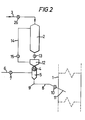
- Figure 2 represents in diagrammatical form a feeding device for catalytically active powder into a fluidised-bed reactor, this device being analogous to that of Figure 1, but comprising in addition an intermediate storage enclosure (12) arranged between the storage enclosure (2) and the metering device (4); a full bore valve (13) is arranged between the two storage enclosures (2) and (12) and a vent line (14) provided with a valve (15) guarantees balancing of the pressure between the two storage enclosures (2) and (12).
- Figure 3 shows in diagrammatical form a metering device of the rotary type, consisting of a ball valve (16) rotating around an axis (17) inside a body (18); the ball valve (16) is provided with a cavity (19) in the form of a truncated cone possessing only a single aperture (20); the body (18) of the valve comprises a powder feed aperture (21) located on the top part of the body (18) and a powder discharge aperture (22) located on the bottom part of the body (18); the ports of the apertures or conduits (21) and (22) are of the same form and the same dimensions as the aperture (20); the, ball valve (16) and the body (18) are provided with devices such as joints or packings guaranteeing gas-tightness between the ball valve (16) and the fixed body (18).
- Figure 4 shows in diagrammatical form the ball valve (16) with its cavity (19) in the form of a truncated cone and a helical spring (23) arranged in the cavity (19) and fixed in the bottom (24) of the latter; when the aperture (20) of the cavity (19) is oriented upwards, the helical spring (23) is compressed under the effect of its weight and the cavity (19) fills with powder; when the aperture (20) of the cavity (19) is oriented downwards, the helical spring (23) expands and facilitates drainage of the powder out of the cavity (19); a weight (25) fixed to the free end of the spring (23) reinforces its effect.
- Polymerisation of ethylene is carried out using an installation comprising a fluidised bed reactor (1) to which is connected a device for feeding catalytically active powder according to the invention, in accordance with the diagrams of Figures 1, 3 and 4.
- the storage enclosure (2) as shown in Figure 1 contains the powder consisting of a prepolymer obtained by contacting on the one hand a catalyst system comprising a catalyst which contains per gram atom of total titanium, 0.92 gram atom of trivalent titanium, 0.08 gram atom of tetravalent titanium, 3.8 gram atoms of magnesium, 8.6 gram atoms of chlorine and 2 gram equivalents of propylene and tri-n-octylaluminium in a quantity such that the ratio of the number of gram atoms of aluminium to the number of gram atoms of titanium is equal to 1.5, and on the other hand, ethylene in a quantity such that the prepolymer contains 2 x 10- 2 milligram atoms of titanium per gram.
- This prepolymer has a bulk density at rest equal to 0.3 g/cm 3 and a density of 0.96; it consists of particles having a mean diameter by mass equal to 200 microns and a particle size distribution such that the ratio Dm:Dn of the particles is equal to 3. Moreoever, it has, on the one hand a content of 1% by weight of liquid tri-n-octylaluminium and on the other hand, a content of 2X by weight of polymer soluble in n-heptane at 70°C.
- This prepolymer contained in the storage enclosure (2) is maintained under a pressure of 2.6 MPa of hydrogen at ambient temperature (20°C).
- the metering device (4) of the rotary type, shown in Figure 3, comprises in particular a cavity (19) of a capacity of 2.8 litres, in the form of a truncated cone, the diameter of whose base is 0.9 times its height.
- the cavity (19) represented by Figure 4 contains a weight (25) of 250 g attached to the helical spring 23.
- the intermediate chamber (5) arranged just below the metering device (4) is of cylindro-conical form, with vertical axis, and a capacity of 4 litres.
- the inert carrier gas is hydrogen, maintained under a pressure of 2.7 MPa in the supply tube (6) which leads out into the upper part of the intermediate chamber (5), in the immediate vicinity of the outlet aperture (22) from metering device (4).
- the shut-off valve (7) of the supply tube (6) of hydrogen and the full bore rapid opening valve (10) of the powder conveyer pipe (8) are closed, the hydrogen pressure existing inside the intermediate chamber (5) is 2.3 MPa.
- the intermediate chamber (5) comprises in its lower part a powder conveyer pipe (8) comprising a horizontal portion and having an internal diameter of 25 mm and a capacity of 1.5 litres.
- This piping (8) which is connected to the intermediate chamber (5) comprises a vertical portion immediately followed by a horizontal portion, producing a right angle bend (9).
- the piping is provided with a full bore rapid opening valve (10), actuated by a control ensuring its complete opening or closure in about 0.5 seconds.
- the powder conveyer piping (8) emerges into the fluidised bed reactor (1) at an angle of 30° in relation to the horizontal and extends inside the reactor (1) over a length of 30 cm.
- the piping (11) which penetrates inside the reactor (1) is in polished stainless steel inside and outside.
- the fluidised bed reactor (1) has the form of a cylinder with a diameter of 3 metres.
- a rising gas mixture circulates inside the fluidised bed reactor at a rate of 45 cm/sec, under a constant pressure of 2.15 MPa and at 92°C.
- This gas mixture comprises 42% by volume ethylene, 40% hydrogen, 10% ethane and 8% nitrogen.
- a prepolymer introduction sequence is performed in the fluidised bed reactor (1) by carrying out the following operations:
- a fresh prepolymer introduction sequence can then be carried out. These introduction sequences are reproduced at a frequency of one injection every 50 seconds, which makes it possible to obtain polyethylene production of about 5000 kg per hour. As has been noted, after several weeks of operation under these conditions, the device and process of the invention make it possible to obtain a polyethylene powder of excellence and uniform quality, practically free from agglomerate of prepolymer or molten polymer.
Landscapes
- Chemical & Material Sciences (AREA)
- Organic Chemistry (AREA)
- Chemical Kinetics & Catalysis (AREA)
- Health & Medical Sciences (AREA)
- Medicinal Chemistry (AREA)
- Polymers & Plastics (AREA)
- Devices And Processes Conducted In The Presence Of Fluids And Solid Particles (AREA)
- Polymerisation Methods In General (AREA)
- Organic Low-Molecular-Weight Compounds And Preparation Thereof (AREA)
- Feeding, Discharge, Calcimining, Fusing, And Gas-Generation Devices (AREA)
- Addition Polymer Or Copolymer, Post-Treatments, Or Chemical Modifications (AREA)
- Catalysts (AREA)
- Transition And Organic Metals Composition Catalysts For Addition Polymerization (AREA)
- Filling Or Emptying Of Bunkers, Hoppers, And Tanks (AREA)
Priority Applications (1)
| Application Number | Priority Date | Filing Date | Title |
|---|---|---|---|
| AT85302113T ATE38624T1 (de) | 1984-03-30 | 1985-03-26 | Apparat und verfahren fuer die beschichtung eines polymerisationswirbelbettreaktors mit einem pulver mit katalytischer aktivitaet. |
Applications Claiming Priority (2)
| Application Number | Priority Date | Filing Date | Title |
|---|---|---|---|
| FR8404985 | 1984-03-30 | ||
| FR8404985A FR2562077B1 (fr) | 1984-03-30 | 1984-03-30 | Dispositif et procede d'introduction d'une poudre a activite catalytique dans un reacteur de polymerisation a lit fluidise |
Publications (3)
| Publication Number | Publication Date |
|---|---|
| EP0157584A2 true EP0157584A2 (de) | 1985-10-09 |
| EP0157584A3 EP0157584A3 (en) | 1985-12-27 |
| EP0157584B1 EP0157584B1 (de) | 1988-11-17 |
Family
ID=9302631
Family Applications (1)
| Application Number | Title | Priority Date | Filing Date |
|---|---|---|---|
| EP85302113A Expired EP0157584B1 (de) | 1984-03-30 | 1985-03-26 | Apparat und Verfahren für die Beschichtung eines Polymerisationswirbelbettreaktors mit einem Pulver mit katalytischer Aktivität |
Country Status (14)
| Country | Link |
|---|---|
| US (2) | US4687381A (de) |
| EP (1) | EP0157584B1 (de) |
| JP (1) | JPS60227824A (de) |
| AT (1) | ATE38624T1 (de) |
| AU (1) | AU569945B2 (de) |
| CA (1) | CA1240447A (de) |
| DE (1) | DE3566224D1 (de) |
| ES (1) | ES8604271A1 (de) |
| FI (1) | FI78627C (de) |
| FR (1) | FR2562077B1 (de) |
| NO (1) | NO163861C (de) |
| NZ (1) | NZ211619A (de) |
| PT (1) | PT80199B (de) |
| ZA (1) | ZA852344B (de) |
Cited By (3)
| Publication number | Priority date | Publication date | Assignee | Title |
|---|---|---|---|---|
| WO1995026810A1 (en) * | 1994-03-31 | 1995-10-12 | Exxon Chemical Patents Inc. | Method and apparatus for feeding a catalyst |
| US5556238A (en) * | 1993-05-19 | 1996-09-17 | Bp Chemicals Limited | Process and apparatus for introducing a solid into a reactor |
| US6927260B2 (en) | 2001-08-10 | 2005-08-09 | Basell Polyolefine Gmbh | Optimization of heat removal in a gas-phase fluidized-bed process |
Families Citing this family (36)
| Publication number | Priority date | Publication date | Assignee | Title |
|---|---|---|---|---|
| DE3366573D1 (en) * | 1982-06-24 | 1986-11-06 | Bp Chimie Sa | Process for the polymerization and copolymerization of alpha-olefins in a fluidized bed |
| US5208109A (en) * | 1982-06-24 | 1993-05-04 | Bp Chemicals Limited | Process for the polymerization and copolymerization of alpha-olefins in a fluidized bed |
| US4767028A (en) * | 1983-12-02 | 1988-08-30 | Phillips Petroleum Company | Rotary valve |
| FR2587081B1 (fr) * | 1985-09-11 | 1988-04-15 | Bp Chimie Sa | Dispositif doseur de type rotatif permettant de delivrer des substances granulaires |
| US5175943A (en) * | 1990-05-23 | 1993-01-05 | E. I. Du Pont De Nemours And Company | Solids feed system and method for feeding fluidized beds |
| FR2664506B1 (fr) * | 1990-07-13 | 1993-05-07 | Bp Chemicals Snc | Procede et dispositif d'introduction d'une poudre dans un reacteur. |
| JP2857916B2 (ja) * | 1990-07-20 | 1999-02-17 | 日本石油化学株式会社 | 気相重合流動床の触媒供給方法 |
| FR2670399B1 (fr) * | 1990-12-14 | 1994-08-05 | Bp Chemicals Snc | Procede et dispositif d'introduction d'une suspension dans un reacteur. |
| JPH05221531A (ja) * | 1992-02-14 | 1993-08-31 | Sumitomo Chem Co Ltd | 粉体触媒連続供給装置及び触媒供給システム |
| JP2674929B2 (ja) * | 1992-11-30 | 1997-11-12 | 住友化学工業株式会社 | 粉体供給装置 |
| SG49620A1 (en) * | 1992-11-30 | 1998-06-15 | Sumitomo Chemical Co | Powder supply |
| US5400921A (en) * | 1993-09-21 | 1995-03-28 | Chem-Trend Incorporated | Powdered lubricant applicator |
| US5851493A (en) * | 1997-05-22 | 1998-12-22 | Chevron Chemical Company | Injection system and method for feeding particulate to a process vessel |
| DE19847647A1 (de) * | 1998-10-15 | 2000-04-20 | Elenac Gmbh | Wirbelschichtverfahren und Reaktor zur Behandlung von Katalysatoren und Katalysatorträgern |
| US6319995B2 (en) * | 1999-08-30 | 2001-11-20 | Equistar Chemicals, Lp | Method of feeding dry catalyst to a polymerization reactor |
| US6901945B2 (en) * | 2003-09-30 | 2005-06-07 | Nalco Company | System for feeding solid materials to a pressurized pipeline |
| US9504975B2 (en) | 2004-03-23 | 2016-11-29 | W. R. Grace & Co.-Conn. | System and process for injecting catalyst and/or additives into a fluidized catalytic cracking unit |
| US8926907B2 (en) * | 2004-03-23 | 2015-01-06 | W. R. Grace & Co.-Conn | System and process for injecting catalyst and/or additives into a fluidized catalytic cracking unit |
| US7846399B2 (en) * | 2004-03-23 | 2010-12-07 | W.R. Grace & Co.-Conn. | System and process for injecting catalyst and/or additives into a fluidized catalytic cracking unit |
| US7645841B2 (en) * | 2004-08-27 | 2010-01-12 | Chevron Phillips Chemical Company Lp | Method and system to reduce polymerization reactor fouling |
| US8058367B2 (en) * | 2004-08-27 | 2011-11-15 | Chevron Phillips Chemical Company Lp | Methods and systems for controlling polymer particle size |
| US8047228B2 (en) * | 2005-02-23 | 2011-11-01 | Exxonmobil Chemical Patents Inc. | Metering system and use thereof |
| US8016000B2 (en) | 2006-04-19 | 2011-09-13 | W. R. Grace & Co.-Conn. | Processes and systems for transferring particulate substances from containers |
| JP5215706B2 (ja) * | 2007-08-01 | 2013-06-19 | 三井造船株式会社 | 固気2相物質の押し込み装置 |
| EP2045273A1 (de) * | 2007-10-01 | 2009-04-08 | Total Petrochemicals Research Feluy Patent Dept. | Verfahren zur Versorgung von Granulat für einen Polymerisationsreaktor |
| CN101909736B (zh) * | 2008-01-07 | 2013-09-04 | 尤尼威蒂恩技术有限责任公司 | 催化剂进料系统及其应用方法 |
| CN102271795A (zh) | 2008-12-29 | 2011-12-07 | 巴塞尔聚烯烃意大利有限责任公司 | 用于将催化剂供给到聚合反应器中的方法 |
| EP2256071A1 (de) * | 2009-05-28 | 2010-12-01 | SPX APV Danmark A/S | Pulvermaterialansaugvorrichtung und Verfahren zum Ansaugen des Pulvermaterials in eine Flüssigkeit |
| BR112014009578B1 (pt) | 2011-10-18 | 2021-03-30 | W. R. Grace & Co. -Conn | Sistemas para a injeção de catalisadores e/ou aditivos em uma unidade de craqueamento catalítico fluidizado e métodos de fabricação e uso dos mesmos |
| US9550847B2 (en) | 2012-09-28 | 2017-01-24 | Ineos Europe Ag | Method for production of polymer |
| WO2014060231A1 (en) | 2012-10-16 | 2014-04-24 | Ineos Europe Ag | Process for the production of a polymer in a gas phase fluidised bed reactor |
| CN107207650B (zh) | 2014-12-22 | 2020-09-15 | Sabic环球技术有限责任公司 | 不相容催化剂之间的转换方法 |
| EP3274374B1 (de) | 2015-03-24 | 2018-10-24 | SABIC Global Technologies B.V. | Verfahren zum übergang zwischen unverträglichen katalysatoren |
| WO2017032535A1 (en) | 2015-08-26 | 2017-03-02 | Sabic Global Technologies B.V. | Ethylene gas phase polymerisation process |
| WO2018031157A1 (en) | 2016-08-10 | 2018-02-15 | Exxonmobil Chemical Patents Inc. | Methods for supplying solid catalysts to a solution polymerization reactor |
| US10544246B2 (en) | 2016-08-10 | 2020-01-28 | Exxonmobil Chemical Patents Inc. | Methods for supplying solid catalysts to a solution polymerization reactor |
Family Cites Families (18)
| Publication number | Priority date | Publication date | Assignee | Title |
|---|---|---|---|---|
| DE112215C (de) * | ||||
| US2613832A (en) * | 1947-08-08 | 1952-10-14 | Standard Oil Dev Co | Method of feeding subdivided solids |
| US3012024A (en) * | 1957-11-25 | 1961-12-05 | Celanese Corp | Dry feed in forming slurry in olefin polymerization |
| US2985324A (en) * | 1958-04-21 | 1961-05-23 | Universal Oil Prod Co | Apparatus for passing particles from a high pressure vessel |
| NL7012509A (de) * | 1969-08-25 | 1971-03-01 | ||
| US3790036A (en) * | 1969-11-21 | 1974-02-05 | Union Carbide Corp | Fluid bed polymerization catalyst injection system |
| US3846394A (en) * | 1970-07-21 | 1974-11-05 | Phillips Petroleum Co | Introducing catalyst into a reactor |
| US3876602A (en) * | 1971-11-26 | 1975-04-08 | Union Carbide Corp | Particulate catalyst injection method in polyolefin production |
| FR2207145B1 (de) * | 1972-11-17 | 1975-09-12 | Naphtachimie Sa | |
| DE2426035A1 (de) * | 1974-05-30 | 1975-12-18 | Krupp Koppers Gmbh | Einrichtung zum ueberfuehren eines feinzerteilten festen stoffes aus einem raum von im wesentlichen normaldruck in einen unter erhoehtem druck stehenden raum |
| US4162894A (en) * | 1976-01-26 | 1979-07-31 | Phillips Petroleum Company | Positive shut-off for catalyst feed system |
| JPS57155204A (en) * | 1981-02-19 | 1982-09-25 | Chisso Corp | Vapor-phase polymerization of olefin and equipment therefor |
| DE3123115A1 (de) * | 1981-06-11 | 1982-12-30 | Basf Ag, 6700 Ludwigshafen | Verfahren zum herstellen von homopolymerisaten oder copolymerisaten des propylens |
| GB2106064B (en) * | 1981-06-25 | 1985-06-19 | Pertocarb Inc | Pneumatic conveyance of solids |
| GB2111946B (en) * | 1981-12-11 | 1985-07-31 | Hotpoint Ltd | Dispenser |
| DZ520A1 (fr) * | 1982-03-24 | 2004-09-13 | Union Carbide Corp | Procédé perfectionné pour accroitre le rendement espace temps d'une réaction de polymérisation exothermique en lit fluidisé. |
| EP0095848A3 (de) * | 1982-06-01 | 1984-05-16 | Imperial Chemical Industries Plc | Verfahren zum Mischpolymerisieren von Äthylen |
| US4610574A (en) * | 1984-05-30 | 1986-09-09 | Amoco Corporation | Catalyst feeding system |
-
1984
- 1984-03-30 FR FR8404985A patent/FR2562077B1/fr not_active Expired
-
1985
- 1985-03-26 EP EP85302113A patent/EP0157584B1/de not_active Expired
- 1985-03-26 DE DE8585302113T patent/DE3566224D1/de not_active Expired
- 1985-03-26 AT AT85302113T patent/ATE38624T1/de not_active IP Right Cessation
- 1985-03-26 US US06/716,030 patent/US4687381A/en not_active Expired - Lifetime
- 1985-03-28 NO NO851253A patent/NO163861C/no not_active IP Right Cessation
- 1985-03-28 FI FI851254A patent/FI78627C/fi not_active IP Right Cessation
- 1985-03-28 ZA ZA852344A patent/ZA852344B/xx unknown
- 1985-03-28 NZ NZ211619A patent/NZ211619A/en unknown
- 1985-03-28 AU AU40460/85A patent/AU569945B2/en not_active Ceased
- 1985-03-29 PT PT80199A patent/PT80199B/pt not_active IP Right Cessation
- 1985-03-29 ES ES541730A patent/ES8604271A1/es not_active Expired
- 1985-03-29 JP JP60066408A patent/JPS60227824A/ja active Granted
- 1985-03-29 CA CA000477905A patent/CA1240447A/en not_active Expired
-
1987
- 1987-04-08 US US07/036,017 patent/US4774299A/en not_active Expired - Lifetime
Cited By (3)
| Publication number | Priority date | Publication date | Assignee | Title |
|---|---|---|---|---|
| US5556238A (en) * | 1993-05-19 | 1996-09-17 | Bp Chemicals Limited | Process and apparatus for introducing a solid into a reactor |
| WO1995026810A1 (en) * | 1994-03-31 | 1995-10-12 | Exxon Chemical Patents Inc. | Method and apparatus for feeding a catalyst |
| US6927260B2 (en) | 2001-08-10 | 2005-08-09 | Basell Polyolefine Gmbh | Optimization of heat removal in a gas-phase fluidized-bed process |
Also Published As
| Publication number | Publication date |
|---|---|
| FI851254L (fi) | 1985-10-01 |
| PT80199B (pt) | 1987-06-17 |
| NO851253L (no) | 1985-10-01 |
| CA1240447A (en) | 1988-08-09 |
| EP0157584B1 (de) | 1988-11-17 |
| NO163861C (no) | 1990-08-01 |
| EP0157584A3 (en) | 1985-12-27 |
| AU4046085A (en) | 1985-10-03 |
| PT80199A (en) | 1985-04-01 |
| NO163861B (no) | 1990-04-23 |
| FI851254A0 (fi) | 1985-03-28 |
| ATE38624T1 (de) | 1988-12-15 |
| JPH0362454B2 (de) | 1991-09-26 |
| NZ211619A (en) | 1987-10-30 |
| JPS60227824A (ja) | 1985-11-13 |
| FR2562077A1 (fr) | 1985-10-04 |
| AU569945B2 (en) | 1988-02-25 |
| ES8604271A1 (es) | 1986-01-16 |
| US4687381A (en) | 1987-08-18 |
| US4774299A (en) | 1988-09-27 |
| FI78627B (fi) | 1989-05-31 |
| ZA852344B (en) | 1986-11-26 |
| ES541730A0 (es) | 1986-01-16 |
| FR2562077B1 (fr) | 1986-06-27 |
| DE3566224D1 (en) | 1988-12-22 |
| FI78627C (fi) | 1989-09-11 |
Similar Documents
| Publication | Publication Date | Title |
|---|---|---|
| EP0157584B1 (de) | Apparat und Verfahren für die Beschichtung eines Polymerisationswirbelbettreaktors mit einem Pulver mit katalytischer Aktivität | |
| EP0466354B1 (de) | Verfahren und Apparat für die Beschickung eines Reaktors mit einem Pulver | |
| EP0202076B1 (de) | Wirbelgasverteilerplatte | |
| US7655192B2 (en) | Method and apparatus for discharging polymerization reactors | |
| US4902483A (en) | Polymerization in several stages of alpha-olefins in the gas phase | |
| AU685947B2 (en) | Improved gas phase fluidized bed polyolefin polymerization process using gas-solids tangential flow | |
| EP0549252A1 (de) | Verfahren zur Gasphase-Polymerisation von Alpha-Olefinen in einem Wirbelbettreaktor | |
| US20100267904A1 (en) | Method and Device for Optimising Catalyst Supply to a Polymerisation Reactor | |
| US5470540A (en) | Apparatus and process for introducing a suspension into a reactor | |
| CN102781564B (zh) | 聚合物粉末储存和/或运输和/或脱气容器 | |
| RU2308320C2 (ru) | Способ дозирования катализаторов | |
| CN109422832A (zh) | 用于生产聚烯烃的方法 | |
| US6398463B1 (en) | Process for introducing a solid catalyst into a fluidized or agitated vessel | |
| JP7662835B2 (ja) | 分析用ガス状サンプルを抜き取ることを含むオレフィンポリマーを調製するためのプロセス | |
| RU2050364C1 (ru) | Способ газофазной полимеризации альфа-олефинов и реактор для осуществления способа | |
| EP0958857A1 (de) | Verfahren zum Zuführen eines Katalysators in eine Polymerisationsreaktion in der Gasphase | |
| JPS6254536B2 (de) |
Legal Events
| Date | Code | Title | Description |
|---|---|---|---|
| PUAI | Public reference made under article 153(3) epc to a published international application that has entered the european phase |
Free format text: ORIGINAL CODE: 0009012 |
|
| AK | Designated contracting states |
Designated state(s): AT BE DE FR GB IT NL SE |
|
| PUAL | Search report despatched |
Free format text: ORIGINAL CODE: 0009013 |
|
| AK | Designated contracting states |
Designated state(s): AT BE DE FR GB IT NL SE |
|
| 17P | Request for examination filed |
Effective date: 19860605 |
|
| 17Q | First examination report despatched |
Effective date: 19870615 |
|
| GRAA | (expected) grant |
Free format text: ORIGINAL CODE: 0009210 |
|
| AK | Designated contracting states |
Kind code of ref document: B1 Designated state(s): AT BE DE FR GB IT NL SE |
|
| REF | Corresponds to: |
Ref document number: 38624 Country of ref document: AT Date of ref document: 19881215 Kind code of ref document: T |
|
| ITF | It: translation for a ep patent filed | ||
| REF | Corresponds to: |
Ref document number: 3566224 Country of ref document: DE Date of ref document: 19881222 |
|
| ET | Fr: translation filed | ||
| PLBE | No opposition filed within time limit |
Free format text: ORIGINAL CODE: 0009261 |
|
| STAA | Information on the status of an ep patent application or granted ep patent |
Free format text: STATUS: NO OPPOSITION FILED WITHIN TIME LIMIT |
|
| 26N | No opposition filed | ||
| ITTA | It: last paid annual fee | ||
| EAL | Se: european patent in force in sweden |
Ref document number: 85302113.7 |
|
| PGFP | Annual fee paid to national office [announced via postgrant information from national office to epo] |
Ref country code: FR Payment date: 20000221 Year of fee payment: 16 |
|
| PGFP | Annual fee paid to national office [announced via postgrant information from national office to epo] |
Ref country code: GB Payment date: 20010213 Year of fee payment: 17 |
|
| PGFP | Annual fee paid to national office [announced via postgrant information from national office to epo] |
Ref country code: AT Payment date: 20010216 Year of fee payment: 17 |
|
| PGFP | Annual fee paid to national office [announced via postgrant information from national office to epo] |
Ref country code: NL Payment date: 20010219 Year of fee payment: 17 |
|
| PGFP | Annual fee paid to national office [announced via postgrant information from national office to epo] |
Ref country code: SE Payment date: 20010226 Year of fee payment: 17 |
|
| PGFP | Annual fee paid to national office [announced via postgrant information from national office to epo] |
Ref country code: BE Payment date: 20010328 Year of fee payment: 17 |
|
| PG25 | Lapsed in a contracting state [announced via postgrant information from national office to epo] |
Ref country code: FR Free format text: LAPSE BECAUSE OF NON-PAYMENT OF DUE FEES Effective date: 20011130 |
|
| REG | Reference to a national code |
Ref country code: FR Ref legal event code: ST |
|
| REG | Reference to a national code |
Ref country code: GB Ref legal event code: IF02 |
|
| PG25 | Lapsed in a contracting state [announced via postgrant information from national office to epo] |
Ref country code: GB Free format text: LAPSE BECAUSE OF NON-PAYMENT OF DUE FEES Effective date: 20020326 Ref country code: AT Free format text: LAPSE BECAUSE OF NON-PAYMENT OF DUE FEES Effective date: 20020326 |
|
| PG25 | Lapsed in a contracting state [announced via postgrant information from national office to epo] |
Ref country code: SE Free format text: LAPSE BECAUSE OF NON-PAYMENT OF DUE FEES Effective date: 20020327 |
|
| PG25 | Lapsed in a contracting state [announced via postgrant information from national office to epo] |
Ref country code: BE Free format text: LAPSE BECAUSE OF NON-PAYMENT OF DUE FEES Effective date: 20020331 |
|
| BERE | Be: lapsed |
Owner name: *BP CHEMICALS LTD Effective date: 20020331 |
|
| PG25 | Lapsed in a contracting state [announced via postgrant information from national office to epo] |
Ref country code: NL Free format text: LAPSE BECAUSE OF NON-PAYMENT OF DUE FEES Effective date: 20021001 |
|
| EUG | Se: european patent has lapsed |
Ref document number: 85302113.7 |
|
| GBPC | Gb: european patent ceased through non-payment of renewal fee |
Effective date: 20020326 |
|
| NLV4 | Nl: lapsed or anulled due to non-payment of the annual fee |
Effective date: 20021001 |
|
| PGFP | Annual fee paid to national office [announced via postgrant information from national office to epo] |
Ref country code: DE Payment date: 20040212 Year of fee payment: 20 |