EP0157318A2 - Verfahren zur Herstellung von Siliconharzvorprodukten - Google Patents
Verfahren zur Herstellung von Siliconharzvorprodukten Download PDFInfo
- Publication number
- EP0157318A2 EP0157318A2 EP85103432A EP85103432A EP0157318A2 EP 0157318 A2 EP0157318 A2 EP 0157318A2 EP 85103432 A EP85103432 A EP 85103432A EP 85103432 A EP85103432 A EP 85103432A EP 0157318 A2 EP0157318 A2 EP 0157318A2
- Authority
- EP
- European Patent Office
- Prior art keywords
- organopolysiloxane
- hydrolysis
- alcoholysis
- partial condensation
- alcohol
- Prior art date
- Legal status (The legal status is an assumption and is not a legal conclusion. Google has not performed a legal analysis and makes no representation as to the accuracy of the status listed.)
- Granted
Links
Images

Classifications
-
- C—CHEMISTRY; METALLURGY
- C08—ORGANIC MACROMOLECULAR COMPOUNDS; THEIR PREPARATION OR CHEMICAL WORKING-UP; COMPOSITIONS BASED THEREON
- C08G—MACROMOLECULAR COMPOUNDS OBTAINED OTHERWISE THAN BY REACTIONS ONLY INVOLVING UNSATURATED CARBON-TO-CARBON BONDS
- C08G77/00—Macromolecular compounds obtained by reactions forming a linkage containing silicon with or without sulfur, nitrogen, oxygen or carbon in the main chain of the macromolecule
- C08G77/04—Polysiloxanes
- C08G77/06—Preparatory processes
-
- C—CHEMISTRY; METALLURGY
- C07—ORGANIC CHEMISTRY
- C07F—ACYCLIC, CARBOCYCLIC OR HETEROCYCLIC COMPOUNDS CONTAINING ELEMENTS OTHER THAN CARBON, HYDROGEN, HALOGEN, OXYGEN, NITROGEN, SULFUR, SELENIUM OR TELLURIUM
- C07F7/00—Compounds containing elements of Groups 4 or 14 of the Periodic Table
- C07F7/02—Silicon compounds
- C07F7/08—Compounds having one or more C—Si linkages
- C07F7/0834—Compounds having one or more O-Si linkage
- C07F7/0838—Compounds with one or more Si-O-Si sequences
- C07F7/0872—Preparation and treatment thereof
- C07F7/0874—Reactions involving a bond of the Si-O-Si linkage
-
- C—CHEMISTRY; METALLURGY
- C07—ORGANIC CHEMISTRY
- C07F—ACYCLIC, CARBOCYCLIC OR HETEROCYCLIC COMPOUNDS CONTAINING ELEMENTS OTHER THAN CARBON, HYDROGEN, HALOGEN, OXYGEN, NITROGEN, SULFUR, SELENIUM OR TELLURIUM
- C07F7/00—Compounds containing elements of Groups 4 or 14 of the Periodic Table
- C07F7/02—Silicon compounds
- C07F7/08—Compounds having one or more C—Si linkages
- C07F7/18—Compounds having one or more C—Si linkages as well as one or more C—O—Si linkages
- C07F7/1804—Compounds having Si-O-C linkages
-
- C—CHEMISTRY; METALLURGY
- C08—ORGANIC MACROMOLECULAR COMPOUNDS; THEIR PREPARATION OR CHEMICAL WORKING-UP; COMPOSITIONS BASED THEREON
- C08G—MACROMOLECULAR COMPOUNDS OBTAINED OTHERWISE THAN BY REACTIONS ONLY INVOLVING UNSATURATED CARBON-TO-CARBON BONDS
- C08G77/00—Macromolecular compounds obtained by reactions forming a linkage containing silicon with or without sulfur, nitrogen, oxygen or carbon in the main chain of the macromolecule
- C08G77/04—Polysiloxanes
- C08G77/14—Polysiloxanes containing silicon bound to oxygen-containing groups
- C08G77/18—Polysiloxanes containing silicon bound to oxygen-containing groups to alkoxy or aryloxy groups
Definitions
- the preparation of the siloxanes often presents difficulties, especially when the cohydrolysis / cocondensation of phenyltrichlorosilane with methyltrichlorosilver, dimethyldichlorosilane and / or trimethylchlorosilane takes place.
- the low boiling points of these silanes lead to high silane losses and resin precursors that are difficult to reproduce on an industrial scale.
- the final properties of the cured silicone resins or silicone combination resins are very much determined by the organic radicals R 2 and by the R 2 / Si ratio. It is therefore often desirable to use larger amounts of diorganodichlorosilane and, if appropriate, triorganochlorosilane in addition to organotrichlorosilane.
- DE-OS 28 06 036 describes a process for the preparation of polysiloxanes by reacting halosilane with alcohol and water in the presence of the desired polysiloxane, ie a polysiloxane, the composition of which corresponds to that of the end product.
- the concept of the highest possible molecular uniformity defines in particular Products, the quantity of which corresponds to the narrowest possible Gaussian distribution.
- Low molecular weight means in particular products whose average molecular weight does not exceed 1500.
- organoalkoxysiloxanes are to be produced which have an R2 / Si ratio of 0.8: 1.7.
- the process must also be technically feasible in a simple manner and lead to products of high quality consistency.
- the object is achieved according to the invention by carrying out the alcoholysis / hydrolysis and partial condensation of organochlorosilanes with alcohol / water in the presence of organopolysiloxane (s) whose composition differs from that of the end product of the process, the organochlorosilanes and ( ) Organopolysiloxane (s) are selected according to their type and quantity so that they correspond in summary to the desired composition of the end product of the process with regard to the organo groups R 2 bonded directly to the Si atom.
- the reaction is preferably carried out at temperatures> 40 ° C., in particular at temperatures from 50 to 70 ° C.
- R 2 has the meaning given, or a mixture of the aforementioned organosiloxanes or an organosiloxane, which consists of a Mixture of silanes of different functionality was produced.
- This also includes organoalkoxypolysiloxanes that have been produced with the use of silicic acid esters or SiCl 4 (in this case -a ⁇ 1).
- Organotrichlorosilanes and diorganodichlorosilanes can be used as organohalosilanes. Triorganochlorosilanes or mixtures thereof are used.
- the type and amount of the silanes are to be selected in accordance with the process according to the invention such that, together with the organopolysiloxane or the organopolysiloxane mixture, they meet the stoichiometric conditions for forming the desired process products.
- Those organosilanes which boil at higher temperatures, in particular phenyltrichlorosilane, are preferably used.
- the ratio of organochlorosilane to organopolysiloxane characterized by the ratio of chlorine-bonded silicon to silicon atoms bridging oxygen, can be varied within wide limits. Even small amounts of Si-Cl are sufficient to cleave the organopolysiloxane. However, the quotient of Si-bonded chlorine to Si-bridging oxygen should preferably be> 0.1.
- the organopolysiloxane can be added to the reaction mixture of chlorosilane, alcohol and water. However, it can also be initially introduced together with part of the alcohol, the chlorosilane being added to this mixture and the reaction then being continued with the addition of residual alcohol / water.
- the molecular weight distribution of the organoalkoxysiloxane depends, among other things. on reaction temperature and reaction time. Both parameters can be varied within wide limits.
- the temperatures are usually between 50 and 70 ° C, the reaction time between 15 minutes and 2 hours. Higher reaction temperatures or longer reaction times favor the establishment of the thermodynamically predetermined equilibrium of narrow molecular weight distribution.
- the organoalkoxysiloxane can optionally be purified by distillation under reduced pressure. In addition to the excess alcohol, the volatile reaction products such as HCl. away.
- An important advantage of the process according to the invention is that it is possible to work at high reaction temperatures which would lead to considerable silane losses if the cohydrolysis / cocondensation were carried out with the addition of the corresponding low-boiling chlorosilanes. However, these high reaction temperatures are required to achieve molecularly uniform organoalkoxysiloxanes.
- organoalkoxysiloxanes are used which do not correspond to the desired molecular composition. Faulty batches therefore do not have to be discarded, but can easily be reused and processed accordingly.
- a particular advantage of the process according to the invention is that the organoalkoxysiloxanes obtained lead to significantly better product properties than those cohydrolysates / cocondensates which are obtained using only the corresponding chlorosilane mixtures with alcohol / water.
- organoalkoxysiloxanes produced according to the invention are described in their physical properties and compared with products which were not produced according to the invention, but each correspond to the same general formula.
- organoalkoxysiloxanes according to DE-OS 28 28 990 and analogously to DE-OS 32 14 984 are converted into silicone resins or silicone combination resins. The improved properties which are obtained with the silicone resin precursors produced according to the invention are shown.
- the phenylmethylethoxysiloxane has the following analytical data:
- the phenylmethylethoxysiloxane has the following analytical data:.
- the reaction product has the following analytical data:
- the gel chromatogram of the resin precursor C is identical to that of A.
- This example thus shows that the process according to the invention enables the processing of a resin precursor (B) with an undesirable composition into a product corresponding to the resin precursor A.
- Resin production is repeated with resin precursors B and C.
- the resin produced with resin precursor B has a viscosity of 1900 cSt / 25 ° C and 80% solids, while the resin produced with resin precursor C has a viscosity of 1100 cSt / 25 ° C with the same solids.
- resin precursors A and C Thermoplasticity, detergent resistance and gloss retention are significantly better with resin precursors A and C than with resin precursor B.
- Resin precursor B performs particularly poorly in adhesion after thermal stress.
- the phenylmethylethoxysiloxane has the following analytical data:
- the phenylmethylethoxysiloxane has the following analytical data:
- the reaction is repeated with the resin precursor (B) not produced according to the invention. After a reaction time of 30 minutes with constant distillation of ethanol and xylene, a conversion of 35% and a viscosity of 45 cSt / 25 ° C. are reached. Gel particles already form, so that the reaction must be stopped.
- the resins are applied with a squeegee to degreased steel sheet. After drying in air, the hardness of the surfaces is measured and then the sheets are exposed to the conditions of a salt spray device for 48 hours.
- the layer thickness is 25 to 30 ⁇ m.
- Carbon black pigmented lacquers are produced which are sprayed onto sandblasted steel sheet, layer thickness 20 to 25 ⁇ m.
- the sheets are thermally stressed at 150 ° C, 300 ° C and 450 ° C for 1 hour. This is followed by a 96 hour salt spray test in accordance with DIN 50 021.
- the results are summarized in the following table, with a result in the salt spray test of 0% meaning no rust and a result of 100% total rusting.
- the hardness is measured as a pencil hardness according to Wolff-Wilborn.
Landscapes
- Chemical & Material Sciences (AREA)
- Organic Chemistry (AREA)
- Chemical Kinetics & Catalysis (AREA)
- Health & Medical Sciences (AREA)
- Medicinal Chemistry (AREA)
- Polymers & Plastics (AREA)
- Silicon Polymers (AREA)
Abstract
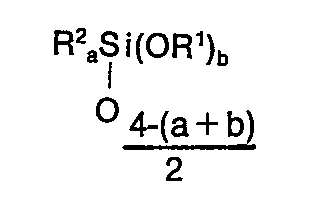
- R1 eine niedere Alkylgruppe mit 1 bis 4 C-Atomen,
- R2 eine Phenyl- oder Alkylgruppe bedeuten,
- a = 0,8 bis 1,7 und
- b ≦ sind,
durch Alkoholyse/Hydrolyse und partielle Kondensation von Organochlorsilanen mit Alkohol/Wasser in Gegenwart von Organopolysiloxanen, wobei man erfindungsgemäss die Alkoholyse/Hydrolyse sowie die partielle Kondensation in Gegenwart von Organopolysiloxan(en), dessen (deren) Zusammensetzung von der des Verfahrensproduktes abweicht, durchführt, wobei die Organochlorsilane und das (die) Organopolysiloxan(e) nach Art und Menge so ausgewählt sind, dass sie hinsichtlich der direkt an das Si-Atom gebundenen Organogruppen R2 summarisch der gewünschten Zusammensetzung des Verfahrensproduktes entsprechen. Die entstehenden Alkoxysiloxane sind niedermolekular und weisen eine einheitlichere Molekulargewichtsverteilung als die Alkoxysiloxane des Standes der Technik auf. Bei der Aushärtung der erfindungsgemäss hergestellten Siliconharzvorprodukte entstehen Siliconharze hoher Härte, guter Detergentienfestigkeit und guter Glanzhaltung.
Description
- Die Erfindung betrifft ein Verfahren zur.Herstellung von Siliconharzvorprodukten der allgemeinen Formel

- worin R1 eine niedere Alkylgruppe mit 1 bis 4 C-Atomen, .
- R 2 eine Phenyl- oder Alkylgruppq bedeuten,
- a = 0,8 bis 1,7 und
- b ≦ 1 sind,
- In den deutschen Offenlegungsschriften 32 14 984 und 32 14 985 werden Verfahren zur Herstellung von Siliconharzen beschrieben, die unter anderem dadurch gekennzeichnet sind, daß man Alkoxysiloxane der vorgenannten Formel, worin R1 und R2 die bereits angegebene Bedeutung haben und a = 1,0 bis 1,2 und b = 0,5 bis 1 sind, verwendet, mit der Maßgabe, daß mindestens 50 Gew.-% der Formel [R2Si(OR1)O-]n, n = 3 bis 8, entsprechen. Die verwendeten Alkoxysiloxane sind überwiegend niedermolekular und entstehen aus den entsprechenden Chlorsilanen mit Alkohol/Wasser bei Reaktionstemperaturen von 20 bis 60°C.
- In der DE-OS 28 28 990 werden zur Herstellung von hitzehärtbaren Siliconharzen ebenfalls Alkoxysiloxane verwendet, die der oben genannten Formel, worin R1 und R2 die angegebene Bedeutung haben und a = 1 bis 1,5 und b = 0,1 bis 0,7 sind, entsprechen. Die Herstellung der Siloxane bereitet jedoch häufig Schwierigkeiten, und zwar insbesondere dann, wenn die Cohydrolyse/Cokondensation von Phenyltrichlorsilan mit Methyltrichlor-, Dimethyldichlor- und/oder Trimethylchlorsilan erfolgt. Die niedrigen Siedepunkte dieser Silane führen zu hohen Silanverlusten und in betrieblichem Maßstab schwer reproduzierbaren Harzvorprodukten.
- Die Endeigenschaften der ausgehärteten Siliconharze oder Siliconkombinationsharze werden durch die organischen Reste R2 sowie durch das R2/Si-Verhältnis ganz wesentlich mitbestimmt. Daher ist es häufig wünschenswert, neben Organotrichlorsilan auch größere Mengen Diorganodichlorsilan sowie gegebenenfalls Triorganochlorsilan mitzuverwenden. Wegen der unterschiedlichen Reaktivitäten der Organotrichlorsilane einerseits und der Diorganodichlor- bzw. Triorganochlorsilane andererseits führt die Cohydrolyse/Cokondensation häufig zu einem schwer reproduzierbaren Gemisch von Älkoxysiloxanen, die zwar im Mittel der vorgenannten Formel entsprechen, jedoch hinsichtlich der Zusammensetzung der einzelnen Moleküle und der Verteilung der Molekulargewichte sehr unterschiedlich sind. Solche Siliconharzvorprodukte führen zu ungünstigen Eigenschaften der daraus hergestellten Siliconharze oder Siliconkombinationsharze, wie z.B. langen Härtungszeiten.
- Es ist bekannt, noch härtbare Siliconharze nach ihrer Kondensation zu höhermolekularen Harzgemischen durch Äquilibrierung in ein molekulares Gleichgewicht zu bringen. Solche äquilibrierten Harze besitzen ein höheres mittleres Molekulargewicht als die Siliconharzhydrolysate und weisen eine einheitlichere Molekulargewichtsverteilung als die Harzgemische, die sich bei der Kondensation der Siliconharzhydrolysate bilden, auf (Polym. Prep. Am. Chem. Soc., Div. Polym. Chem. 15 (2), 76 (1974)). Das bedeutet, daß bei dieser Äquilibrierung Spaltung und Neuknüpfung von Si-0-Si-Bindungen erfolgen. Über die Katalyse dieser Reaktionen ist in der Publikation von Shinohara nichts ausgesagt.
- Die Spaltung von Organopolysiloxanen mit HC1 führt nach der Lehre der DE-OS 31 51 677 bei Ausbeuten bis 99 % zu Chlorsilanen, wenn man die gebildeten Chlorwasserstoffhydrate aus dem Reaktionssystem entfernt. Diese Reaktionen sind aber nur für mono- und bifunktionelle Siloxyeinheiten enthaltende Siloxane beschrieben. Es war zu erwarten, daß diese Reaktionen in Gegenwart trifunktionelle Einheiten enthaltender Siloxane nicht zu dem gewünschten Abbau, sondern zu hochmolekularen bis vergelten Produkten führen.
- Aus der US-PS 4 056 492 kann man eine dem Fachmann geläufige Erfahrung ableiten, daß Hydrolysate aus Organotrichlorsilanen in salzsaurer Lösung leicht vergelen, also weder zu einem Abbau gemäß DE-OS 31 51 677 noch zur Einstellung eines molekularen Gleichgewichtes durch Äquilibrierung, wie oben angegeben, führen. Die bekanntlich sehr unterschiedlichen Reaktivitäten der Hydrolysate aus Organotrichlorsilan einerseits sowie Diorganodichlor- und Triorganochlorsilan andererseits sind auch daraus ersichtlich, daß die sauer katalysierte Kondensation solcher Organosilanhydrolysate nach US-PS 4 056 492 nur in Gegenwart trifunktioneller Siloxyeinheiten möglich ist und zu höhermolekularen Produkten führt, die als Harzvorprodukte nicht geeignet sind.
- In der DE-OS 28 06 036 ist ein Verfahren zum Herstellen von Polysiloxanen durch Umsetzung von Halogensilan mit Alkohol und Wasser in Gegenwart des gewünschten Polysiloxans, also eines Polysiloxans, dessen Zusammensetzung mit der des Endproduktes übereinstimmt, beschrieben. Diese Angaben lassen den Schluß zu, daß man davon ausgegangen ist, daß das mitverwendete Polysiloxan bei der Hydrolyse/Kondensation in seiner molekularen Zusammensetzung nicht wesentlich verändert wird und nur als arteigenes Lösungsmittel dient.
- Aufgabe der Erfindung ist es daher, ein Verfahren zu finden, nach dem möglichst molekulareinheitliche, niedermolekulare Alkoxysiloxane der vorgenannten Formel hergestellt werden können. Der Begriff der möglichst hohen Molekulareinheitlichkeit definiert dabei insbesondere Produkte, deren Individuen bezüglich ihrer Menge einer möglichst engen Gaußschen Verteilung entsprechen. Unter niedermolekular sind insbesondere Produkte zu verstehen, deren mittleres Molekulargewicht einen Wert von 1500 nicht überschreitet. Insbesondere sollen solche Organoalkoxysiloxane hergestellt werden, die ein R2/Si-Verhältnis von 0,8 : 1,7 aufweisen. Das Verfahren muß auch auf einfache Weise technisch durchführbar sein und zu Produkten hoher Qualitätskonstanz führen.
- Die Aufgabe wird erfindungsgemäß dadurch gelöst, daß man die Alkoholyse/Hydrolyse und partielle Kondensation von Organochlorsilanen mit Alkohol/Wasser in Gegenwart von Organopolysiloxan(en), dessen (deren) Zusammensetzung von der des Verfahrensendproduktes abweicht, durchführt, wobei die Organochlorsilane und das (die) Organopolysiloxan(e) nach Art und Menge so ausgewählt sind, daß sie hinsichtlich der direkt an das Si-Atom gebundenen Organogruppen R2 summarisch der gewünschten Zusammensetzung des Verfahrensendproduktes entsprechen. Die Reaktion wird vorzugsweise bei Temperaturen > 40°C, insbesondere bei Temperaturen von 50 bis 70°C, durchgeführt.
- Das verwendete Organopolysiloxan ist vorzugsweise ein z.B. aus Organotrihalogensilan hergestelltes Organoalkoxysiloxan der allgemeinen Formel
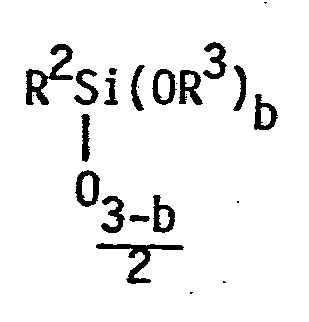
- Es kann auch ein aus Diorganodihalogensilan hergestelltes Diorganopolysiloxan der Formel R3O-[(R2)2-Si-O-]nR3, worin R2 und R3 die angegebene Bedeutung haben und n > 1 ist, sein.
- Man kann dem Reaktionsgemisch ferner Hexaorganodisiloxan der allgemeinen Formel (R2)3-Si-O-Si-(R2)3, worin R2 die angegebene Bedeutung hat, oder ein Gemisch der vorgenannten Organosiloxane zusetzen bzw. ein Organosiloxan, das aus einem Gemisch von Silanen unterschiedlicher Funktionalität hergestellt wurde. Hierunter fallen auch Organoalkoxypolysiloxane, die unter Mitverwendung von Kieselsäureestern oder SiCl4 hergestellt worden sind (in diesem Falle kann-a < 1 sein).
- Als Organohalogensilane können Organotrichlorsilane, Diorganodichlorsilane. Triorganochlorsilane oder deren Gemische verwendet werden. Die Silane sind entsprechend dem erfindungsgemäßen Verfahren dabei nach Art und Menge so auszuwählen, daß sie gemeinsam mit dem Organopolysiloxan oder dem Organopolysiloxangemisch die stöchiometrischen Bedingungen zur Bildung der gewünschten Verfahrensprodukte erfüllen. Vorzugsweise werden solche Organosilane verwendet, die bei höheren Temperaturen sieden, insbesondere Phenyltrichlorsilan.
- Das Verhältnis von Organochlorsilan zu Organopolysiloxan, charakterisiert durch das Verhältnis von an Silicium gebundenem Chlor zu Siliciumatome verbrückendem Sauerstoff, ist in weiten Grenzen variierbar. Bereits geringe Mengen Si-Cl reichen zur Spaltung des Organopolysiloxans aus. Jedoch sollte der Quotient von Si-gebundenem Chlor zu Siverbrückendem Sauerstoff vorzugsweise > 0,1 sein.
- Das Organopolysiloxan kann dem Reaktionsgemisch aus Chlorsilan, Alkohol und Wasser zugesetzt werden. Es kann aber auch zusammen mit einem Teil des Alkohols vorgelegt werden, wobei das Chlorsilan diesem Gemisch zugegeben und dann die Reaktion unter Zusatz von restlichem Alkohol/Wasser fortgesetzt wird.
- Die Molekulargewichtsverteilung des Organoalkoxysiloxans hängt u.a. von Reaktionstemperatur und Reaktionszeit ab. Beide Parameter sind in weiten Grenzen variierbar. Die Temperaturen liegen in der Regel zwischen 50 und 70°C, die Reaktionszeit zwischen 15 Minuten und 2 Stunden. Höhere Reaktionstemperaturen bzw. längere Reaktionszeiten begünstigen die Einstellung des thermodynamisch vorgegebenen Gleichgewichts enger Molekulargewichtsverteilung.
- Nach Beendigung der Reaktion kann das Organoalkoxysiloxan gegebenenfalls unter vermindertem Druck durch Destillation gereinigt werden. Dabei werden neben dem überschüssigen Alkohol die flüchtigen Reaktionsprodukte, wie HCI. entfernt.
- Es war überraschend, daß unter den Bedingungen der Alkoholyse von Organochlorsilanen mit teilweiser Hydrolyse und Kondensation trotz Anwesenheit von trifunktionellen Organosilanen und/oder Organosiloxyeinheiten keine Kondensation zu höhermolekularen oder gelhaltigen Organosiloxanen erfolgt. Es war erst recht nicht zu erwarten, daß das erfindungsgemäße Verfahren zu einheitlichen, niedermolekularen Organosiloxanen führen würde, die sich zur Herstellung von Siliconharzen oder Siliconkombinationsharzen, im Sinne der deutschen Offenlegungsschriften 28 28 990, 32 14 984 oder 32 14 985, eignen. Es war auch nicht zu erwarten, daß schon geringe Mengen Si-C1 zur vollständigen Spaltung des Organopolysiloxans ausreichen, welche zur Bildung der neuen molekulareinheitlichen Organopolysiloxane erforderlich sind.
- Ein wesentlicher Vorteil des erfindungsgemäßen Verfahrens besteht darin, daß bei hohen Reaktionstemperaturen gearbeitet werden kann, die zu erheblichen Silanverlusten führen würden, wenn man die Cohydrolyse/Cokondensation unter Zusatz der entsprechenden, niedrig siedenden Chlorsilane durchführen würde. Diese hohen Reaktionstemperaturen sind jedoch zur Erzielung molekulareinheitlicher Organoalkoxysiloxane erforderlich.
- Ein weiterer Vorteil des erfindungsgemäßen Verfahrens besteht darin, daß gerade solche Organoalkoxysiloxane mitverwendet werden, die der gewünschten molekularen Zusammensetzung nicht entsprechen. Fehlchargen müssen daher nicht verworfen, sondern können in einfacher Weise wieder eingesetzt und entsprechend aufgearbeitet werden.
- Ein besonderer Vorteil des erfindungsgemäßen Verfahrens besteht ferner darin, daß die erhaltenen Organoalkoxysiloxane zu deutlich besseren Produkteigenschaften führen als solche Cohydrolysate/Cokondensate, die unter ausschließlicher Verwendung der entsprechenden Chlorsilangemische mit Alkohol/Wasser erhalten werden.
- In den folgenden Beispielen werden die erfindungsgemäß hergestellten Organoalkoxysiloxane in ihren_physikalischen Eigenschaften beschrieben und mit Produkten verglichen, die nicht erfindungsgemäß hergestellt wurden, aber jeweils der gleichen allgemeinen Formel entsprechen. Darüber hinaus werden die Organoalkoxysiloxane gemäß DE-OS 28 28 990 sowie analog DE-OS 32 14 984 zu Siliconharzen bzw. Siliconkombinationsharzen umgesetzt. Es werden die verbesserten Eigenschaften gezeigt, die man mit den erfindungsgemäß hergestellten Siliconharzvorprodukten erhält.
- Herstellung von Harzvorprodukten der Formel

- 211,5 g (1 Mol) Phenyltrichlorsilan werden langsam mit 160 g ( =3,5 Mol) Ethanol versetzt. Nun werden 85,5 g Methylethoxypolysiloxan der Formel CH3-Si(O)1,25(OC2H5)0,5 zugesetzt und das Reaktionsgemisch auf 60°C aufgeheizt. Nach 15 Minuten werden 17,1 g (0,95 Mol) Wasser tropfenweise zugesetzt. Nach beendeter Wasserzugabe wird das Reaktionsgemisch bei 12 Torr destilliert.
- Das Phenylmethylethoxysiloxan weist folgende analytische Daten auf:

- 149,5 g (1,0 Mol) Methyltrichlorsilan werden tropfenweise mit 300,0 g ( ≈ 6,5 Mol) Ethanol versetzt. Nach 15 Minuten wird das Reaktionsgemisch auf 30°C erwärmt. 211,5 g (1,0 Mol) Phenyltrichlorsilan werden langsam zugegeben. Nach beendeter Silanzugabe werden tropfenweise 39,6 g (2,2 Mol) Wasser zugesetzt. Nach weiteren 15 Minuten wird das Reaktionsprodukt bei 12 Torr destilliert.
- Das Phenylmethylethoxysiloxan weist folgende analytische Daten auf: .

- Die eelchromatogramme der Harzvorprodukte A und B sind in Fig. 1 dargestellt.
- 63,8 g des Harzvorproduktes B und 85,5 g Methylethoxypolysiloxan der Formel CH3-Si(O)1,25(OC2H5)0,5 und 160 g ( 3,5 Mol) Ethanol werden vorgelegt, dann langsam 211,5 g (1,0 Mol) Phenyltrichlorsilan zugesetzt und auf 60°C aufgeheizt. Nach 20 Minuten werden tropfenweise 16,7 g (0,93 Mol) Wasser zugesetzt. Das Reaktionsgemisch wird nach beendeter Wasserzugabe bei 12 Torr destilliert.
- Das Reaktionsprodukt weist folgende analytische Daten auf:

- Das Gelchromatogramm des Harzvorproduktes C ist mit dem von A identisch. Dieses Beispiel zeigt somit, daß das erfindungsgemäße Verfahren die Aufarbeitung eines Harzvorproduktes (B) mit unerwünschter Zusammensetzung in ein dem Harzvorprodukt A entsprechenden Produkt ermöglicht.
- 99,5 g (0,25 Mol) Bis(2,2-dihydroxymethyl)butylterephthalat und 150 g (0,9 Mol SiOC2H5) Harzvorprodukt A werden mit 30 g Ethylglykolacetat und 5 g einer 10 %igen Lösung von Tetrabutyltitanat in Butylacetat versetzt und 30 Minuten bei 135°C unter Abdestillation von 25 g Ethanol (Umsatz: 60 %) umgesetzt. Das-Produkt wird abgekühlt und besitzt eine Viskosität von 1150 cSt/25°C und einen Festkörpergehalt von 80 %, der mit Ethylglykolacetat eingestellt wird.
- Die Harzherstellung wird mit den Harzvorprodukten B und C wiederholt. Dabei weist das mit Harzvorprodukt B hergestellte Harz eine Viskosität von 1900 cSt/25°C und 80 % Festkörper auf, während das mit Harzvorprodukt C hergestellte Harz eine Viskosität von 1100 cSt/25°C bei gleichem Festkörper aufweist.
- Je 100 g des nach D hergestellten Harzes werden mit 0,5 g Härtungskatalysator gemäß DE-OS 32 14 984, Beispiel 1, vermischt und mit 80 g Ti02 pigmentiert. Die Lacke werden auf Aluminiumprüf- . bleche (Bonder 1401 AL) aufgebracht und nach einer Ablüftzeit von 10 Minuten bei 270°C 10 Minuten lang gehärtet. Die Schichtdicke beträgt 30 bis 35 um.
- Die Prüfung ergibt folgende Werte:

- Thermoplastizität, Detergentienfestigkeit und Glanzhaltung sind mit den Harzvorprodukten A und C deutlich besser als mit Harzvorprodukt B. Besonders schlecht schneidet Harzvorprodukt B in der Haftung nach thermischer Belastung ab.
- Haftung nach Gitterschnitt gemäß DIN 53 151:

- Herstellung eines Harzvorproduktes der Formel
-

- Zu 211,5 g (1 Mol) Phenyltrichlorsilan werden 160 g (≈ 3,3 Mol) Ethanol gegeben. Eine Mischung aus 34,9 g Polydimethylsiloxan der Formel H-[-O-Si(CH3)2-]65OH und 1,62 g (0,01 Mol) Hexamethyldisiloxan werden zugesetzt und das Ganze bei 35°C 15 Minuten gerührt. Anschließend wird auf 70°C aufgeheizt, 10 Minuten weitergerührt und anschließend tropfenweise 25,0 g (1,39 Mol) Wasser zugegeben. Die Reaktionslösung wird dann bei 120 bis 130°C unter Normaldruck ausdestilliert. Während des Abkühlens wird Xylol zugegeben und ein Feststoffgehalt von 80 % eingestellt.
- Das Phenylmethylethoxysiloxan hat folgende analytische Daten:

- Zu 211,5 g (1 Mol) Phenyltrichlorsilan werden 160 g ( = 3,3 Mol) Ethanol und 33,8 g (1,87 Mol) Wasser gegeben. Unter Kühlen wird ein Gemisch aus 60,2 g (0,47 Mol) Dimethyldichlorsilan und 2,17 g (0,02 Mol) Trimethylchlorsilan langsam zugetropft. Nach 2 Stunden wird die Reaktionslösung bei 12 Torr ausdestilliert.
- Das Phenylmethylethoxysiloxan hat folgende analytische Daten:

- Die 6elchromatograme der Harzvorprodukte A und B sind in Fig. 2 dargestellt.
- 1000,0 g Harzvorprodukt A (entsprechend 1 Mol Si-OC2H5) werden mit 6,8 g (0,11 Mol) Ethylenglykol und 34,8 g (0,26 Mol) Trimethylolpropan in einer Destillationsapparatur vorgelegt, mit 0,2 g Butyltitanat und 1000 g Xylol versetzt. Das Gemisch wird unter Rühren aufgeheizt. Bei 130°C beginnt die Abspaltung von Ethanol, das im Gemisch mit Xylol abdestilliert. Nach 20 Minuten ist ein Umsatz von 55 % erreicht, was sich aus der Menge des abgespaltenen Alkohols (25 g) ergibt. Das Reaktionsprodukt wird abgekühlt und mit Xylol auf einen Feststoffgehalt von 50 % eingestellt. Die Viskosität beträgt 280 cSt/25°C.
- Die Umsetzung wird mit dem nicht erfindungsgemäß hergestellten Harzvorprodukt (B) wiederholt. Nach 30 Minuten Reaktionszeit unter ständigem Abdestillieren von Ethanol und Xylol ist ein Umsatz von 35 % und eine Viskosität von 45 cSt/25°C erreicht. Es bilden sich bereits Gelteilchen, so daß die Reaktion abgebrochen werden muß.
- a) Die Harze werden mit einer Rakel auf entfettetes Stahlblech aufgetragen. Nach Trocknung an der Luft wird die Härte der Oberflächen gemessen und anschließend werden die Bleche 48 Stunden den Bedingungen eines Salzsprühgerätes ausgesetzt. Die Schichtdicke beträgt 25 bis 30 um.
- b) Es werden rußpigmentierte Lacke hergestellt, die auf gesandstrahltes Stahlblech aufgespritzt werden, Schichtdicke 20 bis 25 µm. Die Bleche werden 1 Stunde lang bei 150°C, 300°C sowie 450°C thermisch belastet. Anschließend erfolgt 96 Stunden Salzsprühtest nach DIN 50 021.
- Die Ergebnisse sind in der folgenden Tabelle zusammengefaßt, wobei ein Ergebnis im Salzsprühtest von 0 % keine Unterrostung und ein Ergebnis von 100 % totale Verrostung bedeuten. Die Härte wird als Bleistifthärte nach Wolff-Wilborn gemessen.
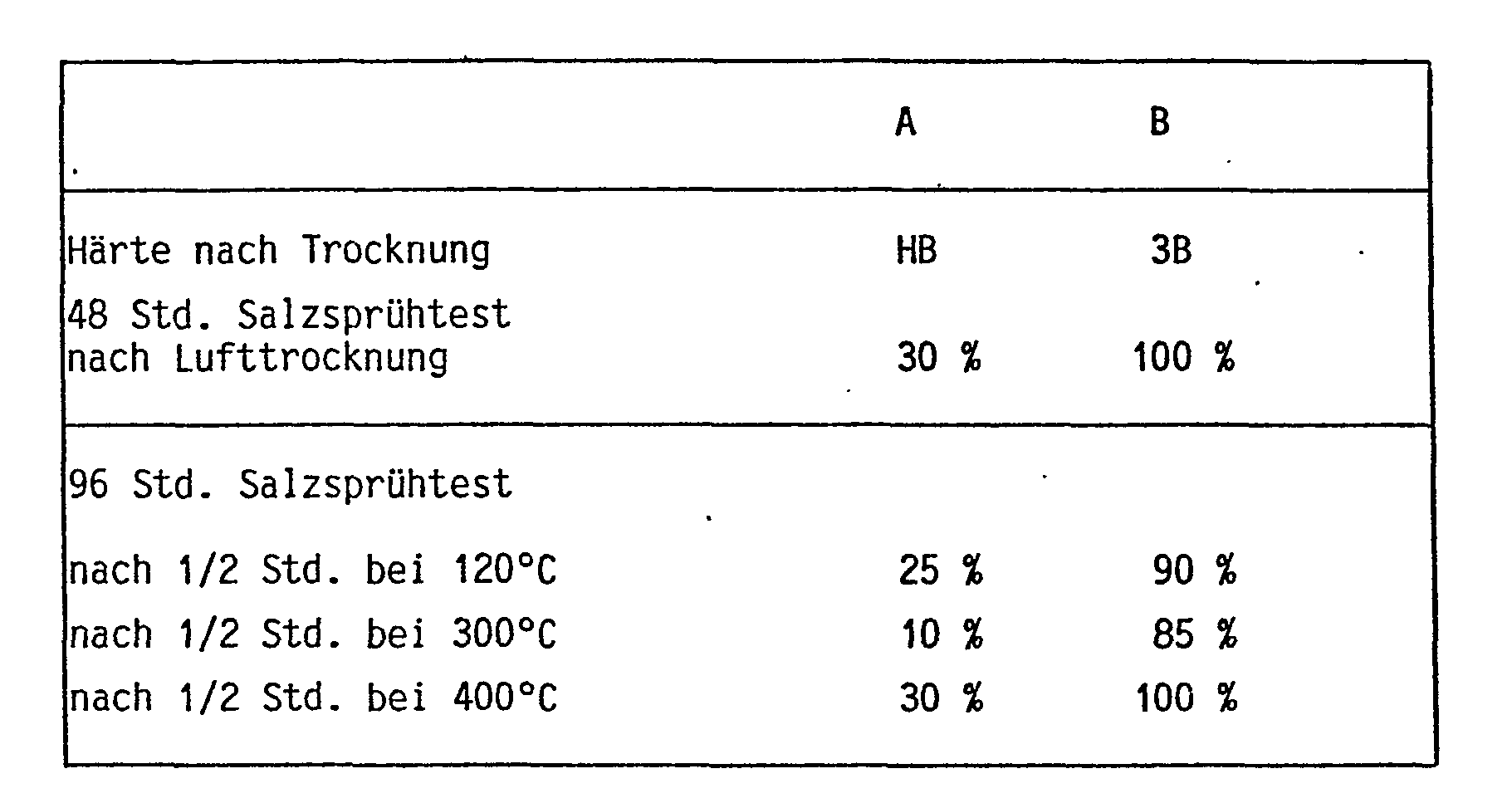
- Die Ergebnisse zeigen, daß das mit Harzvorprodukt A (erfindungsgemäß) hergestellte Siliconharz eine höhere Härte und einen besseren Korrosionsschutz nach Lufttrocknung aufweist und auch nach thermischer Belastung einen erheblich verbesserten Korrosionsschutz bietet, verglichen mit dem Siliconharz, das mit Harzvorprodukt B (nicht erfindungsgemäß) hergestellt wurde.
durch Alkoholyse/Hydrolyse und partielle Kondensation von Organochlorsilanen mit Alkohol/Wasser in Gegenwart von Organopolysiloxanen.
Claims (9)

durch Alkoholyse/Hydrolyse und partielle Kondensation von Organochlorsilanen mit Alkohol/Wasser in Gegenwart von Organopolysiloxanen, dadurch gekennzeichnet, daß man die Alkoholyse/Hydrolyse sowie die partielle Kondensation in Gegenwart von Organopolysiloxan(en), dessen (deren) Zusammensetzung von der des Verfahrensproduktes abweicht, durchführt, wobei die Organochlorsilane und das (die) Organopolysiloxan(e) nach Art und Menge so ausgewählt sind, daß sie hinsichtlich der direkt an das Si-Atom gebundenen Organogruppen R2 summarisch der gewünschten Zusammensetzung des Verfahrensproduktes entsprechen.


Applications Claiming Priority (2)
| Application Number | Priority Date | Filing Date | Title |
|---|---|---|---|
| DE19843412648 DE3412648A1 (de) | 1984-04-04 | 1984-04-04 | Verfahren zur herstellung von siliconharzvorprodukten |
| DE3412648 | 1984-04-04 |
Publications (3)
| Publication Number | Publication Date |
|---|---|
| EP0157318A2 true EP0157318A2 (de) | 1985-10-09 |
| EP0157318A3 EP0157318A3 (en) | 1987-08-26 |
| EP0157318B1 EP0157318B1 (de) | 1989-08-30 |
Family
ID=6232650
Family Applications (1)
| Application Number | Title | Priority Date | Filing Date |
|---|---|---|---|
| EP85103432A Expired EP0157318B1 (de) | 1984-04-04 | 1985-03-22 | Verfahren zur Herstellung von Siliconharzvorprodukten |
Country Status (2)
| Country | Link |
|---|---|
| EP (1) | EP0157318B1 (de) |
| DE (2) | DE3412648A1 (de) |
Cited By (6)
| Publication number | Priority date | Publication date | Assignee | Title |
|---|---|---|---|---|
| EP1142929A3 (de) * | 2000-04-06 | 2002-12-18 | Goldschmidt AG | Methoxyfunktionelle Organopolysiloxane, deren Herstellung und Verwendung |
| DE102013216781A1 (de) | 2013-08-23 | 2015-02-26 | Evonik Industries Ag | Beschichtungsmassen |
| DE102013216777A1 (de) | 2013-08-23 | 2015-02-26 | Evonik Industries Ag | Bei Raumtemperatur härtbare Silikonharz-Zusammensetzungen |
| EP3524651A1 (de) | 2018-02-08 | 2019-08-14 | Evonik Degussa GmbH | Wässrige polyorganosiloxanhybridharz-dispersion |
| EP3719076A1 (de) | 2019-04-01 | 2020-10-07 | Evonik Operations GmbH | Wässrige polyorganosiloxanhybridharz-dispersion |
| US12460081B2 (en) | 2021-11-25 | 2025-11-04 | Evonik Operations Gmbh | Curable condensation compounds based on alkoxy-functional polysiloxanes |
Families Citing this family (10)
| Publication number | Priority date | Publication date | Assignee | Title |
|---|---|---|---|---|
| DE3834462A1 (de) * | 1988-10-10 | 1990-04-12 | Rudolf Dr Herrmann | Verfahren und mittel zur baustoffkonsolidierung und si-haltige polykondensate hierfuer |
| DE19934103A1 (de) | 1999-07-21 | 2001-01-25 | Goldschmidt Ag Th | Polyorganosiloxanharze mit Trenneffekt |
| DE10006270B4 (de) * | 2000-02-12 | 2006-07-20 | Bayerische Motoren Werke Ag | Lackierverfahren und damit hergestelltes Metallbauteil |
| EP1174467B1 (de) | 2000-07-22 | 2004-09-15 | Goldschmidt AG | Hitzestabile, korrosionsinhibierende Polyorganosiloxanharze |
| DE10302743A1 (de) | 2003-01-24 | 2004-07-29 | Goldschmidt Ag | Verwendung von Siliconharzen als Dispergiermittel |
| EP3095827B1 (de) | 2015-05-21 | 2019-04-24 | Mipa Se | Zusammensetzungen auf basis von organosilicium-verbindungen und deren verwendung als beschichtungsmittel, insbesondere zum korrosionsschutz von metallen |
| WO2017055418A1 (de) | 2015-09-30 | 2017-04-06 | Evonik Degussa Gmbh | Mit silikonharzen modifizierte isocyanatoalkylalkoxysilan-addukte und ihre verwendung |
| ES3060196T3 (en) | 2017-09-28 | 2026-03-25 | Evonik Operations Gmbh | Curable composition based on polysiloxanes |
| DK3816247T3 (da) | 2019-10-28 | 2023-02-27 | Evonik Operations Gmbh | Hærderblanding |
| EP4011992A1 (de) | 2020-12-09 | 2022-06-15 | Evonik Operations GmbH | Härtbare kondensationsverbindungen auf basis von alkoxyfunktionellen polysiloxanen |
Family Cites Families (5)
| Publication number | Priority date | Publication date | Assignee | Title |
|---|---|---|---|---|
| FR1472104A (fr) * | 1965-12-07 | 1967-03-10 | Rhone Poulenc Sa | Procédé de préparation d'organopolysiloxanes linéaires |
| DE1620933A1 (de) * | 1966-10-22 | 1970-09-24 | Inst Silikon & Fluorkarbonchem | Verfahren zur Herstellung von mit Trimethylsilylgruppen endblockierten Methylphenylsilikonoelen |
| DE2806036A1 (de) * | 1978-02-14 | 1979-08-16 | Wacker Chemie Gmbh | Verfahren zum herstellen von polysiloxanen mit ueber sauerstoff an silicium gebundenen kohlenwasserstoffresten |
| DE2828990C2 (de) * | 1978-07-01 | 1982-11-18 | Th. Goldschmidt Ag, 4300 Essen | Verfahren zur Herstellung von hitzehärtbaren Organopolysiloxanharzen |
| BE885473A (fr) * | 1979-06-05 | 1981-01-16 | Gen Electric | Procede de preparation de polydimethylsiloxanes a terminaisons methoxy |
-
1984
- 1984-04-04 DE DE19843412648 patent/DE3412648A1/de active Granted
-
1985
- 1985-03-22 EP EP85103432A patent/EP0157318B1/de not_active Expired
- 1985-03-22 DE DE8585103432T patent/DE3572665D1/de not_active Expired
Cited By (9)
| Publication number | Priority date | Publication date | Assignee | Title |
|---|---|---|---|---|
| EP1142929A3 (de) * | 2000-04-06 | 2002-12-18 | Goldschmidt AG | Methoxyfunktionelle Organopolysiloxane, deren Herstellung und Verwendung |
| DE102013216781A1 (de) | 2013-08-23 | 2015-02-26 | Evonik Industries Ag | Beschichtungsmassen |
| DE102013216777A1 (de) | 2013-08-23 | 2015-02-26 | Evonik Industries Ag | Bei Raumtemperatur härtbare Silikonharz-Zusammensetzungen |
| US10287454B2 (en) | 2013-08-23 | 2019-05-14 | Evonik Degussa Gmbh | Coating compositions |
| EP3524651A1 (de) | 2018-02-08 | 2019-08-14 | Evonik Degussa GmbH | Wässrige polyorganosiloxanhybridharz-dispersion |
| US11021608B2 (en) | 2018-02-08 | 2021-06-01 | Evonik Operations Gmbh | Aqueous polyorganosiloxane hybrid resin dispersion |
| EP3719076A1 (de) | 2019-04-01 | 2020-10-07 | Evonik Operations GmbH | Wässrige polyorganosiloxanhybridharz-dispersion |
| EP3722371A1 (de) | 2019-04-01 | 2020-10-14 | Evonik Operations GmbH | Wässrige polyorganosiloxanhybridharz-dispersion |
| US12460081B2 (en) | 2021-11-25 | 2025-11-04 | Evonik Operations Gmbh | Curable condensation compounds based on alkoxy-functional polysiloxanes |
Also Published As
| Publication number | Publication date |
|---|---|
| DE3572665D1 (en) | 1989-10-05 |
| DE3412648C2 (de) | 1987-06-19 |
| DE3412648A1 (de) | 1985-10-24 |
| EP0157318A3 (en) | 1987-08-26 |
| EP0157318B1 (de) | 1989-08-30 |
Similar Documents
| Publication | Publication Date | Title |
|---|---|---|
| EP3401353B1 (de) | Mischungen zyklischer-verzweigter siloxane vom d/t-typ und deren folgeprodukte | |
| EP0157318B1 (de) | Verfahren zur Herstellung von Siliconharzvorprodukten | |
| DE69009816T2 (de) | Verfahren zur Herstellung von Siloxanharzen. | |
| EP0002745B1 (de) | Härtbare Massen auf Grundlage von Polyorganosiloxanen und Titanestern | |
| EP0927734B1 (de) | Kontinuierliches Verfahren zur Herstellung von Polyorganosiloxanen | |
| EP0003285B1 (de) | Verfahren zur Herstellung von siliciumfunktionellen Polyorganosiloxanen | |
| EP3467006A1 (de) | Mischungen zyklischer-verzweigter siloxane vom d/t-typ und deren folgeprodukte | |
| DE4344082C1 (de) | Verfahren zur Herstellung von Organopolysiloxanen mit über Kohlenstoff an Silicium gebundenen sekundären Aminoalkylgruppen | |
| EP3321304A1 (de) | Mischungen zyklischer-verzweigter siloxane vom d/t-typ und deren folgeprodukte | |
| DE2828990C2 (de) | Verfahren zur Herstellung von hitzehärtbaren Organopolysiloxanharzen | |
| DE19514987A1 (de) | Verfahren zum Herstellen von vernetzten Siloxanen durch Disproportionierung | |
| DE1570446A1 (de) | Verfahren zur Herstellung von Organosiloxanblockmischpolymerisaten | |
| DE1495859A1 (de) | Organopolysiloxane und Verfahren zur Herstellung derselben | |
| DE69011162T2 (de) | Siloxanharze und Verfahren zu ihrer Herstellung. | |
| DE3788676T2 (de) | Härtbare Organopolysiloxanzusammensetzungen. | |
| EP0305737A2 (de) | Verfahren zum Kondensieren und/oder Äquilibrieren von Organo-(poly)siloxanen | |
| EP0672702B1 (de) | Verfahren zur Herstellung von Organyloxygruppen aufweisenden Organopolysiloxanen | |
| DE2133105C3 (de) | Verfahren zur Herstellung härtbarer Fluororganopolysiloxanharze | |
| EP1142929B1 (de) | Methoxyfunktionelle Organopolysiloxane, deren Herstellung und Verwendung | |
| EP0401684B1 (de) | Verfahren zur Herstellung von Organosiloxanen | |
| EP0948501B1 (de) | Harnstoffgruppen aufweisende organosiliciumverbindungen, deren herstellung sowie deren verwendung | |
| EP3625285B1 (de) | Verfahren zur herstellung von organopolysiloxanharzen | |
| DE102014200106B4 (de) | Härtbare organomodifizierte Siloxane hergestellt durch Kondensation | |
| DE2020224B2 (de) | Methyl- bzw. methylphenylpolysiloxanharze | |
| DE4419706A1 (de) | Verfahren zur Herstellung flexibler Polyorganosiloxanharze |
Legal Events
| Date | Code | Title | Description |
|---|---|---|---|
| PUAI | Public reference made under article 153(3) epc to a published international application that has entered the european phase |
Free format text: ORIGINAL CODE: 0009012 |
|
| 17P | Request for examination filed |
Effective date: 19850329 |
|
| AK | Designated contracting states |
Designated state(s): BE DE FR GB IT NL |
|
| PUAL | Search report despatched |
Free format text: ORIGINAL CODE: 0009013 |
|
| AK | Designated contracting states |
Kind code of ref document: A3 Designated state(s): BE DE FR GB IT NL |
|
| 17Q | First examination report despatched |
Effective date: 19880603 |
|
| ITF | It: translation for a ep patent filed | ||
| GRAA | (expected) grant |
Free format text: ORIGINAL CODE: 0009210 |
|
| AK | Designated contracting states |
Kind code of ref document: B1 Designated state(s): BE DE FR GB IT NL |
|
| GBT | Gb: translation of ep patent filed (gb section 77(6)(a)/1977) | ||
| REF | Corresponds to: |
Ref document number: 3572665 Country of ref document: DE Date of ref document: 19891005 |
|
| ET | Fr: translation filed | ||
| PLBE | No opposition filed within time limit |
Free format text: ORIGINAL CODE: 0009261 |
|
| STAA | Information on the status of an ep patent application or granted ep patent |
Free format text: STATUS: NO OPPOSITION FILED WITHIN TIME LIMIT |
|
| 26N | No opposition filed | ||
| ITTA | It: last paid annual fee | ||
| NLT1 | Nl: modifications of names registered in virtue of documents presented to the patent office pursuant to art. 16 a, paragraph 1 |
Owner name: GOLDSCHMIDT AG |
|
| REG | Reference to a national code |
Ref country code: FR Ref legal event code: CD |
|
| REG | Reference to a national code |
Ref country code: GB Ref legal event code: IF02 |
|
| PGFP | Annual fee paid to national office [announced via postgrant information from national office to epo] |
Ref country code: GB Payment date: 20030226 Year of fee payment: 19 |
|
| PGFP | Annual fee paid to national office [announced via postgrant information from national office to epo] |
Ref country code: NL Payment date: 20030228 Year of fee payment: 19 |
|
| PGFP | Annual fee paid to national office [announced via postgrant information from national office to epo] |
Ref country code: BE Payment date: 20030310 Year of fee payment: 19 |
|
| PGFP | Annual fee paid to national office [announced via postgrant information from national office to epo] |
Ref country code: DE Payment date: 20030311 Year of fee payment: 19 |
|
| PGFP | Annual fee paid to national office [announced via postgrant information from national office to epo] |
Ref country code: FR Payment date: 20030314 Year of fee payment: 19 |
|
| PG25 | Lapsed in a contracting state [announced via postgrant information from national office to epo] |
Ref country code: GB Free format text: LAPSE BECAUSE OF NON-PAYMENT OF DUE FEES Effective date: 20040322 |
|
| PG25 | Lapsed in a contracting state [announced via postgrant information from national office to epo] |
Ref country code: BE Free format text: LAPSE BECAUSE OF NON-PAYMENT OF DUE FEES Effective date: 20040331 |
|
| BERE | Be: lapsed |
Owner name: *GOLDSCHMIDT A.G. Effective date: 20040331 |
|
| PG25 | Lapsed in a contracting state [announced via postgrant information from national office to epo] |
Ref country code: NL Free format text: LAPSE BECAUSE OF NON-PAYMENT OF DUE FEES Effective date: 20041001 Ref country code: DE Free format text: LAPSE BECAUSE OF NON-PAYMENT OF DUE FEES Effective date: 20041001 |
|
| GBPC | Gb: european patent ceased through non-payment of renewal fee |
Effective date: 20040322 |
|
| PG25 | Lapsed in a contracting state [announced via postgrant information from national office to epo] |
Ref country code: FR Free format text: LAPSE BECAUSE OF NON-PAYMENT OF DUE FEES Effective date: 20041130 |
|
| NLV4 | Nl: lapsed or anulled due to non-payment of the annual fee |
Effective date: 20041001 |
|
| REG | Reference to a national code |
Ref country code: FR Ref legal event code: ST |