EP0151052B1 - Aminoéthylimidazole, composition pharmaceutique en contenant et procédé de préparation - Google Patents
Aminoéthylimidazole, composition pharmaceutique en contenant et procédé de préparation Download PDFInfo
- Publication number
- EP0151052B1 EP0151052B1 EP85400003A EP85400003A EP0151052B1 EP 0151052 B1 EP0151052 B1 EP 0151052B1 EP 85400003 A EP85400003 A EP 85400003A EP 85400003 A EP85400003 A EP 85400003A EP 0151052 B1 EP0151052 B1 EP 0151052B1
- Authority
- EP
- European Patent Office
- Prior art keywords
- phenyl
- imidazole
- radical
- dimethylaminoethyl
- ethyl
- Prior art date
- Legal status (The legal status is an assumption and is not a legal conclusion. Google has not performed a legal analysis and makes no representation as to the accuracy of the status listed.)
- Expired
Links
- DEURIUYJZZLADZ-UHFFFAOYSA-N 2-(1h-imidazol-2-yl)ethanamine Chemical compound NCCC1=NC=CN1 DEURIUYJZZLADZ-UHFFFAOYSA-N 0.000 title claims abstract 5
- 238000000034 method Methods 0.000 title claims description 19
- 238000002360 preparation method Methods 0.000 title claims description 7
- 239000008194 pharmaceutical composition Substances 0.000 title claims description 3
- -1 alkoxy radical Chemical class 0.000 claims abstract description 28
- 150000003839 salts Chemical class 0.000 claims abstract description 10
- 239000002253 acid Substances 0.000 claims abstract description 8
- 230000001120 cytoprotective effect Effects 0.000 claims abstract description 8
- 125000001997 phenyl group Chemical group [H]C1=C([H])C([H])=C(*)C([H])=C1[H] 0.000 claims abstract description 7
- 125000000217 alkyl group Chemical group 0.000 claims abstract description 6
- 150000007513 acids Chemical class 0.000 claims abstract description 5
- 125000004435 hydrogen atom Chemical group [H]* 0.000 claims abstract description 4
- KHUXNRRPPZOJPT-UHFFFAOYSA-N phenoxy radical Chemical group O=C1C=C[CH]C=C1 KHUXNRRPPZOJPT-UHFFFAOYSA-N 0.000 claims abstract description 3
- RAXXELZNTBOGNW-UHFFFAOYSA-N imidazole Natural products C1=CNC=N1 RAXXELZNTBOGNW-UHFFFAOYSA-N 0.000 claims description 23
- XLYOFNOQVPJJNP-UHFFFAOYSA-N water Substances O XLYOFNOQVPJJNP-UHFFFAOYSA-N 0.000 claims description 12
- 125000004432 carbon atom Chemical group C* 0.000 claims description 10
- 229910052757 nitrogen Inorganic materials 0.000 claims description 10
- 230000000694 effects Effects 0.000 claims description 9
- 125000004429 atom Chemical group 0.000 claims description 7
- 150000004820 halides Chemical class 0.000 claims description 7
- 150000002460 imidazoles Chemical class 0.000 claims description 6
- 229910052801 chlorine Inorganic materials 0.000 claims description 5
- 150000003254 radicals Chemical class 0.000 claims description 5
- CIUQDSCDWFSTQR-UHFFFAOYSA-N [C]1=CC=CC=C1 Chemical compound [C]1=CC=CC=C1 CIUQDSCDWFSTQR-UHFFFAOYSA-N 0.000 claims description 4
- 150000001875 compounds Chemical class 0.000 claims description 4
- ZAMOUSCENKQFHK-UHFFFAOYSA-N Chlorine atom Chemical compound [Cl] ZAMOUSCENKQFHK-UHFFFAOYSA-N 0.000 claims description 3
- 150000001408 amides Chemical class 0.000 claims description 3
- 150000004945 aromatic hydrocarbons Chemical class 0.000 claims description 3
- 239000002585 base Substances 0.000 claims description 3
- 239000003054 catalyst Substances 0.000 claims description 3
- 150000004292 cyclic ethers Chemical class 0.000 claims description 2
- 150000002170 ethers Chemical class 0.000 claims description 2
- 230000002496 gastric effect Effects 0.000 claims description 2
- NJVZRMRUMHFKFR-UHFFFAOYSA-N n,n-dimethyl-2-(2-methylimidazol-1-yl)-2-phenylbutan-1-amine Chemical compound C1=CN=C(C)N1C(CN(C)C)(CC)C1=CC=CC=C1 NJVZRMRUMHFKFR-UHFFFAOYSA-N 0.000 claims description 2
- 229910052709 silver Inorganic materials 0.000 claims description 2
- 239000004332 silver Substances 0.000 claims description 2
- 239000002904 solvent Substances 0.000 claims description 2
- 238000009833 condensation Methods 0.000 claims 2
- 230000005494 condensation Effects 0.000 claims 2
- 229910052783 alkali metal Inorganic materials 0.000 claims 1
- 150000001340 alkali metals Chemical class 0.000 claims 1
- 125000003118 aryl group Chemical group 0.000 claims 1
- 150000008282 halocarbons Chemical class 0.000 claims 1
- 229910052736 halogen Inorganic materials 0.000 claims 1
- 150000002367 halogens Chemical group 0.000 claims 1
- 239000003444 phase transfer catalyst Substances 0.000 claims 1
- 125000005496 phosphonium group Chemical group 0.000 claims 1
- 230000000063 preceeding effect Effects 0.000 claims 1
- 125000001453 quaternary ammonium group Chemical group 0.000 claims 1
- 239000003814 drug Substances 0.000 abstract description 2
- 125000005843 halogen group Chemical group 0.000 abstract description 2
- YXFVVABEGXRONW-UHFFFAOYSA-N Toluene Chemical compound CC1=CC=CC=C1 YXFVVABEGXRONW-UHFFFAOYSA-N 0.000 description 27
- LFQSCWFLJHTTHZ-UHFFFAOYSA-N Ethanol Chemical compound CCO LFQSCWFLJHTTHZ-UHFFFAOYSA-N 0.000 description 14
- ZMXDDKWLCZADIW-UHFFFAOYSA-N N,N-Dimethylformamide Chemical compound CN(C)C=O ZMXDDKWLCZADIW-UHFFFAOYSA-N 0.000 description 12
- 239000012071 phase Substances 0.000 description 10
- HEMHJVSKTPXQMS-UHFFFAOYSA-M Sodium hydroxide Chemical compound [OH-].[Na+] HEMHJVSKTPXQMS-UHFFFAOYSA-M 0.000 description 9
- 239000000243 solution Substances 0.000 description 9
- UHOVQNZJYSORNB-UHFFFAOYSA-N Benzene Chemical compound C1=CC=CC=C1 UHOVQNZJYSORNB-UHFFFAOYSA-N 0.000 description 8
- RTZKZFJDLAIYFH-UHFFFAOYSA-N Diethyl ether Chemical compound CCOCC RTZKZFJDLAIYFH-UHFFFAOYSA-N 0.000 description 7
- 239000000203 mixture Substances 0.000 description 7
- 238000006243 chemical reaction Methods 0.000 description 6
- 229910052739 hydrogen Inorganic materials 0.000 description 6
- 239000001257 hydrogen Substances 0.000 description 6
- VLKZOEOYAKHREP-UHFFFAOYSA-N n-Hexane Chemical compound CCCCCC VLKZOEOYAKHREP-UHFFFAOYSA-N 0.000 description 6
- 238000003786 synthesis reaction Methods 0.000 description 6
- CSCPPACGZOOCGX-UHFFFAOYSA-N Acetone Chemical compound CC(C)=O CSCPPACGZOOCGX-UHFFFAOYSA-N 0.000 description 5
- UFHFLCQGNIYNRP-UHFFFAOYSA-N Hydrogen Chemical compound [H][H] UFHFLCQGNIYNRP-UHFFFAOYSA-N 0.000 description 5
- 241000700159 Rattus Species 0.000 description 5
- 230000015572 biosynthetic process Effects 0.000 description 5
- 239000013078 crystal Substances 0.000 description 5
- 238000003756 stirring Methods 0.000 description 5
- YMWUJEATGCHHMB-UHFFFAOYSA-N Dichloromethane Chemical compound ClCCl YMWUJEATGCHHMB-UHFFFAOYSA-N 0.000 description 4
- IMNFDUFMRHMDMM-UHFFFAOYSA-N N-Heptane Chemical compound CCCCCCC IMNFDUFMRHMDMM-UHFFFAOYSA-N 0.000 description 4
- VYPSYNLAJGMNEJ-UHFFFAOYSA-N Silicium dioxide Chemical compound O=[Si]=O VYPSYNLAJGMNEJ-UHFFFAOYSA-N 0.000 description 4
- 208000025865 Ulcer Diseases 0.000 description 4
- 239000003153 chemical reaction reagent Substances 0.000 description 4
- 238000004821 distillation Methods 0.000 description 4
- 125000001495 ethyl group Chemical group [H]C([H])([H])C([H])([H])* 0.000 description 4
- ZWEHNKRNPOVVGH-UHFFFAOYSA-N 2-Butanone Chemical compound CCC(C)=O ZWEHNKRNPOVVGH-UHFFFAOYSA-N 0.000 description 3
- WVDDGKGOMKODPV-UHFFFAOYSA-N Benzyl alcohol Chemical compound OCC1=CC=CC=C1 WVDDGKGOMKODPV-UHFFFAOYSA-N 0.000 description 3
- HEDRZPFGACZZDS-UHFFFAOYSA-N Chloroform Chemical compound ClC(Cl)Cl HEDRZPFGACZZDS-UHFFFAOYSA-N 0.000 description 3
- 231100000111 LD50 Toxicity 0.000 description 3
- OKKJLVBELUTLKV-UHFFFAOYSA-N Methanol Chemical compound OC OKKJLVBELUTLKV-UHFFFAOYSA-N 0.000 description 3
- KWYUFKZDYYNOTN-UHFFFAOYSA-M Potassium hydroxide Chemical compound [OH-].[K+] KWYUFKZDYYNOTN-UHFFFAOYSA-M 0.000 description 3
- OFOBLEOULBTSOW-UHFFFAOYSA-N Propanedioic acid Natural products OC(=O)CC(O)=O OFOBLEOULBTSOW-UHFFFAOYSA-N 0.000 description 3
- PMZURENOXWZQFD-UHFFFAOYSA-L Sodium Sulfate Chemical compound [Na+].[Na+].[O-]S([O-])(=O)=O PMZURENOXWZQFD-UHFFFAOYSA-L 0.000 description 3
- FAPWRFPIFSIZLT-UHFFFAOYSA-M Sodium chloride Chemical compound [Na+].[Cl-] FAPWRFPIFSIZLT-UHFFFAOYSA-M 0.000 description 3
- 108010069102 Thromboxane-A synthase Proteins 0.000 description 3
- 125000001309 chloro group Chemical group Cl* 0.000 description 3
- 238000004587 chromatography analysis Methods 0.000 description 3
- 238000001816 cooling Methods 0.000 description 3
- 230000005764 inhibitory process Effects 0.000 description 3
- VZCYOOQTPOCHFL-UPHRSURJSA-N maleic acid Chemical compound OC(=O)\C=C/C(O)=O VZCYOOQTPOCHFL-UPHRSURJSA-N 0.000 description 3
- 239000011976 maleic acid Substances 0.000 description 3
- 125000002496 methyl group Chemical group [H]C([H])([H])* 0.000 description 3
- 238000010992 reflux Methods 0.000 description 3
- VZCYOOQTPOCHFL-UHFFFAOYSA-N trans-butenedioic acid Natural products OC(=O)C=CC(O)=O VZCYOOQTPOCHFL-UHFFFAOYSA-N 0.000 description 3
- 238000011282 treatment Methods 0.000 description 3
- 231100000397 ulcer Toxicity 0.000 description 3
- RYHBNJHYFVUHQT-UHFFFAOYSA-N 1,4-Dioxane Chemical compound C1COCCO1 RYHBNJHYFVUHQT-UHFFFAOYSA-N 0.000 description 2
- CPELXLSAUQHCOX-UHFFFAOYSA-M Bromide Chemical compound [Br-] CPELXLSAUQHCOX-UHFFFAOYSA-M 0.000 description 2
- XDTMQSROBMDMFD-UHFFFAOYSA-N Cyclohexane Chemical compound C1CCCCC1 XDTMQSROBMDMFD-UHFFFAOYSA-N 0.000 description 2
- IAZDPXIOMUYVGZ-UHFFFAOYSA-N Dimethylsulphoxide Chemical compound CS(C)=O IAZDPXIOMUYVGZ-UHFFFAOYSA-N 0.000 description 2
- DGAQECJNVWCQMB-PUAWFVPOSA-M Ilexoside XXIX Chemical compound C[C@@H]1CC[C@@]2(CC[C@@]3(C(=CC[C@H]4[C@]3(CC[C@@H]5[C@@]4(CC[C@@H](C5(C)C)OS(=O)(=O)[O-])C)C)[C@@H]2[C@]1(C)O)C)C(=O)O[C@H]6[C@@H]([C@H]([C@@H]([C@H](O6)CO)O)O)O.[Na+] DGAQECJNVWCQMB-PUAWFVPOSA-M 0.000 description 2
- 206010061218 Inflammation Diseases 0.000 description 2
- ZLMJMSJWJFRBEC-UHFFFAOYSA-N Potassium Chemical compound [K] ZLMJMSJWJFRBEC-UHFFFAOYSA-N 0.000 description 2
- 229920002472 Starch Polymers 0.000 description 2
- WYURNTSHIVDZCO-UHFFFAOYSA-N Tetrahydrofuran Chemical compound C1CCOC1 WYURNTSHIVDZCO-UHFFFAOYSA-N 0.000 description 2
- 239000004480 active ingredient Substances 0.000 description 2
- 150000001414 amino alcohols Chemical class 0.000 description 2
- 239000008346 aqueous phase Substances 0.000 description 2
- 238000006482 condensation reaction Methods 0.000 description 2
- 238000002425 crystallisation Methods 0.000 description 2
- 230000008025 crystallization Effects 0.000 description 2
- 238000010828 elution Methods 0.000 description 2
- 229940082150 encore Drugs 0.000 description 2
- 238000000605 extraction Methods 0.000 description 2
- 210000001156 gastric mucosa Anatomy 0.000 description 2
- 230000004054 inflammatory process Effects 0.000 description 2
- HQKMJHAJHXVSDF-UHFFFAOYSA-L magnesium stearate Chemical compound [Mg+2].CCCCCCCCCCCCCCCCCC([O-])=O.CCCCCCCCCCCCCCCCCC([O-])=O HQKMJHAJHXVSDF-UHFFFAOYSA-L 0.000 description 2
- 230000000144 pharmacologic effect Effects 0.000 description 2
- 239000011591 potassium Substances 0.000 description 2
- 229910052700 potassium Inorganic materials 0.000 description 2
- 229940127293 prostanoid Drugs 0.000 description 2
- 150000003814 prostanoids Chemical class 0.000 description 2
- 238000000746 purification Methods 0.000 description 2
- 239000000376 reactant Substances 0.000 description 2
- 239000012429 reaction media Substances 0.000 description 2
- 239000000377 silicon dioxide Substances 0.000 description 2
- 229910052708 sodium Inorganic materials 0.000 description 2
- 229910052938 sodium sulfate Inorganic materials 0.000 description 2
- 235000011152 sodium sulphate Nutrition 0.000 description 2
- 239000000725 suspension Substances 0.000 description 2
- VZGDMQKNWNREIO-UHFFFAOYSA-N tetrachloromethane Chemical compound ClC(Cl)(Cl)Cl VZGDMQKNWNREIO-UHFFFAOYSA-N 0.000 description 2
- 238000004809 thin layer chromatography Methods 0.000 description 2
- FYSNRJHAOHDILO-UHFFFAOYSA-N thionyl chloride Chemical compound ClS(Cl)=O FYSNRJHAOHDILO-UHFFFAOYSA-N 0.000 description 2
- RYVBINGWVJJDPU-UHFFFAOYSA-M tributyl(hexadecyl)phosphanium;bromide Chemical compound [Br-].CCCCCCCCCCCCCCCC[P+](CCCC)(CCCC)CCCC RYVBINGWVJJDPU-UHFFFAOYSA-M 0.000 description 2
- 229940100445 wheat starch Drugs 0.000 description 2
- JMQLEFXMYPZGJX-UHFFFAOYSA-N 1-(dimethylamino)-2-phenylbutan-1-ol Chemical compound CN(C)C(O)C(CC)C1=CC=CC=C1 JMQLEFXMYPZGJX-UHFFFAOYSA-N 0.000 description 1
- KKKDZZRICRFGSD-UHFFFAOYSA-N 1-benzylimidazole Chemical compound C1=CN=CN1CC1=CC=CC=C1 KKKDZZRICRFGSD-UHFFFAOYSA-N 0.000 description 1
- LXBGSDVWAMZHDD-UHFFFAOYSA-N 2-methyl-1h-imidazole Chemical compound CC1=NC=CN1 LXBGSDVWAMZHDD-UHFFFAOYSA-N 0.000 description 1
- OCKGFTQIICXDQW-ZEQRLZLVSA-N 5-[(1r)-1-hydroxy-2-[4-[(2r)-2-hydroxy-2-(4-methyl-1-oxo-3h-2-benzofuran-5-yl)ethyl]piperazin-1-yl]ethyl]-4-methyl-3h-2-benzofuran-1-one Chemical compound C1=C2C(=O)OCC2=C(C)C([C@@H](O)CN2CCN(CC2)C[C@H](O)C2=CC=C3C(=O)OCC3=C2C)=C1 OCKGFTQIICXDQW-ZEQRLZLVSA-N 0.000 description 1
- QGZKDVFQNNGYKY-UHFFFAOYSA-O Ammonium Chemical compound [NH4+] QGZKDVFQNNGYKY-UHFFFAOYSA-O 0.000 description 1
- 241000972773 Aulopiformes Species 0.000 description 1
- VEXZGXHMUGYJMC-UHFFFAOYSA-M Chloride anion Chemical compound [Cl-] VEXZGXHMUGYJMC-UHFFFAOYSA-M 0.000 description 1
- NOTFZGFABLVTIG-UHFFFAOYSA-N Cyclohexylethyl acetate Chemical compound CC(=O)OCCC1CCCCC1 NOTFZGFABLVTIG-UHFFFAOYSA-N 0.000 description 1
- FBPFZTCFMRRESA-KVTDHHQDSA-N D-Mannitol Chemical compound OC[C@@H](O)[C@@H](O)[C@H](O)[C@H](O)CO FBPFZTCFMRRESA-KVTDHHQDSA-N 0.000 description 1
- XTHFKEDIFFGKHM-UHFFFAOYSA-N Dimethoxyethane Chemical compound COCCOC XTHFKEDIFFGKHM-UHFFFAOYSA-N 0.000 description 1
- 108010010803 Gelatin Proteins 0.000 description 1
- 208000032843 Hemorrhage Diseases 0.000 description 1
- 241000282412 Homo Species 0.000 description 1
- GUBGYTABKSRVRQ-QKKXKWKRSA-N Lactose Natural products OC[C@H]1O[C@@H](O[C@H]2[C@H](O)[C@@H](O)C(O)O[C@@H]2CO)[C@H](O)[C@@H](O)[C@H]1O GUBGYTABKSRVRQ-QKKXKWKRSA-N 0.000 description 1
- 229930195725 Mannitol Natural products 0.000 description 1
- 241001465754 Metazoa Species 0.000 description 1
- 241000699670 Mus sp. Species 0.000 description 1
- FXHOOIRPVKKKFG-UHFFFAOYSA-N N,N-Dimethylacetamide Chemical compound CN(C)C(C)=O FXHOOIRPVKKKFG-UHFFFAOYSA-N 0.000 description 1
- 238000007126 N-alkylation reaction Methods 0.000 description 1
- 241000283973 Oryctolagus cuniculus Species 0.000 description 1
- 229910019142 PO4 Inorganic materials 0.000 description 1
- BQCADISMDOOEFD-UHFFFAOYSA-N Silver Chemical compound [Ag] BQCADISMDOOEFD-UHFFFAOYSA-N 0.000 description 1
- KEAYESYHFKHZAL-UHFFFAOYSA-N Sodium Chemical compound [Na] KEAYESYHFKHZAL-UHFFFAOYSA-N 0.000 description 1
- QAOWNCQODCNURD-UHFFFAOYSA-N Sulfuric acid Chemical class OS(O)(=O)=O QAOWNCQODCNURD-UHFFFAOYSA-N 0.000 description 1
- 241001080024 Telles Species 0.000 description 1
- 238000010521 absorption reaction Methods 0.000 description 1
- 239000013543 active substance Substances 0.000 description 1
- 230000007059 acute toxicity Effects 0.000 description 1
- 231100000403 acute toxicity Toxicity 0.000 description 1
- 230000016571 aggressive behavior Effects 0.000 description 1
- 150000001298 alcohols Chemical class 0.000 description 1
- 150000001338 aliphatic hydrocarbons Chemical class 0.000 description 1
- 229940035676 analgesics Drugs 0.000 description 1
- 229940035674 anesthetics Drugs 0.000 description 1
- 239000000730 antalgic agent Substances 0.000 description 1
- 239000003242 anti bacterial agent Substances 0.000 description 1
- 239000002260 anti-inflammatory agent Substances 0.000 description 1
- 229940121363 anti-inflammatory agent Drugs 0.000 description 1
- 230000001262 anti-secretory effect Effects 0.000 description 1
- 230000002921 anti-spasmodic effect Effects 0.000 description 1
- 229940088710 antibiotic agent Drugs 0.000 description 1
- 229940124575 antispasmodic agent Drugs 0.000 description 1
- 239000003849 aromatic solvent Substances 0.000 description 1
- 239000012298 atmosphere Substances 0.000 description 1
- 239000000022 bacteriostatic agent Substances 0.000 description 1
- 150000001558 benzoic acid derivatives Chemical class 0.000 description 1
- 235000019445 benzyl alcohol Nutrition 0.000 description 1
- VBQDSLGFSUGBBE-UHFFFAOYSA-N benzyl(triethyl)azanium Chemical compound CC[N+](CC)(CC)CC1=CC=CC=C1 VBQDSLGFSUGBBE-UHFFFAOYSA-N 0.000 description 1
- 150000001649 bromium compounds Chemical class 0.000 description 1
- 239000002775 capsule Substances 0.000 description 1
- 239000000460 chlorine Substances 0.000 description 1
- 150000001805 chlorine compounds Chemical class 0.000 description 1
- 150000001860 citric acid derivatives Chemical class 0.000 description 1
- 230000000295 complement effect Effects 0.000 description 1
- 238000009109 curative therapy Methods 0.000 description 1
- CTGSUWSGSNKTPS-UHFFFAOYSA-N cyclohexane;ethyl acetate;methanol Chemical compound OC.CCOC(C)=O.C1CCCCC1 CTGSUWSGSNKTPS-UHFFFAOYSA-N 0.000 description 1
- 239000008298 dragée Substances 0.000 description 1
- 230000002183 duodenal effect Effects 0.000 description 1
- 230000002526 effect on cardiovascular system Effects 0.000 description 1
- 230000002349 favourable effect Effects 0.000 description 1
- 238000001914 filtration Methods 0.000 description 1
- 230000037406 food intake Effects 0.000 description 1
- 210000001035 gastrointestinal tract Anatomy 0.000 description 1
- 239000000499 gel Substances 0.000 description 1
- 239000008273 gelatin Substances 0.000 description 1
- 229920000159 gelatin Polymers 0.000 description 1
- 235000019322 gelatine Nutrition 0.000 description 1
- 235000011852 gelatine desserts Nutrition 0.000 description 1
- 239000003193 general anesthetic agent Substances 0.000 description 1
- GNOIPBMMFNIUFM-UHFFFAOYSA-N hexamethylphosphoric triamide Chemical compound CN(C)P(=O)(N(C)C)N(C)C GNOIPBMMFNIUFM-UHFFFAOYSA-N 0.000 description 1
- 238000004128 high performance liquid chromatography Methods 0.000 description 1
- 150000004678 hydrides Chemical class 0.000 description 1
- 150000002431 hydrogen Chemical class 0.000 description 1
- 125000002887 hydroxy group Chemical group [H]O* 0.000 description 1
- 239000005457 ice water Substances 0.000 description 1
- 238000000338 in vitro Methods 0.000 description 1
- 238000011065 in-situ storage Methods 0.000 description 1
- 239000012442 inert solvent Substances 0.000 description 1
- 239000003112 inhibitor Substances 0.000 description 1
- 230000002401 inhibitory effect Effects 0.000 description 1
- 229910052500 inorganic mineral Inorganic materials 0.000 description 1
- 229940079865 intestinal antiinfectives imidazole derivative Drugs 0.000 description 1
- 238000007912 intraperitoneal administration Methods 0.000 description 1
- 150000004694 iodide salts Chemical class 0.000 description 1
- INQOMBQAUSQDDS-UHFFFAOYSA-N iodomethane Chemical compound IC INQOMBQAUSQDDS-UHFFFAOYSA-N 0.000 description 1
- 150000002576 ketones Chemical class 0.000 description 1
- 239000008101 lactose Substances 0.000 description 1
- 231100000053 low toxicity Toxicity 0.000 description 1
- 235000019359 magnesium stearate Nutrition 0.000 description 1
- 150000002688 maleic acid derivatives Chemical class 0.000 description 1
- 150000004701 malic acid derivatives Chemical class 0.000 description 1
- 239000000594 mannitol Substances 0.000 description 1
- 235000010355 mannitol Nutrition 0.000 description 1
- 238000004519 manufacturing process Methods 0.000 description 1
- 238000002844 melting Methods 0.000 description 1
- 230000008018 melting Effects 0.000 description 1
- 229910052751 metal Inorganic materials 0.000 description 1
- 239000002184 metal Substances 0.000 description 1
- 150000002739 metals Chemical class 0.000 description 1
- AFVFQIVMOAPDHO-UHFFFAOYSA-M methanesulfonate group Chemical class CS(=O)(=O)[O-] AFVFQIVMOAPDHO-UHFFFAOYSA-M 0.000 description 1
- GRVDJDISBSALJP-UHFFFAOYSA-N methyloxidanyl Chemical compound [O]C GRVDJDISBSALJP-UHFFFAOYSA-N 0.000 description 1
- 239000011707 mineral Substances 0.000 description 1
- 230000007935 neutral effect Effects 0.000 description 1
- 239000012299 nitrogen atmosphere Substances 0.000 description 1
- 150000007524 organic acids Chemical class 0.000 description 1
- 235000005985 organic acids Nutrition 0.000 description 1
- 239000012074 organic phase Substances 0.000 description 1
- 239000003960 organic solvent Substances 0.000 description 1
- 229940094443 oxytocics prostaglandins Drugs 0.000 description 1
- 125000000951 phenoxy group Chemical group [H]C1=C([H])C([H])=C(O*)C([H])=C1[H] 0.000 description 1
- 235000021317 phosphate Nutrition 0.000 description 1
- XYFCBTPGUUZFHI-UHFFFAOYSA-O phosphonium Chemical compound [PH4+] XYFCBTPGUUZFHI-UHFFFAOYSA-O 0.000 description 1
- 150000004714 phosphonium salts Chemical class 0.000 description 1
- 150000003013 phosphoric acid derivatives Chemical class 0.000 description 1
- 229940093429 polyethylene glycol 6000 Drugs 0.000 description 1
- 239000000843 powder Substances 0.000 description 1
- 230000003449 preventive effect Effects 0.000 description 1
- 150000003180 prostaglandins Chemical class 0.000 description 1
- 150000003242 quaternary ammonium salts Chemical class 0.000 description 1
- 239000013558 reference substance Substances 0.000 description 1
- 235000019515 salmon Nutrition 0.000 description 1
- 229920006395 saturated elastomer Polymers 0.000 description 1
- 239000012047 saturated solution Substances 0.000 description 1
- 238000007789 sealing Methods 0.000 description 1
- 230000028327 secretion Effects 0.000 description 1
- 239000011734 sodium Substances 0.000 description 1
- 125000004436 sodium atom Chemical group 0.000 description 1
- 239000011780 sodium chloride Substances 0.000 description 1
- 239000012312 sodium hydride Substances 0.000 description 1
- 229910000104 sodium hydride Inorganic materials 0.000 description 1
- 235000021055 solid food Nutrition 0.000 description 1
- 210000002784 stomach Anatomy 0.000 description 1
- 238000010254 subcutaneous injection Methods 0.000 description 1
- 239000007929 subcutaneous injection Substances 0.000 description 1
- 150000003462 sulfoxides Chemical class 0.000 description 1
- 150000003467 sulfuric acid derivatives Chemical class 0.000 description 1
- 239000000829 suppository Substances 0.000 description 1
- 239000003826 tablet Substances 0.000 description 1
- 150000003892 tartrate salts Chemical class 0.000 description 1
- YLQBMQCUIZJEEH-UHFFFAOYSA-N tetrahydrofuran Natural products C=1C=COC=1 YLQBMQCUIZJEEH-UHFFFAOYSA-N 0.000 description 1
- QEMXHQIAXOOASZ-UHFFFAOYSA-N tetramethylammonium Chemical compound C[N+](C)(C)C QEMXHQIAXOOASZ-UHFFFAOYSA-N 0.000 description 1
- 230000001225 therapeutic effect Effects 0.000 description 1
- 231100000331 toxic Toxicity 0.000 description 1
- 231100000816 toxic dose Toxicity 0.000 description 1
- 230000002588 toxic effect Effects 0.000 description 1
- 230000002110 toxicologic effect Effects 0.000 description 1
- 231100000027 toxicology Toxicity 0.000 description 1
- PDSVZUAJOIQXRK-UHFFFAOYSA-N trimethyl(octadecyl)azanium Chemical compound CCCCCCCCCCCCCCCCCC[N+](C)(C)C PDSVZUAJOIQXRK-UHFFFAOYSA-N 0.000 description 1
- 238000005292 vacuum distillation Methods 0.000 description 1
- 230000002227 vasoactive effect Effects 0.000 description 1
- 238000005303 weighing Methods 0.000 description 1
Classifications
-
- C—CHEMISTRY; METALLURGY
- C07—ORGANIC CHEMISTRY
- C07D—HETEROCYCLIC COMPOUNDS
- C07D233/00—Heterocyclic compounds containing 1,3-diazole or hydrogenated 1,3-diazole rings, not condensed with other rings
- C07D233/54—Heterocyclic compounds containing 1,3-diazole or hydrogenated 1,3-diazole rings, not condensed with other rings having two double bonds between ring members or between ring members and non-ring members
- C07D233/56—Heterocyclic compounds containing 1,3-diazole or hydrogenated 1,3-diazole rings, not condensed with other rings having two double bonds between ring members or between ring members and non-ring members with only hydrogen atoms or radicals containing only hydrogen and carbon atoms, attached to ring carbon atoms
- C07D233/61—Heterocyclic compounds containing 1,3-diazole or hydrogenated 1,3-diazole rings, not condensed with other rings having two double bonds between ring members or between ring members and non-ring members with only hydrogen atoms or radicals containing only hydrogen and carbon atoms, attached to ring carbon atoms with hydrocarbon radicals, substituted by nitrogen atoms not forming part of a nitro radical, attached to ring nitrogen atoms
-
- C—CHEMISTRY; METALLURGY
- C07—ORGANIC CHEMISTRY
- C07D—HETEROCYCLIC COMPOUNDS
- C07D231/00—Heterocyclic compounds containing 1,2-diazole or hydrogenated 1,2-diazole rings
- C07D231/02—Heterocyclic compounds containing 1,2-diazole or hydrogenated 1,2-diazole rings not condensed with other rings
- C07D231/10—Heterocyclic compounds containing 1,2-diazole or hydrogenated 1,2-diazole rings not condensed with other rings having two or three double bonds between ring members or between ring members and non-ring members
- C07D231/12—Heterocyclic compounds containing 1,2-diazole or hydrogenated 1,2-diazole rings not condensed with other rings having two or three double bonds between ring members or between ring members and non-ring members with only hydrogen atoms, hydrocarbon or substituted hydrocarbon radicals, directly attached to ring carbon atoms
-
- A—HUMAN NECESSITIES
- A61—MEDICAL OR VETERINARY SCIENCE; HYGIENE
- A61P—SPECIFIC THERAPEUTIC ACTIVITY OF CHEMICAL COMPOUNDS OR MEDICINAL PREPARATIONS
- A61P1/00—Drugs for disorders of the alimentary tract or the digestive system
- A61P1/04—Drugs for disorders of the alimentary tract or the digestive system for ulcers, gastritis or reflux esophagitis, e.g. antacids, inhibitors of acid secretion, mucosal protectants
-
- C—CHEMISTRY; METALLURGY
- C07—ORGANIC CHEMISTRY
- C07D—HETEROCYCLIC COMPOUNDS
- C07D233/00—Heterocyclic compounds containing 1,3-diazole or hydrogenated 1,3-diazole rings, not condensed with other rings
- C07D233/54—Heterocyclic compounds containing 1,3-diazole or hydrogenated 1,3-diazole rings, not condensed with other rings having two double bonds between ring members or between ring members and non-ring members
- C07D233/56—Heterocyclic compounds containing 1,3-diazole or hydrogenated 1,3-diazole rings, not condensed with other rings having two double bonds between ring members or between ring members and non-ring members with only hydrogen atoms or radicals containing only hydrogen and carbon atoms, attached to ring carbon atoms
-
- C—CHEMISTRY; METALLURGY
- C07—ORGANIC CHEMISTRY
- C07D—HETEROCYCLIC COMPOUNDS
- C07D249/00—Heterocyclic compounds containing five-membered rings having three nitrogen atoms as the only ring hetero atoms
- C07D249/02—Heterocyclic compounds containing five-membered rings having three nitrogen atoms as the only ring hetero atoms not condensed with other rings
- C07D249/08—1,2,4-Triazoles; Hydrogenated 1,2,4-triazoles
Definitions
- the present invention relates to new imidazole derivatives substituted in their position 1 by a 2-N, N-dimethylaminoethyl radical, their preparation process and their application in human and veterinary medicine.
- the products according to the invention have the following general structure:
- x, y and z have the value 0 or 1, the values of y and z cannot, however, be equal, and their addition salts with acids.
- alkyl and alkoxy radicals contain from 1 to 6 carbon atoms in a linear or branched chain.
- R 2 is a phenoxy or phenyl radical it can be plurisubstituted or monosubstituted.
- the monosubstitution is preferably located in the para position by a chlorine atom, or by an alkoxy radical having up to six carbon atoms such as the methoxy radical, or also by an aromatic radical such as the phenyl radical.
- the invention also includes the mono or di addition salts of these derivatives, in particular of mineral acids such as halohydrates, sulfates, phosphates or those of organic acids such as maleates, citrates, malates, tartrates, methane sulfonates , camphosulfonates, benzoates, etc.
- mineral acids such as halohydrates, sulfates, phosphates or those of organic acids such as maleates, citrates, malates, tartrates, methane sulfonates , camphosulfonates, benzoates, etc.
- the invention relates both to the racemic forms of the products and to their optically active forms which can be obtained by well known means, such as, for example, the resolution of the racemic forms by means of optically active acids. , or even by preparation from optically active structures.
- the invention therefore also relates to a pharmaceutical composition
- a pharmaceutical composition comprising a compound of formula (1) or a salt thereof associated with a pharmacologically acceptable vehicle.
- the compound generally represents from 10 to 50 parts by weight of the composition, while the vehicle represents from 90 to 40 parts by weight.
- the products of the invention are prepared by N-alkylation in position 1 of the appropriate imidazole radical by means of 2-N, N-dimethylaminoethyl halides according to the reaction: reagents (II) and (III) in which R i , R z , R 3 , R 4 and R 5 , x, y and z have the meanings previously described and in which X is a halogen atom such as an atom of chlorine and M is a hydrogen atom or a metallic atom such as silver, sodium or potassium.
- the halides (II) are accessible from the corresponding amino alcohols, for example by reaction of thionyl chloride, as described in "Organic Syntheses", Coll. Flight. IV, page 333 or by other appropriate methods described in the literature.
- the starting amino alcohols are themselves prepared by known methods, such as for example that described in French patents Nos. 912 577 and 71 08 700.
- the imidazole compounds (III) are, for some, commercially available or are prepared according to known methods which consist in reacting metals or their hydroxyls, their hydrides, their alcoholates or their amides with the appropriate imidazole.
- the derivatives (III) obtained can be either isolated or prepared in situ in a preliminary manner in the reaction medium for preparing the products of the invention.
- the reactions are carried out at temperatures between 20 ° and 150 ° C depending on the type of reaction and the solvents used. However, it is preferred to use the condensation reaction according to the so-called “phase transfer” method at a temperature between 50 and 100 ° C.
- the duration of the reactions is between 1 and 10 hours and preferably between 2 and 5 hours.
- the products of the invention are isolated from the reaction medium by known methods such as extraction, distillation, crystallization and separative chromatography. Their identity and their purity are verified by conventional means such as spectrographic methods (UV, IR, NMR, mass), chromatographic (TLC, HPLC) or physicochemical (melting point F, refractive index n D 20 ).
- the mixture is stirred for 2 hours 30 minutes at room temperature, then precipitated in 1000 ml of ice water and extracted with ether. The combined ethereal phases are washed with water until neutral and then dried over sodium sulfate.
- the ether is removed by distillation under vacuum and on a water bath. An oily residue (46 g) is obtained which is treated to obtain the products IA and IB.
- the toluene phase is dried over sodium sulphate then the toluene is removed by distillation under vacuum and on a water bath.
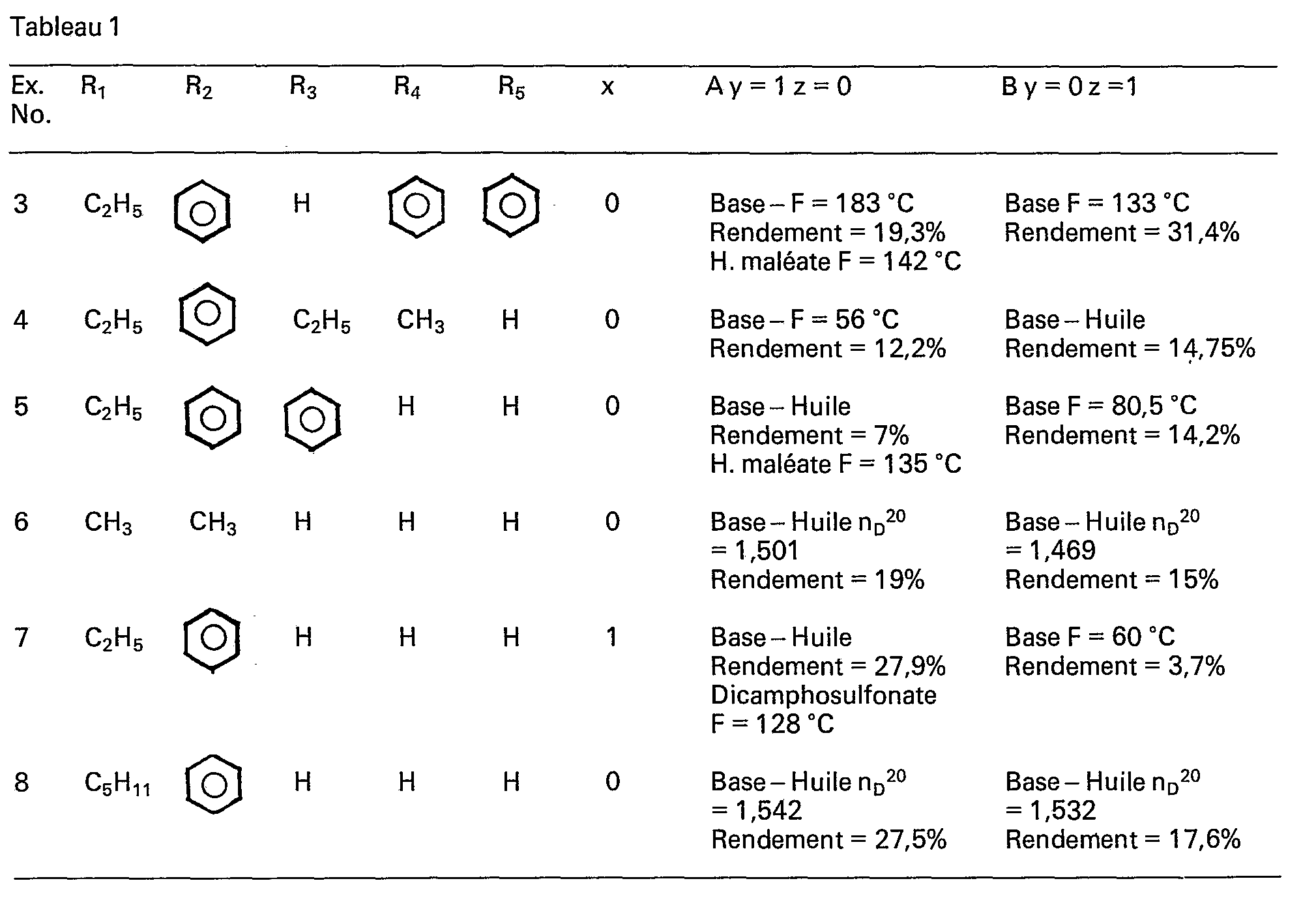
- Examples 3 to 8 are described in Table 1 below. They are prepared according to the procedure of Example 2 from the products of general formula II and III in which the meanings of R 1 , R 2 , R 3 , R 4 , R 5 , x, y and z are defined.
- X is a chlorine atom whereas for the products of formula III, M is a hydrogen or sodium atom.
- R 1 methyl
- R 2 p.methoxybenzyl
- the mixture is brought to 85-90 ° for 4 hours with vigorous stirring then, after cooling, the aqueous phase is removed.
- the toluene phase is washed with a saturated sodium chloride solution, dehydrated, then the toluene is removed by distillation. A residue of 22.0 g is obtained which is purified by chromatography on a silica column.
- the chlorinated derivative corresponding to the levorotatory isomer 2-phenyl 2-ethyl N, N-dimethylaminoethanol is prepared according to the usual technique.
- the product obtained is condensed with imidazole according to the technique described in Example 2.
- the acute toxicity of the products was studied in male SWISS / IOPS mice weighing approximately 22 g.
- the lethal dose 50% (LD 50 ) was calculated by the method of LJ Reed and H. Munch. (Am. J. Hyg. 1939-37-493) fourteen days after oral or intraperitoneal treatment of batches of 10 animals per dose and from 4 to 6 doses per product.
- the results of this study are presented in Table 3 for the products of Examples 1 to 8 and in Table 4 for the products of Examples 9 to 12.
- the cytoprotective activity has been studied with respect to the aggression of the gastric mucosa caused by ethanol.
- the cytoprotection test was carried out according to the technique described by A. Robert et al. (Gastroen- terology 1979-77-433). Lots of six male Dawley rats, fasted on solid food 24 hours before the test, receive 1 ml / rat of absolute ethanol orally after having received the test product 30 minutes before by subcutaneous injection. cutaneous or one hour previously by oral route. One hour after ingestion of the ethanol, the rats are sacrificed by elongation and their stomachs delicately removed, opened according to the great curvature, washed under running water and spread out. The ulcers are then identified and measured under a binocular lamp.
- the products of the invention also show an inhibitory activity of Thromboxane Synthetase. This activity can be linked to the cytoprotective properties described above.
- TXA 2 the effects of TXA 2 would be opposite to those of PGl 2 .
- the relationship between these two types of prostanoids is therefore important and all the more favorable with an increase in PG and a decrease in TX.
- the inhibition of Thromboxane Synthetase by the products of the invention is therefore significant and / or complementary to the cytoprotective activity.
- the products of the invention are administered to humans by routes appropriate to the nature and severity of the condition to be treated and in therapeutic forms compatible with the intended route of administration.
- These different forms prepared from the products of the invention in the form of the base or their different salts are prepared by methods known per se.
- the various preparations may also contain the products of the invention in combination with compatible active ingredients such as bacteriostats, antibiotics, antispasmodics, anesthetics, analgesics, anti-inflammatory agents. matoires, etc.
- active ingredients such as bacteriostats, antibiotics, antispasmodics, anesthetics, analgesics, anti-inflammatory agents. matoires, etc.
- tablets, dragees, capsules, powders, solutions, suspensions, gels and suppositories and to illustrate, without limitation, their manufacture, that of the tablets and that of the isotonic solutes injectable with the active ingredients of the invention.
- the gelatin and the white officinal surplus are dissolved in the water.
- the two solutions are mixed, polyethylene glycol 6000 is added thereto.
- lactose and the mannitol are intimately mixed and then the active substance of Example 2A, wheat starch, and then the solution obtained above are added in order.
- the dough is dried, granulated and sieved by adding magnesium stearate and wheat starch.
- the product obtained is homogenized and compressed at the rate of 200.0 mg per tablet.
- the isotonic solute is divided into ampoules of appropriate volume which are, after sealing, sterilized by thermal means known per se, or else the solute is sterilized by filtration, divided into ampoules which are then sealed, all operations being carried out under sterile atmosphere.
Landscapes
- Chemical & Material Sciences (AREA)
- Organic Chemistry (AREA)
- Health & Medical Sciences (AREA)
- Life Sciences & Earth Sciences (AREA)
- General Health & Medical Sciences (AREA)
- General Chemical & Material Sciences (AREA)
- Medicinal Chemistry (AREA)
- Nuclear Medicine, Radiotherapy & Molecular Imaging (AREA)
- Bioinformatics & Cheminformatics (AREA)
- Pharmacology & Pharmacy (AREA)
- Engineering & Computer Science (AREA)
- Animal Behavior & Ethology (AREA)
- Chemical Kinetics & Catalysis (AREA)
- Public Health (AREA)
- Veterinary Medicine (AREA)
- Pharmaceuticals Containing Other Organic And Inorganic Compounds (AREA)
- Plural Heterocyclic Compounds (AREA)
- Nitrogen And Oxygen Or Sulfur-Condensed Heterocyclic Ring Systems (AREA)
- Organic Low-Molecular-Weight Compounds And Preparation Thereof (AREA)
- Catalysts (AREA)
- Low-Molecular Organic Synthesis Reactions Using Catalysts (AREA)
- Saccharide Compounds (AREA)
- Solid-Sorbent Or Filter-Aiding Compositions (AREA)
Description
- La présente invention concerne de nouveaux dérivés de l'imidazole substitués en leur position 1 par un radical 2-N,N-diméthylaminoéthyle, leur procédé de préparation et leur application en médecine humaine et vétérinaire.
- Les produits selon l'invention répondent à la structure générale suivante:
-

- R1 est alcoyle ayant jusqu'à six atomes de carbone.
- R2 est soit alcoyle ayant jusqu'à six atomes de carbone, soit un radical phényle ou phénoxy éventuellement substitué par un atome de chlore, par un radical alcoxy ayant jusqu'à six atomes de carbone ou par un radical phényle.
- R3, R4 et R5 peuvent être identiques ou différents et sont des atomes d'hydrogène, des radicaux alcoyle ayant jusqu'à six atomes de carbone ou encore des radicaux phényle.
- x, y et z ont pour valeur 0 ou 1, les valeurs de y et de z ne pouvant toutefois être égales, et leurs sels d'addition avec des acides.
- D'une façon générale, les radicaux alcoyle et alcoxy comprennent de 1 à 6 atomes de carbone en chaîne lineaire ou ramifiée.
- Lorsque R2 est un radical phénoxy ou phényle il peut être plurisubstitué ou monosubstitué. Quand il est monosubstitué, la monosubstitution est préférentiellement située en position para par un atome de chlore, ou par un radical alcoxy ayant jusqu'a six atomes de carbone comme le radical méthoxy, ou encore par un radical aromatique comme le radical phényle.
- L'invention englobe également les mono ou di sels d'addition de ces dérivés, notamment d'acides minéraux tels que les halohydrates, sulfates, phosphates ou ceux d'acides organiques tels que les maléates, citrates, malates, tartrates, méthane- sulfonates, camphosulfonates, benzoates, etc.
- Il va de soi que l'invention porte aussi bien sur les formes racémiques des produits que sur leurs formes optiquement actives que l'on peut obtenir par des moyens bien connus, comme par exemple le dédoublement des formes racémiques au moyen d'acides optiquement actifs, ou encore par préparation à partir de structures optiquement actives.
- Les études pharmacologiques démontrent que parallèlement à une faible toxicité, les produits de l'invention possèdent une activité cytoprotectrice particulièrement remarquable appropriée au traitement préventif ou curatif des affections du tractus gastrintestinal. L'invention vise donc aussi une composition pharmaceutique comprenant un composé de formule (1) ou un sel de celui-ci associé à un véhicule pharmacologiquement acceptable. Le composé représente en général de 10 à 50 parties en poids de la composition, tandis que le véhicule en représente de 90 à 40 parties en poids.
- Les produits de l'invention sont préparés par N-alcoylation en position 1 du radical imidazole approprié au moyen d'halogénures de 2-N,N-diméthylaminoéthyle suivant la réaction:

- Les composés imidazole (III) sont pour certains accessibles dans le commerce ou sont préparés selon des méthodes connues qui consistent à faire réagir sur l'imidazole appropriée des métaux ou leurs hydroxyles, leurs hydrures, leurs alcoola- tes ou encore leurs amidures. Les dérivés (III) obtenus peuvent être soit isolés, soit préparés in situ de façon préliminaire dans le milieu réactionnel de préparation des produits de l'invention.
- La réaction de condensation pour la préparation des produits de l'invention peut s'effectuer dans différents milieux:
- - en milieu monophasique dans des solvants anhydres et inertes représentant de 3 à 100 fois et mieux de 8 à 15 fois le poids des deux réactifs comme des hydroacarbures halogénés, tels que le tétrachlorure de carbone, le dichlorométhane, le chloroforme, des hydrocarbures aromatiques, tels que le benzène, le toluène, des éthers, tels que l'éther diéthylique, des éthers cycliques, tels que le tétrahydrofuranne, le dioxanne, des hydrocarbures aliphatiques saturés éventuellement alcoxylés, tels que le diméthoxyéthane, l'hexane, l'heptane, des cétones telles que l'acétone, la méthyléthylcé- tone, des sulfoxydes, tels que le diméthylsul- foxyde, des amides tels que le diméthylformamide, le diméthylacétamide, l'hexaméthylphos- phorotriamide, etc.,
- - en milieu biphasique en présence d'eau et d'un solvant aromatique comme le benzène ou le toluène. La réaction s'effectue alors en milieu très alcalin en présence d'hydroxyde de sodium ou de potassium et en présence d'un catalyseur dit «de transfert de phase» comme des sels d'ammonium quaternaire qui peuvent être des bromures, chlorures, iodures, hydrogénosulfates ou tétrafluoro- borates de tétraméthylammonium, de triéthyl- benzylammonium, de triméthyloctadécylammo- nium, ou encore des dérivés phosphonium comme le bromure de tributylhexadécylphospho- nium. L'eau représente de 10 à 30 parties en volume pour 100 parties en volume de phase organique. L'ensemble eau et solvant organique représente de 3 à 100 fois et mieux de 8 à 15 fois du poids des deux réactifs. Le catalyseur représente 0,5 à 5 parties du poids des deux réactifs.
- Le plus souvent, on utilise 0,5 à 2 moles de dérivé (III) par mole de dérivé (II)et plus favorablement un rapport équimolaire entre ces deux réactifs.
- Les réactions s'effectuent à des températures comprises entre 20° et 150 °C selon le type de réaction et les solvants utilisés. On préfère cependant utiliser la réaction de condensation selon la méthode dite «par transfert de phase» à une température comprise entre 50 et 100 °C.
- La durée des réactions est comprise entre 1 et 10 heures et de façon préférée entre 2 et 5 heures.
- Les produits de l'invention sont isolés du milieu réactionnel par des procédés connus comme l'extraction, la distillation, la cristallisation et la chromatographie séparative.Leur identité et leur pureté sont vérifiée par des moyens conventionnels comme les méthodes spectrographiques (U.V., I.R., R.M.N., masse), chromatographiques (C.C.M., C.L.H.P.) ou physico- chimiques (point de fusion F, indice de réfraction nD 20).
- Les exemples qui suivent décrivent de façon non limitative les produits de l'invention.
- 1A: 1-[(2-phényl 2-éthyl)2-N,N-diméthyl- aminoéthyl] -imidazole
- R1 = éthyle, R2 = phényle, R3 = R4 = R5 = hydrogène,
- x=z=0,y=1.
- 1 B: 1-[(1-phényl 1-éthyl)2-N,N-diméthylami- noéthyl] -imidazole
- R1 = éthyle, R2 = phényle, R3 = R4 = R5 = hydrogène,
- x = y = 0,z = 1.
- Dans un réacteur d'un litre sous atmosphère d'zote, on introduit 100 ml de diméthylformamide (DMF) anhydre et 7,1 g d'hydrure de sodium à 80% (p/p) (5,66 g-0,236 mole).
- A la suspension grisâtre, on ajoute sous agitation une solution de 16,0 g (0,236 mole) d'imidazole dans 100 ml de DMF en 15 minutes environ et à une température inférieure à 25 °C. On obtient une solution verdâtre qui est maintenue 20 minutes sous agitation à température ambiante.
- On introduit ensuite en 20 minutes à une température voisine de 20 °C 50,0 g (0,236 mole) de chlorure de 2-phényl 2-éthyl 2-N,N-diméthylaminoéthyle en solution dans 100 ml de DM F.
- Le mélange est agité durant 2 heures 30 à température ambiante, puis précipité dans 1000 ml d'eau glacée et extrait à l'éther. Les phases éthérées réunies sont lavées à l'eau jusqu'à neutralité puis séchées sur sulfate de sodium.
- L'éther est éliminé par distillation sous vide et sur bain-marie. On obtient un résidu huileux (46 g) qui est traité pour obtenir les produits IA et IB.
- 1 A. Le résidu est repris par 400 ml de cyclohexane à ébullition. La solution abandonnée à la température ordinaire cristallise. Les cristaux sont filtrés et séchés à 60 °C sous vide. Poids: 19,0 g - Rendement = 33,1%. F = 91 °C. 1A, Hémimaléate.
- 13,25 g (0,054 mole) du produit précédent sont salifiés par 6,6 g (0,057 mole) d'acide maléique dans 130,0 ml d'éthanol au reflux. On obtient 17,6 g de cristaux blancs. Rendement = 90,7%. F = 124 °C. 1A, lodométhylate.
- 14,0 g (0,0575 mole) de produit sont dissous dans 85,0 ml d'acétone anhydre. On ajoute rapidement 24,5 g (0,173 mole) d'iodure de méthyle et on laisse agiter une nuit à température ambiante. On obtient 20,2 g de cristaux jaune pâle. Rendement = 91,2%. F = 163 °C.
- 1 B. Le cyclohexane de cristallisation de la base du produit 1A est éliminé par distillation sous vide. La résidu obtenu (28,0 g est purifié par chromatographie sur colonne de silice. L'élution par un mélange cyclohexane-acétate d'éthyle- méthanol 12-3-1 (v/v/v) permet de recueillir une fraction pure en chromatographie sur couche mince. Poids: 8,7 g Rendement = 15,2%. nD 20 = 1,5471.
- La spectrographie de résonance magnétique du proton et la spectrographie de masse des produits sont en accord et permettent d'attribuer sans équivoque les structures annoncées pour les produits 1 A et 1 B.
- 2A: 1 [(2-phényl 2-éthyl)2-N,N- diméthylami- noéthyl] -2méthylimidazole
- Ri: éthyle, R2 = phényle, R3 = méthyle, R4 = R5 = hydrogène x, z = 0, y = 1.
- 2B: 1-[(1-phényl 1-éthyl)2-N,N-diméthylami- noéthyl] - 2-méthylimidazole
- R1 = éthyle, R2 = phényle, R3 = méthyle, R4 = R5 = hydrogène,
- x=y=0, z = 1.
- Dans un réacteur d'un litre, on introduit 300,0 ml de toluène, 11,6g (0,142 mole) de 2-méthylimidazole, 30,0 g (0,142 mole) de chlorure de 2-phényl 2-éthyl 2-N,N-diméthylaminoéthyle, puis 45,0 ml de solution aqueuse d'hydroxyde de sodium (d = 1,33) et 2,7 g de bromure d'hexadécytributylphosphonium.
- Sous agitation énergique, le mélange est porté 2 heures à 80-85 °C. Après refroidissement, la phase aqueuse est éliminée et la phase toluénique lavée par extraction avec une solution saturée de chlorure de sodium.
- La phase toluénique est séchée sur sulfate de sodium puis le toluène est éliminé par distillation sous vide et sur le bain-marie.
- Le résidu huileux (38,5 g) est traité de façon identique à l'exemple 1 pour séparer les produits 2A et 2B. Après traitements et purifications, on obtient:
- 2A, Hémimaléate:
- Poids = 17,0 g. Rendement = 24,5%. F = 111,5 °C.
- 2B: Poids = 7,0 g. Rendement = 19,2%. F = 67,5 °C.
- Les méthodes spectrographiques utilisées confirment sans équivoque les structures des produits 2A et 2B.
- Les produits des exemples 3 à 8 sont décrits dans le tableau 1 qui suit. Ils sont préparés selon le mode opératoire de l'exemple 2 à partir des produits de formule générale II et III dans lesquels les significations de R1, R2, R3, R4, R5, x, y et z sont définies.
- Pour les produits de formule Il, X est un atome de chlore alors que pour les produits de formule III, M est un atome d'hydrogène ou de sodium.
- 1-[(2-p méthoxybenzyl 2-méthyl)-N,N-di- méthylaminoéthyl]imidazole, dihémimaléate.
- R1 = méthyle, R2 = p.méthoxybenzyle, R3 = R4 = R5 = hydrogène, x = 1, z = 0, y = 1.
- Dans un réacteur de 500 ml, on introduit 200 ml de toluène, 5,5 g (0,081 mole) d'imidazole, 19,6 g (0,081 mole de chlorure de 2-(p-méthoxybenzyl)- 2-méthyl-2-N,N diméthylaminoéthyle, 32,6 ml de solution aqueuse d'hydroxyde de sodium (d = 1,33) et 2,0 g de bromure d'hexadécyl-tributylphosphonium.
- Le mélange est porté 4 heures à 85-90° sous agitation énergique puis, après refroidissement, la phase aqueuse est écartée.
- La phase toluénique est lavée par une solution saturée de chlorure de sodium, déshydratée, puis le toluène est éliminé par distillation. On obtient un résidu de 22,0 g qui est purifié par chromatographie sur colonne de silice.
- L'élution par un mélange cyclohexane-acétate d'éthyle-méthanol 100-40-15 (v/v/v) permet d'isoler le produit désiré. Poids = 9,8 g. Rendement = 46,1 %.
- 8,4 g (0,032 mole) de produit sont salifiés par 7,75 g (0,067 mole) d'acide maléique dans 150 ml d'éthanol au reflux. Après refroidissement, les cristaux obtenus sont filtrés. Poids = 10,0 g. Rendement = 61,8% F= 122,5 °C.
- A partir des réactifs appropriés et selon le mode opératoire décrit pour l'exemple 9, on obtient les produits des exemples 10 et 11 (tableau 2) dans lesquels R3 = R4 = R5 = H, z = 0 et y = 1.

- 1-[(2-phényl 2-éthyl) 2-N,N-diméthylami- noéthyl] -imidazole.
- Le dérivé chloré correspondant à l'isomère lévogyre 2-phényl 2-éthyl N,N-diméthylamino- éthanol est préparé selon la technique habituelle.
- Le produit obtenu est condensé avec l'imidazole selon la technique décrite dans l'exemple 2.
- Après traitement et purification, on obtient 18,8 g de produit huileux. Rendement = 38,6%. [α]D 20 = /-27,8° (EtOH c = 1%).
- 18 g de produit précédent (0,074 mole) sont salifiés au reflux de l'éthanol par 9 g (0,078 mole) d'acide maléique.
- On obtient 20 g de cristaux blancs. Rendement = 75%. F = 125 °C. [α]D 20 = 29,2° (H20 c = 2%).
- Les essais toxicologiques et pharmacologiques décrits dans la partie qui suit montrent que les produits de l'invention ne sont que peu toxiques et présentent des activités cytoprotectrices intéressantes.
- La toxicité aiguë des produits a été étudiée chez la souris SWISS/IOPS mâle d'environ 22 g. La dose létale 50% (DL50) a été calculée par la méthode de L.J. Reed et H. Munch. (Am. J. Hyg. 1939-37-493) quatorze jours après traitement par voie orale ou intrapéritonéale de lots de 10 animaux par dose et à partir de 4 à 6 doses par produit. Les résultats de cette étude sont présentés dans le tableau 3 pour les produits des exemples 1 à 8 et dans le tableau 4 pour les produits des exemples 9 à 12.


- L'activité cytoprotectrice a été étudiée vis-à-vis de l'agression de la muqueuse gastrique provoquée par l'éthanol.
- Le test de cytoprotection a été réalisé selon la technique décrite par A. Robert et al. (Gastroen- terology 1979-77-433). Des lots de six rats Spra- gue Dawley mâles, mis à jeun de nourriture solide 24 heures avant le test, reçoivent par voie orale 1 ml/rat d'éthanol absolu, après avoir reçu le produit à tester 30 minutes auparavant par voie sous- cutanée ou une heure auparavant par voie orale. Une heure après l'ingestion de l'éthanol, les rats sont sacrifiés par élongation et leurs estomacs délicatement prélevés, ouverts selon la grande courbure, lavés sous eau courante et étalés. Les ulcérations sont ensuite repérées et mesurées sous une lampe binoculaire. Un index représentant la somme des longueurs des ulcères est ensuite déterminé pour chaque rat et la moyenne de ces index par lot est calculée et comparée à celle du lot contrôle à l'aide du test «t» de Student. La dose efficace 50% (DE50) est ensuite déterminée graphiquement lorsque cela est possible. Dans les autres cas, le pourcentage d'inhibition obtenu à l'aide de la dose maximum testée est présenté. Les résultats sont présentés dans le tableau 5 pour les produits des exemples 1 à 8 et dans le tableau 6 pour les produits des exemples 9 à 12.
-


- Par ailleurs, il paraît particulièrement intéressant de remarquer que cette activité se manifeste à des doses très éloignées des doses toxiques (1 /20 ou 1/40 de la DL50).
- Les produits de l'invention montrent également une activité inhibitrice de la Thromboxane Synthétase. Cette activité peut être reliée aux propriétés cytoprotectrices précédemment décrites.
- En effet, en résumant très brièvement des travaux récents, il apparaît que les prostanoïdes jouent un rôle déterminant dans les phénomènes vaso actifs de l'inflammation. Ainsi, dans certains cas d'inflammation ulcéreuse, il a été démontré aux niveaux gastrique et duodénal, une diminution de la synthèse des PGE2 et PGl2, ces produits étant des médiateurs qui possèdent des effets an- tisécrétoires acides, stimulateurs de la sécrétion alcaline et étant en eux-mêmes cytoprotecteurs.
- Inversement, les effets du TXA2 seraient opposés à ceux de PGl2. Le rapport entre ces deux types de prostanoïdes est donc important et d'autant plus favorable avec une augmentation des PG et une diminution des TX. L'inhibition de la Thromboxane Synthétase par les produits de l'invention est donc significative et/ou complémentaire de l'activité cytoprotectrice.
- Le test pratiqué a été réalisé «in vitro» sur des plaquettes lavées de lapin. Il a été inspiré des publications de Needleman (1977. Proc. Natl. Acad. Sci. 74.1716) et de Salmon (1982, Cardiovascu- lar Pharmacol. of the Prostaglandins - Raven Pess N.Y. p. 7 à 22). Il permet à la fois de déterminer la diminution de synthèse des TXB2 et d'autre par l'éventuelle augmentation de synthèse des PGE2-Il est ainsi possible de déterminer l'activité des produits sur le rapport PG. TX
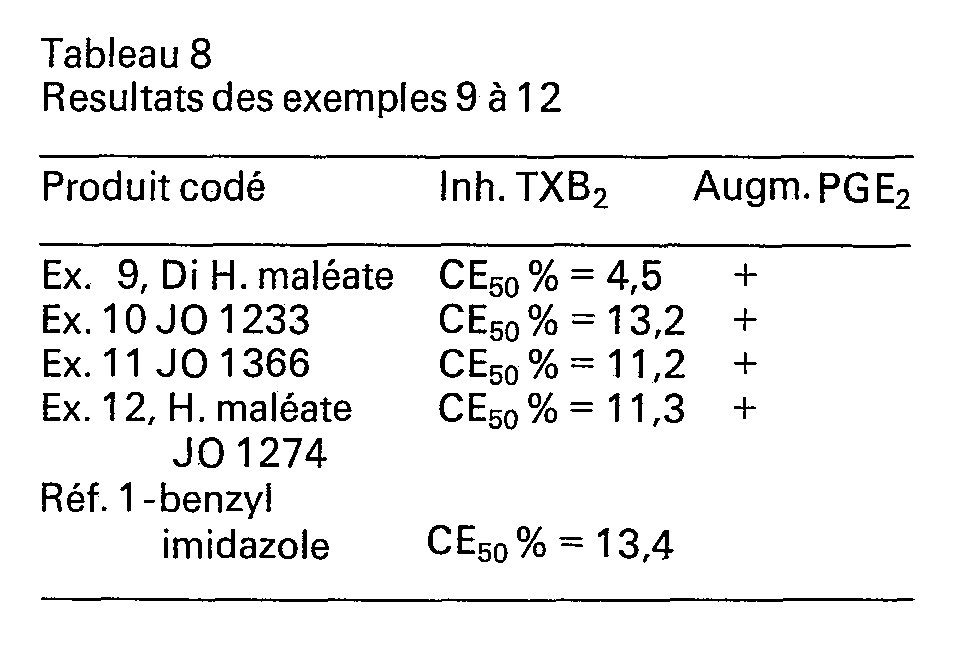
- Les résultats présentés dans les tableaux qui suivent sont exprimés en CE x % c'est-à-dire en concentrations micromolaires par litre permettant une inhibition de x % de la synthèse du TXB2. Dans la colonne voisine, la présence d'un signe + signifie que l'effet provoque également une augmentation de synthèse de la PGE2.
- Dans ce test, le 1-benzyl imidazole reconnu comme inhibiteur de Thromboxane Synthétase sur les plaquettes humaines (Hsin-Hsiung Tai - Barbara Yuan - Bioch.Biophys. Res. Comm. 1978 1 80 p. 236) a été utilisé comme substance de référence. Certains produits de l'invention montrent une activité égale ou nettement supérieure à ce produit en particulier les produits référencés JO 1193,1368,1367 et 1250.

- Les produits de l'invention sont administrés à l'être humain par des voies appropriées à la nature et à la gravité de l'affection à traiter et sous des formes thérapeutiques compatibles avec la voie d'administration envisagée. Ces différentes formes préparées à partir des produits de l'invention sous forme de base ou de leurs différents sels sont préparées par des méthodes connues en soi.
- Les différentes préparations peuvent également contenir les produits de l'invention en association avec des principes actifs compatibles tels que des bactériostatiques, antibiotiques, antispasmodiques, anesthésiques, analgésiques, antiinflam- matoires, etc. Pour exemples de ces préparations, on citera les comprimés, dragées, capsules, poudres, solutions, suspensions, gels et suppositoires et pour illustrer de façon non limitative leur fabrication, on donne ci-dessous celle des comprimés et celle des solutés isotoniques injectables avec les principes actifs de l'invention.
-

- Par ailleurs, le lactose et le mannitol sont mélangés intimement puis on ajoute, dans l'ordre, la substance active de l'exemple 2A, l'amidon de blé, puis la solution obtenue précédemment.
- La pâte est séchée, granulée et tamisée en y ajoutant le stéarate de magnésium et l'amidon de blé.
- Le produit obtenu est homogénéisé et compressé à raison de 200,0 mg par comprimé.
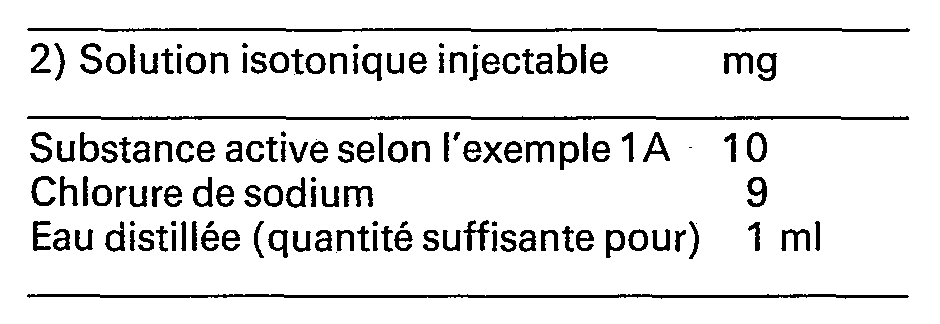
- La soluté isotonique est réparti en ampoules de volume approprié qui sont, après scellement, stérilisées par des moyens thermiques connus en soi, ou bien le soluté est stérilisé par filtration, réparti en ampoules qui sont ensuite scellées, l'ensemble des opérations étant effectué sous atmosphère stérile.
- Dans ce dernier cas, on préfère ajouter à la formule décrite, 1% d'alcool benzylique à titre d'agent bactériostatique, soit 10 mg de cet alcool par ml de soluté.
Claims (12)


Priority Applications (1)
| Application Number | Priority Date | Filing Date | Title |
|---|---|---|---|
| AT85400003T ATE32891T1 (de) | 1984-01-11 | 1985-01-03 | Aminoaethylimidazole, pharmazeutische zusammensetzungen die sie enthalten und verfahren zu ihrer herstellung. |
Applications Claiming Priority (2)
| Application Number | Priority Date | Filing Date | Title |
|---|---|---|---|
| FR8400351 | 1984-01-11 | ||
| FR8400351A FR2557875B1 (fr) | 1984-01-11 | 1984-01-11 | Aminoethylimidazole, composition pharmaceutique en contenant et procede de preparation |
Publications (3)
| Publication Number | Publication Date |
|---|---|
| EP0151052A2 EP0151052A2 (fr) | 1985-08-07 |
| EP0151052A3 EP0151052A3 (en) | 1985-08-21 |
| EP0151052B1 true EP0151052B1 (fr) | 1988-03-09 |
Family
ID=9300006
Family Applications (1)
| Application Number | Title | Priority Date | Filing Date |
|---|---|---|---|
| EP85400003A Expired EP0151052B1 (fr) | 1984-01-11 | 1985-01-03 | Aminoéthylimidazole, composition pharmaceutique en contenant et procédé de préparation |
Country Status (17)
| Country | Link |
|---|---|
| US (1) | US4734428A (fr) |
| EP (1) | EP0151052B1 (fr) |
| JP (1) | JPS60158179A (fr) |
| KR (1) | KR910006987B1 (fr) |
| AT (1) | ATE32891T1 (fr) |
| AU (1) | AU572241B2 (fr) |
| CA (1) | CA1242445A (fr) |
| DE (1) | DE3561816D1 (fr) |
| DK (1) | DK10085A (fr) |
| ES (1) | ES539438A0 (fr) |
| FI (1) | FI82452C (fr) |
| FR (1) | FR2557875B1 (fr) |
| HU (1) | HU193248B (fr) |
| IL (1) | IL73868A (fr) |
| PT (1) | PT79821B (fr) |
| YU (1) | YU44994B (fr) |
| ZA (1) | ZA8560B (fr) |
Families Citing this family (3)
| Publication number | Priority date | Publication date | Assignee | Title |
|---|---|---|---|---|
| US5252594A (en) * | 1992-06-17 | 1993-10-12 | Rohm And Haas Company | Fungicidal (2-aryl-2-substituted)ethyl-1,2,4-triazoles |
| US5358939A (en) * | 1992-06-25 | 1994-10-25 | Rohm And Haas Company | Fungicidal 2-aryl-2,2-disubstituted ethyl-1,2,4-triazoles |
| JP5498168B2 (ja) * | 2006-12-01 | 2014-05-21 | ブリストル−マイヤーズ スクイブ カンパニー | アテローム性動脈硬化および循環器疾患の治療のためのcetp阻害剤としてのn−((3−ベンジル)−2,2−(ビス−フェニル)−プロパン−1−アミン誘導体 |
Family Cites Families (7)
| Publication number | Priority date | Publication date | Assignee | Title |
|---|---|---|---|---|
| US3912689A (en) * | 1973-04-02 | 1975-10-14 | Air Prod & Chem | Dialkylaminoalkylimidazoles as catalysts for preparation of polyurethanes |
| DE2407143A1 (de) * | 1974-02-15 | 1975-08-28 | Bayer Ag | Mittel zur regulierung des pflanzenwachstums |
| GB2016452B (en) * | 1978-02-18 | 1982-07-21 | Kissei Pharmaceutical | Imidazole compounds |
| CA1189857A (fr) * | 1981-03-27 | 1985-07-02 | Janssen Pharmaceutica Naamloze Vennootschap | Triazoles derives antimicrobiens |
| DK162882A (da) * | 1981-04-13 | 1982-10-14 | Searle & Co | Imidazolderivater eller syreadditionssalte deraf,deres fremstilling og anvendelse |
| AU546848B2 (en) * | 1981-04-13 | 1985-09-26 | G.D. Searle & Co. | Imidezole derivatives |
| US4579862A (en) * | 1983-07-05 | 1986-04-01 | G. D. Searle & Co. | Certain 1H-imidazol-1-yl-1-lower-alkanoic acid derivatives having anti-thrombotic activity |
-
1984
- 1984-01-11 FR FR8400351A patent/FR2557875B1/fr not_active Expired
- 1984-12-19 IL IL73868A patent/IL73868A/xx not_active IP Right Cessation
- 1984-12-19 AU AU36926/84A patent/AU572241B2/en not_active Ceased
- 1984-12-29 KR KR1019840008528A patent/KR910006987B1/ko not_active Expired
-
1985
- 1985-01-03 AT AT85400003T patent/ATE32891T1/de active
- 1985-01-03 ZA ZA8560A patent/ZA8560B/xx unknown
- 1985-01-03 EP EP85400003A patent/EP0151052B1/fr not_active Expired
- 1985-01-03 DE DE8585400003T patent/DE3561816D1/de not_active Expired
- 1985-01-08 YU YU29/85A patent/YU44994B/xx unknown
- 1985-01-09 JP JP60001011A patent/JPS60158179A/ja active Pending
- 1985-01-09 DK DK10085A patent/DK10085A/da not_active Application Discontinuation
- 1985-01-10 PT PT79821A patent/PT79821B/fr unknown
- 1985-01-10 CA CA000471836A patent/CA1242445A/fr not_active Expired
- 1985-01-10 HU HU8577A patent/HU193248B/hu not_active IP Right Cessation
- 1985-01-10 FI FI850116A patent/FI82452C/fi not_active IP Right Cessation
- 1985-01-10 ES ES539438A patent/ES539438A0/es active Granted
-
1986
- 1986-06-10 US US06/872,481 patent/US4734428A/en not_active Expired - Fee Related
Also Published As
| Publication number | Publication date |
|---|---|
| FI850116L (fi) | 1985-07-12 |
| EP0151052A3 (en) | 1985-08-21 |
| ATE32891T1 (de) | 1988-03-15 |
| ZA8560B (en) | 1986-08-27 |
| IL73868A (en) | 1988-05-31 |
| YU2985A (en) | 1987-12-31 |
| US4734428A (en) | 1988-03-29 |
| ES8601147A1 (es) | 1985-11-16 |
| KR910006987B1 (ko) | 1991-09-14 |
| PT79821A (fr) | 1985-02-01 |
| PT79821B (fr) | 1986-10-28 |
| FR2557875A1 (fr) | 1985-07-12 |
| YU44994B (en) | 1991-06-30 |
| AU3692684A (en) | 1985-07-18 |
| DE3561816D1 (en) | 1988-04-14 |
| HUT37126A (en) | 1985-11-28 |
| DK10085D0 (da) | 1985-01-09 |
| ES539438A0 (es) | 1985-11-16 |
| DK10085A (da) | 1985-07-12 |
| KR850005828A (ko) | 1985-09-26 |
| CA1242445A (fr) | 1988-09-27 |
| EP0151052A2 (fr) | 1985-08-07 |
| FI82452C (fi) | 1991-03-11 |
| AU572241B2 (en) | 1988-05-05 |
| HU193248B (en) | 1987-08-28 |
| FI850116A0 (fi) | 1985-01-10 |
| IL73868A0 (en) | 1985-03-31 |
| JPS60158179A (ja) | 1985-08-19 |
| FR2557875B1 (fr) | 1986-04-25 |
| FI82452B (fi) | 1990-11-30 |
Similar Documents
| Publication | Publication Date | Title |
|---|---|---|
| EP0068968B1 (fr) | Nouveaux médicaments contenant à titre de substance active des composés du type arylbenzènesulfonamide et leurs procédés de préparation | |
| EP0479631B1 (fr) | Dérivés du spiro [4.5]décane leur procédé de préparation et les compositions pharmaceutiques les renfermant | |
| EP0010460A1 (fr) | Nouveaux dérivés de pyrrolidine-2-méthanol, procédé pour leur préparation et médicaments les contenant | |
| EP0117771B1 (fr) | Imino-2 pyrrolidines, leur procédé de préparation et leurs applications en thérapeutique | |
| EP0364350B1 (fr) | Dérivés de méthyl-4[(phényl-4 pipérazinyl-1)-2 éthyl]-5 thiazole, leur procédé de préparation et les compositions pharmaceutiques en contenant | |
| EP0006789A1 (fr) | Composés bis (aryloxyalcanecarboxyliques), leur préparation et leur utilisation en thérapeutique | |
| FR2662442A1 (fr) | Trifluoromethylphenyltetrahydropyridines n-substituees procede pour leur preparation, intermediaires du procede et compositions pharmaceutiques les contenant. | |
| EP0376850A1 (fr) | Dérivés du benzène, leur préparation et compositions pharmaceutiques les contenant | |
| BE897617A (fr) | Thioesters d'acide acetylsalicylique procede pour les preparer et compositions pharmaceutiques qui en renferment | |
| EP0486385B1 (fr) | Dérivés d'imidazole, leur procédé de préparation et les compositions pharmaceutiques qui les contiennent | |
| EP0063084B1 (fr) | Dérivés de phénéthanolamine, leur préparation et leur application en thérapeutique | |
| EP0301936A1 (fr) | Dérivés de pipéridine, leur préparation et leur application en thérapeutique | |
| EP0173585B1 (fr) | Médicaments à base de dérivés de la pipéridine, nouveaux dérivés de la pipéridine et leurs procédés de préparation | |
| EP0151052A2 (fr) | Aminoéthylimidazole, composition pharmaceutique en contenant et procédé de préparation | |
| FR2617842A1 (fr) | Derives de thiophene, leur procede de fabrication et medicaments les contenant | |
| EP0078765B1 (fr) | Dérivés de p-acylaminophénol à effet thérapeutique, procédé pour leur préparation, et composition à effet thérapeutique contenant lesdits dérivés à titre d'ingrédients pharmacologiquement actifs | |
| EP0002401B1 (fr) | Dérivés de naphtalène, leur préparation et leur application en thérapeutique | |
| FR2516510A1 (fr) | Derives de la (trimethoxy-3,4,5-cinnamoyl)-1-aminocarbonylethyl-4-piperazine substituee utilisables en pharmacie et procede pour leur preparation | |
| JPH02275846A (ja) | カルボン酸誘導体 | |
| FR2531709A1 (fr) | Diazabicyclooctanes, procede pour leur preparation et compositions pharmaceutiques les renfermant | |
| FR2707989A1 (fr) | Nouveaux dérivés de benzylamines silylées, leurs sels, leurs procédés de fabrication et les compositions pharmaceutiques les renfermant. | |
| EP0288647B1 (fr) | Dérivés du [(pyrrolidinyl-1)-2éthoxy]-5 p-cymène, le procédé de préparation desdits dérivés et les médicaments contenant lesdits dérivés | |
| EP0103503A2 (fr) | Amides N-substitués, leurs sels, procédé pour leur préparation et compositions pharmaceutiques en contenant | |
| FR2529549A1 (fr) | Oxime-ethers d'eburnane, procede pour leur preparation et compositions pharmaceutiques qui les contiennent | |
| EP0065909B1 (fr) | ((Pipéridyl-4)-2 alkyl-1 éthyl)-3 indoles et leur utilisation comme médicaments |
Legal Events
| Date | Code | Title | Description |
|---|---|---|---|
| PUAI | Public reference made under article 153(3) epc to a published international application that has entered the european phase |
Free format text: ORIGINAL CODE: 0009012 |
|
| PUAL | Search report despatched |
Free format text: ORIGINAL CODE: 0009013 |
|
| AK | Designated contracting states |
Designated state(s): AT BE CH DE FR GB IT LI LU NL SE |
|
| AK | Designated contracting states |
Designated state(s): AT BE CH DE FR GB IT LI LU NL SE |
|
| 17P | Request for examination filed |
Effective date: 19850916 |
|
| 17Q | First examination report despatched |
Effective date: 19860724 |
|
| GRAA | (expected) grant |
Free format text: ORIGINAL CODE: 0009210 |
|
| AK | Designated contracting states |
Kind code of ref document: B1 Designated state(s): AT BE CH DE FR GB IT LI LU NL SE |
|
| REF | Corresponds to: |
Ref document number: 32891 Country of ref document: AT Date of ref document: 19880315 Kind code of ref document: T |
|
| GBT | Gb: translation of ep patent filed (gb section 77(6)(a)/1977) | ||
| REF | Corresponds to: |
Ref document number: 3561816 Country of ref document: DE Date of ref document: 19880414 |
|
| ITF | It: translation for a ep patent filed | ||
| PLBE | No opposition filed within time limit |
Free format text: ORIGINAL CODE: 0009261 |
|
| STAA | Information on the status of an ep patent application or granted ep patent |
Free format text: STATUS: NO OPPOSITION FILED WITHIN TIME LIMIT |
|
| PG25 | Lapsed in a contracting state [announced via postgrant information from national office to epo] |
Ref country code: LU Free format text: LAPSE BECAUSE OF NON-PAYMENT OF DUE FEES Effective date: 19890131 |
|
| PGFP | Annual fee paid to national office [announced via postgrant information from national office to epo] |
Ref country code: NL Payment date: 19890131 Year of fee payment: 7 |
|
| 26N | No opposition filed | ||
| PGFP | Annual fee paid to national office [announced via postgrant information from national office to epo] |
Ref country code: FR Payment date: 19901206 Year of fee payment: 7 |
|
| PGFP | Annual fee paid to national office [announced via postgrant information from national office to epo] |
Ref country code: SE Payment date: 19901213 Year of fee payment: 7 |
|
| PGFP | Annual fee paid to national office [announced via postgrant information from national office to epo] |
Ref country code: LU Payment date: 19901214 Year of fee payment: 7 |
|
| PGFP | Annual fee paid to national office [announced via postgrant information from national office to epo] |
Ref country code: AT Payment date: 19901217 Year of fee payment: 7 |
|
| PGFP | Annual fee paid to national office [announced via postgrant information from national office to epo] |
Ref country code: CH Payment date: 19901221 Year of fee payment: 7 |
|
| PGFP | Annual fee paid to national office [announced via postgrant information from national office to epo] |
Ref country code: BE Payment date: 19901224 Year of fee payment: 7 |
|
| PGFP | Annual fee paid to national office [announced via postgrant information from national office to epo] |
Ref country code: DE Payment date: 19901228 Year of fee payment: 7 Ref country code: GB Payment date: 19901228 Year of fee payment: 7 |
|
| ITTA | It: last paid annual fee | ||
| EPTA | Lu: last paid annual fee | ||
| PG25 | Lapsed in a contracting state [announced via postgrant information from national office to epo] |
Ref country code: AT Effective date: 19920103 Ref country code: GB Effective date: 19920103 |
|
| PG25 | Lapsed in a contracting state [announced via postgrant information from national office to epo] |
Ref country code: SE Effective date: 19920104 |
|
| PG25 | Lapsed in a contracting state [announced via postgrant information from national office to epo] |
Ref country code: BE Effective date: 19920131 Ref country code: LI Effective date: 19920131 Ref country code: CH Effective date: 19920131 |
|
| BERE | Be: lapsed |
Owner name: S.A. JOUVEINAL Effective date: 19920131 |
|
| PG25 | Lapsed in a contracting state [announced via postgrant information from national office to epo] |
Ref country code: NL Effective date: 19920801 |
|
| GBPC | Gb: european patent ceased through non-payment of renewal fee | ||
| NLV4 | Nl: lapsed or anulled due to non-payment of the annual fee | ||
| PG25 | Lapsed in a contracting state [announced via postgrant information from national office to epo] |
Ref country code: FR Effective date: 19920930 |
|
| REG | Reference to a national code |
Ref country code: CH Ref legal event code: PL |
|
| PG25 | Lapsed in a contracting state [announced via postgrant information from national office to epo] |
Ref country code: DE Effective date: 19921001 |
|
| REG | Reference to a national code |
Ref country code: FR Ref legal event code: ST |
|
| EUG | Se: european patent has lapsed |
Ref document number: 85400003.1 Effective date: 19920806 |