EP0150765A2 - Verwendung von p-Ureidoalkylamino-nitrobenzolverbindungen in Haarfärbemitteln und neue p-Ureidoalkylamino-nitrobenzolverbindungen - Google Patents
Verwendung von p-Ureidoalkylamino-nitrobenzolverbindungen in Haarfärbemitteln und neue p-Ureidoalkylamino-nitrobenzolverbindungen Download PDFInfo
- Publication number
- EP0150765A2 EP0150765A2 EP85100398A EP85100398A EP0150765A2 EP 0150765 A2 EP0150765 A2 EP 0150765A2 EP 85100398 A EP85100398 A EP 85100398A EP 85100398 A EP85100398 A EP 85100398A EP 0150765 A2 EP0150765 A2 EP 0150765A2
- Authority
- EP
- European Patent Office
- Prior art keywords
- hair
- dyes
- ureidoalkylamino
- nitrobenzene
- dye
- Prior art date
- Legal status (The legal status is an assumption and is not a legal conclusion. Google has not performed a legal analysis and makes no representation as to the accuracy of the status listed.)
- Granted
Links
- 239000000203 mixture Substances 0.000 title claims description 14
- 238000004043 dyeing Methods 0.000 title claims description 9
- 150000005181 nitrobenzenes Chemical class 0.000 title description 3
- 239000000118 hair dye Substances 0.000 claims abstract description 38
- 239000000975 dye Substances 0.000 claims abstract description 29
- 125000004432 carbon atom Chemical group C* 0.000 claims abstract description 7
- 229910052739 hydrogen Inorganic materials 0.000 claims abstract description 4
- 239000001257 hydrogen Substances 0.000 claims abstract description 3
- 125000004435 hydrogen atom Chemical group [H]* 0.000 claims abstract description 3
- 230000003647 oxidation Effects 0.000 claims description 14
- 238000007254 oxidation reaction Methods 0.000 claims description 14
- 239000003795 chemical substances by application Substances 0.000 claims description 7
- 125000002924 primary amino group Chemical group [H]N([H])* 0.000 claims description 7
- 239000000654 additive Substances 0.000 claims description 6
- 239000002537 cosmetic Substances 0.000 claims description 6
- 229920000642 polymer Polymers 0.000 claims description 6
- 125000002768 hydroxyalkyl group Chemical group 0.000 claims description 2
- 125000004066 1-hydroxyethyl group Chemical group [H]OC([H])([*])C([H])([H])[H] 0.000 claims 1
- 150000001875 compounds Chemical class 0.000 abstract description 15
- 239000003086 colorant Substances 0.000 abstract description 6
- QFFVPLLCYGOFPU-UHFFFAOYSA-N barium chromate Chemical compound [Ba+2].[O-][Cr]([O-])(=O)=O QFFVPLLCYGOFPU-UHFFFAOYSA-N 0.000 abstract description 3
- 239000003638 chemical reducing agent Substances 0.000 abstract description 3
- 230000002110 toxicologic effect Effects 0.000 abstract description 3
- 238000009967 direct dyeing Methods 0.000 abstract 1
- 230000002349 favourable effect Effects 0.000 abstract 1
- 231100000723 toxicological property Toxicity 0.000 abstract 1
- -1 hydroxyalkyl radical Chemical group 0.000 description 15
- 239000007800 oxidant agent Substances 0.000 description 14
- 239000001005 nitro dye Substances 0.000 description 13
- XLYOFNOQVPJJNP-UHFFFAOYSA-N water Substances O XLYOFNOQVPJJNP-UHFFFAOYSA-N 0.000 description 9
- MHAJPDPJQMAIIY-UHFFFAOYSA-N Hydrogen peroxide Chemical compound OO MHAJPDPJQMAIIY-UHFFFAOYSA-N 0.000 description 8
- 238000004040 coloring Methods 0.000 description 8
- 238000002360 preparation method Methods 0.000 description 7
- QGZKDVFQNNGYKY-UHFFFAOYSA-N Ammonia Chemical compound N QGZKDVFQNNGYKY-UHFFFAOYSA-N 0.000 description 6
- KRKNYBCHXYNGOX-UHFFFAOYSA-N citric acid Chemical compound OC(=O)CC(O)(C(O)=O)CC(O)=O KRKNYBCHXYNGOX-UHFFFAOYSA-N 0.000 description 6
- QTBSBXVTEAMEQO-UHFFFAOYSA-N Acetic acid Chemical compound CC(O)=O QTBSBXVTEAMEQO-UHFFFAOYSA-N 0.000 description 5
- 239000002253 acid Substances 0.000 description 5
- LYCAIKOWRPUZTN-UHFFFAOYSA-N Ethylene glycol Chemical compound OCCO LYCAIKOWRPUZTN-UHFFFAOYSA-N 0.000 description 4
- 239000006071 cream Substances 0.000 description 4
- 238000001035 drying Methods 0.000 description 4
- 239000000499 gel Substances 0.000 description 4
- 230000037308 hair color Effects 0.000 description 4
- 239000000243 solution Substances 0.000 description 4
- PLIKAWJENQZMHA-UHFFFAOYSA-N 4-aminophenol Chemical class NC1=CC=C(O)C=C1 PLIKAWJENQZMHA-UHFFFAOYSA-N 0.000 description 3
- TYMLOMAKGOJONV-UHFFFAOYSA-N 4-nitroaniline Chemical class NC1=CC=C([N+]([O-])=O)C=C1 TYMLOMAKGOJONV-UHFFFAOYSA-N 0.000 description 3
- LFQSCWFLJHTTHZ-UHFFFAOYSA-N Ethanol Chemical compound CCO LFQSCWFLJHTTHZ-UHFFFAOYSA-N 0.000 description 3
- XEKOWRVHYACXOJ-UHFFFAOYSA-N Ethyl acetate Chemical compound CCOC(C)=O XEKOWRVHYACXOJ-UHFFFAOYSA-N 0.000 description 3
- PEDCQBHIVMGVHV-UHFFFAOYSA-N Glycerine Chemical compound OCC(O)CO PEDCQBHIVMGVHV-UHFFFAOYSA-N 0.000 description 3
- DNIAPMSPPWPWGF-UHFFFAOYSA-N Propylene glycol Chemical compound CC(O)CO DNIAPMSPPWPWGF-UHFFFAOYSA-N 0.000 description 3
- 150000001412 amines Chemical class 0.000 description 3
- 229910021529 ammonia Inorganic materials 0.000 description 3
- 235000014113 dietary fatty acids Nutrition 0.000 description 3
- 239000000194 fatty acid Substances 0.000 description 3
- 229930195729 fatty acid Natural products 0.000 description 3
- 150000007524 organic acids Chemical class 0.000 description 3
- 239000002562 thickening agent Substances 0.000 description 3
- 239000000080 wetting agent Substances 0.000 description 3
- GHOKWGTUZJEAQD-ZETCQYMHSA-N (D)-(+)-Pantothenic acid Chemical compound OCC(C)(C)[C@@H](O)C(=O)NCCC(O)=O GHOKWGTUZJEAQD-ZETCQYMHSA-N 0.000 description 2
- ICVRBKCRXNVOJC-UHFFFAOYSA-N 1-amino-4-(methylamino)anthracene-9,10-dione Chemical compound O=C1C2=CC=CC=C2C(=O)C2=C1C(N)=CC=C2NC ICVRBKCRXNVOJC-UHFFFAOYSA-N 0.000 description 2
- WFQDTOYDVUWQMS-UHFFFAOYSA-N 1-fluoro-4-nitrobenzene Chemical compound [O-][N+](=O)C1=CC=C(F)C=C1 WFQDTOYDVUWQMS-UHFFFAOYSA-N 0.000 description 2
- HZAXFHJVJLSVMW-UHFFFAOYSA-N 2-Aminoethan-1-ol Chemical compound NCCO HZAXFHJVJLSVMW-UHFFFAOYSA-N 0.000 description 2
- HVHNMNGARPCGGD-UHFFFAOYSA-N 2-nitro-p-phenylenediamine Chemical compound NC1=CC=C(N)C([N+]([O-])=O)=C1 HVHNMNGARPCGGD-UHFFFAOYSA-N 0.000 description 2
- CWLKGDAVCFYWJK-UHFFFAOYSA-N 3-aminophenol Chemical compound NC1=CC=CC(O)=C1 CWLKGDAVCFYWJK-UHFFFAOYSA-N 0.000 description 2
- CZGCEKJOLUNIFY-UHFFFAOYSA-N 4-Chloronitrobenzene Chemical compound [O-][N+](=O)C1=CC=C(Cl)C=C1 CZGCEKJOLUNIFY-UHFFFAOYSA-N 0.000 description 2
- CIWBSHSKHKDKBQ-JLAZNSOCSA-N Ascorbic acid Chemical compound OC[C@H](O)[C@H]1OC(=O)C(O)=C1O CIWBSHSKHKDKBQ-JLAZNSOCSA-N 0.000 description 2
- 229920001661 Chitosan Polymers 0.000 description 2
- FEWJPZIEWOKRBE-JCYAYHJZSA-N Dextrotartaric acid Chemical compound OC(=O)[C@H](O)[C@@H](O)C(O)=O FEWJPZIEWOKRBE-JCYAYHJZSA-N 0.000 description 2
- IAZDPXIOMUYVGZ-UHFFFAOYSA-N Dimethylsulphoxide Chemical compound CS(C)=O IAZDPXIOMUYVGZ-UHFFFAOYSA-N 0.000 description 2
- KFZMGEQAYNKOFK-UHFFFAOYSA-N Isopropanol Chemical compound CC(C)O KFZMGEQAYNKOFK-UHFFFAOYSA-N 0.000 description 2
- ISWSIDIOOBJBQZ-UHFFFAOYSA-N Phenol Chemical compound OC1=CC=CC=C1 ISWSIDIOOBJBQZ-UHFFFAOYSA-N 0.000 description 2
- FEWJPZIEWOKRBE-UHFFFAOYSA-N Tartaric acid Natural products [H+].[H+].[O-]C(=O)C(O)C(O)C([O-])=O FEWJPZIEWOKRBE-UHFFFAOYSA-N 0.000 description 2
- GSEJCLTVZPLZKY-UHFFFAOYSA-N Triethanolamine Chemical compound OCCN(CCO)CCO GSEJCLTVZPLZKY-UHFFFAOYSA-N 0.000 description 2
- 229960000583 acetic acid Drugs 0.000 description 2
- 239000007864 aqueous solution Substances 0.000 description 2
- 125000003118 aryl group Chemical group 0.000 description 2
- 239000002585 base Substances 0.000 description 2
- 125000001951 carbamoylamino group Chemical group C(N)(=O)N* 0.000 description 2
- HVYWMOMLDIMFJA-DPAQBDIFSA-N cholesterol Chemical compound C1C=C2C[C@@H](O)CC[C@]2(C)[C@@H]2[C@@H]1[C@@H]1CC[C@H]([C@H](C)CCCC(C)C)[C@@]1(C)CC2 HVYWMOMLDIMFJA-DPAQBDIFSA-N 0.000 description 2
- 235000019646 color tone Nutrition 0.000 description 2
- ZXJXZNDDNMQXFV-UHFFFAOYSA-M crystal violet Chemical compound [Cl-].C1=CC(N(C)C)=CC=C1[C+](C=1C=CC(=CC=1)N(C)C)C1=CC=C(N(C)C)C=C1 ZXJXZNDDNMQXFV-UHFFFAOYSA-M 0.000 description 2
- 239000003995 emulsifying agent Substances 0.000 description 2
- 239000000839 emulsion Substances 0.000 description 2
- 150000004665 fatty acids Chemical class 0.000 description 2
- 150000002191 fatty alcohols Chemical class 0.000 description 2
- KWIUHFFTVRNATP-UHFFFAOYSA-N glycine betaine Chemical compound C[N+](C)(C)CC([O-])=O KWIUHFFTVRNATP-UHFFFAOYSA-N 0.000 description 2
- 229910052736 halogen Inorganic materials 0.000 description 2
- 238000010438 heat treatment Methods 0.000 description 2
- 239000007788 liquid Substances 0.000 description 2
- 238000002844 melting Methods 0.000 description 2
- 230000008018 melting Effects 0.000 description 2
- 239000003921 oil Substances 0.000 description 2
- 239000002304 perfume Substances 0.000 description 2
- XKJCHHZQLQNZHY-UHFFFAOYSA-N phthalimide Chemical class C1=CC=C2C(=O)NC(=O)C2=C1 XKJCHHZQLQNZHY-UHFFFAOYSA-N 0.000 description 2
- 230000001766 physiological effect Effects 0.000 description 2
- 229920000036 polyvinylpyrrolidone Polymers 0.000 description 2
- 239000001267 polyvinylpyrrolidone Substances 0.000 description 2
- 235000013855 polyvinylpyrrolidone Nutrition 0.000 description 2
- 239000002243 precursor Substances 0.000 description 2
- 239000000047 product Substances 0.000 description 2
- GHMLBKRAJCXXBS-UHFFFAOYSA-N resorcinol Chemical compound OC1=CC=CC(O)=C1 GHMLBKRAJCXXBS-UHFFFAOYSA-N 0.000 description 2
- 238000005728 strengthening Methods 0.000 description 2
- 239000000126 substance Substances 0.000 description 2
- 239000011975 tartaric acid Substances 0.000 description 2
- 235000002906 tartaric acid Nutrition 0.000 description 2
- 231100000027 toxicology Toxicity 0.000 description 2
- 0 *C1C=CC([N+]([O-])=O)=CC1 Chemical compound *C1C=CC([N+]([O-])=O)=CC1 0.000 description 1
- WZCQRUWWHSTZEM-UHFFFAOYSA-N 1,3-phenylenediamine Chemical compound NC1=CC=CC(N)=C1 WZCQRUWWHSTZEM-UHFFFAOYSA-N 0.000 description 1
- CBCKQZAAMUWICA-UHFFFAOYSA-N 1,4-phenylenediamine Chemical compound NC1=CC=C(N)C=C1 CBCKQZAAMUWICA-UHFFFAOYSA-N 0.000 description 1
- SMZOUWXMTYCWNB-UHFFFAOYSA-N 2-(2-methoxy-5-methylphenyl)ethanamine Chemical compound COC1=CC=C(C)C=C1CCN SMZOUWXMTYCWNB-UHFFFAOYSA-N 0.000 description 1
- HCIMVGCCCGSDQC-UHFFFAOYSA-N 2-(4-aminoanilino)ethylurea Chemical compound NC(=O)NCCNC1=CC=C(N)C=C1 HCIMVGCCCGSDQC-UHFFFAOYSA-N 0.000 description 1
- NIXOWILDQLNWCW-UHFFFAOYSA-N 2-Propenoic acid Natural products OC(=O)C=C NIXOWILDQLNWCW-UHFFFAOYSA-N 0.000 description 1
- OBCSAIDCZQSFQH-UHFFFAOYSA-N 2-methyl-1,4-phenylenediamine Chemical compound CC1=CC(N)=CC=C1N OBCSAIDCZQSFQH-UHFFFAOYSA-N 0.000 description 1
- DPJCXCZTLWNFOH-UHFFFAOYSA-N 2-nitroaniline Chemical compound NC1=CC=CC=C1[N+]([O-])=O DPJCXCZTLWNFOH-UHFFFAOYSA-N 0.000 description 1
- BLCZXLGRKKRKJJ-UHFFFAOYSA-N 3-amino-2-nitrophenol Chemical class NC1=CC=CC(O)=C1[N+]([O-])=O BLCZXLGRKKRKJJ-UHFFFAOYSA-N 0.000 description 1
- 229940018563 3-aminophenol Drugs 0.000 description 1
- 238000010953 Ames test Methods 0.000 description 1
- 231100000039 Ames test Toxicity 0.000 description 1
- 229920002134 Carboxymethyl cellulose Polymers 0.000 description 1
- GHOKWGTUZJEAQD-UHFFFAOYSA-N Chick antidermatitis factor Natural products OCC(C)(C)C(O)C(=O)NCCC(O)=O GHOKWGTUZJEAQD-UHFFFAOYSA-N 0.000 description 1
- 229920002101 Chitin Polymers 0.000 description 1
- 244000248349 Citrus limon Species 0.000 description 1
- 235000005979 Citrus limon Nutrition 0.000 description 1
- 238000005642 Gabriel synthesis reaction Methods 0.000 description 1
- 239000004166 Lanolin Substances 0.000 description 1
- CERQOIWHTDAKMF-UHFFFAOYSA-N Methacrylic acid Chemical compound CC(=C)C(O)=O CERQOIWHTDAKMF-UHFFFAOYSA-N 0.000 description 1
- 239000005662 Paraffin oil Substances 0.000 description 1
- 239000004372 Polyvinyl alcohol Substances 0.000 description 1
- 229920002125 Sokalan® Chemical class 0.000 description 1
- 229920002472 Starch Chemical class 0.000 description 1
- XTXRWKRVRITETP-UHFFFAOYSA-N Vinyl acetate Chemical compound CC(=O)OC=C XTXRWKRVRITETP-UHFFFAOYSA-N 0.000 description 1
- 239000003929 acidic solution Substances 0.000 description 1
- 230000002378 acidificating effect Effects 0.000 description 1
- 150000007513 acids Chemical class 0.000 description 1
- 230000007059 acute toxicity Effects 0.000 description 1
- 231100000403 acute toxicity Toxicity 0.000 description 1
- 229920000615 alginic acid Polymers 0.000 description 1
- 235000010443 alginic acid Nutrition 0.000 description 1
- 239000003513 alkali Substances 0.000 description 1
- 229910052783 alkali metal Inorganic materials 0.000 description 1
- 239000012670 alkaline solution Substances 0.000 description 1
- 150000004996 alkyl benzenes Chemical class 0.000 description 1
- 229940045714 alkyl sulfonate alkylating agent Drugs 0.000 description 1
- 150000008052 alkyl sulfonates Chemical class 0.000 description 1
- 125000005211 alkyl trimethyl ammonium group Chemical group 0.000 description 1
- 125000005263 alkylenediamine group Chemical group 0.000 description 1
- 150000001414 amino alcohols Chemical class 0.000 description 1
- LHIJANUOQQMGNT-UHFFFAOYSA-N aminoethylethanolamine Chemical compound NCCNCCO LHIJANUOQQMGNT-UHFFFAOYSA-N 0.000 description 1
- 239000002280 amphoteric surfactant Substances 0.000 description 1
- 125000000129 anionic group Chemical group 0.000 description 1
- 239000001000 anthraquinone dye Substances 0.000 description 1
- 229960005070 ascorbic acid Drugs 0.000 description 1
- 235000010323 ascorbic acid Nutrition 0.000 description 1
- 239000011668 ascorbic acid Substances 0.000 description 1
- 239000000987 azo dye Substances 0.000 description 1
- 239000000440 bentonite Chemical class 0.000 description 1
- 229910000278 bentonite Inorganic materials 0.000 description 1
- SVPXDRXYRYOSEX-UHFFFAOYSA-N bentoquatam Chemical class O.O=[Si]=O.O=[Al]O[Al]=O SVPXDRXYRYOSEX-UHFFFAOYSA-N 0.000 description 1
- 229960003237 betaine Drugs 0.000 description 1
- 230000015572 biosynthetic process Effects 0.000 description 1
- 239000001768 carboxy methyl cellulose Substances 0.000 description 1
- 235000010948 carboxy methyl cellulose Nutrition 0.000 description 1
- 239000008112 carboxymethyl-cellulose Substances 0.000 description 1
- 125000002091 cationic group Chemical group 0.000 description 1
- 239000003093 cationic surfactant Substances 0.000 description 1
- 239000001913 cellulose Chemical class 0.000 description 1
- 229920002678 cellulose Chemical class 0.000 description 1
- 235000010980 cellulose Nutrition 0.000 description 1
- 238000006243 chemical reaction Methods 0.000 description 1
- 239000007795 chemical reaction product Substances 0.000 description 1
- 235000012000 cholesterol Nutrition 0.000 description 1
- 229940107161 cholesterol Drugs 0.000 description 1
- 239000008139 complexing agent Substances 0.000 description 1
- 229920001577 copolymer Polymers 0.000 description 1
- 239000013078 crystal Substances 0.000 description 1
- 239000000982 direct dye Substances 0.000 description 1
- 150000002148 esters Chemical class 0.000 description 1
- RTZKZFJDLAIYFH-UHFFFAOYSA-N ether Substances CCOCC RTZKZFJDLAIYFH-UHFFFAOYSA-N 0.000 description 1
- 239000003205 fragrance Substances 0.000 description 1
- 239000007789 gas Substances 0.000 description 1
- 239000012362 glacial acetic acid Substances 0.000 description 1
- 150000002334 glycols Chemical class 0.000 description 1
- 150000004820 halides Chemical class 0.000 description 1
- 150000002367 halogens Chemical class 0.000 description 1
- WGCNASOHLSPBMP-UHFFFAOYSA-N hydroxyacetaldehyde Natural products OCC=O WGCNASOHLSPBMP-UHFFFAOYSA-N 0.000 description 1
- 239000004615 ingredient Substances 0.000 description 1
- 150000003951 lactams Chemical class 0.000 description 1
- 229940039717 lanolin Drugs 0.000 description 1
- 235000019388 lanolin Nutrition 0.000 description 1
- 229940018564 m-phenylenediamine Drugs 0.000 description 1
- 238000004519 manufacturing process Methods 0.000 description 1
- 238000000034 method Methods 0.000 description 1
- 238000002156 mixing Methods 0.000 description 1
- 239000003607 modifier Substances 0.000 description 1
- 231100000219 mutagenic Toxicity 0.000 description 1
- 230000003505 mutagenic effect Effects 0.000 description 1
- 229920005615 natural polymer Polymers 0.000 description 1
- 150000002828 nitro derivatives Chemical class 0.000 description 1
- LQNUZADURLCDLV-UHFFFAOYSA-N nitrobenzene Substances [O-][N+](=O)C1=CC=CC=C1 LQNUZADURLCDLV-UHFFFAOYSA-N 0.000 description 1
- 239000002736 nonionic surfactant Substances 0.000 description 1
- SNQQPOLDUKLAAF-UHFFFAOYSA-N nonylphenol Chemical class CCCCCCCCCC1=CC=CC=C1O SNQQPOLDUKLAAF-UHFFFAOYSA-N 0.000 description 1
- 238000000655 nuclear magnetic resonance spectrum Methods 0.000 description 1
- 230000000269 nucleophilic effect Effects 0.000 description 1
- 230000001590 oxidative effect Effects 0.000 description 1
- 229940055726 pantothenic acid Drugs 0.000 description 1
- 235000019161 pantothenic acid Nutrition 0.000 description 1
- 239000011713 pantothenic acid Substances 0.000 description 1
- 235000019271 petrolatum Nutrition 0.000 description 1
- 239000004014 plasticizer Substances 0.000 description 1
- 239000004584 polyacrylic acid Chemical class 0.000 description 1
- 229920002239 polyacrylonitrile Polymers 0.000 description 1
- 229920002689 polyvinyl acetate Polymers 0.000 description 1
- 239000011118 polyvinyl acetate Substances 0.000 description 1
- 229920002451 polyvinyl alcohol Polymers 0.000 description 1
- GKKCIDNWFBPDBW-UHFFFAOYSA-M potassium cyanate Chemical compound [K]OC#N GKKCIDNWFBPDBW-UHFFFAOYSA-M 0.000 description 1
- BDERNNFJNOPAEC-UHFFFAOYSA-N propan-1-ol Chemical compound CCCO BDERNNFJNOPAEC-UHFFFAOYSA-N 0.000 description 1
- 239000003380 propellant Substances 0.000 description 1
- 238000000425 proton nuclear magnetic resonance spectrum Methods 0.000 description 1
- 238000005956 quaternization reaction Methods 0.000 description 1
- 239000011541 reaction mixture Substances 0.000 description 1
- 229960001755 resorcinol Drugs 0.000 description 1
- 150000003839 salts Chemical class 0.000 description 1
- 239000002904 solvent Substances 0.000 description 1
- 239000008107 starch Chemical class 0.000 description 1
- 235000019698 starch Nutrition 0.000 description 1
- 125000001424 substituent group Chemical group 0.000 description 1
- 238000003786 synthesis reaction Methods 0.000 description 1
- AAAQKTZKLRYKHR-UHFFFAOYSA-N triphenylmethane Chemical compound C1=CC=CC=C1C(C=1C=CC=CC=1)C1=CC=CC=C1 AAAQKTZKLRYKHR-UHFFFAOYSA-N 0.000 description 1
- 229920002554 vinyl polymer Polymers 0.000 description 1
- 238000004383 yellowing Methods 0.000 description 1
Classifications
-
- A—HUMAN NECESSITIES
- A61—MEDICAL OR VETERINARY SCIENCE; HYGIENE
- A61K—PREPARATIONS FOR MEDICAL, DENTAL OR TOILETRY PURPOSES
- A61K8/00—Cosmetics or similar toiletry preparations
- A61K8/18—Cosmetics or similar toiletry preparations characterised by the composition
- A61K8/30—Cosmetics or similar toiletry preparations characterised by the composition containing organic compounds
- A61K8/40—Cosmetics or similar toiletry preparations characterised by the composition containing organic compounds containing nitrogen
- A61K8/41—Amines
- A61K8/418—Amines containing nitro groups
-
- A—HUMAN NECESSITIES
- A61—MEDICAL OR VETERINARY SCIENCE; HYGIENE
- A61Q—SPECIFIC USE OF COSMETICS OR SIMILAR TOILETRY PREPARATIONS
- A61Q5/00—Preparations for care of the hair
- A61Q5/06—Preparations for styling the hair, e.g. by temporary shaping or colouring
- A61Q5/065—Preparations for temporary colouring the hair, e.g. direct dyes
-
- A—HUMAN NECESSITIES
- A61—MEDICAL OR VETERINARY SCIENCE; HYGIENE
- A61Q—SPECIFIC USE OF COSMETICS OR SIMILAR TOILETRY PREPARATIONS
- A61Q5/00—Preparations for care of the hair
- A61Q5/10—Preparations for permanently dyeing the hair
-
- C—CHEMISTRY; METALLURGY
- C07—ORGANIC CHEMISTRY
- C07C—ACYCLIC OR CARBOCYCLIC COMPOUNDS
- C07C275/00—Derivatives of urea, i.e. compounds containing any of the groups, the nitrogen atoms not being part of nitro or nitroso groups
- C07C275/04—Derivatives of urea, i.e. compounds containing any of the groups, the nitrogen atoms not being part of nitro or nitroso groups having nitrogen atoms of urea groups bound to acyclic carbon atoms
- C07C275/06—Derivatives of urea, i.e. compounds containing any of the groups, the nitrogen atoms not being part of nitro or nitroso groups having nitrogen atoms of urea groups bound to acyclic carbon atoms of an acyclic and saturated carbon skeleton
- C07C275/14—Derivatives of urea, i.e. compounds containing any of the groups, the nitrogen atoms not being part of nitro or nitroso groups having nitrogen atoms of urea groups bound to acyclic carbon atoms of an acyclic and saturated carbon skeleton being further substituted by nitrogen atoms not being part of nitro or nitroso groups
Definitions
- the invention relates to the use of nitro dyes for dyeing hair, p-ureidoalkylamino-nitrobenzene compounds being used as the nitro dyes, and new p-ureidoalkylamino-nitrobenzene compounds.
- nitro dyes are widely used in hair dyes. They are used in oxidation hair dyes as additives for the creation of natural or fashionable shades. By combining several differently colored nitro dyes, however, it is also possible to produce hair colorants which can dye hair in natural to fashionable shades without the use of oxidizing agents.
- the combination of an orange dyeing and a blue-dyeing nitro dye can produce natural-looking brown dyeings.
- nitro dyes which are able to dye the hair in an intense pure lemon yellow, which must be as free as possible from red components.
- the nitro dyes must be toxicological and be safe from a dermatological point of view. Their use in oxidation hair dyes presupposes that they are stable in the presence of hydrogen peroxide in an alkaline solution. They should also be stable to reducing agents, which are a common ingredient in oxidation hair dyes. Furthermore, good light, acid and rub fastness is required for the hair dyeings produced. Finally, it should be possible to prepare the nitro compounds using the simplest and cheapest methods.
- the present invention therefore also relates to new 1- [N- (hydroxyalkyl), N- (ureidoalkyl) amino] -4-nitrobenzenes of the general formula II where R 'is a hydroxyalkyl radical having 2 to 4 carbon atoms and n is an integer from 2 to 4.
- aminoalkyl nitroanilines V required as an intermediate can also advantageously be prepared by the Gabriel reaction in that, as mentioned in US Pat. No. 3,332,948, p-nitroaniline VI is reacted with the phthalimide derivatives of alkylene halides VII
- the two dyes are 1 - [(2'-ureidoethyl) amino] -4-nitrobenzene and 1- [N (2'-ureidoethyl ), N (2 "-hydroxyethyl) -amino] -4-nitrobenzene in the Amestest not or only weakly mutagenic and have an extremely low acute toxicity.
- the present invention also relates to agents for dyeing hair with a dye content and additives customary for hair dyes, characterized in that it contains a p-ureidoalkylamino-nitrobenzene compound of the formula I.
- the hair colorants according to the invention relate both to those which are used without the addition of an oxidizing agent and to those in which the addition of an oxidizing agent is required.
- hair colorants according to the invention which contain compounds of the formula I in a mixture with the dyes mentioned above, not only pure fashion tones but also fashionable blonde and brown tones of excellent stability can be achieved.
- the preparation form of the hair colorants described here can be, for example, a solution, in particular an aqueous or aqueous-alcoholic solution.
- Preferred forms of preparation are also a cream, a gel or an emulsion, and they can also be sprayed in a mixture with a propellant gas or by means of a pump.
- the dyes of the formula I given should be present in these colorants without the addition of oxidizing agents in a concentration of about 0.01 to 1.0% by weight, preferably of 0.01 to 0.5% by weight.
- the total content of the direct dyes is within the limits of about 0.01 to 3.0% by weight.
- the pH of these colorants is in the range from 3 to 10.5, in particular at pH 7.5 to 9.5, the desired alkaline pH being set primarily with ammonia, but also with organic amines such as, for example, monoethanolamine or Triethanolamine can be made.
- acetic acid, citric acid, tartaric acid and the like can be used as the weak organic acid.
- the hair colorants described above without the addition of oxidizing agents can of course also contain cosmetic polymers, which at the same time achieves a strengthening of the hair with the coloring.
- Such agents are generally referred to as tinting or color strengthening agents.
- polymers known for this purpose in cosmetics are, for example, polyvinylpyrrolidone, polyvinyl acetate, polyvinyl alcohol or polyacrylic compounds such as acrylic acid or methacrylic acid polymers, basic polymers of esters from these two acids and amino alcohols or their salts or quaternization products, polyacrylonitrile, polyvinyl lactams and copolymers of such Compounds such as polyvinylpyrrolidone vinyl acetate and the like are mentioned.
- Natural polymers such as chitosan (deacetylated chitin) or chitosan derivatives, can also be used for the purpose mentioned.
- the polymers are contained in these agents in the usual amount of 1 to 5% by weight.
- the pH values of the agents are in the range from about 6.0 to 9.0.
- These hair dyes with additional setting are used in a known and customary manner by moistening the hair with the setting agent, setting (inserting) the hair for the hairstyle and subsequent drying.
- hair colorants described above can optionally contain further additives that are customary for hair colorants, such as, for example, care substances, wetting agents, thickeners, plasticizers and perfume oils, as well as other customary additives listed below for oxidation hair colorants, without the addition of oxidizing agents.
- the subject of the present invention also includes those hair colorants in which the addition of an oxidizing agent is required.
- the dyes according to the formula I and any known dyes which are directly absorbed onto the hair they additionally contain known oxidation dyes which require oxidative development.
- oxidation dyes are mainly aromatic p-diamines and p-aminophenols such as, for example, p-toluenediamine, p-phenylenediamine, p-aminophenol and similar compounds, which are used for the purpose of shading the colorings with so-called modifiers, such as, for example, m-phenylenediamine , Resorcinol, m-aminophenol and others can be combined.
- the dyes according to formula I are present in these colorants with the addition of oxidizing agents in a concentration of about 0.01 to 1.0% by weight, preferably 0.05 to 0.5% by weight.
- the total content of dyes in these colorants is about 0.1 to 5.0% by weight.
- Oxidation hair colorants are generally adjusted to be alkaline, preferably to pH values of approximately 8.0 to 11.5, the setting being carried out in particular with ammonia.
- other organic amines for example monoethanolamine or triethanolamine, can also be used for this purpose.
- the main oxidizing agents used to develop hair color are hydrogen peroxide and its addition compounds.
- the form of preparation of these hair dyes can be the same as that of hair dyes without the addition of oxidizing agents. It is preferably that of a cream or a gel.
- Usual additives in creams, emulsions or gels are, for example, solvents such as water, lower aliphatic alcohols, for example ethanol, propanol, isopropanol, glycerol or glycols such as ethylene glycol and propylene glycol, or also glycol ethers, furthermore wetting agents or Emulsifiers from the classes of anionic, cationic, amphoteric or nonionic surfactants such as fatty alcohol sulfates, fatty alcohol ether sulfates, alkyl sulfonates, alkyl benzene sulfates, alkyltrimethylammonium salts, alkylbetaines, oxyethylated fatty alcohols, oxyethylated nonylphenols, fatty acid alkanolamides, ethoxylated fatty acid ester, also thickeners such as higher fatty alcohols, bentonite, starch, polyacrylic acid, Cellulose derivative
- the components mentioned are used in the amounts customary for such purposes, for example the wetting agents and emulsifiers in concentrations of about 0.5 to 30% by weight, while the thickeners in an amount of about 0.1 to 25% by weight in the Preparations can be included.
- the preparations mentioned which require the addition of an oxidizing agent, are used in a known manner by mixing the hair colorants with the oxidizing agent before the treatment and an amount of the mixture which is sufficient for coloring the hair, generally about 50 to 150 ml, on the hair. After an exposure time sufficient for hair coloring, which is usually about 10 to 45 minutes, the product is rinsed with water and, if appropriate, subsequently with the aqueous solution of a weak organic acid, such as, for example, citric acid or tartaric acid, and dried.
- a weak organic acid such as, for example, citric acid or tartaric acid
- the hair colorants according to the invention offer a wide range of different color nuances depending on the type and composition of the color components, which differ from natural color tones to highly fashionable, bright shades.
- the colorants are used either in conjunction with hydrogen peroxide or without an oxidizing agent.
- liquid hair dye of the above composition 30 ml of the liquid hair dye of the above composition is applied to white human hair and left for 10 minutes. After rinsing with water and drying, the hair is colored bright yellow.
- White human hair is placed with 20 ml of the above setting coloring solution for hairstyle and dried.
- the hair is colored bright yellow and strengthened.
- 50 ml of the above hair dye are mixed with 50 ml of hydrogen peroxide solution (6%) shortly before use.
- the mixture is then applied to gray human hair and left to act at a temperature of 40 ° C. for 30 minutes. After rinsing the hair with water and then drying it, it is colored deep black without a color cast.
Landscapes
- Health & Medical Sciences (AREA)
- Life Sciences & Earth Sciences (AREA)
- Animal Behavior & Ethology (AREA)
- General Health & Medical Sciences (AREA)
- Public Health (AREA)
- Veterinary Medicine (AREA)
- Chemical & Material Sciences (AREA)
- Organic Chemistry (AREA)
- Birds (AREA)
- Epidemiology (AREA)
- Cosmetics (AREA)
- Organic Low-Molecular-Weight Compounds And Preparation Thereof (AREA)
Abstract

Description
- Gegenstand der Erfindung ist die Verwendung von Nitrofarbstoffen zum Färben von Haaren, wobei als Nitrofarbstoffe p-Ureidoalkylamino-nitrobenzolverbindungen verwendet werden, sowie neue p-Ureidoalkylamino-nitrobenzolverbindungen.
- Nitrofarbstoffe finden heute in Haarfärbemitteln eine breite Anwendung. Sie werden in Oxidationshaarfärbemitteln als Zusätze für die Erzeugung von natürlichen oder modischen Farbnuancen verwendet. Durch Kombination von mehreren verschieden gefärbten Nitrofarbstoffen ist es jedoch auch möglich, Haarfärbemittel herzustellen, die Haare in natürlichen bis modischen Nuancen ohne die Anwendung von Oxidationsmitteln zu färben vermögen.
- So können zum Beispiel durch die Kombination eines orangefärbenden mit einem blaufärbenden Nitrofarbstoff natürlich wirkende braune Färbungen erzeugt werden. Daneben ist es jedoch auch möglich, mit einem gelbfärbenden und einem violettfärbenden Nitrofarbstoff ein ähnliches Ergebnis zu erhalten.
- Es werden daher besonders Nitrofarbstoffe benötigt, die das Haar in einem intensiven reinen Zitronengelb einzufärben vermögen, welches möglichst frei von Rotanteilen sein muß. Daneben sind noch viele weitere Anforderungen gestellt. Die Nitrofarbstoffe müssen in toxikologischer und dermatologischer Hinsicht unbedenklich sein. Ihre Verwendung in Oxidationshaarfärbemitteln setzt voraus, daß sie in Anwesenheit von Wasserstoffperoxid in alkalischer Lösung stabil sind. Außerdem sollten sie gegenüber Reduktionsmitteln, die häufiger Bestandteil von Oxidationshaarfärbemitteln sind, stabil sein. Weiterhin wird für die erzeugten Haarfärbungen eine gute Licht-, Säure- und Reibeechtheit gefordert. Schließlich sollten die Nitroverbindungen durch möglichst einfache und preisgünstige Verfahren darstellbar sein.
- Die bisher in der Literatur zur Gelbfärbung des Haares beschriebenen substituierten Amino-nitrophenole erfüllen die vorstehend genannten Voraussetzungen nur unzureichend. Das im International Journal of Cosmetic Science 1982, Seiten 25 - 35 genannte 4-Nitro-3-(2'-hydroxyethylamino)-phenol ergibt zwar eine zitronengelbe Färbung, diese ist aber sehr farbschwach. Zwei weitere Isomere, nämlich das 4-Nitro- und das 5-Nitro-2-(2'-hydroxyethylamino)-phenol, sind keine gelbfärbenden, sondern orangefärbende Nitrofarbstoffe mit störendem Rotanteil (siehe DE-PS 928 909 und DE-OS 3 231 455). Der zuletzt genannte Nitrofarbstoff ist überdies sehr pH-empfindlich und zeigt unerwünschte Farbänderungen bei Säure- bzw. Alkalieinwirkung.
- Weitere bekannte gelbe Nitrofarbstoffe sind die in der DE-AS 1 619 395 genannten o- und p-Nitroanilinderivate. Diese Verbindungen erfüllen zwar weitgehend die Anforderungen in anwendungstechnischer Hinsicht, befriedigen aber nicht im Hinblick auf die physiologischen Eigenschaften.
- Es wurde nun überraschenderweise gefunden, daß sich die genannten Nachteile beseitigen lassen durch die Verwendung einer 1-Ureidoalkylamino-4-nitrobenzolverbindung der allgemeinen Formel I

- Die Feststellung, daß Verbindungen der allgemeinen Formel I alle an gelbfärbende Nitrofarbstoffe für Haarfärbemittel gestellten Anforderungen erfüllen, ist umso überraschender, weil eine Verbindung der allgemeinen Formel I mit R = H und n = 2 schon seit längerer Zeit aus der DE-OS 1 945 451 als Vorstufe für die Synthese der als Farbstoffbase für Oxidationshaarfärbemittel empfohlenen Verbindung N-(ß-Ureidoethyl)-paraphenylendiamin bekannt ist.
- Von den für die erfindungsgemäße Verwendung beschriebenen Farbstoffen der Formel I sind solche, in denen R einen Hydroxyalkylrest mit 2 bis 4 Kohlenstoffatomen bedeutet, neu.
- Gegenstand der vorliegenden Erfindung sind daher auch neue 1-[N-(Hydroxyalkyl), N-(ureidoalkyl)-amino]-4-nitrobenzole der allgemeinen Formel II
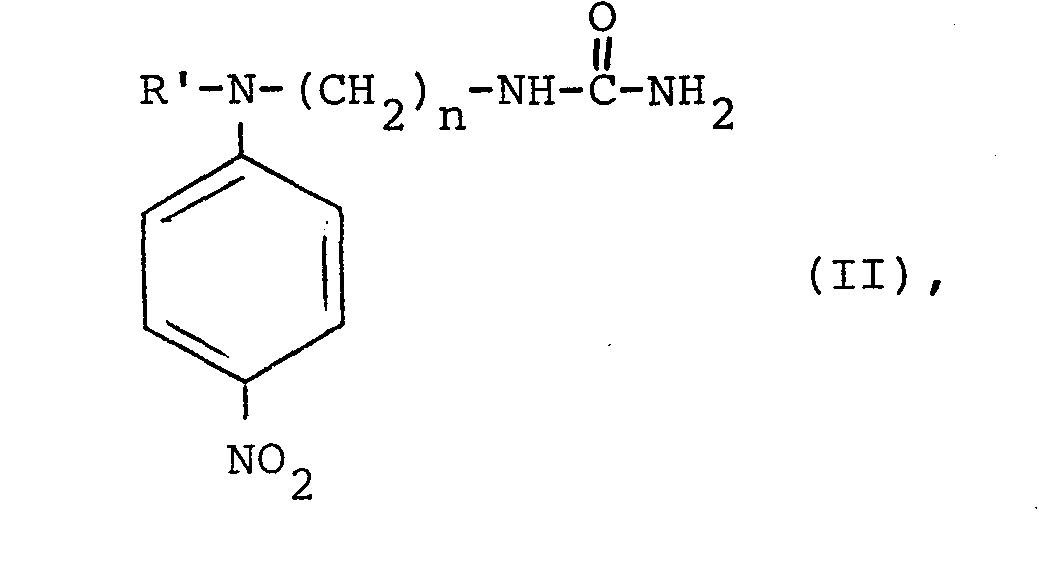
- Diese Verbindungen zeichnen sich gegenüber solchen der Formel I mit R = H durch eine bessere Wasserlöslichkeit aus.
- Die p-Ureidoalkylamino-nitrobenzole der Formel I (welche die neuen Verbindungen der Formel II einschließen) können aus preiswerten Vorstufen wie folgt hergestellt werden:
- Ausgehend von p-Chlor- oder p-Fluornitrobenzol III erfolgt, gemäß nachstehendem Reaktionsschema, ein nucleophiler Austausch des Halogens mit einem Alkylendiamin IV, wobei in guter Ausbeute das Aminoalkylnitroanilin V erhalten wird. Dieses wird sodann mit einem Alkalicyanat in saurer Lösung in das gewünschte p-Ureidoalkylaminonitrobenzol der Formel I übergeführt.


- Die als Zwischenprodukt benötigten Aminoalkylnitroaniline V lassen sich auch vorteilhaft durch die Gabriel-Reaktion herstellen, indem, wie im US-Patent 3 332 948 erwähnt, p-Nitroanilin VI mit den Phthalimidderivaten von Alkylenhalogeniden VII umgesetzt wird

- und anschließend das Amin aus dem Phthalimid VIII freigesetzt wird.
- Überraschend sind die sehr guten toxikologischen und physiologischen Eigenschaften der Verbindungen nach der allgemeinen Formel I. So sind zum Beispiel die beiden Farbstoffe 1-[(2'-Ureidoethyl)-amino]-4-nitrobenzol und 1-[N(2'-Ureidoethyl), N(2"-hydroxyethyl)-amino]-4-nitrobenzol im Amestest nicht bzw. nur schwach mutagen und weisen eine ausgesprochen geringe akute Toxizität auf.
- Von besonderem Vorteil sind weiterhin die außerordentlich hohe Farbtiefe des mit den Verbindungen der Formel I erhältlichen rein zitronengelben Farbtons und die Beständigkeit gegenüber Basen wie Ammoniak und gegenüber Reduktionsmitteln wie zum Beispiel Ascorbinsäure, wodurch auch eine Verwendung in Oxidationshaarfärbemitteln möglich ist.
- Die vorliegende Erfindung betrifft ebenfalls Mittel zur Färbung von Haaren mit einem Farbstoffgehalt und für Haarfärbemittel üblichen Zusätzen, dadurch gekennzeichnet, daß es eine p-Ureidoalkylamino-nitrobenzolverbindung der Formel I enthält.
- Die erfindungsgemäßen Mittel zur Färbung von Haaren betreffen sowohl solche, die ohne Zugabe eines Oxidationsmittels angewendet werden, als auch solche, bei denen die Zugabe eines Oxidationsmittels erforderlich ist.
- Bei den ersteren Haarfärbemitteln ohne Oxidationsmittel-Zugabe handelt es sich um diejenigen, die neben den Farbstoffen der angegebenen Formel noch andere direkt auf das Haar aufziehende Farbstoffe enthalten können. Von diesen für die Haarfärbung bekannten Farbstoffen seien beispielsweise die folgenden Klassen erwähnt:
- Aromatische Nitrofarbstoffe (zum Beispiel 1,4-Diamino-2-nitrobenzol und dessen Derivate) Azofarbstoffe (zum Beispiel Acid Brown 4, C.I. 14 805), Anthrachinonfarbstoffe (zum Beispiel Disperse Violet 4, C.I. 61 105), Triphenylmethanfarbstoffe (zum Beispiel Basic Violet 1, C.I. 42 535), wobei die Farbstoffe dieser Klassen je nach der Art ihrer Substituenten sauren, nichtionogenen oder basischen Charakter haben können. Weitere geeignete direkt auf das Haar aufziehende Farbstoffe sind beispielsweise in dem Buch von J.C. Johnson, "Hair Dyes" Noyes Data Corp. Park-Ridge (USA) (1973), Seiten 3 - 91 und 113 - 139 (ISBN:0-8155-0477-2) beschrieben.
- Mit diesen erfindungsgemäßen Haarfärbemitteln, die Verbindungen der Formel I im Gemisch mit den vorstehend genannten Farbstoffen enthalten, lassen sich neben reinen Modetönen auch modische Blond- und Brauntöne von hervorragender Stabilität erzielen.
- Die Zubereitungsform der hier beschriebenen Haarfärbemittel auf der Basis von direkt auf das Haar aufziehenden Farbstoffen kann beispielsweise eine Lösung, insbesondere eine wäßrige oder wäßrig-alkoholische Lösung, sein. Bevorzugte Zubereitungsformen sind weiterhin eine Creme, ein Gel oder eine Emulsion, wobei sie auch im Gemisch mit einem Treibgas oder mittels einer Pumpe versprüht werden können.
- Die Farbstoffe der angegebenen Formel I sollen in diesen Färbemitteln ohne Oxidationsmittel-Zugabe in einer Konzentration von etwa 0,01 bis 1,0 Gew. %, vorzugsweise von 0,01 bis 0,5 Gew. %, enthalten sein. Der Gesamtgehalt an den direkt ziehenden Farbstoffen liegt in den Grenzen von etwa 0,01 bis 3,0 Gew. %. Der pH-Wert dieser Färbemittel liegt im Bereich von 3 bis 10,5, insbesondere bei pH 7,5 bis 9,5, wobei die Einstellung des gewünschten alkalischen pH-Wertes hauptsächlich mit Ammoniak erfolgt, jedoch auch mit organischen Aminen wie beispielsweise Monoethanolamin oder Triethanolamin vorgenommen werden kann.
- Ihre Anwendung erfolgt in üblicher Weise durch Aufbringen einer für die Haarfärbung ausreichenden Menge des Mittels auf die Haare, mit denen es eine Zeitlang, etwa 5 bis 30 Minuten, in Berührung bleibt. Anschließend wird mit Wasser, gegebenenfalls noch mit einer wäßrigen Lösung einer schwachen organischen Säure, gespült und getrocknet. Als schwache organische Säure können beispielsweise Essigsäure, Zitronensäure, Weinsäure und ähnliche Verwendung finden.
- Die vorstehend beschriebenen Haarfärbemittel ohne Oxidationsmittel-Zugabe können selbstverständlich auch kosmetische Polymerisate enthalten, wodurch gleichzeitig mit der Färbung eine Festigung der Haare erreicht wird. Solche Mittel werden im allgemeinen als Tönungsfestiger oder Farbfestiger bezeichnet.
- Von den für diesen Zweck in der Kosmetik bekannten Polymerisaten seien beispielsweise Polyvinylpyrrolidon, Polyvinylacetat, Polyvinylalkohol oder Polyacrylverbindungen wie Acrylsäure- bzw. Methacrylsäurepolymerisate, basische Polymerisate von Estern aus diesen beiden Säuren und Aminoalkoholen bzw. deren Salze oder Quaternisierungsprodukte, Polyacrylnitril, Polyvinyllactame sowie Copolymerisate aus derartigen Verbindungen wie Polyvinylpyrrolidon-Vinylacetat und dergleichen erwähnt.
- Auch natürliche Polymere, wie Chitosan (entacetyliertes Chitin) oder Chitosanderivate, können für den genannten Zweck eingesetzt werden.
- Die Polymerisate sind in diesen Mitteln in der üblichen Menge von 1 bis 5 Gew. % enthalten. Die pH-Werte der Mittel liegen im Bereich von etwa 6,0 bis 9,0.
- Die Anwendung dieser Haarfärbemittel mit zusätzlicher Festigung erfolgt in bekannter und üblicher Weise durch Befeuchten des Haares mit dem Festiger, Festlegen (Einlegen) des Haares zur Frisur und anschließende Trocknung.
- Selbstverständlich können die vorstehend beschriebenen Haarfärbemittel ohne Oxidationsmittel-Zugabe gegebenenfalls weitere für Haarfärbemittel übliche Zusätze wie zum Beispiel Pflegestoffe, Netzmittel, Verdicker, Weichmacher und Parfümöle sowie auch andere, nachstehend für Oxidationshaarfärbemittel aufgeführte übliche Zusätze enthalten.
- Zum Gegenstand der vorliegenden Erfindung gehören auch, wie eingangs erwähnt, diejenigen Haarfärbemittel, bei denen die Zugabe eines Oxidationsmittels erforderlich ist. Sie enthalten außer den Farbstoffen gemäß der angegebenen Formel I und gegebenenfalls bekannten direkt auf das Haar aufziehenden Farbstoffen noch zusätzlich bekannte Oxidationsfarbstoffe, die einer oxidativen Entwicklung bedürfen.
- Bei diesen Oxidationsfarbstoffen handelt es sich hauptsächlich um aromatische p-Diamine und p-Aminophenole wie beispielsweise p-Toluylendiamin, p-Phenylendiamin, p-Aminophenol und ähnliche Verbindungen, welche zum Zwecke der Nuancierung der Färbungen mit sogenannten Modifiern, wie zum Beispiel m-Phenylendiamin, Resorcin, m-Aminophenol und anderen kombiniert werden.
- Derartige zur Haarfärbung bekannte und übliche Oxidationsfarbstoffe sind unter anderem in dem Buch von E. Sagarin, "Cosmetics",Science and Technology (1957), Interscience Publishers Inc., New York, Seiten 503 ff. sowie in dem Buch von H. Janistyn, "Handbuch der Kosmetika und Riechstoffe" (1973) Seiten 338 ff., beschrieben.
- Mit Mischungen aus diesen Oxidationsfarbstoffen und den Farbstoffen gemäß der angegebenen Formel I lassen sich neben reinen Modetönen auch modische Blond- und Brauntöne erhalten.
- Die Farbstoffe gemäß der Formel I sind in diesen Färbemitteln mit Oxidationsmittel-Zugabe in einer Konzentration von etwa 0,01 bis 1,0 Gew. %, vorzugsweise 0,05 bis 0,5 Gew. %, enthalten. Der Gesamtgehalt an Farbstoffen in diesen Färbemitteln beträgt etwa 0,1 bis 5,0 Gew. %.
- Oxidationshaarfärbemittel sind im allgemeinen alkalisch eingestellt, vorzugsweise auf pH-Werte von etwa 8,0 bis 11,5, wobei die Einstellung insbesondere mit Ammoniak erfolgt. Es können dazu aber auch andere organische Amine, zum Beispiel Monoethanolamin oder Triethanolamin, Verwendung finden. Als Oxidationsmittel zur Entwicklung der Haarfärbungen kommen hauptsächlich Hydrogenperoxyd und dessen Additionsverbindungen in Betracht. Die Zubereitungsform dieser Haarfärbemittel kann die gleiche wie bei Haarfärbemitteln ohne Oxidationsmittel-Zugabe sein. Vorzugsweise ist sie die einer Creme oder eines Gels.
- Übliche Zusätze in Cremes, Emulsionen oder Gelen sind zum Beispiel Lösungsmittel wie Wasser, niedere aliphatische Alkohole, beispielsweise Ethanol, Propanol, Isopropanol, Glycerin oder Glykole wie Ethylenglykol und Propylenglykol, oder auch Glykolether, weiterhin Netzmittel oder Emulgatoren aus den Klassen der anionischen, kationischen, amphoteren oder nichtionogenen oberflächenaktiven Substanzen wie Fettalkoholsulfate, Fettalkoholethersulfate, Alkylsulfonate, Alkylbenzolsulfate, Alkyltrimethylammoniumsalze, Alkylbetaine, oxethylierte Fettalkohole, oxethylierte Nonylphenole, Fettsäurealkanolamide, oxethylierte Fettsäureester, ferner Verdicker wie höhere Fettalkohole, Bentonit, Stärke, Polyacrylsäure, Cellulosederivate wie Carboxymethylcellulose, Alginate, Vaseline, Paraffinöl und Fettsäuren sowie außerdem Pflegestoffe wie Lanolinderivate, Cholesterin, Pantothensäure und Betain, weiterhin Parfümöle und Komplexbildner. Die erwähnten Bestandteile werden in den für solche Zwecke üblichen Mengen verwendet, zum Beispiel die Netzmittel und Emulgatoren in Konzentrationen von etwa 0,5 bis 30 Gew. %, während die Verdicker in einer Menge von etwa 0,1 bis 25 Gew. % in den Zubereitungen enthalten sein können.
- Die Anwendung der genannten Zubereitungen, bei denen die Zugabe eines Oxidationsmittels erforderlich ist, erfolgt in bekannter Weise, indem man die Haarfärbemittel vor der Behandlung mit dem Oxidationsmittel vermischt und eine zur Färbung des Haares ausreichende Menge der Mischung, im allgemeinen etwa 50 bis 150 ml, auf das Haar aufträgt. Nach einer für die Haarfärbung ausreichenden Einwirkungszeit, welche üblicherweise etwa 10 bis 45 Minuten beträgt, wird mit Wasser, gegebenenfalls anschließend mit der wäßrigen Lösung einer schwachen organischen Säure, wie zum Beispiel Zitronensäure oder Weinsäure, gespült und getrocknet.
- Hinsichtlich der färberischen Möglichkeiten bieten die erfindungsgemäßen Haarfärbemittel je nach Art und Zusammensetzung der Farbkomponenten eine breite Palette verschiedener Farbnuancen, die sich von natürlichen Farbtönen bis hin zu hochmodischen, leuchtenden Nuancen erstreckt. Hierbei werden die Färbemittel je nach Zusammensetzung entweder in Verbindung mit Hydrogenperoxid oder auch ohne Oxidationsmittel angewandt.
- Die nachstehenden Beispiele sollen den Anmeldungsgegenstand erläutern, ohne ihn darauf zu beschränken.
-

- 30 ml des flüssigen Haarfärbemittels der obigen Zusammensetzung werden auf weiße menschliche Haare aufgetragen und 10 Minuten einwirken gelassen. Nach der Spülung mit Wasser und dem Trocknen ist das Haar leuchtendgelb gefärbt.
-


- Weiße menschliche Haare werden mit 20 ml der vorstehenden festigenden Färbelösung zur Frisur eingelegt und getrocknet. Das Haar ist leuchtendgelb gefärbt und gefestigt.
-

- 50 ml des vorstehenden Haarfärbemittels werden kurz vor dem Gebrauch mit 50 ml Hydrogenperoxydlösung (6 %-ig) vermischt. Das entstandene Gel wird anschließend auf graue menschliche Haare aufgetragen und 30 Minuten einwirken gelassen. Sodann wird mit Wasser gespült und getrocknet. Das Haar hat einen natürlichen Blondton erhalten.
-

- 50 ml des vorstehenden Haarfärbemittels werden kurz vor der Anwendung mit 50 ml Wasserstoffperoxydlösung (6 %-ig) gemischt. Das Gemisch wird anschließend auf graue menschliche Haare aufgetragen und 30 Minuten bei einer Temperatur von 400 C einwirken gelassen. Nach dem Spülen des Haares mit Wasser und anschließendem Trocknen ist dieses ohne Farbstich tiefschwarz eingefärbt.
- 15,7 g (0,1 Mol) 4-Nitrochlorbenzol und 30 g N-(2-Hydroxyethyl)-ethylendiamin werden in 20 ml Dimethylsulfoxid gelöst und 4 Stunden lang auf 140° C erwärmt. Anschließend wird das Reaktionsgemisch auf Eis gegossen und das unlösliche Reaktionsprodukt abfiltriert. Nach dem Trocknen wird aus Essigester umkristallisiert. Man erhält 12,0 g (53 % der Theorie) der reinen Verbindung in Form gelber Kristalle, die einen Schmelzpunkt von 1260 C aufweisen.
- 12,0 g des Nitrobenzolderivates aus Stufe 1 werden in 20 ml Eisessig unter Erwärmung gelöst. Nach dem Entfernen des Heizbades werden 5,2 g Kaliumcyanat portionsweise zugegeben. Anschließend erwärmt man noch 15 Minuten lang und verdünnt sodann mit Wasser. Die gewünschte Ureidoverbindung fällt aus. Sie wird abfiltriert und aus Wasser umkristallisiert. Man erhält 4,0 g (28 % der Theorie) der reinen Ureidoverbindung vom Schmelzpunkt 1960 C.
-

Claims (8)


Priority Applications (1)
| Application Number | Priority Date | Filing Date | Title |
|---|---|---|---|
| AT85100398T ATE41601T1 (de) | 1984-01-26 | 1985-01-16 | Verwendung von p-ureidoalkylaminonitrobenzolverbindungen in haarfaerbemitteln und neue p-ureidoalkylamino-nitrobenzolverbindungen. |
Applications Claiming Priority (2)
| Application Number | Priority Date | Filing Date | Title |
|---|---|---|---|
| DE19843402519 DE3402519A1 (de) | 1984-01-26 | 1984-01-26 | Verwendung von p-ureidoalkylamino-nitrobenzolverbindungen in haarfaerbemitteln und neue p-ureidoalkylamino-nitrobenzolverbindungen |
| DE3402519 | 1984-01-26 |
Publications (3)
| Publication Number | Publication Date |
|---|---|
| EP0150765A2 true EP0150765A2 (de) | 1985-08-07 |
| EP0150765A3 EP0150765A3 (en) | 1985-08-21 |
| EP0150765B1 EP0150765B1 (de) | 1989-03-22 |
Family
ID=6225878
Family Applications (1)
| Application Number | Title | Priority Date | Filing Date |
|---|---|---|---|
| EP85100398A Expired EP0150765B1 (de) | 1984-01-26 | 1985-01-16 | Verwendung von p-Ureidoalkylamino-nitrobenzolverbindungen in Haarfärbemitteln und neue p-Ureidoalkylamino-nitrobenzolverbindungen |
Country Status (8)
| Country | Link |
|---|---|
| US (1) | US4629467A (de) |
| EP (1) | EP0150765B1 (de) |
| AT (1) | ATE41601T1 (de) |
| AU (1) | AU572257B2 (de) |
| BR (1) | BR8504776A (de) |
| DE (2) | DE3402519A1 (de) |
| MX (1) | MX161857A (de) |
| WO (1) | WO1985003223A1 (de) |
Cited By (1)
| Publication number | Priority date | Publication date | Assignee | Title |
|---|---|---|---|---|
| WO1991009588A1 (de) * | 1989-12-21 | 1991-07-11 | Wella Aktiengesellschaft | Schaumförmiges haartönungsmittel |
Families Citing this family (5)
| Publication number | Priority date | Publication date | Assignee | Title |
|---|---|---|---|---|
| US5264331A (en) * | 1990-06-13 | 1993-11-23 | Fuji Photo Film Co., Ltd. | Color developing agent, processing liquid composition and process for forming color image |
| JP2720232B2 (ja) * | 1990-06-13 | 1998-03-04 | 富士写真フイルム株式会社 | 発色現像主薬、処理液組成物およびカラー画像形成方法 |
| DE19619071A1 (de) * | 1996-05-13 | 1997-11-20 | Henkel Kgaa | Mittel und Verfahren zum Färben und Tönen keratinischer Fasern |
| DE19847192A1 (de) | 1998-10-13 | 2000-04-27 | Wella Ag | Mittel und Verfahren zur Färbung von Fasern |
| US7144517B1 (en) | 2003-11-07 | 2006-12-05 | Amkor Technology, Inc. | Manufacturing method for leadframe and for semiconductor package using the leadframe |
Family Cites Families (5)
| Publication number | Priority date | Publication date | Assignee | Title |
|---|---|---|---|---|
| US3629330A (en) * | 1965-05-24 | 1971-12-21 | Clairol Inc | Components for hair dyeing compositions |
| US3642423A (en) * | 1966-03-21 | 1972-02-15 | Clairol Inc | Dyeing human hair with hydroxyalkyl nitroaniline dyes |
| US3697215A (en) * | 1968-09-09 | 1972-10-10 | Oreal | Dyeing hair with n-(ureidoalkyl)- and n-(thioureidoalkyl) - para - phenylene diamines |
| US4008272A (en) * | 1968-09-09 | 1977-02-15 | Societe Anonyme Dite: L'oreal | N-Thioureido and N-ureido phenylene diamines and method of preparing same |
| DE3231455A1 (de) * | 1981-08-26 | 1983-03-10 | L'Oreal, 75008 Paris | Verfahren zur herstellung von nitroanilinen, deren verwendung und faerbemittel, die diese enthalten sowie neue nitroaniline |
-
1984
- 1984-01-26 DE DE19843402519 patent/DE3402519A1/de not_active Withdrawn
-
1985
- 1985-01-16 BR BR8504776A patent/BR8504776A/pt not_active IP Right Cessation
- 1985-01-16 DE DE8585100398T patent/DE3568941D1/de not_active Expired
- 1985-01-16 US US06/767,277 patent/US4629467A/en not_active Expired - Lifetime
- 1985-01-16 EP EP85100398A patent/EP0150765B1/de not_active Expired
- 1985-01-16 AT AT85100398T patent/ATE41601T1/de not_active IP Right Cessation
- 1985-01-16 AU AU38380/85A patent/AU572257B2/en not_active Ceased
- 1985-01-16 WO PCT/EP1985/000012 patent/WO1985003223A1/de not_active Ceased
- 1985-01-21 MX MX204085A patent/MX161857A/es unknown
Cited By (1)
| Publication number | Priority date | Publication date | Assignee | Title |
|---|---|---|---|---|
| WO1991009588A1 (de) * | 1989-12-21 | 1991-07-11 | Wella Aktiengesellschaft | Schaumförmiges haartönungsmittel |
Also Published As
| Publication number | Publication date |
|---|---|
| WO1985003223A1 (fr) | 1985-08-01 |
| AU3838085A (en) | 1985-08-09 |
| AU572257B2 (en) | 1988-05-05 |
| DE3402519A1 (de) | 1985-08-01 |
| EP0150765B1 (de) | 1989-03-22 |
| ATE41601T1 (de) | 1989-04-15 |
| MX161857A (es) | 1991-01-29 |
| US4629467A (en) | 1986-12-16 |
| EP0150765A3 (en) | 1985-08-21 |
| DE3568941D1 (en) | 1989-04-27 |
| BR8504776A (pt) | 1985-12-24 |
Similar Documents
| Publication | Publication Date | Title |
|---|---|---|
| EP0376047B1 (de) | 2-Amino-6-chlor-4-nitro-phenolderivate, Verfahren zu ihrer Herstellung und Haarfärbemittel mit einem Gehalt an diesen Verbindungen | |
| DE3441148A1 (de) | Oxidationshaarfaerbemittel auf der basis von 4-amino-2-hydroxyalkylphenolen | |
| EP0460128B1 (de) | Mittel und verfahren zum oxidativen färben von haaren | |
| EP0182330B1 (de) | Verwendung von 2-Nitroanilinderivaten in Haarfärbemitteln und neue 2-Nitroanilinderivate | |
| EP0132568B1 (de) | 1,4-Diamino-5-chlor-2-nitrobenzolderivate, Verfahren zu ihrer Herstellung und Mittel zur Färbung von Haaren | |
| EP0303878B1 (de) | 2,5-Diamino-6-nitro-pyridinderivate enthaltende Haarfärbemittel | |
| EP0150765B1 (de) | Verwendung von p-Ureidoalkylamino-nitrobenzolverbindungen in Haarfärbemitteln und neue p-Ureidoalkylamino-nitrobenzolverbindungen | |
| EP0289782B1 (de) | Verwendung von 2,6-Dinitro-anilinderivaten in Haarfärbemitteln und neue 2,6-Dinitro-anilinderivate | |
| EP0608393B1 (de) | Haarfärbemittel | |
| DE3442861C2 (de) | ||
| EP0600045B1 (de) | Haarfärbemittel | |
| EP0460127A1 (de) | Schaumförmiges haartönungsmittel. | |
| EP0352489B1 (de) | Verwendung von 2,6-Dinitro-phenol-derivaten in Haarfärbemitteln | |
| DE3325790C2 (de) | ||
| DE3616720C2 (de) | 1-(2',3'-Dihydroxypropyl)amino -4-(N-ethyl,N-2'-hydroxyethyl)amino-2-nitro-benzol und Mittel zum Färben von Haaren | |
| EP0151400B1 (de) | Haarfärbemittel mit Pikraminsäurederivaten, neue Pikraminsäurederivate sowie Verfahren zu ihrer Herstellung | |
| EP0203446A1 (de) | Nitro-p-phenylendiaminderivative, Verfahren zu ihrer Herstellung sowie Haarfärbemittel mit einem Gehalt an diesen Verbindungen | |
| EP0226973B1 (de) | 4-Bis(2'-hydroxyethyl)amino-1-(3'-hydroxypropyl)amino-2-nitro-benzol, Verfahren zu dessen Herstellung sowie Mittel zum Färben von Haaren | |
| DE3533792A1 (de) | Verwendung von 5-amino-2-nitro-phenolderivaten in haarfaerbemitteln, verfahren zur herstellung dieser verbindungen und neue 5-amino-2-nitro-phenolderivate | |
| DE3508896A1 (de) | Haarfaerbemittel mit nitrotropolonen sowie ein neues nitrotropolon | |
| DE3707273A1 (de) | Nitro-p-phenylendiaminderivate, verfahren zu ihrer herstellung sowie mittel zum faerben von haaren mit einem gehalt an diesen verbindungen | |
| CH550585A (de) | Haarfaerbemittel. | |
| DE4108222A1 (de) | 3-(( 2',2',2'-trifluorethyl)-amino)-anilinderivate, verfahren zu deren herstellung sowie oxidationshaarfaerbemittel |
Legal Events
| Date | Code | Title | Description |
|---|---|---|---|
| PUAI | Public reference made under article 153(3) epc to a published international application that has entered the european phase |
Free format text: ORIGINAL CODE: 0009012 |
|
| PUAL | Search report despatched |
Free format text: ORIGINAL CODE: 0009013 |
|
| AK | Designated contracting states |
Designated state(s): AT BE CH DE FR GB IT LI LU NL SE |
|
| AK | Designated contracting states |
Designated state(s): AT BE CH DE FR GB IT LI LU NL SE |
|
| ITCL | It: translation for ep claims filed |
Representative=s name: BARZANO' E ZANARDO ROMA S.P.A. |
|
| TCNL | Nl: translation of patent claims filed | ||
| 17P | Request for examination filed |
Effective date: 19860116 |
|
| EL | Fr: translation of claims filed | ||
| 17Q | First examination report despatched |
Effective date: 19880520 |
|
| GRAA | (expected) grant |
Free format text: ORIGINAL CODE: 0009210 |
|
| AK | Designated contracting states |
Kind code of ref document: B1 Designated state(s): AT BE CH DE FR GB IT LI LU NL SE |
|
| REF | Corresponds to: |
Ref document number: 41601 Country of ref document: AT Date of ref document: 19890415 Kind code of ref document: T |
|
| REF | Corresponds to: |
Ref document number: 3568941 Country of ref document: DE Date of ref document: 19890427 |
|
| ITF | It: translation for a ep patent filed | ||
| GBT | Gb: translation of ep patent filed (gb section 77(6)(a)/1977) | ||
| ET | Fr: translation filed | ||
| PG25 | Lapsed in a contracting state [announced via postgrant information from national office to epo] |
Ref country code: LU Free format text: LAPSE BECAUSE OF NON-PAYMENT OF DUE FEES Effective date: 19900131 |
|
| PLBE | No opposition filed within time limit |
Free format text: ORIGINAL CODE: 0009261 |
|
| STAA | Information on the status of an ep patent application or granted ep patent |
Free format text: STATUS: NO OPPOSITION FILED WITHIN TIME LIMIT |
|
| 26N | No opposition filed | ||
| PGFP | Annual fee paid to national office [announced via postgrant information from national office to epo] |
Ref country code: LU Payment date: 19901228 Year of fee payment: 7 |
|
| EPTA | Lu: last paid annual fee | ||
| PGFP | Annual fee paid to national office [announced via postgrant information from national office to epo] |
Ref country code: AT Payment date: 19911210 Year of fee payment: 8 |
|
| PGFP | Annual fee paid to national office [announced via postgrant information from national office to epo] |
Ref country code: BE Payment date: 19911211 Year of fee payment: 8 |
|
| PGFP | Annual fee paid to national office [announced via postgrant information from national office to epo] |
Ref country code: SE Payment date: 19911216 Year of fee payment: 8 |
|
| PGFP | Annual fee paid to national office [announced via postgrant information from national office to epo] |
Ref country code: CH Payment date: 19920110 Year of fee payment: 8 |
|
| PGFP | Annual fee paid to national office [announced via postgrant information from national office to epo] |
Ref country code: NL Payment date: 19920131 Year of fee payment: 8 |
|
| PG25 | Lapsed in a contracting state [announced via postgrant information from national office to epo] |
Ref country code: AT Effective date: 19930116 |
|
| PG25 | Lapsed in a contracting state [announced via postgrant information from national office to epo] |
Ref country code: SE Effective date: 19930117 |
|
| ITTA | It: last paid annual fee | ||
| PG25 | Lapsed in a contracting state [announced via postgrant information from national office to epo] |
Ref country code: LI Effective date: 19930131 Ref country code: CH Effective date: 19930131 Ref country code: BE Effective date: 19930131 |
|
| BERE | Be: lapsed |
Owner name: WELLA A.G. Effective date: 19930131 |
|
| PG25 | Lapsed in a contracting state [announced via postgrant information from national office to epo] |
Ref country code: NL Effective date: 19930801 |
|
| NLV4 | Nl: lapsed or anulled due to non-payment of the annual fee | ||
| REG | Reference to a national code |
Ref country code: CH Ref legal event code: PL |
|
| EUG | Se: european patent has lapsed |
Ref document number: 85100398.8 Effective date: 19930810 |
|
| REG | Reference to a national code |
Ref country code: GB Ref legal event code: IF02 |
|
| PGFP | Annual fee paid to national office [announced via postgrant information from national office to epo] |
Ref country code: GB Payment date: 20040105 Year of fee payment: 20 |
|
| PGFP | Annual fee paid to national office [announced via postgrant information from national office to epo] |
Ref country code: DE Payment date: 20040108 Year of fee payment: 20 |
|
| PGFP | Annual fee paid to national office [announced via postgrant information from national office to epo] |
Ref country code: FR Payment date: 20040109 Year of fee payment: 20 |
|
| PG25 | Lapsed in a contracting state [announced via postgrant information from national office to epo] |
Ref country code: GB Free format text: LAPSE BECAUSE OF EXPIRATION OF PROTECTION Effective date: 20050115 |
|
| REG | Reference to a national code |
Ref country code: GB Ref legal event code: PE20 |