EP0149946B1 - Alliage à base de nickel - Google Patents
Alliage à base de nickel Download PDFInfo
- Publication number
- EP0149946B1 EP0149946B1 EP84402689A EP84402689A EP0149946B1 EP 0149946 B1 EP0149946 B1 EP 0149946B1 EP 84402689 A EP84402689 A EP 84402689A EP 84402689 A EP84402689 A EP 84402689A EP 0149946 B1 EP0149946 B1 EP 0149946B1
- Authority
- EP
- European Patent Office
- Prior art keywords
- alloy
- chromium
- iron
- nickel
- alloys
- Prior art date
- Legal status (The legal status is an assumption and is not a legal conclusion. Google has not performed a legal analysis and makes no representation as to the accuracy of the status listed.)
- Expired - Lifetime
Links
Images


Classifications
-
- C—CHEMISTRY; METALLURGY
- C22—METALLURGY; FERROUS OR NON-FERROUS ALLOYS; TREATMENT OF ALLOYS OR NON-FERROUS METALS
- C22C—ALLOYS
- C22C19/00—Alloys based on nickel or cobalt
- C22C19/03—Alloys based on nickel or cobalt based on nickel
- C22C19/05—Alloys based on nickel or cobalt based on nickel with chromium
- C22C19/058—Alloys based on nickel or cobalt based on nickel with chromium without Mo and W
Definitions
- the present invention relates to a use of nickel-based alloys, comprising chromium and aluminum and allowing precipitation hardening by heat treatment.
- a family of nickel-based alloys with a high chromium and aluminum content is known from patent FR 1,267,470 in which precipitation hardening is obtained following a solution treatment followed by 'income.
- the dissolution treatment of the intermetallic hardening phases makes it possible to reach sufficiently low hardness levels so that the metal is easy to shape.
- the temperature at the base in solution must exceed 1100 ° C or even 1150 ° C to also ensure hardening during tempering. Maintaining at a temperature above 1100 ° C can cause excessive grain enlargement. Too coarse grain leads to irregular surface conditions during shaping operations and makes certain machining operations difficult and especially gives the metal great brittleness after hardening.
- the document DE-A-3,240,188 discloses that, in the alloys of the previous family, an adjustment of the composition makes it possible to avoid the dispersion of chromium particles of a certain dimension, in order to obtain regular polishing and a good decorative appearance.
- Such alloys are provided, in fact, to constitute an outer coating layer for watch cases.
- a particular composition comprises by weight 37 to 38% of chromium, 7 to 8% of iron and 3 to 5% of aluminum, 50 to 51% of nickel.
- the alloys according to the invention are produced by the methods of conventional metallurgy (by casting) or by powder metallurgy. They exhibit precipitation hardening after tempering following a solution treatment. Curing is caused by discontinuous (or cellular) precipitation of the y 'Ni 3 AI phase.
- Chromium is favorable for corrosion resistance and contributes to the formation of phase a with a centered cubic structure (called ferrite).
- the chromium content must be greater than 28% and the iron content must be less than 25%, and for the brittleness of the alloy not to be excessive, the chromium does not exceed 42%.
- the cellular precipitation of phase y ' is more and more slow and less and less complete.
- the zone I the outline of which is marked ABCD defines the field of the compositions according to the invention which have a sufficient quantity of phase a to slow down the magnification of the grain on dissolution.
- the compositions do not have enough ferrite to slow down the magnification of the grain during dissolution.
- the compositions In the zone 111 situated above DC, the compositions have too much ferrite, which reduces the ductility of the alloy.
- Aluminum contributes to give good resistance to corrosion and is used to form the hardening phase y '.
- the content of this element must be greater than 3% for the precipitation hardening to be sufficient and must be less than 5% to avoid difficult manufacture or excessive brittleness.
- the analyzes of the alloys above reveal non-essential elements which may result from processing, the contents not exceeding 0.05% for each of these elements.
- the alloys were tested in tension. To this end, the alloy N underwent a solution treatment at 1200 ° C. followed by a quenching with water which made it possible to obtain a grain of 9.5 ASTM. Alloy A underwent a solution treatment at 1225 ° C followed by quenching with water which made it possible to obtain a grain of 3 ASTM. The alloys then underwent hardening tempering at temperatures between 650 ° C and 800 ° C for several hours. Depending on the tempering conditions, the alloys have a high hardness which ranges from around 500 HV to more than 700 HV. These different treatments make it possible to adjust the elastic limit.
- the alloys according to the invention can be used for applications requiring high mechanical strength with excellent corrosion resistance and also requiring high ductility. As possible applications, structural parts requiring high ductility can be cited (bolts, casing, turbine disc, etc.).
Landscapes
- Chemical & Material Sciences (AREA)
- Engineering & Computer Science (AREA)
- Materials Engineering (AREA)
- Mechanical Engineering (AREA)
- Metallurgy (AREA)
- Organic Chemistry (AREA)
- Powder Metallurgy (AREA)
- Manufacture And Refinement Of Metals (AREA)
- Chemically Coating (AREA)
- Saccharide Compounds (AREA)
- Heat Treatment Of Articles (AREA)
- Heat Treatment Of Steel (AREA)
Description
- La présente invention se rapporte à une utilisation d'alliages à base de nickel, comportant du chrome et de l'aluminium et permettant un durcissement de précipitation par un traitement thermique.
- On connaît par le brevet FR 1.267.470 une famille d'alliages à base de nickel comportant une forte teneur en chrome et de l'aluminium dans lesquels un durcissement de précipitation est obtenu à la suite d'un traitement de mise en solution suivi d'un revenu. Le traitement de mise en solution des phases durcissantes intermétalliques permet d'atteindre des niveaux de dureté suffisamment bas pour que le métal soit facile à mettre en forme. La température à la base en solution doit dépasser 1100°C voire 1150°C pour assurer par ailleurs le durcissement lors du revenu. Des maintiens à une température supérieure à 1100°C peuvent entrainer un grossissement excessif du grain. Un grain trop grossier entraîne des états de surface irréguliers lors d'opérations de mise en forme et rend difficiles certaines opérations d'usinage et confère surtout au métal une grande fragilité après le revenu durcissant.
- D'autre part, le document DE-A-3.240.188 divulgue que, dans les alliages de la famille précédente, un ajustement de la composition permet d'éviter la dispersion de particules de Chrome d'une certaine dimension, afin d'obtenir un polissage régulier et un bon aspect décoratif. De tels alliages sont prévus, en effet, pour constituer une couche de revêtement extérieur pour des boitiers de montres.
- La Société déposante a découvert que de tels alliages pouvaient également trouver une nouvelle utilisation à condition de respecter un ajustement précis des teneurs relatives en Fer et en Chrome permettant d'assurer la présence d'une quantité suffisante mais pas excessive de Ferrite.
- L'invention a donc pour objet une utilisation d'alliages du type précédent pour la fabrication de pièces de structure nécessitant une grande résistance mécanique avec une excellente résistance à la corrosion et exigeant en plus une ductilité élevée, telles que des pièces pour boulonnerie, tubages, disques de turbines, etc., ledit alliage comportant en poids:
- -de 28 à 40% de Chrome,
- -moins de 25% de Fer,
- -de 3 à 5% d'Aluminium,
- -jusqu'à 0,05% au plus d'éléments constituant des impuretés,
- -des éléments tels que Molybdène, Vanadium, Titane, pouvant être incorporés à l'alliage pour stabiliser la ferrite,
- -le Nickel faisant le solde,
- -les teneurs en Fer et Chrome étant ajustées l'une en fonction de l'autre de façon à former une quantité de phase a suffisante pour contrôler le grossissement du grain et assez limitée pour obtenir une ductilité élevée,
- -lesdites teneurs se situant, à ce effet, dans la zone repérée 1 du diagramme de la Figure 1, limitée par les points:


- Une composition particulière comporte en poids 37 à 38% de chrome, 7 à 8% de fer et 3 à 5% d'aluminium, 50 à 51% de nickel.
- D'autres caractéristiques et avantages de l'invention ressortiront de la description suivante qui se réfère aux dessins annexés sur lesquels:
- La figure 1 représente un diagramme qui définit les pourcentages pondéraux relatifs en chrome et en fer de la famille d'alliages selon l'invention.
- Les figures 2 et 3 sont des graphiques donnant chacun la taille du grain en fonction de la température θ de mise en solution pour un alliage selon l'invention (figure 2) et pour un alliage sans ferrite (figure 3).
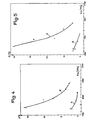
- La figure 4 est un graphique donnant la variation de l'allongement à la rupture en % (en ordonnée) en fonction de la limite élastique en MPa (en abscisse).
- La figure 5 est un graphique donnant la variation de la striction à la rupture en % (en ordonnée) en fonction de la limite élastique en MPa (en abscisse).
- Les alliages selon l'invention sont élaborés par les méthodes de la métallurgie conventionnelle (par coulée) ou par la métallurgie des poudres. Ils présentent un durcissement de précipitation après un revenu qui suit un traitement de mise en solution. Le durcissement est provoqué par la précipitation discontinue (ou cellulaire) de la phase y' Ni3AI.
- Le chrome est favorable pour la résistance à la corrosion et contribue à former de la phase a à structure cubique centrée (appelée ferrite).
- Le fer contribue lui aussi à la formation de la phase a.
- Pour que les alliages aient un durcissement suffisant il faut que la teneur en chrome soit supérieure à 28% et que la teneur en fer soit inférieure à 25% et pour que la fragilité de l'alliage ne soit pas excessive il faut que la teneur en chrome ne dépasse pas 42%. Pour les teneurs en chrome inférieures à 28% et pour les teneurs en fer supérieures à 25%, la précipitation cellulaire de phase y' est de plus en plus lente et de moins en moins complète.
- Les teneurs relatives en chrome et en fer doivent être ajustées pour que les alliages selon l'invention présentent aux températures habituelles de mise en solution (supérieures à 1100°C) une quantité suffisante mais pas excessive de la phase a.
- Dans le diagramme de la figure 1, la zone I dont le contour est repéré ABCD définit le domaine des compositions selon l'invention qui présentent une quantité suffisante de phase a pour freiner le grossissement du grain à la mise en solution. Dans la zone Il située au-dessous de AB, les compositions ne présentent pas assez de ferrite pour freiner le grossissement du grain lors de la mise en solution. Dans la zone 111 située au-dessus de DC, les compositions présentent trop de ferrite ce qui diminue la ductilité de l'alliage.
- L'aluminium contribue à donner une bonne résistance à la corrosion et sert à former la phase durcissante y'. La teneur de cet élément doit être supérieure à 3% pour que le durcissement par précipitation soit suffisant et doit être inférieure à 5% pour éviter une fabrication difficile ou une fragilité excessive.
- Des éléments connus pour stabiliser la ferrite tels que le molybdène, le vanadium, le titane pourraient être incorporés dans les alliages sans modifier les caractéristiques de l'invention.
- Il a été édudié, à titre d'exemple, plus particulièrement un alliage N de la famille conforme à l'invention et à titre comparatif, un alliage A ne présentant pas de ferrite. Les compositions qui sont données dans le tableau I ci-dessous sont exprimées en pourcentages pondéraux.
-

- Les analyses des alliages ci-dessus révèlent des éléments non essentiels qui peuvent résulter de l'élaboration, les teneurs n'excédant pas 0,05% pour chacun de ces éléments. Parmi ces éléments, on peut citer le carbone, le silicium, le soufre, le phosphore, le manganèse, le calcium, le magnésium, l'yttrium.
- On a étudié l'effet, sur la taille du grain, d'un traitement de mise en solution entre 1000° et 1250°C suivi d'une trempe à l'eau sur des échantillons d'alliages A et N préalablement écrouis par laminage. Après traitement, l'alliage N présente un grain très fin (figure 2). Au contraire l'alliage A présente un grain plus groissier qui n'est jamais plus fin que 2 ASTM (figure 3). Par ailleurs le traitement de mise en solution doit être effectué à plus de 1150°C de manière que la dureté se situe à un niveau assez bas (inférieur à 240 HV) pour permettre un travail de mise en forme.
- On a testé les alliages en traction. A cet effet l'alliage N a subi un traitement de mise en solution à 1200°C suivi d'une trempe à l'eau qui a permis d'obtenir un grain de 9,5 ASTM. L'alliage A a subi un traitement de mise en solution à 1225°C suivi d'une trempe à l'eau qui a permis d'obtenir un grain de3 ASTM. Les alliages ont ensuite subi des revenus durcissants à des températures comprises entre 650°C et 800°C pendant plusieurs heures. Selon les conditions de revenu les alliages ont une dureté élevée qui s'échelonne d'environ 500 HV à plus de 700 HV. Ces différents traitements permettent d'ajuster la limite élastique.
- Les alliages ont été testés en traction à 20°C, les figures 4 et 5 illustrant les résultats. L'allongement total (figure 4) et surtout la striction (figure 5) sont nettement améliorés par l'affinage du grain et atteignent des niveaux tout-à-fait intéressants.
- Les alliages selon l'invention peuvent être utilisés pour des applications nécessitant une grande résistance mécanique avec une excellente résistance à la corrosion et exigeant en plus une ductilité élevée. Comme applications possibles on peut citer des pièces de structure exigeant une ductilité élevée (boulonnerie, tubage, disque de turbine, etc.).
Claims (3)


Priority Applications (1)
| Application Number | Priority Date | Filing Date | Title |
|---|---|---|---|
| AT84402689T ATE58182T1 (de) | 1983-12-30 | 1984-12-21 | Nickel-basis-legierung. |
Applications Claiming Priority (2)
| Application Number | Priority Date | Filing Date | Title |
|---|---|---|---|
| FR8321083A FR2557594B1 (fr) | 1983-12-30 | 1983-12-30 | Alliages a base de nickel |
| FR8321083 | 1983-12-30 |
Publications (3)
| Publication Number | Publication Date |
|---|---|
| EP0149946A2 EP0149946A2 (fr) | 1985-07-31 |
| EP0149946A3 EP0149946A3 (en) | 1985-08-21 |
| EP0149946B1 true EP0149946B1 (fr) | 1990-11-07 |
Family
ID=9295749
Family Applications (1)
| Application Number | Title | Priority Date | Filing Date |
|---|---|---|---|
| EP84402689A Expired - Lifetime EP0149946B1 (fr) | 1983-12-30 | 1984-12-21 | Alliage à base de nickel |
Country Status (5)
| Country | Link |
|---|---|
| EP (1) | EP0149946B1 (fr) |
| JP (1) | JPS60169539A (fr) |
| AT (1) | ATE58182T1 (fr) |
| DE (1) | DE3483571D1 (fr) |
| FR (1) | FR2557594B1 (fr) |
Families Citing this family (3)
| Publication number | Priority date | Publication date | Assignee | Title |
|---|---|---|---|---|
| US4798633A (en) * | 1986-09-25 | 1989-01-17 | Inco Alloys International, Inc. | Nickel-base alloy heat treatment |
| FI77057C (fi) * | 1987-03-26 | 1989-01-10 | Outokumpu Oy | Foerfarande foer framstaellning av roer, staenger och band. |
| US4882125A (en) * | 1988-04-22 | 1989-11-21 | Inco Alloys International, Inc. | Sulfidation/oxidation resistant alloys |
Family Cites Families (4)
| Publication number | Priority date | Publication date | Assignee | Title |
|---|---|---|---|---|
| DE521547C (de) * | 1925-12-29 | 1931-03-23 | Heraeus Vacuumschmelze Akt Ges | Baustoff zur Herstellung von Turbinenschaufeln und solchen Bauteilen, welche aehnlichen mechanischen und Waermebeanspruchungen unterworfen sind |
| US2460590A (en) * | 1946-05-11 | 1949-02-01 | Driver Harris Co | Electric resistance element and method of heat-treatment |
| FR1267470A (fr) * | 1960-09-13 | 1961-07-21 | Alliages nickel, chrome, aluminium résistant à la chaleur | |
| JPS5877545A (ja) * | 1981-10-31 | 1983-05-10 | Toshiba Corp | 硬質合金 |
-
1983
- 1983-12-30 FR FR8321083A patent/FR2557594B1/fr not_active Expired - Lifetime
-
1984
- 1984-12-21 EP EP84402689A patent/EP0149946B1/fr not_active Expired - Lifetime
- 1984-12-21 AT AT84402689T patent/ATE58182T1/de active
- 1984-12-21 DE DE8484402689T patent/DE3483571D1/de not_active Expired - Lifetime
- 1984-12-27 JP JP59281985A patent/JPS60169539A/ja active Pending
Also Published As
| Publication number | Publication date |
|---|---|
| ATE58182T1 (de) | 1990-11-15 |
| FR2557594B1 (fr) | 1990-04-06 |
| JPS60169539A (ja) | 1985-09-03 |
| EP0149946A2 (fr) | 1985-07-31 |
| FR2557594A1 (fr) | 1985-07-05 |
| EP0149946A3 (en) | 1985-08-21 |
| DE3483571D1 (de) | 1990-12-13 |
Similar Documents
| Publication | Publication Date | Title |
|---|---|---|
| KR100505928B1 (ko) | 알루미늄 베어링 합금 | |
| BE658149A (fr) | ||
| FR2583778A1 (fr) | Acier inoxydable a haute resistance | |
| EP0143727B1 (fr) | Alliages à base d'aluminium présentant une grande stabilité à chaud | |
| EP0149946A2 (fr) | Alliage à base de nickel | |
| JPH07126790A (ja) | 高耐食性Mg基合金 | |
| WO1990010723A1 (fr) | Acier inoxydable ferritique et procede pour l'elaboration d'un tel acier | |
| JPH0657359A (ja) | Ni基耐熱合金 | |
| JP4823652B2 (ja) | 連続鋳造ロール肉盛用溶接材料およびロール | |
| EP0300927B1 (fr) | Alliage à base d'AL pour boitage et procédé d'obtention | |
| CH627788A5 (en) | Nickel alloy with a high boron content | |
| JP2003247039A (ja) | 耐酸化性、高温強度及び熱間加工性に優れたNi基合金 | |
| JP3049567B2 (ja) | Ni基耐熱合金素材の製造方法 | |
| TW202022126A (zh) | 鎳基沃斯田鐵系合金及其製造方法 | |
| JP2007239029A (ja) | 展伸加工用耐熱アルミニウム合金 | |
| JP6600401B1 (ja) | 時効硬化型銅合金の製造方法 | |
| EP1211336A1 (fr) | Superalliage à base de nickel pour aubes monocristallines de turbines industrielles ayant une résistance élevée à la corrosion à chaud | |
| EP0849372B1 (fr) | Acier de construction faiblement allié à particules actives | |
| JPS634904B2 (fr) | ||
| JP3068868B2 (ja) | エンジンバルブ用耐熱鋼 | |
| FR2497832A1 (fr) | Acier pour moulage, resistant a la chaleur | |
| JPH062061A (ja) | 常温延性に優れたNiAl系金属間化合物 | |
| Lee et al. | Precipitation and recrystallization in two Al–4.5% Mg–Mn alloys | |
| CH137266A (fr) | Alliage blanc inaltérable. | |
| JPH0442461B2 (fr) |
Legal Events
| Date | Code | Title | Description |
|---|---|---|---|
| PUAI | Public reference made under article 153(3) epc to a published international application that has entered the european phase |
Free format text: ORIGINAL CODE: 0009012 |
|
| PUAL | Search report despatched |
Free format text: ORIGINAL CODE: 0009013 |
|
| AK | Designated contracting states |
Designated state(s): AT BE CH DE FR GB IT LI LU NL SE |
|
| AK | Designated contracting states |
Designated state(s): AT BE CH DE FR GB IT LI LU NL SE |
|
| 17P | Request for examination filed |
Effective date: 19851220 |
|
| 17Q | First examination report despatched |
Effective date: 19870423 |
|
| GRAA | (expected) grant |
Free format text: ORIGINAL CODE: 0009210 |
|
| AK | Designated contracting states |
Kind code of ref document: B1 Designated state(s): AT BE CH DE FR GB IT LI LU NL SE |
|
| PG25 | Lapsed in a contracting state [announced via postgrant information from national office to epo] |
Ref country code: NL Effective date: 19901107 Ref country code: IT Free format text: LAPSE BECAUSE OF FAILURE TO SUBMIT A TRANSLATION OF THE DESCRIPTION OR TO PAY THE FEE WITHIN THE PRESCRIBED TIME-LIMIT;WARNING: LAPSES OF ITALIAN PATENTS WITH EFFECTIVE DATE BEFORE 2007 MAY HAVE OCCURRED AT ANY TIME BEFORE 2007. THE CORRECT EFFECTIVE DATE MAY BE DIFFERENT FROM THE ONE RECORDED. Effective date: 19901107 Ref country code: AT Effective date: 19901107 |
|
| REF | Corresponds to: |
Ref document number: 58182 Country of ref document: AT Date of ref document: 19901115 Kind code of ref document: T |
|
| REF | Corresponds to: |
Ref document number: 3483571 Country of ref document: DE Date of ref document: 19901213 |
|
| GBT | Gb: translation of ep patent filed (gb section 77(6)(a)/1977) | ||
| PG25 | Lapsed in a contracting state [announced via postgrant information from national office to epo] |
Ref country code: LU Free format text: LAPSE BECAUSE OF NON-PAYMENT OF DUE FEES Effective date: 19901231 Ref country code: BE Effective date: 19901231 |
|
| NLV1 | Nl: lapsed or annulled due to failure to fulfill the requirements of art. 29p and 29m of the patents act | ||
| BERE | Be: lapsed |
Owner name: S.A. IMPHY Effective date: 19901231 |
|
| PLBE | No opposition filed within time limit |
Free format text: ORIGINAL CODE: 0009261 |
|
| STAA | Information on the status of an ep patent application or granted ep patent |
Free format text: STATUS: NO OPPOSITION FILED WITHIN TIME LIMIT |
|
| 26N | No opposition filed | ||
| PGFP | Annual fee paid to national office [announced via postgrant information from national office to epo] |
Ref country code: FR Payment date: 19921120 Year of fee payment: 9 |
|
| PGFP | Annual fee paid to national office [announced via postgrant information from national office to epo] |
Ref country code: SE Payment date: 19921127 Year of fee payment: 9 |
|
| PGFP | Annual fee paid to national office [announced via postgrant information from national office to epo] |
Ref country code: DE Payment date: 19921202 Year of fee payment: 9 |
|
| PGFP | Annual fee paid to national office [announced via postgrant information from national office to epo] |
Ref country code: GB Payment date: 19921214 Year of fee payment: 9 |
|
| PGFP | Annual fee paid to national office [announced via postgrant information from national office to epo] |
Ref country code: CH Payment date: 19921221 Year of fee payment: 9 |
|
| PG25 | Lapsed in a contracting state [announced via postgrant information from national office to epo] |
Ref country code: GB Effective date: 19931221 |
|
| PG25 | Lapsed in a contracting state [announced via postgrant information from national office to epo] |
Ref country code: SE Effective date: 19931222 |
|
| PG25 | Lapsed in a contracting state [announced via postgrant information from national office to epo] |
Ref country code: LI Effective date: 19931231 Ref country code: CH Effective date: 19931231 |
|
| GBPC | Gb: european patent ceased through non-payment of renewal fee |
Effective date: 19931221 |
|
| PG25 | Lapsed in a contracting state [announced via postgrant information from national office to epo] |
Ref country code: FR Effective date: 19940831 |
|
| REG | Reference to a national code |
Ref country code: CH Ref legal event code: PL |
|
| PG25 | Lapsed in a contracting state [announced via postgrant information from national office to epo] |
Ref country code: DE Effective date: 19940901 |
|
| REG | Reference to a national code |
Ref country code: FR Ref legal event code: ST |
|
| EUG | Se: european patent has lapsed |
Ref document number: 84402689.8 Effective date: 19940710 |