EP0147726A2 - Entschäumer für wässrige Dispersionen und Lösungen von Kunstharzen - Google Patents
Entschäumer für wässrige Dispersionen und Lösungen von Kunstharzen Download PDFInfo
- Publication number
- EP0147726A2 EP0147726A2 EP84115267A EP84115267A EP0147726A2 EP 0147726 A2 EP0147726 A2 EP 0147726A2 EP 84115267 A EP84115267 A EP 84115267A EP 84115267 A EP84115267 A EP 84115267A EP 0147726 A2 EP0147726 A2 EP 0147726A2
- Authority
- EP
- European Patent Office
- Prior art keywords
- weight
- percent
- agent according
- component
- defoamer
- Prior art date
- Legal status (The legal status is an assumption and is not a legal conclusion. Google has not performed a legal analysis and makes no representation as to the accuracy of the status listed.)
- Granted
Links
- 239000006185 dispersion Substances 0.000 title claims abstract description 16
- 239000013530 defoamer Substances 0.000 title claims abstract description 15
- 229920003002 synthetic resin Polymers 0.000 title claims abstract description 8
- 239000000057 synthetic resin Substances 0.000 title claims abstract description 8
- XLYOFNOQVPJJNP-UHFFFAOYSA-N water Substances O XLYOFNOQVPJJNP-UHFFFAOYSA-N 0.000 title description 3
- VYPSYNLAJGMNEJ-UHFFFAOYSA-N Silicium dioxide Chemical compound O=[Si]=O VYPSYNLAJGMNEJ-UHFFFAOYSA-N 0.000 claims abstract description 26
- 239000000203 mixture Substances 0.000 claims abstract description 23
- 239000012188 paraffin wax Substances 0.000 claims abstract description 14
- 239000000377 silicon dioxide Substances 0.000 claims abstract description 12
- 239000002480 mineral oil Substances 0.000 claims abstract description 11
- LFQSCWFLJHTTHZ-UHFFFAOYSA-N Ethanol Chemical compound CCO LFQSCWFLJHTTHZ-UHFFFAOYSA-N 0.000 claims abstract description 10
- 125000004432 carbon atom Chemical group C* 0.000 claims abstract description 8
- 235000010446 mineral oil Nutrition 0.000 claims abstract description 8
- 239000007788 liquid Substances 0.000 claims abstract description 5
- 239000003973 paint Substances 0.000 claims description 18
- 239000003795 chemical substances by application Substances 0.000 claims description 12
- 238000002844 melting Methods 0.000 claims description 11
- 230000008018 melting Effects 0.000 claims description 10
- 150000001298 alcohols Chemical class 0.000 claims description 8
- 239000012876 carrier material Substances 0.000 claims description 2
- 239000004922 lacquer Substances 0.000 abstract description 8
- 230000015572 biosynthetic process Effects 0.000 abstract description 5
- 239000004200 microcrystalline wax Substances 0.000 abstract description 4
- 235000019808 microcrystalline wax Nutrition 0.000 abstract description 4
- 230000002209 hydrophobic effect Effects 0.000 abstract description 2
- 239000006260 foam Substances 0.000 description 13
- 238000012360 testing method Methods 0.000 description 7
- 238000000576 coating method Methods 0.000 description 6
- 230000000694 effects Effects 0.000 description 6
- 239000000839 emulsion Substances 0.000 description 4
- 150000002148 esters Chemical class 0.000 description 4
- 229920001296 polysiloxane Polymers 0.000 description 4
- 229920000180 alkyd Polymers 0.000 description 3
- 239000011230 binding agent Substances 0.000 description 3
- 239000003599 detergent Substances 0.000 description 3
- 235000014113 dietary fatty acids Nutrition 0.000 description 3
- 239000003995 emulsifying agent Substances 0.000 description 3
- 239000000194 fatty acid Substances 0.000 description 3
- 229930195729 fatty acid Natural products 0.000 description 3
- 150000004665 fatty acids Chemical class 0.000 description 3
- 239000011521 glass Substances 0.000 description 3
- 229930195733 hydrocarbon Natural products 0.000 description 3
- 150000002430 hydrocarbons Chemical class 0.000 description 3
- 239000003112 inhibitor Substances 0.000 description 3
- 238000004519 manufacturing process Methods 0.000 description 3
- 235000019809 paraffin wax Nutrition 0.000 description 3
- 235000019271 petrolatum Nutrition 0.000 description 3
- 229920000728 polyester Polymers 0.000 description 3
- 239000011148 porous material Substances 0.000 description 3
- 238000003860 storage Methods 0.000 description 3
- 239000005662 Paraffin oil Substances 0.000 description 2
- 125000003178 carboxy group Chemical group [H]OC(*)=O 0.000 description 2
- IJOOHPMOJXWVHK-UHFFFAOYSA-N chlorotrimethylsilane Chemical compound C[Si](C)(C)Cl IJOOHPMOJXWVHK-UHFFFAOYSA-N 0.000 description 2
- 239000012459 cleaning agent Substances 0.000 description 2
- 229910021485 fumed silica Inorganic materials 0.000 description 2
- 238000010438 heat treatment Methods 0.000 description 2
- 239000008240 homogeneous mixture Substances 0.000 description 2
- 238000002156 mixing Methods 0.000 description 2
- 239000012170 montan wax Substances 0.000 description 2
- 239000002245 particle Substances 0.000 description 2
- 239000004033 plastic Substances 0.000 description 2
- 229920003023 plastic Polymers 0.000 description 2
- 229920000058 polyacrylate Polymers 0.000 description 2
- 238000002360 preparation method Methods 0.000 description 2
- 150000003138 primary alcohols Chemical class 0.000 description 2
- 150000003839 salts Chemical class 0.000 description 2
- 229940099259 vaseline Drugs 0.000 description 2
- 239000001993 wax Substances 0.000 description 2
- DSEKYWAQQVUQTP-XEWMWGOFSA-N (2r,4r,4as,6as,6as,6br,8ar,12ar,14as,14bs)-2-hydroxy-4,4a,6a,6b,8a,11,11,14a-octamethyl-2,4,5,6,6a,7,8,9,10,12,12a,13,14,14b-tetradecahydro-1h-picen-3-one Chemical compound C([C@H]1[C@]2(C)CC[C@@]34C)C(C)(C)CC[C@]1(C)CC[C@]2(C)[C@H]4CC[C@@]1(C)[C@H]3C[C@@H](O)C(=O)[C@@H]1C DSEKYWAQQVUQTP-XEWMWGOFSA-N 0.000 description 1
- LEACJMVNYZDSKR-UHFFFAOYSA-N 2-octyldodecan-1-ol Chemical compound CCCCCCCCCCC(CO)CCCCCCCC LEACJMVNYZDSKR-UHFFFAOYSA-N 0.000 description 1
- VXEGSRKPIUDPQT-UHFFFAOYSA-N 4-[4-(4-methoxyphenyl)piperazin-1-yl]aniline Chemical group C1=CC(OC)=CC=C1N1CCN(C=2C=CC(N)=CC=2)CC1 VXEGSRKPIUDPQT-UHFFFAOYSA-N 0.000 description 1
- 241000251468 Actinopterygii Species 0.000 description 1
- FYYHWMGAXLPEAU-UHFFFAOYSA-N Magnesium Chemical compound [Mg] FYYHWMGAXLPEAU-UHFFFAOYSA-N 0.000 description 1
- 229920000877 Melamine resin Polymers 0.000 description 1
- BPQQTUXANYXVAA-UHFFFAOYSA-N Orthosilicate Chemical compound [O-][Si]([O-])([O-])[O-] BPQQTUXANYXVAA-UHFFFAOYSA-N 0.000 description 1
- 229920005830 Polyurethane Foam Polymers 0.000 description 1
- OFOBLEOULBTSOW-UHFFFAOYSA-N Propanedioic acid Natural products OC(=O)CC(O)=O OFOBLEOULBTSOW-UHFFFAOYSA-N 0.000 description 1
- 229920001807 Urea-formaldehyde Polymers 0.000 description 1
- 230000002378 acidificating effect Effects 0.000 description 1
- 150000001252 acrylic acid derivatives Chemical class 0.000 description 1
- 239000000654 additive Substances 0.000 description 1
- 125000002723 alicyclic group Chemical group 0.000 description 1
- 125000001931 aliphatic group Chemical group 0.000 description 1
- 125000000217 alkyl group Chemical group 0.000 description 1
- 150000001412 amines Chemical class 0.000 description 1
- 239000002518 antifoaming agent Substances 0.000 description 1
- 238000010009 beating Methods 0.000 description 1
- 238000009835 boiling Methods 0.000 description 1
- 239000000969 carrier Substances 0.000 description 1
- 238000006243 chemical reaction Methods 0.000 description 1
- QABCGOSYZHCPGN-UHFFFAOYSA-N chloro(dimethyl)silicon Chemical compound C[Si](C)Cl QABCGOSYZHCPGN-UHFFFAOYSA-N 0.000 description 1
- 239000011248 coating agent Substances 0.000 description 1
- 239000003086 colorant Substances 0.000 description 1
- 150000001875 compounds Chemical class 0.000 description 1
- 239000000470 constituent Substances 0.000 description 1
- 238000001816 cooling Methods 0.000 description 1
- 229920001577 copolymer Polymers 0.000 description 1
- 238000002425 crystallisation Methods 0.000 description 1
- 230000008025 crystallization Effects 0.000 description 1
- 125000004122 cyclic group Chemical group 0.000 description 1
- 238000000354 decomposition reaction Methods 0.000 description 1
- 230000007547 defect Effects 0.000 description 1
- LIKFHECYJZWXFJ-UHFFFAOYSA-N dimethyldichlorosilane Chemical compound C[Si](C)(Cl)Cl LIKFHECYJZWXFJ-UHFFFAOYSA-N 0.000 description 1
- 238000004821 distillation Methods 0.000 description 1
- 238000001035 drying Methods 0.000 description 1
- 239000000975 dye Substances 0.000 description 1
- 239000010696 ester oil Substances 0.000 description 1
- 210000000416 exudates and transudate Anatomy 0.000 description 1
- 235000013305 food Nutrition 0.000 description 1
- 238000009472 formulation Methods 0.000 description 1
- 150000002334 glycols Chemical class 0.000 description 1
- 239000008187 granular material Substances 0.000 description 1
- 238000010348 incorporation Methods 0.000 description 1
- 239000000976 ink Substances 0.000 description 1
- 150000002576 ketones Chemical class 0.000 description 1
- 239000011777 magnesium Substances 0.000 description 1
- 229910052749 magnesium Inorganic materials 0.000 description 1
- 159000000003 magnesium salts Chemical class 0.000 description 1
- 239000011976 maleic acid Substances 0.000 description 1
- VZCYOOQTPOCHFL-UPHRSURJSA-N maleic acid group Chemical group C(\C=C/C(=O)O)(=O)O VZCYOOQTPOCHFL-UPHRSURJSA-N 0.000 description 1
- 238000005259 measurement Methods 0.000 description 1
- JDSHMPZPIAZGSV-UHFFFAOYSA-N melamine Chemical compound NC1=NC(N)=NC(N)=N1 JDSHMPZPIAZGSV-UHFFFAOYSA-N 0.000 description 1
- 229910052751 metal Inorganic materials 0.000 description 1
- 239000002184 metal Substances 0.000 description 1
- 238000006386 neutralization reaction Methods 0.000 description 1
- 239000012875 nonionic emulsifier Substances 0.000 description 1
- 239000003921 oil Substances 0.000 description 1
- 239000003960 organic solvent Substances 0.000 description 1
- 150000001367 organochlorosilanes Chemical class 0.000 description 1
- 239000003208 petroleum Substances 0.000 description 1
- 229920000642 polymer Polymers 0.000 description 1
- -1 polysiloxanes Polymers 0.000 description 1
- 229920002635 polyurethane Polymers 0.000 description 1
- 239000004814 polyurethane Substances 0.000 description 1
- 239000011496 polyurethane foam Substances 0.000 description 1
- 238000001556 precipitation Methods 0.000 description 1
- 230000001698 pyrogenic effect Effects 0.000 description 1
- 229920006395 saturated elastomer Polymers 0.000 description 1
- 238000005204 segregation Methods 0.000 description 1
- 239000005049 silicon tetrachloride Substances 0.000 description 1
- 239000000344 soap Substances 0.000 description 1
- 235000019832 sodium triphosphate Nutrition 0.000 description 1
- 238000007711 solidification Methods 0.000 description 1
- 230000008023 solidification Effects 0.000 description 1
- 239000002904 solvent Substances 0.000 description 1
- 238000003756 stirring Methods 0.000 description 1
- 239000004753 textile Substances 0.000 description 1
- 239000002562 thickening agent Substances 0.000 description 1
- 231100000331 toxic Toxicity 0.000 description 1
- 230000002588 toxic effect Effects 0.000 description 1
- VZCYOOQTPOCHFL-UHFFFAOYSA-N trans-butenedioic acid Natural products OC(=O)C=CC(O)=O VZCYOOQTPOCHFL-UHFFFAOYSA-N 0.000 description 1
- 239000005051 trimethylchlorosilane Substances 0.000 description 1
- 239000002023 wood Substances 0.000 description 1
Classifications
-
- C—CHEMISTRY; METALLURGY
- C09—DYES; PAINTS; POLISHES; NATURAL RESINS; ADHESIVES; COMPOSITIONS NOT OTHERWISE PROVIDED FOR; APPLICATIONS OF MATERIALS NOT OTHERWISE PROVIDED FOR
- C09D—COATING COMPOSITIONS, e.g. PAINTS, VARNISHES OR LACQUERS; FILLING PASTES; CHEMICAL PAINT OR INK REMOVERS; INKS; CORRECTING FLUIDS; WOODSTAINS; PASTES OR SOLIDS FOR COLOURING OR PRINTING; USE OF MATERIALS THEREFOR
- C09D7/00—Features of coating compositions, not provided for in group C09D5/00; Processes for incorporating ingredients in coating compositions
-
- B—PERFORMING OPERATIONS; TRANSPORTING
- B01—PHYSICAL OR CHEMICAL PROCESSES OR APPARATUS IN GENERAL
- B01D—SEPARATION
- B01D19/00—Degasification of liquids
- B01D19/02—Foam dispersion or prevention
- B01D19/04—Foam dispersion or prevention by addition of chemical substances
-
- B—PERFORMING OPERATIONS; TRANSPORTING
- B01—PHYSICAL OR CHEMICAL PROCESSES OR APPARATUS IN GENERAL
- B01D—SEPARATION
- B01D19/00—Degasification of liquids
- B01D19/02—Foam dispersion or prevention
- B01D19/04—Foam dispersion or prevention by addition of chemical substances
- B01D19/0404—Foam dispersion or prevention by addition of chemical substances characterised by the nature of the chemical substance
Definitions
- Aqueous synthetic resin solutions and dispersions which are used, for example, as binders for printing inks, wood and metal lacquers and as coatings for paper and plastics, are mostly based on water-soluble alkyd resins, polyacrylates or polyesters.
- Suitable alkyd resins are those having carboxyl such as modified with maleic acid oils, oil-modified alkyds and oil-free polyester into account, whereby in addition to the neutralization component - usually an amine - is often a Cosolventkom p onente present.
- Polyacrylate-based paints are copolymeric acrylic acid derivatives that can be combined with melamine or urea resins as well as with polyurethanes. Modified unsaturated compounds in emulsion form are suitable as polyesters.
- organopolysiloxanes that are useful or specially developed for such purposes are comparatively expensive. There have therefore been repeated attempts to replace them in whole or in part with less expensive foam suppressants.
- defoamers which consist of esters of branched chain fatty acids and branched chain monoalcohols. They are suitable as defoamers in the textile, detergent and food industries as well as in chemical reactions and in distillation. A use in aqueous synthetic resin dispersions is not disclosed, and it can be shown that the effect of these esters in the absence of further foam inhibitors is not sufficient for the stated purpose.
- Patent application DE 30 13 391 describes a silicone-free defoamer which consists of a homogeneous mixture of chain-branched, primary alcohols containing 18 to 30 carbon atoms, in particular Guerbet alcohols and silanized silica in the ratio of alcohol to silica, such as 100: 2 to 100:20.
- the practically silicone-free defoamer is primarily intended for incorporation in detergents and cleaning agents.
- Patent application DE 31 15 644 teaches that the effect of this defoamer can be achieved by mixing with waxes, such as paraffin, montan wax or ester waxes, and applying it to a water-soluble, salt-like carriers, such as sodium tripolyphosphate, for the special application, namely the use in detergents and cleaning agents.
- the use of such defoamer granules in aqueous synthetic resin dispersions is not disclosed.
- the defoamers according to DE 31 15 644 would otherwise be unsuitable for this purpose because of their high salt
- antifoam agents for aqueous polymer dispersions which contain a mixture of 10 to 95% of an organic carrier liquid, for example a paraffin oil, 1 to 5% of a synthetic hard paraffin with a solidification range from 90 to 100 ° C., 0.5 up to 2% of the magnesium salt of a fatty acid, 0.5 to 5% of a hydrophobized silica and 2 to 20% of a nonionic emulsifier.
- the need to stabilize such defoamers by adding emulsifiers and thickeners (fatty acidic magnesium soaps) is a disadvantage, since these non-foam-reducing additives are incompatible with the aqueous paint dispersions, especially gloss coatings.
- microfoams in particular, can lead to significant disturbances, namely the formation of pores and craters, and loss of gloss.
- Such microfoams can form, for example, when the lacquer dispersion is applied to the surface to be coated. If their formation is not stopped, or if they are not destroyed before the lacquer layer hardens, the described formation of pores and craters occurs.
- These mineral oils can be partially replaced by branched-chain, primary alcohols of the formula I given above.
- Guerbet alcohols which are obtainable in a known manner from straight-chain, saturated alcohols or alcohol mixtures having 6 to 16 carbon atoms, for example by heating them, have proven to be particularly suitable Alcohols in the presence of strong alkalis. It has been shown that foam suppressants in which component (a) consists of a mixture of mineral oil and alcohols of the formula I have a higher activity in certain cases. Mixtures in a weight ratio of 50: 1 to 1: 1 have proven to be very suitable.
- the proportion of component (a) is preferably 85 to 97 percent by weight of the defoamer mixture.
- microcrystalline paraffin waxes are suitable, which have a melting point of from 6 0 to 95 ° C, preferably from 62 ° to 90 ° C.
- microcrystalline waxes are, for example, part of montan waxes or high-melting petroleum fractions (ceresin) and are characterized by a content of and cyclic paraffins. Their proportion is 0.2 to 5 percent by weight, preferably 0.5 to 3 percent by weight.
- Suitable as component (c) are customary paraffin hydrocarbons which, in contrast to the aforementioned microcrystalline waxes, have a more or less pronounced crystallization behavior.
- the melting point of this hydrocarbons generally referred to as hard paraffins is between 40 and 60 ° C, preferably between 42 and 56 ° C. Based on the defoamer mixture, their proportion is 0.5 to 20 percent by weight, preferably 1 to 10 percent by weight and in particular 1.5 to 5 percent by weight.
- the total amount of components (b) and (c) is preferably at least 3 percent by weight and in particular 4 to 10 percent by weight.
- Component (d) consists of finely divided, hydrophobized silica and is present in the mixture in proportions of 0.05 to 5 percent by weight, preferably 0.1 to 3 percent by weight and in particular 0.2 to 2 percent by weight.
- Hydrophobicized, finely divided silica is understood to mean a microfine silica, produced by precipitation from silicate solutions, but in particular pyrogenic decomposition of silicon tetrachloride, which was reacted in a known manner with organochlorosilanes, as is described, for example, in US Pat. Nos. 3,207,698 and 3,388,073.
- An example is a fumed silica reacted with trimethylchlorosilane or dimethyldichlorosilane, which usually has a particle size of 5 to 20 ⁇ m.
- compositions may contain, as a further component of the mixture, a component (e) which consists of a soft paraffin with a melting point of 32 ° to 42 ° C., in particular 35 to 40 ° C. Suitable soft paraffins are commercially available under the name Vaseline.
- Component (e) leads to a further increase in the defoaming action and can be present in amounts of preferably 0.1 to 10 percent by weight, in particular 0.2 to 5 percent by weight.
- the foam suppressants are obtained by homogenizing the aforementioned components, preferably with heating to temperatures between 80 and 110 V C, it being advisable to initially introduce component (a) and then to mix components (b) to (e).
- the mixture is stable in storage or can be used immediately.
- the foam suppressant is ideal for suppressing foam in synthetic resin, paint and dye dispersions intended for the production of clear or high-gloss molded parts, paints and coatings.
- the amounts of foam inhibitor used in such preparations are 0.01 to 1.5 percent by weight, preferably 0.05 to 1 percent by weight.
- the foam inhibitors are highly effective and, despite the presence of hydrophobic silica, do not impair the gloss. In particular, they reliably prevent the formation of disruptive microfoams. Gloss colors with the incorporated defoamer are stable in storage. Their effect is comparable to that of well-known, highly effective silicone defoamers, but they exceed their compatibility with gloss lacquer preparations because they do not lead to segregation and clouding in the applied lacquer layers.
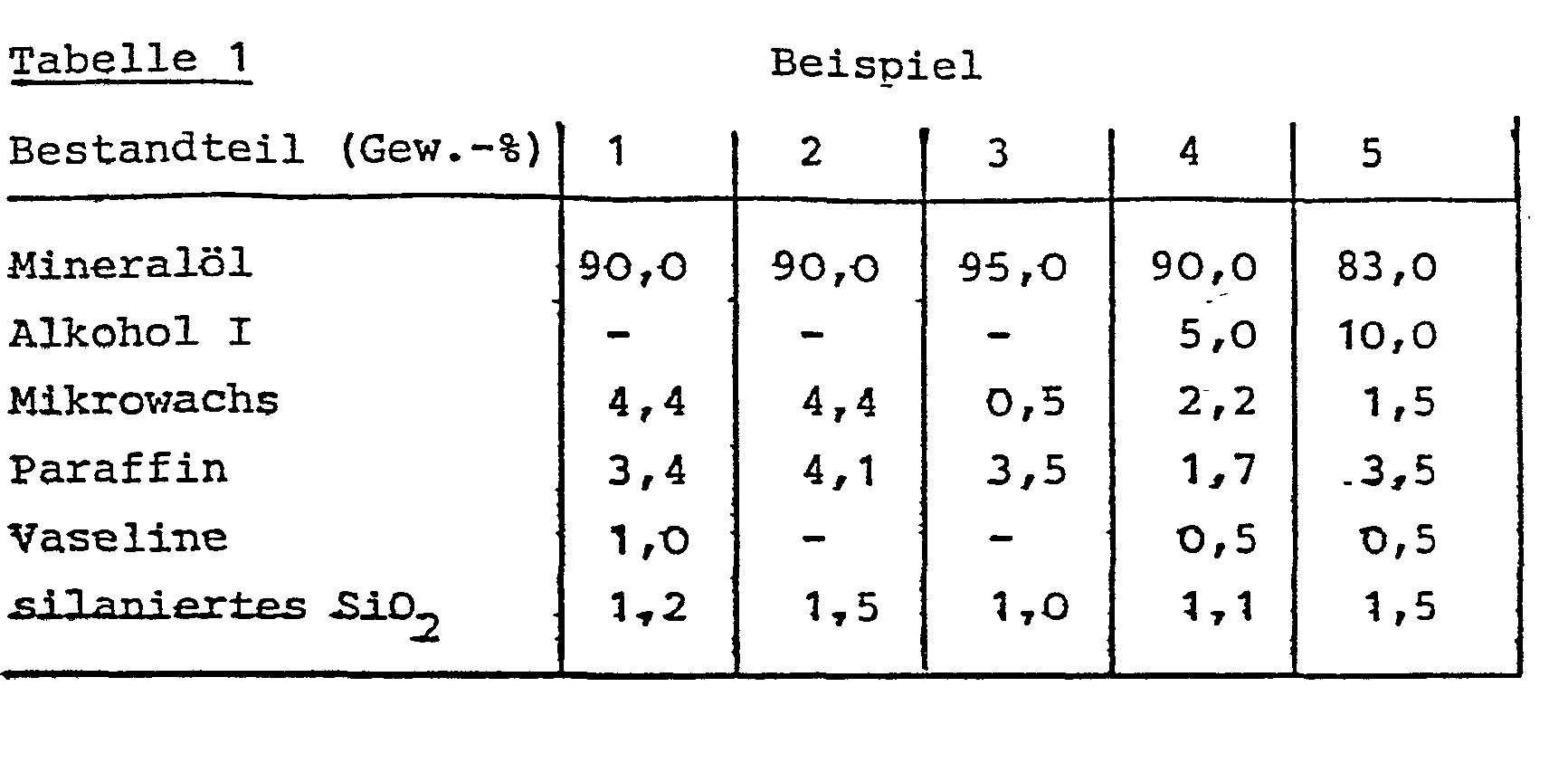
- the constituents listed in Table 1 were processed in such a way that the melted paraffin waxes or the branched-chain alcohol and the silanated silica (d) were introduced into the mineral oil heated to 80 ° C. with vigorous stirring. Mixing was continued until cooling to room temperature.
- a naphthenic paraffin oil with a pour point below 5 ° C was used as the mineral oil.
- the branched chain alcohol had been prepared by cross-beating technical decanol-1 and consisted essentially of 2-octyl-dodecanol.
- the melting point of the microcrystalline wax was 92 0-94 ° C, the hard paraffin 42 ° to 44 ° C and the Vaseline 36 ° to 39 ° C.
- the silanized silica had an average particle size of 15 ⁇ m and had been obtained by reacting pyrogenic silica with dimethylchlorosilane.
- the homogenized defoamers proved to be completely stable even after storage for 6 to 10 weeks at room temperature (22 ° C).
- the defoamer-containing dispersion is poured into the frame of the doctor blade, which is then drawn over a flat surface at a uniform speed.
- the resulting film (2O0 ⁇ m) dries in air and is then assessed for air inclusion (microfoam) and flow or silicone disorders. After 24 hours, an additional gloss measurement of the surface (according to GARDNER) was carried out.
- the sponge roller used with a width of 6 cm and a diameter of 7 cm consists of open-pore polyurethane foam.
- the use of such a roller has the advantages that not only the foam bubbles enclosed in the paint are assessed, but also air is incorporated into the paint, as is the case with brush application, albeit to a lesser extent.
Landscapes
- Chemical & Material Sciences (AREA)
- Health & Medical Sciences (AREA)
- Toxicology (AREA)
- Dispersion Chemistry (AREA)
- Chemical Kinetics & Catalysis (AREA)
- Wood Science & Technology (AREA)
- Engineering & Computer Science (AREA)
- Materials Engineering (AREA)
- Life Sciences & Earth Sciences (AREA)
- Organic Chemistry (AREA)
- Paints Or Removers (AREA)
- Compositions Of Macromolecular Compounds (AREA)
- Addition Polymer Or Copolymer, Post-Treatments, Or Chemical Modifications (AREA)
- Processes Of Treating Macromolecular Substances (AREA)
- Colloid Chemistry (AREA)
- Degasification And Air Bubble Elimination (AREA)
Abstract

Description
- Wäßrige Kunstharzlösungen und Dispersionen, die zum Beispiel als Bindemittel für Druckfarben, Holz- und Metalllacke sowie als Überzüge für Papier und Kunststoffe verwendet werden, basieren meist auf wasserlöslichen Alkydharzen, Polyacrylaten oder Polyestern. Als Alkydharze kommen solche mit Carboxylfunktionalität, wie mit Maleinsäure modifizierte Öle, ölmodifizierte Alkyde und ölfreie Polyester in Betracht, wobei neben der Neutralisationskomponente - meist einem Amin - häufig eine Cosolventkomponente anwesend ist. Bei Lacken auf Polyacrylatbasis handelt es sich um copolymere Acrylsäurederivate, die sowohl mit Melamin- oder Harnstoffharzen als auch mit Polyurethanen kombiniert sein können. Als Polyester eignen sich modifizierte ungesättigte Verbindungen in Emulsionsform.
- Diese Bindemittelsysteme werfen, bedingt durch die Anwesenheit von Emulgatoren bzw. Salze bildenden Carboxylgruppen, bei der Herstellung und Applikation Schaumprobleme auf, die mit üblichen Entschäumern im allgemeinen nicht zu lösen sind. So erhält man bei Einsatz von herkömmlichen Alkylpolysiloxanen in Form von Emulsionen oder als Lösung in Kohlenwasserstoffen starke Oberflächenstörungen, die dem Fachmann als Krater, Fischaugen und Orangenschaleneffekte bekannt sind.
- Andererseits sind die für derartige Zwecke brauchbaren bzw. speziell entwickelten Organopolysiloxane vergleichsweise teuer. Es ist daher wiederholt versucht worden, sie ganz oder teilweise durch preiswertere Schaumdämpfungsmittel zu ersetzen.
- Soweit diese Mittel zusätzlich weitere bekannte Schaumdämpfungsmittel enthalten, zum Beispiel solche auf Basis von Mineralölen oder Esterölen auf Basis langkettiger linearer Fettsäuren, kann es aber trotz Zusatz von Emulgatoren zu Unverträglichkeiten mit dem Bindemittelsystem sowie Ausschwitzungen auf der Lackoberfläche kommen. Organische Lösungsmittel, wie niedermolekulare Glykole, Ketone oder Ester enthaltende Entschäumer besitzen den Nachteil, daß nach Trocknung der Lackapplikationen deutliche Restschäume in Form von Flächen- bzw. Mikroschaum verbleiben. Außerdem weisen derartige Lösungsmittel vielfach einen niedrigen Flammpunkt auf und erfordern für den Transport sowie bei der Handhabung aufgrund kritischer MAK-Werte sowie toxischer Belastungen zusätzliche Sicherheitsmaßnahmen. Aus den vorstehend genannten Gründen sind derartige Entschäumergemische für die erfindungsgemäßen Zwecke nicht geeignet.
- Aus der DE-AS 12 57 111 sind ferner Entschäumer bekannt, die aus Estern verzweigtkettiger Fettsäuren und verzweigtkettiger Monoalkohole bestehen. Sie eignen sich als Entschäumer in der Textil-, Waschmittel- und Nahrungsmittelindustrie sowie bei chemischen Umsetzungen und beim Destillieren. Eine Verwendung in wäßrigen Kunstharzdispersionen wird nicht offenbart, und es läßt sich zeigen, daß die Wirkung dieser Ester bei Abwesenheit weiterer Schaum Inhibitoren für den genannten Zweck nicht ausreicht.
- In der Patentanmeldung DE 30 13 391 ist ein silikonfreier Entschäumer beschrieben, der aus einem homogenen Gemisch kettenverzweigter, 18 bis 30 Kohlenstoffatome enthaltender, primärer Alkohole, insbesondere Guerbetalkohole und silanierter Kieselsäure im Verhältnis Alkohol zu Kieselsäure wie 100 : 2 bis 100 : 20 besteht. Der praktisch silikonfreie Entschäumer ist in erster Linie zur Einarbeitung in Wasch- und Reinigungsmittel bestimmt.. Die Patentanmeldung DE 31 15 644 -vermittelt die Lehre, daß man die Wirkung dieses Entschäumers durch Vermischen mit Wachsen, wie Paraffin, Montanwachs oder Esterwachsen sowie Aufbringen auf einem wasserlöslichen, salzartigen Träger, wie Natriumtripolyphosphat, für den speziellen Anwendungszweck, nämlich den Einsatz in Wasch- und Reinigungsmitteln steigern kann. Die Verwendung derartiger Entschäumergranulate in wäßrigen Kunstharzdispersionen ist nicht offenbart. Für diesen Verwendungszweck wären die Entschäumer nach DE 31 15 644 im übrigen auf Grund ihres hohen Salzgehaltes ungeeignet.
- Weiterhin sind aus DE 27 45 583 Schaumverhütungsmittel für wäßrige Polymerdispersionen bekannt, die ein Gemisch aus 10 bis 95 % an einer organischen Trägerflüssigkeit, z.B. eines Paraffinöls, 1 bis 5 % eines synthetischen Hartparaffins mit einem Erstarrungsbereich von 90 bis 100 °C, 0,5 bis 2 % des Magnesiumsalzes einer Fettsäure, 0,5 bis 5 % einer hydrophobierten Kieselsäure und 2 bis 20 % eines nichtionogenen Emulgators besteht. Die Notwendigkeit, derartige Entschäumer durch Zusätze an Emulgatoren sowie Verdickungsmitteln (fettsauren Magnesiumseifen) stabilisieren zu müssen, stellt einen Nachteil dar, da diese nicht schaumdämpfend wirkenden Zusätze zu Unverträglichkeiten mit den wäßrigen Lackdispersionen, insbesondere Glanzlacken führen können. Bei derartigen Glanzlacken können insbesondere auch sogenannte Mikroschäume zu erhebulichen Störungen nämlich Poren- und Kraterbildung sowie Glanzverlust führen. Solche Mikroschäume können sich beispielsweise beim Auftragen der Lackdispersion auf die zu beschichtende Oberfläche bilden. Wird ihre Entstehung nicht nnterbrückt, beziehungsweise werden sie nicht vor dem Erhärten der Lackschicht zerstört, so kommt es zu der beschriebenen Ausbildung von Poren und Kratern.
- Es wurde nun gefunden, daß sich Mittel der Zusammensetzung
- a) 70 bis 98 Gewichtsprozent eines bei Raumtemperatur flüssigen, organischen Trägermaterials. bestehend aus einem Mineralöl sowie dessen Gemischen mit Alkoholen der Formel I

- b) 0,2 bis 5 Gewichtsprozent eines mikrokristallinen Paraffinwachses mit einem Schmelzpunkt von 60° bis 95°C
- c) 0,5 bis 20 Gewichtsprozent Hartparaffin mit einem Schmelzpunkt von 40° bis 60 °C,
- d) 0,05 bis 5 Gewichtsprozent hydrophobierte feinteilige Kieselsäure, mit Vorteil als Entschäumer in wäßrigen Lack- und Kunstharzdispersionen verwenden lassen.
- Als Mineralöle (Komponente a) kommen aliphatische und alicyclische (naphthenische) Paraffinöle mit einem mittleren Molekulargewicht von 140 bis 250, einem Stockpunkt von unter 10°C und einem Siedepunkt von über 180 °C in Frage. Diese Mineralöle können teilweise ersetzt sein durch verzweigtkettige, primäre Alkohole der vorstehend angegebenen Formel I. Als geeignet haben sich insbesondere Guerbetalkohole erwiesen, die in bekannter Weise aus geradkettigen, gesättigten Alkoholen beziehungsweise Alkoholgemischen mit 6 bis 16 C-Atomen zugänglich sind, beispielsweise durch Erhitzen dieser Alkohole in Gegenwart von starken Alkalien. Es hat sich gezeigt, daß Schaumdämpfungsmittel, in denen die Komponente (a) aus einem Gemisch von Mineralöl und Alkoholen der Formel I besteht, in bestimmten Fällen eine höhere Wirkung besitzen. Als gut geeignet haben sich Gemische im Gewichtsverhältnis von 50 : 1 bis 1 : 1 erwiesen.
- Vorzugsweise beträgt der Anteil der Komponente (a) 85 bis 97 Gewichtsprozent des Entschäumergemisches.
- Als Komponente (b) kommen bekannte mikrokristalline Paraffinwachse in Frage, die einen Schmelzpunkt von 60 bis 95 °C, vorzugsweise von 62 bis 90 °C aufweisen. Derartige mikrokristalline Wachse sind zum Beispiel Bestandteil von Montanwachsen beziehungsweise hochschmelzenden Erdölfraktionen (Ceresin) und zeichnen sich durch einen Gehalt an und cyclischen Paraffinen aus. Ihr Anteil beträgt 0,2 bis 5 Gewichtsprozent, vorzugsweise 0,5 bis 3 Gewichtsprozent.
- Als Komponente (c) eignen sich übliche Paraffinkohlenwasserstoffe, die im Gegensatz zu den vorgenannten mikrokristallinen Wachsen ein mehr oder weniger ausgeprägtes Kristallisationsverhalten zeigen. Der Schmelzpunkt dieser allgemein als Hartparaffine bezeichneten Kohlenwasserstoffe liegt zwischen 40 und 60 °C, vorzugsweise zwischen 42 und 56 °C. Bezogen auf Entschäumergemisch beträgt ihr Anteil 0,5 bis 20 Gewichtsprozent, vorzugsweise 1 bis 10 Gewichtsprozent und insbesondere 1,5 bis 5 Gewichtsprozent.
- Die Gesamtmenge der Komponenten (b) und (c) beträgt vorzugsweise mindestens 3 Gewichtsprozent und insbesondere 4 bis 10 Gewichtsprozent.
- Die Komponente (d) besteht aus feinteiliger, hydrophobierter Kieselsäure und ist in Anteilen von 0,05 bis 5 Gewichtsprozent, vorzugsweise von 0,1 bis 3 Gewichtsprozent und insbesondere von 0,2 bis 2 Gewichtsprozent in dem Gemisch enthalten. Unter hydrophobierter, feinteiliger Kieselsäure versteht man eine mikrofeine, durch Fällung aus Silikatlösungen, insbesondere jedoch pyrogene Zersetzung von Siliciumtetrachlorid hergestellte Kieselsäure, die in bekannter Weise mit Organochlorsilanen umgesetzt wurde, so wie dies zum Beispiel in US 3,207,698 und US 3,388,073 beschrieben ist. Als Beispiel sei ein mit Trimethylchlorsilan oder Dimethyldichlorsilan umgesetztes pyrogenes Siliciumdioxid genannt, das üblicherweise eine Teilchengröße von 5 bis 20µm aufweist.
- Außer den unter (a) bis (d) genannten Komponenten können die Mittel als weiteren Mischungsbestandteil eine Komponente (e) enthalten, die aus einem Weichparaffin mit einem Schmelzpunkt von 32° bis 42 °C, insbesondere von 35 bis 40 °C besteht. Geeignete Weichparaffine sind unter der Bezeichnung Vaseline im Handel. Die Komponente (e) führt zu einer weiteren Steigerung der Entschäumerwirkung und kann in Anteilen von vorzugsweise O,1 bis 10 Gewichtsprozent, insbesondere 0,2 bis 5 Gewichtsprozent anwesend sein.
- Die Schaumdämpfungsmittel werden durch Homogenisieren der vorgenannten Komponenten, vorzugsweise unter Erwärmen auf Temperaturen zwischen 80 und 110 v C erhalten, wobei es sich empfiehlt, die Komponente (a) vorzulegen und anschließend die Komponenten (b) bis (e) zuzumischen. Das Gemisch ist lagerbeständig oder kann unmittelbar weiterverwendet werden.
- Das Schaumdämpfungsmittel eignet sich hervorragend zur Schaumunterdrückung in Kunstharz-, Lack- und Farbstoffdispersionen, die zur Herstellung klarer beziehungsweise hochglänzender Formstücke, Lacke und Beschichtungen bestimmt sind. Die Einsatzmengen an Schauminhibitor betragen in derartigen Zubereitungen 0,01 bis 1,5 Gewichtsprozent, vorzugsweise 0,05 bis 1 Gewichtsprozent. Die Schauminhibitoren sind hochwirksam und beeinträchtigen trotz der Anwesenheit von hydrophober Kieselsäure nicht den Glanz. Sie unterbinden insbesondere zuverlässig die Bildung störender Mikroschäume. Glanzfarben mit dem eingearbeiteten Entschäumer sind lagerstabil. Ihre Wirkung ist etwa denen bekannter, hochwirksamer Silikonentschäumer vergleichbar, übertreffen sie jedoch hinsichtlich ihrer Verträglichkeit mit Glanzlack-Zubereitungen, da sie nicht zu Entmischungen und Trübungen in den applizierten Lackschichten führen.
- Zwecks Herstellung homogener Gemische wurden die in der Tabelle 1 aufgeführten Bestandteile in der Weise verarbeitet, daß in das auf 80 °C erwärmte Mineralöl die aufgeschmolzenen Paraffinwachse beziehungsweise der verzweigtkettige Alkohol sowie die silanierte Kieselsäure (d) unter intensiveren Rühren eingegeben wurden. Das Durchmischen wurde bis zum Abkühlen auf Raumtemperatur fortgesetzt.
- Als Mineralöl wurde ein naphthenisches Paraffinöl mit einem Stockpunkt unter 5 °C eingesetzt. Der verzweigtkettige Alkohol war durch Querbetisierung von technischem Decanol-1 hergestellt worden und bestand im wesentlichen aus 2-Octyl-dodecanol. Der Schmelzpunkt des mikrokristallinen Paraffins betrug 92 0 bis 94 °C, des Hartparaffins 42° bis 44 °C und der Vaseline 36° bis 39 °C. Die silanierte Kieselsäure wies eine mittlere Teilchengröße von 15 µm auf und war durch Umsetzung von pyrogener Kieselsäure mit Dimethylchlorsilan erhalten worden.
-

- Die homogenisierten Entschäumer erwiesen sich auch nach 6- bis 10-wöchiger Lagerung bei Raumtemperatur (22 °C) als völlig stabil.
- Zwecks anwendungstechnischer Prüfung wurden die Entschäumer in folgende Glanzlack-Dispersion eingearbeitet (Angaben in Gewichrtsteilen = T) .

- Mit dem hergestellten Dispersionslack wurden folgende anwendungstechnische Prüfungen durchgeführt.
- Unmittelbar nach der Herstellung der Dispersionsfarbe werden 80 T der Farbe mit 20 T Wasser gemischt und .jeweils 1 Minute bei 2.000 Upm mit einem Dissolver (Dispergierscheibe 0 40 mm) gerührt. Mit diesem Gemisch wird ein tarierter Standzylinder bis zur 50 ml-Marke gefüllt und das Gewicht dieser Flüssigkeitsmenge bestimmt.Je höher das Gewicht der Probe, um so niedriger ist der Luftgehalt, um so besser also die Wirkung des Entschäumers. Angegeben wird der prozentuale Lufteinschluß, bezogen auf eine schaumfreie (ideale) Dispersion.
- Die Durchführung erfolgt mittels eines Filmziehgerätes. Die entschäumerhaltige Dispersion wird in den Rahmen der-Rakel gegossen, welcher anschließend mit gleichmäßiger Geschwindigkeit über eine plane Oberfläche gezogen wird. Der entstandene Film ( 2O0 µm ) trocknet an der Luft ab and wird anschließend auf Lufteinschluß (Mikroschaum) und Verlaufs- beziehungsweise Silikonstörungen beurteilt. Nach 24 Stunden wurde zusätzlich eine Glanzmessung der Oberfläche (nach GARDNER) durchgeführt.
- Nach der Herstellung der Dispersionsfarbe werden 80 T Farbe mit 20 T Wasser
- gemischt und 1 Minute bei 2.000 Upm mit einen Dissolver gerührt. Anschließend wird die Probe mit Hilfe einer Anstrichrolle (Lammfellrolle) auf eine sorgfältig gereinigte Glasplatte aufgetragen. Nach dem Trocknen wird der Anstrich auf Lufteinschlüsse (Blasenbildung) visuell beurteilt.
- Hartfaserplatten der Größe 20 x 30 x 0,4 cm werden auf der glatten:Seite mit einer 1 : 1 verdünnten Kunststoffdispersion durch Pinselauftrag abgesperrt. Nun werden 60 bis 70 g Farbe auf diese Platte gegeben und mit einer Schwammwalze so gleichmäßig verteilt, daß 15 g nasser Farbe (= 250 g/m2) verbleiben.
- Die verwendete Schwammwalze mit einer Breite von 6 cm und einem Durchmesser von 7 cm besteht aus offenporigem polyurethanschaum. Die Verwendung einer solchen Walze bringt den Vorteile daß nicht nur die in der Farbe eingeschlossenen Schaumbläschen beurteilt werden, sondern zusätzlich Luft in den Anstrich eingearbeitet wird, wie dies bei der Pinselapplikation, wenn auch in geringerem Maße, gegeben ist.
- Die trockenen Anstriche werden nach folgender Vergleichsskala beurteilt:
- 1 = sehr Starker Lufteinschluß
- 2 = starker Lufteinschluß
- 3 = mäßiger Lufteinschluß
- 4 = wenig Lufteinschluß
- 5 = sehr wenig Lufteinschluß
- 6 = kein Lufteinschluß
- Die Ergebnisse sind in Tabelle 3 zusammengestellte. Sie belegen die Überlegenheit der erfindungsgemäßen Mittel.

Claims (9)
als Entschäumer in wäßrigen Lack- und Kunstharzdispersionen.

Priority Applications (1)
| Application Number | Priority Date | Filing Date | Title |
|---|---|---|---|
| AT84115267T ATE32186T1 (de) | 1984-01-02 | 1984-12-12 | Entschaeumer fuer waessrige dispersionen und loesungen von kunstharzen. |
Applications Claiming Priority (2)
| Application Number | Priority Date | Filing Date | Title |
|---|---|---|---|
| DE3400014 | 1984-01-02 | ||
| DE19843400014 DE3400014A1 (de) | 1984-01-02 | 1984-01-02 | Entschaeumer fuer waessrige dispersionen und loesungen von kunstharzen |
Publications (3)
| Publication Number | Publication Date |
|---|---|
| EP0147726A2 true EP0147726A2 (de) | 1985-07-10 |
| EP0147726A3 EP0147726A3 (en) | 1985-08-07 |
| EP0147726B1 EP0147726B1 (de) | 1988-01-27 |
Family
ID=6224244
Family Applications (1)
| Application Number | Title | Priority Date | Filing Date |
|---|---|---|---|
| EP84115267A Expired EP0147726B1 (de) | 1984-01-02 | 1984-12-12 | Entschäumer für wässrige Dispersionen und Lösungen von Kunstharzen |
Country Status (5)
| Country | Link |
|---|---|
| US (1) | US4655960A (de) |
| EP (1) | EP0147726B1 (de) |
| JP (1) | JPS60158258A (de) |
| AT (1) | ATE32186T1 (de) |
| DE (2) | DE3400014A1 (de) |
Cited By (1)
| Publication number | Priority date | Publication date | Assignee | Title |
|---|---|---|---|---|
| US7771747B2 (en) | 2002-10-16 | 2010-08-10 | Orexo Ab | Gastric acid secretion inhibiting composition |
Families Citing this family (11)
| Publication number | Priority date | Publication date | Assignee | Title |
|---|---|---|---|---|
| DE4113783C1 (de) * | 1991-04-26 | 1992-11-19 | Rudolf Gmbh & Co Kg Chemische Fabrik, 8192 Geretsried, De | |
| DE4119116C2 (de) * | 1991-06-10 | 1997-08-07 | Boehme Chem Fab Kg | Biologisch leicht eliminierbare Entschäumer für wäßrige Systeme |
| US5874017A (en) * | 1996-08-12 | 1999-02-23 | Geo Specialty Chemicals, Inc. | Use of microcrystalline wax and low foaming emulsifiers as defoamers |
| US6869642B2 (en) * | 2000-05-18 | 2005-03-22 | Raymond G. Freuler | Phase change thermal interface composition having induced bonding property |
| JP3997262B2 (ja) * | 2004-03-30 | 2007-10-24 | サンノプコ株式会社 | 消泡剤 |
| US20060160921A1 (en) * | 2005-01-20 | 2006-07-20 | Ragone Pietro J | Non-aqueous slurries used as thickeners and defoamers and method of using slurries in aqueous systems |
| DE102007061455A1 (de) * | 2007-12-20 | 2009-06-25 | Evonik Degussa Gmbh | Entschäumerformulierung |
| CN107008035A (zh) * | 2017-04-21 | 2017-08-04 | 苏州博纳化学科技有限公司 | 含高碳醇的消泡剂及其制备方法 |
| CN107050936A (zh) * | 2017-04-21 | 2017-08-18 | 苏州博纳化学科技有限公司 | 高碳醇乳液型的消泡剂及其制备方法 |
| CN107080980A (zh) * | 2017-04-21 | 2017-08-22 | 苏州博纳化学科技有限公司 | 高碳醇类的消泡剂及其制备方法 |
| US12427444B2 (en) * | 2018-06-15 | 2025-09-30 | W.R. Grace & Co.-Conn. | Defoamer active, manufacturing thereof, and deforming formulation |
Family Cites Families (23)
| Publication number | Priority date | Publication date | Assignee | Title |
|---|---|---|---|---|
| US2085709A (en) * | 1931-07-25 | 1937-06-29 | Ig Farbenindustrie Ag | Composition for combating foam |
| US3329625A (en) * | 1961-01-11 | 1967-07-04 | Bissell Inc | Defoaming cleaning cake |
| US3207698A (en) * | 1963-02-13 | 1965-09-21 | Nopco Chem Co | Composition and method for defoaming aqueous systems |
| US3388073A (en) * | 1963-12-16 | 1968-06-11 | Nalco Chemical Co | Process of defoaming and inhibiting foam formation in aqueous systems |
| DE1257111C2 (de) * | 1964-08-05 | 1973-01-25 | Hoechst Ag | Schaumdaempfungsmittel |
| US3909445A (en) * | 1970-03-18 | 1975-09-30 | Mobil Oil Corp | Method for reducing foam in water containing systems |
| US3705860A (en) * | 1970-09-23 | 1972-12-12 | Basf Wyandotte Corp | Antifoam agent |
| US3923683A (en) * | 1971-09-07 | 1975-12-02 | Nalco Chemical Co | Amides and hydrophobic silica as antifoams |
| US3784479A (en) * | 1972-05-15 | 1974-01-08 | Dow Corning | Foam control composition |
| GB1492938A (en) * | 1974-01-11 | 1977-11-23 | Procter & Gamble Ltd | Low sudsing detergent compositions |
| IE42854B1 (en) * | 1975-06-13 | 1980-11-05 | Ciba Geigy Ag | Process for removing foam from aqueous systems |
| DE2557954C2 (de) * | 1975-12-22 | 1984-12-13 | Henkel KGaA, 4000 Düsseldorf | Mittel zur Schaumbekämpfung |
| CA1083006A (en) * | 1976-03-08 | 1980-08-05 | William A. Satterwhite | Defoamer for high strength acid media |
| US4132535A (en) * | 1976-11-17 | 1979-01-02 | Western Chemical Company | Process for injecting liquid in moving natural gas streams |
| DE2745583C2 (de) * | 1977-10-11 | 1986-04-24 | Münzing Chemie GmbH, 7100 Heilbronn | Schaumverhütungsmittel für wäßrige Polymerisatdispersionen |
| CH637304A5 (de) * | 1978-11-03 | 1983-07-29 | Ciba Geigy Ag | Schaumdaempfungsmittel fuer waessrige systeme. |
| DE3001387A1 (de) * | 1980-01-16 | 1981-07-23 | Chemische Fabrik Stockhausen & Cie, 4150 Krefeld | Emulgatorhaltige suspensionen auf der basis hoeher aliphatischer alkohole, verfahren zu ihrer herstellung und ihre verwendung als entschaeumer fuer waessrige schaeumende systeme |
| DE3013391A1 (de) * | 1980-04-05 | 1981-10-29 | Henkel KGaA, 4000 Düsseldorf | Verfahren zur herstellung eines entschaeumers fuer waessrige systeme und seine verwendung als schauminhibitor |
| DE3115644A1 (de) * | 1981-04-18 | 1982-11-04 | Henkel KGaA, 4000 Düsseldorf | "pulverfoermiger entschaeumer fuer waessrige systeme, verfahren zu seiner herstellung und seine verwendung" |
| EP0076558B1 (de) * | 1981-09-30 | 1985-10-16 | Imperial Chemical Industries Plc | Antischaummittel zur Kontrolle unerwünschten Schaums |
| DE3218676C2 (de) * | 1982-05-18 | 1985-08-01 | Th. Goldschmidt Ag, 4300 Essen | Mittel zum Entlüften von Beschichtungssystemen |
| DE3333073A1 (de) * | 1983-09-14 | 1985-03-21 | Herberts Gmbh, 5600 Wuppertal | Verfahren zur herstellung von lagerfaehigen konzentraten und deren verwendung zur herstellung von ueberzugsmitteln |
| US4540511A (en) * | 1984-02-15 | 1985-09-10 | National Distillers And Chemical Corporation | Defoamer and processing aid for wet process phosphoric acid |
-
1984
- 1984-01-02 DE DE19843400014 patent/DE3400014A1/de not_active Withdrawn
- 1984-12-12 DE DE8484115267T patent/DE3468985D1/de not_active Expired
- 1984-12-12 AT AT84115267T patent/ATE32186T1/de not_active IP Right Cessation
- 1984-12-12 EP EP84115267A patent/EP0147726B1/de not_active Expired
- 1984-12-27 JP JP59274245A patent/JPS60158258A/ja active Pending
-
1985
- 1985-01-02 US US06/688,225 patent/US4655960A/en not_active Expired - Fee Related
Cited By (2)
| Publication number | Priority date | Publication date | Assignee | Title |
|---|---|---|---|---|
| US7771747B2 (en) | 2002-10-16 | 2010-08-10 | Orexo Ab | Gastric acid secretion inhibiting composition |
| US7785626B2 (en) | 2002-10-16 | 2010-08-31 | Orexo Ab | Gastric acid secretion inhibiting composition |
Also Published As
| Publication number | Publication date |
|---|---|
| EP0147726A3 (en) | 1985-08-07 |
| EP0147726B1 (de) | 1988-01-27 |
| DE3468985D1 (en) | 1988-03-03 |
| US4655960A (en) | 1987-04-07 |
| ATE32186T1 (de) | 1988-02-15 |
| JPS60158258A (ja) | 1985-08-19 |
| DE3400014A1 (de) | 1985-07-18 |
Similar Documents
| Publication | Publication Date | Title |
|---|---|---|
| EP0036597B1 (de) | Schaumdämpfungsmittel und dessen Verwendung in Kunstharz-, Lack- und Farbdispersionen | |
| EP0331952B1 (de) | Verfahren zum Entschäumen wässriger Dispersionen polymerer organischer Substanzen durch Zusatz von Polyoxyalkylen-Polysiloxan-Blockmischpolymerisaten | |
| EP0717758B1 (de) | Stabile wässrige polyolefinwachsdispersionen | |
| DE2454977C2 (de) | Entschäumerzubereitung | |
| CH652048A5 (de) | Nichtwaessriges fluides system. | |
| EP0777010A2 (de) | Polysiloxan-Polyoxyethylen-Polyoxypropylen-Triblockcopolymere und diese enthaltende Entschäumercompounds | |
| EP0147726B1 (de) | Entschäumer für wässrige Dispersionen und Lösungen von Kunstharzen | |
| DE2727845B2 (de) | Oberflächenbehandelter mineralischer Füllstoff | |
| EP0130521A1 (de) | Siliconharz-Emulsion | |
| EP0002252B1 (de) | Wässrige Dispersionen von als Überzugsmittel bzw. Lackbindemittel geeigneten Harzen | |
| EP0548789A1 (de) | Pflegemittel für harte Oberflächen | |
| EP0149139B1 (de) | Entschäumer für wässrige Dispersionen und Lösungen von Kunstharzen | |
| DE60101199T2 (de) | Abriebfester Tintenzusatz mit verringerter Menge an polytetrafluoroethylen und Tinten enthaltend diesen Zusatz | |
| DE1592865C3 (de) | Verfahren zur Herstellung von organisch modifizierten Kieselsauren | |
| EP0546421B1 (de) | Fassadenanstrichmittel und Putze mit hoher Frühwasserbeständigkeit | |
| EP1533333B1 (de) | Emulgatorfreie Öl in Wasser-Emulsionen von Organopolysiloxanen und deren Verwendung in technischen Anwendungen | |
| DE2506203A1 (de) | Entschaeumer | |
| DE2321755A1 (de) | Schaumbekaempfungsmittel | |
| DE2745583C2 (de) | Schaumverhütungsmittel für wäßrige Polymerisatdispersionen | |
| EP0597320B1 (de) | Schutzkolloid enthaltende Entschäumeremulsion | |
| DE10315158A1 (de) | Verbesserte wässrige Entschäumerformulierungen | |
| DE2557898A1 (de) | Mittel zur schaumbekaempfung | |
| DE2652603C2 (de) | Verwendung von wässrigen Gemischen zur Herstellung von pigmenthaltigen Beschichtungen von Kohlepapieren | |
| EP0521920B1 (de) | Tiefenwirksame grundierung | |
| DE19620405B4 (de) | Verfahren zur Herstellung wäßriger Siliconemulsionen |
Legal Events
| Date | Code | Title | Description |
|---|---|---|---|
| PUAI | Public reference made under article 153(3) epc to a published international application that has entered the european phase |
Free format text: ORIGINAL CODE: 0009012 |
|
| PUAL | Search report despatched |
Free format text: ORIGINAL CODE: 0009013 |
|
| AK | Designated contracting states |
Designated state(s): AT BE CH DE FR GB IT LI LU NL SE |
|
| AK | Designated contracting states |
Designated state(s): AT BE CH DE FR GB IT LI LU NL SE |
|
| 17P | Request for examination filed |
Effective date: 19860123 |
|
| 17Q | First examination report despatched |
Effective date: 19870320 |
|
| RBV | Designated contracting states (corrected) |
Designated state(s): AT BE CH DE FR GB LI |
|
| GRAA | (expected) grant |
Free format text: ORIGINAL CODE: 0009210 |
|
| AK | Designated contracting states |
Kind code of ref document: B1 Designated state(s): AT BE CH DE FR GB LI |
|
| REF | Corresponds to: |
Ref document number: 32186 Country of ref document: AT Date of ref document: 19880215 Kind code of ref document: T |
|
| GBT | Gb: translation of ep patent filed (gb section 77(6)(a)/1977) | ||
| REF | Corresponds to: |
Ref document number: 3468985 Country of ref document: DE Date of ref document: 19880303 |
|
| ET | Fr: translation filed | ||
| PLBE | No opposition filed within time limit |
Free format text: ORIGINAL CODE: 0009261 |
|
| STAA | Information on the status of an ep patent application or granted ep patent |
Free format text: STATUS: NO OPPOSITION FILED WITHIN TIME LIMIT |
|
| 26N | No opposition filed | ||
| PGFP | Annual fee paid to national office [announced via postgrant information from national office to epo] |
Ref country code: CH Payment date: 19901122 Year of fee payment: 7 |
|
| PGFP | Annual fee paid to national office [announced via postgrant information from national office to epo] |
Ref country code: DE Payment date: 19901129 Year of fee payment: 7 |
|
| PGFP | Annual fee paid to national office [announced via postgrant information from national office to epo] |
Ref country code: GB Payment date: 19901203 Year of fee payment: 7 |
|
| PGFP | Annual fee paid to national office [announced via postgrant information from national office to epo] |
Ref country code: AT Payment date: 19901207 Year of fee payment: 7 |
|
| PGFP | Annual fee paid to national office [announced via postgrant information from national office to epo] |
Ref country code: FR Payment date: 19901215 Year of fee payment: 7 |
|
| PGFP | Annual fee paid to national office [announced via postgrant information from national office to epo] |
Ref country code: BE Payment date: 19901228 Year of fee payment: 7 |
|
| PG25 | Lapsed in a contracting state [announced via postgrant information from national office to epo] |
Ref country code: GB Effective date: 19911212 Ref country code: AT Effective date: 19911212 |
|
| PG25 | Lapsed in a contracting state [announced via postgrant information from national office to epo] |
Ref country code: LI Effective date: 19911231 Ref country code: CH Effective date: 19911231 Ref country code: BE Effective date: 19911231 |
|
| BERE | Be: lapsed |
Owner name: HEMKEL K.G.A.A. Effective date: 19911231 |
|
| GBPC | Gb: european patent ceased through non-payment of renewal fee | ||
| PG25 | Lapsed in a contracting state [announced via postgrant information from national office to epo] |
Ref country code: FR Effective date: 19920831 |
|
| REG | Reference to a national code |
Ref country code: CH Ref legal event code: PL |
|
| PG25 | Lapsed in a contracting state [announced via postgrant information from national office to epo] |
Ref country code: DE Effective date: 19920901 |
|
| REG | Reference to a national code |
Ref country code: FR Ref legal event code: ST |