EP0146145B1 - Naphthalenische Anti-Sporiasis-Wirkstoffe - Google Patents
Naphthalenische Anti-Sporiasis-Wirkstoffe Download PDFInfo
- Publication number
- EP0146145B1 EP0146145B1 EP84115947A EP84115947A EP0146145B1 EP 0146145 B1 EP0146145 B1 EP 0146145B1 EP 84115947 A EP84115947 A EP 84115947A EP 84115947 A EP84115947 A EP 84115947A EP 0146145 B1 EP0146145 B1 EP 0146145B1
- Authority
- EP
- European Patent Office
- Prior art keywords
- optionally substituted
- carbon atoms
- naphthoquinone
- compound
- formula
- Prior art date
- Legal status (The legal status is an assumption and is not a legal conclusion. Google has not performed a legal analysis and makes no representation as to the accuracy of the status listed.)
- Expired
Links
- 0 C*(C)c1c(C=CC(C)(C)C=C2)c2c(*)c(I)c1* Chemical compound C*(C)c1c(C=CC(C)(C)C=C2)c2c(*)c(I)c1* 0.000 description 3
Classifications
-
- C—CHEMISTRY; METALLURGY
- C07—ORGANIC CHEMISTRY
- C07D—HETEROCYCLIC COMPOUNDS
- C07D213/00—Heterocyclic compounds containing six-membered rings, not condensed with other rings, with one nitrogen atom as the only ring hetero atom and three or more double bonds between ring members or between ring members and non-ring members
- C07D213/02—Heterocyclic compounds containing six-membered rings, not condensed with other rings, with one nitrogen atom as the only ring hetero atom and three or more double bonds between ring members or between ring members and non-ring members having three double bonds between ring members or between ring members and non-ring members
- C07D213/04—Heterocyclic compounds containing six-membered rings, not condensed with other rings, with one nitrogen atom as the only ring hetero atom and three or more double bonds between ring members or between ring members and non-ring members having three double bonds between ring members or between ring members and non-ring members having no bond between the ring nitrogen atom and a non-ring member or having only hydrogen or carbon atoms directly attached to the ring nitrogen atom
- C07D213/60—Heterocyclic compounds containing six-membered rings, not condensed with other rings, with one nitrogen atom as the only ring hetero atom and three or more double bonds between ring members or between ring members and non-ring members having three double bonds between ring members or between ring members and non-ring members having no bond between the ring nitrogen atom and a non-ring member or having only hydrogen or carbon atoms directly attached to the ring nitrogen atom with hetero atoms or with carbon atoms having three bonds to hetero atoms with at the most one bond to halogen, e.g. ester or nitrile radicals, directly attached to ring carbon atoms
- C07D213/62—Oxygen or sulfur atoms
- C07D213/70—Sulfur atoms
-
- A—HUMAN NECESSITIES
- A61—MEDICAL OR VETERINARY SCIENCE; HYGIENE
- A61P—SPECIFIC THERAPEUTIC ACTIVITY OF CHEMICAL COMPOUNDS OR MEDICINAL PREPARATIONS
- A61P17/00—Drugs for dermatological disorders
-
- A—HUMAN NECESSITIES
- A61—MEDICAL OR VETERINARY SCIENCE; HYGIENE
- A61P—SPECIFIC THERAPEUTIC ACTIVITY OF CHEMICAL COMPOUNDS OR MEDICINAL PREPARATIONS
- A61P29/00—Non-central analgesic, antipyretic or antiinflammatory agents, e.g. antirheumatic agents; Non-steroidal antiinflammatory drugs [NSAID]
-
- C—CHEMISTRY; METALLURGY
- C07—ORGANIC CHEMISTRY
- C07C—ACYCLIC OR CARBOCYCLIC COMPOUNDS
- C07C205/00—Compounds containing nitro groups bound to a carbon skeleton
- C07C205/45—Compounds containing nitro groups bound to a carbon skeleton the carbon skeleton being further substituted by at least one doubly—bound oxygen atom, not being part of a —CHO group
- C07C205/46—Compounds containing nitro groups bound to a carbon skeleton the carbon skeleton being further substituted by at least one doubly—bound oxygen atom, not being part of a —CHO group the carbon skeleton containing carbon atoms of quinone rings
- C07C205/47—Anthraquinones containing nitro groups
- C07C205/48—Anthraquinones containing nitro groups the carbon skeleton being further substituted by singly-bound oxygen atoms
-
- C—CHEMISTRY; METALLURGY
- C07—ORGANIC CHEMISTRY
- C07C—ACYCLIC OR CARBOCYCLIC COMPOUNDS
- C07C255/00—Carboxylic acid nitriles
-
- C—CHEMISTRY; METALLURGY
- C07—ORGANIC CHEMISTRY
- C07C—ACYCLIC OR CARBOCYCLIC COMPOUNDS
- C07C255/00—Carboxylic acid nitriles
- C07C255/49—Carboxylic acid nitriles having cyano groups bound to carbon atoms of six-membered aromatic rings of a carbon skeleton
- C07C255/57—Carboxylic acid nitriles having cyano groups bound to carbon atoms of six-membered aromatic rings of a carbon skeleton containing cyano groups and carboxyl groups, other than cyano groups, bound to the carbon skeleton
-
- C—CHEMISTRY; METALLURGY
- C07—ORGANIC CHEMISTRY
- C07C—ACYCLIC OR CARBOCYCLIC COMPOUNDS
- C07C317/00—Sulfones; Sulfoxides
-
- C—CHEMISTRY; METALLURGY
- C07—ORGANIC CHEMISTRY
- C07C—ACYCLIC OR CARBOCYCLIC COMPOUNDS
- C07C323/00—Thiols, sulfides, hydropolysulfides or polysulfides substituted by halogen, oxygen or nitrogen atoms, or by sulfur atoms not being part of thio groups
-
- C—CHEMISTRY; METALLURGY
- C07—ORGANIC CHEMISTRY
- C07C—ACYCLIC OR CARBOCYCLIC COMPOUNDS
- C07C45/00—Preparation of compounds having >C = O groups bound only to carbon or hydrogen atoms; Preparation of chelates of such compounds
- C07C45/61—Preparation of compounds having >C = O groups bound only to carbon or hydrogen atoms; Preparation of chelates of such compounds by reactions not involving the formation of >C = O groups
- C07C45/63—Preparation of compounds having >C = O groups bound only to carbon or hydrogen atoms; Preparation of chelates of such compounds by reactions not involving the formation of >C = O groups by introduction of halogen; by substitution of halogen atoms by other halogen atoms
-
- C—CHEMISTRY; METALLURGY
- C07—ORGANIC CHEMISTRY
- C07C—ACYCLIC OR CARBOCYCLIC COMPOUNDS
- C07C46/00—Preparation of quinones
-
- C—CHEMISTRY; METALLURGY
- C07—ORGANIC CHEMISTRY
- C07C—ACYCLIC OR CARBOCYCLIC COMPOUNDS
- C07C46/00—Preparation of quinones
- C07C46/02—Preparation of quinones by oxidation giving rise to quinoid structures
-
- C—CHEMISTRY; METALLURGY
- C07—ORGANIC CHEMISTRY
- C07C—ACYCLIC OR CARBOCYCLIC COMPOUNDS
- C07C50/00—Quinones
- C07C50/24—Quinones containing halogen
-
- C—CHEMISTRY; METALLURGY
- C07—ORGANIC CHEMISTRY
- C07C—ACYCLIC OR CARBOCYCLIC COMPOUNDS
- C07C50/00—Quinones
- C07C50/26—Quinones containing groups having oxygen atoms singly bound to carbon atoms
- C07C50/32—Quinones containing groups having oxygen atoms singly bound to carbon atoms the quinoid structure being part of a condensed ring system having two rings
-
- C—CHEMISTRY; METALLURGY
- C07—ORGANIC CHEMISTRY
- C07C—ACYCLIC OR CARBOCYCLIC COMPOUNDS
- C07C69/00—Esters of carboxylic acids; Esters of carbonic or haloformic acids
- C07C69/017—Esters of hydroxy compounds having the esterified hydroxy group bound to a carbon atom of a six-membered aromatic ring
-
- C—CHEMISTRY; METALLURGY
- C07—ORGANIC CHEMISTRY
- C07D—HETEROCYCLIC COMPOUNDS
- C07D213/00—Heterocyclic compounds containing six-membered rings, not condensed with other rings, with one nitrogen atom as the only ring hetero atom and three or more double bonds between ring members or between ring members and non-ring members
- C07D213/02—Heterocyclic compounds containing six-membered rings, not condensed with other rings, with one nitrogen atom as the only ring hetero atom and three or more double bonds between ring members or between ring members and non-ring members having three double bonds between ring members or between ring members and non-ring members
- C07D213/89—Heterocyclic compounds containing six-membered rings, not condensed with other rings, with one nitrogen atom as the only ring hetero atom and three or more double bonds between ring members or between ring members and non-ring members having three double bonds between ring members or between ring members and non-ring members with hetero atoms directly attached to the ring nitrogen atom
Definitions
- the invention relates to naphthalene derivatives which are useful in inhibiting certain dermatological conditions.
- This invention also relates to pharmaceutical compositions useful in relieving the effects of certain chronic recurrent papulosquamous dermatoses, e.g., psoriasis.
- This invention also relates to a process for preparing compounds of this invention.
- Psoriasis is a skin disease characterized in part by excessive proliferation of cells of the epidermis which remain strongly adherent and build up into a scaly plaque typical of the disease.
- therapies which are not curative, depend on the control of epidermal cell proliferation through the use of hormonal agents, such as corticosteroids or through the use of compounds related to cancer chemotherapy such as hydroxyurea, methotrexate, and the nitrogen mustards.
- the compounds of the instant invention are also effective antipsoriatic agents and are less irritating, do not stain the skin and do not sensitize when used in the treatment of psoriasis. Further, the compounds of the present invention are more stable in the topical formulations normally used.
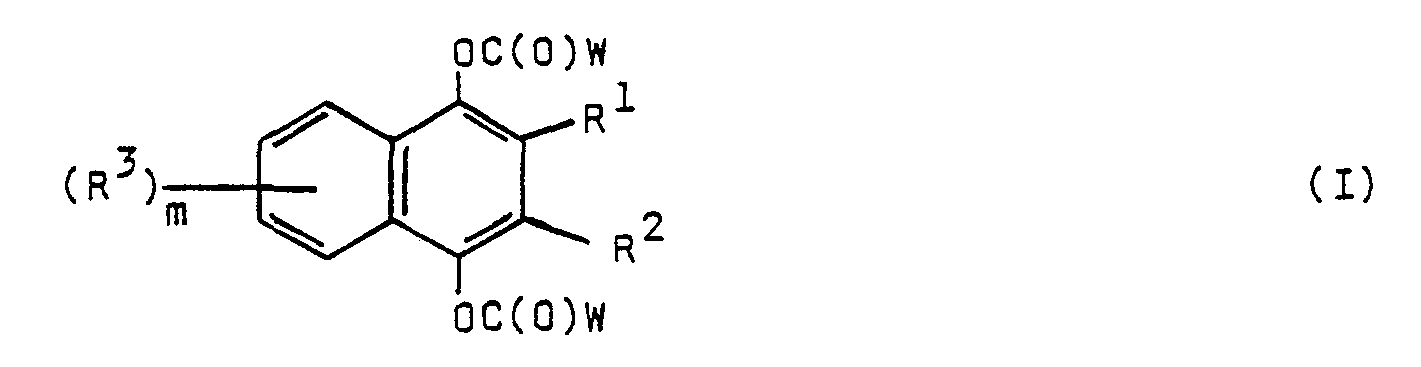
- the present invention relates to a pharmaceutical composition in a form suitable for topical administration to mammals comprising a compound of the following formula or a pharmaceutically acceptable acid addition salt thereof; wherein:
- Another aspect of the invention is the use of a compound of formula (I) as defined above or of a pharmaceutically acceptable acid addition salt thereof in the manufacture of a medicament for treating the condition of psoriasis.
- Another aspect of the invention is the novel compounds of formula (I) wherein R 1 , R 2 , R 3 , W, m and n are as defined above with the proviso that m is 2 when R 1 and R 2 are alkoxy of 1 to 6 carbon atoms or alkylthio of 1 to 6 carbon atoms and W is alkyl of 1 to 7 carbon atoms.
- Yet another aspect of the invention is preparing compounds of formula (I) by reacting compounds of formula (XI)(infra) with an acid anhydride.
- the present invention relates to a pharmaceutical composition in a form suitable for topical administration to mammals comprising a compound of the following formula
- W is alkyl of one to seven carbon atoms, phenyl or benzyl optionally substituted with one or two lower alkyl of one to four carbon atoms, lower alkoxy of one to four carbon atoms or halo, with the proviso that when R 1 and R 2 are optionally substituted phenoxy or optionally substituted phenylthio, m is 0, 1, or 2; and with the further proviso that m is 2 when R 1 and R 2 are alkoxy of 1 to 6 carbon atoms or alkylthio of 1 to 6 carbon atoms and W is alkyl of 1 to 7 carbon atoms.
- the present invention also relates to compounds of the formula and the pharmaceutically acceptable acid addition salts thereof; wherein:
- W is alkyl of one to seven carbon atoms, phenyl or benzyl optionally substituted with one or two lower alkyl of one to four carbon atoms, lower alkoxy of one to four carbon atoms or halo; with the proviso that m is 2 when R 1 and R are alkoxy of 1 to 6 carbon atoms or alkylthio of 1 to 6 carbon atoms and W is alkyl of 1 to 7 carbon atoms.
- An even more specific embodiment of the instant invention is compounds of formula (I) wherein m is 1 and R 3 is at the 6-position and is bromo, chloro, fluoro, cyano, methoxy, ethoxy, n-propoxy, i-propoxy, n-butoxy, and i-butoxy.
- a preferred group of compounds of formula (I) is those wherein R 1 and R 2 are the same and are lower alkoxy of one to three carbon atoms and W is lower alkyl of one to five carbon atoms.
- Another embodiment of the invention is compounds wherein m is 2 and the two R 3 s are at the 6 and 7 positions and are lower alkyl, lower alkoxy or halo with R 3 being methyl being preferred.
- Another embodiment of the invention is compounds wherein at least two of the groups R 1 , R or W contain an optionally substituted phenyl.
- R 1 , R or W contain an optionally substituted phenyl.
- each W is an optionally substituted phenyl or an optionally substituted benzyl and R 1 and R 2 are the same and are lower alkoxy or lower alkylthio.
- Another group of compounds are those wherein each W is an alkyl group and R 1 and R are the same and are optionally substituted phenyl or optionally substituted phenylthio.
- Still another group of compounds are those wherein each W is an optionally substituted phenyl or optionally substituted benzyl and R 1 and R are the same and are optionally substituted phenoxy or optionally substituted phenylthio.
- alkyl is intended to mean alkyl groups containing one to seven carbon atoms including straight chain groups, or branched chain groups. Illustrative of such groups are for example, methyl, ethyl, n-propyl, i-propyl, n-butyl, i-butyl, s-butyl, n-pentyl, i-pentyl, n-hexyl, 2-methylphenyl, and n-heptyl
- lower alkyl refers to alkyl groups of one to six carbon atoms as defined above.
- lower alkyl groups are methyl, ethyl, n-propyl, i-propyl, n-butyl, i-butyl, s-butyl, 2,2-dimethylpropyl and t-hexyl.
- phenyl lower alkyl refers to an optionally substituted phenyl ring attached to an alkylene chain of one to six carbon atoms.
- lower alkoxy refers to a straight or branched chain aliphatic group of one to six carbon atoms having bonded thereto an oxygen moiety.
- lower alkoxy are methoxy, ethoxy, n-propoxy, i-propoxy, n-butoxy, i-butoxy, s-butoxy, t-butoxy and n-pentyloxy.
- Phenyl lower alkoxy refers to a phenyl ring attached to an alkylene chain of one to six carbon atoms having bonded thereto an oxygen atom.
- phenyl lower alkoxy are benzyloxy, 4-chlorophenylethoxy and phenyl-n-propoxy.
- lower alkylthio refers to a straight or branched chain aliphatic group of one to six carbon atoms having bonded thereto a sulfur moiety.
- Examples of “lower alkylthio” are methylthio, ethylthio, n-propylthio, i-butylthio and n-hexylthio.
- Optionally substituted phenyl refers to a phenyl ring optionally substituted by one or more substituents selected from lower alkyl, lower alkoxy, halo, lower acyl, lower acyloxy, cyano, nitro, amino and lower acylamino unless otherwise defined.
- halo refers to fluoro, chloro, and bromo.
- cyano refers to the group -CN.
- amino refers to the group -NH 2 .
- lower alkylamino refers to an amino group substituted by lower alkyl as is defined above.
- Examples of “lower alkylamino” are methylamino, ethylamino and n-butylamino.
- lower dialkylamino refers to an amino group substituted by two lower alkyl groups.
- Examples of “lower dialkylamino” are di-n-methylamino, dipropylamino and methylethylamino.
- lower acyl refers to the group R'C(O)- wherein R 4 is a lower alkyl group of one to six carbon atoms or an optionally substituted phenyl group.
- lower acyl are acetyl, propanoyl, butanoyl and benzoyl.
- lower alkoxycarbonylalkyl refers to an ester group of the formula R 5 0C(O)-substituted on an alkyl group wherein R 5 is lower alkyl as is defined above.
- Examples of “lower alkoxycarbonylalkyl” are methoxycarbonylmethyl, ethoxycarbonylmethyl, ethoxycarbonylethyl and n-propoxycarbonylethyl.
- heterocyclic aryl is defined as those cyclic aromatic compounds having 3 to 9 ring carbon atoms and having one or two heteroatoms in the ring selected from the group consisting of nitrogen, oxygen and sulfur. Examples of such include the groups thiapyranyl, benzothiapyranyl, furyl, pyrrolyl, imidazolyl, pyrazolyl, pyridinyl, pyrimidinyl, indolyl, quinolinyl and indazolyl. These heterocyclic aryls may be optionally substituted with halo, lower alkyl, cyano and lower alkoxy.
- suitable inorganic anions include, for example, chloride, bromide, iodide, sulfate, phosphate and nitrate.
- suitable organic anions include, for example, acetate, benzoate, lactate, picrate, propionate, butyrate, valerate, tartrate, maleate, fumarate, citrate, succinate, tosylate, ascorbate, nicotinate, adipate and gluconate.
- compositions of the present invention may be formulated for administration in any convenient way by analogy with other topical compositions adapted for use in mammals. These compositions may be presented for use in any conventional manner with the aid of any of a wide variety of pharmaceutical carriers or vehicles.
- the naphthalenes of formula (I) may be formulated with suitable pharmaceutical vehicles known in the art to form particularly effective topical compositions.
- An effective amount of the naphthalene compound is about 0.001% w to about 10% w of the total formulated composition.
- the rest of the formulated composition will be about 90% w to about 99.999% w of a suitable excipient which may include a pharmaceutically acceptable solvent and other pharmaceutically acceptable additives to form a topically effective pharmaceutical formulation.
- a pharmaceutically acceptable solvent is one which is substantially non-toxic and non-irritating under the conditions used and may be readily formulated into any of the classical drug formulations such as powders, creams, ointments, lotions, gels, foams, aerosols and solutions.
- Particularly suitable solvents include water, ethanol, acetone, glycerine, propylene carbonate, dimethylsulfoxide (DMSO), and glycols such as 1,2-propylene diol, i.e., propylene glycol, 1,3-propylene diol, polyethylene glycol having a molecular weight of from 100 to 10,000 and dipropylene glycol and mixtures of the aforementioned solvents with each other.
- a topical cream may be prepared as a semi-solid emulsion of oil in water or water in oil.
- a cream base formulation by definition is an emulsion, which is a two-phase system with one liquid (for example fats or oils) being dispersed as small globules in another substance (e.g., a glycol-water solvent phase) which may be employed as the primary solvent for the naphthalenes therein.
- the cream formulation may contain fatty alcohols, surfactants, mineral oil or petrolatum and other typical pharmaceutical adjuvants such as antioxidants, antiseptics, or compatible adjuvants.
- a typical cream base formulation is as follows:
- the naphthalenes of formula (I) may also be formulated as topical ointments.
- a "classical" ointment is a semisolid anhydrous composition which may contain mineral oil, white petrolatum, a suitable solvent such as a glycol and may include propylene carbonate and other pharmaceutically suitable additives such as surfactants, for example Span and Tween, or wool fat (lanolin), along with stabilizers such as antioxidants and other adjuvants as mentioned before.
- surfactants for example Span and Tween, or wool fat (lanolin)
- stabilizers such as antioxidants and other adjuvants as mentioned before.
- the condition of psoriasis may be relieved by topically administering a composition containing a compound of formula (I) wherein n, R 1 , R 2 , R 3 , W, m and n are as defined above.
- a composition containing a compound of formula (I) wherein n, R 1 , R 2 , R 3 , W, m and n are as defined above.
- the psoriatic manifestation in mammals, particularly humans is combatted by contacting the inflamed areas with a therapeutically effective amount of the naphthalene-containing compositions of this invention, that is, an amount which results in a lessening of the epidermal cell proliferation (an anti-psoriatic effect).
- the naphthalenes are first formulated to prepare a suitable pharmaceutical formulation, as discussed hereinabove, which is then placed in contact with the afflicted area(s).
- an effective amount of the naphthalene compound will depend upon the particular condition and the mammal receiving the treatment and will vary between 0.001 % to 10% by weight of the pharmaceutical composition and preferably will be between 0.01% and 1% by weight of the formulation. Using these levels in the formulation, a therapeutically effective and non-side effect producing amount, i.e. enough to affect an anti-psoriatic response, but not enough to adversely effect the recipient, is applied to the afflicted area(s).
- a further aspect of the invention is a process for the preparation of compounds of formula (I) and the pharmaceutically acceptable acid addition salts thereof; wherein:
- W is alkyl of one to seven carbon atoms, phenyl or benzyl optionally substituted by one or two lower alkyl of one to four carbon atoms, lower alkoxy of one to four carbon atoms or halo; with the proviso that m is 2 when R 1 and R 2 are alkoxy of 1 to 6 carbon atoms or alkylthio of 1 to 6 carbon atoms and W is alkyl of 1 to 7 carbon atoms;
- the compounds of formula (I) may be prepared from compounds of formula (V) or (VI).
- Compounds of formula (III) are prepared by starting with a 2,3-dihalonaphthoquinone, preferably 2,3- dichioro-1,4-naphthoquinone (compound of formula (II)), which is available from, i.a., Aldrich Chemical Co., and directly nitrating.
- the reaction proceeds in the manner known for polycyclic aromatic compounds to yield a mixture of the 5- and 6-nitro-2-3-dichloro-1,4-naphthoquinones, compounds of formula (III).
- the reaction is conducted typically with concentrated nitric acid in a low pH solvent medium, preferably concentrated sulfuric acid, typically at 20°C to 100°C for a time sufficient to complete the reaction.
- ratios of the 5-nitro isomer:6-nitro isomer mixture may range from 10:1 to 1:10, typically 8:1.
- the compounds of formula (V) are prepared from compounds of formula (IV) by catalytic or non- catalytic reduction processes known in the prior art.
- Metal-acid reducing agent compositions such as granulated iron and hydrochloric acid and tin and hydrochloric acid or neutral reducing agent compositions such as zinc dust and aqueous alcohol or aluminum amalgam and aqueous alcohol as well as organometallic reducing agents such as lithium aluminum hydride and sodium borohydride may be used in this reduction.
- the reduction is accomplished by treating the compounds of formula (IV) with excess hydrazine in the presence of a catalytically sufficient amount of palladium, typically on carbon.
- the reaction readily occurs at room temperature, the time of reaction being governed by the rate of addition of the hydrazine to the reaction mixture such typically being about 1 to about 10 hours.
- Compounds of formula (VI) wherein R 3 is hydrogen may be prepared by reacting compound of formula (11) with an alkali metal alkoxide or phenoxide or alkali metal salt of a mercaptan as described hereinabove.
- a modification of the above Sandmeyer reaction is useful in the preparation of the compounds of formula (VI) where R 3 is cyano in that the diazonium salt, rather than being decomposed in the presence of cuprous halide/halogen acid is decomposed in the presence of an alkali metal cyanide and a cuprous halide. See Clarke and Read, Org. Synthesis, Coll. Vol. I, 514 (1941) for a further explanation of the considerations involved in this modified Sandmeyer reaction.
- the compounds of formula (VI) where R 3 is an optionally substituted heterocyclic arylthio group, optionally substituted phenylthio or alkylthio may also be prepared from the diazonium salt (above).
- the diazonium salt of the compound of formula (V) is reacted with an alkali solution of thiophenol to yield the compounds of formula (VI) where R 3 is phenylthio.
- the displacement reaction of the diazonium salt is carried out at 30°-75°C by adding an alkali solution of thiophenol in an inert organic solvent.
- Solvents of preference are the inert solvents such as ethyl acetate and tetrahydrofuran. Reaction times may vary from about 10 minutes to about 24 hours.
- the heterocyclic arylthio compounds are preferably prepared by adding the 6-nitro-1,4-naphthoquinone compound of formula (IV) to a solution of the thiol-substituted heterocyclic aryl compound admixed with an alkali metal hydride in an inert organic solvent such as dimethylformamide.
- the reaction is typically conducted at -75° to -25°C over a period of about 10 to about 60 minutes.
- a mixture of an alkaline earth or alkali metal thiol carboxylate such as the acetate, propanoate and butanoate (compounds of the formula where y is the integer 0 to 18, M is an alkali or alkaline earth metal and x is the valence of said metal) in an inert organic solvent is added to a solution or dispersion of compound of formula (V) at a temperature of -10 to +10°C over a period of about 1 to about 120 minutes, preferably 5 to 30 minutes.
- Reaction media include a variety of polar inert solvents such as dimethylformamide and dimethylsulfoxide. After further reaction, typically for about 1 to about 10 hours at about 20° to about 50°C, the disulfide is isolated.
- This compound can then be used to prepare the alkyl or phenylalkyl sulfides of formula (VI) by first treating the disulfide with sodium borohydride in an inert organic solvent and adding to such mixture at a temperature of about -10°C to about 75°C for 1 to 10 hours an appropriate alkylating agent such as a dialkyl sulfate, an alkyl halide and a phenylalkyl halide.
- alkylating agents are the compounds methyl bromide, methyl iodide, dimethyl sulfate and benzyl bromide.
- alkyl iodide is used as the alkylating agent herein.
- salts of the compounds bearing heterocyclic aryl substituents are prepared.
- the methylsulfate salt of the 2,3-dialkoxy-5-(pyridin-4-ylthio)-1,4-naphthoquinone is readily prepared by admixture with dimethylsulfate in an inert organic solvent such as tetrahydrofuran. Salt formations of this type are well known in the prior art.
- Compounds of formula (IX) are prepared by bubbling chlorine gas into a solution of compound of formula (VIII) in a solvent such as glacial acetic acid, nitrobenzene and carbon tetrachloride, preferably glacial acetic acid at room temperature.
- a solvent such as glacial acetic acid, nitrobenzene and carbon tetrachloride, preferably glacial acetic acid at room temperature.
- This compound which may be isolated by known means, dissolved in a solvent such as acetic acid is treated with chlorine gas and a suitable catalyst such as sodium acetate, iodine, iron(III)chloride, dimethylformamide or alcohols with heating under reflux for to 4 hours, preferably for 1 to 2) hours to yield compounds of formula (X).
- Compounds of formula (VI) wherein R 3 is halo are prepared by reacting compound of formula (X) with an alkali metal alkoxide or phenoxide such as sodium alkoxide or phenoxide, e.g., sodium methoxide or sodium phenoxide in an anhydrous solvent such as methanol and dimethylformamide, the solvent being chosen according to the length of the alkyl chain on the alkoxy group.
- an alkali metal alkoxide or phenoxide such as sodium alkoxide or phenoxide, e.g., sodium methoxide or sodium phenoxide in an anhydrous solvent such as methanol and dimethylformamide, the solvent being chosen according to the length of the alkyl chain on the alkoxy group.
- the reaction mixture is heated under reflux for to 3 hours, preferably for to 1 1 / 2 hours.
- Compounds of formula (VI) are recovered by conventional means such as by crystallization.
- R' and R 2 are lower alkylthio or phenylthio may be prepared by the method described for the alkoxy or phenoxy compound except that the alkali metal alkoxide is replaced by the alkali metal salt of the alkyl or a phenyl mercaptan with the solvent being dimethylformamide.
- the intermediate, 2-chloro-1,3-butadiene (chloroprene) is available from, i.a., Pfaltz and Bauer Chemical Co.
- 2-Bromo-1,3-butadiene and 2-fluoro-1,3-butadiene may be prepared by methods well known in the art, for example, by the methods discussed in J. Am. Chem. Soc., 55 786 (1933) and US-A-2,401,850, respectively.
- intermediates of formula (VI) wherein R 3 is lower alkyl, lower alkoxy, optionally substituted phenyl, optionally substituted phenyl lower alkyl or optionally substituted phenyl lower alkoxy may be prepared by methods well known in the art such as by reacting the diazonium salt of compound of formula (V) with an appropriate compound such as an alcohol e.g. methanol, ethanol and benzyl alcohol.
- an alcohol e.g. methanol, ethanol and benzyl alcohol.
- These intermediates may also be prepared by the method set out in Reaction Sequence (II) wherein the 2-halo-1,3-butadiene is replaced by the appropriate 1,3-butadiene such as 2-methyl-1,3-butadiene(isoprene), 2-ethyl-1,3-butadiene, 2,3-dimethyl-1,3-butadiene and the like.
- 2-halo-1,3-butadiene such as 2-methyl-1,3-butadiene(isoprene), 2-ethyl-1,3-butadiene, 2,3-dimethyl-1,3-butadiene and the like.
- Compounds of formula (I) are prepared from compounds of formula (VI) by first hydrogenating to form compounds of formula (XI) in a hydrogen atmosphere in the presence of a catalyst such as palladium on charcoal and then reacting the hydrogenated compound with pyridine and an appropriate anhydride such as acetic anhydride and benzoic acid anhydride in a solvent such as tetrahydrofuran and diethyl ether. Compounds of formula (I) are recovered by crystallization.
- the acid anhydrides are commercially available from, i.a., Aldrich Chemical Co. or if not available may be prepared by condensing the appropriate acid in the presence of acetic anhydride or acetyl chloride containing a trace of phosphoric acid. The anhydride is recovered by distillation or crystallization.
- the sulfinylnaphthalenes of formula (I) are prepared by oxidation of the corresponding thio compounds with a stoichiometric amount of a suitable peracid in an inert organic solvent.
- the compounds of formula (I) bearing a sulfonyl substituent are prepared by further oxidizing the compounds of formula (I) wherein R 3 is a sulfinyl group with a suitable peracid typically at -10 to 75°C for 1 to 10 hours.
- a suitable peracid typically at -10 to 75°C for 1 to 10 hours.
- m-chloroperbenzoic acid in an inert organic solvent at room temperature is used to prepare the desired sulfonyl compounds.
- Finely powdered 2,3-dichloro-1,4-naphthoquinone (50 g. 0.22 mol) was added to a stirred mixture of concentrated sulfuric acid (170 ml) and 90% nitric acid (102 ml) at a rate so that the exothermic reaction raised the temperature to 60°C.
- the resulting mixture was stirred at 60°C for a further 2 hours.
- the yellow crystalline solid was filtered off, washed thoroughly with water and recrystallized from chloroform giving 22.9 g of the 5-nitro isomer, mp 156-157°C.
- the above strongly acidic filtrate was poured onto ice water.
- a solution of sodium nitrite (0.69 g, 10 mmol) in water (5 ml) was added at 0-5°C to a solution of 5-amino-2,3-dimethoxy-1,4-naphthoquinone (1.17 g, 5 mmol) in 5:1 acetic acid:water (25 ml) containing concentrated hydrochloric acid (1.7 ml).
- a further quantity of sodium nitrite (0.69 g) was then added to the reaction mixture after cooling to -5°C, followed by a solution of cuprous chloride (0.6 g) in concentrated hydrochloric acid (5 ml). The mixture was allowed to warm to 22°C and solid cuprous chloride was added portionwise until the mixture assumed a green color.
- a slurry of potassium thiolacetate (1.5 g, 13.1 mmol) in dimethylformamide (25 ml) was added over 10 minutes to a solution at 0-5°C of 5-amino-2,3-dimethoxy-1,4-naphthoquinone (2.63 g, 10 mmol) in dimethylformamide (25 ml).
- the mixture was allowed to warm to 22°C and, after 2 hours, an additional quantity of potassium thiolacetate (1.25 g) was added. After a further 45 minute reaction, the mixture was added to ice water (500 ml) that was adjusted to pH 6 with acetic acid.
- Method A Sodium nitrite (0.18 g) was added at o-5°C to a stirred suspension of 5-amino-2,3-dimethoxy-1,4-naphthoquinone (233 mg, 1 mmol) in 0.6N hydrochloric acid (10 ml) and tetrahydrofuran (1 ml). The mixture was stirred at 5°C for 10 minutes until a clear solution was obtained and was then neutralized by the addition of sodium carbonate.
- the ice cold solution was then slowly added to a vigorously stirred two-phase mixture in a nitrogen atmosphere at 50°C composed of potassium hydroxide (0.16 g), water (10 ml), thiophenol (0.32 ml) and ethyl acetate (35 ml). After a total reaction time of 20 min, the mixture was partitioned between ethyl acetate (40 ml) and brine (100 ml). The ethyl acetate phase was dried over MgS0 4 and concentrated in vacuo.
- Method B Thiophenol (6.0 ml, 59 mmol) was added at -30°C to a stirred mixture of 100% sodium hydride (1.4 g, 59 mmol) and dimethylformamide (200 ml) and the resulting mixture was stirred at 22°C for 16 hours. This mixture was then cooled to -50°C and a solution of di(2,3-dimethoxy-1,4-naphthoquinone-5)-disulfide (13.0 g, 49 mmol) in dimethylformamide (100 ml) was added over 30 min.
- MethodA Into a solution of 6-chloro-1,4-naphthoquinone (193 g) in glacial acetic acid (1600 ml) was bubbled chlorine gas until TLC. of an aliquot showed complete disappearance of 6-chloro-1,4-naphthoquinone. The resulting precipitate was collected by filtration, and washed with acetic acid (200 ml) and hexane (2 x 300 ml) and air dried to yield the 2,3,6-trichioro-2,3-dihydro-1,4-naphthoquinone (157 g). The solid was transferred into a flask equipped with a mechanical stirrer and reflux condenser.
- Method B Into a suspension of 6-chloro-1,4-naphthoquinone (100 g) in acetic acid (800 ml) heated to 70°C with mechanical stirring was bubbled chlorine gas. Heating was increased to bring the mixture to reflux, at which time solid iodine (13.2 g) was added. Chlorine addition at reflux was continued until TLC showed complete conversion to product, 7-10 hours total. The reaction was cooled to give a thick precipitate of 2,3,6-trichloro-1,4-naphthoquinone collected by filtration. A second crop was obtained by concentration and/or dilution with water. Total yield of dried product was 121.2 g, mp 147.5°-148.5°C.
- mice Male or female Swiss Webster mice weighing 18-27 g were randomly assigned to treatment groups of 8 or 10 animals, caged together, and given food and water ad libitum.
- test materials were prepared as solutions or suspensions in reagent grade acetone at a dose level of 100 mg/ml and arachidonic acid was prepared as a solution in acetone also at 100 mg/ml.
- the test materials were applied to the right ears of mice by means of an automatic microliter pipet so that 10 ⁇ l of solution was applied to each of the inner and outer surfaces. Each ear therefore received a total of 20 pl of solution containing 2 mg of test material.
- the arachidonic acid solution was applied in the same manner.
- the animals were sacrificed by cervical dislocation and the right ears were removed.
Landscapes
- Chemical & Material Sciences (AREA)
- Organic Chemistry (AREA)
- Health & Medical Sciences (AREA)
- Chemical Kinetics & Catalysis (AREA)
- Public Health (AREA)
- General Health & Medical Sciences (AREA)
- General Chemical & Material Sciences (AREA)
- Medicinal Chemistry (AREA)
- Nuclear Medicine, Radiotherapy & Molecular Imaging (AREA)
- Veterinary Medicine (AREA)
- Pharmacology & Pharmacy (AREA)
- Life Sciences & Earth Sciences (AREA)
- Animal Behavior & Ethology (AREA)
- Rheumatology (AREA)
- Bioinformatics & Cheminformatics (AREA)
- Pain & Pain Management (AREA)
- Dermatology (AREA)
- Engineering & Computer Science (AREA)
- Organic Low-Molecular-Weight Compounds And Preparation Thereof (AREA)
- Acyclic And Carbocyclic Compounds In Medicinal Compositions (AREA)
- Low-Molecular Organic Synthesis Reactions Using Catalysts (AREA)
- Pharmaceuticals Containing Other Organic And Inorganic Compounds (AREA)
- Medicines That Contain Protein Lipid Enzymes And Other Medicines (AREA)
- Multiple-Way Valves (AREA)
- Electrical Discharge Machining, Electrochemical Machining, And Combined Machining (AREA)
- Organic Insulating Materials (AREA)
- Luminescent Compositions (AREA)
- Steroid Compounds (AREA)
- Medicines Containing Material From Animals Or Micro-Organisms (AREA)
- Heterocyclic Carbon Compounds Containing A Hetero Ring Having Nitrogen And Oxygen As The Only Ring Hetero Atoms (AREA)
- Pyridine Compounds (AREA)
Claims (25)


Priority Applications (1)
| Application Number | Priority Date | Filing Date | Title |
|---|---|---|---|
| AT84115947T ATE45877T1 (de) | 1983-12-22 | 1984-12-20 | Naphthalenische anti-sporiasis-wirkstoffe. |
Applications Claiming Priority (2)
| Application Number | Priority Date | Filing Date | Title |
|---|---|---|---|
| US564155 | 1983-12-22 | ||
| US06/564,155 US4593120A (en) | 1982-10-27 | 1983-12-22 | Naphthalene anti-psoriatic agents |
Publications (3)
| Publication Number | Publication Date |
|---|---|
| EP0146145A2 EP0146145A2 (de) | 1985-06-26 |
| EP0146145A3 EP0146145A3 (en) | 1986-04-16 |
| EP0146145B1 true EP0146145B1 (de) | 1989-08-30 |
Family
ID=24253366
Family Applications (1)
| Application Number | Title | Priority Date | Filing Date |
|---|---|---|---|
| EP84115947A Expired EP0146145B1 (de) | 1983-12-22 | 1984-12-20 | Naphthalenische Anti-Sporiasis-Wirkstoffe |
Country Status (15)
| Country | Link |
|---|---|
| US (1) | US4593120A (de) |
| EP (1) | EP0146145B1 (de) |
| JP (1) | JPS60156642A (de) |
| KR (1) | KR850004574A (de) |
| AT (1) | ATE45877T1 (de) |
| AU (1) | AU580277B2 (de) |
| DE (1) | DE3479563D1 (de) |
| DK (1) | DK617284A (de) |
| ES (1) | ES8600730A1 (de) |
| FI (1) | FI845047A7 (de) |
| HU (1) | HU195471B (de) |
| IL (1) | IL73878A0 (de) |
| NO (1) | NO160360C (de) |
| NZ (1) | NZ210666A (de) |
| ZA (1) | ZA849959B (de) |
Families Citing this family (12)
| Publication number | Priority date | Publication date | Assignee | Title |
|---|---|---|---|---|
| US4466981A (en) * | 1982-10-27 | 1984-08-21 | Syntex (U.S.A.) Inc. | Naphthalene anti-psoriatic agents |
| IE850174L (en) * | 1984-01-27 | 1985-07-27 | Syntex Inc | Naphthalene anti-psoriatic agents |
| US5026759A (en) * | 1985-05-08 | 1991-06-25 | Du Pont Merck Pharmaceutical | 2-substituted-1-naphthols as 5-lipoxygenase inhibitors |
| US4833164A (en) * | 1985-05-08 | 1989-05-23 | E. I. Du Pont De Nemours And Company | 2-substituted-1-naphthols, pharmaceutical compositions of, and their use as 5-lipoxygenase inhibitors |
| ZA863425B (en) * | 1985-05-08 | 1988-01-27 | Du Pont | 2-substituted-1-naphthols as 5-lipoxygenase inhibitors |
| JPS6284046A (ja) * | 1985-09-09 | 1987-04-17 | シンテツクス(ユ−・エス・エイ)インコ−ポレイテツド | ナフタレン系抗乾癬剤 |
| US4792556A (en) * | 1985-09-09 | 1988-12-20 | Syntex (U.S.A.) Inc. | Naphthalene anti-psoriatic agents |
| NZ223787A (en) * | 1987-03-09 | 1990-12-21 | Syntex Inc | Substituted naphthalene derivatives as anti-psoriatic and anti-inflammatory agents |
| US4786652A (en) * | 1987-03-09 | 1988-11-22 | Syntex (U.S.A.) Inc. | Naphthalene anti-psoriatic agents |
| US5134161A (en) * | 1987-03-09 | 1992-07-28 | Syntex (U.S.A.) Inc. | Method for treating disease states in mammals with naphthalene lipoxygenase-inhibiting agents |
| US4882339A (en) * | 1987-07-10 | 1989-11-21 | Ciba-Geigy Corporation | 4-Amino-substituted 1,2-dihydroxynaphthalene derivatives useful in inhibiting 5-lipoxygenase activity in mammals |
| US5242946A (en) * | 1988-10-27 | 1993-09-07 | Bio-Mega, Inc. | Treating herpes Viral infections |
Family Cites Families (3)
| Publication number | Priority date | Publication date | Assignee | Title |
|---|---|---|---|---|
| US4466981A (en) * | 1982-10-27 | 1984-08-21 | Syntex (U.S.A.) Inc. | Naphthalene anti-psoriatic agents |
| IE850174L (en) * | 1984-01-27 | 1985-07-27 | Syntex Inc | Naphthalene anti-psoriatic agents |
| JPH0520420A (ja) * | 1991-07-12 | 1993-01-29 | Brother Ind Ltd | 図形処理装置 |
-
1983
- 1983-12-22 US US06/564,155 patent/US4593120A/en not_active Expired - Fee Related
-
1984
- 1984-12-20 JP JP59270570A patent/JPS60156642A/ja active Pending
- 1984-12-20 DK DK617284A patent/DK617284A/da not_active Application Discontinuation
- 1984-12-20 NO NO845147A patent/NO160360C/no unknown
- 1984-12-20 AT AT84115947T patent/ATE45877T1/de not_active IP Right Cessation
- 1984-12-20 FI FI845047A patent/FI845047A7/fi not_active Application Discontinuation
- 1984-12-20 ES ES538903A patent/ES8600730A1/es not_active Expired
- 1984-12-20 NZ NZ210666A patent/NZ210666A/xx unknown
- 1984-12-20 HU HU844753A patent/HU195471B/hu not_active IP Right Cessation
- 1984-12-20 DE DE8484115947T patent/DE3479563D1/de not_active Expired
- 1984-12-20 KR KR1019840008146A patent/KR850004574A/ko not_active Ceased
- 1984-12-20 ZA ZA849959A patent/ZA849959B/xx unknown
- 1984-12-20 IL IL73878A patent/IL73878A0/xx unknown
- 1984-12-20 AU AU37119/84A patent/AU580277B2/en not_active Ceased
- 1984-12-20 EP EP84115947A patent/EP0146145B1/de not_active Expired
Also Published As
| Publication number | Publication date |
|---|---|
| FI845047L (fi) | 1985-06-23 |
| ATE45877T1 (de) | 1989-09-15 |
| EP0146145A3 (en) | 1986-04-16 |
| NO845147L (no) | 1985-06-24 |
| ES538903A0 (es) | 1985-11-01 |
| NO160360C (no) | 1989-04-12 |
| AU3711984A (en) | 1985-07-04 |
| DK617284D0 (da) | 1984-12-20 |
| NO160360B (no) | 1989-01-02 |
| DE3479563D1 (en) | 1989-10-05 |
| NZ210666A (en) | 1988-06-30 |
| ZA849959B (en) | 1986-08-27 |
| KR850004574A (ko) | 1985-07-25 |
| FI845047A7 (fi) | 1985-06-23 |
| HUT36079A (en) | 1985-08-28 |
| HU195471B (en) | 1988-05-30 |
| US4593120A (en) | 1986-06-03 |
| DK617284A (da) | 1985-06-23 |
| ES8600730A1 (es) | 1985-11-01 |
| IL73878A0 (en) | 1985-03-31 |
| JPS60156642A (ja) | 1985-08-16 |
| FI845047A0 (fi) | 1984-12-20 |
| AU580277B2 (en) | 1989-01-12 |
| EP0146145A2 (de) | 1985-06-26 |
Similar Documents
| Publication | Publication Date | Title |
|---|---|---|
| EP0107512B1 (de) | 1,4-Acyloxynaphthalenderivate, diese enthaltende Kompositionen, Verfahren für ihre Herstellung und Zwischenprodukte dafür | |
| EP0146145B1 (de) | Naphthalenische Anti-Sporiasis-Wirkstoffe | |
| US4229478A (en) | Naphthaquinone anti-psoriatic agents | |
| US4419368A (en) | Naphthoquinone anti-psoriatic agents | |
| EP0150831B1 (de) | Gegen Psoriasis wirkende Naphthalin-Verbindungen | |
| EP0215622B1 (de) | Naphthalenische Antipsoriasismittel und ihr Herstellungsverfahren | |
| US4946845A (en) | Naphthalene anti-psoriatic agents | |
| US4786652A (en) | Naphthalene anti-psoriatic agents | |
| US4442127A (en) | Naphthoquinone anti-psoriatic agents | |
| CA1267849A (en) | Naphthalene anti-psoriatic agents | |
| US5091558A (en) | Naphthalene anti-psoriatic agents | |
| US4758587A (en) | Naphthalene anti-psoriatic agents | |
| US4840965A (en) | Naphthalene anti-psoriatic agents | |
| US5089657A (en) | Naphthalene anti-psoriatic agents | |
| US5134161A (en) | Method for treating disease states in mammals with naphthalene lipoxygenase-inhibiting agents | |
| US5155132A (en) | Naphthalene lipoxygenase-inhibiting agents | |
| EP0282006A1 (de) | Antipsoriatische Mittel auf Naphthalinbasis |
Legal Events
| Date | Code | Title | Description |
|---|---|---|---|
| PUAI | Public reference made under article 153(3) epc to a published international application that has entered the european phase |
Free format text: ORIGINAL CODE: 0009012 |
|
| AK | Designated contracting states |
Designated state(s): AT BE CH DE FR GB IT LI LU NL SE |
|
| PUAL | Search report despatched |
Free format text: ORIGINAL CODE: 0009013 |
|
| AK | Designated contracting states |
Kind code of ref document: A3 Designated state(s): AT BE CH DE FR GB IT LI LU NL SE |
|
| 17P | Request for examination filed |
Effective date: 19860422 |
|
| 17Q | First examination report despatched |
Effective date: 19871222 |
|
| GRAA | (expected) grant |
Free format text: ORIGINAL CODE: 0009210 |
|
| AK | Designated contracting states |
Kind code of ref document: B1 Designated state(s): AT BE CH DE FR GB IT LI LU NL SE |
|
| REF | Corresponds to: |
Ref document number: 45877 Country of ref document: AT Date of ref document: 19890915 Kind code of ref document: T |
|
| REF | Corresponds to: |
Ref document number: 3479563 Country of ref document: DE Date of ref document: 19891005 |
|
| ITF | It: translation for a ep patent filed | ||
| ET | Fr: translation filed | ||
| PLBE | No opposition filed within time limit |
Free format text: ORIGINAL CODE: 0009261 |
|
| STAA | Information on the status of an ep patent application or granted ep patent |
Free format text: STATUS: NO OPPOSITION FILED WITHIN TIME LIMIT |
|
| 26N | No opposition filed | ||
| PGFP | Annual fee paid to national office [announced via postgrant information from national office to epo] |
Ref country code: LU Payment date: 19911023 Year of fee payment: 8 |
|
| PGFP | Annual fee paid to national office [announced via postgrant information from national office to epo] |
Ref country code: FR Payment date: 19911030 Year of fee payment: 8 |
|
| PGFP | Annual fee paid to national office [announced via postgrant information from national office to epo] |
Ref country code: SE Payment date: 19911114 Year of fee payment: 8 |
|
| PGFP | Annual fee paid to national office [announced via postgrant information from national office to epo] |
Ref country code: BE Payment date: 19911204 Year of fee payment: 8 |
|
| PGFP | Annual fee paid to national office [announced via postgrant information from national office to epo] |
Ref country code: CH Payment date: 19911205 Year of fee payment: 8 |
|
| PGFP | Annual fee paid to national office [announced via postgrant information from national office to epo] |
Ref country code: GB Payment date: 19911210 Year of fee payment: 8 Ref country code: AT Payment date: 19911210 Year of fee payment: 8 |
|
| ITTA | It: last paid annual fee | ||
| PGFP | Annual fee paid to national office [announced via postgrant information from national office to epo] |
Ref country code: NL Payment date: 19911231 Year of fee payment: 8 |
|
| PGFP | Annual fee paid to national office [announced via postgrant information from national office to epo] |
Ref country code: DE Payment date: 19920113 Year of fee payment: 8 |
|
| EPTA | Lu: last paid annual fee | ||
| PG25 | Lapsed in a contracting state [announced via postgrant information from national office to epo] |
Ref country code: LU Free format text: LAPSE BECAUSE OF NON-PAYMENT OF DUE FEES Effective date: 19921220 Ref country code: GB Effective date: 19921220 Ref country code: AT Effective date: 19921220 |
|
| PG25 | Lapsed in a contracting state [announced via postgrant information from national office to epo] |
Ref country code: SE Effective date: 19921221 |
|
| PG25 | Lapsed in a contracting state [announced via postgrant information from national office to epo] |
Ref country code: LI Effective date: 19921231 Ref country code: CH Effective date: 19921231 Ref country code: BE Effective date: 19921231 |
|
| BERE | Be: lapsed |
Owner name: SYNTEX (U.S.A.) INC. Effective date: 19921231 |
|
| PG25 | Lapsed in a contracting state [announced via postgrant information from national office to epo] |
Ref country code: NL Effective date: 19930701 |
|
| NLV4 | Nl: lapsed or anulled due to non-payment of the annual fee | ||
| GBPC | Gb: european patent ceased through non-payment of renewal fee |
Effective date: 19921220 |
|
| PG25 | Lapsed in a contracting state [announced via postgrant information from national office to epo] |
Ref country code: FR Effective date: 19930831 |
|
| REG | Reference to a national code |
Ref country code: CH Ref legal event code: PL |
|
| PG25 | Lapsed in a contracting state [announced via postgrant information from national office to epo] |
Ref country code: DE Effective date: 19930901 |
|
| REG | Reference to a national code |
Ref country code: FR Ref legal event code: ST |
|
| EUG | Se: european patent has lapsed |
Ref document number: 84115947.8 Effective date: 19930709 |