EP0142878A1 - Electrochemical cell comprising stable hydride-forming material - Google Patents
Electrochemical cell comprising stable hydride-forming material Download PDFInfo
- Publication number
- EP0142878A1 EP0142878A1 EP84201493A EP84201493A EP0142878A1 EP 0142878 A1 EP0142878 A1 EP 0142878A1 EP 84201493 A EP84201493 A EP 84201493A EP 84201493 A EP84201493 A EP 84201493A EP 0142878 A1 EP0142878 A1 EP 0142878A1
- Authority
- EP
- European Patent Office
- Prior art keywords
- hydrogen
- electrochemical cell
- intermetallic compound
- hydride
- negative electrode
- Prior art date
- Legal status (The legal status is an assumption and is not a legal conclusion. Google has not performed a legal analysis and makes no representation as to the accuracy of the status listed.)
- Granted
Links
Images
Classifications
-
- H—ELECTRICITY
- H01—ELECTRIC ELEMENTS
- H01M—PROCESSES OR MEANS, e.g. BATTERIES, FOR THE DIRECT CONVERSION OF CHEMICAL ENERGY INTO ELECTRICAL ENERGY
- H01M10/00—Secondary cells; Manufacture thereof
- H01M10/34—Gastight accumulators
- H01M10/345—Gastight metal hydride accumulators
-
- C—CHEMISTRY; METALLURGY
- C01—INORGANIC CHEMISTRY
- C01B—NON-METALLIC ELEMENTS; COMPOUNDS THEREOF; METALLOIDS OR COMPOUNDS THEREOF NOT COVERED BY SUBCLASS C01C
- C01B3/00—Hydrogen; Gaseous mixtures containing hydrogen; Separation of hydrogen from mixtures containing it; Purification of hydrogen; Reversible storage of hydrogen
- C01B3/0005—Reversible storage of hydrogen, e.g. by hydrogen getters or electrodes
-
- H—ELECTRICITY
- H01—ELECTRIC ELEMENTS
- H01M—PROCESSES OR MEANS, e.g. BATTERIES, FOR THE DIRECT CONVERSION OF CHEMICAL ENERGY INTO ELECTRICAL ENERGY
- H01M4/00—Electrodes
- H01M4/02—Electrodes composed of, or comprising, active material
- H01M4/36—Selection of substances as active materials, active masses, active liquids
- H01M4/38—Selection of substances as active materials, active masses, active liquids of elements or alloys
- H01M4/383—Hydrogen absorbing alloys
-
- Y—GENERAL TAGGING OF NEW TECHNOLOGICAL DEVELOPMENTS; GENERAL TAGGING OF CROSS-SECTIONAL TECHNOLOGIES SPANNING OVER SEVERAL SECTIONS OF THE IPC; TECHNICAL SUBJECTS COVERED BY FORMER USPC CROSS-REFERENCE ART COLLECTIONS [XRACs] AND DIGESTS
- Y02—TECHNOLOGIES OR APPLICATIONS FOR MITIGATION OR ADAPTATION AGAINST CLIMATE CHANGE
- Y02E—REDUCTION OF GREENHOUSE GAS [GHG] EMISSIONS, RELATED TO ENERGY GENERATION, TRANSMISSION OR DISTRIBUTION
- Y02E60/00—Enabling technologies; Technologies with a potential or indirect contribution to GHG emissions mitigation
- Y02E60/10—Energy storage using batteries
-
- Y—GENERAL TAGGING OF NEW TECHNOLOGICAL DEVELOPMENTS; GENERAL TAGGING OF CROSS-SECTIONAL TECHNOLOGIES SPANNING OVER SEVERAL SECTIONS OF THE IPC; TECHNICAL SUBJECTS COVERED BY FORMER USPC CROSS-REFERENCE ART COLLECTIONS [XRACs] AND DIGESTS
- Y02—TECHNOLOGIES OR APPLICATIONS FOR MITIGATION OR ADAPTATION AGAINST CLIMATE CHANGE
- Y02E—REDUCTION OF GREENHOUSE GAS [GHG] EMISSIONS, RELATED TO ENERGY GENERATION, TRANSMISSION OR DISTRIBUTION
- Y02E60/00—Enabling technologies; Technologies with a potential or indirect contribution to GHG emissions mitigation
- Y02E60/30—Hydrogen technology
- Y02E60/32—Hydrogen storage
Definitions
- the invention relates to an electrochemical cell comprising a negative electrode the electrochemically active material of which consists of an intermetallic compound forming a hydride with hydrogen.
- the cell may be in open communication with the atmosphere or may be sealed from the atmosphere.
- a cell sealed from the atmosphere may have a valve which is proportioned so as to become operative at a previously fixed pressure.
- a rechargeable cell of the closed type is described, for example, in United States Patent Specification No. 4,214,043.
- the electrochemically active part of the positive electrode in this known cell may be nickel hydroxide, silver oxide or manganese oxide, nickel hydroxyde being generally preferred for practical reasons.
- the electrochemically active part of the negative electrode consists of an intermetallic compound of lanthanum and nickel having the empirical formula LaNi . It is known that in hydride-forming intermetallic compounds of this type, both the lanthanum and the nickel can partly be replaced by other metals without the capacity of forming hydrides being lost. For example, the lanthanum may be replaced partly by the other rare earth metals or by calcium, thorium and yttrium, and nickel may be replaced, for example, by copper, cobalt and iron. (See, for example, US Patent Specification No. 4312928).
- LaNi LaNi
- intermetallic compounds derived therefrom by substitution they are to be understood to include generally compounds having the general composition AB n , where n may be between 4.8 and 5.4. It concerns compounds of the CaCu - structure comprising the existence range of AB 5 .
- the expression existence range in this connection means a range of concentrations in a continuous series of intermetallic compounds with which an identical structure can be realized with or without a thermal treatment.
- the electrolyte generally consists of an aqueous solution of one or more alkali hydroxides, for example, lithium hydroxide, sodium hydroxide and potassium hydroxide, having a pH exceeding 7.
- alkali hydroxides for example, lithium hydroxide, sodium hydroxide and potassium hydroxide
- the cell may furthermore comprise a separator which separates the electrodes electrically but permits transport of ions and gas.
- the separator may consist of synthetic resin fibres (woven or not woven), for example, of polyamide fibres or polypropylene fibres.
- the hydrogen dissolves while forming a low-hydrogen hydride phase, where the hydrogen equilibrium pressure above the intermetallic compound increases when the quantity of dissolved hydrogen increases. From the instant the low-hydrogen hydride phase has reached the composition LaNi 5 H 0.3 , a new phase having the overall composition LaNi 5 H 5.5 is formed when larger quantities of hydrogen are supplied.
- the said compositions apply to room temperature and are temperature-dependent.
- the quantity of hydride phase rich in hydrogen increases at the expense of the quantity of low-hydrogen hydride phase, while the hydrogen equilibrium pressure above the intermetallic compound remains constant (plateau pressure) until the low-hydrogen hydride phase has been fully converted into the hydride phase rich in hydrogen. Subsequently, an extra quantity of hydrogen may dissolve in the hydride phase rich in hydrogen, with the hydrogen equilibrium pressure above the intermetallic compound increasing.
- the plateau pressure can be influenced in negative and positive senses, respectively, by partially replacing lanthanum or nickel by other metals, for example, those mentioned hereinbefore.
- the atomic compositions of the low-hydrogen hydride phase and of the hydride phase which is rich in hydrogen also vary. The influence of the plateau pressure upon substitution by several metals is additive.
- the loss of the electrochemical capacity is the result of corrosion of the hydride-forming intermetallic compound.
- Compounds which are no longer active in the formation of hydrides are formed at the surface of said compound by oxidation.
- cracks are formed in the hydride-forming intermetallic compound as a result of which the specific area of said compound becomes larger and more and more material is oxidized.
- Corrosion can be controlled only partly by providing an oxygen-reduction electrode in the cell, as described in German Patent Specification No. 2,838,857, because lanthanum, at potentials more positive than -2.0 V with respect to a reversible hydrogen electrode, reacts with water according to the reaction equation:
- this object is achieved by means of a negative electrode the electrochemically active material of which consists of an intermetallic compound having the CaCu 5 structure of the type with overall formula AB C , where m + n is between 4.8 and 5.4, n being between 0.05 and 0.6 in which A consists of Mischmetall or of at least one element selected from the group consisting of Y, Ti, Hf, Zr, Ca, Th, La and the remaining rare earth metals, in which the collective atomic quantities of the elements Y, Ti, Hf and Zr may not be more than 40% of A, in which B consists of two or more elements selected from the group formed by Ni i Co, Cu, Fe and Mn, the maximum atomic quantity per gram atom of A being for Ni: 3.5, for Co: 3.5, for Cu: 3.5, for Fe: 2.0 and for Mn: 1.0, and in which C consists of at least one element selected from the group formed by Al, Cr and Si:in the indicated atomic quantities:
- Mischmetall is a mixture, consisting of more than 50% by weight of Ce, about 25% by weight of La, about 25% by weight of a mixture of other rare-earth metals.
- the exact composition varies according to the place of origin of the material.
- a suitable value of the plateau pressure of the electrochemical cell is achieved if A consists of La or of a mixture of La and one or more of the remaining rare earth metals, the atomic quantity of La being at least as large as the collective quantity of the remaining rare earth metals.
- a not too high plateau pressure with a good stability of the electrochemical cell can be achieved if A consists of a mixture of La and Nd.
- B consists of Ni and Co in the following atomic quantities:
- C is selected from the group formed by Si and Cr, where n is between 0.05 and 0.15.
- C consists of Al, where n is between 0.3 and 0.5.
- n is smaller than 0.05 the desired effect of the stabilization occurs to an insufficient extent.
- the upper limits of n and of the quantity of the elements Fe and Mn are indicated because the elements in question may not be present in such large quantities that the CaCu 5 structure of the intermetallic compound is disturbed because the capability to take up hydrogen is then adversely influenced.
- the upper limits for Ni, Co and Cu are determined by the requirement that the electrochemically active material of the negative electrode must have a distributed affinity to hydrogen.
- the invention is based on the discovery that hydride-forming intermetallic compounds which can withstand the strong corrosive conditions in the electrochemical cells of the above-mentioned type can be obtained by the addition of comparatively small quantities of elements which in the pure state form closed oxide layers at their surface when being exposed to the atmosphere, which layers protect the underlying metal from further oxidation, for example, Al, Cr and Si.
- the invention is further based on understanding gained as regards the formation of cracks in hydride-forming intermetallic compounds.
- the hydrogen equilibrium pressure initially increases while forming a low-hydrogen phase: LaNi 5 H 0.3 , until the plateau pressure is reached.
- the quantity of hydrogen is further increased, gradually more of the hydrogen-rich phase LaNi 5 H 5.5 is formed from the low-hydrogen phase. Because the hydride phase rich in hydrogen has a specific volume which is 25% larger than that of the low-hydrogen hydride phase, great mechanical stresses arise in the intermetallic compound.
- the electrochemically active material of the negative electrode is an electrochemical cell according to the invention comprises at least four components, with the result that positions, which may be occupied by hydrogen atoms, with a different affinity to hydrogen are present in the metallic structure of the compound. This results in a distributed affinity to hydrogen of the intermetallic compound.
- an intermetallic compound more hydrogen can dissolve before a separation takes place in a low-hydrogen hydride phase and a hydride phase rich in hydrogen, than is the case with LaNi 5 .
- the solubility of hydrogen is also larger in the hydride phase rich in hydrogen.
- the plateau pressure generally is lower than with LaNi 5'
- the intermetallic compounds which are used in the electrochemical cell according to the invention in the case of absorption of hydrogen have a low-hydrogen hydride phase and a hydride phase which is rich in hydrogen, which phases mutually differ less in composition than with LaNi 5 and which mutually differ less than 10% in specific volume.
- a low-hydrogen hydride phase and a hydride phase which is rich in hydrogen, which phases mutually differ less in composition than with LaNi 5 and which mutually differ less than 10% in specific volume.
- the desired effect according to the invention is reached only if an intermetallic comppound is formed.
- the desired effect is, on the contrary, not reached by mixing hydride-forming materials having a low plateau pressure and hydride-forming materials having a high plateau pressure because in that case the former material is filled entirely with hydrogen at the low plateau pressure in which large volume variations occur, after which the hydrogen equilibrium pressure increases stepwise to the high plateau pressure in which the latter material is filled with hydrogen.
- a gradual volume variation does not occur.
- the intermetallic compound according to the invention has a wide-spread affinity to hydrogen.
- the e.m.f. of the electrochemical cell slightly depends on the charge condition of the cell.
- the small variation of the e.m.f. during charging and discharging is not detrimental for technical applications of the cell and even has the advantage that the charge condition of the cell can be measured electrically.
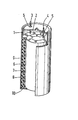
- the cell sealed from the air as shown in Figure 1 is manufactured using a suitable housing 1 of metal, for example stainless steel, having a cover 2 comprising apertures for the conductors 3 and 4.
- the conductors are insulated from the metal housing (1, 2) by means of rings 5 of synthetic resin.
- the outside diameter of the housing may be, for example, 22 mm and its height 41 mm.
- Inside the housing a roll of a negative electrode 6, a separator 7 and a positive electrode 8 are provided, while the assembly is surrounded by an electrically insulating foil 9 of synthetic resin, for example, polyvinyl chloride, and is supported by a disk 10 of an electrically insulating material, for example, polyvinyl chloride.
- the negative electrode 6 is a hydride-forming intermetallic compound as described hereinbefore and is connected to the conductor 3.
- the negative electrode 6 is manufactured by fusing suitable quantities of the relevant elements sintering the intermetallic compound thus formed on a nickel carrier foil as described in US Patent Specification 4312928.
- the positive electrode 8 is a nickel hydroxide electrode of the conventional sintered type which is connected to the conductor 4.
- a 6N potassium hydroxide solution in water is used as an electrolyte.
- the electrolyte is absorbed in the separator 7 and is in wetting contact with the electrochemically active material of the two electrodes.
- the separator 7 consists of a non-woven membrane of polyamide fibres (nylon).
- the free gas space in the cell is approximately 5 cm 3 .
- a closed cell of this type has an e.m.f. between 1.2 and 1.4 V.
- the cells according to the invention can be combined in a conventional manner to form batteries comprising, for example, several series-arranged cells.
- the electrochemically active material of the negative electrode is prepared by mixing, fusing and pulverising the quantities of the various components indicated in table 1. An electrode is then made and accommodated in a cell, for example, as described hereinbefore. In order to be able to measure the capacity variation of the negative electrode it is efficacious to give the positive electrode comparatively too large a capacity.
- the initial capacity of the cell is shown in table 1 in mAh per gramme of electrochemically active material of the negative electrode.
- table 1 Furthermore recorded in table 1 is the decrease in capacity of the cell in mAh per gramme of electrochemically active material of the negative electrode per charge/discharge cycle. The capacity variation was measured for a few hundred cycles in which the cell was always charged and discharged entirely, with such a current that charging and discharging each took one hour per cycle.
- An electrochemically active material to be technically useful must have a capacity decrease of less than 0.30 mAh/g per cycle, preferably less than 0.15 mAh/g. cycle.
- the materials in table 1 are arranged in a decreasing sequence of stability.
- the material according to example 17 comprises so much 0 r that phase separation occurs as a result of which the CaCu 5 structure is disturbed.
- the materials according to the examples 19-26 comprise too much Ni and too little Co and/or Cu so that there is too small a spread in the affinity of the material with respect to hydrogen. In such a case too much corrosion of the material takes place upon charging and discharging.
- the materials according to examples 16, 18, 19, 22, 25 and 26 comprise no Al, Cr or Si, so that no protective oxide skin is formed.
Landscapes
- Chemical & Material Sciences (AREA)
- Chemical Kinetics & Catalysis (AREA)
- Electrochemistry (AREA)
- General Chemical & Material Sciences (AREA)
- Engineering & Computer Science (AREA)
- Organic Chemistry (AREA)
- Manufacturing & Machinery (AREA)
- Combustion & Propulsion (AREA)
- Inorganic Chemistry (AREA)
- Battery Electrode And Active Subsutance (AREA)
Abstract
Description
- The invention relates to an electrochemical cell comprising a negative electrode the electrochemically active material of which consists of an intermetallic compound forming a hydride with hydrogen.
- The cell may be in open communication with the atmosphere or may be sealed from the atmosphere. A cell sealed from the atmosphere may have a valve which is proportioned so as to become operative at a previously fixed pressure.
- A rechargeable cell of the closed type is described, for example, in United States Patent Specification No. 4,214,043. The electrochemically active part of the positive electrode in this known cell may be nickel hydroxide, silver oxide or manganese oxide, nickel hydroxyde being generally preferred for practical reasons.
- The electrochemically active part of the negative electrode consists of an intermetallic compound of lanthanum and nickel having the empirical formula LaNi . It is known that in hydride-forming intermetallic compounds of this type, both the lanthanum and the nickel can partly be replaced by other metals without the capacity of forming hydrides being lost. For example, the lanthanum may be replaced partly by the other rare earth metals or by calcium, thorium and yttrium, and nickel may be replaced, for example, by copper, cobalt and iron. (See, for example, US Patent Specification No. 4312928).
- Where in literature there is referred to LaNi; and intermetallic compounds derived therefrom by substitution,they are to be understood to include generally compounds having the general composition ABn, where n may be between 4.8 and 5.4. It concerns compounds of the CaCu - structure comprising the existence range of AB5. The expression existence range in this connection means a range of concentrations in a continuous series of intermetallic compounds with which an identical structure can be realized with or without a thermal treatment.
- The electrolyte generally consists of an aqueous solution of one or more alkali hydroxides, for example, lithium hydroxide, sodium hydroxide and potassium hydroxide, having a pH exceeding 7.
- The cell may furthermore comprise a separator which separates the electrodes electrically but permits transport of ions and gas. The separator may consist of synthetic resin fibres (woven or not woven), for example, of polyamide fibres or polypropylene fibres.
- When incorporating small quantities of hydrogen in the intermetallic compound LaNi5, the hydrogen dissolves while forming a low-hydrogen hydride phase, where the hydrogen equilibrium pressure above the intermetallic compound increases when the quantity of dissolved hydrogen increases. From the instant the low-hydrogen hydride phase has reached the composition LaNi5H0.3, a new phase having the overall composition LaNi5H5.5 is formed when larger quantities of hydrogen are supplied. The said compositions apply to room temperature and are temperature-dependent. When the hydrogen content increases, the quantity of hydride phase rich in hydrogen increases at the expense of the quantity of low-hydrogen hydride phase, while the hydrogen equilibrium pressure above the intermetallic compound remains constant (plateau pressure) until the low-hydrogen hydride phase has been fully converted into the hydride phase rich in hydrogen. Subsequently, an extra quantity of hydrogen may dissolve in the hydride phase rich in hydrogen, with the hydrogen equilibrium pressure above the intermetallic compound increasing.
- The plateau pressure can be influenced in negative and positive senses, respectively, by partially replacing lanthanum or nickel by other metals, for example, those mentioned hereinbefore. The atomic compositions of the low-hydrogen hydride phase and of the hydride phase which is rich in hydrogen also vary. The influence of the plateau pressure upon substitution by several metals is additive.
- It has been found in practice that the electrochemical capacity of rechargeable cells of the above-mentioned type deteriorates after a number of charging and discharging cycles, even if they are not regularly deeply discharged or strongly overcharged. In Applicants' opinion this problem has so far delayed the application of said cells.
- The loss of the electrochemical capacity is the result of corrosion of the hydride-forming intermetallic compound. Compounds which are no longer active in the formation of hydrides are formed at the surface of said compound by oxidation. During charging and discharging of the electrochemical cell, cracks are formed in the hydride-forming intermetallic compound as a result of which the specific area of said compound becomes larger and more and more material is oxidized. Corrosion can be controlled only partly by providing an oxygen-reduction electrode in the cell, as described in German Patent Specification No. 2,838,857, because lanthanum, at potentials more positive than -2.0 V with respect to a reversible hydrogen electrode, reacts with water according to the reaction equation:
- La + 3 H20 → LA(OH)3 + 3 H+ + 3 e .
- It is the object of the present invention to provide an electrochemical cell having a negative electrode the electrochemically active material of which is based on LaNi5 and which is not subject to corrosion or is subject to corrosion to a much smaller extent than the materials proposed so far, to thus minimize the decrease of the electrochemical capacity.
- According to the invention, this object is achieved by means of a negative electrode the electrochemically active material of which consists of an intermetallic compound having the CaCu5 structure of the type with overall formula AB C , where m + n is between 4.8 and 5.4, n being between 0.05 and 0.6 in which A consists of Mischmetall or of at least one element selected from the group consisting of Y, Ti, Hf, Zr, Ca, Th, La and the remaining rare earth metals, in which the collective atomic quantities of the elements Y, Ti, Hf and Zr may not be more than 40% of A, in which B consists of two or more elements selected from the group formed by Nii Co, Cu, Fe and Mn, the maximum atomic quantity per gram atom of A being for Ni: 3.5, for Co: 3.5, for Cu: 3.5, for Fe: 2.0 and for Mn: 1.0, and in which C consists of at least one element selected from the group formed by Al, Cr and Si:in the indicated atomic quantities:

- Mischmetall is a mixture, consisting of more than 50% by weight of Ce, about 25% by weight of La, about 25% by weight of a mixture of other rare-earth metals. The exact composition varies according to the place of origin of the material.
- A suitable value of the plateau pressure of the electrochemical cell is achieved if A consists of La or of a mixture of La and one or more of the remaining rare earth metals, the atomic quantity of La being at least as large as the collective quantity of the remaining rare earth metals.
- A not too high plateau pressure with a good stability of the electrochemical cell can be achieved if A consists of a mixture of La and Nd.
- In a suitable embodiment of the electrochemical cell, B consists of Ni and Co in the following atomic quantities:

- A good stability and a high-rate-discharge capability of the electrochemical cell can be obtained if C is selected from the group formed by Si and Cr, where n is between 0.05 and 0.15.
- A particularly good stability of the electrochemical cell is obtained if C consists of Al, where n is between 0.3 and 0.5.
- If n is smaller than 0.05 the desired effect of the stabilization occurs to an insufficient extent. The upper limits of n and of the quantity of the elements Fe and Mn are indicated because the elements in question may not be present in such large quantities that the CaCu5 structure of the intermetallic compound is disturbed because the capability to take up hydrogen is then adversely influenced. The upper limits for Ni, Co and Cu are determined by the requirement that the electrochemically active material of the negative electrode must have a distributed affinity to hydrogen.
- The invention is based on the discovery that hydride-forming intermetallic compounds which can withstand the strong corrosive conditions in the electrochemical cells of the above-mentioned type can be obtained by the addition of comparatively small quantities of elements which in the pure state form closed oxide layers at their surface when being exposed to the atmosphere, which layers protect the underlying metal from further oxidation, for example, Al, Cr and Si.
- The invention is further based on understanding gained as regards the formation of cracks in hydride-forming intermetallic compounds. When the hydrogen content of the intermetallic compound LaNiSHx increases, for example during charging a rechargeable cell, the hydrogen equilibrium pressure initially increases while forming a low-hydrogen phase: LaNi5H0.3, until the plateau pressure is reached. When the quantity of hydrogen is further increased, gradually more of the hydrogen-rich phase LaNi5H5.5 is formed from the low-hydrogen phase. Because the hydride phase rich in hydrogen has a specific volume which is 25% larger than that of the low-hydrogen hydride phase, great mechanical stresses arise in the intermetallic compound. When the low-hydrogen hydride phase has been fully converted into hydride phase which is rich in hydrogen, an increase of the hydrogen equilibrium pressure takes place when the hydrogen content increases further. When the hydrogen content in the intermetallic compound decreases the reverse process takes place, the low-hydrogen hydride phase being formed from the hydride phase rich in hydrogen. In this case also, internal mechanical stresses occur in the intermetallic compound in that the two phases coexist. Said mechanical stresses are the cause of crack formation and hence of an increase of the specific area of the intermetallic compound. The result of this is an increasing corrosion of the electrochemical material of the negative electrode under the influence of water and/or oxygen.
- The electrochemically active material of the negative electrode is an electrochemical cell according to the invention comprises at least four components, with the result that positions, which may be occupied by hydrogen atoms, with a different affinity to hydrogen are present in the metallic structure of the compound. This results in a distributed affinity to hydrogen of the intermetallic compound. In such an intermetallic compound more hydrogen can dissolve before a separation takes place in a low-hydrogen hydride phase and a hydride phase rich in hydrogen, than is the case with LaNi5. The solubility of hydrogen is also larger in the hydride phase rich in hydrogen. The plateau pressure generally is lower than with LaNi5' The intermetallic compounds which are used in the electrochemical cell according to the invention in the case of absorption of hydrogen have a low-hydrogen hydride phase and a hydride phase which is rich in hydrogen, which phases mutually differ less in composition than with LaNi5 and which mutually differ less than 10% in specific volume. As a result of this there are only small mechanical stresses over the phase boundaries as a result of which crack formation and hence corrosion is restricted. Also when hydrogen is supplied to the intermetallic compounds, two hydride phases exist beside each other which show only small differences in specific volume. The result of this is that when an electrochemical cell according to the invention is charged and discharged the capacity remains substantially constant during a large number of cycles.
- The desired effect according to the invention is reached only if an intermetallic comppound is formed. The desired effect is, on the contrary, not reached by mixing hydride-forming materials having a low plateau pressure and hydride-forming materials having a high plateau pressure because in that case the former material is filled entirely with hydrogen at the low plateau pressure in which large volume variations occur, after which the hydrogen equilibrium pressure increases stepwise to the high plateau pressure in which the latter material is filled with hydrogen. Thus, in a mixture of such hydride-forming materials, a gradual volume variation does not occur.
- The intermetallic compound according to the invention has a wide-spread affinity to hydrogen. As a result of this the e.m.f. of the electrochemical cell slightly depends on the charge condition of the cell. The small variation of the e.m.f. during charging and discharging is not detrimental for technical applications of the cell and even has the advantage that the charge condition of the cell can be measured electrically.
- The invention will be described in greater detail with reference to the accompanying drawing. In the drawing the sole Figure has the following meaning:
- Figure 1 is a partial sectional view and a partial elevation of a closed rechargeable electrochemical cell according to the invention.
- Example of a rechargeable cell construction.
- The cell sealed from the air as shown in Figure 1 is manufactured using a suitable housing 1 of metal, for example stainless steel, having a
cover 2 comprising apertures for theconductors rings 5 of synthetic resin. The outside diameter of the housing may be, for example, 22 mm and its height 41 mm. Inside the housing a roll of anegative electrode 6, aseparator 7 and apositive electrode 8 are provided, while the assembly is surrounded by an electrically insulatingfoil 9 of synthetic resin, for example, polyvinyl chloride, and is supported by adisk 10 of an electrically insulating material, for example, polyvinyl chloride. - The
negative electrode 6 is a hydride-forming intermetallic compound as described hereinbefore and is connected to theconductor 3. Thenegative electrode 6 is manufactured by fusing suitable quantities of the relevant elements sintering the intermetallic compound thus formed on a nickel carrier foil as described in US Patent Specification 4312928. - The
positive electrode 8 is a nickel hydroxide electrode of the conventional sintered type which is connected to theconductor 4. A 6N potassium hydroxide solution in water is used as an electrolyte. The electrolyte is absorbed in theseparator 7 and is in wetting contact with the electrochemically active material of the two electrodes. Theseparator 7 consists of a non-woven membrane of polyamide fibres (nylon). - The free gas space in the cell is approximately 5 cm3. A closed cell of this type has an e.m.f. between 1.2 and 1.4 V. The cells according to the invention can be combined in a conventional manner to form batteries comprising, for example, several series-arranged cells.
- The electrochemically active material of the negative electrode is prepared by mixing, fusing and pulverising the quantities of the various components indicated in table 1. An electrode is then made and accommodated in a cell, for example, as described hereinbefore. In order to be able to measure the capacity variation of the negative electrode it is efficacious to give the positive electrode comparatively too large a capacity. The initial capacity of the cell is shown in table 1 in mAh per gramme of electrochemically active material of the negative electrode. Furthermore recorded in table 1 is the decrease in capacity of the cell in mAh per gramme of electrochemically active material of the negative electrode per charge/discharge cycle. The capacity variation was measured for a few hundred cycles in which the cell was always charged and discharged entirely, with such a current that charging and discharging each took one hour per cycle.
- An electrochemically active material to be technically useful must have a capacity decrease of less than 0.30 mAh/g per cycle, preferably less than 0.15 mAh/g. cycle. The materials in table 1 are arranged in a decreasing sequence of stability.
- Examples 16-26 (not according to the invention).
- The method is the same as that in the examples 1-15. Materials have been composed wich do not satisfy the conditions according to the invention, see numbers 16 to 26 in table 2. The decrease in capacity of these materials is inadmissible large.
- The material according to example 17 comprises so much 0r that phase separation occurs as a result of which the CaCu5 structure is disturbed.
- The materials according to the examples 19-26 comprise too much Ni and too little Co and/or Cu so that there is too small a spread in the affinity of the material with respect to hydrogen. In such a case too much corrosion of the material takes place upon charging and discharging.
- The materials according to examples 16, 18, 19, 22, 25 and 26 comprise no Al, Cr or Si, so that no protective oxide skin is formed.
- It appears from table 2 (Example No. 26) that, although LaNiS has a high initial capacity of 360 mAh/h, the capacity after 100 charge/discharge cycles has already dropped to approximately 180 mAh/g. The materials which according to the invention are preferably used (1 to 12 in table 1) still have substantially the full initial capacity after 100 charge/discharge cycles. The capacity drops to half of the initial value only after more than 1000 charge/discharge cycles.


Claims (7)


Applications Claiming Priority (2)
| Application Number | Priority Date | Filing Date | Title |
|---|---|---|---|
| NL8303630 | 1983-10-21 | ||
| NL8303630A NL8303630A (en) | 1983-10-21 | 1983-10-21 | ELECTROCHEMICAL CELL WITH STABLE HYDRIDE-FORMING MATERIALS. |
Publications (2)
| Publication Number | Publication Date |
|---|---|
| EP0142878A1 true EP0142878A1 (en) | 1985-05-29 |
| EP0142878B1 EP0142878B1 (en) | 1988-01-07 |
Family
ID=19842594
Family Applications (1)
| Application Number | Title | Priority Date | Filing Date |
|---|---|---|---|
| EP84201493A Expired EP0142878B1 (en) | 1983-10-21 | 1984-10-16 | Electrochemical cell comprising stable hydride-forming material |
Country Status (7)
| Country | Link |
|---|---|
| US (1) | US4487817A (en) |
| EP (1) | EP0142878B1 (en) |
| JP (1) | JPS6089066A (en) |
| CA (1) | CA1235739A (en) |
| DE (1) | DE3468594D1 (en) |
| DK (1) | DK174149B1 (en) |
| NL (1) | NL8303630A (en) |
Cited By (6)
| Publication number | Priority date | Publication date | Assignee | Title |
|---|---|---|---|---|
| EP0206776A3 (en) * | 1985-06-21 | 1987-06-03 | Kabushiki Kaisha Toshiba | Rechargeable electrochemical cell with a negative electrode comprising a hydrogen absorbing alloy including rare earth component |
| EP0273624A3 (en) * | 1986-12-29 | 1989-06-14 | Energy Conversion Devices, Inc. | Enhanced charge retention electrochemical hydrogen storage alloys and an enhanced charge retention electrochemical cell |
| WO1991012199A1 (en) * | 1990-02-15 | 1991-08-22 | Dignam, Michael, J. | Electrical device for loading of hydrogen and its isotopes to high activities in hydrogen permeable media |
| WO1993019215A1 (en) * | 1992-03-19 | 1993-09-30 | Louis Schlapbach | Alloy for the reversible electrochemical storage of hydrogen and its use in rechargeable batteries |
| EP0557522A4 (en) * | 1990-10-29 | 1993-11-18 | Yuasa Corporation | Hydrogen-storing electrode, nickel electrode, and nickel-hydrogen battery |
| US6593031B1 (en) | 1999-08-13 | 2003-07-15 | Hitachi Maxell, Ltd. | Nickel metal-hydride cell |
Families Citing this family (57)
| Publication number | Priority date | Publication date | Assignee | Title |
|---|---|---|---|---|
| JP2513456B2 (en) * | 1984-08-10 | 1996-07-03 | 三洋電機 株式会社 | Metal-hydrogen alkaline battery |
| JPH0756803B2 (en) * | 1984-10-11 | 1995-06-14 | 松下電器産業株式会社 | Sealed alkaline storage battery |
| JPS61168871A (en) * | 1985-01-19 | 1986-07-30 | Sanyo Electric Co Ltd | Hydrogen occlusion electrode |
| JPS61168869A (en) * | 1985-01-19 | 1986-07-30 | Sanyo Electric Co Ltd | Metal-hydrogen alkaline storage battery |
| JPS61168870A (en) * | 1985-01-19 | 1986-07-30 | Sanyo Electric Co Ltd | Metal-hydrogen alkaline storage battery |
| JPS61181063A (en) * | 1985-02-07 | 1986-08-13 | Sanyo Electric Co Ltd | Hydrogen occulusion electrode |
| JP2713881B2 (en) * | 1985-06-21 | 1998-02-16 | 株式会社東芝 | Sealed metal oxide / hydrogen battery |
| JPS6276254A (en) * | 1985-09-30 | 1987-04-08 | Sanyo Electric Co Ltd | Hydrogen occlusion electrode |
| JPS62119863A (en) * | 1985-11-20 | 1987-06-01 | Matsushita Electric Ind Co Ltd | Enclosed-type alkaline storage battery |
| JP2745501B2 (en) * | 1985-11-20 | 1998-04-28 | 松下電器産業株式会社 | Sealed alkaline storage battery |
| NL8601674A (en) * | 1986-06-26 | 1988-01-18 | Philips Nv | ELECTROCHEMICAL CELL. |
| NL8601675A (en) * | 1986-06-26 | 1988-01-18 | Philips Nv | ELECTROCHEMICAL CELL. |
| JP2752970B2 (en) * | 1987-06-03 | 1998-05-18 | 松下電器産業株式会社 | Hydrogen storage electrode |
| JPS63314764A (en) * | 1987-06-17 | 1988-12-22 | Matsushita Electric Ind Co Ltd | Hydrogen absorbing electrode |
| NL8701778A (en) * | 1987-07-28 | 1989-02-16 | Philips Nv | ELECTROCHEMICAL CELL. |
| USRE34588E (en) * | 1987-11-17 | 1994-04-19 | Hong; Kuochih | Hydrogen storage hydride electrode materials |
| US5017442A (en) * | 1988-03-19 | 1991-05-21 | Hitachi Maxell, Ltd. | Coiled lithium battery |
| NL8801233A (en) * | 1988-05-11 | 1989-12-01 | Philips Nv | CLOSED ELECTROCHEMICAL CELL. |
| JPH0797497B2 (en) * | 1988-09-29 | 1995-10-18 | 工業技術院長 | Hydrogen storage electrode |
| JPH02174063A (en) * | 1988-12-26 | 1990-07-05 | Agency Of Ind Science & Technol | Hydrogen storage electrode |
| JPH02186559A (en) * | 1989-01-13 | 1990-07-20 | Sanyo Electric Co Ltd | Hydrogen storage alloy electrode for alkaline storage battery |
| US5250369A (en) * | 1989-02-23 | 1993-10-05 | Matsushita Electric Industrial Co., Ltd. | Alkaline storage battery |
| US5346781A (en) * | 1989-02-23 | 1994-09-13 | Matsushita Electric Industrial Co., Ltd. | Alkaline storage battery |
| JP2926734B2 (en) * | 1989-02-23 | 1999-07-28 | 松下電器産業株式会社 | Alkaline storage battery using hydrogen storage alloy |
| US5034289A (en) * | 1989-02-23 | 1991-07-23 | Matsushita Electric Industrial Co., Ltd. | Alkaline storage battery and method of producing negative electrode thereof |
| JPH02227966A (en) * | 1989-02-28 | 1990-09-11 | Matsushita Electric Ind Co Ltd | Sealed alkaline storage battery and manufacture of its negative electrode |
| JP2771592B2 (en) * | 1989-04-18 | 1998-07-02 | 三洋電機株式会社 | Hydrogen storage alloy electrode for alkaline storage batteries |
| NL8901776A (en) * | 1989-07-11 | 1991-02-01 | Philips Nv | ELECTROCHEMICAL CELL. |
| JPH07105230B2 (en) * | 1989-07-26 | 1995-11-13 | 古河電池株式会社 | Hydrogen storage electrode for alkaline storage battery |
| US5284619A (en) * | 1990-03-24 | 1994-02-08 | Japan Storage Battery Company, Limited | Hydrogen absorbing electrode for use in nickel-metal hydride secondary batteries |
| JPH07105231B2 (en) * | 1990-04-02 | 1995-11-13 | 工業技術院長 | Hydrogen storage electrode |
| US5536591A (en) | 1990-04-26 | 1996-07-16 | Ovonic Battery Company, Inc. | Electrochemical hydrogen storage alloys for nickel metal hydride batteries |
| JPH0685323B2 (en) * | 1990-06-18 | 1994-10-26 | 古河電池株式会社 | Hydrogen storage electrode |
| NL9001677A (en) * | 1990-07-24 | 1992-02-17 | Koninkl Philips Electronics Nv | ELECTROCHEMICAL CELL WITH HYDRIDE FORMING INTERMETALLIC COMPOUND. |
| KR940007277B1 (en) * | 1992-02-14 | 1994-08-12 | 한국과학기술원 | Hydrogen metal |
| EP0560535B1 (en) * | 1992-03-05 | 1999-11-03 | Sanyo Electric Co., Limited. | Hydrogen-absorbing alloy for negative electrode |
| DE69333089T2 (en) * | 1992-09-14 | 2004-05-19 | Kabushiki Kaisha Toshiba, Kawasaki | Hydrogen-absorbing alloy for batteries, process for their production and nickel-metal hydride secondary battery |
| US5376474A (en) * | 1993-02-05 | 1994-12-27 | Sanyo Electric Co., Ltd. | Hydrogen-absorbing alloy for a negative electrode and manufacturing method therefor |
| KR950009220B1 (en) * | 1993-09-13 | 1995-08-18 | 한국과학기술원 | Zirconium-Based Hydrogen Storage Alloys for Secondary Battery Electrodes |
| US5434022A (en) * | 1993-10-08 | 1995-07-18 | Hughes Aircraft Company | Electrodes and electrochemical storage cells utilizing tin-modified active materials |
| US5393617A (en) * | 1993-10-08 | 1995-02-28 | Electro Energy, Inc. | Bipolar electrochmeical battery of stacked wafer cells |
| US5492543A (en) * | 1993-10-08 | 1996-02-20 | Hughes Aircraft Company | Preparation of electrodes and Ni/MHx electrochemical storage cell |
| CA2184377C (en) * | 1994-03-31 | 2000-12-12 | Han Wu | Improved metal hydride hydrogen storage electrodes |
| US5451474A (en) * | 1994-04-04 | 1995-09-19 | Motorola, Inc. | Metal hydride hydrogen storage electrodes |
| JP3152845B2 (en) * | 1994-08-22 | 2001-04-03 | 株式会社東芝 | Nickel-metal hydride battery |
| US5629000A (en) | 1994-11-25 | 1997-05-13 | Sanyo Electric Co., Ltd. | Hydrogen-absorbing alloy electrode for metal hydride alkaline batteries and process for producing the same |
| US5656388A (en) * | 1995-06-07 | 1997-08-12 | California Institute Of Technology | Metal hydrides as electrode/catalyst materials for oxygen evolution/reduction in electrochemical devices |
| US6110304A (en) | 1995-11-17 | 2000-08-29 | Sanyo Electric Co., Ltd. | Hydrogen-absorbing alloy electrode for alkaline storage batteries |
| US5932372A (en) * | 1997-01-02 | 1999-08-03 | Lightyear Technologies Inc. | Composite materials, processes for manufacturing the composites, composite electrode, hydrogen occluding composite, and electrochemical cell utilizing the composite |
| US6330925B1 (en) | 1997-01-31 | 2001-12-18 | Ovonic Battery Company, Inc. | Hybrid electric vehicle incorporating an integrated propulsion system |
| KR100264343B1 (en) | 1997-07-16 | 2000-08-16 | 윤덕용 | A high-capability and high-performance hrdrogen storage alloy for secondary battery electrode which contains zirconium |
| US6503658B1 (en) * | 2001-07-11 | 2003-01-07 | Electro Energy, Inc. | Bipolar electrochemical battery of stacked wafer cells |
| US20040030166A1 (en) * | 2002-03-18 | 2004-02-12 | Dick Copeland | Methods for treating deodorizer distillate |
| US6830725B2 (en) * | 2003-04-01 | 2004-12-14 | Texaco Ovonic Battery Systems, Llc | Hydrogen storage alloys having a high porosity surface layer |
| PL2459938T3 (en) | 2009-07-26 | 2020-04-30 | Forever Young International, Inc. | Expandable exothermic particulate gel-forming composition |
| US10050319B2 (en) | 2014-05-28 | 2018-08-14 | John M. Guerra | Photoelectrochemical secondary cell and battery |
| CN114469503B (en) | 2016-12-13 | 2025-08-01 | 永远年轻国际有限公司 | Exothermic expandable composition |
Citations (4)
| Publication number | Priority date | Publication date | Assignee | Title |
|---|---|---|---|---|
| FR2382774A2 (en) * | 1977-03-02 | 1978-09-29 | Anvar | Alloy based on nickel and lanthanum, for use as battery electrode - contains substits. to improve hydrogen absorption |
| FR2399484A1 (en) * | 1977-08-02 | 1979-03-02 | Anvar | NEW LANTHAN AND NICKEL-BASED ALLOYS, THEIR MANUFACTURING AND THEIR ELECTROCHEMICAL APPLICATIONS |
| US4249940A (en) * | 1979-01-08 | 1981-02-10 | The International Nickel Co., Inc. | Mischmetal-nickel-iron hydrogen storage compound |
| US4396576A (en) * | 1980-07-04 | 1983-08-02 | Agency Of Industrial Science & Technology | Alloy for occlusion of hydrogen |
Family Cites Families (12)
| Publication number | Priority date | Publication date | Assignee | Title |
|---|---|---|---|---|
| US3405008A (en) * | 1965-03-31 | 1968-10-08 | Allis Chalmers Mfg Co | Fuel cell and fuel cell electrode containing nickel-rare earth intermetallic catalyst |
| US3850694A (en) * | 1972-11-27 | 1974-11-26 | Communications Satellite Corp | Low pressure nickel hydrogen cell |
| US3980501A (en) * | 1974-06-19 | 1976-09-14 | Bell Telephone Laboratories, Incorporated | Use of hydrogen-absorbing electrode in alkaline battery |
| US4112199A (en) * | 1975-12-30 | 1978-09-05 | Communications Satellite Corporation | Lanthanum nickel hydride-hydrogen/metal oxide cell |
| JPS5931829B2 (en) * | 1976-09-09 | 1984-08-04 | 松下電器産業株式会社 | Manufacturing method of hydrogen storage electrode |
| US4214043A (en) * | 1978-02-03 | 1980-07-22 | U.S. Philips Corporation | Rechargeable electrochemical cell |
| US4312928A (en) * | 1978-05-04 | 1982-01-26 | U.S. Philips Corporation | Rechargeable electrochemical cell |
| JPS55154301A (en) * | 1979-05-18 | 1980-12-01 | Sanyo Electric Co Ltd | Hydrogen storing material |
| JPS592957B2 (en) * | 1979-08-31 | 1984-01-21 | 松下電工株式会社 | pedometer |
| JPS5928626B2 (en) * | 1980-10-03 | 1984-07-14 | 工業技術院長 | Mitsushi Metal for Hydrogen Storage - Manufacturing method of nickel-based quaternary alloy |
| JPS5841334B2 (en) * | 1981-02-26 | 1983-09-12 | 工業技術院長 | Quaternary hydrogen storage alloy |
| JPS5877544A (en) * | 1981-10-29 | 1983-05-10 | Sekisui Chem Co Ltd | Hydrogen occluding alloy |
-
1983
- 1983-10-21 NL NL8303630A patent/NL8303630A/en not_active Application Discontinuation
-
1984
- 1984-03-07 JP JP59042233A patent/JPS6089066A/en active Granted
- 1984-03-09 US US06/587,795 patent/US4487817A/en not_active Expired - Lifetime
- 1984-10-16 EP EP84201493A patent/EP0142878B1/en not_active Expired
- 1984-10-16 DE DE8484201493T patent/DE3468594D1/en not_active Expired
- 1984-10-18 DK DK198404976A patent/DK174149B1/en not_active IP Right Cessation
- 1984-10-18 CA CA000465733A patent/CA1235739A/en not_active Expired
Patent Citations (4)
| Publication number | Priority date | Publication date | Assignee | Title |
|---|---|---|---|---|
| FR2382774A2 (en) * | 1977-03-02 | 1978-09-29 | Anvar | Alloy based on nickel and lanthanum, for use as battery electrode - contains substits. to improve hydrogen absorption |
| FR2399484A1 (en) * | 1977-08-02 | 1979-03-02 | Anvar | NEW LANTHAN AND NICKEL-BASED ALLOYS, THEIR MANUFACTURING AND THEIR ELECTROCHEMICAL APPLICATIONS |
| US4249940A (en) * | 1979-01-08 | 1981-02-10 | The International Nickel Co., Inc. | Mischmetal-nickel-iron hydrogen storage compound |
| US4396576A (en) * | 1980-07-04 | 1983-08-02 | Agency Of Industrial Science & Technology | Alloy for occlusion of hydrogen |
Non-Patent Citations (4)
| Title |
|---|
| CHEMICAL ABSTRACTS, vol. 97, no. 2, July 1982, page 181, no. 9221h, Columbus, Ohio, USA; & JP - A - 82 19347 (AGENCY OF INDUSTRIAL SCIENCES AND TECHNOLOGY) 01-02-1982 * |
| CHEMICAL ABSTRACTS, vol. 97, no. 20, November 1982, page 197, no. 166202v, Columbus, Ohio, USA; & JP - A - 82 63670 (AGENCY OF INDUSTRIAL SCIENCES AND TECHNOLOGY) 17-04-1982 * |
| CHEMICAL ABSTRACTS, vol. 97, no. 22, November 1982, page 196, no. 185490d, Columbus, Ohio, USA; & JP - A - 82 101 632 (S. SUDA) 24-06-1982 * |
| HYDROGEN IN METALS, PROCEEDINGS OF THE 2nd INTERNATIONAL CONGRESS, Paris, 6th-10th June 1977, vol. 8, section 1E12, pages 1-6, Pergamon Press, Oxford, GB; J.C. ACHARD et al.: "Hydrures ternaires de terres rares. Application au stockage de l'hydrogène" * |
Cited By (7)
| Publication number | Priority date | Publication date | Assignee | Title |
|---|---|---|---|---|
| EP0206776A3 (en) * | 1985-06-21 | 1987-06-03 | Kabushiki Kaisha Toshiba | Rechargeable electrochemical cell with a negative electrode comprising a hydrogen absorbing alloy including rare earth component |
| EP0273624A3 (en) * | 1986-12-29 | 1989-06-14 | Energy Conversion Devices, Inc. | Enhanced charge retention electrochemical hydrogen storage alloys and an enhanced charge retention electrochemical cell |
| WO1991012199A1 (en) * | 1990-02-15 | 1991-08-22 | Dignam, Michael, J. | Electrical device for loading of hydrogen and its isotopes to high activities in hydrogen permeable media |
| EP0557522A4 (en) * | 1990-10-29 | 1993-11-18 | Yuasa Corporation | Hydrogen-storing electrode, nickel electrode, and nickel-hydrogen battery |
| US5393616A (en) * | 1990-10-29 | 1995-02-28 | Yuasa Corporation | Metal hydride electrode |
| WO1993019215A1 (en) * | 1992-03-19 | 1993-09-30 | Louis Schlapbach | Alloy for the reversible electrochemical storage of hydrogen and its use in rechargeable batteries |
| US6593031B1 (en) | 1999-08-13 | 2003-07-15 | Hitachi Maxell, Ltd. | Nickel metal-hydride cell |
Also Published As
| Publication number | Publication date |
|---|---|
| US4487817A (en) | 1984-12-11 |
| DE3468594D1 (en) | 1988-02-11 |
| JPS6089066A (en) | 1985-05-18 |
| JPH0515774B2 (en) | 1993-03-02 |
| DK497684A (en) | 1985-04-22 |
| NL8303630A (en) | 1985-05-17 |
| DK497684D0 (en) | 1984-10-18 |
| EP0142878B1 (en) | 1988-01-07 |
| DK174149B1 (en) | 2002-07-22 |
| CA1235739A (en) | 1988-04-26 |
Similar Documents
| Publication | Publication Date | Title |
|---|---|---|
| EP0142878B1 (en) | Electrochemical cell comprising stable hydride-forming material | |
| US5501917A (en) | Hydrogen storage material and nickel hydride batteries using same | |
| EP0383991B1 (en) | Alkaline storage battery using hydrogen absorbing alloy | |
| US4214043A (en) | Rechargeable electrochemical cell | |
| US4699856A (en) | Electrochemical cell | |
| EP0206776A2 (en) | Rechargeable electrochemical cell with a negative electrode comprising a hydrogen absorbing alloy including rare earth component | |
| EP0170519B1 (en) | A method of producing a sealed metal oxide-hydrogen storage cell | |
| US4312928A (en) | Rechargeable electrochemical cell | |
| GB1579714A (en) | Rechargeable electrochemical cells | |
| CA1232634A (en) | Battery cell | |
| US5242656A (en) | Active material of hydrogen storage alloy electrode | |
| US4702978A (en) | Electrochemical cell | |
| US7198868B2 (en) | Alkaline storage battery | |
| US5470675A (en) | Electrochemical cell comprising a hydride-forming intermetallic compound | |
| US6197448B1 (en) | Hydrogen storage alloy | |
| CN111118344B (en) | Multi-component gadolinium-containing rare earth hydrogen storage material, negative electrode, battery and preparation method | |
| US6593031B1 (en) | Nickel metal-hydride cell | |
| JP3141141B2 (en) | Sealed nickel-metal hydride storage battery | |
| JP3362400B2 (en) | Nickel-metal hydride storage battery | |
| JPH0690922B2 (en) | Sealed alkaline storage battery | |
| JPH05263171A (en) | Hydrogen storage alloy, its electrode, and hydrogen storage alloy battery | |
| JPH0517659B2 (en) | ||
| JPH06318455A (en) | Nickel-hydrogen battery | |
| JPH0831415A (en) | Alkaline secondary battery |
Legal Events
| Date | Code | Title | Description |
|---|---|---|---|
| PUAI | Public reference made under article 153(3) epc to a published international application that has entered the european phase |
Free format text: ORIGINAL CODE: 0009012 |
|
| AK | Designated contracting states |
Designated state(s): BE DE FR GB IT NL SE |
|
| 17P | Request for examination filed |
Effective date: 19851128 |
|
| 17Q | First examination report despatched |
Effective date: 19860718 |
|
| GRAA | (expected) grant |
Free format text: ORIGINAL CODE: 0009210 |
|
| AK | Designated contracting states |
Kind code of ref document: B1 Designated state(s): BE DE FR GB IT NL SE |
|
| REF | Corresponds to: |
Ref document number: 3468594 Country of ref document: DE Date of ref document: 19880211 |
|
| ITF | It: translation for a ep patent filed | ||
| ET | Fr: translation filed | ||
| PLBE | No opposition filed within time limit |
Free format text: ORIGINAL CODE: 0009261 |
|
| 26N | No opposition filed | ||
| ITTA | It: last paid annual fee | ||
| EAL | Se: european patent in force in sweden |
Ref document number: 84201493.8 |
|
| ITPR | It: changes in ownership of a european patent |
Owner name: CAMBIO RAGIONE SOCIALE;PHILIPS ELECTRONICS N.V. |
|
| REG | Reference to a national code |
Ref country code: FR Ref legal event code: CD |
|
| NLT1 | Nl: modifications of names registered in virtue of documents presented to the patent office pursuant to art. 16 a, paragraph 1 |
Owner name: PHILIPS ELECTRONICS N.V. |
|
| NLT1 | Nl: modifications of names registered in virtue of documents presented to the patent office pursuant to art. 16 a, paragraph 1 |
Owner name: KONINKLIJKE PHILIPS ELECTRONICS N.V. |
|
| REG | Reference to a national code |
Ref country code: FR Ref legal event code: CD |
|
| REG | Reference to a national code |
Ref country code: GB Ref legal event code: IF02 |
|
| PGFP | Annual fee paid to national office [announced via postgrant information from national office to epo] |
Ref country code: NL Payment date: 20031024 Year of fee payment: 20 |
|
| PGFP | Annual fee paid to national office [announced via postgrant information from national office to epo] |
Ref country code: FR Payment date: 20031027 Year of fee payment: 20 |
|
| PGFP | Annual fee paid to national office [announced via postgrant information from national office to epo] |
Ref country code: SE Payment date: 20031028 Year of fee payment: 20 |
|
| PGFP | Annual fee paid to national office [announced via postgrant information from national office to epo] |
Ref country code: GB Payment date: 20031031 Year of fee payment: 20 |
|
| PGFP | Annual fee paid to national office [announced via postgrant information from national office to epo] |
Ref country code: DE Payment date: 20031215 Year of fee payment: 20 |
|
| PGFP | Annual fee paid to national office [announced via postgrant information from national office to epo] |
Ref country code: BE Payment date: 20040421 Year of fee payment: 20 |
|
| PG25 | Lapsed in a contracting state [announced via postgrant information from national office to epo] |
Ref country code: GB Free format text: LAPSE BECAUSE OF EXPIRATION OF PROTECTION Effective date: 20041015 |
|
| PG25 | Lapsed in a contracting state [announced via postgrant information from national office to epo] |
Ref country code: NL Free format text: LAPSE BECAUSE OF EXPIRATION OF PROTECTION Effective date: 20041016 |
|
| BE20 | Be: patent expired |
Owner name: *KONINKLIJKE PHILIPS ELECTRONICS N.V. Effective date: 20041016 |
|
| REG | Reference to a national code |
Ref country code: GB Ref legal event code: PE20 |
|
| EUG | Se: european patent has lapsed | ||
| NLV7 | Nl: ceased due to reaching the maximum lifetime of a patent |
Effective date: 20041016 |