EP0132169B1 - Procédé et dispositif pour la fabrication par coulée d'une couche optiquement homogène transparente à partir d'un mélange de composants - Google Patents
Procédé et dispositif pour la fabrication par coulée d'une couche optiquement homogène transparente à partir d'un mélange de composants Download PDFInfo
- Publication number
- EP0132169B1 EP0132169B1 EP84401216A EP84401216A EP0132169B1 EP 0132169 B1 EP0132169 B1 EP 0132169B1 EP 84401216 A EP84401216 A EP 84401216A EP 84401216 A EP84401216 A EP 84401216A EP 0132169 B1 EP0132169 B1 EP 0132169B1
- Authority
- EP
- European Patent Office
- Prior art keywords
- mixer
- mixing
- mixture
- reaction
- reaction components
- Prior art date
- Legal status (The legal status is an assumption and is not a legal conclusion. Google has not performed a legal analysis and makes no representation as to the accuracy of the status listed.)
- Expired
Links
Images


Classifications
-
- B—PERFORMING OPERATIONS; TRANSPORTING
- B29—WORKING OF PLASTICS; WORKING OF SUBSTANCES IN A PLASTIC STATE IN GENERAL
- B29B—PREPARATION OR PRETREATMENT OF THE MATERIAL TO BE SHAPED; MAKING GRANULES OR PREFORMS; RECOVERY OF PLASTICS OR OTHER CONSTITUENTS OF WASTE MATERIAL CONTAINING PLASTICS
- B29B7/00—Mixing; Kneading
- B29B7/74—Mixing; Kneading using other mixers or combinations of mixers, e.g. of dissimilar mixers ; Plant
- B29B7/7461—Combinations of dissimilar mixers
-
- B—PERFORMING OPERATIONS; TRANSPORTING
- B01—PHYSICAL OR CHEMICAL PROCESSES OR APPARATUS IN GENERAL
- B01F—MIXING, e.g. DISSOLVING, EMULSIFYING OR DISPERSING
- B01F27/00—Mixers with rotary stirring devices in fixed receptacles; Kneaders
- B01F27/27—Mixers with stator-rotor systems, e.g. with intermeshing teeth or cylinders or having orifices
- B01F27/272—Mixers with stator-rotor systems, e.g. with intermeshing teeth or cylinders or having orifices with means for moving the materials to be mixed axially between the surfaces of the rotor and the stator, e.g. the stator rotor system formed by conical or cylindrical surfaces
- B01F27/2721—Mixers with stator-rotor systems, e.g. with intermeshing teeth or cylinders or having orifices with means for moving the materials to be mixed axially between the surfaces of the rotor and the stator, e.g. the stator rotor system formed by conical or cylindrical surfaces provided with intermeshing elements
-
- B—PERFORMING OPERATIONS; TRANSPORTING
- B01—PHYSICAL OR CHEMICAL PROCESSES OR APPARATUS IN GENERAL
- B01F—MIXING, e.g. DISSOLVING, EMULSIFYING OR DISPERSING
- B01F23/00—Mixing according to the phases to be mixed, e.g. dispersing or emulsifying
- B01F23/40—Mixing liquids with liquids; Emulsifying
- B01F23/49—Mixing systems, i.e. flow charts or diagrams
-
- B—PERFORMING OPERATIONS; TRANSPORTING
- B01—PHYSICAL OR CHEMICAL PROCESSES OR APPARATUS IN GENERAL
- B01F—MIXING, e.g. DISSOLVING, EMULSIFYING OR DISPERSING
- B01F25/00—Flow mixers; Mixers for falling materials, e.g. solid particles
- B01F25/40—Static mixers
- B01F25/42—Static mixers in which the mixing is affected by moving the components jointly in changing directions, e.g. in tubes provided with baffles or obstructions
- B01F25/43—Mixing tubes, e.g. wherein the material is moved in a radial or partly reversed direction
- B01F25/431—Straight mixing tubes with baffles or obstructions that do not cause substantial pressure drop; Baffles therefor
- B01F25/4317—Profiled elements, e.g. profiled blades, bars, pillars, columns or chevrons
-
- B—PERFORMING OPERATIONS; TRANSPORTING
- B01—PHYSICAL OR CHEMICAL PROCESSES OR APPARATUS IN GENERAL
- B01F—MIXING, e.g. DISSOLVING, EMULSIFYING OR DISPERSING
- B01F25/00—Flow mixers; Mixers for falling materials, e.g. solid particles
- B01F25/40—Static mixers
- B01F25/42—Static mixers in which the mixing is affected by moving the components jointly in changing directions, e.g. in tubes provided with baffles or obstructions
- B01F25/43—Mixing tubes, e.g. wherein the material is moved in a radial or partly reversed direction
- B01F25/431—Straight mixing tubes with baffles or obstructions that do not cause substantial pressure drop; Baffles therefor
- B01F25/43197—Straight mixing tubes with baffles or obstructions that do not cause substantial pressure drop; Baffles therefor characterised by the mounting of the baffles or obstructions
- B01F25/431971—Mounted on the wall
-
- B—PERFORMING OPERATIONS; TRANSPORTING
- B01—PHYSICAL OR CHEMICAL PROCESSES OR APPARATUS IN GENERAL
- B01F—MIXING, e.g. DISSOLVING, EMULSIFYING OR DISPERSING
- B01F27/00—Mixers with rotary stirring devices in fixed receptacles; Kneaders
- B01F27/60—Mixers with rotary stirring devices in fixed receptacles; Kneaders with stirrers rotating about a horizontal or inclined axis
- B01F27/70—Mixers with rotary stirring devices in fixed receptacles; Kneaders with stirrers rotating about a horizontal or inclined axis with paddles, blades or arms
- B01F27/707—Mixers with rotary stirring devices in fixed receptacles; Kneaders with stirrers rotating about a horizontal or inclined axis with paddles, blades or arms the paddles co-operating, e.g. intermeshing, with elements on the receptacle wall
-
- B—PERFORMING OPERATIONS; TRANSPORTING
- B01—PHYSICAL OR CHEMICAL PROCESSES OR APPARATUS IN GENERAL
- B01F—MIXING, e.g. DISSOLVING, EMULSIFYING OR DISPERSING
- B01F33/00—Other mixers; Mixing plants; Combinations of mixers
- B01F33/45—Magnetic mixers; Mixers with magnetically driven stirrers
- B01F33/453—Magnetic mixers; Mixers with magnetically driven stirrers using supported or suspended stirring elements
-
- B—PERFORMING OPERATIONS; TRANSPORTING
- B01—PHYSICAL OR CHEMICAL PROCESSES OR APPARATUS IN GENERAL
- B01F—MIXING, e.g. DISSOLVING, EMULSIFYING OR DISPERSING
- B01F33/00—Other mixers; Mixing plants; Combinations of mixers
- B01F33/80—Mixing plants; Combinations of mixers
- B01F33/82—Combinations of dissimilar mixers
-
- B—PERFORMING OPERATIONS; TRANSPORTING
- B29—WORKING OF PLASTICS; WORKING OF SUBSTANCES IN A PLASTIC STATE IN GENERAL
- B29B—PREPARATION OR PRETREATMENT OF THE MATERIAL TO BE SHAPED; MAKING GRANULES OR PREFORMS; RECOVERY OF PLASTICS OR OTHER CONSTITUENTS OF WASTE MATERIAL CONTAINING PLASTICS
- B29B7/00—Mixing; Kneading
- B29B7/30—Mixing; Kneading continuous, with mechanical mixing or kneading devices
- B29B7/32—Mixing; Kneading continuous, with mechanical mixing or kneading devices with non-movable mixing or kneading devices
- B29B7/325—Static mixers
-
- B—PERFORMING OPERATIONS; TRANSPORTING
- B29—WORKING OF PLASTICS; WORKING OF SUBSTANCES IN A PLASTIC STATE IN GENERAL
- B29B—PREPARATION OR PRETREATMENT OF THE MATERIAL TO BE SHAPED; MAKING GRANULES OR PREFORMS; RECOVERY OF PLASTICS OR OTHER CONSTITUENTS OF WASTE MATERIAL CONTAINING PLASTICS
- B29B7/00—Mixing; Kneading
- B29B7/30—Mixing; Kneading continuous, with mechanical mixing or kneading devices
- B29B7/34—Mixing; Kneading continuous, with mechanical mixing or kneading devices with movable mixing or kneading devices
- B29B7/38—Mixing; Kneading continuous, with mechanical mixing or kneading devices with movable mixing or kneading devices rotary
- B29B7/40—Mixing; Kneading continuous, with mechanical mixing or kneading devices with movable mixing or kneading devices rotary with single shaft
- B29B7/401—Mixing; Kneading continuous, with mechanical mixing or kneading devices with movable mixing or kneading devices rotary with single shaft having a casing closely surrounding the rotor, e.g. with a plunger for feeding the material
-
- B—PERFORMING OPERATIONS; TRANSPORTING
- B29—WORKING OF PLASTICS; WORKING OF SUBSTANCES IN A PLASTIC STATE IN GENERAL
- B29B—PREPARATION OR PRETREATMENT OF THE MATERIAL TO BE SHAPED; MAKING GRANULES OR PREFORMS; RECOVERY OF PLASTICS OR OTHER CONSTITUENTS OF WASTE MATERIAL CONTAINING PLASTICS
- B29B7/00—Mixing; Kneading
- B29B7/30—Mixing; Kneading continuous, with mechanical mixing or kneading devices
- B29B7/34—Mixing; Kneading continuous, with mechanical mixing or kneading devices with movable mixing or kneading devices
- B29B7/38—Mixing; Kneading continuous, with mechanical mixing or kneading devices with movable mixing or kneading devices rotary
- B29B7/40—Mixing; Kneading continuous, with mechanical mixing or kneading devices with movable mixing or kneading devices rotary with single shaft
- B29B7/402—Mixing; Kneading continuous, with mechanical mixing or kneading devices with movable mixing or kneading devices rotary with single shaft using a rotor-stator system with intermeshing elements, e.g. teeth
-
- B—PERFORMING OPERATIONS; TRANSPORTING
- B29—WORKING OF PLASTICS; WORKING OF SUBSTANCES IN A PLASTIC STATE IN GENERAL
- B29B—PREPARATION OR PRETREATMENT OF THE MATERIAL TO BE SHAPED; MAKING GRANULES OR PREFORMS; RECOVERY OF PLASTICS OR OTHER CONSTITUENTS OF WASTE MATERIAL CONTAINING PLASTICS
- B29B7/00—Mixing; Kneading
- B29B7/30—Mixing; Kneading continuous, with mechanical mixing or kneading devices
- B29B7/34—Mixing; Kneading continuous, with mechanical mixing or kneading devices with movable mixing or kneading devices
- B29B7/38—Mixing; Kneading continuous, with mechanical mixing or kneading devices with movable mixing or kneading devices rotary
- B29B7/40—Mixing; Kneading continuous, with mechanical mixing or kneading devices with movable mixing or kneading devices rotary with single shaft
- B29B7/405—Mixing heads
- B29B7/407—Mixing heads with a casing closely surrounding the rotor, e.g. with conical rotor
-
- B—PERFORMING OPERATIONS; TRANSPORTING
- B29—WORKING OF PLASTICS; WORKING OF SUBSTANCES IN A PLASTIC STATE IN GENERAL
- B29B—PREPARATION OR PRETREATMENT OF THE MATERIAL TO BE SHAPED; MAKING GRANULES OR PREFORMS; RECOVERY OF PLASTICS OR OTHER CONSTITUENTS OF WASTE MATERIAL CONTAINING PLASTICS
- B29B7/00—Mixing; Kneading
- B29B7/30—Mixing; Kneading continuous, with mechanical mixing or kneading devices
- B29B7/34—Mixing; Kneading continuous, with mechanical mixing or kneading devices with movable mixing or kneading devices
- B29B7/38—Mixing; Kneading continuous, with mechanical mixing or kneading devices with movable mixing or kneading devices rotary
- B29B7/40—Mixing; Kneading continuous, with mechanical mixing or kneading devices with movable mixing or kneading devices rotary with single shaft
- B29B7/405—Mixing heads
- B29B7/408—Mixing heads with mixing elements on a rotor co-operating with mixing elements, perpendicular to the axis of the rotor, fixed on a stator
-
- B—PERFORMING OPERATIONS; TRANSPORTING
- B29—WORKING OF PLASTICS; WORKING OF SUBSTANCES IN A PLASTIC STATE IN GENERAL
- B29B—PREPARATION OR PRETREATMENT OF THE MATERIAL TO BE SHAPED; MAKING GRANULES OR PREFORMS; RECOVERY OF PLASTICS OR OTHER CONSTITUENTS OF WASTE MATERIAL CONTAINING PLASTICS
- B29B7/00—Mixing; Kneading
- B29B7/74—Mixing; Kneading using other mixers or combinations of mixers, e.g. of dissimilar mixers ; Plant
- B29B7/7404—Mixing devices specially adapted for foamable substances
- B29B7/7409—Mixing devices specially adapted for foamable substances with supply of gas
- B29B7/7414—Mixing devices specially adapted for foamable substances with supply of gas with rotatable stirrer, e.g. using an intermeshing rotor-stator system
-
- B—PERFORMING OPERATIONS; TRANSPORTING
- B29—WORKING OF PLASTICS; WORKING OF SUBSTANCES IN A PLASTIC STATE IN GENERAL
- B29B—PREPARATION OR PRETREATMENT OF THE MATERIAL TO BE SHAPED; MAKING GRANULES OR PREFORMS; RECOVERY OF PLASTICS OR OTHER CONSTITUENTS OF WASTE MATERIAL CONTAINING PLASTICS
- B29B7/00—Mixing; Kneading
- B29B7/74—Mixing; Kneading using other mixers or combinations of mixers, e.g. of dissimilar mixers ; Plant
- B29B7/7404—Mixing devices specially adapted for foamable substances
- B29B7/7409—Mixing devices specially adapted for foamable substances with supply of gas
- B29B7/7419—Mixing devices specially adapted for foamable substances with supply of gas with static or injector mixer elements
- B29B7/7423—Mixing devices specially adapted for foamable substances with supply of gas with static or injector mixer elements preceded or followed by rotatable stirring device
-
- B—PERFORMING OPERATIONS; TRANSPORTING
- B29—WORKING OF PLASTICS; WORKING OF SUBSTANCES IN A PLASTIC STATE IN GENERAL
- B29B—PREPARATION OR PRETREATMENT OF THE MATERIAL TO BE SHAPED; MAKING GRANULES OR PREFORMS; RECOVERY OF PLASTICS OR OTHER CONSTITUENTS OF WASTE MATERIAL CONTAINING PLASTICS
- B29B7/00—Mixing; Kneading
- B29B7/74—Mixing; Kneading using other mixers or combinations of mixers, e.g. of dissimilar mixers ; Plant
- B29B7/7404—Mixing devices specially adapted for foamable substances
- B29B7/7409—Mixing devices specially adapted for foamable substances with supply of gas
- B29B7/7428—Methodical aspects
-
- B—PERFORMING OPERATIONS; TRANSPORTING
- B29—WORKING OF PLASTICS; WORKING OF SUBSTANCES IN A PLASTIC STATE IN GENERAL
- B29B—PREPARATION OR PRETREATMENT OF THE MATERIAL TO BE SHAPED; MAKING GRANULES OR PREFORMS; RECOVERY OF PLASTICS OR OTHER CONSTITUENTS OF WASTE MATERIAL CONTAINING PLASTICS
- B29B7/00—Mixing; Kneading
- B29B7/74—Mixing; Kneading using other mixers or combinations of mixers, e.g. of dissimilar mixers ; Plant
- B29B7/7476—Systems, i.e. flow charts or diagrams; Plants
- B29B7/7485—Systems, i.e. flow charts or diagrams; Plants with consecutive mixers, e.g. with premixing some of the components
-
- C—CHEMISTRY; METALLURGY
- C08—ORGANIC MACROMOLECULAR COMPOUNDS; THEIR PREPARATION OR CHEMICAL WORKING-UP; COMPOSITIONS BASED THEREON
- C08G—MACROMOLECULAR COMPOUNDS OBTAINED OTHERWISE THAN BY REACTIONS ONLY INVOLVING UNSATURATED CARBON-TO-CARBON BONDS
- C08G18/00—Polymeric products of isocyanates or isothiocyanates
- C08G18/06—Polymeric products of isocyanates or isothiocyanates with compounds having active hydrogen
- C08G18/08—Processes
-
- B—PERFORMING OPERATIONS; TRANSPORTING
- B01—PHYSICAL OR CHEMICAL PROCESSES OR APPARATUS IN GENERAL
- B01F—MIXING, e.g. DISSOLVING, EMULSIFYING OR DISPERSING
- B01F25/00—Flow mixers; Mixers for falling materials, e.g. solid particles
- B01F2025/91—Direction of flow or arrangement of feed and discharge openings
-
- Y—GENERAL TAGGING OF NEW TECHNOLOGICAL DEVELOPMENTS; GENERAL TAGGING OF CROSS-SECTIONAL TECHNOLOGIES SPANNING OVER SEVERAL SECTIONS OF THE IPC; TECHNICAL SUBJECTS COVERED BY FORMER USPC CROSS-REFERENCE ART COLLECTIONS [XRACs] AND DIGESTS
- Y10—TECHNICAL SUBJECTS COVERED BY FORMER USPC
- Y10S—TECHNICAL SUBJECTS COVERED BY FORMER USPC CROSS-REFERENCE ART COLLECTIONS [XRACs] AND DIGESTS
- Y10S261/00—Gas and liquid contact apparatus
- Y10S261/26—Foam
Definitions
- the present invention relates to a process for the production of optically homogeneous, highly transparent layers from a mixture of several components, in particular from a mixture of components which can be poured and reacts to give a polyurethane, according to which the reaction components, if necessary with the addition of a reaction catalyst, and the mixture is deposited on a casting substrate on which the layer performs its reaction.
- the invention further relates to a device for carrying out the method.
- plastic objects must meet extremely high requirements regarding the uniformity of the plastic. This is the case, for example, with layers, films or transparent plates which must allow vision without defect or distortion. Such highly transparent layers or films are used, for example, as protective layers against fragmentation on silicate glass panes or as layers improving abrasion resistance on plastic substrates. Such panes of safety glass or panes of plastic material insensitive to abrasion, as well as the manufacture of such layers from determined polyurethanes are described, for example, in documents DE-OS 20 58 504 and DE-AS 22 28 299 and 26 29 779.
- the homogeneity and thus the optical quality of the polyurethane layer is essentially determined by the mixing operation which immediately precedes the casting of the layer.
- the polyaddition reaction indeed begins and since the reacting fractions of the mixture have a viscosity different from that of the reaction constituents, streaks are formed inside. of the poured mass and are visible in the layer at the end of the reaction.
- homogeneous as possible mixing of the reaction components must be carried out in the shortest possible time when it is desired to obtain a uniform reaction in the cast, that is to say to avoid streaking.
- reaction components Homogeneous mixing of the reaction components is further made difficult in the case of polyurethane by the fact that the two components, namely the polyol component and the isocyanate component, have markedly different viscosities, the difference being measured according to a factor of between 4 and 8 or more.
- Document FR-A-1 211 689 discloses a mixing device in which the constituents are each divided into a plurality of individual streams which are then intermingled to form a mixture which passes directly into a dynamic mixer.
- the object of the invention is to provide a process for mixing two or more of two components of a multi-reaction system reacting to give a polyurethane, which process, in the shortest possible time after the combination of the components of reaction, ensures optimal homogeneity of the mixture satisfying the highest requirements.
- this object is achieved by the fact that the reaction components are mixed, after their combination first of all a mixer operating on the basis of the static principle, then in a dynamic mixer which immediately follows the static mixer.
- the process according to the invention gives transparent films or layers free of streaks of optimum optical quality. This result is achieved by a desired combination of two known mixing methods carried out in a determined order, the result of the mixing operation being able to be further improved by certain preferred arrangements of the devices used.
- the invention is based on the established fact that the use of known mixing methods does not lead to the desired result in the case of the particular difficulties existing, but on the contrary that the manufacture of films free from optical distortion, that is to say that is, streak-free dandruff is not possible in this way. If, for example, the static mixing method is used in which the various known mixers are used for mixing liquids in the laminar flow domain, it is observed that a relatively long mixing distance is necessary to ensure a sufficient mixture of reaction components. The reactive mixture, however, needs a relatively long time to travel this long mixing distance while the polyaddition process already begins.
- a catalyst and, if necessary, other additives are added to the reaction mixture, for example a stabilizer, to increase the resistance to ultraviolet rays.
- these additives are distributed uniformly in one of the reaction components before the reaction components are combined. It has been found that it is thus possible to avoid in the most secure manner possible homogeneity defects which are to be attributed to the supply of these additives.
- a device suitable for implementing the method according to the invention comprises in a particularly advantageous manner a dynamic mixer in which the mixing shaft is coupled to the drive apparatus by means of a coupling with permanent magnets, the reaction mixture flowing between the wall of the mixer casing and the magnetic coupling ring connected to the mixing shaft, so that the inner magnetic coupling ring is driven by a ring driven magnetic coupling arranged outside the mixer casing.
- a dynamic mixer of this construction has the advantage that the reaction mixture is drawn linearly through the mixer, so that an essentially linear flow of liquid is established because the mixer is devoid of so-called dead zones in which fractions of the reaction mixture can stay longer than others.
- the pressure of the reaction mixture passing through this mixer can be greatly increased without sealing difficulties arising.
- the higher pressure results in increased flow rates, so the residence time of the plastic reaction mixture in the mixer is shortened, which avoids the risk of early hardening or d '' too strong polymerization of the reaction mixture, influencing the fluidity and the homogeneity of the plastic reaction mixture.
- the reaction mixture which leaves the mixer is of a completely homogeneous composition and is therefore entirely free of streaks.
- the mixing method according to the invention and the device described below in detail are suitable not only for mixing reaction resins, but also of course for mixing and homogenizing other systems, for example solvents and adhesives, when the mixture must meet particularly high requirements from the point of view of its homogeneity. This is always the case when these films or films must be free of streaks to guarantee vision without distortion.
- a polyether obtained by condensation of propylene oxide with a triol and having a molecular weight of approximately 450 and a content of free OH radicals is used as component K 1. from 10.5 to 12% and as component K 2, a biuret of 1.6-hexamethylene diisocyanate having a content of free NCO radicals of 21 to 22%.
- component K 1 has a viscosity at room temperature of 300 to 800 cP and component K 2 also at room temperature, a viscosity of 2000 to 14000 cP.
- the pourable mixture additionally, as UV stabilizer, 2,6-di-t-butyl-p-cresol in an amount of 2.3%, based on the amount of component K 1 and as an accelerator, dibutyltin dilaurate in an amount of 0.05%, based on the amount of component K 1.
- the components K 1 and K 2 are mixed together according to a weight ratio of approximately 1: 1.
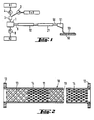
- a mixture of the additives that is to say of the stabilizer S and of the catalyst B, is prepared in the indicated ratio, and introduce this mixture into the apparatus mixing 3 by means of the dosing pump 2 shown diagrammatically.
- Component K 1 is also introduced into this mixing device 3 by means of the metering pump 4, the metering pumps 2 and 4 being arranged so that the desired quantitative ratio to the mixture of stabilizer and catalyst on the one hand, and of the component K 1, on the other hand, is maintained with precision.
- the mixing apparatus 3 as such can in principle be of any structure and is not a critical element of the process. Static mixers of the type of the static mixer 10, described in detail below, which follows the mixing chamber 1 have been found suitable for the mixing apparatus 3.
- the component K 1 mixed with the stabilizer and the catalyst flows in the mixing chamber 1 from the mixing device 3.
- Component K 2 is also introduced into the mixing chamber 1, also with the aid of a metering pump 8 in the desired quantitative ratio.
- the function of the mixing chamber 1 is simply to combine the reaction components.
- the supply lines of the two components there are check valves (not shown) which prevent the direction of flow from changing in the event of pressure reversal.
- the pipe 9 which introduces the combined reaction components into the static mixer 10.
- the static mixer 10 which is shown in longitudinal section in FIG. 2, is formed by a tube 11 provided with flanges 12 and a length of 360 mm, in which are installed mixing elements 13, 14.
- the mixing elements 13, 14 with a length of 24 mm and a 12 mm diameter corresponding to the inner diameter of the tube 11, are formed of slats assembled and arranged in substance transversely to the direction of flow, while being offset each time by 90 ° from each other.
- Fifteen mixing elements 13 and 14 of this type are alternately placed in the tube 11.
- the slats of the mixing elements arranged across the direction of flow continuously cut the components to be mixed into layers and spread them over the entire section of the tube.
- the static mixer SULZER type SMX from the company Gebrüder Sulzer AG, Switzerland, and the N-FORM mixer from the company Bran & Lübbe from Hamburg have proved particularly suitable.
- FIG. 3 shows the mixer 21 with the retaining sleeve 22 stationary and the intake manifold 23 through which the fluid reaction mixture enters.
- the retaining sleeve 22 is provided with a through hole 24 which is connected to the intake manifold 23.
- a hole 25 connects to the through hole 24 and opens into a recess 35 centered in the holding sleeve 22.
- Part of the reaction mixture immediately flows through the bore 25 through the ball bearing 34 carrying the shaft 33 and thus ensures a continuous flushing of the bearing, which avoids dead zones of flow in the region of the bearing.
- the casing 26 of the mixer can be rigidly fixed to the retaining sleeve 26, for example by a screw connection.
- the casing 26 is detachably closed by means of a cover 27.
- the cover 27 is provided with a bore 28 extending in the axial direction and with an outlet pipe 29 for the outlet of the reaction mixture. fluid synthetic material.
- a bore 30 having an inclination connects to the bore 28 and leads to the central recess 31 in which the shaft 33 journals.
- an internal coupling ring 32 which is rigidly connected to the shaft 33.
- the coupling ring 32 is rotatably mounted on a ball bearing 34 in the recess 35 of the retaining sleeve 22.
- Permanent magnets 36 are disposed around the entire periphery of the interior coupling ring and are fitted in hollows of an annular sheath 37 which can be inserted axially.
- the permanent magnets 36 are, for example, covered towards the outside (see FIG. 4) by a hollow cylinder 38 with a thin wall which is, for example, made of a chemically resistant synthetic material.
- Mixing elements 39 are arranged on the mixing shaft 33 in the mixing chamber 40 at a certain distance from each other.
- the shaft 33 extends over the whole of the mixing chamber 40.
- the shaft 33 ends in the journal 41 which is rotatably mounted in the cover 27 in the bearings 42, 43.
- the reaction mixture leaving the mixing chamber flows, in part, through the bearings 42 and 43, through the bore 30, in the outlet pipe 29.
- mixing rods 44 In the region of the mixing chamber 40, between the rotating crosses 39 of the shaft 33, mixing rods 44, the ends of which penetrate into the mixing chamber 40, are inserted into the wall of the casing 26. From preferably, two to four mixing rods are arranged distributed over the periphery of the casing 26 (Fig. 7).
- a coupling ring 45 is mounted to rotate on the casing.
- the coupling ring 45 is preferably mounted on the casing 26 by means of a bearing 46.
- the coupling ring 45 is connected by means of a pinion 47 to a motor, not shown, which drives the coupling ring 45.
- permanent magnets 48 are fitted all along the periphery in hollows, many permanent magnets being arranged parallel side by side. Permanent magnets in the outer coupling ring 45 and in the annular sheath 37 are arranged in such a way that they are always oriented towards one another by opposite poles. When the permanent magnets disposed in the coupling ring 45 are oriented with the south pole inward, the permanent magnets disposed in the annular sheath 37 are oriented with the north pole outward (see Fig. 6).
- the reaction mixture of fluid synthetic material reaches, via the intake manifold 23, the bore 24 in the retaining sleeve 22 and the annular intermediate space present between the internal coupling ring 32 and the envelope wall 26, in the mixing chamber 40 which is arranged downstream of the permanent magnet coupling.
- a part of the reaction mixture flows through the bore 25 immediately through the ball bearing 34.
- the reaction mixture undergoes, in the mixing chamber 40, a dynamic treatment and is mixed intensively without any dead zones being able to form in the coupling region near the bearings or in the mixing chamber.
- the reaction mixture leaves the mixing chamber 40 partly through the bearings 42 and 33 and partly via the bore 28 through the outlet pipe 29.
- the direction of flow of the reaction mixture is indicated by arrows.
- the direction of flow and the flow ratio in the permanent magnet coupling are shown in particular in FIG. 4.
- FIG 3 clearly shows that the mixer shown does not have sliding seals which heat up during operation and thus cause too rapid polymerization at this location.
- the fluid synthetic reaction mixture flows almost linearly through the mixer without passing through dead zones, which is of particular importance for the production of an absolutely homogeneously mixed reaction mixture.
- the reaction mixture exiting through the outlet pipe 29 now exhibits optimal homogeneity. It is admitted via line 50 to the casting device 51.
- this casting device 51 it may be a device called a doctor blade casting head such as that shown, for example, in the document DE -PS 26 14 596. If it is intended to produce sheets from the reaction mixture, glass plates are advantageously used as the casting substrate 52.
- the reaction mixture is applied to this casting substrate 52 in a layer of uniform thickness. After polymerization of the layer 53 with corresponding heating, the finished polyurethane sheet is torn off from the poured substrate 52.
Landscapes
- Chemical & Material Sciences (AREA)
- Chemical Kinetics & Catalysis (AREA)
- Engineering & Computer Science (AREA)
- Mechanical Engineering (AREA)
- Dispersion Chemistry (AREA)
- Polymers & Plastics (AREA)
- Medicinal Chemistry (AREA)
- Organic Chemistry (AREA)
- Health & Medical Sciences (AREA)
- Processing And Handling Of Plastics And Other Materials For Molding In General (AREA)
- Injection Moulding Of Plastics Or The Like (AREA)
- Mixers With Rotating Receptacles And Mixers With Vibration Mechanisms (AREA)
- Casting Or Compression Moulding Of Plastics Or The Like (AREA)
Applications Claiming Priority (2)
| Application Number | Priority Date | Filing Date | Title |
|---|---|---|---|
| FR8309839 | 1983-06-14 | ||
| FR8309839A FR2548043A1 (fr) | 1983-06-14 | 1983-06-14 | Procede et dispositif pour la fabrication par coulee d'une couche optiquement homogene transparente a partir d'un melange de composants |
Publications (2)
| Publication Number | Publication Date |
|---|---|
| EP0132169A1 EP0132169A1 (fr) | 1985-01-23 |
| EP0132169B1 true EP0132169B1 (fr) | 1987-09-09 |
Family
ID=9289772
Family Applications (1)
| Application Number | Title | Priority Date | Filing Date |
|---|---|---|---|
| EP84401216A Expired EP0132169B1 (fr) | 1983-06-14 | 1984-06-14 | Procédé et dispositif pour la fabrication par coulée d'une couche optiquement homogène transparente à partir d'un mélange de composants |
Country Status (6)
| Country | Link |
|---|---|
| US (1) | US4590030A (OSRAM) |
| EP (1) | EP0132169B1 (OSRAM) |
| JP (1) | JPS6071205A (OSRAM) |
| CA (1) | CA1245028A (OSRAM) |
| DE (1) | DE3465887D1 (OSRAM) |
| FR (1) | FR2548043A1 (OSRAM) |
Families Citing this family (42)
| Publication number | Priority date | Publication date | Assignee | Title |
|---|---|---|---|---|
| FR2576012B1 (fr) * | 1985-01-15 | 1991-11-22 | Saint Gobain Vitrage | Procede et dispositif pour la fabrication d'un vitrage de securite |
| FR2576011B1 (fr) * | 1985-01-15 | 1991-10-31 | Saint Gobain Vitrage | Procede et dispositif pour la fabrication d'un vitrage de securite |
| CH670987A5 (OSRAM) * | 1986-10-24 | 1989-07-31 | Spritztechnik Ag | |
| US4950148A (en) * | 1987-01-31 | 1990-08-21 | Kabushiki Kaisha Cubic Engineering | Apparatus for manufacturing silicone gel sheet |
| CH674317A5 (OSRAM) * | 1988-01-29 | 1990-05-31 | Applied Biosystems | |
| US5092523B1 (en) * | 1989-02-21 | 1996-11-12 | Sybron Chemicals | Magnetic drive tank cleaning apparatus |
| DE59104667D1 (de) * | 1990-08-23 | 1995-03-30 | Sulzer Chemtech Ag | Statische Laminar-Mischeinrichtung, Zumischvorrichtung, sowie Verwendung von Mischeinrichtung und Zumischvorrichtung. |
| US5114732A (en) * | 1991-04-02 | 1992-05-19 | Kraft General Foods, Inc. | Method of mixing viscous emulsions |
| US5225168A (en) * | 1991-09-03 | 1993-07-06 | Caterpillar Inc. | Static mixing apparatus |
| US5393546A (en) * | 1993-02-26 | 1995-02-28 | Rich-Seapak Corporation | Method for two phase conveyance of a product |
| US5332313A (en) * | 1993-03-12 | 1994-07-26 | Dow Corning Corporation | Nozzle mixer assembly |
| US5480589A (en) * | 1994-09-27 | 1996-01-02 | Nordson Corporation | Method and apparatus for producing closed cell foam |
| US5965676A (en) * | 1996-11-14 | 1999-10-12 | Nippon Shokubai Co., Ltd. | Production process, production apparatus, and product of resin particle |
| US6405759B1 (en) * | 1997-08-05 | 2002-06-18 | Owens Corning Composites Sprl | Apparatus for the continuous preparation of glass fiber sizing compositions |
| EP2308470A1 (en) * | 1997-09-18 | 2011-04-13 | Pacira Pharmaceuticals, Inc. | Sustained-release liposomal anesthetic compositions |
| JPH11172082A (ja) * | 1997-11-10 | 1999-06-29 | Teijin Ltd | 改質ポリエステルの連続製造方法 |
| NZ504188A (en) | 1997-11-14 | 2001-10-26 | Skyepharma Inc | Emulsification process for preparing multivesicular liposomes |
| KR100397934B1 (ko) * | 2000-12-01 | 2003-09-19 | 기아자동차주식회사 | 연속 혼합식 제독제 생성장치 |
| DE10231213B4 (de) * | 2002-07-11 | 2008-02-07 | Herbák, Zsolt | Vorrichtung zum Mischen von Flüssigkeiten |
| GB0222194D0 (en) * | 2002-09-25 | 2002-10-30 | Porvair Plc | Polymer film production |
| WO2004067816A1 (de) * | 2003-01-29 | 2004-08-12 | Saurer Gmbh & Co. Kg | Vorrichtung und verfahren zum spinnen farbiger fasern |
| DE10345099A1 (de) * | 2003-09-26 | 2005-04-21 | Basf Ag | Verfahren zur Herstellung von Mischungen zur Polyurethan-Herstellung |
| US20050094482A1 (en) * | 2003-10-31 | 2005-05-05 | Nordson Corporation | Method and apparatus for producing closed cell foam |
| DE10357182A1 (de) * | 2003-12-06 | 2005-06-30 | Bayer Materialscience Ag | Verfahren zum schonenden Eintragen von Additiven, Katalysatoren oder Inhibitoren in Polymerschmelzen |
| US20080225638A1 (en) * | 2005-09-13 | 2008-09-18 | Bayone Urethane Systems Llc | Dynamic Helical Mixer and Mixing Apparatus Using Same |
| US8182134B2 (en) | 2005-12-16 | 2012-05-22 | PRC De Soto International, Inc. | Mixing system for thermoset compositions including static and rotary mixers |
| ES2306411T3 (es) * | 2006-08-21 | 2008-11-01 | Zhermack S.P.A. | Aparato y procedimiento para mezclar una sustancia multicomponente para moldeos dentales. |
| JP5205097B2 (ja) * | 2007-06-18 | 2013-06-05 | 旭サナック株式会社 | 多液混合装置 |
| RU2455957C2 (ru) * | 2008-02-20 | 2012-07-20 | Жермак С.П.А. | Смеситель |
| US7731413B2 (en) * | 2008-02-20 | 2010-06-08 | Zhermack S.P.A. | Mixer for multi-components substance for dental casting |
| JP5779454B2 (ja) * | 2010-09-15 | 2015-09-16 | 富士フイルム株式会社 | 混合装置、流延ドープの製造方法及び溶液製膜方法 |
| JP2012061677A (ja) * | 2010-09-15 | 2012-03-29 | Fujifilm Corp | 混合装置、流延ドープの製造方法及び溶液製膜方法 |
| FI20155036A (fi) * | 2015-01-19 | 2016-07-20 | Outotec Finland Oy | Menetelmä ja sekoituslaite ensimmäisen nesteen ja toisen nesteen sekoittamiseksi dispersioon |
| AT516946B1 (de) | 2015-07-03 | 2016-10-15 | Sonderhoff Eng Gmbh | Mischvorrichtung |
| US11357727B1 (en) | 2021-01-22 | 2022-06-14 | Pacira Pharmaceuticals, Inc. | Manufacturing of bupivacaine multivesicular liposomes |
| US11278494B1 (en) | 2021-01-22 | 2022-03-22 | Pacira Pharmaceuticals, Inc. | Manufacturing of bupivacaine multivesicular liposomes |
| US12151024B2 (en) | 2021-01-22 | 2024-11-26 | Pacira Pharmaceuticals, Inc. | Manufacturing of bupivacaine multivesicular liposomes |
| US11033495B1 (en) | 2021-01-22 | 2021-06-15 | Pacira Pharmaceuticals, Inc. | Manufacturing of bupivacaine multivesicular liposomes |
| US12285419B2 (en) | 2021-10-14 | 2025-04-29 | Pacira Pharmaceuticals, Inc. | Bupivacaine multivesicular liposome formulations and uses thereof |
| US12251472B1 (en) | 2024-05-20 | 2025-03-18 | Pacira Pharmaceuticals, Inc. | Manufacturing of bupivacaine multivesicular liposomes |
| US12246092B1 (en) | 2024-05-20 | 2025-03-11 | Pacira Pharmaceuticals, Inc. | Manufacturing of bupivacaine multivesicular liposomes |
| US12280149B1 (en) | 2024-05-20 | 2025-04-22 | Pacira Pharmaceuticals, Inc. | Manufacturing of bupivacaine multivesicular liposomes |
Family Cites Families (17)
| Publication number | Priority date | Publication date | Assignee | Title |
|---|---|---|---|---|
| US2556854A (en) * | 1949-10-29 | 1951-06-12 | Standard Oil Dev Co | Magnetic coupling drive for highpressure stirred reactors |
| US2868518A (en) * | 1957-01-08 | 1959-01-13 | Du Pont | Mixer |
| US2955319A (en) * | 1957-10-07 | 1960-10-11 | American Viscose Corp | Gear type blender assembly |
| US3111389A (en) * | 1959-10-22 | 1963-11-19 | Chrysler Corp | Apparatus for preparing polyurethane foam compositions and the like |
| US3208958A (en) * | 1963-03-04 | 1965-09-28 | Pacific Vegets Le Oil Corp | Method and apparatus for producing plastic foam |
| DE2058504C2 (de) * | 1970-11-27 | 1982-11-25 | Bayer Ag, 5090 Leverkusen | Verfahren zum Kratzfestmachen von schlagfesten und klar durchsichtigen Kunststoffen |
| CH537208A (de) * | 1971-04-29 | 1973-07-13 | Sulzer Ag | Mischeinrichtung für fliessfähige Medien |
| DE2228299C3 (de) * | 1972-06-09 | 1985-11-14 | Saint-Gobain Industries, Neuilly-sur-Seine | Sicherheitsglasscheibe |
| DE2534740C3 (de) * | 1975-08-04 | 1983-02-03 | Franz 4630 Bochum Klaus | Spaltrohrkreiselpumpe |
| US4065234A (en) * | 1975-12-22 | 1977-12-27 | Nihon Kagaku Kizai Kabushiki Kaisha | Magnetically driven rotary pumps |
| DE2614596C3 (de) * | 1976-04-05 | 1980-03-13 | Vereinigte Glaswerke Gmbh, 5100 Aachen | Abstreichgießkopf zum Aufbringen gießfähiger Kunststoffschichten auf plane Unterlagen |
| DE2624058C2 (de) * | 1976-05-28 | 1984-11-15 | Franz Klaus-Union, 4630 Bochum | Permanentmagnetpumpe |
| DE2629779C3 (de) * | 1976-07-02 | 1985-04-04 | Saint Gobain | Verfahren zur Herstellung einer zweischichtigen Folie mit Selbstheileigenschaften unter Verwendung von Polyurethanen als Splitterschutzschicht eines Sicherheitsglases |
| JPS5518130A (en) * | 1978-07-24 | 1980-02-08 | Mitsubishi Electric Corp | Offset circuit |
| US4330215A (en) * | 1979-05-03 | 1982-05-18 | Rubber & Plastics Research Assoc Of Gb | Mixing device |
| JPS5731941U (OSRAM) * | 1980-07-31 | 1982-02-19 | ||
| JPS602899B2 (ja) * | 1980-10-13 | 1985-01-24 | 三井東圧化学株式会社 | 混合装置 |
-
1983
- 1983-06-14 FR FR8309839A patent/FR2548043A1/fr not_active Withdrawn
-
1984
- 1984-06-06 US US06/617,814 patent/US4590030A/en not_active Expired - Fee Related
- 1984-06-12 JP JP59119222A patent/JPS6071205A/ja active Granted
- 1984-06-14 DE DE8484401216T patent/DE3465887D1/de not_active Expired
- 1984-06-14 CA CA000456605A patent/CA1245028A/fr not_active Expired
- 1984-06-14 EP EP84401216A patent/EP0132169B1/fr not_active Expired
Also Published As
| Publication number | Publication date |
|---|---|
| FR2548043A1 (fr) | 1985-01-04 |
| JPH0526641B2 (OSRAM) | 1993-04-16 |
| JPS6071205A (ja) | 1985-04-23 |
| CA1245028A (fr) | 1988-11-22 |
| US4590030A (en) | 1986-05-20 |
| EP0132169A1 (fr) | 1985-01-23 |
| DE3465887D1 (en) | 1987-10-15 |
Similar Documents
| Publication | Publication Date | Title |
|---|---|---|
| EP0132169B1 (fr) | Procédé et dispositif pour la fabrication par coulée d'une couche optiquement homogène transparente à partir d'un mélange de composants | |
| EP0406068B1 (fr) | Dispositif pour la fabrication de couches de matières plastiques transparentes présentant une bande filtrante colorée dans la masse | |
| FR2919281A1 (fr) | Procede et dispositif pour homogeneiser une masse fondue de verre | |
| CH634027A5 (fr) | Procede et dispositif de fibrage du verre. | |
| CA2347147A1 (fr) | Corps de revolution creux et son procede de fabrication | |
| FR2470672A1 (fr) | Tete d'extrusion pour profile composite en matiere plastique et profile obtenu | |
| EP3983188A1 (fr) | Procédé et dispositif de fabrication d'un béton fibré anisotrope | |
| FR2840546A1 (fr) | Procede pour melanger en contenu dynamiquement au moins deux fluides et micromelangeur | |
| FR2632891A1 (fr) | Amelioration a la fabrication d'un cordon de matiere organique destine a servir de joint et d'intercalaire dans un vitrage multiple | |
| FR2523030A1 (fr) | Dispositif pour traiter des matieres visqueuses ou des matieres devenant visqueuses lors du traitement | |
| FR2578575A1 (fr) | Vitrage multiple enrobe et son procede de fabrication | |
| BE898140A (fr) | Dispositif en vue de mélanger continuellement un produit sec avec un liquide et en vue de transporter le produit de mélange. | |
| FR3066947A1 (fr) | Malaxage d'un composite elastomerique par melange continu en phase liquide | |
| FR2627428A1 (fr) | Procede de fabrication d'un cylindre d'impression en plastique pour machines a ecrire et analogues et cylindre ainsi obtenu | |
| LU81919A1 (fr) | Procede de fabrication de feuilles de matiere plastique | |
| WO2021152251A1 (fr) | Carter de turbomachine d'aeronef et son procede de fabrication | |
| EP2928675B1 (fr) | Dispositif d'impregnation, unite de fabrication d'un profile creux par pultrusion comprenant un tel dispositif et procede de fabrication correspondant | |
| EP2958862B1 (fr) | Procede de fabrication d'un verre avec melange d'un flux de verre liquide et dispositif | |
| FR2976210A1 (fr) | Ensemble et methode de fabrication d'une gaine tubulaire | |
| FR2479795A1 (fr) | Procede d'amincissement de verre produit par flottage | |
| FR2540042A1 (fr) | Revetement a base de resine stratifiee et a deux modes d'armature | |
| BE1008708A3 (fr) | Procede et dispositif de fabrication d'un tuyau composite renforce. | |
| EP0418158A1 (fr) | ProcédÀ© et installation de fabrication de liants modifies à usage routier | |
| EP0124403A1 (fr) | Procédé de fabrication de brides à collerette, haute pression, en matériau composite, et produit obtenu | |
| EP0655968B1 (fr) | Appareil de production, par extrusion, en continu, de tubes composites renforces par un insert |
Legal Events
| Date | Code | Title | Description |
|---|---|---|---|
| PUAI | Public reference made under article 153(3) epc to a published international application that has entered the european phase |
Free format text: ORIGINAL CODE: 0009012 |
|
| AK | Designated contracting states |
Designated state(s): BE DE FR GB IT SE |
|
| 17P | Request for examination filed |
Effective date: 19850717 |
|
| 17Q | First examination report despatched |
Effective date: 19860319 |
|
| GRAA | (expected) grant |
Free format text: ORIGINAL CODE: 0009210 |
|
| AK | Designated contracting states |
Kind code of ref document: B1 Designated state(s): BE DE FR GB IT SE |
|
| REF | Corresponds to: |
Ref document number: 3465887 Country of ref document: DE Date of ref document: 19871015 |
|
| GBT | Gb: translation of ep patent filed (gb section 77(6)(a)/1977) | ||
| ITF | It: translation for a ep patent filed | ||
| PLBE | No opposition filed within time limit |
Free format text: ORIGINAL CODE: 0009261 |
|
| 26N | No opposition filed | ||
| ITTA | It: last paid annual fee | ||
| EAL | Se: european patent in force in sweden |
Ref document number: 84401216.1 |
|
| PGFP | Annual fee paid to national office [announced via postgrant information from national office to epo] |
Ref country code: SE Payment date: 19950522 Year of fee payment: 12 |
|
| PG25 | Lapsed in a contracting state [announced via postgrant information from national office to epo] |
Ref country code: SE Effective date: 19960615 |
|
| EUG | Se: european patent has lapsed |
Ref document number: 84401216.1 |
|
| PGFP | Annual fee paid to national office [announced via postgrant information from national office to epo] |
Ref country code: DE Payment date: 19990715 Year of fee payment: 16 |
|
| PGFP | Annual fee paid to national office [announced via postgrant information from national office to epo] |
Ref country code: GB Payment date: 20000525 Year of fee payment: 17 |
|
| PGFP | Annual fee paid to national office [announced via postgrant information from national office to epo] |
Ref country code: FR Payment date: 20000621 Year of fee payment: 17 |
|
| PGFP | Annual fee paid to national office [announced via postgrant information from national office to epo] |
Ref country code: BE Payment date: 20000629 Year of fee payment: 17 |
|
| PG25 | Lapsed in a contracting state [announced via postgrant information from national office to epo] |
Ref country code: DE Free format text: LAPSE BECAUSE OF NON-PAYMENT OF DUE FEES Effective date: 20010403 |
|
| PG25 | Lapsed in a contracting state [announced via postgrant information from national office to epo] |
Ref country code: GB Free format text: LAPSE BECAUSE OF NON-PAYMENT OF DUE FEES Effective date: 20010614 |
|
| PG25 | Lapsed in a contracting state [announced via postgrant information from national office to epo] |
Ref country code: BE Free format text: LAPSE BECAUSE OF NON-PAYMENT OF DUE FEES Effective date: 20010630 |
|
| BERE | Be: lapsed |
Owner name: SAINT-GOBAIN VITRAGE Effective date: 20010630 |
|
| GBPC | Gb: european patent ceased through non-payment of renewal fee |
Effective date: 20010614 |
|
| PG25 | Lapsed in a contracting state [announced via postgrant information from national office to epo] |
Ref country code: FR Free format text: LAPSE BECAUSE OF NON-PAYMENT OF DUE FEES Effective date: 20020228 |