EP0129720A2 - Verwendung der Umsetzungsprodukte von Ethylenoxid mit aliphatischen vicinalen Diolen als Emulgatoren für die Emulsionspolymerisation - Google Patents
Verwendung der Umsetzungsprodukte von Ethylenoxid mit aliphatischen vicinalen Diolen als Emulgatoren für die Emulsionspolymerisation Download PDFInfo
- Publication number
- EP0129720A2 EP0129720A2 EP84105924A EP84105924A EP0129720A2 EP 0129720 A2 EP0129720 A2 EP 0129720A2 EP 84105924 A EP84105924 A EP 84105924A EP 84105924 A EP84105924 A EP 84105924A EP 0129720 A2 EP0129720 A2 EP 0129720A2
- Authority
- EP
- European Patent Office
- Prior art keywords
- ethylene oxide
- mol
- reaction products
- emulsifiers
- vicinal diols
- Prior art date
- Legal status (The legal status is an assumption and is not a legal conclusion. Google has not performed a legal analysis and makes no representation as to the accuracy of the status listed.)
- Ceased
Links
- IAYPIBMASNFSPL-UHFFFAOYSA-N Ethylene oxide Chemical compound C1CO1 IAYPIBMASNFSPL-UHFFFAOYSA-N 0.000 title claims abstract description 62
- 239000003995 emulsifying agent Substances 0.000 title claims abstract description 36
- 150000002009 diols Chemical group 0.000 title claims abstract description 18
- 125000001931 aliphatic group Chemical group 0.000 title claims abstract description 13
- 238000007720 emulsion polymerization reaction Methods 0.000 title claims description 13
- 239000012084 conversion product Substances 0.000 title 1
- 239000007795 chemical reaction product Substances 0.000 claims abstract description 25
- 239000000178 monomer Substances 0.000 claims abstract description 24
- 125000004432 carbon atom Chemical group C* 0.000 claims abstract description 7
- 125000000129 anionic group Chemical group 0.000 claims abstract description 5
- -1 aliphatic 1,2-diols Chemical class 0.000 claims description 17
- 239000000839 emulsion Substances 0.000 claims description 11
- 125000002887 hydroxy group Chemical group [H]O* 0.000 claims description 5
- 125000002091 cationic group Chemical group 0.000 claims description 4
- 239000000047 product Substances 0.000 abstract description 15
- 238000006116 polymerization reaction Methods 0.000 abstract description 14
- 229920000642 polymer Polymers 0.000 abstract description 4
- 229920000126 latex Polymers 0.000 abstract description 2
- 238000004519 manufacturing process Methods 0.000 abstract description 2
- 239000004094 surface-active agent Substances 0.000 abstract description 2
- 239000000243 solution Substances 0.000 description 30
- LYCAIKOWRPUZTN-UHFFFAOYSA-N Ethylene glycol Chemical compound OCCO LYCAIKOWRPUZTN-UHFFFAOYSA-N 0.000 description 29
- 239000006185 dispersion Substances 0.000 description 13
- 239000000203 mixture Substances 0.000 description 13
- IJGRMHOSHXDMSA-UHFFFAOYSA-N Atomic nitrogen Chemical compound N#N IJGRMHOSHXDMSA-UHFFFAOYSA-N 0.000 description 12
- 238000006243 chemical reaction Methods 0.000 description 10
- QGZKDVFQNNGYKY-UHFFFAOYSA-N Ammonia Chemical compound N QGZKDVFQNNGYKY-UHFFFAOYSA-N 0.000 description 9
- 238000000034 method Methods 0.000 description 9
- 238000007142 ring opening reaction Methods 0.000 description 9
- PPBRXRYQALVLMV-UHFFFAOYSA-N Styrene Chemical compound C=CC1=CC=CC=C1 PPBRXRYQALVLMV-UHFFFAOYSA-N 0.000 description 6
- 229910052757 nitrogen Inorganic materials 0.000 description 6
- SMZOUWXMTYCWNB-UHFFFAOYSA-N 2-(2-methoxy-5-methylphenyl)ethanamine Chemical compound COC1=CC=C(C)C=C1CCN SMZOUWXMTYCWNB-UHFFFAOYSA-N 0.000 description 5
- CERQOIWHTDAKMF-UHFFFAOYSA-N Methacrylic acid Chemical compound CC(=C)C(O)=O CERQOIWHTDAKMF-UHFFFAOYSA-N 0.000 description 5
- ROOXNKNUYICQNP-UHFFFAOYSA-N ammonium persulfate Chemical compound [NH4+].[NH4+].[O-]S(=O)(=O)OOS([O-])(=O)=O ROOXNKNUYICQNP-UHFFFAOYSA-N 0.000 description 5
- XTXRWKRVRITETP-UHFFFAOYSA-N Vinyl acetate Chemical compound CC(=O)OC=C XTXRWKRVRITETP-UHFFFAOYSA-N 0.000 description 4
- 229910021529 ammonia Inorganic materials 0.000 description 4
- 150000002148 esters Chemical class 0.000 description 4
- 238000010438 heat treatment Methods 0.000 description 4
- JRZJOMJEPLMPRA-UHFFFAOYSA-N olefin Natural products CCCCCCCC=C JRZJOMJEPLMPRA-UHFFFAOYSA-N 0.000 description 4
- 230000001681 protective effect Effects 0.000 description 4
- 239000000126 substance Substances 0.000 description 4
- 229920002554 vinyl polymer Polymers 0.000 description 4
- XLYOFNOQVPJJNP-UHFFFAOYSA-N water Substances O XLYOFNOQVPJJNP-UHFFFAOYSA-N 0.000 description 4
- NIXOWILDQLNWCW-UHFFFAOYSA-N 2-Propenoic acid Natural products OC(=O)C=C NIXOWILDQLNWCW-UHFFFAOYSA-N 0.000 description 3
- KAKZBPTYRLMSJV-UHFFFAOYSA-N Butadiene Chemical compound C=CC=C KAKZBPTYRLMSJV-UHFFFAOYSA-N 0.000 description 3
- RRHGJUQNOFWUDK-UHFFFAOYSA-N Isoprene Chemical compound CC(=C)C=C RRHGJUQNOFWUDK-UHFFFAOYSA-N 0.000 description 3
- IGFHQQFPSIBGKE-UHFFFAOYSA-N Nonylphenol Natural products CCCCCCCCCC1=CC=C(O)C=C1 IGFHQQFPSIBGKE-UHFFFAOYSA-N 0.000 description 3
- 239000002253 acid Substances 0.000 description 3
- 150000001336 alkenes Chemical group 0.000 description 3
- 239000012935 ammoniumperoxodisulfate Substances 0.000 description 3
- 239000000084 colloidal system Substances 0.000 description 3
- 150000001875 compounds Chemical class 0.000 description 3
- 229920001577 copolymer Polymers 0.000 description 3
- 238000007334 copolymerization reaction Methods 0.000 description 3
- 150000002191 fatty alcohols Chemical class 0.000 description 3
- SNQQPOLDUKLAAF-UHFFFAOYSA-N nonylphenol Chemical compound CCCCCCCCCC1=CC=CC=C1O SNQQPOLDUKLAAF-UHFFFAOYSA-N 0.000 description 3
- 239000002245 particle Substances 0.000 description 3
- 229920002689 polyvinyl acetate Polymers 0.000 description 3
- 239000011118 polyvinyl acetate Substances 0.000 description 3
- 150000003839 salts Chemical class 0.000 description 3
- 238000003756 stirring Methods 0.000 description 3
- CWERGRDVMFNCDR-UHFFFAOYSA-N thioglycolic acid Chemical compound OC(=O)CS CWERGRDVMFNCDR-UHFFFAOYSA-N 0.000 description 3
- VZCYOOQTPOCHFL-UHFFFAOYSA-N trans-butenedioic acid Natural products OC(=O)C=CC(O)=O VZCYOOQTPOCHFL-UHFFFAOYSA-N 0.000 description 3
- 229920001567 vinyl ester resin Polymers 0.000 description 3
- 125000000391 vinyl group Chemical group [H]C([*])=C([H])[H] 0.000 description 3
- 150000000180 1,2-diols Chemical class 0.000 description 2
- NLHHRLWOUZZQLW-UHFFFAOYSA-N Acrylonitrile Chemical compound C=CC#N NLHHRLWOUZZQLW-UHFFFAOYSA-N 0.000 description 2
- VGGSQFUCUMXWEO-UHFFFAOYSA-N Ethene Chemical compound C=C VGGSQFUCUMXWEO-UHFFFAOYSA-N 0.000 description 2
- 239000005977 Ethylene Substances 0.000 description 2
- VZCYOOQTPOCHFL-OWOJBTEDSA-N Fumaric acid Chemical compound OC(=O)\C=C\C(O)=O VZCYOOQTPOCHFL-OWOJBTEDSA-N 0.000 description 2
- PEDCQBHIVMGVHV-UHFFFAOYSA-N Glycerine Chemical compound OCC(O)CO PEDCQBHIVMGVHV-UHFFFAOYSA-N 0.000 description 2
- MHAJPDPJQMAIIY-UHFFFAOYSA-N Hydrogen peroxide Chemical compound OO MHAJPDPJQMAIIY-UHFFFAOYSA-N 0.000 description 2
- VQTUBCCKSQIDNK-UHFFFAOYSA-N Isobutene Chemical compound CC(C)=C VQTUBCCKSQIDNK-UHFFFAOYSA-N 0.000 description 2
- KFZMGEQAYNKOFK-UHFFFAOYSA-N Isopropanol Chemical compound CC(C)O KFZMGEQAYNKOFK-UHFFFAOYSA-N 0.000 description 2
- 229910019142 PO4 Inorganic materials 0.000 description 2
- OFOBLEOULBTSOW-UHFFFAOYSA-N Propanedioic acid Natural products OC(=O)CC(O)=O OFOBLEOULBTSOW-UHFFFAOYSA-N 0.000 description 2
- UIIMBOGNXHQVGW-UHFFFAOYSA-M Sodium bicarbonate Chemical compound [Na+].OC([O-])=O UIIMBOGNXHQVGW-UHFFFAOYSA-M 0.000 description 2
- BZHJMEDXRYGGRV-UHFFFAOYSA-N Vinyl chloride Chemical compound ClC=C BZHJMEDXRYGGRV-UHFFFAOYSA-N 0.000 description 2
- 150000007513 acids Chemical class 0.000 description 2
- 230000003197 catalytic effect Effects 0.000 description 2
- DOIRQSBPFJWKBE-UHFFFAOYSA-N dibutyl phthalate Chemical compound CCCCOC(=O)C1=CC=CC=C1C(=O)OCCCC DOIRQSBPFJWKBE-UHFFFAOYSA-N 0.000 description 2
- 150000001993 dienes Chemical class 0.000 description 2
- 235000014113 dietary fatty acids Nutrition 0.000 description 2
- 239000004815 dispersion polymer Substances 0.000 description 2
- 239000012153 distilled water Substances 0.000 description 2
- 238000001035 drying Methods 0.000 description 2
- RTZKZFJDLAIYFH-UHFFFAOYSA-N ether Substances CCOCC RTZKZFJDLAIYFH-UHFFFAOYSA-N 0.000 description 2
- 239000000194 fatty acid Substances 0.000 description 2
- 229930195729 fatty acid Natural products 0.000 description 2
- 150000004665 fatty acids Chemical class 0.000 description 2
- VZCYOOQTPOCHFL-UPHRSURJSA-N maleic acid Chemical compound OC(=O)\C=C/C(O)=O VZCYOOQTPOCHFL-UPHRSURJSA-N 0.000 description 2
- 239000011976 maleic acid Substances 0.000 description 2
- 150000005673 monoalkenes Chemical class 0.000 description 2
- 239000012071 phase Substances 0.000 description 2
- 235000021317 phosphate Nutrition 0.000 description 2
- 239000011541 reaction mixture Substances 0.000 description 2
- 239000000344 soap Substances 0.000 description 2
- HRZFUMHJMZEROT-UHFFFAOYSA-L sodium disulfite Chemical compound [Na+].[Na+].[O-]S(=O)S([O-])(=O)=O HRZFUMHJMZEROT-UHFFFAOYSA-L 0.000 description 2
- 235000010262 sodium metabisulphite Nutrition 0.000 description 2
- 238000005303 weighing Methods 0.000 description 2
- DGVVWUTYPXICAM-UHFFFAOYSA-N β‐Mercaptoethanol Chemical compound OCCS DGVVWUTYPXICAM-UHFFFAOYSA-N 0.000 description 2
- UZKWTJUDCOPSNM-UHFFFAOYSA-N 1-ethenoxybutane Chemical compound CCCCOC=C UZKWTJUDCOPSNM-UHFFFAOYSA-N 0.000 description 1
- JAHNSTQSQJOJLO-UHFFFAOYSA-N 2-(3-fluorophenyl)-1h-imidazole Chemical compound FC1=CC=CC(C=2NC=CN=2)=C1 JAHNSTQSQJOJLO-UHFFFAOYSA-N 0.000 description 1
- OEPOKWHJYJXUGD-UHFFFAOYSA-N 2-(3-phenylmethoxyphenyl)-1,3-thiazole-4-carbaldehyde Chemical compound O=CC1=CSC(C=2C=C(OCC=3C=CC=CC=3)C=CC=2)=N1 OEPOKWHJYJXUGD-UHFFFAOYSA-N 0.000 description 1
- JKNCOURZONDCGV-UHFFFAOYSA-N 2-(dimethylamino)ethyl 2-methylprop-2-enoate Chemical compound CN(C)CCOC(=O)C(C)=C JKNCOURZONDCGV-UHFFFAOYSA-N 0.000 description 1
- XHZPRMZZQOIPDS-UHFFFAOYSA-N 2-Methyl-2-[(1-oxo-2-propenyl)amino]-1-propanesulfonic acid Chemical compound OS(=O)(=O)CC(C)(C)NC(=O)C=C XHZPRMZZQOIPDS-UHFFFAOYSA-N 0.000 description 1
- ATRRKUHOCOJYRX-UHFFFAOYSA-N Ammonium bicarbonate Chemical compound [NH4+].OC([O-])=O ATRRKUHOCOJYRX-UHFFFAOYSA-N 0.000 description 1
- OKTJSMMVPCPJKN-UHFFFAOYSA-N Carbon Chemical compound [C] OKTJSMMVPCPJKN-UHFFFAOYSA-N 0.000 description 1
- 229920002134 Carboxymethyl cellulose Polymers 0.000 description 1
- IMROMDMJAWUWLK-UHFFFAOYSA-N Ethenol Chemical compound OC=C IMROMDMJAWUWLK-UHFFFAOYSA-N 0.000 description 1
- 238000007869 Guerbet synthesis reaction Methods 0.000 description 1
- 239000004354 Hydroxyethyl cellulose Substances 0.000 description 1
- GYCMBHHDWRMZGG-UHFFFAOYSA-N Methylacrylonitrile Chemical compound CC(=C)C#N GYCMBHHDWRMZGG-UHFFFAOYSA-N 0.000 description 1
- 239000004372 Polyvinyl alcohol Substances 0.000 description 1
- ZLMJMSJWJFRBEC-UHFFFAOYSA-N Potassium Chemical compound [K] ZLMJMSJWJFRBEC-UHFFFAOYSA-N 0.000 description 1
- VMHLLURERBWHNL-UHFFFAOYSA-M Sodium acetate Chemical compound [Na+].CC([O-])=O VMHLLURERBWHNL-UHFFFAOYSA-M 0.000 description 1
- ULUAUXLGCMPNKK-UHFFFAOYSA-N Sulfobutanedioic acid Chemical compound OC(=O)CC(C(O)=O)S(O)(=O)=O ULUAUXLGCMPNKK-UHFFFAOYSA-N 0.000 description 1
- 238000007171 acid catalysis Methods 0.000 description 1
- 150000001252 acrylic acid derivatives Chemical class 0.000 description 1
- 150000001298 alcohols Chemical class 0.000 description 1
- 150000001335 aliphatic alkanes Chemical class 0.000 description 1
- 229910052783 alkali metal Inorganic materials 0.000 description 1
- 150000001340 alkali metals Chemical class 0.000 description 1
- 125000000217 alkyl group Chemical group 0.000 description 1
- 229940045714 alkyl sulfonate alkylating agent Drugs 0.000 description 1
- 150000008052 alkyl sulfonates Chemical class 0.000 description 1
- XYLMUPLGERFSHI-UHFFFAOYSA-N alpha-Methylstyrene Chemical compound CC(=C)C1=CC=CC=C1 XYLMUPLGERFSHI-UHFFFAOYSA-N 0.000 description 1
- 150000001408 amides Chemical class 0.000 description 1
- 239000001099 ammonium carbonate Substances 0.000 description 1
- 235000012501 ammonium carbonate Nutrition 0.000 description 1
- 229910001870 ammonium persulfate Inorganic materials 0.000 description 1
- 239000008346 aqueous phase Substances 0.000 description 1
- 239000000872 buffer Substances 0.000 description 1
- CQEYYJKEWSMYFG-UHFFFAOYSA-N butyl acrylate Chemical compound CCCCOC(=O)C=C CQEYYJKEWSMYFG-UHFFFAOYSA-N 0.000 description 1
- 125000000484 butyl group Chemical group [H]C([*])([H])C([H])([H])C([H])([H])C([H])([H])[H] 0.000 description 1
- UTOVMEACOLCUCK-PLNGDYQASA-N butyl maleate Chemical compound CCCCOC(=O)\C=C/C(O)=O UTOVMEACOLCUCK-PLNGDYQASA-N 0.000 description 1
- 229910052799 carbon Inorganic materials 0.000 description 1
- 239000001768 carboxy methyl cellulose Substances 0.000 description 1
- 235000010948 carboxy methyl cellulose Nutrition 0.000 description 1
- 229920003090 carboxymethyl hydroxyethyl cellulose Polymers 0.000 description 1
- 239000008112 carboxymethyl-cellulose Substances 0.000 description 1
- 229920003086 cellulose ether Polymers 0.000 description 1
- 239000003638 chemical reducing agent Substances 0.000 description 1
- 230000000052 comparative effect Effects 0.000 description 1
- 239000007859 condensation product Substances 0.000 description 1
- LDHQCZJRKDOVOX-NSCUHMNNSA-N crotonic acid Chemical compound C\C=C\C(O)=O LDHQCZJRKDOVOX-NSCUHMNNSA-N 0.000 description 1
- JBSLOWBPDRZSMB-FPLPWBNLSA-N dibutyl (z)-but-2-enedioate Chemical compound CCCCOC(=O)\C=C/C(=O)OCCCC JBSLOWBPDRZSMB-FPLPWBNLSA-N 0.000 description 1
- 125000003438 dodecyl group Chemical group [H]C([H])([H])C([H])([H])C([H])([H])C([H])([H])C([H])([H])C([H])([H])C([H])([H])C([H])([H])C([H])([H])C([H])([H])C([H])([H])C([H])([H])* 0.000 description 1
- 230000000694 effects Effects 0.000 description 1
- 229920001971 elastomer Polymers 0.000 description 1
- 125000003700 epoxy group Chemical group 0.000 description 1
- IGBZOHMCHDADGY-UHFFFAOYSA-N ethenyl 2-ethylhexanoate Chemical compound CCCCC(CC)C(=O)OC=C IGBZOHMCHDADGY-UHFFFAOYSA-N 0.000 description 1
- PROZFBRPPCAADD-UHFFFAOYSA-N ethenyl but-3-enoate Chemical compound C=CCC(=O)OC=C PROZFBRPPCAADD-UHFFFAOYSA-N 0.000 description 1
- UIWXSTHGICQLQT-UHFFFAOYSA-N ethenyl propanoate Chemical compound CCC(=O)OC=C UIWXSTHGICQLQT-UHFFFAOYSA-N 0.000 description 1
- 150000002170 ethers Chemical class 0.000 description 1
- 125000001495 ethyl group Chemical group [H]C([H])([H])C([H])([H])* 0.000 description 1
- 238000011156 evaluation Methods 0.000 description 1
- 230000002349 favourable effect Effects 0.000 description 1
- 239000001530 fumaric acid Substances 0.000 description 1
- 230000009477 glass transition Effects 0.000 description 1
- 239000003292 glue Substances 0.000 description 1
- 235000011187 glycerol Nutrition 0.000 description 1
- 125000004051 hexyl group Chemical group [H]C([H])([H])C([H])([H])C([H])([H])C([H])([H])C([H])([H])C([H])([H])* 0.000 description 1
- 235000019447 hydroxyethyl cellulose Nutrition 0.000 description 1
- 239000000543 intermediate Substances 0.000 description 1
- 125000001449 isopropyl group Chemical group [H]C([H])([H])C([H])(*)C([H])([H])[H] 0.000 description 1
- 229920000609 methyl cellulose Polymers 0.000 description 1
- 125000002496 methyl group Chemical group [H]C([H])([H])* 0.000 description 1
- 239000001923 methylcellulose Substances 0.000 description 1
- 235000010981 methylcellulose Nutrition 0.000 description 1
- LVHBHZANLOWSRM-UHFFFAOYSA-N methylenebutanedioic acid Natural products OC(=O)CC(=C)C(O)=O LVHBHZANLOWSRM-UHFFFAOYSA-N 0.000 description 1
- 150000002763 monocarboxylic acids Chemical class 0.000 description 1
- 125000002347 octyl group Chemical group [H]C([*])([H])C([H])([H])C([H])([H])C([H])([H])C([H])([H])C([H])([H])C([H])([H])C([H])([H])[H] 0.000 description 1
- 239000003921 oil Substances 0.000 description 1
- 238000006384 oligomerization reaction Methods 0.000 description 1
- WXZMFSXDPGVJKK-UHFFFAOYSA-N pentaerythritol Chemical compound OCC(CO)(CO)CO WXZMFSXDPGVJKK-UHFFFAOYSA-N 0.000 description 1
- 229920001485 poly(butyl acrylate) polymer Polymers 0.000 description 1
- 239000003505 polymerization initiator Substances 0.000 description 1
- 229920002451 polyvinyl alcohol Polymers 0.000 description 1
- 239000011591 potassium Substances 0.000 description 1
- USHAGKDGDHPEEY-UHFFFAOYSA-L potassium persulfate Chemical compound [K+].[K+].[O-]S(=O)(=O)OOS([O-])(=O)=O USHAGKDGDHPEEY-UHFFFAOYSA-L 0.000 description 1
- 229910052939 potassium sulfate Inorganic materials 0.000 description 1
- 238000002360 preparation method Methods 0.000 description 1
- 239000003755 preservative agent Substances 0.000 description 1
- 230000002335 preservative effect Effects 0.000 description 1
- 125000001436 propyl group Chemical group [H]C([*])([H])C([H])([H])C([H])([H])[H] 0.000 description 1
- 150000003856 quaternary ammonium compounds Chemical class 0.000 description 1
- 238000010992 reflux Methods 0.000 description 1
- 229920005989 resin Polymers 0.000 description 1
- 239000011347 resin Substances 0.000 description 1
- 230000000630 rising effect Effects 0.000 description 1
- 239000001632 sodium acetate Substances 0.000 description 1
- 235000017281 sodium acetate Nutrition 0.000 description 1
- 229910000030 sodium bicarbonate Inorganic materials 0.000 description 1
- 235000017557 sodium bicarbonate Nutrition 0.000 description 1
- FQENQNTWSFEDLI-UHFFFAOYSA-J sodium diphosphate Chemical compound [Na+].[Na+].[Na+].[Na+].[O-]P([O-])(=O)OP([O-])([O-])=O FQENQNTWSFEDLI-UHFFFAOYSA-J 0.000 description 1
- 229940048086 sodium pyrophosphate Drugs 0.000 description 1
- 239000007787 solid Substances 0.000 description 1
- 239000007858 starting material Substances 0.000 description 1
- 238000003860 storage Methods 0.000 description 1
- 150000003467 sulfuric acid derivatives Chemical class 0.000 description 1
- 239000003760 tallow Substances 0.000 description 1
- 238000010998 test method Methods 0.000 description 1
- 235000019818 tetrasodium diphosphate Nutrition 0.000 description 1
- 239000001577 tetrasodium phosphonato phosphate Substances 0.000 description 1
- LDHQCZJRKDOVOX-UHFFFAOYSA-N trans-crotonic acid Natural products CC=CC(O)=O LDHQCZJRKDOVOX-UHFFFAOYSA-N 0.000 description 1
- 150000003623 transition metal compounds Chemical class 0.000 description 1
- ZTWTYVWXUKTLCP-UHFFFAOYSA-N vinylphosphonic acid Chemical compound OP(O)(=O)C=C ZTWTYVWXUKTLCP-UHFFFAOYSA-N 0.000 description 1
- NLVXSWCKKBEXTG-UHFFFAOYSA-N vinylsulfonic acid Chemical compound OS(=O)(=O)C=C NLVXSWCKKBEXTG-UHFFFAOYSA-N 0.000 description 1
Classifications
-
- C—CHEMISTRY; METALLURGY
- C08—ORGANIC MACROMOLECULAR COMPOUNDS; THEIR PREPARATION OR CHEMICAL WORKING-UP; COMPOSITIONS BASED THEREON
- C08F—MACROMOLECULAR COMPOUNDS OBTAINED BY REACTIONS ONLY INVOLVING CARBON-TO-CARBON UNSATURATED BONDS
- C08F2/00—Processes of polymerisation
- C08F2/12—Polymerisation in non-solvents
- C08F2/16—Aqueous medium
- C08F2/22—Emulsion polymerisation
- C08F2/24—Emulsion polymerisation with the aid of emulsifying agents
- C08F2/30—Emulsion polymerisation with the aid of emulsifying agents non-ionic
-
- C—CHEMISTRY; METALLURGY
- C09—DYES; PAINTS; POLISHES; NATURAL RESINS; ADHESIVES; COMPOSITIONS NOT OTHERWISE PROVIDED FOR; APPLICATIONS OF MATERIALS NOT OTHERWISE PROVIDED FOR
- C09K—MATERIALS FOR MISCELLANEOUS APPLICATIONS, NOT PROVIDED FOR ELSEWHERE
- C09K23/00—Use of substances as emulsifying, wetting, dispersing, or foam-producing agents
- C09K23/42—Ethers, e.g. polyglycol ethers of alcohols or phenols
Definitions
- the invention is in the field of surfactants. It describes the use of the reaction products of ethylene oxide with the ring opening products of aliphatic olefin oxides (aliphatic vicinal diols) as polymerization emulsifiers.
- the invention relates to the use of the reaction products of ethylene oxide with aliphatic vicinal diols containing 8 - 25 - C-atoms as emulsifiers in the emulsion polymerization of ethylenically unsaturated monomers.
- German Patent 1,190,927 describes the reaction of 1,2-diols containing 8-26 carbon atoms with ethylene oxide.
- German Offenlegungsschrift 2 900 030 a process for ring opening of internal or terminal olefin oxides containing 6 to 18 carbon atoms with polyfunctional alcohols such as. B. described ethylene glycol.
- the products produced thereafter can be converted into the products to be used according to the invention by reaction with ethylene oxide using known catalytic processes. However, their use in the sense of the invention is not known.
- the invention relates to the use of the reaction products of ethylene oxide with unbranched 1,2-diols with n C atoms, where n is an even number between 8 and 24 and preferably between 10 and 18.
- the products to be used according to the invention are obtained by subjecting linear 1,2-epoxyalkanes with an even carbon number or their mixtures to the catalytic ring opening with ethylene glycol and then reacting them with ethylene oxide. It is preferred to acid catalyze the ring opening of the 1,2-epoxyalkanes. Acid catalysis produces about half of l-hydroxy-2- (2-hydroxyethoxy) alkanes, which thus have 2 primary hydroxyl groups, which react in virtually the same way with ethylene oxide.
- reaction products of ethylene oxide with mixtures of aliphatic 1,2-diols are suitable, which consist of unbranched products with an even and odd number of carbon atoms.
- Such products can e.g. B. from 1,2 epoxyalkane mixtures of the following compositions
- 1,2-epoxyalkanes can be ring-opened in the manner described with an excess of ethylene glycol to give intermediates which either preferably have primary or primary and secondary hydroxyl groups.
- Emulsifiers which can be used according to the invention can furthermore be prepared by starting from mixtures of unbranched and 2-alkyl-branched olefin oxides with a proportion of internal olefin oxides.
- the reaction products of aliphatic vicinal diols with 5-200 mol of ethylene oxide per mol of diol are used.
- one Aliphatic vicinal diol with, for example, 5 mol of ethylene oxide is also understood here to mean the ring opening product of an epoxyalkane with ethylene glycol which is reacted with 4 mol of ethylene oxide.
- the reaction products to be used according to the invention have increasing hydrophilicity with increasing amount of ethylene oxide.
- the reaction products with more than 50 or more than 100 mol of ethylene oxide are very hydrophilic emulsifiers which already have a protective colloid-like effect which is desired in industry.
- Particularly suitable emulsifiers are the reaction products with 16-80 mol ethylene oxide.
- the reaction products with 5 to 10 mol or 11 to 15 mol of ethylene oxide are suitable for many purposes.
- the reaction products of ethylene oxide with vicinal, long chain diols can be used for the emulsion polymerization of numerous ethylenically unsaturated monomers.
- the compounds can be used according to the invention in the emulsion polymerization of monoolefins.
- Suitable monoolefins are, for example, styrene or other vinyl aromatics such as ⁇ -methylstyrene and isobutene. It is preferred according to the invention to use the emulsifiers in the emulsion polymerization of diolefins, particularly when polymers are formed whose glass transition temperature is below room temperature.
- the emulsifiers are suitable for the preparation of rubber latices in the broadest sense, for example those based on butadiene, isoprene, chlorinated butadienes or chlorinated isoprene, and on the basis of copolymers of diolefins with styrene or acrylonitrile.
- esters and / or amides of acrylic and / or methacrylic acid It is further preferred to use the substances in the emulsion polymerization of esters and / or amides of acrylic and / or methacrylic acid.
- the compounds can thus be used in the polymerization of methyl, ethyl, propyl, isopropyl, butyl, Hexyl and / or 2 - ethyl hexyl esters of acrylic acid and / or methacrylic acid.
- the emulsifiers are also suitable for the emulsion polymerization of n-alkylamides of acrylic acid and / or methacrylic acid.
- the reaction products of ethylene oxide with long-chain, vicinal diols are also used in the emulsion polymerization of vinyl esters.
- Suitable vinyl esters are vinyl acetate, vinyl propionate, vinyl 2-ethylhexanate and higher esters of vinyl alcohol.
- Another embodiment of the invention relates to the use in the polymerization of vinyl halides.
- Preferred vinyl halides are vinyl chloride and vinylidene chloride.
- the emulsifiers can also be used in the copolymerization of at least one of the monomers mentioned with further, optionally partially water-soluble monomers.
- emulsifiers can also be used in the emulsion polymerization of mixtures of different monomers, for example acrylates with styrene, ethylene with vinyl acetate, if desired in the presence of vinyl chloride, and vinyl acetate-versatic acid vinyl ester.
- the emulsifiers are also in the copolymerization of ethylenically unsaturated, are used in essential water-insoluble monomers ch s having dissociable, water-soluble monomers.
- the proportion of d issoziierbaren, water-insoluble monomer amounts to, based on total monomers, less than 60 wt .-%, preferably between 0.5 and 15 wt .-%.
- APMS 2-acrylamido-2-methylpropanesulfonic acid
- acrylic acid methacrylic acid, itaconic acid, maleic acid, fumaric acid, half-ester of maleic acid, crotonic acid, vinylphosphonic acid, vinylsulfonic acid and / or 2-acrylamido-2-methylpropanesulfonic acid (AMPS).
- AMPS 2-acrylamido-2-methylpropanesulfonic acid
- Suitable comonomers are basic esters of acrylic and / or methacrylic acid such as. B. Dimethylaminoethyl methacrylate.
- the reaction products of ethylene oxide with vicinal long-chain diols can be used as sole emulsifiers (primary emulsifiers).
- primary emulsifiers emulsifiers
- anionic, nonionic or cationic emulsifiers can be used together with the products used according to the invention.
- anionic emulsifiers soaps of natural or synthetic fatty acids, disproportionated resin soaps, water-soluble salts of branched monocarboxylic acids, which, for. B.
- nonionic emulsifiers which can be combined with the products used according to the invention, z. B. alkyl phenol, fatty acid and / or fatty alcohol ethoxylates.
- fatty amine hydrochlorides and / or quaternary ammonium compounds are suitable as cationic emulsifiers.
- Suitable protective colloids are water-soluble cellulose ethers such as methyl cellulose, carboxymethyl cellulose, hydroxyethyl cellulose or also partially saponified polyvinyl acetate or partially saponified copolymers of polyvinyl acetate and vinyl butyl ether.
- a preferred ratio between monomers and water is 1: 3 to 1: 1 parts by weight.
- the emulsifiers are used in an amount of 0.1 to 5% by weight, preferably 1 to 3% by weight, based on the total emulsion.
- the auxiliaries customary in emulsion polymerization can be used together with the emulsifiers.
- Such usual auxiliaries are e.g. B. polymerization initiators and accelerators, such. B. potassium or ammonium persulfate, hydrogen peroxide, Reducing agents, transition metal compounds in amounts between 0.05 and 2 wt .-%.
- emulsion polymerization can be carried out in the temperature range between 20 and 120 ° C., preferably between 40 and 100 ° C. and in particular between 50 and 80 ° C. It can be carried out under normal pressure, or in particular with gaseous monomers, under increased pressure.
- the coagulum content of the dispersion is 0.5%.
- the speck-free dispersion has a dry matter content of 47.0% and a particle size of approx. 0.1 ⁇ m.
- the components of solution 1 are mixed and placed in the reaction vessel, then flushed with nitrogen for about 30 minutes. Approx. 30 ml of solution 2 in the storage vessel and 5 ml of solution 3 in the dropping funnel are added.
- the jacket heating is set to 90 ° C.
- the polymerization starts at a jacket temperature of 70 ° C and an internal temperature of 55 ° C. At this moment the dosing of the monomer solution 2 and the sodium disulfite solution 3 is started.
- the internal reactor temperature rises relatively quickly to 88 to 98 ° C and is kept at this temperature.
- the dosing of solutions 2 and 3 is completed within about an hour.
- the mixture is then polymerized for one hour at a jacket temperature of 98 ° C.
- the polymer dispersion is cooled to approx. 50 ° C. and adjusted to a pH of 6 to 7 at this temperature with 5.0 g of 25 percent ammonia. It is then cooled to room temperature.
- the components of solution 1 are placed in the reaction vessel and stirred for 30 minutes with nitrogen rinsed. Approx. 10% of the monomer solution 2 are metered in from the reservoir.
- the reaction mixture is heated by setting the jacket heating to 90 ° C.
- the polymerization reaction begins at an internal temperature of 56 ° C.
- the metering in of the remaining monomer solution 2 and the ammonium peroxodisulfate solution 3 is started.
- the temperature in the reactor rises relatively quickly to about 88 ° C. and is kept at this temperature.
- the dosage is adjusted so that the remaining solution 2 and 2/3 of solution 3 are added within one hour after the start of the dosage.
- the temperature in the reactor rises to approximately 94 ° C.
- the postpolymerization phase is initiated by raising the jacket heating to 98 ° C. and metering in the remaining 1/3 ammonium peroxodisulfate solution 3. After one hour of post-polymerization, the dispersion is cooled to about 50 ° C. and adjusted to pH 6 to 7 at this temperature with 13.7 g of 25 percent ammonia. It is then cooled to room temperature.
- Distilled water, nonionic emulsifiers, polyvinyl alcohol and potassium peroxodisulfate are placed in the reaction vessel, dissolved with stirring and flushed with nitrogen. Approx. 15 g of vinyl acetate monomer are metered in.
- the jacket is heated to 70 ° C.
- the polymerization reaction begins at an internal temperature of 64 ° C., and the metering of the remaining monomeric vinyl acetate is started at the same time. The metering is completed within an hour, the internal reactor temperature rising to approximately 73 ° C. towards the end of the metering. After raising the jacket heating to 80 ° C, polymerization is continued for one hour.
- the result is a white polymer dispersion that can be processed to an excellent white glue by adding 24 g dibutyl phthalate, 328 g calcide and 0.3 g preservative.
- the components of solution 1 are placed in the reaction vessel, flushed with nitrogen and heated to 80.degree.
- a pre-emulsion is prepared by vigorous stirring by adding the monomer solution 3 to the aqueous phase containing emulsifier.
- the pH of the pre-emulsion is adjusted to 3.8 to 4.0.
- the metering of the monomer pre-emulsion is started.
- the duration of the dosage is 2 to 2.5 hours.
- the temperature of the reaction mixture is a further 2 hours Kept at 80 ° C.
- the dispersion is cooled and filtered and the pH is adjusted to 7.0 to 7.5 with 23.9 g of a 10 percent ammonium carbonate solution.
Landscapes
- Chemical & Material Sciences (AREA)
- Organic Chemistry (AREA)
- Health & Medical Sciences (AREA)
- Chemical Kinetics & Catalysis (AREA)
- Medicinal Chemistry (AREA)
- Polymers & Plastics (AREA)
- Engineering & Computer Science (AREA)
- Materials Engineering (AREA)
- Polymerisation Methods In General (AREA)
- Emulsifying, Dispersing, Foam-Producing Or Wetting Agents (AREA)
- Polyethers (AREA)
Abstract
Description
- Die Erfindung liegt auf dem Gebiet der oberflächenaktiven Mittel. Sie beschreibt die Verwendung der Umsetzungsprodukte von Ethylenoxid mit den Ringsöffnungsprodukten aliphatischer Olefinoxide (aliphatische vicinale Diole) als Polymerisationsemulgatoren.
- Es ist bekannt, die Polymerisation von im wesentlichen wasserunlöslichen ethylenisch ungesättigten Monomeren in Gegenwart von Emulgatoren in wäßriger Dispersion durchzuführen. Als Emulgatoren wurden bereits zahlreiche anionische, kationische aber auch nichtionische Verbindungen, und unter diesen insbesondere Umsetzungsprodukte des Ethylenoxids beschrieben. So wird z. B. in der deutschen Patentschrift 2 831 942 vorgeschlagen, die Umsetzungsprodukte von Ethylenoxid mit Alkylphenolen, insbesondere Octyl- und/oder Nonylphenol zu verwenden. Weiterhin sind auch die Umsetzungsprodukte mit nativen Fettalkoholen z. B. Lauryl- oder Talgfettalkohol für diesen Verwendungszweck bekannt und in der deutschen Auslegeschrift 1 269 360 beschrieben.
- Auf dem hier angesprochenen Gebiet der Technik ist es für den Fachmann nicht möglich, aus der chemischen Struktur einer Substanz genaue Rückschlüsse auf ihre Eignung bei der Emulsionspolymerisation zu ziehen. Aufgrund der zahlreichen Anforderungen, die heute an Polymerdispersionen gestellt werden, besteht daher laufend Bedarf nach neuen Polymerisationsemulgatoren.
- Von dieser Aufgabe ausgehend ist Gegenstand der Erfindung die Verwendung der Umsetzungsprodukte von Ethylenoxid mit aliphatischen vicinalen Diolen mit 8 - 25-C-Atomen als Emulgatoren bei der Emulsionspolymerisation ethylenisch ungesättigter Monomerer.
- Die erfindungsgemäß verwendeten Umsetzungsprodukte von Ethylenoxid mit aliphatischen vicinalen Diolen sind bereits bekannt. So wird in der deutschen Patentschrift 1 190 927 die Umsetzung von 1,2-Diolen, die 8 - 26 Kohlenstoffatome enthalten mit Ethylenoxid beschrieben.
- Weiterhin wird in der deutschen Offenlegungsschrift 2 900 030 ein Verfahren zur Ringöffnung innenständiger oder endständiger Olefinoxide, die 6 - 18 Kohlenstoffatome enthalten, mit mehrfunktionellen Alkoholen wie z. B. Ethylenglykol beschrieben. Die danach hergestellten Produkte können durch Umsetzung mit Ethylenoxid nach bekannten katalytischen Verfahren in die erfindungsgemäß zu verwendenden Produkte umgewandelt werden. Ihre Verwendung im Sinne der Erfindung ist jedoch nicht bekannt.
- Nach einer ersten Ausführungsform betrifft die Erfindung die Verwendung der Umsetzungsprodukte von Ethylenoxid mit unverzweigten 1,2-Diolen mit n C-Atomen, wobei n eine gerade Zahl zwischen 8 und 24 und vorzugsweise zwischen 10 und 18 bedeutet. Die erfindungsgemäß zu verwendenden Produkte werden erhalten, indem man lineare 1,2-Epoxyalkane mit gerader Kohlenstoffzahl oder deren Mischungen der katalytischen Ringöffnung mit Ethylenglykol unterwirft und anschließend mit Ethylenoxid umsetzt. Es ist bevorzugt, die Ringöffnung der 1,2-Epoxyalkane sauer zu katalysieren. Bei der sauren Katalyse entstehen etwa zur Hälfte l-Hydroxy-2-(2-hydroxyethoxy-)alkane, die somit 2 primäre Hydroxylgruppen aufweisen, die in praktisch gleicher Weise mit Ethylenoxid reagieren. Weiterhin Ist es möglich, zu erfindungsgemäß verwendbaren Produkten zu kommen, indem man die Ringöffnung der 1,2-Epoxyalkane mit einem Überschuß an Ethylenglykol basisch katalysiert. Dabei entstehen im wesentlichen 1-(2-Hydroxyethoxy-)-2-Hydroxyalkane, die eine primäre und eine sekundäre Hydroxylgruppe aufweisen und mit Ethylenoxid bevorzugt an der primären Hydroxylgruppe reagieren.
- Nach einer weiteren Ausführungsform der Erfindung sind Umsetzungsprodukte von Ethylenoxid mit Mischungen von aliphatischen 1,2-Diolen geeignet, die aus unverzweigten Produkten mit gerader und ungerader Kohlenstoffanzahl bestehen. Derartige Produkte können z. B. aus 1,2 Epoxyalkanmischungen der folgenden Zusammensetzungen hergestellt werden
- C11 - C14 - Fraktion:
- 22 Gew.-% 1,2-Epoxyalkan C11
- 30 Gew.-% 1,2-Epoxyalkan C12
- 26 Gew.-% 1,2-Epoxyalkan C13 und
- 22 Gew.-% 1,2-Epoxyalkan C14.
- C15 - C18 - Fraktion:
- 16 Gew.-% 1,2-Epoxyalkan C15
- 32 Gew.-% 1,2-Epoxyalkan C16
- 43 Gew.-% 1,2-Epoxyalkan C17 und
- 9 Gew.-% 1,2-Epoxyalkan C18.
- Diese 1,2-Epoxyalkane können in der beschriebenen Weise mit einem Überschuß an Ethylenglykol zu Zwischenprodukten ringgeöffnet werden, die entweder vorzugsweise primäre oder aber primäre und sekundäre Hydroxylgruppen aufweisen.
- Erfindungsgemäß verwendbare Emulgatoren sind weiterhin herstellbar, indem man von Gemischen unverzweigter und 2-alkylverzweigter Olefinoxide mit einem Anteil an innenständigen Olefinoxiden ausgeht.

- Diese Ausgangsstoffe fallen bei der Ethylenoligomerisierung nach Ziegler an. Sie sind z. B. in Ullmanns Enzyklopädie der technischen Chemie, Band 7, Seite 210, Verlag Chemie, Weinheim 1974 beschrieben. Die Epoxyalkane mit innenständiger Epoxidgruppe können ebenfalls nach dem Verfahren der deutschen Offenlegungsschrift 2 900 030 mit einem Überschuß an Ethylenglykol der Ringöffnung unterworfen und anschließend mit Ethylenoxid zu den erfindungsgemäß verwendbaren Emulgatoren umgesetzt werden. So werden Produkte mit günstigen Eigenschaften erhalten, wenn man beispielsweise von einer C16/C18-Fraktion einer Epoxyalkanmischung ausgeht, welche nach der Kettenlänge folgende Bestandteile enthält:
- 2 Gew.-% C14-Epoxyalkane
- 50 Gew.-% C16-Epoxyalkane
- 38 Gew.-% C18-Epoxyalkane und
- 10 Gew.-% C20-Epoxyalkane.
- Nach der Struktur geordnet enthält dieses Gemisch die folgende Zusammensetzung:
- ca. 60 Gew.-% unverzweigte endständige Epoxyalkane
- ca. 25 Gew-―% 2-alkylverzweigte, endständige Epoxyalkane und
- ca. 17 Gew.-% innenständige Epoxyalkane.
- Erfindungsgemäß finden die Umsetzungsprodukte aliphatischer vicinaler Diole mit 5 - 200 mol Ethylenoxid pro mol Diol Verwendung. Unter dem Umsetzungsprodukt eines aliphatischen vicinalen Diols mit beispielsweise 5 mol Ethylenoxid wird hier auch das mit 4 mol Ethylenoxid umgesetzte Ringöffnungsprodukt eines Epoxyalkans mit Ethylenglykol verstanden. Die erfindungsgemäß zu verwendenden Umsetzungsprodukte weisen mit steigender Ethylenoxidmenge steigende Hydrophilie auf. So sind die Umsetzungsprodukte mit mehr als 50 bzw. mehr als 100 mol Ethylenoxid sehr hydrophile Emulgatoren die bereits einen in der Technik gewünschten.schutzkolloidartigen Effekt aufweisen. Besonders geeignete Emulgatoren sind die Umsetzungsprodukte mit 16 - 80 mol Ethylenoxid. Für viele Zwecke sind jedoch bereits die Umsetzungsprodukte mit 5 - 10 mol oder 11 bis 15 mol Ethylenoxid geeignet.
- Die Umsetzungsprodukte von Ethylenoxid mit vicinalen, langkettigen Diolen können zur Emulsionspolymerisation zahlreicher ethylenisch ungesättigter Monomerer verwendet werden. So können die Verbindungen erfindungsgemäß bei der Emulsionspolymerisation von Monoolefinen verwendet werden. Geeignete Monoolefine sind beispielsweise Styrol oder andere Vinylaromaten wie α-Methylstyrol, ferner Isobuten. Es ist erfindungsgemäß bevorzugt, die Emulgatoren bei der Emulsionspolymerisation von Diolefinen einzusetzen insbesondere dann, wenn Polymere entstehen, deren Glastemperatur unterhalb Raumtemperatur liegt. So sind die Emulgatoren geeignet zur Herstellung von Xautschuklatices im weitesten Sinne, etwa von solchen auf Basis von Butadien, Isopren, chlorierten Butadienen oder chlorierten Isoprenen sowie auf Basis von Copolymeren von Diolefinen mit Styrol oder Acrylnitril.
- Weiter ist es bevorzugt, die Substanzen bei der Emulsionspolymerisation von Estern und/oder Amiden der Acryl- und/oder Methacrylsäure einzusetzen.So können die Verbindungen verwendet werden bei der Polymerisation der Methyl-, Ethyl-, Propyl-, Isopropyl-, Butyl-, Hexyl-, und/oder 2--Ethylhexylester der Acrylsäure und/oder der Methacrylsäure. Ferner sind die Emulgatoren bei der Emulsionspolymerisation von n-Alkylamiden der Acrylsäure und/oder Methacrylsäure geeignet.
- Erfindungsgemäß werden die Umsetzungsprodukte von Ethylenoxid mit langkettigen, vicinalen Diolen auch bei der Emulsionspolymerisation von Vinylestern eingesetzt. Geeignete Vinylester sind Vinylacetat, Vinylpropionat, Vinyl-2-ethylhexanat sowie höhere Ester des Vinylalkohols. Eine weitere Ausführungsform der Erfindung betrifft die Verwendung bei der Polymerisation von Vinylhalogeniden. Bevorzugte Vinylhalogenide sind Vinylchlorid und Vinylidenchlorid. Die Emulgatoren können weiterhin bei der Copolymerisation von mindestens einem der genannten Monomeren mit weiteren, gegebenenfalls teilweise wasserlöslichen Monomeren eingesetzt werden. So sind sie bei der Copolymerisation ethylenisch ungesättigter Monomerer mit Acrylnitril, mit Methacrylnitril, Malein- bzw. Fumarestern, wie Di-n-butylmaleinat oder mit Monobutylmaleinat geeignet. Schließlich können die Emulgatoren auch bei der Emulsionspolymerisation von Mischungen unterschiedlicher Monomerer verwendet werden, etwa von Acrylaten mit Styrol, Ethylen mit Vinylacetat gewünschtenfalls in Gegenwart von Vinylchlorid sowie Vinylacetat-Versaticsäurevinylester.
- Erfindungsgemäß werden die Emulgatoren auch bei der Copolymerisation ethylenisch ungesättigter, im wesentli- chen wasserunlöslicher Monomerer mit dissoziierbaren, wasserlöslichen Monomeren eingesetzt. Der Anteil der dissoziierbaren, wasserunlöslichen Monomeren beträgt dabei, bezogen auf Gesamtmonomere, weniger als 60 Gew.-%, vorzugsweise zwischen 0,5 und 15 Gew.-%. Als wasserlösliche, dissoziierbare Monomere können eingesetzt werden: Acrylsäure, Methacrylsäure, Itaconsäure, Maleinsäure, Fumarsäure, Halbester der Maleinsäure, Crotonsäure, Vinylphosphonsäure, Vinylsulfonsäure und/oder 2-Acrylamido-2- methylpropansulfonsäure (AMPS). Außer den Säuren können auch deren Salze z. B. mit Alkalimetallen oder Ammoniak eingesetzt werden. Weitere geeignete Comonomere sind basische Ester der Acryl- und/oder Methacrylsäure wie z. B. Dimethylaminoethylmethacrylat.
- Erfindungsgemäß können die Umsetzungsprodukte von Ethylenoxid mit vicinalen langkettigen Diolen als alleinige Emulgatoren (Primäremulgatoren) eingesetzt werden. Es ist jedoch auch möglich, sie mit anderen Emulgatoren oder mit herkömmlichen Schutzkolloiden zu kombinieren. So können zusammen mit den erfindungsgemäß verwendeten Produkten anionaktive, nichtionogene oder kationaktive Emulgatoren eingesetzt werden. Als anionaktive Emulgatoren können Seifen natürlicher oder synthetischer Fettsäuren, disproportionierte Harzseifen, wasserlösliche Salze verzweigter Monocarbonsäuren, die z. B. durch die sogenannte Guerbetreaktion zugänglich sind, Fettalkoholsulfate, Fettalkoholethersulfate, Alkylphenolethersulfate, Alkylbenzolsulfonate, Paraffinsulfonate, Alkylnaphthalinsulfonate, wasserlösliche Salze sulfatierter Öle, Sulfobernsteinsäurehalbester, Sulfobernsteinsäurediester, Alkyletherphosphate, Alkylphenoletherphosphate, Alkylisethionate, Kondensationsprodukte von Oxi- und Aminoalkanolsulfonsäuren und/oder Alkyldiphenylethersulfonate eingesetzt werden. Als nichtionogene Emulgatoren, die mit den erfindungsgemäß verwendeten Produkten kombiniert werden können, sind z. B. Alkylphenol-, Fettsäure- und/oder Fettalkoholethoxylate geeignet. Als kationaktive Emulgatoren sind beispielsweise Fettaminhydrochloride und/oder quartäre Ammoniumverbindungen geeignet.
- Geeignete Schutzkolloide sind wasserlösliche Celluloseether wie Methylcellulose, Carboxymethylcellulose, Hydroxyethylcellulose oder auch teilverseiftes Polyvinylacetat oder teilverseifte Copolymere aus Polyvinylacetat und Vinylbutylether.
- Bei der erfindungsgemäßen Verwendung der Umsetzungsprodukte von Ethylenoxid mit langkettigen vicinalen Diolen beträgt ein bevorzugtes Verhältnis zwischen Monomeren und Wasse 1 : 3 bis 1 : 1 Gewichtsteile. Die Emulgatoren werden, bezogen auf Gesamtemulsion in einer Menge von 0,1 bis 5 Gew.-%, vorzugsweise von 1 - 3 Gew.-% eingesetzt. Zusammen mit den Emulgatoren können die bei der Emulsionspolymerisation üblichen Hilfsstoffe eingesetzt werden. Derartige übliche Hilfsstoffe sind z. B. Polymerisationsinitiatoren und -beschleuniger, so z. B. Kalium- oder Ammoniumpersulfat, Wasserstoffperoxid, Reduktionsmittel, Ubergangsmetallverbindungen in Mengen zwischen 0,05 und 2 Gew.-%. Weitere übliche Hilfsstoffe sind Puffersubstanzen wie Natriumhydrogencarbonat, Natriumpyrophosphat, Natriumacetat. Verwendet werden können weiterhin Molekulargewichtsregler wie z. B. 2-Mercaptoethanol, Thioglycolsäure, Thioglykolsäureester von Ethylenglycol, Glycerin oder Pentaerythrit oder auch Isopropanol. Unter Verwendung der erfindungsgemäß geeigneten Emulgatoren kann die Emulsionspolymerisation im Temperaturbereich zwischen 20 und 120 °C, vorzugsweise zwischen 40 und 100 °C und insbesondere zwischen 50 und 80 °C durchgeführt werden. Dabei kann unter Normaldruck, oder insbesondere bei gasförmigen Monomeren, unter erhöhtem Druck gearbeitet werden. Dabei können die dem Polymerisationsfachmann bekannten Zugabeweisen angewendet werden. So kann im Reaktionsgefäß eine Emulsion hergestellt und dann polymerisiert werden. Es können aber auch Monomere, Hilfsstoffe oder weitere Emulsionen während der Polymerisation chargenweise oder kontinuierlich zudosiert werden.
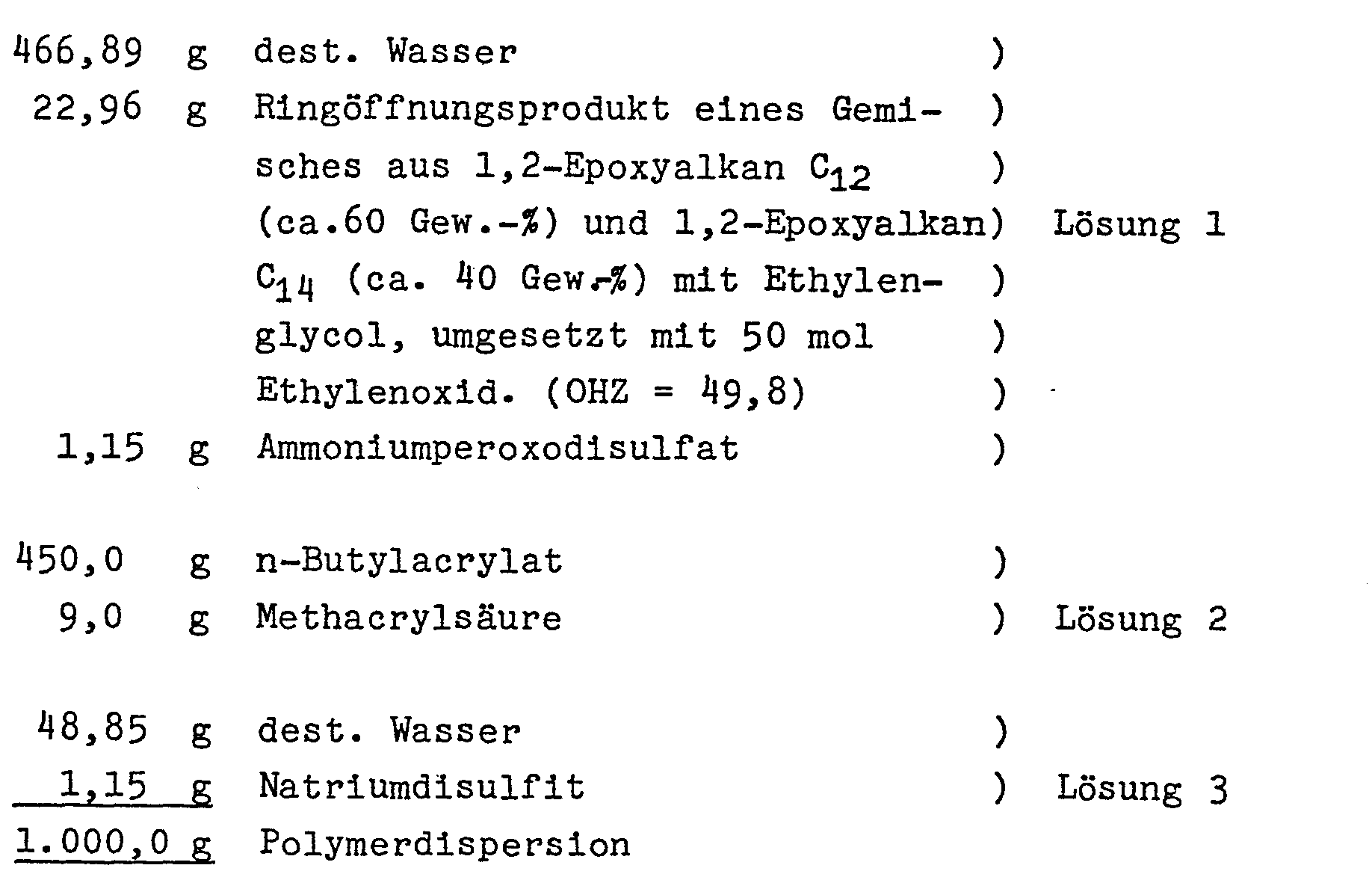
- Rezeptur:
- Apparatur:
- geschlossener beheizbarer 2-1-Planschliffbecher, ausgerüstet mit V4A-Ankerrührer, Tropftrichter, Rückflußkühler und einem 2-1-Vorlegegefäß mit Blattrührer
- Verfahren:
- 1,15 g Ammoniumperoxodisulfat und 22,96 g Emulgator werden in 466,89 g destilliertem Wasser im Vorlegegefäß gelöst (Lösung 1). 150 ml dieser Lösung werden in das Reaktionsgefäß gegeben. Zur restlichen Lösung 1 gibt man die Monomeren (Lösung 2) und emulgiert 15 min intensiv. 150 ml dieser Präemulsion werden ebenfalls in die Reaktionsapparatur gegeben und unter Rühren 30 min mit Stickstoff gespült. Danach läßt man aus der im Tropftrichter befindlichen Natriumdisulfit-Lösung (Lösung 3) 20 ml in das Reaktionsgefäß zulaufen und beginnt aufzuheizen. Zwischen 50 und 60°C setzt unter Temperaturanstieg die Polymerisation ein. Nunmehr werden gleichzeitig innerhalb von 1 bis 1,5 Stunden die Monomeremulsiion aus dem Vorlagegefäß und die restliche Lösung 3 zudosiert. Dabei wird die Temperatur auf 65 bis 68°C gehalten. Anschließend wird eine Stunde bei etwa 70°C nachgerührt und dann abgekühlt. Der pH-Wert der Emulsion wird mit 25prozentigem Ammoniak auf ca. 6 bis 7 eingestellt.
- Der Koagulatanteil der Dispersion beträgt 0,5 %. Die stippenfreie Dispersion hat einen Trockengehalt von 47,0 % und eine Teilchengröße von ca. 0,1µm.
- Polybutylacrylat-co-Styrol
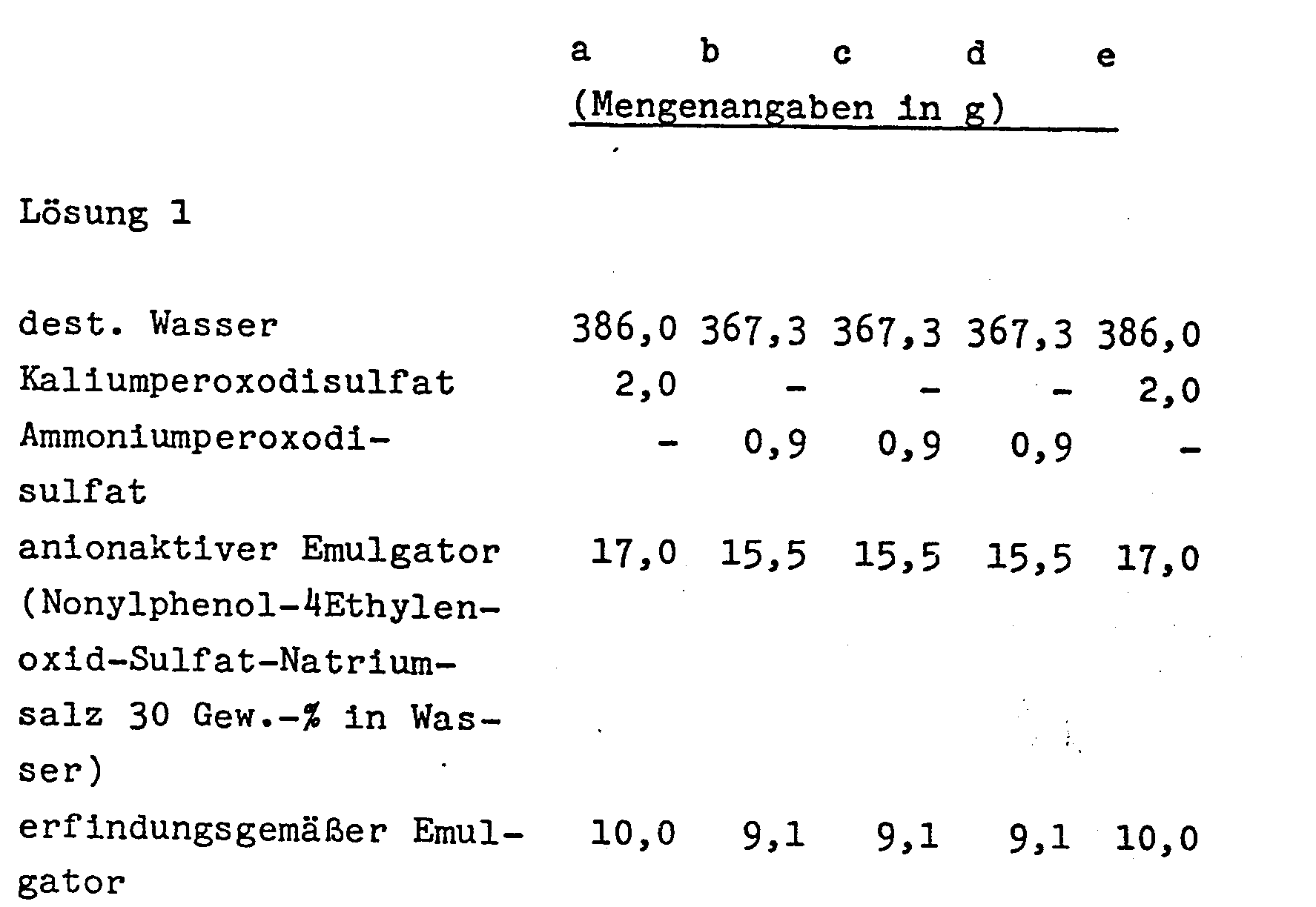
- Rezeptur:

- Verwendete erfindungsgemäße Emulgatoren:
- Verwendet wurde das Ringöffnungsprodukt eines Gemisches aus 1,2-Epoxyalkan C12(ca. 60 Gew.-%) und 1,2-Epoxyalkan C14 (ca. 40 Gew.-%) mit Ethylenglycol, umgesetzt mit:
- Beispiel a) 10 mol Ethylenoxid (EO) (OHZ = 155)
- b) 10 mol Ethylenoxid (EO) (OHZ = 155)
- c) 20 mol Ethylenoxid (EO) (OHZ = 102)
- d) 30 mol Ethylenoxid (EO) (OHZ = 78)
- e) Vergleichsbeispiel: Nonylphenol + 11 mol EO
- Die Komponenten der Lösung 1 werden gemischt und in das Reaktionsgefäß vorgelegt, anschließend ca. 30 min unter Rühren mit Stickstoff gespült. Ca. 30 ml der im Vorlegegefäß befindlichen Lösung 2 und 5 ml der im Tropftrichter befindlichen Lösung 3 werden zugegeben. Die Mantelheizung wird auf 90°C eingestellt. Bei einer Manteltemperatur von 70°C und einer Innentemperatur von 55°C setzt die Polymerisation ein. In diesem Augenblick wird mit der Dosierung der Monomerlösung 2 und der Natriumdisulfitlösung 3 begonnen. Die Reaktorinnentemperatur steigt relativ rasch auf 88 bis 98°C und wird bei dieser Temperatur gehalten. Die Dosierung der Lösungen 2 und 3 ist innerhalb von ca. einer Stunde beendet. Anschließend wird bei einer Manteltemperatur von 98°C eine Stunde nachpolymerisiert. Die Polymerdispersion wird auf ca. 50°C abgekühlt und bei dieser Temperatur mit 5,0 g 25prozentigem Ammoniak auf einen pH-Wert von 6 bis 7 eingestellt. Anschließend wird auf Raumtemperatur abgekühlt.
- Die Komponenten der Lösung 1 werden in das Reaktionsgefäß vorgelegt und ca. 30 min unter Rühren mit Stickstoff gespült. Ca. 10 % der Monomerlösung 2 werden aus dem Vorlegegefäß zudosiert. Durch Einstellung der Mantelheizung auf 90°C wird das Reaktionsgemisch aufgeheizt. Bei einer Innentemperatur von 56°C beginnt die Polymerisationsreaktion. In diesem Augenblick wird mit der Zudosierung der restlichen Monomerlösung 2 und der Ammoniumperoxodisulfat-Lösung 3 begonnen. Die Temperatur im Reaktor steigt relativ rasch auf ca. 88°C und wird bei dieser Temperatur gehalten. Die Dosierung wird so eingestellt, daß innerhalb einer Stunde nach Dosierbeginn die restliche Lösung 2 und 2/3 der Lösung 3 zugegeben sind. Gegen Ende der Dosierphase steigt die Temperatur im Reaktor auf ca. 94°C. Durch Anheben der Mantelheizung auf 98°C und Dosierung des restlichen 1/3 Ammoniumperoxodisulfat-Lösung 3 wird die Nachpolymerisationsphase eingeleitet. Nach einer Stunde Nachpolymerisation wird die Dispersion auf ca. 50°C abgekühlt und bei dieser Temperatur mit 13,7 g 25prozentigem Ammoniak auf pH 6 bis 7 eingestellt. Anschließend wird auf Raumtemperatur abgekühlt.
-

- Destilliertes Wasser, nichtionogene Emulgatoren, Polyvinylalkohol und Kaliumperoxodisulfat werden im Reaktionsgefäß vorgelegt, unter Rühren aufgelöst und mit Stickstoff gespült. Ca. 15 g Vinylacetat-Monomer werden zudosiert. Durch Anlegen einer Mantelheizung von 70°C wird erwärmt. Bei einer Innentemperatur von 64°C beginnt die Polymerisationsreaktion, gleichzeitig wird mit der Dosierung des restlichen monomeren Vinylacetats begonnen. Die Dosierung ist innerhalb einer Stunde beendet, wobei die Reaktorinnentemperatur gegen Ende der Dosierung auf ca. 73°C ansteigt. Nach Erhöhung der Mantelheizung auf 80°C wird eine Stunde nachpolymerisiert. Es entsteht eine weiße Polymerdispersion, die durch Zusatz von 24 g Dibutylphtalat, 328 g Calcid und 0,3 g Konservierungsmittel zu einem hervorragenden Weißleim verarbeitet werden kann.
- Rezeptur:


- Verwendete erfindungsgemäße Emulgatoren:
- Verwendet wurden die Ringöffnungsprodukte eines Gemisches aus 1,2-Epoxyalkan C12 (ca. 60 Gew.-%) und 1,2-Epoxyalkan C14 (ca. 40 Gew.-%) mit Ethylenglycol,umgesetzt mit:
- Beispiel a) 7 mol Ethylenoxid (EO) (OHZ = 192)
- b) 10 mol EO (OHZ = 155)
- c) 20 mol EO (OHZ = 102)
- d) 30 mol EO (OHZ = 78)
- e) 50 mol EO (OHZ = 50)
- Die Komponenten der Lösung 1 werden in das Reaktionsgefäß vorgelegt, mit Stickstoff gespült und auf 80°C aufgeheizt. Während der Aufheizpause wird im Vorlagegefäß durch Zugabe der Monomerlösung 3 zur emulgatorhaltigen wäßrigen Phase Lösung 2 durch kräftiges Rühren eine Präemulsion hergestellt. Der pH-Wert der Präemulsion wird auf 3,8 bis 4,0 eingestellt. Bei Erreichen einer Reaktorinnentemperatur von 80°C wird mit der Dosierung der Monomerpräemulsion begonnen. Die Dauer der Dosierung beträgt 2 bis 2,5 Stunden. Nach beendeter Zugabe wird die Temperatur des Reaktionsgemisches weitere 2 Stunden bei 80°C gehalten. Die Dispersion wird abgekühlt und filtriert und der pH-Wert mit 23,9 g einer 10prozentigen Ammoniumcarbonat-Lösung auf 7,0 bis 7,5 eingestellt.
- Die Eigenschaften der nach Beispiel IV hergestellten Polymerdispersionen sind nachfolgend aufgeführt.

-
- 1 Koagulatgehalt nach der Herstellung Die fertiggestellte Dispersion wird durch einen tarierten Perlonsiebbeutel der Fa. Schwegman mit 80 micron Maschenweite abgefüllt. Der Siebbeutel mit evtl. vorhandenem Koagulat wird 24 Stunden bei 105°C getrocknet und das Koagulat durch Differenzwägung bestimmt.
- 2 Trockengehalt Trockenrückstandsbestimmungen (Fa. Satorius), Typ 709301. Der Feststoffgehalt wird bei Stufe 7 und 20 min Trockenzeit bestimmt. Die Einwaage beträgt ca. 5 g.
- 3 Bestimmung der Teilchengröße Die Teilchengröße wird nach folgenden Maßstäben visuell bestimmt:
- milchig-weiße Dispersion = oberhalb 1 micron
- bläulich-weiße bis = 1 micron bis 0,1 micron bräunlich-weiße Dispersion
- grau-weiße, semi- = 0,1 micron bis transparente Dispersion 0,05 micron
- praktisch transparente = unter 0,05 micron Dispersion
- 4 Mechanische Stabilität 80 g der Dispersion werden 30 min bei 14.000 Upm mit einem Klaxon-Rührer, Typ HM UB 2 (Klaxon Ltd.), gerührt und anschließend durch einen 80-micron-Siebbeutel der Fa. Schwegmann filtriert. Der Koagulatanteil wird durch Trocknung und Differenzwägung des evtl. im Siebbeutel verbliebenen Koagulates bestimmt. (analog ASTM D 1076).
- 5 Viskosität Die Viskosität wird mit einem Brookfield-Viskosimeter vom Typ RVT bei 20°C gemessen.
- 6 Filmbeurteilung Mit einem Ziehlineal (ca. 1 mm Spalthöhe) werden zwei Filme ausgezogen. Ein Film wird 48 Stunden bei Raumtemperatur getrocknet, der andere Film 24 Stunden bei 105°C. Die Beurteilung erfolgt in beiden Fällen auf Farbe und Transparenz.
Claims (7)
Applications Claiming Priority (2)
| Application Number | Priority Date | Filing Date | Title |
|---|---|---|---|
| DE19833319782 DE3319782A1 (de) | 1983-06-01 | 1983-06-01 | Verwendung der umsetzungsprodukte von ethylenoxid mit aliphatischen vicinalen diolen als emulgatoren fuer die emulsionspolymerisation |
| DE3319782 | 1983-06-01 |
Publications (2)
| Publication Number | Publication Date |
|---|---|
| EP0129720A2 true EP0129720A2 (de) | 1985-01-02 |
| EP0129720A3 EP0129720A3 (de) | 1986-07-09 |
Family
ID=6200363
Family Applications (1)
| Application Number | Title | Priority Date | Filing Date |
|---|---|---|---|
| EP84105924A Ceased EP0129720A3 (de) | 1983-06-01 | 1984-05-23 | Verwendung der Umsetzungsprodukte von Ethylenoxid mit aliphatischen vicinalen Diolen als Emulgatoren für die Emulsionspolymerisation |
Country Status (4)
| Country | Link |
|---|---|
| US (1) | US4549002A (de) |
| EP (1) | EP0129720A3 (de) |
| JP (1) | JPS606706A (de) |
| DE (1) | DE3319782A1 (de) |
Cited By (4)
| Publication number | Priority date | Publication date | Assignee | Title |
|---|---|---|---|---|
| EP0212610A3 (en) * | 1985-08-26 | 1989-07-26 | Henkel Kommanditgesellschaft Auf Aktien | Use of 2-alkylalkanol-1-polyglycol ether |
| WO1991013140A1 (de) * | 1990-03-01 | 1991-09-05 | Henkel Kommanditgesellschaft Auf Aktien | Giessbares, flüssiges tensidkonzentrat |
| EP0538572A1 (de) * | 1991-10-19 | 1993-04-28 | Hüls Aktiengesellschaft | Verfahren zur Herstellung von schutzkolloidstabilisierten, emulgatorfreien, wässrigen Kunststoffdispersionen |
| DE4417364A1 (de) * | 1994-05-18 | 1995-11-23 | Minnesota Mining & Mfg | Elektrisch isolierende formbare Masse mit feldsteuernder Wirkung, insbesondere für die Anwendung im Mittelspannungsbereich |
Families Citing this family (7)
| Publication number | Priority date | Publication date | Assignee | Title |
|---|---|---|---|---|
| US5310790A (en) * | 1986-08-01 | 1994-05-10 | Kuraray Co. Ltd. | Process for producing polyvinyl ester having a high degree of polymerization and process for producing polyvinyl alcohol having a high degree of polymerization |
| JPH0699516B2 (ja) * | 1986-08-01 | 1994-12-07 | 株式会社クラレ | 高重合度ポリビニルエステル系重合体の製造方法及び高重合度ポリビニルアルコ−ル系重合体の製造方法 |
| DE4421270A1 (de) * | 1994-06-20 | 1995-12-21 | Henkel Kgaa | Wäßrige Fettalkoholdispersionen |
| DE19622967C1 (de) * | 1996-06-07 | 1998-01-29 | Henkel Kgaa | Wäßrige Perlglanzkonzentrate |
| US5852151A (en) * | 1997-06-06 | 1998-12-22 | The Goodyear Tire & Rubber Company | Toner resin with improved adhesion properties |
| US7384990B2 (en) * | 2004-06-17 | 2008-06-10 | Hewlett-Packard Development Company, L.P. | Latex particulates with active ester functional groups |
| US7320831B2 (en) * | 2005-05-03 | 2008-01-22 | Celanese International Corporation | Salt-sensitive vinyl acetate binder compositions and fibrous article incorporating same |
Family Cites Families (8)
| Publication number | Priority date | Publication date | Assignee | Title |
|---|---|---|---|---|
| US2615009A (en) * | 1949-04-18 | 1952-10-21 | Phillips Petroleum Co | Process for emulsion polymerization at low temperatures |
| FR1087127A (fr) * | 1952-11-13 | 1955-02-21 | Basf Ag | Procédé de préparation de polymères de styrolène résistant à la lumière |
| BE632423A (de) * | 1962-05-17 | |||
| DE1190127B (de) * | 1963-06-21 | 1965-04-01 | Bayer Ag | Verfahren zur selektiven Hydrierung von Pyrolysebenzin oder dessen Fraktionen |
| CH482740A (de) * | 1964-10-07 | 1969-12-15 | Bayer Ag | Verfahren zur Herstellung von thermoplastisch-elastischen Formmassen |
| US3329640A (en) * | 1965-02-26 | 1967-07-04 | American Cyanamid Co | Vinyl acetate polymer emulsions containing ethoxylated monoalkyl sulfosuccinate as emulsifiers |
| US3516975A (en) * | 1968-10-25 | 1970-06-23 | Gen Tire & Rubber Co | Ethylene-vinyl acetate polymers prepared with polyoxyalkylene compounds |
| JPS5343787A (en) * | 1976-10-01 | 1978-04-20 | Kao Corp | Emulsifier for emulsion polymerization |
-
1983
- 1983-06-01 DE DE19833319782 patent/DE3319782A1/de not_active Withdrawn
-
1984
- 1984-05-23 EP EP84105924A patent/EP0129720A3/de not_active Ceased
- 1984-05-30 US US06/615,444 patent/US4549002A/en not_active Expired - Fee Related
- 1984-06-01 JP JP59113775A patent/JPS606706A/ja active Pending
Cited By (4)
| Publication number | Priority date | Publication date | Assignee | Title |
|---|---|---|---|---|
| EP0212610A3 (en) * | 1985-08-26 | 1989-07-26 | Henkel Kommanditgesellschaft Auf Aktien | Use of 2-alkylalkanol-1-polyglycol ether |
| WO1991013140A1 (de) * | 1990-03-01 | 1991-09-05 | Henkel Kommanditgesellschaft Auf Aktien | Giessbares, flüssiges tensidkonzentrat |
| EP0538572A1 (de) * | 1991-10-19 | 1993-04-28 | Hüls Aktiengesellschaft | Verfahren zur Herstellung von schutzkolloidstabilisierten, emulgatorfreien, wässrigen Kunststoffdispersionen |
| DE4417364A1 (de) * | 1994-05-18 | 1995-11-23 | Minnesota Mining & Mfg | Elektrisch isolierende formbare Masse mit feldsteuernder Wirkung, insbesondere für die Anwendung im Mittelspannungsbereich |
Also Published As
| Publication number | Publication date |
|---|---|
| US4549002A (en) | 1985-10-22 |
| DE3319782A1 (de) | 1984-12-06 |
| JPS606706A (ja) | 1985-01-14 |
| EP0129720A3 (de) | 1986-07-09 |
Similar Documents
| Publication | Publication Date | Title |
|---|---|---|
| EP0182282B1 (de) | Polymerisationsemulgatoren | |
| DE2442121C2 (de) | ||
| DE2256154C3 (de) | Verfahren zur Herstellung von wäßrigen Dispersionen von Polymerisaten monoolefinisch ungesättigter Carbonsäureester | |
| EP0565825A1 (de) | Verfahren zur Herstellung von wässrigen Polymerdispersionen | |
| EP0960135A1 (de) | Emulgatorsystem für die wässrige emulsionspolymerisation | |
| DE3319782A1 (de) | Verwendung der umsetzungsprodukte von ethylenoxid mit aliphatischen vicinalen diolen als emulgatoren fuer die emulsionspolymerisation | |
| DE60015285T2 (de) | Verfahren zur Herstellung von Vinylacetat-Ethylen-Copolymer Emulsionen stabilisiert mit einer Polyethylenglykol-Polyvinylacetat- Mischung | |
| EP0195328B1 (de) | Aminobernsteinsäurederivate und ihre Verwendung als Emulgatoren für Polymerdispersionen | |
| EP0140320B1 (de) | Mischemulgator für die Emulsionspolymerisation | |
| DE1925353C3 (de) | Verfahren zur Herstellung von Polyvinylesterdispersionen | |
| EP0025561A1 (de) | Verfahren zur diskontinuierlichen Polymerisation von Vinylchlorid in Emulsion | |
| DE2554082C2 (de) | Verfahren zur Herstellung von stabilen Wasser-in-Öl-Dispersionen von Acrylamidpolymerisaten | |
| EP0093854B1 (de) | Hochtransparente schlagzähe Formmassen auf der Basis von Polyvinylchlorid | |
| DE3701579A1 (de) | Verfahren zur herstellung von verpastbaren vinylchlorid-polymerisaten durch kontinuierliche polymerisation in waessriger emulsion | |
| DE68906208T2 (de) | Emulsionspolymerisationsverfahren von Vinylmonomeren. | |
| EP0142014B1 (de) | Verwendung von oberflächenaktiven tertiären Alkylaminen als Poly-merisationsemulgatoren | |
| EP2194069A1 (de) | Copolymerisierbare Tenside | |
| WO2019020156A1 (de) | Hydrophobe und kaltwasserlösliche vinylalkohol-copolymere | |
| EP0212610B1 (de) | Verwendung von 2-Alkylalkanol-1-polyglykolethern | |
| EP0320930B1 (de) | Verfahren zur Emulsionspolymerisation von Pfropfcopolymeren | |
| DE3526251A1 (de) | Verfahren zur herstellung von verpastbaren vinylchlorid-polymerisaten | |
| DE1060600B (de) | Verfahren zur Herstellung von waessrigen Polyvinylester-Dispersionen | |
| DE2557324A1 (de) | Herstellung von stabilen wasser-inoel-dispersionen von acrylamidpolymerisaten | |
| DE1076373B (de) | Verfahren zur Herstellung von Polyvinylchlorid-Dispersionen | |
| DE3921299C2 (de) | Verfahren zur Herstellung einer sinterfähigen, feinteiligen Formmasse auf der Basis von Polyvinylchlorid |
Legal Events
| Date | Code | Title | Description |
|---|---|---|---|
| PUAI | Public reference made under article 153(3) epc to a published international application that has entered the european phase |
Free format text: ORIGINAL CODE: 0009012 |
|
| AK | Designated contracting states |
Designated state(s): AT BE CH DE FR GB IT LI LU NL SE |
|
| PUAL | Search report despatched |
Free format text: ORIGINAL CODE: 0009013 |
|
| AK | Designated contracting states |
Kind code of ref document: A3 Designated state(s): AT BE CH DE FR GB IT LI LU NL SE |
|
| 17P | Request for examination filed |
Effective date: 19860525 |
|
| 17Q | First examination report despatched |
Effective date: 19870821 |
|
| STAA | Information on the status of an ep patent application or granted ep patent |
Free format text: STATUS: THE APPLICATION HAS BEEN REFUSED |
|
| 18R | Application refused |
Effective date: 19890731 |
|
| RIN1 | Information on inventor provided before grant (corrected) |
Inventor name: WEGEMUND, BERND, DR. Inventor name: MEFFERT, ALFRED, DR. Inventor name: HOEFER, RAINER, DR. |