EP0127490B1 - Verfahren zur Konditionierung von in saurem Medium kontaminierten Abfällen, insbesondere von Kationenaustauschermaterialien - Google Patents
Verfahren zur Konditionierung von in saurem Medium kontaminierten Abfällen, insbesondere von Kationenaustauschermaterialien Download PDFInfo
- Publication number
- EP0127490B1 EP0127490B1 EP84400727A EP84400727A EP0127490B1 EP 0127490 B1 EP0127490 B1 EP 0127490B1 EP 84400727 A EP84400727 A EP 84400727A EP 84400727 A EP84400727 A EP 84400727A EP 0127490 B1 EP0127490 B1 EP 0127490B1
- Authority
- EP
- European Patent Office
- Prior art keywords
- hardener
- process according
- epoxy resin
- wastes
- resin
- Prior art date
- Legal status (The legal status is an assumption and is not a legal conclusion. Google has not performed a legal analysis and makes no representation as to the accuracy of the status listed.)
- Expired
Links
- 239000002699 waste material Substances 0.000 title claims description 44
- 238000000034 method Methods 0.000 title claims description 43
- 230000008569 process Effects 0.000 title claims description 37
- 239000000463 material Substances 0.000 title claims description 19
- 238000005341 cation exchange Methods 0.000 title claims description 18
- 230000003750 conditioning effect Effects 0.000 title claims description 7
- 239000002253 acid Substances 0.000 title description 3
- 239000003822 epoxy resin Substances 0.000 claims description 67
- 229920000647 polyepoxide Polymers 0.000 claims description 67
- 239000004848 polyfunctional curative Substances 0.000 claims description 67
- 229920005989 resin Polymers 0.000 claims description 55
- 239000011347 resin Substances 0.000 claims description 55
- 239000000203 mixture Substances 0.000 claims description 36
- 125000002091 cationic group Chemical group 0.000 claims description 32
- 229920000768 polyamine Polymers 0.000 claims description 22
- 150000004982 aromatic amines Chemical class 0.000 claims description 17
- 238000006116 polymerization reaction Methods 0.000 claims description 15
- 150000001875 compounds Chemical class 0.000 claims description 11
- 150000001412 amines Chemical class 0.000 claims description 10
- XLYOFNOQVPJJNP-UHFFFAOYSA-N water Substances O XLYOFNOQVPJJNP-UHFFFAOYSA-N 0.000 claims description 10
- 125000001931 aliphatic group Chemical group 0.000 claims description 9
- 238000006243 chemical reaction Methods 0.000 claims description 9
- 239000003085 diluting agent Substances 0.000 claims description 8
- ZZTCPWRAHWXWCH-UHFFFAOYSA-N diphenylmethanediamine Chemical group C=1C=CC=CC=1C(N)(N)C1=CC=CC=C1 ZZTCPWRAHWXWCH-UHFFFAOYSA-N 0.000 claims description 8
- WPYMKLBDIGXBTP-UHFFFAOYSA-N benzoic acid Chemical compound OC(=O)C1=CC=CC=C1 WPYMKLBDIGXBTP-UHFFFAOYSA-N 0.000 claims description 6
- IISBACLAFKSPIT-UHFFFAOYSA-N bisphenol A Chemical compound C=1C=C(O)C=CC=1C(C)(C)C1=CC=C(O)C=C1 IISBACLAFKSPIT-UHFFFAOYSA-N 0.000 claims description 6
- GHMLBKRAJCXXBS-UHFFFAOYSA-N resorcinol Chemical compound OC1=CC=CC(O)=C1 GHMLBKRAJCXXBS-UHFFFAOYSA-N 0.000 claims description 6
- YGSDEFSMJLZEOE-UHFFFAOYSA-N salicylic acid Chemical compound OC(=O)C1=CC=CC=C1O YGSDEFSMJLZEOE-UHFFFAOYSA-N 0.000 claims description 6
- 150000003839 salts Chemical group 0.000 claims description 6
- 239000003729 cation exchange resin Substances 0.000 claims description 5
- 229940023913 cation exchange resins Drugs 0.000 claims description 5
- GYZLOYUZLJXAJU-UHFFFAOYSA-N diglycidyl ether Chemical compound C1OC1COCC1CO1 GYZLOYUZLJXAJU-UHFFFAOYSA-N 0.000 claims description 4
- 239000007787 solid Substances 0.000 claims description 4
- SMZOUWXMTYCWNB-UHFFFAOYSA-N 2-(2-methoxy-5-methylphenyl)ethanamine Chemical compound COC1=CC=C(C)C=C1CCN SMZOUWXMTYCWNB-UHFFFAOYSA-N 0.000 claims description 3
- NIXOWILDQLNWCW-UHFFFAOYSA-N 2-Propenoic acid Natural products OC(=O)C=C NIXOWILDQLNWCW-UHFFFAOYSA-N 0.000 claims description 3
- 239000005711 Benzoic acid Substances 0.000 claims description 3
- 235000010233 benzoic acid Nutrition 0.000 claims description 3
- 239000007788 liquid Substances 0.000 claims description 3
- FJKROLUGYXJWQN-UHFFFAOYSA-N papa-hydroxy-benzoic acid Natural products OC(=O)C1=CC=C(O)C=C1 FJKROLUGYXJWQN-UHFFFAOYSA-N 0.000 claims description 3
- 229960004889 salicylic acid Drugs 0.000 claims description 3
- AMLFJZRZIOZGPW-NSCUHMNNSA-N (e)-prop-1-en-1-amine Chemical class C\C=C\N AMLFJZRZIOZGPW-NSCUHMNNSA-N 0.000 claims description 2
- 125000003118 aryl group Chemical group 0.000 claims description 2
- 230000001143 conditioned effect Effects 0.000 claims description 2
- 125000002723 alicyclic group Chemical group 0.000 claims 3
- RTZKZFJDLAIYFH-UHFFFAOYSA-N Diethyl ether Chemical compound CCOCC RTZKZFJDLAIYFH-UHFFFAOYSA-N 0.000 claims 2
- ISWSIDIOOBJBQZ-UHFFFAOYSA-N Phenol Chemical compound OC1=CC=CC=C1 ISWSIDIOOBJBQZ-UHFFFAOYSA-N 0.000 claims 2
- 230000001588 bifunctional effect Effects 0.000 claims 2
- 125000000129 anionic group Chemical group 0.000 description 12
- 238000004806 packaging method and process Methods 0.000 description 9
- WVDDGKGOMKODPV-UHFFFAOYSA-N Benzyl alcohol Chemical compound OCC1=CC=CC=C1 WVDDGKGOMKODPV-UHFFFAOYSA-N 0.000 description 6
- 239000003456 ion exchange resin Substances 0.000 description 6
- 229920003303 ion-exchange polymer Polymers 0.000 description 6
- 238000006386 neutralization reaction Methods 0.000 description 6
- 239000002901 radioactive waste Substances 0.000 description 6
- -1 filters Substances 0.000 description 5
- MYRTYDVEIRVNKP-UHFFFAOYSA-N 1,2-Divinylbenzene Chemical compound C=CC1=CC=CC=C1C=C MYRTYDVEIRVNKP-UHFFFAOYSA-N 0.000 description 4
- 230000000903 blocking effect Effects 0.000 description 4
- 238000009434 installation Methods 0.000 description 4
- 238000002386 leaching Methods 0.000 description 4
- 239000004593 Epoxy Substances 0.000 description 3
- 239000012141 concentrate Substances 0.000 description 3
- 238000004132 cross linking Methods 0.000 description 3
- ZBCBWPMODOFKDW-UHFFFAOYSA-N diethanolamine Chemical compound OCCNCCO ZBCBWPMODOFKDW-UHFFFAOYSA-N 0.000 description 3
- 150000002118 epoxides Chemical class 0.000 description 3
- 238000001704 evaporation Methods 0.000 description 3
- 230000008020 evaporation Effects 0.000 description 3
- XMBWDFGMSWQBCA-UHFFFAOYSA-N hydrogen iodide Chemical compound I XMBWDFGMSWQBCA-UHFFFAOYSA-N 0.000 description 3
- 150000002500 ions Chemical class 0.000 description 3
- GUTLYIVDDKVIGB-OUBTZVSYSA-N Cobalt-60 Chemical compound [60Co] GUTLYIVDDKVIGB-OUBTZVSYSA-N 0.000 description 2
- OWYWGLHRNBIFJP-UHFFFAOYSA-N Ipazine Chemical compound CCN(CC)C1=NC(Cl)=NC(NC(C)C)=N1 OWYWGLHRNBIFJP-UHFFFAOYSA-N 0.000 description 2
- 239000003957 anion exchange resin Substances 0.000 description 2
- 230000008901 benefit Effects 0.000 description 2
- 235000019445 benzyl alcohol Nutrition 0.000 description 2
- 150000001642 boronic acid derivatives Chemical class 0.000 description 2
- TVFDJXOCXUVLDH-RNFDNDRNSA-N cesium-137 Chemical compound [137Cs] TVFDJXOCXUVLDH-RNFDNDRNSA-N 0.000 description 2
- 239000011248 coating agent Substances 0.000 description 2
- 238000000576 coating method Methods 0.000 description 2
- 238000010586 diagram Methods 0.000 description 2
- LNEPOXFFQSENCJ-UHFFFAOYSA-N haloperidol Chemical compound C1CC(O)(C=2C=CC(Cl)=CC=2)CCN1CCCC(=O)C1=CC=C(F)C=C1 LNEPOXFFQSENCJ-UHFFFAOYSA-N 0.000 description 2
- 238000004519 manufacturing process Methods 0.000 description 2
- 239000002609 medium Substances 0.000 description 2
- 238000002156 mixing Methods 0.000 description 2
- 150000002989 phenols Chemical class 0.000 description 2
- 229920005990 polystyrene resin Polymers 0.000 description 2
- 239000000843 powder Substances 0.000 description 2
- 238000002360 preparation method Methods 0.000 description 2
- 239000000047 product Substances 0.000 description 2
- 230000002285 radioactive effect Effects 0.000 description 2
- 239000012429 reaction media Substances 0.000 description 2
- 239000004576 sand Substances 0.000 description 2
- 229920001187 thermosetting polymer Polymers 0.000 description 2
- 241001508691 Martes zibellina Species 0.000 description 1
- GRYLNZFGIOXLOG-UHFFFAOYSA-N Nitric acid Chemical compound O[N+]([O-])=O GRYLNZFGIOXLOG-UHFFFAOYSA-N 0.000 description 1
- 229910000831 Steel Inorganic materials 0.000 description 1
- 230000002378 acidificating effect Effects 0.000 description 1
- 239000012736 aqueous medium Substances 0.000 description 1
- 239000007864 aqueous solution Substances 0.000 description 1
- 239000007900 aqueous suspension Substances 0.000 description 1
- 230000004888 barrier function Effects 0.000 description 1
- 150000007514 bases Chemical class 0.000 description 1
- 229910052792 caesium Inorganic materials 0.000 description 1
- TVFDJXOCXUVLDH-UHFFFAOYSA-N caesium atom Chemical compound [Cs] TVFDJXOCXUVLDH-UHFFFAOYSA-N 0.000 description 1
- 230000015556 catabolic process Effects 0.000 description 1
- 239000007795 chemical reaction product Substances 0.000 description 1
- 239000003153 chemical reaction reagent Substances 0.000 description 1
- 150000001805 chlorine compounds Chemical class 0.000 description 1
- 238000006731 degradation reaction Methods 0.000 description 1
- 238000009792 diffusion process Methods 0.000 description 1
- 239000000945 filler Substances 0.000 description 1
- 238000004898 kneading Methods 0.000 description 1
- 239000007791 liquid phase Substances 0.000 description 1
- 230000014759 maintenance of location Effects 0.000 description 1
- 229910052751 metal Inorganic materials 0.000 description 1
- 239000002184 metal Substances 0.000 description 1
- 239000010814 metallic waste Substances 0.000 description 1
- 229910017604 nitric acid Inorganic materials 0.000 description 1
- 239000004033 plastic Substances 0.000 description 1
- 229920003023 plastic Polymers 0.000 description 1
- 125000001453 quaternary ammonium group Chemical group 0.000 description 1
- 230000009257 reactivity Effects 0.000 description 1
- 230000009467 reduction Effects 0.000 description 1
- 238000012958 reprocessing Methods 0.000 description 1
- QEVHRUUCFGRFIF-MDEJGZGSSA-N reserpine Chemical compound O([C@H]1[C@@H]([C@H]([C@H]2C[C@@H]3C4=C(C5=CC=C(OC)C=C5N4)CCN3C[C@H]2C1)C(=O)OC)OC)C(=O)C1=CC(OC)=C(OC)C(OC)=C1 QEVHRUUCFGRFIF-MDEJGZGSSA-N 0.000 description 1
- 229920006395 saturated elastomer Polymers 0.000 description 1
- 238000007711 solidification Methods 0.000 description 1
- 230000008023 solidification Effects 0.000 description 1
- 238000009987 spinning Methods 0.000 description 1
- 239000010959 steel Substances 0.000 description 1
- 150000003467 sulfuric acid derivatives Chemical class 0.000 description 1
- 239000006228 supernatant Substances 0.000 description 1
- 230000009974 thixotropic effect Effects 0.000 description 1
- 239000010891 toxic waste Substances 0.000 description 1
- 230000009466 transformation Effects 0.000 description 1
- 229920006305 unsaturated polyester Polymers 0.000 description 1
- 238000011144 upstream manufacturing Methods 0.000 description 1
- 239000002023 wood Substances 0.000 description 1
Images


Classifications
-
- G—PHYSICS
- G21—NUCLEAR PHYSICS; NUCLEAR ENGINEERING
- G21F—PROTECTION AGAINST X-RADIATION, GAMMA RADIATION, CORPUSCULAR RADIATION OR PARTICLE BOMBARDMENT; TREATING RADIOACTIVELY CONTAMINATED MATERIAL; DECONTAMINATION ARRANGEMENTS THEREFOR
- G21F9/00—Treating radioactively contaminated material; Decontamination arrangements therefor
- G21F9/28—Treating solids
- G21F9/30—Processing
- G21F9/301—Processing by fixation in stable solid media
- G21F9/307—Processing by fixation in stable solid media in polymeric matrix, e.g. resins, tars
-
- G—PHYSICS
- G21—NUCLEAR PHYSICS; NUCLEAR ENGINEERING
- G21F—PROTECTION AGAINST X-RADIATION, GAMMA RADIATION, CORPUSCULAR RADIATION OR PARTICLE BOMBARDMENT; TREATING RADIOACTIVELY CONTAMINATED MATERIAL; DECONTAMINATION ARRANGEMENTS THEREFOR
- G21F9/00—Treating radioactively contaminated material; Decontamination arrangements therefor
- G21F9/28—Treating solids
- G21F9/30—Processing
-
- C—CHEMISTRY; METALLURGY
- C08—ORGANIC MACROMOLECULAR COMPOUNDS; THEIR PREPARATION OR CHEMICAL WORKING-UP; COMPOSITIONS BASED THEREON
- C08G—MACROMOLECULAR COMPOUNDS OBTAINED OTHERWISE THAN BY REACTIONS ONLY INVOLVING UNSATURATED CARBON-TO-CARBON BONDS
- C08G59/00—Polycondensates containing more than one epoxy group per molecule; Macromolecules obtained by polymerising compounds containing more than one epoxy group per molecule using curing agents or catalysts which react with the epoxy groups
- C08G59/18—Macromolecules obtained by polymerising compounds containing more than one epoxy group per molecule using curing agents or catalysts which react with the epoxy groups ; e.g. general methods of curing
- C08G59/40—Macromolecules obtained by polymerising compounds containing more than one epoxy group per molecule using curing agents or catalysts which react with the epoxy groups ; e.g. general methods of curing characterised by the curing agents used
- C08G59/50—Amines
- C08G59/5006—Amines aliphatic
-
- C—CHEMISTRY; METALLURGY
- C08—ORGANIC MACROMOLECULAR COMPOUNDS; THEIR PREPARATION OR CHEMICAL WORKING-UP; COMPOSITIONS BASED THEREON
- C08G—MACROMOLECULAR COMPOUNDS OBTAINED OTHERWISE THAN BY REACTIONS ONLY INVOLVING UNSATURATED CARBON-TO-CARBON BONDS
- C08G59/00—Polycondensates containing more than one epoxy group per molecule; Macromolecules obtained by polymerising compounds containing more than one epoxy group per molecule using curing agents or catalysts which react with the epoxy groups
- C08G59/18—Macromolecules obtained by polymerising compounds containing more than one epoxy group per molecule using curing agents or catalysts which react with the epoxy groups ; e.g. general methods of curing
- C08G59/40—Macromolecules obtained by polymerising compounds containing more than one epoxy group per molecule using curing agents or catalysts which react with the epoxy groups ; e.g. general methods of curing characterised by the curing agents used
- C08G59/50—Amines
- C08G59/5026—Amines cycloaliphatic
-
- C—CHEMISTRY; METALLURGY
- C08—ORGANIC MACROMOLECULAR COMPOUNDS; THEIR PREPARATION OR CHEMICAL WORKING-UP; COMPOSITIONS BASED THEREON
- C08G—MACROMOLECULAR COMPOUNDS OBTAINED OTHERWISE THAN BY REACTIONS ONLY INVOLVING UNSATURATED CARBON-TO-CARBON BONDS
- C08G59/00—Polycondensates containing more than one epoxy group per molecule; Macromolecules obtained by polymerising compounds containing more than one epoxy group per molecule using curing agents or catalysts which react with the epoxy groups
- C08G59/18—Macromolecules obtained by polymerising compounds containing more than one epoxy group per molecule using curing agents or catalysts which react with the epoxy groups ; e.g. general methods of curing
- C08G59/40—Macromolecules obtained by polymerising compounds containing more than one epoxy group per molecule using curing agents or catalysts which react with the epoxy groups ; e.g. general methods of curing characterised by the curing agents used
- C08G59/50—Amines
- C08G59/5033—Amines aromatic
Definitions
- the present invention relates to a process for conditioning waste such as radioactive or toxic waste, the acidity of which can inhibit polymerization reactions.
- waste mainly comprising cation exchange materials constituted for example by cationic resins or by a mixture of cationic and anionic resins contaminated by radioactive elements, or other materials with an acid function, example of salts in the form of powder or grains in an acidic humid environment.
- waste consisting of powders of evaporation concentrates (salts such as borates, sulfates, chlorides), crushed ion exchange resins in spent form at 65% humidity and technological waste such as filters, metal shavings, plastics, wood etc ...
- the ion exchange resins can in particular be polystyrene resins crosslinked with divinylbenzene, which comprise sulphonic groups SO 3 H (cationic resins) or a mixture of test resins with polystyrene resins crosslinked with divinylbenzene which contain OH functions fixed on a quaternary ammonium group (anionic resins).
- polystyrene resins crosslinked with divinylbenzene which comprise sulphonic groups SO 3 H (cationic resins) or a mixture of test resins with polystyrene resins crosslinked with divinylbenzene which contain OH functions fixed on a quaternary ammonium group (anionic resins).
- the ion exchange resins are incorporated into a thermosetting resin, polymerizable at room temperature, consisting for example of an unsaturated polyester or an epoxy resin, and then the polymerization of this resin is obtained in order to obtain a solid block.
- a thermosetting resin polymerizable at room temperature, consisting for example of an unsaturated polyester or an epoxy resin
- this process which is entirely satisfactory for anionic resins cannot be used according to the same procedure for cationic resins which are not completely used, that is to say which still contain H + ions .
- thermosetting resin does not take place completely due to the presence of active sites on the cationic resins which are not used, that is to say the presence of protons. H + which are capable of consuming some of the reagents used for curing the resin.
- the subject of the present invention is a process for packaging contaminated waste, the acidity of which can inhibit polymerization reactions, in particular cation exchange materials, which precisely makes it possible to avoid the drawbacks of the previous processes.
- the method according to the invention consists in incorporating said waste into an epoxy resin liquid and at room temperature and then causing the polymerization of the resin by means of a hardener to obtain a solid block, and it is characterized in that the hardener comprises at least one compound comprising at least one NH 2 group in an amount sufficient to polymerize the epoxy resin and block the acidity of the waste.
- an amount of hardener is used such that it corresponds to an excess relative to the amount necessary to polymerize the epoxy resin, in order to use this excess to block the acidity waste or active sites of cation exchange materials present in the waste.
- the excess hardener is used to neutralize the H + sites of the cation exchange materials and thus obtain solid blocks having satisfactory properties for retaining radioactivity.
- the epoxy resin is advantageously a diglycidyl ether of bis-phenol A having an epoxy equivalent of approximately 190; the viscosity of the epoxy resin can be adjusted to an appropriate value by adding a directional diluent with a low vapor pressure consisting for example of neopentyldiglycidylether.
- the compounds comprising at least one NH 2 group capable of being used are cycloaliphatic or aromatic amines, aromatic or cycloaliphatic polyamines, and derivatives of the propylene amine.
- Polyaminoamides can also be used.
- the hardener can consist of a compound of this type, in the pure state or dissolved in a suitable diluent such as benzyl alcohol.
- a suitable diluent such as benzyl alcohol.
- the hardener consists of a prepolymerized or "adduct" mixture obtained by reaction of a small amount of the epoxy resin with an aromatic amine.
- the aromatic amine used in this case is diamino-diphenyl-methane of formula:
- a hardening accelerator is advantageously used, constituted for example by a salt obtained by reaction of acrylic acid, benzoic acid, salicylic acid or phenols such as resorcinol, with the aromatic amine.
- the amount of hardener used to obtain the polymerization and the crosslinking of the epoxy resin depends on the epoxy resin used, in particular on its epoxy equivalent, that is to say on the mass of resin containing an epoxy function. Generally to obtain the hardening and crosslinking of the epoxy resin, an amount of hardener is used such that there is an amine NH 2 function per epoxy resin equivalent.
- an excess of hardener is used which depends in particular on the content of cation exchange materials in the waste to be treated or the acidity of the waste and the hardener used.
- an excess of hardener is used such that the weight ratio hardener / epoxy resin is greater than 0.5.
- the quantity of hardener used also increases with the content of cation exchange materials in the radioactive waste or their acidity, and a weight ratio of the hardener to the epoxy resin can be used which varies from 0.5 to 1.5 when the content of cation exchange materials in the waste varies from 0 to 100%.
- an appropriate hardener is chosen so as to achieve, on the one hand, the blocking of the active sites of the cation exchange materials or the partial or total neutralization of the acidity and, on the other hand the hardening of the epoxy resin without having to use an excess of hardener in variable content.
- the epoxy resins used in this second embodiment of the process of the invention are preferably diglycidyl ether of bisphenol A having an epoxide equivalent of approximately 190, and their viscosity can also be adjusted by adding a reactive diluent such as neopentyl diglycidyl ether.
- the polyamines which can be used are aliphatic or cycloaliphatic polyamines.
- a cycloaliphatic polyamine having an amine index close to 63 is used.
- the aromatic amine used is advantageously diaminodiphenylmethane (DDM) preferably presented in the form of adduct with a small amount of epoxy resin.
- DDM diaminodiphenylmethane
- the adduct may comprise a non-reactive diluent such as benzyl alcohol and optionally a hardening accelerator consisting for example of the reaction product of acrylic acid, benzoic acid, salicylic acid or phenols, resorcinol for example, with diaminodiphenylmethane.
- a non-reactive diluent such as benzyl alcohol
- a hardening accelerator consisting for example of the reaction product of acrylic acid, benzoic acid, salicylic acid or phenols, resorcinol for example, with diaminodiphenylmethane.
- the hardener can be adapted by adjusting the aliphatic polyamine / aromatic amine ratio as a function of the degree of humidity of the waste.
- the exothermicity of the polymerization reaction can also be controlled by adjusting this aliphatic polyamine / aromatic amine ratio.
- the increase in the rate of aliphatic amine makes it possible to tolerate a greater quantity of water in the waste.
- increasing the level of aromatic amine makes it possible to reduce the exothermicity of the polymerization reaction.
- the aliphatic polyamine / aromatic amine ratio is preferably chosen as a function of the water content of the waste to be conditioned.
- this eliminates the pretreatment step which was necessary according to the prior art to condition radioactive waste containing cation exchange materials. This constitutes an important advantage and also makes it possible to avoid the production of new contaminated effluents.
- the characteristics of the blocks obtained can be improved, in particular their mechanical strength.
- This waste consists of a mixture of a cationic resin "C20H” marketed by DIAPROSIM, and an anionic resin "ARA9366” marketed by DIAPROSIM.
- an epoxy resin constituted by a diglycidyl ether of bisphenol A having an epoxide equivalent of approximately 190 diluted with neopentyl diglycidyl ether is used.
- the hardener used is a diaminodiphenylmethane (DDM) adduct.
- the wrung resins are mixed with the epoxy resin in weight proportions of epoxy resin which can vary from 40% to 60%, then the desired quantity of hardener is added to the mixture, which can vary so that the hardener / epoxy resin ratio is between 0.5 and 1.5.
- the reaction is carried out at room temperature (substantially 25 ° C) and the polymerization is allowed to continue for the desired time which is generally several hours.
- room temperature substantially 25 ° C
- the polymerization is allowed to continue for the desired time which is generally several hours.
- This polymerization takes place slowly makes it possible to spread the heat of the reaction over time and, consequently, it is thus possible to limit the rise in temperature within the reaction medium to a temperature below 100 °. vs.
- FIG. 1 illustrates the variations in Shore hardness of the block obtained as a function of the hardener / epoxide weight ratio used for the preparation of this block.
- curve (1) relates to a mixture containing 50% cationic resin
- curve (2) relates to a mixture containing 66% cationic resin
- curve (3) relates to a mixture containing 85 % by weight of cationic resin
- the curve (4) relates to the treatment of waste constituted solely by the cationic resin.
- mixtures of anionic resin and cationic resin are used, identical to those used in Examples 1 to 4, and the packaging of these mixtures is carried out by means of the epoxy resin sold by Ciba Geigy under the brand XF431 and XF348 hardener also sold by Ciba Geigy.
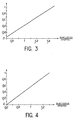
- FIG. 3 the straight line has been drawn which makes it possible to determine the hardener / epoxy resin ratio as a function of the cationic resin content of the mixture when the epoxy resin and the hardener of Examples 1 to 4 are used.
- FIG. 4 the line has been drawn which makes it possible to determine the optimum hardener / epoxy resin ratio as a function of the cationic resin content of the waste to be treated when the epoxy resin and the hardener of Examples 5 to 7 are used.
- this ratio increases linearly with the content of cationic resin in the waste to be treated.
- the hardener / epoxy resin weight ratio can advantageously be approximately 1.1 to 1.2.
- the same epoxy resin is used as in Examples 1 to 7, and a hardener composed of a cycloaliphatic polyamine having an amine equivalent of approximately 63, and a diaminodiphenylmethane adduct and of the epoxy resin having an amine equivalent around 130, marketed by CdF Chimie under the reference D6M4.
- the dewatered resins are mixed with the epoxy resin in proportions by weight of epoxy resin of between 40% and 60%, then the hardener is added to the mixture in an amount such that the hardener / epoxy resin ratio is 0.6.
- the reaction is carried out at room temperature (substantially at 20 ° C) and the polymerization is allowed to continue for several hours.
- the Shore hardness of the blocks obtained is then determined, as in Examples 1 to 4, which is between 55 and 65.
- the results are shown in FIG. 5 which illustrates the variations in Shore hardness of the blocks as a function of the content of cationic resin (in%) of the treated resin mixture.
- This example relates to the coating of a wet waste in an acid medium: lead iodide which is a reprocessing waste.
- Lead iodide is insoluble in nitric acid medium. It can be coated in epoxy resins, in accordance with the invention and according to its two embodiments.
- the second embodiment of the invention is used and 10 kg of waste consisting of dry lead iodide or in aqueous suspension is mixed up to 60% by weight of the proportion of waste, with 6.3 kg of epoxy resin sold under the reference MN201T by CdF chimie and 3.7 kg of a hardener consisting of the product sold under the reference D6M5 by CdF Chimie, which is composed, like the hardener D6M4 of Example 8, a cycloaliphatic polyamine having an amine equivalent of approximately 63 and a diaminodiphenyl methane adduct and epoxy resin having an amine equivalent of approximately 130, but has an aliphatic amine content lower than that of the D6M4 dircosseir.
- the temperature at the core of the mix remains below 100 ° C. and the Shore hardness of the blocks obtained is approximately 60 after 24 h.
- the leaching rates at 60 days are all less than 4.10- 7 cm.day- 1 for cobalt-60 and 8.10- 6 cm.day- 1 for cesium 137.
- the Shore hardness of the blocks obtained is approximately 60 after 24 h and the leaching rates are identical to those obtained in Example 10.
- 100 kg of waste consisting of evaporation concentrates is treated in the form of borates. They are mixed with 40 kg of the epoxy resin MN 201 T of example 9 and 26 kg of the hardener D6M5 of example 9. After solidification of the block, one obtains a Shore hardness higher than 70.
- the epoxy resin MN 201 is a resin similar to that of Example 13 but it is not thixotropic.
Landscapes
- Chemical & Material Sciences (AREA)
- Organic Chemistry (AREA)
- Health & Medical Sciences (AREA)
- Chemical Kinetics & Catalysis (AREA)
- Medicinal Chemistry (AREA)
- Polymers & Plastics (AREA)
- General Engineering & Computer Science (AREA)
- High Energy & Nuclear Physics (AREA)
- Engineering & Computer Science (AREA)
- Physics & Mathematics (AREA)
- Processing Of Solid Wastes (AREA)
- Epoxy Resins (AREA)
- Treatment Of Water By Ion Exchange (AREA)
Claims (17)
Applications Claiming Priority (2)
| Application Number | Priority Date | Filing Date | Title |
|---|---|---|---|
| FR8306572A FR2544909B1 (fr) | 1983-04-21 | 1983-04-21 | Procede de conditionnement de dechets contamines en milieu acide, notamment de materiaux echangeurs de cations |
| FR8306572 | 1983-04-21 |
Publications (2)
| Publication Number | Publication Date |
|---|---|
| EP0127490A1 EP0127490A1 (de) | 1984-12-05 |
| EP0127490B1 true EP0127490B1 (de) | 1987-07-22 |
Family
ID=9288092
Family Applications (1)
| Application Number | Title | Priority Date | Filing Date |
|---|---|---|---|
| EP84400727A Expired EP0127490B1 (de) | 1983-04-21 | 1984-04-11 | Verfahren zur Konditionierung von in saurem Medium kontaminierten Abfällen, insbesondere von Kationenaustauschermaterialien |
Country Status (7)
| Country | Link |
|---|---|
| US (1) | US4599196A (de) |
| EP (1) | EP0127490B1 (de) |
| JP (1) | JPS59208499A (de) |
| KR (1) | KR910005931B1 (de) |
| CA (1) | CA1220936A (de) |
| DE (1) | DE3464978D1 (de) |
| FR (1) | FR2544909B1 (de) |
Families Citing this family (17)
| Publication number | Priority date | Publication date | Assignee | Title |
|---|---|---|---|---|
| GB2164491B (en) * | 1984-09-14 | 1988-04-07 | Stc Plc | Semiconductor devices |
| FR2577709B1 (fr) * | 1985-02-14 | 1987-03-20 | Commissariat Energie Atomique | Procede de conditionnement de dechets radioactifs ou toxiques dans des resines epoxydes et melange polymerisable a deux constituants liquides utilisable dans ce procede |
| JPS6224197A (ja) * | 1985-07-25 | 1987-02-02 | 三井化学株式会社 | 固体状放射性廃棄物の固化処理方法 |
| AU593303B2 (en) * | 1985-11-19 | 1990-02-08 | Konishiroku Photo Industry Co., Ltd. | Method for evaporation treatment of photographic processing waste solution and device therefor |
| JPH0646238B2 (ja) * | 1986-04-16 | 1994-06-15 | 三井石油化学工業株式会社 | 放射性廃シリカゲルの固化処理方法 |
| FR2623655B1 (fr) * | 1987-11-23 | 1990-03-02 | Commissariat Energie Atomique | Procede de conditionnement de dechets radioactifs ou toxiques dans des resines thermodurcissables |
| WO1989012305A1 (en) * | 1988-06-07 | 1989-12-14 | Nutech, Inc. | Method for decontaminating specially selected and conventional plastic materials which have become radioactively contaminated, and articles |
| FR2678761B1 (fr) * | 1991-07-03 | 1994-07-01 | Commissariat Energie Atomique | Bloc contenant des resines echangeuses d'ions contaminees et son procede de preparation. |
| US5434338A (en) * | 1993-09-16 | 1995-07-18 | Us Technology Recycling Corporation | Process for conditioning waste materials and products therefrom |
| US6187374B1 (en) | 1998-09-02 | 2001-02-13 | Xim Products, Inc. | Coatings with increased adhesion |
| US6388163B1 (en) * | 1999-06-29 | 2002-05-14 | Sandia Corporation | Method for chemically inactivating energetic materials and forming a nondetonable product therefrom |
| FR2825182B1 (fr) * | 2001-05-23 | 2004-09-10 | Qualia | Systeme matriciel pour l'enrobage et le stockage d'un produit dangereux, procede de preparation et utilisation notamment pour les resines echangeuses d'ions faiblement radioactives |
| JP3951685B2 (ja) * | 2001-11-30 | 2007-08-01 | 株式会社日立製作所 | 中性子遮蔽材及び使用済み燃料収納容器 |
| FR2931832B1 (fr) * | 2008-05-30 | 2013-02-08 | Spado Sa | Composition d'enrobage pour le stockage de dechets toxiques pour la sante et/ou l'environnement, et son utilisation. |
| KR100979451B1 (ko) * | 2009-12-02 | 2010-09-02 | (주)아해 | 방사성 폐기물 고화용 폴리머 조성물 |
| FR2957710B1 (fr) | 2010-03-19 | 2012-05-11 | Onectra | Procede de conditionnement de dechets radioactifs, notamment de resines echangeuses d'ions |
| FR3039155B1 (fr) * | 2015-07-21 | 2017-09-01 | Polynt Composites France | Composition d'enrobage pour le stockage ou le confinement de dechets toxiques pour la sante et/ou l'environnement |
Family Cites Families (11)
| Publication number | Priority date | Publication date | Assignee | Title |
|---|---|---|---|---|
| FR2251081A2 (en) * | 1973-05-17 | 1975-06-06 | Commissariat Energie Atomique | Radioactive waste storage using ion exchange resin - or filtration or flocculation adjuvants |
| US3723338A (en) * | 1971-04-28 | 1973-03-27 | Atomic Energy Commission | Method of reducing the release of mobile contaminants from granular solids |
| SU524437A1 (ru) * | 1975-04-24 | 1982-07-23 | Центральная Станция Радиационной Безопасности | Способ фиксации жидких радиоактивных отходов в устойчивой твердой среде |
| US4077901A (en) * | 1975-10-03 | 1978-03-07 | Arnold John L | Encapsulation of nuclear wastes |
| DE2628286C2 (de) * | 1976-06-24 | 1986-04-10 | Kernforschungszentrum Karlsruhe Gmbh, 7500 Karlsruhe | Verfahren zur Verbesserung der Auslaugbeständigkeit von Bitumenverfestigungsprodukten radioaktiver Stoffe |
| FR2361724A1 (fr) * | 1976-08-12 | 1978-03-10 | Commissariat Energie Atomique | Procede de stockage de resines echangeuses d'ions contaminees |
| FR2361725A1 (fr) * | 1976-08-13 | 1978-03-10 | Commissariat Energie Atomique | Procede de stockage de dechets radioactifs solides de grandes dimensions |
| US4234632A (en) * | 1978-05-26 | 1980-11-18 | The United States Of America As Represented By The Administrator U.S. Environmental Protection Agency | Solid waste encapsulation |
| DE2842475A1 (de) * | 1978-09-29 | 1980-04-03 | Kernforschungsanlage Juelich | Verfahren zur beseitigung tritiumhaltiger abwaesser durch bindung an feststoffe |
| DE3018749A1 (de) * | 1980-05-16 | 1981-11-26 | Nukem Gmbh, 6450 Hanau | Verfahren zur voruebergehenden versiegelung radioaktiv kontaminierter gegenstaende |
| IT1195040B (it) * | 1981-05-11 | 1988-09-28 | Snial Resine Poliestere Spa Ca | Composizioni di materia contenenti materiale radioattivo a base di resine scambiatrici di ioni |
-
1983
- 1983-04-21 FR FR8306572A patent/FR2544909B1/fr not_active Expired
-
1984
- 1984-04-09 US US06/598,528 patent/US4599196A/en not_active Expired - Fee Related
- 1984-04-11 DE DE8484400727T patent/DE3464978D1/de not_active Expired
- 1984-04-11 EP EP84400727A patent/EP0127490B1/de not_active Expired
- 1984-04-18 CA CA000452333A patent/CA1220936A/en not_active Expired
- 1984-04-20 KR KR1019840002097A patent/KR910005931B1/ko not_active Expired
- 1984-04-21 JP JP59081025A patent/JPS59208499A/ja active Granted
Also Published As
| Publication number | Publication date |
|---|---|
| KR910005931B1 (ko) | 1991-08-08 |
| EP0127490A1 (de) | 1984-12-05 |
| US4599196A (en) | 1986-07-08 |
| KR840008512A (ko) | 1984-12-15 |
| JPH0380280B2 (de) | 1991-12-24 |
| FR2544909B1 (fr) | 1985-06-21 |
| JPS59208499A (ja) | 1984-11-26 |
| FR2544909A1 (fr) | 1984-10-26 |
| CA1220936A (en) | 1987-04-28 |
| DE3464978D1 (en) | 1987-08-27 |
Similar Documents
| Publication | Publication Date | Title |
|---|---|---|
| EP0127490B1 (de) | Verfahren zur Konditionierung von in saurem Medium kontaminierten Abfällen, insbesondere von Kationenaustauschermaterialien | |
| EP0923412A1 (de) | Verbundmaterial auf basis von hexacyanoferraten und polymer , dessen herstellungsverfahren und verwendung | |
| WO2003018193A1 (fr) | Procede de preparation d'un materiau solide composite a base d'hexacyanoferrates, et procede de fixation de polluants mineraux le mettant en oeuvre | |
| EP0275763B1 (de) | Verfahren zur Kationenextraktion und deren Anwendung zur Behandlung von Abwässern | |
| EP1423197B1 (de) | Fester verbundwerkstoff zum binden von mineralischen schadstoffen, verfahren zu dessen herstellung und verfahren zur bindung von mineralischen schadstoffen unter verwendung desselben | |
| CA2726062C (fr) | Composition d'enrobage pour le stockage de dechets toxiques pour la sante et/ou l'environnement depourvue d'agent durcisseur amine aromatique | |
| EP0318367B1 (de) | Verfahren zur Konditionierung von radioaktiven oder toxischen Abfällen in wärmehärtbaren Harzen | |
| JPH0646236B2 (ja) | 放射性廃棄物の処理方法 | |
| EP0522931B1 (de) | Block kontaminierte Ionenaustauschharze enthaltend und Herstellung davon | |
| EP0192543B1 (de) | Verfahren zum Konditionieren radioaktiven oder giftigen Abfalls in ein Epoxydharz und polymerisierbare Mischung mit zwei Bestandteilen zur Verwendung in diesem Verfahren | |
| EP3325534B1 (de) | Verkapselungszusammensetzung zur lagerung oder zum einschluss von gesundheits- und/oder umweltgefährdendem abfall | |
| FR2687499A1 (fr) | Procede de conditionnement de resines echangeuses d'ions contaminees par des elements radioactifs. | |
| FR2615315A1 (fr) | Procede d'immobilisation de resines echangeuses d'ions radioactives, par un liant hydraulique | |
| BE835002A (fr) | Procede d'enrobage par du ciment d'un compose organique d'echange d'ions epuise, en forme de grains | |
| FR2931832A1 (fr) | Composition d'enrobage pour le stockage de dechets toxiques pour la sante et/ou l'environnement, et son utilisation. | |
| FR2535103A1 (fr) | Procede pour la reduction de volume de dechets radioactifs aqueux | |
| BE821609R (fr) | Procede de conditionnement de dechets radioactifs | |
| FR2479539A1 (fr) | Procede de traitement d'un floc radioactif | |
| JPH01112200A (ja) | 使用済イオン交換樹脂のプラスチック固化体 |
Legal Events
| Date | Code | Title | Description |
|---|---|---|---|
| PUAI | Public reference made under article 153(3) epc to a published international application that has entered the european phase |
Free format text: ORIGINAL CODE: 0009012 |
|
| AK | Designated contracting states |
Designated state(s): BE CH DE FR GB IT LI |
|
| 17P | Request for examination filed |
Effective date: 19850513 |
|
| 17Q | First examination report despatched |
Effective date: 19860925 |
|
| GRAA | (expected) grant |
Free format text: ORIGINAL CODE: 0009210 |
|
| AK | Designated contracting states |
Kind code of ref document: B1 Designated state(s): BE CH DE FR GB IT LI |
|
| REF | Corresponds to: |
Ref document number: 3464978 Country of ref document: DE Date of ref document: 19870827 |
|
| ITF | It: translation for a ep patent filed | ||
| BECN | Be: change of holder's name |
Effective date: 19870722 |
|
| RAP2 | Party data changed (patent owner data changed or rights of a patent transferred) |
Owner name: COMMISSARIAT A L'ENERGIE ATOMIQUE |
|
| PLBE | No opposition filed within time limit |
Free format text: ORIGINAL CODE: 0009261 |
|
| STAA | Information on the status of an ep patent application or granted ep patent |
Free format text: STATUS: NO OPPOSITION FILED WITHIN TIME LIMIT |
|
| 26N | No opposition filed | ||
| ITTA | It: last paid annual fee | ||
| PGFP | Annual fee paid to national office [announced via postgrant information from national office to epo] |
Ref country code: BE Payment date: 19960401 Year of fee payment: 13 |
|
| PGFP | Annual fee paid to national office [announced via postgrant information from national office to epo] |
Ref country code: GB Payment date: 19960409 Year of fee payment: 13 |
|
| PGFP | Annual fee paid to national office [announced via postgrant information from national office to epo] |
Ref country code: DE Payment date: 19960419 Year of fee payment: 13 |
|
| PGFP | Annual fee paid to national office [announced via postgrant information from national office to epo] |
Ref country code: CH Payment date: 19960425 Year of fee payment: 13 |
|
| PG25 | Lapsed in a contracting state [announced via postgrant information from national office to epo] |
Ref country code: GB Effective date: 19970411 |
|
| PG25 | Lapsed in a contracting state [announced via postgrant information from national office to epo] |
Ref country code: LI Free format text: LAPSE BECAUSE OF NON-PAYMENT OF DUE FEES Effective date: 19970430 Ref country code: CH Free format text: LAPSE BECAUSE OF NON-PAYMENT OF DUE FEES Effective date: 19970430 Ref country code: BE Effective date: 19970430 |
|
| BERE | Be: lapsed |
Owner name: COMMISSARIAT A L'ENERGIE ATOMIQUE Effective date: 19970430 |
|
| GBPC | Gb: european patent ceased through non-payment of renewal fee |
Effective date: 19970411 |
|
| REG | Reference to a national code |
Ref country code: CH Ref legal event code: PL |
|
| PG25 | Lapsed in a contracting state [announced via postgrant information from national office to epo] |
Ref country code: DE Free format text: LAPSE BECAUSE OF NON-PAYMENT OF DUE FEES Effective date: 19980101 |
|
| PGFP | Annual fee paid to national office [announced via postgrant information from national office to epo] |
Ref country code: FR Payment date: 20030428 Year of fee payment: 20 |