EP0125401B1 - Method for decontaminating metals contaminated with radioactive substances - Google Patents
Method for decontaminating metals contaminated with radioactive substances Download PDFInfo
- Publication number
- EP0125401B1 EP0125401B1 EP84101859A EP84101859A EP0125401B1 EP 0125401 B1 EP0125401 B1 EP 0125401B1 EP 84101859 A EP84101859 A EP 84101859A EP 84101859 A EP84101859 A EP 84101859A EP 0125401 B1 EP0125401 B1 EP 0125401B1
- Authority
- EP
- European Patent Office
- Prior art keywords
- electrolysis
- decontamination
- seconds
- anode
- time
- Prior art date
- Legal status (The legal status is an assumption and is not a legal conclusion. Google has not performed a legal analysis and makes no representation as to the accuracy of the status listed.)
- Expired
Links
- 238000000034 method Methods 0.000 title claims description 42
- 229910052751 metal Inorganic materials 0.000 title claims description 39
- 239000002184 metal Substances 0.000 title claims description 37
- 150000002739 metals Chemical class 0.000 title claims description 16
- 239000000941 radioactive substance Substances 0.000 title claims description 6
- 238000005868 electrolysis reaction Methods 0.000 claims description 96
- 238000005202 decontamination Methods 0.000 claims description 27
- 230000003588 decontaminative effect Effects 0.000 claims description 19
- 239000003792 electrolyte Substances 0.000 claims description 19
- NTHWMYGWWRZVTN-UHFFFAOYSA-N sodium silicate Chemical compound [Na+].[Na+].[O-][Si]([O-])=O NTHWMYGWWRZVTN-UHFFFAOYSA-N 0.000 claims description 17
- 230000007935 neutral effect Effects 0.000 claims description 15
- 235000019353 potassium silicate Nutrition 0.000 claims description 15
- 150000003839 salts Chemical class 0.000 claims description 15
- 239000007864 aqueous solution Substances 0.000 claims description 9
- 238000002156 mixing Methods 0.000 claims description 6
- 239000003795 chemical substances by application Substances 0.000 claims description 4
- 150000003841 chloride salts Chemical class 0.000 claims description 3
- 238000000926 separation method Methods 0.000 claims description 3
- 150000003467 sulfuric acid derivatives Chemical class 0.000 claims description 3
- 229910019142 PO4 Inorganic materials 0.000 claims description 2
- 150000002823 nitrates Chemical class 0.000 claims description 2
- 235000021317 phosphate Nutrition 0.000 claims description 2
- 150000003013 phosphoric acid derivatives Chemical class 0.000 claims description 2
- 238000007711 solidification Methods 0.000 claims description 2
- 230000008023 solidification Effects 0.000 claims description 2
- 239000010802 sludge Substances 0.000 description 19
- 230000005855 radiation Effects 0.000 description 14
- 239000010953 base metal Substances 0.000 description 10
- XLYOFNOQVPJJNP-UHFFFAOYSA-N water Substances O XLYOFNOQVPJJNP-UHFFFAOYSA-N 0.000 description 10
- 239000002699 waste material Substances 0.000 description 9
- 238000006243 chemical reaction Methods 0.000 description 6
- 150000004679 hydroxides Chemical class 0.000 description 6
- 239000010814 metallic waste Substances 0.000 description 6
- 230000002285 radioactive effect Effects 0.000 description 6
- 238000004090 dissolution Methods 0.000 description 5
- 238000006722 reduction reaction Methods 0.000 description 5
- 239000012266 salt solution Substances 0.000 description 5
- 239000000243 solution Substances 0.000 description 5
- PMZURENOXWZQFD-UHFFFAOYSA-L Sodium Sulfate Chemical compound [Na+].[Na+].[O-]S([O-])(=O)=O PMZURENOXWZQFD-UHFFFAOYSA-L 0.000 description 4
- FAPWRFPIFSIZLT-UHFFFAOYSA-M Sodium chloride Chemical compound [Na+].[Cl-] FAPWRFPIFSIZLT-UHFFFAOYSA-M 0.000 description 4
- 229910000831 Steel Inorganic materials 0.000 description 4
- 239000002253 acid Substances 0.000 description 4
- 238000011038 discontinuous diafiltration by volume reduction Methods 0.000 description 4
- 239000002901 radioactive waste Substances 0.000 description 4
- 239000013049 sediment Substances 0.000 description 4
- 229910052938 sodium sulfate Inorganic materials 0.000 description 4
- 235000011152 sodium sulphate Nutrition 0.000 description 4
- 229910052596 spinel Inorganic materials 0.000 description 4
- 239000011029 spinel Substances 0.000 description 4
- 239000010959 steel Substances 0.000 description 4
- 239000000126 substance Substances 0.000 description 4
- XEEYBQQBJWHFJM-UHFFFAOYSA-N Iron Chemical compound [Fe] XEEYBQQBJWHFJM-UHFFFAOYSA-N 0.000 description 3
- 239000000356 contaminant Substances 0.000 description 3
- 230000000694 effects Effects 0.000 description 3
- -1 hydrogen ions Chemical class 0.000 description 3
- 238000007689 inspection Methods 0.000 description 3
- 150000002500 ions Chemical class 0.000 description 3
- 239000000463 material Substances 0.000 description 3
- 239000000203 mixture Substances 0.000 description 3
- 238000000053 physical method Methods 0.000 description 3
- OKTJSMMVPCPJKN-UHFFFAOYSA-N Carbon Chemical compound [C] OKTJSMMVPCPJKN-UHFFFAOYSA-N 0.000 description 2
- NBIIXXVUZAFLBC-UHFFFAOYSA-N Phosphoric acid Chemical compound OP(O)(O)=O NBIIXXVUZAFLBC-UHFFFAOYSA-N 0.000 description 2
- QAOWNCQODCNURD-UHFFFAOYSA-N Sulfuric acid Chemical compound OS(O)(=O)=O QAOWNCQODCNURD-UHFFFAOYSA-N 0.000 description 2
- 229910052799 carbon Inorganic materials 0.000 description 2
- 239000004568 cement Substances 0.000 description 2
- 238000004140 cleaning Methods 0.000 description 2
- 230000000737 periodic effect Effects 0.000 description 2
- 238000005554 pickling Methods 0.000 description 2
- 239000000047 product Substances 0.000 description 2
- 238000005096 rolling process Methods 0.000 description 2
- 229920006395 saturated elastomer Polymers 0.000 description 2
- 239000011734 sodium Substances 0.000 description 2
- 239000011780 sodium chloride Substances 0.000 description 2
- 238000005406 washing Methods 0.000 description 2
- 229910000975 Carbon steel Inorganic materials 0.000 description 1
- 229910002651 NO3 Inorganic materials 0.000 description 1
- NHNBFGGVMKEFGY-UHFFFAOYSA-N Nitrate Chemical compound [O-][N+]([O-])=O NHNBFGGVMKEFGY-UHFFFAOYSA-N 0.000 description 1
- QAOWNCQODCNURD-UHFFFAOYSA-L Sulfate Chemical compound [O-]S([O-])(=O)=O QAOWNCQODCNURD-UHFFFAOYSA-L 0.000 description 1
- 239000000654 additive Substances 0.000 description 1
- 229910052783 alkali metal Inorganic materials 0.000 description 1
- 150000001340 alkali metals Chemical class 0.000 description 1
- 229910000147 aluminium phosphate Inorganic materials 0.000 description 1
- 238000000137 annealing Methods 0.000 description 1
- 239000010426 asphalt Substances 0.000 description 1
- 239000010962 carbon steel Substances 0.000 description 1
- 239000012141 concentrate Substances 0.000 description 1
- 239000000470 constituent Substances 0.000 description 1
- 238000011109 contamination Methods 0.000 description 1
- 238000001816 cooling Methods 0.000 description 1
- 238000005260 corrosion Methods 0.000 description 1
- 230000007797 corrosion Effects 0.000 description 1
- 238000005336 cracking Methods 0.000 description 1
- 239000013078 crystal Substances 0.000 description 1
- 230000001186 cumulative effect Effects 0.000 description 1
- 238000000354 decomposition reaction Methods 0.000 description 1
- 230000003247 decreasing effect Effects 0.000 description 1
- 229910052736 halogen Inorganic materials 0.000 description 1
- 238000010438 heat treatment Methods 0.000 description 1
- 229910052739 hydrogen Inorganic materials 0.000 description 1
- 239000001257 hydrogen Substances 0.000 description 1
- 229910010272 inorganic material Inorganic materials 0.000 description 1
- 239000011147 inorganic material Substances 0.000 description 1
- 229910052742 iron Inorganic materials 0.000 description 1
- 239000007788 liquid Substances 0.000 description 1
- 229910021645 metal ion Inorganic materials 0.000 description 1
- 229910044991 metal oxide Inorganic materials 0.000 description 1
- 150000004706 metal oxides Chemical class 0.000 description 1
- 239000003758 nuclear fuel Substances 0.000 description 1
- 239000011368 organic material Substances 0.000 description 1
- 238000004806 packaging method and process Methods 0.000 description 1
- 239000004033 plastic Substances 0.000 description 1
- 238000005498 polishing Methods 0.000 description 1
- 229910052700 potassium Inorganic materials 0.000 description 1
- 239000000843 powder Substances 0.000 description 1
- 239000002244 precipitate Substances 0.000 description 1
- 238000004321 preservation Methods 0.000 description 1
- 230000002035 prolonged effect Effects 0.000 description 1
- 230000009257 reactivity Effects 0.000 description 1
- 238000004904 shortening Methods 0.000 description 1
- 229910052708 sodium Inorganic materials 0.000 description 1
- 239000002689 soil Substances 0.000 description 1
- 239000007921 spray Substances 0.000 description 1
- 238000003860 storage Methods 0.000 description 1
- 239000008399 tap water Substances 0.000 description 1
- 235000020679 tap water Nutrition 0.000 description 1
Images



Classifications
-
- G—PHYSICS
- G21—NUCLEAR PHYSICS; NUCLEAR ENGINEERING
- G21F—PROTECTION AGAINST X-RADIATION, GAMMA RADIATION, CORPUSCULAR RADIATION OR PARTICLE BOMBARDMENT; TREATING RADIOACTIVELY CONTAMINATED MATERIAL; DECONTAMINATION ARRANGEMENTS THEREFOR
- G21F9/00—Treating radioactively contaminated material; Decontamination arrangements therefor
- G21F9/28—Treating solids
- G21F9/30—Processing
-
- C—CHEMISTRY; METALLURGY
- C25—ELECTROLYTIC OR ELECTROPHORETIC PROCESSES; APPARATUS THEREFOR
- C25F—PROCESSES FOR THE ELECTROLYTIC REMOVAL OF MATERIALS FROM OBJECTS; APPARATUS THEREFOR
- C25F3/00—Electrolytic etching or polishing
- C25F3/02—Etching
-
- C—CHEMISTRY; METALLURGY
- C25—ELECTROLYTIC OR ELECTROPHORETIC PROCESSES; APPARATUS THEREFOR
- C25F—PROCESSES FOR THE ELECTROLYTIC REMOVAL OF MATERIALS FROM OBJECTS; APPARATUS THEREFOR
- C25F1/00—Electrolytic cleaning, degreasing, pickling or descaling
-
- G—PHYSICS
- G21—NUCLEAR PHYSICS; NUCLEAR ENGINEERING
- G21F—PROTECTION AGAINST X-RADIATION, GAMMA RADIATION, CORPUSCULAR RADIATION OR PARTICLE BOMBARDMENT; TREATING RADIOACTIVELY CONTAMINATED MATERIAL; DECONTAMINATION ARRANGEMENTS THEREFOR
- G21F9/00—Treating radioactively contaminated material; Decontamination arrangements therefor
- G21F9/001—Decontamination of contaminated objects, apparatus, clothes, food; Preventing contamination thereof
Definitions
- This invention relates to a method for decontaminating metal components which have been contaminated on their surfaces with radioactive substances. More particularly, this invention relates to such a decontamination method for radiation contaminated metals, which method is especially suited for the decontamination of the surface-contaminated metal wastes produced in nuclear plants such as nuclear power plants, nuclear fuel concentrator, etc.
- Radioactive metal wastes including equipments, apparatus, tools, pipes and such are yielded from nuclear power plants at the time of periodic inspection or various kinds of repairing or reconstruction works.
- these radioactive metal wastes are packaged in drums after being cut appropriately and stored in the plants.
- the number of such radioactive waste metal-packaged drums produced in a year is of the order of 150 to 200, but their cumulative amount is increasing every year.
- reactors presently used in nuclear power plants are scrapped and dismantled, which is expected in the not too distant future, the amount of the radioactive metal waste alone would reach several ten thousands of drums. It is therefore strongly desired to make an effort for remarkably reducing the radiation contaminated metal components by safely decontaminating them.
- An object of this invention is to provide a decontamination method for metals contaminated with radioactive substances, which method is capable of drastically reducing the radiation contaminated metal components in nuclear plants or other institutions.
- Another object of this invention is to provide a radiation contaminated metal decontamination method which is capable of effectively removing radioactivated stiff spinel type oxide films (Fe 3 0 4 ) in radiation contaminated metal components by an electrolytic means.
- Still another object of this invention is to provide a radiation contaminated metal decontamination method capable of separating from the electrolyte and solidifying the metal elements (including radioisotopes) which have been electrolytically removed from the radiation contaminated metal components.
- the present invention provides as a feature thereof a method for electrolytically decontaminating metals which have been contaminated on their surfaces with radio active substances, which comprises subjecting a metal to be decontaminated to an alternating electrolysis treatment consisting of alternately repeated cathode electrolysis in a unit period of 30 to 180 seconds and anode electrolysis in a unit period of 15 to 60 seconds with a ratio of the cathode electrolysis time to the anode electrolysis time of 1 to 4 by using an aqueous solution of a neutral salt as electrolyte, thereby removing the radioactivated oxide films and metal surfaces.
- an alternating electrolysis treatment consisting of alternately repeated cathode electrolysis in a unit period of 30 to 180 seconds and anode electrolysis in a unit period of 15 to 60 seconds with a ratio of the cathode electrolysis time to the anode electrolysis time of 1 to 4 by using an aqueous solution of a neutral salt as electrolyte, thereby removing the radioactivated oxide films and metal surfaces.
- the present invention also provides as a second feature thereof a method for electrolytically decontaminating metals which have been contaminated on their surfaces with radioactive substances, which comprises subjecting a metal to be decontaminated to an alternating electrolysis treatment consisting of alternately repeated cathode electrolysis in a unit period of 30 to 180 seconds and anode electrolysis in a unit period of 15 to 60 seconds with a ratio of the cathode electrolysis time to the anode electrolysis time of 1/1 to 4/1 by using an aqueous solution of a neutral salt to thereby remove the radioactivated oxide films and metal surfaces, separating a decontamination residue contained in the electrolyte from the electrolyte, and solidifying the separated residue by adding a solidifying agent thereto.
- an alternating electrolysis treatment consisting of alternately repeated cathode electrolysis in a unit period of 30 to 180 seconds and anode electrolysis in a unit period of 15 to 60 seconds with a ratio of the cathode electrolysis time to the anode electrolysis time of 1/1
- Radiation contaminated metal wastes can be roughly classified into two groups: tools and the like brought in from the outside for works in the plants, and equipments and devices (including component parts) installed in the plants.
- the former are contaminated on their surfaces when radioactive isotopes released from the devices adhere to the tool surfaces during the works or at the time of periodic inspection.
- Contamination of the latter occurs when oxides deposited on a reactor core (such oxides being mainly composed of iron and called "crud") are radioactivated by neutron bombardment and such radioactivated crud is carried to the devices in the primary cooling system and main vapor system to accumulate on the surfaces of such devices, or the radioactivated metal elements penetrate into the oxide films on the device surfaces.
- the latter overwhelm the former in quantity.
- the amount of the latter type of waste comes to around 30-50 tons at the time of period inspections conducted every year, and its figure could reach 20,000 tons at the.time of dismantlement of the scrapped reactors.
- Decontamination techniques for these surface contaminated metals can be roughly classified into physical methods such as high-speed jet water cleaning, supersonic cleaning, etc., and chemical methods such as pickling, electrolytic decontamination, etc. Tools can easily be decontaminated by a physical method since radioactived metals are simply deposited on their surfaces. 1n the case of contaminated devices, radioactivated metals are taken in the oxide films, and such contaminated oxide films cannot be sufficiently removed by a physical method alone, so that the use of a chemical method is required. Even with the chemical methods, however, use of pickling alone takes a long time, and hence is impractical for removing the oxide (Fe 3 0 4 ) films having a stiff spinel type crystal structure.
- the treatment of waste liquor is easy as the removed oxide films or metals are precipitated in the form of hydroxides. Even with this method, however, it is difficult to remove the oxide films (Fe 3 0 4 ) having a stiff spinel structure formed under the environment around the devices in nuclear power plants, that is, under the operating conditions of 270°C and 70 atm.
- Fig. 1 shows the results obtained when a steel plate having an approximately 100 ⁇ m thick oxidized film was subjected to an anode electrolysis. It was found that it was necessary to electrolyze the base metal of more than twice the weight of the oxidized film, and in the case of a sodium sulfate solution, polishing of more than one hour was required.
- JP-A-53120637 A method for removing weak oxide films by subjectig the object (steel plate) to alternating electrolysis in an aqueous neutral salt solution has been proposed in JP-A-53120637, but such alternating electrolysis method can not be applied to the decontamination of radiation contaminated metals.
- the invention of JP-A-53120637 is intended to remove an oxide scale produced in the treating steps such as rolling, annealing, etc., of steel material, and for this purpose, a three-layer (Fe 2 0 37 --F 3 0 47 -FeO) weak laminate oxide film formed at a temperature above 500°C under atmospheric pressure is is subjected to mechanical scale breaking and then alternating electrolysis is conducted in a very short time on the thus treated object.
- radioactive metal wastes produced in nuclear power plants or such are mostly thick-walled (more than 10 mm thick) pipings or valves, and it is difficult to conduct mechanical scale breaking such as rolling on such materials. Further, the above-mentioned radioactive contaminated metal oxide film is so stiff that it cannot be removed by the alternating electrolysis as taught by JP-A-53120637.
- a stiff oxide film is first subjected to a cathode reduction to soften the film so that the ions can easily penetrate into the film, and the thus treated film is further subjected to an anode electrolysis, these two steps being repeated alternately to attain effective removal of the oxide film.
- an additional reaction represented by the following formula (3) takes place for reducing and softening the oxide film:
- the softened oxide film is increased in its ion penetrability, so that when such an oxide film is subjected to the next step of anode electrolysis, said film is separated with the dissolution of base metal.
- Fig. 2 shows the decontamination factor (radioactivity before decontamination/radioactivity after decontamination) as obtained when the electrolytic process of this invention was carried out for 20 minutes by changing the ratio of cathode electrolysis time to anode electrolysis time. It is seen from the graph that the best result is obtained when the cathode electrolysis time is prolonged to effect sufficient softening of the oxide film and then anode electrolysis is conducted. However, the decontamination factor lowers when the cathode electrolysis time becomes more than 10 times the anode electrolysis time.
- the ratio of the cathode electrolysis time to the anode electrolysis time is effective in the range of 1/1 to 4/1, and more preferably in the range 2/1 to 3/1.
- the length of each cathode electrolysis time or anode electrolysis time is also important.
- the anode electrolysis time is preferably 15 to 60 seconds, more preferably 20 to 40 seconds and the best at 30 seconds.
- the cathode electrolysis time is preferably 30 to 180 seconds, more preferably 40 to 120 seconds, and particularly preferably 60 to 90 seconds.
- a total time required for the alternating electrolysis (treating time) is preferably ' 10 to 20 minutes.
- Fig. 6 shows the relationship between the removal percent of oxide film and alternating electrolysis time when the repeated anode electrolysis time and cathode electrolysis time are changed.
- the cathode electrolysis time is 2 seconds and the anode electrolysis time is 2 seconds
- the alternating electrolysis time of about 35 minutes is necessary for 100% removal of oxide film, although the ratio of each electrolysis time is 1.
- the cathode electrolysis time is 60 seconds and the anode electrolysis time is 30 seconds
- the alternating electrolysis time of about 12 minutes is necessary for 100% removal of oxide film.
- the results of Fig. 6 clearly show that the electrolysis time is remarkably reduced by selecting proper unit cathode and anode electrolysis time.
- Fig. 7 The effects of the length of cathode and anode electrolysis times and the ratio thereof on the removing speed of oxide film are shown in Fig. 7.
- Fig. 7 only the unit anode electrolysis time is shown in the graph, but the unit cathode electrolysis time can easily be obtained considering the ratio of cathode electrolysis time to anode electrolysis time.
- the best results are obtained when the unit anode electrolysis time is 30 seconds, while the unit periods of 15 and 60 seconds also give good results.
- Fig. 3 shows the results obtained when a carbon steel plate having an approximately 100 pm thick oxide film was subjected to alternating electrolysis in a sodium sulfate solution according to this invention. It will be seen that the film removal amount drastically increases when the film is treated first by cathode electrolysis and then by anode electrolysis, and the film is completely removed by about 10-minute electrolysis. It is possible with this method to decontaminate the object material to the background level of radioactivity by removing 10 mg/cm 2 of contaminated metals and oxide films in 10 minutes. According to the known anode electrolysis method as shown in Fig.
- the neutral salt for preparing an electrolyte there can be used at least one member selected from the group consisting of chlorides, sulfates, nitrates and phosphates of alkali metals such as Na, K, etc..
- the use of Na 2 S0 4 particularly in a saturated concentration (about 20% by weight) and NaCl particularly in a saturated concentration (about 10 to 20% by weight) is particularly preferable.
- sulfates and chlorides are more preferable due to high reactivity for surface metals such as oxide film.
- radioactive contaminants removed by this treatment are left in the electrolyte, but in a neutral salt solution, all of such contaminants precipitate in the form of hydroxides or oxides and therefore the solution is not contaminated at all by radioactivity.
- the dissolution of base metal and the separation of oxide films progress simultaneously, and the separated oxide films settle down without dissolved in the electrolyte while the metal ions eluted collateral with the dissolution of base metal are reacted, in the manner shown by the following formula (4), with the hydroxide ions produced from the reactions of the formulae (1) and (2) shown before.
- water alone is consumed in the electrolysis reactions and no neutral salt is consumed, so that the electrolyte can be used continuously by merely supplying water.
- the mixture of precipitated oxides and hydroxides is a sludge with a water content of 85-90%, so that it is desirable to concentrate such sludge by a suitable means such as centrifugal separation for the purpose of volume reduction.
- a suitable means such as centrifugal separation for the purpose of volume reduction.
- the water content was reduced to 80-83% while the sludge volume was decreased to about 1/4 of its original volume.
- Direct packaging of the sludge dewatered to a water content of 80-83% in a drum is attended by such problems as corrosion of the drum and leakage of radioactivity, so that the sludge needs be solidified by some suitable means.
- the residue is solidified by using a solidifying agent, but it is especially preferred to solidify the dewatered sludge with water glass.
- a solidifying agent In case of using water glass as solidifying agent, it suffices to simply mix water glass and dewatered sludge, and there is no need of adding other additives or conducting extra treatment such as heating.
- the strength of the solidified mass made by this method is of course decided by the mixing ratio of the water glass to dewatered sludge.
- Fig. 4 shows the compressive strength of the solidified masses formed by mixing dewatered sludge (80% water content) and pre-dewatered sludge (86% water content), respectively, with water glass.
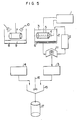
- Fig. 5 is a schematic layout of an apparatus which is suited for practicing the method of this invention.
- This apparatus comprises as its main constituents a power source 1, an electrolytic cell 2, a counter electrode 4, a washing tank 8, a centrifugal dehydrator 11, and a mixing tank 15.
- the radioactive waste 5 is immersed in the electrolytic cell 2 filled with a heutral salt solution 3 and subjected to alternating electrolysis with the counter electrode 4.
- the electrolysis time is preferably 10 to 20 minutes.
- the contaminants removed by the alternating electrolysis settle down as oxides or hydroxides 6, and the sediment is sent into the centrifugal dehydrator 11 where it is dewatered to a water content of about 80% to form a sludge 13, the latter being forwarded into the mixer 15.
- the liquid produced by the dewatering is passed through a filter 12 and reused as the electrolyte.
- the dewatered sludge in the mixer is stirred and mixed with 2 to 3 times the amount (by weight) of water glass 14 by a stirrer 16 and then packaged in a drum 17.
- the sludge and water glass mixture in the drum is solidified in 48-72 hours.
- the waste material decontaminated by the electrolysis is washed with ordinary tap water 9 by a spray washer 10 in the washing tank 8, whereby the intensity of its radioactivity can be reduced to the background level.
- the alternating electrolysis (repetition of 90-second cathode electrolysis and 30-second anode electrolysis) was conducted for about 10 minutes by using a 10% by weight aqueous solution of sodium chloride as electrolyte and carbon or steel as counter electrode at a voltage of ⁇ 7V and a current density of 1 A/cm 2.
- the contaminated oxide films could be completely removed by this treatment.
- the sediment was treated in the same way as in Example 1 to obtain a volume reduction of 1/15, which is the same as in Example 1.
- Example 2 By using the same apparatus as in Example 1 and by using a 20% by weight aqueous solution of sodium sulfate as electrolyte while letting the radioactive waste 5 serve as one electrode and the contaminated metal as counter electrode 4, the alternating electrolysis (repetition of 3-minute cathode electrolysis and one-minute anode electrolysis) was performed at a voltage of 5-10 V and a current density of 0.2-0.5 A/cm 2 for about 20 minutes. This treatment could perfectly remove the radioactivated oxide films.
- the sediment treatment in the manner as in Example 1 provided a volume reduction of 1/15 which is the same as in Example 1. According to this example, since the counter electrode 4 is constituted by a radiation contaminated metal product, it is possible to decontaminate two pieces of radiation contaminated metal products at one time.
- the radiation contaminated metals are subjected to the alternating electrolysis in an aqueous solution of a neutral salt for electrolytically removing the radioactivated oxide films on the metal surfaces.
- This treatment is capable of perfectly removing said oxide film from the base metal, making it possible to greatly reduce the radiation contaminated metal components in the nuclear plants.
- the method of this invention is capable of effectively removing even stiff spinel type radioactivated oxide films on the base metal. Also, according to the method of this invention, it is possible to minimize the rate of dissolution of the non-contaminated base metal in the electrolytic decontamination process, and this enables a marked reduction of secondary waste.
- both the electrolytic decontamination step and the step of removing the resultantly produced hydroxides, etc. can be accomplished at the same time, so that it is possible to realize a shortening of the electrolysis treatment time as well as cost reduction of the chemicals used for the electrolyte.
- the oxides or hydroxides removed by the electrolysis can be separated from the electrolyte and solidified, so that their storage is easy.
Landscapes
- Engineering & Computer Science (AREA)
- Chemical & Material Sciences (AREA)
- Chemical Kinetics & Catalysis (AREA)
- Organic Chemistry (AREA)
- Metallurgy (AREA)
- Materials Engineering (AREA)
- Electrochemistry (AREA)
- General Engineering & Computer Science (AREA)
- High Energy & Nuclear Physics (AREA)
- Physics & Mathematics (AREA)
- Life Sciences & Earth Sciences (AREA)
- Food Science & Technology (AREA)
- Processing Of Solid Wastes (AREA)
- Cleaning And De-Greasing Of Metallic Materials By Chemical Methods (AREA)
- Solid-Sorbent Or Filter-Aiding Compositions (AREA)
- Electrolytic Production Of Metals (AREA)
Applications Claiming Priority (2)
| Application Number | Priority Date | Filing Date | Title |
|---|---|---|---|
| JP27703/83 | 1983-02-23 | ||
| JP58027703A JPS59154400A (ja) | 1983-02-23 | 1983-02-23 | 放射性汚染金属の除染方法 |
Publications (2)
| Publication Number | Publication Date |
|---|---|
| EP0125401A1 EP0125401A1 (en) | 1984-11-21 |
| EP0125401B1 true EP0125401B1 (en) | 1987-06-16 |
Family
ID=12228339
Family Applications (1)
| Application Number | Title | Priority Date | Filing Date |
|---|---|---|---|
| EP84101859A Expired EP0125401B1 (en) | 1983-02-23 | 1984-02-22 | Method for decontaminating metals contaminated with radioactive substances |
Country Status (5)
| Country | Link |
|---|---|
| US (1) | US4481089A (enExample) |
| EP (1) | EP0125401B1 (enExample) |
| JP (1) | JPS59154400A (enExample) |
| KR (1) | KR900000343B1 (enExample) |
| DE (1) | DE3464292D1 (enExample) |
Families Citing this family (18)
| Publication number | Priority date | Publication date | Assignee | Title |
|---|---|---|---|---|
| US4615776A (en) * | 1983-10-21 | 1986-10-07 | Shinko-Pfaudler Company | Electrolytic decontamination process and process for reproducing decontaminating electrolyte by electrodeposition and apparatuses therefore |
| FR2565021B1 (fr) * | 1984-05-25 | 1992-03-06 | Toshiba Kk | Appareil de decontamination de dechets metalliques radioactifs |
| JPH0634095B2 (ja) * | 1985-03-13 | 1994-05-02 | 上村工業株式会社 | 放射能汚染金属廃棄物の除染方法 |
| US4654126A (en) * | 1985-10-07 | 1987-03-31 | International Business Machines Corporation | Process for determining the plating activity of an electroless plating bath |
| SE462286B (sv) * | 1988-10-13 | 1990-05-28 | Avesta Ab | Saett vid framstaellning av rostfria band och plaatar med god ytjaemnhet och glans |
| US5160590A (en) * | 1989-09-06 | 1992-11-03 | Kawasaki Steel Corp. | Electrolytic processing method for electrolytically processing metal surface |
| DE4110128A1 (de) * | 1990-04-09 | 1991-11-07 | Westinghouse Electric Corp | Dekontamination von radioaktiv verseuchten metallen |
| US5098533A (en) * | 1991-02-06 | 1992-03-24 | International Business Machines Corp. | Electrolytic method for the etch back of encapsulated copper-Invar-copper core structures |
| US5865965A (en) * | 1994-02-01 | 1999-02-02 | Kabushiki Kaisha Toshiba | Apparatus for electrochemical decontamination of radioactive metallic waste |
| TW288145B (enExample) * | 1994-02-01 | 1996-10-11 | Toshiba Co Ltd | |
| DE4420139C1 (de) * | 1994-06-09 | 1995-12-07 | Kraftanlagen En Und Industriea | Verfahren zur elektrochemischen Dekontamination von radioaktiv belasteten Oberflächen von Metallkomponenten aus kerntechnischen Anlagen |
| US7384529B1 (en) | 2000-09-29 | 2008-06-10 | The United States Of America As Represented By The United States Department Of Energy | Method for electrochemical decontamination of radioactive metal |
| KR100514612B1 (ko) * | 2002-11-14 | 2005-09-16 | 주식회사 데콘엔지니어링 | 중성염 전해연마를 이용한 방사능 오염 금속의 제염장치 |
| US20100072059A1 (en) * | 2008-09-25 | 2010-03-25 | Peters Michael J | Electrolytic System and Method for Enhanced Radiological, Nuclear, and Industrial Decontamination |
| RU2417467C1 (ru) * | 2009-11-24 | 2011-04-27 | Открытое акционерное общество "Сибирский химический комбинат" | Способ дезактивации радиоактивных металлических отходов |
| KR101289231B1 (ko) * | 2011-12-16 | 2013-07-29 | 재단법인 포항산업과학연구원 | 방사성 원소 함량이 낮은 지르콘 정광의 제조방법 |
| CN104389011B (zh) * | 2014-11-27 | 2017-01-18 | 中国原子能科学研究院 | 一种电化学去污电解液 |
| PL4065754T3 (pl) * | 2019-11-25 | 2026-03-23 | Arcelormittal | Elektrowspomagane wytrawianie stali |
Family Cites Families (12)
| Publication number | Priority date | Publication date | Assignee | Title |
|---|---|---|---|---|
| US2492047A (en) * | 1946-03-30 | 1949-12-20 | Du Pont | Bleaching wood pulp |
| US2468006A (en) * | 1948-06-23 | 1949-04-19 | J H Shoemaker | Electrolytic cleaning of metal |
| FR1237777A (fr) * | 1959-06-20 | 1960-08-05 | Jacquet Hispano Suiza | Perfectionnements apportés aux moyens pour séparer ou éliminer des éléments radio-actifs à la surface de pièces ou ensembles |
| US3063917A (en) * | 1959-06-29 | 1962-11-13 | Combustion Eng | Anodic decontamination of zirconium and hafnium |
| US3905885A (en) * | 1973-06-13 | 1975-09-16 | United States Steel Corp | Method for the electrolytic conditioning of metal tubes |
| BE812192A (en) * | 1974-03-12 | 1974-07-01 | Radioactive or hazardous liquid wastes treatment - to produce solid masses suitable for storage using a silicate carrier soln. | |
| JPS53120637A (en) * | 1977-03-30 | 1978-10-21 | Agency Of Ind Science & Technol | Electrolytic descaling method for steel strip or wire |
| US4193853A (en) * | 1979-05-15 | 1980-03-18 | The United States Of America As Represented By The United States Department Of Energy | Decontaminating metal surfaces |
| US4318786A (en) * | 1980-03-10 | 1982-03-09 | Westinghouse Electric Corp. | Electrolytic decontamination |
| JPS6020720B2 (ja) * | 1980-10-30 | 1985-05-23 | 株式会社日立製作所 | 放射能で汚染された金属材料の除染方法 |
| JPS5785980A (en) * | 1980-11-17 | 1982-05-28 | Hitachi Ltd | Method for removal of oxide on metallic surface |
| JPS5793299A (en) * | 1980-12-02 | 1982-06-10 | Hitachi Ltd | Solidifying treatment of radioactive waste |
-
1983
- 1983-02-23 JP JP58027703A patent/JPS59154400A/ja active Granted
-
1984
- 1984-02-16 KR KR1019840000744A patent/KR900000343B1/ko not_active Expired
- 1984-02-22 EP EP84101859A patent/EP0125401B1/en not_active Expired
- 1984-02-22 US US06/582,543 patent/US4481089A/en not_active Expired - Lifetime
- 1984-02-22 DE DE8484101859T patent/DE3464292D1/de not_active Expired
Also Published As
| Publication number | Publication date |
|---|---|
| JPH052960B2 (enExample) | 1993-01-13 |
| US4481089A (en) | 1984-11-06 |
| JPS59154400A (ja) | 1984-09-03 |
| EP0125401A1 (en) | 1984-11-21 |
| DE3464292D1 (en) | 1987-07-23 |
| KR900000343B1 (ko) | 1990-01-25 |
| KR840007797A (ko) | 1984-12-10 |
Similar Documents
| Publication | Publication Date | Title |
|---|---|---|
| EP0125401B1 (en) | Method for decontaminating metals contaminated with radioactive substances | |
| KR100566725B1 (ko) | 화학 오염 제거 방법 | |
| US4056482A (en) | Method for preparing aqueous, radioactive waste solutions from nuclear plants for solidification | |
| EP0682806B1 (en) | Process for the treatment of particulate material | |
| JPH0153440B2 (enExample) | ||
| JP4753141B2 (ja) | イオン液体を用いたウランの溶解分離方法、及びそれを用いたウランの回収方法 | |
| US5752206A (en) | In-situ decontamination and recovery of metal from process equipment | |
| US5386078A (en) | Process for decontaminating radioactive metal surfaces | |
| JP2023510461A (ja) | 液体トリチウム含有放射性廃棄物を処理する方法 | |
| JP4495458B2 (ja) | 放射性廃棄物の処理のための方法及び装置 | |
| EP0859671A1 (en) | Method for decontamination of nuclear plant components | |
| JP2509654B2 (ja) | 化学除染廃液処理方法 | |
| JP7272585B2 (ja) | 汚染金属の除染方法及び除染装置 | |
| CN112176393B (zh) | 一种电化学去污电解液及其制备方法和应用 | |
| US5545795A (en) | Method for decontaminating radioactive metal surfaces | |
| RU2849158C1 (ru) | Способ дезактивации радиоактивных отходов | |
| JPS61231496A (ja) | 放射性金属廃棄物の除染方法 | |
| Akatov et al. | Industrial Implementation of Combined Electrochemical and Ultrasonic Decontamination Technology | |
| CA2265413A1 (en) | A method for complex decontamination of metal surfaces with deep and surface contamination and of liquid radioactive wastes | |
| JPS6083000A (ja) | 放射性汚染金属の除染方法 | |
| Yu | Chemistry and Chemical Engineering | |
| RU2194320C2 (ru) | Способ утилизации жидких отходов, содержащих азиды металлов и азотисто-водородную кислоту | |
| Oh et al. | Nuclear fuel cycle waste recycling technology deverlopment-Radioactive metal waste recycling technology development | |
| JPS6246297A (ja) | 放射性廃液及び放射性金属廃棄物の処理方法 | |
| KR20250164944A (ko) | 원전 해체 전해제염 발생 원전수 제염처리 방법 및 장치 |
Legal Events
| Date | Code | Title | Description |
|---|---|---|---|
| PUAI | Public reference made under article 153(3) epc to a published international application that has entered the european phase |
Free format text: ORIGINAL CODE: 0009012 |
|
| AK | Designated contracting states |
Designated state(s): DE SE |
|
| 17P | Request for examination filed |
Effective date: 19841128 |
|
| GRAA | (expected) grant |
Free format text: ORIGINAL CODE: 0009210 |
|
| AK | Designated contracting states |
Kind code of ref document: B1 Designated state(s): DE SE |
|
| REF | Corresponds to: |
Ref document number: 3464292 Country of ref document: DE Date of ref document: 19870723 |
|
| PLBE | No opposition filed within time limit |
Free format text: ORIGINAL CODE: 0009261 |
|
| STAA | Information on the status of an ep patent application or granted ep patent |
Free format text: STATUS: NO OPPOSITION FILED WITHIN TIME LIMIT |
|
| 26N | No opposition filed | ||
| EAL | Se: european patent in force in sweden |
Ref document number: 84101859.1 |
|
| PGFP | Annual fee paid to national office [announced via postgrant information from national office to epo] |
Ref country code: SE Payment date: 19970107 Year of fee payment: 14 |
|
| PGFP | Annual fee paid to national office [announced via postgrant information from national office to epo] |
Ref country code: DE Payment date: 19970428 Year of fee payment: 14 |
|
| PG25 | Lapsed in a contracting state [announced via postgrant information from national office to epo] |
Ref country code: SE Free format text: LAPSE BECAUSE OF NON-PAYMENT OF DUE FEES Effective date: 19980223 |
|
| EUG | Se: european patent has lapsed |
Ref document number: 84101859.1 |
|
| PG25 | Lapsed in a contracting state [announced via postgrant information from national office to epo] |
Ref country code: DE Free format text: LAPSE BECAUSE OF NON-PAYMENT OF DUE FEES Effective date: 19981103 |