EP0122202B1 - Nouveaux tétra-alkyl-2,2,5,5 cyclohexanone-4 ol-1 et leurs dérivés sulfonylés, leur procédé et leurs intermédiaires de préparation et leur application à la synthèse de lactones cyclopropaniques cis - Google Patents
Nouveaux tétra-alkyl-2,2,5,5 cyclohexanone-4 ol-1 et leurs dérivés sulfonylés, leur procédé et leurs intermédiaires de préparation et leur application à la synthèse de lactones cyclopropaniques cis Download PDFInfo
- Publication number
- EP0122202B1 EP0122202B1 EP84400693A EP84400693A EP0122202B1 EP 0122202 B1 EP0122202 B1 EP 0122202B1 EP 84400693 A EP84400693 A EP 84400693A EP 84400693 A EP84400693 A EP 84400693A EP 0122202 B1 EP0122202 B1 EP 0122202B1
- Authority
- EP
- European Patent Office
- Prior art keywords
- fact
- alkyl
- formula
- radical
- tetra
- Prior art date
- Legal status (The legal status is an assumption and is not a legal conclusion. Google has not performed a legal analysis and makes no representation as to the accuracy of the status listed.)
- Expired
Links
- 0 CC(C1CC(*)(*C=O)N)C1(C)N Chemical compound CC(C1CC(*)(*C=O)N)C1(C)N 0.000 description 2
Classifications
-
- C—CHEMISTRY; METALLURGY
- C12—BIOCHEMISTRY; BEER; SPIRITS; WINE; VINEGAR; MICROBIOLOGY; ENZYMOLOGY; MUTATION OR GENETIC ENGINEERING
- C12P—FERMENTATION OR ENZYME-USING PROCESSES TO SYNTHESISE A DESIRED CHEMICAL COMPOUND OR COMPOSITION OR TO SEPARATE OPTICAL ISOMERS FROM A RACEMIC MIXTURE
- C12P7/00—Preparation of oxygen-containing organic compounds
- C12P7/24—Preparation of oxygen-containing organic compounds containing a carbonyl group
- C12P7/26—Ketones
-
- C—CHEMISTRY; METALLURGY
- C07—ORGANIC CHEMISTRY
- C07C—ACYCLIC OR CARBOCYCLIC COMPOUNDS
- C07C309/00—Sulfonic acids; Halides, esters, or anhydrides thereof
-
- C—CHEMISTRY; METALLURGY
- C07—ORGANIC CHEMISTRY
- C07C—ACYCLIC OR CARBOCYCLIC COMPOUNDS
- C07C45/00—Preparation of compounds having >C = O groups bound only to carbon or hydrogen atoms; Preparation of chelates of such compounds
- C07C45/61—Preparation of compounds having >C = O groups bound only to carbon or hydrogen atoms; Preparation of chelates of such compounds by reactions not involving the formation of >C = O groups
- C07C45/64—Preparation of compounds having >C = O groups bound only to carbon or hydrogen atoms; Preparation of chelates of such compounds by reactions not involving the formation of >C = O groups by introduction of functional groups containing oxygen only in singly bound form
-
- C—CHEMISTRY; METALLURGY
- C07—ORGANIC CHEMISTRY
- C07C—ACYCLIC OR CARBOCYCLIC COMPOUNDS
- C07C45/00—Preparation of compounds having >C = O groups bound only to carbon or hydrogen atoms; Preparation of chelates of such compounds
- C07C45/61—Preparation of compounds having >C = O groups bound only to carbon or hydrogen atoms; Preparation of chelates of such compounds by reactions not involving the formation of >C = O groups
- C07C45/67—Preparation of compounds having >C = O groups bound only to carbon or hydrogen atoms; Preparation of chelates of such compounds by reactions not involving the formation of >C = O groups by isomerisation; by change of size of the carbon skeleton
- C07C45/673—Preparation of compounds having >C = O groups bound only to carbon or hydrogen atoms; Preparation of chelates of such compounds by reactions not involving the formation of >C = O groups by isomerisation; by change of size of the carbon skeleton by change of size of the carbon skeleton
-
- C—CHEMISTRY; METALLURGY
- C07—ORGANIC CHEMISTRY
- C07C—ACYCLIC OR CARBOCYCLIC COMPOUNDS
- C07C45/00—Preparation of compounds having >C = O groups bound only to carbon or hydrogen atoms; Preparation of chelates of such compounds
- C07C45/61—Preparation of compounds having >C = O groups bound only to carbon or hydrogen atoms; Preparation of chelates of such compounds by reactions not involving the formation of >C = O groups
- C07C45/67—Preparation of compounds having >C = O groups bound only to carbon or hydrogen atoms; Preparation of chelates of such compounds by reactions not involving the formation of >C = O groups by isomerisation; by change of size of the carbon skeleton
- C07C45/68—Preparation of compounds having >C = O groups bound only to carbon or hydrogen atoms; Preparation of chelates of such compounds by reactions not involving the formation of >C = O groups by isomerisation; by change of size of the carbon skeleton by increase in the number of carbon atoms
-
- C—CHEMISTRY; METALLURGY
- C07—ORGANIC CHEMISTRY
- C07C—ACYCLIC OR CARBOCYCLIC COMPOUNDS
- C07C49/00—Ketones; Ketenes; Dimeric ketenes; Ketonic chelates
- C07C49/385—Saturated compounds containing a keto group being part of a ring
- C07C49/487—Saturated compounds containing a keto group being part of a ring containing hydroxy groups
- C07C49/497—Saturated compounds containing a keto group being part of a ring containing hydroxy groups a keto group being part of a six-membered ring
-
- C—CHEMISTRY; METALLURGY
- C07—ORGANIC CHEMISTRY
- C07C—ACYCLIC OR CARBOCYCLIC COMPOUNDS
- C07C51/00—Preparation of carboxylic acids or their salts, halides or anhydrides
- C07C51/09—Preparation of carboxylic acids or their salts, halides or anhydrides from carboxylic acid esters or lactones
-
- C—CHEMISTRY; METALLURGY
- C07—ORGANIC CHEMISTRY
- C07D—HETEROCYCLIC COMPOUNDS
- C07D313/00—Heterocyclic compounds containing rings of more than six members having one oxygen atom as the only ring hetero atom
- C07D313/02—Seven-membered rings
- C07D313/04—Seven-membered rings not condensed with other rings
-
- Y—GENERAL TAGGING OF NEW TECHNOLOGICAL DEVELOPMENTS; GENERAL TAGGING OF CROSS-SECTIONAL TECHNOLOGIES SPANNING OVER SEVERAL SECTIONS OF THE IPC; TECHNICAL SUBJECTS COVERED BY FORMER USPC CROSS-REFERENCE ART COLLECTIONS [XRACs] AND DIGESTS
- Y10—TECHNICAL SUBJECTS COVERED BY FORMER USPC
- Y10S—TECHNICAL SUBJECTS COVERED BY FORMER USPC CROSS-REFERENCE ART COLLECTIONS [XRACs] AND DIGESTS
- Y10S435/00—Chemistry: molecular biology and microbiology
- Y10S435/8215—Microorganisms
- Y10S435/911—Microorganisms using fungi
-
- Y—GENERAL TAGGING OF NEW TECHNOLOGICAL DEVELOPMENTS; GENERAL TAGGING OF CROSS-SECTIONAL TECHNOLOGIES SPANNING OVER SEVERAL SECTIONS OF THE IPC; TECHNICAL SUBJECTS COVERED BY FORMER USPC CROSS-REFERENCE ART COLLECTIONS [XRACs] AND DIGESTS
- Y10—TECHNICAL SUBJECTS COVERED BY FORMER USPC
- Y10S—TECHNICAL SUBJECTS COVERED BY FORMER USPC CROSS-REFERENCE ART COLLECTIONS [XRACs] AND DIGESTS
- Y10S435/00—Chemistry: molecular biology and microbiology
- Y10S435/8215—Microorganisms
- Y10S435/911—Microorganisms using fungi
- Y10S435/913—Aspergillus
- Y10S435/917—Aspergillus niger
-
- Y—GENERAL TAGGING OF NEW TECHNOLOGICAL DEVELOPMENTS; GENERAL TAGGING OF CROSS-SECTIONAL TECHNOLOGIES SPANNING OVER SEVERAL SECTIONS OF THE IPC; TECHNICAL SUBJECTS COVERED BY FORMER USPC CROSS-REFERENCE ART COLLECTIONS [XRACs] AND DIGESTS
- Y10—TECHNICAL SUBJECTS COVERED BY FORMER USPC
- Y10S—TECHNICAL SUBJECTS COVERED BY FORMER USPC CROSS-REFERENCE ART COLLECTIONS [XRACs] AND DIGESTS
- Y10S435/00—Chemistry: molecular biology and microbiology
- Y10S435/8215—Microorganisms
- Y10S435/911—Microorganisms using fungi
- Y10S435/929—Fusarium
-
- Y—GENERAL TAGGING OF NEW TECHNOLOGICAL DEVELOPMENTS; GENERAL TAGGING OF CROSS-SECTIONAL TECHNOLOGIES SPANNING OVER SEVERAL SECTIONS OF THE IPC; TECHNICAL SUBJECTS COVERED BY FORMER USPC CROSS-REFERENCE ART COLLECTIONS [XRACs] AND DIGESTS
- Y10—TECHNICAL SUBJECTS COVERED BY FORMER USPC
- Y10S—TECHNICAL SUBJECTS COVERED BY FORMER USPC CROSS-REFERENCE ART COLLECTIONS [XRACs] AND DIGESTS
- Y10S435/00—Chemistry: molecular biology and microbiology
- Y10S435/8215—Microorganisms
- Y10S435/911—Microorganisms using fungi
- Y10S435/931—Mucor
-
- Y—GENERAL TAGGING OF NEW TECHNOLOGICAL DEVELOPMENTS; GENERAL TAGGING OF CROSS-SECTIONAL TECHNOLOGIES SPANNING OVER SEVERAL SECTIONS OF THE IPC; TECHNICAL SUBJECTS COVERED BY FORMER USPC CROSS-REFERENCE ART COLLECTIONS [XRACs] AND DIGESTS
- Y10—TECHNICAL SUBJECTS COVERED BY FORMER USPC
- Y10S—TECHNICAL SUBJECTS COVERED BY FORMER USPC CROSS-REFERENCE ART COLLECTIONS [XRACs] AND DIGESTS
- Y10S435/00—Chemistry: molecular biology and microbiology
- Y10S435/8215—Microorganisms
- Y10S435/911—Microorganisms using fungi
- Y10S435/933—Penicillium
- Y10S435/935—Penicillium chrysogenum
-
- Y—GENERAL TAGGING OF NEW TECHNOLOGICAL DEVELOPMENTS; GENERAL TAGGING OF CROSS-SECTIONAL TECHNOLOGIES SPANNING OVER SEVERAL SECTIONS OF THE IPC; TECHNICAL SUBJECTS COVERED BY FORMER USPC CROSS-REFERENCE ART COLLECTIONS [XRACs] AND DIGESTS
- Y10—TECHNICAL SUBJECTS COVERED BY FORMER USPC
- Y10S—TECHNICAL SUBJECTS COVERED BY FORMER USPC CROSS-REFERENCE ART COLLECTIONS [XRACs] AND DIGESTS
- Y10S435/00—Chemistry: molecular biology and microbiology
- Y10S435/8215—Microorganisms
- Y10S435/911—Microorganisms using fungi
- Y10S435/939—Rhizopus
Definitions
- the present invention relates to new tetra-alkyl-2,2,5,5 cyclohexanone-4 ol-1 and their sulfonylated derivatives, their process and their preparation intermediates and their application to the synthesis of cyclopropanic lactones of cis structure.
- R and R ' preferably represent a methyl, ethyl, propyl radical and when R "represents a radical -SO 2 R"', R "'preferably represents a methyl, ethyl, phenyl radical, p-tolyle or xylyl.
- the subject of the invention is in particular those in which R and R 'are identical and represent a methyl radical.
- the subject of the invention is also in particular those in which R "represents a hydrogen atom and those in which R" represents a radical -S0 2 R “', in which R"' represents a methyl or p-tolyl radical.
- the invention more particularly relates to those in which the configuration of the carbon atom carrying the group OR "is (S).
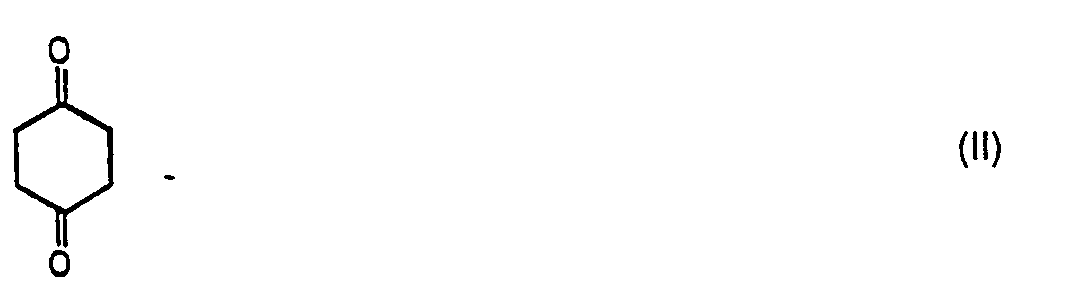
- a subject of the invention is also a process for the preparation of the compounds of formula (I), as defined above, characterized in that the 1,4-cyclohexane dione of formula (II) is alkylated: to obtain the tetra-alkyl-2,2,5,5 cyclohexanediones-1,4 of formula (III): which are reduced selectively to obtain the corresponding tetraalkyl-2,2,5,5 cyclohexanone-4 ol-1, of formula (I), in which R "represents a hydrogen atom, and which one transforms, if desired, said products into corresponding sulfonylated derivatives, of formula (I) in which R "represents a radical -SO 2 R"', as defined above.
- the starting cyclohexanedione-1,4 (II) is a compound easily accessible by reduction of hydroquinone.
- a monoenolate of the compound of formula (III) is formed beforehand, using an alkaline alcoholate.
- the operation is preferably carried out in an anhydrous medium, in tetrahydrofuran and at a temperature of approximately 0 ° C.
- alkali alcoholate use may be made of a sodium alcoholate of a lower aliphatic alcohol having from 1 to 6 carbon atoms, preferably sodium tert-butylate or sodium tertioamylate.
- the selective reduction proper is preferably carried out using a hydride such as diisobutylaluminum hydride or a borohydride such as sodium borohydride.
- a hydride such as diisobutylaluminum hydride or a borohydride such as sodium borohydride.
- said reduction is carried out microbiologically, particularly using a fungi imperfecti, especially chosen from the group consisting of Curvularia, Aspergillus, Mucor, Geotrichum, Penicillium, Rhizopus, Kloeckera, Cunninghamella, Cylindrocarpon, Fusarium, Neurospora and Trichothecium.
- a fungi imperfecti especially chosen from the group consisting of Curvularia, Aspergillus, Mucor, Geotrichum, Penicillium, Rhizopus, Kloeckera, Cunninghamella, Cylindrocarpon, Fusarium, Neurospora and Trichothecium.
- those chosen from the group consisting of Curvularia lunata, Aspergillus niger, Aspergillus ochraceus, Mucor racemosus and Penicilium chrysogenum are most particularly preferred for the level of selectivity and stereospecificity which they make it possible to achieve.
- the sulfonylation stage of the process of the invention is preferably carried out using a halide of an alkyl or aryl sulfonic acid and, more particularly, using mesyl chloride or tolyl chloride, in particular operating in an anhydrous medium, in the presence of a base and at a temperature of approximately 0 ° C.
- the compounds of formula (111), as defined above, are new products.
- the compounds of formula (III) and in particular those in which R and R ′ are identical and represent a methyl radical, constitute one of the objects of the invention.
- the invention further relates to an application of the compounds of formula (I) as defined in claim 1, characterized in that the compounds of formula (I) are transformed, where appropriate, in which R "represents a hydrogen atom, in sulfonylated derivatives, which said sulfonylated derivatives in lactones of formula (IV) are oxidized using a peracid: then a cyclopropanation reaction of said lactones (IV) is carried out in basic medium to obtain the corresponding cyclopropanic lactones of cis structure corresponding to the general formula (V):
- the oxidation reaction of the sulfonylated derivative can be carried out using a peracid such as perbenzoic acid, monoperphthalic acid, peracetic acid, metachloroperbenzoic acid or trifluoroperacetic acid, but preferably by presence of metachloroperbenzoic acid, in an anhydrous medium, preferably in a halogenated hydrocarbon such as dichloromethane, at room temperature and for a time between 10 and 100 hours.
- a peracid such as perbenzoic acid, monoperphthalic acid, peracetic acid, metachloroperbenzoic acid or trifluoroperacetic acid, but preferably by presence of metachloroperbenzoic acid, in an anhydrous medium, preferably in a halogenated hydrocarbon such as dichloromethane, at room temperature and for a time between 10 and 100 hours.
- the last step of the application according to the invention consists in carrying out the intramolecular cyclization of the sulfonylated lactone (IV) to the cis-cyclopropanic lactone of formula (V).
- This cyclization is preferably carried out in the presence of an alkaline alcoholate, in an anhydrous medium, preferably in tetrahydrofuran, and at a temperature of approximately 0 ° C.
- the invention particularly relates to an application as defined above, characterized in that R and R 'are identical and represent a methyl radical.
- the alkaline alcoholate used above may in particular be one of those which have been mentioned above for the formation of the monoenolate of the compound of formula (III).
- the compounds of formula (IV), as defined above, are new products.
- said compounds of formula (IV), in particular those in which R and R ′ are identical and represent a methyl radical, and very particularly, those in which the configuration of the carbon atom carrying the sulfonylated group is (S ), that is to say the lactone of (S) trimethyl-3,3,6-hydroxy-6-mesyloxy-4-heptanoic acid, constitute one of the objects of the invention.
- the cyclopropanic lactones of formula (V) constitute particularly valuable intermediates in the synthesis of substituted cis-cyclopropane carboxylic acids, in particular in the synthesis of cis-chrysanthememic acid or cis-dimethyl-2,2 (methyl-2 'acid).
- propenyl-1 ') - 3 cyclopropane-1-carboxylic which we know on the one hand, the properties, in particular insecticides or olfactory of some of its esters and on the other hand, the interest as intermediates in the synthesis other esters of dihalogenovinyl cyclopropane carboxylic acids which also have remarkable insecticidal properties.
- the cis-chrysanthemic acid (1 R, 3S) thus constitutes in particular a particularly important intermediate in the synthesis of deltamethrin discovered by M. ELLIOTT in 1974, this compound combining exceptional insecticidal properties with reduced toxicity towards higher organisms and low persistence in the natural environment.
- This cis-chrysanthemic acid (1 R, 3S) can therefore be obtained from the lactone of formula (V) of configuration (1 R, 3S) in which R and R 'are identical and represent a methyl radical, itself obtained from the corresponding lactone of formula (IV) of configuration (4S).
- the intermediates obtained are for the most part in the form of crystallized products which greatly facilitates their purification when the latter proves necessary.
- Example 1 Tetramethyl 2,2,5,5-cyclohexanone-4-ol-1.
- Stage B Tetramethyl-2,2,5,5-cyclohexanone-4-ol-1.
- Example 2 Tetramethyl-2,2,5,5-cyclohexanone-4-ol-1 mesylate.
- Example 3 Cis dimethyl-2,2- (methyl-2'-propenyl-1 ') - 3-cyclopropane 1-carboxylic acid lactone.
- Stage A Lactone of trimethyl-3,3,6-hydroxy-6-mesyloxy-4-heptanoic acid.
- Stage B Lactone of cis-dimethyl-2.2- (methyl-2'-propenyl-1 ') - 3-cyclopropane-1-carboxylic acid or cis-chrysanthemic acid lactone.
- the cis-chrysanthemic acid obtained is identical to an authentic sample described by J. Ficini, J. d'Angelo, Tetrahedron Letters (1976) 2441 and J. Ficini, S. Falou, J. d'Angelo, Tetrahedron Letters (1983 ) 375.
- Vapor chromatography of an isopropyl urethane derivative of ketol on a chiral column detects only one peak, which indicates the presence of a single stereoisomer.
- Example 7 Lactone (+) of cis-dimethyl-2,2- (methyl-2'-propenyl-1 ') - 3-cyclopropane-1-carboxylic acid.
- Stage A Lactone (+) - (S) of (S) trimethyl-3,3,6-hydroxy-6-mesyloxy-4-heptanoic acid.
Landscapes
- Chemical & Material Sciences (AREA)
- Organic Chemistry (AREA)
- Chemical Kinetics & Catalysis (AREA)
- Engineering & Computer Science (AREA)
- Wood Science & Technology (AREA)
- Life Sciences & Earth Sciences (AREA)
- Zoology (AREA)
- Health & Medical Sciences (AREA)
- Microbiology (AREA)
- General Chemical & Material Sciences (AREA)
- Biotechnology (AREA)
- Biochemistry (AREA)
- Bioinformatics & Cheminformatics (AREA)
- General Engineering & Computer Science (AREA)
- General Health & Medical Sciences (AREA)
- Genetics & Genomics (AREA)
- Oil, Petroleum & Natural Gas (AREA)
- Organic Low-Molecular-Weight Compounds And Preparation Thereof (AREA)
- Preparation Of Compounds By Using Micro-Organisms (AREA)
- Pyrane Compounds (AREA)
Description
- La présente invention a pour objet de nouveaux tétra-alkyl-2,2,5,5 cyclohexanone-4 ol-1 et leurs dérivés sulfonylés, leur procédé et leurs intermédiaires de préparation et leur application à la synthèse de lactones cyclopropaniques de structure cis.
- La présente invention a ainsi pour objet les tétra-alkyl-2,2,5,5 cyclohexanone-4 oi-1 et leurs dérivés sulfonylés de formule générale (1) :

- R et R', identiques ou différents, représentent un radical alkyle ayant de 1 à 5 atomes de carbone et R" représente un atome d'hydrogène ou un radical -S02R"', dans lequel R"' représente un radical alkyle renfermant de 1 à 5 atomes de carbone ou un radical aryle renfermant de 6 à 14 atomes de carbone.
- Dans la formule générale (I), R et R' représentent de préférence un radical méthyle, éthyle, propyle et lorsque R" représente un radical -S02R"', R"' représente de préférence un radical méthyle, éthyle, phényle, p-tolyle ou xylyle.
- Parmi les composés de formule générale (I), l'invention a notamment pour objet ceux dans lesquels R et R' sont identiques et représentent un radical méthyle.
- Parmi les composés de formule générale (I), l'invention a également notamment pour objet ceux dans lesquels R" représente un atome d'hydrogène et ceux dans lesquels R" représente un radical -S02R"', dans lesquels R"' représente un radical méthyle ou p-tolyle.
- Parmi les composés de formule générale (I), l'invention a plus particulièrement pour objet ceux dans lesquels la configuration de l'atome de carbone porteur du groupement OR" est (S).
- L'invention a également pour objet un procédé de préparation des composés de formule (I), telle que définie précédemment, caractérisé en ce que l'on alkyle la cyclohexane dione-1,4 de formule (II) :

- Dans des conditions préférentielles d'exécution du stade d'alkylation du procédé de l'invention :
- - lorsque les radicaux R et R' sont identiques, la réaction de tétra-alkylation peut être effectuée en une seule étape à partir de la cyclohexane dione-1,4, et d'un halogénure d'alkyle en milieu anhydre, dans le tétrahydrofuranne en présence d'un alcoolate alcalin ;
- - lorsque les radicaux R et R' sont différents mais également lorsqu'ils sont identiques, la réaction d'alkylation est effectuée en deux étapes, à partir de cyclohexane dione-1,4 dicarboxylate-2,5 d'éthyle dans les mêmes conditions que celles décrites ci-dessus pour la tétra-alkylation de la cyclohexanedione-1,4.
- Ce stade d'alkylation peut être illustré par le schéma réactionnel suivant :

- R2 pouvant être R ou R',
- X = halogène (CI, Br ou I)
- La cyclohexanedione-1,4 (II) de départ est un composé facilement accessible par réduction de l'hydroquinone.
- Dans des conditions préférentielles d'exécution du stade de réduction sélective du procédé de l'invention, l'on forme au préalable un monoénolate du composé de formule (III), à l'aide d'un alcoolate alcalin. On opère de préférence en milieu anhydre, dans le tétrahydrofuranne et à une température d'environ 0 °C.
- Comme alcoolate alcalin, on peut utiliser un alcoolate de sodium d'un alcool aliphatique inférieur ayant de 1 à 6 atomes de carbone, de préférence le tertiobutylate de sodium ou le tertioamylate de sodium.
- La réduction sélective proprement dite est effectuée de préférence à l'aide d'un hydrure tel que l'hydrure de diisobutylaluminium ou d'un borohydrure tel que le borohydrure de sodium.
- Dans des conditions très préférentielles d'exécution du stade de réduction sélective du procédé de l'invention, on effectue ladite réduction par voie microbiologique, particulièrement à l'aide d'un fungi imperfecti, notamment choisi dans le groupe constitué par les Curvularia, les Aspergillus, les Mucor, les Geotrichum, les Penicillium, les Rhizopus, les Kloeckera, les Cunninghamella, les Cylindrocarpon, les Fusarium, les Neurospora et les Trichothecium.
- L'utilisation des microorganismes ci-dessus présente l'avantage très important de conduire à une réduction sélective et stéréospécifique du composé dicétonique en un cétol de configuration (S).
- Parmi les microorganismes ci-dessus, ceux choisis dans le groupe constitué par Curvularia lunata, Aspergillus niger, Aspergillus ochraceus, Mucor racemosus et Penicilium chrysogenum sont tout particulièrement préférés pour le niveau de sélectivité et de stéréospécificité qu'ils permettent d'atteindre.
- Le stade de sulfonylation du procédé de l'invention est effectué de préférence à l'aide d'un halogénure d'un acide alkyl ou aryl sulfonique et, plus pârticulièrement, à l'aide de chlorure de mésyle ou de chlorure de tolyle, en opérant en milieu anhydre, en présence d'une base et à une température d'environ 0°C.
- Les composés de formule (111), telle que définie précédemment, sont des produits nouveaux. A ce titre, les composés de formule (III) et notamment ceux dans lesquels R et R' sont identiques et représentent un radical méthyle, constituent l'un des objets de l'invention.
- L'invention a, en outre, pour objet une application des composés de formule (I) telle que définie à la revendication 1, caractérisée en ce que l'on transforme, le cas échéant, les composés de formule (I) dans laquelle R" représente un atome d'hydrogène, en dérivés sulfonylés, que l'on oxyde à l'aide d'un peracide lesdits dérivés sulfonylés en lactones de formule (IV) :


- La réaction d'oxydation du dérivé sulfonylé peut être effectuée à l'aide d'un peracide tel que l'acide perbenzoïque, l'acide monoperphtalique, l'acide peracétique, l'acide métachloroperbenzoïque ou l'acide trifluoroperacétique, mais de préférence en présence d'acide métachloroperbenzoïque, en milieu anhydre, de préférence dans un hydrocarbure halogéné tel que le dichlorométhane, à la température ambiante et pendant un temps compris entre 10 et 100 heures.
- La dernière étape de l'application selon l'invention consiste à réaliser la cyclisation intramoléculaire de la lactone sulfonylée (IV) en lactone cis-cyclopropanique de formule (V). Cette cyclisation est réalisée de préférence en présence d'un alcoolate alcalin, en milieu anhydre, de préférence dans du tétrahydrofuranne, et à température d'environ 0 °C.
- L'invention a notamment pour objet une application telle que définie précédemment, caractérisée en ce que R et R' sont identiques et représentent un radical méthyle.
- L'alcoolate alcalin utilisé plus-haut peut être notamment l'un de ceux qui ont été cités précédemment pour la formation du monoénolate du composé de formule (III).
- Les composés de formule (IV), telle que définie précédemment, sont des produits nouveaux. A ce titre, lesdits composés de formule (IV), notamment ceux dans lesquels R et R' sont identiques et représentent un radical méthyle, et tout particulièrement, ceux dans lesquels la configuration de l'atome de carbone porteur du groupement sulfonylé est (S), c'est-à-dire la lactone de l'acide (S) triméthyl-3,3,6 hydroxy-6 mésyloxy-4 heptanoïque, constituent l'un des objets de l'invention.
- Les lactones cyclopropaniques de formule (V) constituent des intermédiaires particulièrement précieux dans la synthèse d'acides cis-cyclopropane carboxyliques substitués, notamment dans la synthèse de l'acide cis-chrysanthémique ou acide cis-diméthyl-2,2 (méthyl-2' propényl-1')-3 cyclopropane-1-carboxylique, dont on connait d'une part, les propriétés, notamment insecticides ou olfactives de certains de ses esters et d'autre part, l'intérêt en tant qu'intermédiaires dans la synthèse d'autres esters d'acides cyclopropane carboxyliques dihalogénovinyliques qui possèdent également des propriétés insecticides remarquables.
- L'acide cis-chrysanthémique (1 R, 3S) constitue ainsi notamment un intermédiaire particulièrement important dans la synthèse de la deltaméthrine découvert par M. ELLIOTT en 1974, ce composé alliant des propriétés insecticides exceptionnelles à une toxicité réduite envers les organismes supérieurs et à une faible persistance dans le milieu naturel.
- Cet acide cis-chrysanthémique (1 R, 3S) peut donc être obtenu à partir de la lactone de formule (V) de configuration (1 R, 3S) dans laquelle R et R' sont identiques et représentent un radical méthyle, elle-même obtenue à partir de la lactone de formule (IV) correspondante de configuration (4S).
- La lactone de l'acide cis-diméthyl-2.2 (méthyl-2' propényl-1')-3 cyclopropane-1-carboxylique ou lactone de l'acide cis-chrysanthémique de formule (V) dans laquelle R = R' = -CH3 a déjà été décrite dans le brevet français n° 69.05865 comme intermédiaire dans la préparation de l'acide cis-chrysanthémique ràcémique, cette lactone étant elle-même obtenue par une suite d'étapes à partir d'acide trans- chrysanthémique.
- Les lactones cyclopropaniques de formule (V) constituant des intermédiaires particulièrement précieux dans la synthèse d'acides cyclopropanes carboxyliques substitués en position 3 par une chaîne vinylique ramifiée, la présente demande est particulièrement intéressante d'un point de vue industriel dans la mesure où elle décrit la préparation desdites lactones en peu d'étapes, au départ de produits facilement accessibles et avec des conditions opératoires particulièrement simples et peu coûteuses en énergie.
- Par ailleurs, les intermédiaires obtenus se présentent pour la plupart sous forme de produits cristallisés ce qui facilite grandement leur purification lorsque celle-ci s'avère nécessaire.
- Les exemples suivants permettent d'illustrer l'invention sans toutefois lui conférer aucun caractère limitatif.
- A 4,48 g de cyclohexanedione-1,4 et 10,2 ml d'iodure de méthyle, en solution dans 100 ml de tétrahydrofuranne anhydre à 0 °C, on ajoute goutte à goutte 106 ml d'une solution 1,5M de tertio amylate de sodium dans le benzène, en une heure. L'addition terminée, la solution est agitée à 20 °C pendant une heure.
- Après hydrolyse par addition d'eau et séparation, la phase aqueuse est extraite à l'éther. Les phases organiques sont combinées puis lavées à l'eau et séchées. Après évaporation, on isole par chromatographie sur colonne de silice (éluant : acétate d'éthyle-hexane 20/80) et cristallisation dans l'hexane, 3,25 g du composé attendu. Rendement : 50 %. Point de fusion : 112°C.
- Spectre IR (Nujol) : 1 700 cm-1
- Spectre RMN1 H (60 MHz, CC14) : 2,5 (s 4H) 1,1 (s 12H).
- Stade A' : Tétraméthyl 2,2,5,5-cyclohexanedione-1,4.
- Etape 1 :
- a) A 25,6 g de cyclohexanedione-1,4-dicarboxylate-2,5 d'éthyle et 10,4 g d'hydroxyde de sodium en solution dans un mélange de 200 ml d'alcool éthylique à 95° et 50 ml d'eau, on ajoute 13.7 ml d'iodure de méthyle à 0 °C sous agitation. La solution obtenue est ensuite maintenue à 25 °C pendant 100 heures. Après évaporation du solvant, le résidu est repris à l'eau puis extrait à l'éther. La solution éthérée est lavée à l'eau salée et séchée. Après évaporation on obtient 24 g d'huile brute.
- b) Les 24 g du produit obtenu ci-dessus sont alors agités dans 200 ml d'acide perchlorique à 20 % à 100 °C pendant 2 heures 30 minutes. Après extraction au chlorure de méthylène et évaporation. le produit brut est chromatographié sur colonne de silice (éluant : acétate d'éthyle-hexane 40/60). On obtient 8.5 g de diméthyl-2,5-cyclohexanedione-1,4 (mélange de 2 diastéréoisomères).
- Spectre IR (film) : 1 700 cm-1
- Spectre RMN1H (60 MHz). CCl4) : 3,0-2,2 (m 6H) 1,1 (dJ = 6Hz 6H).
- A 3 g de diméthyl-2,5-cyclohexanedione-1,4 et 2,6 ml d'iodure de méthyle en solution dans 30 ml de tétrahydrofuranne anhydre, on ajoute à 0 °C, 28 ml d'une solution 1,5M de tertio amylate de sodium dans du benzène, en 15 minutes. Après hydrolyse à l'eau et séparation, la phase aqueuse est extraite à l'éther. Les phases organiques sont combinées puis lavées à l'eau et séchées. Après évaporation et purification par chromatographie sur colonne de silice (éluant : acétate d'éthyle-hexane 20/80), on obtient 2,9 g de tétraméthyl-2,2,5,5-cyclohexanedione-1,4 (Rendement 82 %) présentant les mêmes caractéristiques que la dione obtenue selon l'exemple 1.
- A 2 g de tétraméthyl-2,2,5,5-cyclohexanedione-1,4 agitée dans 12 ml de tétrahydrofuranne anhydre, on ajoute goutte à goutte à -20 °C, 8 ml d'une solution 1,5M de tertio amylate de sodium dans du benzène. La solution obtenue est maintenue une heure à 0 °C puis le mélange est à nouveau porté à -20 °C et l'on ajoute goutte à goutte 24 ml d'une solution 1 M d'hydrure de diisobutylaluminium dans l'hexane. Après 30 minutes à cette température, on ajoute successivement 1 ml d'acétone, 1 ml de méthanol et 10 ml d'acétate d'éthyle jusqu'à précipitation des sels d'aluminium. Après filtration et lavage du précipité à l'éther, la phase organique est évaporée. Le résidu conduit après chromatographie sur colonne de silice (éluant : étherhexane 30/70) à 1,80 g du composé attendu (Rendement : 88 %). Point de fusion (après cristallisation dans l'éther) = 84 °C.
- Spectre IR (film) : 3 420 - 1 680 cm-1
- Spectre RMN1H (60 MHz, CDCI3) : 3,9 (m 1 H) 2,6-1,7 (m 5H) 1,2 (s 3H) 1,1 (s 3H) 1,05 (s 3H) 0,9 (s 3H).
- A 600 mg du composé obtenu à l'exemple 1 et 1 ml de triéthyl-λ amine dans 7 ml de chlorure de méthylène anhydre, on ajoute 0,4 ml de chlorure de mésyle à 0 °C sous agitation et l'on maintient 30 minutes à cette température. Après hydrolyse à l'eau et extraction à l'éther, la phase organique est lavée à l'eau salée puis séchée et évaporée. On obtient après chromatographie sur colonne de silice (éluant : acétate d'éthylehexane 40/60) 850 mg de mésylate attendu (Rendement : 97 %). Point de fusion (après cristallisation dans le mélange éther-hexane) = 51 °C.
- Spectre IR (nujol) : 1 710 cm-1
- Spectre RMN1H (60 MHz, CCl4):4,8 (dd J = 6 8Hz 1H) 3,0 (s 3H) 2.6-1,9 (m 4H) 1.2 (s 3H) 1,15 (s 3H) 1,10 (s 3H) 0,95 (s 3H).
- 850 mg de mésylate obtenu selon l'exemple 2 et 1 g d'acide métachloroperbenzoïque sont agités dans 4 ml de chlorure de méthylène anhydre. Après 100 heures, la solution est filtrée, le précipité lavé au chlorure de méthylène et les phases organiques sont combinées puis évaporées. On obtient après chromatographie sur colonne de silice (éluant : acétate d'éthyle-hexane 60/40), 766 mg du produit attendu (Rendement 85 %). Point de fusion (après cristallisation dans le mélange acétate d'éthyle- éther) = 128°C.
- Spectre IR (Nujol) : 1 700 cm-1
- Spectre RMN1H (60 MHz, CDCl3) : 4.8 (dd J = 6 6Hz 1 H) 3,1 (s 3H) 2,75 (m 2H) 2,4 (m 2H) 1.6 (s 6H) 1.2 (s 3H) 1,1 (s 3H).
- A 380 mg de la lactone mésylate obtenu selon le stade A dans 4 ml de tétrahydrofuranne anhydre, on ajoute 1,15 ml d'une solution 1,5M de tertio amylate de sodium dans du benzène à 0°C. On laisse remonter la température à 20 °C en 15 minutes. Après hydrolyse à l'eau, on extrait à l'éther puis lave la phase organique à l'eau salée, sèche et évapore à sec. Après chromatographie sur colonne de silice (éluant : acétate d'éthyle-hexane 40/60), on obtient 220 mg de la lactone cis cyclopropanique attendue (Rendement : 95 %). Fusion = 50,5 °C. Spectre de masse M/e = 168 (M+) 153 124 109 95 81 67 55 43
- Spectre IR (film) : 1 720 cm-'
- Spectre RMN1H (400 MHz, CDCl3) : 1,92 (dd J = 9,7 15,0 Hz 1H) 1,65 (dd J = 5,1 15,0 1H) 1,55 (d J = 7,7 Hz 1H) 1,44 (s 3H) 1,41 (ddd J = 5,1 7,7 9,7 Hz 1H) 1,34 (s 3H) 1,22 (s 3H) 1,08 (s 3H).
- Litt. : H. Lehmkuhl, K. Mehier; Liebigs Ann. Chem 11, 1841 (1978).
- Application de la lactone obtenue à l'exemple 3 à la préparation de l'acide cis-chrysanthémique ou cis-diméthyl-2,2-(méthyl-2'-propényl-1')-3-cyclopropane-1-carboxylique racémique.
- 40 mg de lactone obtenue dans l'exemple ci-dessus sont chauffés en présence de 146 mg de bromure de magnésium hexahydraté dans 0,25 ml de pyridine anhydre à 125 °C pendant 14 heures. Après acidification par 0,5 ml d'acide chlorhydrique 5N, la phase aqueuse est extraite à l'éther ; les phases organiques sont réunies, lavées à l'acide chlorhydrique dilué puis à l'eau salée, puis séchées et évaporées à sec. Après chromatographie sur colonne de silice (éluant : acétate d'éthyle-hexane 20/80), on isole 35 mg d'acide cis-chrysanthémique pur (Rendement : 88 %). L'acide cis-chrysanthémique obtenu est identique à un échantillon authentique décrit par J. Ficini, J. d'Angelo, Tetrahedron Letters (1976) 2441 et J. Ficini, S. Falou, J. d'Angelo, Tetrahedron Letters (1983) 375.
- Curvularia lunata NRRL 2380 conservée sur milieu solide a) est ensemencée en milieu liquide b) et cultivée 48 heures à 24 °C dans un incubateur rotatif. La dicétone obtenue selon l'exemple 1 ou 2 est ajoutée en solution à 5 % dans l'éthanol à une concentration finale de 500 mg pour 1 litre de milieu liquide. Après 3 jours d'agitation supplémentaires à 24 °C, la chromatographie en phase vapeur d'un extrait obtenu à l'acétate d'éthyle indique 95 % de conversion en cétol qui est isolé par filtration sur célite, saturation du filtrat par le chlorure de sodium et extraction répétée au dichlorométhane. Après séchage et évaporation, on obtient 460 mg de produit cristallisé jaune pâle qu'on décolore au charbon actif et qu'on recristallise dans l'hexane pour obtenir le (S) (+) cétol (252 mg). Le traitement des eaux mères permet d'obtenir encore 100 mg environ de (S) cétol pur. Rendement : 70 %. Point de fusion (après cristallisation dans l'éther) : 103-104 °C.
- Spectre IR (Nujol) : 3 420 - 1 680 cm―1
- Spectre RMN1H (60 MHz, CDCI3) : 3,9 (m 1H) 2,6-1,7 (m 5H) 1,2 (s 3H) 1,1 (s 3H) 1,05 (s 3H) 0,9 (s 3H). /α/p20 =+ 89,7° (c = 0,3 MeOH).
- La chromatographie en phase vapeur d'un dérivé isopropyl uréthane du cétol sur colonne chirale (R a-phényl glycinamide) ne détecte qu'un seul pic, ce qui traduit la présence d'un seul stéréoisomère.
- Dans le tableau suivant sont reportés les résultats obtenus en réduisant la dicétone de l'exemple 1 stade A ou A', avec différents microorganismes, en opérant à une concentration de dicétone de 1 g/I.

-
- a) Milieu solide : Glucose. 20 g, peptone. 5 g. Bacto-Yeast Extract. 5 g, Bacto-Malt Extract. 5 g Bacto-agar, 20 g, pour 1 litre.
- b) Milieu liquide (Nakazaki étal., J. Org. Chem.. 44 (1979) 4588).
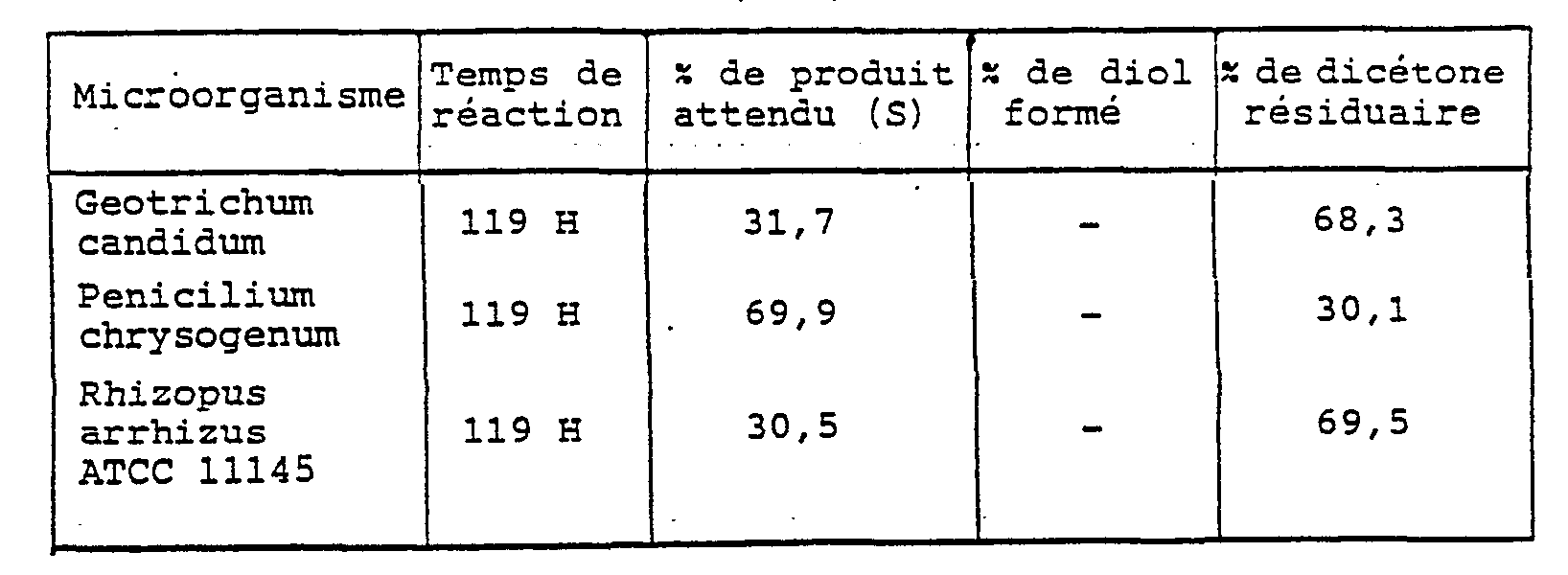
- De nombreuses souches des espèces Aspergillus niger, Mucor racemosus. Geotrichum candidum et Penicilium chrysogenum sont facilement accessibles dans diverses collections, notamment dans l'ATCC ou le NRRL.
- A 200 mg du composé de l'exemple 4 et 0,33 ml de triéthylamine dans 3 ml de chlorure de méthylène anhydre, on ajoute 130 ml de chlorure de mésyle à 0 °C sous agitation et l'on maintient 30 minutes à cette température. Après hydrolyse par addition de 2 ml d'eau et extraction à l'éther, la phase organique est lavée par 1 ml d'eau salée puis séchée sur MgS04 et évaporée. On obtient après chromatographie sur colonne de silice (éluant : acétate d'éthyle-hexane 40/60) 283 mg du mésylate attendu. (Rendement : 97%).
- Point de fusion (après cristallisation dans le mélange étherhexane) = 56-57 °C.
- Spectre IR (Nujol) : 1 710 cm―1
- Spectre RMN1H (60 MHz, CCl4) : 4,8 (dd J = 6,8 Hz 1H) 3,0 (s 3H) 2,6-1,9 (m 4H) 1,2 (s 3H) 1,15 (s 3H) 1,10 (s 3H) 0,95 (s 3H).
- /α/D 20 = + 60,7° (c = 2,06 CHCl3).
- 283 mg du mésylate obtenu selon l'exemple 6 et 0,33 g d'acide métachloroperbenzoïque sont agités dans 2 ml de chlorure de méthylène anhydre. Après 100 heures, la solution est filtrée, le précipité lavé au chlorure de méthylène et les phases organiques sont combinées puis évaporées. On obtient après chromatographie sur colonne de silice (éluant : acétate d'éthyle-hexane 60/40) 255 mg du produit attendu. (Rendement : 85 %).
- Point de fusion (après cristallisation dans le mélange acétate d'éthyle-éther) : décomposition vers 100 °C
- Spectre IR (Nujol) : 1 700 cm―1
- Spectre RMN1H (60 MHz, CDCI3) : 4,8 (dd J = 6 Hz 1H) 3.1 (s 3H) 2,75 (m 2H) 2,4 (m 2H) 1,6 (s 6H) 1.2 (s 3H) 1,1 (s 3H).
- /α/D20 = + 24,7° (c = 1,9 CHCI3).
- Stade B : Lactone (+) (1R,3S) de l'acide cis-diméthyl-2,2-(méthyl-2'-propényl-1')-3-cyclopropane-1-carboxylique ou lactone (+) de l'acide (1R,3S) cis-chrysanthémique.
- A 126 mg de la lactone mésylate obtenue selon le stade A dans 2 ml de tétrahydrofuranne anhydre, on ajoute 0,38 ml d'une solution 1,5 M de tertio amylate de sodium dans le benzène à 0°C. On laisse remonter la température à 20 °C en 15 minutes. Après hydrolyse à l'eau, on extrait à l'éther puis lave à l'eau salée la phase organique. Après chromatographie sur colonne de silice (éluant : acétate d'éthyle- hexane 40/60), on obtient 73 mg de la lactone cis cyclopropanique attendue (Rendement : 95 %).
- Point de fusion (après cristallisation dans l'hexane) 83-84 °C. Spectre de Masse M/e : 168 (M+) 153, 124, 109, 95, 81, 67, 55, 43.
- Spectre IR (film) : 1 720 cm-'.
- Spectre RMN1H (400 MHz, CDCI3) : 1.92 (dd J = 9,7 ; 15,0 Hz 1H) 1,65 (dd J = 5.1 ; 15.0 Hz 1H) 1,55 (d J = 7,7 Hz 1 H) 1,44 (s 3H) 1.41 (ddd J = 5,1 ; 7,7 ; 9,7 Hz 1 H) 1,34 (s 3H) 1,22 (s 3H) 1,08 (s 3H). / α /D20 = + 78° (c = 1,2 dans CHCI3). (Littérature : S. Torri, T. Inokuchi, R. Oi ; J. Org. Chem. Vol. 48, p. 1944 (1983) : / α /D 22 = 77,6° (c = 1,8
Claims (25)


Priority Applications (1)
| Application Number | Priority Date | Filing Date | Title |
|---|---|---|---|
| AT84400693T ATE27804T1 (de) | 1983-04-08 | 1984-04-09 | Tetra-alkyl-2,2,5,5-cyclohexanon-4-ol-1 und ihre sulfonierte derivate, verfahren und zwischenprodukte zur ihrer herstellung und ihre verwendung zur herstellung von ciscyclopropanlaktonen. |
Applications Claiming Priority (2)
| Application Number | Priority Date | Filing Date | Title |
|---|---|---|---|
| FR8305772 | 1983-04-08 | ||
| FR838305772A FR2543947B1 (fr) | 1983-04-08 | 1983-04-08 | Nouveaux tetra-alkyl-2,2,5,5 cyclohexanone-4 01-1 et leurs derives sulfonyles, leur preparation et leur application a la synthese de lactones cyclopropaniques |
Publications (3)
| Publication Number | Publication Date |
|---|---|
| EP0122202A2 EP0122202A2 (fr) | 1984-10-17 |
| EP0122202A3 EP0122202A3 (en) | 1985-07-10 |
| EP0122202B1 true EP0122202B1 (fr) | 1987-06-16 |
Family
ID=9287652
Family Applications (1)
| Application Number | Title | Priority Date | Filing Date |
|---|---|---|---|
| EP84400693A Expired EP0122202B1 (fr) | 1983-04-08 | 1984-04-09 | Nouveaux tétra-alkyl-2,2,5,5 cyclohexanone-4 ol-1 et leurs dérivés sulfonylés, leur procédé et leurs intermédiaires de préparation et leur application à la synthèse de lactones cyclopropaniques cis |
Country Status (9)
| Country | Link |
|---|---|
| US (2) | US4610826A (fr) |
| EP (1) | EP0122202B1 (fr) |
| JP (1) | JPS60501005A (fr) |
| AT (1) | ATE27804T1 (fr) |
| CA (1) | CA1235082A (fr) |
| DE (1) | DE3464237D1 (fr) |
| FR (1) | FR2543947B1 (fr) |
| HU (2) | HU201321B (fr) |
| WO (1) | WO1984004090A1 (fr) |
Families Citing this family (3)
| Publication number | Priority date | Publication date | Assignee | Title |
|---|---|---|---|---|
| US4841071A (en) * | 1983-07-08 | 1989-06-20 | Sandoz Pharm. Corp. | 6-substituted-4-hydroxy-tetrahydropyran-2-ones |
| EP0913376B1 (fr) * | 1997-11-03 | 2002-02-13 | MERCK PATENT GmbH | Procédé pour la préparation de cyclohexanones |
| US20070033881A1 (en) * | 2005-08-15 | 2007-02-15 | Love Bethel W | Safety and security block window system |
Family Cites Families (11)
| Publication number | Priority date | Publication date | Assignee | Title |
|---|---|---|---|---|
| CH363033A (fr) * | 1959-01-28 | 1962-07-15 | Om Lab Sa | Procédé de préparation de dérivés sulfonés, thérapeutiquement actifs, du p-dihydroxy-benzène |
| US3418290A (en) * | 1965-10-18 | 1968-12-24 | Du Pont | Sulfonated caprolactones and polymerization with 2,2-dialkyl-3-propiolactones |
| US3737447A (en) * | 1970-02-13 | 1973-06-05 | Yeda Res & Dev | Carbyloxy-methylene-sulfonates, their preparation and use in syntheses |
| US3728372A (en) * | 1971-01-18 | 1973-04-17 | Zoecon Corp | Chrysanthemic acid preparation |
| US3914316A (en) * | 1972-12-29 | 1975-10-21 | Dow Chemical Co | Preparation of 2-(sulfur-substituted)-3-hydroxy-5,5-dimethyl-2-cyclohexen-1-ones |
| US4072715A (en) * | 1974-08-21 | 1978-02-07 | Hoffmann-La Roche Inc. | Optically active cyclohexane derivatives |
| US3988205A (en) * | 1974-08-21 | 1976-10-26 | Hoffmann-La Roche Inc. | Optically active cyclohexane derivatives |
| US3962148A (en) * | 1975-07-03 | 1976-06-08 | Givaudan Corporation | Odorant compositions containing 4,4,6-trimethyl-2-cyclohexenone |
| JPS5432471A (en) * | 1977-08-18 | 1979-03-09 | Sagami Chem Res Center | 8-aklyl-3-oxo-2-oxabicyclo(3,2,1)-octanes, their preparation, and perfume composition containing the same |
| DE3112056A1 (de) * | 1981-03-27 | 1982-10-07 | Basf Ag, 6700 Ludwigshafen | Verbessertes verfahren zur herstellung von cyclohexan-1,3-dionen sowie einige neue bicyclische cyclohexan-1,3-dione |
| DK158947C (da) * | 1982-07-06 | 1991-01-21 | Hoffmann La Roche | Tetrahydronaphthalin-,benzofuran- og benzothiophenderivater, fremstilling og anvendelse deraf samt rodenticid indeholdende saadanne derivater |
-
1983
- 1983-04-08 FR FR838305772A patent/FR2543947B1/fr not_active Expired
-
1984
- 1984-04-06 CA CA000451455A patent/CA1235082A/fr not_active Expired
- 1984-04-09 HU HU886135A patent/HU201321B/hu not_active IP Right Cessation
- 1984-04-09 US US06/691,525 patent/US4610826A/en not_active Expired - Fee Related
- 1984-04-09 JP JP59501540A patent/JPS60501005A/ja active Pending
- 1984-04-09 AT AT84400693T patent/ATE27804T1/de not_active IP Right Cessation
- 1984-04-09 WO PCT/FR1984/000096 patent/WO1984004090A1/fr not_active Ceased
- 1984-04-09 DE DE8484400693T patent/DE3464237D1/de not_active Expired
- 1984-04-09 EP EP84400693A patent/EP0122202B1/fr not_active Expired
- 1984-04-09 HU HU841997A patent/HU197557B/hu not_active IP Right Cessation
-
1986
- 1986-06-24 US US06/878,039 patent/US4749797A/en not_active Expired - Fee Related
Also Published As
| Publication number | Publication date |
|---|---|
| FR2543947B1 (fr) | 1985-07-26 |
| HU197557B (en) | 1989-04-28 |
| JPS60501005A (ja) | 1985-07-04 |
| HU201321B (en) | 1990-10-28 |
| ATE27804T1 (de) | 1987-07-15 |
| US4610826A (en) | 1986-09-09 |
| EP0122202A2 (fr) | 1984-10-17 |
| CA1235082A (fr) | 1988-04-12 |
| DE3464237D1 (en) | 1987-07-23 |
| EP0122202A3 (en) | 1985-07-10 |
| HUT38090A (en) | 1986-04-28 |
| WO1984004090A1 (fr) | 1984-10-25 |
| US4749797A (en) | 1988-06-07 |
| FR2543947A1 (fr) | 1984-10-12 |
Similar Documents
| Publication | Publication Date | Title |
|---|---|---|
| CH491071A (fr) | Procédé de préparation de nouveaux acides dérivés du cyclopropane | |
| WO1996000206A1 (fr) | Procede pour la preparation de l'acide (+)-(1r)-cis-3-oxo-2-pentyl-1-cyclopentaneacetique | |
| EP0122202A2 (fr) | Nouveaux tétra-alkyl-2,2,5,5 cyclohexanone-4 ol-1 et leurs dérivés sulfonylés, leur procédé et leurs intermédiaires de préparation et leur application à la synthèse de lactones cyclopropaniques cis | |
| CA1228365A (fr) | Lactones de l'acide tetra-alkyl-3,3,6,6 hydroxy-6 hexanoique substitue en 4 par un radical alkyl ou aryl sulfonate, et leur procede de preparation | |
| FR2498592A1 (fr) | Procede de preparation de derives d'oxocyclopentene et nouveaux produits ainsi obtenus | |
| EP0007828B1 (fr) | Procédé de préparation d'esters d'alcoyle de l'acide dl-cis chrysanthémique | |
| EP0135415B1 (fr) | Procédé de préparation d'esters d'alcoyle de l'acide cis chrysanthémique et nouveaux composés obtenus | |
| EP0025383B1 (fr) | Nouveaux dérivés substitués du cyclopropène, leur préparation et leur application dans la synthèse de précurseurs de l'acide dl cis chrysanthémique | |
| EP0024241A1 (fr) | Nouveaux composés sulfonés comportant un cycle lactonique, ainsi qu'un procédé de préparation de dérivés cyclopropaniques | |
| EP0277052B1 (fr) | Dérivés de la 4,4-diméthyl tétrahydropyr-2-one, leur procédé de préparation et leur application à la synthèse de produits pyréthrinoides | |
| EP0119899B1 (fr) | Nouveau procédé de préparation de dérivés de l'acide pen-4-énoique | |
| US4284820A (en) | 3,6,6-Trimethylbicyclo[3.1.0]hexane derivatives as pyrethrod intermediates | |
| EP0466583B1 (fr) | Procédé de préparation de la diméthyl-2,5 hydroxy-4 (2H)furanone-3 | |
| EP0012390A2 (fr) | Procédé pour la préparation de la muscone et composés pyranniques intermédiaires | |
| EP0802180A1 (fr) | Bèta-méthylène aldéhydes utiles notamment pour la préparation de composés d'intérêt tels que les rétinoides ou les caroténoides et préparation de composés d'intérêt au moyen desdits bèta-méthylène aldéhydes | |
| EP0647623A1 (fr) | Nouveaux intermédiaires de préparation de la vitamine A et des caroténoides et leur procédé de préparation | |
| EP0043307B1 (fr) | Dérivés cyclopropane-1-carboxyliques et leurs sels, préparation et application à la synthèse d'intermédiaires de pyréthrinoides cis | |
| WO1985004873A1 (fr) | Composes imines de synthese contenant un atome de carbone quaternaire chiral, leur preparation et leur utilisation | |
| EP0362309B1 (fr) | (ethylenedioxo-3,3 cyclohexyl)-4 acetophenone et derives de ce compose, procedes pour leur preparation et utilisation de ces composes | |
| FR2558833A1 (fr) | Nouveaux derives de la 4,4-dimethyl tetrahydro-2-pyran-2-one, leur procede de preparation et leur application a la synthese de derives cyclopropaniques | |
| CH540248A (fr) | Procédé pour la préparation d'acides chromone-2-carboxy-liques substitués | |
| FR2499979A1 (fr) | Procede d'epimerisation d'acides trans chrysanthemiques | |
| CH634815A5 (fr) | Procede pour la preparation d'esters et acides gamma, delta-insatures. | |
| WO2020193650A1 (fr) | Procédé de préparation de composés 1,2-endoperoxyde | |
| FR2560875A1 (fr) | Procede pour la preparation d'un derive d'isoxazole |
Legal Events
| Date | Code | Title | Description |
|---|---|---|---|
| PUAI | Public reference made under article 153(3) epc to a published international application that has entered the european phase |
Free format text: ORIGINAL CODE: 0009012 |
|
| AK | Designated contracting states |
Designated state(s): AT BE CH DE FR GB IT LI LU NL SE |
|
| PUAL | Search report despatched |
Free format text: ORIGINAL CODE: 0009013 |
|
| AK | Designated contracting states |
Designated state(s): AT BE CH DE FR GB IT LI LU NL SE |
|
| 17P | Request for examination filed |
Effective date: 19850727 |
|
| 17Q | First examination report despatched |
Effective date: 19860303 |
|
| GRAA | (expected) grant |
Free format text: ORIGINAL CODE: 0009210 |
|
| AK | Designated contracting states |
Kind code of ref document: B1 Designated state(s): AT BE CH DE FR GB IT LI LU NL SE |
|
| REF | Corresponds to: |
Ref document number: 27804 Country of ref document: AT Date of ref document: 19870715 Kind code of ref document: T |
|
| REF | Corresponds to: |
Ref document number: 3464237 Country of ref document: DE Date of ref document: 19870723 |
|
| ITF | It: translation for a ep patent filed | ||
| PLBE | No opposition filed within time limit |
Free format text: ORIGINAL CODE: 0009261 |
|
| STAA | Information on the status of an ep patent application or granted ep patent |
Free format text: STATUS: NO OPPOSITION FILED WITHIN TIME LIMIT |
|
| 26N | No opposition filed | ||
| ITTA | It: last paid annual fee | ||
| PGFP | Annual fee paid to national office [announced via postgrant information from national office to epo] |
Ref country code: BE Payment date: 19910228 Year of fee payment: 8 |
|
| PGFP | Annual fee paid to national office [announced via postgrant information from national office to epo] |
Ref country code: LU Payment date: 19910307 Year of fee payment: 8 |
|
| PGFP | Annual fee paid to national office [announced via postgrant information from national office to epo] |
Ref country code: SE Payment date: 19910405 Year of fee payment: 8 Ref country code: GB Payment date: 19910405 Year of fee payment: 8 Ref country code: CH Payment date: 19910405 Year of fee payment: 8 |
|
| PGFP | Annual fee paid to national office [announced via postgrant information from national office to epo] |
Ref country code: FR Payment date: 19910419 Year of fee payment: 8 |
|
| PGFP | Annual fee paid to national office [announced via postgrant information from national office to epo] |
Ref country code: NL Payment date: 19910430 Year of fee payment: 8 Ref country code: AT Payment date: 19910430 Year of fee payment: 8 |
|
| PGFP | Annual fee paid to national office [announced via postgrant information from national office to epo] |
Ref country code: DE Payment date: 19910617 Year of fee payment: 8 |
|
| EPTA | Lu: last paid annual fee | ||
| REG | Reference to a national code |
Ref country code: CH Ref legal event code: PUE Owner name: CENTRE NATIONAL DE LA RECHERCHE SCIENTIFIQUE |
|
| ITPR | It: changes in ownership of a european patent |
Owner name: CESSIONE;CNRS (CENTRE NATIONAL DE LA RECHERCHE SCI |
|
| REG | Reference to a national code |
Ref country code: GB Ref legal event code: 732 |
|
| NLS | Nl: assignments of ep-patents |
Owner name: CENTRE NATIONAL DE LA RECHERCHE SCIENTIFIQUE TE PA |
|
| PG25 | Lapsed in a contracting state [announced via postgrant information from national office to epo] |
Ref country code: LU Free format text: LAPSE BECAUSE OF NON-PAYMENT OF DUE FEES Effective date: 19920409 Ref country code: GB Effective date: 19920409 Ref country code: AT Effective date: 19920409 |
|
| PG25 | Lapsed in a contracting state [announced via postgrant information from national office to epo] |
Ref country code: SE Effective date: 19920410 |
|
| PG25 | Lapsed in a contracting state [announced via postgrant information from national office to epo] |
Ref country code: LI Effective date: 19920430 Ref country code: CH Effective date: 19920430 Ref country code: BE Effective date: 19920430 |
|
| BERE | Be: lapsed |
Owner name: CENTRE NATIONAL DE LA RECHERCHE SCIENTIFIQUE Effective date: 19920430 |
|
| PG25 | Lapsed in a contracting state [announced via postgrant information from national office to epo] |
Ref country code: NL Effective date: 19921101 |
|
| GBPC | Gb: european patent ceased through non-payment of renewal fee | ||
| NLV4 | Nl: lapsed or anulled due to non-payment of the annual fee | ||
| PG25 | Lapsed in a contracting state [announced via postgrant information from national office to epo] |
Ref country code: FR Effective date: 19921230 |
|
| REG | Reference to a national code |
Ref country code: CH Ref legal event code: PL |
|
| PG25 | Lapsed in a contracting state [announced via postgrant information from national office to epo] |
Ref country code: DE Effective date: 19930101 |
|
| REG | Reference to a national code |
Ref country code: FR Ref legal event code: ST |
|
| EUG | Se: european patent has lapsed |
Ref document number: 84400693.2 Effective date: 19921108 |