EP0121630A2 - Austenitische Stahllegierungen für Anwendungen bei hohen Temperaturen - Google Patents
Austenitische Stahllegierungen für Anwendungen bei hohen Temperaturen Download PDFInfo
- Publication number
- EP0121630A2 EP0121630A2 EP83307474A EP83307474A EP0121630A2 EP 0121630 A2 EP0121630 A2 EP 0121630A2 EP 83307474 A EP83307474 A EP 83307474A EP 83307474 A EP83307474 A EP 83307474A EP 0121630 A2 EP0121630 A2 EP 0121630A2
- Authority
- EP
- European Patent Office
- Prior art keywords
- alloy
- phosphorus
- boron
- plus
- sum
- Prior art date
- Legal status (The legal status is an assumption and is not a legal conclusion. Google has not performed a legal analysis and makes no representation as to the accuracy of the status listed.)
- Granted
Links
Images

Classifications
-
- C—CHEMISTRY; METALLURGY
- C22—METALLURGY; FERROUS OR NON-FERROUS ALLOYS; TREATMENT OF ALLOYS OR NON-FERROUS METALS
- C22C—ALLOYS
- C22C38/00—Ferrous alloys, e.g. steel alloys
- C22C38/18—Ferrous alloys, e.g. steel alloys containing chromium
- C22C38/40—Ferrous alloys, e.g. steel alloys containing chromium with nickel
- C22C38/58—Ferrous alloys, e.g. steel alloys containing chromium with nickel with more than 1.5% by weight of manganese
-
- G—PHYSICS
- G21—NUCLEAR PHYSICS; NUCLEAR ENGINEERING
- G21C—NUCLEAR REACTORS
- G21C3/00—Reactor fuel elements and their assemblies; Selection of substances for use as reactor fuel elements
- G21C3/02—Fuel elements
- G21C3/04—Constructional details
- G21C3/06—Casings; Jackets
- G21C3/07—Casings; Jackets characterised by their material, e.g. alloys
-
- Y—GENERAL TAGGING OF NEW TECHNOLOGICAL DEVELOPMENTS; GENERAL TAGGING OF CROSS-SECTIONAL TECHNOLOGIES SPANNING OVER SEVERAL SECTIONS OF THE IPC; TECHNICAL SUBJECTS COVERED BY FORMER USPC CROSS-REFERENCE ART COLLECTIONS [XRACs] AND DIGESTS
- Y02—TECHNOLOGIES OR APPLICATIONS FOR MITIGATION OR ADAPTATION AGAINST CLIMATE CHANGE
- Y02E—REDUCTION OF GREENHOUSE GAS [GHG] EMISSIONS, RELATED TO ENERGY GENERATION, TRANSMISSION OR DISTRIBUTION
- Y02E30/00—Energy generation of nuclear origin
- Y02E30/30—Nuclear fission reactors
-
- Y—GENERAL TAGGING OF NEW TECHNOLOGICAL DEVELOPMENTS; GENERAL TAGGING OF CROSS-SECTIONAL TECHNOLOGIES SPANNING OVER SEVERAL SECTIONS OF THE IPC; TECHNICAL SUBJECTS COVERED BY FORMER USPC CROSS-REFERENCE ART COLLECTIONS [XRACs] AND DIGESTS
- Y10—TECHNICAL SUBJECTS COVERED BY FORMER USPC
- Y10S—TECHNICAL SUBJECTS COVERED BY FORMER USPC CROSS-REFERENCE ART COLLECTIONS [XRACs] AND DIGESTS
- Y10S376/00—Induced nuclear reactions: processes, systems, and elements
- Y10S376/90—Particular material or material shapes for fission reactors
Definitions
- This invention relates to austenitic stainless steel alloys for use in high temperature applications, especially nuclear reactor applications.
- LMFBR liquid metal fast breeder reactor
- the present invention resides in an austenitic stainless steel alloy characterized in that said alloy consists essentially of: 0.02 to 0.08 wt.% carbon; from 1.5 to 2.5 wt.% manganese; from 0.5 to 1.0 wt.% silicon; from 0.02 to 0.08 wt.% phosphorus; from 0.004 to 0.010 wt.% sulphur; from 12.5 to 14.5 wt.% chromium; from 14.5 to 16.5 wt.% nickel; from 1.5 to 2.5 wt.% molybdenum; from 0.02 to 0.05 wt.% aluminum; from 0.002 to 0.008 wt.% boron; from 0.1 to 0.4 wt.% titanium; up to 0.01 wt.% zirconium; from 0.02 to 0.05 wt.% niobium; from 0.01 to 0.05 wt.% vanadium; from 0.005 to 0.02 wt.% tantalum; from 0.01 to 0.04 .
- the sulphur content be limited to 0.005 to 0.010 wt.%
- the phosphorus content be limited to 0.025 to 0.06 wt.%
- the boron content be limited to 0.003 to 0.006 wt.%.
- Ti/C+N for both the broad and preferred compositions shown in Table I be between 4. 5 and 5.5.
- the present alloys may be put to good use in any high temperature applications requiring good stress rupture properties in the temperature range of from 500 to 800°C
- the present alloys are particularly well suited for use in elevated temperature, high fluence, fast neutron irradiation environments such as those encountered by fuel element cladding in an LMFBR core.
- the alloy requires a cold worked microstructure which may be produced by the final cold working step in tube fabrication. A 10 to 40%, and more preferably, a 15 to 25% final reduction in area is desired in the final cold working step.
- the alloys of the present invention have at least 0.03 wt.%, and preferably at least 0.035 wt.%, total, of boron, phosphorus and sulphur. It is further believed that small, but finite amounts of the impurities niobium, vanadium, tantalum, aluminum, copper, and cobalt, should also be present to provide the desired stress rupture properties. To this end, minimum values have been set for each of these elements as shown by Table I.
- the ratio (on a weight percentage basis) of titanium to the sum of carbon and nitrogen be between 4 and 6 and most preferably about 5. It is believed that in the present alloys, the aforementioned Ti/(C+N) ratio range is conducive to placing a large fraction of the carbon and nitrogen atoms in the alloy into fine, Ti(C,N) particles dispersed through the cold worked austenitic matrix. In alloys having the specified Ti/(C+N) ratios, these fine Ti(C,N) particles are expected to be more resistant to coarsening during elevated temperature use and thereby maintain the inhibiting effect these particles have on dislocation motion for longer periods of elevated temperature use at a specific temperature.
- the electrolytically pure starting materials of the prior art may be partially or entirely replaced by scrap which has been selected to provide a melt chemistry, meeting the requirements of Table I.
- Any of the melting techniques known in the art may be used in the production of the present alloys so long as they are capable of providing a product meeting the Table I chemistry requirements. Double-vacuum melting is specifically contemplated.
- Fuel element cladding may be fabricated from hot worked billets by cold working reductions having anneals between each reduction as is described in the above- mentioned copending United States Patent Application Serial Nos. 414,167 and 359,549.
- the finished cladding should have a cold worked microstructure produced by a final cold working reduction of about 10 to 40% in cross- sectional area, with reductions of 15 to 25% being preferred.
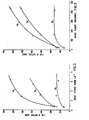
- Figure 2 shows lifetime to rupture, at 700°C and a stress of 36.6 ksi, as a function of boron content for three different levels of phosphorus content.
- Curve 30 shows that increasing boron content in alloys containing 0.005 wt.% phosphorus while initially producing a small increase in rupture lifetime, does not produce an increase in rupture lifetime above boron contents of 0.0028 wt.%.
- Curve 20, for alloys containing nominally 0.03 wt.% phosphorus indicates that increasing the boron content of these alloys results in a substantially linear increase in the rupture life time.
- Curve 10 for alloys containing nominally 0.085 wt.% phosphorus indicates that increasing the boron content from 0.0008 wt.% to 0.0029 wt.% results in an approximate tripling of the stress rupture life time. Increasing the boron content from 0.0029 to 0.0064 wt.% results in a further increase in rupture lifetime which is, however, not as large as the increase in going from 0.0008 to 0.0029 wt.%.
- Figure 3 utilizing the same data used to plot the Figure 2 curves, shows the stress rupture lifetime as a function of phosphorus content for three different levels of boron content.
- Curve 60 for alloys containing nominally 0.0008 wt.% boron, shows that increasing phosphorus from less than 0.005 wt.% to about 0.03 wt.% produces a small increase in rupture lifetime, but that further increases in phosphorus content do not produce further increases in rupture lifetime.
- Curve 50 for alloys containing about 0.003 wt.% boron, shows that increasing phosphorus produces an almost linearly increasing stress rupture lifetime from just above 100 hours for less than 0.005 wt.% phosphorus to over 500 hours for about 0.085 wt.% phosphorus.
- Curve 40 for alloys containing about 0.006 wt.% boron, shows that up to about 0.03 wt.% phosphorus, rupture lifetime increases at a faster rate than in the 0.003 wt.% boron alloys 50, but beyond about .030 wt.% phosphorus, the rate of increase in rupture lifetime with phosphorus content is substantially the same as that shown by curve 50 for the same phosphorus content interval.
- boron should be present at levels of 0.003 wt.% to 0.006 wt.%, and phosphorus should be present between 0.025 wt.% and 0.06 wt.%.
- Maximum stress rupture lifetime can be obtained by simultaneously maximizing the boron and phosphorus contents within the above ranges.
- Approximately equivalent stress rupture lifetimes can be maintained between different alloys having varying boron and phosphorus contents within the aforementioned ranges by setting the product of the phosphorus and boron contents of the desired alloy equal to the product of the phosphorus and boron contents of the other alloy.
Landscapes
- Engineering & Computer Science (AREA)
- Metallurgy (AREA)
- Physics & Mathematics (AREA)
- Chemical & Material Sciences (AREA)
- Plasma & Fusion (AREA)
- General Engineering & Computer Science (AREA)
- High Energy & Nuclear Physics (AREA)
- Materials Engineering (AREA)
- Mechanical Engineering (AREA)
- Organic Chemistry (AREA)
- Heat Treatment Of Steel (AREA)
Applications Claiming Priority (2)
| Application Number | Priority Date | Filing Date | Title |
|---|---|---|---|
| US484322 | 1983-04-12 | ||
| US06/484,322 US4530719A (en) | 1983-04-12 | 1983-04-12 | Austenitic stainless steel for high temperature applications |
Publications (3)
| Publication Number | Publication Date |
|---|---|
| EP0121630A2 true EP0121630A2 (de) | 1984-10-17 |
| EP0121630A3 EP0121630A3 (en) | 1985-01-09 |
| EP0121630B1 EP0121630B1 (de) | 1987-07-29 |
Family
ID=23923668
Family Applications (1)
| Application Number | Title | Priority Date | Filing Date |
|---|---|---|---|
| EP83307474A Expired EP0121630B1 (de) | 1983-04-12 | 1983-12-08 | Austenitische Stahllegierungen für Anwendungen bei hohen Temperaturen |
Country Status (6)
| Country | Link |
|---|---|
| US (1) | US4530719A (de) |
| EP (1) | EP0121630B1 (de) |
| JP (1) | JPS59190351A (de) |
| CA (1) | CA1217359A (de) |
| DE (1) | DE3372791D1 (de) |
| ES (1) | ES8801708A1 (de) |
Cited By (3)
| Publication number | Priority date | Publication date | Assignee | Title |
|---|---|---|---|---|
| EP0371202A1 (de) * | 1988-11-30 | 1990-06-06 | Westinghouse Electric Corporation | Hochfester legierter martensitischer Stahl und Verfahren zu seiner Herstellung |
| EP0530725A1 (de) * | 1991-09-03 | 1993-03-10 | Hitachi, Ltd. | Austentischer rostfreier Stahl mit hohe Beständigkeit gegen durch Strahlung verursachte Entmischung |
| CN113493881A (zh) * | 2021-06-24 | 2021-10-12 | 江苏良工精密合金钢有限公司 | 超纯净耐热不锈圆钢及制造工艺 |
Families Citing this family (7)
| Publication number | Priority date | Publication date | Assignee | Title |
|---|---|---|---|---|
| US4613479A (en) * | 1984-03-14 | 1986-09-23 | Westinghouse Electric Corp. | Water reactor fuel cladding |
| US4863682A (en) * | 1988-03-11 | 1989-09-05 | General Electric Company | Austenitic stainless steel alloy |
| US5196272A (en) * | 1989-08-01 | 1993-03-23 | Ishikawajima-Harima Heavy Industries Co., Ltd. | Corrosion resistant stainless steel |
| US5475723A (en) * | 1994-03-21 | 1995-12-12 | General Electric Company | Nuclear fuel cladding with hydrogen absorbing inner liner |
| RU2233906C1 (ru) * | 2003-04-03 | 2004-08-10 | Открытое акционерное общество "Машиностроительный завод" | Аустенитная сталь |
| JP5861599B2 (ja) * | 2012-09-04 | 2016-02-16 | 新日鐵住金株式会社 | 原子炉用オーステナイト系ステンレス鋼 |
| CN110951955A (zh) * | 2019-11-11 | 2020-04-03 | 邯郸钢铁集团有限责任公司 | 低成本高强工程机械用钢q460md及其生产方法 |
Family Cites Families (11)
| Publication number | Priority date | Publication date | Assignee | Title |
|---|---|---|---|---|
| US3118761A (en) * | 1955-05-09 | 1964-01-21 | Westinghouse Electric Corp | Crack resistant austenitic stainless steel alloys |
| DE1558635B2 (de) * | 1966-02-10 | 1970-06-18 | Sumitomo Kinzoku Kogyo Kabushiki Kaisha, Osaka (Japan) | Hochfester stabilaustenitischer korrosionsbeständiger Stahl zur Herstellung von Verdampferrohren und Überhitzerrohren |
| CA953947A (en) * | 1970-07-14 | 1974-09-03 | Sumitomo Metal Industries, Ltd. | Ni-cr stainless steels excellent in resistance to stress corrosion cracking |
| US4158606A (en) * | 1977-01-27 | 1979-06-19 | The United States Department Of Energy | Austenitic stainless steel alloys having improved resistance to fast neutron-induced swelling |
| JPS53131397A (en) * | 1977-04-22 | 1978-11-16 | Toshiba Corp | Nuclear fuel element |
| JPS5456018A (en) * | 1977-10-12 | 1979-05-04 | Sumitomo Metal Ind Ltd | Austenitic steel with superior oxidation resistance for high temperature use |
| DE3070736D1 (en) * | 1980-01-09 | 1985-07-11 | Westinghouse Electric Corp | Austenitic iron base alloy |
| US4407673A (en) * | 1980-01-09 | 1983-10-04 | Korenko Michael K | Solid solution strengthened duct and cladding alloy D9-B1 |
| JPS5856024B2 (ja) * | 1980-03-08 | 1983-12-13 | 動力炉・核燃料開発事業団 | 高速炉々心構造用オ−ステナイト系鋼 |
| US4421572A (en) * | 1982-03-18 | 1983-12-20 | The United States Of America As Represented By The United States Department Of Energy | Thermomechanical treatment of alloys |
| US4576641A (en) * | 1982-09-02 | 1986-03-18 | The United States Of America As Represented By The United States Department Of Energy | Austenitic alloy and reactor components made thereof |
-
1983
- 1983-04-12 US US06/484,322 patent/US4530719A/en not_active Expired - Fee Related
- 1983-12-08 EP EP83307474A patent/EP0121630B1/de not_active Expired
- 1983-12-08 DE DE8383307474T patent/DE3372791D1/de not_active Expired
- 1983-12-09 ES ES527922A patent/ES8801708A1/es not_active Expired
- 1983-12-09 JP JP58233469A patent/JPS59190351A/ja active Pending
- 1983-12-09 CA CA000442973A patent/CA1217359A/en not_active Expired
Cited By (4)
| Publication number | Priority date | Publication date | Assignee | Title |
|---|---|---|---|---|
| EP0371202A1 (de) * | 1988-11-30 | 1990-06-06 | Westinghouse Electric Corporation | Hochfester legierter martensitischer Stahl und Verfahren zu seiner Herstellung |
| EP0530725A1 (de) * | 1991-09-03 | 1993-03-10 | Hitachi, Ltd. | Austentischer rostfreier Stahl mit hohe Beständigkeit gegen durch Strahlung verursachte Entmischung |
| US5316597A (en) * | 1991-09-03 | 1994-05-31 | Hitachi, Ltd. | A nuclear reactor comprising a reactor vessel and structural members made of an austenitic stainless steel having superior resistance to irradiation-induced segregation |
| CN113493881A (zh) * | 2021-06-24 | 2021-10-12 | 江苏良工精密合金钢有限公司 | 超纯净耐热不锈圆钢及制造工艺 |
Also Published As
| Publication number | Publication date |
|---|---|
| EP0121630A3 (en) | 1985-01-09 |
| ES8801708A1 (es) | 1988-02-16 |
| ES527922A0 (es) | 1988-02-16 |
| EP0121630B1 (de) | 1987-07-29 |
| DE3372791D1 (en) | 1987-09-03 |
| US4530719A (en) | 1985-07-23 |
| JPS59190351A (ja) | 1984-10-29 |
| CA1217359A (en) | 1987-02-03 |
Similar Documents
| Publication | Publication Date | Title |
|---|---|---|
| US4212686A (en) | Zirconium alloys | |
| CA1066922A (en) | Heat-resistant allow for welded structures | |
| EP0415134A1 (de) | Legierungswerkstoff auf Zirkoniumbasis zur Anwendung bei einem Leichtwasserreaktor | |
| US4818485A (en) | Radiation resistant austenitic stainless steel alloys | |
| EP0121630B1 (de) | Austenitische Stahllegierungen für Anwendungen bei hohen Temperaturen | |
| US4049431A (en) | High strength ferritic alloy | |
| US4844864A (en) | Precipitation hardenable, nickel-base alloy | |
| EP0106426B1 (de) | Austenitische Legierung und deren Verwendung als Reaktorbauteil | |
| DE3020844C2 (de) | Verwendung hochwarmfester, gegen Korrosion resistenter, austenitischer Eisen-Nickel-Chrom-Legierungen mit hoher Langzeit-Stand-Festigkeit | |
| EP0174418B1 (de) | Austenitische Legierungen auf Eisen-Mangan-Basis und auf Eisen-Mangan-Chrom-Basis | |
| JPH07116575B2 (ja) | 耐応力腐食割れの改善のための合金718の熱処理 | |
| US4842814A (en) | Nuclear reactor fuel assembly | |
| DE10332239B3 (de) | Zirkoniumlegierung und Bauteile für den Kern von leichtwassergekühlten Kernreaktoren | |
| JPS6325062B2 (de) | ||
| US4144059A (en) | Ductile long range ordered alloys with high critical ordering temperature and wrought articles fabricated therefrom | |
| US4877465A (en) | Structural parts of austenitic nickel-chromium-iron alloy | |
| EP0037446B1 (de) | Austenitische Eisenlegierung | |
| US3856517A (en) | Irradiation swelling resistant alloy for use in fast neutron reactors | |
| CN118979177A (zh) | 一种高功率微堆用镍基合金及其制造方法 | |
| US4299625A (en) | Niobium-base alloy | |
| US3597193A (en) | Vanadium base alloy | |
| KR102670439B1 (ko) | 납 또는 납-비스무스 공융물 내의 내부식성 알루미나 산화막 형성 오스테나이트계 스테인리스 강 및 이의 제조 방법 | |
| JP2000282101A (ja) | 酸化物分散強化型フェライト鋼の製造方法 | |
| Iwao et al. | Mechanical properties of vanadium-base binary alloys | |
| JPH02190446A (ja) | 燃料被覆材料としてのマルテンサイト系合金鋼及びその製造方法 |
Legal Events
| Date | Code | Title | Description |
|---|---|---|---|
| PUAI | Public reference made under article 153(3) epc to a published international application that has entered the european phase |
Free format text: ORIGINAL CODE: 0009012 |
|
| AK | Designated contracting states |
Designated state(s): BE DE FR GB IT NL SE |
|
| PUAL | Search report despatched |
Free format text: ORIGINAL CODE: 0009013 |
|
| AK | Designated contracting states |
Designated state(s): BE DE FR GB IT NL SE |
|
| 17P | Request for examination filed |
Effective date: 19850704 |
|
| 17Q | First examination report despatched |
Effective date: 19860221 |
|
| GRAA | (expected) grant |
Free format text: ORIGINAL CODE: 0009210 |
|
| AK | Designated contracting states |
Kind code of ref document: B1 Designated state(s): BE DE FR GB IT NL SE |
|
| REF | Corresponds to: |
Ref document number: 3372791 Country of ref document: DE Date of ref document: 19870903 |
|
| ET | Fr: translation filed | ||
| ITF | It: translation for a ep patent filed | ||
| PGFP | Annual fee paid to national office [announced via postgrant information from national office to epo] |
Ref country code: NL Payment date: 19871231 Year of fee payment: 5 |
|
| PLBI | Opposition filed |
Free format text: ORIGINAL CODE: 0009260 |
|
| 26 | Opposition filed |
Opponent name: COMMISSARIAT A L'ENERGIE ATOMIQUE Effective date: 19880418 |
|
| NLR1 | Nl: opposition has been filed with the epo |
Opponent name: COMMISSARIAT A L'ENERGIE ATOMIQUE |
|
| PGFP | Annual fee paid to national office [announced via postgrant information from national office to epo] |
Ref country code: DE Payment date: 19881227 Year of fee payment: 6 |
|
| ITTA | It: last paid annual fee | ||
| PG25 | Lapsed in a contracting state [announced via postgrant information from national office to epo] |
Ref country code: GB Effective date: 19891208 |
|
| PG25 | Lapsed in a contracting state [announced via postgrant information from national office to epo] |
Ref country code: SE Effective date: 19891209 |
|
| PG25 | Lapsed in a contracting state [announced via postgrant information from national office to epo] |
Ref country code: BE Effective date: 19891231 |
|
| BERE | Be: lapsed |
Owner name: WESTINGHOUSE ELECTRIC CORP. Effective date: 19891231 |
|
| PG25 | Lapsed in a contracting state [announced via postgrant information from national office to epo] |
Ref country code: NL Effective date: 19900701 |
|
| GBPC | Gb: european patent ceased through non-payment of renewal fee | ||
| NLV4 | Nl: lapsed or anulled due to non-payment of the annual fee | ||
| PG25 | Lapsed in a contracting state [announced via postgrant information from national office to epo] |
Ref country code: FR Effective date: 19900831 |
|
| PG25 | Lapsed in a contracting state [announced via postgrant information from national office to epo] |
Ref country code: DE Effective date: 19900901 |
|
| PLBN | Opposition rejected |
Free format text: ORIGINAL CODE: 0009273 |
|
| STAA | Information on the status of an ep patent application or granted ep patent |
Free format text: STATUS: OPPOSITION REJECTED |
|
| REG | Reference to a national code |
Ref country code: FR Ref legal event code: ST |
|
| 27O | Opposition rejected |
Effective date: 19900630 |
|
| EUG | Se: european patent has lapsed |
Ref document number: 83307474.3 Effective date: 19900830 |