EP0121226A1 - Verfahren zur Herstellung von Phosphinothricin - Google Patents
Verfahren zur Herstellung von Phosphinothricin Download PDFInfo
- Publication number
- EP0121226A1 EP0121226A1 EP84103398A EP84103398A EP0121226A1 EP 0121226 A1 EP0121226 A1 EP 0121226A1 EP 84103398 A EP84103398 A EP 84103398A EP 84103398 A EP84103398 A EP 84103398A EP 0121226 A1 EP0121226 A1 EP 0121226A1
- Authority
- EP
- European Patent Office
- Prior art keywords
- salts
- acid
- hydroxymethylphosphinyl
- ammonia
- phosphinothricin
- Prior art date
- Legal status (The legal status is an assumption and is not a legal conclusion. Google has not performed a legal analysis and makes no representation as to the accuracy of the status listed.)
- Granted
Links
- IAJOBQBIJHVGMQ-UHFFFAOYSA-N Phosphinothricin Natural products CP(O)(=O)CCC(N)C(O)=O IAJOBQBIJHVGMQ-UHFFFAOYSA-N 0.000 title description 4
- IAJOBQBIJHVGMQ-BYPYZUCNSA-N glufosinate-P Chemical compound CP(O)(=O)CC[C@H](N)C(O)=O IAJOBQBIJHVGMQ-BYPYZUCNSA-N 0.000 title description 4
- 238000004519 manufacturing process Methods 0.000 title description 2
- 238000000034 method Methods 0.000 claims abstract description 21
- QGZKDVFQNNGYKY-UHFFFAOYSA-N Ammonia Chemical compound N QGZKDVFQNNGYKY-UHFFFAOYSA-N 0.000 claims abstract description 18
- 150000003839 salts Chemical class 0.000 claims abstract description 12
- UFHFLCQGNIYNRP-UHFFFAOYSA-N Hydrogen Chemical compound [H][H] UFHFLCQGNIYNRP-UHFFFAOYSA-N 0.000 claims abstract description 10
- 239000003054 catalyst Substances 0.000 claims abstract description 10
- 229910052739 hydrogen Inorganic materials 0.000 claims abstract description 10
- 239000001257 hydrogen Substances 0.000 claims abstract description 10
- 229910021529 ammonia Inorganic materials 0.000 claims abstract description 9
- 238000005984 hydrogenation reaction Methods 0.000 claims abstract description 7
- 238000002360 preparation method Methods 0.000 claims abstract description 6
- 150000003141 primary amines Chemical class 0.000 claims abstract description 5
- YJTNHDYMQPHXFO-UHFFFAOYSA-N 4-(hydroxymethylphosphinyl)-2-oxobutyric acid Chemical compound CP(O)(=O)CCC(=O)C(O)=O YJTNHDYMQPHXFO-UHFFFAOYSA-N 0.000 claims description 8
- FNJQGUKETYGBGL-UHFFFAOYSA-N OC(=O)C(N)CCP(=O)CO Chemical compound OC(=O)C(N)CCP(=O)CO FNJQGUKETYGBGL-UHFFFAOYSA-N 0.000 claims description 4
- 238000003776 cleavage reaction Methods 0.000 abstract 1
- 230000007017 scission Effects 0.000 abstract 1
- OKKJLVBELUTLKV-UHFFFAOYSA-N Methanol Chemical compound OC OKKJLVBELUTLKV-UHFFFAOYSA-N 0.000 description 21
- KDLHZDBZIXYQEI-UHFFFAOYSA-N Palladium Chemical compound [Pd] KDLHZDBZIXYQEI-UHFFFAOYSA-N 0.000 description 9
- 150000003863 ammonium salts Chemical class 0.000 description 9
- 239000000047 product Substances 0.000 description 7
- OKTJSMMVPCPJKN-UHFFFAOYSA-N Carbon Chemical compound [C] OKTJSMMVPCPJKN-UHFFFAOYSA-N 0.000 description 6
- WGQKYBSKWIADBV-UHFFFAOYSA-N benzylamine Chemical compound NCC1=CC=CC=C1 WGQKYBSKWIADBV-UHFFFAOYSA-N 0.000 description 6
- 238000004128 high performance liquid chromatography Methods 0.000 description 6
- 238000006243 chemical reaction Methods 0.000 description 4
- 238000001035 drying Methods 0.000 description 4
- 229910052763 palladium Inorganic materials 0.000 description 4
- BASFCYQUMIYNBI-UHFFFAOYSA-N platinum Chemical compound [Pt] BASFCYQUMIYNBI-UHFFFAOYSA-N 0.000 description 4
- 239000000843 powder Substances 0.000 description 4
- 230000002829 reductive effect Effects 0.000 description 4
- 239000002904 solvent Substances 0.000 description 4
- LFQSCWFLJHTTHZ-UHFFFAOYSA-N Ethanol Chemical compound CCO LFQSCWFLJHTTHZ-UHFFFAOYSA-N 0.000 description 3
- PXHVJJICTQNCMI-UHFFFAOYSA-N Nickel Chemical compound [Ni] PXHVJJICTQNCMI-UHFFFAOYSA-N 0.000 description 3
- YXFVVABEGXRONW-UHFFFAOYSA-N Toluene Chemical compound CC1=CC=CC=C1 YXFVVABEGXRONW-UHFFFAOYSA-N 0.000 description 3
- 239000002253 acid Substances 0.000 description 3
- 150000007513 acids Chemical class 0.000 description 3
- HWXBTNAVRSUOJR-UHFFFAOYSA-N alpha-hydroxyglutaric acid Natural products OC(=O)C(O)CCC(O)=O HWXBTNAVRSUOJR-UHFFFAOYSA-N 0.000 description 3
- 239000003085 diluting agent Substances 0.000 description 3
- 230000008018 melting Effects 0.000 description 3
- 238000002844 melting Methods 0.000 description 3
- 239000000203 mixture Substances 0.000 description 3
- 238000006268 reductive amination reaction Methods 0.000 description 3
- XLYOFNOQVPJJNP-UHFFFAOYSA-N water Substances O XLYOFNOQVPJJNP-UHFFFAOYSA-N 0.000 description 3
- RQEUFEKYXDPUSK-UHFFFAOYSA-N 1-phenylethylamine Chemical compound CC(N)C1=CC=CC=C1 RQEUFEKYXDPUSK-UHFFFAOYSA-N 0.000 description 2
- KPGXRSRHYNQIFN-UHFFFAOYSA-N 2-oxoglutaric acid Chemical compound OC(=O)CCC(=O)C(O)=O KPGXRSRHYNQIFN-UHFFFAOYSA-N 0.000 description 2
- KFZMGEQAYNKOFK-UHFFFAOYSA-N Isopropanol Chemical compound CC(C)O KFZMGEQAYNKOFK-UHFFFAOYSA-N 0.000 description 2
- ZLMJMSJWJFRBEC-UHFFFAOYSA-N Potassium Chemical compound [K] ZLMJMSJWJFRBEC-UHFFFAOYSA-N 0.000 description 2
- 150000001370 alpha-amino acid derivatives Chemical class 0.000 description 2
- 235000008206 alpha-amino acids Nutrition 0.000 description 2
- 238000000354 decomposition reaction Methods 0.000 description 2
- 239000002638 heterogeneous catalyst Substances 0.000 description 2
- -1 methanephosphonous ester Chemical class 0.000 description 2
- 229910052697 platinum Inorganic materials 0.000 description 2
- 229910052700 potassium Inorganic materials 0.000 description 2
- 239000011591 potassium Substances 0.000 description 2
- 229920006395 saturated elastomer Polymers 0.000 description 2
- 239000007858 starting material Substances 0.000 description 2
- 239000000126 substance Substances 0.000 description 2
- 238000003786 synthesis reaction Methods 0.000 description 2
- RQEUFEKYXDPUSK-ZETCQYMHSA-N (1S)-1-phenylethanamine Chemical compound C[C@H](N)C1=CC=CC=C1 RQEUFEKYXDPUSK-ZETCQYMHSA-N 0.000 description 1
- TYEYBOSBBBHJIV-UHFFFAOYSA-N 2-oxobutanoic acid Chemical compound CCC(=O)C(O)=O TYEYBOSBBBHJIV-UHFFFAOYSA-N 0.000 description 1
- QTBSBXVTEAMEQO-UHFFFAOYSA-M Acetate Chemical compound CC([O-])=O QTBSBXVTEAMEQO-UHFFFAOYSA-M 0.000 description 1
- DGAQECJNVWCQMB-PUAWFVPOSA-M Ilexoside XXIX Chemical compound C[C@@H]1CC[C@@]2(CC[C@@]3(C(=CC[C@H]4[C@]3(CC[C@@H]5[C@@]4(CC[C@@H](C5(C)C)OS(=O)(=O)[O-])C)C)[C@@H]2[C@]1(C)O)C)C(=O)O[C@H]6[C@@H]([C@H]([C@@H]([C@H](O6)CO)O)O)O.[Na+] DGAQECJNVWCQMB-PUAWFVPOSA-M 0.000 description 1
- WHUUTDBJXJRKMK-VKHMYHEASA-N L-glutamic acid Chemical compound OC(=O)[C@@H](N)CCC(O)=O WHUUTDBJXJRKMK-VKHMYHEASA-N 0.000 description 1
- 229910010082 LiAlH Inorganic materials 0.000 description 1
- XQJBFCQFMRDQTH-UHFFFAOYSA-N OCP(=O)CCC(O)C(O)=O Chemical compound OCP(=O)CCC(O)C(O)=O XQJBFCQFMRDQTH-UHFFFAOYSA-N 0.000 description 1
- 239000007868 Raney catalyst Substances 0.000 description 1
- 229910000564 Raney nickel Inorganic materials 0.000 description 1
- 150000001298 alcohols Chemical class 0.000 description 1
- 229940009533 alpha-ketoglutaric acid Drugs 0.000 description 1
- 150000001412 amines Chemical class 0.000 description 1
- 230000000844 anti-bacterial effect Effects 0.000 description 1
- 239000003899 bactericide agent Substances 0.000 description 1
- 230000015572 biosynthetic process Effects 0.000 description 1
- 244000309464 bull Species 0.000 description 1
- 229910052799 carbon Inorganic materials 0.000 description 1
- 125000003178 carboxy group Chemical group [H]OC(*)=O 0.000 description 1
- 238000005119 centrifugation Methods 0.000 description 1
- 238000004587 chromatography analysis Methods 0.000 description 1
- 229910017052 cobalt Inorganic materials 0.000 description 1
- 239000010941 cobalt Substances 0.000 description 1
- GUTLYIVDDKVIGB-UHFFFAOYSA-N cobalt atom Chemical compound [Co] GUTLYIVDDKVIGB-UHFFFAOYSA-N 0.000 description 1
- 150000001875 compounds Chemical class 0.000 description 1
- 239000012043 crude product Substances 0.000 description 1
- 238000002425 crystallisation Methods 0.000 description 1
- 230000008025 crystallization Effects 0.000 description 1
- MGHPNCMVUAKAIE-UHFFFAOYSA-N diphenylmethanamine Chemical compound C=1C=CC=CC=1C(N)C1=CC=CC=C1 MGHPNCMVUAKAIE-UHFFFAOYSA-N 0.000 description 1
- 238000004821 distillation Methods 0.000 description 1
- 230000000694 effects Effects 0.000 description 1
- 238000001704 evaporation Methods 0.000 description 1
- 230000008020 evaporation Effects 0.000 description 1
- 239000000706 filtrate Substances 0.000 description 1
- 238000001914 filtration Methods 0.000 description 1
- 230000002363 herbicidal effect Effects 0.000 description 1
- 239000004009 herbicide Substances 0.000 description 1
- 239000002815 homogeneous catalyst Substances 0.000 description 1
- 239000012535 impurity Substances 0.000 description 1
- 238000002955 isolation Methods 0.000 description 1
- 229910052987 metal hydride Inorganic materials 0.000 description 1
- 150000004681 metal hydrides Chemical class 0.000 description 1
- 229910052759 nickel Inorganic materials 0.000 description 1
- 125000002524 organometallic group Chemical group 0.000 description 1
- ACVYVLVWPXVTIT-UHFFFAOYSA-N phosphinic acid Chemical group O[PH2]=O ACVYVLVWPXVTIT-UHFFFAOYSA-N 0.000 description 1
- 150000003151 propanoic acid esters Chemical class 0.000 description 1
- 239000011541 reaction mixture Substances 0.000 description 1
- 238000001953 recrystallisation Methods 0.000 description 1
- 229910052703 rhodium Inorganic materials 0.000 description 1
- 239000010948 rhodium Substances 0.000 description 1
- MHOVAHRLVXNVSD-UHFFFAOYSA-N rhodium atom Chemical compound [Rh] MHOVAHRLVXNVSD-UHFFFAOYSA-N 0.000 description 1
- 229910052708 sodium Inorganic materials 0.000 description 1
- 239000011734 sodium Substances 0.000 description 1
- 239000000725 suspension Substances 0.000 description 1
- BZVJOYBTLHNRDW-UHFFFAOYSA-N triphenylmethanamine Chemical compound C=1C=CC=CC=1C(C=1C=CC=CC=1)(N)C1=CC=CC=C1 BZVJOYBTLHNRDW-UHFFFAOYSA-N 0.000 description 1
- 238000010626 work up procedure Methods 0.000 description 1
Classifications
-
- C—CHEMISTRY; METALLURGY
- C07—ORGANIC CHEMISTRY
- C07F—ACYCLIC, CARBOCYCLIC OR HETEROCYCLIC COMPOUNDS CONTAINING ELEMENTS OTHER THAN CARBON, HYDROGEN, HALOGEN, OXYGEN, NITROGEN, SULFUR, SELENIUM OR TELLURIUM
- C07F9/00—Compounds containing elements of Groups 5 or 15 of the Periodic Table
- C07F9/02—Phosphorus compounds
- C07F9/28—Phosphorus compounds with one or more P—C bonds
- C07F9/30—Phosphinic acids [R2P(=O)(OH)]; Thiophosphinic acids ; [R2P(=X1)(X2H) (X1, X2 are each independently O, S or Se)]
- C07F9/301—Acyclic saturated acids which can have further substituents on alkyl
Definitions
- a disadvantage of this process is the very considerable amount of salt and the complex removal of I from the Reaction mixture, since the resulting ⁇ -amino acid has solubility properties like that of inorganic salts. Impurities which arise during the preparation of the starting compound by adding the methanephosphonous ester to acroleincyanhydrin acetate also have a negative effect on the course of the last stage and significantly reduce the yield.
- An additional disadvantage is the fact that the synthesis of optically active I is not possible using this method.
- Japan 36, 763 (1963) discloses that in the reductive amination of ⁇ -ketoglutaric acid (the carboxyl analog of II), ⁇ -hydroxyglutaric acid is formed to a considerable extent in addition to the desired ⁇ -aminoglutaric acid.
- the II or its salts required as a starting compound for the process according to the invention are from commercially available 3- (alkoxymethylphosphinyl) propionic acid esters of the general formula IV, wherein R and R may be the same or different and each represent a (C 1 -C 4 ) alkyl radical, can be prepared according to EP - A 30 424.
- the mono- and bis- come as salts Salts of II, especially the sodium, potassium and ammonium salts in question.
- Lower alcohols such as methanol, ethanol and isopropanol or water, or else mixtures of these solvents or diluents are preferably suitable as solvents or diluents for the process according to the invention.
- the reaction temperatures are generally -10 to 150 ° C, preferably 20-100 ° C.
- Preferred hydrogenation catalysts are heterogeneous catalysts, such as platinum, palladium, nickel, cobalt and rhodium catalysts in their most varied forms of use.
- heterogeneous catalysts such as, for example, potassium pentacyano-cobaltate or metal hydrides (for example LiAlH 4 , NaBH 4 ), is also possible.
- primary amines whose C-N bond is split hydrogenolytically by the hydrogenation catalysts mentioned are also suitable as amines for the process according to the invention. These are in particular benzylamine, benzhydrylamine, tritylamine, D, L-1-phenylethylamine, (+) - 1-phenylethylamine, (-) - 1-phenylethylamine.
- Ammonia or the primary amine are used in equimolar amounts or in a 10-fold excess.
- the process according to the invention is generally carried out in a hydrogen atmosphere at pressures between 1 and 200 bar, preferably between 1 and 50 bar.
- the reaction can be regarded as complete when no more hydrogen is consumed under the given reaction conditions (constant pressure).
- the isolation of the process product is very simple in terms of apparatus, since the process product, after evaporation of the solvent or diluent under reduced pressure, is already sufficient chemical purity.
- the yields are approximately 85-95%.
- the crude process product can then be further purified either by recrystallization or by chromatography.
Landscapes
- Chemical & Material Sciences (AREA)
- Organic Chemistry (AREA)
- Health & Medical Sciences (AREA)
- Life Sciences & Earth Sciences (AREA)
- Biochemistry (AREA)
- General Health & Medical Sciences (AREA)
- Molecular Biology (AREA)
- Organic Low-Molecular-Weight Compounds And Preparation Thereof (AREA)
- Low-Molecular Organic Synthesis Reactions Using Catalysts (AREA)
- Steroid Compounds (AREA)
Abstract

Description
- Die Erfindung betrifft ein neues Verfahren zur Herstellung von 4-(Hydroxymethylphosphinyl)-2-aminobuttersäure (=Phosphinothricin) der Formel I

- Die Verbindung I ist bekannt und wird z.B. in Helv. Chim. Acta 55, 224 (1972) und DE-OS 27 17 440 als Bakterizid bzw. Herbizid beschrieben. Zur Herstellung von I sind in der Literatur bereits zahlreiche Methoden beschrieben /Helv. Chim. Acta 55, 229 (1972); Japan. Kokai Sho-48-091019 (27.11.1973); Rocz. Chem. 49, 2 127 (1975); J. prakt. Chemie 318, 157 (1976); EP-A 9 022 (12.07.1979); Pol. J. Chem. 53, 937, (1979); EP-A 18 145 (13.12.1979); JA-A Sho-55-064 595; C.A. 94, 84 295 b (15.05.1980); EP-A 11 2457, die jedoch mit wenigen Ausnahmen keine befriedigenden Ausbeuten liefern.
- Gemäß dem in EP-A 11 245 beschriebenen Verfahren entsteht I nach folgender Reaktion

- Nachteilig an diesem Verfahren ist der recht erhebliche Salzanfall und die aufwendige Abtrennung von I aus dem Reaktionsgemisch, da die entstehende α-Aminosäure Löslichkeitseigenschaften wie die von anorganischen Salzen besitzt. Ebenso wirken sich Verunreinigungen, die bei der Herstellung der Ausgangsverbindung durch Addition des Methanphosphonigsäureesters an Acroleincyanhydrinacetat entstehen, negativ auf den Verlauf der letzten Stufe aus und mindern deutlich den Ertrag. Ein zusätzlicher Nachteil ist darin zu sehen, daß die Synthese von optisch aktivem I nach diesem Verfahren nicht möglich ist.
- Es wurde nun gefunden, daß man die beschriebenen Nachteile ohne Verminderung der Ausbeute vermeidet, wenn man 4-(Hydroxymethylphosphinyl)-2-oxobuttersäure der Formel II

- Die reduktive Aminierung von α -Oxocarbonsäuren zu den entsprechenden α-Aminocarbonsäuren ist an sich bekannt. Dennoch ist das Ergebnis des erfindungsgemäßen Verfahrens in mehrfacher Hinsicht als überraschend zu bezeichnen.
- Zum einen mußte damit gerechnet werden, daß unter den Hydrierungsbedingungen auch der Phosphinsäureteil der α-Oxobuttersäure II reduziert würde. /Helv. Chim. Acta 49., 842 (1966) ; J..Am. Chem. Soc. 90, 3 459 (1968) ; J. Organometallic Chem. 97, C 31 (1975); Chem. Ber. 113, 1 356 (1980)/. Zum anderen war zu erwarten, daß bei der Reaktion die unerwünschte 4-(Hydroxymethylphosphinyl)-2-hydroxybuttersäure der Formel III
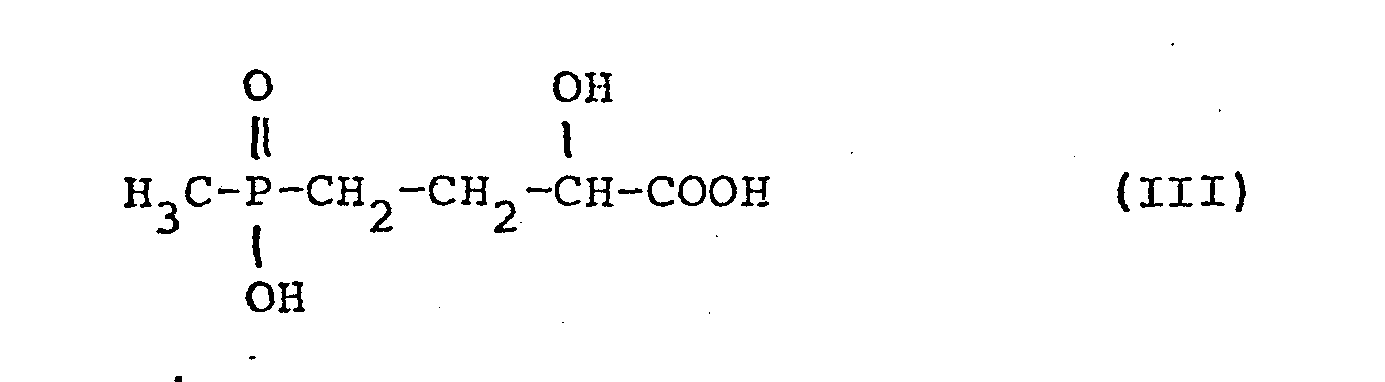
- Angesichts dieser Tatsachen war die hohe chemische Ausbeute und die Reinheit des Verfahrensprodukt bei Anwendung des erfindungsgemäßen Verfahrens nicht zu erwarten.
- Wie unerwartet ein solches Verfahren war, wird besonders deutlich dadurch, daß zwar viele Verfahren zur Herstellung von 1 beschrieben worden sind, kein einziges jedoch diese Möglichkeit in Betracht gezogen hat, obwohl eine ganze Reihe von α-Aminosäuresynthesen auf der reduktiven Aminierung von K-Oxocarbonsäuren aufbauen.
- Das als Ausgangsverbindung für das erfindungsgemäße Verfahren benötigte II bzw. seine Salze sind aus handelsüblichen 3-(Alkoxymethylphosphinyl)-propionsäureestern der allgemeinen Formel IV,

- Als Lösungs- bzw. Verdünnungsmittel für das erfindungsgemäße Verfahren eignen sich bevorzugt niedere Alkohole, wie Methanol, Ethanol und Isopropanol oder Wasser, oder auch Gemische dieser Lösungs- bzw. Verdünnungsmittel.
- Die Reaktionstemperaturen betragen im allgemeinen -10 bis 150°C vorzugsweise 20 - 100°C.
- Als Hydrierungskatalysatoren kommen bevorzugt heterogene Katalysatoren, wie z.B. Platin-, Palladium-, Nickel-, Kobalt- und Rhodium-Katalysatoren in ihren verschiedensten Anwendungsformen in Frage. Auch der Einsatz von homogenen Katalysatoren, wie z.B. Kaliumpentacyano-kobaltat oder Metallhydriden(z.B. LiAlH4, NaBH4) ist möglich.
- Als Amine kommen für das erfindungsgemäße Verfahren neben Ammoniak auch solche primären Amine, deren C-N-Bindung durch die genannten Hydrierungskatalysatoren hydrogenolytisch gespalten wird, in Frage. Dies sind insbesondere Benzylamin, Benzhydrylamin, Tritylamin,D,L-1 -Phenylethylamin, (+)-1-Phenylethylamin, (-)-1-Phenylethylamin.
- Ammoniak oder das primäre Amin werden äquimolar oder in einem bis zu 10fachen überschuß eingesetzt. Das erfindungsgemäße Verfahren wird je nach der Natur des verwendeten Katalysators in einer Wasserstoffatmosphäre im allgemeinen bei Drucken zwischen 1 und 200 bar vorzugsweise zwischen 1 und 50 bar durchgeführt.
- Die Reaktion kann als beendet angesehen werden, wenn unter den gegebenen Reaktionsbedingungen kein Wasserstoff mehr verbraucht wird (Druckkonstanz).
- Bei dem erfindungsgemäßen Verfahren gestaltet sich die Isolierung des Verfahrensproduktes, insbesondere beim Arbeiten mit heterogenen Katalysatoren, die durch Filtration ind/oder Zentrifugieren leicht abtrennbar sind, apparativ sehr einfach, da das Verfahrensprodukt nach Abdampfen des Lösungs- bzw. Verdünnungsmittels unter vermindertem Druck bereits in ausreichender chemischer Reinheit anfällt. Die Ausbeuten betragen ca. 85 - 95 %.
- Das rohe Verfahrensprodukt kann zusätzlich anschließend entweder durch Umkristallisieren oder durch Chromatographie weiter gereinigt werden.
- Das erfindungsgemäße Verfahren wird anhand der folgenden Herstellungsbeispiele näher erläutert.
-

- Schmelzbereich 205 - 215°C .(Zers.). Das Produkt bestand zu 90 % (HPLC-Analyse) aus dem gewünschten Ammoniumsalz des Phosphinothricins.
- Analog zu Beispiel 1 wurden 9,0 g (0.05 mol) 4-(Hydroxy- methylphosphinyl)-2-oxobuttersäure in Anwesenheit von 1 g 5 %igem Palladium auf A-Kohle bei 5 bar und 50°C hydriert.
- Nach Trocknen im Vakuum wurden 9,8 g pulverisiertes, farbloses Produkt erhalten, das bei 208 - 215°C unter Zersetzung schmolz und zu 93 % (HPLC-Analyse) aus dem Ammoniumsalz von I bestand.
- Analog Beispiel 1 wurden 18,0 g.(0.1 mol) 4-(Hydroxy- methylphosphinyl)-2-oxobuttersäure nach Zugabe von 1 g 10 %igem Platin auf A-Kohle bei 5 bar und 50°C hydriert.
- Nach Trocknen im Vakuum wurden 19,5 g farbloses Pulver vom Schmelzbereich 205 - 210°C (Zers.) erhalten, das zu 87 % (HPLC-Analyse) aus dem Ammoniumsalz von I bestand.
- 9,0 g (0.05 mol) 4-(Hydroxymethylphosphinyl)-2-oxobutter- säure wurden in 50 ml Methanol gelöst und innerhalb von 1 Stunde bei 20 -.25°C zu einer intensiv gerührten Suspension von 1 g 5 %igem Palladium auf A-Kohle in 50 ml mit Ammoniak gesättigtem Methanol bei einem Wasserstoffdruck von ca. 1,0 bis 1,2 bar zugetropft. Hierbei wurde eine Eigenbauapparatur entsprechend Houben-Weyl, Bd.IV/1c, S. 34 ff. benutzt. Nach beendeter Wasserstoffaufnahme wurde analog Beispiel 1 aufgearbeitet.
- Es wurden 9,8 g farbloses Pulver erhalten, das zwischen 208 und 213°C.unter Zersetzung schmolz und zu 95 % (HPLC-Analyse) aus dem Ammoniumsalz des Phosphinothricins bestand. Aus dem rohen Produkt konnten durch Kristallisation aus Methanol/Wasser 8 g reines I (Ammoniumsalz) vom Schmelzpunkt 210°C.(Zers.) gewonnen werden.
- 2,0 g (0.011 mol) 4-(Hydroxymethylphosphinyl)-2-oxo- buttersäure wurden in 50 ml Wasser, in das bei 10°C ca. 0,5 - 0,6 (mol) Ammoniak eingeleitet worden waren, gelöst und nach Zugabe von 0,5 g 5 %igem Palladium auf Aktivkohle bei 2 bar und 25°C in einem Schüttelautoklaven hydriert. Nach beendeter Wasserstoffaufnahme wurde wie in Beispiel 1 aufgearbeitet. Hierbei fielen nach Trocknen im Vakuum 2,1.g farbloses Pulver an, das zu 89 % (HPLC-Analyse) aus dem Ammoniumsalz von I bestand.
- 11,2 g (0.05 mol) Bis-Natriumsalz der 4-(Hydroxymethyl- phosphinyl)-2-oxobuttersäure und 5,4 g (0.05 mol) Benzylamin wurden in 50 ml Methanol gelöst und nach Zugabe von 2 g 5 %igem Palladium.auf A-Kohle bei 5 bar und 50°C in einem Schüttelautoklaven hydriert. Nach beendeter Wasserstoffaufnahme wurde vom Katalysator abfiltriert, und das Filtrat unter vermindertem Druck destilliert. Hierbei ging die Hauptmenge des Methanols zusammen mit Toluol und Spuren von nicht umgesetztem Benzylamin über.
- Nach Trocknen des öligen Rückstandes im Vakuum wurden 11 g farbloses Pulver erhalten, das zu 90 % (HPLC-Analyse) aus dem Bisnatriumsalz der 4-(Hydroxy-methylphosphinyl)-2-aminobuttersäure bestand.
Claims (1)
- Verfahren zur .Herstellung von 4-(Hydroxymethyl-phosphinyl) -2-aminobuttersäure der Formel


Priority Applications (1)
| Application Number | Priority Date | Filing Date | Title |
|---|---|---|---|
| AT84103398T ATE23342T1 (de) | 1983-04-02 | 1984-03-28 | Verfahren zur herstellung von phosphinothricin. |
Applications Claiming Priority (2)
| Application Number | Priority Date | Filing Date | Title |
|---|---|---|---|
| DE3312165 | 1983-04-02 | ||
| DE19833312165 DE3312165A1 (de) | 1983-04-02 | 1983-04-02 | Verfahren zur herstellung von phosphinothricin |
Publications (2)
| Publication Number | Publication Date |
|---|---|
| EP0121226A1 true EP0121226A1 (de) | 1984-10-10 |
| EP0121226B1 EP0121226B1 (de) | 1986-11-05 |
Family
ID=6195457
Family Applications (1)
| Application Number | Title | Priority Date | Filing Date |
|---|---|---|---|
| EP84103398A Expired EP0121226B1 (de) | 1983-04-02 | 1984-03-28 | Verfahren zur Herstellung von Phosphinothricin |
Country Status (9)
| Country | Link |
|---|---|
| EP (1) | EP0121226B1 (de) |
| JP (1) | JPS59184196A (de) |
| AT (1) | ATE23342T1 (de) |
| CA (1) | CA1231103A (de) |
| DD (1) | DD215554A5 (de) |
| DE (2) | DE3312165A1 (de) |
| HU (1) | HU196816B (de) |
| IL (1) | IL71424A (de) |
| ZA (1) | ZA842388B (de) |
Cited By (6)
| Publication number | Priority date | Publication date | Assignee | Title |
|---|---|---|---|---|
| EP0399949B1 (de) * | 1989-05-13 | 1995-04-12 | Ciba-Geigy Ag | Substituierte Aminoalkylphosphinsäure |
| WO2008138088A3 (en) * | 2007-05-16 | 2011-08-11 | Ricardo Amaral Remer | Solid and water-soluble gluphosinate for herbicide formulation, production process therefor, and process for controlling weeds |
| US8017797B2 (en) | 2007-03-23 | 2011-09-13 | Meiji Seika Kaisha Ltd. | Method for producing phosphorus-containing α-keto acid |
| CN107552071A (zh) * | 2017-09-26 | 2018-01-09 | 安徽国星生物化学有限公司 | 一种钴盐改性的雷尼镍的制备方法及合成草铵膦的方法 |
| WO2019015909A1 (de) | 2017-07-21 | 2019-01-24 | Basf Se | Herstellung von glufosinat durch umsetzung von 3-[n-butoxy(methyl)phosphoryl]-1 -cyanopropylacetat zu einer mischung aus n-butyl(3-amino-3-cyanopropyl)-methylphosphinat und (3-amino-3-cyanopropyl)-methylphosphinsäure ammoniumsalz |
| WO2019121362A1 (de) | 2017-12-19 | 2019-06-27 | Basf Se | VERFAHREN ZUR HERSTELLUNG VON PHOSPHORHALTIGEN α-AMINONITRILEN |
Families Citing this family (8)
| Publication number | Priority date | Publication date | Assignee | Title |
|---|---|---|---|---|
| DE3544376A1 (de) * | 1985-12-14 | 1987-06-19 | Hoechst Ag | Dipeptide mit c-terminalem phosphinothricin, verfahren zu ihrer herstellung und ihre verwendung zur bekaempfung unerwuenschten pflanzenwuchses |
| US5281747A (en) * | 1989-05-13 | 1994-01-25 | Ciba-Geigy Corporation | Substituted aminoalkylphosphinic acids |
| HU212802B (en) | 1991-07-19 | 1996-11-28 | Monsanto Europe Sa | Phytoactive sack-like composition containing glyphosate-izopropylamine salt |
| IL101539A (en) | 1991-04-16 | 1998-09-24 | Monsanto Europe Sa | Non-hygroscopic mono-ammonium salts of n-phosphonomethyl glycine derivatives their preparation and pesticidal compositons containing them |
| CN103539815B (zh) * | 2013-10-14 | 2016-03-23 | 苏州联合伟业科技有限公司 | 4-(羟基-(甲基)氧膦基)-2-氧代丁酸的生产工艺 |
| CN103665032B (zh) * | 2013-12-09 | 2016-02-17 | 江苏七洲绿色化工股份有限公司 | 一种草铵膦的制备方法 |
| CN105218579B (zh) * | 2015-09-28 | 2017-11-07 | 江苏七洲绿色化工股份有限公司 | 一种l‑型草铵膦铵盐的合成方法 |
| CN106565776A (zh) * | 2016-11-10 | 2017-04-19 | 安徽国星生物化学有限公司 | 一种4‑(甲基羟基磷酰基)‑2‑羰基丁酸的分离提纯方法 |
Citations (1)
| Publication number | Priority date | Publication date | Assignee | Title |
|---|---|---|---|---|
| EP0011245A1 (de) * | 1978-11-11 | 1980-05-28 | Hoechst Aktiengesellschaft | Verfahren zur Herstellung von phosphorhaltigen Cyanhydrinderivaten und diese Cyanhydrinderivate |
-
1983
- 1983-04-02 DE DE19833312165 patent/DE3312165A1/de not_active Withdrawn
-
1984
- 1984-03-27 HU HU841214A patent/HU196816B/hu unknown
- 1984-03-28 DE DE8484103398T patent/DE3461190D1/de not_active Expired
- 1984-03-28 EP EP84103398A patent/EP0121226B1/de not_active Expired
- 1984-03-28 AT AT84103398T patent/ATE23342T1/de not_active IP Right Cessation
- 1984-03-29 DD DD84261393A patent/DD215554A5/de not_active IP Right Cessation
- 1984-03-30 ZA ZA842388A patent/ZA842388B/xx unknown
- 1984-03-30 CA CA000450957A patent/CA1231103A/en not_active Expired
- 1984-03-31 JP JP59062239A patent/JPS59184196A/ja active Granted
- 1984-04-02 IL IL71424A patent/IL71424A/xx not_active IP Right Cessation
Patent Citations (1)
| Publication number | Priority date | Publication date | Assignee | Title |
|---|---|---|---|---|
| EP0011245A1 (de) * | 1978-11-11 | 1980-05-28 | Hoechst Aktiengesellschaft | Verfahren zur Herstellung von phosphorhaltigen Cyanhydrinderivaten und diese Cyanhydrinderivate |
Non-Patent Citations (2)
| Title |
|---|
| BULL. CHEM. SOC. JAPAN, Band 36, Nr. 7, Juli 1963, Seiten 763-769; M. MURAKAMI et al.: "Homogeneous hydrogenations of organic compounds with cobalt complex ions. VII. Homogeneous hydrogenations of organic compounds with a cyano cobalt complex as a catalyst" * |
| JOURNAL OF THE AMERICAN CHEMICAL SOCIETY, Band 90, Nr. 13, 19. Juni 1968, Seiten 3659-3665; T.L. EMMICK et al.: "Unsymmetrical secondary phosphine oxides. Synthetic, isotopic exchange and stereochemical studies" * |
Cited By (7)
| Publication number | Priority date | Publication date | Assignee | Title |
|---|---|---|---|---|
| EP0399949B1 (de) * | 1989-05-13 | 1995-04-12 | Ciba-Geigy Ag | Substituierte Aminoalkylphosphinsäure |
| US8017797B2 (en) | 2007-03-23 | 2011-09-13 | Meiji Seika Kaisha Ltd. | Method for producing phosphorus-containing α-keto acid |
| WO2008138088A3 (en) * | 2007-05-16 | 2011-08-11 | Ricardo Amaral Remer | Solid and water-soluble gluphosinate for herbicide formulation, production process therefor, and process for controlling weeds |
| WO2019015909A1 (de) | 2017-07-21 | 2019-01-24 | Basf Se | Herstellung von glufosinat durch umsetzung von 3-[n-butoxy(methyl)phosphoryl]-1 -cyanopropylacetat zu einer mischung aus n-butyl(3-amino-3-cyanopropyl)-methylphosphinat und (3-amino-3-cyanopropyl)-methylphosphinsäure ammoniumsalz |
| CN107552071A (zh) * | 2017-09-26 | 2018-01-09 | 安徽国星生物化学有限公司 | 一种钴盐改性的雷尼镍的制备方法及合成草铵膦的方法 |
| WO2019121362A1 (de) | 2017-12-19 | 2019-06-27 | Basf Se | VERFAHREN ZUR HERSTELLUNG VON PHOSPHORHALTIGEN α-AMINONITRILEN |
| US11220520B2 (en) | 2017-12-19 | 2022-01-11 | Basf Se | Method for preparing phosphorus-containing α-aminonitriles |
Also Published As
| Publication number | Publication date |
|---|---|
| DE3312165A1 (de) | 1984-10-04 |
| JPH047753B2 (de) | 1992-02-12 |
| IL71424A (en) | 1987-10-20 |
| EP0121226B1 (de) | 1986-11-05 |
| CA1231103A (en) | 1988-01-05 |
| IL71424A0 (en) | 1984-07-31 |
| ZA842388B (en) | 1984-11-28 |
| HU196816B (en) | 1989-01-30 |
| HUT34757A (en) | 1985-04-28 |
| JPS59184196A (ja) | 1984-10-19 |
| DD215554A5 (de) | 1984-11-14 |
| ATE23342T1 (de) | 1986-11-15 |
| DE3461190D1 (en) | 1986-12-11 |
Similar Documents
| Publication | Publication Date | Title |
|---|---|---|
| EP0121226B1 (de) | Verfahren zur Herstellung von Phosphinothricin | |
| EP0346658A1 (de) | Verfahren zur Herstellung phosphorhaltiger L-Aminosäuren sowie ihrer Ester und N-Derivate | |
| EP1472210A1 (de) | Verfahren zur herstellung substituierter acrylsäureester und deren einsatz zur herstellung von substituierten gamma-aminosäuren | |
| EP0238954B1 (de) | Verfahren zur Herstellung von L-Phosphinothricin(derivaten) sowie ihrer Alkylester | |
| EP0055695A1 (de) | Verfahren zur Herstellung von N-phosphonomethylglycin | |
| DE10007702A1 (de) | Verfahren zur Herstellung von N-(Phosphonomethyl)glycin | |
| DE60104446T2 (de) | VERFAHREN ZUR HERSTELLUNG VON Beta-PHOSPHORNITROXIDRADIKALEN | |
| EP0094633A2 (de) | Spiro-2-aza-alkan-3-carbonitrile, Verfahren zu ihrer Herstellung und ihre Verwendung | |
| DE3026094C2 (de) | Verfahren zur Herstellung von Cyclopropancarbonsäureamiden | |
| DE4142191A1 (de) | Verfahren zur herstellung von 3-alkoxy-acrylestern | |
| DE19909200C1 (de) | Verfahren zur Herstellung von N-Phosphonomethyliminodiessigsäure | |
| AT395148B (de) | Verfahren zur herstellung von 1-(3-mercapto-(2s)methyl-1-oxo-propyl)-l-prolin | |
| EP0480307A2 (de) | Verfahren zur Herstellung von Acylaminomethanphosphonsäuren | |
| EP0474057B1 (de) | Verfahren zur Herstellung von N-(2-Chlor-pyridin-5-yl-methyl)-ethylendiamin | |
| DE1227449B (de) | Verfahren zur Herstellung von Phosphorsaeureestern | |
| DE2518144A1 (de) | Verfahren zur herstellung von carboxyalkan-phosphonsaeuren und carboxy-alkylphosphinsaeuren | |
| EP1401845A1 (de) | Verfahren zur herstellung von n-phosphonomethylglycin | |
| EP0027956A1 (de) | Verfahren zur Herstellung von (1-(4-Chlorbenzoyl)-5-methoxy-2-methyl-3-indol)acetoxyessigsäure | |
| DE2605650A1 (de) | Verfahren zur herstellung von para-isobutyl-phenylessigsaeurederivaten | |
| DE102006041941A1 (de) | Verfahren zur Herstellung von 1,2-Diolen aus Carbonyl-Verbindungen | |
| DE2407460C2 (de) | Verfahren zur Herstellung von Methylphosphinoxiden | |
| EP0073052B1 (de) | Verfahren zur Trennung des Racemats S-(Carboxymethyl)-(RS)-cystein (A) | |
| EP0634411A1 (de) | Verfahren zur Herstellung von 8-(4'-(4"-(Pyrimidin-2'''-yl)-piperazin-1"-yl)-butyl)-8-aza-spiro(4,5) decan-7,9-dion und von dessen Hydrochloriden hoher Reinheit | |
| DE3900331A1 (de) | Methyl-3,3-dialkoxy-1-propyl-phosphinsaeureester, die entsprechenden 3-oxoverbindungen sowie ein verfahren zu deren herstellung | |
| DE3812208A1 (de) | Verfahren zur herstellung von 4-guanidinomethyl-cyclohexancarbonsaeure |
Legal Events
| Date | Code | Title | Description |
|---|---|---|---|
| PUAI | Public reference made under article 153(3) epc to a published international application that has entered the european phase |
Free format text: ORIGINAL CODE: 0009012 |
|
| AK | Designated contracting states |
Designated state(s): AT BE CH DE FR GB IT LI NL |
|
| 17P | Request for examination filed |
Effective date: 19841205 |
|
| GRAA | (expected) grant |
Free format text: ORIGINAL CODE: 0009210 |
|
| AK | Designated contracting states |
Kind code of ref document: B1 Designated state(s): AT BE CH DE FR GB IT LI NL |
|
| REF | Corresponds to: |
Ref document number: 23342 Country of ref document: AT Date of ref document: 19861115 Kind code of ref document: T |
|
| ITF | It: translation for a ep patent filed | ||
| REF | Corresponds to: |
Ref document number: 3461190 Country of ref document: DE Date of ref document: 19861211 |
|
| ET | Fr: translation filed | ||
| PLBE | No opposition filed within time limit |
Free format text: ORIGINAL CODE: 0009261 |
|
| STAA | Information on the status of an ep patent application or granted ep patent |
Free format text: STATUS: NO OPPOSITION FILED WITHIN TIME LIMIT |
|
| 26N | No opposition filed | ||
| ITTA | It: last paid annual fee | ||
| REG | Reference to a national code |
Ref country code: GB Ref legal event code: IF02 |
|
| PGFP | Annual fee paid to national office [announced via postgrant information from national office to epo] |
Ref country code: DE Payment date: 20021206 Year of fee payment: 20 |
|
| PGFP | Annual fee paid to national office [announced via postgrant information from national office to epo] |
Ref country code: FR Payment date: 20030310 Year of fee payment: 20 |
|
| PGFP | Annual fee paid to national office [announced via postgrant information from national office to epo] |
Ref country code: AT Payment date: 20030312 Year of fee payment: 20 |
|
| PGFP | Annual fee paid to national office [announced via postgrant information from national office to epo] |
Ref country code: GB Payment date: 20030326 Year of fee payment: 20 |
|
| PGFP | Annual fee paid to national office [announced via postgrant information from national office to epo] |
Ref country code: NL Payment date: 20030327 Year of fee payment: 20 |
|
| PGFP | Annual fee paid to national office [announced via postgrant information from national office to epo] |
Ref country code: CH Payment date: 20030331 Year of fee payment: 20 |
|
| PGFP | Annual fee paid to national office [announced via postgrant information from national office to epo] |
Ref country code: BE Payment date: 20030514 Year of fee payment: 20 |
|
| PG25 | Lapsed in a contracting state [announced via postgrant information from national office to epo] |
Ref country code: LI Free format text: LAPSE BECAUSE OF EXPIRATION OF PROTECTION Effective date: 20040327 Ref country code: GB Free format text: LAPSE BECAUSE OF EXPIRATION OF PROTECTION Effective date: 20040327 Ref country code: CH Free format text: LAPSE BECAUSE OF EXPIRATION OF PROTECTION Effective date: 20040327 |
|
| PG25 | Lapsed in a contracting state [announced via postgrant information from national office to epo] |
Ref country code: NL Free format text: LAPSE BECAUSE OF EXPIRATION OF PROTECTION Effective date: 20040328 Ref country code: AT Free format text: LAPSE BECAUSE OF EXPIRATION OF PROTECTION Effective date: 20040328 |
|
| BE20 | Be: patent expired |
Owner name: *HOECHST A.G. Effective date: 20040328 |
|
| REG | Reference to a national code |
Ref country code: GB Ref legal event code: PE20 |
|
| REG | Reference to a national code |
Ref country code: CH Ref legal event code: PL |
|
| NLV7 | Nl: ceased due to reaching the maximum lifetime of a patent |
Effective date: 20040328 |