EP0117469B2 - Hair cosmetics - Google Patents
Hair cosmetics Download PDFInfo
- Publication number
- EP0117469B2 EP0117469B2 EP84101398A EP84101398A EP0117469B2 EP 0117469 B2 EP0117469 B2 EP 0117469B2 EP 84101398 A EP84101398 A EP 84101398A EP 84101398 A EP84101398 A EP 84101398A EP 0117469 B2 EP0117469 B2 EP 0117469B2
- Authority
- EP
- European Patent Office
- Prior art keywords
- hair
- water
- agents
- carbon atoms
- ingredients
- Prior art date
- Legal status (The legal status is an assumption and is not a legal conclusion. Google has not performed a legal analysis and makes no representation as to the accuracy of the status listed.)
- Expired - Lifetime
Links
- 239000003676 hair preparation Substances 0.000 title description 3
- 210000004209 hair Anatomy 0.000 claims description 187
- 239000000203 mixture Substances 0.000 claims description 66
- 239000004615 ingredient Substances 0.000 claims description 47
- 239000000284 extract Substances 0.000 claims description 30
- 235000018185 Betula X alpestris Nutrition 0.000 claims description 28
- 235000018212 Betula X uliginosa Nutrition 0.000 claims description 28
- 150000001875 compounds Chemical class 0.000 claims description 27
- 102000011782 Keratins Human genes 0.000 claims description 23
- 108010076876 Keratins Proteins 0.000 claims description 23
- 239000002537 cosmetic Substances 0.000 claims description 21
- 238000000354 decomposition reaction Methods 0.000 claims description 13
- 238000002156 mixing Methods 0.000 claims description 6
- 229920001184 polypeptide Polymers 0.000 claims description 6
- 102000004196 processed proteins & peptides Human genes 0.000 claims description 6
- 108090000765 processed proteins & peptides Proteins 0.000 claims description 6
- 238000006864 oxidative decomposition reaction Methods 0.000 claims description 4
- 239000002798 polar solvent Substances 0.000 claims description 4
- 230000002829 reductive effect Effects 0.000 claims description 4
- 238000000638 solvent extraction Methods 0.000 claims description 3
- 241001529742 Rosmarinus Species 0.000 claims 1
- 239000003795 chemical substances by application Substances 0.000 description 54
- LFQSCWFLJHTTHZ-UHFFFAOYSA-N Ethanol Chemical compound CCO LFQSCWFLJHTTHZ-UHFFFAOYSA-N 0.000 description 48
- XLYOFNOQVPJJNP-UHFFFAOYSA-N water Substances O XLYOFNOQVPJJNP-UHFFFAOYSA-N 0.000 description 46
- 125000004432 carbon atom Chemical group C* 0.000 description 35
- 239000013543 active substance Substances 0.000 description 32
- -1 ammonium ions Chemical class 0.000 description 31
- 239000000243 solution Substances 0.000 description 30
- 239000000047 product Substances 0.000 description 29
- 125000000217 alkyl group Chemical group 0.000 description 27
- 238000011156 evaluation Methods 0.000 description 27
- 235000019441 ethanol Nutrition 0.000 description 25
- 238000011282 treatment Methods 0.000 description 25
- DNIAPMSPPWPWGF-UHFFFAOYSA-N Propylene glycol Chemical compound CC(O)CO DNIAPMSPPWPWGF-UHFFFAOYSA-N 0.000 description 24
- 238000000034 method Methods 0.000 description 21
- 239000002453 shampoo Substances 0.000 description 21
- PEDCQBHIVMGVHV-UHFFFAOYSA-N Glycerine Chemical compound OCC(O)CO PEDCQBHIVMGVHV-UHFFFAOYSA-N 0.000 description 18
- 238000009472 formulation Methods 0.000 description 17
- 239000006210 lotion Substances 0.000 description 17
- 239000007788 liquid Substances 0.000 description 16
- 239000000463 material Substances 0.000 description 15
- XSQUKJJJFZCRTK-UHFFFAOYSA-N Urea Chemical compound NC(N)=O XSQUKJJJFZCRTK-UHFFFAOYSA-N 0.000 description 14
- 239000000975 dye Substances 0.000 description 14
- 239000002304 perfume Substances 0.000 description 14
- HEMHJVSKTPXQMS-UHFFFAOYSA-M Sodium hydroxide Chemical compound [OH-].[Na+] HEMHJVSKTPXQMS-UHFFFAOYSA-M 0.000 description 12
- 125000003342 alkenyl group Chemical group 0.000 description 12
- 229920001577 copolymer Polymers 0.000 description 12
- 229920000642 polymer Polymers 0.000 description 12
- 238000005406 washing Methods 0.000 description 12
- 125000000129 anionic group Chemical group 0.000 description 11
- 239000007864 aqueous solution Substances 0.000 description 11
- 125000002091 cationic group Chemical group 0.000 description 11
- 238000006460 hydrolysis reaction Methods 0.000 description 11
- 238000002360 preparation method Methods 0.000 description 11
- 239000002904 solvent Substances 0.000 description 11
- KFZMGEQAYNKOFK-UHFFFAOYSA-N Isopropanol Chemical compound CC(C)O KFZMGEQAYNKOFK-UHFFFAOYSA-N 0.000 description 10
- 230000000694 effects Effects 0.000 description 10
- 230000007062 hydrolysis Effects 0.000 description 10
- 239000000758 substrate Substances 0.000 description 10
- 210000002268 wool Anatomy 0.000 description 10
- 235000011187 glycerol Nutrition 0.000 description 9
- VEXZGXHMUGYJMC-UHFFFAOYSA-N Hydrochloric acid Chemical compound Cl VEXZGXHMUGYJMC-UHFFFAOYSA-N 0.000 description 8
- MHAJPDPJQMAIIY-UHFFFAOYSA-N Hydrogen peroxide Chemical compound OO MHAJPDPJQMAIIY-UHFFFAOYSA-N 0.000 description 8
- 229920003171 Poly (ethylene oxide) Polymers 0.000 description 8
- 150000001298 alcohols Chemical class 0.000 description 8
- 235000014113 dietary fatty acids Nutrition 0.000 description 8
- 239000000194 fatty acid Substances 0.000 description 8
- 229930195729 fatty acid Natural products 0.000 description 8
- 150000004665 fatty acids Chemical class 0.000 description 8
- 239000000118 hair dye Substances 0.000 description 8
- 238000005259 measurement Methods 0.000 description 8
- 238000007254 oxidation reaction Methods 0.000 description 8
- 235000013772 propylene glycol Nutrition 0.000 description 8
- 229940092258 rosemary extract Drugs 0.000 description 8
- 235000020748 rosemary extract Nutrition 0.000 description 8
- 239000001233 rosmarinus officinalis l. extract Substances 0.000 description 8
- 239000004202 carbamide Substances 0.000 description 7
- 239000003086 colorant Substances 0.000 description 7
- 239000000835 fiber Substances 0.000 description 7
- 239000003921 oil Substances 0.000 description 7
- 235000019198 oils Nutrition 0.000 description 7
- 230000003647 oxidation Effects 0.000 description 7
- PUPZLCDOIYMWBV-UHFFFAOYSA-N (+/-)-1,3-Butanediol Chemical compound CC(O)CCO PUPZLCDOIYMWBV-UHFFFAOYSA-N 0.000 description 6
- QTBSBXVTEAMEQO-UHFFFAOYSA-N Acetic acid Chemical compound CC(O)=O QTBSBXVTEAMEQO-UHFFFAOYSA-N 0.000 description 6
- CSCPPACGZOOCGX-UHFFFAOYSA-N Acetone Chemical compound CC(C)=O CSCPPACGZOOCGX-UHFFFAOYSA-N 0.000 description 6
- IAYPIBMASNFSPL-UHFFFAOYSA-N Ethylene oxide Chemical compound C1CO1 IAYPIBMASNFSPL-UHFFFAOYSA-N 0.000 description 6
- 239000004166 Lanolin Substances 0.000 description 6
- 239000002253 acid Substances 0.000 description 6
- 229920006317 cationic polymer Polymers 0.000 description 6
- 239000001913 cellulose Substances 0.000 description 6
- 229920002678 cellulose Polymers 0.000 description 6
- 238000000605 extraction Methods 0.000 description 6
- 229940039717 lanolin Drugs 0.000 description 6
- 235000019388 lanolin Nutrition 0.000 description 6
- 239000011734 sodium Substances 0.000 description 6
- 244000178231 Rosmarinus officinalis Species 0.000 description 5
- DBMJMQXJHONAFJ-UHFFFAOYSA-M Sodium laurylsulphate Chemical compound [Na+].CCCCCCCCCCCCOS([O-])(=O)=O DBMJMQXJHONAFJ-UHFFFAOYSA-M 0.000 description 5
- 238000006243 chemical reaction Methods 0.000 description 5
- 238000001035 drying Methods 0.000 description 5
- 150000002148 esters Chemical class 0.000 description 5
- 239000008266 hair spray Substances 0.000 description 5
- 239000003906 humectant Substances 0.000 description 5
- 150000002500 ions Chemical class 0.000 description 5
- 229910052708 sodium Inorganic materials 0.000 description 5
- 235000019333 sodium laurylsulphate Nutrition 0.000 description 5
- 239000007787 solid Substances 0.000 description 5
- 239000001027 temporary hair color Substances 0.000 description 5
- NIXOWILDQLNWCW-UHFFFAOYSA-N 2-Propenoic acid Natural products OC(=O)C=C NIXOWILDQLNWCW-UHFFFAOYSA-N 0.000 description 4
- DGAQECJNVWCQMB-PUAWFVPOSA-M Ilexoside XXIX Chemical compound C[C@@H]1CC[C@@]2(CC[C@@]3(C(=CC[C@H]4[C@]3(CC[C@@H]5[C@@]4(CC[C@@H](C5(C)C)OS(=O)(=O)[O-])C)C)[C@@H]2[C@]1(C)O)C)C(=O)O[C@H]6[C@@H]([C@H]([C@@H]([C@H](O6)CO)O)O)O.[Na+] DGAQECJNVWCQMB-PUAWFVPOSA-M 0.000 description 4
- WHNWPMSKXPGLAX-UHFFFAOYSA-N N-Vinyl-2-pyrrolidone Chemical compound C=CN1CCCC1=O WHNWPMSKXPGLAX-UHFFFAOYSA-N 0.000 description 4
- NBIIXXVUZAFLBC-UHFFFAOYSA-N Phosphoric acid Chemical compound OP(O)(O)=O NBIIXXVUZAFLBC-UHFFFAOYSA-N 0.000 description 4
- KWYUFKZDYYNOTN-UHFFFAOYSA-M Potassium hydroxide Chemical compound [OH-].[K+] KWYUFKZDYYNOTN-UHFFFAOYSA-M 0.000 description 4
- FAPWRFPIFSIZLT-UHFFFAOYSA-M Sodium chloride Chemical compound [Na+].[Cl-] FAPWRFPIFSIZLT-UHFFFAOYSA-M 0.000 description 4
- QAOWNCQODCNURD-UHFFFAOYSA-N Sulfuric acid Chemical compound OS(O)(=O)=O QAOWNCQODCNURD-UHFFFAOYSA-N 0.000 description 4
- 230000002378 acidificating effect Effects 0.000 description 4
- 239000003513 alkali Substances 0.000 description 4
- 150000008051 alkyl sulfates Chemical class 0.000 description 4
- 238000004043 dyeing Methods 0.000 description 4
- 239000000706 filtrate Substances 0.000 description 4
- 238000001914 filtration Methods 0.000 description 4
- 239000006260 foam Substances 0.000 description 4
- 229930195733 hydrocarbon Natural products 0.000 description 4
- 150000002430 hydrocarbons Chemical class 0.000 description 4
- 229960002163 hydrogen peroxide Drugs 0.000 description 4
- 238000007654 immersion Methods 0.000 description 4
- GLDOVTGHNKAZLK-UHFFFAOYSA-N octadecan-1-ol Chemical compound CCCCCCCCCCCCCCCCCCO GLDOVTGHNKAZLK-UHFFFAOYSA-N 0.000 description 4
- 239000000049 pigment Substances 0.000 description 4
- 239000000419 plant extract Substances 0.000 description 4
- 229920001296 polysiloxane Polymers 0.000 description 4
- 229920000036 polyvinylpyrrolidone Polymers 0.000 description 4
- 235000013855 polyvinylpyrrolidone Nutrition 0.000 description 4
- 239000000843 powder Substances 0.000 description 4
- 239000002244 precipitate Substances 0.000 description 4
- 150000003242 quaternary ammonium salts Chemical class 0.000 description 4
- 238000006722 reduction reaction Methods 0.000 description 4
- 229920005989 resin Polymers 0.000 description 4
- 239000011347 resin Substances 0.000 description 4
- 150000003839 salts Chemical class 0.000 description 4
- CDBYLPFSWZWCQE-UHFFFAOYSA-L sodium carbonate Substances [Na+].[Na+].[O-]C([O-])=O CDBYLPFSWZWCQE-UHFFFAOYSA-L 0.000 description 4
- 235000011121 sodium hydroxide Nutrition 0.000 description 4
- 238000012360 testing method Methods 0.000 description 4
- 229940058015 1,3-butylene glycol Drugs 0.000 description 3
- SMZOUWXMTYCWNB-UHFFFAOYSA-N 2-(2-methoxy-5-methylphenyl)ethanamine Chemical compound COC1=CC=C(C)C=C1CCN SMZOUWXMTYCWNB-UHFFFAOYSA-N 0.000 description 3
- 241000196324 Embryophyta Species 0.000 description 3
- 102000004190 Enzymes Human genes 0.000 description 3
- 108090000790 Enzymes Proteins 0.000 description 3
- LYCAIKOWRPUZTN-UHFFFAOYSA-N Ethylene glycol Chemical compound OCCO LYCAIKOWRPUZTN-UHFFFAOYSA-N 0.000 description 3
- 239000004354 Hydroxyethyl cellulose Substances 0.000 description 3
- 229920000663 Hydroxyethyl cellulose Polymers 0.000 description 3
- 206010020649 Hyperkeratosis Diseases 0.000 description 3
- OKKJLVBELUTLKV-UHFFFAOYSA-N Methanol Chemical compound OC OKKJLVBELUTLKV-UHFFFAOYSA-N 0.000 description 3
- 239000002202 Polyethylene glycol Substances 0.000 description 3
- XTXRWKRVRITETP-UHFFFAOYSA-N Vinyl acetate Chemical compound CC(=O)OC=C XTXRWKRVRITETP-UHFFFAOYSA-N 0.000 description 3
- 125000005250 alkyl acrylate group Chemical group 0.000 description 3
- 235000019437 butane-1,3-diol Nutrition 0.000 description 3
- REZZEXDLIUJMMS-UHFFFAOYSA-M dimethyldioctadecylammonium chloride Chemical compound [Cl-].CCCCCCCCCCCCCCCCCC[N+](C)(C)CCCCCCCCCCCCCCCCCC REZZEXDLIUJMMS-UHFFFAOYSA-M 0.000 description 3
- 239000004664 distearyldimethylammonium chloride (DHTDMAC) Substances 0.000 description 3
- 229940088598 enzyme Drugs 0.000 description 3
- 239000000413 hydrolysate Substances 0.000 description 3
- 235000019447 hydroxyethyl cellulose Nutrition 0.000 description 3
- 229940057995 liquid paraffin Drugs 0.000 description 3
- 229920000609 methyl cellulose Polymers 0.000 description 3
- 125000002496 methyl group Chemical group [H]C([H])([H])* 0.000 description 3
- 239000001923 methylcellulose Substances 0.000 description 3
- 235000010981 methylcellulose Nutrition 0.000 description 3
- 239000003607 modifier Substances 0.000 description 3
- 229910052757 nitrogen Inorganic materials 0.000 description 3
- 239000007800 oxidant agent Substances 0.000 description 3
- 230000001590 oxidative effect Effects 0.000 description 3
- 229920001223 polyethylene glycol Polymers 0.000 description 3
- 229920001451 polypropylene glycol Polymers 0.000 description 3
- 239000001267 polyvinylpyrrolidone Substances 0.000 description 3
- 235000018102 proteins Nutrition 0.000 description 3
- 102000004169 proteins and genes Human genes 0.000 description 3
- 108090000623 proteins and genes Proteins 0.000 description 3
- XUXNAKZDHHEHPC-UHFFFAOYSA-M sodium bromate Chemical compound [Na+].[O-]Br(=O)=O XUXNAKZDHHEHPC-UHFFFAOYSA-M 0.000 description 3
- 239000004094 surface-active agent Substances 0.000 description 3
- 239000000725 suspension Substances 0.000 description 3
- CWERGRDVMFNCDR-UHFFFAOYSA-N thioglycolic acid Chemical class OC(=O)CS CWERGRDVMFNCDR-UHFFFAOYSA-N 0.000 description 3
- 125000003396 thiol group Chemical group [H]S* 0.000 description 3
- 235000015961 tonic Nutrition 0.000 description 3
- 230000001256 tonic effect Effects 0.000 description 3
- FFJCNSLCJOQHKM-CLFAGFIQSA-N (z)-1-[(z)-octadec-9-enoxy]octadec-9-ene Chemical compound CCCCCCCC\C=C/CCCCCCCCOCCCCCCCC\C=C/CCCCCCCC FFJCNSLCJOQHKM-CLFAGFIQSA-N 0.000 description 2
- CBCKQZAAMUWICA-UHFFFAOYSA-N 1,4-phenylenediamine Chemical compound NC1=CC=C(N)C=C1 CBCKQZAAMUWICA-UHFFFAOYSA-N 0.000 description 2
- DURPTKYDGMDSBL-UHFFFAOYSA-N 1-butoxybutane Chemical compound CCCCOCCCC DURPTKYDGMDSBL-UHFFFAOYSA-N 0.000 description 2
- KJCVRFUGPWSIIH-UHFFFAOYSA-N 1-naphthol Chemical compound C1=CC=C2C(O)=CC=CC2=C1 KJCVRFUGPWSIIH-UHFFFAOYSA-N 0.000 description 2
- WNWHHMBRJJOGFJ-UHFFFAOYSA-N 16-methylheptadecan-1-ol Chemical compound CC(C)CCCCCCCCCCCCCCCO WNWHHMBRJJOGFJ-UHFFFAOYSA-N 0.000 description 2
- HZAXFHJVJLSVMW-UHFFFAOYSA-N 2-Aminoethan-1-ol Chemical compound NCCO HZAXFHJVJLSVMW-UHFFFAOYSA-N 0.000 description 2
- FECNOIODIVNEKI-UHFFFAOYSA-N 2-[(2-aminobenzoyl)amino]benzoic acid Chemical class NC1=CC=CC=C1C(=O)NC1=CC=CC=C1C(O)=O FECNOIODIVNEKI-UHFFFAOYSA-N 0.000 description 2
- CDAWCLOXVUBKRW-UHFFFAOYSA-N 2-aminophenol Chemical compound NC1=CC=CC=C1O CDAWCLOXVUBKRW-UHFFFAOYSA-N 0.000 description 2
- CWLKGDAVCFYWJK-UHFFFAOYSA-N 3-aminophenol Chemical compound NC1=CC=CC(O)=C1 CWLKGDAVCFYWJK-UHFFFAOYSA-N 0.000 description 2
- PLIKAWJENQZMHA-UHFFFAOYSA-N 4-aminophenol Chemical compound NC1=CC=C(O)C=C1 PLIKAWJENQZMHA-UHFFFAOYSA-N 0.000 description 2
- HIQIXEFWDLTDED-UHFFFAOYSA-N 4-hydroxy-1-piperidin-4-ylpyrrolidin-2-one Chemical compound O=C1CC(O)CN1C1CCNCC1 HIQIXEFWDLTDED-UHFFFAOYSA-N 0.000 description 2
- IJGRMHOSHXDMSA-UHFFFAOYSA-N Atomic nitrogen Chemical compound N#N IJGRMHOSHXDMSA-UHFFFAOYSA-N 0.000 description 2
- 235000002992 Betula pubescens Nutrition 0.000 description 2
- 241001520764 Betula pubescens Species 0.000 description 2
- OYPRJOBELJOOCE-UHFFFAOYSA-N Calcium Chemical compound [Ca] OYPRJOBELJOOCE-UHFFFAOYSA-N 0.000 description 2
- CURLTUGMZLYLDI-UHFFFAOYSA-N Carbon dioxide Chemical compound O=C=O CURLTUGMZLYLDI-UHFFFAOYSA-N 0.000 description 2
- JJLJMEJHUUYSSY-UHFFFAOYSA-L Copper hydroxide Chemical compound [OH-].[OH-].[Cu+2] JJLJMEJHUUYSSY-UHFFFAOYSA-L 0.000 description 2
- QIGBRXMKCJKVMJ-UHFFFAOYSA-N Hydroquinone Chemical compound OC1=CC=C(O)C=C1 QIGBRXMKCJKVMJ-UHFFFAOYSA-N 0.000 description 2
- FYYHWMGAXLPEAU-UHFFFAOYSA-N Magnesium Chemical compound [Mg] FYYHWMGAXLPEAU-UHFFFAOYSA-N 0.000 description 2
- CERQOIWHTDAKMF-UHFFFAOYSA-N Methacrylic acid Chemical compound CC(=C)C(O)=O CERQOIWHTDAKMF-UHFFFAOYSA-N 0.000 description 2
- KFSLWBXXFJQRDL-UHFFFAOYSA-N Peracetic acid Chemical compound CC(=O)OO KFSLWBXXFJQRDL-UHFFFAOYSA-N 0.000 description 2
- ZLMJMSJWJFRBEC-UHFFFAOYSA-N Potassium Chemical compound [K] ZLMJMSJWJFRBEC-UHFFFAOYSA-N 0.000 description 2
- 239000004365 Protease Substances 0.000 description 2
- SMWDFEZZVXVKRB-UHFFFAOYSA-N Quinoline Chemical compound N1=CC=CC2=CC=CC=C21 SMWDFEZZVXVKRB-UHFFFAOYSA-N 0.000 description 2
- 229910006069 SO3H Inorganic materials 0.000 description 2
- 229920002472 Starch Polymers 0.000 description 2
- GSEJCLTVZPLZKY-UHFFFAOYSA-N Triethanolamine Chemical compound OCCN(CCO)CCO GSEJCLTVZPLZKY-UHFFFAOYSA-N 0.000 description 2
- SLINHMUFWFWBMU-UHFFFAOYSA-N Triisopropanolamine Chemical compound CC(O)CN(CC(C)O)CC(C)O SLINHMUFWFWBMU-UHFFFAOYSA-N 0.000 description 2
- 239000006096 absorbing agent Substances 0.000 description 2
- 229910052783 alkali metal Inorganic materials 0.000 description 2
- 229910001413 alkali metal ion Inorganic materials 0.000 description 2
- 229910001420 alkaline earth metal ion Inorganic materials 0.000 description 2
- 150000005215 alkyl ethers Chemical class 0.000 description 2
- 229910000147 aluminium phosphate Inorganic materials 0.000 description 2
- 150000003863 ammonium salts Chemical class 0.000 description 2
- 239000003963 antioxidant agent Substances 0.000 description 2
- 230000003796 beauty Effects 0.000 description 2
- 239000011575 calcium Substances 0.000 description 2
- 229910052791 calcium Inorganic materials 0.000 description 2
- 239000006229 carbon black Substances 0.000 description 2
- 239000004359 castor oil Substances 0.000 description 2
- 235000019438 castor oil Nutrition 0.000 description 2
- YCIMNLLNPGFGHC-UHFFFAOYSA-N catechol Chemical compound OC1=CC=CC=C1O YCIMNLLNPGFGHC-UHFFFAOYSA-N 0.000 description 2
- 239000006071 cream Substances 0.000 description 2
- 238000000502 dialysis Methods 0.000 description 2
- ZBCBWPMODOFKDW-UHFFFAOYSA-N diethanolamine Chemical compound OCCNCCO ZBCBWPMODOFKDW-UHFFFAOYSA-N 0.000 description 2
- 238000010790 dilution Methods 0.000 description 2
- 239000012895 dilution Substances 0.000 description 2
- DMBHHRLKUKUOEG-UHFFFAOYSA-N diphenylamine Chemical compound C=1C=CC=CC=1NC1=CC=CC=C1 DMBHHRLKUKUOEG-UHFFFAOYSA-N 0.000 description 2
- VTIIJXUACCWYHX-UHFFFAOYSA-L disodium;carboxylatooxy carbonate Chemical compound [Na+].[Na+].[O-]C(=O)OOC([O-])=O VTIIJXUACCWYHX-UHFFFAOYSA-L 0.000 description 2
- 239000003995 emulsifying agent Substances 0.000 description 2
- 239000003925 fat Substances 0.000 description 2
- 235000019197 fats Nutrition 0.000 description 2
- 210000003746 feather Anatomy 0.000 description 2
- 239000007789 gas Substances 0.000 description 2
- ZEMPKEQAKRGZGQ-XOQCFJPHSA-N glycerol triricinoleate Natural products CCCCCC[C@@H](O)CC=CCCCCCCCC(=O)OC[C@@H](COC(=O)CCCCCCCC=CC[C@@H](O)CCCCCC)OC(=O)CCCCCCCC=CC[C@H](O)CCCCCC ZEMPKEQAKRGZGQ-XOQCFJPHSA-N 0.000 description 2
- 230000003699 hair surface Effects 0.000 description 2
- 238000010438 heat treatment Methods 0.000 description 2
- BXWNKGSJHAJOGX-UHFFFAOYSA-N hexadecan-1-ol Chemical compound CCCCCCCCCCCCCCCCO BXWNKGSJHAJOGX-UHFFFAOYSA-N 0.000 description 2
- 229910052739 hydrogen Inorganic materials 0.000 description 2
- 125000002768 hydroxyalkyl group Chemical group 0.000 description 2
- 239000011777 magnesium Substances 0.000 description 2
- 229910052749 magnesium Inorganic materials 0.000 description 2
- 239000002609 medium Substances 0.000 description 2
- 239000003595 mist Substances 0.000 description 2
- GOQYKNQRPGWPLP-UHFFFAOYSA-N n-heptadecyl alcohol Natural products CCCCCCCCCCCCCCCCCO GOQYKNQRPGWPLP-UHFFFAOYSA-N 0.000 description 2
- 229920000058 polyacrylate Polymers 0.000 description 2
- 239000002952 polymeric resin Substances 0.000 description 2
- 239000011591 potassium Substances 0.000 description 2
- 229910052700 potassium Inorganic materials 0.000 description 2
- 239000003755 preservative agent Substances 0.000 description 2
- BDERNNFJNOPAEC-UHFFFAOYSA-N propan-1-ol Chemical compound CCCO BDERNNFJNOPAEC-UHFFFAOYSA-N 0.000 description 2
- WQGWDDDVZFFDIG-UHFFFAOYSA-N pyrogallol Chemical compound OC1=CC=CC(O)=C1O WQGWDDDVZFFDIG-UHFFFAOYSA-N 0.000 description 2
- 238000000926 separation method Methods 0.000 description 2
- 229910000029 sodium carbonate Inorganic materials 0.000 description 2
- 239000011780 sodium chloride Substances 0.000 description 2
- 229960001922 sodium perborate Drugs 0.000 description 2
- 229940045872 sodium percarbonate Drugs 0.000 description 2
- GEHJYWRUCIMESM-UHFFFAOYSA-L sodium sulfite Chemical compound [Na+].[Na+].[O-]S([O-])=O GEHJYWRUCIMESM-UHFFFAOYSA-L 0.000 description 2
- YKLJGMBLPUQQOI-UHFFFAOYSA-M sodium;oxidooxy(oxo)borane Chemical compound [Na+].[O-]OB=O YKLJGMBLPUQQOI-UHFFFAOYSA-M 0.000 description 2
- 229920003002 synthetic resin Polymers 0.000 description 2
- 238000010998 test method Methods 0.000 description 2
- DLYUQMMRRRQYAE-UHFFFAOYSA-N tetraphosphorus decaoxide Chemical compound O1P(O2)(=O)OP3(=O)OP1(=O)OP2(=O)O3 DLYUQMMRRRQYAE-UHFFFAOYSA-N 0.000 description 2
- DGVVWUTYPXICAM-UHFFFAOYSA-N β‐Mercaptoethanol Chemical compound OCCS DGVVWUTYPXICAM-UHFFFAOYSA-N 0.000 description 2
- DNIAPMSPPWPWGF-VKHMYHEASA-N (+)-propylene glycol Chemical compound C[C@H](O)CO DNIAPMSPPWPWGF-VKHMYHEASA-N 0.000 description 1
- JHPBZFOKBAGZBL-UHFFFAOYSA-N (3-hydroxy-2,2,4-trimethylpentyl) 2-methylprop-2-enoate Chemical compound CC(C)C(O)C(C)(C)COC(=O)C(C)=C JHPBZFOKBAGZBL-UHFFFAOYSA-N 0.000 description 1
- ZBTRTXLGWIKSMO-UHFFFAOYSA-N (4-aminophenyl)sulfamic acid Chemical compound NC1=CC=C(NS(O)(=O)=O)C=C1 ZBTRTXLGWIKSMO-UHFFFAOYSA-N 0.000 description 1
- ALSTYHKOOCGGFT-KTKRTIGZSA-N (9Z)-octadecen-1-ol Chemical compound CCCCCCCC\C=C/CCCCCCCCO ALSTYHKOOCGGFT-KTKRTIGZSA-N 0.000 description 1
- GEYOCULIXLDCMW-UHFFFAOYSA-N 1,2-phenylenediamine Chemical compound NC1=CC=CC=C1N GEYOCULIXLDCMW-UHFFFAOYSA-N 0.000 description 1
- QLAJNZSPVITUCQ-UHFFFAOYSA-N 1,3,2-dioxathietane 2,2-dioxide Chemical compound O=S1(=O)OCO1 QLAJNZSPVITUCQ-UHFFFAOYSA-N 0.000 description 1
- WZCQRUWWHSTZEM-UHFFFAOYSA-N 1,3-phenylenediamine Chemical compound NC1=CC=CC(N)=C1 WZCQRUWWHSTZEM-UHFFFAOYSA-N 0.000 description 1
- YPFDHNVEDLHUCE-UHFFFAOYSA-N 1,3-propanediol Substances OCCCO YPFDHNVEDLHUCE-UHFFFAOYSA-N 0.000 description 1
- CRBBOOXGHMTWOC-NPDDRXJXSA-N 1,4-Anhydro-6-O-dodecanoyl-2,3-bis-O-(2-hydroxyethyl)-D-glucitol Chemical compound CCCCCCCCCCCC(=O)OC[C@@H](O)[C@H]1OC[C@H](OCCO)[C@H]1OCCO CRBBOOXGHMTWOC-NPDDRXJXSA-N 0.000 description 1
- FBMQNRKSAWNXBT-UHFFFAOYSA-N 1,4-diaminoanthracene-9,10-dione Chemical compound O=C1C2=CC=CC=C2C(=O)C2=C1C(N)=CC=C2N FBMQNRKSAWNXBT-UHFFFAOYSA-N 0.000 description 1
- SKTISOFAJJJZGA-UHFFFAOYSA-N 1-chloro-2-octadecylicosan-1-ol Chemical compound CCCCCCCCCCCCCCCCCCC(C(O)Cl)CCCCCCCCCCCCCCCCCC SKTISOFAJJJZGA-UHFFFAOYSA-N 0.000 description 1
- BAHPQISAXRFLCL-UHFFFAOYSA-N 2,4-Diaminoanisole Chemical compound COC1=CC=C(N)C=C1N BAHPQISAXRFLCL-UHFFFAOYSA-N 0.000 description 1
- VOZKAJLKRJDJLL-UHFFFAOYSA-N 2,4-diaminotoluene Chemical compound CC1=CC=C(N)C=C1N VOZKAJLKRJDJLL-UHFFFAOYSA-N 0.000 description 1
- FFMBYMANYCDCMK-UHFFFAOYSA-N 2,5-dihydro-1h-imidazole Chemical class C1NCN=C1 FFMBYMANYCDCMK-UHFFFAOYSA-N 0.000 description 1
- VLZVIIYRNMWPSN-UHFFFAOYSA-N 2-Amino-4-nitrophenol Chemical compound NC1=CC([N+]([O-])=O)=CC=C1O VLZVIIYRNMWPSN-UHFFFAOYSA-N 0.000 description 1
- DOPJTDJKZNWLRB-UHFFFAOYSA-N 2-Amino-5-nitrophenol Chemical compound NC1=CC=C([N+]([O-])=O)C=C1O DOPJTDJKZNWLRB-UHFFFAOYSA-N 0.000 description 1
- MGLZGLAFFOMWPB-UHFFFAOYSA-N 2-chloro-1,4-phenylenediamine Chemical compound NC1=CC=C(N)C(Cl)=C1 MGLZGLAFFOMWPB-UHFFFAOYSA-N 0.000 description 1
- OBCSAIDCZQSFQH-UHFFFAOYSA-N 2-methyl-1,4-phenylenediamine Chemical compound CC1=CC(N)=CC=C1N OBCSAIDCZQSFQH-UHFFFAOYSA-N 0.000 description 1
- HVHNMNGARPCGGD-UHFFFAOYSA-N 2-nitro-p-phenylenediamine Chemical compound NC1=CC=C(N)C([N+]([O-])=O)=C1 HVHNMNGARPCGGD-UHFFFAOYSA-N 0.000 description 1
- BCHZICNRHXRCHY-UHFFFAOYSA-N 2h-oxazine Chemical compound N1OC=CC=C1 BCHZICNRHXRCHY-UHFFFAOYSA-N 0.000 description 1
- 229940018563 3-aminophenol Drugs 0.000 description 1
- WHODQVWERNSQEO-UHFFFAOYSA-N 4-Amino-2-nitrophenol Chemical compound NC1=CC=C(O)C([N+]([O-])=O)=C1 WHODQVWERNSQEO-UHFFFAOYSA-N 0.000 description 1
- BXIXXXYDDJVHDL-UHFFFAOYSA-N 4-Chloro-ortho-phenylenediamine Chemical compound NC1=CC=C(Cl)C=C1N BXIXXXYDDJVHDL-UHFFFAOYSA-N 0.000 description 1
- XWNSFEAWWGGSKJ-UHFFFAOYSA-N 4-acetyl-4-methylheptanedinitrile Chemical compound N#CCCC(C)(C(=O)C)CCC#N XWNSFEAWWGGSKJ-UHFFFAOYSA-N 0.000 description 1
- HDGMAACKJSBLMW-UHFFFAOYSA-N 4-amino-2-methylphenol Chemical compound CC1=CC(N)=CC=C1O HDGMAACKJSBLMW-UHFFFAOYSA-N 0.000 description 1
- ZFIQGRISGKSVAG-UHFFFAOYSA-N 4-methylaminophenol Chemical compound CNC1=CC=C(O)C=C1 ZFIQGRISGKSVAG-UHFFFAOYSA-N 0.000 description 1
- DGRGLKZMKWPMOH-UHFFFAOYSA-N 4-methylbenzene-1,2-diamine Chemical compound CC1=CC=C(N)C(N)=C1 DGRGLKZMKWPMOH-UHFFFAOYSA-N 0.000 description 1
- QZHXKQKKEBXYRG-UHFFFAOYSA-N 4-n-(4-aminophenyl)benzene-1,4-diamine Chemical compound C1=CC(N)=CC=C1NC1=CC=C(N)C=C1 QZHXKQKKEBXYRG-UHFFFAOYSA-N 0.000 description 1
- RAUWPNXIALNKQM-UHFFFAOYSA-N 4-nitro-1,2-phenylenediamine Chemical compound NC1=CC=C([N+]([O-])=O)C=C1N RAUWPNXIALNKQM-UHFFFAOYSA-N 0.000 description 1
- ODHCTXKNWHHXJC-VKHMYHEASA-N 5-oxo-L-proline Chemical compound OC(=O)[C@@H]1CCC(=O)N1 ODHCTXKNWHHXJC-VKHMYHEASA-N 0.000 description 1
- HRPVXLWXLXDGHG-UHFFFAOYSA-N Acrylamide Chemical compound NC(=O)C=C HRPVXLWXLXDGHG-UHFFFAOYSA-N 0.000 description 1
- 241000255789 Bombyx mori Species 0.000 description 1
- 244000025254 Cannabis sativa Species 0.000 description 1
- 239000004215 Carbon black (E152) Substances 0.000 description 1
- 244000060011 Cocos nucifera Species 0.000 description 1
- 235000013162 Cocos nucifera Nutrition 0.000 description 1
- 102000008186 Collagen Human genes 0.000 description 1
- 108010035532 Collagen Proteins 0.000 description 1
- QXNVGIXVLWOKEQ-UHFFFAOYSA-N Disodium Chemical compound [Na][Na] QXNVGIXVLWOKEQ-UHFFFAOYSA-N 0.000 description 1
- PIICEJLVQHRZGT-UHFFFAOYSA-N Ethylenediamine Chemical compound NCCN PIICEJLVQHRZGT-UHFFFAOYSA-N 0.000 description 1
- 229920002153 Hydroxypropyl cellulose Polymers 0.000 description 1
- OUYCCCASQSFEME-QMMMGPOBSA-N L-tyrosine Chemical compound OC(=O)[C@@H](N)CC1=CC=C(O)C=C1 OUYCCCASQSFEME-QMMMGPOBSA-N 0.000 description 1
- 241001465754 Metazoa Species 0.000 description 1
- AMQJEAYHLZJPGS-UHFFFAOYSA-N N-Pentanol Chemical compound CCCCCO AMQJEAYHLZJPGS-UHFFFAOYSA-N 0.000 description 1
- 239000004677 Nylon Substances 0.000 description 1
- 229910019142 PO4 Inorganic materials 0.000 description 1
- 108090000526 Papain Proteins 0.000 description 1
- 108091005804 Peptidases Proteins 0.000 description 1
- 239000004952 Polyamide Substances 0.000 description 1
- 229920001213 Polysorbate 20 Polymers 0.000 description 1
- 239000004153 Potassium bromate Substances 0.000 description 1
- GOOHAUXETOMSMM-UHFFFAOYSA-N Propylene oxide Chemical compound CC1CO1 GOOHAUXETOMSMM-UHFFFAOYSA-N 0.000 description 1
- JUJWROOIHBZHMG-UHFFFAOYSA-N Pyridine Chemical compound C1=CC=NC=C1 JUJWROOIHBZHMG-UHFFFAOYSA-N 0.000 description 1
- 102100037486 Reverse transcriptase/ribonuclease H Human genes 0.000 description 1
- 239000004115 Sodium Silicate Substances 0.000 description 1
- DWAQJAXMDSEUJJ-UHFFFAOYSA-M Sodium bisulfite Chemical compound [Na+].OS([O-])=O DWAQJAXMDSEUJJ-UHFFFAOYSA-M 0.000 description 1
- VBIIFPGSPJYLRR-UHFFFAOYSA-M Stearyltrimethylammonium chloride Chemical compound [Cl-].CCCCCCCCCCCCCCCCCC[N+](C)(C)C VBIIFPGSPJYLRR-UHFFFAOYSA-M 0.000 description 1
- PJANXHGTPQOBST-VAWYXSNFSA-N Stilbene Natural products C=1C=CC=CC=1/C=C/C1=CC=CC=C1 PJANXHGTPQOBST-VAWYXSNFSA-N 0.000 description 1
- QAOWNCQODCNURD-UHFFFAOYSA-L Sulfate Chemical compound [O-]S([O-])(=O)=O QAOWNCQODCNURD-UHFFFAOYSA-L 0.000 description 1
- LSNNMFCWUKXFEE-UHFFFAOYSA-N Sulfurous acid Chemical compound OS(O)=O LSNNMFCWUKXFEE-UHFFFAOYSA-N 0.000 description 1
- GWEVSGVZZGPLCZ-UHFFFAOYSA-N Titan oxide Chemical compound O=[Ti]=O GWEVSGVZZGPLCZ-UHFFFAOYSA-N 0.000 description 1
- 206010044625 Trichorrhexis Diseases 0.000 description 1
- 239000007983 Tris buffer Substances 0.000 description 1
- 244000274883 Urtica dioica Species 0.000 description 1
- 235000009108 Urtica dioica Nutrition 0.000 description 1
- QYKIQEUNHZKYBP-UHFFFAOYSA-N Vinyl ether Chemical compound C=COC=C QYKIQEUNHZKYBP-UHFFFAOYSA-N 0.000 description 1
- 150000001242 acetic acid derivatives Chemical class 0.000 description 1
- 238000005903 acid hydrolysis reaction Methods 0.000 description 1
- 150000008043 acidic salts Chemical class 0.000 description 1
- 239000000999 acridine dye Substances 0.000 description 1
- 239000000443 aerosol Substances 0.000 description 1
- 238000013019 agitation Methods 0.000 description 1
- 238000007605 air drying Methods 0.000 description 1
- 125000001931 aliphatic group Chemical group 0.000 description 1
- 150000003973 alkyl amines Chemical class 0.000 description 1
- 125000005526 alkyl sulfate group Chemical group 0.000 description 1
- 125000002947 alkylene group Chemical group 0.000 description 1
- 150000001412 amines Chemical class 0.000 description 1
- ZZTCCAPMZLDHFM-UHFFFAOYSA-N ammonium thioglycolate Chemical compound [NH4+].[O-]C(=O)CS ZZTCCAPMZLDHFM-UHFFFAOYSA-N 0.000 description 1
- 229940075861 ammonium thioglycolate Drugs 0.000 description 1
- 230000000844 anti-bacterial effect Effects 0.000 description 1
- 239000006286 aqueous extract Substances 0.000 description 1
- 239000000987 azo dye Substances 0.000 description 1
- 239000003899 bactericide agent Substances 0.000 description 1
- 239000002585 base Substances 0.000 description 1
- 125000001797 benzyl group Chemical group [H]C1=C([H])C([H])=C(C([H])=C1[H])C([H])([H])* 0.000 description 1
- FADYGXGJTNYCHZ-UHFFFAOYSA-M benzyl-dodecyl-diethylazanium;chloride Chemical compound [Cl-].CCCCCCCCCCCC[N+](CC)(CC)CC1=CC=CC=C1 FADYGXGJTNYCHZ-UHFFFAOYSA-M 0.000 description 1
- SXDBWCPKPHAZSM-UHFFFAOYSA-M bromate Inorganic materials [O-]Br(=O)=O SXDBWCPKPHAZSM-UHFFFAOYSA-M 0.000 description 1
- 230000001680 brushing effect Effects 0.000 description 1
- 229940063333 burdock root extract Drugs 0.000 description 1
- 235000013877 carbamide Nutrition 0.000 description 1
- 229910052799 carbon Inorganic materials 0.000 description 1
- 239000001569 carbon dioxide Substances 0.000 description 1
- 229910002092 carbon dioxide Inorganic materials 0.000 description 1
- 229960000541 cetyl alcohol Drugs 0.000 description 1
- WOWHHFRSBJGXCM-UHFFFAOYSA-M cetyltrimethylammonium chloride Chemical compound [Cl-].CCCCCCCCCCCCCCCC[N+](C)(C)C WOWHHFRSBJGXCM-UHFFFAOYSA-M 0.000 description 1
- 238000007385 chemical modification Methods 0.000 description 1
- 239000003240 coconut oil Substances 0.000 description 1
- 235000019864 coconut oil Nutrition 0.000 description 1
- 229920001436 collagen Polymers 0.000 description 1
- 210000000795 conjunctiva Anatomy 0.000 description 1
- 239000000470 constituent Substances 0.000 description 1
- LDHQCZJRKDOVOX-NSCUHMNNSA-N crotonic acid Chemical compound C\C=C\C(O)=O LDHQCZJRKDOVOX-NSCUHMNNSA-N 0.000 description 1
- XUJNEKJLAYXESH-UHFFFAOYSA-N cysteine Natural products SCC(N)C(O)=O XUJNEKJLAYXESH-UHFFFAOYSA-N 0.000 description 1
- 235000018417 cysteine Nutrition 0.000 description 1
- 230000007423 decrease Effects 0.000 description 1
- 230000003247 decreasing effect Effects 0.000 description 1
- GQOKIYDTHHZSCJ-UHFFFAOYSA-M dimethyl-bis(prop-2-enyl)azanium;chloride Chemical compound [Cl-].C=CC[N+](C)(C)CC=C GQOKIYDTHHZSCJ-UHFFFAOYSA-M 0.000 description 1
- 239000000982 direct dye Substances 0.000 description 1
- HUPXVBJTMJUPEX-UHFFFAOYSA-L disodium hydrogen peroxide hydrogen sulfate chloride Chemical compound [Cl-].[Na+].OO.S(=O)(=O)([O-])O.[Na+] HUPXVBJTMJUPEX-UHFFFAOYSA-L 0.000 description 1
- 239000002612 dispersion medium Substances 0.000 description 1
- 238000004090 dissolution Methods 0.000 description 1
- 238000004821 distillation Methods 0.000 description 1
- MOTZDAYCYVMXPC-UHFFFAOYSA-N dodecyl hydrogen sulfate Chemical compound CCCCCCCCCCCCOS(O)(=O)=O MOTZDAYCYVMXPC-UHFFFAOYSA-N 0.000 description 1
- 229940043264 dodecyl sulfate Drugs 0.000 description 1
- XJWSAJYUBXQQDR-UHFFFAOYSA-M dodecyltrimethylammonium bromide Chemical compound [Br-].CCCCCCCCCCCC[N+](C)(C)C XJWSAJYUBXQQDR-UHFFFAOYSA-M 0.000 description 1
- 235000013399 edible fruits Nutrition 0.000 description 1
- 239000000839 emulsion Substances 0.000 description 1
- 239000012467 final product Substances 0.000 description 1
- 238000005187 foaming Methods 0.000 description 1
- 238000005755 formation reaction Methods 0.000 description 1
- UPBDXRPQPOWRKR-UHFFFAOYSA-N furan-2,5-dione;methoxyethene Chemical compound COC=C.O=C1OC(=O)C=C1 UPBDXRPQPOWRKR-UHFFFAOYSA-N 0.000 description 1
- 239000000499 gel Substances 0.000 description 1
- 239000011521 glass Substances 0.000 description 1
- 230000003779 hair growth Effects 0.000 description 1
- 230000003660 hair regeneration Effects 0.000 description 1
- 125000005843 halogen group Chemical group 0.000 description 1
- PYGSKMBEVAICCR-UHFFFAOYSA-N hexa-1,5-diene Chemical group C=CCCC=C PYGSKMBEVAICCR-UHFFFAOYSA-N 0.000 description 1
- 210000000003 hoof Anatomy 0.000 description 1
- 210000003284 horn Anatomy 0.000 description 1
- 150000003840 hydrochlorides Chemical class 0.000 description 1
- 239000001257 hydrogen Substances 0.000 description 1
- 125000004435 hydrogen atom Chemical group [H]* 0.000 description 1
- 125000002887 hydroxy group Chemical group [H]O* 0.000 description 1
- 239000001863 hydroxypropyl cellulose Substances 0.000 description 1
- 235000010977 hydroxypropyl cellulose Nutrition 0.000 description 1
- 239000001866 hydroxypropyl methyl cellulose Substances 0.000 description 1
- 235000010979 hydroxypropyl methyl cellulose Nutrition 0.000 description 1
- 229920003088 hydroxypropyl methyl cellulose Polymers 0.000 description 1
- UFVKGYZPFZQRLF-UHFFFAOYSA-N hydroxypropyl methyl cellulose Chemical compound OC1C(O)C(OC)OC(CO)C1OC1C(O)C(O)C(OC2C(C(O)C(OC3C(C(O)C(O)C(CO)O3)O)C(CO)O2)O)C(CO)O1 UFVKGYZPFZQRLF-UHFFFAOYSA-N 0.000 description 1
- 239000012535 impurity Substances 0.000 description 1
- JDNTWHVOXJZDSN-UHFFFAOYSA-N iodoacetic acid Chemical compound OC(=O)CI JDNTWHVOXJZDSN-UHFFFAOYSA-N 0.000 description 1
- 230000000622 irritating effect Effects 0.000 description 1
- 229940018564 m-phenylenediamine Drugs 0.000 description 1
- 239000002075 main ingredient Substances 0.000 description 1
- FPYJFEHAWHCUMM-UHFFFAOYSA-N maleic anhydride Chemical compound O=C1OC(=O)C=C1 FPYJFEHAWHCUMM-UHFFFAOYSA-N 0.000 description 1
- 238000000691 measurement method Methods 0.000 description 1
- 239000012528 membrane Substances 0.000 description 1
- 150000002734 metacrylic acid derivatives Chemical class 0.000 description 1
- 125000001160 methoxycarbonyl group Chemical group [H]C([H])([H])OC(*)=O 0.000 description 1
- XJRBAMWJDBPFIM-UHFFFAOYSA-N methyl vinyl ether Chemical compound COC=C XJRBAMWJDBPFIM-UHFFFAOYSA-N 0.000 description 1
- 238000012986 modification Methods 0.000 description 1
- 230000004048 modification Effects 0.000 description 1
- 238000006011 modification reaction Methods 0.000 description 1
- 210000000282 nail Anatomy 0.000 description 1
- 230000007935 neutral effect Effects 0.000 description 1
- 239000001005 nitro dye Substances 0.000 description 1
- 229920001778 nylon Polymers 0.000 description 1
- 235000014593 oils and fats Nutrition 0.000 description 1
- 229940055577 oleyl alcohol Drugs 0.000 description 1
- XMLQWXUVTXCDDL-UHFFFAOYSA-N oleyl alcohol Natural products CCCCCCC=CCCCCCCCCCCO XMLQWXUVTXCDDL-UHFFFAOYSA-N 0.000 description 1
- 239000003605 opacifier Substances 0.000 description 1
- 150000007530 organic bases Chemical class 0.000 description 1
- 150000002898 organic sulfur compounds Chemical class 0.000 description 1
- ATGUVEKSASEFFO-UHFFFAOYSA-N p-aminodiphenylamine Chemical compound C1=CC(N)=CC=C1NC1=CC=CC=C1 ATGUVEKSASEFFO-UHFFFAOYSA-N 0.000 description 1
- 238000010979 pH adjustment Methods 0.000 description 1
- 229940055729 papain Drugs 0.000 description 1
- 235000019834 papain Nutrition 0.000 description 1
- 239000012188 paraffin wax Substances 0.000 description 1
- 150000002989 phenols Chemical class 0.000 description 1
- QCDYQQDYXPDABM-UHFFFAOYSA-N phloroglucinol Chemical compound OC1=CC(O)=CC(O)=C1 QCDYQQDYXPDABM-UHFFFAOYSA-N 0.000 description 1
- 229960001553 phloroglucinol Drugs 0.000 description 1
- 235000021317 phosphate Nutrition 0.000 description 1
- QXYMVUZOGFVPGH-UHFFFAOYSA-N picramic acid Chemical compound NC1=CC([N+]([O-])=O)=CC([N+]([O-])=O)=C1O QXYMVUZOGFVPGH-UHFFFAOYSA-N 0.000 description 1
- OXNIZHLAWKMVMX-UHFFFAOYSA-N picric acid Chemical compound OC1=C([N+]([O-])=O)C=C([N+]([O-])=O)C=C1[N+]([O-])=O OXNIZHLAWKMVMX-UHFFFAOYSA-N 0.000 description 1
- 239000003495 polar organic solvent Substances 0.000 description 1
- 229920000191 poly(N-vinyl pyrrolidone) Polymers 0.000 description 1
- 229920001467 poly(styrenesulfonates) Polymers 0.000 description 1
- 229920002647 polyamide Polymers 0.000 description 1
- 229920000151 polyglycol Polymers 0.000 description 1
- 239000010695 polyglycol Substances 0.000 description 1
- 229920000259 polyoxyethylene lauryl ether Polymers 0.000 description 1
- 239000000256 polyoxyethylene sorbitan monolaurate Substances 0.000 description 1
- 235000010486 polyoxyethylene sorbitan monolaurate Nutrition 0.000 description 1
- 229920000166 polytrimethylene carbonate Polymers 0.000 description 1
- 229920002689 polyvinyl acetate Polymers 0.000 description 1
- 239000011118 polyvinyl acetate Substances 0.000 description 1
- 229940094037 potassium bromate Drugs 0.000 description 1
- 235000019396 potassium bromate Nutrition 0.000 description 1
- 238000001556 precipitation Methods 0.000 description 1
- 235000019419 proteases Nutrition 0.000 description 1
- 239000003531 protein hydrolysate Substances 0.000 description 1
- VHNQIURBCCNWDN-UHFFFAOYSA-N pyridine-2,6-diamine Chemical compound NC1=CC=CC(N)=N1 VHNQIURBCCNWDN-UHFFFAOYSA-N 0.000 description 1
- 229940079877 pyrogallol Drugs 0.000 description 1
- 229940079889 pyrrolidonecarboxylic acid Drugs 0.000 description 1
- 238000010992 reflux Methods 0.000 description 1
- GHMLBKRAJCXXBS-UHFFFAOYSA-N resorcinol Chemical compound OC1=CC=CC(O)=C1 GHMLBKRAJCXXBS-UHFFFAOYSA-N 0.000 description 1
- 229960001755 resorcinol Drugs 0.000 description 1
- 229920006395 saturated elastomer Polymers 0.000 description 1
- 229940079827 sodium hydrogen sulfite Drugs 0.000 description 1
- 235000010267 sodium hydrogen sulphite Nutrition 0.000 description 1
- NTHWMYGWWRZVTN-UHFFFAOYSA-N sodium silicate Chemical compound [Na+].[Na+].[O-][Si]([O-])=O NTHWMYGWWRZVTN-UHFFFAOYSA-N 0.000 description 1
- 229910052911 sodium silicate Inorganic materials 0.000 description 1
- 235000010265 sodium sulphite Nutrition 0.000 description 1
- 239000008107 starch Substances 0.000 description 1
- 235000019698 starch Nutrition 0.000 description 1
- 239000007858 starting material Substances 0.000 description 1
- SFVFIFLLYFPGHH-UHFFFAOYSA-M stearalkonium chloride Chemical compound [Cl-].CCCCCCCCCCCCCCCCCC[N+](C)(C)CC1=CC=CC=C1 SFVFIFLLYFPGHH-UHFFFAOYSA-M 0.000 description 1
- PJANXHGTPQOBST-UHFFFAOYSA-N stilbene Chemical compound C=1C=CC=CC=1C=CC1=CC=CC=C1 PJANXHGTPQOBST-UHFFFAOYSA-N 0.000 description 1
- 235000021286 stilbenes Nutrition 0.000 description 1
- 238000005728 strengthening Methods 0.000 description 1
- 239000000126 substance Substances 0.000 description 1
- 150000003443 succinic acid derivatives Chemical class 0.000 description 1
- 150000005846 sugar alcohols Polymers 0.000 description 1
- BDHFUVZGWQCTTF-UHFFFAOYSA-M sulfonate Chemical compound [O-]S(=O)=O BDHFUVZGWQCTTF-UHFFFAOYSA-M 0.000 description 1
- WODGXFMUOLGZSY-UHFFFAOYSA-J tetrasodium phosphonatooxy phosphate Chemical compound [Na+].[Na+].[Na+].[Na+].[O-]P([O-])(=O)OOP([O-])([O-])=O WODGXFMUOLGZSY-UHFFFAOYSA-J 0.000 description 1
- 239000004753 textile Substances 0.000 description 1
- 239000001017 thiazole dye Substances 0.000 description 1
- OGIDPMRJRNCKJF-UHFFFAOYSA-N titanium oxide Inorganic materials [Ti]=O OGIDPMRJRNCKJF-UHFFFAOYSA-N 0.000 description 1
- 229960000716 tonics Drugs 0.000 description 1
- LDHQCZJRKDOVOX-UHFFFAOYSA-N trans-crotonic acid Natural products CC=CC(O)=O LDHQCZJRKDOVOX-UHFFFAOYSA-N 0.000 description 1
- 230000001052 transient effect Effects 0.000 description 1
- PDSVZUAJOIQXRK-UHFFFAOYSA-N trimethyl(octadecyl)azanium Chemical compound CCCCCCCCCCCCCCCCCC[N+](C)(C)C PDSVZUAJOIQXRK-UHFFFAOYSA-N 0.000 description 1
- USFMMZYROHDWPJ-UHFFFAOYSA-N trimethyl-[2-(2-methylprop-2-enoyloxy)ethyl]azanium Chemical class CC(=C)C(=O)OCC[N+](C)(C)C USFMMZYROHDWPJ-UHFFFAOYSA-N 0.000 description 1
- AAAQKTZKLRYKHR-UHFFFAOYSA-N triphenylmethane Chemical compound C1=CC=CC=C1C(C=1C=CC=CC=1)C1=CC=CC=C1 AAAQKTZKLRYKHR-UHFFFAOYSA-N 0.000 description 1
- LENZDBCJOHFCAS-UHFFFAOYSA-N tris Chemical compound OCC(N)(CO)CO LENZDBCJOHFCAS-UHFFFAOYSA-N 0.000 description 1
- VBIJGJLWKWLWHQ-UHFFFAOYSA-K trisodium;oxido phosphate Chemical compound [Na+].[Na+].[Na+].[O-]OP([O-])([O-])=O VBIJGJLWKWLWHQ-UHFFFAOYSA-K 0.000 description 1
- OUYCCCASQSFEME-UHFFFAOYSA-N tyrosine Natural products OC(=O)C(N)CC1=CC=C(O)C=C1 OUYCCCASQSFEME-UHFFFAOYSA-N 0.000 description 1
- 238000000108 ultra-filtration Methods 0.000 description 1
- AQLJVWUFPCUVLO-UHFFFAOYSA-N urea hydrogen peroxide Chemical compound OO.NC(N)=O AQLJVWUFPCUVLO-UHFFFAOYSA-N 0.000 description 1
- 229940099259 vaseline Drugs 0.000 description 1
- 238000009736 wetting Methods 0.000 description 1
- 239000003871 white petrolatum Substances 0.000 description 1
- 238000004804 winding Methods 0.000 description 1
- 239000001018 xanthene dye Substances 0.000 description 1
Classifications
-
- A—HUMAN NECESSITIES
- A61—MEDICAL OR VETERINARY SCIENCE; HYGIENE
- A61K—PREPARATIONS FOR MEDICAL, DENTAL OR TOILETRY PURPOSES
- A61K8/00—Cosmetics or similar toiletry preparations
- A61K8/18—Cosmetics or similar toiletry preparations characterised by the composition
- A61K8/96—Cosmetics or similar toiletry preparations characterised by the composition containing materials, or derivatives thereof of undetermined constitution
- A61K8/98—Cosmetics or similar toiletry preparations characterised by the composition containing materials, or derivatives thereof of undetermined constitution of animal origin
- A61K8/987—Cosmetics or similar toiletry preparations characterised by the composition containing materials, or derivatives thereof of undetermined constitution of animal origin of species other than mammals or birds
-
- A—HUMAN NECESSITIES
- A61—MEDICAL OR VETERINARY SCIENCE; HYGIENE
- A61K—PREPARATIONS FOR MEDICAL, DENTAL OR TOILETRY PURPOSES
- A61K8/00—Cosmetics or similar toiletry preparations
- A61K8/18—Cosmetics or similar toiletry preparations characterised by the composition
- A61K8/30—Cosmetics or similar toiletry preparations characterised by the composition containing organic compounds
- A61K8/64—Proteins; Peptides; Derivatives or degradation products thereof
-
- A—HUMAN NECESSITIES
- A61—MEDICAL OR VETERINARY SCIENCE; HYGIENE
- A61K—PREPARATIONS FOR MEDICAL, DENTAL OR TOILETRY PURPOSES
- A61K8/00—Cosmetics or similar toiletry preparations
- A61K8/18—Cosmetics or similar toiletry preparations characterised by the composition
- A61K8/30—Cosmetics or similar toiletry preparations characterised by the composition containing organic compounds
- A61K8/64—Proteins; Peptides; Derivatives or degradation products thereof
- A61K8/65—Collagen; Gelatin; Keratin; Derivatives or degradation products thereof
-
- A—HUMAN NECESSITIES
- A61—MEDICAL OR VETERINARY SCIENCE; HYGIENE
- A61K—PREPARATIONS FOR MEDICAL, DENTAL OR TOILETRY PURPOSES
- A61K8/00—Cosmetics or similar toiletry preparations
- A61K8/18—Cosmetics or similar toiletry preparations characterised by the composition
- A61K8/96—Cosmetics or similar toiletry preparations characterised by the composition containing materials, or derivatives thereof of undetermined constitution
- A61K8/97—Cosmetics or similar toiletry preparations characterised by the composition containing materials, or derivatives thereof of undetermined constitution from algae, fungi, lichens or plants; from derivatives thereof
- A61K8/9783—Angiosperms [Magnoliophyta]
- A61K8/9789—Magnoliopsida [dicotyledons]
-
- A—HUMAN NECESSITIES
- A61—MEDICAL OR VETERINARY SCIENCE; HYGIENE
- A61Q—SPECIFIC USE OF COSMETICS OR SIMILAR TOILETRY PREPARATIONS
- A61Q5/00—Preparations for care of the hair
- A61Q5/12—Preparations containing hair conditioners
-
- A—HUMAN NECESSITIES
- A61—MEDICAL OR VETERINARY SCIENCE; HYGIENE
- A61Q—SPECIFIC USE OF COSMETICS OR SIMILAR TOILETRY PREPARATIONS
- A61Q5/00—Preparations for care of the hair
- A61Q5/02—Preparations for cleaning the hair
-
- A—HUMAN NECESSITIES
- A61—MEDICAL OR VETERINARY SCIENCE; HYGIENE
- A61Q—SPECIFIC USE OF COSMETICS OR SIMILAR TOILETRY PREPARATIONS
- A61Q5/00—Preparations for care of the hair
- A61Q5/06—Preparations for styling the hair, e.g. by temporary shaping or colouring
Definitions
- This invention relates to hair cosmetic compositions and more particularly, to hair cosmetic compositions of the type which comprise extracts obtained by polar solvent extraction of plants and polypeptide compounds and which can impart, to hair, a suitable degree of set retentivity and good feeling to the touch.
- Hair style is one of the most important captivating points from the standpoint of beauty care and a variety of beauty treatments have been made.
- hair cosmetics including so-called permanent treatments by permanent waving techniques and transient treatments using set lotions or hair sprays.
- the treatments by the permanent waving techniques may sometimes damage the hair considerably to such an extent that the hair cannot refresh.
- the treatments using set lotions or hair sprays are disadvantageous in that the hair is merely set transiently and thus the once set hair is broken simply by the action of moisture. Hence, both types of treatments are not satisfactory.
- these techniques have the tendency of stiffening the hair and are not also satisfactory in the touch of the hair.
- shampooes are extensively used for the pupose of washing away soiling attached on the hair.
- currently available shampooes also wash away oil necessary for the hair, so that the shampooed hair become dry and split-ends or broken hairs are undesirably involved upon brushing.
- hair rinses or pre-shampooes are used, of which some contain oils or fats, causing the hair sticky.
- DE ⁇ A ⁇ 2 262 375 discloses a hair shampoo containing a decomposition product of collagen.
- a hair growth composition comprising a nettle or burdock root extract.
- the hair treatment composition of GB ⁇ A ⁇ 2 088 210 comprises protein per se. The latter also applies to "Kosemtik-Parfum-Drogen Rundschau", page 120, left column of 1970.
- RO-A-752999 discloses a hair regeneration lotion for strengthening hair roots comprising 10 to 20 % of birch extract and 3 to 6 % keratin hydrolysate.
- FR-A-1402017 describes a hair lotion for dry-shampooing which contains a special quaternary ammonium salt as a main ingredient together with a keratin proteolysate and an aqueous extract of plants.
- a hair cosmetic composition as defined in Claim 1 comprising
- the (A) ingredient useful in the present invention is obtained by extraction of birch or rosemary.
- Preferable sites of these plants for the extraction are, for example, bark of birch and an entire grass part of rosemary.
- the plant extract is obtained by extracting flowers, leaves, fruit, roots, stems and the like with solvent at a normal temperature or under heating conditions according to any known extraction technique.
- the extraction solvents are polar organic solvents including, for example, lower alcohols such as methanol, ethanol and the like, propylene glycol, 1,3-butylene glycol and glycerine, and water, These solvents may be used singly or in combination.
- the extracts of birch and rosemary are commercially available.
- the commercially sold birch extracts include Birch Extract made by Noverom Co., Ltd., Boulene MCF787 by Gattefossé Co., Ltd., Birch Extract by Virmin Co., Ltd., Birch Extract by Nowak Co., Ltd., Extrapone Birch Special by Dragoo Co., Ltd., and the like.
- Mentioned as rosemary extract are Rosemary Extract by Novarom Co, Ltd., Romarin MCF722 by Gattefossé Co. Ltd., Phytelene EG009 by Virmin Co. Ltd., and Rosemary Extract by Nowak Co., Ltd.
- the ingredient (A) When the plant extract is in a liquid form, the ingredient (A) is used in an amount ranging from 0.001 to 2.0 wt%, preferably 0,01 to 1,0 wt% (hereinafter referred to simply as %) of the total composition, calculated as a residue obtained after distillation of extraction solvent therefrom.
- the ingredient (A) or plant extract may be directly added to hair cosmetic compositions in the form of liquid extract, or may be added after concentration to a desired level or after complete removal of extraction solvent from the extract.
- the ingredient (B) used in the present invention are polypeptide compounds as defined hereinbefore.
- Keratin is derived from, for example, animal hairs, human hairs, feathers, nails, horns, hooves or scales. These materials may be used as a decomposition derivative thereof. Preferably keratin materials are wool, human hair, and feathers.
- the decomposition derivatives of keratin materials are hydrolyzates, oxidative decomposition products, and ⁇ SH group-modified compounds of reductive decomposition products.
- the hydrolysis, oxidation and reduction reactions and a subsequent modification reaction may be suitably combined.
- the hydrolysis techniques include an acid hydrolysis using hydrochloric acid, sulfuric acid, phosphoric acid or the like; and alkali hydrolysis using sodium hydroxide, sodium carbonate or the like: and an enzyme hydrolysis using protease.
- the oxidation and/or reduction reaction may be affected according to any known method.
- the disulfide bond is cleft, by the reduction reaction, into a thiol group ( ⁇ SH).
- the thiol group can be modified by a known method to give the following groups: ⁇ SCH 2 COOH, ⁇ SCH 2 CH 2 COOH, ⁇ SO 3 H, ⁇ SSO 3 H, ⁇ SCH 2 CH 2 SO 3 H, ⁇ SCH 2 CH 2 SO 2 CH 2 COOH Of these groups, ⁇ SCH 2 COOH and obtained by the modification are preferably.
- the decomposition products of keratin and derivatives thereof have a molecular weight of 350 to 30,000.
- Silk fibres are one of the starting materials for the ingredient (B).
- silk fibers are used as a product obtained by hydrolysis with an acid, alkali or enzyme.
- the hydrolyzate of silk fibres may be obtained by hydrolysis with an acid such as hydrochloric acid, sulfuric acid, phosphoric acid or the like, and an alkali such as sodium hydroxide, sodium carbonate or the like.
- the acid or alkali hydrolysis may be used in combination with an enzyme hydrolysis.
- the resulting decomposition or hydrolysis product has a molecular weight of 350 to 30,000.
- the ingredient (B) is used in an amount of 0.01 to 10 wt%, preferably 0.1 to 5.0 wt%, of the hair cosmetic composition.
- the mixing ratio of the ingredients (A) and (B) in the hair cosmetic composition of the invention is 0.1 to 10:1, preferably 1 to 8:1.
- hair cosmetic or cosmetics used herein is intended to mean all cosmetics applicable to the hair.
- pre-shampoo treatment agents shampooes, hair rinses, after shampoo agents, conditioners, hair conditioners, setting lotions, blow styling lotions, hair sprays, hair dyes, bleaches, first permanent waving solutions, second permanent waving solutions, hair liquids or hair tonics.
- the hair cosmetic compositions according to the invention are prepared by adding the essential ingredients (A) and (B) to known ingredients for these purposes which may vary depending on the type of hair cosmetic.
- the hair cosmetic composition may be formulated in various forms such as aqueous solution, ethanolic solution, emulsion, suspension gel, solid, aerosol or powder.
- Preferable ionic active agents which are used as a shampoo substrate are mentioned below.
- Counter ions of these anionic active agents are, for example, alkali metal ions such as sodium, potassium and the like, alkaline earth metal ions such as calcium, magnesium and the like, ammonium ions, and alkanolamines having from 1 to 3 alkanol group having 2 or 3 carbon atoms and including, for example, monoethanolamine, diethanolamine, triethanolamine, triisopropanolamine and the like.
- linear or branched alkylsulfates having from 10 to 16 carbon atoms on average linear or branched alkylsulfates having from 10 to 16 carbon atoms on average, polyoxyethylene alkylsulfates (an average number of addition moles of 0.5 to 8) having an alkyl group having from 8 to 20 carbon atoms on average, and olefinsulfonates having from 10 to 16 carbon atoms on average are preferably used.
- anionic active agents are generally used in an amount of from 5 to 30%, preferably 10 to 25%.
- ingredients may be used in the shampoo composition of the invention in amounts not to impede the effect of the invention, which include amphoteric active agents, nonionic active agents, cationic active agents, solubilizers such as propylene glycol, glycerine, urea and the like, viscosity adjusters such as ethyl alcohol, isopropyl alcohol, hydroxyethyl cellulose, methyl cellulose, higher alcohols and the like, perfumes, colorants, UV absorbers, antioxidants, preservatives, pearling agents and lotionizing agents. These agents may be added as desired.
- the thus obtained shampoo composition not only has excellent hair-conditioning and washing effects, but also is less irritative than known shampooes when it comes in contact with eyes by mistake upon washing and rinsing, giving only a mild influence on the conjunctiva and the iris.
- ingredients (A) and (B) are dissolved or dispersed in a suitable solvent or medium such as water, ethanol, glycerin, ethylene glycol, propylene glycol, 1,3-propanediol, isopropanol, polyethylene glycol or the like, thereby obtaining the rinse, conditioner or treatment composition.
- a suitable solvent or medium such as water, ethanol, glycerin, ethylene glycol, propylene glycol, 1,3-propanediol, isopropanol, polyethylene glycol or the like, thereby obtaining the rinse, conditioner or treatment composition.
- compositions may be further added any known ingredients which are ordinarily used in rinses, conditioners or treatments.
- Preferable ingredients which are added to the compositions are surface active agents such as cationic active agents, anionic active agents, nonionic active agents and amphoteric active agents. Most preferably, cationic active agents should be added.
- the counter ions of the anionic active agents are, for example, alkali metal ions such as sodium, potassium and the like, alkaline earth metal ions such as calcium, magnesium and the like, ammonium ions, and alkanolamines having from 1 to 3 alkanol groups having 2 or 3 carbon atoms and including, for example, monoethanolamine, diethanolamine, triethanolamine, triisopropanolamine and the like.
- any cationic active agents may be used without limitation so far as they are ordinarily used in hair rinses or the like.
- the agents include quaternary ammonium salts represented by the following formula (1) in which one or two of R 15 , R 16 , R 17 and R 18 independently represent a long-chained alkyl group or long-chained hydroxyalkyl group having from 8 to 20 carbon atoms, and the others independently represent an alkyl or hydroxyalkyl group having from 1 to 3 carbon atoms or a benzyl group, and X 3 represents a halogen atom or an alkyl sulfate group having from 1 or 2 carbon atoms.
- quaternary ammonium salts are distearyldimethylammonium chloride, stearyltrimethylammonium methosulfate, stearyltrimethylammonium chloride, stearyldimethylbenzylammonium chloride, lauryldiethylbenzylammonium chloride, lauryltrimethylammonium bromide, distearylmethylhydroxymethyl chloride, cetyltrimethylammonium chloride and the like.
- compositions of the invention may further comprise hydrocarbons such as liquid paraffin, Vaseline® or solid paraffin, esters such as isopropyl myristate, lanolin derivatives such as lanolin, refined lanolin or lanolin fatty acids silicone derivatives such as diemthylpolysiloxane, methylphenylpolysiloxane or organo-modified polysiloxane, polyethylene glycol, polypropylene glycol or polymers thereof, oils such as polyoxyalkene alkyl ether or polyoxyalkylene alkyl ether phosphates, polymeric materials such as hydroxyethyl cellulose, hydroxypropyl cellulose, hydroxypropylmethyl cellulose, methyl cellulose, cationized cellulose or cationized polymers, bactericides, preservatives, perfumes or colorants.
- hydrocarbons such as liquid paraffin, Vaseline® or solid paraffin
- esters such as isopropyl myristate
- the ingredients (A) and (B) are dissolved, as usual, in polar solvents such as water, ethyl alcohol, propyl alcohol and the like, thereby obtaining hair setting agents.
- polar solvents such as water, ethyl alcohol, propyl alcohol and the like.
- Any polymer compounds which are used in ordinary hair setting agents may also be used in the practice of the invention. Examples of such polymer compounds are mentioned below.
- the hair setting agents of the invention may further comprise, within ranges of amounts not impending the effect of the invention, arbitrary ingredients which may depend on the purpose.
- arbitrary ingredients include oil substances such as higher alcohols or higher fatty acid esters, non-ionic active agents serving as an emulsifier or solubilizer such as polyoxyethylene lauryl ether, polyoxyethylene sorbitan monolaurate and polyoxyethylene hardened castor oil, humectants such as glycerine or propylene glycol, perfumes and colorants.
- the hair setting agents of the invention may be applied to the hair as they are. Alternatively, they may be applied in the form of mist by the use of a pump sprayer or the like or may be applied in the form of mist or foam after packed in a container along with a jetting agent such as flon gas, liquid hydrocarbons or carbon dioxide gas.
- a jetting agent such as flon gas, liquid hydrocarbons or carbon dioxide gas.
- hair setting agents of the invention can form a uniform, tough film after drying, which shows excellent hair setting ability even under high humidity conditions. These hair setting agents can be readily removed from the hair upon washing it with now widely used shampooes comprising anionic active agents.
- the hair setting agents of the invention satisfy both requirements of set retentivity and washability.
- the agents can be prepared by mixing the ingredients (A) and (B) with an ordinary permanent waving solution comprising a reducing material as a substrate.
- the reducing materials which are used as a substrate of the first permanent waving agent may be any known materials which are ordinarily used for the purposes.
- Preferable examples include ammonium salts of thioglycollic acid and acid and hydrochlorides of cysteine.
- the first permanent waving agent may be prepared by mixing the above ingredients together by any known technique.
- the waving agent may further comprise conventionally used ingredients such as colorants, perfumes, oils, opacifiers, water-soluble silicones, organic salts or urea. These ingredients are used depending on the purpose.
- the amount of an oxidative material which is used as substrate of the second permanent waving agent of the invention may differ depending on wether or not the second agent is dissolved in solvent, or the degree of dilution when such an agent is used as diluted.
- the amount is generally in the range of from 1 to 30%, preferably from 3 to 20%.
- the oxidative materials which are used as a substrate of the second permanent waving agent may be any materials ordinarily used for the purposes and include, for example, alkali metal bromates such as sodium bromate, potassium bromate and the like, hydrogen peroxide, sodium percarbonate, sodium perborate and the like. Of these, alkali metal bromate are preferred.
- the second permanent waving agents may further comprise, aside from the above essential ingredients, arbitrary ingredients used for the purposes in amounts not impeding the effect of the invention.
- arbitrary ingredients include anionic active agents, amphoteric active agents, nonionic active agents, cationic polymer compounds, water-soluble silicones, urea, suitable oils, humectants, perfumes or colorants.
- Cationic polymer compounds mentioned above are, for example, cationic cellulose derivatives, cationic starch, diallyl quaternary ammonium salts, copolymers of diallyl quarternary ammonium salts and acrylamide, polyglycol and polyamide condensates, methacryloxyethyltrimethylammonium salts, and copolymers of metharyloxyethyltrimethylammonium salts and polyvinyl pyrrolidone.
- cationic cellulose a typical product of which is available under the name of "Polymer JR®”
- diallyl quaternary ammonium salts a typical product of which is available under the name of "Merquat 100®”
- diallyl quaternary ammonium salt/acrylamine copolymer typical of which is a product available under the name of "Merquat 500®”.
- These cationic polymer compounds are generally used in an amount of from 0.01 to 5%, preferably 0.05 to 2%.
- the thus obtained second agent is adjusted in such a way that an aqueous 5% solution thereof has a pH of below 9, preferably from 3.5 to 6.5.
- the ingredients (A) and (B) are added to dye substrates as usual to give hair dyes.
- the dye substrates used in the hair dye composition of the invention are not critical and include any known substrates.
- oxidation hair dyes and temporary hair dyes are described by way of illustration only.
- Dye intermediates, oxidizing agents and, if necessary, couplers or modifiers are mixed together.
- the dye intermediates include para or ortho compounds such as p-phenylenediamine, toluene-2,5-diamine, N-phenyl-p-phenylenediamine, 4,4'-diaminodiphenylamine, p-aminophenol, p-methylaminophenol, o-phenylenediamine, toluene-3,4-diamine, o-aminophenol, p-chloro-o-phenylenediamine, p-amino-o-cresol, o-chloro-p-phenylenediamine, phloroglucin pyrogallol, 3,3'-iminodiphenyl, diphenylamine, 2,6-diaminopyridine or p-aminophenylsulfamic acid.
- para or ortho compounds such as p-phenylenediamine, toluene-2,5-diamine, N-phenyl-p
- Couplers or modifiers include metha compounds or phenols such as m-phenylenediamine, toluene-2,4-diamine, p-methoxy-m-phenylenediamine, m-aminophenol, alpha-naphthol, resorcin, hydroquinone and catechol.
- Hydrogen peroxide is ordinarily used as the oxidizing agent.
- direct dyes and particularly nitro dyes such as nitro-p-phenylenediamine, p-nitro-o-phenylenediamine, 2-amino-4-nitrophenol, 2-amino-5-nitrophenol and, 4-amino-2-nitrophenol.
- nitro dyes such as nitro-p-phenylenediamine, p-nitro-o-phenylenediamine, 2-amino-4-nitrophenol, 2-amino-5-nitrophenol and, 4-amino-2-nitrophenol.
- picramic acid, picric acid and/or 1,4-diaminoanthraquinone may be also added.
- nonionic active agents such as cationic active agents, solvents such as propylene glycol, glycerine and the like, viscosity adjusters including lower alcohols such as ethyl alcohol, isopropyl alcohol and the like, hydroxyethyl cellulose, methyl cellulose, cationic polymer compounds, and higher alcohols, humectants, protein modifiers such as urea, perfumes, colorants, UV absorbers, antioxidants, perservatives, pearling agents or lotionizing agents.
- solvents such as propylene glycol, glycerine and the like
- viscosity adjusters including lower alcohols such as ethyl alcohol, isopropyl alcohol and the like, hydroxyethyl cellulose, methyl cellulose, cationic polymer compounds, and higher alcohols, humectants, protein modifiers such as urea, perfumes, colorants, UV absorbers, antioxidants, perservatives, pearling agents or lotionizing agents.
- the oxidation hair agents of the invention are prepared by mixing the essential ingredients and the above-mentioned ingredients by a usual manner to give a powder preparation of a cream preparation. In applications, the preparation is added to water or a shampoo substrate. Alternatively, an oxidation dye and an oxidizing agent are separately provided. The essential ingredients are added to either or both of the agents to give powder, cream or liquid preparations. In applications, separately provided systems are combined together.
- Dyes and pigments are not limited to any specific ones and include, for example, pigments such as titanium oxide, carbon black and the like, and tar-base colorants such as triphenylmethane dyes, azo dyes, quinoline dyes, xanthene dyes, acridine dyes, azine dyes, oxazine dyes, indigoid dyes, stilbene dyes, thiazole dyes and the like.
- pigments such as titanium oxide, carbon black and the like
- tar-base colorants such as triphenylmethane dyes, azo dyes, quinoline dyes, xanthene dyes, acridine dyes, azine dyes, oxazine dyes, indigoid dyes, stilbene dyes, thiazole dyes and the like.
- the resins are, for example, copolmers of acrylic esters or methyacrylic esters, copolymers of mono-chloroacetic acid-amine salt-modified products of N,N'-diethylaminoethyl methacrylate and metharylic esters, copolymers of vinyl pyrrolidone and vinyl acetate and the like.
- the temporary hair dyes are prepared by dissolving or dispersing the essential ingredients, resins, dyes and pigments in a dispersion medium such as water, amyl alcohol, isopropanol, ethanol or acetone.
- a dispersion medium such as water, amyl alcohol, isopropanol, ethanol or acetone.
- known ingredients which are ordinarily added to existing temporary hair dye compositions, including anionic active agents, cationic active agents, amphoteric active agents, nonionic active agents, polyhydric alcohols such as propylene glycol, glycerine, polyethylene glycol and the like, higher alcohols such as isostearyl alcohol, oleyl alcohol and the like, fatty acids such as lanolin fatty acids, fatty acids from coconut oil and the like, esters such as isopropyl myristate, hydrocarbons such as liquid paraffin, cationized polymer compounds, amines and perfumes.
- Pre-shampoo treatment agent is prepared by dissolving or suspending the ingredients (A) and (B) and, optionally, other known ingredients in a medium such as water.
- oils and fats such as higher alcohols and fatty acid esters, nonionic active agents serving as an emulsifier or solubilizing agent and including polyoxyalkylene alkyl ethers, and humectants such as glycerine and pyrrolidonecarboxylic acid.
- nonionic active agents serving as an emulsifier or solubilizing agent and including polyoxyalkylene alkyl ethers
- humectants such as glycerine and pyrrolidonecarboxylic acid.
- the reaction solution was filtered to remove insoluble matters therefrom and the resultant filtrate was charged into a cellulose tube wherein it was dialyzed against ion-exchanged water to remove low molecular weight impurities including urea.
- the content in the cellulose tube became cloudy since water-insoluble HGT (component with high contents of glycerine and tyrosine) was caused to precipitate.
- HGT was centrifugally removed and S-carboxymethyl keratin (SCMKA) was obtained from the neutral transparent solution of SCMKA by the isoelectric precipitation method. That is, 1N hydrochloric acid was added to the system to adjust its pH to 4.4 by which SCMKA became insoluble and separated as precipitate. This precipitate was filtered, washed with ethanol and dried to obtain 4.2 g of SCMKA.
- Hair rinses of the formulations indicated in Table 3 ⁇ A were prepared. Five hundreds milliliters of a 50:1 dilution of each hair rinse was used to treat the hair therewith, which was subsequently rinsed with hot water two times and air-dried. The thus dried hair was evaluated by 20 panelers according to the following five-point method.
- Hair treatment agents of formulations (S) through (V) were prepared using the following fundamental composition.
- Permanent waving treatments were effected using first permanent waving agents of the formulation indicated in Table 9 ⁇ A and a second permanent waving agent to determine a degree of waving, wave retentivity, adsorptivity, and feeling to the touch. The results are shown in Table 9 ⁇ B.
- Second permanent waving agent Sodium bromate 5.0% Water 95.0%
- the hair used for the measurement of the degree of wave was observed through a scanning electron microscope in order to determine the presence or absence of adsorbed matters on the hair surfaces.
- the evaluation standard is shown below. Adsorptivity State of Hair Surfaces ++ Covered with a film and being thus smooth + Slight amounts of adsorbed matters observed though the surfaces are smooth - Considerable irregularities observed with hair cuticle being partly separated
- a hair bundle made of Japanese virgin hairs was immersed in a first agent of each of formulations through at 30°C for 10 minutes and subsequently immersed in a second agent at 30°C for 10 minutes.
- the bundle which was sufficiently rinsed with water and air-dried was evaluated by 20 female panelers according to the five-point method with respect to the feeling of the hair bundle to the touch.
- the results are indicated by geometric average.
- the hair was permed using a first agent and second agents of the formulations indicated below.
- a degree of damage of the hair during the perming treatment was determined by measuring weights of the hair prior to and after the treatment. The method of measuring the hair weight and the evaluation standard are described below.
- Second Agent Thioglycolic acid 7.0% Polyoxyethylene hardened castor oil 1.0% Perfume 0.2% Ammoniacal solution, water (pH adjusted to 9.0 by means of ammoniacal solution) balance TABLE 10 Second Agents J K L Sodium bromate 5% 5% 5% Amphoteric active agent (Miranol® CSM-SF, by Miranol Co., Ltd.) 0.5% 0.5% 0.5% Perfume 0.1% 0.1% 0.1% Rosemary extract (Vermin Co., Ltd.) ⁇ 1.0% 1.0% Silk hydrolyzate (average molecular weight 1,500) ⁇ ⁇ 2.0% Water balance balance balance balance balance balance balance balance balance balance balance balance balance balance balance balance balance balance balance balance balance balance balance balance balance balance balance balance balance balance balance balance balance balance balance balance balance balance balance balance balance balance balance balance balance balance balance balance balance balance balance balance balance balance balance balance balance balance balance balance balance balance balance balance balance balance balance balance balance balance balance balance balance balance balance balance balance balance balance balance balance balance balance balance balance balance balance balance balance balance balance balance balance balance balance balance balance balance balance
- Two-component hair dye compositions of the formulations indicated in Table 11 were prepared and the influence of these compositions on the hair was determined by measuring hair weights prior to and after the hair dyeing treatment. The results are shown below.
- the hair was dyed according to the following procedure and air-dried, followed by drying in the same manner as described above and measuring the weight of the dyed hair to give an absolute dry weight of the dyed hair.
- the hair weight after the hair dyeing treatment was evaluated by comparison with the virgin hair weight and an influence of the respective dye compositions on the hair was judged.
- the dyed hair increased in weight over the virgin hair O
- the dyed hair decreased in weight by 0 ⁇ 3% as compared with the virgin hair X
- the dyed hair decreases in weight over 3% as compared with the virgin hair
- a mixture of the first and second liquids in equal amounts was provided as a dyeing solution and was diluted to have a liquor ratio of 1:5.
- the hair was immersed in the solution at room temperature for 30 minutes and dyed. Thereafter, the hair was washed with city water of 40°C to wash away the deposited dye therefrom and washed further with an aqueous solution of 0.5% sodium lauryl sulfate, followed by instantaneously immersing in an aqueous 1N acetic acid solution and washing with city water of 40°C.
- Temporary hair dye compositions (hair colorants) of the mascara type having formulations indicated in Table 12 ⁇ A were prepared. 0.5 g of each composition was applied to 1 g of grey hair. After drying in air, the hair was organoleptically evaluated by 10 expert panelers with respect to the gloss, smoothness and feeling. The results are shown in Table 12 ⁇ B.
- a 20 cm long hair bundle having a weight of 5 g and made of Japanese female hair was applied with 1 g of a hair cosmetic throughout the hair and rinsed with running water of 40°C for 1 minute, after which an excess of water was removed by means of filter paper.
- the thus treated hair bundle was wound around a glass tube with a diameter of 1.5 cm so that a winding width was 5 cm, and fixed at opposite ends thereof.
- the hair bundle after the measurement of the combing force under wet conditions was dried in air and then evaluated according to the evaluation and measurement methods described in (1) and (3) above.
Landscapes
- Life Sciences & Earth Sciences (AREA)
- Health & Medical Sciences (AREA)
- General Health & Medical Sciences (AREA)
- Veterinary Medicine (AREA)
- Public Health (AREA)
- Animal Behavior & Ethology (AREA)
- Epidemiology (AREA)
- Birds (AREA)
- Zoology (AREA)
- Dermatology (AREA)
- Engineering & Computer Science (AREA)
- Biotechnology (AREA)
- Botany (AREA)
- Microbiology (AREA)
- Mycology (AREA)
- Cosmetics (AREA)
Description
- This invention relates to hair cosmetic compositions and more particularly, to hair cosmetic compositions of the type which comprise extracts obtained by polar solvent extraction of plants and polypeptide compounds and which can impart, to hair, a suitable degree of set retentivity and good feeling to the touch.
- Hair style is one of the most important charming points from the standpoint of beauty care and a variety of beauty treatments have been made. For instance, several techniques of suitably waving the hair using hair cosmetics are known including so-called permanent treatments by permanent waving techniques and transient treatments using set lotions or hair sprays. By the treatments, the hair is suitably set or dressed. However, the treatments by the permanent waving techniques may sometimes damage the hair considerably to such an extent that the hair cannot refresh. On the other hand, the treatments using set lotions or hair sprays are disadvantageous in that the hair is merely set transiently and thus the once set hair is broken simply by the action of moisture. Hence, both types of treatments are not satisfactory. Moreover, these techniques have the tendency of stiffening the hair and are not also satisfactory in the touch of the hair.
- Shampooes are extensively used for the pupose of washing away soiling attached on the hair. However, currently available shampooes also wash away oil necessary for the hair, so that the shampooed hair become dry and split-ends or broken hairs are undesirably involved upon brushing. To avoid this, hair rinses or pre-shampooes are used, of which some contain oils or fats, causing the hair sticky.
- DE―A―2 262 375 discloses a hair shampoo containing a decomposition product of collagen.
- In AT―A―175 976 a hair growth composition is used comprising a nettle or burdock root extract.
- The hair treatment composition of GB―A―2 088 210 comprises protein per se. The latter also applies to "Kosemtik-Parfum-Drogen Rundschau", page 120, left column of 1970.
- RO-A-752999 discloses a hair regeneration lotion for strengthening hair roots comprising 10 to 20 % of birch extract and 3 to 6 % keratin hydrolysate. FR-A-1402017 describes a hair lotion for dry-shampooing which contains a special quaternary ammonium salt as a main ingredient together with a keratin proteolysate and an aqueous extract of plants.
- In order to obtain hair cosmetic compositions having excellent properties, we have made extensive studies on ingredients of the cosmetics. As a result, it was found that when a combination of a specific type of plant extract and a polypeptide is admixed with hair cosmetic compositions such as shampoo, rinse, set lotion and hair spray, the resulting cosmetic compositions can impart good hair style retentivity and a suitable degree of feeling to the touch with ease in combing.
- According to the present invention, there is provided a hair cosmetic composition as defined in Claim 1, comprising
- (A) an extract obtained by polar solvent extraction of birch or rosemary, and
- (B) a polypeptide compound having a molecular weight of 350 to 30,000 selected from decomposition products of silk, decomposition products of keratin and derivatives thereof.
- The (A) ingredient useful in the present invention is obtained by extraction of birch or rosemary.
- Preferable sites of these plants for the extraction are, for example, bark of birch and an entire grass part of rosemary.
- The plant extract is obtained by extracting flowers, leaves, fruit, roots, stems and the like with solvent at a normal temperature or under heating conditions according to any known extraction technique. The extraction solvents are polar organic solvents including, for example, lower alcohols such as methanol, ethanol and the like, propylene glycol, 1,3-butylene glycol and glycerine, and water, These solvents may be used singly or in combination.
- The extracts of birch and rosemary are commercially available. The commercially sold birch extracts include Birch Extract made by Noverom Co., Ltd., Boulene MCF787 by Gattefossé Co., Ltd., Birch Extract by Virmin Co., Ltd., Birch Extract by Nowak Co., Ltd., Extrapone Birch Special by Dragoo Co., Ltd., and the like. Mentioned as rosemary extract are Rosemary Extract by Novarom Co, Ltd., Romarin MCF722 by Gattefossé Co. Ltd., Phytelene EG009 by Virmin Co. Ltd., and Rosemary Extract by Nowak Co., Ltd.
- When the plant extract is in a liquid form, the ingredient (A) is used in an amount ranging from 0.001 to 2.0 wt%, preferably 0,01 to 1,0 wt% (hereinafter referred to simply as %) of the total composition, calculated as a residue obtained after distillation of extraction solvent therefrom. The ingredient (A) or plant extract may be directly added to hair cosmetic compositions in the form of liquid extract, or may be added after concentration to a desired level or after complete removal of extraction solvent from the extract.
- The ingredient (B) used in the present invention are polypeptide compounds as defined hereinbefore.
- Keratin is derived from, for example, animal hairs, human hairs, feathers, nails, horns, hooves or scales. These materials may be used as a decomposition derivative thereof. Preferably keratin materials are wool, human hair, and feathers.
- The decomposition derivatives of keratin materials are hydrolyzates, oxidative decomposition products, and ―SH group-modified compounds of reductive decomposition products. The hydrolysis, oxidation and reduction reactions and a subsequent modification reaction may be suitably combined. The hydrolysis techniques include an acid hydrolysis using hydrochloric acid, sulfuric acid, phosphoric acid or the like; and alkali hydrolysis using sodium hydroxide, sodium carbonate or the like: and an enzyme hydrolysis using protease. The oxidation and/or reduction reaction may be affected according to any known method. The disulfide bond is cleft, by the reduction reaction, into a thiol group (―SH). The thiol group can be modified by a known method to give the following groups:
―SCH2COOH, ―SCH2CH2COOH,

Of these groups, ―SCH2COOH and
- The chemical modification of the thiol group is conducted according to a method known per se as described, for example, in Textile Progress Vol. 7, page 1 (1975) by N. H. Leon, "Organic Sulfur Compounds" (1968) written by Shigeru Ooae and published by Kagaku Dojin Co., Ltd., and "Course of Polymer Experimentation" Vol. 12 (1957) written by Masami Oku and published by Kyoritsu Pub. Co.
- The decomposition products of keratin and derivatives thereof have a molecular weight of 350 to 30,000.
- Silk fibres are one of the starting materials for the ingredient (B). Preferably, silk fibers are used as a product obtained by hydrolysis with an acid, alkali or enzyme. The hydrolyzate of silk fibres may be obtained by hydrolysis with an acid such as hydrochloric acid, sulfuric acid, phosphoric acid or the like, and an alkali such as sodium hydroxide, sodium carbonate or the like. Moreover, the acid or alkali hydrolysis may be used in combination with an enzyme hydrolysis. The resulting decomposition or hydrolysis product has a molecular weight of 350 to 30,000.
- In the practice of the invention, the ingredient (B) is used in an amount of 0.01 to 10 wt%, preferably 0.1 to 5.0 wt%, of the hair cosmetic composition.
- The mixing ratio of the ingredients (A) and (B) in the hair cosmetic composition of the invention is 0.1 to 10:1, preferably 1 to 8:1.
- The term "hair cosmetic or cosmetics" used herein is intended to mean all cosmetics applicable to the hair. For instance, there are included pre-shampoo treatment agents, shampooes, hair rinses, after shampoo agents, conditioners, hair conditioners, setting lotions, blow styling lotions, hair sprays, hair dyes, bleaches, first permanent waving solutions, second permanent waving solutions, hair liquids or hair tonics.
- The hair cosmetic compositions according to the invention are prepared by adding the essential ingredients (A) and (B) to known ingredients for these purposes which may vary depending on the type of hair cosmetic. The hair cosmetic composition may be formulated in various forms such as aqueous solution, ethanolic solution, emulsion, suspension gel, solid, aerosol or powder.
- Preparation of the hair cosmetics of the invention are described.
- Prepared by mixing known shampoo constituents by a usual manner along with one or more anionic active agents and the ingredients (A) and (B).
- Preferable ionic active agents which are used as a shampoo substrate are mentioned below.
- (1) Linear or branched alkylbenzenesulfonates having an alkyl group having from 10 to 16 carbon atoms on average.
- (2) Polyoxyalkylene alkylsulfates having a linear or branched alkyl group having from 8 to 20 carbon atoms on average and added with 0.5 to 8 moles, on average, of ethylene oxide and/or propylene oxide in one molecule thereof.
- (3) Alkylsulfates having an alkyl group having from 10 to 20 carbon atoms on average.
- (4) Olefinsulfonates having from 10 to 20 carbon atoms on average in one molecule thereof.
- (5) Alkanesulfonates having from 10 to 20 carbon atoms in one molecule thereof.
- (6) Alkylethoxycarboxylates having an alkyl group having from 10 to 20 carbon atoms on average and added with from 0.5 to 8 moles of ethylene oxide on average in one molecule thereof.
- (7) Succinic acid derivatives represented by the following formula
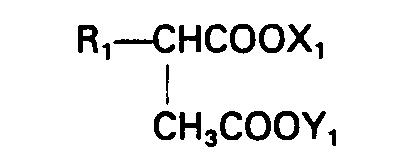
- Counter ions of these anionic active agents are, for example, alkali metal ions such as sodium, potassium and the like, alkaline earth metal ions such as calcium, magnesium and the like, ammonium ions, and alkanolamines having from 1 to 3 alkanol group having 2 or 3 carbon atoms and including, for example, monoethanolamine, diethanolamine, triethanolamine, triisopropanolamine and the like.
- Of these anionic active agents, linear or branched alkylsulfates having from 10 to 16 carbon atoms on average, polyoxyethylene alkylsulfates (an average number of addition moles of 0.5 to 8) having an alkyl group having from 8 to 20 carbon atoms on average, and olefinsulfonates having from 10 to 16 carbon atoms on average are preferably used.
- In the shampoo compositions of the invention, anionic active agents are generally used in an amount of from 5 to 30%, preferably 10 to 25%.
- Other ingredients may be used in the shampoo composition of the invention in amounts not to impede the effect of the invention, which include amphoteric active agents, nonionic active agents, cationic active agents, solubilizers such as propylene glycol, glycerine, urea and the like, viscosity adjusters such as ethyl alcohol, isopropyl alcohol, hydroxyethyl cellulose, methyl cellulose, higher alcohols and the like, perfumes, colorants, UV absorbers, antioxidants, preservatives, pearling agents and lotionizing agents. These agents may be added as desired.
- The thus obtained shampoo composition not only has excellent hair-conditioning and washing effects, but also is less irritative than known shampooes when it comes in contact with eyes by mistake upon washing and rinsing, giving only a mild influence on the conjunctiva and the iris.
- The ingredients (A) and (B) are dissolved or dispersed in a suitable solvent or medium such as water, ethanol, glycerin, ethylene glycol, propylene glycol, 1,3-propanediol, isopropanol, polyethylene glycol or the like, thereby obtaining the rinse, conditioner or treatment composition.
- To these compositions, may be further added any known ingredients which are ordinarily used in rinses, conditioners or treatments. Preferable ingredients which are added to the compositions are surface active agents such as cationic active agents, anionic active agents, nonionic active agents and amphoteric active agents. Most preferably, cationic active agents should be added.
- Specific examples of the surface active agents are mentioned below.
-
- (1) Linear or branched alkylbenzenesulfonates having an alkyl group having fromn 10 to 16 carbon atoms on average.
- (2) Alkyl or alkenyl ethoxysulfates having a linear or branched alkyl or alkenyl group having from 8 to 20 carbon atoms on average and having 0.5 to 8 moles, on average, of ethylene oxide added in one molecule thereof.
- (3) Alkyl- or alkenylsulfates having an alkyl or alkenyl group having from 10 to 20 carbon atoms on average.
- (4) Olefinsulfonates having from 10 to 20 carbon atoms on average in one molecule thereof.
- (5) Alkanesulfonates having from 10 to 20 carbon atoms on average in one molecule thereof.
- (6) Saturated or unsaturated aliphatic acid salts having from 10 to 20 carbon atoms on average in one molecule thereof.
- (7) Alkyl or alkenyl ethoxycarboxylates having an alkyl or alkenyl group having from 10 to 20, preferably 12 to 16, carbon atoms on average and having 0.5 to 8 moles, on average, of ethylene oxide added in one molecule thereof.
- (8) Alpha-sulfofatty acid salts or esters represented by the following formula

- The counter ions of the anionic active agents are, for example, alkali metal ions such as sodium, potassium and the like, alkaline earth metal ions such as calcium, magnesium and the like, ammonium ions, and alkanolamines having from 1 to 3 alkanol groups having 2 or 3 carbon atoms and including, for example, monoethanolamine, diethanolamine, triethanolamine, triisopropanolamine and the like.
-
- (1) Polyoxyethylene alkyl or alkenyl ethers having a primary or secondary alkyl or alkenyl group having from 8 to 20 carbon atoms on average and having from 3 to 12 moles of ethylene oxide added thereto.
- (2) Polyoxyethylene alkylphenyl ethers having an alkyl group having from 8 to 12 carbon atoms on average and having from 3 to 12 moles of ethylene oxide added thereto.
- (3) Higher fatty acid alkanolamides represented by the following formula and alkylene oxide adducts thereof
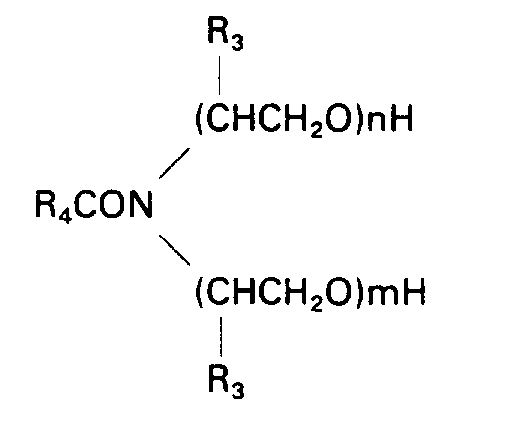
-
- (1) Alkylamine oxides represented by the following formula

In the above formula, it is preferred that R5 represents an alkyl or alkenyl group having from 12 to 16 carbon atoms and R6 and R7 independently represent methyl group. - (2) Compounds of the following formula

- (3) Imidazoline compounds represented by the following formula


- In the practive of the invention, any cationic active agents may be used without limitation so far as they are ordinarily used in hair rinses or the like. Preferable examples of the agents include quaternary ammonium salts represented by the following formula (1)

- Good results are obtained using these surface active agents in an amount of 0.01 to 10%, preferably 0.5 to 5%, of the hair rinse composition.
- The hair rinse or the like compositions of the invention may further comprise hydrocarbons such as liquid paraffin, Vaseline® or solid paraffin, esters such as isopropyl myristate, lanolin derivatives such as lanolin, refined lanolin or lanolin fatty acids silicone derivatives such as diemthylpolysiloxane, methylphenylpolysiloxane or organo-modified polysiloxane, polyethylene glycol, polypropylene glycol or polymers thereof, oils such as polyoxyalkene alkyl ether or polyoxyalkylene alkyl ether phosphates, polymeric materials such as hydroxyethyl cellulose, hydroxypropyl cellulose, hydroxypropylmethyl cellulose, methyl cellulose, cationized cellulose or cationized polymers, bactericides, preservatives, perfumes or colorants.
- The ingredients (A) and (B) are dissolved, as usual, in polar solvents such as water, ethyl alcohol, propyl alcohol and the like, thereby obtaining hair setting agents. Any polymer compounds which are used in ordinary hair setting agents may also be used in the practice of the invention. Examples of such polymer compounds are mentioned below.
- (a) Polyvinylpyrrolidone compounds.
Specific examples of these compounds include polyvinylpyrrolidone, copolymers of vinylpyrrolidone and vinyl acetate and alkylaminoacrylates. These compounds are commercially available under the names of Luviskol® K, Liviskol® VA, Luviflex® D410l (Yuka Badische Co., Ltd.), and PVPK, PVP/VA and E―735 (GAF Co., Ltd.). - (b) Acidic vinyl ether polymer compounds
For instance, there are mentioned lower alkyl half-esters of copolymers of methyl vinyl ether and maleic anhydride, which are commercially available under the names of Gantrez® ES―225 and ES―335 (Gaf Co., Ltd.). - (c) Acidic polyvinyl acetate polymer compounds
Examples of these compounds include copolymers of vinyl acetate and crotonic acid and are commercially sold under the names of Resin 28―1310 (National Starch Co., Ltd.), Luviset® CE5055 (Yuka Badische Co., Ltd.). - (d) Acidic acrylic polymer compounds
For instance, copolymers of acrylic acid and/or methacrylic acid and alkyl acrylates and/or alkyl methacrylates, and copolymers of acrylic acid, alkyl acrylates and N-alkylamides are mentioned. Commercial products include Plasize® (Gooh Chem. Co., Ltd.), Ultrahold® (Ciba-Geigy A.G.), and the like. - (e) Amphoteric acrylic polymer compounds
There are mentioned compounds which are obtained by copolymerizing dialkylaminoethyl methacrylates, dialkylaminoethyl arylates or diacetone acrylamides with acrylic acid, methacrylic acid, alkyl acrylates and alkyl methacrylates and subjecting the copolymers to amphoteric reaction with halogenated acetic acid. Yuka Foamer AM―TS (Mitsubishi Petrochemical Co., Ltd.) is typical of commercial products of these polymer compounds. - The hair setting agents of the invention may further comprise, within ranges of amounts not impending the effect of the invention, arbitrary ingredients which may depend on the purpose. Examples of such arbitrary ingredients include oil substances such as higher alcohols or higher fatty acid esters, non-ionic active agents serving as an emulsifier or solubilizer such as polyoxyethylene lauryl ether, polyoxyethylene sorbitan monolaurate and polyoxyethylene hardened castor oil, humectants such as glycerine or propylene glycol, perfumes and colorants.
- The hair setting agents of the invention may be applied to the hair as they are. Alternatively, they may be applied in the form of mist by the use of a pump sprayer or the like or may be applied in the form of mist or foam after packed in a container along with a jetting agent such as flon gas, liquid hydrocarbons or carbon dioxide gas.
- The thus obtained hair setting agents of the invention can form a uniform, tough film after drying, which shows excellent hair setting ability even under high humidity conditions. These hair setting agents can be readily removed from the hair upon washing it with now widely used shampooes comprising anionic active agents. Thus, the hair setting agents of the invention satisfy both requirements of set retentivity and washability.
- The agents can be prepared by mixing the ingredients (A) and (B) with an ordinary permanent waving solution comprising a reducing material as a substrate.
- The reducing materials which are used as a substrate of the first permanent waving agent may be any known materials which are ordinarily used for the purposes. Preferable examples include ammonium salts of thioglycollic acid and acid and hydrochlorides of cysteine.
- The first permanent waving agent may be prepared by mixing the above ingredients together by any known technique. The waving agent may further comprise conventionally used ingredients such as colorants, perfumes, oils, opacifiers, water-soluble silicones, organic salts or urea. These ingredients are used depending on the purpose.
- To ordinary second permanent waving agents comprising oxidative materials as a substrate are added the ingredients (A) and (B).
- The amount of an oxidative material which is used as substrate of the second permanent waving agent of the invention may differ depending on wether or not the second agent is dissolved in solvent, or the degree of dilution when such an agent is used as diluted. The amount is generally in the range of from 1 to 30%, preferably from 3 to 20%.
- The oxidative materials which are used as a substrate of the second permanent waving agent may be any materials ordinarily used for the purposes and include, for example, alkali metal bromates such as sodium bromate, potassium bromate and the like, hydrogen peroxide, sodium percarbonate, sodium perborate and the like. Of these, alkali metal bromate are preferred.
- The second permanent waving agents may further comprise, aside from the above essential ingredients, arbitrary ingredients used for the purposes in amounts not impeding the effect of the invention. Examples of such arbitrary ingredients include anionic active agents, amphoteric active agents, nonionic active agents, cationic polymer compounds, water-soluble silicones, urea, suitable oils, humectants, perfumes or colorants.
- Cationic polymer compounds mentioned above are, for example, cationic cellulose derivatives, cationic starch, diallyl quaternary ammonium salts, copolymers of diallyl quarternary ammonium salts and acrylamide, polyglycol and polyamide condensates, methacryloxyethyltrimethylammonium salts, and copolymers of metharyloxyethyltrimethylammonium salts and polyvinyl pyrrolidone. Of these, there are preferably used cationic cellulose a typical product of which is available under the name of "Polymer JR®", diallyl quaternary ammonium salts a typical product of which is available under the name of "Merquat 100®", and diallyl quaternary ammonium salt/acrylamine copolymer typical of which is a product available under the name of "Merquat 500®". These cationic polymer compounds are generally used in an amount of from 0.01 to 5%, preferably 0.05 to 2%.
- The thus obtained second agent is adjusted in such a way that an aqueous 5% solution thereof has a pH of below 9, preferably from 3.5 to 6.5.
- The ingredients (A) and (B) are added to dye substrates as usual to give hair dyes.
- The dye substrates used in the hair dye composition of the invention are not critical and include any known substrates. For example, oxidation hair dyes and temporary hair dyes are described by way of illustration only.
- Dye intermediates, oxidizing agents and, if necessary, couplers or modifiers are mixed together.
- Examples of the dye intermediates include para or ortho compounds such as p-phenylenediamine, toluene-2,5-diamine, N-phenyl-p-phenylenediamine, 4,4'-diaminodiphenylamine, p-aminophenol, p-methylaminophenol, o-phenylenediamine, toluene-3,4-diamine, o-aminophenol, p-chloro-o-phenylenediamine, p-amino-o-cresol, o-chloro-p-phenylenediamine, phloroglucin pyrogallol, 3,3'-iminodiphenyl, diphenylamine, 2,6-diaminopyridine or p-aminophenylsulfamic acid. Couplers or modifiers include metha compounds or phenols such as m-phenylenediamine, toluene-2,4-diamine, p-methoxy-m-phenylenediamine, m-aminophenol, alpha-naphthol, resorcin, hydroquinone and catechol. Hydrogen peroxide is ordinarily used as the oxidizing agent. Also, there may be used sodium perborate, urea peroxide, sodium percarbonate, sodium peroxytripolyphosphate, sodium peroxypyrophosphate, sodium peroxyorthophosphate, sodium silicate and hydrogen peroxide adduct and sodium sulfate-sodium chloride-hydrogen peroxide adduct. In order to give an influence on the color of the hair without taking part in the dye formation reaction, there may be further added direct dyes and particularly nitro dyes such as nitro-p-phenylenediamine, p-nitro-o-phenylenediamine, 2-amino-4-nitrophenol, 2-amino-5-nitrophenol and, 4-amino-2-nitrophenol. If necessary, picramic acid, picric acid and/or 1,4-diaminoanthraquinone may be also added.
- Within ranges of amounts not impeding the effect of the invention, there may be also added nonionic active agents, cationic active agents, solvents such as propylene glycol, glycerine and the like, viscosity adjusters including lower alcohols such as ethyl alcohol, isopropyl alcohol and the like, hydroxyethyl cellulose, methyl cellulose, cationic polymer compounds, and higher alcohols, humectants, protein modifiers such as urea, perfumes, colorants, UV absorbers, antioxidants, perservatives, pearling agents or lotionizing agents.
- The oxidation hair agents of the invention are prepared by mixing the essential ingredients and the above-mentioned ingredients by a usual manner to give a powder preparation of a cream preparation. In applications, the preparation is added to water or a shampoo substrate. Alternatively, an oxidation dye and an oxidizing agent are separately provided. The essential ingredients are added to either or both of the agents to give powder, cream or liquid preparations. In applications, separately provided systems are combined together.
- Dyes and pigments are not limited to any specific ones and include, for example, pigments such as titanium oxide, carbon black and the like, and tar-base colorants such as triphenylmethane dyes, azo dyes, quinoline dyes, xanthene dyes, acridine dyes, azine dyes, oxazine dyes, indigoid dyes, stilbene dyes, thiazole dyes and the like.
- The resins are, for example, copolmers of acrylic esters or methyacrylic esters, copolymers of mono-chloroacetic acid-amine salt-modified products of N,N'-diethylaminoethyl methacrylate and metharylic esters, copolymers of vinyl pyrrolidone and vinyl acetate and the like.
- The temporary hair dyes are prepared by dissolving or dispersing the essential ingredients, resins, dyes and pigments in a dispersion medium such as water, amyl alcohol, isopropanol, ethanol or acetone. As a matter of course, there may be further added known ingredients, which are ordinarily added to existing temporary hair dye compositions, including anionic active agents, cationic active agents, amphoteric active agents, nonionic active agents, polyhydric alcohols such as propylene glycol, glycerine, polyethylene glycol and the like, higher alcohols such as isostearyl alcohol, oleyl alcohol and the like, fatty acids such as lanolin fatty acids, fatty acids from coconut oil and the like, esters such as isopropyl myristate, hydrocarbons such as liquid paraffin, cationized polymer compounds, amines and perfumes.
- Pre-shampoo treatment agent is prepared by dissolving or suspending the ingredients (A) and (B) and, optionally, other known ingredients in a medium such as water.
- Known ingredients are, for example, oils and fats such as higher alcohols and fatty acid esters, nonionic active agents serving as an emulsifier or solubilizing agent and including polyoxyalkylene alkyl ethers, and humectants such as glycerine and pyrrolidonecarboxylic acid. These ingredients serve to control a degree of styling of the hair when the hair is treated with the pre-shampoo treatment agent of the invention and shampooed thereafter. That is, use of liquid oil or fat ingredients is effective in imparting softness to the hair and humectants can impart moistness to the hair. In addition, use of higher alcohols imparts dryness to the hair.
- The present invention is described by way of references and examples, which should not be construed as limiting the present invention thereto.
- Ten kilograms of the whole of a birch tree (Betula alba) was admixed with 20 liters of 40% 1,3-butylene glycol immersed therein at 20 to 25°C for 10 to 15 days, followed by centrifugal separation. To the residue was further added 10 liters of 1,3-butylene glycol for re-immersion. The resulting immersion solution and the solution obtained by the centrifugal separation were combined and aged in a dark and cold place (0 to 5°C) for about 40 days. As a result, there was obtained a birch extract in the form of a dark brown liquid containing 5% solid matters.
- Twenty liters of 50% ethanol was added to 10 kg of the whole of a birch tree (Betula alba) for immersion in a cold and dark place for 20 days. As a result, a birch extract in the form of a brown liquid containing 6.5% solid matters was obtained.
- Ten liters of an aqueous 50% propylene glycol solution was added to 5 kg of leaves of rosemary (Rosemarinus Officinalis), followed by refluxing at 50°C for 12 hours to obtain an extract. The extract was subjected to filtration to remove the residue therefrom to obtain a final product. This product was a rosemary extract in the form of a brown liquid containing 10% solid matters.
- Ten kilograms of silk fibers obtained from the silkworm was washed with water, dried, cut into pieces, powdered and passed through a 200 µm sieve to obtain 9.5 kg of a silk powder.
- Sixty grams of silk fibers were dissolved in 600 ml of water containing 48 g of ethylenediamine and 36 g of cupric hydroxide, followed by heating to 60°C for 2 hours. Subsequently, the solution was adjusted in pH with 3N acetic acid to 6.0―7.0, and filtered, followed by placing the resulting filtrate in a cellulose tube C―65 and subjecting to dialysis in running water over one or two days and nights. The resulting dialyzate was filtered and made up to 2000 ml, to which was added 80 g of a strongly acidic cationic exchange resin Dowex® all 50wx―2, followed by agitating for 20 to 30 minutes and filtering. Thereafter, the resulting filtrate was admixed with an 1N sodium hydroxide solution to adjust its pH to 6.0―7.0. As a result, there was obtained 1900 ml of a solution containing 0.5% of the effective ingredient. The thus obtained silk protein had an average molecular weight of 2000.
- Ten grams of wool fibers were immersed in 700 g of an aqueous 8% peracetic acid solution at room temperature for 1 day to carry out the oxidation reaction. The resulting oxidized wool fibers were filtered, washed with water and immersed in 700 g of a 0.1N ammoniacal solution at room temperature for 1 day, permitting about 90% of the wool to dissolve in the ammoniacal solution. About 1 g of the insoluble matters were removed by filtration and the aqueous ammoniacal solution of keratose to be an oxidized decomposition product of the wool keratin was admixed with 2N hydrochloric acid to adjust the pH to 4.0, whereupon alpha-keratose was settled as precipitate. This precipitate was flltered, washed with acetone and dried to obtain 5.4 g of alpha-keratose.
- Ten grams of wool fibers were immersed in 60 ml of an aqueous solution with concentration of 8M urea and 0.01M tris buffer, to which was added 6 ml of 2-mercaptoethanol, followed by adjusting the pH to 10 by means of a 5N potassium hydroxide aqueous solution to effect the reduction reaction in a stream of nitrogen at room temperature. About 3 hours after commencement of the reaction, the wool dissolved in the reaction solution in an amount of about 85% thereof. While the system was adjusted with a 5N potassium hyroxide solution so that the pH was not below 7, 16.5 g of iodoacetic acid was gradually added and the pH of the system was finally adjusted to 8.5 to carry out the carboxymethylation reaction at room temperature for 2 hours. The reaction solution was filtered to remove insoluble matters therefrom and the resultant filtrate was charged into a cellulose tube wherein it was dialyzed against ion-exchanged water to remove low molecular weight impurities including urea. As the urea was dialyzed, the content in the cellulose tube became cloudy since water-insoluble HGT (component with high contents of glycerine and tyrosine) was caused to precipitate. After completion of the dialysis, HGT was centrifugally removed and S-carboxymethyl keratin (SCMKA) was obtained from the neutral transparent solution of SCMKA by the isoelectric precipitation method. That is, 1N hydrochloric acid was added to the system to adjust its pH to 4.4 by which SCMKA became insoluble and separated as precipitate. This precipitate was filtered, washed with ethanol and dried to obtain 4.2 g of SCMKA.
- Ten grams of wool fibers were immersed in 300 g of a 1% sodium hydrogensulfite aqueous solution, whose pH was adjusted to 6.7 by the use of a 5N aqueous caustic soda solution. Thereafter, 0.2 g of papain was added to the system to effect the hydrolysis reaction at 60°C for 15 hours, by which about 80% of the wool dissolved. Insoluble matters were removed by filtration and the sulfite in the resulting filtrate was removed by the ultrafiltration technique using a membrane with a fractional molecular weight of 500. The aqueous solution of the hydrolysate was concentrated and freeze dried to obtain 7.7 g of the hydrolysate having a molecular weight of 500―2,000.
- Shampoo compositions of the formulations indicated in Table 1―A were prepared and subjected to the performance evaluation test thereof. The results are shown in Table 1―B.
- The performance evaluation was conducted according to the following methods in or throughout the examples appearing hereinafter.
- To an aqueous solution of 1% shampoo composition was added 0.1% of lanolin as an artificial dirt, followed by agitating in a cylinder for 5 minutes by means of a flat propeller at 40°C at 1000 r.p.m. in such a way that the propeller was turned in opposite directions every 10 seconds. After completion of the agitation, an amount of lathering after 30 seconds was measured for evaluation.
- Thirty grams of human hair was wetted with water of 40°C to permit 20 g of water to be contained. Thereafter, 1 g of each of the shampoo compositions was used for washing the hair therewith whereupon the touch of the lather was organoleptically evaluated by 20 female panelers.
- The degree of ease in passing fingers through the hair upon washing was evaluated as "foam smoothness".
-
- O
- Better foam smoothness than that of a reference Slightly better than a reference
- X
- Same in foam smoothness as a reference
- Thirty grams of human hair was wetted with water of 40°C to permit 20 g of water to be contained. One gram of each of the shampoo compositions was used to effect washing and rinsing operations two times, after which it was squeezed and set on a strain gauge. Subsequently, the hair was combed to determine a force exerted thereon (wet combing force). The hair was then dried with a dryer and allowed to stand in an air-conditioned room of a temperature of 20°C and a relative humidity of 65% overnight, followed by setting on a strain gauge and combing to determine a force exerted thereon (dry combing force).
- Upon the measurement of "combing force" under dry conditions, it was observed whether or not there took place an electrostatic hair fly phenomenon.
-
- O
- Occurrence of hair fly
- X
- No occurrence of hair fly
-
TABLE 1―B Lathering Characteristics Hair Finishing Lathering Lather Smoothness Combing Force (g) Hair Fly A 114 X 210 O B 105 △ 196 O C (product of invention) 138 ⓞ 101 X D 91 X 254 O E 93 △ 247 O F 87 X 201 O G 90 X 198 O - Shampoo compositions of the formulation indicated in Table 2―A were prepared and subjected to the performance evaluation test. The results are shown in Table 2―B.
- The performance evaluations were effected in the same manner as in Example 1.
TABLE 2―A H I J Sodium polyoxyethylene (2) lauryl sulfate 15% 15% 15% Coconut fatty acid diethanolamide 3 3 3 Birch extract (Novarom Co., Ltd.) ― 0.5 0.5 Hydrolyzate of silk (average molecular weight of 20,000) ― ― 0.1 Perfume suitable amount suitable amount suitable amount Water balance (pH 7.2) balance (pH 7.2) balance (pH 7.2) TABLE 2―B Lathering Characteristics Hair Finishing Lathering Lather Smoothness Combing Force (g) Hair Fly H 114 X 210 O I 107 △ 176 O J (product of invention) 142 ⓞ 97 X - Hair rinses of the formulations indicated in Table 3―A were prepared. Five hundreds milliliters of a 50:1 dilution of each hair rinse was used to treat the hair therewith, which was subsequently rinsed with hot water two times and air-dried. The thus dried hair was evaluated by 20 panelers according to the following five-point method.
- Good 5, Fair 4, Moderate 3, Rather poor 2, Poor 1
- The results are shown in Table 3―B as average values.
TABLE 3―A K L M N Distearyldimethylammonium chloride 2% 2% 2% 2% Stearyl alcohol 1% 1% 1% 1% Birch extract (obtained in Reference 1) ― 1% ― 1% Hydrolyzate of keratin (obtained in Reference 8, average molecular weight 3000) ― ― 1% 1% Water balance (pH 5.0) balance (pH 5.0) balance (pH 5.0) balance (pH 5.0) TABLE 3―B Softness Smoothness Ease in Combing K 1.2 1.3 1.2 L 2.1 2.5 3.3 M 3.2 3.4 2.5 N (product of invention) 4.2 4.0 3.9 - Hair rinses of the formulations indicated in Table 4―A were prepared and evaluated in the same manner as in Example 3. The results are shown in Table 4―B.
TABLE 4―A O P Q R Distearyldimethylammonium chloride 2% 2% 2% 2% Stearyl alcohol 1% 1% 1% 1% Rosemary extract (obtained in Reference 3) ― 1% ― 1% Hydrolyzate of silk average molecular weight 20,000) ― ― 1% 1% Water balance (pH 5.0) balance (pH 5.0) balance (pH 5.0) balance (pH 5.0) TABLE 4―B Softness Smoothness Ease in Combing O 1.2 1.3 1.2 P 2.1 2.6 3.4 Q 3.2 3.4 2.5 R (product of invention) 4.5 4.1 4.4 - Hair treatment agents of formulations (S) through (V) were prepared using the following fundamental composition.
-
Liquid paraffin 5.0% White Vaseline® 2.0% Cetyl alcohol 2.0% POE (20) sorbitan monostearate 1.0% Glycerine 10.0% Water balance pH 7.0 - (S) no material,
- (T) 1.0% of a birch extract (obtained in Reference 1),
- (U) 2.0% of a hydrolyzate of keratin (an average molecular weight of 20,000), or
- (V) 1.0% of a birch extract (obtained in Reference 1) and 2.0% of a hydrolyzate of keratin (average molecular weight of 20,000).
- These hair treatments were evaluated according to the five-point method with respect to the following items. Average values of the respective evaluation tests are shown in Table 5.
TABLE 5 Organoleptic Evaluation Combing Force (g) Wet State Dry State S 2.0 420 360 T 2.0 405 351 U 2.3 326 265 V (product of invention) 4.6 116 107 - Based on the fundamental composition of Example 5, the following formulations (W)―(Z) were prepared.
- (W) Nothing was added.
- (X) 1.0% of a birch extract (obtained in Reference 1) was added.
- (Y) 2.0% of a silk hydrolyzate (average molecular weight 20,000) was added.
- (Z) 1.0% of a birch extract (obtained in Reference 1) and 2.0% of a silk hydrolyzate were added.
- The resulting hair treatments were evaluated in the same manner as in Example 5 with the results shown in Table 6.
TABLE 6 Organoleptic Evaluation Combing Force (g) Wet State Dry State W 2.0 420 360 X 2.0 405 351 Y 2.3 326 265 Z (product of invention) 4.6 123 115 - Hair setting lotions of the formulations indicated in Table 7―A were prepared and their set retentivity was evaluated. The results are shown in Table 7―B.
TABLE 7―A A B C Ethanol 10% 10% 10% Birch extract (Vermin Co., Ltd.) ― 2.0% 2.0% Hydrolyzate of wool keratin (average molecular weight 20,000) ― ― 1.0% Polyoxyethylene oleyl ether (EO 20) 0.5% 0.5% 0.5% Perfume 0.1% 0.1% 0.1% Water balance balance balance 
- Lo = 14 cm,
- Ls = a length (cm) of a curled hair immediately after suspension under 95% relative humidity conditions,
- Lt = a length (cm) of a curled hair 30 minutes after suspension of the hair under 95% R.H. conditions.
- Hair setting lotions of the formulations indicated in Table 8―A were prepared to determine set retentivity in the same manner as in Example 7. The results are shown in Table 8―B.
TABLE 8―A D E F Ethanol 10% 10% 10% Birch extract (Vermin Co. Ltd.) ― 2.0% 2.0% Silk hydrolyzate (average molecular weight 20,000) ― ― 1.0% Polyoxyethylene oleyl ether (EO 20) 0.5% 0.5% 0.5% Perfume 0.1% 0.1% 0.1% Water balance balance balance TABLE 8―B Set Retentivity D 53% E 60% F (product of invention) 84% - Permanent waving treatments were effected using first permanent waving agents of the formulation indicated in Table 9―A and a second permanent waving agent to determine a degree of waving, wave retentivity, adsorptivity, and feeling to the touch. The results are shown in Table 9―B.
-
(1) First permanent waving agentTABLE 9―A G H I Ammonium thioglycolate 7% 7% 7% Birch extract (Novarom Co., Ltd.) ― 1% 1% Silk hydrolyzate (average molecular weight 1,500) ― ― 2% Water (ammoniacal solution for pH adjustment) 93% 92% 90%
(2) Second permanent waving agent:Sodium bromate 5.0% Water 95.0% -
- (i) A bundle of 20 human hairs were fixed to cylinders of a wave-measuring plate (in which a plurality of cylinders, each having a diameter of 2 mm and a length of 1.5 mm, were arranged in zigzag form in two rows). The bundle was immersed in the first agent of each of the formulations through at 30°C for 10 minutes, followed by immersion in a second agent at 30°C for 10 minutes. Thereafter, the immersed bundle was sufficiently rinsed with water and removed from the plate. A degree of waving in still water was calculated according to the following equation.
It should be noted that the hair used was a 20 cm long virgin hair which was washed with an aqueous solution of 0.5% of sodium lauryl sulfate and dried.
- Xo: a length of the hair fixed between points a and b of one row of the zigzag cylinders which are distant from each other.
- Yo: a distance between a and b.
- Zo: a distance of the hair, fixed between the point a and b, in still water after removal from the measuring plate.
- (ii) The hair used in (i) was slightly moved and washed while immersing in an aqueous solution of 0.5% sodium lauryl sulfate for 1 minute, followed by sufficiently rinsing and air drying for 1 day. The above procedure was repeated four times and, after the fifth washing, the hair was sufficiently rinsed. Thereafter, a distance, Zo, in still water was measured, from which a degree of wave was determined. A ratio of this degree to a degree of wave prior to washing was calculated to give a wave retentivity.

- The hair used for the measurement of the degree of wave was observed through a scanning electron microscope in order to determine the presence or absence of adsorbed matters on the hair surfaces. The evaluation standard is shown below.
Adsorptivity State of Hair Surfaces ++ Covered with a film and being thus smooth + Slight amounts of adsorbed matters observed though the surfaces are smooth - Considerable irregularities observed with hair cuticle being partly separated - A hair bundle made of Japanese virgin hairs was immersed in a first agent of each of formulations through at 30°C for 10 minutes and subsequently immersed in a second agent at 30°C for 10 minutes. The bundle which was sufficiently rinsed with water and air-dried was evaluated by 20 female panelers according to the five-point method with respect to the feeling of the hair bundle to the touch. The evaluation standard was as follows: Good = 5; Fair = 4; Moderate = 3; Rather poor = 2; Poor = 1. The results are indicated by geometric average.
TABLE 9―B First Permanent Adsorptivity Degree of wave (%) Wave Retentivity (%) Feeling to the touch G - 52 73 2.4 H + 49 70 2.1 I ++ 56 91 3.5 - The hair was permed using a first agent and second agents of the formulations indicated below. A degree of damage of the hair during the perming treatment was determined by measuring weights of the hair prior to and after the treatment. The method of measuring the hair weight and the evaluation standard are described below.
-
First Agent: Thioglycolic acid 7.0% Polyoxyethylene hardened castor oil 1.0% Perfume 0.2% Ammoniacal solution, water (pH adjusted to 9.0 by means of ammoniacal solution) balance TABLE 10 Second Agents J K L Sodium bromate 5% 5% 5% Amphoteric active agent (Miranol® CSM-SF, by Miranol Co., Ltd.) 0.5% 0.5% 0.5% Perfume 0.1% 0.1% 0.1% Rosemary extract (Vermin Co., Ltd.) ― 1.0% 1.0% Silk hydrolyzate (average molecular weight 1,500) ― ― 2.0% Water balance balance balance - Ten centimeters long virgin hair was washed with an aqueous solution of 0.5% sodium lauryl sulfate and air-dried to give a hair being tested. About 1 g of the hair was bundled and placed in a desiccator using a phosphorus pentaoxide dryer, followed by drying under reduced pressure for one week and measuring the dried hair to give an absolute dry weight of the virgin hair. The thus dried hair was immersed in the first agent or solution at 30°C for 10 minutes and sufficiently washed with water. Thereafter, the hair was further immersed in the respective second agents at 30°C for 10 minutes. After sufficiently rinsing with water, it was air-dried and dried according to the above procedure to give an absolute dry weight of the permed hair.
-
Evaluation Content ⓞ The difference in absolute dry weight between the virgin hair and the permed hair is less than 1% O The difference in absolute dry weight between the virgin hair and the permed hair is in the range from 1 to 5% X The difference in absolute dry weight between the virgin hair and the permed hair is over 5% Results J X K O L (product of invention) ⓞ - Two-component hair dye compositions of the formulations indicated in Table 11 were prepared and the influence of these compositions on the hair was determined by measuring hair weights prior to and after the hair dyeing treatment. The results are shown below.
-
TABLE 11 First Liquid Component M N O p-Phenylenediamine 1.0% 1.0% 1.0% Birch extract (obtained in Reference 2) ― 1.0% 1.0% Silk hydrolyzate (average molecular weight 20,000) ― ― 0.5% Propylene glycol 10.0% 10.0% 10.0% Disodium edetoate 0.3% 0.3% 0.3% Sodium sulfite 0.5% 0.5% 0.5% Perfume 0.1% 0.1% 0.1% Water balance balance balance (pH was adjusted to 10.0 by means of an ammoniacal solution.) -
Hydrogen peroxide 6.0% Water 94.0% - Ten centimeters long virgin hair was washed with an aqueous solution of 0.5% sodium lauryl sulfate and air-dried to give a hair being tested. About 1 g of the hair was bundled and placed in a desiccator using phosphorus pentaoxide dryer, followed by drying under reduced pressure for 1 week and measuring the dried hair weight to give an absolute dry weight of the virgin hair.
- Subsequently, the hair was dyed according to the following procedure and air-dried, followed by drying in the same manner as described above and measuring the weight of the dyed hair to give an absolute dry weight of the dyed hair.
- The hair weight after the hair dyeing treatment was evaluated by comparison with the virgin hair weight and an influence of the respective dye compositions on the hair was judged.
-
Evaluation Content ⓞ The dyed hair increased in weight over the virgin hair O The dyed hair decreased in weight by 0―3% as compared with the virgin hair X The dyed hair decreases in weight over 3% as compared with the virgin hair - A mixture of the first and second liquids in equal amounts was provided as a dyeing solution and was diluted to have a liquor ratio of 1:5. The hair was immersed in the solution at room temperature for 30 minutes and dyed. Thereafter, the hair was washed with city water of 40°C to wash away the deposited dye therefrom and washed further with an aqueous solution of 0.5% sodium lauryl sulfate, followed by instantaneously immersing in an aqueous 1N acetic acid solution and washing with city water of 40°C.
Results: M X N O O (product of invention) ⓞ - Temporary hair dye compositions (hair colorants) of the mascara type having formulations indicated in Table 12―A were prepared. 0.5 g of each composition was applied to 1 g of grey hair. After drying in air, the hair was organoleptically evaluated by 10 expert panelers with respect to the gloss, smoothness and feeling. The results are shown in Table 12―B.
-
TABLE 12―A P Q R Polymer resin* 12.0% 12.0% 12.0% Pigment (carbon black) 1.0% 1.0% 1.0% Birch extract (obtained in Reference 1) ― 1.0% 1.0% Silk hydrolyzate (average molecular weight 20,000) ― ― 0.5% Perfume 0.1% 0.1% 0.1% Ethanol balance balance balance * Polymer resin: Copolymer of monochloroacetic acid-amine salt-modified product of N,N'-dimethylaminoethyl metharylate and methacrylic ester. -
TABLE 12―B Gloss Smoothness Feeling to the Touch P X X X Q △ △ O R (product of invention) O O O - In the above table, by the mark "O" is meant "good", by "△" meant "fair", and by "X" meant "poor".
-
(a) Rosemary extract (Novarom Co., Ltd.) 1.0% (b) Oxidative decomposition product of keratin (obtained in Reference 6) 0.1% (c) Polyoxypropylene (30) butyl ether 15.0% (d) Ethanol 40.0% (e) Water 44.0% - The above ingredients (a) through (e) were mixed together to completely dissolve the components to obtain a hair liquid.
-
(a) Rosemary extract (obtained in Reference 3) 1.0% (b) Hydrolyzate of keratin (obtained in Reference 8) 0.1% (c) PCA―A1 0.5% (d) Ethanol 55.0% (e) Water 44.0% - The above ingredients (a) through (e) were mixed and agitated until a uniform solution was obtained, thereby giving a hair tonic.
-
(a) Birch extract (obtained in Reference 1) 1.0% (b) Silk hydrolyzate (average molecular weight 20,000) 0.1% (c) Polyoxypropylene (30) butyl ether 15.0% (d) Ethanol 40.0% (e) Water 44.0% - The above ingredients (a) through (e) were mixed for complete dissolution to obtain a hair liquid.
-
(a) Birch extract (Novarom Co. Ltd.) 1.0% (b) Silk hydrolyzate (average molecular weight 20,000) 0.1% (c) PCA―A1 0.5% (d) Ethanol 55.0% (e) Water 44.0% - The above ingredients (a) through (e) were mixed and agitated until a uniform solution was obtained, thereby giving a hair tonic.
- Setting lotions having formulations indicated in Table 17―A were prepared and applied to the hair to determine the feeling of the hair to the touch and set retentivity. The results are shown in Table 17―B.
TABLE 17―A S T U Birch extract (Dragoco Co., Ltd.) ― 0.005% 0.005% Oxidative decomposition product of keratin (obtained in Reference 6) ― ― 0.2% Cationic polymer (Polymer JR400®) 1.0 1.0 1.0 Sodium chloride 1.0 1.0 1.0 Ethanol 5.0 5.0 5.0 Water balance balance balance pH 7.0 7.0 7.0 - Twenty grams of a 20 cm long hair bundle made of Japanese female hair was applied with 2 g of a hair cosmetic throughout the hair and then rinsed with running water of 40°C for 1 minute. The thus treated hair was organoleptically evaluated. The organoleptic evaluation was carried out by paired comparison according to the following evaluation point using, as a reference, a hair bundle treated with a commercial hair rinse comprising as its principal components a quaternary ammonium salt and a hydrocarbon. An average point by 20 expert panelers is indicated in Table appearing hereinafter.
Evaluation Point Evaluation +2 Better in feeling than the reference hair bundle +1 Slightly better than the reference hair bundle 0 Equal to the reference hair bundle -1 Slightly poorer than the reference hair bundle -2 Poorer than the reference hair bundle - A 20 cm long hair bundle having a weight of 5 g and made of Japanese female hair was applied with 1 g of a hair cosmetic throughout the hair and rinsed with running water of 40°C for 1 minute, after which an excess of water was removed by means of filter paper. The thus treated hair bundle was wound around a glass tube with a diameter of 1.5 cm so that a winding width was 5 cm, and fixed at opposite ends thereof. The bundle was allowed to stand under conditions of 65 R.H.% and 20°C for 24 hours and curled. After 24 hours, the wound bundle was removed from the tube and vertically suspended, whereupon its length was measured and a degree of curling was calculated according to the following equation.

- Ao:
- Length of the hair immediately after removal of the hair.
- Bo:
- Length of the hair 12 hours after removal of the hair.
- After completion of the evaluation of the feeling of the hair, it was fixed on a strain gauge, through which a nylon comb was passed 20 times while recording a force exerted upon the combing. An average value of the 20 measurement was determined as a combining force.
- The hair bundle after the measurement of the combing force under wet conditions was dried in air and then evaluated according to the evaluation and measurement methods described in (1) and (3) above.
-
TABLE 17―B Feeling of the Hair Degree of Curling Combing Force under wet conditions under dry conditions S -0.1 72% 170 (g) 194 (g) T +0.1 76% 165 187 U +1.4 90% 107 160 - Setting lotions of formulations indicated in Table 18―A were prepared and applied to the hair. The feeling of the hair and the set-retaining effect of the respective lotions were determined in the same manner as in Example 17. The results are shown in Table 18―B.
TABLE 18―A V W X Birch extract (Dragoco Co., Ltd.) ― 0.005% 0.005% Silk hydrolyzate (M.W. 20,000) ― ― 0.2% Cationic polymer (Polymer JR400®) 1.0 1.0 1.0 Sodium chloride 1.0 1.0 1.0 Ethanol 5.0 5.0 5.0 Water balance balance balance pH 7.0 7.0 7.0 -
TABLE 18―B Feeling of the Hair Degree of Curling Combing Force under wet conditions under dry conditions V -0.1 72% 170 (g) 194 (g) W +0.1 76% 165 187 X +1.3 93% 136 161

| Set Retentivity | |
| A | 53% |
| B | 60% |
| C (product of invention) | 76% |
Claims (3)
- A hair cosmetic composition comprising(A) an extract obtained by polar solvent extraction of birch or rosemary, and(B) a polypeptide compound having a molecular weight of 350 to 30000 selected from decomposition products of silk, decomposition products of keratin and derivatives thereof,
wherein the ingredient (A) is contained in an amount ranging from 0.001 to 2 weight-% and the ingredient (B) is in an amount ranging from 0.01 to 10 weight-%. - A hair cosmetic composition according to Claim 1, wherein the mixing ratio of the ingredient (A) and the ingredient (B) is in the range of 0.1 to 10:1.
- A hair cosmetic composition according to Claim 1, wherein the ingredient (B) is a polypeptide compound having a molecular weight of 350 to 30000 selected from hydrolysates of silk, hydrolysates of keratin, oxidative decomposition products of keratin and thiolgroup-modified compounds of reductive decomposition products of keratin.
Priority Applications (1)
| Application Number | Priority Date | Filing Date | Title |
|---|---|---|---|
| AT84101398T ATE33551T1 (en) | 1983-02-25 | 1984-02-10 | HAIR COSMETICS. |
Applications Claiming Priority (4)
| Application Number | Priority Date | Filing Date | Title |
|---|---|---|---|
| JP58030446A JPS59157011A (en) | 1983-02-25 | 1983-02-25 | Hair cosmetic |
| JP30446/83 | 1983-02-25 | ||
| JP30445/83 | 1983-02-25 | ||
| JP58030445A JPS59157010A (en) | 1983-02-25 | 1983-02-25 | Hair cosmetic |
Publications (3)
| Publication Number | Publication Date |
|---|---|
| EP0117469A1 EP0117469A1 (en) | 1984-09-05 |
| EP0117469B1 EP0117469B1 (en) | 1988-04-20 |
| EP0117469B2 true EP0117469B2 (en) | 1996-09-04 |
Family
ID=26368792
Family Applications (1)
| Application Number | Title | Priority Date | Filing Date |
|---|---|---|---|
| EP84101398A Expired - Lifetime EP0117469B2 (en) | 1983-02-25 | 1984-02-10 | Hair cosmetics |
Country Status (7)
| Country | Link |
|---|---|
| US (1) | US4839168A (en) |
| EP (1) | EP0117469B2 (en) |
| DE (1) | DE3470457D1 (en) |
| HK (1) | HK34391A (en) |
| MY (1) | MY100835A (en) |
| PH (1) | PH20158A (en) |
| SG (1) | SG26991G (en) |
Families Citing this family (70)
| Publication number | Priority date | Publication date | Assignee | Title |
|---|---|---|---|---|
| JPS63502104A (en) * | 1985-11-22 | 1988-08-18 | アゲイブ・コスメティックス・プロプライアタリ−・リミテッド | hair treatment |
| US4793992A (en) * | 1987-03-25 | 1988-12-27 | Redken Laboratories, Inc. | Hair treatment composition |
| US4970067A (en) * | 1988-12-12 | 1990-11-13 | Helene Curtis, Inc. | Method and composition to condition hair and impart semi-permanent hair set retention properties |
| JPH03261714A (en) * | 1990-03-09 | 1991-11-21 | Kao Corp | Hair cosmetic |
| DE4009617A1 (en) * | 1990-03-26 | 1991-10-02 | Henkel Kgaa | HAIR REGENERATING PREPARATIONS |
| US5145607A (en) * | 1990-06-19 | 1992-09-08 | Takasago International Corporation (U.S.A.) | Optically clear conditioning shampoo comprising anionic and cationic surfactants |
| DE9110351U1 (en) * | 1991-08-22 | 1992-12-24 | Goldwell AG, 6100 Darmstadt | Shampoo |
| JPH0570330A (en) * | 1991-09-10 | 1993-03-23 | Kao Corp | Hair cosmetic |
| FR2688135B1 (en) * | 1992-03-09 | 1995-06-09 | Oreal | COSMETIC COMPOSITION FOR HOLDING HAIRDRESSING, CONTAINING A MILK PROTEIN AND / OR A MILK PROTEIN HYDROLYSAT AND A KERATIN HYDROLYSAT. |
| EP0583757B1 (en) * | 1992-08-14 | 1997-11-05 | National Starch and Chemical Investment Holding Corporation | Hydrolyzed zein as hair fixative in hair compositions |
| ES2101263T3 (en) * | 1993-02-19 | 1997-07-01 | Howard Green | COMPOSITIONS CONTAINING CORNEOCYTE PROTEINS. |
| DE4419470B4 (en) * | 1993-06-03 | 2008-02-07 | Erich Petritsch | Process for the preparation of a skin and / or hair care product from surfactants and water |
| US5681554A (en) * | 1995-06-28 | 1997-10-28 | Cosmair, Inc. | Composition for treating hair and method for using the same |
| US6013250A (en) * | 1995-06-28 | 2000-01-11 | L'oreal S. A. | Composition for treating hair against chemical and photo damage |
| DE19544655A1 (en) † | 1995-11-30 | 1997-06-05 | Goldwell Gmbh | Oxidation hair dye |
| KR100414538B1 (en) * | 1996-10-08 | 2004-04-29 | 주식회사 엘지생활건강 | Hair cosmetic composition |
| DE19708478B4 (en) * | 1997-03-03 | 2004-02-05 | Gerold Strathausen | Honey, herbal bath additive and manufacturing process |
| ES2126534B1 (en) * | 1997-08-18 | 1999-10-01 | Gonzalez Gonzalez Maria | BASE COMPOSITION FOR THE PREPARATION OF COSMETIC PRODUCTS. |
| CA2224627A1 (en) | 1997-11-06 | 1999-05-06 | Joseph Lizzi | Hair and skin treatment product |
| US6919076B1 (en) | 1998-01-20 | 2005-07-19 | Pericor Science, Inc. | Conjugates of agents and transglutaminase substrate linking molecules |
| US6958148B1 (en) * | 1998-01-20 | 2005-10-25 | Pericor Science, Inc. | Linkage of agents to body tissue using microparticles and transglutaminase |
| CA2318661A1 (en) | 1998-01-20 | 1999-07-22 | Howard Green | Transglutaminase linkage of agents to tissue |
| FR2774588B1 (en) * | 1998-02-11 | 2000-05-05 | Oreal | COSMETIC OR DERMATOLOGICAL COMPOSITION CONTAINING AT LEAST ONE NATURAL, RECOMBINANT ARACHNID SILK PROTEIN OR THE LIKE |
| US6413505B1 (en) * | 1998-04-09 | 2002-07-02 | Nationa L Starch And Chemical Investment Holding Corporation | Nonionically derivatized starches and their use in non-aerosol, low VOC hair cosmetic compositions |
| US6448464B1 (en) | 1999-07-30 | 2002-09-10 | Kimberly-Clark Worldwide, Inc. | Absorbent article which maintains skin temperature when wet |
| US6497893B1 (en) * | 1999-06-30 | 2002-12-24 | Kimberly-Clark Worldwide, Inc. | Silk protein treatment composition and treated substrate for transfer to skin |
| US6217890B1 (en) | 1998-08-25 | 2001-04-17 | Susan Carol Paul | Absorbent article which maintains or improves skin health |
| US6152906A (en) * | 1998-08-25 | 2000-11-28 | Kimberly-Clark Worldwide, Inc. | Absorbent article having improved breathability |
| US6287286B1 (en) | 1998-08-25 | 2001-09-11 | Kimberly-Clark Worldwide, Inc. | Absorbent article having a reduced viability of candida albicans |
| US6238379B1 (en) | 1998-08-25 | 2001-05-29 | Kimberly-Clark Worldwide, Inc. | Absorbent article with increased wet breathability |
| US6139828A (en) * | 1999-06-02 | 2000-10-31 | Hair Associates, Llc | Hair care formulations |
| US6270791B1 (en) * | 1999-06-11 | 2001-08-07 | Keraplast Technologies, Ltd. | Soluble keratin peptide |
| US6500443B1 (en) | 1999-06-30 | 2002-12-31 | Kimberly-Clark Worldwide, Inc. | Delivery of a sacrificial substrate to inhibit protease permeation into skin |
| US6506394B1 (en) | 1999-06-30 | 2003-01-14 | Kimberly-Clark Worldwide, Inc. | Delivery of a botanical extract to a treated substrate for transfer to skin |
| AR025300A1 (en) * | 1999-08-23 | 2002-11-20 | Kimberly Clark Co | A DISPOSABLE ABSORBENT ARTICLE WITH CAPACITY TO BREATHE IN INCREASED MOISTURE. |
| AR027842A1 (en) | 1999-08-23 | 2003-04-16 | Kimberly Clark Co | AN ABSORBENT ARTICLE WHICH MAINTAINS OR IMPROVES SKIN HEALTH |
| US6371984B1 (en) | 1999-09-13 | 2002-04-16 | Keraplast Technologies, Ltd. | Implantable prosthetic or tissue expanding device |
| US6783546B2 (en) | 1999-09-13 | 2004-08-31 | Keraplast Technologies, Ltd. | Implantable prosthetic or tissue expanding device |
| US6270793B1 (en) | 1999-09-13 | 2001-08-07 | Keraplast Technologies, Ltd. | Absorbent keratin wound dressing |
| US6316598B1 (en) | 1999-09-13 | 2001-11-13 | Keraplast Technologies, Ltd. | Water absorbent keratin and gel formed therefrom |
| US6544548B1 (en) * | 1999-09-13 | 2003-04-08 | Keraplast Technologies, Ltd. | Keratin-based powders and hydrogel for pharmaceutical applications |
| US6461628B1 (en) | 1999-09-13 | 2002-10-08 | Keraplast Technologies, Ltd. | Non-woven keratin cell scaffold |
| US20020122782A1 (en) * | 1999-10-15 | 2002-09-05 | Gwen-Nelson Bichard | Hair treatment system |
| US6861077B1 (en) | 2000-03-17 | 2005-03-01 | L'oreal S.A. | Use of plant extracts in a cosmetic composition to protect keratinous fibers |
| US6254896B1 (en) | 2000-05-17 | 2001-07-03 | Brent W. Davis | Apparatus and process for in situ manufacture of essence from living, uncut plants |
| US6503524B1 (en) | 2000-06-16 | 2003-01-07 | Kimberly-Clark Worldwide, Inc. | Delivery of a skin health benefit agent to a treated substrate for transfer to skin |
| WO2002043681A1 (en) * | 2000-11-28 | 2002-06-06 | Avon Products, Inc. | Anti-aging cosmetic composition and method of application |
| WO2003074014A1 (en) * | 2002-03-01 | 2003-09-12 | Henkel Kommanditgesellschaft Auf Aktien | Colouring agents |
| US7157076B2 (en) * | 2002-05-31 | 2007-01-02 | L'oreal | Aerosol device comprising a hair treatment composition, and hair treatment process |
| US20040082717A1 (en) * | 2002-06-24 | 2004-04-29 | Southwest Research Institute | Keratin-silicone copolymers and interpenetrating networks (IPN's), methods of production and methods of use thereof |
| BR0206328A (en) * | 2002-11-21 | 2004-08-10 | Johnson & Johnson Ind Ltda | Cosmetic makeup especially for dark hair |
| EP1601275A1 (en) * | 2003-03-10 | 2005-12-07 | The Procter & Gamble Company | Disposable nonwoven cleansing mitt |
| DE602004013426T2 (en) * | 2003-03-10 | 2009-06-04 | The Procter & Gamble Company, Cincinnati | WASHING SYSTEM FOR CHILDREN |
| CL2004000494A1 (en) * | 2003-03-10 | 2005-01-14 | Procter & Gamble | DISPOSABLE CLEANING HANDLE FOR THE HAND OF A USER UNDERSTANDING A FIRST AND SECOND NON-WOVEN MEMBER AND A COMPOSITION FOR SKIN CARE, SUCH FIRST AND SECOND MEMBERS INCLUDE A MEANS OF ADJUSTMENT TO ALLOW |
| KR100404912B1 (en) * | 2003-04-11 | 2003-11-07 | Chung Woo Textile Co Ltd | Method for making natural dye by using beer sludge, natural sludge obtained thereby, dyeing method for fabrics using the same natural dye, and fabrics dyed thereby |
| US7350256B2 (en) | 2003-12-16 | 2008-04-01 | The Procter & Gamble Company | Child's aromatherapy cleaning implement |
| US20050129743A1 (en) * | 2003-12-16 | 2005-06-16 | The Procter & Gamble Company | Child's cleaning implement comprising a biological extract |
| US20050125877A1 (en) * | 2003-12-16 | 2005-06-16 | The Procter & Gamble Company | Disposable nonwoven mitt adapted to fit on a child's hand |
| US7490382B2 (en) * | 2003-12-16 | 2009-02-17 | The Procter & Gamble Company | Child's sized disposable article |
| DE102004063628A1 (en) * | 2004-12-27 | 2006-07-06 | Henkel Kgaa | Hair treatment agent with corneocyte proteins or polypeptides |
| DE102004063627A1 (en) * | 2004-12-27 | 2006-07-06 | Henkel Kgaa | Hair treatment preparations containing corneocyte proteins or polypeptides and silicone (s) |
| ES2258384B1 (en) * | 2005-02-07 | 2007-07-01 | Marina A. Resneeva | TOPICAL APPLICATION PRODUCT FOR THE TREATMENT OF CALVICIE AND CUTANEOUS DISEASES. |
| US8158144B2 (en) * | 2006-09-15 | 2012-04-17 | Calvin Garris | Hair care solution protecting natural hair from gluing products |
| DE102008061861A1 (en) * | 2008-12-15 | 2010-06-17 | Henkel Ag & Co. Kgaa | Nourishing hair color |
| DE102008063280A1 (en) * | 2008-12-29 | 2010-07-01 | Henkel Ag & Co. Kgaa | Waving agent with aloe vera |
| ES2347512B1 (en) * | 2009-01-15 | 2011-09-20 | Dalmiro Marino Gomez | FOLICULO-STIMULATING COSMETIC LOTION TO REGENATE KERATIN AND MANUFACTURING PROCEDURE. |
| JP2012526845A (en) | 2009-05-13 | 2012-11-01 | ケラプラスト テクノロジーズ, リミテッド | Biopolymer material |
| US8709455B2 (en) | 2009-06-15 | 2014-04-29 | Chemyunion Quimica Ltda. | Sericin cationic nanoparticles for application in products for hair and dyed hair |
| US9505820B2 (en) | 2010-09-01 | 2016-11-29 | Zotos International, Inc. | Hair treatment composition with naturally - derived peptide identical to human hair |
| CN107320362A (en) * | 2017-05-24 | 2017-11-07 | 河南依薇琳科技有限公司 | All Pure Nature, support, protect, washing comprehensive, noresidue goes to remain shampoo |
Family Cites Families (14)
| Publication number | Priority date | Publication date | Assignee | Title |
|---|---|---|---|---|
| US114544A (en) * | 1871-05-09 | Improvement in medical compounds | ||
| AT175976B (en) * | 1951-05-04 | 1953-09-10 | Karl Bohac | Method for producing a hair restorer |
| FR2087991B1 (en) * | 1970-05-06 | 1973-10-19 | Levy Lozata Suzanne | |
| DE2262375B2 (en) * | 1972-12-20 | 1976-08-19 | Henkel & Cie GmbH, 4000 Düsseldorf | HAIR TREATMENT PRODUCTS WITH ANTI-SCALE EFFECT |
| CA1095419A (en) * | 1975-11-26 | 1981-02-10 | Janet A. Gumprecht | Polypeptides for cosmetic formulations |
| FR2425241A2 (en) * | 1978-05-08 | 1979-12-07 | Todorov Ivanov | HAIR PRODUCT TO STOP HAIR LOSS |
| FR2437829A1 (en) * | 1978-10-05 | 1980-04-30 | Caster | Cosmetic cream for the hair and skin - comprising aq. emulsion of guar extract, soya lecithin and oily plant extract |
| DE2945100A1 (en) * | 1979-11-08 | 1981-05-21 | Henkel KGaA, 4000 Düsseldorf | INNOVATIVE SURFACES, THEIR PRODUCTION AND USE IN SKIN-FRIENDLY DETERGENTS, WASHING AND CLEANING AGENTS AND CONTAINER-SKIN-FRIENDLY, IN PARTICULAR COSMETIC PREPARATIONS |
| GB2088210B (en) * | 1980-12-02 | 1984-11-28 | Gleave Dorothy | Hair and scalp treatment composition containing protein and rosemary |
| JPS57126410A (en) * | 1981-01-27 | 1982-08-06 | Kao Corp | Hair rinse agent composition |
| JPS57179109A (en) * | 1981-04-25 | 1982-11-04 | Lion Corp | Hair treating agent |
| DE3118882C2 (en) * | 1981-05-13 | 1985-11-14 | Rudolf V. Dr.rer.nat Dipl.-Chem. 5024 Pulheim Noronha | Hair loss and hair growth agents |
| JPS5846011A (en) * | 1981-09-14 | 1983-03-17 | Kao Corp | Hair treatment |
| JPS591408A (en) * | 1982-06-28 | 1984-01-06 | Fukue Ito | Preparation of hair tonic |
-
1984
- 1984-02-10 EP EP84101398A patent/EP0117469B2/en not_active Expired - Lifetime
- 1984-02-10 DE DE8484101398T patent/DE3470457D1/en not_active Expired
- 1984-02-23 PH PH30282A patent/PH20158A/en unknown
-
1986
- 1986-10-02 US US06/914,510 patent/US4839168A/en not_active Expired - Lifetime
-
1987
- 1987-03-09 MY MYPI87000258A patent/MY100835A/en unknown
-
1991
- 1991-04-11 SG SG269/91A patent/SG26991G/en unknown
- 1991-05-02 HK HK343/91A patent/HK34391A/en not_active IP Right Cessation
Also Published As
| Publication number | Publication date |
|---|---|
| DE3470457D1 (en) | 1988-05-26 |
| EP0117469B1 (en) | 1988-04-20 |
| SG26991G (en) | 1991-08-23 |
| MY100835A (en) | 1991-03-15 |
| PH20158A (en) | 1986-10-09 |
| HK34391A (en) | 1991-05-10 |
| US4839168A (en) | 1989-06-13 |
| EP0117469A1 (en) | 1984-09-05 |
Similar Documents
| Publication | Publication Date | Title |
|---|---|---|
| EP0117469B1 (en) | Hair cosmetics | |
| US4517175A (en) | Hair cosmetics | |
| US6117436A (en) | Cosmetic care product with two components | |
| DE2808830C2 (en) | ||
| JPH0375526B2 (en) | ||
| KR102387338B1 (en) | Personal Care Compositions for Keratin Substrates Containing Conditioning, Color Protecting and Styling Polymers | |
| DE202017004939U1 (en) | Hair-strengthening composition and a hair strengthening kit | |
| DE202017101867U1 (en) | Hair hardening composition and hair strengthening agent | |
| EP0256691A2 (en) | Hair conditioner base | |
| GB2321595A (en) | Hair treatment composition | |
| EP1037591B1 (en) | Cosmetic preparations containing a special combination of active agents | |
| DE19617515A1 (en) | Conditioning hair treatment agent contg. aminoacid or peptide | |
| DE19523596A1 (en) | Preparation for the treatment of keratinic fibers | |
| EP1555987B1 (en) | Hair treatment compositions containing xanthine and alpha hydroxy acid | |
| EP0648103B1 (en) | Hair conditioner | |
| US6110450A (en) | Hair care compositions comprising ceramide | |
| EP0648104B1 (en) | Hair-treatment agents | |
| RU2350316C2 (en) | Composition for hair treatment | |
| JPS59155307A (en) | Hair cosmetic | |
| JPH0471885B2 (en) | ||
| DE19617569A1 (en) | Hair treatment prod., e.g. shampoo, styling agent, permanent wave formulation or hair car prod. | |
| KR20010024151A (en) | Extract and cosmetic preparation | |
| JPS59157011A (en) | Hair cosmetic | |
| SI9300482A (en) | Hair treatment agent | |
| EP0742709B1 (en) | Complex of active ingredients for hair conditioners |
Legal Events
| Date | Code | Title | Description |
|---|---|---|---|
| PUAI | Public reference made under article 153(3) epc to a published international application that has entered the european phase |
Free format text: ORIGINAL CODE: 0009012 |
|
| AK | Designated contracting states |
Designated state(s): AT BE CH DE GB LI NL |
|
| 17P | Request for examination filed |
Effective date: 19850122 |
|
| 17Q | First examination report despatched |
Effective date: 19860530 |
|
| GRAA | (expected) grant |
Free format text: ORIGINAL CODE: 0009210 |
|
| AK | Designated contracting states |
Kind code of ref document: B1 Designated state(s): AT BE CH DE GB LI NL |
|
| REF | Corresponds to: |
Ref document number: 33551 Country of ref document: AT Date of ref document: 19880515 Kind code of ref document: T |
|
| REF | Corresponds to: |
Ref document number: 3470457 Country of ref document: DE Date of ref document: 19880526 |
|
| PLBI | Opposition filed |
Free format text: ORIGINAL CODE: 0009260 |
|
| 26 | Opposition filed |
Opponent name: HENKEL KOMMANDITGESELLSCHAFT AUF AKTIEN Effective date: 19881212 |
|
| NLR1 | Nl: opposition has been filed with the epo |
Opponent name: HENKEL KOMMANDITGESELLSCHAFT AUF AKTIEN |
|
| PUAH | Patent maintained in amended form |
Free format text: ORIGINAL CODE: 0009272 |
|
| STAA | Information on the status of an ep patent application or granted ep patent |
Free format text: STATUS: PATENT MAINTAINED AS AMENDED |
|
| 27A | Patent maintained in amended form |
Effective date: 19960904 |
|
| AK | Designated contracting states |
Kind code of ref document: B2 Designated state(s): AT BE CH DE GB LI NL |
|
| REG | Reference to a national code |
Ref country code: CH Ref legal event code: AEN Free format text: MAINTIEN DU BREVET DONT L'ETENDUE A ETE MODIFIEE |
|
| NLR2 | Nl: decision of opposition | ||
| NLR3 | Nl: receipt of modified translations in the netherlands language after an opposition procedure | ||
| APAC | Appeal dossier modified |
Free format text: ORIGINAL CODE: EPIDOS NOAPO |
|
| APAC | Appeal dossier modified |
Free format text: ORIGINAL CODE: EPIDOS NOAPO |
|
| PGFP | Annual fee paid to national office [announced via postgrant information from national office to epo] |
Ref country code: GB Payment date: 19980202 Year of fee payment: 15 |
|
| PGFP | Annual fee paid to national office [announced via postgrant information from national office to epo] |
Ref country code: AT Payment date: 19980211 Year of fee payment: 15 |
|
| PGFP | Annual fee paid to national office [announced via postgrant information from national office to epo] |
Ref country code: CH Payment date: 19980223 Year of fee payment: 15 |
|
| PGFP | Annual fee paid to national office [announced via postgrant information from national office to epo] |
Ref country code: BE Payment date: 19980417 Year of fee payment: 15 |
|
| PG25 | Lapsed in a contracting state [announced via postgrant information from national office to epo] |
Ref country code: GB Free format text: LAPSE BECAUSE OF NON-PAYMENT OF DUE FEES Effective date: 19990210 Ref country code: AT Free format text: LAPSE BECAUSE OF NON-PAYMENT OF DUE FEES Effective date: 19990210 |
|
| PG25 | Lapsed in a contracting state [announced via postgrant information from national office to epo] |
Ref country code: LI Free format text: LAPSE BECAUSE OF NON-PAYMENT OF DUE FEES Effective date: 19990228 Ref country code: CH Free format text: LAPSE BECAUSE OF NON-PAYMENT OF DUE FEES Effective date: 19990228 Ref country code: BE Free format text: LAPSE BECAUSE OF NON-PAYMENT OF DUE FEES Effective date: 19990228 |
|
| BERE | Be: lapsed |
Owner name: KAO CORP. Effective date: 19990228 |
|
| GBPC | Gb: european patent ceased through non-payment of renewal fee |
Effective date: 19990210 |
|
| REG | Reference to a national code |
Ref country code: CH Ref legal event code: PL |
|
| PGFP | Annual fee paid to national office [announced via postgrant information from national office to epo] |
Ref country code: DE Payment date: 20030220 Year of fee payment: 20 |
|
| PGFP | Annual fee paid to national office [announced via postgrant information from national office to epo] |
Ref country code: NL Payment date: 20030226 Year of fee payment: 20 |
|
| PG25 | Lapsed in a contracting state [announced via postgrant information from national office to epo] |
Ref country code: NL Free format text: LAPSE BECAUSE OF EXPIRATION OF PROTECTION Effective date: 20040210 |
|
| NLV7 | Nl: ceased due to reaching the maximum lifetime of a patent |
Effective date: 20040210 |
|
| APAH | Appeal reference modified |
Free format text: ORIGINAL CODE: EPIDOSCREFNO |