EP0111733B1 - Flüssigkeitsempfindliches Element - Google Patents
Flüssigkeitsempfindliches Element Download PDFInfo
- Publication number
- EP0111733B1 EP0111733B1 EP83111248A EP83111248A EP0111733B1 EP 0111733 B1 EP0111733 B1 EP 0111733B1 EP 83111248 A EP83111248 A EP 83111248A EP 83111248 A EP83111248 A EP 83111248A EP 0111733 B1 EP0111733 B1 EP 0111733B1
- Authority
- EP
- European Patent Office
- Prior art keywords
- electrodes
- insulating material
- material plate
- resistance heating
- heating layer
- Prior art date
- Legal status (The legal status is an assumption and is not a legal conclusion. Google has not performed a legal analysis and makes no representation as to the accuracy of the status listed.)
- Expired
Links
- 239000007788 liquid Substances 0.000 title description 11
- 238000010438 heat treatment Methods 0.000 claims abstract description 21
- 239000011810 insulating material Substances 0.000 claims abstract description 15
- 239000004020 conductor Substances 0.000 claims abstract description 12
- 239000012530 fluid Substances 0.000 claims abstract 6
- 239000011248 coating agent Substances 0.000 claims abstract 2
- 238000000576 coating method Methods 0.000 claims abstract 2
- 229910052751 metal Inorganic materials 0.000 claims description 11
- 239000002184 metal Substances 0.000 claims description 11
- 238000000034 method Methods 0.000 claims description 10
- 239000000126 substance Substances 0.000 claims description 10
- 239000003054 catalyst Substances 0.000 claims description 8
- 239000004071 soot Substances 0.000 claims description 2
- 238000010030 laminating Methods 0.000 claims 1
- 239000002245 particle Substances 0.000 description 10
- RYGMFSIKBFXOCR-UHFFFAOYSA-N Copper Chemical compound [Cu] RYGMFSIKBFXOCR-UHFFFAOYSA-N 0.000 description 9
- 229910052802 copper Inorganic materials 0.000 description 8
- 239000010949 copper Substances 0.000 description 8
- 239000011230 binding agent Substances 0.000 description 7
- 239000000945 filler Substances 0.000 description 7
- 238000001465 metallisation Methods 0.000 description 7
- 230000000694 effects Effects 0.000 description 5
- 239000011521 glass Substances 0.000 description 5
- 239000000463 material Substances 0.000 description 5
- 150000002739 metals Chemical class 0.000 description 5
- 230000008569 process Effects 0.000 description 5
- 229920003023 plastic Polymers 0.000 description 4
- 239000004033 plastic Substances 0.000 description 4
- BASFCYQUMIYNBI-UHFFFAOYSA-N platinum Substances [Pt] BASFCYQUMIYNBI-UHFFFAOYSA-N 0.000 description 4
- 230000004044 response Effects 0.000 description 4
- 238000007650 screen-printing Methods 0.000 description 4
- OKTJSMMVPCPJKN-UHFFFAOYSA-N Carbon Chemical compound [C] OKTJSMMVPCPJKN-UHFFFAOYSA-N 0.000 description 3
- VYPSYNLAJGMNEJ-UHFFFAOYSA-N Silicium dioxide Chemical compound O=[Si]=O VYPSYNLAJGMNEJ-UHFFFAOYSA-N 0.000 description 3
- HEMHJVSKTPXQMS-UHFFFAOYSA-M Sodium hydroxide Chemical compound [OH-].[Na+] HEMHJVSKTPXQMS-UHFFFAOYSA-M 0.000 description 3
- 238000005516 engineering process Methods 0.000 description 3
- 150000002736 metal compounds Chemical class 0.000 description 3
- TWNQGVIAIRXVLR-UHFFFAOYSA-N oxo(oxoalumanyloxy)alumane Chemical compound O=[Al]O[Al]=O TWNQGVIAIRXVLR-UHFFFAOYSA-N 0.000 description 3
- IJGRMHOSHXDMSA-UHFFFAOYSA-N Atomic nitrogen Chemical compound N#N IJGRMHOSHXDMSA-UHFFFAOYSA-N 0.000 description 2
- GWEVSGVZZGPLCZ-UHFFFAOYSA-N Titan oxide Chemical compound O=[Ti]=O GWEVSGVZZGPLCZ-UHFFFAOYSA-N 0.000 description 2
- 229910052782 aluminium Inorganic materials 0.000 description 2
- -1 argon ions Chemical class 0.000 description 2
- 229910052799 carbon Inorganic materials 0.000 description 2
- 239000012876 carrier material Substances 0.000 description 2
- 238000005259 measurement Methods 0.000 description 2
- 239000000203 mixture Substances 0.000 description 2
- BPUBBGLMJRNUCC-UHFFFAOYSA-N oxygen(2-);tantalum(5+) Chemical compound [O-2].[O-2].[O-2].[O-2].[O-2].[Ta+5].[Ta+5] BPUBBGLMJRNUCC-UHFFFAOYSA-N 0.000 description 2
- 229910052697 platinum Inorganic materials 0.000 description 2
- 239000002296 pyrolytic carbon Substances 0.000 description 2
- 230000002441 reversible effect Effects 0.000 description 2
- 238000007788 roughening Methods 0.000 description 2
- 229910001936 tantalum oxide Inorganic materials 0.000 description 2
- XLYOFNOQVPJJNP-UHFFFAOYSA-N water Chemical compound O XLYOFNOQVPJJNP-UHFFFAOYSA-N 0.000 description 2
- LRXTYHSAJDENHV-UHFFFAOYSA-H zinc phosphate Chemical compound [Zn+2].[Zn+2].[Zn+2].[O-]P([O-])([O-])=O.[O-]P([O-])([O-])=O LRXTYHSAJDENHV-UHFFFAOYSA-H 0.000 description 2
- 208000007101 Muscle Cramp Diseases 0.000 description 1
- 229910052581 Si3N4 Inorganic materials 0.000 description 1
- 239000005083 Zinc sulfide Substances 0.000 description 1
- 239000011354 acetal resin Substances 0.000 description 1
- 239000000853 adhesive Substances 0.000 description 1
- 230000001070 adhesive effect Effects 0.000 description 1
- ILRRQNADMUWWFW-UHFFFAOYSA-K aluminium phosphate Chemical compound O1[Al]2OP1(=O)O2 ILRRQNADMUWWFW-UHFFFAOYSA-K 0.000 description 1
- 238000005576 amination reaction Methods 0.000 description 1
- XKRFYHLGVUSROY-UHFFFAOYSA-N argon Substances [Ar] XKRFYHLGVUSROY-UHFFFAOYSA-N 0.000 description 1
- 229910052786 argon Inorganic materials 0.000 description 1
- 244000052616 bacterial pathogen Species 0.000 description 1
- 239000013590 bulk material Substances 0.000 description 1
- 239000003990 capacitor Substances 0.000 description 1
- 239000006229 carbon black Substances 0.000 description 1
- 230000003197 catalytic effect Effects 0.000 description 1
- 229910001567 cementite Inorganic materials 0.000 description 1
- 239000000919 ceramic Substances 0.000 description 1
- 230000008859 change Effects 0.000 description 1
- 238000005234 chemical deposition Methods 0.000 description 1
- HGAZMNJKRQFZKS-UHFFFAOYSA-N chloroethene;ethenyl acetate Chemical compound ClC=C.CC(=O)OC=C HGAZMNJKRQFZKS-UHFFFAOYSA-N 0.000 description 1
- 238000011109 contamination Methods 0.000 description 1
- 230000001419 dependent effect Effects 0.000 description 1
- 125000005442 diisocyanate group Chemical group 0.000 description 1
- 238000001035 drying Methods 0.000 description 1
- 239000003822 epoxy resin Substances 0.000 description 1
- 230000002349 favourable effect Effects 0.000 description 1
- 239000007789 gas Substances 0.000 description 1
- 230000035784 germination Effects 0.000 description 1
- 229910052737 gold Inorganic materials 0.000 description 1
- 239000010439 graphite Substances 0.000 description 1
- 229910002804 graphite Inorganic materials 0.000 description 1
- 125000002887 hydroxy group Chemical group [H]O* 0.000 description 1
- 238000005468 ion implantation Methods 0.000 description 1
- 150000002500 ions Chemical class 0.000 description 1
- 238000003475 lamination Methods 0.000 description 1
- 229910000464 lead oxide Inorganic materials 0.000 description 1
- 238000004519 manufacturing process Methods 0.000 description 1
- 229910044991 metal oxide Inorganic materials 0.000 description 1
- 150000004706 metal oxides Chemical class 0.000 description 1
- 238000004377 microelectronic Methods 0.000 description 1
- 230000005012 migration Effects 0.000 description 1
- 238000013508 migration Methods 0.000 description 1
- 229910052757 nitrogen Inorganic materials 0.000 description 1
- YEXPOXQUZXUXJW-UHFFFAOYSA-N oxolead Chemical compound [Pb]=O YEXPOXQUZXUXJW-UHFFFAOYSA-N 0.000 description 1
- 238000012856 packing Methods 0.000 description 1
- 229910052763 palladium Inorganic materials 0.000 description 1
- NBIIXXVUZAFLBC-UHFFFAOYSA-K phosphate Chemical compound [O-]P([O-])([O-])=O NBIIXXVUZAFLBC-UHFFFAOYSA-K 0.000 description 1
- 230000000704 physical effect Effects 0.000 description 1
- 238000007747 plating Methods 0.000 description 1
- 229920000647 polyepoxide Polymers 0.000 description 1
- 229920000728 polyester Polymers 0.000 description 1
- 229920000642 polymer Polymers 0.000 description 1
- 229920006324 polyoxymethylene Polymers 0.000 description 1
- 229920002635 polyurethane Polymers 0.000 description 1
- 239000004814 polyurethane Substances 0.000 description 1
- 239000011148 porous material Substances 0.000 description 1
- 238000001556 precipitation Methods 0.000 description 1
- 238000007639 printing Methods 0.000 description 1
- 230000005855 radiation Effects 0.000 description 1
- 230000009467 reduction Effects 0.000 description 1
- 229920006395 saturated elastomer Polymers 0.000 description 1
- 239000000377 silicon dioxide Substances 0.000 description 1
- 235000012239 silicon dioxide Nutrition 0.000 description 1
- HQVNEWCFYHHQES-UHFFFAOYSA-N silicon nitride Chemical compound N12[Si]34N5[Si]62N3[Si]51N64 HQVNEWCFYHHQES-UHFFFAOYSA-N 0.000 description 1
- 229910052814 silicon oxide Inorganic materials 0.000 description 1
- 229920002050 silicone resin Polymers 0.000 description 1
- 229910052709 silver Inorganic materials 0.000 description 1
- 238000004544 sputter deposition Methods 0.000 description 1
- XOLBLPGZBRYERU-UHFFFAOYSA-N tin dioxide Chemical compound O=[Sn]=O XOLBLPGZBRYERU-UHFFFAOYSA-N 0.000 description 1
- 229910001887 tin oxide Inorganic materials 0.000 description 1
- 239000004408 titanium dioxide Substances 0.000 description 1
- 238000005019 vapor deposition process Methods 0.000 description 1
- 229910052984 zinc sulfide Inorganic materials 0.000 description 1
- DRDVZXDWVBGGMH-UHFFFAOYSA-N zinc;sulfide Chemical compound [S-2].[Zn+2] DRDVZXDWVBGGMH-UHFFFAOYSA-N 0.000 description 1
Images

Classifications
-
- G—PHYSICS
- G01—MEASURING; TESTING
- G01N—INVESTIGATING OR ANALYSING MATERIALS BY DETERMINING THEIR CHEMICAL OR PHYSICAL PROPERTIES
- G01N27/00—Investigating or analysing materials by the use of electric, electrochemical, or magnetic means
- G01N27/02—Investigating or analysing materials by the use of electric, electrochemical, or magnetic means by investigating impedance
- G01N27/04—Investigating or analysing materials by the use of electric, electrochemical, or magnetic means by investigating impedance by investigating resistance
- G01N27/12—Investigating or analysing materials by the use of electric, electrochemical, or magnetic means by investigating impedance by investigating resistance of a solid body in dependence upon absorption of a fluid; of a solid body in dependence upon reaction with a fluid, for detecting components in the fluid
- G01N27/121—Investigating or analysing materials by the use of electric, electrochemical, or magnetic means by investigating impedance by investigating resistance of a solid body in dependence upon absorption of a fluid; of a solid body in dependence upon reaction with a fluid, for detecting components in the fluid for determining moisture content, e.g. humidity, of the fluid
Definitions
- the invention is based on a liquid-sensitive element according to the preamble of claim 1.
- Measurement and control technology is increasingly being used in industry - not least due to the increased use of microelectronics and robots in production lines.
- An important part of the measurement data acquisition is the sensor or sensor.
- One is faced with the problem of having to collect various physical data, such as B. Position, temperature, pressure, draft, flow, speed, pH values, moisture, liquid, etc.
- various physical effects can be exploited, e.g. B. the dependence of the electrical resistance or the capacity of the humidity.
- a capacitive moisture sensor is already known, in which two electrodes which are electrically insulated from one another are applied to a moisture-insensitive carrier material made of metal, glass or ceramic by means of a vapor deposition process. These electrodes made of Au, Ag, Pt or Al are comb-shaped to achieve a sufficient capacitive effect and interlock.
- high-frequency cathode sputtering superimposes a moisture-sensitive capacitor dielectric that is both “sputterable” and has sufficient reversible affinity for moisture.
- silicon nitride, tantalum oxide or zinc sulfide are also used.
- this sputtered layer has to be subjected to a roughening process.
- the roughening process is carried out by means of nitrogen or argon ions of predetermined energy in an ion implantation system.
- the degree of porosity of the layer is adjusted via the radiation dose.
- a sensor for detecting condensed moisture is described in DE-C-26 27 441. It is used to control an electric heater that turns on when there is ice, hoarfrost, or condensed moisture on a glass plate.
- a change in current or impedance occurs between the electrodes, which changes are used to control the heating device.
- a glass plate, an aluminum oxide plate or a heat-resistant plastic plate is used as the carrier material, on which the electrodes made of a conductive material with a high chemical resistance are applied, for example in a screen printing process. This is done using a conductive metal oxide, such as. B.
- a layer of zinc orthophosphate is applied between the electrodes. If moisture gets on it, the orthophosphate dissolves in the condensed moisture and dissociates. When the moisture disappears, the ions are combined again to form zinc orthophosphate.
- the surface of the anti-fog glass plate equipped with the sensor is heated as soon as the resistance of the sensor reaches 0.5 M ⁇ when the moisture is deposited, and is heated by printed heating element strips. The fogging disappears and the resistance of the sensor again reaches 1 M ⁇ . As soon as this value is reached, the current is switched off.
- a rain sensor for a rain collector is known from De-GM 81 21 939, in which comb-like electrodes are applied to a plastic plate on the top.
- Four wire resistors are provided for heating, which are located on the underside of the plastic plate.
- the housing in which the plastic plate is inserted is installed at an incline of 20 degrees so that excess rainwater can drain off. The function is adequately guaranteed by the heating, especially in the cold season and when there is snow. In addition, it ensures that the sensor dries out after the precipitation has ended.
- EP-A-0 043 001 describes a moisture sensor with tantalum oxide as a moisture-sensitive insulating layer between the electrodes.
- the object of the present invention is to provide a liquid-sensitive element with a short response time and a long service life, which has a simple structure, can be manufactured cost-effectively, is better protected against contamination and is energy-saving with respect to heating.
- the resistance heating layer is on the same side as the electrodes, only the relatively thin insulating layer needs to be heated by the heating, but not the insulating plate, which is relatively thick, on the other hand. This element is therefore more energy efficient with the same effect and it also has a shorter response time.
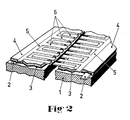
- the liquid-sensitive element consists of a rectangular, flat insulating material plate 1, preferably made of hard paper, on which the connecting conductor tracks 2 for the Wi derstandscreamtik 3 are applied for example in screen printing technology.
- a resistance paste for example a pyropolymer resistance paste which is core-catalyzed for chemical copper plating, is used as the material for the connecting conductor tracks 2.
- the resistance value of the paste is of minor importance, since the connecting conductor tracks in a chemical bath are reinforced by chemical metal deposition, the metal being electrically conductive with low resistance.
- the copper-containing pyropolymer resistance paste is a paste that consists of a binder to which the conductive particles and the catalyst substance are admixed.
- a binder to which the conductive particles and the catalyst substance are admixed.
- Mixtures of caprolactam-blocked polyurethane with silicone resins and / or acetal resins and / or vinyl chloride-vinyl acetate polymers and / or saturated polyesters can be used as binders.
- the binders can also be a caprolactam-blocked adduct of isoporone diisocyanate and a hydroxyl-containing oxyester.
- the resistance value depends on the type and packing density of the pyropolymers.
- These are electrically conductive particles that are coated with pyrolytic carbon.
- the particles consist of aluminum phosphate, aluminum oxide, silicon dioxide, titanium dioxide, iron carbide, tin oxide or lead oxide. Carbon black, graphite or mixtures can also be added to the binder as conductive particles.
- catalysts in the binder which are effective for the chemical metal deposition of the connecting conductor tracks.
- the term “catalytic” should be understood to mean a substance or a material that effects the metal deposition from chemically working baths.
- Such fillers which are effective for chemical metal deposition, form catalytically active centers on the surface and in the pore system of the binder, at which a well-adhering metal layer can be built up from a chemically working metallization bath.
- Metals or metal compounds of the copper and / or platinum group are used as catalysts.
- the catalysts can be added to the binder separately from the refractory particles coated with pyrolytic carbon. On the other hand, these particles coated with carbon can also be germinated with the catalysts.
- germs of metal or metal compounds are deposited on the filler particles.
- other metals can also be used to germinate the filler. The selection of these metals is made depending on the metal deposition solution to be used later.
- the metal compounds of copper, such as copper I-oxide are particularly suitable as catalysts for copper metallization.
- Germination of the filler materials is preferably carried out in which the filler particles are impregnated with a copper-I-chloride solution and the copper-I-chloride absorbed on the filler particle surface by e.g. NaOH exposure is converted into the practically water-insoluble copper I-oxide.
- the resistance heating layer 3 is applied in a screen printing process in the next step.
- This layer also consists of a pyropolymer resistance paste, the resistance value of which is usually somewhat higher than that of the connecting conductor tracks 2.
- this paste lacks the catalysts which are important for chemical deposition.
- Electrodes 5, 6 There is an insulating layer 4 above the resistance heating layer 3, in which the electrodes 5, 6 are embedded. These electrodes consist of two longitudinal electrodes 5, which extend at the edge parallel to the two long sides of the insulating material plate 1, and comb-shaped tines 6, which alternately run inward from the two longitudinal electrodes 5, but do not touch. If an electrically conductive liquid now gets between the prongs, the previously very high-resistance is reduced and this reduction can, for. B. be used to display rain.
- the relatively thin insulating layer 4, which is located between the resistance heating layer 3 and the electrodes 5, 6, is easier to heat up than the relatively thick insulating material plate 1.
- the element thus has a shorter response time.
- this is more energy-efficient since less energy is required to achieve the same effect, namely drying the smooth surface of the element.
- the insulating layer 4 is applied together with the electrodes 5, 6 using the so-called reverse lamination technique.
- this technique one first starts from an intermediate carrier on which the electrodes are applied in the desired layout, preferably by printing in the screen printing process. The structure is then cured and laminated with the coated side onto the insulating material plate 1, which is already provided with the resistance heating layer, using an epoxy resin adhesive as the insulating layer. In a final process step, the intermediate carrier is removed or completely etched away. The connection points on the conductor tracks or electrodes for rivets or cramps are covered beforehand by means of a cover.
- the material for the electrodes 5, 6 consists of a low-resistance paste containing soot. This paste shows no signs of migration in high humidity or in the presence of liquid.
- a low-resistance paste made of pyrolytically carbon-coated temperature-resistant particles can also be used.
- the element can not only be used as a rain sensor, but also wherever it is important to indicate the presence of conductive liquids.
Landscapes
- Chemical & Material Sciences (AREA)
- Chemical Kinetics & Catalysis (AREA)
- Electrochemistry (AREA)
- Physics & Mathematics (AREA)
- Health & Medical Sciences (AREA)
- Life Sciences & Earth Sciences (AREA)
- Analytical Chemistry (AREA)
- Biochemistry (AREA)
- General Health & Medical Sciences (AREA)
- General Physics & Mathematics (AREA)
- Immunology (AREA)
- Pathology (AREA)
- Surface Heating Bodies (AREA)
- Resistance Heating (AREA)
- Investigating Or Analyzing Materials By The Use Of Fluid Adsorption Or Reactions (AREA)
- Investigating Or Analyzing Materials By The Use Of Electric Means (AREA)
- Measurement Of The Respiration, Hearing Ability, Form, And Blood Characteristics Of Living Organisms (AREA)
Priority Applications (1)
| Application Number | Priority Date | Filing Date | Title |
|---|---|---|---|
| AT83111248T ATE32952T1 (de) | 1982-12-15 | 1983-11-11 | Fluessigkeitsempfindliches element. |
Applications Claiming Priority (2)
| Application Number | Priority Date | Filing Date | Title |
|---|---|---|---|
| DE19823246412 DE3246412A1 (de) | 1982-12-15 | 1982-12-15 | Fluessigkeitsempfindliches element |
| DE3246412 | 1982-12-15 |
Publications (3)
| Publication Number | Publication Date |
|---|---|
| EP0111733A2 EP0111733A2 (de) | 1984-06-27 |
| EP0111733A3 EP0111733A3 (en) | 1985-04-10 |
| EP0111733B1 true EP0111733B1 (de) | 1988-03-09 |
Family
ID=6180731
Family Applications (1)
| Application Number | Title | Priority Date | Filing Date |
|---|---|---|---|
| EP83111248A Expired EP0111733B1 (de) | 1982-12-15 | 1983-11-11 | Flüssigkeitsempfindliches Element |
Country Status (3)
| Country | Link |
|---|---|
| EP (1) | EP0111733B1 (cg-RX-API-DMAC7.html) |
| AT (1) | ATE32952T1 (cg-RX-API-DMAC7.html) |
| DE (1) | DE3246412A1 (cg-RX-API-DMAC7.html) |
Families Citing this family (4)
| Publication number | Priority date | Publication date | Assignee | Title |
|---|---|---|---|---|
| DE3829517A1 (de) * | 1988-08-31 | 1990-03-08 | Bosch Gmbh Robert | Feuchtesensor |
| DE3916921C1 (cg-RX-API-DMAC7.html) * | 1989-05-24 | 1990-10-11 | Preh-Werke Gmbh & Co Kg, 8740 Bad Neustadt, De | |
| DK90192D0 (da) * | 1992-07-09 | 1992-07-09 | Rasmussen Kann Ind As | Elektrisk regnfoeler og fremgangsmaade til fremstilling af et foelerelement dertil |
| SE0102426D0 (sv) * | 2001-07-06 | 2001-07-06 | Bioett Ab | Fuktsensor |
Citations (1)
| Publication number | Priority date | Publication date | Assignee | Title |
|---|---|---|---|---|
| EP0043001A1 (de) * | 1980-06-27 | 1982-01-06 | Endress u. Hauser GmbH u.Co. | Feuchtigkeitsfühler und Verfahren zu seiner Herstellung |
Family Cites Families (9)
| Publication number | Priority date | Publication date | Assignee | Title |
|---|---|---|---|---|
| JPS5152005A (ja) * | 1974-09-12 | 1976-05-08 | Uop Inc | Denkiteikotaiinki |
| JPS51151176A (en) * | 1975-06-20 | 1976-12-25 | Asahi Glass Co Ltd | Dew condensation sensor |
| US4011538A (en) * | 1976-01-30 | 1977-03-08 | Illinois Tool Works Inc. | Fluid sensor |
| AT368811B (de) * | 1978-07-12 | 1982-11-10 | Siemens Ag Oesterreich | Feuchtigkeitsmesseinrichtung |
| DE2938434C2 (de) * | 1979-09-22 | 1981-07-09 | Fraunhofer-Gesellschaft zur Förderung der angewandten Forschung e.V., 8000 München | Kapazitiver Feuchtigkeitsfühler und Verfahren zur Herstellung des Fühlers |
| DE3045617A1 (de) * | 1979-12-03 | 1981-08-20 | Tokyo Cosmos Electric Co. Ltd.,, Hachioji, Tokyo | Feuchtigkeitsempfindlicher widerstand |
| DE8121939U1 (de) * | 1981-07-25 | 1982-01-14 | Kernforschungsanlage Jülich GmbH, 5170 Jülich | Regenfuehler fuer einen regensammler |
| DE3176700D1 (en) * | 1981-09-30 | 1988-05-05 | Mitsubishi Electric Corp | Humidity sensor |
| US4520341A (en) * | 1981-12-08 | 1985-05-28 | Sharp Kabushiki Kaisha | Moisture responsive element with crosslinked organic membrane and protective layering |
-
1982
- 1982-12-15 DE DE19823246412 patent/DE3246412A1/de active Granted
-
1983
- 1983-11-11 AT AT83111248T patent/ATE32952T1/de not_active IP Right Cessation
- 1983-11-11 EP EP83111248A patent/EP0111733B1/de not_active Expired
Patent Citations (1)
| Publication number | Priority date | Publication date | Assignee | Title |
|---|---|---|---|---|
| EP0043001A1 (de) * | 1980-06-27 | 1982-01-06 | Endress u. Hauser GmbH u.Co. | Feuchtigkeitsfühler und Verfahren zu seiner Herstellung |
Also Published As
| Publication number | Publication date |
|---|---|
| ATE32952T1 (de) | 1988-03-15 |
| DE3246412C2 (cg-RX-API-DMAC7.html) | 1988-03-17 |
| DE3246412A1 (de) | 1984-06-20 |
| EP0111733A3 (en) | 1985-04-10 |
| EP0111733A2 (de) | 1984-06-27 |
Similar Documents
| Publication | Publication Date | Title |
|---|---|---|
| EP1623217B1 (de) | Sensor zur detektion von teilchen | |
| EP0953141A1 (de) | Füllstandsgeber | |
| DE4036109C2 (de) | Widerstandstemperaturfühler | |
| DE2824609C2 (de) | Vorrichtung zur Feuchtigkeitsmessung durch elektrostatische Kapazitätsänderung | |
| DE19524943C2 (de) | Sensor | |
| EP0944816A1 (de) | Elektrischer widerstand mit wenigstens zwei anschlusskontaktfeldern auf einem keramik-substrat sowie verfahren zu dessen herstellung | |
| DE3911812A1 (de) | Schneller feuchtesensor auf polymerbasis | |
| EP0111733B1 (de) | Flüssigkeitsempfindliches Element | |
| DE19957991C2 (de) | Anordnung einer Heizschicht für einen Hochtemperaturgassensor | |
| WO2016142080A1 (de) | Herstellungsverfahren für einen gassensor und entsprechender gassensor | |
| WO1999002980A1 (de) | Anordnung zum bestimmen der relativen luftfeuchte | |
| EP0280150B1 (de) | Raumheizelement, bestehend aus einem mit einer elektrischen Widerstandsbeschichtung versehenen keramischen Formkörper, insbesondere in Form einer keramischen Platte | |
| EP0243602B1 (de) | Elektrisches Bauelement mit hoher Festigkeit bei Beanspruchung durch Temperaturwechsel und durch Stossströme, insbesondere ein Varistor | |
| DE2853134C2 (de) | Keramikvaristor | |
| DE3410578A1 (de) | Duennfilm-feuchtigkeitsmessfuehler | |
| DE8235238U1 (de) | Fluessigkeitsempfindliches element | |
| WO2010130370A1 (de) | Fotolithographisch strukturierter dickschichtsensor | |
| DE1765097C3 (de) | Spannungsabhaengiger Widerstand aus einer gesinterten Scheibe aus Zinkoxid | |
| DE3050770C2 (de) | Verfahren zur Herstellung eines Varistors | |
| DE3586994T2 (de) | Elektrischer kontakt zwischen metallen und widerstandselementen. | |
| DE3416945A1 (de) | Feuchtigkeitssensor und verfahren zu seiner herstellung | |
| DE29700625U1 (de) | Füllstandsgeber | |
| DE1018171B (de) | Bildschirm mit einander zugeordneten photoempfindlichen und elektrolumineszierenden Elementen | |
| DE3900787A1 (de) | Verfahren zur herstellung eines keramischen elektrischen bauelementes | |
| DE8011367U1 (de) | Fluessigkeitsstand-fuehlervorrichtung |
Legal Events
| Date | Code | Title | Description |
|---|---|---|---|
| PUAI | Public reference made under article 153(3) epc to a published international application that has entered the european phase |
Free format text: ORIGINAL CODE: 0009012 |
|
| AK | Designated contracting states |
Designated state(s): AT BE CH FR GB IT LI NL SE |
|
| PUAL | Search report despatched |
Free format text: ORIGINAL CODE: 0009013 |
|
| AK | Designated contracting states |
Designated state(s): AT BE CH FR GB IT LI NL SE |
|
| 17P | Request for examination filed |
Effective date: 19850430 |
|
| 17Q | First examination report despatched |
Effective date: 19860704 |
|
| ITF | It: translation for a ep patent filed | ||
| GRAA | (expected) grant |
Free format text: ORIGINAL CODE: 0009210 |
|
| AK | Designated contracting states |
Kind code of ref document: B1 Designated state(s): AT BE CH FR GB IT LI NL SE |
|
| REF | Corresponds to: |
Ref document number: 32952 Country of ref document: AT Date of ref document: 19880315 Kind code of ref document: T |
|
| GBT | Gb: translation of ep patent filed (gb section 77(6)(a)/1977) | ||
| ET | Fr: translation filed | ||
| PLBE | No opposition filed within time limit |
Free format text: ORIGINAL CODE: 0009261 |
|
| STAA | Information on the status of an ep patent application or granted ep patent |
Free format text: STATUS: NO OPPOSITION FILED WITHIN TIME LIMIT |
|
| 26N | No opposition filed | ||
| PGFP | Annual fee paid to national office [announced via postgrant information from national office to epo] |
Ref country code: AT Payment date: 19891102 Year of fee payment: 7 |
|
| PGFP | Annual fee paid to national office [announced via postgrant information from national office to epo] |
Ref country code: BE Payment date: 19891114 Year of fee payment: 7 |
|
| PGFP | Annual fee paid to national office [announced via postgrant information from national office to epo] |
Ref country code: SE Payment date: 19891116 Year of fee payment: 7 |
|
| PGFP | Annual fee paid to national office [announced via postgrant information from national office to epo] |
Ref country code: NL Payment date: 19891130 Year of fee payment: 7 |
|
| PG25 | Lapsed in a contracting state [announced via postgrant information from national office to epo] |
Ref country code: AT Effective date: 19901111 |
|
| PG25 | Lapsed in a contracting state [announced via postgrant information from national office to epo] |
Ref country code: SE Effective date: 19901112 |
|
| PG25 | Lapsed in a contracting state [announced via postgrant information from national office to epo] |
Ref country code: BE Effective date: 19901130 |
|
| BERE | Be: lapsed |
Owner name: PREH ELEKTROFEINMECHANISCHE WERKE JAKOB PREH NACH Effective date: 19901130 |
|
| PG25 | Lapsed in a contracting state [announced via postgrant information from national office to epo] |
Ref country code: NL Effective date: 19910601 |
|
| NLV4 | Nl: lapsed or anulled due to non-payment of the annual fee | ||
| ITTA | It: last paid annual fee | ||
| PGFP | Annual fee paid to national office [announced via postgrant information from national office to epo] |
Ref country code: GB Payment date: 19941024 Year of fee payment: 12 |
|
| PGFP | Annual fee paid to national office [announced via postgrant information from national office to epo] |
Ref country code: FR Payment date: 19941027 Year of fee payment: 12 |
|
| PGFP | Annual fee paid to national office [announced via postgrant information from national office to epo] |
Ref country code: CH Payment date: 19950120 Year of fee payment: 12 |
|
| EUG | Se: european patent has lapsed |
Ref document number: 83111248.7 Effective date: 19910705 |
|
| PG25 | Lapsed in a contracting state [announced via postgrant information from national office to epo] |
Ref country code: GB Effective date: 19951111 |
|
| PG25 | Lapsed in a contracting state [announced via postgrant information from national office to epo] |
Ref country code: LI Effective date: 19951130 Ref country code: CH Effective date: 19951130 |
|
| GBPC | Gb: european patent ceased through non-payment of renewal fee |
Effective date: 19951111 |
|
| REG | Reference to a national code |
Ref country code: CH Ref legal event code: PL |
|
| PG25 | Lapsed in a contracting state [announced via postgrant information from national office to epo] |
Ref country code: FR Effective date: 19960731 |
|
| REG | Reference to a national code |
Ref country code: FR Ref legal event code: ST |