EP0104797A2 - Einlage für Vollreifen - Google Patents
Einlage für Vollreifen Download PDFInfo
- Publication number
- EP0104797A2 EP0104797A2 EP83305039A EP83305039A EP0104797A2 EP 0104797 A2 EP0104797 A2 EP 0104797A2 EP 83305039 A EP83305039 A EP 83305039A EP 83305039 A EP83305039 A EP 83305039A EP 0104797 A2 EP0104797 A2 EP 0104797A2
- Authority
- EP
- European Patent Office
- Prior art keywords
- tube
- tyre
- web
- bore
- insert
- Prior art date
- Legal status (The legal status is an assumption and is not a legal conclusion. Google has not performed a legal analysis and makes no representation as to the accuracy of the status listed.)
- Granted
Links
Images



Classifications
-
- B—PERFORMING OPERATIONS; TRANSPORTING
- B60—VEHICLES IN GENERAL
- B60C—VEHICLE TYRES; TYRE INFLATION; TYRE CHANGING; CONNECTING VALVES TO INFLATABLE ELASTIC BODIES IN GENERAL; DEVICES OR ARRANGEMENTS RELATED TO TYRES
- B60C7/00—Non-inflatable or solid tyres
-
- B—PERFORMING OPERATIONS; TRANSPORTING
- B60—VEHICLES IN GENERAL
- B60C—VEHICLE TYRES; TYRE INFLATION; TYRE CHANGING; CONNECTING VALVES TO INFLATABLE ELASTIC BODIES IN GENERAL; DEVICES OR ARRANGEMENTS RELATED TO TYRES
- B60C7/00—Non-inflatable or solid tyres
- B60C7/10—Non-inflatable or solid tyres characterised by means for increasing resiliency
- B60C7/12—Non-inflatable or solid tyres characterised by means for increasing resiliency using enclosed chambers, e.g. gas-filled
- B60C7/121—Non-inflatable or solid tyres characterised by means for increasing resiliency using enclosed chambers, e.g. gas-filled enclosed chambers defined by a distinct core
-
- B—PERFORMING OPERATIONS; TRANSPORTING
- B29—WORKING OF PLASTICS; WORKING OF SUBSTANCES IN A PLASTIC STATE IN GENERAL
- B29D—PRODUCING PARTICULAR ARTICLES FROM PLASTICS OR FROM SUBSTANCES IN A PLASTIC STATE
- B29D30/00—Producing pneumatic or solid tyres or parts thereof
- B29D30/04—Resilient fillings for rubber tyres; Filling tyres therewith
Definitions
- the present invention relates to a non-pneumatic insert tube adapted for use in a pneumatic tyre as a replacement for pressurised air, comprising an elongate tube defining a bore which extends along the .- length of the tube.
- a rubber insert is placed within a tyre casing to replace pressurised air.
- Each of the tubular inserts contains one or more cushioning chambers to simulate a pressurised pneumatic tyre.
- One of the disadvantages of the prior art inserts is that during use the frictional movement of the insert generates heat causing deterioration of the tyre casing's inner walls.
- Another problem is that there is no convenient means by which these inserts can be constructed to ensure a simulated pressure equivalent to the tyre manufacturer's recommended pressure.
- many of the inserts disclosed in the prior art rely on the use of trapped ambient pressure to obtain a cushioning effect. In so doing, the tyre can take on the characteristics of a partially flat or an improperly inflated tyre when the trapped air is released by puncture.
- tyre inserts In addition to the use of tyre inserts, various other approaches have been suggested to render a tyre puncture resistant.
- One technique is to add to a tyre casing or inner tube a quick-curing substance which enters a puncture and causes it to self-seal.
- Another approach is to produce a thicker inner tube. Others have suggested a double walled inner tube. When the outer wall is punctured, the inner wall.retains sufficient air to permit the vehicle to be brought to a relatively safe stop. Still another approach is to insert a solid material, such as rubber or steel, within the tyre casing of a pneumatic tyre. If such a tyre is punctured and loses its air, it becomes only partially flat due to the support provided by the hard inner material.
- a relatively recent innovation for preventing flat tyres proposes a method for filling a pneumatic tyre with a foamed rubber or plastics material and then curing the material within the tyre. Upon completing the curing operation, the tyre is supported by this material and does not require pressurised air.
- non-pneumatic inserts offer many advantages over the pneumatic tube or tyre and the foamed tube or tyre, several disadvantages are also present.
- One further problem associated with non-pneumatic tube inserts relates to the extrusion and joining of the tube ends.
- the material selected for the tube must have a very high yield point and exhibit almost no creep under stress.
- the very characteristics which permit satisfactory performance as an inner- tube replacement make extrusion into a circular configuration for insertion into a tyre almost impossible.
- the ratio of the wall thickness to the tube diameter must be maintained above a certain minimum in order to prevent kinking when the straight tube (as extruded) is formed into a hoop.
- Some prior art discloses a non-pneumatic tube which requires to be formed into a circle and then its ends are welded together to make a continuous hoop.
- the weld can create a non-homogeneity in the structure resulting in a bump every revolution. Also, if the welded tube is not precisely correct in its circumference it will not stay securely mounted on the wheel inside the tyre.
- a non-pneumatic insert tube replacement for the pneumatic inner tube has in the past posed difficult manufacturing problems, has required very large field inventories to accommodate all sizes, and has offered marginal performance to the user in terms of installation and handling characteristics.
- non-pneumatic tyre insert tube which provides riding qualities and rolling-resistance comparable to or better than pneumatic inner tubes, and which can be simply manufactured. It is a further object to provide a design configuration which can be trimmed to the proper circumferential length with ease, which can be installed as easily as a pneumatic tube, and which offers the user a light weight tube which will not become flat if punctured.
- a further object of this invention is to reduce the amount and variety of inventory a dealer or manufacturer must stock in order to service all required applications for an inner insert tube, and to eliminate the need for welding the ends of the insert tube together in order to eliminate a hump when installed in the tyre.
- a non-pneumatic insert tube is characterised by a sequence of partial cuts through the wall of the tube, the sequence of partial cuts being disposed about the outer periphery of the tube when formed into a single coil hoop for insertion into a tyre and with the uncut portion of the tube being located on the inner periphery of the tube.
- the tube comprises a resilient thermoplastic tube which is extruded continuously and partially cut through the cross-section at close intervals during extrusion. The depth and interval of these cuts are selected to meet criteria dictated by specific vehicular use.
- the tube is thin walled and the bore is continuous and extends throughout the entire tube length.
- the flattened or elliptical cross-section reduces the load carrying characteristics and increases rolling resistance, since the "footprint" of the tyre is enlarged.
- the partial cutting of the insert tube relieves these stresses, allows the tube to reassume a circular cross-section, and thereby retains ,the lowest rolling resistance at a given load and ride harshness.
- the designer has two additional independent variables to select from in determining the most cost effective design for the non-pneumatic tyre insert tube.
- the partial cuts are closely spaced, for example, 1/4 inch (6.35 mm) apart, selection of the proper length insert for a given wheel is simplified, because the insert tube can be placed within the tyre and cut off very accurately through one of the partial cuts. Also, inventories can be reduced to one continuous roll of partially cut tubing for all wheel sizes using the same cross-sectional diameter tube.
- a further benefit derived from the partial cut design of this invention is found in the natural curvature of the partially cut tubing.
- the exact material properties which provide low creep and high load carrying capacity make tubing without partial cuts expensive to form into a circle, or impossible without a second thermoforming step.
- the tube ends must be joined, usually by butt welding.
- the partial cuts allow the use of the tube insert within the tyre casing without joined ends, or with an inexpensive internal sleeve connector, though, of course, if particularly required, a conventional butt welded joint can be used.
- the partially cut tube can be packaged into a much smaller volume than an uncut tube, because it will naturally coil into a smaller diameter.
- the sequence of partial cuts is continuous throughout the entire length of the tube, however, variation of the invention is characterised by providing the partial cuts only at that portion of tube close to its ends, for example within 5 to 10 times of the cross-sectional diameter from each end, thereby allowing simplified insertion of the tube into the tyre casing, and eliminating the need for butt welding the ends to prevent circular discontinuity.
- the partial cuts are symmetrically disposed relative a first longitudinal line located on the outer periphery of the tube, each of the cuts being transverse to the longitudinal central axis of the tube.
- the tube is generally cylindrical and adjacent partial cuts have a spacing less than the diameter of the tube.
- a preferred form of tube is characterised by the presence of a relatively thin reinforcing web in the bore of the tube, which is attached to the interior walls of the tube and extends the entire length of the tube and is formed with the tube as a single thermoplastics extrusion.
- the reinforcing web divides the interior bore into two sections which may or may not be equal,-though preferably, the web is located approximately midway between the inside and outside tube peripheries when coiled into a hoop.
- the web may be arched or flat, depending upon the upon the ride characteristics desired.
- the cuts extend into the reinforcing web to subdivide the web into separate sections.
- the web may be formed with a predetermined curvature or "arch". This permits the tube to deform at a low load and provide a softer ride.
- the load causes the tube to assume an elliptical shape due to increased weight or severe impact, the web is placed in tension due to a flattening of the web arch.
- This load may be predetermined by the designer. For.loads which cause a flattened web, the load is shared by the web and the tube sidewalls in such a fashion that the ride becomes very hard, and the tube can withstand heavy shock or static loads without permanent deformation.
- non-pneumatic insert,tubes Because of the advantages offered by non-pneumatic insert,tubes; they have been considered for use in vehicles carrying still heavier loads while subject to both sudden impact forces and intense angularly applied forces. For example, an apparent demand exists for the use of non-pneumatic insert tubes in rickshaws which may carry the full weight of several individuals. In this application, the insert tube diameter is relatively large. A soft ride of necessity dictates an insert tube having a relatively thin sidewall. With these design criteria, the insert tube, including of course the tyre within which it is .contained, may distort excessively into a generally inclined elliptical out-of-round shape during sharp cornering manoeuvres at relatively high speeds.
- a single flat reinforcing web may not eliminate entirely the out-of-round elliptical distortion created by the foregoing aggravating and demanding conditions.
- another object of this invention is to provide a non-pneumatic insert tube for tyres which can be advantageously used in applications and environments in which heavy loads are carried at relatively high speeds while subject to both angularly applied forces and also intermittent impact or shock forces.
- Another object of this invention is to.broaden the range of use of non-pneumatic insert tubes with respect to the types of vehicles with which they may be used.
- a further preferred form of tube is characterised by the inclusion of a reinforcing web structure within the bore of the insert tube having a plurality of generally intersecting cross legs.
- a reinforcing web structure within the bore of the insert tube having a plurality of generally intersecting cross legs.
- the reinforcing web is located within the bore of the generally circular non-pneumatic insert tube and is integrally attached to the sidewalls of the insert tube at four or six points.
- each cross leg is formed with a pair of wall attached segments joined together at the locus of intersection of the cross legs.
- the locus of intersection may be offset from the insert tube centre toward the outer or inner periphery, or may be located approximately on the geometrical centre of the undeformed tube bore.
- the reinforcing web has a plurality of intersecting cross legs extending across the bore of the tube from sidewall to sidewall for the length of the tube and integrally joined to the interior wall of the tube adjacent the partial cuts with the sequence of partial cuts also severing the reinforcing web at least in part.
- the third cross leg preferably divides the tube bore into two approximately equal semi-circles both of which are generally symmetrically disposed about both the inner and outer periphery.
- the cross-sectional locus of intersection of the cross legs may be located closer to the inner or outer periphery of the tube.
- the reinforcing cross web When the insert tube is subjected to a vertically applied load, the reinforcing cross web is placed in tension with the result that excessive deformation or flattening of the insert tube is prevented.
- the insert tube When the insert tube is subjected to angularly applied forces, in the main, one or more legs of the reinforcing web are placed-pin tension so as to prevent excessive distortion of the insert tube and the resulting generally inclined elliptical shape.
- a tube having three intersecting cross legs forming the reinforcing web tends to provide the greatest load handling capabilities of all the various designs.
- Certain variations of the invention contemplate the use of curved cross web segments so that the insert tube must be subject to a minimum threshold weight before one or both of the cross legs of the reinforcing web are placed in tension. This mode of operation provides a generally softer ride.
- Another variation of the invention contemplates attachment points to the insert tube sidewalls to define a relatively larger span length.
- This design promotes the reinforcement strength of the insert tubes adjacent the wheel rim, particularly for insert tubes having a relatively large diameter and a thin wall.
- This increased span length minimises the tendency in this application for the insert tube to be distorted into an out-of-round, or generally inclined elliptical cross section adjacent the wheel rim in response to angularly applied forces.
- a non-uniform wall thickness for the insert tube In another variation of this invention there is provided a non-uniform wall thickness for the insert tube.
- the tube sidewall is made relatively thicker in those vertical areas of the sidewall which carry the highest stress under load, for example at positions adjacent the reinforcing web attachment areas.
- the effect of this wall non-uniformity is to create a spring-like load-deflection curve approximating that of a variable-rate spring. This results in a soft ride at low loads, and a harsher ride at high loads or impact loads, while preventing the tube from becoming permanently deformed from excessive stress.
- a non-pneumatic insert tube for a tyre adapted to be mounted upon a circular rim comprising an elongated tube characterised by the tube having a thin wall defining a continuous bore which extends throughout the entire tube length, a sequence of spaced partial cuts severing the thin wall of the tube with the sequence of partial cuts being generally symmetrically centred about the outer periphery of the tube when formed into a single coil hoop for insertion into a tyre and with an uncut portion of the tube being generally symmetrically centered about the inner periphery of the tube which is to be seated adjacent the rim and with the sequence spacing of the partial cuts being less than the diameter of the tube, and a reinforcing-web having three intersecting cross legs extending across the bore of the tube from sidewall.to sidewall for the length of the tube and integrally joined to the interior wall of the tube adjacent the partial cuts with the sequence of partial cuts also severing the reinforcing web.
- the three intersecting cross legs may define substantially equal.angular cross-sectional sectors, or alternatively, they may define a first group of equal angular cross-sectional sectors, and a second group of equal angular cross-sectional sectors which are different in size from the first group.
- the inner and outer wall thicknesses of the insert tube are different.
- a preferred form is to make the road contacting wall thicker than the opposite or bottom wall.
- Two purposes may be achieved with this design. Firstly, a significant saving of material can be achieved.
- the ride characteristics may be tailored to suit the objectives of the designer; that is, the outer wall thickness adjacent the road surface can be made to react to loads at one rate, while the inner wall thickness supported by the tyre beads can be made to react at a different rate.
- the various reinforcing web designs may be combined with any of the wall configurations to provide added load carrying and variable spring ride characteristics.
- ⁇ -.tyre insert tube is shown contained within a conventional bicycle tyre 2. Tyre 2 is carried on a wheel 3 which includes a hub 4 from which spokes 5 extend radially to a rim 6.
- the tyre insert tube 1 forms a central annular bore 7 ( Figures 2, 5) defined by a cylindrical thin wall 8.
- This central bore functions as a cushioning chamber which, in combination with certain physical characteristics of the material from which the insert tube is constructed, will produce a resistance to deformation similar or identical to that which would be realised if tyre 2 were filled with pressurised air contained within a conventional inner tube.
- the insert tube 1 is made from a resilient thermoplastics material.
- the tube is produced by continuous extrusion, and upon emerging from the extrusion die it is repeatedly cut at close intervals while the tube is in motion and before the thermoplastics material has fully set and completely cured.
- the cuts 9 are partial cuts through i the cross-section of the tube. The depth c and interval s of these cuts are dictated by the performance requirements-and certain critical dimensions of a particular application.
- the depth of the cuts 9 must be increased and/or the number of cuts 9 for a given length of insert tube 1 must be increased to prevent flattening and or kinking of the insert tube.
- the wall thickness t ( Figure 5) is increased, the depth c of the cuts 9 per unit length of insert tube 1 must be increased to prevent kinking of the insert tube.
- the depth of cut c may be less than the cross-sectional radius of the tube.
- the depth of cut c may be greater than the cross-sectional radius of the tube.
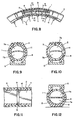
- the cuts 9 are preferably made as knife cuts during extrusion as the tube emerges from the extrusion die. These knife cuts are characterised by. no substantial removal of thermoplastics material and are distinguishable from a saw cut in this regard. As is shown in Figure 4, after the application of a series of cuts 9 to the insert tube 1, the tube assumes a natural curve, which enables the extrusion operator to coil an otherwise long length of extruded tube stock into relatively smaller diameter coils.
- insert tube 1 can be cut at the appropriate cut 9 (to form a tube end 10) from the coil stock for insertion to the tyre casing 2 ( Figure 2).
- FIG. 7 A variation of the invention is shown in Figure 7 in which partial cuts 9 as described above are made only at the portion of the insert tube 1 close to its ends 10, for example within 5 to 10 times of the cross-sectional diameter from each end, ..
- This allows simplified insertion of the tube into the tyre casing, and eliminates the need for butt welding the ends to prevent circular discontinuity.
- This alternative design is really only useful in those applications in which the insert tube parameters are such that kinking does not occur when the cuts are eliminated.
- a preferred plastics material that may be used for the preparation of the tube is a chemically extended polyester and polybutylene terephthalate polymer.
- the mixture will comprise from about 50% to about 90% of the chemically extended polyester and from about 10% to about 50% of the polybutylene terephathalate polymer.
- the chemically extended polyesters which may be used are known and described in, for example, U.S. Patents 3,651,014, 3,766,146,and 3,763,109.
- the chemically extended polyesters are prepared from mixtures comprising a long-chain glycol, one or more dicarboxylic acids or their esters or ester-forming derivatives, and one or more low molecular weight aliphatic diols. Included among the long-chain gycols are those having a molecular weight of about 400 to about 4,000, and a carbon-to-oxygen ratio in the long-chain glycol in excess of about 2:5. Examples of these glycols include poly (1,2- and 1.3-propylenè oxide) glycol, poly (tetramethylene oxide) glycol, etc.
- the dicarboxylic acids utilised in preparing the chemically extended polyesters are those having a molecular weight of less than about 300, and they may be aromatic, aliphatic or.cycloaliphatic dicarboxylic acids.
- Representative dicarboxylic acids include terephthalic and isophthalic acids, dibenzoic acid, . etc.
- Included among the low molecular weight diols used in the preparation of the chemically extended polyesters are acyclic, alicyclic and aromatic dihydroxy compounds. Preferred are diols with 2 to 15 carbon atoms such as ethylene glycol, propylene gylcol, tetramethylene glycol, etc.
- Copolyesters of these types are available commercially from E.I. du Pont de Nemours Company under the general trade designation "Hytrel”.
- Hytrel polyester elastomers is available from du Pont and these are contemplated as being useful in the preparation of the tyre insert of the invention.
- a particularly preferred example of a chemically extended polyester material which can be utilised in this invention is a Hytrel formulation having a Bayshore resilience greater than 50.
- thermoplastic vulcanizates comprising blends of olefin rubber and thermoplastic olefin resin as described in U.S. Patent 4,130,535. These thermoplastic compositions are sold by the Monsanto Company under the trade designation Santoprene.
- Figures 8 to 12 show a second preferred embodiment.
- This embodiment is structurally the same as the first embodiment described with reference to Figures 1 to 6, except that an arched reinforcing web 11 is disposed within the interior bore 7 of tube 1 to subdivide the bore into approximately equal upper and lower bore sections 7a and 7b.
- the web 11 extends for the entire length of insert tube 1 to limit the extent of flattening of the insert tube during extreme conditions.
- the web 11 is made of the same thermoplastics material as the tube 1, and because the web 11 and tube 1 are formed in the same thermoplastic extrusion step, the web 11 is molecularly bonded to the interior sidewalls of the tube 1 so as to have a permanent attachment to diametrically opposed longitudinal areas of the interior sidewalls.
- the partial cuts 9 extend through reinforcing web 11 so that the web is subdivided into generally rectangular sections each having a length equal to the spacing s ( Figure 4). Accordingly, a gap 12 ( Figure 4) defined by the partial cut 9 appears between adjacent sections of reinforcing web 11.
- the web 11 is formed with a predetermined curvature or "arch". This permits the tube 1 to deform at a low load and so provide a softer ride.
- the load causes the tube 1 to assume an elliptical shape ( Figure 12) due to increased weight or severe impact, the web 11 is placed in tension due to a flattening of the web arch ( Figure 12).
- This load may be predetermined by the designer. For the heavier loads which cause a flattened web, the load is shared by web 11 and the tube sidewalls in such a fashion that the ride becomes very hard, and the tube can withstand heavy shock or static loads without permanent deformation.
- the arched reinforcing web 11 is thus advantageously included in the structure of the tube 1 in those situations in which the tyre 2 is used in an environment having wide temperature variations, wide ranges of applied weight, or extremely rough terrain which subjects the tyre to momentarily intense forces. In these cases if the web is not present the extreme conditions will cause excessive flattening or an excessive out-of-round condition of the tube which detracts from its overall riding performance.
- the tube 1 Although it is preferable to fabricate the tube 1 with the-partial cuts 9 which penetrate into the reinforcing web 11 to form the series of gaps 12, such gaps are not necessary under conditions of moderate weight, moderate applied forces, or limited high temperatures. Additionally, in those situations in which the tyre insert diameter D is relatively large, it may not be necessary to penetrate into the reinforcing web 11 to form the gaps 12.
- Figures 13 to 16 show a variation of the second preferred embodiment of the tube 1. This embodiment is structurally the same as the embodiment described with reference to Figures 8 to 12, except that the reinforcing web 13 is "flat".
- the reinforcing web 13 is desirable to form with a flat cross-section at no load (arch eliminated) so that the web is in tension even under light weights.
- This flat-web design is particularly useful in applications having relatively large insert tube diameters d ( Figure 5) which would otherwise tend to flatten easily. Because of the relatively large insert tube diameter, adequate cushioning may be obtained by flexing the outer portions of the tube sidewall adjacent the road. Because the flat web 13 goes into tension upon application of the slightest tyre load, the tyre is prevented from assuming an excessive out-of-round condition.
- Figures 17 to 20 show four different variations of the invention involving modifications in the tube wall 8 thickness t ( Figure 5). These wall modifications are applicable to insert tubes fabricated with ( Figures 18, 20) or without ( Figures 17, 19) reinforcing webs and webs which are either arched or flat and also to the insert tubes 1(A-G) - ( Figures 22, 24, 27-38), to be described below.
- the tube sidewall 8 is made.relatively thicker in those vertical areas 8a and 8b of the sidewall which carry the highest stress under load.
- the effect of the wall non-uniformity is to create a spring-like load-deflection curve approximating that of a variable-rate spring. This results in-.a soft ride at low loads, and a harsher ride at high loads or impact loads, while preventing the tube 1 from becoming permanently deformed from excessive stress.
- the inner and outer wall thicknesses at 9c and 8d of the insert tube are different.
- a preferred modification is to make the road contacting wall at 8c thicker than the opposite or bottom wall at 8d.
- Two purposes may be achieved with this embodiment. Firstly, a significant saving of material may be achieved.
- the ride characteristics may be tailored to suit the objectives of the designer; that is, the outer wall thickness in contact with the road surface will react to loads at one rate, and the inner wall thickness supported by the tyre beads will react at a different rate.
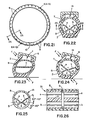
- Figures 21 to 32 serve to illustrate a third embodiment of the insert tube 1(A-D) which includes a reinforcing cross web within the bore 7 to strengthen the tube.
- an appropriate length of the insert tube l(A-G) is formed into a single coil for insertion into tyre 2.
- the insert tube l(A-G) is fabricated from a resilient thermoplastics material as was the case with the insert tube 1.
- the tyre insert tube 1(A-G) contains a central bore 7 which is subdivided by the X-shaped and modified X-shaped reinforcing webs shown in Figures 22 and 24 to 32.
- the reinforcing webs are particularly designed to strengthen the insert tube 1 (A-G) in response to intense angularly applied forces-on the tyre 2 (for example, during a turning manoeuvre on a sharp corner) or to prevent excessive flattening in response to heavy load weights.
- the insert tube 1 (A-G) is produced by continuous extrusion, and upon emerging from the extrusion die it is repeatedly cut at close intervals to form the partial cuts 9 while the tube is emerging from the die and before the thermoplastics material has fully set and completely cured,
- the cuts 9 are again partial cuts through the wall 8 to enable the insert tube to be curved into a single coil as shown in Figure 21 without kinking.
- the ends of the single tube coil meet at 10.
- the tyre insert tube with partial cuts only is satisfactory for vehicles carrying light loads and in which the tyres are not subject to intense angularly applied forces.
- the inclusion of the single reinforcing web enables the vehicle to carry heavier loads with some improvement in the ability of the insert tube to withstand angularly applied loads.
- such an insert tube may be subject to a partial collapse in the sense that the tyre insert tube assumes an excessively out-of-round or a generally inclined-elliptical shape ( Figure 23).
- the tyre insert tube may-lose its ability to return to its generally circular cross section.
- an X-shaped or modified X-shaped reinforcing web having two intersecting cross legs is substituted for the single web 11 shown in Figure 23.
- Four variations of the third embodiment.of reinforcing web structure are shown..
- a modified X-shaped reinforcing web is shown in which sidewall attached web segments a, b, c, d are joined together by a centre link e within the insert tube 1A.
- modified X-shaped reinforcing web is shown in which the sidewall attached segments a, b, c, d are joined together by a centre link e within the insert tube IC.
- the reinforcing web of the third variation differs from that of the first and second variations in that the attachment points f and g of the web segments a and b, respectively, are substantially elevated and are located closer to the rim 6.
- an X-shaped reinforcing web is shown in which the sidewall attached web segments a, b, c, d are joined directly together within the insert tube 1D and without the inclusion of a centre link.
- the fourth variation is similar to the third variation in that the attachment points f and g of the web segments a and b,:respectively, are substantially elevated and occur closer to the rim 6 than that of the first and second species.
- the attachment span length between the web segments a and c and also between the segments b and d is relatively increased.
- both the cross legs of the X-shaped or modified X-shaped reinforcing web of all four variations of the third embodiment are placed in tension.
- the cross leg comprising web segments a, e, d and the cross leg comprising web segments b, e, c are placed in tension; and with respect to the second and fourth variations, the cross leg comprising web segments a, d and the cross leg comprising web segments b, are placed in tension.
- the web segments a and b of all variations of the third embodiment are shown formed with an optional slight curvature in the unloaded (no-tension) state, This curvature requires a relatively greater vertical load before the cross legs are placed in tension. As such, the curvature of the web segments a and b provides a somewhat softer ride.
- web segments c and d are shown straight or flat for all variations of the third embodiment, these web segments can also be formed with a slight curvature to provide a softer ride.
- an adequately soft ride can be attained by forming the web segments a and b only with a curvature. Because excessive deformation tends to occur first in the wall 8 defining the lower semi-circle containing the partial cuts 9, and secondly, in the upper semi-circle adjacent the rim 6, it is generally desirable to have the web segments c and d go into tension before the web segments a and b in response to vertically applied loads.
- the tensioned web segments c and d preferably reinforce the lower semi-circle of the insert tube wall 8 first because the upper semi-circle of the insert tube wall 8 has no partial cuts 9 and also because the upper semi-circle is also reinforced by the channel sides of the rim 6.
- the centre link e of the first and third variations of the third embodiment and the intersection point h of variations 2 and 4 of the third embodiment are preferably located somewhat below the centre of the circular bore 7. This positioning facilitates placing the lower semi-circle of the insert tube wall 8 into tension first.
- the elevated attachment points f and g reinforce the upper semi-circle of the tyre insert tube somewhat more than the lower attachment points.
- optimum design angles for the web segments a, b, c, d relative a horizontal line passing through the point of intersection h of the cross webs (or segment e) are in the range of 30 to 45 degrees.
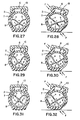
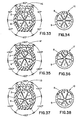
- Figures 33 to 38 show the fourth embodiment of tube designs l(E-G) in which a reinforcing web having three intersecting cross legs is employed.
- the insert tube 1E ( Figures 33, 34) has a reinforcing web in which sidewall attached web segments j, k, l, m, n and o are joined together at an intersection point p.
- the point p is located on the central axis of the cylindrical tube wall 8.
- the attached web segments extend radially outwards from the.intersection point p to divide the tube bore 7 into six equal sectors.
- a ccordingly,.each sidewall attached web segment forms a 60 degree angle with its adjacent segments.
- the partial cut 9 does not extend through the entire cross section for web segments k and 1.
- This partial cut is to be distinguished from the partial cut 9 shown in Figure 25 applicable to the insert tube 1(A-D).
- the insert tube 1 (E-G) since the points of attachment of segments k and 1 are substantially elevated and closer to the inner periphery of the tube wall 8 than the attachment for the web segments a and b in the insert tubes l(A-D), it is desirab l e tha t the uncut portion of the tube wall 8 be left relatively large so as not to unduly weaken the sidewall 8 in the area of the rim 6.
- the insert tube 1E tends to be substantially stronger than the insert tubes 1(A-D).
- each of the three cross legs comprising j, m; k, n; and 1, o is placed into tension.
- This web reinforcing arrangement enables the insert tube 1E to resist deformation better than the designs 1(A-D), However, this improved resistance to deformation is not without some loss in the softness of the ride, and so the insert tube lE provides a somewhat firmer and harder ride than the.designs of insert tube designated 1(A-D). This compromise of softness for increased web reinforcing strength is necessary in those extremely rigorous applications in which the insert tube is used on relatively large vehicles carrying heavy weights.
- the insertstube 1E is also better able to withstand angularly applied forces.
- the insert tube IF is a variation on the structure of the insert tube IE.
- the intersection point g is elevated above the geometrical centre point for the circular cylinder defined by the insert tube wall 8.
- the elevation of the intersection point g while maintaining the web attachment-points for segments j and m on the horizontal diameter, enlarges the sector angl e s defined by the segments j, k, l and m for the inner or upper semi-circle adjacent the rim to greater than 60 degrees. This weakens the resistance to deformation of the rim half of insert tube 8.
- the sector angles defined by segments m, n, o and j for the lower or ground half of the insert tube IF are made less than 60 degrees, and this strengthens the resistance to deformation of the ground half of the insert tube IF.
- the insert tube IF is advantageously employed in those applications in which greater strength is required of the lower half of the insert tube adjacent the ground, while less strength, due to reinforcement by rim 9, is required of the upper half.
- the partial cut 9 employed in the insert tube IF does not extend through the entire cross section for web segments k and.l for reasons similar. to those discussed with respect to Figure 34 as they apply to the insert tube lE.
- Insert tube 1G shown.in Figures 37 and 38 shows another variation on the reinforcing web structure of the fourth embodiment.
- the cross-leg intersection point r is located below the geometrical centre for insert tube wall 8.
- the inner or upper sector angles defined by the web segments j, k, 1 and m are less than 60 degrees, whereas the lower sectors defined by the segments m, n, o and are greater than 60 degrees.
- the spacing of successive partial cuts 9 is preferably less than the diameter of the insert tube wall 8. Satisfactory performance has been obtained with a spacing approximately equal to the radius of the circle defined by wall 8.
Landscapes
- Engineering & Computer Science (AREA)
- Mechanical Engineering (AREA)
- Tires In General (AREA)
Priority Applications (1)
| Application Number | Priority Date | Filing Date | Title |
|---|---|---|---|
| AT83305039T ATE38960T1 (de) | 1982-09-02 | 1983-09-01 | Einlage fuer vollreifen. |
Applications Claiming Priority (6)
| Application Number | Priority Date | Filing Date | Title |
|---|---|---|---|
| US41406882A | 1982-09-02 | 1982-09-02 | |
| US414068 | 1982-09-02 | ||
| US45565383A | 1983-01-05 | 1983-01-05 | |
| US455653 | 1983-01-05 | ||
| US509743 | 1983-07-01 | ||
| US06/509,743 US4471827A (en) | 1983-01-05 | 1983-07-01 | Non-pneumatic insert tube for tires |
Publications (3)
| Publication Number | Publication Date |
|---|---|
| EP0104797A2 true EP0104797A2 (de) | 1984-04-04 |
| EP0104797A3 EP0104797A3 (en) | 1985-01-09 |
| EP0104797B1 EP0104797B1 (de) | 1988-11-30 |
Family
ID=27411009
Family Applications (1)
| Application Number | Title | Priority Date | Filing Date |
|---|---|---|---|
| EP83305039A Expired EP0104797B1 (de) | 1982-09-02 | 1983-09-01 | Einlage für Vollreifen |
Country Status (5)
| Country | Link |
|---|---|
| EP (1) | EP0104797B1 (de) |
| KR (1) | KR880000196B1 (de) |
| AU (1) | AU546559B2 (de) |
| CA (1) | CA1198042A (de) |
| DE (1) | DE3378571D1 (de) |
Cited By (5)
| Publication number | Priority date | Publication date | Assignee | Title |
|---|---|---|---|---|
| FR2726225A1 (fr) * | 1994-10-26 | 1996-05-03 | Hutchinson | Garniture pour pneumatique du type increvable |
| FR2726226A1 (fr) * | 1994-10-26 | 1996-05-03 | Hutchinson | Garniture pour pneumatique du type increvable |
| FR2759944A1 (fr) * | 1997-02-27 | 1998-08-28 | Hutchinson | Garniture pour pneumatique du type increvable et procede de montage de cette garniture |
| EP1465947A4 (de) * | 2001-12-13 | 2005-11-30 | Exxonmobil Chem Patents Inc | Thermoplastische vulkanisate für pannenlauffähige reifen |
| CN116761729A (zh) * | 2021-01-29 | 2023-09-15 | 巴斯夫欧洲公司 | 用于非充气轮胎的模制体的构造 |
Families Citing this family (3)
| Publication number | Priority date | Publication date | Assignee | Title |
|---|---|---|---|---|
| CN108194773B (zh) * | 2018-01-31 | 2024-06-07 | 扬州海通电子科技有限公司 | 一种可调式非线性弹性支承轮装置 |
| KR20190122962A (ko) | 2018-04-23 | 2019-10-31 | 김혜진 | 가공식품조리장치 |
| KR102127668B1 (ko) * | 2018-11-05 | 2020-06-30 | 한국타이어앤테크놀로지 주식회사 | 비공기입 타이어 |
Family Cites Families (4)
| Publication number | Priority date | Publication date | Assignee | Title |
|---|---|---|---|---|
| GB213639A (en) * | 1923-07-31 | 1924-04-10 | Gerald Olf Basil Hackett | Improvements in or relating to resilient tyres for the wheels of road vehicles |
| FR803637A (fr) * | 1933-05-02 | 1936-10-05 | Michelin & Cie | Dispositif de sécurité pour roue à bandages pneumatiques |
| US4275782A (en) * | 1977-03-24 | 1981-06-30 | Mcfarlane Richard B | Pneumatic tire inserts |
| US4324279A (en) * | 1979-01-16 | 1982-04-13 | Mcfarlane Richard B | Vehicle tire comprising pneumatic tire inserts |
-
1983
- 1983-08-31 AU AU18581/83A patent/AU546559B2/en not_active Ceased
- 1983-09-01 EP EP83305039A patent/EP0104797B1/de not_active Expired
- 1983-09-01 CA CA000435857A patent/CA1198042A/en not_active Expired
- 1983-09-01 DE DE8383305039T patent/DE3378571D1/de not_active Expired
- 1983-09-02 KR KR1019830004132A patent/KR880000196B1/ko not_active Expired
Cited By (7)
| Publication number | Priority date | Publication date | Assignee | Title |
|---|---|---|---|---|
| FR2726225A1 (fr) * | 1994-10-26 | 1996-05-03 | Hutchinson | Garniture pour pneumatique du type increvable |
| FR2726226A1 (fr) * | 1994-10-26 | 1996-05-03 | Hutchinson | Garniture pour pneumatique du type increvable |
| US5685925A (en) * | 1994-10-26 | 1997-11-11 | Hutchinson | Filling for a puncture-proof pneumatic tire |
| FR2759944A1 (fr) * | 1997-02-27 | 1998-08-28 | Hutchinson | Garniture pour pneumatique du type increvable et procede de montage de cette garniture |
| EP0861739A1 (de) * | 1997-02-27 | 1998-09-02 | Hutchinson | Einlage für pannensicheren Luftreifen und Verfahren zur Montage dieser Einlage |
| EP1465947A4 (de) * | 2001-12-13 | 2005-11-30 | Exxonmobil Chem Patents Inc | Thermoplastische vulkanisate für pannenlauffähige reifen |
| CN116761729A (zh) * | 2021-01-29 | 2023-09-15 | 巴斯夫欧洲公司 | 用于非充气轮胎的模制体的构造 |
Also Published As
| Publication number | Publication date |
|---|---|
| KR880000196B1 (ko) | 1988-03-12 |
| KR840005989A (ko) | 1984-11-21 |
| DE3378571D1 (en) | 1989-01-05 |
| CA1198042A (en) | 1985-12-17 |
| AU1858183A (en) | 1984-03-08 |
| EP0104797B1 (de) | 1988-11-30 |
| AU546559B2 (en) | 1985-09-05 |
| EP0104797A3 (en) | 1985-01-09 |
Similar Documents
| Publication | Publication Date | Title |
|---|---|---|
| CA1175324A (en) | Vehicle tires with low absorption of horse-power | |
| EP0808730B1 (de) | Paar von Reifen mit hoher Querkrümmung für Zweiradfahrzeuge | |
| US4854362A (en) | Pneumatic tire | |
| EP0104797B1 (de) | Einlage für Vollreifen | |
| JPS595446B2 (ja) | 空気タイヤのための空気入り插入体 | |
| EP3902691B1 (de) | Luftloser reifen mit verstärktem aussenring | |
| JP3142738B2 (ja) | ラジアル空気タイヤ | |
| US4471827A (en) | Non-pneumatic insert tube for tires | |
| US20040173298A1 (en) | Safety support for vehicle tires | |
| JP6935213B2 (ja) | 空気入りタイヤ | |
| JPH0359844B2 (de) | ||
| US4336833A (en) | Tubeless pneumatic tires | |
| EP1968810B1 (de) | Luftreifen mit verbesserter gürtelstruktur | |
| JP6807263B2 (ja) | 空気入りタイヤ | |
| JP4685281B2 (ja) | 空気入りタイヤ | |
| AU708113B2 (en) | Low pressure all terrain vehicle tire | |
| JPS5963203A (ja) | 空気圧不要タイヤ用インサ−トチユ−ブ | |
| JP4410575B2 (ja) | サポートリング及びそれを用いたタイヤ組立体 | |
| JP6812293B2 (ja) | 空気入りタイヤ | |
| JP4562486B2 (ja) | 空気入りタイヤ | |
| JP2003205713A (ja) | 空気入りタイヤ | |
| EP3755550B1 (de) | Schlauchloser radialreifen | |
| JP2006111104A (ja) | 空気入りタイヤ | |
| JP2886664B2 (ja) | 空気入りラジアルタイヤ | |
| WO2020141012A1 (en) | Heavy-load vehicle |
Legal Events
| Date | Code | Title | Description |
|---|---|---|---|
| PUAI | Public reference made under article 153(3) epc to a published international application that has entered the european phase |
Free format text: ORIGINAL CODE: 0009012 |
|
| AK | Designated contracting states |
Designated state(s): AT BE CH DE FR GB IT LI LU NL SE |
|
| PUAL | Search report despatched |
Free format text: ORIGINAL CODE: 0009013 |
|
| AK | Designated contracting states |
Designated state(s): AT BE CH DE FR GB IT LI LU NL SE |
|
| 17P | Request for examination filed |
Effective date: 19850430 |
|
| RAP1 | Party data changed (applicant data changed or rights of an application transferred) |
Owner name: SOCIETE DE DEVELOPPEMENT TECHNOLOGIQUE S.A. |
|
| RIN1 | Information on inventor provided before grant (corrected) |
Inventor name: CZAPAR, WILLIAM A. |
|
| 17Q | First examination report despatched |
Effective date: 19860807 |
|
| GRAA | (expected) grant |
Free format text: ORIGINAL CODE: 0009210 |
|
| AK | Designated contracting states |
Kind code of ref document: B1 Designated state(s): AT BE CH DE FR GB IT LI LU NL SE |
|
| PG25 | Lapsed in a contracting state [announced via postgrant information from national office to epo] |
Ref country code: IT Free format text: LAPSE BECAUSE OF FAILURE TO SUBMIT A TRANSLATION OF THE DESCRIPTION OR TO PAY THE FEE WITHIN THE PRESCRIBED TIME-LIMIT;WARNING: LAPSES OF ITALIAN PATENTS WITH EFFECTIVE DATE BEFORE 2007 MAY HAVE OCCURRED AT ANY TIME BEFORE 2007. THE CORRECT EFFECTIVE DATE MAY BE DIFFERENT FROM THE ONE RECORDED. Effective date: 19881130 Ref country code: AT Effective date: 19881130 |
|
| REF | Corresponds to: |
Ref document number: 38960 Country of ref document: AT Date of ref document: 19881215 Kind code of ref document: T |
|
| REF | Corresponds to: |
Ref document number: 3378571 Country of ref document: DE Date of ref document: 19890105 |
|
| ET | Fr: translation filed | ||
| PG25 | Lapsed in a contracting state [announced via postgrant information from national office to epo] |
Ref country code: GB Effective date: 19890901 |
|
| PG25 | Lapsed in a contracting state [announced via postgrant information from national office to epo] |
Ref country code: SE Effective date: 19890902 |
|
| PG25 | Lapsed in a contracting state [announced via postgrant information from national office to epo] |
Ref country code: LU Free format text: LAPSE BECAUSE OF NON-PAYMENT OF DUE FEES Effective date: 19890930 Ref country code: LI Effective date: 19890930 Ref country code: CH Effective date: 19890930 Ref country code: BE Effective date: 19890930 |
|
| PLBE | No opposition filed within time limit |
Free format text: ORIGINAL CODE: 0009261 |
|
| STAA | Information on the status of an ep patent application or granted ep patent |
Free format text: STATUS: NO OPPOSITION FILED WITHIN TIME LIMIT |
|
| 26N | No opposition filed | ||
| BERE | Be: lapsed |
Owner name: SOC. DE DEVELOPPEMENT TECHNOLOGIQUE S.A. Effective date: 19890930 |
|
| PG25 | Lapsed in a contracting state [announced via postgrant information from national office to epo] |
Ref country code: NL Effective date: 19900401 |
|
| GBPC | Gb: european patent ceased through non-payment of renewal fee | ||
| NLV4 | Nl: lapsed or anulled due to non-payment of the annual fee | ||
| PG25 | Lapsed in a contracting state [announced via postgrant information from national office to epo] |
Ref country code: FR Effective date: 19900531 |
|
| REG | Reference to a national code |
Ref country code: CH Ref legal event code: PL |
|
| PG25 | Lapsed in a contracting state [announced via postgrant information from national office to epo] |
Ref country code: DE Effective date: 19900601 |
|
| REG | Reference to a national code |
Ref country code: FR Ref legal event code: ST |
|
| EUG | Se: european patent has lapsed |
Ref document number: 83305039.6 Effective date: 19900521 |