EP0102992B1 - Schutzbekleidung - Google Patents
Schutzbekleidung Download PDFInfo
- Publication number
- EP0102992B1 EP0102992B1 EP19830900916 EP83900916A EP0102992B1 EP 0102992 B1 EP0102992 B1 EP 0102992B1 EP 19830900916 EP19830900916 EP 19830900916 EP 83900916 A EP83900916 A EP 83900916A EP 0102992 B1 EP0102992 B1 EP 0102992B1
- Authority
- EP
- European Patent Office
- Prior art keywords
- protective garment
- solubility parameter
- membrane
- materials
- polymer
- Prior art date
- Legal status (The legal status is an assumption and is not a legal conclusion. Google has not performed a legal analysis and makes no representation as to the accuracy of the status listed.)
- Expired
Links
- 230000001681 protective effect Effects 0.000 title claims abstract description 43
- 239000012528 membrane Substances 0.000 claims abstract description 53
- 229920000642 polymer Polymers 0.000 claims abstract description 18
- 125000000391 vinyl group Chemical group [H]C([*])=C([H])[H] 0.000 claims abstract description 14
- 229920002554 vinyl polymer Polymers 0.000 claims abstract description 14
- 229920001577 copolymer Polymers 0.000 claims abstract description 8
- 239000004698 Polyethylene Substances 0.000 claims description 32
- 229920000573 polyethylene Polymers 0.000 claims description 32
- -1 polyethylene Polymers 0.000 claims description 24
- 239000002861 polymer material Substances 0.000 claims description 19
- 229920001038 ethylene copolymer Polymers 0.000 claims description 13
- 150000001336 alkenes Chemical group 0.000 claims description 8
- 239000004014 plasticizer Substances 0.000 claims description 7
- VGGSQFUCUMXWEO-UHFFFAOYSA-N Ethene Chemical compound C=C VGGSQFUCUMXWEO-UHFFFAOYSA-N 0.000 claims description 6
- 239000005977 Ethylene Substances 0.000 claims description 6
- 229920000098 polyolefin Polymers 0.000 claims description 6
- IMROMDMJAWUWLK-UHFFFAOYSA-N Ethenol Chemical compound OC=C IMROMDMJAWUWLK-UHFFFAOYSA-N 0.000 claims description 4
- 125000002887 hydroxy group Chemical group [H]O* 0.000 claims description 4
- 229920003176 water-insoluble polymer Polymers 0.000 claims description 4
- 229920001519 homopolymer Polymers 0.000 claims description 2
- 239000004593 Epoxy Substances 0.000 abstract description 18
- 238000000034 method Methods 0.000 abstract description 11
- 239000000383 hazardous chemical Substances 0.000 abstract description 10
- 230000004888 barrier function Effects 0.000 abstract description 8
- 239000002904 solvent Substances 0.000 abstract description 8
- 229920005597 polymer membrane Polymers 0.000 abstract description 7
- 239000000047 product Substances 0.000 abstract description 6
- 239000003960 organic solvent Substances 0.000 abstract description 2
- 239000000575 pesticide Substances 0.000 abstract description 2
- 238000005457 optimization Methods 0.000 abstract 1
- 239000000463 material Substances 0.000 description 45
- 239000000126 substance Substances 0.000 description 17
- XLYOFNOQVPJJNP-UHFFFAOYSA-N water Substances O XLYOFNOQVPJJNP-UHFFFAOYSA-N 0.000 description 15
- LCFVJGUPQDGYKZ-UHFFFAOYSA-N Bisphenol A diglycidyl ether Chemical compound C=1C=C(OCC2OC2)C=CC=1C(C)(C)C(C=C1)=CC=C1OCC1CO1 LCFVJGUPQDGYKZ-UHFFFAOYSA-N 0.000 description 14
- 239000004372 Polyvinyl alcohol Substances 0.000 description 11
- 229920002451 polyvinyl alcohol Polymers 0.000 description 11
- 239000000853 adhesive Substances 0.000 description 8
- 230000001070 adhesive effect Effects 0.000 description 8
- 150000001875 compounds Chemical class 0.000 description 8
- 238000005259 measurement Methods 0.000 description 7
- OKKJLVBELUTLKV-UHFFFAOYSA-N Methanol Chemical compound OC OKKJLVBELUTLKV-UHFFFAOYSA-N 0.000 description 6
- 230000035699 permeability Effects 0.000 description 6
- 238000012360 testing method Methods 0.000 description 6
- 239000004743 Polypropylene Substances 0.000 description 5
- 238000001514 detection method Methods 0.000 description 5
- 238000003475 lamination Methods 0.000 description 5
- 239000000203 mixture Substances 0.000 description 5
- 229920001084 poly(chloroprene) Polymers 0.000 description 5
- 229920001155 polypropylene Polymers 0.000 description 5
- 230000008901 benefit Effects 0.000 description 4
- IISBACLAFKSPIT-UHFFFAOYSA-N bisphenol A Chemical compound C=1C=C(O)C=CC=1C(C)(C)C1=CC=C(O)C=C1 IISBACLAFKSPIT-UHFFFAOYSA-N 0.000 description 4
- 238000009792 diffusion process Methods 0.000 description 4
- 238000001125 extrusion Methods 0.000 description 4
- 239000012530 fluid Substances 0.000 description 4
- IAZDPXIOMUYVGZ-UHFFFAOYSA-N Dimethylsulphoxide Chemical compound CS(C)=O IAZDPXIOMUYVGZ-UHFFFAOYSA-N 0.000 description 3
- YXFVVABEGXRONW-UHFFFAOYSA-N Toluene Chemical compound CC1=CC=CC=C1 YXFVVABEGXRONW-UHFFFAOYSA-N 0.000 description 3
- 238000010521 absorption reaction Methods 0.000 description 3
- 239000011230 binding agent Substances 0.000 description 3
- 230000000694 effects Effects 0.000 description 3
- 239000004800 polyvinyl chloride Substances 0.000 description 3
- LRHPLDYGYMQRHN-UHFFFAOYSA-N N-Butanol Chemical compound CCCCO LRHPLDYGYMQRHN-UHFFFAOYSA-N 0.000 description 2
- 239000002318 adhesion promoter Substances 0.000 description 2
- 150000001298 alcohols Chemical class 0.000 description 2
- 150000001412 amines Chemical class 0.000 description 2
- MVPPADPHJFYWMZ-UHFFFAOYSA-N chlorobenzene Chemical compound ClC1=CC=CC=C1 MVPPADPHJFYWMZ-UHFFFAOYSA-N 0.000 description 2
- 238000010276 construction Methods 0.000 description 2
- 230000001419 dependent effect Effects 0.000 description 2
- 238000003795 desorption Methods 0.000 description 2
- GYZLOYUZLJXAJU-UHFFFAOYSA-N diglycidyl ether Chemical compound C1OC1COCC1CO1 GYZLOYUZLJXAJU-UHFFFAOYSA-N 0.000 description 2
- 229960001760 dimethyl sulfoxide Drugs 0.000 description 2
- 229920001971 elastomer Polymers 0.000 description 2
- 239000007789 gas Substances 0.000 description 2
- 231100001261 hazardous Toxicity 0.000 description 2
- 239000001257 hydrogen Substances 0.000 description 2
- 229910052739 hydrogen Inorganic materials 0.000 description 2
- 239000000178 monomer Substances 0.000 description 2
- VLKZOEOYAKHREP-UHFFFAOYSA-N n-Hexane Chemical compound CCCCCC VLKZOEOYAKHREP-UHFFFAOYSA-N 0.000 description 2
- 239000003973 paint Substances 0.000 description 2
- 229920000915 polyvinyl chloride Polymers 0.000 description 2
- 230000002633 protecting effect Effects 0.000 description 2
- 239000005060 rubber Substances 0.000 description 2
- 229920001059 synthetic polymer Polymers 0.000 description 2
- 238000009736 wetting Methods 0.000 description 2
- 244000043261 Hevea brasiliensis Species 0.000 description 1
- UFHFLCQGNIYNRP-UHFFFAOYSA-N Hydrogen Chemical compound [H][H] UFHFLCQGNIYNRP-UHFFFAOYSA-N 0.000 description 1
- 229920000459 Nitrile rubber Polymers 0.000 description 1
- 239000004677 Nylon Substances 0.000 description 1
- XSTXAVWGXDQKEL-UHFFFAOYSA-N Trichloroethylene Chemical group ClC=C(Cl)Cl XSTXAVWGXDQKEL-UHFFFAOYSA-N 0.000 description 1
- NIXOWILDQLNWCW-UHFFFAOYSA-N acrylic acid group Chemical group C(C=C)(=O)O NIXOWILDQLNWCW-UHFFFAOYSA-N 0.000 description 1
- 125000001931 aliphatic group Chemical group 0.000 description 1
- 230000002009 allergenic effect Effects 0.000 description 1
- 238000004458 analytical method Methods 0.000 description 1
- 239000012736 aqueous medium Substances 0.000 description 1
- 235000019568 aromas Nutrition 0.000 description 1
- 150000004982 aromatic amines Chemical class 0.000 description 1
- QVGXLLKOCUKJST-UHFFFAOYSA-N atomic oxygen Chemical compound [O] QVGXLLKOCUKJST-UHFFFAOYSA-N 0.000 description 1
- DKPFZGUDAPQIHT-UHFFFAOYSA-N butyl acetate Chemical compound CCCCOC(C)=O DKPFZGUDAPQIHT-UHFFFAOYSA-N 0.000 description 1
- 238000005266 casting Methods 0.000 description 1
- POIUWJQBRNEFGX-XAMSXPGMSA-N cathelicidin Chemical compound C([C@@H](C(=O)N[C@@H](CCCNC(N)=N)C(=O)N[C@@H](CCCCN)C(=O)N[C@@H](CO)C(=O)N[C@@H](CCCCN)C(=O)N[C@@H](CCC(O)=O)C(=O)N[C@@H](CCCCN)C(=O)N[C@@H]([C@@H](C)CC)C(=O)NCC(=O)N[C@@H](CCCCN)C(=O)N[C@@H](CCC(O)=O)C(=O)N[C@@H](CC=1C=CC=CC=1)C(=O)N[C@@H](CCCCN)C(=O)N[C@@H](CCCNC(N)=N)C(=O)N[C@@H]([C@@H](C)CC)C(=O)N[C@@H](C(C)C)C(=O)N[C@@H](CCC(N)=O)C(=O)N[C@@H](CCCNC(N)=N)C(=O)N[C@@H]([C@@H](C)CC)C(=O)N[C@@H](CCCCN)C(=O)N[C@@H](CC(O)=O)C(=O)N[C@@H](CC=1C=CC=CC=1)C(=O)N[C@@H](CC(C)C)C(=O)N[C@@H](CCCNC(N)=N)C(=O)N[C@@H](CC(N)=O)C(=O)N[C@@H](CC(C)C)C(=O)N[C@@H](C(C)C)C(=O)N1[C@@H](CCC1)C(=O)N[C@@H](CCCNC(N)=N)C(=O)N[C@@H]([C@@H](C)O)C(=O)N[C@@H](CCC(O)=O)C(=O)N[C@@H](CO)C(O)=O)NC(=O)[C@H](CC=1C=CC=CC=1)NC(=O)[C@H](CC(O)=O)NC(=O)CNC(=O)[C@H](CC(C)C)NC(=O)[C@@H](N)CC(C)C)C1=CC=CC=C1 POIUWJQBRNEFGX-XAMSXPGMSA-N 0.000 description 1
- 239000012459 cleaning agent Substances 0.000 description 1
- 238000000576 coating method Methods 0.000 description 1
- 239000000470 constituent Substances 0.000 description 1
- 238000005520 cutting process Methods 0.000 description 1
- 238000005237 degreasing agent Methods 0.000 description 1
- 239000003599 detergent Substances 0.000 description 1
- 239000000539 dimer Substances 0.000 description 1
- 239000006185 dispersion Substances 0.000 description 1
- 238000004090 dissolution Methods 0.000 description 1
- 238000005553 drilling Methods 0.000 description 1
- 238000013213 extrapolation Methods 0.000 description 1
- 239000002657 fibrous material Substances 0.000 description 1
- 239000000945 filler Substances 0.000 description 1
- 239000003292 glue Substances 0.000 description 1
- 230000036541 health Effects 0.000 description 1
- 239000001307 helium Substances 0.000 description 1
- 229910052734 helium Inorganic materials 0.000 description 1
- SWQJXJOGLNCZEY-UHFFFAOYSA-N helium atom Chemical compound [He] SWQJXJOGLNCZEY-UHFFFAOYSA-N 0.000 description 1
- 238000007654 immersion Methods 0.000 description 1
- 239000012535 impurity Substances 0.000 description 1
- 239000002198 insoluble material Substances 0.000 description 1
- 238000007689 inspection Methods 0.000 description 1
- 238000010030 laminating Methods 0.000 description 1
- 238000012886 linear function Methods 0.000 description 1
- 238000004811 liquid chromatography Methods 0.000 description 1
- 238000004519 manufacturing process Methods 0.000 description 1
- 229910052751 metal Inorganic materials 0.000 description 1
- 239000002184 metal Substances 0.000 description 1
- 238000012544 monitoring process Methods 0.000 description 1
- 229920003052 natural elastomer Polymers 0.000 description 1
- 229920001194 natural rubber Polymers 0.000 description 1
- 229910052757 nitrogen Inorganic materials 0.000 description 1
- 229920001778 nylon Polymers 0.000 description 1
- 230000001590 oxidative effect Effects 0.000 description 1
- 239000001301 oxygen Substances 0.000 description 1
- 229910052760 oxygen Inorganic materials 0.000 description 1
- 238000012856 packing Methods 0.000 description 1
- 239000012466 permeate Substances 0.000 description 1
- 229910052698 phosphorus Inorganic materials 0.000 description 1
- 239000000049 pigment Substances 0.000 description 1
- 229920003023 plastic Polymers 0.000 description 1
- 239000004033 plastic Substances 0.000 description 1
- 229920000768 polyamine Polymers 0.000 description 1
- 239000004848 polyfunctional curative Substances 0.000 description 1
- 229920006254 polymer film Polymers 0.000 description 1
- 238000006116 polymerization reaction Methods 0.000 description 1
- 238000012545 processing Methods 0.000 description 1
- 230000002035 prolonged effect Effects 0.000 description 1
- 230000003014 reinforcing effect Effects 0.000 description 1
- 238000011160 research Methods 0.000 description 1
- 229920006395 saturated elastomer Polymers 0.000 description 1
- 238000007789 sealing Methods 0.000 description 1
- 229920002379 silicone rubber Polymers 0.000 description 1
- 238000004611 spectroscopical analysis Methods 0.000 description 1
- 239000007921 spray Substances 0.000 description 1
- 210000004243 sweat Anatomy 0.000 description 1
- 230000008961 swelling Effects 0.000 description 1
- 231100000331 toxic Toxicity 0.000 description 1
- 230000002588 toxic effect Effects 0.000 description 1
- 230000007704 transition Effects 0.000 description 1
- UBOXGVDOUJQMTN-UHFFFAOYSA-N trichloroethylene Natural products ClCC(Cl)Cl UBOXGVDOUJQMTN-UHFFFAOYSA-N 0.000 description 1
- 239000013638 trimer Substances 0.000 description 1
- 239000002966 varnish Substances 0.000 description 1
- 125000002348 vinylic group Chemical group 0.000 description 1
Images

Classifications
-
- B—PERFORMING OPERATIONS; TRANSPORTING
- B32—LAYERED PRODUCTS
- B32B—LAYERED PRODUCTS, i.e. PRODUCTS BUILT-UP OF STRATA OF FLAT OR NON-FLAT, e.g. CELLULAR OR HONEYCOMB, FORM
- B32B27/00—Layered products comprising a layer of synthetic resin
- B32B27/06—Layered products comprising a layer of synthetic resin as the main or only constituent of a layer, which is next to another layer of the same or of a different material
- B32B27/08—Layered products comprising a layer of synthetic resin as the main or only constituent of a layer, which is next to another layer of the same or of a different material of synthetic resin
-
- A—HUMAN NECESSITIES
- A62—LIFE-SAVING; FIRE-FIGHTING
- A62B—DEVICES, APPARATUS OR METHODS FOR LIFE-SAVING
- A62B17/00—Protective clothing affording protection against heat or harmful chemical agents or for use at high altitudes
-
- A—HUMAN NECESSITIES
- A62—LIFE-SAVING; FIRE-FIGHTING
- A62D—CHEMICAL MEANS FOR EXTINGUISHING FIRES OR FOR COMBATING OR PROTECTING AGAINST HARMFUL CHEMICAL AGENTS; CHEMICAL MATERIALS FOR USE IN BREATHING APPARATUS
- A62D5/00—Composition of materials for coverings or clothing affording protection against harmful chemical agents
-
- B—PERFORMING OPERATIONS; TRANSPORTING
- B32—LAYERED PRODUCTS
- B32B—LAYERED PRODUCTS, i.e. PRODUCTS BUILT-UP OF STRATA OF FLAT OR NON-FLAT, e.g. CELLULAR OR HONEYCOMB, FORM
- B32B27/00—Layered products comprising a layer of synthetic resin
- B32B27/32—Layered products comprising a layer of synthetic resin comprising polyolefins
-
- B—PERFORMING OPERATIONS; TRANSPORTING
- B32—LAYERED PRODUCTS
- B32B—LAYERED PRODUCTS, i.e. PRODUCTS BUILT-UP OF STRATA OF FLAT OR NON-FLAT, e.g. CELLULAR OR HONEYCOMB, FORM
- B32B2307/00—Properties of the layers or laminate
- B32B2307/70—Other properties
- B32B2307/714—Inert, i.e. inert to chemical degradation, corrosion
-
- B—PERFORMING OPERATIONS; TRANSPORTING
- B32—LAYERED PRODUCTS
- B32B—LAYERED PRODUCTS, i.e. PRODUCTS BUILT-UP OF STRATA OF FLAT OR NON-FLAT, e.g. CELLULAR OR HONEYCOMB, FORM
- B32B2323/00—Polyalkenes
- B32B2323/04—Polyethylene
-
- B—PERFORMING OPERATIONS; TRANSPORTING
- B32—LAYERED PRODUCTS
- B32B—LAYERED PRODUCTS, i.e. PRODUCTS BUILT-UP OF STRATA OF FLAT OR NON-FLAT, e.g. CELLULAR OR HONEYCOMB, FORM
- B32B2437/00—Clothing
- B32B2437/02—Gloves, shoes
-
- B—PERFORMING OPERATIONS; TRANSPORTING
- B32—LAYERED PRODUCTS
- B32B—LAYERED PRODUCTS, i.e. PRODUCTS BUILT-UP OF STRATA OF FLAT OR NON-FLAT, e.g. CELLULAR OR HONEYCOMB, FORM
- B32B2571/00—Protective equipment
- B32B2571/02—Protective equipment defensive, e.g. armour plates or anti-ballistic clothing
-
- Y—GENERAL TAGGING OF NEW TECHNOLOGICAL DEVELOPMENTS; GENERAL TAGGING OF CROSS-SECTIONAL TECHNOLOGIES SPANNING OVER SEVERAL SECTIONS OF THE IPC; TECHNICAL SUBJECTS COVERED BY FORMER USPC CROSS-REFERENCE ART COLLECTIONS [XRACs] AND DIGESTS
- Y10—TECHNICAL SUBJECTS COVERED BY FORMER USPC
- Y10T—TECHNICAL SUBJECTS COVERED BY FORMER US CLASSIFICATION
- Y10T428/00—Stock material or miscellaneous articles
- Y10T428/26—Web or sheet containing structurally defined element or component, the element or component having a specified physical dimension
- Y10T428/261—In terms of molecular thickness or light wave length
-
- Y—GENERAL TAGGING OF NEW TECHNOLOGICAL DEVELOPMENTS; GENERAL TAGGING OF CROSS-SECTIONAL TECHNOLOGIES SPANNING OVER SEVERAL SECTIONS OF THE IPC; TECHNICAL SUBJECTS COVERED BY FORMER USPC CROSS-REFERENCE ART COLLECTIONS [XRACs] AND DIGESTS
- Y10—TECHNICAL SUBJECTS COVERED BY FORMER USPC
- Y10T—TECHNICAL SUBJECTS COVERED BY FORMER US CLASSIFICATION
- Y10T428/00—Stock material or miscellaneous articles
- Y10T428/31504—Composite [nonstructural laminate]
- Y10T428/31855—Of addition polymer from unsaturated monomers
- Y10T428/31909—Next to second addition polymer from unsaturated monomers
- Y10T428/31913—Monoolefin polymer
Definitions
- the present invention relates to protective garments or clothings for the protection against the influence of chemicals.
- the present invention relates to improved protective garments for protection against chemicals, in particular epoxy materials, and to a rational method of selecting polymer membranes with optimal permeation resistance against hazardous chemicals.
- the three solubility parameters termed ⁇ H , 6p and 6 D measured in (cal/cm3) 1 ⁇ 2 , quantify the molecular cohesive forces (the hydrogen bonding, polar and dispersion forces) in a given compound or mixture of compounds.
- the so far commonly used membrane materials for protective garments have b H - and 6p-values of about 3 or less, and ⁇ D -values of about 9. In view of the low 6 H - and 6p-values, these membrane materials are designated as low-energy type polymers because of the relatively low level of intermolecular cohesive forces.
- These solubility parameter values are fairly close to the solubility parameter values occupied by a major part of the commonly used solvents and epoxy materials.
- polymer materials of the high-energy type i.e. with solubility parameters considerably different from those so far commonly used, exhibit superior properties with regard to being impermeable to chemical compounds, e.g. epoxy materials.
- the invention relates to a protective garment comprising a membrane comprising a substantially water insoluble polymer material having a solubility parameter set (6 H , ⁇ P , 6 D ) which is positioned at a solubility parameter distance of at least 7 from the solubility parameter set (6 H , ⁇ P , ⁇ D ) equal to (0,0,8).
- the distance A between the solubility parameter set of the chemical ( ⁇ HO . ⁇ PO , ⁇ DO ) and the solubility parameter set of the polymer ( ⁇ HM , ⁇ PM , ⁇ DM ) is defined as follows (cf. ref. 1 and 3):
- the parameter set of (0,0,8) is a suitable average representative of a large number of hazardous chemicals encountered in the metal industry, the construction industry, and the chemical industry. While it cannot be said that all hazardous chemicals contribute to this average (noteable exceptions are e.g. methanol and dimethyl sulfoxide), the hazardous chemicals which can be said for practical purposes to average at a parameter set of about (0,0,8) comprises by far the major number of hazardous organic solvents and plasticizers, polymerization monomers, pesticides and detergents.
- One particularly important group of hazardous chemicals of which the parameter set of (0,0,8) is representative are the above-mentioned epoxy materials.
- epoxy materials designates two component types comprising a binder component whioch contains epoxy monomer, dimer, or trimer, commonly based on diglycidylether of bisphenol A (DGEBA), solvents such as butanol, and butylacetat, and optionally pigments and fillers, and a hardener component containing polyaminoamides and optionally aromatic amines or aliphatic polyamines.
- DGEBA diglycidylether of bisphenol A
- solvents such as butanol, and butylacetat
- optionally pigments and fillers such as butanol, and butylacetat
- a hardener component containing polyaminoamides and optionally aromatic amines or aliphatic polyamines.
- solubility parameter system is primarily used for formulating paint coatings, i.e., for selecting solvents for particular binders.
- the principle is that a solvent is selected, the solubility parameter of which is as close as possible to the solubility parameter of the binder.
- a solvent is selected which is constituted by a mixture of components, in which case the relevant solubility parameter set is the solubility parameter set of the mixture, which is calculated from the parameter set of the individual components by calculating each parameter in the set as the volume weighted average.
- the solubility parameter set although calculated in the same manner, is used for a completely different purpose, i.e., for predicting a completely different combination of relative properties between two materials, i.e., the break-through time and the permeation rate of a fluid in a polymer membrane: It has been found that the greater the distance is between the solubility parameter set of the fluid and the polymer, the longer is the breakthrough time, and the lower is the permeation rate.
- High-energy polymer materials i.e., polymer materials with high molecular cohesive forces, in particular high hydrogen-bonding and polar cohesive forces
- polymer membrane materials including polymer membrane materials conventionally used for protective garments
- low-energy polymer materials which typically are at a distance of 6 or lower from the solubility parameter set of (0,0,8)
- the synthetic polymer high-energy material is one which is substantially water-insoluble. This term includes materials which will undergo swelling in contact with water, but is intended to exclude materials which are actually soluble in water.
- An example of a high-energy material which is soluble in water is polyvinyl alcohol. Although polyvinyl alcohol shows a high breakthrough time and a low permeation rate for epoxy materials such as shown in the experimental section, and although polyvinyl alcohol has in fact been suggested as a membrane for a protective garment, vide German Offenlegungsschrift No. 2330316, the water soluble character of PVA results in a number of disadvantages which are believed to exclude its utility as a protective garment membrane for practical purposes:
- a particularly interesting class of polymer materials for the purpose of the present invention are copolymers substantially free of plasticizers, since the presence of plasticizers increase the mobility of the polymer molecules and hence increases the permeability.
- An especially interesting class of polymer materials are copolymers of a C 2 - 5 alkene substituted with up to 4 hydroxy groups and a C 2 - 5 alkene, or homopolymers of a C 3 - 5 alkene substituted with up to 4 hydroxy groups.
- the C 2 - 5 alkene is preferably ethylene.
- a particularly useful copolymer is a vinyl alcohol-ethylene copolymer.
- PVAE is used to designate a vinyl alcohol-ethylene copolymer.
- the vinyl alcohol-ethylene copolymer contains 40-80 mole per cent of vinyl alcohol and 20-60 mole per cent of ethylene. In particular, it is preferred that the vinyl alcohol-ethylene copolymer contains 65-75 mole per cent of vinyl alcohol and 25-35 mole per cent of ethylene.
- Vinyl alcohol-ethylene copolymers (PVAE) are described, inter alia, in DE Auslegeschrift No. 22339806, GB Patent No. 1212569, GB Patent No. 1247114, and GB Patent No. 1489635.
- Vinyl alcohol-ethylene copolymers suited for the purposes of the present invention are produced, e.g. by Kuraray Company Limited, Osaka, Japan. They are normally used as packing materials for food; the main reason for their suitability for this purpose is their resistance against permeation by oxygen and their capability of reducing the loss of aromas from the food.
- the PVAE materials show unique advantages for the purpose of the present invention in that they show extremely long breakthrough time.
- the PVAE materials may be produced and shaped into membranes without the use of plasticizers, but with excellent flexibility and plyability.
- the PVAE membranes have an extremely long breakthrough time, they show the advantage of the main component in epoxy materials, DGEBA does not wet PVAE materials, which is attributed to the fact that PVAE materials have a very high hydrogen binding parameter 6, compared to DGEBA. This is of major importance in the practical use of the garments according to the invention and contributes to the high barrier effect of the PVAE materials because the contact area between the membrane and the epoxy material is then essentially reduced.
- the substantially water insoluble high energy polymer material is laminated with a layer of another polymer.
- another polymer such as a polyolefin, in particular polyethylene or polypropylene:
- PVAE/polyethylene laminates therefore, provide a superior general protecting effect against hazardous chemicals, including epoxy products.
- a layer of polyethylene laminated with a PVAE membrane enhances the mechanical properties of the protective membrane and therefore constitute an economic construction in view of the relatively high cost of PVAE compared to polyethylene.
- the substantially water-insoluble material having a solubility parameter set positioned at solubility parameter distance of at least 7 from the parameter set (0,0,8) constitutes at least one intermediary layer of the laminate, for instance being the central layer in a 3-layer laminate or being layers Nos. 2 and 4 in a 5-layer laminate.
- the PVAE layer is effectively protected against water, amines, and alcohols.
- the PE/PVAE/PE laminate in practical dimensions has excellent mechanical properties (flexibility, strength, and elongation).
- the lamination may be performed by extrusion lamination in which the polymer materials are extruded together into one membrane without any aid to help the polymer materials adhere together. Extrusion lamination may also be performed with the use of an adhesive promoter such as an organometallic titanium compound, e.g., tetra-n-butyltitanate or tetra-i-propyltitanate. The lamination may also be aided by means of oxidizing one of the polymers, e.g., oxidized polyethylene film as described in Reference 6. Another method is lamination with an adhesive. In this method, the individual polymer films are laminated together by means of a thin layer (a few pm) of an adhesive such as a modified polyolefine, e.g.
- a modified polyethylene or a modified polypropylene such as the types manufactured by Mitsui Petrochemical Industry Company Ltd., Japan, under the trade name ADMERTM or by the Mitsubishi Petrochemical Company Ltd., Japan, under the trade name MODICTM.
- Other useful adhesives are acrylic resinous adhesives and modified vinylic resinous adhesives, the use of which is described in reference 7. This method is especially useful if the polymers have such different cohesive characteristics that they do not adhere well to one another on their own, e.g. in the case of a vinyl alcohol-ethylene copolymer and polyethylene.
- this layer should have a thickness of at least 10 ⁇ m.
- the membrane will usually have a thickness in the range from about 25 pm to about 5000 ⁇ m.
- a preferred thickness range is 25-200 ⁇ m, in particular 50-150 ⁇ m, especially about 100 pm.
- a preferred thickness range is 300-1000 pm, especially 250-500 ⁇ m.
- the protective garment of the invention may be a glove as mentioned of the disposable type, or of a type for repeated use, a hood for protecting the face and head, a boot (both of the disposable type for covering shoes and of the rubber boot type), a coverall suit (both of the type with integral gloves, boots, and hood, and of the type with separate gloves, boots, or hood), or an apron.
- the garment is also laminated with a reinforcing layer, such as woven nylon.
- the membrane material may be heat welded, cast (e.g. by immersion or dip-casting), pneumatically extruded, or sown (with subsequent covering of the seams).
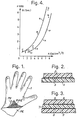
- a sample 34 of a fluid chemical is arranged on top of the membrane 24.
- a current of helium gas is directed against the lower side of the membrane 24, from where the gas (together with any chemical which has permeated the membrane) is discharged through the capillary tube 32 for analysis in a mass spectrometer.
- the breakthrough time of DGEBA in a series of low energy polymer materials and some high energy polymer materials and laminates of low energy materials with high energy materials was determined. From these determinations, the diffusion coefficient was determined by the so-called time lag method, the time lag diffusion coefficient D L being expressed as where I is the membrane thickness measured in cm, and ⁇ is the time lag breakthrough time in sec.
- the basis of the time lag method is that the permeation rate of a substance that is brought into contact with a membrane becomes constant with time. This means that the concentration of the substance in question in a closed (detection) chamber on the desorption side, after a certain transition period, will become linearly increasing. Finally, in the case when the air in the chamber is saturated or when all of the material has been absorbed, the concentration will remain constant, cf. the typical time lag curve in Figure 5.
- the "outer" side of the membrane was covered with DGEBA (diglycidyl ether of bisphenol A). It was determined that the membrane was pinhole-free.
- DGEBA diglycidyl ether of bisphenol A
- the permeation of DGEBA was detected by mass spectroscopic analysis with respect to DGEBA vapor on the "instrument side” (desorption side) of the membrane. The permeation was determined on the basis of the intensity of the signal at the mass numbers 77, 91 and 94, the signal/noise ratio being best for these signals.
- test cell was thermostated at 40°C.
- the content of impurities of the DGEBA used was less than 1 % according to liquid chromatography.
- Membranes 1-10 were studied in an introductory series of tests, Nos. 11-15 in a concluding series of tests.
- the results of the measurements are summarized in Table 2 and 2a.
- the time point T s for the first traces of DGEBA in the detection chamber was measured directly.
- the detection limit was 1 picomole/sec.
- the uncertainty of the breakthrough time 8 is ⁇ 15%.
- the membranes studied were placed in the table according to increasing diffusion coefficient.
- PVAE-1/PE was tested for permeability from both sides. After 335 min, the DGEBA had still not penetrated from the PE side. At the measurement after 1217 min, the substance had penetrated.
- the membrane thicknesses are of the same order of magnitude as those which occur in safety gloves.
- the measured breakthrough times 8 and trace times T s therefore by themselves give an impression of the suitability of the material for safety gloves.
- Several membranes are of essentially the same thickness, which enables direct comparison of ⁇ and T s within subgroups of the membrane materials in question. Where there are differences in the membrane thickness, the comparison should be based on the calculated diffusion coefficient.
- the breakthrough time ⁇ varied within the group of all membranes studied between 4.4 min (0.08 mm polyethylene (PE)) and more than 240 min (0.07 mm polyvinyl alcohol (PVA), 0.056 mm PE/PVAE-1/PE and the like).
- Disposable gloves manufactured from PE are, according to experience of the Labor Inspection's Administration of Worker Safety Regulations with Epoxy Products and Use of Them, quite common as a protection against DGEBA and other constituents.
- gloves of polyvinyl chloride (PVC), nitrile rubber, neoprene or natural rubber are used. The results reported above demonstrate the clear superiority of the PVAE materials over these known art materials.
Landscapes
- Health & Medical Sciences (AREA)
- Chemical & Material Sciences (AREA)
- General Health & Medical Sciences (AREA)
- Toxicology (AREA)
- Business, Economics & Management (AREA)
- Emergency Management (AREA)
- Engineering & Computer Science (AREA)
- Materials Engineering (AREA)
- Chemical Kinetics & Catalysis (AREA)
- General Chemical & Material Sciences (AREA)
- Laminated Bodies (AREA)
- Gloves (AREA)
Claims (22)
Priority Applications (1)
| Application Number | Priority Date | Filing Date | Title |
|---|---|---|---|
| AT83900916T ATE23806T1 (de) | 1982-03-12 | 1983-03-14 | Schutzbekleidung. |
Applications Claiming Priority (2)
| Application Number | Priority Date | Filing Date | Title |
|---|---|---|---|
| DK1112/82 | 1982-03-12 | ||
| DK111282 | 1982-03-12 |
Publications (3)
| Publication Number | Publication Date |
|---|---|
| EP0102992A1 EP0102992A1 (de) | 1984-03-21 |
| EP0102992B1 true EP0102992B1 (de) | 1986-11-26 |
| EP0102992B2 EP0102992B2 (de) | 1993-05-05 |
Family
ID=8101141
Family Applications (1)
| Application Number | Title | Priority Date | Filing Date |
|---|---|---|---|
| EP19830900916 Expired - Lifetime EP0102992B2 (de) | 1982-03-12 | 1983-03-14 | Schutzbekleidung |
Country Status (5)
| Country | Link |
|---|---|
| US (1) | US5059477A (de) |
| EP (1) | EP0102992B2 (de) |
| DE (1) | DE3367861D1 (de) |
| FI (1) | FI75739C (de) |
| WO (1) | WO1983003205A1 (de) |
Families Citing this family (40)
| Publication number | Priority date | Publication date | Assignee | Title |
|---|---|---|---|---|
| EP0213756A3 (de) * | 1985-08-02 | 1988-02-10 | Drg (Uk) Limited | Aus einem geschweissten mehrlagigen Material hergestellte Schutzbekleidung, die eine Grenzschicht besitzt |
| US4992335A (en) * | 1985-09-12 | 1991-02-12 | Sanders Associates, Inc. | Composite material and method of making same |
| US5019453A (en) * | 1985-09-12 | 1991-05-28 | Guerra Richard J | Composite material and method of making same |
| US4935308A (en) * | 1985-09-12 | 1990-06-19 | Sanders Associates | Composite material and method of making same |
| US4920575A (en) * | 1986-10-20 | 1990-05-01 | Bodigard Technologies, Inc. | Protective garment material and construction |
| US4924525A (en) * | 1986-10-20 | 1990-05-15 | Bodigard Technologies, Inc. | Multilayer film for chemical protective clothing |
| JPH01501160A (ja) * | 1986-10-20 | 1989-04-20 | バータシス ジェイムズ イー | 防護服の材料及びその構造 |
| DE8707585U1 (de) * | 1987-05-29 | 1987-10-08 | P. Brøste A/S, Kopenhagen/Copenhagen | Wegwerfehandschuh |
| DE4123127C2 (de) * | 1991-07-12 | 1996-06-20 | Hoechst Ag | Mehrschichtenverbundfolie mit verbesserter Gasbarrierewirkung |
| GB2264632B (en) * | 1992-03-07 | 1996-10-30 | Smith & Nephew | Protective liners for surgical gloves |
| EP0642418A1 (de) * | 1992-05-29 | 1995-03-15 | E.I. Du Pont De Nemours And Company | Chemikalienbeständiger mehrschichtstoff für schutzbekleidung |
| DE4336788C2 (de) * | 1993-10-25 | 1996-01-25 | Auergesellschaft Gmbh | Gasundurchlässiger chemikalienbeständiger Schutzanzug |
| USD368352S (en) | 1994-04-08 | 1996-04-02 | Torres Kim M | Glove |
| US5869193A (en) * | 1994-11-16 | 1999-02-09 | Kappler Safety Group | Breathable polyvinyl alcohol protection wear |
| US5560044A (en) * | 1995-03-29 | 1996-10-01 | W. L. Gore & Associates, Inc. | Hand covering |
| US6044493A (en) * | 1997-08-27 | 2000-04-04 | Rubotech, Inc. | Stretchable protective garments and method for making same |
| US20090000007A1 (en) * | 1998-12-07 | 2009-01-01 | Meridian Research And Development, Inc. | Nonwoven radiopaque material for medical garments and method for making same |
| ITPS20010029A1 (it) * | 2001-11-15 | 2003-05-15 | Cl Com Advanced Tecnology Srl | Indumento di protezione contro gli agenti biologici |
| US20030150041A1 (en) * | 2002-02-14 | 2003-08-14 | Hasmukh Patel | Chemical-resistant, user-wearable protective article including a ceramic-based barrier layer |
| US20040006815A1 (en) * | 2002-05-10 | 2004-01-15 | Kappler Safety Group | Contamination avoidance garment |
| DE10250275B4 (de) * | 2002-10-28 | 2014-08-21 | Paul Hartmann Ag | Wegwerfbares Bekleidungsstück |
| ITPS20020023A1 (it) * | 2002-11-14 | 2004-05-15 | Cl Com Srl Advanced Technology | Indumenti di protezione parziale del corpo contro gli agenti biologici. |
| RU2005118088A (ru) * | 2002-11-14 | 2006-01-20 | Кл. Ком С.Р.Л. (It) | Спецодежда для частичной защиты тела от биологических агентов |
| US6854135B2 (en) * | 2002-12-06 | 2005-02-15 | Microtek Medical Holdings, Inc. | Reusable, launderable water-soluble coveralls |
| US7196023B2 (en) * | 2003-04-10 | 2007-03-27 | Kappler, Inc. | Chemically resistant radiation attenuation barrier |
| US20050015848A1 (en) * | 2003-06-23 | 2005-01-27 | Hao Junjie | Disposable gloves |
| US7328463B2 (en) * | 2003-09-08 | 2008-02-12 | Microtek Medical Holdings, Inc. | Water-soluble articles and methods of making and using the same |
| WO2007033180A1 (en) * | 2005-09-12 | 2007-03-22 | Abela Pharmaceuticals, Inc. | Materials for facilitating administration of dimethyl sulfoxide (dmso) and related compounds |
| EP1937286B1 (de) | 2005-09-12 | 2016-03-09 | Abela Pharmaceuticals, Inc. | Zusammensetzungen aus dimethylsulfoxid (dmso) |
| EP1966229B1 (de) | 2005-09-12 | 2015-10-21 | Abela Pharmaceuticals, Inc. | Systeme zur entfernung von dimethylsulfoxid (dmso) oder verwandten verbindungen, oder damit assoziierten gerüchen |
| US8480797B2 (en) | 2005-09-12 | 2013-07-09 | Abela Pharmaceuticals, Inc. | Activated carbon systems for facilitating use of dimethyl sulfoxide (DMSO) by removal of same, related compounds, or associated odors |
| US20080016601A1 (en) * | 2006-07-24 | 2008-01-24 | Mccrorey Anthony | Protective disposable hand covering |
| BRPI0921494A2 (pt) | 2008-11-03 | 2018-10-30 | Prad Reasearch And Development Ltd | método de planejamento de uma operação de amostragem para uma formação subterrãnea, método de contolar uma operação de amostragem de formação subterrânea, método de controlar uma operação de perfuração para uma formação subterrãnea, e método de realizar uma amostragem durante a operação de perfuração. |
| JP5947721B2 (ja) | 2009-10-30 | 2016-07-06 | アベラ ファーマスーティカルズ インコーポレイテッド | 変形性関節症を治療するためのジメチルスルホキシド(dmso)およびメチルスルホニルメタン(msm)製剤 |
| US20120011636A1 (en) * | 2010-07-13 | 2012-01-19 | Honeywell International Inc. | Water resistant and chemical resistant glove |
| US20120090075A1 (en) * | 2010-10-15 | 2012-04-19 | Andrea Barbara Piesker | Chemical resistant, mechanical resistant, anti-static glove |
| US9538952B2 (en) | 2012-10-30 | 2017-01-10 | Medicametrix, Inc. | Controller for measuring prostate volume |
| US9402547B2 (en) | 2012-10-30 | 2016-08-02 | Medicametrix, Inc. | Prostate glove with receiver fibers |
| US9402564B2 (en) * | 2012-10-30 | 2016-08-02 | Medicametrix, Inc. | Prostate glove with measurement grid |
| US11638552B2 (en) | 2015-12-22 | 2023-05-02 | Medicametrix, Inc. | Prostate glove, fingertip optical encoder, connector system, and related methods |
Family Cites Families (23)
| Publication number | Priority date | Publication date | Assignee | Title |
|---|---|---|---|---|
| GB577866A (en) * | 1943-01-25 | 1946-06-04 | James Henry Rooney | Improvements relating to film-forming materials and products formed therefrom |
| US3043717A (en) * | 1958-11-17 | 1962-07-10 | Archer Daniels Midland Co | Hydrophobic sheet material and method of making the same |
| US3547765A (en) * | 1966-08-10 | 1970-12-15 | Harold I Snyder | Multiple-layer fabric for protective garments and the like |
| GB1212569A (en) * | 1967-06-17 | 1970-11-18 | Kurashiki Rayon Kk | Packaging laminate film comprising polyethylene and ethylene/vinyl alcohol copolymer |
| US3620435A (en) * | 1968-12-24 | 1971-11-16 | Kuraray Co | Food packaging container comprising molded laminated polyethylene and ethylene-vinylalcohol |
| AT341972B (de) * | 1972-06-29 | 1978-03-10 | Lamprecht A G & Co Gummiwarenf | Schutzbekleidung, insbesondere schutzhandschuh |
| JPS5141157B2 (de) * | 1972-08-08 | 1976-11-08 | ||
| GB1489635A (en) * | 1975-03-03 | 1977-10-26 | Toyo Seikan Kaisha Ltd | Packaging materials |
| US4064296A (en) * | 1975-10-02 | 1977-12-20 | W. R. Grace & Co. | Heat shrinkable multi-layer film of hydrolyzed ethylene vinyl acetate and a cross-linked olefin polymer |
| US4036233A (en) * | 1976-07-02 | 1977-07-19 | Union Carbide Corporation | Flexible waist diaper |
| FR2375839B1 (fr) * | 1977-01-04 | 1980-07-11 | Sofiman Sa | Procede de fabrication d'un article d'habillement et machine pour la mise en oeuvre du procede |
| US4156753A (en) * | 1978-06-21 | 1979-05-29 | Akio Tanaka | Flexible coating formed on fabric pretreated with a repelling layer |
| FR2441641A2 (fr) * | 1978-11-15 | 1980-06-13 | Kuraray Co | Membranes en copolymere d'ethylene et d'alcool vinylique ayant des proprietes ameliorees et procede pour les preparer |
| US4214321A (en) * | 1978-12-21 | 1980-07-29 | Abcor, Inc. | Glove for use with organic solvents |
| US4254169A (en) * | 1978-12-28 | 1981-03-03 | American Can Company | Multi-layer barrier film |
| US4239826A (en) * | 1978-12-28 | 1980-12-16 | American Can Company | Multi-layer barrier film |
| US4407897A (en) * | 1979-12-10 | 1983-10-04 | American Can Company | Drying agent in multi-layer polymeric structure |
| CA1172920A (en) * | 1980-04-09 | 1984-08-21 | Walther G. Grot | Protective clothing of fabric containing a layer of highly fluorinated ion exchange polymer |
| CA1172919A (en) * | 1980-04-09 | 1984-08-21 | Walther G. Grot | Protective clothing of fabric containing a layer of highly fluorinated ion exchange polymer |
| DE3035476A1 (de) * | 1980-09-19 | 1982-04-08 | American Can Co., 06830 Greenwich, Conn. | Delaminierungsbestaendiges, mehrschichtiges gebilde sowie seine verwendung zur herstellung von behaeltern |
| DE3035474C2 (de) * | 1980-09-19 | 1984-07-05 | American Can Co., 06830 Greenwich, Conn. | Delaminierungsbeständiges, mehrschichtiges Gebilde sowie seine Verwendung zur Herstellung von Behältern |
| US4405325A (en) * | 1981-08-03 | 1983-09-20 | The B. F. Goodrich Company | Hydrophobic nonwoven fabric bonded by a copolymer formed from a diene |
| US4569707A (en) * | 1982-10-25 | 1986-02-11 | Becton, Dickinson And Company | Method of making foamed slip resistant surfaces |
-
1983
- 1983-03-14 EP EP19830900916 patent/EP0102992B2/de not_active Expired - Lifetime
- 1983-03-14 US US06/785,094 patent/US5059477A/en not_active Expired - Lifetime
- 1983-03-14 WO PCT/DK1983/000034 patent/WO1983003205A1/en not_active Ceased
- 1983-03-14 DE DE8383900916T patent/DE3367861D1/de not_active Expired
- 1983-11-11 FI FI834151A patent/FI75739C/fi not_active IP Right Cessation
Also Published As
| Publication number | Publication date |
|---|---|
| WO1983003205A1 (en) | 1983-09-29 |
| EP0102992A1 (de) | 1984-03-21 |
| FI834151A0 (fi) | 1983-11-11 |
| FI75739B (fi) | 1988-04-29 |
| US5059477A (en) | 1991-10-22 |
| EP0102992B2 (de) | 1993-05-05 |
| FI75739C (fi) | 1992-10-26 |
| DE3367861D1 (en) | 1987-01-15 |
| FI834151L (fi) | 1983-11-11 |
Similar Documents
| Publication | Publication Date | Title |
|---|---|---|
| EP0102992B1 (de) | Schutzbekleidung | |
| US4902558A (en) | Method for protecting skin from hazardous chemicals | |
| EP0311316B1 (de) | Gewebe für Schutzkleidung | |
| US5626947A (en) | Composite chemical barrier fabric for protective garments | |
| US6370694B1 (en) | Surgical glove | |
| US5190806A (en) | Liquid-penetration-resistant sorbent laminate | |
| AU766933B2 (en) | Chemical protective covering | |
| CA2594545C (en) | Slip resistant multi-layered articles | |
| US20090300833A1 (en) | Flame resistant, selectively permeable laminates | |
| FI87621B (fi) | Tyg foer skyddsdraekter | |
| CA2039180A1 (en) | Laminate and protective clothing fabricated therefrom | |
| CN1578689A (zh) | 防护装备 | |
| CA1157758A (en) | Chemically resistant coated fabric | |
| Vahdat | Permeation of polymeric materials by toluene | |
| NZ534161A (en) | Use of polymers in fabrics and clothing used for protection against harmful chemical or biochemical agents | |
| Berardinelli et al. | Site-specific whole glove chemical permeation | |
| NO165055B (no) | Beskyttelsesplagg. | |
| US4826730A (en) | Composite film for protective garments | |
| US4897296A (en) | Fabric for protective garments | |
| CA2446401A1 (en) | Medical laminate with viral barrier | |
| CN121518047A (zh) | 耐化学溶剂的化学防护服用热封胶带及其制备方法 | |
| HK1105802B (en) | Slip resistant multi-layered articles | |
| TH17688B (th) | ฟิล์มหายใจได้ที่ทำให้บางด้วยการยึดที่ต้านทานต่อการแทรกผ่านของเลือดและไวรัส | |
| TH30490A (th) | ฟิล์มหายใจได้ที่ทำให้บางด้วยการยึดที่ต้านทานต่อการแทรกผ่านของเลือดและไวรัส | |
| WO2010011216A1 (en) | N-alkylchitosan films and laminates made therefrom |
Legal Events
| Date | Code | Title | Description |
|---|---|---|---|
| PUAI | Public reference made under article 153(3) epc to a published international application that has entered the european phase |
Free format text: ORIGINAL CODE: 0009012 |
|
| 17P | Request for examination filed |
Effective date: 19831114 |
|
| AK | Designated contracting states |
Designated state(s): AT BE CH DE FR GB LI LU NL SE |
|
| EL | Fr: translation of claims filed | ||
| TCAT | At: translation of patent claims filed | ||
| TCNL | Nl: translation of patent claims filed | ||
| DET | De: translation of patent claims | ||
| GRAA | (expected) grant |
Free format text: ORIGINAL CODE: 0009210 |
|
| AK | Designated contracting states |
Kind code of ref document: B1 Designated state(s): AT BE CH DE FR GB LI LU NL SE |
|
| REF | Corresponds to: |
Ref document number: 23806 Country of ref document: AT Date of ref document: 19861215 Kind code of ref document: T |
|
| REF | Corresponds to: |
Ref document number: 3367861 Country of ref document: DE Date of ref document: 19870115 |
|
| ET | Fr: translation filed | ||
| PLBI | Opposition filed |
Free format text: ORIGINAL CODE: 0009260 |
|
| PLBI | Opposition filed |
Free format text: ORIGINAL CODE: 0009260 |
|
| 26 | Opposition filed |
Opponent name: TRELLEBORG AB Effective date: 19870819 |
|
| 26 | Opposition filed |
Opponent name: BODIGARD TECHNOLOGIES, INC. Effective date: 19870826 Opponent name: SIEBE NORTH, INC. Effective date: 19870825 Opponent name: HENRIKSEN, HENNING RISVIG Effective date: 19870824 |
|
| NLR1 | Nl: opposition has been filed with the epo |
Opponent name: BODIGARD TECHNOLOGIES, INC. Opponent name: SIEBE NORTH, INC. Opponent name: HENRIKSEN, HENNING RISVIG Opponent name: TRELLEBORG AB |
|
| PUAH | Patent maintained in amended form |
Free format text: ORIGINAL CODE: 0009272 |
|
| STAA | Information on the status of an ep patent application or granted ep patent |
Free format text: STATUS: PATENT MAINTAINED AS AMENDED |
|
| 27A | Patent maintained in amended form |
Effective date: 19930505 |
|
| AK | Designated contracting states |
Kind code of ref document: B2 Designated state(s): AT BE CH DE FR GB LI LU NL SE |
|
| REG | Reference to a national code |
Ref country code: CH Ref legal event code: AEN |
|
| ET3 | Fr: translation filed ** decision concerning opposition | ||
| NLR2 | Nl: decision of opposition | ||
| NLR3 | Nl: receipt of modified translations in the netherlands language after an opposition procedure | ||
| EPTA | Lu: last paid annual fee | ||
| EAL | Se: european patent in force in sweden |
Ref document number: 83900916.4 |
|
| APAC | Appeal dossier modified |
Free format text: ORIGINAL CODE: EPIDOS NOAPO |
|
| APAC | Appeal dossier modified |
Free format text: ORIGINAL CODE: EPIDOS NOAPO |
|
| REG | Reference to a national code |
Ref country code: GB Ref legal event code: IF02 |
|
| PGFP | Annual fee paid to national office [announced via postgrant information from national office to epo] |
Ref country code: LU Payment date: 20020320 Year of fee payment: 20 |
|
| PGFP | Annual fee paid to national office [announced via postgrant information from national office to epo] |
Ref country code: SE Payment date: 20020321 Year of fee payment: 20 |
|
| PGFP | Annual fee paid to national office [announced via postgrant information from national office to epo] |
Ref country code: AT Payment date: 20020322 Year of fee payment: 20 |
|
| PGFP | Annual fee paid to national office [announced via postgrant information from national office to epo] |
Ref country code: CH Payment date: 20020326 Year of fee payment: 20 |
|
| PGFP | Annual fee paid to national office [announced via postgrant information from national office to epo] |
Ref country code: GB Payment date: 20020327 Year of fee payment: 20 |
|
| PGFP | Annual fee paid to national office [announced via postgrant information from national office to epo] |
Ref country code: FR Payment date: 20020329 Year of fee payment: 20 |
|
| PGFP | Annual fee paid to national office [announced via postgrant information from national office to epo] |
Ref country code: NL Payment date: 20020331 Year of fee payment: 20 |
|
| PGFP | Annual fee paid to national office [announced via postgrant information from national office to epo] |
Ref country code: BE Payment date: 20020416 Year of fee payment: 20 |
|
| PGFP | Annual fee paid to national office [announced via postgrant information from national office to epo] |
Ref country code: DE Payment date: 20020429 Year of fee payment: 20 |
|
| PG25 | Lapsed in a contracting state [announced via postgrant information from national office to epo] |
Ref country code: LI Free format text: LAPSE BECAUSE OF EXPIRATION OF PROTECTION Effective date: 20030313 Ref country code: GB Free format text: LAPSE BECAUSE OF EXPIRATION OF PROTECTION Effective date: 20030313 Ref country code: CH Free format text: LAPSE BECAUSE OF EXPIRATION OF PROTECTION Effective date: 20030313 |
|
| PG25 | Lapsed in a contracting state [announced via postgrant information from national office to epo] |
Ref country code: NL Free format text: LAPSE BECAUSE OF EXPIRATION OF PROTECTION Effective date: 20030314 Ref country code: LU Free format text: LAPSE BECAUSE OF EXPIRATION OF PROTECTION Effective date: 20030314 Ref country code: AT Free format text: LAPSE BECAUSE OF EXPIRATION OF PROTECTION Effective date: 20030314 |
|
| BE20 | Be: patent expired |
Owner name: *HENRIKSEN HENNING RISVIG Effective date: 20030314 |
|
| REG | Reference to a national code |
Ref country code: GB Ref legal event code: PE20 |
|
| REG | Reference to a national code |
Ref country code: CH Ref legal event code: PL |
|
| NLV7 | Nl: ceased due to reaching the maximum lifetime of a patent |
Effective date: 20030314 |
|
| EUG | Se: european patent has lapsed | ||
| APAH | Appeal reference modified |
Free format text: ORIGINAL CODE: EPIDOSCREFNO |
|
| PLAB | Opposition data, opponent's data or that of the opponent's representative modified |
Free format text: ORIGINAL CODE: 0009299OPPO |