EP0102735B1 - Electrode for an electrostatic charge injectiondevice - Google Patents
Electrode for an electrostatic charge injectiondevice Download PDFInfo
- Publication number
- EP0102735B1 EP0102735B1 EP83304318A EP83304318A EP0102735B1 EP 0102735 B1 EP0102735 B1 EP 0102735B1 EP 83304318 A EP83304318 A EP 83304318A EP 83304318 A EP83304318 A EP 83304318A EP 0102735 B1 EP0102735 B1 EP 0102735B1
- Authority
- EP
- European Patent Office
- Prior art keywords
- metal
- electrode
- composite
- metal oxide
- process according
- Prior art date
- Legal status (The legal status is an assumption and is not a legal conclusion. Google has not performed a legal analysis and makes no representation as to the accuracy of the status listed.)
- Expired
Links
Images
Classifications
-
- B—PERFORMING OPERATIONS; TRANSPORTING
- B05—SPRAYING OR ATOMISING IN GENERAL; APPLYING FLUENT MATERIALS TO SURFACES, IN GENERAL
- B05B—SPRAYING APPARATUS; ATOMISING APPARATUS; NOZZLES
- B05B5/00—Electrostatic spraying apparatus; Spraying apparatus with means for charging the spray electrically; Apparatus for spraying liquids or other fluent materials by other electric means
- B05B5/025—Discharge apparatus, e.g. electrostatic spray guns
- B05B5/053—Arrangements for supplying power, e.g. charging power
- B05B5/0533—Electrodes specially adapted therefor; Arrangements of electrodes
Definitions
- This invention relates to a composite electrode for an electrostatic charge injection device.
- Nickel-alumina cermets were fabricated by P. D. Djali and K. R. Linger (Proc. British Ceram. Soc., 26, July 1978, pp. 113-127) by hot-pressing alumina power precoated with nickel to promote bonding between the particles. Near theoretical dense compacts were obtained with average mechanical properties.
- C. S. Morgan used in situ deposition of metal coatings (Thin Solid Films, 39, December 1976, pp. 305-311) to coat ceramic powders and promote the wetting of the ceramic component. Using this approach, and Eu 2 0 3 powder was coated with W and hot-pressed to form a composite with improved thermal conductivity and improved thermal shock resistance for possible neutron absorbers for reactor use.
- A. C. D. Chaklader and M. N. Shetty formed ceramic-metal composites by reactive hot pressing (Trans. Metal. Soc. of AIME, 33, July 1965, pp. 1440-42).
- a monohydrate of AI 2 0 3 (Boehmite) was mixed with several metal powders 3 and the "enhanced" reactivity of the AI 2 0 3 during decomposition used to promote interparticle bonding.
- A. V. Virkau and D. L. Johnson studied the fracture behavior of Zr0 2 -Zr composites (J. Am. Cer. Soc., 60, Jan-Feb 1977, pp.
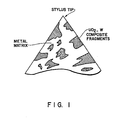
- an electrode for an electrostatic charge injection device which electrode comprises a metal oxide-metal composite and is characterised in that the metal oxide-metal composite is in a fragmented or particulate form substantially uniformly dispersed within and bonded by a metal matrix.
- an electrode for an electrostatic charge injection device which electrode comprises a metal oxide-metal composite; characterised by the steps of:
- At least some embodiments of the invention exhibit the properties of a composite metal, metal-oxide eutectic emitter and the mechanical properties of a metal.
- Inexpensive emitters can be formed by powder metallurgical techniques. This has the subsidiary advantage of high utilisation of the composite metal, metal-oxide ingot.
- An electrostatic charge injection device includes a cell having a chamber disposed therein, a discharge spray means in communication with the cell, at least two electrodes disposed in the chamber and being in liquid contact with the liquid in the chamber, the liquid in the chamber being transported to the discharge spray means and atomised into droplets, and a mechanism for generating, by means of the electrodes, a charge through the liquid within the chamber, wherein the charge is sufficient to generate free excess charge in the liquid within the chamber.
- An example of a charge injection device of this kind is disclosed in our U.S. Patent 4,255,777.
- the electrodes of the invention are formed from a blend mixture of two components, metal oxide-metal composite particles and metal powders.
- the composite particles typically contain between 10 6 and 5x10 7 aligned, submicron diameter, metallic fibers per cm 2 uniformly embedded in an electrically insulating (oxide) matrix.
- the composite can be fabricated by well-known prior art techniques. One fabrication approach which can be utilized is described in detail in the publication "Report No. 6: Melt Grown Oxide-Metal Composites” from the School of Ceramic Engineering, Georgia Institute of Technology, A. T. Chapman, Project Director (December 1973) detailing fabrication of a melt grown metal oxide-metal composite. It is well-known that electron field emission can be stimulated from a single tip or plurality of small metallic points either flush with an insulating matrix or disposed above the matrix, and the metal oxide-metal composite particles provide this spatial geometry.
- the composite structures have been used to obtain electron field emission under high vacuum conditions as described, for example, by Feeney, et al., in Journal of Applied Physics, Vol. 46, No. 4, April 1975, pp. 1841-43, entitled "High-Field Electron Emission from Oxide-Metal Composite Materials".
- the composite particles may be selected but not limited to systems such as
- the electrically conducting and connecting metal matrix may be composed but not limited to Cu, Co, or Ni, or combinations of these metals.
- the reconstructed metal oxide-metal cermet is designated ROMC in the following description.
- the crushed and sized metal oxide-metal fragments are simply blended with desired amounts of metallic powder(s).
- the volume fraction of the composite particles may be between 10 and 80 percent, more preferably between 15 and 75 percent, and most preferably between 25 and 60 percent.
- the composite metal powder mixture is compacted to consolidate the blend using pressure and/or temperature to form disc shaped material.
- the disc of the blend mixture is cut into square shaped bars which are subsequently machined into the desired cylindrical shaped electrodes.
- the composite blend mixture permits machining of the electrode into any desired shape by conventional machinery methods whereas conventional electrodes are formed by a more costly and complicated process.
- Example I describes the use of direct induction heating to form the cermet-type electrode
- Example II describes the hot-pressing of the composite-metal ROMC material in graphite dies
- Example III describes the direct bonding of the ROMC material on a metal pin during hot pressing.
- Step 1 A previously grown 3.1 cm diameter UO Z W ingot was sliced transversely to yield wafers 2 mm thick. The unmelted skin was removed from these wafers using a diamond saw.
- Step 2 The core region of the U0 2- W wafers was hand-crushed in porcelain mortar and pestle and screened until about three grams of composite fragments passed through a 325 mesh screen (yielding composite powder less than 44 pm in diameter).
- Step 3 The composite fragments and copper powder (-325 mesh) were weighed separately to provide three grams of each material and hand- mixed in a mortar and pestle. From the resultant ROMC mixture, two grams were loaded into a 3/8" diameter steel punch and die set and compacted at 2000 psi.
- Step 4 The pressed ROMC disc was placed on a ceramic support (foamed, fused silica) and loaded into a glass tube for the direct induction heating of the sample.
- the glass tube was evacuated and filled with an N 2 /H 2 atmosphere (10/1 molecular ratio).
- the wafer was heated by a 10 kW rf generator operating at 4 mHz by increasing the power until the temperature of the surface of the ROMC disc reached 900°C, as measured by an optical pyrometer. The initial heating required 30 minutes.
- the ROMC disc was held at 900°C for 150 minutes and then cooled to room temperature for an additional 30 minutes.
- Step 5 The consolidated ROMC disc was cut into square shaped bars using a silicon carbide saw.
- the ROMC bars were mounted in a 4 jaw chuck of a lathe and ground to a stylus shaped geometry using a rotating SiC grinding wheel.
- Step 1 A previously grown 3.1 cm diameter U02-W ingot was sliced transversely to yield wafers 2 mm thick. The unmelted skin was removed from these wafers using a diamond saw.
- Step 2 The core region of the U0 2 -W wafers was hand-crushed in a porcelain mortar and pestle and screened until 15 grams of the composite fragments passed thorugh a 200 mesh screen (yielding composite powder less than 75 11m in diameter).
- Step 3 Fifteen grams of a metal mixture consisting of five grams each of -325 mesh copper, nickel and cobalt powders were blended and mixed by hand in a mortar and pestle.
- Step 4 The U02-W composite fragments and metal mixture (15 grams of each) was hand- mixed in a mortar and pestle and loaded into a 1/ 2" diameter steel punch and die set and compacted at 2000 psi.
- Step 5 The pressed ROMC disc was placed into a graphite die 1/2" inside diameter and placed inside a silica tube for hot pressing. The sample was heated to approximately 1000°C in 15 minutes and held at 2000 psi at this temperature for 60 minutes. After 75 minutes, the rf generator was turned off and the sample cooled to room temperature.
- Step 6 The compacted and densified ROMC disc was cut into wafers 3 mm thick. Density measurements indicated the material was approximately 9.0 grams per cc, a value close to 90% of theoretical density. The 3 mm thick wafers were mounted on glass slides and core drilled with a diamond tool to yield cylindrically shaped specimens.
- Step 1 A previously grown 3.1 cm diameter Y 2 0 3 stabilized Zr0 2 -W (ZYW) ingot was sliced transversely to yield wafers 2 mm thick. The unmelted skin was removed from these wafers using a diamond saw.
- Step 2 The core region of the ZYW wafers was hand-crushed in a porcelain mortar and pestle and screened until 15 grams of the composite fragments passed through a 200 mesh screen (yielding composite powder less than 75 ⁇ m in diameter).
- Step 3 Fifteen grams of a metal mixture consisting of five grams each of -325 mesh copper, nickel, and cobalt powders were blended and mixed by hand in a mortar and pestle.
- Step 4 The ZYW composite fragments and metal mixture (15 grams of each) was hand- mixed in a mortar and pestle and between 100 and 200 milligrams of the blend loaded into a graphite die containing a 1/8" diameter stainless steel pin.
- Step 5 The graphite die assembly was placed inside the silica tube, and heated to about 1000°C in 15 minutes. During heating, the pressure was incrementally increased to pressures up to 20,000 psi. The high pressure was maintained for 60 minutes at 1000°C. After 75 minutes, the rf generator was turned off and the sample cooled to room temperature and the pressure reduced incrementally.
- Step 6 The consolidated ROMC material was bonded to the steel pin and cylindrical in shape.
- the pin with the ROMC end was mounted in a lathe and the stylus shaped electrode Figure 1 was ground with a rotating SiC grinding wheel.
Landscapes
- Powder Metallurgy (AREA)
- Electrostatic Spraying Apparatus (AREA)
- Physical Or Chemical Processes And Apparatus (AREA)
- Manufacture Of Alloys Or Alloy Compounds (AREA)
Applications Claiming Priority (2)
| Application Number | Priority Date | Filing Date | Title |
|---|---|---|---|
| US401833 | 1982-07-26 | ||
| US06/401,833 US4627903A (en) | 1982-07-26 | 1982-07-26 | Electrode for an electrostatic atomizing device |
Publications (3)
| Publication Number | Publication Date |
|---|---|
| EP0102735A2 EP0102735A2 (en) | 1984-03-14 |
| EP0102735A3 EP0102735A3 (en) | 1985-06-12 |
| EP0102735B1 true EP0102735B1 (en) | 1988-12-14 |
Family
ID=23589409
Family Applications (1)
| Application Number | Title | Priority Date | Filing Date |
|---|---|---|---|
| EP83304318A Expired EP0102735B1 (en) | 1982-07-26 | 1983-07-26 | Electrode for an electrostatic charge injectiondevice |
Country Status (5)
| Country | Link |
|---|---|
| US (1) | US4627903A (enExample) |
| EP (1) | EP0102735B1 (enExample) |
| JP (1) | JPS5941435A (enExample) |
| CA (1) | CA1223551A (enExample) |
| DE (1) | DE3378679D1 (enExample) |
Families Citing this family (33)
| Publication number | Priority date | Publication date | Assignee | Title |
|---|---|---|---|---|
| AU580147B2 (en) * | 1985-04-18 | 1989-01-05 | Nordson Corporation | Particle spray gun |
| US4819879A (en) * | 1985-10-25 | 1989-04-11 | Nordson Corporation | Particle spray gun |
| US4834939A (en) * | 1988-05-02 | 1989-05-30 | Hamilton Standard Controls, Inc. | Composite silver base electrical contact material |
| US5515681A (en) * | 1993-05-26 | 1996-05-14 | Simmonds Precision Engine Systems | Commonly housed electrostatic fuel atomizer and igniter apparatus for combustors |
| US5367869A (en) * | 1993-06-23 | 1994-11-29 | Simmonds Precision Engine Systems | Laser ignition methods and apparatus for combustors |
| DE19536604A1 (de) * | 1994-10-04 | 1996-04-11 | Simmonds Precision Engine Syst | Zündvorrichtung und Zündverfahren unter Verwendung elektrostatischer Düse und katalytischen Zünders |
| US20020031998A1 (en) * | 2000-08-23 | 2002-03-14 | Holland United Food Processing Equipment B.V. | Method of and device for processing poultry to be slaughtered |
| US8302887B2 (en) | 2005-03-31 | 2012-11-06 | Rain Bird Corporation | Drip emitter |
| US7648085B2 (en) * | 2006-02-22 | 2010-01-19 | Rain Bird Corporation | Drip emitter |
| JP4997800B2 (ja) * | 2006-03-16 | 2012-08-08 | 大日本印刷株式会社 | 金属酸化物膜の製造方法 |
| PL2131928T3 (pl) | 2007-03-23 | 2017-12-29 | 3M Innovative Properties Company | Aparat doprowadzający powietrze do respiratora kapturowego |
| EP3326697A1 (en) | 2007-03-23 | 2018-05-30 | 3M Innovative Properties Company | Respirator flow control apparatus and method |
| CN101815557B (zh) | 2007-10-05 | 2012-12-19 | 3M创新有限公司 | 呼吸器流量控制设备和方法 |
| AU2008321312B2 (en) | 2007-11-12 | 2012-11-29 | 3M Innovative Properties Company | Respirator assembly with air flow direction control |
| US8628032B2 (en) * | 2008-12-31 | 2014-01-14 | Rain Bird Corporation | Low flow irrigation emitter |
| US10440903B2 (en) | 2012-03-26 | 2019-10-15 | Rain Bird Corporation | Drip line emitter and methods relating to same |
| US9877440B2 (en) | 2012-03-26 | 2018-01-30 | Rain Bird Corporation | Elastomeric emitter and methods relating to same |
| US20130248622A1 (en) | 2012-03-26 | 2013-09-26 | Jae Yung Kim | Drip line and emitter and methods relating to same |
| US9485923B2 (en) | 2012-03-26 | 2016-11-08 | Rain Bird Corporation | Elastomeric emitter and methods relating to same |
| US9872444B2 (en) | 2013-03-15 | 2018-01-23 | Rain Bird Corporation | Drip emitter |
| JP5990118B2 (ja) * | 2013-03-15 | 2016-09-07 | 住友化学株式会社 | 静電噴霧装置、および静電噴霧装置の制御方法 |
| US10285342B2 (en) | 2013-08-12 | 2019-05-14 | Rain Bird Corporation | Elastomeric emitter and methods relating to same |
| US10631473B2 (en) | 2013-08-12 | 2020-04-28 | Rain Bird Corporation | Elastomeric emitter and methods relating to same |
| USD811179S1 (en) | 2013-08-12 | 2018-02-27 | Rain Bird Corporation | Emitter part |
| US9883640B2 (en) | 2013-10-22 | 2018-02-06 | Rain Bird Corporation | Methods and apparatus for transporting elastomeric emitters and/or manufacturing drip lines |
| US10330559B2 (en) | 2014-09-11 | 2019-06-25 | Rain Bird Corporation | Methods and apparatus for checking emitter bonds in an irrigation drip line |
| US10375904B2 (en) | 2016-07-18 | 2019-08-13 | Rain Bird Corporation | Emitter locating system and related methods |
| US11051466B2 (en) | 2017-01-27 | 2021-07-06 | Rain Bird Corporation | Pressure compensation members, emitters, drip line and methods relating to same |
| US10626998B2 (en) | 2017-05-15 | 2020-04-21 | Rain Bird Corporation | Drip emitter with check valve |
| USD883048S1 (en) | 2017-12-12 | 2020-05-05 | Rain Bird Corporation | Emitter part |
| US11985924B2 (en) | 2018-06-11 | 2024-05-21 | Rain Bird Corporation | Emitter outlet, emitter, drip line and methods relating to same |
| JP6782871B1 (ja) * | 2019-05-31 | 2020-11-11 | 花王株式会社 | 静電噴出装置 |
| US12207599B2 (en) | 2021-10-12 | 2025-01-28 | Rain Bird Corporation | Emitter coupler and irrigation system |
Family Cites Families (8)
| Publication number | Priority date | Publication date | Assignee | Title |
|---|---|---|---|---|
| US3729971A (en) * | 1971-03-24 | 1973-05-01 | Aluminum Co Of America | Method of hot compacting titanium powder |
| US3796673A (en) * | 1972-06-30 | 1974-03-12 | Atomic Energy Commission | Method of producing multicomponent metal-metal oxide single crystals |
| GB1505874A (en) * | 1975-08-06 | 1978-03-30 | Plessey Co Ltd | Electrically conductive composite materials |
| GB1571084A (en) * | 1975-12-09 | 1980-07-09 | Thorn Electrical Ind Ltd | Electric lamps and components and materials therefor |
| US4103063A (en) * | 1976-03-23 | 1978-07-25 | United Technologies Corporation | Ceramic-metallic eutectic structural material |
| US4255777A (en) * | 1977-11-21 | 1981-03-10 | Exxon Research & Engineering Co. | Electrostatic atomizing device |
| US4231796A (en) * | 1978-11-28 | 1980-11-04 | The United States Of America As Represented By The United States Department Of Energy | Internal zone growth method for producing metal oxide metal eutectic composites |
| US4386960A (en) * | 1980-10-06 | 1983-06-07 | General Electric Company | Electrode material for molten carbonate fuel cells |
-
1982
- 1982-07-26 US US06/401,833 patent/US4627903A/en not_active Expired - Lifetime
-
1983
- 1983-07-05 CA CA000431822A patent/CA1223551A/en not_active Expired
- 1983-07-26 DE DE8383304318T patent/DE3378679D1/de not_active Expired
- 1983-07-26 JP JP58136673A patent/JPS5941435A/ja active Granted
- 1983-07-26 EP EP83304318A patent/EP0102735B1/en not_active Expired
Non-Patent Citations (3)
| Title |
|---|
| McGRAW-HILL ENCYCLOPEDIA OF SCIENCE AND TECHNOLOGY, vol. 10, 1960, McGRAW-HILL, NEW YORK (US), pp. 550-553, "Powder metallurgy" * |
| McGRAW-HILL ENCYCLOPEDIA OF SCIENCE AND TECHNOLOGY, vol. 12, 1960, McGRAW-HILL, NEW YORK (US), pp. 341-342, "Sintering" * |
| McGRAW-HILL ENCYCLOPEDIA OF SCIENCE AND TECHNOLOGY, vol. 2, 1960, McGRAW-HILL, NEW YORK (US), pp. 655-656, "Cermet" * |
Also Published As
| Publication number | Publication date |
|---|---|
| JPS5941435A (ja) | 1984-03-07 |
| JPH0453592B2 (enExample) | 1992-08-27 |
| EP0102735A3 (en) | 1985-06-12 |
| DE3378679D1 (en) | 1989-01-19 |
| EP0102735A2 (en) | 1984-03-14 |
| US4627903A (en) | 1986-12-09 |
| CA1223551A (en) | 1987-06-30 |
Similar Documents
| Publication | Publication Date | Title |
|---|---|---|
| US4627903A (en) | Electrode for an electrostatic atomizing device | |
| US4164680A (en) | Polycrystalline diamond emitter | |
| US4084942A (en) | Ultrasharp diamond edges and points and method of making | |
| US6293986B1 (en) | Hard metal or cermet sintered body and method for the production thereof | |
| US4273561A (en) | Ultrasharp polycrystalline diamond edges, points, and improved diamond composites, and methods of making and irradiating same | |
| EP0336569B1 (en) | Hot isostatic pressing of powders to form high density contacts | |
| US4909841A (en) | Method of making dimensionally reproducible compacts | |
| US5169572A (en) | Densification of powder compacts by fast pulse heating under pressure | |
| KR100260337B1 (ko) | 투명한 도전막을 제조하기 위한 캐소드 스퍼터링용 타겟과 이 타겟의 제조방법 | |
| Snowball et al. | Densification processes in the tungsten carbide-cobalt system | |
| RU2456369C1 (ru) | Способ формирования титан-бор-медных покрытий на медных контактных поверхностях | |
| Senthilnathan et al. | Synthesis of tungsten through spark plasma and conventional sintering processes | |
| Akaishi et al. | Synthesis of sintered diamond with high electrical resistivity and hardness | |
| EP0219319B1 (en) | Method of producing ceramic articles | |
| US4839315A (en) | Process for the production of ceramic materials having heat and wear resistance | |
| Ervin et al. | Structure and properties of high energy, high rate consolidated molybdenum alloy TZM | |
| US3352951A (en) | Method for induction sintering refractory carbide articles | |
| US3449120A (en) | Method of producing tungsten powder bodies infiltrated with zirconium | |
| US3785093A (en) | Method of bonding diamond with refractory cermet material | |
| US5061661A (en) | Method for producing tungsten carbide and cemented tungsten carbide article therefrom having a uniform microstructure | |
| US5007874A (en) | Method of making a cathode from tungsten and iridium powders using a reaction product from reacting a group III A metal with barium peroxide as an impregnant | |
| GB2040908A (en) | Internal zone growth method for producing metal oxide-metal eutectic composites | |
| US3413435A (en) | Electrical discharge machine electrodes impregnated with inorganic compounds | |
| US3423203A (en) | Tungsten-indium powder bodies infiltrated with copper | |
| JP3342882B2 (ja) | 予備成形された加工片の圧密方法 |
Legal Events
| Date | Code | Title | Description |
|---|---|---|---|
| PUAI | Public reference made under article 153(3) epc to a published international application that has entered the european phase |
Free format text: ORIGINAL CODE: 0009012 |
|
| AK | Designated contracting states |
Designated state(s): BE DE FR GB IT NL |
|
| PUAL | Search report despatched |
Free format text: ORIGINAL CODE: 0009013 |
|
| AK | Designated contracting states |
Designated state(s): BE DE FR GB IT NL |
|
| 17P | Request for examination filed |
Effective date: 19851113 |
|
| 17Q | First examination report despatched |
Effective date: 19861126 |
|
| R17C | First examination report despatched (corrected) |
Effective date: 19870626 |
|
| GRAA | (expected) grant |
Free format text: ORIGINAL CODE: 0009210 |
|
| AK | Designated contracting states |
Kind code of ref document: B1 Designated state(s): BE DE FR GB IT NL |
|
| ITF | It: translation for a ep patent filed | ||
| REF | Corresponds to: |
Ref document number: 3378679 Country of ref document: DE Date of ref document: 19890119 |
|
| ET | Fr: translation filed | ||
| PLBE | No opposition filed within time limit |
Free format text: ORIGINAL CODE: 0009261 |
|
| STAA | Information on the status of an ep patent application or granted ep patent |
Free format text: STATUS: NO OPPOSITION FILED WITHIN TIME LIMIT |
|
| 26N | No opposition filed | ||
| ITTA | It: last paid annual fee | ||
| REG | Reference to a national code |
Ref country code: GB Ref legal event code: IF02 |
|
| PGFP | Annual fee paid to national office [announced via postgrant information from national office to epo] |
Ref country code: GB Payment date: 20020613 Year of fee payment: 20 |
|
| PGFP | Annual fee paid to national office [announced via postgrant information from national office to epo] |
Ref country code: NL Payment date: 20020618 Year of fee payment: 20 |
|
| PGFP | Annual fee paid to national office [announced via postgrant information from national office to epo] |
Ref country code: FR Payment date: 20020702 Year of fee payment: 20 |
|
| PGFP | Annual fee paid to national office [announced via postgrant information from national office to epo] |
Ref country code: DE Payment date: 20020731 Year of fee payment: 20 |
|
| PGFP | Annual fee paid to national office [announced via postgrant information from national office to epo] |
Ref country code: BE Payment date: 20020910 Year of fee payment: 20 |
|
| PG25 | Lapsed in a contracting state [announced via postgrant information from national office to epo] |
Ref country code: GB Free format text: LAPSE BECAUSE OF EXPIRATION OF PROTECTION Effective date: 20030725 |
|
| PG25 | Lapsed in a contracting state [announced via postgrant information from national office to epo] |
Ref country code: NL Free format text: LAPSE BECAUSE OF EXPIRATION OF PROTECTION Effective date: 20030726 |
|
| REG | Reference to a national code |
Ref country code: GB Ref legal event code: PE20 |
|
| NLV7 | Nl: ceased due to reaching the maximum lifetime of a patent |
Effective date: 20030726 |